Museum of the Roman Republic and Garibaldian Memory
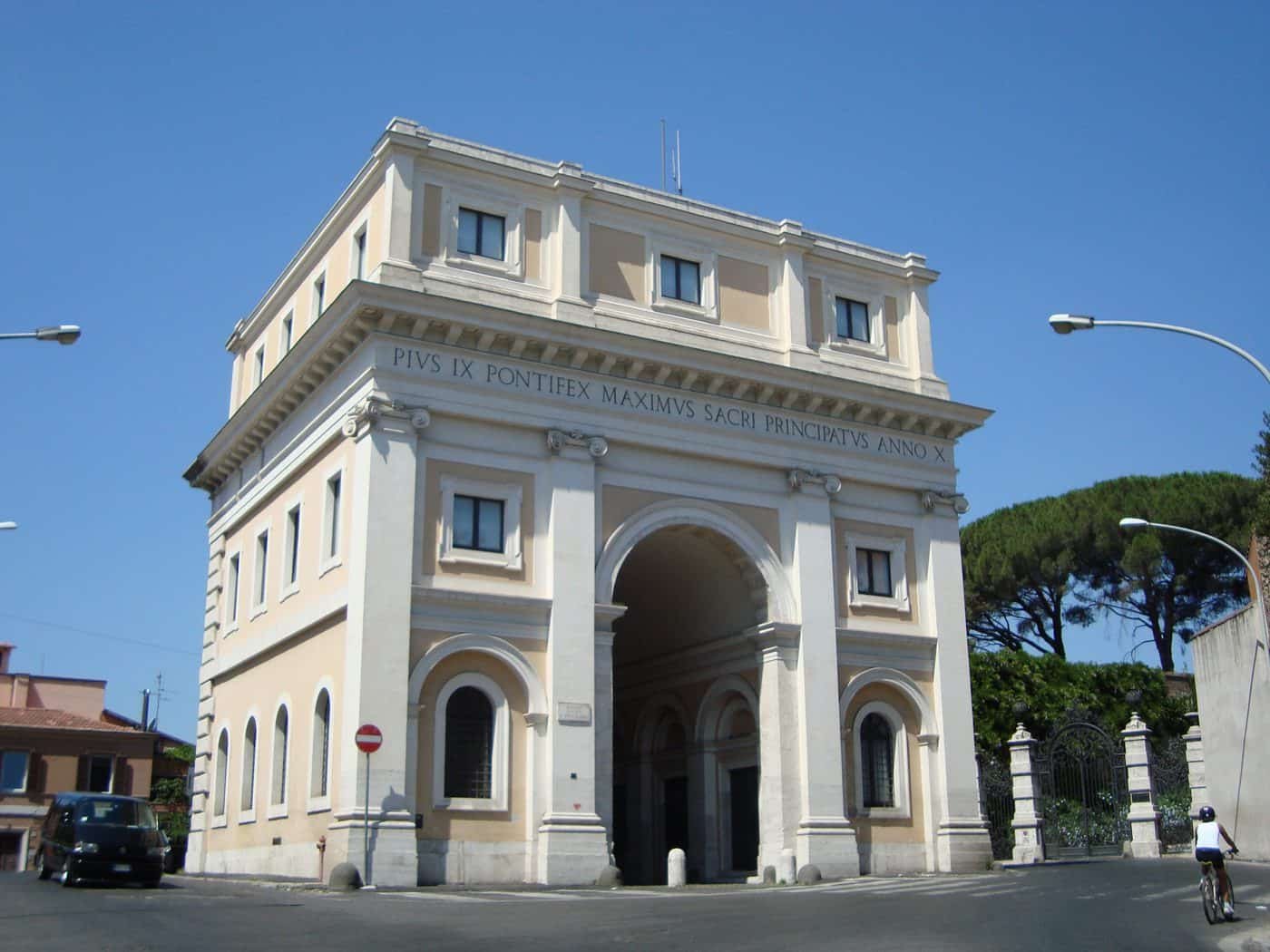
In short. The Museum of the Roman Republic and Garibaldian Memory occupies Porta San Pancrazio, at Largo di Porta San Pancrazio, 00153 Rome, on the top of the Janiculum Hill, at the point where Via Garibaldi ends and Via di San Pancrazio begins.
The Museum of the Roman Republic and Garibaldian Memory occupies Porta San Pancrazio, at Largo di Porta San Pancrazio, 00153 Rome, on the top of the Janiculum Hill, at the point where Via Garibaldi ends and Via di San Pancrazio begins. Free admission. Hours: Tuesday to Friday 10.00-14.00, Saturday and Sunday 10.00-18.00, closed Monday. On December 24 and 31 the opening is reduced to 10.00-14.00. Annual closing on May 1 and December 25. Last entry is allowed one hour before closing. Information and reservations at the number 060608, every day from 9.00 to 19.00. You get there by bus 115, the Janiculum Hill circular line that stops at Carini/San Pancrazio, or by the 870, which has a stop at Piazza San Pancrazio. From below, tram 8 and the buses of Viale di Trastevere drop you at Piazza Sonnino, and from there you climb on foot up Via Garibaldi in a good quarter of an hour of real uphill. No need to reserve for the individual visit. Groups of between five and 25 people reserve at 060608, and the reservation is free. The complete visit of the four levels takes between 50 minutes and an hour and a half, depending on how many videos you watch in full.
If your plan for the day includes the climb up the hill, it's best to read first the page dedicated to the Janiculum Hill: the museum is the indoor chapter of a walk that outdoors continues for two kilometers of busts, terraces and monuments. There's no ticket, almost never a line, and the number of Romans who have been inside at least once remains embarrassingly low.
Where it is and how to get to the Museum of the Roman Republic and Garibaldian Memory
There is only one address, Largo di Porta San Pancrazio, and it has the merit of being unambiguous: the museum is inside the gate, literally. There's no building next to the gate, no modern pavilion built in the garden. You enter through the side opening of the 17th-century monument rebuilt in the 19th century and climb the stairs set into the two towers. Anyone arriving from above, that is, from Piazzale Giuseppe Garibaldi, covers 300 meters slightly downhill along the promenade. Anyone arriving from below, from Trastevere, earns every one of them with their legs.
By bus to the Museum of the Roman Republic and Garibaldian Memory
The most convenient line is the 115, a small circular line that starts from Via Paola, climbs Via del Gianicolo, touches the Bambino Gesù Pediatric Hospital, goes by Piazzale Garibaldi and comes down Via Garibaldi toward Viale di Trastevere. The useful stop is Carini/San Pancrazio, about 50 meters from the gate. The declared frequency ranges between nine and 11 minutes in the 7.00-22.00 band, but the vehicle is small and fills up at rush hour. The second line is the 870, which has its terminus at Trullo and ends at Via Paola. It serves Piazza San Pancrazio and Piazzale Garibaldi, and for those coming from outside the center it's often the most direct solution. Practical advice: if you're more than 10, the Janiculum Hill bus is not a good idea. Better to climb on foot in a column from Via Garibaldi, which is slower but predictable.
On foot to the Museum of the Roman Republic and Garibaldian Memory from Trastevere and from St. Peter's
From Piazza Trilussa you take Via Garibaldi and climb at an easy pace: a good 15 minutes, with an elevation gain you feel at the end of a day of walking. The route pays off, because it crosses exactly the ground of the siege of 1849. You pass in front of the church of San Pietro in Montorio with Bramante's Tempietto in the first cloister, you skirt the Acqua Paola Fountain, the Romans' Fontanone, and you reach the gate. From St. Peter's and the Vatican the climb starts instead from Piazza della Rovere and continues along Via del Gianicolo: longer, less steep, with the advantage of coming out at the square of the equestrian monument. From Largo di Porta San Pancrazio, on the other side, in 10 minutes you're at the entrance of Villa Doria Pamphilj, which in 1849 was the main battlefield.
By car, by taxi and with tourist transport
The Janiculum Hill has no metro and never will: the hill is a bank of Pliocene clays and sands full of cavities and water, and the tunnel that passes under the hill, the Principe Amedeo Savoia Aosta tunnel, was already a remarkable undertaking in 1902. You can get there by car, but parking in the area is a lottery: the blue-line spaces on Via Carini and Via Dandolo are almost always taken, and parking along the promenade is regulated. A taxi gets to the square with no problem. Tourist buses normally unload at Piazzale Garibaldi, not in front of the gate.
How long it takes to visit the Museum of the Roman Republic and Garibaldian Memory
One hour is the honest measure for a visitor who reads the main panels and watches in full the video in the hall on the second floor. Anyone who sets out to read every notice, every proclamation and every biographical file on the touch screens takes two hours and doesn't notice. Anyone who comes in with kids and heads for the interactive model of the Janiculum Hill and the battle animations leaves in 40 minutes, satisfied. The museum should be visited at the start of the walk, not at the end. Coming out of the gate with the chronology of the siege still in your head and then seeing the Vascello, the busts and the equestrian monument completely changes the meaning of the walk. The opposite, that is, arriving at the museum tired after two hours of sun, produces rushed visits and bad memories.
Hours, entry and tickets for the Museum of the Roman Republic and Garibaldian Memory
Entry is free for everyone. It's not a temporary promotion or an extraordinary opening: the museum belongs to the Roma Capitale Museum System and is among the civic venues with free admission. The information on access is posted in Italian and English at the reception desk, where you still pick up the entry slip: it serves for counting visitors, not for payment.
The weekly hours of the Museum of the Roman Republic and Garibaldian Memory
From Tuesday to Friday the museum opens at 10.00 and closes at 14.00. On Saturday and Sunday the hours extend to 18.00, and it's the slot to go in if you want real time. Monday it's closed, like almost all Roman civic venues. Annual closings on May 1 and December 25. On December 24 and 31 the opening stops at 14.00. Last entry is allowed one hour before closing time, which on weekdays means that at 13.00 access is closed. It's a detail that ruins more visits than you'd imagine: whoever arrives at 13.20 on a Wednesday finds friendly staff and a polite refusal. For extraordinary openings and any changes the reference is the notices page of the official website, museodellarepubblicaromana.it.
The MIC card at the Museum of the Roman Republic and Garibaldian Memory and in the Museum System
The MIC card costs €5, is valid for 12 months and opens the venues of the Roma Capitale Museum System for free to residents, people domiciled in the city and university students. Here it's not needed, because entry is already free, but it's very much needed if you build a day that includes the Capitoline Museums, the Museo di Roma at Palazzo Braschi or the Napoleonic Museum. On the first Sunday of every month the civic venues and municipal archaeological areas are free for everyone. Here the difference doesn't show in your wallet, it shows in the crowd, because the free Sundays push people up the Janiculum Hill who otherwise wouldn't climb it.
Groups, schools and accompanied visits at the Museum of the Roman Republic and Garibaldian Memory
Groups of five to 25 people enter by free reservation at the number 060608. School classes reserve the same way, and the museum offers educational visits and workshops: the program includes thematic routes, meetings for teachers and university students and accessible itineraries such as the sensory journey dedicated to the Roman Republic of 1849, designed for those who visit with visual difficulties. Guided visits in several languages are booked at the same number and are paid, while the individual visit, on the other hand, stays free. A recommendation from a professional: if you're accompanying a school group, split it in two. The hall on the second floor holds 40 people, the stairs of the towers do not.
Porta San Pancrazio, the building that houses the Museum of the Roman Republic and Garibaldian Memory
The venue is not a neutral container. It's the largest document in the collection, and it should be looked at from outside before going in. The gate has two different faces, one turned toward the city and one toward the countryside, and the outer face still bears carved the rhetoric of the power that rebuilt it.
From Porta Aurelia to the walls of Urban VIII
The oldest opening at this point of the hill was called Porta Aurelia and belonged to the circuit of the Aurelian Walls, built between 271 and 275 under the emperor Aurelian. It did not occupy exactly the present site: it was slightly set back from today's gate, and from there Via Aurelia left toward the Tyrrhenian coast and toward Gaul. The name changed in the Middle Ages because of the cemetery and the basilica of San Pancrazio, the boy martyr buried just outside, and the gate became for everyone the gate of San Pancrazio. In 1643, during the War of Castro, the opening was the scene of clashes between the papal troops and the Tuscan grand-ducal ones.
The gate by Marcantonio De Rossi for Urban VIII
The jump in scale comes with Pope Urban VIII Barberini, who between 1642 and 1644 had a new bastioned circuit built to defend the Janiculum Hill and the Vatican, the so-called Janiculum or Urbanian walls. The 17th-century gate, rebuilt in 1642 as part of those fortifications, is attributed to Marcantonio De Rossi and replaced the old Roman gate by shifting its position slightly. The museum's sources also give the date 1648 for that building site: one of those small discrepancies that in 17th-century Rome happen often, between the start of the works and the final inspection. What matters is the military logic, and it hasn't changed in 2,000 years: the road that climbs to the highest point of the right bank passes through here, and whoever holds the Janiculum Hill dominates Rome with artillery. The popes understood it in the 17th century, the French understood it in 1849, the Germans understood it in 1943.
The reconstruction by Virginio Vespignani, 1854-1857
In June 1849 the 17th-century gate was reduced to a heap of rubble by French artillery: it was the main target, because behind it was the road to the center. Returning to Rome in April 1850, Pius IX entrusted the reconstruction to Virginio Vespignani, the architect who in those same years was working on the Roman basilicas and would become the trusted designer of the papal court. The building site ran between 1854 and 1857. Vespignani did not rebuild the gate as it was: he reinvented it in a neo-16th-century key, with a single archway, severe rustication, two side bodies and a dedication celebrating the restored pontiff. The result is a political monument. Whoever looks at it from outside, from the side of Via di San Pancrazio, reads in stone the victory of the Restoration over the Republic. Whoever looks at it from inside, from the side of Via Garibaldi, sees the building that today tells the story of the defeated Republic. Few places in Italy have such a sharp symbolic short circuit, and none declares it with as much discretion.
The Jubilee 2000 restoration and the structure that houses the Museum of the Roman Republic and Garibaldian Memory
The gate was fully restored for the Jubilee of 2000. On that occasion an elevator unit was added to overcome architectural barriers, keeping the outer image of the monument intact. The structure is made up of two side bodies that develop on four levels, each with its own stairwell, and a central hall that connects the two bodies on the second level: this is why the museum's route works like a spiral, going up on one side and down the other. The major recovery and enhancement work for the museum opening, funded by the Mission Technical Unit of the Presidency of the Council of Ministers, involved cleaning the outer facades and the two inner elevations and enlarging the outer buffer zone, to let visitors stop without having cars on top of them. The declared amount of the works is €1,049,737.
How the Museum of the Roman Republic and Garibaldian Memory came to be
The museum vocation of the gate has a long history, and it begins well before 2011.
1951: the Garibaldian veterans take possession of the gate
On April 19, 1951 the city administration handed over the premises of Porta San Pancrazio to the National Association of Garibaldian Veterans and Survivors. It was a choice of continuity: in those same years, on the Janiculum Hill, the memory of the Risorgimento was being reorganized around the Ossuary Mausoleum inaugurated in 1941. The veterans began arranging the materials and documentation they owned, relics, uniforms, photographs, flags, with the idea of making a museum out of them.
1976: the first Garibaldian museum at Porta San Pancrazio
The museum opened to the public in 1976 with two sections. The first concerned the Risorgimento Garibaldian history, the second the history and events of the Italian Partisan Division Garibaldi, the unit formed in Montenegro in 1943 from the Italian units that chose to fight with the Yugoslav partisans after the armistice. That double soul, 19th century and 20th century, survived the refitting and continues to be the most original trait of today's museum.
2011: the Museum of the Roman Republic and Garibaldian Memory is born for the 150th anniversary of Unification
On March 17, at the end of a broad recovery project, the monumental complex of Porta San Pancrazio reopened and with it the Museum of the Roman Republic and Garibaldian Memory was inaugurated, which became part of the Civic Museums System of Roma Capitale. The date is not random: March 17, 2011 was the 150th anniversary of the proclamation of the Kingdom of Italy. The project was conceived by the Superintendency of Cultural Heritage of Roma Capitale, by the Mission Technical Unit of the Presidency of the Council of Ministers and by the Institute for the History of the Italian Risorgimento, with the collaboration of the National Association of Garibaldian Veterans and Survivors, which has kept its seat in the building, of the Library of Modern and Contemporary History of Rome and of the Janiculum Committee. If the theme of the Risorgimento interests you beyond the single museum, the national reference is the Institute for the History of the Italian Risorgimento with the Central Museum of the Risorgimento at the Vittoriano.
Who designed the exhibition of the Museum of the Roman Republic and Garibaldian Memory
The exhibition design is signed by Studio Next Urban Solution, which worked with the Superintendency and with the design area of Zetema Progetto Cultura. The declared choice was to focus on technologies then at the cutting edge, touch screens, plasma screens for video projections, simulations of battle scenes, while keeping the architectural and historical characteristics of the monument unchanged. The multimedia installations were made by Infobyte, the building and systems works by Baglioni, the fittings by Meloni Fabrizio, the graphics by Operaprima, the video production by Tetratkys, the communication creativity by Signdesign. It's worth saying, because the museum belongs to a precise generation of Italian museums, that of the bicentennial and the 150th anniversary, in which video has replaced the display case as the main narrative tool. Anyone expecting a boundless collection of finds is disappointed. Anyone looking for a well-built story, with the objects as punctuation, finds exactly what they're looking for.
The visitor route of the Museum of the Roman Republic and Garibaldian Memory, floor by floor
The exhibition route winds along the four floors of the building and tells, room by room, the events of the Roman Republic and of the Garibaldian tradition. Busts, paintings, engravings and Garibaldian relics, together with models and a very rich multimedia apparatus, guide the visitor through the places, dates and protagonists. The thematic sections are six, and their titles are already a summary of the story: Uprisings of 1848, Pius IX, Rome, Republic, Come, Heroes at 20, The Siege, The Constitution. Then you pass into the other body of the building, where the story leaves 1849 and reaches the 20th century.
Uprisings of 1848 room: Europe in revolt
The first section places Rome inside the most turbulent year of the century. 1848 begins in Palermo on January 12, continues in Paris in February with the fall of Louis Philippe, explodes in Vienna and Berlin in March, produces the Five Days of Milan from March 18 to 22 and the uprising of Venice with Daniele Manin. In a few months almost all the European sovereigns grant a constitution, and almost all withdraw it within a year. The engravings and notices displayed in this section serve to get across something school textbooks tend to compress: the Roman Republic was not an isolated episode of Mazzinian fanaticism, it was the Roman chapter of a continental movement. Look closely at the printed sheets. The print shop was the political weapon of the era, and the speed with which proclamations were composed, printed and posted tells of the modernity of that revolution more than any portrait.
Pius IX room: the liberal pope who changes his mind
The second section deals with the most uncomfortable figure in the story, Giovanni Maria Mastai Ferretti, elected pope on June 16, 1846 with the name Pius IX. The first two years of his pontificate were a real opening: amnesty for political prisoners, a council of State, press reform, a civic guard, and in March 1848 the fundamental Statute for the temporal government of the States of the Church. It was a European phenomenon: people spoke of neo-Guelphism, and in half of Italy they shouted long live Pius IX believing the pope would put himself at the head of national independence. The break comes with the allocution of April 29, 1848, when the pontiff declares he cannot wage war on Catholic Austria. From that moment the trajectory plunges: on November 15, 1848 the minister Pellegrino Rossi is assassinated with a stab to the throat on the staircase of the Cancelleria, and nine days later the pope leaves Rome. The section does what a civic museum must do, that is, explain the contradiction without flattening it: the same man who in 1846 opened the political prisons in 1850 reinstated the death penalty and sent the Jews back into the ghetto.
The flight to Gaeta as told at the Museum of the Roman Republic and Garibaldian Memory
The flight of November 24, 1848 is one of the most novelistic passages of 19th-century Italy and the museum tells it with documents. Pius IX left the Quirinal disguised as a simple priest, with dark glasses, got into a carriage and reached the territory of the Kingdom of the Two Sicilies, stopping at Gaeta under the protection of Ferdinand II of Bourbon. From there, on January 1, 1849, he launched the excommunication against anyone who took part in the elections for the Constituent Assembly. The gesture had two opposite consequences: it stripped the Republic of all religious legitimacy and at the same time freed it from the need to negotiate. The power vacuum left by the flight is the premise of everything that follows, and anyone who visits the museum without having brought this point into focus risks reading the Roman Republic as a coup de main. It was not: it was the legal filling of a power that had excluded itself.
Rome, Republic, Come room: the birth of the Republic
The title of the section takes up the telegram with which Goffredo Mameli called Giuseppe Mazzini to Rome on February 9, 1849: three words, Rome, Republic, come. The elections for the Constituent Assembly had been held on January 21 and 22, 1849 by universal male suffrage, with high turnout despite the papal excommunication, and had elected 179 Representatives of the people. The Assembly met on February 5 under the presidency of Giuseppe Galletti, with Aurelio Saffi and Luigi Masi as vice presidents. In the night between February 8 and 9, at one in the morning, the fundamental decree was voted: 118 votes in favor, eight against, 12 abstentions. The text is terse and worth remembering in full: the papacy has fallen in fact and in law from the temporal government of the Roman State. The pontiff is guaranteed all the necessary guarantees for independence in his spiritual power. The form of government of the Roman State will be pure democracy, and will take the glorious name of Roman Republic. The proclamation took place from the Campidoglio that same morning.
The triumvirate of Mazzini, Saffi and Armellini at the Museum of the Roman Republic and Garibaldian Memory
After the Piedmontese defeat at Novara on March 23, 1849, the Assembly entrusted full powers to a triumvirate: Giuseppe Mazzini, deputy of Ferrara and of Rome, Aurelio Saffi, deputy of Forlì, and Carlo Armellini, deputy of Rome. Three very different men. Mazzini was the theorist and moral leader, arrived in Rome on March 5 after 30 years of exile, who had himself assigned a modest lodging and a clerk's salary. Saffi, from Romagna, aged 30, was the organizer and de facto Minister of the Interior. Armellini was a Roman lawyer aged 62, a notable who gave the revolutionary junta a face of civic legality. The museum presents them with portraits and prints, and the comparison is worth a stop: in 1849 the executive power of a State of 3,000,000 inhabitants was exercised by a Genoese conspirator, a young man from Romagna and a lawyer from the Roman bar. It was, literally, the republic of lawyers and men of letters, and it held for 146 days under siege.
What the Roman Republic really did in five months
Here the museum insists, and rightly so, because it's the chapter that is always forgotten. In a few months the Republic abolished the death penalty and torture, canceled the tribunal of the Inquisition, proclaimed freedom of worship and the secular nature of the State, abolished prior censorship, introduced universal male suffrage, started a tax reform that eased taxes on basic necessities and laid hands on church property, taking it over to assign land on long lease to the peasants of Lazio and Romagna. It opened disused convents as lodgings for the homeless. It reorganized the city's health service. It did all this with the French at the gates, with an empty treasury, with paper money losing value every week. Judging the Roman Republic by its economic results is like judging a surgeon by the results of an operation interrupted by a bombardment. The right yardstick is another, and it's the quality of the laws it made in a hurry and under pressure.
Heroes at 20 room: who defended Rome
The section dedicated to the defenders is the one that strikes young visitors most, and the reason is arithmetic. Goffredo Mameli died at 21. Colomba Antonietti at 22. Luciano Manara at 24. Emilio Dandolo was 20 when he commanded a company of Lombard bersaglieri and 23 when he wrote the book that is still today the best source on those days. In Rome in the spring of 1849 volunteers converged from the whole peninsula and from outside: Manara's Lombard bersaglieri, Garibaldi's Italian Legion with the veterans of Rio Grande and Montevideo, Roman students, the papal regiments that went over to the Republic, Polish legionaries, Swiss and French volunteers. The museum tells their story with an iconographic apparatus of paintings and prints and with interactive videos that reconstruct their profiles. Look at the ages on the labels. It's the datum that explains why that defense was conducted with a recklessness that any military manual would judge unreasonable.
The second-floor hall of the Museum of the Roman Republic and Garibaldian Memory and Léon Philippet's panorama
It's the largest and most significant space in the complex, the hall that links the two wings of the building on the second level, and it's the heart of the museum. On one wall a high-impact video runs through the images of the siege with which the French tightened their grip on the city between the spring and summer of 1849. Below it, a model reconstructs the battle of April 30. The most unusual element, though, is an animation that starts from the photographs and from the great painted panorama by the Belgian Léon Philippet: the painting shows the battle of 1849 as seen from Villa Savorelli, that is, from today's Villa Aurelia, which was Garibaldi's headquarters. The original panorama is made up of 12 canvases kept in the city of Seraing, in Belgium. Placed side by side, they give the feeling of being immersed 360 degrees in the space of the battle. The fact that the only large painted panorama of the siege of Rome is in an industrial city in Wallonia is one of those oddities worth telling out loud to your fellow visitors.
The interactive model of Janiculum Hill at the Museum of the Roman Republic and Garibaldian Memory
At the opposite end of the hall is the model of Janiculum Hill. It's not a little model to look at: with the interactive features, the significant places light up and you retrace the key phases of the siege in chronological order, while on the wall above, images documenting those days scroll by. If you want to understand the battle, this is the most useful piece in the whole museum, and I recommend giving it at least 10 full minutes. The geography of the siege is counterintuitive: you tend to imagine the French coming up from the Tiber, but in fact they arrived from the west, from the countryside, occupying the villas on the ridge, and the battle was played out entirely over the 300 meters between Villa Corsini, the Vascello and the gate. Seeing those distances to scale explains in an instant why the defense cost so dearly.
The virtual photo album of the herms of Janiculum Hill
There's one station that guides rarely mention and that is nevertheless the best idea in the display: the heroes commemorated in the herms along the Janiculum Hill promenade are presented through a station that works like a virtual photo album, where you leaf through the stories of the individual figures. It does two things. First, it gives a face and a biography to those busts that everyone walks past without reading the name. Second, it prepares you for the walk: whoever leaves the museum after leafing through the album looks at the busts in a completely different way. If you're with other people, have each one choose a figure to look for later along the avenue. It works with adults as well as with kids.
The Siege Room: the days of the bombardment
The section devoted to the siege tells the hardest phase, the one between June 3 and June 30, 1849, with engravings, historical proclamations and photographic material. And here I have to say something that almost nobody knows: the siege of Rome in 1849 is the first photographic war report in history. It was made by Stefano Lecchi, a photographer working in Rome, who after the fall of the Republic walked the Janiculum Hill with calotype equipment and fixed on salted paper the defensive works, the marks of the fighting, the devastation of the villas and the walls. It came six years before Roger Fenton's famous report on the Crimean War in 1855. His salted paper prints have been found on several occasions: 41 at the Library of Modern and Contemporary History in Rome in 1997, 20 at the Civica raccolta in Milan in 1998, another 41 at the Getty Research Institute in Los Angeles. The section also shows civilian life under the bombs: the improvised hospitals, the processions of wounded coming down from Via Garibaldi toward Trastevere, the decrees of the Assembly, which kept meeting while the shells fell.
The Constitution Room: the text of July 3, 1849
The last rooms of the first wing are devoted to the men who lost their lives in the defense and to the Constitution of the Roman Republic, a text of extraordinary modernity proclaimed with great pride on the Capitoline Hill when the French troops had already entered the city. The museum displays it and comments on it, and it is right to give it a space of its own: it is the document that justifies the very existence of this museum. Later on I devote a whole chapter to the Constitution, because it deserves to be read article by article.
The second wing of the Museum of the Roman Republic and Garibaldian Memory: Garibaldian memory from 1849 to the twentieth century
The visit continues in the other wing of the gate, and here the museum changes register. Through uniforms, relics, paintings, weapons and photographic memorabilia, it shows the continuity of the Garibaldian tradition, which after taking part in the defense of the Republic played a leading role in much of twentieth-century history. The red shirt runs through the 1860 Mille expedition, Aspromonte in 1862, Mentana in 1867, the Vosges campaign of 1870-71 in aid of republican France, the Argonne in 1914-15 with Garibaldi's grandsons, the Spanish Civil War with the Garibaldi Brigade, all the way to the Italian Partisan Division Garibaldi in Montenegro and the partisan brigades in Italy. It's the section that the National Association of Garibaldian Veterans and Survivors has in effect built over the course of 70 years, and its presence inside a civic museum is in its own way a historical document. If you're looking for real objects, and not screens, make time for these display cases: the uniforms, the sabers and the group photographs are the most physical material in the whole museum.
What not to expect from the Museum of the Roman Republic and Garibaldian Memory
An honest warning, because it saves you disappointment. It's not a museum of great works of art: if you want a picture gallery, go elsewhere. It's not an encyclopedic museum of the Risorgimento: that's the Central Museum of the Risorgimento at the Vittoriano. It doesn't have a weapons collection comparable to those of the military museums. What it has instead is something no one else has: the place. The walls you touch as you climb the stairs are the ones the French fired at for four weeks, and the panorama you see from the windows is the battlefield. On that, the museum can't be beaten.
The Roman Republic of 1849 told month by month at the Museum of the Roman Republic and Garibaldian Memory
Anyone leaving the museum should take a chronology away. The story lasts a little more than five months, from February 9 to July 4, 1849, and every week counts. Here is the sequence, with verified dates, in the order in which the museum tells it.
November 1848: the assassination of Pellegrino Rossi and the pope's flight
On November 15, 1848, Pellegrino Rossi, Pius IX's Minister of the Interior, a jurist of European fame and a man of mediation, is killed by a knife stab to the carotid artery as he climbs the staircase of Palazzo della Cancelleria for the opening of the Council of Deputies. The assassin was never identified with certainty. The next day the crowd besieges the Quirinal and obtains a democratic ministry. On November 24 the pope flees to Gaeta. In nine days the Papal States lose both their ablest minister and their sovereign.
January 1849: elections by universal suffrage
On January 21 and 22, 1849, the vote is held for the Constituent Assembly. The right to vote belongs to all males aged 21 or over, with no property requirements: for the Italy of the time, this is an absolute novelty. The excommunication hurled from Gaeta on January 1 doesn't stop turnout. 179 Representatives of the people are elected, among them lawyers, doctors, teachers, a few priests and some craftsmen.
February 9, 1849: the fundamental decree and the proclamation from the Capitoline Hill
The vote takes place in the night between February 8 and 9, at one o'clock. The fundamental decree passes with 118 votes in favor, eight against, 12 abstentions. At dawn the Republic is solemnly proclaimed from the Capitoline Hill. Mameli telegraphs Mazzini the three words that became famous. The tricolor flag is raised on Palazzo Senatorio.
March 1849: Mazzini arrives in Rome, Novara, the triumvirate
Mazzini arrives in Rome on March 5, welcomed as a Roman citizen by decree of the Assembly. On March 23 the Piedmontese army of Charles Albert is defeated at Novara by Radetzky: the resumption of the war against Austria was over in 24 hours, Charles Albert abdicates, and Rome remains the last revolutionary stronghold on the peninsula along with Venice. At the end of March the Assembly appoints the triumvirate with full powers: Mazzini, Saffi, Armellini.
April 1849: Oudinot lands at Civitavecchia
The France of the Second Republic, presided over by Louis Napoleon Bonaparte, decides to intervene to restore the pope and to avoid leaving the operation to the Austrians. On April 24, 1849, about 7,000 men under the command of General Charles Oudinot de Reggio, son of the Napoleonic marshal, land at Civitavecchia. The ferocity of the historical irony escaped no one: one republic marching against another republic to put an absolute sovereign back on the throne. Oudinot was convinced that Rome would welcome him as a liberator. He ordered the troops not to load the siege cannons.
April 30, 1849: the first Roman victory
This is the day the museum tells with the model and the video. The French advance from the west toward the Janiculum walls, convinced they'll find the gates open. Garibaldi, who is positioning the defense on the ridge, lets them come close and then counterattacks from the Vatican and from the Janiculum with the Italian Legion, the Roman students and the lancers of Angelo Masina. The fight is waged between Villa Pamphili, Villa Corsini and the vineyards. The French are driven back and fall back on Civitavecchia, leaving on the ground over 500 men dead or wounded and 365 prisoners. Garibaldi, grazed in the side, asked to pursue and destroy the expeditionary corps. Mazzini said no, so as not to give France the pretext for a total war, and the French prisoners were treated with ostentatious generosity, fed and sent back. It is the most debated political decision of the whole affair. Many military historians see it this way: on the tactical level Garibaldi was right, on the political level Mazzini was trying the only card he had. Neither of them could win.
May 1849: Palestrina, Velletri and the Lesseps truce
While the French reorganize, the Republic also has to face the Bourbon troops advancing from the south. Garibaldi beats them at Palestrina on May 9 and at Velletri on May 19. On May 16 Luciano Manara leaves Rome with the bersaglieri and occupies Anagni and Frosinone. Meanwhile Paris sends Ferdinand de Lesseps to Rome, the future builder of the Suez Canal, with the task of negotiating. Lesseps negotiates in good faith and on May 31 signs with Mazzini a convention providing for a truce and a French commitment to non-interference. It was already worthless paper: on May 29 Louis Napoleon had revoked Lesseps's mission and ordered Oudinot to proceed with the siege.
June 3, 1849: the bloodiest day
At three in the morning on June 3, a day ahead of the truce's deadline and without a formal declaration, the French columns of Mollière and Levaillant take Villa Doria Pamphilj and Villa Corsini by surprise, that is, the key positions on the ridge. Garibaldi understands that without Villa Corsini the defense is lost and launches a series of frontal counterattacks against the Casino dei Quattro Venti, a three-story building at the top of a rise, with a narrow avenue and a gate that forced the attackers to pass in single file. Six or seven assaults in one day, about 6,000 men against 16,000 well-positioned French. The villa was taken and lost several times, and in the end it stayed with the French. On that avenue the flower of Italian youth fell: Angelo Masina, commander of the Bolognese lancers, died in the charge. Goffredo Mameli was hit in the left leg. Enrico Dandolo, Emilio's older brother, was killed in one of the assaults. The next day Manara took over as chief of staff. The judgment isn't new: June 3 was an extremely costly tactical error. But it has to be said honestly that, once Villa Corsini was lost at dawn, any commander would have tried to retake it.
June 1849: four weeks of bombardment
From June 4 the siege becomes methodical. Oudinot has about 30,000 men and 75 cannons. The French dig trenches, advance by parallels following Vauban's manual, and from June 13 seven batteries hammer the Vascello, the walls and, progressively, the city. Between June 21 and 22 the breach is opened and the bastions near Porta Portese give way: the French enter the outer perimeter of Trastevere. Bombs fall on Via Garibaldi, on the houses of Trastevere, on the roofs around Piazza Santa Maria. Improvised hospitals operate in the city, organized also by Cristina Trivulzio di Belgiojoso, who runs the medical service, and volunteers work in them, among them the American journalist Margaret Fuller.
June 30, 1849: Villa Spada, the death of Manara, the end of the defense
The final assault concentrates on Villa Spada and Villa Savorelli. Luciano Manara falls at Villa Spada, mortally wounded, at 24: his friend Emilio Dandolo stays with him to the end and will leave an account of it. In the same hours Andrea Aguyar dies, the comrade-in-arms whom Garibaldi had brought with him from Montevideo and whom the Romans called Garibaldi's Moor, killed by a grenade according to the story handed down by the veterans. The defensive line is compromised. On the evening of June 30 the Assembly meets and Garibaldi walks into the chamber still covered in dust to say that any further resistance is impossible and that all that can be done is to leave and continue the war elsewhere.
July 2-4, 1849: I leave Rome
On July 2 Garibaldi gathers in St. Peter's Square those who want to follow him and delivers the most quoted speech of the Risorgimento, the one in which he promises neither pay nor lodging nor ammunition, but hunger, thirst, forced marches, battles and death. About 4,000 men leave Rome toward Umbria and Tuscany. On July 3 the Assembly, meeting on the Capitoline Hill, promulgates the Constitution. On July 4 the French complete the occupation of the city. The triumvirate had already resigned and the Assembly approves a decree that takes note of force without formally giving up the Republic. No capitulation was ever signed. On April 12, 1850, Pius IX returned to Rome and repealed the Statute of 1848, restored the death penalty and reintroduced the restrictions for the Jews of the ghetto. From then until 1870 the papal government rested on French bayonets.
The Constitution of July 3, 1849 displayed at the Museum of the Roman Republic and Garibaldian Memory
This is the text that gives meaning to everything. Approved and promulgated on July 3, 1849, by the Constituent Assembly meeting on the Capitoline Hill, while the French were occupying the city, it never came into force for a single day. And yet it is one of the most advanced constitutional documents of the Europe of its time, and some of its wording passed almost word for word into the Italian Constitution of 1948.
The eight Fundamental Principles
The text opens with eight Fundamental Principles, and even the choice of placing them before the articles is modern: almost no European constitution of the time did that. The first establishes that sovereignty rests by eternal right in the people and that the people of the Roman State are constituted as a democratic republic. The second names equality, liberty and fraternity as the rule of the democratic regime, and bans noble titles. The third commits the Republic to promoting, through laws and institutions, the improvement of the moral and material conditions of all citizens: it is a principle of substantive equality, a century before Article 3 of the Italian republican Constitution. The fourth looks beyond the borders and declares that the Republic regards all peoples as brothers, respects every nationality and champions the Italian one. The other principles deal with the guarantee of persons and property, the organization of the municipalities and the relationship with the head of the Church.
The abolition of the death penalty and of confiscation
Among the guarantees of the title devoted to the rights and duties of citizens, you read a dry formula: death penalties and confiscation are proscribed. In 1849, in Europe, capital punishment was in force practically everywhere, and in the Papal States it was carried out in public by the executioner Mastro Titta at Ponte Sant'Angelo. Erasing it in a constitution, and in a constitution written under siege, is a gesture that is worth the visit to the museum all by itself. The Grand Duchy of Tuscany had abolished it in 1786 with the Leopoldine reform, the first in the world, but had then reintroduced it. The Roman Republic bans it as a constitutional principle, with no exceptions.
Freedom of thought, worship and teaching
The expression of thought is free and the law punishes its abuse without any prior censorship: in a state that until three years earlier had the Index and the imprimatur, this is a revolution. Teaching is free, which means the end of the ecclesiastical monopoly over schools. Freedom of worship is guaranteed, and this in a republic born on the pope's territory. The home and the secrecy of letters are inviolable. Association and peaceful assembly are allowed. These are freedoms that we take for granted today. In 1849, in that city, they were the overturning of a millennium-old order.
The right to vote and the organization of powers
Every citizen who enjoys civil and political rights is a voter at 21 and eligible for office at 25. Suffrage is universal for men, direct and secret, and has no requirements of property, education or wealth: in the Europe of 1849 you found it in France after February 1848 and in very few other places. Legislative power belongs to the Assembly, executive power to a Consulate of three members, the judges are independent and irremovable, and justice is free of charge. A system of municipalities with broad local competences is provided for, that is, a decentralized framework that the unified Kingdom of Italy, 12 years later, did not adopt.
The pope and the guarantees
The most delicate point is the relationship with the pontiff, and the Republic handled it without vengeance. The fundamental decree of February 9 already guaranteed the pope all the necessary guarantees for the independent exercise of his spiritual power, and the Fundamental Principles of the Constitution reaffirm that the head of the Catholic Church will have from the Republic all the guarantees necessary for the independent exercise of spiritual power. It's worth stopping on this wording: it is the separation between State and Church proposed by people who had just taken the throne away from the pope, and it anticipates by 21 years the Law of Guarantees of the Kingdom of Italy of 1871. The Roman Republic was not antireligious. It was anticlerical in the political sense of the term, that is, opposed to temporal power, and very careful not to touch worship.
Why the Constitution of 1849 is considered among the most advanced in Europe
I'll sum up the comparison, which is what visitors always ask about. The Albertine Statute of 1848, which will be the constitution of united Italy until 1948, is an octroyed charter, that is, one granted by the king, amendable by ordinary law, with a vote based on property limited to an electorate in the tens of thousands, with the Catholic religion as the only state religion and with no abolition of capital punishment. The Constitution of the Roman Republic, by contrast, is voted by an assembly elected by universal suffrage, proclaims substantive equality, abolishes the death penalty, guarantees freedom of worship and of the press without prior censorship, and provides for free education and free justice. It did not come into force for even an hour. But when the framers of 1946 and 1947 looked for Italian precedents to lean on, they went back and reread this text. In our judgment it is the finest Italian political document of the nineteenth century, and the fact that it was promulgated while the enemy army was entering the city makes it the most moving one too.
The battle sites around the Museum of the Roman Republic and Garibaldian Memory
The museum is the key to reading a battlefield that you can still cross today in 10 minutes on foot. Here are the sites, in the order in which it makes sense to see them on leaving the gate.
Villa Corsini and the Casino dei Quattro Venti, a short walk from the Museum of the Roman Republic and Garibaldian Memory
Once you're out of the gate and onto Via di San Pancrazio, the first important building on the right was the Casino dei Quattro Venti, the upper part of the Corsini villa, a small multistory palace at the top of a rise with a straight avenue and a gate. Its position dominated the whole stretch of walls as far as the gate, and that is the reason why on June 3, 1849, one of the bloodiest days of the defense of the Roman Republic was fought there: whoever held that building could hit the gate and the road behind it with artillery. The casino was reduced to ruins by the fighting and was not rebuilt. The garden grounds were incorporated into Villa Doria Pamphilj in 1856. The Arco dei Quattro Venti that you see today at the entrance to Villa Pamphilj from Via Aurelia Antica was erected shortly afterward, reusing elements of the destroyed casino. If you're looking for a single point where the Roman Republic lost the war, that's it.
The Vascello and the resistance of Giacomo Medici
Going down Via di San Pancrazio, on the left, you see the scenic remains of Villa del Vascello, today the seat of the Grande Oriente d'Italia. The villa was designed in 1663 by the siblings Plautilla and Basilio Bricci for Abbot Elpidio Benedetti, Louis XIV's agent in Rome, and took its name from the odd shape of the main building, which looked like a ship under sail. Plautilla Bricci is, among other things, one of the first documented women architects in European history: that alone would be reason enough to stop. In June 1849 the Vascello became the defenders' last bulwark in front of the walls, and it was held by Giacomo Medici with his volunteers. It held out for weeks under the concentrated fire of the French batteries, amid rubble that collapsed every day, and he abandoned the building only on June 30, when it was by then a heap of stones. Medici later became a general of the Kingdom of Italy and in 1877 bought the property, having the minor buildings restored and giving the villa its present appearance. The title of Marquis of the Vascello was granted to him precisely for that defense. The ruined facade that you glimpse from the street is authentic: it's the damage of 1849, preserved as a monument.
Villa Savorelli, now Villa Aurelia: Garibaldi's headquarters
Just inside the gate, on the left going up toward the square, is Villa Aurelia, which in 1849 was called Villa Savorelli and was Garibaldi's headquarters. From its terrace you can see the whole western front, and from there the Belgian Léon Philippet drew the great painted panorama that the museum uses for the animation in the hall. The villa was badly damaged by the bombardment and later rebuilt. Today it belongs to the American Academy in Rome and is not normally open to visitors, but from the boundary wall you can understand the position very well. It is the place where Garibaldi slept, or more exactly did not sleep, for four weeks.
Villa Spada and Villa Doria Pamphilj
Villa Spada, on today's Via Giacomo Medici, was the last command post of the defense and the place where Luciano Manara fell on June 30, 1849. Today it houses the Embassy of Ireland to the Holy See. A little farther west opens the great park of Villa Doria Pamphilj, the largest in Rome, which in 1849 was French maneuvering ground: the casino del Bel Respiro and its gardens were occupied from the first day of every attack. If you have time, do the full loop, because walking on those lawns today with the chronology of the siege in your head is an exercise worth a history lesson.
The Janiculum walls and the bastions
The stretch of Urbanian walls that starts at the gate and runs south is still readable. The numbered bastions, which the defenders called by number, were the systematic target of the French artillery: between June 21 and 22 the breach opened near Porta Portese allowed entry into Trastevere. If you want to go deeper into the Roman defensive system as a whole, you'll find the ancient chapter at the Museum of the Walls at Porta San Sebastiano, which tells the story of the Aurelian Walls. The two gate museums, San Pancrazio and San Sebastiano, face each other from two ends of the city and together explain 1,600 years of the defense of Rome.
The fallen, told at the Museum of the Roman Republic and Garibaldian Memory
The museum devotes the last rooms of the first wing to the men who lost their lives in the defense. It's worth arriving with the names already in your head.
Goffredo Mameli in the rooms of the Museum of the Roman Republic and Garibaldian Memory
Born in Genoa on September 5, 1827, son of a Sardinian admiral, he had written at 20 the text of the Canto degli Italiani, which today is the national anthem. He arrived in Rome after Rossi's assassination and the pope's flight, joined the Council of the provisional government dealing mainly with military organization, and on February 9, 1849, sent Mazzini the famous three-word dispatch. He was wounded in the left leg on June 3, 1849, during the assaults on Villa Corsini. There are two versions of the wound, an accidental bayonet wound from a comrade and a French shot, and the second is the more credited. Taken to the hospital of the Trinità dei Pellegrini, he was treated by the doctor Pietro Maestri. Gangrene set in after four days and by June 19 it had reached four fingers below the knee. The surgeon Paolo Maria Baroni amputated. Mameli died of septicemia on July 6, 1849, at half past seven in the morning: he was 21, and the Republic he had come for had fallen two days earlier. Buried first at Santa Maria in Monticelli, then at the Verano, since 1941 he has rested in the Garibaldian Ossuary Mausoleum on the Janiculum Hill, 400 meters from the museum.
Luciano Manara and the Lombard bersaglieri
A Milanese, born on March 25, 1825, Manara had fought in the Five Days and had organized at his own expense a corps of volunteers, the Lombard bersaglieri, 500 men with a discipline that was rare among Risorgimento volunteers. After the Salasco armistice and exile, on April 22, 1849, he left Portofino with 600 bersaglieri and on the 29th reached Rome, that is, the day before the battle. Promoted to lieutenant colonel and then colonel, on May 16 he left Rome and occupied Anagni and Frosinone. From June 3 Garibaldi wanted him as chief of staff. He fell at Villa Spada on June 30, 1849, at 24, assisted by his friend Emilio Dandolo. The body was taken first to Vezia, near Lugano, and in 1853 moved to Barzanò. Emilio Dandolo later wrote Il volontario italiano, the memoir that remains the liveliest source on those months. If I had to recommend a single reading after the visit, that would be it.
Colomba Antonietti, the only woman with a bust on the Janiculum Hill
Born in Bastia Umbra on October 19, 1826, the daughter of a baker, she had married Lieutenant Luigi Porzi on December 13, 1846, in a nighttime ceremony in Foligno, almost without relatives, because a marriage between a nobleman and a commoner was considered a scandal. In 1849 she cut her hair, put on the bersaglieri uniform and followed her husband into the volunteer corps. She fought at Palestrina and Velletri, helped the wounded, and stayed in the line. On June 13, 1849, under French artillery fire, she was hit by a cannonball right in the Porta San Pancrazio sector and died in her husband's arms. She was 22. Buried at San Carlo ai Catinari, in 1941 she was moved to the Garibaldian Ossuary Mausoleum. Her bust, placed on the Janiculum Hill in 1911, remains the only female bust on the promenade. Look for it: it is the most eloquent monument on the hill precisely because of its solitude.
Angelo Masina, Andrea Aguyar, Ugo Bassi and the others
Angelo Masina, from Bologna, commanded the lancers, a light cavalry unit made up largely of students from Emilia: he died on June 3, 1849, in a charge against Villa Corsini. Andrea Aguyar, who had come with Garibaldi from Montevideo, fell on June 30. Ugo Bassi, a Barnabite from Cento, was the chaplain of the Garibaldians: a very famous preacher, he followed Garibaldi in the retreat, was captured by the Austrians on August 3, 1849, near Comacchio and shot on August 8 in Bologna, near the Meloncello arch, without trial, together with Giovanni Livraghi. Angelo Brunetti, known as Ciceruacchio, the cart driver from Ripetta who had been the tribune of the people in 1848, was taken with the same group and shot at midnight on August 10, 1849, at Ca' Tiepolo, in the Po delta, together with his son Lorenzo, who was 13, and seven other companions. The monument to Ciceruacchio, a work by Ettore Ximenes from 1907, was moved to the Janiculum Hill and inaugurated on March 16, 2011, on the eve of the museum's opening.
Anita Garibaldi, the retreat and the end, told at the Museum of the Roman Republic and Garibaldian Memory
The story the museum tells does not end at the gate. Ana Maria de Jesus Ribeiro da Silva, born on August 30, 1821, in Morrinhos, in southern Brazil, had met Garibaldi in 1839 at Laguna during the Farrapos war and from then on had been with him in America and in Europe. She joined Garibaldi at Rieti on February 24, 1849, and followed him to Rome. On July 2 she left the city with the column, in men's clothes, with her hair cut, pregnant with her fifth child and already ill. The retreat crossed Umbria and Tuscany pursued by four armies, found refuge in San Marino on July 31, set off again by sea from Cesenatico toward Venice with the bragozzi, and was intercepted by Austrian patrol boats off the Po delta. Anita died on August 4, 1849, at the Guiccioli farm in Mandriole, in the province of Ravenna, of fever and exhaustion. The posthumous accusations of strangulation, spread by hostile propaganda, were disproved by expert examinations. She was buried on the spot, exhumed in 1859 and taken to Nice. Her remains finally arrived in Rome on December 2, 1932, and were placed in the base of the equestrian monument dedicated to her on the Janiculum Hill. Among all the tombs of Rome, that one is the most unusual: a Brazilian woman buried inside the pedestal of her own statue, 200 meters from the gate her husband defended.
The Janiculum Hill around the Museum of the Roman Republic and Garibaldian Memory
On leaving the museum the outdoor part begins, and without the museum that walk remains a nice view and little more. With the museum it becomes the chronicle of a battle carved in marble.
The busts of the Garibaldians on the promenade above the Museum of the Roman Republic and Garibaldian Memory
Along the avenue are dozens of marble and bronze herms dedicated to the fighters of 1849 and to the Garibaldian campaigns, placed starting in 1886 and growing over decades with donations from committees, municipalities and families. Among the best known are the bust of Goffredo Mameli, placed in 1887 and remade in 1926, that of Menotti Garibaldi from 1907 and that of Colomba Antonietti from 1911. A major overall restoration in 2010 covered the entire series. Walk along reading the names: you'll find Poles, Hungarians, French, South Americans. The defense of Rome was an international affair, and those busts say it better than any panel.
The equestrian monument to Giuseppe Garibaldi
At the square, 300 meters above the museum, is the equestrian monument inaugurated on September 20, 1895, a work by the sculptor Emilio Gallori, with four bronze groups at the base showing the allegories of Europe and America, the bersaglieri and the fighters of Calatafimi. The date was not chosen by chance: September 20, 1895, was the 25th anniversary of the taking of Rome. Romans have always said that the general on horseback is turned toward St. Peter's with polemical intent. The orientation is what it is, but the reading belongs to the oral tradition of the city rather than to the documents of the building site.
The monument to Anita Garibaldi
A little farther on, toward the Vatican, is the equestrian monument to Anita, a work by Mario Rutelli inaugurated in 1932: the figure is caught at the moment of the gallop, with a child in one arm and a pistol in the other, the horse's mane raised. It's a theatrical sculpture, very twentieth-century, that divides tastes. I like it, and the reason is simple: it's one of the very few equestrian monuments in the world dedicated to a woman in arms, and it holds the remains of the person it represents.
The Janiculum Hill lighthouse
Above the terrace that looks over the city rises the lighthouse, a gift from the Italians who emigrated to Argentina to the motherland, designed by the architect Manfredo Manfredi and inaugurated with a ceremony on September 19, in the climate of the celebrations for the 50th anniversary of Unification. The lantern, when lit, turns through the three colors of the flag. It is not a maritime lighthouse. It is a symbolic lighthouse, and for generations of emigrants it was a precise sign, the light of Rome seen from the sea of memory. It should be seen in the evening, and there's no guarantee that it is lit.
The noon cannon, five minutes from the Museum of the Roman Republic and Garibaldian Memory
Every day, at noon, a blank shot is fired from the terrace below the square. It's the most beloved tradition of the hill and it has a precise history. The cannon time signal was instituted by Pius IX in 1847 to bring into agreement the clocks and bells of the city, which each struck noon on their own, and the first shot was fired from Castel Sant'Angelo. In 1903 the position was moved for a few months to Monte Mario, and on January 24, 1904, it arrived at the Janiculum Hill for good. The firing was suspended during the Second World War and restored on April 21, 1959, on the day of Rome's birthday. The piece in service today is a 105 howitzer operated by Army personnel. Practical advice if you visit the museum on a weekday: go in at 10:30, come out at 11:45, climb back up to the square and take the cannon shot. It's the best way to close the morning, and kids remember it for years. Bring them to the front, but keep the youngest away from the balustrade when it fires: it's really loud.
The Garibaldian Ossuary Mausoleum
Not far away, on the hill, is the Janiculum Ossuary Mausoleum, built to a design by Giovanni Jacobucci and inaugurated in 1941, which holds the remains of those who fell for Rome from 1849 to 1870 and beyond. Among others, Goffredo Mameli and Colomba Antonietti rest there. It's a building in Fascist-era architecture, massive, which many people don't like. But it is the natural completion of the visit to the museum, and the crypt deserves the respect of silence. In 2026 the mausoleum underwent a temporary closure, so it's best to check that it is open before you go up.
Righetto and the minor monuments
Near the monument to Ciceruacchio stands the monument to Righetto, installed in 2005. Righetto is the Trastevere boy who, according to the story handed down, picked up the fallen French bombs and threw them into the Tiber before they exploded, until one blew up in his hand. Documented history or popular legend, the monument is dedicated to all the boys who fell in the defense of 1849, and Romans treat it as something real. With kids it works better than 10 panels.
A curiosity about the Museum of the Roman Republic and Garibaldian Memory
The best curiosity concerns a painting that is not in Rome and that the museum shows only in animation. The great panorama of the siege painted by the Belgian Léon Philippet, the 360-degree view taken from Villa Savorelli, that is, from Garibaldi's headquarters, is made up of 12 canvases kept in Seraing, an industrial city in Wallonia, on the Meuse, a few kilometers from Liège. Not in Rome, not in Turin, not in Milan: in Seraing. In the hall on the second floor those 12 canvases are recomposed digitally and set in motion together with the period photographs, and it's the only way today to see the siege through the eyes of someone watching it from Garibaldi's terrace.
There is then a second curiosity, which concerns the building and is ironic in nature. The museum that celebrates the Roman Republic lives inside the gate that Republic saw collapse, rebuilt by the architect trusted by the pope who had returned to power, at the wish of that same pope, with a dedication that exalts his return. Every visitor, on entering, physically passes through the monument of the Restoration to go and read the democratic Constitution of 1849. Add a third element: the building still houses the National Association of Garibaldian Veterans and Survivors, which has never left since 1951. In a single Roman building live side by side the stone of the papal victory, the story of the defeated republic and the association of its heirs. I know of no other Italian museums that rest on so exact a contradiction, and this contradiction, more than any panel, is the reason it's worth going in.
Something nobody tells you about the Museum of the Roman Republic and Garibaldian Memory
Nobody will tell you that on weekdays the museum has a very short life. From Tuesday to Friday it opens at 10:00 and closes at 14:00, and since the last entry is allowed one hour before closing, the door stops welcoming people at 13:00 sharp. Four hours of opening, three of actual admission. If you plan a Roman day by putting the Janiculum Hill in the afternoon, as anyone would because of the light on the panorama, you arrive in front of a closed door. On Saturday and Sunday, instead, it stays open until 18:00: the weekend is the only time this museum can be visited without rushing, and it needs to be said because no guide writes it.
The second little-known piece of information concerns the structure. The building has two separate wings, one per tower, each with its own staircase, connected only by the hall on the second level. Someone who walks in distracted goes up one wing, looks at the rooms, comes back down and leaves convinced they've seen the museum: they've seen half. The Garibaldian section from 1849 to the twentieth century, the one with the uniforms, the weapons, the photographs of the veterans and the Garibaldi Division in Montenegro, is in the other wing, and you get there by crossing the hall. If someone tells you the museum can be visited in 20 minutes, they got the scale wrong.
Third thing: this is one of the very few museums of the Roma Capitale Museum System with completely free admission, and for exactly that reason it doesn't appear in commercial circuits, has no lines, has no packages. The result is that in the middle of a Tuesday morning you may find yourself alone in the hall with the video of the siege. In a city where to spend five minutes alone in front of something important you have to get up at dawn, an hour of silence inside a monument is a rare commodity, and here it costs nothing.
The advice I give you for visiting the Museum of the Roman Republic and Garibaldian Memory
There is only one piece of advice and it concerns the order of things. Walk up from Trastevere, go into the museum first, come out and walk toward the square. Never the other way around. The reason is that the Janiculum Hill, without the chronology of the siege in your head, is a viewpoint with some busts. With that chronology it becomes a map. If you have an hour and a half, the perfect plan is this: leave Piazza Trilussa at 09:40, climb up Via Garibaldi with a stop at the Fontanone, enter the museum at 10:10, spend an hour inside with 10 full minutes in front of the interactive model, come out at 11:15, five minutes in front of the Vascello, then climb back to the square in time for the noon cannon shot.
The second piece of advice is about the day. Go early on a Saturday morning, or on a Sunday: the museum stays open until 18:00 and the hill on the weekend has a different air, with Romans bringing their kids and the carousel operators near the square. Avoid the Sundays of free admission to the civic museums if you're looking for silence, not because you pay anything here anyway, but because the Janiculum Hill fills up on those days. Avoid the early afternoon hours in summer: the climb up Via Garibaldi in August, at two, is a cruelty that nobody deserves.
Third piece of advice, the one that counts most with groups and with families: split your forces. The museum is better tackled in two stages, first the 1849 part in the main wing, then the hall, then the Garibaldian part in the second wing, with a break in the middle at the windows. And if you have children between eight and 12, give each one a name to look for: Mameli, Manara, Colomba Antonietti, Righetto. They will leaf through the virtual album of the herms to find it and then, on the avenue, look for the bust. With this simple trick even bored kids become relentless in 10 minutes.
Another well-known fact, yet rarely cited
Everyone in Italy knows the words of Fratelli d'Italia. They sing them at the stadium, at award ceremonies, on June 2. Very few connect those words to this piece of hillside. Goffredo Mameli wrote the Canto degli Italiani in Genoa in the autumn of 1847, at 20. A little over a year and a half later he was hit in the leg 300 meters from here, in the assaults on Villa Corsini of June 3, 1849, and died of septicemia on July 6 at the hospital of the Trinità dei Pellegrini, at 21, four days after Garibaldi had left Rome. Since 1941 his bones have rested in the Ossuary Mausoleum on the Janiculum Hill, a few minutes' walk from the museum. The fact is very well known, the link almost never: the Italian national anthem has an author who died young defending a republic that lasted 146 days, and the hill where he died is the same one where Romans bring their children to see the cannon.
There is a second fact of the same kind. Everyone knows that the Italian Constitution of 1948 bans the death penalty. Almost nobody remembers that the first Italian constitutional charter to proscribe it without exceptions was that of the Roman Republic, promulgated on July 3, 1849, on the Capitoline Hill while the French troops were entering the city, in a state where until three years earlier the executioner worked in public at Ponte Sant'Angelo. That text was never applied for even a day. 99 years later, the Italian framers kept it on the table as a precedent. It is a line of continuity that passes through this gate, and the museum shows it with the discretion of someone who knows that documents speak for themselves.
The right photo to take at the Museum of the Roman Republic and Garibaldian Memory
The photograph almost everyone gets wrong is the one of the gate. You stand in front of it, on Via Garibaldi side, frame the archway, and what comes out is a yellowish building crushed by traffic. The right spot is on the other side, on the outer side, along Via di San Pancrazio: from there the gate looks the way Vespignani wanted it, with the rustication, the single archway and the dedicatory inscription, and the cars stay out of frame if you crouch down a little. Go in the late afternoon, when the sun comes from the west and hits the outer facade full on: the stone goes from gray to ocher and the relief of the rustication reads completely.
The second photograph, the one nobody takes, is shot from inside. From the windows of the hall on the second floor and from the loopholes of the towers you see the western front, that is, exactly the terrain of the siege: Villa Corsini, the ridge, the trees of Villa Pamphilj. Frame the drop of the windowsill together with the landscape, with the stone of the gate in the foreground and the countryside behind, and you'll have a photograph worth more than 10 panoramas from the square, because it tells the point of view of the besieged. Photographing and filming for personal use is allowed, except for the temporary exhibitions, without a tripod, without a selfie stick and without additional lights. For professional shooting you need authorization from the Capitoline Superintendency.
The third shot, for those with patience, is 100 meters from the museum: the remains of the facade of the Vascello, with the cracks and wounds of 1849 left in view, photographed from the sidewalk of Via di San Pancrazio with a short telephoto lens to compress the plane. If you want the photograph of the day, though, wait for noon at the square and focus on the crowd a moment before the cannon shot, not on the cannon. The faces of the kids covering their ears are the best portrait of this hill.
Some important events that happened here in history
The first event is very ancient and concerns the road. From this passage, when it was still called Porta Aurelia and belonged to the Aurelian Walls, Via Aurelia set out toward Cerveteri, Civitavecchia, Tuscany and Gaul. For centuries, anyone leaving Rome to the northwest passed through here, from legionaries to pilgrims headed for the basilicas, from papal couriers to armies. In 1643, during the War of Castro, the gate was the scene of clashes between the troops of Urban VIII and those of the Grand Duke of Tuscany. A few years earlier, between 1642 and 1644, Urban VIII himself had had the new bastioned wall built around the Janiculum Hill, which still defines the top of the hill today.
On April 30, 1849, in front of this gate the first battle of the defense of Rome was fought: the 7,000 French who had landed at Civitavecchia six days earlier were driven back with over 500 dead and wounded and 365 prisoners, and Garibaldi, grazed by a wound, asked in vain to pursue them. On June 3, at three in the morning, the French broke the truce and took Villa Corsini and Villa Pamphilj. In that single day Angelo Masina and Enrico Dandolo fell and Goffredo Mameli was mortally wounded. On June 13, under the bombardment, in this same sector, Colomba Antonietti, 22, the only woman who today has a bust on the Janiculum Hill promenade, was killed by a cannonball. Between June 21 and 22 the French opened the breach and occupied the bastions toward Porta Portese. On June 30 Luciano Manara fell at Villa Spada and the defense ended. On July 2 Garibaldi left Rome with 4,000 men, on July 3 the Assembly promulgated the Constitution from the Capitoline Hill, on July 4 the French completed the occupation. Of this gate, after a month of cannonade, rubble remained.
The later events are about reconstruction and memory. Between 1854 and 1857 Virginio Vespignani raised the gate again for Pius IX. In 1849, right after the fall, Stefano Lecchi walked through these ruins with photographic equipment and made what is considered the first war report in history. On April 19, 1951, the City handed the premises over to the Garibaldian veterans. In 1976 the first museum opened. On March 17, on the 150th anniversary of the proclamation of the Kingdom of Italy, the restored complex reopened as the Museum of the Roman Republic and Garibaldian Memory.
Who passed through the Museum of the Roman Republic and Garibaldian Memory
Giuseppe Garibaldi passed through this gate dozens of times between April and July of 1849, because his headquarters at Villa Savorelli was a few dozen meters away and the front began right outside. Anita passed through, who joined him in Rome after Rieti and who on July 2 left the city with the column. Giuseppe Mazzini passed through, triumvir, who in the days of the siege came up to inspect the positions. Luciano Manara passed through at the head of the Lombard bersaglieri on April 29, 1849, the day before the battle, and he passed through for the last time on June 30 on his way to Villa Spada, where he died. Goffredo Mameli passed through, carried from here wounded toward the hospital of the Trinità dei Pellegrini. Colomba Antonietti passed through in her bersaglieri uniform, and in this very sector she was killed on June 13.
Giacomo Medici passed through, who from the Vascello, 200 meters away, held the position for weeks, Angelo Masina with his Bolognese lancers, Emilio Dandolo, who wrote the most widely read memoir of those days, Nino Bixio, wounded in the defense, Ugo Bassi, the chaplain of the Garibaldians, and Andrea Aguyar, who came from Montevideo. Angelo Brunetti, known as Ciceruacchio, the tribune of the people from Ripetta, passed through with his sons. Cristina Trivulzio di Belgiojoso worked here, on the hospital front, organizing the medical service of the Republic, and with her the American journalist Margaret Fuller, correspondent of the New York Tribune, who assisted the wounded and told the story of the siege to readers across the ocean.
From the other side of the barricade passed General Charles Oudinot de Reggio, son of one of Napoleon's marshals, who commanded the French expeditionary corps, and his engineering officers passed through, who applied the nineteenth-century siege manuals here. Ferdinand de Lesseps passed through, the diplomat who attempted the mediation of May before being recalled, and who 15 years later would open the Suez Canal. Stefano Lecchi passed through, with his camera. Virginio Vespignani worked here, who rebuilt the gate. And in a certain sense the Belgian painter Léon Philippet passed through too, who from Villa Savorelli fixed the panorama of the battle on 12 canvases. Then all the others passed through, the nameless ones: the pilgrims on Via Aurelia headed for the basilicas, the carters from the Castelli with their wine, the Trastevere families who came up to get some air on Sunday. Whoever enters today walks across a very busy threshold.
The Museum of the Roman Republic and Garibaldian Memory with kids
It works, and it works better than the subject would lead you to think. The reason is the display: kids react to the interactive model of the Janiculum Hill, to the animations of the battle and to the touch screens far more than to a case of sabers. The ideal range runs from eight to 14 years old. Under six the museum has little to offer, other than the stairs and the windows, which have their own appeal anyway. Strollers are allowed along the whole route.
How to tell the story of the Museum of the Roman Republic and Garibaldian Memory to kids
The trick is the age of the protagonists. If you tell a 13-year-old that a battle was fought here, he yawns. If you tell him that the boy who wrote the anthem he sings at the European Championships died right next door at 21, and that a 22-year-old girl had cut her hair to be able to enlist and was killed by a cannonball at this very spot, his face changes. Righetto, the little boy who according to Trastevere tradition threw unexploded bombs into the Tiber, is the character that works with the youngest. A second useful device: have them count the windows and the loopholes from the outside, then ask them to find them again from the inside. The museum is a military building, and kids understand it with the body before they understand it with the head.
What to do before and after with little ones
Before: the noon cannon shot at the square, taking care to stay a few meters from the balustrade because the noise is loud. After: the walk toward the equestrian monument, the search for the busts assigned to each child, and the old puppet theater of the Janiculum Hill, which when it is running remains one of the oldest and most stubborn shows in the city. If the weather holds, the Botanical Garden downhill, on Via Corsini side, closes the day perfectly: you come down from the hill, pass from the monuments to the garden, and the kids let off steam.
Accessibility of the Museum of the Roman Republic and Garibaldian Memory
The complex was restored for the Jubilee of 2000 and on that occasion an elevator unit was added to overcome architectural barriers. Inside the museum a wheelchair is available for those who have difficulty walking. The museum takes part in the accessible projects of the Museum System and offers routes such as the sensory journey devoted to the Roman Republic of 1849, built for those who visit through touch and hearing. The physical limits of a seventeenth-century military building rebuilt in the nineteenth century remain: the stairs of the towers are narrow and steep, and circulation between the two wings goes through the hall on the second level. For a planned visit with specific needs, the practical advice is to call ahead at 060608 and arrange the welcome: the staff at the site are used to it and cooperate.
Visitor services at the Museum of the Roman Republic and Garibaldian Memory
At the entrance there is a small shop with the museum's publications. Guides and catalogs of the Museum System can also be bought online. Information on the conditions of access is displayed in Italian and in English. The staff in the rooms give directions in English. Bulky luggage, umbrellas, animals except small dogs in a carrier, food and drinks are not allowed. The smoking ban applies throughout the building. Photographs and videos for personal use are allowed, except for the temporary exhibitions, without a tripod, without a stick and without additional lighting.
What to see around the Museum of the Roman Republic and Garibaldian Memory
The 10-minute walking radius from this gate is one of the densest in the city, and almost nobody takes advantage of it.
On the hill, above the Museum of the Roman Republic and Garibaldian Memory
Going north you meet the square with the monument to Garibaldi, the busts, the lighthouse, the monument to Anita, the Ossuary Mausoleum, the terrace from which you see the whole city with the dome of St. Peter's behind you. This is the Janiculum Hill promenade proper, two kilometers of tree-lined avenue that you cover in a good half hour walking slowly.
Going down toward Trastevere
Walking downhill along Via Garibaldi, in order: the Fontana dell'Acqua Paola, the great facade commissioned by Paul V in 1612 as the end display of the Traiano-Paolo aqueduct. The church of San Pietro in Montorio with Bramante's Tempietto, one of the manifestos of the mature Renaissance, and with the Flagellation by Sebastiano del Piombo after a design by Michelangelo. Then the fabric of Trastevere with the Basilica of Santa Maria in Trastevere, the mosaics of Pietro Cavallini, and the Basilica of Santa Cecilia with Cavallini's Last Judgment in the nuns' choir. On the north side, below the hill, the Villa Farnesina by Baldassarre Peruzzi with Raphael's Galatea, and the Botanical Garden in the garden of Palazzo Corsini.
On the opposite side, toward Monteverde
Going out of the gate to the west, in 10 minutes you are at the entrances to Villa Doria Pamphilj, 180 hectares of historic park with the casino del Bel Respiro, the seventeenth-century gardens and the lawns where the French columns maneuvered in 1849. Along the way you pass in front of the Vascello. If the Risorgimento thread interests you, the museum pairs well with the Museo di Roma in Trastevere, which tells the story of the popular Rome of the nineteenth century with the watercolors of Ettore Roesler Franz, and with the Napoleonic Museum on the other bank, devoted to the Bonapartist Rome from which, by winding paths, the French president who ordered the siege also came.
When to go to the Museum of the Roman Republic and Garibaldian Memory
The best season is the middle one: April and May, October and November. In spring the hill has a light that no other part of Rome gives back, and in autumn the plane trees of the promenade change color. In summer the climb is hard and the museum, which is inside a mass of masonry, is still cooler than the street. In winter, Saturday morning is almost always deserted.
The dates when it's worth being there
February 9 is the anniversary of the proclamation of the Roman Republic, and ceremonies and wreath-layings are held on the Janiculum Hill. April 30 and June 3 are the anniversaries of the two battles. July 2 recalls Garibaldi's departure from Rome, July 3 the promulgation of the Constitution. September 20 is the anniversary of the breach of Porta Pia and of the equestrian monument. If you happen to be in Rome on one of these dates, make time to go up: Roman Risorgimento memory is alive, watched over by associations and committees, and attending a commemoration on the Janiculum Hill is an experience unlike any visit.
The times to avoid at the Museum of the Roman Republic and Garibaldian Memory
On weekdays, after 13:00, admission is closed. On Monday the museum doesn't open. On May 1 and December 25 it is closed. On December 24 and 31 it closes at 14:00. On the Sundays of free admission to the civic museums the hill fills with families: wonderful for the atmosphere, less good for concentration. And if you're after sunset from the Janiculum Hill, know that when the light becomes perfect the museum has been closed for a long time: they are two different things, and they're done at two different times.
Quick questions about the Museum of the Roman Republic and Garibaldian Memory
How much is a ticket to the Museum of the Roman Republic and Garibaldian Memory?
Nothing. Admission is free for everyone. At the desk you still pick up a slip, which is used to count visitors.
What are the opening hours of the Museum of the Roman Republic and Garibaldian Memory?
Tuesday to Friday 10:00-14:00, Saturday and Sunday 10:00-18:00. Closed on Monday. December 24 and 31 10:00-14:00. Closed May 1 and December 25. Last entry is allowed one hour before closing.
Where exactly is the Museum of the Roman Republic and Garibaldian Memory?
At Largo di Porta San Pancrazio, 00153 Rome, inside Porta San Pancrazio, at the top of the Janiculum Hill, where Via Garibaldi becomes Via di San Pancrazio.
Do you need to book to visit the Museum of the Roman Republic and Garibaldian Memory?
No for an individual visit. Yes for groups of five to 25 people, with free booking at 060608, and for school groups.
How long does a visit to the Museum of the Roman Republic and Garibaldian Memory take?
From 40 minutes to two hours. One hour is the right measure for a complete visit without rushing.
Is the Museum of the Roman Republic and Garibaldian Memory suitable for kids?
Yes, especially between eight and 14 years old, thanks to the interactive model, the animations of the battle and the touch screens. Strollers are allowed.
Can you take photographs inside the Museum of the Roman Republic and Garibaldian Memory?
Yes, for personal use, except for the temporary exhibitions, without a tripod, without a selfie stick and without additional lights. Professional shooting requires authorization from the Capitoline Superintendency.
Is the Museum of the Roman Republic and Garibaldian Memory wheelchair accessible?
The complex has an elevator unit added with the Jubilee restoration of 2000, and a wheelchair is available on site. Since it is a historic building, physical limits remain: for particular needs it's best to call 060608 first.
Do you need the MIC card to enter the Museum of the Roman Republic and Garibaldian Memory?
No, because admission is already free. The MIC card, which costs 5 euros and is valid for 12 months, is useful for the other civic sites that charge admission.
How do you get to the Museum of the Roman Republic and Garibaldian Memory by public transport?
By bus 115, stop Carini/San Pancrazio, or by 870, stop at Piazza San Pancrazio. Alternatively, tram 8 or a bus to Trastevere and a 15-minute walk uphill along Via Garibaldi.
Are there guided tours of the Museum of the Roman Republic and Garibaldian Memory?
Yes, in several languages, for a fee and by booking at 060608, every day from 09:00 to 19:00. The individual visit remains free to do on your own.
Is there a coat check or luggage storage?
There is no storage for bulky luggage, which is not allowed inside along with umbrellas, food and drinks. Show up light.
Do you wait in line at the Museum of the Roman Republic and Garibaldian Memory?
Practically never. It's one of the least visited museums in the historic center, and its quiet is one of its merits.
What's the difference between the Museum of the Roman Republic and Garibaldian Memory and the Central Museum of the Risorgimento?
The Central Museum of the Risorgimento tells the whole process of national unification, from the eighteenth century to 1918, with an imposing documentary collection. Here the field is narrowed to a single episode, the Roman Republic of 1849, and to the Garibaldian tradition, but told in the exact place where it happened. They are complementary: the first gives the picture, the second gives the ground.
Is there a bookshop?
Yes, a small shop at the entrance with the museum's publications. Guides and catalogs of the Museum System can also be found online.
Is the Museum of the Roman Republic and Garibaldian Memory open on the first Sunday of the month?
Yes, with the holiday hours 10:00-18:00. On the first Sunday of the month the civic sites and the municipal archaeological areas are free for everyone. Here the news isn't the price, which is already zero, but the crowds, which increase.
Can you visit the Museum of the Roman Republic and Garibaldian Memory in half an hour?
You can, but you see half the building. The route occupies two separate wings connected by the hall on the second level: whoever is in a hurry skips the twentieth-century Garibaldian section.
Is the noon cannon fired every day?
Yes, every day at noon from the terrace below Piazzale Garibaldi, operated by Army personnel. It's not part of the museum, but it's five minutes' walk away and worth matching to your schedule.
Where is Goffredo Mameli buried?
In the Garibaldian Ossuary Mausoleum on the Janiculum Hill, where his remains were moved in 1941. Before that he had been buried at Santa Maria in Monticelli and then in the Verano cemetery.
Can you see the Constitution of 1849 at the Museum of the Roman Republic and Garibaldian Memory?
The museum devotes a whole section to the Constitution of the Roman Republic promulgated on July 3, 1849, with documents and displays that illustrate its content. The text is the one that abolished the death penalty, guaranteed freedom of worship and of the press, and recognized universal male suffrage.
What is the relationship between the Museum of the Roman Republic and Garibaldian Memory and the Vascello?
The Vascello is the seventeenth-century villa 200 meters from the gate that Giacomo Medici held for weeks under French fire in June 1849. Today it houses the Grande Oriente d'Italia and is not normally open to visitors, but the remains of the damaged facade can be seen from the street and complete the museum's story.
How many floors does the Museum of the Roman Republic and Garibaldian Memory have?
Four levels, spread over two side wings, each with its own staircase and connected by a central hall on the second level.
Are there temporary exhibitions at the Museum of the Roman Republic and Garibaldian Memory?
The museum organizes exhibitions, events, talks and educational activities during the year. The updated calendar and notices are published on the museum's official website.
Can you combine the visit with other civic museums?
Yes, and it's a good idea. A sensible day includes this museum in the morning and in the afternoon the Museo di Roma in Trastevere, or, crossing the river, Palazzo Braschi and the Napoleonic Museum.
One last thing
Of all the Roman civic museums, this is the one to defend most firmly when you hear that small museums aren't worth the time. The time it asks for is one hour. What it gives back is the ability to look at a hill that everyone crosses for the view and see on it a battle, a constitution written under the bombs and a generation of 20-year-olds who left their skin there. If I had to point to a single moment of the visit, it would be the window of the hall on the second floor: from there you see the field, and behind you is the text of the Constitution of July 3. Look at the one and read the other. Then go out, go to the square at noon, wait for the cannon shot and give yourself time to think it over. It's not a museum you visit. It's a museum you use, and it helps you understand the rest of the city.
Article written by the editorial team of TourLeaderPro, contact them for Private/Corporate/V.I.P. Tours and Experiences.
Planning a trip to Rome? The English-language guides to visiting the city are on ItalyPlanner.com.