Janiculum Ossuary Mausoleum
In short. The Janiculum Ossuary Mausoleum is at Via Giuseppe Garibaldi 29/e, 00153 Rome, in the Trastevere rione, about 100 meters above Piazzale Giuseppe Garibaldi, on the stretch of ridge that the 19th century called Colle del Pino.
The Janiculum Ossuary Mausoleum is at Via Giuseppe Garibaldi 29/e, 00153 Rome, in the Trastevere rione, about 100 meters above Piazzale Giuseppe Garibaldi, on the stretch of ridge that the 19th century called Colle del Pino. Admission is free. The Sovraintendenza Capitolina, which runs it, lists public opening Tuesday to Saturday from 9:30 to 13:30, closed Monday and Sunday, and a free guided tour every Saturday at 11:00 that you can join without booking. Special openings for groups with their own guide are arranged by writing to didattica@zetema.it. For general information, the Roma Capitale call center answers at 060608, every day from 9:00 to 19:00. The hours of the City's minor monuments change with the seasons, with construction work and with the availability of custodial staff: checking the Sovraintendenza website the day before you climb up avoids a wasted climb.
You get there by bus with line 115, the Janiculum circular that starts from Via Paola and passes through Piazzale Garibaldi and the Garibaldi/Iacobucci stop, or with the 870, which climbs from Trullo and serves the stops Mura Gianicolensi, Passeggiata del Gianicolo/Villa Corsini and Piazzale Garibaldi. On foot from Piazza Trilussa, in Trastevere, you go up Via Garibaldi in about 20 minutes of continuous climbing. From the Vatican you arrive by the high promenade, entering from Salita di Sant'Onofrio. The visit to the Janiculum Ossuary Mausoleum alone takes 40 minutes. With the crypt read slab by slab and a stop at the viewpoint you comfortably reach an hour and a half. If you really want to understand the Janiculum, the page dedicated to Janiculum Hill frames the whole hill and its monuments.
What the Janiculum Ossuary Mausoleum is
It is the shrine of those who fell for Rome. Not a monumental cemetery, not a museum, not a chapel: a State ossuary built to gather in one place the remains and above all the names of those who died fighting for the city between 1849 and 1870. 21 years of wars, sieges, defeats and executions, condensed into a truncated pyramid of travertine that almost nobody looks at while rushing to photograph the panorama 200 meters lower down.
The monument holds the fallen of three distinct seasons, which the distracted visitor tends to confuse. The first is the defense of the Roman Republic in 1849, the French siege of April to July, the fighting on the Janiculum. The second is the Garibaldian campaigns for Rome: Aspromonte in 1862, the Roman countryside in 1867 with Monterotondo, Mentana, Villa Glori and the massacre at the Ajani wool mill in Trastevere. The third is September 20, 1870, the breach at Porta Pia and the simultaneous attack on Porta San Pancrazio, that is, right at the foot of this hill. Anyone who enters the crypt and reads the slabs finds all three seasons mixed together, because the lives were mixed too: many of the names from 1870 were boys who in 1849 had not yet been born, and some of the veterans of 1849 made it all the way here, grown old, to see the game end.
One fact has to be stated right away, because it changes the way you look at the crypt: in the 36 niches only about 200 remains are kept, largely anonymous, recovered during the different surveys of the 19th and 20th centuries. The slabs commemorate over 1,600 names. The Janiculum Ossuary Mausoleum is therefore much more a monument of names than a full burial ground: an archive of carved names, with very few bones inside and a single certain individual tomb, that of Goffredo Mameli. Anyone expecting an ossuary in the macabre sense of the word is thrown off. Anyone who understands that this is its nature leaves with something more.
Why it's called Ossuary and why you also find it as the Garibaldian Ossuary Mausoleum
The monument carries two names that have coexisted for 80 years. In municipal signage, in guidebooks and on the Sovraintendenza website it appears as the Garibaldian Ossuary Mausoleum, because a Garibaldian association wanted it and because Garibaldian is the memory it guards. In current place-naming and in a good part of Roman publishing it is instead the Janiculum Ossuary Mausoleum, from the hill it stands on. They are the same building. The double name isn't an error to correct but a historical clue: one emphasizes the political side, the other the place. The Roman Republic of 1849 wasn't only Garibaldian, and not all the fallen remembered here served under Garibaldi: many were regular soldiers of the Republic's army, Lombard bersaglieri, artillerymen, working people of Trastevere. The geographic name, in this sense, is the more honest of the two.
The shape of the Janiculum Ossuary Mausoleum in three words
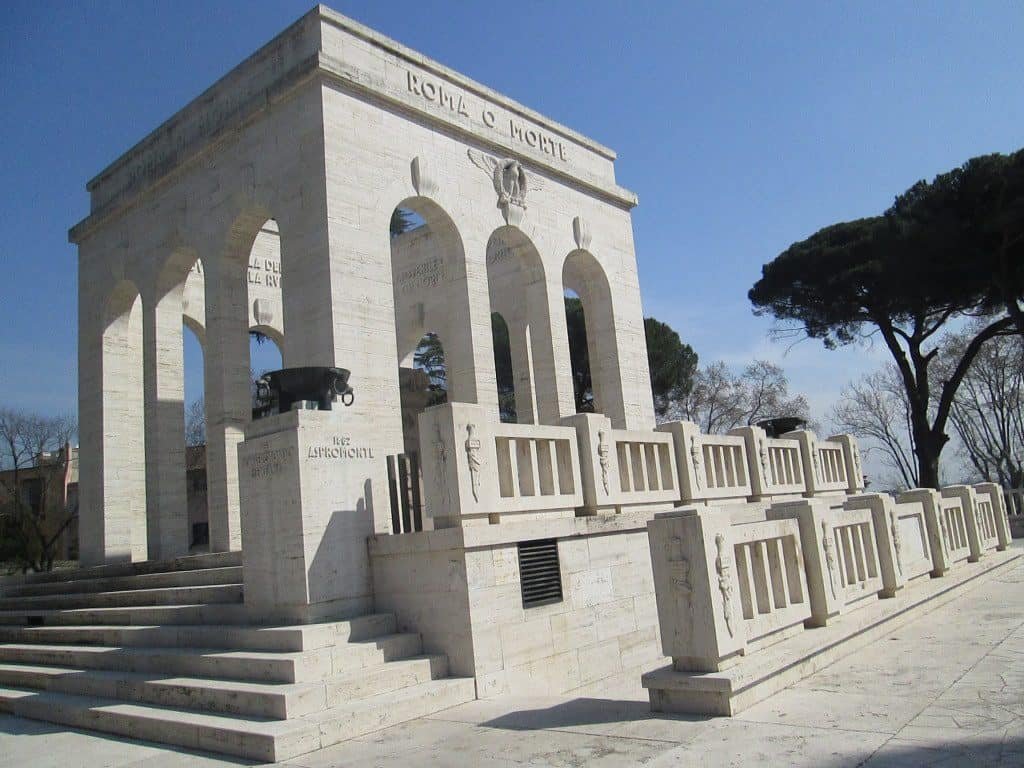
Enclosure, quadriporticus, crypt. The enclosure marks off a tree-lined area with the entrance on Via Garibaldi. The quadriporticus is the visible part, a ring of travertine raised on a flight of steps, with three round arches per side, which from a distance reads as a squashed truncated pyramid: the profile you glimpse from the high promenade and that many mistake for a water tank or a Guardia di Finanza block. The crypt is below, and you go down to it from the back by a double flight of stairs. The whole game is here: outside, the State rhetoric of 1941, below, the silence of the names. The jump between the two registers is the best thing about the visit.
Colle del Pino: why the Janiculum Ossuary Mausoleum stands right there
The place was called Colle del Pino and it was the most exposed point of the entire Janiculum front. Between April 30 and the first days of July 1849 the last defense of the Roman Republic was played out there, led by Giuseppe Garibaldi against the French expeditionary corps of General Nicolas Charles Victor Oudinot. Building the shrine elsewhere would have been more convenient and infinitely less meaningful: here the ground itself is a document.
Anyone who has never studied the siege struggles to understand why a hill outside the Aurelian Walls was the key to Rome. The reason is ballistics. In the mid-19th century artillery had become the decisive weapon of sieges, and from the top of the Janiculum you could bombard the city below without effort: Trastevere at your feet, the Tiber right after, the historic center within useful range. Whoever held the Janiculum held Rome. The city walls, for their part, were those built between the 3rd and 6th centuries and reworked by Urban VIII: high, thin curtain walls, designed to stop ladders and not shells. Against the French batteries of 1849 they were worth little.
On the ridge, back then, there was neither the promenade nor the plane trees. There were patrician villas with their casini, their walled gardens and their avenues: Villa Corsini with the Casino dei Quattro Venti, Villa del Vascello, Villa Spada, Villa Savorelli, the great enclosure of Villa Doria Pamphilj. Those villas were the trenches, the bastions and finally the rubble of the defense. The Janiculum Ossuary Mausoleum stands inside that battlefield, a few hundred meters from each of the places where the people whose names are carved in its crypt died. It isn't a shrine built far from the events, like so many. It is a shrine built on top of the events.
The Roman Republic of 1849, in brief and with the right dates
Without 1849 the monument can't be understood, and 1849 in Italy is almost always told badly, in hints. It's worth lining up the dates, because they are few and they are clear-cut.
From the flight of Pius IX to the proclamation
Pope Pius IX left Rome for Gaeta in November 1848, after the assassination of minister Pellegrino Rossi and weeks of popular tension. The power vacuum was filled by elections by universal male suffrage, held on January 21 and 22, 1849, which brought 179 Representatives of the people to Rome. The National Constituent Assembly met from February 5, under the presidency of Giuseppe Galletti, with Aurelio Saffi and Luigi Masi as vice presidents. On February 9, 1849, the Roman Republic was proclaimed from the Campidoglio.
The Triumvirate and the Constitution
After the Piedmontese defeat at Novara, in March 1849, the Assembly entrusted full powers to a triumvirate made up of Giuseppe Mazzini, Carlo Armellini and Aurelio Saffi. These are the three names the visitor finds carved in the crypt of the Janiculum Ossuary Mausoleum, on the Order of the Day of the Roman Triumvirate. The Constitution of the Roman Republic was approved on July 3, 1849, while the French were entering the city: an act of political stubbornness with few parallels in Europe. The text declared the temporal power of the papacy over the Roman State forfeited in fact and in law, abolished the death penalty and torture, guaranteed freedom of worship to Catholics, Jews and foreigners of other religions, canceled noble titles and caste privileges, eliminated censorship, and provided for forms of land reform through confiscated church property. For its time it was the most advanced constitutional text on the continent. It lasted less than 24 hours of actual application.
The forces in the field
The Republic could count on 16,000 to 17,000 men in all: about 8,600 line infantry inherited from the papal army, 4,700 irregular infantry including 1,500 of Garibaldi's Italian Legion and 1,000 of the Roman Legion, 690 cavalrymen, 800 men of the auxiliary arms, 74 cannons and howitzers. The minister of war was Giuseppe Avezzana. The commander in chief was General Pietro Roselli. Garibaldi commanded the Italian Legion. Luciano Manara led the Lombard bersaglieri, Giacomo Medici the defense of the Vascello. Facing them, on June 3, the French lined up 30,000 men, 4,000 horses, about 10 heavy batteries and 1,000 sappers. The disproportion wasn't great: it was absurd.
The siege of 1849 and the defense of the Janiculum
April 30, 1849: the first attack repelled
Oudinot had landed at Civitavecchia on April 24 with the mission, decided in Paris by Louis Napoleon Bonaparte, of restoring papal power. He counted on entering Rome without a fight. On April 30 he attacked from the Janiculum side and was beaten: Garibaldi's volunteers drove him back to the countryside and took hundreds of prisoners from him, whom the Republic then released out of political calculation. It is the date that opens the monument and that opens every discussion of the defense of Rome. The Republic had won its first battle against the leading military power of the continent, and for a good month Rome believed it could hold out.
June 3, 1849: Villa Corsini and the Casino dei Quattro Venti
June 3 is the day that fills the crypt. A letter from Oudinot dated June 1 suggested that the attack would not take place before Monday morning, that is, June 4. The French instead moved at three in the morning on Sunday the 3rd, claiming afterward that the villas outside the walls were not covered by the truce. General Mollière's column blew up some mines in the enclosure of Villa Doria Pamphilj and drove out its defenders, then threw itself on Villa Corsini.
The Casino dei Quattro Venti, the large building that crowned the upper part of Villa Corsini, was the tactically decisive point: whoever held it dominated the Vascello, the walls and the whole ridge. The Romans retook it around seven 30 in the morning and lost it a quarter of an hour later. Garibaldi had it attacked several more times, head-on, along a straight avenue swept fully by French fire. It was a slaughter. Roman losses that day exceeded 700 men, 500 of them from the Italian Legion alone and 200 among Manara's bersaglieri. The French had between 250 and 400 dead and wounded and about 15 officers. From a military point of view, the frontal assaults of June 3 were a mistake that historians still debate. From a human point of view they were the moment when the Republic decided not to surrender in silence.
In those hours fell Angelo Masina, the man from Bologna who led his lancers. Fell Francesco Daverio, chief of staff of the legion. Fell Captain Enrico Dandolo, 21 years old, of the Lombard bersaglieri. And Goffredo Mameli, who had not yet turned 22, was wounded in the left leg. Nino Bixio took a ball in the side. These are five names that the visitor will find carved, a few meters from one another, in the crypt of the Janiculum Ossuary Mausoleum.
The Vascello and Giacomo Medici's defense
With Villa Corsini lost, the front fell back to the Villa del Vascello, the 17th-century building erected from 1663 to a design by Plautilla Bricci and her brother Basilio for Abbot Elpidio Benedetti. Plautilla Bricci is one of the very few women to whom the Roman baroque age recognized the role of architect in public documents: her ship-shaped villa ended up becoming, two centuries later, the last bulwark of Rome's defenders in front of the walls.
Giacomo Medici held it, repelling the French assaults of June 26 and 28 while the building collapsed on him piece by piece. A memoir of the time describes the situation without adjectives: the whole upper floor ruined, and of the two lower ones the front part ruined, so that the fine apartments were left open to the air. Medici came out of there with the title of Marquis of the Vascello and with a military reputation that he carried with him all his life. The villa, on Via di San Pancrazio, is still in its place, with the main casino mutilated by post-war demolitions. Since 1983 it has been the seat of the Grand Orient of Italy. Anyone who climbs to the Janiculum Ossuary Mausoleum and wants to see a real scar of 1849 will find it there, five minutes on foot.
Villa Spada, June 29 and 30, 1849
The last night was the one between June 29 and 30. The French, who since June 13 had been bombarding systematically and who in the night between the 21st and 22nd had taken a stretch of the central bastions and of the Barberini bastions near Porta Portese, attacked Villa Spada and Villa Savorelli by surprise. The fighting dragged on through the whole day of the 30th, losing strength hour after hour. At Villa Spada Luciano Manara, colonel, 25 years old, Garibaldi's chief of staff, was struck down. There Emilio Morosini, 19 years old, was mortally wounded. In the city, in Vicolo del Canestraro, today Via dei Panieri, a French shell killed Andrea Aguyar, the Uruguayan whom all Rome called Garibaldi's Moor.
At noon on July 1 a brief truce was agreed to collect the dead and wounded. Mazzini put the alternative to the Assembly: total capitulation, or battle inside the city with destruction and looting. Garibaldi confirmed that any further resistance was useless.
July 2, 1849: the speech and the exit from Rome
On July 2, in Piazza San Pietro, Garibaldi spoke to his men. The words are among the few of the Risorgimento that can be quoted without embarrassment, because they promise nothing: I am leaving Rome, whoever wants to continue the war against the foreigner come with me, I promise no pay, no soft idleness, water and bread when there is any. At 20:00 he left the city with about 4,000 armed men, heading for the unoccupied provinces and then, in intention, toward Venice. The French entered Rome before noon on that same July 2, occupying Trastevere, Castel Sant'Angelo, the Pincio and Porta del Popolo. Oudinot arrived only in the evening, with 12,000 soldiers. Formally there was no capitulation: the act was defined as an exit from the city, and the Assembly could declare that the Republic remained legally constituted. A legal fiction, certainly. But it is the fiction on which, 21 years later, Italy's moral right to take Rome was built.
The Garibaldian retreat left other names at the Janiculum Ossuary Mausoleum. Among them Angelo Brunetti, the carter from Ripetta whom the Romans called Ciceruacchio, shot by the Austrians at Ca' Tiepolo, in the Po delta, on August 10, 1849, together with his 13-year-old son Lorenzo and his elder son Luigi.
From the burial ground of 1879 to the Janiculum Ossuary Mausoleum
The monument you visit today is the third answer to a problem that Rome posed the day after the taking of Porta Pia: where to put the dead. Not in the practical sense. In the political sense.
The law of 1878-79 and the first burial ground
The need to commemorate worthily those who fell for Rome was forcefully raised in the wake of September 20, 1870. In 1878-79 Giuseppe Garibaldi in person and his son Menotti were among the promoters of the law that recognized the Janiculum as the place to gather the remains of the patriots. Painstaking surveys followed to identify the bodies: some were buried at Campo Verano, others still lay on the sites of the battles near the Walls, where they had been buried in haste in 1870. On that basis a first burial ground was built.
It was a modest installation, cemetery in scale, suited to a nation that had just finished making itself and had not yet decided what rhetoric to adopt for its dead. It was enough for half a century. In the meantime the Janiculum was changing face: in 1883 the area became a public promenade dedicated to the memory of the defense of Rome, in 1895 the equestrian monument to Garibaldi arrived, and between the 19th and 20th centuries the busts of the patriots were lined up along the avenues. The hill was turning into a park of memory, and the old burial ground cut an increasingly poor figure there.
Ezio Garibaldi and the revival of the project in the 1930s
The idea of a real mausoleum was taken up in the 1930s by Ezio Garibaldi, son of Ricciotti and therefore grandson of the Hero of Two Worlds, then president of the Società dei Reduci Patrie Battaglie, an association named for his grandfather. The proposal was brought to the Government, which adopted it and bore the costs. The design was entrusted by the Society to its member Giovanni Jacobucci. The execution was overseen by the Technical Offices of the Governatorato of Rome.
On this passage we should be adults. The Janiculum Ossuary Mausoleum is a monument of the Fascist regime, built between 1939 and 1941 inside an operation of appropriation of Garibaldian memory that Fascism carried out methodically, and which left substantial marks in Rome: the equestrian monument to Anita of 1932, promoted by the same Ezio Garibaldi, is the other chapter. Acknowledging this takes nothing away from the dead of 1849, who were republicans, Mazzinians, democrats, and who had nothing to share with that regime. What it takes away is the naivety with which one looks at the architecture: the imperial eagle on the altar, the gladii, the shields, the she-wolf repeated everywhere are not neutral decorations, they are a precise speech delivered in 1941. The crypt, below, speaks another language. The monument is worth double precisely because the two languages coexist two meters apart.
Giovanni Jacobucci and the architecture of the Janiculum Ossuary Mausoleum
Giovanni Jacobucci (1895-1970) belonged to the generation of Roman architects raised between late eclecticism and the simplified monumentalism of the 1930s. The Janiculum Ossuary Mausoleum was solemnly inaugurated on November 3, 1941, after two years of work. The date was not chosen by chance: November 3 is the anniversary of the battle of Mentana in 1867, one of the Garibaldian defeats recalled on the pedestals of the monument itself.
The enclosure and the quadriporticus of the Janiculum Ossuary Mausoleum
The complex is organized at the center of a fenced, tree-lined area. The visible core is an austere travertine quadriporticus, made up of three round arches on each side, raised on a flight of steps. The choice of travertine, in a Roman work of 1941, is a declaration of continuity with antiquity: it is the stone of the Colosseum and the Theater of Marcellus, and in those years it was the official stone of the regime's Romanness. Jacobucci works it in broad surfaces, without projecting ornament, counting on volumes and light. The result is a building that in the morning, with the sun striking from the east, looks almost white, and that in the late afternoon turns yellowish and heavier. Anyone who wants to photograph it should think about that.
The quadriporticus has no liturgical or funerary function: it is a threshold device. It serves to slow down whoever arrives, to force them to walk around the central altar, to bring them to the back where the descent to the crypt opens. It is architecture of movement, and it works: the most common mistake of the hurried visitor is to enter, look at the altar, leave and go away, without noticing that the real monument is underground.
The altar of red Baveno granite
At the center of the quadriporticus, the core of the monument is an altar carved from a single block of red Baveno granite, the stone of Lake Maggiore that in the 19th and 20th centuries was the obligatory choice for Italian obelisks, bases and monumental columns. A monolithic block of that size meant quarry, cutting, rail transport and installation: in 1940 it was a technical investment, not only an aesthetic one.
The altar is enriched with allegorical figures inspired by Roman antiquity: the she-wolf, the imperial eagle, shields and gladii. These are the motifs that repeat throughout the decorative apparatus of the Janiculum Ossuary Mausoleum, from the braziers to the frames. It is worth stopping to look at them carefully, because they tell of a cultural operation: the volunteers of 1849, who fought for a constitutional and secular republic, are here dressed in the symbolic gear of the Roman Empire. The short circuit is evident and nobody, in 1941, found it embarrassing.
The four braziers and the battles carved on the pedestals
At the corners of the quadriporticus, four travertine pedestals support as many bronze braziers decorated with she-wolf heads. They aren't dead ornaments: they are still lit during official commemorations, and seeing the Janiculum Ossuary Mausoleum with the four living fires at the corners, on April 30 or June 2, is a different experience from the ordinary visit.
On the pedestals are carved the most significant battles for the liberation of Rome. The list deserves to be read in full, because it is the summary of the monument: for 1849 Vascello, San Pancrazio, Palestrina, Velletri, Monti Parioli, Villa Spada. For 1862 Aspromonte. For 1867 Monterotondo, Mentana, Villa Glori, Casa Ajani. For 1870 Porta Pia and San Pancrazio again.
Anyone who reads those names calmly understands the logic of the shrine. Palestrina and Velletri are the Garibaldian victories of May 1849 against the Bourbon army that had come up from the south, the ones in which Colomba Antonietti fought in a bersagliere's uniform. Monti Parioli recalls the clashes on the northern front. Aspromonte, August 29, 1862, is the wounding of Garibaldi by Italian soldiers, the bitterest page. Monterotondo and Mentana are the campaign in the Roman countryside in 1867, with the decisive clash of November 3 at Mentana, where 5,000 Garibaldians found themselves facing about 3,000 papal troops and 2,500 French armed with the 1866 model Chassepot rifle, capable of 12 shots a minute: 150 dead, 220 wounded and 1,700 prisoners among the volunteers, against 32 dead and 140 wounded on the other side. Villa Glori is the clash of October 23, 1867 in which Enrico Cairoli fell. Casa Ajani is the massacre at the wool mill in Trastevere, on the same day. Porta Pia and San Pancrazio close the account on September 20, 1870.
The shrine crypt of the Janiculum Ossuary Mausoleum
Here the monument changes register and becomes a serious thing. If you have only a quarter of an hour, spend it below and not above.
The double flight of stairs and the bronze portal of the Janiculum Ossuary Mausoleum
At the back of the quadriporticus a double flight of stairs descends to the Shrine, closed by an imposing bronze portal. The descent is designed to work: you lose the view of the panorama, you lose the light, the temperature drops, and when the portal opens you are already in another state of mind. Jacobucci, here, knows exactly what he is doing. It is a device as old as funerary architecture, from the Etruscan dromoi onward, but applied with restraint.
The vestibule and the square chamber
The underground space is divided into two zones. The first is a vestibule with small side apses. The second is a square chamber with a large circular pillar at the center, ornamented with palms and votive crosses in alabaster: the palm is the symbol of martyrdom, the votive cross is the Christian translation of civic sacrifice. The choice of material is not casual, because alabaster transmits light and, with raking illumination, the motifs seem to light up from inside.
The lowered vaulted ceiling is entirely covered with gold mosaic tesserae. Polychrome marbles line the floor and the walls. It is the only point of the Janiculum Ossuary Mausoleum where the design abandons the austerity of travertine and allows itself splendor: the citation, evident, is of early Christian and Byzantine shrines, with the gold ground that cancels space and brings the inscriptions to the foreground.
The 36 niches of the Janiculum Ossuary Mausoleum and the 1,600 names
On the walls are arranged 36 niches closed by slabs that commemorate the names of over 1,600 fallen. In the niches only a few remains are kept, about 200, mostly anonymous, found during the different surveys. This asymmetry between names and bones is the thing that strikes most whoever enters with the idea of visiting an ossuary: the slabs are a list, not a catalog of burials.
Reading them one by one takes time and pays off. There are Roman surnames from Trastevere and the Monti next to Lombard, Genoese, Bolognese, Romagnol, Sicilian surnames. There are foreign names. There are ages that repeat with an impressive monotony: 18, 19, 21, 22. The defense of Rome was a matter of boys. The fact emerges from no historical summary as it emerges from those walls.
The sarcophagus of Goffredo Mameli
On the back wall is placed the porphyry sarcophagus with the remains of Goffredo Mameli, the young Genoese poet author of the text of the national anthem, mortally wounded right here on the Janiculum in 1849. It is the only identified individual burial in the shrine, and it is the point toward which the whole route converges: the golden vault, the marbles, the axis of the square chamber.
Porphyry is not just any choice. In the Roman and then Byzantine tradition it was the stone reserved for emperors, and its presence here raises the register to a level that in 1941 everyone knew how to read. The 21-year-old boy who had written Fratelli d'Italia at 19 is buried like an emperor. One may find it excessive. One may also think that Mameli, who had a rather solemn literary taste, would not have minded.
The inscriptions of the Janiculum Ossuary Mausoleum and the Mazzinian epigraph
Throughout the monument the inscriptions are many and recall events, places, thoughts and texts tied to the historical events and the figures celebrated. In the crypt there are two slabs with the Orders of the Day of the Municipality of Rome and of the Roman Triumvirate, that is, of Giuseppe Mazzini, Aurelio Saffi and Carlo Armellini, and a mosaic epigraph drawn from Mazzini's writings.
This is the most underrated part of the Janiculum Ossuary Mausoleum. The epigraphs are not a side dish: they are the document. Whoever reads them discovers the tone in which a republican government spoke to its citizens during a siege, and also discovers how little it resembles the military rhetoric that surrounds it in the monument of 1941. Bring your glasses. The light is low and the letters are deeply carved.
The names carved in the Janiculum Ossuary Mausoleum: who they really were
A clarification that avoids misunderstandings: being remembered here does not mean being buried here. The slabs commemorate over 1,600 people. The identified burials are very few. Several of the most famous names rest elsewhere, and I say this because you often hear, in front of the wall, statements as confident as they are wrong.
Goffredo Mameli
Born in Genoa on September 5, 1827, died in Rome on July 6, 1849. He had written the text of the Song of the Italians in 1847, before the age of 20. The music is by Michele Novaro. The song was adopted as the provisional national anthem in 1946 and officially recognized by law only in 2017.
On June 3, 1849 he was wounded in the left leg during the action around Villa Corsini. There are two versions of how it happened: one that attributes the wound to the bayonet of a comrade and the other, more credited, to a French rifle shot. Carried unconscious to the Trinità dei Pellegrini hospital, he was treated by the doctor Pietro Maestri. After four days gangrene appeared. On June 19 the surgeon Paolo Maria Baroni proceeded with the amputation, but the infection was already generalized and degenerated into septicemia. He died on the morning of July 6, at 7:30, three days after the approval of the Constitution, which he did not live to know had been promulgated. He had not yet turned 22.
His remains made a long journey: first the church of Santa Maria in Monticelli, then the crypts of the church of the Stimmate, then the Verano after the taking of Porta Pia, finally the Janiculum in 1941, inside the porphyry sarcophagus you see today. Four burials in 92 years. The return of 1941 was the real reason the Janiculum Ossuary Mausoleum obtained the attention and the funds that it obtained.
Luciano Manara
A Milanese, born on March 25, 1825 to a family of the upper bourgeoisie, with high school studies in Milan and naval school in Venice. In 1848 he organized and financed out of his own pocket a corps of 500 volunteers, the Lombard Bersaglieri, and put them at the disposal of the Provisional Government of Milan. In the Five Days he led the attack on Porta Tosa. He fought in Trentino, at Sclemo, then on the Po and at La Cava after the armistice.
After Novara he embarked at Portofino on April 22, 1849 and reached Rome on April 29, the day before the first French attack. Promoted to lieutenant colonel and then colonel, he was named chief of staff by Garibaldi. He died at Villa Spada on June 30, 1849, struck down in the last night of the siege. He was 25 years old. His is one of the most quoted and least rhetorical phrases of the Risorgimento: we must die to close 1848 with seriousness.
The funeral was celebrated in the church of San Lorenzo in Lucina. The body was then transported by sea to Genoa and then to Vezia, near Lugano, to the tomb of the Morosini family. In 1853 Emperor Franz Joseph authorized the transfer to Barzanò, and only in 1864 could the family erect the definitive sepulchral monument. At the Janiculum, of Manara, there is the name.
Enrico Dandolo
Born in Varese on June 26, 1827, captain in the battalion of the Lombard Bersaglieri under Manara's command. A protagonist of the Five Days of Milan together with his brother Emilio, with Manara and with Emilio Morosini: four boys of the same Lombard circle, bound by friendship before politics. He fell in Rome on June 3, 1849, in the clash near Villa Corsini. He was 21 years and 11 months old.
His brother Emilio, wounded the same day, survived and wrote the account of the campaign that remains one of the most widely read direct sources on the siege. Enrico was buried at Vezia, in Canton Ticino, where the Morosini had a villa. Only in September 1968 were his remains transferred to the family tomb at Adro.
Emilio Morosini
Born in Varese on June 26, 1830, son of the nobleman Gian Battista Morosini, originally from Vezia in Ticino, and of Emilia Zeltner of Solothurn. An officer of Manara's first battalion of Lombard bersaglieri already in the Five Days, he fought at Castelnuovo, Lazise, Monte Suello, Gavardo. In Rome he was gravely wounded in the night assault of June 29, 1849 on the Janiculum and died of his wounds. He had not yet turned 19. His mother, Emilia Zeltner Morosini, became after the war one of the reference figures of the Lombard patriotic emigration in Switzerland.
Francesco Daverio
A Lombard, chief of staff of Garibaldi's Italian Legion, he fell on June 3, 1849 in the fighting for the Casino dei Quattro Venti. The post passed to Luciano Manara, who survived him by 27 days. The turnover of commands, in that siege, was measured in weeks.
Andrea Aguyar, Garibaldi's Moor
It is the name that surprises most whoever reads the slabs. Andrea Aguyar was born in Montevideo to enslaved parents and lived in slavery until 1842, when the two sides of the Uruguayan civil war, Colorados and Blancos, proclaimed the emancipation of the slaves to swell their own troops. He met Garibaldi during the siege of Montevideo, where about 5,000 former slaves defended the city. When Garibaldi returned to Europe in 1848, Aguyar followed him: among his companions from across the ocean he was almost the only one to do so.
In Rome he was a hugely popular figure, and the English press of the time described him with his red coat open and a showy silk handkerchief around his neck. Promoted to lieutenant by Garibaldi, he was struck down by a French shell on June 30, 1849 in Vicolo del Canestraro, today Via dei Panieri, in Trastevere. He expired at Santa Maria della Scala. The accounts agree on his last words, a greeting to the republics of America and of Rome. A man born a slave in South America is remembered today in a shrine on the Janiculum: if you are looking for a story to tell a bored teenager, this one always works.
Angelo Brunetti, known as Ciceruacchio
Born in 1800 in the Campo Marzio rione, son of a farrier, a carter at the port of Ripetta where he unloaded the wine of the Castelli, then an innkeeper near Porta del Popolo. Ciceruacchio was the popular leader of Rome in the two years 1846-1848, the man able to fill a square in half an hour, first in support of the reforms of Pius IX and then against the fugitive pope. He fought in the defense of 1849 and followed Garibaldi in the retreat toward Venice. After crossing the Apennines, the group embarked at Cesenatico on requisitioned bragozzi. Near the Po delta it was intercepted by an Austrian lookout. He was shot at midnight on August 10, 1849 at Ca' Tiepolo, with his son Lorenzo, 13 years old, and with his elder son Luigi.
The monument to Ciceruacchio, made in 1907 by the sculptor Ettore Ximenes, after several vicissitudes was relocated to the Janiculum and inaugurated in its current setting on March 16, 2011. Whoever visits the Janiculum Ossuary Mausoleum can see it along the promenade, a few minutes on foot.
Colomba Antonietti
Born in Bastia Umbra on October 19, 1826, daughter of the baker Michele and of Diana Trabalza, raised in Foligno. At 15 she met Count Luigi Porzi, a cadet in the papal troops. The families opposed it because of the difference in class and he was transferred to Senigallia, but the two married in the church of the Misericordia in Foligno at one in the morning on December 13, 1846, almost without relatives. In Rome Porzi was arrested for a marriage contracted without authorization and shut up in Castel Sant'Angelo with his salary halved.
In 1849, when her husband joined the Roman Republic, Colomba cut her hair, put on a bersagliere's uniform and fought with him at Palestrina and Velletri, earning Garibaldi's public praise. She died on June 13, 1849 under Porta San Pancrazio, struck full on by a cannonball, in her husband's arms. She was 22 years old. Buried at first in San Carlo ai Catinari, in 1941 her remains were moved here, to the Janiculum. Along the promenade her bust, placed in 1911, is the only female one in the series.
Giuditta Tavani Arquati
A Roman, born on the Tiber Island on April 30, 1830 and baptized the same day in San Bartolomeo all'Isola, daughter of a patriot who had known exile. Married at 14, on July 22, 1844, to Francesco Arquati. On October 25, 1867 about 40 patriots met at Via della Lungaretta 97, in Trastevere, at the premises of Giulio Ajani's wool mill, to organize the uprising that was supposed to accompany the Garibaldian campaign in the Roman countryside. Around 12:30 a patrol of papal Zouaves arriving from Via del Moro attacked the building. In the fighting nine people died, among them Giuditta, pregnant with her fourth child, her husband Francesco and her son Antonio.
Her name is carved in the Janiculum Ossuary Mausoleum and the battle appears on the pedestals under the wording Casa Ajani. Her body, however, rests in a mound tomb on the little hill facing the Ossuary of the Verano Cemetery. In 1909 the Trastevere square that now bears her name was named after her.
Angelo Masina, Giacomo Venezian, Edoardo Negri
Angelo Masina, a Bolognese born on September 24, 1815, formed and commanded the Lancers of Death, the mounted unit with which he met Garibaldi in 1848 and followed him to Rome. He fell on June 3, 1849 in the assault on the Casino dei Quattro Venti. He is buried at the Certosa of Bologna, in the Columbarium hall, where a bust by Giuseppe Pacchioni commemorates him. Giacomo Venezian and Edoardo Negri appear among the fallen listed in the crypt: two names that the public does not know and that deserve, like all the others, a slow reading. In a collective shrine the hierarchy of fame is the first thing to leave at the entrance.
A curiosity about the Janiculum Ossuary Mausoleum
The curiosity lies in a number: 36 niches, over 1,600 names, about 200 remains. Do the math. The most solemn shrine dedicated to those who fell for Rome keeps, in terms of bones, less than an eighth of the people it names, and of those few almost none has a certain identity. It is not a flaw of the design: it is the direct consequence of how people died and were buried in a 19th-century siege.
In June 1849 the fallen were collected during truces and buried in haste wherever possible, in the vegetable gardens of the villas, along the ditches, under the bastions, in mass graves dug at shallow depth with artillery fire still active. Many ended up at Campo Verano, which had only recently come into operation. Those of 1870 stayed for years at the sites of the clashes near the Walls, where they had been put on the very same day. When, after the law promoted in 1878-79 by Giuseppe Garibaldi and his son Menotti, the surveys began, those in charge found themselves facing mixed remains, unidentifiable, in many cases already scattered by building works and excavations. What could be recovered was recovered.
Hence the design choice of 1939-41, which is smarter than it seems: to give up the correspondence between name and body and build a monument of lists. The Janiculum Ossuary Mausoleum works as a modern memorial, of the kind the 20th century would build after the two world wars, and it does so almost 20 years ahead of the European spread of that model. The visitor who notices this stops looking for tombs and starts reading the names, which is exactly what the monument asks.
I'll add a detail that amuses groups: the bus stop closest to the monument, on line 115, is called Garibaldi/Iacobucci. The surname of the architect who designed the shrine goes by every day on the displays of Rome's buses, and nobody knows it.
Something nobody tells you about the Janiculum Ossuary Mausoleum
That it is open almost every morning of the week, free, with a free guided tour on Saturday, and that practically nobody goes.
It sounds like a banal piece of information and yet it is the practical key to the entire visit to the Janiculum. 200 meters lower down, at Piazzale Garibaldi, on spring mornings dozens of tour buses crowd in, groups line up for the photo on the balustrade, stalls, the audience for the noon cannon. Up here, inside the enclosure of the Janiculum Ossuary Mausoleum, it regularly happens that you are the only visitors. The crypt, in particular, is often walked through alone. For a monument that contains the tomb of the author of the national anthem, it is an anomaly hard to explain.
There are three reasons and it is worth knowing them. The first is the signage: from the promenade the monument is barely glimpsed, the gate is set back from the street and the sign is discreet. The second is the morning schedule, incompatible with the flow of organized groups, who arrive at the Janiculum in the afternoon, after St. Peter's. The third is that in the tourist imagination of Rome the Risorgimento simply does not exist: those who come from outside look for antiquity and the baroque, and 19th-century Italian history remains invisible.
The practical consequence is excellent for the reader. If you organize a morning on the Janiculum, put the Mausoleum at the beginning, around 10:00: you go in, you have the crypt to yourself, you come out in time for the noon cannon. It is one of the very few places in the historic center of Rome where you can still stand in silence in front of something important without booking anything and without paying anything. Take advantage of it while it lasts.
The advice I give you for visiting the Janiculum Ossuary Mausoleum
Don't arrive from above. Arrive from below, on foot, from the side the French came from.
The recommended route begins in Trastevere, in Piazza Trilussa, and climbs Via Garibaldi. After the first bend you meet the church of San Pietro in Montorio with Bramante's Tempietto in the courtyard. A little higher up opens the Acqua Paola Fountain, the Fontanone, which Romans use as a viewpoint and film directors as a backdrop. From there you continue to Largo di Porta San Pancrazio: the gate you see is the reconstruction that Virginio Vespignani carried out in 1854 for Pius IX, because the previous one was destroyed by the French bombardments of 1849. Inside the gate today is the Museum of the Roman Republic and of Garibaldian Memory. Past the gate, on the right, begins Via Garibaldi, which leads to the monument. On the left, on Via di San Pancrazio, is the Villa del Vascello.
Done this way, the climb lasts 25 minutes and puts in chronological order everything you will read in the crypt. You arrive at the Janiculum Ossuary Mausoleum already knowing who Medici was, where Colomba Antonietti fell, why the gate is new and the road is old. The difference compared with getting off the bus at the piazzale is enormous, and it costs nothing.
Second piece of advice, less poetic and more useful: bring a small flashlight or use your phone's at low intensity. The crypt is lit for atmosphere and not for reading, the slabs are many and the names are carved in regular but not large letters. Third piece of advice: if you have less than an hour, sacrifice the quadriporticus. The upper level can be understood in five minutes. The underground cannot.
Another well-known fact, yet seldom cited
That June 3, 1849, the day that filled this shrine, began with a misunderstanding about a date.
On June 1 General Oudinot sent the Romans a communication from which it was inferred that operations would not resume before Monday morning, that is, June 4. The Republic, which had every interest in gaining days, calibrated on that deadline the rotation of units and the maintenance of the outer defenses. The French attacked at 3:00 in the morning on Sunday the 3rd, in the dark, blowing up mines in the enclosure of Villa Doria Pamphilj. To the protest, Oudinot replied that the truce concerned the city and not the villas outside the walls, and that therefore Villa Corsini and the Vascello were legitimate targets.
If the question were only diplomatic it would be a footnote. It is not, because that initial advantage determined the immediate fall of the Casino dei Quattro Venti, which was the key position of the whole front, and forced Garibaldi to try all day to retake it with frontal assaults along a straight avenue, exposed and swept by fire. Roman losses that day exceeded 700 men. 500 were from the Italian Legion alone, 200 from Manara's bersaglieri.
The well-known fact, then, is that June 3 was a terrible day. The thing rarely cited is that it was terrible twice: for the surprise suffered at dawn and for the tactic chosen in response. On the assaults on the Casino dei Quattro Venti, military historiography has been arguing for over a century, and not without reason: was it courage or was it waste? In our judgment, on the military level they were indefensible and on the political level they were the only possible thing. A republic four months old could not afford to lose its most important position without fighting to retake it. The difference between the two judgments is all written on the walls of the crypt.
The right photo to take at the Janiculum Ossuary Mausoleum
The wrong photo is the one of the quadriporticus seen head-on, in full sun, with the white sky above. Everyone gets it, it tells nothing and it flattens the travertine until it looks like concrete.
The right photo is just one and has to be taken early in the morning, between 9:30 and 10:30, when the sun strikes from the east and cuts across the three round arches of one side. Stand at the corner of the quadriporticus, not at the center, and frame diagonally: take two sides instead of one. In the frame you get the succession of arches, the flight of steps, one of the four corner pedestals with the bronze brazier and its she-wolf head. With that raking light the travertine shows its texture, the shadows of the arches draw a rhythmic cadence on the pavement and the monument stops being a block and becomes architecture. If there is wind and the pines are moving, wait a few seconds and take two or three shots.
The second photo that's worth it is in the crypt, and it requires patience. No flash: the flash burns the golden vault and kills the alabaster. Rest the phone or the camera on a stable surface, for example the edge of a plinth or the railing, keep the sensitivity low and lengthen the exposure time. The framing to look for is the one that takes in together the circular pillar with the palms and the votive crosses in alabaster and, in the background, the back wall with Mameli's porphyry sarcophagus. In the frame are the two poles of the monument: the symbol of sacrifice and the body that made it.
A warning of common sense, valid in any shrine: this is a burial place, and smiling selfies in front of the slabs are in very poor taste. If you have a group of teenagers, tell them before going down, not after.
Some important events that took place here in history
The ground on which the Janiculum Ossuary Mausoleum stands has hosted, in a little over 90 years, some of the densest events in modern Roman history.
April 30, 1849. First French attack on the Janiculum, repelled by the volunteers of the Republic. It is the only pitched victory of an 82-day republic against the strongest army on the continent. The date is recalled on the pedestals of the monument and is still today the anniversary on which the four braziers are lit.
June 3, 1849. Oudinot's surprise attack at 3:00 in the morning, the fall of Villa Doria Pamphilj and of Villa Corsini, the failed assaults on the Casino dei Quattro Venti. Angelo Masina, Francesco Daverio and Enrico Dandolo die. Goffredo Mameli is wounded. Nino Bixio is also wounded. Over 700 Roman casualties in one day.
June 13, 1849. Under Porta San Pancrazio, a cannonball kills Colomba Antonietti, in a bersagliere's uniform, in front of her husband. She is the woman whose remains the crypt has held since 1941.
Night between June 21 and 22, 1849. The French take a stretch of the central bastions and of the Barberini bastions near Porta Portese. The line of the walls is breached. From that moment the defense falls back inside the villas.
June 29 and 30, 1849. The last night. Attack on Villa Spada and Villa Savorelli. Luciano Manara falls, Emilio Morosini is mortally wounded, Andrea Aguyar dies in Trastevere struck by a shell.
July 2, 1849. Garibaldi speaks in Piazza San Pietro and at 20:00 leaves Rome with 4,000 men. The French occupy the city during the day.
July 3, 1849. The Assembly approves the Constitution of the Roman Republic while French troops are in the city: death penalty abolished, freedom of worship, forfeiture of temporal power.
September 20, 1870. While the breach opens at Porta Pia, a second Italian attack develops right at Porta San Pancrazio, at the foot of the hill. It is the feat of arms that closes the list carved on the pedestals of the monument.
1878-79. Law promoted among others by Giuseppe Garibaldi and Menotti Garibaldi: the Janiculum is recognized as the gathering place for the remains of those who fell for Rome. The first burial ground is born.
November 3, 1941. Solemn inauguration of the Janiculum Ossuary Mausoleum after two years of work, with the transfer of the remains of Goffredo Mameli from the Verano and of Colomba Antonietti from San Carlo ai Catinari. The date coincides with the anniversary of Mentana.
2025. The monument is the subject of a restoration project under the PNRR Caput Mundi program, the plan with which Roma Capitale has put its hands again on dozens of minor places of its heritage in view of the jubilee year.
Who has passed through the Janiculum Ossuary Mausoleum
The monument dates from 1941, but the place has a list of visitors that few Roman addresses can claim.
Giuseppe Garibaldi. Colle del Pino was his command sector between April 30 and June 30, 1849. From here he ordered the assaults on Villa Corsini and here he lost most of his men. 30 years later, with his son Menotti, he promoted the law that dedicated this same ground to the memory of the fallen: very few generals have personally chosen the place where their men would be remembered.
Goffredo Mameli. He passed through here alive on June 3, 1849 and returned here dead on November 3, 1941, inside a porphyry sarcophagus. His is the only body in the shrine that has a name, a surname and a certain date.
Luciano Manara, Enrico Dandolo, Emilio Morosini, Francesco Daverio, Angelo Masina, Andrea Aguyar. They all fought a few hundred meters from this enclosure and died within a radius of a kilometer. Their names are carved in the crypt, their bodies, for the most part, are elsewhere.
Giacomo Medici. He held the Vascello, the building you can see five minutes away on foot, and came out of it Marquis of the Vascello. He is among the few protagonists of the defense who survived, made a career in the Italian army and saw 1870.
Nicolas Charles Victor Oudinot. The French commander entered Rome on the evening of July 2, 1849 with 12,000 soldiers, after taking this ridge piece by piece. History remembers him above all for the letter of June 1.
Giuseppe Mazzini, Carlo Armellini, Aurelio Saffi. They did not fight on the hill, but their words are here: the Order of the Day of the Roman Triumvirate is carved on one of the two slabs in the crypt, and a mosaic epigraph takes up Mazzini's writings.
Ezio Garibaldi. Grandson of Giuseppe and son of Ricciotti, president of the Società dei Reduci Patrie Battaglie, he was the man who in the 1930s relaunched the project and got the Government to fund it. He had already promoted, in 1932, the equestrian monument to Anita Garibaldi a little farther along the promenade.
Giovanni Jacobucci. The architect (1895-1970) who translated all this into travertine, Baveno granite, bronze and gold mosaic. His name, besides being on the monument, is on a bus stop.
Around the Janiculum Ossuary Mausoleum: the park of memory
The monument is not an isolated episode: it belongs to a system built over 80 years on top of a battlefield. Anyone who visits only the shrine loses half the sense. Here is what you meet within a 10-minute walk, in order of distance.
The Janiculum promenade
In 1883 the ridge was transformed into a public promenade dedicated to the memory of the defense of Rome. It consists of two large avenues lined with plane trees that converge on Piazzale Garibaldi, for a total extent of three and a half hectares, in the Trastevere rione. Access is free and permanent, from the entrances on Via Garibaldi and Salita di Sant'Onofrio. At the edges survive the things that make the Janiculum a Roman place and not a postcard viewpoint: the refreshment stands at the piazzale and in Piazza Sant'Onofrio, the carousels at the entrance on Via Garibaldi, the puppet theater at the piazzale, which has been an institution of the Roman Sunday for generations.
The equestrian monument to Giuseppe Garibaldi
200 meters below the Janiculum Ossuary Mausoleum, at the center of the piazzale, stands Emilio Gallori's equestrian monument to Giuseppe Garibaldi, inaugurated on September 20, 1895 for the 25th anniversary of the taking of Rome. The bronze equestrian statue was cast by Alessandro Nelli in Rome. The side bronze groups came out of the Galli foundry in Florence. On the long sides of the large marble pedestal run the allegorical figures of Europe, accompanied by History and Genius, and of America, with Industry and Commerce. On the short sides are two military episodes, Luciano Manara's bersaglieri in the defense of Rome in 1849 and the fighters of Calatafimi in 1860. On the wreath placed in 1907 appears the motto O Roma o morte.
A note for those who guide groups: the group of Manara's bersaglieri and the crypt of the Mausoleum tell of the same men 200 meters apart and 46 years apart, with two completely different rhetorics. Seeing them in the same morning is the cheapest art history lesson that Rome offers.
The monument to Anita Garibaldi
A little farther along the promenade, toward the Vatican, you meet Mario Rutelli's equestrian monument to Anita Garibaldi, inaugurated on June 4, 1932 and promoted by Ezio Garibaldi, the same one who would later obtain the Mausoleum. The bronze group represents Anita on horseback, pistol in hand, holding her newborn son Menotti and trying to escape capture in the camp of São Luís surrounded by imperial troops during the Farrapos War. Two days before the inauguration, on June 2, 1932, Anita's remains, exhumed from the tomb in Nice and temporarily deposited at the Staglieno cemetery in Genoa, arrived in Rome on a special train after a long negotiation with the French Government, to be interred in the base.
On the Janiculum, then, there are two burials in the full sense of the term: Anita in the base of her monument and Mameli in the porphyry sarcophagus of the crypt. They are 400 meters from each other and almost nobody knows it.
The busts of the patriots along the avenue
Along the avenues are lined the busts of the Garibaldians, in marble and bronze, on small columns. The Sovraintendenza counts 84, including four foreign fighters. The encyclopedic references go up to 86. The discrepancy depends on moves, replacements and thefts that took place over time, and should not surprise. The oldest dates from 1851. The great majority were placed between 1886 and 1920, the last in 1957. Sculptors such as Giuseppe Trabacchi, Alfredo Luzi, Riccardo Grifoni, Pietro Benedettini, Michele Capri, Enrico Simonetti, Antonio Ilarioli, Attilio Temperoni, Biagio Salvatore, Mario Rutelli, Ercole Drei and Giovanni Spertini worked on them.
Look for three in particular. The bust of Goffredo Mameli, placed in 1887 and remade in 1926, which is the public portrait of the man whose tomb you have just visited. The bust of Colomba Antonietti, from 1911, the only female one in the entire series. And the busts of Garibaldi's sons, Menotti from 1907 and Ricciotti from the 1930s, which close the family circle with the Mausoleum, since it was Menotti who promoted the law of 1878-79 and Ezio, Ricciotti's son, who obtained the monument of 1941.
Along the promenade you also meet four commemorative steles for those who fell for the Roman Republic, Ettore Ximenes's monument to Ciceruacchio relocated in 2011, and a statue dedicated to Righetto, the Roman boy whom popular tradition has busy putting out the fuses of French bombs during the siege, placed in 2005. For the story of Righetto there is no documentation comparable to that of the other fallen: it is oral memory handed down and then turned into a monument, and as such it should be presented.
The lighthouse of the Italians of Argentina
A few dozen meters from the Janiculum Ossuary Mausoleum, on the panorama side, rises the lighthouse donated by the Italians living in Argentina. The initiative started from a committee of compatriots in Buenos Aires, prompted by Count Vincenzo Macchi di Cellere, then Italian Minister to the Argentine Republic. The committee fully financed the work and offered to guarantee the power for the lantern. The design is by Manfredo Manfredi. The structure, in Botticino marble, is 20 meters high: circular base, fluted column, capital, glass lantern. It was erected in 1911 for the 50th anniversary of Italian Unity, but the official ceremony slipped to 1920 because of the Great War.
The lantern was divided into three sectors, so as to produce the colors of the Italian flag, green, white and red, visible from the city. Permanent operation, however, created maintenance problems over the years and today the tricolor is lit only on special occasions. If you happen to be on the Janiculum on the evening of June 2 or September 20, look up: it is one of the few Roman monuments that still communicates by light signals with those who left and did not come back.
The noon cannon
At 12:00 sharp, from the terrace below the piazzale, the blank shot that all Rome hears goes off. The tradition was introduced by Pius IX in 1847 to give a single reference to the bells of Roman churches, which until then each rang according to the time of its own sacristan. The shot was fired from Castel Sant'Angelo. In 1903 it was moved for a few months to Monte Mario and since 1904 it has been fired from the Janiculum. It was suspended during the Second World War and restored on April 21, 1959, the birthday of Rome. Today the piece is a 105/22 model 14/61 howitzer served by Italian Army personnel.
The practical advice: if you want to see it, be on the spot by 11:45, because the balcony fills up. If you only want to hear it, leave the Janiculum Ossuary Mausoleum at 11:55 and stop in the tree-lined enclosure: the shot arrives sharp, without a crowd around, and in the silence of the shrine it has a different effect.
Porta San Pancrazio and the Museum of the Roman Republic
At the foot of Via Garibaldi, at Largo di Porta San Pancrazio, the gate of the Aurelian Walls that in antiquity was called Aurelia and that since the 6th century has borne the name of the martyr Pancras was destroyed by the French bombardments of 1849 and rebuilt in 1854 by Virginio Vespignani at the wish of Pius IX. It is the same gate against which, on September 20, 1870, the Italian attack parallel to that of Porta Pia developed.
Inside today is the Museum of the Roman Republic and of Garibaldian Memory, at Largo di Porta San Pancrazio, which tells with historical documents, works of art and multimedia materials the story of 1849 and the Garibaldian memory. It is the natural complement to the shrine: here the documents and the faces, up there the names and the bones. Hours and tickets are published on the museum's website, at museodellarepubblicaromana.it. On the page dedicated to the Museum of the Roman Republic and of Garibaldian Memory you will find the complete picture of the collections.
The Vascello, Villa Doria Pamphilj and the front of 1849
From Largo di Porta San Pancrazio, Via di San Pancrazio leads in a few steps to the Villa del Vascello, the last bulwark of the defense, and a little beyond to the monumental entrance of Villa Doria Pamphilj, the largest public park in Rome, inside whose enclosure on the morning of June 3, 1849 the French blew up the mines that opened the siege. Walking along that stretch, with the plan of the siege in hand, is the best way to understand why the Casino dei Quattro Venti was worth 700 dead in one day.
Below the hill: Trastevere and the Lungara
Going down toward the river you reach the Basilica of Santa Maria in Trastevere and the Basilica of Santa Cecilia in Trastevere, and the Museo di Roma in Trastevere, which preserves the visual memory of the popular Rome of the 19th century, that of Ciceruacchio and the carters. On the Lungara side are lined up the Botanical Garden of Rome, which occupies the lower part of the old Villa Corsini, Palazzo Corsini and Villa Farnesina. It is useful to remember that the Botanical Garden and the Casino dei Quattro Venti belonged to the same Corsini property: the garden you visit today for its palms and greenhouses is the lower part of the ground on which half the Italian Legion died.
For those who want to continue the Risorgimento story
Anyone who leaves the Janiculum Ossuary Mausoleum wanting to go deeper has two other addresses in the city: the Central Museum of the Risorgimento and the Institute for the History of the Italian Risorgimento, both at the Vittoriano, where the documents, flags and archives of the period are kept. The Vittoriano complex brings the two together. On the side of places, there remain the Aurelian Walls, which 1849 tested for the last time in their military history, and the Verano Cemetery, first destination of many of the remains later transferred here. Even the Tiber Island enters the story: it is there that Giuditta Tavani Arquati was born in 1830.
How to organize the visit to the Janiculum Ossuary Mausoleum
How much time the Janiculum Ossuary Mausoleum takes
For the monument alone 40 minutes are enough: 10 for the quadriporticus and the altar, 25 for the crypt, five for the enclosure. If you read the slabs carefully and stop at the epigraphs of the Triumvirate, you reach an hour and a quarter. With the free guided tour on Saturday morning count a full hour, depending on the number of people present.
For the whole Janiculum, that is the Mausoleum, lighthouse, Garibaldi monument, Anita monument, busts and noon cannon, count three and a half hours. Adding the museum at Porta San Pancrazio you reach a full half day, which is the formula I recommend to anyone who has already seen the center and wants a different morning.
The itinerary that works best
9:30, departure from Piazza Trilussa. Climb along Via Garibaldi with a stop at San Pietro in Montorio and the Fontanone. 10:15, Largo di Porta San Pancrazio and a look at the Villa del Vascello. 10:30, entrance to the Janiculum Ossuary Mausoleum and descent into the crypt. 11:30, climb back up along the promenade with the busts and the lighthouse. 11:55, position for the cannon. Noon, the shot. From 12:15 on, descent toward Trastevere for lunch or continuation to the museum at Porta San Pancrazio. It is a route of about three kilometers with 200 meters of total elevation change, almost all uphill in the first part and downhill in the second.
The Janiculum Ossuary Mausoleum with children
It works better than you imagine, but only if you tell it well. Under six it makes no sense: the crypt is dark and there is nothing to touch. From seven up, on the other hand, the monument offers three sure hooks. The first is Mameli, because everyone knows the anthem and discovering that the person who wrote it is buried down there, at 21, has an immediate effect. The second is Andrea Aguyar, the man born a slave in Montevideo who crossed the ocean to fight in Rome. The third is Colomba Antonietti, who cut her hair and dressed as a bersagliere to be next to her husband.
The noon cannon closes the morning in the right way, and the carousels and the puppet theater at Piazzale Garibaldi are the natural reward. One recommendation: the crypt is a real burial place, not a setting. Explain it before going down.
Accessibility of the Janiculum Ossuary Mausoleum
The quadriporticus is raised on a flight of steps and the crypt is reached by going down a double flight of stairs: these are the two critical points for people with mobility difficulties. The outer enclosure and the tree-lined paths are instead flat, and the route of the Janiculum promenade is easy. Anyone moving in a wheelchair or with a stroller can therefore reach the monument and walk around its perimeter without problems, but cannot, as things stand, access the underground shrine because of the stairs. Before planning a visit with people of reduced mobility it is best to contact the call center 060608 or write to didattica@zetema.it to check the conditions on the day.
When to go to the Janiculum Ossuary Mausoleum and when to avoid it
The best period is spring, between April and the first half of June, for two reasons: the climate allows the walk up from Trastevere and the anniversaries fall in those weeks. On April 30 and June 2 the monument takes on a completely different look, with the braziers lit. October is the second choice, with low light that is excellent for photographs of the quadriporticus.
To avoid: the full summer afternoon, when the monument is closed anyway and the walk up becomes an ordeal. And Sundays and Mondays, when the shrine does not open and you risk going all the way up there to find the gate barred. If you have just one day and it falls on a Sunday, fall back on the museum at Porta San Pancrazio and on the promenade, which remain accessible.
How much it costs to visit the Janiculum Ossuary Mausoleum and what to bring
Admission to the Janiculum Ossuary Mausoleum is free and the Saturday morning guided tour is free too. There is no ticket office, no cloakroom, no bookshop, no restrooms inside the monument: the cafes at Piazzale Garibaldi are the nearest solution. Bring water, shoes suitable for the climb, a small flashlight for the slabs and, if you come in spring, something against the sun of the piazzale, where shade is scarce.
Quick questions about the Janiculum Ossuary Mausoleum
Where exactly is the Janiculum Ossuary Mausoleum?
At Via Giuseppe Garibaldi 29/e, 00153 Rome, Trastevere rione, on the ridge of the Janiculum in the Colle del Pino area, just above Piazzale Giuseppe Garibaldi and a few minutes on foot from Largo di Porta San Pancrazio.
How much does it cost to enter the Janiculum Ossuary Mausoleum?
Nothing. Admission is free, and the Saturday morning guided tour is free as well. There is no ticket office and nothing to buy online: anyone who presents a paid service for entry to this monument is selling you something that the City offers for free.
What are the opening hours of the Janiculum Ossuary Mausoleum?
The Sovraintendenza Capitolina lists opening Tuesday to Saturday from 9:30 to 13:30, closed Monday and Sunday. The hours of monuments run directly by the City vary with the seasons and with construction work, so checking the official website before climbing up is always a good idea.
Do you need to book to visit the Janiculum Ossuary Mausoleum?
No for the individual visit and no for the free Saturday guided tour at 11:00, which you join freely. Yes for groups that want a special opening with their own guide: in that case the request is sent to didattica@zetema.it.
Is there a free guided tour of the Janiculum Ossuary Mausoleum?
Yes, every Saturday at 11:00, with no need to book. It is the best formula for a first visit, because the crypt without someone explaining who the carved names were risks being reduced to a list.
How do you get to the Janiculum Ossuary Mausoleum by public transport?
With bus 115, the Janiculum circular that starts from Via Paola and stops at Piazzale Garibaldi and at Garibaldi/Iacobucci, or with line 870, which climbs from Trullo and stops at Mura Gianicolensi, Passeggiata del Gianicolo/Villa Corsini and Piazzale Garibaldi. From Trastevere you can also walk up Via Garibaldi in about 20 minutes.
Can you drive up and park?
You can drive up, but the spaces along the promenade are very few and on fine days they run out early. The road up from Trastevere is narrow and full of bends. The advice, in a city like Rome, remains the bus or your legs.
How long does the visit to the Janiculum Ossuary Mausoleum take?
40 minutes for the monument, an hour and a quarter if you read all the slabs, three and a half hours if you include the lighthouse, busts, monuments to Garibaldi and Anita and the noon cannon.
Who is buried in the Janiculum Ossuary Mausoleum?
The certain individual burial is that of Goffredo Mameli, in the porphyry sarcophagus on the back wall. In the 36 niches about 200 remains are kept, largely anonymous. The slabs commemorate over 1,600 names. The remains of Colomba Antonietti were also transferred there in 1941.
Is Goffredo Mameli really buried in the Janiculum Ossuary Mausoleum?
Yes. His remains, after Santa Maria in Monticelli, the crypts of the Stimmate and the Verano, were transferred to the Janiculum in 1941 and placed in the porphyry sarcophagus you see in the crypt.
Is Luciano Manara buried in the Janiculum Ossuary Mausoleum?
No. Manara is commemorated with his name carved, but his body, after the funeral in San Lorenzo in Lucina, was taken to Genoa, then to Vezia near Lugano and finally, from 1853, to Barzanò, in Brianza, where the family erected the sepulchral monument in 1864.
What is the difference between the Janiculum Ossuary Mausoleum and the Garibaldian Ossuary Mausoleum?
None: they are two names for the same monument. The first recalls the hill it stands on, the second the Garibaldian memory it guards and the association that promoted it.
What is the difference with the Museum of the Roman Republic at Porta San Pancrazio?
The museum, set up inside the gate rebuilt by Vespignani in 1854, displays documents, works and multimedia materials on the Roman Republic of 1849 and on Garibaldian memory. The Janiculum Ossuary Mausoleum is instead a shrine, that is, a place of burial and of memory by name. The museum explains, the shrine commemorates. Visiting them on the same day, in this order, is the most effective solution.
Can you take photos inside the Janiculum Ossuary Mausoleum?
In the outdoor areas there are no problems. For the crypt, common sense and the instructions of the custodial staff apply: no flash, so as not to spoil the rendering of the golden vault and out of respect for the place, and no selfies in front of the slabs.
Is the Janiculum Ossuary Mausoleum wheelchair accessible?
The outer enclosure and the perimeter of the monument are on level ground and can be walked. The quadriporticus is raised on a flight of steps and the crypt is reached by a double flight of stairs: the underground shrine, therefore, is not accessible to those who cannot manage steps. For a precise check it is best to contact the call center 060608.
Is the Janiculum Ossuary Mausoleum suitable for small children?
From seven up yes, provided you tell the stories and not just the dates: Mameli and the anthem, Andrea Aguyar born a slave in Montevideo, Colomba Antonietti in a bersagliere's uniform. Under six it is best to stick to the promenade, the carousels and the noon cannon.
At the Janiculum Ossuary Mausoleum is there a cloakroom, a bookshop or a cafe?
No, none of the three. The monument has no internal services. The nearest refreshment points are at Piazzale Garibaldi and in Piazza Sant'Onofrio, along the promenade.
How long is the wait in line at the Janiculum Ossuary Mausoleum?
In ordinary conditions there is no wait at all. It is one of the few visitable places in the historic center of Rome where the problem of the line simply does not exist. The only exceptions are official anniversaries and advertised special openings, when attendance grows.
When are the braziers of the Janiculum Ossuary Mausoleum lit?
The four bronze braziers with she-wolf heads at the corners of the quadriporticus are lit during official anniversaries. The dates to keep an eye on at the Janiculum are April 30, anniversary of the victory of 1849, June 2 and September 20.
Which battles are commemorated on the pedestals of the Janiculum Ossuary Mausoleum?
For 1849 Vascello, San Pancrazio, Palestrina, Velletri, Monti Parioli and Villa Spada. For 1862 Aspromonte. For 1867 Monterotondo, Mentana, Villa Glori and Casa Ajani. For 1870 Porta Pia and San Pancrazio.
Who designed the Janiculum Ossuary Mausoleum and when was it inaugurated?
It was designed by the architect Giovanni Jacobucci (1895-1970), commissioned by the Società dei Reduci Patrie Battaglie chaired by Ezio Garibaldi. The construction was overseen by the Technical Offices of the Governatorato. The solemn inauguration took place on November 3, 1941, after two years of work.
What materials is the Janiculum Ossuary Mausoleum made of?
Travertine for the quadriporticus and the pedestals, red Baveno granite for the monolithic central altar, bronze for the braziers and the portal of the shrine, alabaster for the palms and votive crosses of the pillar, gold-ground mosaic for the vault of the crypt, polychrome marbles for floor and walls.
Has the Janiculum Ossuary Mausoleum been restored recently?
Yes, in 2025 it was the subject of a restoration project under the PNRR Caput Mundi program.
Can you visit the crypt of the Janiculum Ossuary Mausoleum without a guide?
Yes, during ordinary opening hours the crypt can be visited freely. The Saturday guided tour adds context, which in a shrine of names makes a notable difference.
What to see right after the Janiculum Ossuary Mausoleum?
In order: the lighthouse of the Italians of Argentina, the busts of the patriots along the avenue, the Garibaldi monument at the piazzale, the noon cannon, the Anita monument, and on the way down the Museum of the Roman Republic at Porta San Pancrazio, the Villa del Vascello, Villa Doria Pamphilj, the Fontana dell'Acqua Paola and San Pietro in Montorio.
Is it the right place for sunset?
The sunset on the Janiculum is famous and worth it, but the Janiculum Ossuary Mausoleum at that hour has long been closed. Organize yourself in two stages: the shrine in the morning, the viewpoint of the piazzale as the light falls.
Is there a library or a place named after Mameli in the area?
In Trastevere, just below the hill, is the Goffredo Mameli Library, named after the Genoese poet buried in the crypt. Via Mameli, which climbs from the bridge toward the Janiculum, is also served by line 115.
Our verdict on the Janiculum Ossuary Mausoleum
There are places that stand up to a second visit, and this is one of them. This one stands up to it, and to a third as well. Not for the architecture, which is the regime's and shows, with its imperial eagle stuck onto boys who were fighting for a secular constitution. It stands up for the crypt, that is, for the only place in Rome where the history of 19th-century Italy stops being a series of exam dates and becomes a list of names with next to them an age that almost always begins with a one or a two.
The final advice is to go on a Saturday morning, take the free guided tour at 11:00, and then stay inside 10 minutes longer after the group has left. The noise of Rome doesn't reach down there. Above your head you have a gold mosaic, in front of you a porphyry sarcophagus with inside it a 21-year-old boy who had written two stanzas that 60 million people still sing, and around you 1,600 names of which you know almost none. You go out, climb the steps, and noon hits you with the cannon shot. There is no morning in Rome that costs zero euros and is worth more.
Article written by the editorial team of TourLeaderPro, contact them for Private/Corporate/V.I.P. Tours and Experiences.
Planning a trip to Rome? The English guides to visiting the city are on ItalyPlanner.com.