Biblioteca Goffredo Mameli
In short. There are places in Rome that tell their own story, because they have 2,000 years of marble on them and a line of tourist buses in front of the door.
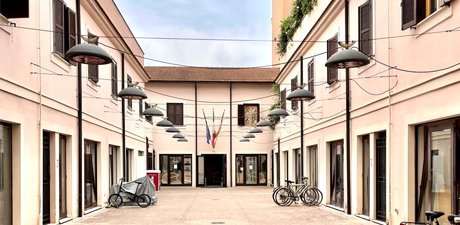
There are places in Rome that tell their own story, because they have 2,000 years of marble on them and a line of tourist buses in front of the door. And then there are places like this one: a glass door on a street in the historic outskirts, a counter, a stamp, a card with the opening hours, and inside a few tens of thousands of books that change homes every day. The Biblioteca Goffredo Mameli belongs to the second category, and for that very reason it deserves to be told properly. Because a municipal library is not a monument. It is a piece of civic infrastructure. It is the place where a city decides, concretely and not in words, whether culture is a right or a luxury.
The most honest question to ask in Rome is not "what is there to see?" but "what is there to understand?" At the Biblioteca Goffredo Mameli there is nothing to see in the tourist sense of the term: no fresco, no crypt, no ticket to buy. There is instead a great deal to understand, and three stories that intertwine in a way I find almost moving: the story of a neighborhood born from nothing at the end of the 1800s, the story of a 21-year-old boy from Genoa who died for the Roman Republic in 1849, and the story of a public library system that holds together a huge and disorderly city. Three stories that seem to have nothing to do with one another, and that instead meet exactly here, in front of a loan desk.
Biblioteca Goffredo Mameli: where it really is, and why the address matters
Let's start from the one fact on which, in my experience, people are almost always wrong. The name is misleading. Goffredo Mameli died in Rome, yes, but on the other side of the city. He was wounded on the Janiculum and died at the hospice of the Trinità dei Pellegrini, in the heart of the historic center, a few steps from Campo de' Fiori. Whoever hears "Biblioteca Goffredo Mameli" thinks almost automatically of Trastevere, of the Janiculum, of the side of the city where the memory of 1849 is carved into busts and street names. And is wrong.
The Biblioteca Goffredo Mameli is at via del Pigneto 22, postal code 00176, in Municipio V of Roma Capitale. So we are in the Pigneto, the urban area that stretches east of Porta Maggiore, just outside the Aurelian Walls, in the triangle squeezed between via Prenestina, via Casilina and via di Acqua Bullicante. Nothing to do with the hill where Mameli was hit. The name is an act of memory, not a topographical indication: a choice that, as we'll see, has a precise logic and is not at all random.
The Pigneto triangle in three vertices
If you want to picture the neighborhood without a map, keep three points in mind. The first vertex is piazzale Labicano, just outside Porta Maggiore, where the Prenestina and the Casilina part like the arms of a Y. The second is largo Preneste, where the Prenestina meets via di Acqua Bullicante. The third is piazza della Marranella, at the crossing between Acqua Bullicante and the Casilina. Draw the three lines and you have the Pigneto: an almost isosceles triangle, crossed lengthwise by via del Pigneto, which zigzags from piazza Caballini to about the middle of via di Acqua Bullicante. The Biblioteca Goffredo Mameli is in there, on the main street, at number 22.
I'll add a clarification that escapes even Romans: the Pigneto does not coincide with a single official neighborhood. Its largest part falls in Q. VII Prenestino-Labicano, a smaller portion in Q. VI Tiburtino, and administratively the whole falls within urban zone 6A Torpignattara. It is a bureaucrat's detail, but it explains why, when you ask "which neighborhood is the Pigneto in?", you find different answers and all of them, in part, right. The Pigneto is an urban area: an entity that Romans recognize perfectly well when walking through it, and that administrative maps struggle to fit into a single box.
An address that is already a lesson in urban history
Via del Pigneto: the name comes from pines. Not from a forest, mind you, but from a row. The Caballini family had planted a long row of pines along the wall of the 18th-century villa Serventi, and that row, the "pigneto," gave its name first to the place, then to the street, then to the whole neighborhood, then to an imaginary that today extends well beyond Rome. I find it beautiful that one of the most literary and cinematic neighborhoods of the city owes its name to a detail of noble gardening from the 1700s. It is the kind of underground continuity that Rome produces effortlessly and without noticing.
What the Biblioteca Goffredo Mameli is, and what it is not
Let's make it clear right away, because it is the source of most misunderstandings. The Biblioteca Goffredo Mameli is not a museum. It is not a historic conservation library, it holds no illuminated codices, it has no 17th-century reading room to photograph. It is a municipal public reading library. It is part of the Istituzione Biblioteche di Roma, the instrumental body of Roma Capitale that manages the network of the city's libraries. Its job is to lend books, offer places to study, give access to the internet, organize meetings, and keep a door open.
This means two very practical things. The first: you don't buy a ticket, because there is no ticket. Access to the Biblioteca Goffredo Mameli is free and open, as in all the libraries of the capital's system. The second: the rules are not those of a museum but those of a shared workplace. You speak quietly, you turn off ringtones, you respect other people's space, and whoever arrives early finds a seat. They are trivial rules, but it is surprising how many occasional visitors don't have them in mind.
The identification codes, for those who love precision
For those who work with catalogs, the Biblioteca Goffredo Mameli has its codes in the Servizio Bibliotecario Nazionale: RMBF1 and RM0623. They look like dry acronyms and yet they say something: they mean that the books of this neighborhood library are recorded in the same national system that describes the holdings of the great university and state libraries. A volume lent out in via del Pigneto has the same cataloging dignity as a volume kept in a grand reading room. It is a form of bibliographic democracy that is rarely talked about, and that is instead one of the most solid results of Italian library culture in the second half of the 20th century.
Contacts
The telephone of the Biblioteca Goffredo Mameli is 06 45460541. The email address is goffredomameli@bibliotechediroma.it. There is also a contact dedicated to interlibrary loan services, ill.goffredomameli@bibliotechediroma.it, where ILL stands for interlibrary loan. It serves to request volumes that aren't here and that arrive from other libraries. The head of the branch is Daniela Ukmar. It's best to phone before showing up for something specific: public libraries live on hours that can change, on closures for works, on events that temporarily occupy the rooms.
How to get to the Biblioteca Goffredo Mameli without ending up on the other side of Rome
The first rule is the one already given: don't go to the Janiculum. The second is that the Pigneto, in recent years, has become much easier to reach than it used to be, and this has changed the physiognomy of the neighborhood in a deep way.
By metro
Line C brought the metro into a quadrant that for a century moved only on trams, local trains and buses. The reference stops for the area are Pigneto and Malatesta. It is an enormous change in the daily life of the neighborhood: it means that a student who lives in Centocelle or Torre Maura can reach the Biblioteca Goffredo Mameli in a reasonable and predictable time, something that 20 years ago was not at all a given.
By urban railway
Today this route doesn't exist. According to Roma Servizi per la Mobilità the Termini-Centocelle railway has been stopped since March 4, 2026 and will not return to service, because the line will be turned into a tramway. Bus 105 runs along the same route. What follows tells of the line as it was.
There is also a small railway wonder that seems normal to Romans and like a dream to visitors: the Roma-Giardinetti, the last surviving section of the old narrow-gauge railway to the Castelli. It runs at street level along the Casilina, with stops such as Porta Maggiore, Alessi, Ponte Casilino, Sant'Elena and Villini. It is slow, it is noisy, it is anachronistic, and it is one of the most authentically Roman experiences you can have without paying anything more than an urban ticket. If you have time, arrive at the Biblioteca Goffredo Mameli this way: you'll understand the neighborhood before you even get off.
On foot from Porta Maggiore
The advice, though, is to get there on foot from Porta Maggiore. It's about a 20-minute walk, and it's 20 minutes worth a chapter of Roman history. You start from one of the densest points of the ancient city, the Claudian gate of AD 52, the superimposed aqueducts, the tomb of the baker Eurysaces, and in a few steps you enter an urban fabric of low houses, villini, courtyards and workshops born between the end of the 1800s and the early 1900s. There is no better way to understand what the Pigneto is, and so to understand what the Biblioteca Goffredo Mameli is doing there.
The Pigneto around the Biblioteca Goffredo Mameli: birth of a neighborhood
The place name "Pigneto" is attested already in the 17th century, but then it meant something quite different: a suburban countryside of vegetable gardens, vineyards and villas, outside the walls, where Romans went to do what was done outside the gate, that is eat, drink and get some air. The neighborhood as we know it begins to form from 1870, that is exactly from the year Rome becomes the capital of the Kingdom of Italy and starts to grow convulsively.
It was not born as a master plan. It was born as a sum of separate settlements that little by little touched each other. There were the Prenestino, the Torrione, the borgata Galliano, the Acqua Bullicante, the borgata Marranella, the Casilino. Each with its own identity, its trades, its parish. The Pigneto proper stood at the center of this perimeter, and ended up giving its name to the whole triangle. It is a typically Roman way of growing: by aggregation of fragments, not by design.
The horse tram depot
A curious detail of these parts. In piazza Caballini is the access to the first depot for omnibuses and trams, both animal-drawn, built by the Società Romana Tramways Omnibus between 1886 and 1891, outside the Aurelian Walls. In 1904, with the abandonment of horse-drawn vehicles and the electrification of the network, it becomes exclusively a tram depot. Translation: the Pigneto was born attached to public transport. Even before being a neighborhood of houses, it was a neighborhood of sheds, stables, workshops for the maintenance of vehicles. Its working-class identity is not an ideological label applied after the fact. It is a material consequence of where the depots were placed.
The factories
And then there are the plants, which within a few minutes of the Biblioteca Goffredo Mameli have left imposing traces. The former Pantanella pasta factory, on the Casilina, was born in 1871 as a grain-milling plant of the firm Ducco e Valle. In 1929 the Società molini e pastificio Pantanella moved in. Damaged by the war, it was rebuilt in 1950, abandoned in the 1970s and turned into a residential complex in 2001. The former Serono pharmaceutical institute, on the Casilina at the corner with piazza del Pigneto, was built between 1906 and 1909 and inaugurated on March 22, 1909 in the presence of its founder, the pharmaceutical chemist Cesare Serono. After industrial activity ceased, the building became a hotel in 2010. And finally the former SNIA Viscosa factory on the Prenestina, a plant for the production of rayon born as CISA Viscosa in 1923 and active until 1954.
Three factories, three different destinies: apartments, hotel, public park. The Pigneto is an open-air manual of what happens to a city when industry leaves. And the Biblioteca Goffredo Mameli, in the middle of this metamorphosis, is one of the few public presences that has not changed its trade.
The lake that was not supposed to exist, near the Biblioteca Goffredo Mameli
The story of the former SNIA Viscosa area, today the parco delle Energie, deserves a chapter of its own, because it is one of the most extraordinary urban stories of contemporary Rome and it happens a few minutes from the Biblioteca Goffredo Mameli.
The rayon factory opens in 1923 and closes in 1954. Decades later, a building site starts on the abandoned area. The excavations intercept an aquifer and the water starts to rise. It does not stop. In place of the planned foundations a permanent body of water forms: the former SNIA lake. A lake not designed, not wanted, born from an error of hydrogeological calculation, which within a few years fills with reeds, ducks, herons, and becomes one of the most singular urban ecosystems in Italy.
Around that lake one of the neighborhood's most tenacious civic disputes was built, carried on for years by committees of residents who claimed public use of the area. It is the kind of story that explains better than any essay what "active neighborhood" means: not a real-estate marketing formula, but people who spend decades guarding a piece of land. When I say that the Biblioteca Goffredo Mameli stands inside a living social fabric, I am thinking of this too.
Who was Goffredo Mameli, the boy who gives his name to the Biblioteca Goffredo Mameli
Now let's leave the Pigneto and go to Genoa, in 1827. Because the name of the Biblioteca Goffredo Mameli is not a neutral label. It is a piece of Italian history worth knowing in full, and not in the schoolbook version.
Goffredo Mameli dei Mannelli was born in Genoa on September 5, 1827, in the sestiere of Molo, at number 30 of via San Bernardo. The Kingdom of Sardinia. His mother is Adelaide, Adele, Zoagli (1805-1884), eldest daughter of the marquis Nicolò Zoagli and of a Lomellini woman: Genoese aristocracy of ancient rank. His father is Giorgio Mameli, a man of the sea who had embarked very young and had made his whole career from the bottom, from sailor to admiral, and was then elected deputy to the Sardinian parliament in Turin for three legislatures. A great-great-grandfather, Giommaria Mameli (1675-1751), had been a notary in Tortolì, in Ogliastra, and the emperor Charles VI of Habsburg had ennobled him, making him his own consul at the Savoy court and then honorary private secretary.
I care about these details because they take apart a comforting image. Mameli was not a boy of the people shouldering a rifle. He was the son of the best Ligurian bourgeoisie-aristocracy, with a father who was a senior officer and member of parliament. He chose revolution having everything to lose. It is a different thing, and a more interesting one.
Studies and first verses
He studied first in the Scuole Pie of Genoa, then in the college of Carcare, in the province of Savona. His literary talent shows immediately. He composes Romantic-style verses with titles that today make us smile for their adolescent solemnity: Il giovine crociato, L'amore, Il sogno della vergine, La vergine e l'amante. They are exercises, but they are the exercises of a boy who at 18 handles verse with an uncommon assurance.
September 1846: the tricolor
The turning point comes in September 1846. Genoa celebrates the centenary of the expulsion of the Austrians of 1746, the episode of Balilla, the revolt of the Portoria district, and Mameli, not yet 19, is at the head of the demonstrations and displays the tricolor. From that moment his poetry changes register. The political and military songs are born, Ai fratelli Bandiera, Dante e l'Italia, and later Dio e il popolo, which Carducci liked very much.
Il Canto degli Italiani: how the anthem that bears Mameli's name was born
In 1847 Goffredo Mameli is 20 and writes the text that will outlive him by almost two centuries. On the exact date the sources quarrel: some indicate September 10, 1847, others September 8. Among the supporters of September 8 is Giosuè Carducci, who tied the composition to a first Genoese movement for reforms and for the civic guard, and who defined the text as "the anthem of Italy, the anthem of union and independence, which resounded through all the lands and on all the battlefields of the peninsula in 1848 and 49."
The journey of the manuscript
Mameli rejects the idea of adapting his verses to already existing music. On November 10, 1847 he sends the text to Turin to be set to music by another Genoese, the composer Michele Novaro (1818-1885), who at that moment was at the home of the patriot Lorenzo Valerio. Novaro was thunderstruck and composed the melody that same evening.
The corrections that tell of the haste
The original manuscript preserves the traces of the excitement with which it was penned: Mameli wrote "Ilia" instead of "Italia" and "chiamo" instead of "chiamò." The refrain, in the first draft, began with "Siam stretti a coorte," corrected immediately by Mameli himself just above the line into "Stringiamgi a coorte," and only later rectified into the definitive and correctly spelled "Stringiamci a coorte." The first line, then, was not "Fratelli d'Italia": it was "Evviva l'Italia." Mameli changed it before sending the sheet to Novaro. It was Novaro, for his part, who added that final "Sì!" to the refrain that today we all shout in stadiums without knowing it is an addition by the musician.
I find this one of the most beautiful details of Italian cultural history. The national anthem was not born perfect and monumental. It was born with the spelling mistakes of a hurried 20-year-old, and it became what it is by passing through the pencil of another Genoese who adds an exclamation.
The public debut
On December 10, 1847, on the forecourt of the sanctuary of Nostra Signora di Loreto in the Genoese district of Oregina, the Canto degli Italiani is presented to the citizens on the occasion of the commemoration of the centenary of the Portoria revolt. It is performed by the Filarmonica Sestrese, then the municipal band of Sestri Ponente, in front of a part of the roughly 30,000 patriots gathered in Genoa for the demonstration.
The reaction of the authorities says it all. Its author being a notorious Mazzinian, the piece was banned by the Savoy police until March 1848. The Austrian police prosecuted its performance as a political crime until the end of the First World War. Singing those verses, for 70 years, could cost you dearly.
Where the autographs are
For the pedantic: the surviving autographs of Mameli are two. The first, that of the first draft, is at the Istituto mazziniano of Genoa. The second, dated November 10, 1847 and sent to Novaro, is at the Museo del Risorgimento in Turin. The autographs of Novaro's score are three: one in Turin, dedicated "To my beloved city of Turin." One in Genoa, datable to 1849. One in Milan, the one sent to the publisher Francesco Lucca on October 27, 1859.
Mazzini's criticisms
Whoever believes the anthem was received with unanimous enthusiasm will be disappointed. The first criticisms came precisely from Giuseppe Mazzini, who judged Novaro's music too little martial and did not like the text either. In 1848 he commissioned from Mameli a new song, Suona la tromba, and entrusted its music to none other than Giuseppe Verdi. The result, however, did not win Mazzini's favor either. History, as often happens, sided with the text discarded by the critics and not with the one commissioned by the leaders.
From 1946 to 2017
The Canto degli Italiani was adopted as the provisional national anthem of the Italian Republic in 1946. Provisional: and so it remained, with a thoroughly Italian tenacity, for 70 years. Only in 2017 did a law officially recognize it as the national anthem of the Republic. It took us a century and 70 years from the writing to put it in black and white. This too, if you like, is a national trait.
The 1848 of Goffredo Mameli, between Milan and the editorship of a newspaper
Whoever stops at the anthem misses the most interesting part of the biography. Mameli was not a poet writing patriotic verses from a desk. He was an organizer, a fighter and a journalist, all within the span of 24 months.
In March 1848, when Milan rises in the Five Days, Mameli is among the organizers of an expedition of 300 volunteers who set out to help Nino Bixio. For that undertaking he is enlisted in the army of Giuseppe Garibaldi with the rank of captain. He is 20.
After the failure of the Milanese uprisings and the signing of the Salasco armistice, he returns to Genoa and publishes in protest the Inno militare composed at Mazzini's invitation and set to music by Verdi. At the same time he takes over the direction of the newspaper Il Diario del Popolo, from October 16, 1848. A 21-year-old directing a political daily in one of the most turbulent cities of Europe: you'll agree that the portrait of the "poet of the anthem" is a bit reductive.
The call of Rome
In November 1848 Rome explodes. Pellegrino Rossi, minister of Pius IX, is killed, and the pope flees Rome, taking refuge in Gaeta. Mameli, as soon as he hears of the uprisings, sets out. He joins the Roman committee of the association born to promote the convening of a national constituent assembly, according to Mazzinian political precepts. In January 1849, within the Provisional Government Junta, he deals mainly with military organization.
"Roma! Repubblica! Venite!": the Roman Republic and the name of the Biblioteca Goffredo Mameli
On February 9, 1849 the Constituent Assembly proclaims the Roman Republic. It is the moment when Mameli sends to Mazzini, who is still far away, the most famous dispatch of the Italian Risorgimento, three words and three exclamation marks: "Roma! Repubblica! Venite!".
This phrase deserves a moment of attention, because it is a masterpiece of political writing. There is no adjective, no subordinate clause, no rhetoric. Three nouns and an imperative. A 21-year-old who has directed a newspaper knows perfectly well what he is doing: he is writing a headline. It is the same hand that had replaced "Evviva l'Italia" with "Fratelli d'Italia" because the second sounded better than the first. Mameli had an ear, and the ear in politics counts as much as ideas.
What the Roman Republic of 1849 really was
It is worth remembering, because at school it is dismissed in three lines, that this Republic lasted a few months and produced a Constitution that was the most advanced in Europe: it abolished the death penalty, guaranteed freedom of worship, separated temporal and spiritual power. It was approved on July 3, 1849, that is the very day the French entered the city. A document born already posthumous, and precisely for this reason become legend.
Volunteers flocked to Rome from all over the peninsula: the Genoese Goffredo Mameli, the men of Varese Enrico Dandolo and Emilio Morosini, the Milanese Luciano Manara with his Lombard bersaglieri. They were not Romans. They were boys from the North who chose to go and die for a republic in the center of Italy, in the name of an Italy that did not yet exist. It is the most surprising historical fact of 1849, the one that makes the name of the Biblioteca Goffredo Mameli something more than a plaque.
The Janiculum, June 1849: the battle in which Mameli was wounded
To understand why Mameli died in Rome you have to understand why the defense of the city was played entirely on one hill. Rome, in 1849, was not a modern fortress. To the south, east and north it was still surrounded by the Aurelian Walls, largely built between the 3rd and 6th centuries and reinforced in the 1500s, toward Porta San Sebastiano, by the bastions of Antonio da Sangallo the Younger. The most modern stretch was the western one: the Janiculum walls, which from Porta Portese climbed up to join the Vatican walls, encircling the hill.
The problem was ballistic. With 19th-century artillery, whoever held the top of the Janiculum could comfortably bombard the city below. Whoever wanted to take Rome had to take the Janiculum, and to hold the Janiculum it was not enough to garrison the walls, because the outer ground was largely at the same height as the fortifications and some villas even exceeded Porta San Pancrazio in altitude. So the outer strongpoints had to be held too: Villa Doria Pamphilj, Villa Corsini (the so-called Casino dei Quattro Venti), the Villa del Vascello.
The four invasions
Four armies moved against the Roman Republic. The first was the French one: on April 24, 1849 Louis Napoleon landed at Civitavecchia an expeditionary corps led by General Nicolas Charles Victor Oudinot, who attempted the assault on Rome on April 30 and was badly defeated, falling back to Civitavecchia and asking for reinforcements. The second was Ferdinand II of the Two Sicilies, who sent 8,500 men with 52 cannons and cavalry. They were beaten by Garibaldi in the battle of Palestrina on May 9. The third was the Austria of Radetzky, which took Livorno on May 11, Bologna on the 15th, Florence on the 25th. The fourth, a Spanish corps of 9,000 men, arrived at Gaeta too late to matter and was diverted to Umbria.
Mameli fought at Palestrina on May 9 and at Velletri on May 19, and had become Garibaldi's aide. Then he fought in the defense of Villa del Vascello on the Janiculum.
The night between June 2 and 3
Here the story turns unpleasant, and it has to be told in full. On June 1 General Roselli receives a letter signed by Oudinot setting the resumption of hostilities for the morning of June 4: "I defer the attack on the city until Monday morning at the earliest," wrote the Frenchman, justifying the delay with the need to give his compatriots who wished to leave Rome the chance to do so.
At three in the morning on June 3, shortly before dawn, the column of General Mollière, flanked by a second column led by Levaillant, blew up some mines in the enclosure of Villa Doria Pamphilj, surprising the defenders. From there it proceeded against Villa Corsini, where about 200 fugitives from the first strongpoint had taken refuge together with a few of Pietramellara's bersaglieri and Galletti's battalion. After three hours of fighting all the Roman forces had to fall back on the Villa del Vascello.
The postponement to June 4, in short, had been a ruse. General Roselli had even visited the garrisons on June 2, reassuring the defenders that an attack before the 4th was impossible. They were surprised in their sleep.
16 hours of assaults
Garibaldi was ready around five in the morning, when the villas were already lost. He brought his forces to Porta San Pancrazio and ordered the assault on Villa Corsini, aware that without that building the defense of the Janiculum was compromised. He retook it around 7:30, lost it, retook it, lost it again within an hour. In his Memorie the account is dry: "The charge was sounded, and Villa Corsini was retaken. But barely a quarter of an hour had passed and we had lost it again. This time it cost us precious blood. Masina, as I already told, was wounded in the arm, Nino Bixio had received a ball in the side, Daverio was killed."
Around nine the Lombard bersaglieri of Luciano Manara arrived, who in the first frantic hours had received contradictory orders. They occupied Casa Giacometti to provide cover, assaulted Villa Valentini and then Villa Corsini, without managing to take it. A later assault, supported by the artillery pieces placed at the Vascello, seemed to give more hope. Many Romans followed the volunteers, galvanized by a spectacle that could be seen very well from the walls. But beyond the villa the French artillery was very strong and well placed. It swept the position just conquered and forced them to flee. In that assault Angelo Masina died.
The last attempt of the late afternoon
Then came the last attack, the one of the late afternoon: half-hearted, fruitless, carried out by now out of desperation more than calculation. In that assault Emilio Dandolo and Goffredo Mameli were wounded. The bullet, or the bayonet, as we shall see, hit Mameli in the left leg.
The tally of the day is merciless. Garibaldi had at his disposal, never all together, about 6,000 men against 16,000 well deployed and provided with overabundant artillery. After 16 hours of fighting, the French were fortifying themselves at the Pamphilj and the Corsini, while the Romans remained entrenched almost only at the Vascello. The defenders lost at least 700 men: 500 between dead and wounded in Garibaldi's Italian Legion, 200 among Manara's bersaglieri. Oudinot lost between 250 and 400, plus about 15 officers.
The disputed version of the wounding
Two versions circulate of that wounding, and honesty requires reporting both. According to the first, Mameli was hit by mistake by the bayonet of a comrade in the confusion of the assault. According to the second, more widespread and more credited, he was struck by a French rifle shot. We have no way of establishing it with certainty. In either case the result doesn't change: a wound to the left leg on a day when medicine still knew nothing about antisepsis.
Trinità dei Pellegrini: the last five weeks of Goffredo Mameli
Carried by his comrades to the hospice of the Trinità dei Pellegrini, Mameli was examined and treated by the doctor Pietro Maestri. His condition appeared very grave at once. Maestri described it like this, in a letter to Agostino Bertani: "Wounded on June 3 in the first moments of the action, he was carried to the hospital senseless. I saw him after about three hours, in a state almost of stupor. He was not himself and fell into grave and frequent faints. Pale and gaunt in the face, as if he had suffered several months of illness: in the few moments when he did not lose awareness of himself he complained of spasmodic pains as a consequence of the wound."
The gangrene
The real problem was not the wound but the infection. Maestri observed the gangrene after four days. When Agostino Bertani saw the leg for the first time, on June 19, the gangrene had reached four fingers below the knee. After a consultation among doctors it was decided to amputate. The operation was performed by the surgeon Paolo Maria Baroni and judged successful by Bertani, given the modest blood loss and the correct closure of the stump.
But there was nothing to be done against the sepsis. In 1849 Lister's antisepsis was almost 20 years away and antibiotics almost a century. A 21-year-old boy with an infected leg was, quite simply, a condemned boy.
July 6, 1849, 7:30
Goffredo Mameli died on July 6, 1849 at 7:30 in the morning, at the age of 21, in the hospice of Trinità dei Pellegrini. Bertani noted in his diary: "On July 6, at half past seven in the morning, singing, almost conscious of himself, waiting for that nervous fit, as he called it, to pass, he had a few moments of agony." Nino Bixio recorded the exact hour in even drier words: "At half past seven in the morning of July 6, 1849, the great soul of Goffredo Mameli expired in Rome at the hospital of the Trinità de' Pellegrini."
His father, Rear Admiral Giorgio Mameli, rushed from Genoa to his son's bedside. He arrived too late.
There is a detail that strikes you in this story: the Republic for which Mameli had died had already fallen. The French had entered the city on July 3. Mameli died three days later, in an occupied Rome, inside a hospice in the historic center. He never knew what had happened at the end, or perhaps he knew and could do nothing about it, which is worse.
Where the man for whom the Biblioteca Goffredo Mameli is named rests today
Mameli's remains have traveled more than he did when alive. He was buried first in the church of Santa Maria in Monticelli, then in the crypt of the church of the Santissime Stimmate di San Francesco. After the capture of Porta Pia in 1870 the body was found and taken to the Verano Cemetery, where his funerary monument, a cenotaph in the great monumental cemetery of Rome, still stands today. Finally, in 1941, his remains were moved to the Mausoleo Ossario Garibaldino on the Janiculum, where they rest.
The Mausoleo Ossario Garibaldino
It is worth explaining what that mausoleum is, because it is one of the least visited and densest places in Rome. It stands on the hill where between April 30 and the first days of July 1849 the last defense of the Roman Republic took place, and it gathers the remains of those who fell in the battles for Rome as capital from 1849 to 1870.
The story begins right after Porta Pia. A committee chaired by Menotti Garibaldi, with the support of his father, set about searching for the bones of the fallen, scattered among the Verano, the sites of the battles near the Walls, Villa Borghese, the Giustiniana and some vineyards between San Pancrazio and Porta Maggiore. The bill was presented by the deputy Cairoli and declared urgent by the deputy Avezzana. Law no. 4936 was approved on June 22, 1879 and published in the Gazzetta Ufficiale on June 28. The text authorized the Government "to allow the bones to be gathered on the Janiculum of those who died fighting in the defense of 1849 or were shot after the surrender of the city, or fell for the liberation of 1870." The first burials took place in 1879 itself, others in 1884.
The mausoleum seen today dates instead from the 1930s. Designed and built by the architect Giovanni Jacobucci (1895-1970) at the wish of the Società Reduci delle patrie battaglie on a proposal by Ezio Garibaldi, it was inaugurated on November 3, 1941 after two years of work. It is an altar surrounded by a travertine quadriporticus, with three round arches per side and no roof. The altar is carved from a single block of red Baveno granite, from Lake Maggiore, and bears allegorical figures in an ancient Roman taste: the Capitoline she-wolf with the S.P.Q.R. scroll, the imperial eagle, lion heads, gladii, shields and legionary standards. It is an explicit way of saying that the Roman Republic of 1849 looked back to the ancient Roman Republic.
On the pedestals the battles are recalled: 1849 Vascello, San Pancrazio, Palestrina, Velletri, Monti Parioli, Villa Spada. 1862 Aspromonte. 1867 Monterotondo, Mentana, Villa Glori, Casa Ajani. 1870 Porta Pia, San Pancrazio. On the attic of the main facade is carved "To those who fell for Rome 1849-1870" and the motto "Roma o morte." At the corners, monolithic travertine pillars support bronze braziers decorated with wolf heads, which are still lit during official ceremonies.
The bust on the Janiculum
On the Janiculum there is also a bust of Goffredo Mameli, one of the many that flank the great equestrian monument to Garibaldi along the avenue. If you pass by, stop and look at it with the right eye: under that 19th-century bronze there is a boy who at 21 had already written the national anthem, directed a newspaper, commanded men in battle and died. It is not a statue. It is an interrupted curriculum.
The museum at Porta San Pancrazio
If this story has taken hold of you, there is the right place to explore it further: the Museo della Repubblica Romana e della memoria garibaldina, housed inside Porta San Pancrazio, in the rione Trastevere, on the exact scene of the 1849 fighting. It is part of the Musei in Comune circuit of Roma Capitale and was inaugurated on March 17, 2011 by the President of the Republic Giorgio Napolitano, on the occasion of the 150th anniversary of Italian Unification. It is a small and well-made museum. The visit takes an hour and gives back the sense of those weeks better than any textbook.
Why a library in the Pigneto bears the name of Goffredo Mameli
At this point the question is legitimate: what does a Genoese patriot who died in the historic center have to do with a neighborhood library on the east outskirts?
The answer lies in the grammar of Italian street naming. In post-unification and then republican Italy, naming streets, schools and libraries after the protagonists of the Risorgimento was one of the ways the State built a shared national identity. There did not need to be a geographical link. There needed to be a symbolic one. And the Pigneto, a working-class and antifascist neighborhood, with a very strong labor tradition and memory of the Resistance, is exactly the kind of place where naming something after a republican Mazzinian who died at 21 for a Republic has a political meaning and not just a decorative one.
Then there is a subtler coherence, and I find it the most beautiful. Mameli was a boy who believed the written word was a weapon. He wrote verses, directed newspapers, and considered the spreading of ideas a revolutionary act. A free public library, where anyone can walk in without paying and take books home, is the most peaceful and most lasting form of the same conviction. The Biblioteca Goffredo Mameli does not celebrate the fighter. It celebrates the writer who thought that reading changed people.
Who can enter the Biblioteca Goffredo Mameli, and how registration works
Let's return to the present and to practical things, because this is where the most common misunderstandings nest. Many visitors, especially foreigners but also quite a few Romans, take for granted that a municipal library is reserved for residents, or students, or those with some particular qualification. It isn't.
Entry to the Biblioteca Goffredo Mameli is free and open to anyone. You can walk in, sit down, consult the volumes on the open shelves, read a newspaper, use the study room. You don't need a card to enter. The card is for taking books home.
The Bibliocard
Registration with the Biblioteche di Roma system is done through the Bibliocard. Basic registration is free, can be done online through the system's portal or at the desk of any library in the network, and is valid for one year. With it you access the related services offered by the city's libraries: lending, reservations, a personal online space, wi-fi.
There is also a Bibliocard plus, which can be bought online after registration and the first access to your personal space, which involves paying an annual membership fee and entitles you to further services and benefits: discounts and agreements with theaters, events and partner shops. It is an optional card. Nobody is obliged to get it, and all the essential services of the Biblioteca Goffredo Mameli remain accessible with the free registration alone.
What documents you need
For registration you need your personal data, your tax code and the details of an identity document. For minors, you fill in the form with the minor's data and the contact details of the parent or guardian, also giving the details of the latter's document. It is a 10-minute procedure, not a public competition, but keep in mind that the staff must verify the data and that at peak hours there is a line.
The practical advice
If you are in Rome for a few months, an Erasmus student, a researcher, a worker on assignment, register on the first available day. The card is single for the whole system. It means you register once and can borrow and return books in any library of the capital's network. Almost nobody knows this, and it is probably the best cultural deal available in this city.
Lending at the Biblioteca Goffredo Mameli: how it really works
Lending is the heart of the trade. At the Biblioteca Goffredo Mameli it works on three levels, which is worth distinguishing because many users know only the first.
Local lending
This is the obvious one: I take a book from the shelves of this library, take it home, bring it back by the due date. The capital's system works largely on open shelves, which means you can wander between the sections, leaf through, change your mind. It is a freedom that conservation libraries do not grant and that completely changes the experience: you discover by contiguity, you find what you weren't looking for.
Intersystem lending
This is the level that makes the system a true network. If the volume you need is not at the Biblioteca Goffredo Mameli but is in another municipal library of Rome, you can request its transfer. The book travels and you pick it up here. You don't have to cross the city. It does. This service, banal to say, is what turns dozens of neighborhood libraries into a single large library distributed over an enormous territory.
Interlibrary lending
The third level, the interlibrary loan, goes beyond the municipal boundaries: you request volumes from other Italian libraries, and in some cases you obtain reproductions of articles. That is why the dedicated address ill.goffredomameli@bibliotechediroma.it exists. It is a service that takes time and has its own rules, but it is the entry door to an entire national heritage from a desk in via del Pigneto. If you are writing a thesis and need a volume you can't find, ask. It is exactly the case the service exists for.
The unwritten rules of lending
Here are the things that are not in the regulations. First: respect the due dates, because delays block the chain and penalize whoever reserved after you. Second: if you have finished early, return early, don't keep the book on your nightstand on principle. Third: if you need a volume and it is on loan, reserve it instead of coming back to check every week. Fourth: purchase suggestions exist and are read. If an important book is missing, point it out. The collections of public libraries are built this way too, from below.
The study room of the Biblioteca Goffredo Mameli: 48 seats and an ethic
One of the most requested services, and one of the most misunderstood. The Biblioteca Goffredo Mameli has a study and coworking space with 48 indoor seats and 40 open seats. These are numbers to read carefully: in a densely populated neighborhood, with many students from out of town and many self-employed workers, 88 seats in total are a contested resource.
How to behave
First rule: arrive early. In exam session weeks, January-February, June-July, September, the seats are gone within the first hour of opening. Second rule: you don't hold a seat with a backpack and leave for three hours. It is a widespread and rude practice, and whoever does it effectively reduces the capacity of the room. Third rule: you take the phone outside. Fourth: the laptop with the noisy fan bothers more than you think.
Why the study room is a political service
A digression is worthwhile, because it is the central point of the whole discussion. A seat in a study room is not a comfort. It is a leveler of inequalities. There are kids who study in a kitchen with the television on, in a room shared with two siblings, in apartments without decent heating in winter. For them a quiet table with a power outlet and a connection is not an accessory service. It is the difference between taking the exam and not taking it.
The reason for telling a neighborhood library with the same care reserved for a basilica is this. The Biblioteca Goffredo Mameli is a piece of social infrastructure that produces measurable results in people's lives. Basilicas produce wonder, which is splendid. Libraries produce degrees, work contracts and curiosity. They are two different things and both are needed.
The children's section of the Biblioteca Goffredo Mameli
The section dedicated to children and teenagers is, in Rome's municipal libraries, often the most vital, and the Biblioteca Goffredo Mameli is no exception. Here you find picture books, fiction by age group, comics, popular nonfiction, and above all a program of activities that goes well beyond lending.
Age groups and reading suggestions
The library curates thematic selections designed for precise ages: new titles for the 6-13 age group, reading for girls and boys aged 12-18, seasonal bibliographies for the holidays. These lists are a precious and underrated service. Behind them is the work of librarians who read, evaluate and select, that is who do a job that no recommendation algorithm performs with the same quality.
The Biblioteca Goffredo Mameli has also taken part in awareness campaigns with dedicated thematic selections, including lists of books for children and teenagers tied to campaigns on the themes of peace and the rejection of war. These are choices that some will judge partisan. In our judgment they are simply consistent with the educational function of a public library, which is not a supermarket of titles but a place that makes proposals.
Why bring children here
If you have small children and are in Rome for a few days, know that a children's section in a municipal library is one of the few indoor, free and non-commercial places where a child can stay without anyone being asked to consume. On a rainy Roman afternoon, this information is worth more than many guides.
Periodicals room, digital newsstand and online library of the Biblioteca Goffredo Mameli
A chapter that in the 21st century weighs as much as the physical shelves. With registration in the system you access a digital library that includes e-books and a digital newsstand: newspapers and periodicals that can be consulted in electronic format.
What this means in practice
It means that with your card you can read the national and international press from your sofa at home, borrow electronic books with automatic expiry, and use resources that a single person could not afford to buy. It is the kind of service for which, if offered by a private subscription, we would gladly pay a few tens of euros a month. It is included in the free registration with the public library and almost nobody uses it.
An honest warning
Digital catalogs change over time: platforms are renewed, contracts with publishers change, some resources come and go. Don't take any list of titles as definitive. The sensible thing is to ask at the library what is active right now, or check directly on the system's portal. The staff of the Biblioteca Goffredo Mameli do exactly this job and do it gladly. Asking is not disturbing.
The reading groups of the Biblioteca Goffredo Mameli
If I had to name the activity that best tells the soul of this branch, I would name the reading groups. At the Biblioteca Goffredo Mameli there are two, and they are not the same thing.
The Goffredo Mameli Reading Circle
This is the library's historic group, which meets periodically to discuss a book chosen together. It has an in-house contact person who looks after its calendar and contacts. It works the way good reading groups work: someone proposes, everyone reads in the same month, you meet and argue civilly. You don't need to be a literary critic. You need to have read.
The Igiaba Scego Book Club
The second group is named after Igiaba Scego, an Italian writer of Somali origin born in Rome, author of books that have changed the way this country tells its colonial past. That a book club of a library in the Pigneto bears her name says a lot about the neighborhood and the library. It says that here contemporary Italian literature is not only that of the canonical names, and that the theme of plural identity is at home. In an urban area where third-generation Roman families live alongside Bangladeshi, Chinese, Romanian and North African communities, it is not a decorative detail. It is the real portrait of the public that walks through that door.
How to take part
The reading groups of Rome's municipal libraries are generally open and free. You show up, ask at the desk, and are added to the contact list. The meetings have their own frequency and hours, often in the late afternoon. The practical advice is to write to the library to learn the updated calendar, because like all activities based on cultural volunteering the groups follow the rhythms of the people who run them.
Officina Pigneto and the programs of the Biblioteca Goffredo Mameli
This library does not limit itself to lending books. It produces cultural programming. The series that bears the name of the neighborhood, Officina Pigneto, has over time reached many editions and brings to the library meetings with authors, presentations, staged readings, with the participation of well-known faces of Italian theater and cinema as well.
The comics festival
Among the events that the Biblioteca Goffredo Mameli hosts there is also a festival dedicated to comics by women authors, with workshops and meetings held over several days. Comics in a library is still today, in Italy, a small cultural battle. There are those who consider it a minor material and those who, rightly, treat it as an adult and complex language with its own critical history. The fact that a municipal library hosts comics workshops, and not only shelves of comics, points to a precise choice of side.
Literature and childhood
The library also hosts events of the children's section of Roman literary festivals, with readings, meetings and workshops concentrated in a few days. It is the kind of event that fills the children's room and that, for those who live in the neighborhood, marks the autumn calendar more than many events in the center do.
What it is like at an event in a library
Whoever has never been imagines orderly audiences and working microphones. The reality of a meeting in a neighborhood library is more beautiful and more chaotic: chairs added at the last minute, people standing at the back, someone who comes in halfway because they happened to pass by, questions from the audience that go off topic and now and then hit the target better than the moderator's. If you happen to be in Rome at a time when the Biblioteca Goffredo Mameli has a meeting scheduled, go. It is a city experience that no organized tour will give you.
The Biblioteche di Roma system, of which the Biblioteca Goffredo Mameli is part
A Roman municipal library cannot be understood without understanding the network it belongs to. The Istituzione Biblioteche di Roma is the instrumental body of Roma Capitale that manages the city's libraries: dozens of branches distributed across all the municipi, from the center to the farthest outskirts, with a single catalog and a single card.
What "single catalog" means
It means that when you search for a title on the system's portal you see all the copies available in all the branches, with their status: available, on loan, reservable. It means you can decide whether to go and get it where it is or have it sent to the Biblioteca Goffredo Mameli. It means, in the end, that the public book heritage of the city is treated as a single asset, not as the sum of many small fiefdoms.
Why the outskirts have the most interesting libraries
I'll make an observation that may seem provocative. The most interesting libraries in Rome, from the social point of view, are not those of the center. They are those of the neighborhoods. In the historic center a library competes with museums, churches, bookshops, cafés, and becomes one of many cultural offerings. In a neighborhood like the Pigneto, or in Torpignattara, Quarticciolo, Tor Sapienza, the municipal library is often the public cultural presence. Not one among many: the one. This radically changes its weight and its meaning.
In Municipio V alone, besides the Biblioteca Goffredo Mameli, there are other branches of the system: the Teatro Biblioteca Quarticciolo complex on via Castellaneta, the library named after Gianni Rodari on via Francesco Tovaglieri, the Lorenzo Lodi on via di Tor Sapienza, located inside a technical institute, and the Penazzato on via Dino Penazzato. Five outposts for a vast and very populous territory. They are few, when you think about it. And that is precisely why each of them counts so much.
Bibliopoint: when the Biblioteca Goffredo Mameli leaves the library
There is an idea in the Roman library system that deserves to be explained because it is among the smartest of the last 20 years: the Bibliopoint.
What it is
A Bibliopoint is a school library that, thanks to an agreement between the school and the Istituzione Biblioteche di Roma, is opened to the neighborhood public at set hours. The school provides the space and the holdings. The library system provides technical, cataloging and training support. The volunteers, often teachers, parents, students, provide the hours.
Why it is a brilliant idea
Because it solves three problems with one move. First: it multiplies the access points to reading in a city where opening new library branches costs a great deal. Second: it makes useful a school book collection that for decades stayed locked in dusty cupboards. Third, and most important: it involves students in the management, which means that kids learn to catalog, to lend, to staff the desk. There is no better way to make a teenager understand what a library is than to put them on the other side of the counter.
The relationship with the neighborhood schools
The Biblioteca Goffredo Mameli, like the other municipal branches, regularly works with the schools of the area: class visits, reading promotion programs, workshops. It is work invisible to those who have no children of school age and that instead represents an enormous share of the daily activity of a neighborhood library. When you see a line of children walking two by two into via del Pigneto around 10 in the morning, know that this is the library at work as much as the lending desk is.
Wi-fi, accessibility and practical services of the Biblioteca Goffredo Mameli
Let's move on to the information that is really needed by those who have to go there.
The connection
The Biblioteca Goffredo Mameli offers wi-fi in the indoor spaces and in the outdoor spaces. Access uses the same credentials and the same password as your registration with the Biblioteche di Roma system. From a computer you use the Bibliowifi network, from a smartphone the Bibliosmart network. No voucher to collect at the desk, no password of the day written on a slip of paper: the credentials are yours and are valid across the whole city network.
I'll add a detail I appreciate a lot: the coverage of the outdoor spaces too. It means that in the mid-seasons you can stay outside to work, and it means that someone can connect even when the room is full. It is a small thing that widens the service more than it seems.
Accessibility
The branch is declared as having full access for people with disabilities. In the Roman landscape, where very many public buildings, for historical reasons and because of decades of postponed maintenance, present barriers of every kind, this is a fact to be noted with satisfaction. If you have particular needs, phoning beforehand is still the wisest choice: the staff will be able to point out the best route and the least crowded hours.
Internet stations
Like all the libraries of the system, the Biblioteca Goffredo Mameli provides computer stations. It is a service that seems outdated to many in the era of smartphones and that instead remains essential: there is a substantial part of the population, elderly people, migrants, people in economic difficulty, who have no computer at home and who today, with a digitized public administration, need a computer to do elementary things. The public library is often the only place where they can do them without paying.
Opening hours of the Biblioteca Goffredo Mameli and how to read them
The opening hours of the Biblioteca Goffredo Mameli follow the typical scheme of Rome's municipal libraries: afternoon opening on Monday, a full day from Tuesday to Thursday, a long morning on Friday, half a day on Saturday, closed on Sunday. In concrete terms, in the ordinary calendar, on Monday it opens in the early afternoon and closes in the evening. From Tuesday to Thursday it covers the whole span from 9:00 to 19:00. On Friday it closes in the early afternoon. On Saturday it works only in the morning.
The summer closures
Like all the branches of the system, the Biblioteca Goffredo Mameli observes a closing period in the second half of August, with possible additional closures of individual Saturdays in the hottest months. Anyone who arrives in Rome at Ferragosto and counts on finding a municipal library open will be disappointed. It is the moment of the year when the city truly stops.
The advice on hours
Never trust an hour read on just any page, not even this one. The hours of public libraries change: for building works, for staff shortages, for reorganizations, for events. Before crossing Rome to go to via del Pigneto, take two minutes to check on the official portal of the system, bibliotechediroma.it, or phone. It holds for the Biblioteca Goffredo Mameli as for any other public service in this city.
The Pigneto of cinema, a short walk from the Biblioteca Goffredo Mameli
If there is one reason why the name "Pigneto" is known even to those who have never been to Rome, that reason is cinema. And the places are all within a few minutes' walk of the Biblioteca Goffredo Mameli.
Roberto Rossellini and Anna Magnani's run
The central scene of Roberto Rossellini's Roma città aperta, shot in 1945, Pina's run after the truck carrying off her husband, captured by the Germans, and the burst of gunfire that kills her in the middle of the street, was shot on via Raimondo Montecuccoli, in the Prenestino-Labicano neighborhood. That is, here. On an ordinary street of the Pigneto, as wide as all the others, with the low buildings of the 1920s and 1930s.
It is one of the most famous sequences in the history of Italian cinema and perhaps of world cinema, and there is a detail I love to tell: in the two shots with which it was filmed, Anna Magnani fell too early compared to what was planned. The imperfection stayed in the film. That desperate run that defined neorealism for 70 years contains a synchronization error, and nobody ever noticed because the truth of the performance overwrote the editing.
Go there. There is nothing to see, in the sense that the street is just a street. But standing on some ordinary asphalt knowing that that long take was shot there is an experience that the historic center of Rome, with all its marble, cannot give you.
Pier Paolo Pasolini and Accattone
16 years later, in 1961, Pier Paolo Pasolini shot his first film here, Accattone. The crew, with a very young Bernardo Bertolucci as assistant director, moved among the symbolic places of the Roman periphery: via Casilina, the Portuense, the Appia Antica, the Tiburtina, Ponte Testaccio, the borgata Gordiani, Centocelle, the Marranella. And the Pigneto, which is the visual heart of that film.
Pasolini defined this belt of the city with a formula that has stuck: "the crown of thorns that girds the city of God." It is a terrible and perfect image. The borgate as a crown of thorns around a papal and monumental Rome that ignored them. The Pigneto of that time was exactly this: poverty, shacks, dust, boys without work, a humanity that official cinema had never brought into focus.
What happened afterward
Today's Pigneto is not Pasolini's, and it would be dishonest to pretend otherwise. The relative proximity to the Sapienza has made it a neighborhood of out-of-town students. The pedestrianization of a stretch of via del Pigneto, begun in 2015, has increased the number of visitors. Bars, restaurants and nightlife have changed the face of the evenings. The neighborhood has become one of the most frequented centers of the capital's nightlife.
Opinions in the neighborhood are divided on this transformation, and it is not for me to arbitrate. I only observe a fact: in an area under pressures of this kind, a free and non-commercial public service like the Biblioteca Goffredo Mameli takes on further value. It is one of the few places where you can stay for hours without anyone asking you to order something. In a neighborhood turning into a shop window, the library remains a piece of city that sells nothing.
The cinema that came back
A story worth knowing: in 1996 the cinema L'Aquila del Pigneto was confiscated from the Banda della Magliana. It remained closed for years, then was renovated and given back to the neighborhood as a public hall. A property that passed from organized crime to the screening of auteur films is an urban parable almost too perfect to be true. And yet it is true, and it is a few minutes from the Biblioteca Goffredo Mameli.
The antiquities around the Biblioteca Goffredo Mameli
Whoever believes that ancient Rome ends when you leave the Aurelian Walls is badly mistaken. The perimeter of the Pigneto is scattered with monuments that in any other European city would be top attractions.
Porta Maggiore
The western vertex of the triangle. The gate, from AD 52, was in fact not born as a gate but as a monumental crossing of the Claudian and Anio Novus aqueducts over the two consular roads. The Aurelian Walls, two centuries later, absorbed it, turning it into a city gate. It is one of the best-preserved spectacles of hydraulic engineering in the world, and we drive past it without looking.
The tomb of Eurysaces
At piazzale Labicano, leaning against the gate, is the monument I prefer in all of Rome: the tomb of Marcus Vergilius Eurysaces, baker, datable to around 30 BC. A freedman who got rich with bread built himself a tomb decorated with what most scholars interpret as the vessels for kneading dough, and had a frieze carved on it with the phases of bread-making. An entrepreneur who has himself buried inside his own trade, without shame and without aristocratic camouflage. If you are looking for an ancestor of the European productive bourgeoisie, it is there, 200 meters from the Casilina.
The Neopythagorean underground basilica
Also at piazzale Labicano, at the beginning of via Prenestina, is the underground basilica of Porta Maggiore, from the 1st century AD: a hypogeal room with white stuccoes of extraordinary refinement, attributed to a Neopythagorean milieu. It was discovered by chance in 1917 during works on the railway line. It can be visited only in particular ways and exceptionally, so don't take it as a guaranteed stop. But knowing that it exists, a 15-minute walk from the Biblioteca Goffredo Mameli, gives the measure of the layering of this area.
The Torrione prenestino and the tomb at largo Preneste
At the second mile of via Prenestina stands the Torrione prenestino, a mausoleum of the 1st century BC turned into a tower in the Middle Ages, which survives embedded in a modern building fabric with an almost comic dignity. At the third mile, at largo Preneste, there is another tomb, from the 2nd century. The extra-urban stretch of the consular roads was a continuous necropolis: the Romans buried along the roads because the law required it and because the tomb had to be seen by travelers.
The Ecomuseo Casilino
The whole territory of the Pigneto is included in the Ecomuseo Casilino ad Duas Lauros, an urban ecomuseum project that holds together archaeology, landscape, industrial memory and social memory of this quadrant. It is a different way of thinking about heritage: not a list of monuments to fence off, but a territory to be read. The Biblioteca Goffredo Mameli stands inside this reading, and it is coherent that it does.
Churches, villas and architectural curiosities near the Biblioteca Goffredo Mameli
The Pigneto has no basilicas, but it has a 20th-century heritage that those who know how to look appreciate very much.
The 20th-century churches
The church of Sant'Elena on via Casilina, of 1913-14, which also gave its name to a cardinal title. The church of San Leone I on the Prenestina, of 1950-52. The church of San Luca Evangelista, of 1955-56. The church of San Barnaba on via Giovanni Maggi, of 1956-57. Four churches in 40 years: it is the snapshot of a neighborhood growing at an accelerated pace and needing parishes, that is, in the Italy of that time, gathering centers as well as places of worship.
A villa by Michelucci
At the crossing of via Conte di Carmagnola and via Romanello da Forlì is Villa Valiani, of 1929-30, designed by Giovanni Michelucci. Yes, that Michelucci: the architect of the Santa Maria Novella station in Florence and of the Church of the Autostrada del Sole. An early work by one of the masters of Italian 20th-century architecture, on a side street of the Pigneto. Walk past it: there is no plaque, no ticket office, nobody photographing it.
The hypogeum under a bar
And then there is the most amusing curiosity. Under one of the historic venues on via Fanfulla da Lodi, in the pedestrian heart of the neighborhood, an underground hypogeum has been identified, with tunnels that tell of the ancient presence of quarries. Because under via del Pigneto, in fact, an ancient quarry also opens up: the subsoil of this area was dug out to extract building materials, like so much of the Roman periphery. Above you drink a coffee, below there is a hole in the geological and industrial history of the city.
The street names of the Pigneto: the streets around the Biblioteca Goffredo Mameli
Here is a game I recommend to anyone who comes to these parts, and which makes the walk toward the Biblioteca Goffredo Mameli much more fun. The street names of the Pigneto are organized in three thematic systems, and once you know it you can't stop noticing.
The Italian cities
In the triangle bounded by via Prenestina, by the circonvallazione Casilina and by via Casilina, the streets bear the names of Italian cities. Via l'Aquila, for example, which also gives its name to the neighborhood's cinema.
The captains of fortune
In the quadrilateral between via Prenestina, via di Acqua Bullicante, via del Pigneto and the circonvallazione Casilina, the streets are dedicated to Italian war captains and condottieri of the period between 1330 and 1550. Some of them took part in the Challenge of Barletta, others in the battle of Anghiari. Hence via Fanfulla da Lodi, via Braccio da Montone, via Romanello da Forlì, via Conte di Carmagnola, via Raimondo Montecuccoli, yes, the very street of Roma città aperta.
The detail is splendid: the most famous scene of Italian neorealism, the film that told the Roman Resistance to the world, was shot on a street named after a 17th-century general. Nobody did it on purpose. But the result is that the Pigneto overlays three and a half centuries of Italian military history in a single frame.
The geographers and cartographers
In the last quadrilateral, between via del Pigneto, via di Acqua Bullicante, via Casilina and the circonvallazione Casilina, the streets are dedicated to geographers, cartographers and engravers. Via Vincenzo Coronelli, for example, dedicated to the great Venetian cosmographer of globes, where you also find the Museo storico didattico di giochi e giocattoli del Novecento.
To sum up: around the Biblioteca Goffredo Mameli you walk among cities, condottieri and cartographers. It is not a bad way to go and get a book.
The memory of the war around the Biblioteca Goffredo Mameli
There is a chapter that the Pigneto does not forget and that has to be told. Working class in its social makeup like San Lorenzo, the neighborhood was very active in antifascism and, like San Lorenzo, suffered the Allied bombings of 1943 and 1944. In those bombings, among others, 50 ATAC employees died: the men of the depots, that is the professional backbone of the neighborhood since its foundation.
The memory trail
In the fabric of the neighborhood there are plaques and stops of a memory trail dedicated to the victims and protagonists of those years. They are not imposing monuments. They are plaques on walls, often at eye level, often in front of just any doorway. It is the way Rome remembers when it remembers seriously, without rhetoric.
An ANPI branch named after Giorgio Marincola
The local branch of the Associazione Nazionale Partigiani d'Italia of Pigneto-Torpignattara is named after Giorgio Marincola. It is worth explaining who he was, because his story is extraordinary and little known: the son of an Italian man and a Somali woman, born in Somalia and raised in Italy, a medical student, a partisan, killed in 1945 in Val di Fiemme a few days before the end of the war. A Black Italian partisan, in a country that had just finished telling itself it was a pure race. That a Pigneto branch bears his name is, once again, the exact portrait of this neighborhood.
The thread linking 1849 to 1944
And here the circle closes, and you understand why naming the library after Goffredo Mameli is not arbitrary. The Genoese boy who in 1849 died defending a Republic from the French army, and the depot workers who in 1944 died under the bombs in an antifascist neighborhood, belong to the same long story: that of those who thought Italy should be something different from what it was. The Biblioteca Goffredo Mameli stands in the middle of this story, and does so in the mildest possible way: by keeping a reading room open.
A half-day itinerary with the Biblioteca Goffredo Mameli at the center
Here is how to build the itinerary to see a Rome that is not the postcard one.
First stop: Porta Maggiore
You start from piazzale Labicano. A good half hour to look at the Claudian gate, the superimposed aqueducts, the tomb of Eurysaces with its bread-making frieze, and to understand where walled Rome ended and where the rest began.
Second stop: the walk along the Casilina
20 minutes on foot heading east, with an eye on the large industrial complexes abandoned and converted. The Pantanella, the Serono. Those with legs and curiosity can detour along the Prenestina to the parco delle Energie and the former SNIA lake.
Third stop: the Biblioteca Goffredo Mameli
You arrive at via del Pigneto 22 and go in. Not to take photographs, but to stay inside for 20 minutes: look at the full study room, the children's section, the events board, the signs with the hours, the people at the desk. It is the only stop on the itinerary where there is nothing ancient, and it is the one that explains today's city.
Fourth stop: the streets of cinema
Leaving the Biblioteca Goffredo Mameli, you take via Fanfulla da Lodi and arrive at via Raimondo Montecuccoli. 10 minutes in all, and meanwhile you cross the pedestrian stretch with its venues and its signs.
Fifth stop: the café
To close, a pause. The Pigneto has a density of cafés and small venues that the historic center can only dream of, and with prices that the historic center has forgotten. Sit down, order, watch who passes. The Pigneto should be observed standing still.
A second itinerary: from the Biblioteca Goffredo Mameli to Mameli's Janiculum
For those with a full day who want to close the circle between the name and the place, I propose a more ambitious itinerary: start from the library and end where Mameli died and where he rests.
Morning: the library and the neighborhood
You start from the Biblioteca Goffredo Mameli, with the walk through the neighborhood described above. It is right to start from here: from the present, from a living service, from an open door.
Midday: the Trinità dei Pellegrini
You cross the city toward the historic center and reach the church of the Santissima Trinità dei Pellegrini, in the square of the same name between via Giulia and Campo de' Fiori. Here, in the adjoining hospice, Mameli died on July 6, 1849. On the facade of the building there is a plaque that recalls the episode. It is a quiet, side place, ignored by all the tourist flows that pass 50 meters away. Stop for five minutes: it is the room in which a 21-year-old boy understood he would not make it.
Afternoon: Porta San Pancrazio and the museum
You climb toward the Janiculum and reach Porta San Pancrazio, home to the Museo della Repubblica Romana e della memoria garibaldina. An hour's visit to reconstruct the siege of 1849 in its military and political details.
Late afternoon: the Vascello, the Corsini, the mausoleum
Leaving the museum, you are already on the battlefield. The Villa del Vascello is there, on the other side of the street, with the scars of the French bombardments still readable. A little further, inside Villa Doria Pamphilj, is the arch of the Casino dei Quattro Venti, what remains of Villa Corsini: the building for which Garibaldi sent his men to the assault six or seven times in one day, and where Mameli was wounded.
You end at the Mausoleo Ossario Garibaldino, where Mameli's remains have rested since 1941, and then at the bust along the Janiculum promenade. If you get there at sunset, with Rome below, you will understand perfectly why in 1849 whoever held that hill held the city.
Common mistakes about the Biblioteca Goffredo Mameli
I gather here the misunderstandings I hear most often, to get them out of the way once and for all.
"It's in Trastevere"
No. It's in the Pigneto, Municipio V, via del Pigneto 22. The association with Trastevere and the Janiculum comes from Mameli's biography, not from the geography of the library.
"You have to book"
To enter, no. For the study room, in particular periods, there may be ways of managing the seats: ask at the time. For events, often yes, because capacity is limited.
"You need Rome residency"
No. Registration with the system is open to anyone, Roman or not, Italian or not.
"It's a historic library with manuscripts"
No. It is a public reading library. If you are looking for Risorgimento autograph manuscripts by Mameli, you have to go to Genoa or Turin, as explained: they are not here, and it is not a flaw, it is simply another trade.
"It's always empty anyway"
Quite the opposite. In exam sessions the study room fills within the first hour. Whoever imagines deserted public libraries hasn't been to one in 20 years.
Biblioteca Goffredo Mameli for those who study, for those who work, for those with children
If you have to study
Arrive at opening, bring the bare minimum, take into account that someone has already taken the best seat. Make the most of the fact that you are surrounded by books: if during review you need a manual, it is 10 meters away. It is the structural advantage of studying in a library instead of in any old study room.
If you work remotely
The Biblioteca Goffredo Mameli offers wi-fi and stations, but remember that a library is not an office: calls are made outside, video conferences are not made at all. If your work requires talking, this is not the right place, and nobody will tell you politely the second time.
If you have children
The children's section is designed for them and activities for childhood are frequent. Check the calendar before coming: many initiatives require registration because the places are counted.
If you are passing through Rome
Go in anyway. Five minutes are enough to understand something about this city that no museum will tell you: that Rome is not only a depot of ruins, but a European capital with a system of public services that works, laboriously, every day.
A curiosity about the Biblioteca Goffredo Mameli
The curiosity I like best concerns an overlap of names that nobody planned and that is delightful. The library is named after a man who in 1847 wrote the verses "Fratelli d'Italia, l'Italia s'è desta," that is a text that imagines a single and compact people. And it stands in a neighborhood where, today, people speak Italian, Romanesco, Bengali, Chinese, Romanian, Arabic, Spanish and half a dozen other languages every day.
It is not a contradiction. It is an update. Mameli's "we" was the "we" possible in 1847, when Italians did not yet exist as a nation and had to be invented. The "we" of the Pigneto in the 21st century is something else, more complicated to define and just as real. That inside that library there operates a reading group named after an Italian writer of Somali origin seems the most intelligent possible continuation of Mameli's project, not its betrayal. He wanted strangers to recognize each other as brothers on the basis of a language and a shared idea. It is still being done, with other protagonists.
I'll add a second curiosity, a lighter one. The anthem Mameli wrote was judged "too little martial" by Giuseppe Mazzini, who commissioned a replacement from him and entrusted its music to Giuseppe Verdi. The Verdi replacement is known today to a few hundred specialists. The piece discarded by the movement's most authoritative critic is the national anthem of the Italian Republic. It is the most effective reminder I know of the relative value of authoritative opinions, and I find it perfect that it is kept, in the form of a dedication, in a place where every day someone chooses what to read trusting their own judgment.
One thing nobody tells you about the Biblioteca Goffredo Mameli
Nobody will tell you that the Biblioteca Goffredo Mameli, like all public neighborhood libraries, does a daily job of social assistance that appears in no job description. Roman librarians don't like to talk about it, because it is not their official trade and because they fear that saying it would sound like a complaint. But it is so.
In a municipal library on the outskirts, every day, people come in who are not looking for a book. They are looking for a computer to fill in an online application, because the public administration has digitized everything and they have neither the device nor the skills. They are looking for a warm place in winter and a cool one in summer. They are looking for someone to explain a word in a bureaucratic letter. They are looking, simply, for a place to be without having to consume, which in the contemporary city has become very rare. And the librarians, who were hired to catalog and lend, end up doing this too, on top of everything else and without anyone counting it.
There are two reasons. The first is that, if you walk into the Biblioteca Goffredo Mameli and see a line at the desk, you now know it is not necessarily a line of people returning books. It could be a line of much more complicated requests. Be patient. The second is that this is the most solid reason why a neighborhood library must be defended when someone proposes cutting its hours and staff. You are not cutting a shelf. You are cutting a piece of the social safety net that nobody else is holding.
I'll add the observation that closes the discussion. A public service that manages to be at the same time a study room for university students, a de facto play space for children, a digital literacy center for the elderly and a cultural reference point for a changing neighborhood, with the resources of a municipal library, is a small organizational miracle. We take it for granted because it is free. Free things are the ones we stop looking at.
The advice I give you for visiting the Biblioteca Goffredo Mameli
The main advice is to go at a precise time: in the morning, on a weekday, around 10. Let me explain why.
At 10 on a Tuesday morning the Biblioteca Goffredo Mameli is in its most characteristic and most readable state. The study room is already occupied by those who arrived at opening. In the children's section there may be a class visiting. At the desk there is the ordinary flow of returns and loans. Outside, via del Pigneto is in its daytime working version, which is completely different from the evening one. You see the neighborhood and the service at the same moment, and that is exactly what you need to understand both.
The second piece of advice is procedural and is the one that saves the most disappointment: check first. Hours, extraordinary closures, events calendar. The system's portal is up to date and the branch's phone is answered. Public libraries are not tourist attractions with unchanging hours. They are services that adapt to available staff, to building works, to holidays. A two-minute check avoids a wasted trip across half of Rome.
The third piece of advice is about attitude, and I care about it. Don't walk into the Biblioteca Goffredo Mameli as a tourist visiting a place of local color. Walk in the way you enter a public service that belongs to you too: with discretion, without photographing people, greeting whoever is at the desk, lowering your voice. If you truly want to honor the place, do the simplest and most radical thing there is: register and borrow a book. The gesture is worth more than any visit.
Last piece of advice, for those with time: combine the visit with the historical walk. On their own, the shelves of a municipal library say little to someone who doesn't use them. Inserted in a route that starts from Porta Maggiore and ends in via Raimondo Montecuccoli, they become the contemporary chapter of a story 2,000 years long. That is how the Biblioteca Goffredo Mameli should be told: as the latest layer of a neighborhood that has many.
Another well-known fact, yet rarely cited
Everyone knows that Goffredo Mameli wrote the Italian national anthem. It is the best-known fact about him, the one that appears in every school profile. And yet almost nobody mentions its most striking consequence: Mameli never knew he had written a national anthem.
Think about it for a moment. The text is from 1847. Mameli dies on July 6, 1849. United Italy is born in 1861, 12 years after his death. The Canto degli Italiani is adopted as the provisional national anthem in 1946, 97 years later. And it becomes officially the national anthem of the Republic by law only in 2017, that is 168 years after the author's death.
Mameli lived his text as a song of clandestine struggle, not as a symbol of the State. In his 21 years of life that song was banned by the Savoy police until March 1848 and prosecuted by the Austrian police as a political crime. Whoever sang it took a risk. It was not the anthem you listen to standing in stadiums. It was a song sung in secret, and knowing it by heart was dangerous.
A second very well-known fact, rarely explored in depth, concerns the birth records. We all know Mameli died young. But "young" is a convenient word that cushions the blow. 21 years old: it means that when he wrote the text of the anthem he was 20, and that when he was directing a political daily in Genoa he was just 21. At his age, today, you are in your second year of university. It is a fact that should be repeated every time the Risorgimento is spoken of as a story of bearded statues: it was, in very large part, an affair of people in their 20s.
Third well-known fact and never really weighed: the defense of the Roman Republic was entrusted to volunteers who in their majority were not Roman. Mameli was Genoese, Manara Milanese, Dandolo and Morosini came from Northern families. They came to Rome to die for a city that was not theirs, in the name of a country that did not yet exist. It is the closest thing to an act of political faith that 19th-century Italian history has handed us, and we remember it with a shrug.
The right photo to take at the Biblioteca Goffredo Mameli
First the warning that matters most: inside a public library you don't photograph people. Never. Whoever is studying, whoever is filling in an application at the computer, whoever is accompanying a child has given no consent to appear in your photographs. If you want images of the interiors, ask the staff. They will tell you if and how it can be done. In general, the reasonable answer is that empty spaces can be shot, and not people.
That said, the right photo is not inside. It is outside, and it is the one that tells the truest thing about this place: the facade on via del Pigneto with the street in front. Not the entrance isolated and centered as you do with monuments, but a slightly lateral framing that holds together the library's door and the context: the sidewalk, the parked scooters, the shop signs, the people passing. That is the honest photograph of the Biblioteca Goffredo Mameli, because it shows what this library is: a public service wedged into the ordinary life of a neighborhood street.
The light
Via del Pigneto is a narrow street, pedestrian in places, with low buildings. The best light is that of the morning or the late afternoon, when the raking sun enters the street and lights the facades without crushing them. The Roman summer midday is the worst possible ally: harsh contrasts, black shadows, washed-out colors.
The other two framings I recommend
The first: the pedestrian stretch of via del Pigneto looking toward Porta Maggiore, with the perspective line of the signs. It is the photograph everyone takes of the neighborhood and it is right to take it, because it works.
The second, and for me the best: via Raimondo Montecuccoli, the street of Roma città aperta. A frontal, low framing that takes in the asphalt and the perspective of the street. There is nothing spectacular, and that is exactly why it works. It is a photograph that makes sense only if you know what happened there. It is the exact opposite of the tourist photograph, which makes sense even without knowing anything.
One last idea, for those who love details
If you are looking for a symbolic image to pair with the story of the Biblioteca Goffredo Mameli, go and photograph the bust of Goffredo Mameli on the Janiculum, on the other side of the city. Putting that bronze next to the glass door of via del Pigneto gives you in two shots the whole story told here: a boy dead in 1849 and a reading room open today, 8 kilometers and 177 years apart.
Some important events that took place here in history
A premise is needed. The events that made this part of Rome famous did not happen inside the walls of the library. They happened in the streets that surround it, and in some cases decades before the library existed. But the library stands there, in the middle of those places, and those who frequent it walk over them every day.
1886-1891: the depots are born
Between 1886 and 1891 the Società Romana Tramways Omnibus builds, outside the Aurelian Walls, the first depot for horse-drawn omnibuses and trams, with access from piazza Caballini. In 1904, with the electrification of the network, it becomes exclusively a tram depot. It is the economic birth certificate of the neighborhood: before the houses, public transport.
1909: the Serono is inaugurated
On March 22, 1909 the pharmaceutical institute built on the Casilina between 1906 and 1909 is inaugurated, in the presence of the founder Cesare Serono and the city authorities. It is the entry of the chemical-pharmaceutical industry into a quadrant that until a few years earlier was countryside.
1923: the rayon factory opens
On the Prenestina the rayon production plant is born as CISA Viscosa, and will stay active until 1954. It is the last great industrial settlement in the area, and the land it occupied is today the parco delle Energie with its involuntary lake.
1943-1944: the bombings
The Pigneto, a working-class and antifascist neighborhood like nearby San Lorenzo, suffers the Allied bombings. Among the victims, 50 ATAC employees: the men of those depots who had founded the neighborhood 60 years earlier. It is the event that has most deeply marked the collective memory of these streets.
1945: Roma città aperta is shot
On via Raimondo Montecuccoli, a few minutes from the Biblioteca Goffredo Mameli, Roberto Rossellini shoots the sequence of Pina's death played by Anna Magnani. Italian neorealism is born, among other places, here.
1961: Accattone is shot
Pier Paolo Pasolini makes his directorial debut by taking the camera into the Roman borgate and making the Pigneto one of his visual centers. From that moment the name of the neighborhood enters Italian cultural history for good.
1996: the confiscation of the cinema
The neighborhood cinema is confiscated from organized crime. After years of closure and modernization works it will be given back to the public as a movie theater. It is one of the most cited cases of social reuse of a confiscated asset in the cultural field in Rome.
2015: the pedestrianization
A stretch of via del Pigneto becomes a pedestrian zone. The neighborhood changes pace: visitors increase, prices change, the rhythm of the evenings changes. The Biblioteca Goffredo Mameli finds itself on a street that is at once the same and another.
Recent years: the metro
The arrival of line C with the reference stops of the quadrant has redrawn the accessibility of the area, bringing the Pigneto, and with it the Biblioteca Goffredo Mameli, closer to an enormous portion of the eastern city that used to reach it with difficulty.
And inside the library?
Inside the library the events are on a different scale and don't end up in the newspapers: the birth and consolidation of the reading groups, the building of a cultural series that bears the name of the neighborhood and that over time has accumulated dozens of events, the opening to literary festivals and to events dedicated to comics, the continuous work with the schools of the area. They are tiny events taken one by one and imposing when added up over 20 years. The history of a public library is not written by memorable dates. It is written by accumulation.
Who passed through the Biblioteca Goffredo Mameli
The most interesting answer is the one that takes apart the question: Goffredo Mameli never passed through this library. He couldn't. He died in 1849, when the Pigneto did not exist as a neighborhood and via del Pigneto did not exist as a street. And in any case he never left that part of the city, having come to Rome to make a revolution and not to explore the countryside outside Porta Maggiore. The link between the man and the place is entirely symbolic. I find it right to say so clearly, instead of letting people believe in a closeness that isn't there.
Who really passes through, every day
Passing through here, and these are the real protagonists, are the students who arrive at opening to take a seat in the study room. The high school kids of the quadrant. The Sapienza university students who live in the area because rents were, once, more affordable. The elementary and middle school classes who come to visit two by two and leave with books under their arms. The parents with strollers who fill the children's section in the afternoon. The elderly who come to read the newspapers and stay an hour longer because in the library it feels good to be. The people who ask for help with an online procedure. The readers of the groups, who every month discuss a book with an intensity that many university conferences can only dream of.
Who passes through for the events
Through the series that bears the name of the neighborhood, and through the literary events that choose the Biblioteca Goffredo Mameli as a venue, there pass writers, illustrators, women comics artists, and sometimes well-known performers of Italian theater and cinema invited to read or to talk with the authors. It is a program that a municipal library builds with minimal budgets and many personal relationships, and it is the reason why it is always worth checking the calendar before coming to Rome.
A name written on the door of a room
There is then a name that this library has chosen to tie to itself, and it is that of Igiaba Scego, after whom one of the two reading groups active in the branch is named. A Roman writer, Italian of a Somali family, author of books that have forced this country to look its own colonial past in the face. That a library in the Pigneto has chosen her to name a book club is, in our judgment, the most significant cultural gesture made here in recent years. It means declaring that the canon of contemporary Italian literature also includes voices that come from paths different from the usual ones.
The ghosts of the neighborhood
And finally, in a broad sense, some of the protagonists of 20th-century Italian culture have passed through these streets. Roberto Rossellini and Anna Magnani, who shot here the scene that invented a language. Pier Paolo Pasolini, who crossed these borgate with the camera and with his eyes, and who called them "the crown of thorns that girds the city of God." Bernardo Bertolucci, who learned the trade here as an assistant director at age 20. They did not enter the Biblioteca Goffredo Mameli, but they walked on the sidewalks the library faces, and their presence is still the thing visitors come looking for in the Pigneto.
The last answer
But those who really count, among all who have passed through here, have no proper names. What counts are the kids who in this room prepared the exam that let them graduate, the children who here borrowed the first book chosen on their own, the people who here found the computer they didn't have at home. They are thousands and nobody will remember them. It is exactly for them that the Biblioteca Goffredo Mameli exists, and it is the reason why, to someone who asks what there is to see in the Pigneto, it is best to point first to a glass door at number 22.
Quick questions about the Biblioteca Goffredo Mameli
Where is the Biblioteca Goffredo Mameli
The library is at via del Pigneto 22, in Municipio V, and not in Trastevere or on the Janiculum as the name suggests. You are in the Pigneto, east of Porta Maggiore, just outside the Aurelian Walls, in the triangle between via Prenestina, via Casilina and via di Acqua Bullicante. The name recalls Mameli, but the link with the place is only symbolic.
How to get to the Biblioteca Goffredo Mameli
By metro take line C. The reference stops for the area are Pigneto and Malatesta. The Roma-Giardinetti urban railway, which ran along the Casilina, has been stopped since March 4, 2026 according to Roma Servizi per la Mobilità. Bus 105 runs along the same route. If you have time it's best to arrive on foot from Porta Maggiore. It is about a 20-minute walk and it helps you understand the neighborhood before you even go in.
Do you pay to enter the Biblioteca Goffredo Mameli
No, access is free and open to anyone, and you don't even need residency in Rome. You can walk in, sit down, consult the volumes on the open shelves, read a newspaper and use the study room without a card. The card, the Bibliocard, is for taking books home. Basic registration is free, valid for one year, and done online or at the desk of any library in the network.
What are the opening hours of the Biblioteca Goffredo Mameli
In the ordinary calendar on Monday it opens in the early afternoon and closes in the evening. From Tuesday to Thursday it covers the whole span from 9:00 to 19:00. On Friday it closes in the early afternoon. On Saturday it works only in the morning and on Sunday it is closed. In the second half of August there is a closing period. Hours can change, so check on the official portal bibliotechediroma.it or phone 06 45460541 before going.
Do you need to book to enter or for the study room
To enter, no. For the study room, in particular periods, there may be ways of managing the seats, so ask at the time. For events often yes, because capacity is limited. The study and coworking space has 48 indoor seats and 40 open seats, and in exam session weeks it fills in the first hour of opening. It's best to arrive early.
Is the library suitable for children and is it accessible
Yes to both. There is a children's section with picture books, fiction by age group, comics and popular nonfiction, and activities for childhood are frequent. Many require registration because the places are counted, so check the calendar. The branch is declared as having full access for people with disabilities. If you have particular needs, phone first. The staff will point out the best route and the least crowded hours.
Article written by the editorial team of TourLeaderPro, contact them for Private/Corporate/V.I.P. Tours and Experiences.
Planning a trip to Rome? The English guides to visiting the city are on ItalyPlanner.com.
Contact Information
Via del Pigneto, 22
Roma Roma Città, Roma Città