National Gallery of Ancient Art at Palazzo Corsini
In short. The Corsini Gallery is at Via della Lungara 10, 00165 Rome, on the side of Trastevere that faces the river, just past Porta Settimiana.
The Corsini Gallery is at Via della Lungara 10, 00165 Rome, on the side of Trastevere that faces the river, just past Porta Settimiana. You get there by buses 23 and 280, which run along the Tiber embankment and stop a few steps from the door. If you're coming from the center, you can take tram 8 to Trastevere and walk back up along the river in about 10 minutes, or get off at Porta Settimiana and slip into Via della Lungara, the straight road opened by Julius II between the Vatican and the port of Ripa Grande. The museum is open Tuesday to Sunday from 10:00 to 19:00, with last entry at 18:00, and it's closed on Monday. The full ticket costs €15, the reduced ticket €2 for European Union citizens between 18 and 25, those with the annual MetreBus Card pay €12, and free admission follows the ministerial rules (under 18s, certain categories of students and teachers, people with disabilities and a companion). The thing to know before you buy: that ticket is valid for 20 days and covers both the Corsini Gallery and Palazzo Barberini, with entry at a reserved time on the Quirinal and free entry at Via della Lungara. On the first Sunday of the month admission is free. The online ticket office is CoopCulture's, the switchboard is +39 06 68802323, the institutional mailbox is gan-aar@cultura.gov.it. For extraordinary holiday closures and schedule changes, the reference remains the official website of the National Galleries.
This guide is part of the section on state museums of Rome and reads as a pair with the one on Palazzo Barberini, which is the other half of the same museum. If you're putting together a wider itinerary, the general index of museums of Rome gives you the full picture.
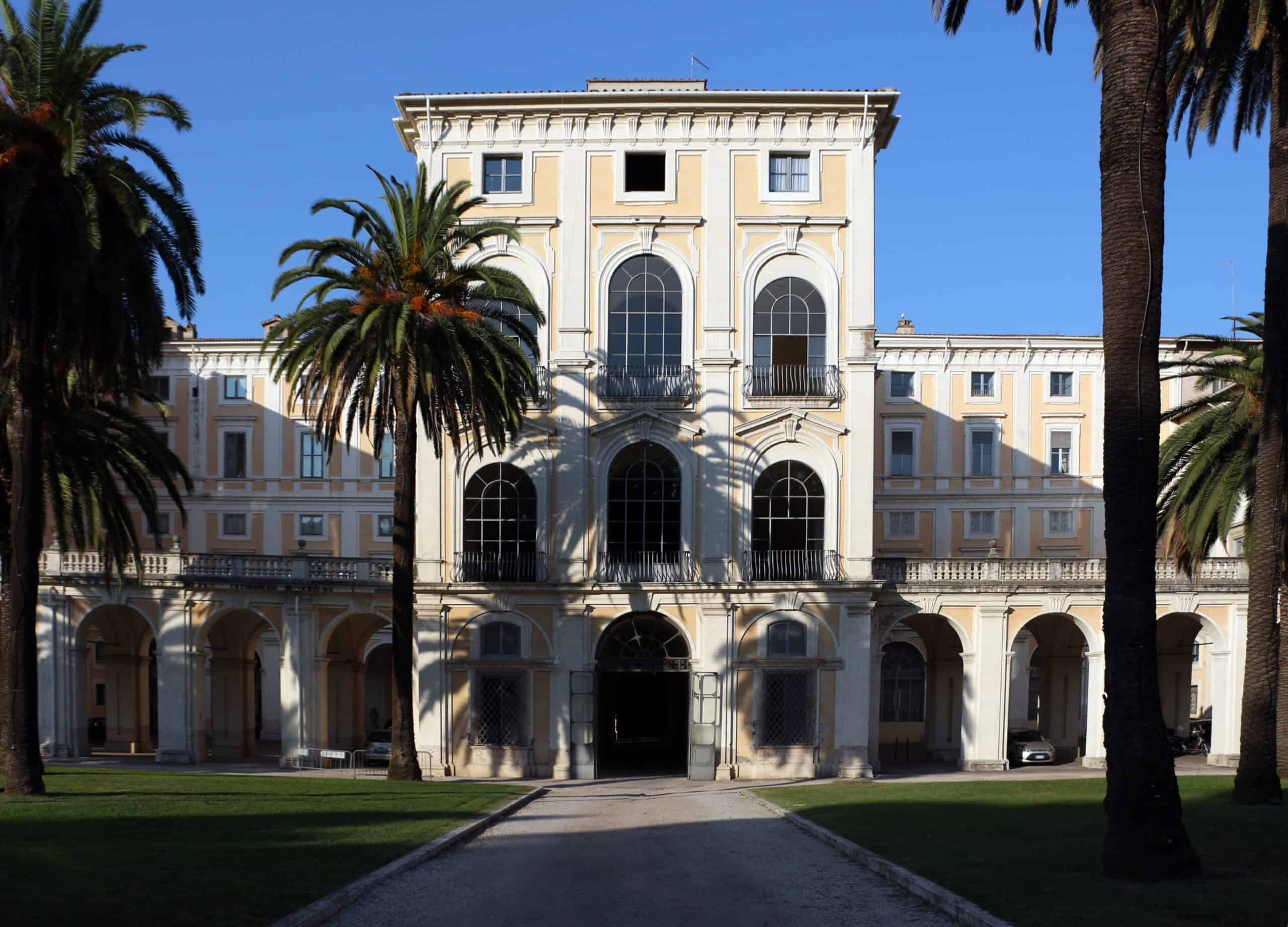
What the National Gallery of Ancient Art at Palazzo Corsini really is
Let's clear up right away the misunderstanding I see born every week in front of the door, because it shapes the whole visit. The Corsini Gallery is not a small independent museum on Via della Lungara. It is one of the two sites of the National Galleries of Ancient Art, a single institution that holds over 5,000 works including paintings, sculptures, sketches and decorative arts from the 13th to the 18th century, spread between Palazzo Barberini on the Quirinal and Palazzo Corsini in Trastevere. One museum, two palaces, two banks of the Tiber, one ticket.
Where to buy tickets. The Corsini Gallery is paid for on the official website of the National Galleries of Ancient Art, barberinicorsini.org. The ticket is also valid for Palazzo Barberini, so it makes sense to see both sites on the same trip. The combined entry is on GetYourGuide. Verified on September 28, 2026.
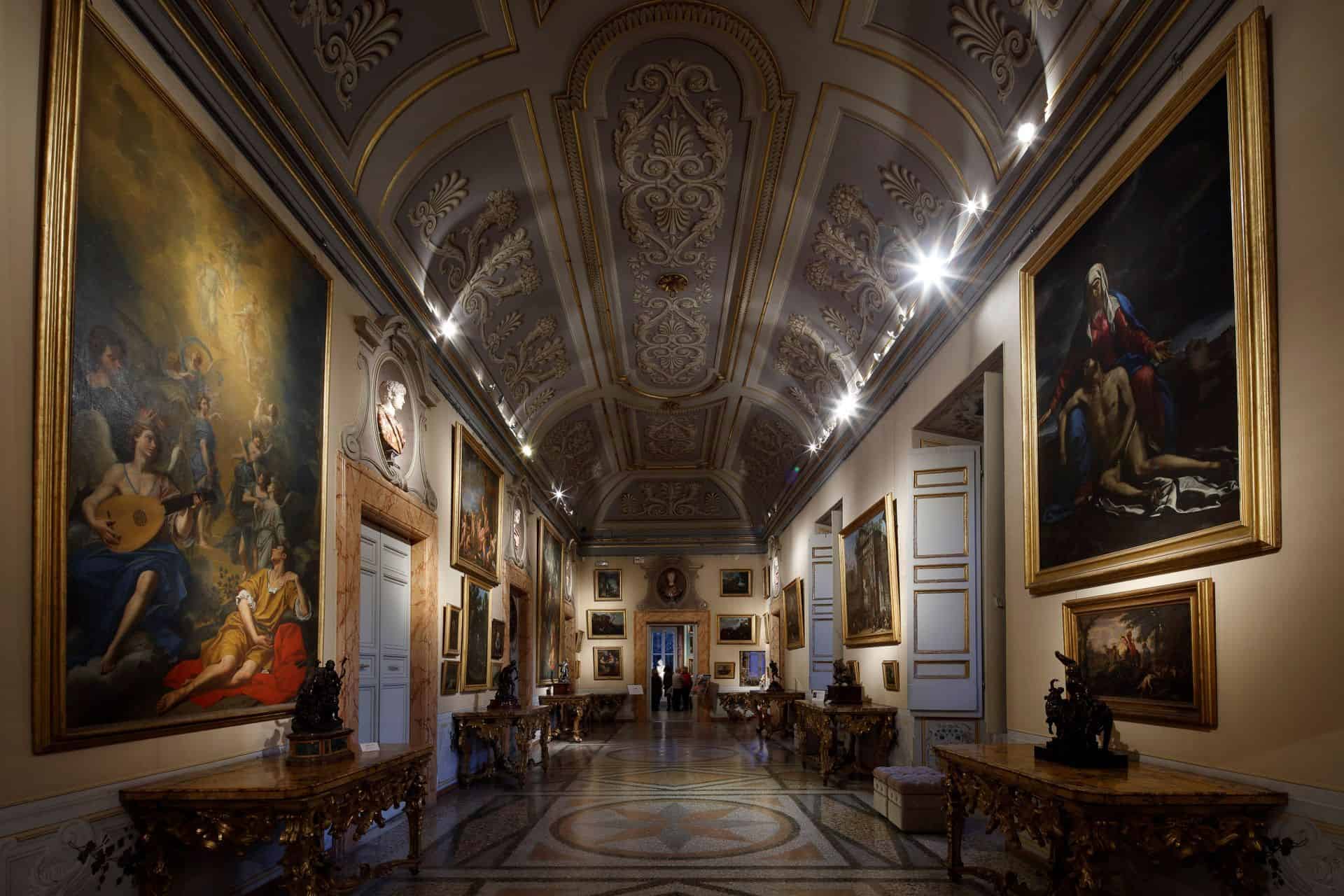
But the two sites are not interchangeable, and this is the point worth understanding before you go in. Palazzo Barberini is a modern museum built inside a historic palace: a chronological route, captions, reorganized rooms, works arranged according to art history as universities teach it. Palazzo Corsini is not that. Palazzo Corsini is an 18th-century picture gallery that stayed where it was, with the paintings hung the way the family wanted them, in several rows, from the baseboard to the cornice, with no didactic intention at all. If you go to Corsini expecting Barberini in a smaller format, you'll leave disappointed. If you go knowing you're stepping into a time machine of taste, you'll leave with one of the rarest experiences Rome offers.
The Corsini Gallery is the most underrated museum in the historic center, and for a banal geographic reason. It's on the wrong side of the river for the classic tourist routes, it has no facade you can see from far away, and its most famous masterpiece is a Caravaggio that almost no one associates with this address. The result: 20 people go in, where at Palazzo Barberini 200 crowd in front of works of the same size.
Why the National Gallery of Ancient Art at Palazzo Corsini has that name
The official name is long and slightly misleading. "Ancient art," in the 19th-century Italian museum vocabulary, doesn't mean Greek and Roman art. It means art before the modern era, that is, roughly from the Middle Ages to the end of the 18th century. When the State acquired the palace and the collection in 1883, the word served to distinguish this collection from the newborn National Gallery of Modern Art. Anyone who arrives at Via della Lungara expecting sarcophagi and imperial statues finds Baroque canvases instead, and the surprise is understandable. There is ancient sculpture in the Corsini house, but it is the exception, not the rule, and the most famous piece is a marble throne we'll get to further on.
The Riario palace on Via della Lungara, before the Corsini
Before being Corsini, this palace was Riario for almost two centuries, and without that first life neither the shape of the building nor its fame can be explained.
Julius II's road and the Riario villa
Via della Lungara is one of the first operations of modern urban planning in Rome: a straight road wanted by Julius II at the start of the 16th century to connect the Vatican to Trastevere along the right bank, the twin of Via Giulia, which the other bank would get shortly after. On a new road, straight and wide, people build. And on Via della Lungara, between the end of the 15th century and the early 16th, everything that mattered was built, from the villa of Agostino Chigi, which we call the Farnesina today, to the palace of the Riario family.
The Riario were nephews of Sixtus IV della Rovere, and their fortune was entirely that of a papal family: offices, benefices, money, and a suburban palace on a road the pope himself had opened. The building they raised here was smaller and lower than the one you see today, with a garden that climbed the flank of the Janiculum, a layout closer to a city villa than to an urban royal residence. Of that 15th-century structure, after the 18th-century building work, very little visible remains, and this has to be said plainly: whoever is looking for the Renaissance in this palace should look for it in the Farnesina across the street, not here.
A century and a half of illustrious rentals
In the 17th century the Riario palace becomes one of those addresses that Roman families grant and take back, and guests of the first rank pass through. It is the typical fate of the great buildings of Baroque Rome: not lived in permanently by their owners, but used as currency of prestige, lent to cardinals, ambassadors and exiled sovereigns. It is exactly in this logic that the woman who would change its fame forever arrives at the palace.
Christina of Sweden on Via della Lungara
This is the part of the story for which it's worth coming to Via della Lungara even if Baroque painting doesn't excite you. In this palace, for 30 years, lived the most talked-about person in 17th-century Europe.
Who Christina was, and why she was in Rome
Christina Vasa, born in 1626, had been queen of Sweden since the age of six, the daughter of Gustavus Adolphus, the sovereign who had led the Protestant camp in the 30 Years' War. In 1654 she abdicated. Then she did what nobody expected: she converted to Catholicism, which for the Europe of the time was a political earthquake before it was a spiritual one, and in December 1655 she entered Rome as a triumphant victor, welcomed by the pope as the most sensational gain of the Counter-Reformation.
What followed was less linear than the prologue. Christina was cultured, arrogant, witty, without restraint, and she had no intention of playing the part of the exemplary penitent that the Vatican had assigned her. She settled on Via della Lungara, in the Riario palace, toward the end of the 1650s, and stayed until her death. In those rooms she put a massive library, a collection of paintings and ancient sculptures of European standing, a private theater, a laboratory, and a court of scholars, musicians and curious minds that made this palace one of the three or four places in Europe where one could speak freely about science, philosophy and art.
The court, the library, the laboratory
Christina's collection was of the very first order, and this is a fact that usually gets overlooked: her paintings came in large part from the Swedish loot of Prague, that is, from the imperial collections of Rudolf II plundered in 1648, and included Correggio, Titian, Veronese. Those works are not in this palace: after her death they passed to Cardinal Decio Azzolino, then to Livio Odescalchi, and in the early 18th century they were sold in France to the Regent Philippe d'Orléans, and then scattered all over Europe. Anyone who enters the Corsini Gallery looking for Christina's collection is looking for something that left these walls three centuries ago.
What remains are the less conspicuous and more interesting traces: the memory of an intellectual environment that in the garden and rooms of the palace brought together astronomers, alchemists, men of letters and collectors. Among the regulars of her circle are names that today belong to very different stories, from the Jesuit writer on many subjects Athanasius Kircher to the astronomer Giovanni Domenico Cassini, and the hermetic and alchemical component that fed the queen's black legend so much is not missing. On this chapter the literature swings widely between document and novel, and it's best to keep the two apart: that alchemy was discussed at the Riario palace is well known, that an organized school of magic was practiced there is a matter of storytelling, not of archives.
The Royal Academy, which comes before the Arcadia
Christina's most solid legacy is not an object: it's an institution. In 1674 the queen founded the Royal Academy in this palace, a gathering of men of letters and scientists that met under her protection and that is the immediate model of what would come after. Because after her death, in 1690, a group of those same men of letters founded the Arcadian Academy, the most important Italian literary institution between the 17th and 18th centuries, the one that imposed Neoclassical taste and the reform of Italian poetry against the Baroque.
Put directly: the Arcadia is born from the void left by Christina, and it is born from this address. Whoever wants to close the circle can then climb the Janiculum to the Bosco Parrasio, the monumental seat that the Arcadians built for themselves in the mid-18th century on the flank of the hill. It's a 10-minute climb from here, and it's one of those places that Romans themselves have never seen.
The room where she died in 1689
Christina of Sweden died in this palace on April 19, 1689, at the age of 62. She was buried in the Vatican Grottoes, in St. Peter's, an honor that had never been granted to a woman who was neither a reigning queen nor a saint: only three women rest in that basilica, and she is one of them.
The museum keeps the memory of her bedroom, and the room we now call the Alcove Room bears this name for that reason. Here, though, we need to be precise, because the difference between memory and matter is the whole substance of the visit: what you see today is a space reworked in Ferdinando Fuga's 18th-century building project, not the room of 1689 left intact. Tradition places the queen's death here, the display celebrates it, but the architecture in front of you is later by almost half a century. It is a place of memory, and as such it should be looked at: with respect and without believing you are touching the wood of a 17th-century bed.
The Corsini, Clement XII and Ferdinando Fuga's reconstruction
The second act begins in 1736, and changes everything: the shape of the building, its size, its function, and above all its content.
Cardinal Neri Maria Corsini and the purchase of 1736
The Corsini were an ancient and powerful Florentine family, and in 1730 one of them, Lorenzo Corsini, was elected pope with the name Clement XII. The mechanics of Roman nepotism started up with the punctuality of a clock: the pope's nephew, Neri Maria Corsini, was made a cardinal, and the family needed a Roman residence worthy of the rank it had just acquired. In 1736 Cardinal Neri Maria bought the Riario palace on Via della Lungara.
Why that one, and why there? There are three reasons, and all practical. The first is that the palace had an enormous garden that climbed the Janiculum, a very rare thing inside the walls. The second is that it was big enough to be doubled without demolishing half a neighborhood. The third, the most interesting, is that it came with the prestige of Christina of Sweden: buying the queen's house meant buying a history, and the Corsini, who in Rome were Florentine outsiders, needed Roman history.
What Ferdinando Fuga did between 1736 and 1754
The architect was Ferdinando Fuga, also a Florentine, and in the Rome of Clement XII the man of the great building sites: the facade of Santa Maria Maggiore Basilica is his, and so is Palazzo della Consulta on the Quirinal. The work on Via della Lungara lasted from 1736 until the 1750s, and it was not a restoration: it was a refoundation.
Fuga doubled the extent of the facade, bringing it to a length that no palace on the street had, and marked it with giant pilasters that tie the floors together vertically. At the back he articulated the front toward the garden in three projecting bodies, so that the palace, seen from the top of the Janiculum, presented itself as a multi-level theatrical scene. Inside he set up the element that is still the most beautiful thing in the building architecturally: a monumental double-ramp staircase that doesn't only serve for climbing, but works as a belvedere over the greenery.
The problem of the facade you can't see
Something has to be said here that no guide admits willingly. Fuga built a magnificent facade on a street that is barely wider than an alley. The result is that the facade of the National Gallery of Ancient Art at Palazzo Corsini can't be looked at: to see it whole you would have to step back 40 meters, and on Via della Lungara there are no 40 meters. You walk along the wall with your nose in the air and you sense the giant order without ever taking it in with your eyes.
A piece of advice worth 30 seconds of your attention: once you're in the courtyard, stop and turn around on yourself. It's there, and only there, that the scale of the building makes sense. Then climb the staircase slowly and look out the windows at every landing: Fuga calculated those views onto the garden, and whoever runs up the steps with the ticket in hand misses half of the design.

The only 18th-century Roman picture gallery still in its place
This is the sentence you read everywhere about the Corsini Gallery, and almost always it's dropped without being explained. Let's explain it, because it's the reason this museum is unique and why it deserves an hour of your time.
What "original display" means
In the 17th and 18th centuries a Roman nobleman didn't hang paintings the way we hang them. There was no single row at eye level, no chronological criterion, no room dedicated to one artist. There was the picture gallery: one or more rooms in which the canvases were mounted in two, three, four stacked registers, from the baseboard to the ceiling cornice, fitted together like tesserae according to a criterion that was both geometric and conceptual. Formats that balanced each other were placed side by side, symmetrical subjects were mirrored on the two sides of a door, the biggest pieces were put high so they could be seen from afar and the small ones low so they could be looked at up close. The mounting was itself a discourse: it said who the owner was, what he had read, how rich he was, what taste he claimed.
In Rome there were dozens of picture galleries like this. Today essentially one remains intact in its historic arrangement, and it's this one. The other great patrician collections were either dispersed, or rearranged according to modern criteria, or changed palace. The Corsini collection, ceded to the State in 1883, stayed in the rooms it was conceived for, with the arrangement documented by the 18th-century inventories as a reference. This means that when you enter a room of the National Gallery of Ancient Art at Palazzo Corsini you're not looking only at paintings: you're looking at the way an 18th-century cardinal wanted paintings to be looked at.
How to look at a picture gallery without hurting your neck
I'll give the technical advice, because it really helps. Don't walk into a room and start reading the captions from left to right as in a modern museum: you'll go crazy in three minutes and see nothing. Do the opposite. Stand in the middle of the room, look at the whole wall as if it were a single composition, and look for symmetry: there is almost always a central axis, with two pendants answering each other on the right and on the left. Then choose three or four paintings and go see them up close. Let the others act as fabric.
The second rule is even more unpopular: in a picture gallery not everything is a masterpiece, and it doesn't have to be. There are period copies, workshop pieces, replicas, pieces bought to fill a symmetry. It's part of the game, and in fact it's the part that tells the most: an 18th-century collector also bought to complete a wall. Whoever demands that every canvas be a Caravaggio leaves unhappy, whoever understands the mechanism leaves with a piece of the history of taste in their pocket.
The Corsini Gallery from private collection to public museum
The passage happened in 1883, when Prince Tommaso Corsini sold the palace to the Italian Government, donating the library and the gallery along with it. It was an act of enormous importance: from that cession comes the first core of the National Gallery of Ancient Art, that is, of the state museum that today has two sites. In the following years other patrician collections came to the State, and the site on Via della Lungara quickly became insufficient to hold them: from there the road that would lead, in the 20th century, to opening the second site at Palazzo Barberini. In 1984 the Corsini collection returned permanently to its original rooms, which is why today we can see it where it was born.
The National Gallery of Ancient Art at Palazzo Corsini, room by room
Before going into detail, a professional warning that holds for any museum and for this one in particular. Works move: they leave on loan for exhibitions, they come back from restoration, they change walls when a display is reviewed. What follows is the map of the cores and masterpieces of the collection, not a guarantee that a single painting is hanging on the day you go. If you're coming from far away for one specific canvas, ask the museum for confirmation before leaving.
The first room of the National Gallery of Ancient Art at Palazzo Corsini: the large formats of the 17th and 18th centuries
It starts with the heavy artillery. The first room of the gallery is occupied by canvases of very large dimensions from the 17th and 18th centuries, mostly landscapes and religious subjects, and it's the room that most throws off anyone arriving with the idea of an orderly museum. Here the criterion is openly scenographic: enormous formats, dark tones, overall effect.
Look at the landscapes. Landscape as an autonomous genre was born precisely in Rome in the 17th century, thanks to a colony of northern and French painters who came here to study the countryside, the ruins and the light, and who invented a formula later exported all over Europe: dark foreground, luminous opening in the center, ancient ruin or twisted tree as a backdrop. Anyone who has 18th-century English landscape painting in mind is looking, without knowing it, at the grandchildren of this room. Personal opinion, and I'll defend it: these large canvases are the least photographed and the most instructive in the gallery, because they show how an image was built before photography existed.
The primitives and Beato Angelico's Last Judgment at the Corsini Gallery
The next room houses the core of the so-called "primitives," that is, the Italian painters before the full Renaissance, and contains the oldest and most precious piece in the collection: the triptych with Pentecost, Last Judgment and Ascension by Beato Angelico, in the gallery since 1740.
It's worth stopping. Guido di Pietro, a Dominican friar known as Beato Angelico, is the painter who holds together two worlds that were divorcing: late Gothic spirituality, with its gold grounds and its hierarchies of scale, and the new Florentine perspective construction of the 15th century. In the central panel, the Last Judgment, this double nature can be seen with the naked eye: the geometry of the composition is modern, the gold and the symbolic logic are medieval. It's a small format, made for private devotion or for the furnishing of a liturgical piece of furniture, not for a monumental altar, and for this reason it should be looked at up close, from 20 centimeters, the way you look at a miniature.
The detail to notice: in the Last Judgment, paradise and hell don't get the same pictorial treatment. Paradise is orderly, rhythmic, almost choreographic, with the blessed arranged in rows and in circle dances. Hell is chaotic, dense, painted with a freedom that seems to belong to another century. It's the same brush, and it's the same panel: order and disorder as a conscious stylistic choice. A 15th-century panel of this level inside a Baroque picture gallery is a rarity, and the fact that it has been here since 1740 says how far ahead of the taste of their time the Corsini were, when the primitives were considered old-fashioned painting and were bought cheaply.
The 16th century: Jacopo Bassano and the Venetians
Renaissance art is represented in the gallery by a group of works among which the Adoration of the Shepherds by Jacopo Bassano stands out. Jacopo dal Ponte, called Bassano after the Veneto town where he worked, is one of the most original painters of 16th-century Italy and one of the least understood by the general public: he invented a nocturnal, rustic painting, populated by animals and everyday objects, in which the sacred scene takes place inside a stable that really is a stable, with the beasts and the tools.
In the Adoration of the Shepherds, look at the paint: quick brushstrokes, bright colors laid one against the other, lights that come from a fire or a lantern inside the painting rather than from an outside source. This way of painting, which seemed hasty to his contemporaries, is the technical premise of what in the following century would become a school all over Europe. Bassano is the bridge between Titian and 17th-century genre painting, and in this room he is worth more than his current fame suggests.
Caravaggio's Saint John the Baptist at the National Gallery of Ancient Art at Palazzo Corsini
Here we are at the painting many visitors come in for. Michelangelo Merisi da Caravaggio's Saint John the Baptist hangs here, and most Romans don't know it: the Rome of Caravaggio in the common imagination is San Luigi dei Francesi Church, Sant'Agostino Church, Santa Maria del Popolo Church, Palazzo Barberini, the Borghese Gallery. Via della Lungara almost never.
The dating in the literature oscillates between 1603 and 1605, that is, in the painter's central Roman years, those between the great public commissions and the flight from the city. Caravaggio painted several versions of the Baptist, and this one belongs to the series in which the saint is not the bearded preacher of tradition but a half-naked adolescent, seated, wrapped in a red cloth, with an expression between melancholy and absent. The iconography is correct on paper: there is the skin mantle, there is the reference to the lamb. The rendering, though, is anything but devotional, and this is exactly why Caravaggio scandalized.
What to look at in front of the original, concretely. First: the background. There is no landscape, no architecture, no sky, there is a compact darkness that works like a theater screen. Second: the light, which enters from a single direction, cuts the body diagonally and leaves everything else in shadow, without ever blending the transitions the way a school painter would. Third: the flesh, painted with a realism that spares nothing, because Caravaggio worked from the live model, often street boys, and did not correct nature toward the ideal. Fourth, the detail to look for: the hands and the feet. That's where you measure a Caravaggio, much more than in the face.
In front of this painting it's worth standing for 10 minutes alone, and on Via della Lungara you can, while in front of the Deposition or the Calling of Saint Matthew the line behind you doesn't allow it. Seeing a Caravaggio in silence, with the natural light of the room, is a luxury that in Rome has survived in very few places. This is one of them.
Orazio Gentileschi and the Madonna and Child
Next to the Baptist is a Madonna and Child by Orazio Gentileschi, which for a long time was attributed to Caravaggio himself. The story of the attribution deserves to be told because it teaches you how to look.
Orazio Gentileschi, Pisan by birth and Roman by training, is the most refined of Caravaggio's first followers, and the father of Artemisia. His adherence to Caravaggesque naturalism is real but tempered by an entirely Tuscan elegance: lighter colors, drapery drawn with almost metallic precision, sharp outlines. If you put his Madonna next to Merisi's Baptist the difference shows in 30 seconds, and it's all in how the shadows are treated: Caravaggio uses them to erase, Gentileschi to model. In the second case the form stays legible everywhere, in the first it disappears into the black.
The fact that for generations this painting passed for a Caravaggio is not a ridiculous mistake: it is proof of how contagious the master's language was and how recent, a 20th-century achievement, the philological knowledge of his catalog is. In historic picture galleries optimistic attributions were the norm, and a wall full of grand names was worth more than an honest wall.
Rubens at the National Gallery of Ancient Art at Palazzo Corsini: Saint Sebastian Tended by Angels
Peter Paul Rubens is in Rome in his youthful years, before becoming the painter-diplomat Europe knows, and the Saint Sebastian Tended by Angels kept in this gallery belongs precisely to that Roman season, datable to around 1602-1603. It's a Rubens that almost no one recognizes at first sight, because it doesn't yet have the whirling compositional machine of the great Antwerp canvases.
The subject is the least frequent one of the Sebastian cycle: not the martyrdom with the arrows, but the moment after, the care. Here Rubens studies the models he has before his eyes in Rome, that is, ancient sculpture and Michelangelo, and fuses them with the Venetian colorism he has just absorbed in Italy. Look at the saint's body: it's built like a statue, with a twist that comes straight from ancient sculpture, but the skin is painted with a softness no sculptor could obtain. It is this synthesis that is the reason why Rubens, once back in Flanders, will change the painting of Northern Europe.
A tip: if you also plan to see Palazzo Barberini, keep this Sebastian in mind and compare it mentally with the great Baroque painters you'll see over there. The single ticket serves this too, building comparisons that can't be made in one museum alone.
Van Dyck at the Corsini Gallery: the Madonna of the Straw
Anthony van Dyck arrives in Italy very young, after his apprenticeship in Rubens's workshop, and stays on the peninsula for a few years between Genoa, Rome, Palermo and Venice. The Madonna of the Straw kept here is tied to that Italian stay and is one of the works that best show how the painter was building his own personal language, breaking away from the master.
The difference between the two Flemish painters reads well in this very gallery, and it's one of the reasons why the historic display has a didactic value no modern room can replicate: Rubens builds through masses and energy, Van Dyck through elegance and silence. In his figures there is an aristocratic gentleness, a restrained melancholy, an elongation of proportions that will become the signature of the English portraits of his last years. Look at the Virgin's hands and the fall of the drapery: it's all already there.
Murillo and the Madonna and Child
Bartolomé Esteban Murillo is the great painter of 17th-century Seville, and he is present in the gallery with a Madonna and Child of the kind that made his name hugely popular all over Europe until the 19th century and that the 20th century then unjustly devalued as too sweet.
Let's reappraise him, because he deserves it. Murillo works with a warm palette, often on brown grounds, and obtains an effect of atmospheric softness that is technically very difficult: the outlines are not drawn, they are obtained through passages of tone, and the figure emerges from the background as if through a luminous fog. This procedure, which Romantic 19th-century taste adored, is as far as you can imagine from the clean cut of Caravaggio. Having them in the same collection, a few rooms apart, is a chance for comparison that I recommend taking advantage of: you understand one better by looking at the other.
Guido Reni, Guercino and the Bolognese school
The Italian 17th century is not only Caravaggio, and whoever tells it that way tells half the story. The other half is called Bologna, and in the Corsini collection the Emilian and Bolognese component is conspicuous.
Guido Reni is the champion of ideal beauty: polished figures, light and cool colors, eyes turned to the sky, a grace that in the 17th century was considered the absolute summit of painting and that the 19th century then turned into a synonym for sentimentality. Rehabilitating him is not hard in front of an original: his technical craft is of a quality few have reached, and his ability to build a figure with very few chromatic means is impressive. Giovanni Francesco Barbieri, called Guercino, of a later generation, starts instead from somewhere else entirely: dense painting, very strong lights, warm shadows, a material impasto that in the early works is almost violent and that in the mature years calms down toward more classical solutions. Between the two, our preference goes to the young Guercino, but it's a partisan position.
In the room, the useful exercise is this: find a Bolognese painting and a Caravaggesque one on the same wall and ask yourself where the light comes from in each of the two. In Reni the light is diffuse and has no identifiable source, because it serves to show the ideal form. In the Caravaggisti the light has a precise direction and comes from outside the frame. Two opposite ideas of pictorial truth, hung two meters apart.
Ribera, Luca Giordano and the Neapolitans
The next rooms gather an important core of 17th-century Neapolitan painting, which is perhaps the least known and strongest part of the collection.
The big piece is Venus Discovers the Dead Adonis by Jusepe de Ribera, dated 1637. Ribera, a Spaniard from Játiva transplanted to Naples, is the painter who took Caravaggesque naturalism to its crudest consequences, and this canvas is a particular case in his output because it shows a light and luminous colorism, of the kind associated with the great Spanish season of Diego Velázquez. The subject is mythological but treated like a news story: Adonis's body is a real corpse, Venus's reaction is a physical pain, without poses. Look at the flesh and the way the light runs over the chest: it is painting of a physicality that very few allowed themselves in the 17th century on a classical theme.
In the same area is Christ among the Doctors by Luca Giordano, a pupil of Ribera and a man of legendary speed of execution, so much so that he earned the nickname Luca fa presto. Giordano is the European champion of large-scale painting: he can change style on command, imitate anyone, fill enormous vaults in record time. In Christ among the Doctors you see his craft applied to a crowded scene: the construction in groups, the bearded old men in the foreground, the figure of the boy isolated by the light. His career will take him all the way to the court of Spain, and his influence will reach the Venetian 18th century.
Salvator Rosa at Palazzo Corsini: the Prometheus, the battles, the landscapes
Salvator Rosa deserves a chapter of his own, because he is the most nonconformist character in this gallery and because the collection holds a group of his works that covers his three specialties.
A Neapolitan, a poet and actor as well as a painter, a fierce satirist of power and of his colleagues, Rosa single-handedly built the modern figure of the rebel artist, two centuries before Romanticism made it a system. His Prometheus is the most extreme proof: the chained Titan with the eagle tearing at his liver, painted with an anatomical relish that still makes people uncomfortable today. It is not a painting for delicate stomachs and it doesn't pretend to be: Rosa was after shock, and he was after it knowingly.
On the other side of his output there are the battle canvases, a genre in great demand at the time, and above all the landscapes: rocks, broken trees, stormy skies, tiny figures of bandits or hermits lost in nature. These landscapes had an enormous success in 18th-century England, where they helped found the aesthetic category of the sublime, the one that precedes all of European Romanticism. Put another way: a part of the taste for mountains, for storms and for the wild that modern Europe has inherited passes through this painter, and some of his best efforts hang on Via della Lungara.
Carlo Maratta and the Roman 18th century
In the room dedicated to the 18th century there is a large core of works by Carlo Maratta, and this is no accident: Maratta was the official painter of Rome between the 17th and 18th centuries, the undisputed head of the school, the man popes, cardinals and princely families turned to when they wanted an impeccable painting.
The collection includes the Madonna and Child, the Martyrdom of Saint Andrew, Rebecca at the Well and the Flight into Egypt, that is, a sampler covering the devotional, the martyrdom, the biblical episode and the narrative scene. Maratta is the direct heir of the classicist line that comes from the Carracci and Andrea Sacchi: stable composition, measured gestures, balanced colors, no violence. For contemporary taste, which loves extreme painters, he is an unexciting artist, and I understand that. But in front of the originals you notice one thing: the quality of the drawing is very high and the heads are real portraits, not ideal types. He is a painter to be looked at for the craft, not for the emotion.
In the same area is the Triumph of Ovid, a canvas attributed to Nicolas Poussin, the Frenchman who reinvented classical-subject painting in Rome and never left the city. The questions of attribution around Poussinesque works in Roman collections are complex and still debated by scholars: on the precise authorship it's best to trust the caption in the room, which reports the updated state of research.
Giovanni Lanfranco and the Emilians
The next rooms offer examples of Emilian art, including works by Giovanni Lanfranco, from Parma, a pupil of the Carracci and one of the inventors of great Baroque dome decoration. Lanfranco is the painter who, by frescoing the dome of Sant'Andrea della Valle Church, brought to Rome the model of the open sky that comes from Correggio and from Parma: figures rising in a whirl toward a central light, with no painted architecture dividing the space.
In the easel paintings that ascending thrust translates into oblique compositions and a golden light that wraps the figures. Lanfranco was for years the great rival of Domenichino, in a polemic that is one of the hottest chapters of 17th-century Roman art history, and seeing him in a private collection like this one helps you understand that the giants of fresco were also excellent painters of small rooms.
The portraits of the Corsini house
A family picture gallery without portraits would not exist, and the Corsini are no exception. In the rooms you meet the faces of the house and of its protectors: Pope Clement XII, Cardinal Neri Maria, the figures of the Florentine and Roman relatives.
These paintings are usually passed through in a hurry, and we all make that mistake. The 17th- and 18th-century formal portrait is a codified genre with precise rules: the position of the hands, the type of seat, the color of the robe, the objects on the table and even the curtain in the background have a precise meaning and communicate rank, office and virtue. A cardinal portrayed seated in an armchair with a closed book says something different from a cardinal standing with a letter in his hand. Learning to read these codes turns a boring wall into a document, and it is one of the pleasures this gallery offers more than others precisely because the family is still present in its rooms.
The Throne Room and the Corsini Throne
Among the rooms of the gallery there is one named after the most unexpected object in the collection: the Corsini Throne, a marble seat that has nothing to do with Baroque painting and is one of the most debated archaeological pieces in Roman collections.
It is a circular marble throne, decorated in relief with figured scenes, which reproduces in its form the bronze thrones of the Etruscan tradition. Its dating and its function have kept scholars arguing for two centuries: the prevailing view considers it a Roman work of the imperial age that takes up archaic models, but over time it has also been read as an older original or as a ritual object. For the detail of the interpretations it's best to refer to the museum's entry, which reports the state of research. What needs to be said to the visitor is that this is a piece of the first magnitude, and that its presence here tells an essential aspect of 18th-century collecting.
Why does a Baroque cardinal buy a Roman throne? Because in the 18th century a collection of antiquities was not a scholarly whim: it was the way a family declared its continuity with classical Rome. Putting an ancient marble in the middle of the picture gallery meant saying that the Corsini were not only rich, they were legitimate. The same logic that leads Roman families to commission genealogies going back to the republican consuls.
The Alcove Room and the Cardinal's Gallery
Two spaces close the route and should be looked at as architecture as well as containers of paintings. The Alcove Room keeps the memory of Christina of Sweden's bedroom, with the usual caution that holds for all places of memory: the structure you see is the one given by Fuga's building work, and the relationship with the room of 1689 is one of tradition, not of material identity.
The Cardinal's Gallery, on the other hand, is the formal space par excellence: the long room in which the master of the house received guests and in which the collection gave its best as an apparatus. Stay here longer than would come naturally. It's the room where the concept of the picture gallery can best be seen, with the walls treated as continuous surfaces and the paintings mounted in an order that has its own music. If I had to point to a single space in the National Gallery of Ancient Art at Palazzo Corsini to look at for 10 minutes standing still, I would point to this one.
Palazzo Barberini and the National Gallery of Ancient Art at Palazzo Corsini: one museum, two sites
The relationship between the two sites is the thing visitors understand least and that is most useful to know, because it affects your wallet and the organization of your day.
How the shared ticket for the Corsini Gallery works
The full €15 ticket is not the Corsini Gallery ticket: it is the ticket of the National Galleries of Ancient Art, and it includes both sites. It is valid for 20 days from the date indicated, with entry at a reserved time at Palazzo Barberini and entry to the Corsini Gallery done by showing up at Via della Lungara during opening hours. The reduced ticket at €2 is for European Union citizens between 18 and 25, while holders of the annual MetreBus Card pay €12. On the first Sunday of the month admission is free, and March 8 is free for women.
20 days is a lot, and this is where almost everyone wastes money. Many people buy two separate tickets in the belief that they are visiting two different museums. They are the same museum. If you do Barberini in the morning and want Corsini another day, the ticket is already in your pocket. If you want to do them on the same day instead, you can, but I warn you that they are two very different experiences and that moving from one to the other takes half an hour of travel between the two banks of the river.
Which of the two sites to visit first
A partisan piece of advice, matured in the field: start with Corsini and finish at Barberini, not the other way around. The reason is attention. Corsini is small, dense, it requires concentration and a rested eye to read the walls. Barberini is big and you gladly arrive there already a bit tired, because it has space, light and a route that accompanies you. If you do the opposite, you arrive at Via della Lungara drained and the picture gallery will look to you like a heap of dark paintings.
If you have only one afternoon and have to choose, the answer depends on what you're looking for: for the famous masterpieces and for monumental Baroque architecture you go to Palazzo Barberini. For the intact historic atmosphere and an hour of quiet in front of a Caravaggio, you come here.
The Botanical Garden, which was this palace's garden
The greenery that climbs the flank of the Janiculum behind the palace is not a public park born by chance: it is the garden of the Riario and then Corsini villa, and today it is Rome's Botanical Garden, run by Sapienza University.
The continuity is direct. With the cession to the State in 1883 the historic garden, with its fountains, its water stairways and its terraces, passed to scientific use, and the old university botanical garden, which had wandered around the city, finally found a stable and suitable home. Today it is about 12 hectares of hillside, with the rose garden, the Japanese garden, the bamboo grove, the historic greenhouses, the palm collection and a monumental staircase of Baroque layout that is still the one designed for the villa.
Watch out for a practical detail that catches everyone: the Botanical Garden of Rome has its own entrance, ticket and hours, and you don't enter from the museum. Access is from Largo Cristina di Svezia 24, that is, a little further along the same street, just past the palace. The museum ticket is not valid for the garden and vice versa. That said, the combination of the two, on a spring morning, is one of the best things you can do in Rome, and at the end of the visit you come out directly below the Janiculum.
The Accademia dei Lincei at Palazzo Corsini
The door at Via della Lungara 10 leads to a museum, but the palace also hosts one of the oldest scientific institutions in the world: the Accademia Nazionale dei Lincei, which has its seat here.
The Lincei were founded in Rome in 1603 by Federico Cesi, a very young aristocrat, with the aim of studying nature with eyes as sharp as those of the lynx, which gives the academy its name. Galileo Galilei was among its first members, and he made the Lincei part of his public identity by signing himself a Lincean academician. The original academy died out with the death of its founder, only to be reborn in the modern age and eventually become the country's highest cultural institution in both science and the humanities. Since 1883 it has had its seat in this palace, together with the Academy Library and the Biblioteca Corsiniana, the book collection donated by the family with the transfer to the State.
The practical consequence for the visitor is simple: the library and the academy rooms are not part of the museum route and have their own access rules, tied to research and events. But knowing that behind the same walls, while you look at the Caravaggio, scientific conferences are held and leading manuscript collections are kept changes how you see the building. This is not a museum-ified palace: it is a palace that still works.
Villa Farnesina, right across the street
As you leave through the main door, cross the street. The building in front of you is Villa Farnesina, and the fact that the two buildings face each other from 30 meters apart is one of Rome's great logistical advantages.
The Farnesina was built in the early 1500s by Baldassarre Peruzzi for the Sienese banker Agostino Chigi, the richest man in the Rome of Leo X, and it contains frescoes by Raphael and his workshop, including the Galatea and the Loggia of Cupid and Psyche, as well as the Hall of Perspectives by Peruzzi himself and the bridal chamber frescoed by Sodoma. It is the Renaissance villa par excellence inside the city, and by a symmetry that is rather amusing it also belongs to the Lincei Academy.
My practical advice: if you do both, do the Farnesina first, since it has more restrictive hours and closes earlier, then the Corsini Gallery. Altogether it comes to a full two and a half hours, and they cover two centuries of Italian art history a pedestrian crossing apart. I don't know many other places in Europe where that is possible.
How to really visit the National Gallery of Ancient Art at Palazzo Corsini
How long a visit to the Corsini Gallery takes
One hour is the right amount of time for an attentive but not obsessive visit. Those who rush get out in 35 minutes, and that's no crime: the museum is small, it is laid out on a single main exhibition level and it has no labyrinthine routes. Those who want to read the walls properly, sit where there is somewhere to sit and go back twice to the Baptist should allow an hour and a half. With the Botanical Garden you easily reach half a day.
Accessibility at the Corsini Gallery
The entrance is accessible and the museum declares that it can be used by people with motor disabilities, but the palace remains an 18th-century building, with the limitations that this brings in some passages. Those with specific needs do well to contact the museum in advance at +39 06 68802323 to arrange access and learn the state of the facilities on the day of the visit. People with disabilities and their companion are among the categories with free entry under the ministry regulation.
Cloakroom, backpacks and photos at the Corsini Gallery
The cloakroom is mandatory for bags, backpacks and umbrellas, and the lockers are small, around 40 by 38.5 by 36 centimeters: if you're traveling with a carry-on suitcase, know in advance that it won't fit. It is a rule common to all museums housed in historic palaces, where the corridors are narrow and a bulky item on your shoulder is a risk to the paintings.
On photos, the practice in Italian state museums allows shots without flash and without a tripod for personal use, but the rules can vary for individual rooms and for temporary exhibitions: the sign at the entrance and the staff in the room are the authority, not habits picked up elsewhere.
When to go to the Corsini Gallery, and when to avoid it
The Corsini Gallery doesn't have a problem with lines, and that is its main luxury. That said, not all times are equal.
The best time is early in the morning on a weekday, right after the 10:00 opening. The rooms have windows overlooking the garden and natural light, in a picture gallery hung over several tiers, makes an enormous difference: the paintings up high, with little light, become dark patches. On gray days in January the top row is hard to read, and no artificial lighting fully makes up for it.
The time to avoid, counterintuitively, is the first Sunday of the month. Free entry brings here a number of people this museum is not sized to absorb, and a crowded picture gallery is a picture gallery you can't see. If your goal is to save €15, go. If your goal is to look at the paintings, come on a Tuesday morning and pay for them, those €15, which also include Palazzo Barberini for 20 days.
The National Gallery of Ancient Art at Palazzo Corsini with children
Honesty first: it is not the best museum in Rome for small children, and anyone who tells you otherwise has never brought a child here. The rooms are full of dark religious painting hung high, there are no tactile routes or interactive displays, and the ban on touching in narrow spaces becomes tiring.
It works very well, though, with kids from 10 years old up, if you give them a task. Two games that hold up: the hunt for animals inside the paintings, which in a collection with Bassano and the landscape painters is very rich, and the before-and-after game, in which they are asked to find the scene immediately before and the one immediately after the one painted. With the older ones, the comparison of Caravaggio against Guido Reni works: you show the same idea of the sacred treated in two opposite ways and ask which of the two is more convincing. They argue for 20 minutes.
What's around the National Gallery of Ancient Art at Palazzo Corsini
The location is one of the strengths of this visit, because within a 10-minute walk you change register completely.
Toward Trastevere and Porta Settimiana
Leaving to the right you quickly reach Porta Settimiana, the arch that marks the entrance to the inhabited heart of Trastevere and that in its present form dates from the late 1400s, built on a gate from the age of Aurelian. From there Via della Scala begins and in a few minutes you are at the Basilica of Santa Maria in Trastevere, with the apse mosaics by Pietro Cavallini and the Cosmatesque floor. Continuing toward Porta Portese you come to the Basilica of Santa Cecilia in Trastevere with Cavallini's Last Judgment in the nuns' choir, and San Francesco a Ripa Church, where the Blessed Ludovica Albertoni by Gian Lorenzo Bernini is, the last great sculpture by the master and one of the most striking.
Uphill: the Janiculum
Behind the palace the hill rises. Those with breath to spare can walk up to San Pietro in Montorio, where Donato Bramante's Tempietto is, the built manifesto of High Renaissance architecture, and continue to the Janiculum for Piazzale Garibaldi, the view over the city and the noon cannon. On the same hill, as mentioned, the Bosco Parrasio of the Arcadia Academy ideally closes the story that began in the rooms of Christina of Sweden.
Eating and stopping nearby
On the Lungara there are hardly any places to eat, and it's good to know before you go. The street is long, quiet and without services, with the wall of the Regina Coeli prison on one side for a good stretch. The options begin at Porta Settimiana and multiply inside Trastevere, where, however, the value for money gets noticeably worse as you get closer to the most photographed squares. For a blunt piece of advice: move three or four streets away from the main square, toward Viale Trastevere or toward the more inland part of Via della Lungaretta, and you'll feel the difference in the bill.
A curiosity about the National Gallery of Ancient Art at Palazzo Corsini
Of all the buildings in Rome, this is the one that changed its skin the most times without changing its address, and the sequence of its occupants seems invented. The villa of a pope's nephews in the late 1400s. The Roman residence of a converted Protestant queen, who kept a court, a library and an academy here for 30 years. A cardinal's palace rebuilt by the fashionable architect of the 1700s for the family of another pope. Then, during the Napoleonic occupation of Rome, the home of Joseph Bonaparte, the emperor's older brother and king first of Naples and then of Spain. Finally, since 1883, a museum of the Italian state, seat of the National Lincei Academy and of two research libraries.
Do the math: in a little over three centuries, within the same walls, there slept a sovereign from Northern Europe, the nephew of a Florentine pontiff and Napoleon's brother. No plaque tells it in a compact way, and almost no guidebook lines up the three names.
There is a second layer that is even more fun. This palace has hosted, at different times, two of the most important cultural institutions in Italy: the Arcadia Academy, which had its seat here before finding other homes, and the National Lincei Academy, which still resides here today. A building that began as a display of family power and ends up being, without a break, the place where poetry was discussed in the 1700s and where science is discussed today. In the Rome of palaces turned into offices or hotels, this continuity of intellectual function is a rarity worth recording.
Something nobody tells you about the National Gallery of Ancient Art at Palazzo Corsini
There are two, and both are uncomfortable.
The first concerns Christina of Sweden. Many arrive here convinced they will find her collection, because the link between the queen and the palace is the first fact you meet reading anything about this address. That collection is not here, and it never came back. Christina owned extraordinary paintings, largely from the Swedish plunder of Prague in 1648, that is, from the imperial collections of Rudolf II. At her death they passed to Cardinal Decio Azzolino and then to Livio Odescalchi, in the early 1700s they were sold in France to the Regent Philippe d'Orléans, and from there they scattered across half of Europe. What you see on the Lungara is the Corsini collection, formed largely after 1736, that is, almost 50 years after the queen's death.
The second concerns the Alcove Room. It is the room that keeps alive the memory of the chamber in which Christina died on April 19, 1689, and as a place of memory it is entirely legitimate. But the structure you see is the one that came out of Ferdinando Fuga's building site, that is, from an intervention almost half a century later. Anyone who walks in thinking they are treading the floor of 1689 and looking at the walls the queen looked at is overlapping two different eras. I say this because the difference between remembering and preserving is the hardest thing to explain in a museum, and because knowing what you are looking at takes nothing away from the emotion: it only moves it from the fetish to the historical fact, which is more solid and lasts longer.
The advice I give you for visiting the National Gallery of Ancient Art at Palazzo Corsini
The advice is a sequence, and it works better if you follow all of it.
First: come on a Tuesday or Wednesday morning, at 10:00 sharp. The museum has just opened, the rooms are empty and the light coming in from the garden windows is the one the picture gallery was designed for. In a collection hung over several tiers, natural light is not an aesthetic detail: it is the condition for seeing the paintings in the top row.
Second: don't start with the Caravaggio. I know it's the temptation, and I also know how it ends. Whoever runs straight to the Saint John the Baptist looks at it for two minutes, all excited, then goes through the rest of the gallery drained and doesn't see anything anymore. Follow the route in order, get to the Baptist when your eye is already warmed up, and linger for 10 minutes. Here you can afford it: on the Lungara nobody pushes you from behind.
Third: make use of the 20 days of the ticket. It costs €15 and also includes Palazzo Barberini. Not using it for the second site is throwing away half of what you paid, and 20 days is enough even for a tourist who comes back to the city weeks later.
Fourth: combine Villa Farnesina, which is on the other side of the street, and the Botanical Garden, which is 200 meters further on. In one morning you hold together the Renaissance of Raphael, the baroque of the picture gallery and the historic garden of the Corsini, without ever taking public transport.
Fifth, and I insist: avoid the first Sunday of the month. Free entry fills a museum with small rooms, and in a crowded picture gallery you can't see the wall. Save that day for a big museum, and keep this one for a weekday.
Another well-known fact, yet rarely mentioned
That the Botanical Garden of Rome is next to the palace, many people know. That it is the very same garden of the Villa Riario, later Corsini, with the same fountains, the same terraces and the same monumental staircase designed for the residence, is said very rarely, and it changes the way you look at both places.
When the Corsini bought the palace in 1736, they bought above all that: about 12 hectares of hillside inside the walls of Rome, something that in the mid-1700s was worth as much as the building and more. The garden was not a backdrop, it was the project. Fuga arranged the rear front of the palace in three projecting bodies precisely to engage with that greenery, and the inner grand staircase was conceived as a belvedere over the green scene. Whoever visits the museum without knowing what is behind the windows is looking at half the architecture.
The transfer of 1883 separated the two and assigned them to two different administrations: the palace with the picture gallery to the State to make a museum and the seat of the Lincei, the garden to the university to make a botanical garden. Since then they are two places with two tickets, two entrances and two sets of hours, which nevertheless continue to be the same historical organism. Climb to the upper part of the garden and turn around: from up there you see the rear front of the palace as Fuga wanted it to be seen, that is, from above and from afar, and it is the only point in the city from which this architecture can be read in full. It is a piece of information worth the price of the second ticket.
The right photo to take at the National Gallery of Ancient Art at Palazzo Corsini
First the wrong one, because it's the one everybody takes. The facade on Via della Lungara is not photographed. The street is too narrow, you step back 10 meters and end up against the wall opposite, and the wide-angle lens gives back a distorted building that looks like nothing. Go ahead and try, but know that it doesn't work.
The right photo is inside. Climb Fuga's monumental staircase and stop at the first landing, on the side facing the garden: from there you have together the geometry of the double flight, the depth of the perspective going up and the light coming in from the windows. It is an architectural image, it holds up very well in black and white, and it doesn't need people. If you put someone in it, put them small and in the back, to give the scale.
The second photo, the one you'll end up keeping, is the picture gallery wall photographed in full. Not the single painting: the wall. Stand in the middle of the room, hold the camera level and straight, and frame the wall with all its tiers of canvases. It is the only image that really explains what an 18th-century picture gallery is, and no close-up detail achieves the same effect. Watch out for two things: no flash, which besides being forbidden produces reflections on the varnishes, and watch for distortion at the edges, which with strong wide angles makes the frames curve.
The third, if you have time, is taken from the Botanical Garden: climb the terraces, turn around and shoot the rear front of the palace with the greenery in the foreground. It is the framing the architecture was designed for, and it is the one nobody takes because it requires a second ticket and half an hour of climbing.
Some important events that happened here in history
The first is the arrival of Christina of Sweden. The queen entered Rome in December 1655, after the abdication of 1654 and the conversion to Catholicism, and hers was one of the most sensational propaganda operations of the Counter-Reformation. Toward the end of that decade she settled on the Lungara, and Palazzo Riario became for 30 years one of the intellectual centers of Europe.
The second is the founding of the Royal Academy, in 1674, in these rooms. It is not an erudite detail: that gathering of writers and scientists is the immediate model for the Arcadia Academy, which would be born in 1690, the year after the queen's death, from the same circle of people and would change Italian literary taste for a century.
The third is the death of Christina, on April 19, 1689, in this palace. She had a solemn funeral and was buried in the Vatican Grottoes, in St. Peter's: an honor reserved for very few women in the history of the basilica.
The fourth is the purchase of 1736 by Cardinal Neri Maria Corsini, nephew of Clement XII, and the building work of Ferdinando Fuga that followed, which turned a suburban villa into one of the greatest Roman residences.
The fifth belongs to the Risorgimento and took place higher up, on the hill, in the villa that the same family owned on the Janiculum, the casino known as the Quattro Venti. On June 3, 1849, during the defense of the Roman Republic against the French expeditionary force, that villa was the center of one of the bloodiest clashes of the siege, and in that very fight Goffredo Mameli, 21 years old, received the wound that would lead to his death a few weeks later. The author of the words of the Italian national anthem fell fighting on a Corsini property.
The sixth is the transfer to the State in 1883, by which Prince Tommaso Corsini sold the palace and donated the library and the gallery: from there were born together the museum and the Roman seat of the Lincei.
Who has passed through the National Gallery of Ancient Art at Palazzo Corsini
The list is the kind that impresses even those used to Rome.
Christina of Sweden, first of all, who did not just pass through here but lived here, and around her a court of the first rank in Europe. In her Roman circle we count the Jesuit Athanasius Kircher, polymath, orientalist and collector, the man who in Rome embodied the encyclopedic knowledge of the 1600s, and the astronomer Giovanni Domenico Cassini, who shortly afterward would be called to Paris to direct the Observatory and to give his name to the division in Saturn's rings. Gian Lorenzo Bernini also frequented her court, who was a friend of the queen and took part in the activities of her academy: the greatest sculptor of the century and the most talked-about sovereign of the century, in the same room.
Then there is the musical chapter, which visitors almost always ignore. Christina was a decisive patron of Roman music in the late 1600s: Arcangelo Corelli, the violinist and composer who founded the form of the concerto grosso and the European violin school, worked in her service, and the young Alessandro Scarlatti, forefather of the great Neapolitan opera school, was also tied to her. In the private theater of the palace music was made at the highest levels in Europe.
After her come the Corsini: Pope Clement XII, Cardinal Neri Maria, and the architect Ferdinando Fuga, who left here one of his major works. Then Joseph Bonaparte, during the Napoleonic occupation. In the 19th and 20th centuries the palace became a place of obligatory passage for art historians, archaeologists and scientists, because of the libraries and the Lincei: anyone who has seriously studied 17th-century Rome has climbed this staircase at least once. And today anyone who comes to see a Caravaggio in a room where you can be in silence passes through here, without knowing it.
Quick questions about the National Gallery of Ancient Art at Palazzo Corsini
Where is the National Gallery of Ancient Art at Palazzo Corsini
At Via della Lungara 10, 00165 Rome, in the Trastevere district, on the right bank of the Tiber just past Porta Settimiana and across from Villa Farnesina.
How much is a ticket to the National Gallery of Ancient Art at Palazzo Corsini
The full ticket costs €15 and the reduced ticket €2 for citizens of the European Union between 18 and 25, holders of the annual MetreBus Card pay €12. Free entry follows the ministry regulation.
Is the ticket also valid for Palazzo Barberini
Yes. The ticket is a single one for the National Galleries of Ancient Art, includes both sites and is valid for 20 days: entry at a booked time at Palazzo Barberini and entry to the Corsini Gallery during opening hours.
What are the opening hours of the National Gallery of Ancient Art at Palazzo Corsini
Tuesday to Sunday, from 10:00 to 19:00, with last entry at 18:00.
What day is the National Gallery of Ancient Art at Palazzo Corsini closed
Mondays. For extraordinary holiday closures it's best to check the official website of the National Galleries before setting out.
Do you need to book to visit the National Gallery of Ancient Art at Palazzo Corsini
For the Lungara site, access is during opening hours with no mandatory time slot, buying in advance is nonetheless done online on CoopCulture, and is recommended for the first Sunday of the month and in periods of heavy crowds.
Is entry free on the first Sunday of the month
Yes, entry is free. My advice, though, is not to choose it: the rooms are small and a crowded picture gallery can't be read. On March 8 entry is free for women.
How long does a visit to the National Gallery of Ancient Art at Palazzo Corsini take
One hour for an attentive visit, an hour and a half if you really stop in front of the main works, a little over half an hour for those in a hurry. Adding the Botanical Garden brings it to half a day.
Is there really a Caravaggio at the National Gallery of Ancient Art at Palazzo Corsini
Yes, the Saint John the Baptist, placed by critics in the painter's central Roman years, between 1603 and 1605. It is one of the least crowded Caravaggios in Rome.
What are the main works of the National Gallery of Ancient Art at Palazzo Corsini
Caravaggio's Saint John the Baptist, the triptych with Pentecost, Last Judgment and Ascension by Fra Angelico, Rubens's Saint Sebastian Tended by the Angels, Van Dyck's Madonna of the Straw, a Madonna and Child by Murillo, Ribera's Venus Discovering the Dead Adonis, the Prometheus and the landscapes of Salvator Rosa, Luca Giordano's Christ among the Doctors, the core of Carlo Maratta and the Corsini Throne.
What is the difference between the Corsini Gallery and Palazzo Barberini
They are the two sites of the same museum. Barberini is big, with a chronological route and a modern layout, Corsini is an 18th-century picture gallery that has stayed in its historic arrangement, with the paintings hung over several tiers in the rooms for which they were designed.
What does 18th-century picture gallery mean
A room in which paintings are hung in several overlapping rows, from the baseboard to the ceiling, according to a criterion of symmetry and balance of formats and not according to chronology. It was the normal way of displaying in noble houses between the 1600s and 1700s, and in Rome it has survived substantially here.
Can you take photos at the National Gallery of Ancient Art at Palazzo Corsini
The practice of state museums allows shots for personal use without flash and without a tripod, but the rules can vary for individual rooms and for temporary exhibitions: the signs at the entrance and the staff's instructions are what count.
Is the National Gallery of Ancient Art at Palazzo Corsini wheelchair accessible
The entrance is accessible and the museum declares that it can be used by people with motor disabilities. Since it is an 18th-century palace, for specific needs it's best to contact the museum in advance at +39 06 68802323.
Is there a cloakroom
Yes, and it is mandatory for bags, backpacks and umbrellas. The lockers are small, around 40 by 38.5 by 36 centimeters: a carry-on suitcase won't fit.
How do you get to the National Gallery of Ancient Art at Palazzo Corsini by public transport
With buses 23 and 280, which run along the lungotevere and stop a few steps from the main door. Alternatively, tram 8 to Trastevere and about 10 minutes on foot along the river, or entering Trastevere from Porta Settimiana.
Can you park nearby
Badly and for a fee. Via della Lungara is narrow, parking is almost all reserved for residents and the traffic in Trastevere is among the worst in the center. For this visit the car is the wrong choice: you get there much better by bus or on foot from the center.
Is the Botanical Garden included in the ticket
No. The Botanical Garden of Rome has its own entrance, ticket and hours, with access from Largo Cristina di Svezia 24. It was the historic garden of this palace, but today it is run by Sapienza University and is a different visit.
Is the National Gallery of Ancient Art at Palazzo Corsini suitable for children
Not much for the youngest: narrow rooms, dark religious painting hung high, no interactive displays. It works well from 10 years old up, if you give them an observation task.
Where did Christina of Sweden die
In this palace, on April 19, 1689. She was buried in the Vatican Grottoes, in St. Peter's. The Alcove Room keeps her memory, but the room you see today is the one that came out of Ferdinando Fuga's 18th-century building work.
Can you see Christina of Sweden's collection here
No. Her paintings passed to Cardinal Decio Azzolino and then to Livio Odescalchi, and in the early 1700s they were sold in France to the Regent Philippe d'Orléans, then scattered across Europe. What you visit on the Lungara is the Corsini collection.
Who built the palace that houses the National Gallery of Ancient Art at Palazzo Corsini
The original structure belongs to the Riario family, in the late 1400s. The present form is due to Ferdinando Fuga, commissioned by Cardinal Neri Maria Corsini after the purchase of 1736: he doubled the facade, marked it with giant pilasters, arranged the garden front and built the monumental staircase.
What does the Lincei Academy have to do with this palace
Since 1883 the National Lincei Academy has had its seat here, together with its library and the Biblioteca Corsiniana. They are not part of the museum route and have their own access rules, tied to research and events.
What can you visit nearby
Villa Farnesina is right across the street, the Botanical Garden 200 meters further on, Trastevere begins at Porta Settimiana and the Janiculum with San Pietro in Montorio is the hill behind. Within a 10-minute walk you go from the Renaissance of Raphael to the baroque to the view over the city.
Is it better to visit the National Gallery of Ancient Art at Palazzo Corsini or Palazzo Barberini
With the same ticket, both. If time is short: Barberini for the famous masterpieces and the monumental architecture, Corsini for the intact historical atmosphere and for spending 10 minutes alone in front of a Caravaggio.
One last thing, and then I'll let you go. If I had to point a friend to a single Roman museum where they can understand how art was looked at before museums existed, I would send them here, to Via della Lungara 10, on a Tuesday morning at 10:00. Not for the Caravaggio, which is worth the trip on its own, but for the silence of the rooms and for those walls covered with canvases up to the ceiling, which are the last standing testimony of a way of owning and showing painting that Rome invented and then forgot. You often see people walk in distracted and, after 10 minutes, lower their voices on their own. It happens in very few places.
Article written by the editorial team of TourLeaderPro, contact them for Private/Corporate/V.I.P. Tours and Experiences.
Planning a trip to Rome? The English guides to visiting the city are on ItalyPlanner.com.