Basilica of Santa Maria in Trastevere
In short. The Basilica of Santa Maria in Trastevere is on Piazza di Santa Maria in Trastevere, 00153 Rome, on the long side of the square with the fountain, and entry is free: it is a parish church, not a museum, so there is no ticket, no ticket…
The Basilica of Santa Maria in Trastevere is on Piazza di Santa Maria in Trastevere, 00153 Rome, on the long side of the square with the fountain, and entry is free: it is a parish church, not a museum, so there is no ticket, no ticket booth, and no reservation. The phone number is 06 5814802, the same listing on turismoroma.it, arte.it, monnoroma.it, and orarimesse.it. The parish office has a different address from the basilica: Via della Paglia 14/c, nearby, according to the orarimesse.it listing. On hours, the secondary sources do not fully agree. Arte.it lists opening hours of 7:30-21:00 every day and, for August, 8:00-12:00 and 16:00-21:00. Monnoroma.it also lists 7:30-21:00, but with Friday starting at 9:00, and for August 8:00-13:00 and 15:00-21:00. In August the difference matters: one source has the church closing at 12:00 and reopening at 16:00, the other closing at 13:00 and reopening at 15:00. Plan on arriving early in the morning or after 16:00, which is the only window where the two sources agree. How to get there: tram eight to the Gioacchino Belli stop, or bus H to the Sonnino/San Gallicano stop, or buses 23 and 280 to the Lungotevere Sanzio/Filipperi stop, then a five-minute walk into the maze of alleys. Here too the sources disagree: monnoroma.it lists tram eight, H, 23, and 280, while arte.it lists tram eight and buses 23, 64, and 125, with a stop at Piazza Sant'Egidio. Before you go, check the route on the Atac website, because routes in Rome change. There is no metro: Trastevere has no metro station, and anyone who tells you otherwise has never been there. If you want to build half a day around it, you can walk to the Basilica of Santa Cecilia in Trastevere, the Museum of Rome in Trastevere, and the Church of San Francesco a Ripa in 10 minutes on foot, and heading uphill, the Villa Farnesina and the Rome Botanical Garden.
What the Basilica Santa Maria in Trastevere Really Is
It is the parish church of the Trastevere district and, according to a tradition that all sources report with caution, the first officially recognized Christian place of worship in Rome and in any case the first dedicated to the Virgin. The wording on turismoroma.it is exactly this, "probably the first official Christian place of worship in Rome," and that "probably" matters: it is not an archival fact, it is an established tradition. The Basilica Santa Maria in Trastevere is also one of the oldest cardinal titles, attested from the fifth century according to the Cathopedia entry. It is a living church, with daily Masses, baptisms, funerals, and a community that uses it every day, and this changes how you visit: you are not entering an archaeological site with a turnstile, you are entering someone else's home.
The Fons Olei, the Miracle of 38 BC
The story that makes this place different from every other church in Rome lies under your feet, on the step of the presbytery, where an inscription marks the spot of the fons olei. In 38 BC, in this area, a spring of mineral oil is said to have gushed from the ground and flowed for a full day down to the Tiber. The miracle is recorded by Cassius Dio and by Saint Jerome, according to the English Wikipedia entry. It is often read that the miracle happened "because Christians saw in it the sign foretelling the coming of Christ." In fact, in 38 BC there were no Christians yet, and Christ had not even been born: the Christian reading of the miracle, oil as the announcement of the Anointed One of the Lord, is an interpretation built much later, by Christian authors who looked back at an event recorded by pagan sources and gave it no messianic meaning at the time. The English Wikipedia entry attributes the messianic interpretation to the Jews of Trastevere, who were a sizable community in that district. The substance remains beautiful, but the chronology needs to be set straight.
From the Titulus Callisti to the Basilica of Pope Julius I
The original core was a domus ecclesiae, that is, a private house used as a meeting place for Christians, founded according to tradition by Pope Callixtus I, who was pope from 217 to 222 and died a martyr. For this reason the church was called titulus Calixti until the sixth century, when it took its Marian title. The site was occupied by a public building called the taberna meritoria, a kind of hostel for veterans, and the memory of the fons olei is linked precisely to that place. Then Pope Julius I arrives, who rebuilds the building on the scale of a true basilica. And here the first of the disagreements among the sources begins.
What Year Was the Basilica Santa Maria in Trastevere Founded?
Turismoroma.it says it was completed by Saint Julius I in 340. The English Wikipedia entry also gives 340. Cathopedia gives 349. Monnoroma.it does not give a single year and refers only to Julius I's pontificate, 337-352. So the actual range falls within Julius I's pontificate, and the two dates in circulation are 340 and 349. The century is the fourth, and anyone who gives you a precise year is giving you a tradition, not a document.
Innocent II, the Schism, and the 12th-Century Building Site
The basilica you see today is not the one from Julius I's time: it is the one of Pope Innocent II, who had it rebuilt almost from scratch on the earlier foundations. Innocent II was a Roman of Trastevere family, the Papareschi, and rebuilding the church of his own district was also a political move, since his pontificate was marked by the clash with the antipope Anacletus II, that is, Pietro Pierleoni, also a Roman and also very powerful. The English Wikipedia entry lists among the basilica's burials precisely that of the antipope Anacletus II, which, if you think about it for a moment, is one of the heaviest ironies in Roman topography: the rival buried in the church rebuilt by the victor.
When Exactly the Basilica Was Rebuilt
It is often read that the church "was almost entirely rebuilt by Innocent II in the 12th century, largely with travertine and marble from the Baths of Caracalla (1130-1143)." But 1130-1143 is not the length of the construction: it is the length of Innocent II's pontificate. Sources date the works differently: the Italian Wikipedia entry says 1138-1143, the English entry says 1140-1143, and Cathopedia and monnoroma.it say 1138-1148. None says 1130. In any case, the construction falls within the decade between 1138 and 1148, and the pope had begun to reign eight years earlier. It remains true, and all the sources confirm it, that the pope died in 1143 without seeing the basilica finished and that he left the funds to complete it, and it remains true that according to Cathopedia the consecration came in the 1160s under Pope Alexander III.
The Columns That Come From the Baths of Caracalla
Walk in and count: 22 ancient granite columns, with Ionic and Corinthian capitals, support the architrave of the three naves. They were not made for this church. They come from a dismantled Roman building, and all the sources, from the turismoroma.it listing to the English Wikipedia entry, identify the ruins of the Baths of Caracalla as the quarry of origin, along with the architrave of the entrance portal. It is ancient reuse taken to the extreme: an imperial bath complex of the third century that becomes a warehouse of spare parts for a 12th-century basilica. Look at the capitals one by one, because they are not the same, and that is the quickest way to see they are secondhand.
Why Some Capitals Look Deliberately Damaged
Because they are. The capitals once carved heads of Egyptian deities, Isis, Serapis, and Harpocrates, gods who had important temples in Rome. According to the English Wikipedia entry, in 1870, under Pius IX, those heads were chiseled away. Go and look: you can see the fracture plane, the surface re-cut with a chisel. It is a piece of 19th-century taste and religious intolerance carved into second-century stone. It is the most instructive detail in the entire nave, and almost no one points it out.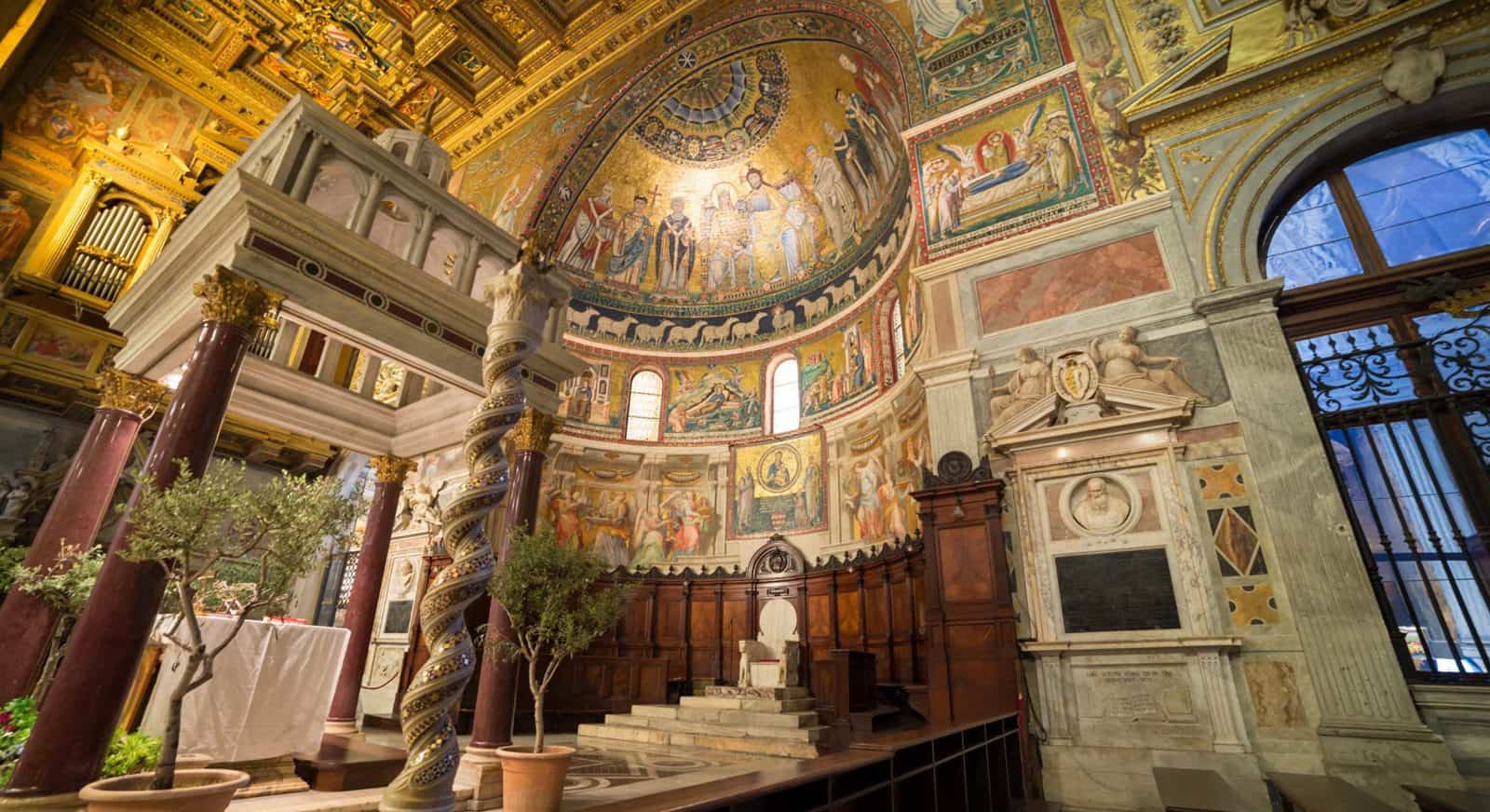
The Façade and the Mosaic of the 10 Women With Lamps
The façade is gabled, meaning it follows the profile of the three naves, and in the upper band it carries the mosaic that will catch your eye in the square before you even go in: the Madonna enthroned nursing the Child, flanked by 10 female figures holding lamps, some lit and some unlit. The most common reading identifies them with the wise and foolish virgins of the Gospel parable, but not all of them have halos and not all wear crowns, and historians have debated this for a century. Below, a frieze of windows and the two prophets. It is a mosaic that is easier to read in the evening, under the light of the floodlights, than at noon.
Who Made the Façade Mosaic and When
Here the sources disagree. It is often listed only as "a 13th-century mosaic," without an author. The English Wikipedia entry attributes it to Pietro Cavallini. Cathopedia instead dates it to around 1250-1260 and assigns it to a Roman workshop with no named author, and it also shifts the subject to a Madonna and Child enthroned among holy virgins. These are two different readings: one puts Cavallini's signature on it, the other says an anonymous workshop from the mid-13th century. Cavallini was born around 1240, so in 1250-1260 he would have been a young child: if you accept Cathopedia's dating, the attribution to Cavallini falls apart on its own. Two versions remain, and it's best to look at the mosaic knowing the label is uncertain. What no one disputes is that the apse mosaics, inside, are a different matter and have secure dates.
The Romanesque Bell Tower and the Niche Mosaic
The bell tower is Romanesque, square-based, and according to Cathopedia dates to the first half of the 12th century. It is about 20 meters tall and has 17th-century modifications. On its east side it has a 19th-century clock and, in a niche, a small mosaic of the Madonna and Child that Cathopedia places in the 17th century. People often describe it simply as "at the top of the Romanesque bell tower." The mosaic really is there, but the source dates it to the 1600s, so it is not a medieval piece like the rest of the tower. It's the kind of detail tourists photograph without knowing it is three centuries younger than the tower holding it up.
Carlo Fontana's Portico and the Statues of the Four Popes
In 1702 Pope Clement XI commissioned Carlo Fontana to rebuild the portico, and what you see today is his work: five arches framed by two pilasters and four granite columns, with a balustrade on top that holds four statues of popes. The names, confirmed by the sources, are Callixtus, Cornelius, Julius and Calepodius. They are the four popes and martyrs tied to the history of the title and buried or venerated here. The portico once served a function that has since been lost: it was the filter between the square and the church, the space where people stood, waited and negotiated. Fontana gave it a classicizing look, with a sloping roof, and erased the earlier medieval portico.
The Story of the Knives of the Toughs Hung in the Portico
This is the most Roman page of the entire basilica. Until the end of the 1800s, under the portico, next to a crucifix, you could see knives and spits hanging. The spit was a weapon, only a little shorter than a lance. The reason: when a Trastevere tough, that is, a man who lived by brawling and knife fights, decided to change his life, he brought the weapon of his trade to the Basilica of Santa Maria in Trastevere and hung it there. A votive offering in reverse: I don't ask, I give back. Today those weapons are gone and the portico houses a lapidarium.
The Lapidarium Under the Portico
Under the arches of the portico you'll find a collection of Christian inscriptions, fragments of friezes, remains of chancel screens from the ancient basilica, sarcophagi, detached frescoes and gravestones. They can be viewed for free, without going inside, and they are the piece that 90% of visitors walk past at a brisk pace while looking at their phones. That is a mistake. Some of those inscriptions come from the catacombs and early Christian cemeteries of the area, and reading them in Latin, with the name of the deceased and their age in months and days, has an effect you no longer feel inside, among the gold mosaics. If this topic interests you, the site has an entry dedicated to the Catacombs of Rome.
The Vestibule, Mino da Fiesole's Tabernacle and the Sacristy
Before entering the nave, in the vestibule, Cathopedia points out two things: 1st-century mosaics with waterbirds from Palestrina and a terracotta relief of the Resurrection, dated 1640-1647, by Niccolò Sale. Inside, again according to Cathopedia, there is a tabernacle for the holy oils by Mino da Fiesole, in marble from around 1450-1463, with Christ as the fons vitae, prophets, angels and the dove of the Spirit. The sacristy was built in 1483 under Cardinal Stefano Nardini and redone at the beginning of the 1700s by Francesco Carlo Bizzaccheri.

Domenichino's Ceiling and the Assumption at the Center
Look up as soon as you walk in. The wooden coffered ceiling, carved and gilded, was designed by Domenichino, and in the central octagon is his Assumption of the Virgin, painted in oil. On the date, the sources almost entirely agree: turismoroma.it and the English Wikipedia entry say 1617, while Cathopedia says the ceiling dates to 1616-1617. It isn't a real contradiction. It is the difference between when the work ended and how long the work took.
The Apse Mosaic: Christ and Mary on the Same Throne
This is why the basilica appears in every art history textbook. In the apse's conch, against a gold background, Christ and the Virgin sit on the same throne, side by side, and Christ puts his right arm around her shoulder. In all earlier Christian art, the Virgin is below, or in front, or in adoration. Here she sits beside him, on equal terms, crowned. It is the first great Roman example of this iconography, and it set the model for two centuries. On the left is Innocent II holding a model of the basilica, and around them a row of saints and popes. Above, the canopy of the Empyrean with the Father's hand crowning the Son. Below, the band with the Lamb of God and the 12 sheep coming out of Bethlehem and Jerusalem. On the triumphal arch, the prophets Isaiah and Jeremiah, the tetramorph of the evangelists, the seven candlesticks of the Apocalypse and the golden cross with the alpha and omega. The date all sources give for this mosaic band is 1140-1143, that is, Innocent II's construction period.
Why Christ and Mary Hold Scrolls
Because those scrolls carry verses from the Song of Songs. It is the detail on which Ernst Kitzinger's interpretation rests, and it is worth quoting in full. Kitzinger reads the mosaic as an allusion to the great medieval procession on the night of the Assumption, when the acheiropoietos icon of the Savior left the Lateran and was carried to Santa Maria Maggiore, in front of the Salus populi romani. A meeting between Mother and Son in the form of icons. The procession stopped at Santa Maria Nova near the Forum, today's Santa Francesca Romana, where there was another venerated image of the Virgin, and according to Kitzinger it is precisely this second icon that served as the model for the Virgin of the Trastevere mosaic. The thesis rests on stylistic resemblances, in particular between the face of Christ in the mosaic and the Lateran acheiropoietos, and on the documented fact that during that procession antiphons and passages taken from the Song of Songs were sung.
Pietro Cavallini and the 1291 Panels
Below the conch, in the lower band of the apse, are the mosaics with the Stories of the Virgin by Pietro Cavallini, dated 1291 by all sources. Cathopedia specifies that they were commissioned by Cardinal Bertoldo Stefaneschi and that there are six narrative panels, arranged in two registers: the Nativity of the Virgin, the Annunciation, the Nativity of Christ, the Adoration of the Magi, the Presentation in the Temple and the Dormition of the Virgin. At the center of the lower register is a medallion with the Madonna and Child between Saints Peter and Paul, with Cardinal Stefaneschi kneeling. Here Cavallini does something no one in Rome was doing in 1291: he gives weight and volume to bodies, puts shadow under the drapery, and builds architecture that stands up. 10 years later Giotto will paint in Assisi. Anyone who wants to understand where Italian painting comes from should stop in front of these six panels for a good 20 minutes.
How Many Cavallini Panels Are There, Six or Seven?
There's a small discrepancy between the sources here too. Cathopedia speaks of seven narrative panels in total, but then lists six in the upper register and describes the seventh as the central medallion with the Madonna, Saints Peter and Paul and the donor. So: six narrative scenes plus one votive panel. If you read seven somewhere and six somewhere else, the difference lies only in how you count the medallion.
The Icon of the Madonna della Clemenza
In the Altemps Chapel is a panel painted in encaustic, showing the Madonna enthroned with the Child between angels, known as the Madonna della Clemenza or Theotokos. It is one of the very few Early Medieval Marian icons to survive in the West. The sources don't agree on the date: it is often read as "perhaps the 6th century, but some historians suppose the 8th." Cathopedia places it in the second half of the 6th century, Roman workshop. monnoroma.it calls it Roman, 6th-7th century. The English Wikipedia entry widens the range to between the 6th and 9th centuries and says it is probably of Byzantine origin. So the real range falls between the 6th and 9th centuries, with most sources favoring the 6th. It is correct to relate it to the first layer of frescoes at Santa Maria Antiqua in the Forum, which is the classic stylistic comparison. The English Wikipedia entry adds that it was canonically crowned in 1659.
Why It's Called the Madonna della Clemenza
Cathopedia reports the tradition: the icon was supposedly carried in procession during a severe drought, the sky darkened and rain came. Hence the clemency. It is a devotional legend, not a document.
The Altemps Chapel and Who Commissioned It
Cardinal Marco Sittico Altemps, that is, Markus Sittikus von Hohenems, had the chapel built to house the icon. He is often called "the Austrian cardinal," and the chapel is attributed to Martino Longhi the Elder, in the 16th century. The sources narrow the date: Cathopedia says the chapel was built in 1584-1585, while English Wikipedia says 1580-1585. The four-year gap at the start likely reflects the distinction between commissioning and construction work. As for the adjective Austrian: Hohenems is today in Austria, in Vorarlberg, but at the time it was a separate imperial county. It isn't a serious mistake. It is a simplification.
The Chapels of the Right Nave
In the first chapel is Santa Francesca Romana by Giacomo Zoboli: Cathopedia specifies that the chapel is from 1721-1727 and that the painting, a Communion of Saint Frances, is from 1724. In the second chapel is the Nativity by Etienne Parrocel, and Cathopedia adds that the chapel is from 1739 to a design by Filippo Raguzzini, the architect of Piazza di Sant'Ignazio. Then Cathopedia lists a chapel of the Crucifix from 1652 with a polychrome wooden Christ of the 15th century and a chapel of Saint Peter from 1583 with a Handing over of the Keys by Giuseppe Vasconio. The fourth chapel, traditionally indicated as dedicated to Saint Frederick of Utrecht, is the most curious: in 1651, when the titular of the basilica was Cardinal Federico Corner, who lived between 1579 and 1653, work began and the altarpiece was painted by Giacinto Brandi with the martyrdom of Saint Frederick. The painting, however, is no longer there: according to a traditional claim, not confirmed by an official source, it has been kept in the parish priest's office since the seventeenth century to protect it from damp, and in the chapel remained a copy by Arcangelo Spagna, a pupil of Brandi.
The chapels of the left aisle and the Avila chapel
You sometimes read that "the first chapel of the left aisle is the Avila chapel". In reality the Avila chapel, the one with the Baroque stuccoes by Antonio Gherardi, is the fifth and last of the left aisle, the one near the transept. The Italian Wikipedia entry says so, placing it explicitly as the fifth chapel of the left aisle with Gherardi's stuccoes of 1680, and Cathopedia confirms it, listing in order the five chapels on the left and putting last that of Saint Jerome, designed by Antonio Gherardi around 1686, with its Baroque dome and its Saint Jerome at the altar. On the date of the stuccoes the two sources do not agree: 1680 and about 1686.
What the Avila chapel is and why it's worth the detour
It's a masterpiece of late Roman Baroque and one of the few experiments in indirect lighting of that era: Gherardi builds a dome inside the dome, with stucco angels holding up an openwork structure, and lets in light from sources you cannot see. The result is that the light seems to come from nowhere. If you have seen the chapel of Santa Cecilia in San Carlo ai Catinari, also by Gherardi, you recognize the hand. In our judgment it's the most surprising thing in the basilica after the mosaics, and most people walk past it looking the other way.
The other left chapels according to the sources
Cathopedia lists, from the inner facade toward the transept: the baptistery chapel, from 1592 and redesigned in 1741, with the baptismal font by Filippo Raguzzini. The chapel of Saints Marius and Callistus, from 1618. The chapel of Saint Francis of Assisi, from 1590-1591, with the frescoes by Ferraù Fenzoni, the ecstasy and the stories of his life. The chapel of the Sacred Heart, with an altarpiece of Saint John the Baptist attributed to Antonio Carracci from the early seventeenth century. And finally the chapel of Saint Jerome, that is the Avila, by Gherardi. The Italian Wikipedia entry dates Fenzoni's frescoes to 1591-1593 and the Stigmata of Saint Francis to 1594-1595. On Fenzoni, then, there is a two-year difference between the sources.

The Madonna di Strada Cupa and the winter choir
According to Cathopedia, in 1624 an image of the Madonna and Child with the young Saint John was found near the Janiculum, a fresco by a Roman workshop of the second quarter of the sixteenth century, traditionally attributed to Perin del Vaga. In 1625 Pope Urban VIII had it moved to the basilica and the chapel was built to a design by Domenichino. The Italian Wikipedia entry places this Madonna di Strada Cupa in the winter choir together with a Flight into Egypt by Carlo Maratta. The English Wikipedia entry dates the canonical coronation of the Madonna di Strada Cupa to 1634. Three sources, three different pieces of the same story, and no contradiction among them.
The presbytery: ciborium, cathedra, Paschal candlestick
Cathopedia describes a ciborium with four Corinthian porphyry columns, reassembled by Vespignani with ancient reused elements. An altar in pavonazzetto marble earlier than the 9th century. A candlestick for the Paschal candle from the workshop of the Vassalletto, between the second half of the 12th and the 13th century. And an episcopal cathedra in marble of the 13th century with griffin supports, in Cosmatesque style. The floor is Cosmatesque, the work of Roman marble workers between the 12th and 13th century, remade in the nineteenth century by Vespignani. turismoroma.it, in its English listing, speaks of 13th-century floor mosaics restored in 1860. If you have seen the floor of Santa Maria in Cosmedin or that of San Clemente, this is from the same family and the same workshop hand.
The tombs and the relics
The basilica houses the relics of Saint Julius I and the remains of Saint Callixtus I and Innocent II, and in the confessio dug between the 8th and 9th centuries, the remains of some martyrs were laid to rest. The list grows longer: English Wikipedia adds to the burials the antipope Anacletus II, Cardinal Philip of Alencon and Cardinal Lorenzo Campeggio, and among the relics it cites the head of Saint Apollonia and a portion of the Holy Sponge. The tomb of Innocent II that you see today, between the third and fourth chapels of the left nave, is not medieval. It is the work of Virginio Vespignani, the architect of the 1866-1877 restoration under Pius IX.
The Pipe Organs, Two Worlds in the Same Transept
In the transept stand two twin choir lofts, carved and gilded, with cases and façades of three bays, traditionally dated to the 16th century. Inside them are two instruments that are very far apart. In cornu Epistulae is an organ from 1702 by the Roman organ builder Filippo Testa, which replaced a 16th-century instrument by the Venetian Venerio de Legge: a single 53-note keyboard with a short first octave, a lectern-style pedalboard of 17 notes coupled to the manual and with no stops of its own. In cornu Evangelii is an organ from 1911 by the French firm Mutin Cavaille-Coll, direct heir of Aristide Cavaille-Coll, with two 56-note manuals and a straight pedalboard of 27. The Italian Wikipedia entry confirms both technical specifications word for word. Two and a half centuries of organ history in the same transept, facing each other: a Roman baroque organ for liturgical accompaniment and a French symphonic organ for concerts. If you visit during a service with organ, listen closely to see which of the two is playing.
The Community of Sant'Egidio and the Evening Prayer
The Basilica of Santa Maria in Trastevere is the site of the evening prayer of the Community of Sant'Egidio. The community was founded in Rome in 1968 and is known worldwide for its peace mediation in Mozambique. On the website santegidio.org, on the prayer page, it says word for word that the evening prayer at Santa Maria in Trastevere is broadcast live at 20:30. The Community's headquarters is very close, at Piazza Sant'Egidio 3a. Believer or not, walking in here at 20:30, with the basilica in dim light, the chants and the lamps lit, is a different experience from a daytime visit. Be careful: during the prayer, don't wander around the church with your phone in hand. Either stay, or come back tomorrow.
The Cardinal Title of Santa Maria in Trastevere
The title has been attested since the 5th century according to Cathopedia, and it is one of the most prestigious in the College of Cardinals. Among past holders, the sources list Pope John XI between 925 and 931, Pope Eugene IV between 1426 and 1431, Giovanni Morone between 1556 and 1560, Pietro Aldobrandini between 1612 and 1620, Cardinal Duke of York Henry Benedict Stuart between 1759 and 1761, the future Pope Leo XII, the American James Gibbons between 1887 and 1921, and the Pole Stefan Wyszynski between 1957 and 1981, beatified in 2021. For the current holder, both English Wikipedia and Cathopedia name Cardinal Carlos Osoro Sierra, emeritus archbishop of Madrid, holder since 2016. Cardinal appointments change. If you need this detail with certainty, check the official yearbook, because it is not confirmed by a Vatican source.
Hours, Masses and Admission: What the Sources Say
Here's a summary, because this is the part you really need. Free admission: arte.it states it explicitly, and no source mentions a ticket. No reservations. General hours: 7:30-21:00 according to arte.it and monnoroma.it, which however adds Fridays from 9:00. August hours: arte.it says 8:00-12:00 and 16:00-21:00, monnoroma.it says 8:00-13:00 and 15:00-21:00. The two sources don't match. If you visit in August, aim for early morning or late afternoon after 16:00, the only window where they agree.
What Time Are Masses at the Basilica of Santa Maria in Trastevere
Here too there are two sources, and they differ. Orarimesse.it lists weekday Masses from Monday to Friday at 17:30, the vigil Mass on Saturday at 17:30, and Sunday Masses at 10:00 and 17:30. Arte.it instead lists holiday Masses at 8:30, at 10:00 moved to 11:00 from September 1 to June 30, and at 17:30 moved to 18:45 from September 1 to June 30. Vigil Masses at 17:30 move to 20:00 from September 1 to July 31. These two timetables don't line up. Arte.it adds a note that applies to all churches in Rome: visits are not allowed during Mass. Keep that in mind if your only goal is the apse mosaics.
What Email Address Does the Parish Use?
The sources contradict each other here. Turismoroma.it and Cathopedia give s.mariaintrastevere@libero.it. Arte.it instead gives santamariaintrastevere@vicariatusurbis.org. Cathopedia also adds a fax number, 06 5810599. It is not clear which of the two addresses is active. If you need to write, try the phone first.
How to Get to the Basilica of Santa Maria in Trastevere
Trastevere has no metro, and that's the first fact that saves you half an hour of wrong searches. These are the surface lines the sources list. Monnoroma.it: tram eight with the stop Gioacchino Belli, bus H with the stop Sonnino/San Gallicano, buses 23 and 280 with the stop Lungotevere Sanzio/Filipperi. Arte.it: tram eight and buses 23, 64 and 125 with the stop Piazza Sant'Egidio. The two lists don't agree on the bus numbers: tram eight and bus 23 are the only ones both lists share. According to the Italian Wikipedia entry, tram eight connects Piazza Venezia to Via del Casaletto through Viale di Trastevere, so from the center it's the simplest option. From the tram stop to the square in front of the basilica it's five minutes on foot, a slight uphill climb through the alleys. Still, check the current route on the Atac website before you leave, because lines in Rome are often rerouted.
Walking from the center
Yes, and it's the best way. From Largo Argentina, past Ponte Garibaldi, it's less than 20 minutes. From the Tiber Island it's barely 10 minutes, crossing the Ponte Cestio and heading into Via della Lungaretta. From the Janiculum Hill it's a quarter of an hour downhill, and the descent from the Acqua Paola Fountain toward the square is one of the most beautiful walks in Rome. Anyone coming from the Synagogue and the Portico d'Ottavia crosses the river and takes a quarter of an hour.
Accessibility of the Basilica of Santa Maria in Trastevere
An official accessibility profile for this basilica does not appear to be available: turismoroma.it refers to a dedicated section of its own website. This isn't certified data, but the main entrance from the square has a few steps under the portico, and the interior is on one level, with an old, uneven floor and some changes in level toward the presbytery. Anyone who uses a wheelchair should call ahead at 06 5814802 and ask about the side entrance. Confirmation has to be requested by phone.
With kids
It works better than you'd think, as long as you give them something to look for. Three treasure hunts that always work here. First: find the spot of the fons olei on the step of the presbytery. Second: count how many of the 10 women in the facade mosaic have their lamp lit and how many have it turned off. Third: look for the spots on the capitals where the Egyptian heads were chiseled off. They're three games of 20 minutes total that turn a church into something you do more than look at. The square outside, with the fountain and the steps, is the right place for a gelato break right afterward.
The square in front, which is worth as much as the church
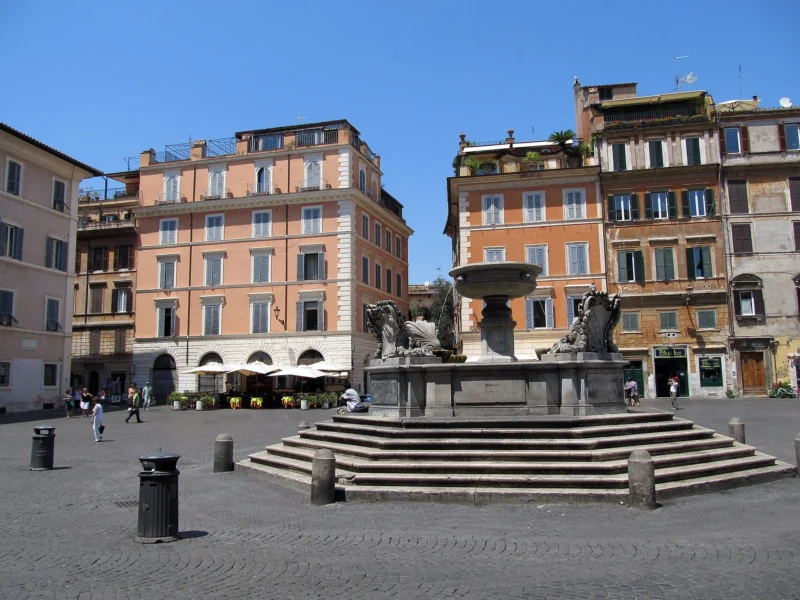
Piazza di Santa Maria in Trastevere is one of the few Roman squares without traffic and with a fountain where people actually sit down. The fountain has a long history of rebuilding that involves Bramante, Bernini and Carlo Fontana, and for that reason it doesn't have a single author: what you see is the result of several interventions. In the evening the square fills up, with musicians, kids sitting on the steps, tourists, Romans, and the golden facade lit up above everyone. If you have to pick one time to come, pick that one.
What's around
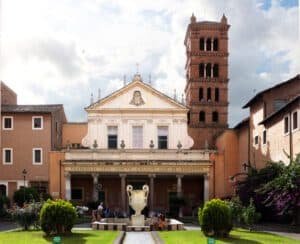
The rione is a machine for half days. The Basilica of Santa Cecilia in Trastevere with Cavallini's Last Judgment in the nuns' choir, and that Judgment dates to 1293, two years after the mosaics here, so the comparison is the most instructive thing you can do in one day in Rome. The Church of San Francesco a Ripa with Bernini's Blessed Ludovica Albertoni. The Church of Sant'Agata in Trastevere. The Museo di Roma in Trastevere to understand what the rione looked like before the demolitions. Going uphill, the Villa Farnesina with Raphael, the Rome Botanical Garden, the Galleria Corsini, and higher still San Pietro in Montorio with Bramante's Tempietto and the Janiculum Hill. On Sunday morning, Porta Portese. For long days, Villa Doria Pamphilj.
A curiosity about the Basilica of Santa Maria in Trastevere
The real curiosity isn't the mosaics. It's the oil. Nowhere else in Rome is the exact spot of a miracle, recounted by pagan authors, Cassius Dio and later Saint Jerome, marked physically on the sanctuary floor with an inscription. The fons olei of 38 BC is an ancient news story, a spurt of mineral oil from the ground that flowed down to the Tiber, transformed centuries later into prophecy. It's the only Roman case where you can put your finger on a spot and say: here, according to tradition, that happened. The clarification already made above applies: in 38 BC there were no Christians, and the messianic reading of the oil came later. The curiosity remains intact, but the chronology needs to be set straight.
Something Nobody Tells You About the Basilica of Santa Maria in Trastevere
There is an antipope buried in here. English Wikipedia lists among the basilica's burials that of Anacletus II, that is, Pietro Pierleoni, the man who held Rome for eight years against Innocent II, and whom the Church considers an antipope. Innocent II rebuilt this basilica and is buried here. According to that same source, his rival is buried here too. No guidebook tells this story, no sign points it out, and the matter is delicate: antipopes don't get monumental tombs, and their memory fades quickly. But if it's true, and the source says it is, then this is the only church in Rome where a pope and his antipope rest under the same roof. Take it for what it is: a fact from an encyclopedic source, not an inscription you can read on site.
My Advice for Visiting the Basilica of Santa Maria in Trastevere
Come twice on the same day. The first time early in the morning, right when it opens, when the basilica is empty and light comes through the high windows of the nave. It's the only moment when you can stand in front of the apse for 20 minutes without anyone walking in front of you, and Cavallini's mosaics need exactly those 20 minutes. The second time, come back in the evening, after 20:00, when the square fills up and inside there's the Sant'Egidio prayer at 20:30. These are two different buildings. The second tip, less poetic and more useful: bring €2 in coins for the apse lighting, because in many Roman churches the apse stays dark until you drop a coin in, and you can't see mosaics in the dark. Third: don't come between 12 and 16 in August, because according to both sources you risk finding it closed during that window. The two sources only disagree about exactly when the closure falls.
Another Well-Known Fact, Though Rarely Mentioned
Everyone mentions that the columns come from the Baths of Caracalla. What almost nobody adds is the consequence: this basilica is built from the pieces of a dismantled pagan building, 22 granite columns plus the portal's architrave, which makes it an unintentional catalog of imperial Roman sculpture. The capitals are of different orders, Ionic and Corinthian, in sizes that don't match, and the 12th-century builders had to level the heights with bases and plinths. Go look at the base of the columns and you'll see the tricks. It's the architecture of reuse, and in Rome it's the rule, not the exception: the same marble workers who supplied these sites also worked at San Clemente and Santa Maria in Cosmedin.

The Right Photo to Take at the Basilica of Santa Maria in Trastevere
Not the interior. Inside it's dark, and without a tripod or lights switched on, the apse mosaics come out as a yellow blur. The right photo is taken outside, in the square, at sunset or just after, when the façade lights come on and the mosaic of the 10 women with lamps stands out against the dark brick. Stand on the opposite side of the square, with your back to Via della Paglia, lower yourself to the height of the fountain steps, and frame the fountain in the foreground on the left and the façade behind it. That way the fountain gives you depth, and you don't end up with a flat façade. If you have a phone, use night mode but rest your elbow on the edge of the fountain, because the mosaic blurs if you hold the phone freehand. The second good photo, inside, is Domenichino's ceiling: stand under the central octagon, phone pointed up, and the gilded coffers frame the Assumption. That one works even without a tripod. Third, for the patient: the bell tower seen from vicolo di Santa Maria in Trastevere, with laundry hung out, in the morning.
Some Important Events That Took Place Here in History
Here, in order, are the dates the sources record precisely. In 38 BC, according to the tradition reported by Cassius Dio and Saint Jerome, the spring of the fons olei. Between 217 and 222, under Pope Callixtus I, the founding of the titulus. In the 4th century, under Pope Julius I, the construction of the first true basilica: 340 according to turismoroma.it and English Wikipedia, 349 according to Cathopedia. Between the 8th and 9th centuries, the addition of the side aisles and the excavation of the confessio with the relics of the martyrs. Innocent II's construction work, between 1138 and 1148 depending on the source, with the apse mosaics of 1140-1143. The consecration by Alexander III in the 1160s, according to Cathopedia. 1291, Pietro Cavallini's mosaics for Cardinal Bertoldo Stefaneschi. 1483, the sacristy of Cardinal Stefano Nardini. 1584-1585, the Altemps Chapel for the Madonna della Clemenza. 1616-1617, Domenichino's ceiling. 1625, the arrival of the Madonna di Strada Cupa, wanted by Urban VIII and crowned in 1634 according to English Wikipedia. 1659, the canonical coronation of the Madonna della Clemenza. 1680, or around 1686 according to Cathopedia, the Avila Chapel by Antonio Gherardi. 1702, the portico by Carlo Fontana for Clement XI and the organ by Filippo Testa. 1870, under Pius IX, the chiseling away of the Egyptian heads on the capitals. Between 1866 and 1877, the general restoration by Virginio Vespignani. 1911, the Mutin Cavaille-Coll organ. 2018, Pope Francis's Mass for the 50th anniversary of the Community of Sant'Egidio, according to English Wikipedia, a detail not confirmed by a Vatican source.
Who Passed Through the Basilica of Santa Maria in Trastevere
Artists first of all: Pietro Cavallini, who here in 1291 made the leap that leads to Italian painting. Domenichino, who designs the ceiling and paints the Assumption between 1616 and 1617, and also designs the chapel of the Madonna di Strada Cupa. Carlo Fontana, who rebuilds the portico in 1702. Antonio Gherardi, who builds the Avila Chapel around 1680. Mino da Fiesole, with the tabernacle for the holy oils. Giacinto Brandi, Giacomo Zoboli, Etienne Parrocel, Ferraù Fenzoni, Carlo Maratta, Jacopo Palma the Younger with the Martyrdom of Saints Philip and James in the left transept according to the Italian Wikipedia entry, Filippo Raguzzini, Virginio Vespignani. The popes: Callixtus I, Julius I, Innocent II, Alexander III, Urban VIII, Clement XI, Pius IX. And the antipope Anacletus II, buried here according to English Wikipedia. The titular cardinals make up a textbook list of history: Pope John XI between 925 and 931, Pope Eugene IV between 1426 and 1431, Giovanni Morone, Pietro Aldobrandini, Cardinal Federico Corner, the Duke of York Henry Benedict Stuart between 1759 and 1761, that is, the last Stuart pretender to the English throne, the future Pope Leo XII, the American James Gibbons from 1887 to 1921, who according to English Wikipedia took possession of the church with a speech defending the American constitutional model, and the Pole Stefan Wyszynski from 1957 to 1981, the primate of Poland beatified in 2021 and the mentor of Karol Wojtyla. Among recent events, the same source notes the 2014 wedding of Prince Amedeo of Belgium and the 2018 Mass by Pope Francis for Sant'Egidio's 50th anniversary. And then, every evening, the people of the Community of Sant'Egidio, who have made this basilica their own house of prayer.
Quick Questions About the Basilica of Santa Maria in Trastevere
How Much Does It Cost to Enter the Basilica of Santa Maria in Trastevere
Nothing. Arte.it declares free admission, and none of the other sources mention a ticket. It is an active parish church, not a museum.
Do You Need a Reservation
No. There's no reservation, no ticket office and no regulated queue. You just walk in during opening hours.
What Are the Opening Hours
The two available sources say 7:30-21:00, with monnoroma.it adding Fridays from 9:00. In August, arte.it says 8:00-12:00 and 16:00-21:00, and monnoroma.it says 8:00-13:00 and 15:00-21:00. When in doubt, aim for early morning or the afternoon after 16:00.
How Long Does a Visit Take
Arte.it indicates about one hour. 40 minutes is enough if you come for the mosaics. An hour and a half is better if you also want the side chapels, the portico with the lapidarium and the vestibule.
Can You Take Photos Inside
No official rule written specifically for this basilica appears to be published. The practice in Roman parish churches is that photos without flash and without a tripod are allowed, while during services they are not. Follow that practice and check for signs at the entrance.
Where Exactly Are Cavallini's Mosaics
In the lower band of the apse, under the large conch with Christ and the Virgin enthroned. There are six panels with the Stories of the Virgin, plus a central medallion with the Madonna between Saints Peter and Paul and Cardinal Bertoldo Stefaneschi, who commissioned them in 1291.
What's the Difference Between the Conch Mosaic and Cavallini's Mosaics
Where is the fons olei spot
On the step of the presbytery, marked with an inscription. It's the spot where, according to tradition, oil came out of the ground in 38 BC.
The Basilica of Santa Maria in Trastevere is the oldest church in Rome
It depends on what you mean by church. Sources, including turismoroma.it, use the cautious phrase "probably the first official place of Christian worship in Rome," referring to the domus ecclesiae of Callixtus I. The building you see today dates from the 12th century. So: a very ancient title, medieval walls.
Is it true that it's the first church dedicated to the Madonna
That's what turismoroma.it and arte.it both report: the first in Rome dedicated to the cult of the Virgin. The Marian title replaced the titulus Calixti in the 6th century.
Are there ancient remains visible under the basilica
No source describes an underground archaeological route you can visit here, as there is, for example, at San Clemente. What the sources do describe is the confession under the altar, excavated between the 8th and 9th centuries. If you're looking for stratified underground levels, San Clemente is still the right basilica.
Is the church wheelchair accessible
An official accessibility report is not available. The main entrance has a few steps, and the interior is all on one level, but with an uneven ancient floor. Call 06 5814802 and ask about the side entrance: it's the only way to get a certain answer.
Are there toilets
No public restroom is listed inside the basilica, and no source confirms or rules one out. The bars on the square are the practical solution, as they always have been.
Is it hot inside in August
Less than outside. Roman churches built in heavy masonry stay several degrees below the temperature of the square, and Santa Maria in Trastevere is wide, tall and shady. On scorching days it's one of the places where the neighborhood can breathe.
When is the prayer of the Community of Sant'Egidio
santegidio.org lists the evening prayer at Santa Maria in Trastevere at 20.30, also broadcast live. During the prayer the basilica is not open for visits: you take part or you come back later.
Can you go in during Mass
You can go in, but you can't walk around. Arte.it states it explicitly: during Mass, visits are not allowed. If mosaics are your goal, check the times of the services before heading up to the square.
Which bus and tram lines arrive nearby
Monnoroma.it lists tram 8 to the Gioacchino Belli stop, bus H to the Sonnino/San Gallicano stop, and buses 23 and 280 to the Lungotevere Sanzio/Filipperi stop. Arte.it lists tram 8 and buses 23, 64 and 125 with Piazza Sant'Egidio stop. The two lists don't match: tram 8 and bus 23 are the two that both agree on. Check Atac before you leave.
Is there a metro in Trastevere
No. The neighborhood isn't served by the metro. Anyone arriving by train at Trastevere station continues by tram 8 or on foot in about 20 minutes.
Is the basilica suitable for children
Yes, if you give them something to look for: the fons olei spot, the lamps on and off in the façade mosaic, the capitals with chiseled-off heads. Outside there's the square with the fountain for a break.
What is the Madonna della Clemenza
A panel painted in encaustic with the Madonna enthroned with the Child between angels, kept in the Altemps chapel. Sources date it between the 6th and 9th centuries, with most favoring the 6th. It's one of the oldest surviving Marian paintings in the West.
Who is buried in the basilica
Sources name Pope Callixtus I, Pope Innocent II, the antipope Anacletus II, Cardinal Filippo di Alencon and Cardinal Lorenzo Campeggio, as well as relics of Pope Julius I, the head of Saint Apollonia and a portion of the Holy Sponge.
Are there organ concerts
The basilica has two historic organs, one from 1702 by Filippo Testa and one from 1911 by Mutin Cavaille-Coll, but no official concert schedule is published. If you're interested, ask at the parish at 06 5814802.
Is it worth coming in the evening
It's the best time. The façade lit up with its 13th-century mosaic, the square full of people, the prayer inside at 20.30. It's the only hour when you understand why this church and this neighborhood are the same thing.
What's the difference with Santa Cecilia in Trastevere
They're 10 minutes apart and they complement each other. Here you find the Cavallini mosaics of 1291 in the apse, at Santa Cecilia you find its Last Judgment frescoed two years later, in the nuns' choir, with separate access and its own hours. Seeing both on the same day is the best way to understand who Cavallini was.

Why Come Here
The Basilica of Santa Maria in Trastevere is the only church in Rome that manages to be both a masterpiece of art history and the living room of a neighborhood. People come in to do some grocery shopping for the soul and leave to sit on the steps of the fountain. It has no turnstile, no audio guide, no line. It has 22 columns stolen from the Baths of Caracalla, a mosaic where Christ holds the Mother by the shoulders eight centuries before anyone thought it could be done, six panels by Pietro Cavallini that are worth the trip on their own, and, at half past eight in the evening, about a hundred people singing. If you have only one hour in Trastevere, spend it here. And if you have two, spend one early in the morning and one in the evening: it's the same place, and they are two different experiences. Then go out, turn left, have a coffee at the bar on the square, and look at the golden facade while the lights come on.
Contact Information
Nearby
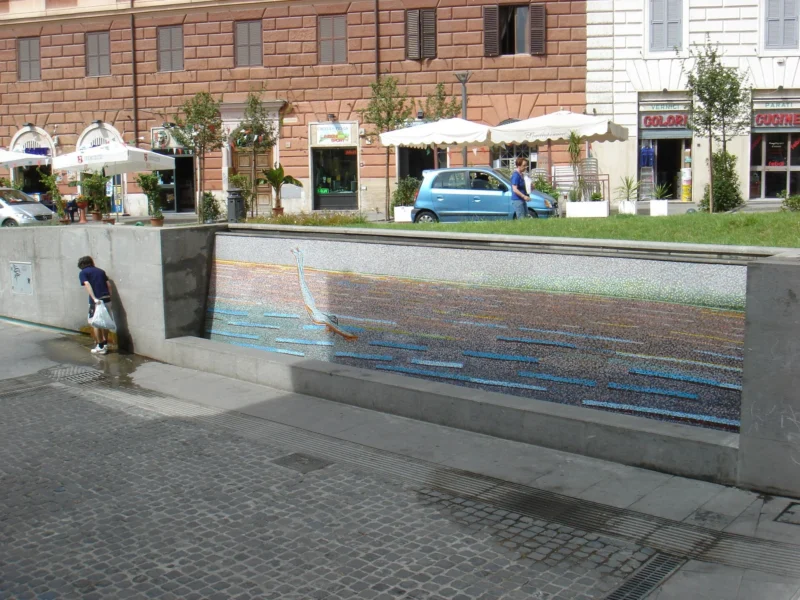
 Piazza di Santa Maria in Trastevere100 m
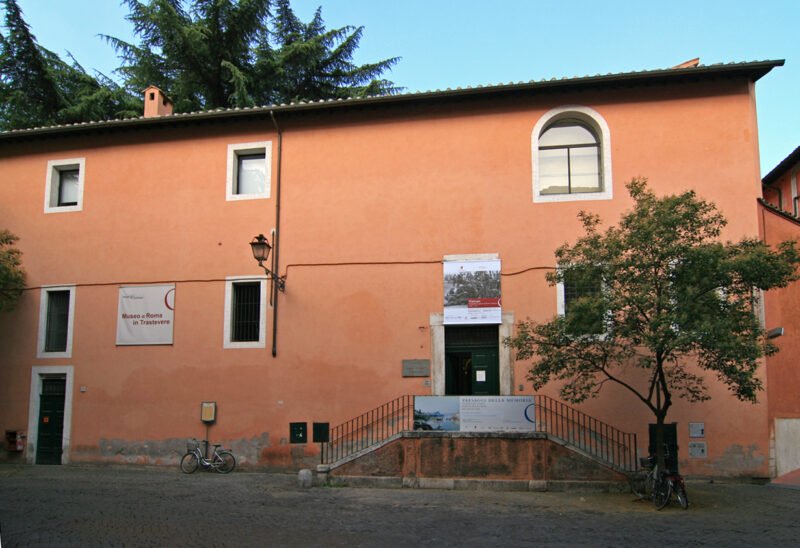
- Museo di Roma in Trastevere100 m
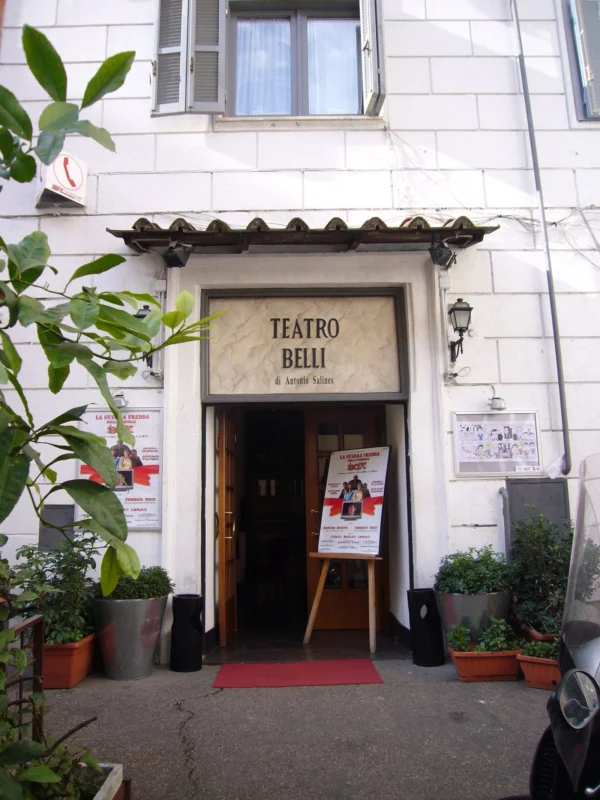
- Teatro Belli100 m
- Almost Corner Bookshop200 m
- Mercato di San Cosimato200 m
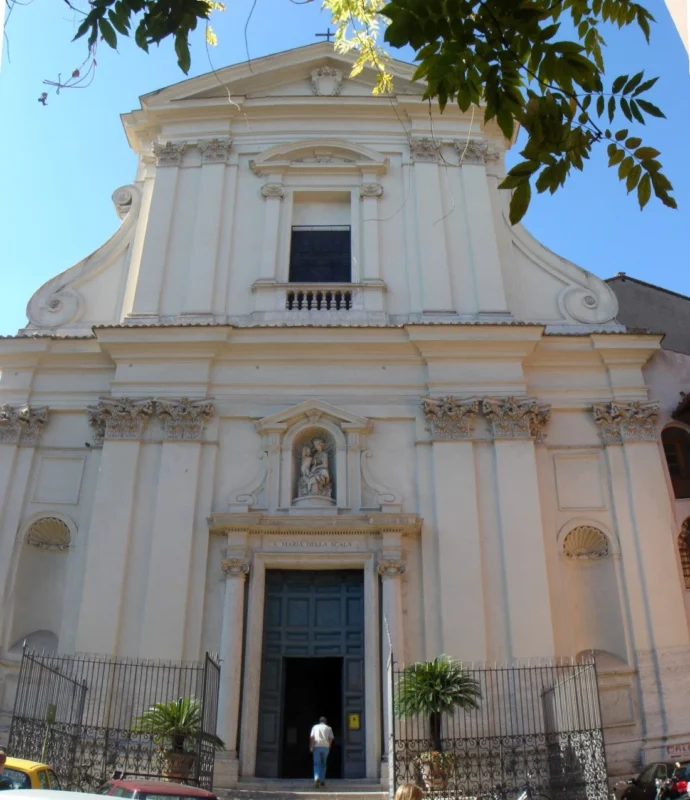
- Church of Santa Maria della Scala200 m
Upcoming events nearby
- Las Grietas by Fabiola Ferrero at Museo di Roma in Trastevere, from October 1 to November 22, 2026100 m
- Le Parole delle Scrittrici at Museo di Roma in Trastevere, October 15, 2026 to May 27, 2027100 m
- Fulco Pratesi. Acquerelli Pionieri at Museo di Roma in Trastevere, from September 16 to December 6, 2026100 m
- The Thin Line at Museo di Roma in Trastevere, Oct 28, 2026 to Feb 21, 2027100 m