Museo di Roma in Trastevere
In short. The Museo di Roma in Trastevere is at piazza Sant'Egidio 1/b, 00153 Roma, inside the former monastery of the Discalced Carmelite nuns that occupies the northern side of the little square, 70 meters from piazza Santa Maria in Trastevere.

The Museo di Roma in Trastevere is at piazza Sant'Egidio 1/b, 00153 Roma, inside the former monastery of the Discalced Carmelite nuns that occupies the northern side of the little square, 70 meters from piazza Santa Maria in Trastevere. It's open Tuesday to Sunday from 10.00 to 20.00, with last entry one hour before closing. It's closed on Monday, and also on May 1 and December 25, while on December 24 and 31 the hours are reduced to 10.00-14.00. The ticket has two price lists, and the difference isn't a detail. When there are exhibitions running on the ground floor, full price is €13.00 and reduced is €8.50. When there aren't, it drops to €9.50 full and €5.00 reduced. Advance purchase online or by phone at the 060608 call center adds a €1.00 presale fee and produces a ticket that is neither refundable nor changeable, so it only makes sense if you're going for sure. Admission is free for MIC card holders and, since February 2026, for those who live in Rome and the Metropolitan City by showing an ID card at the desk. Groups of five to 25 people with a guide book for free at 060608 with at least five tickets bought in advance. School groups get in free with official documentation and one chaperone for every 10 pupils, except for some exhibitions that ask for a reduced €2.00. Booking is not required for individual visitors. The 060608 call center answers every day from 9.00 to 19.00. The ticket office has a dedicated mailbox, bstrastevere@zetema.it, and the museum answers at museodiroma.trastevere@comune.roma.it. To get there: trams 3 and 8, buses 23, 44, 75, 116, 280 and 630, with stops on the lungotevere or along viale di Trastevere and five minutes of alleys on foot. The subway doesn't reach this neighborhood, and whoever tells you otherwise has never set foot here. Check the line on Atac before heading out, because Roman routes change more often than would be reasonable.
This guide is part of the section devoted to the museums of Rome, where you'll find the city's other municipal and state collections with hours and fares.

What the Museo di Roma in Trastevere really is
Whoever buys the ticket thinking they're entering a painting museum is wrong by only a little, but wrong. The Museo di Roma in Trastevere is three things layered on top of each other, and understanding that before climbing the stairs changes the visit.
The first is an ethnographic museum: the Scene Romane, eight life-size reconstructed settings with dressed mannequins, real furnishings and painted backdrops, representing trades and situations of pre-unification Rome. The second is a collection of views: watercolors, paintings, prints, and above all Ettore Roesler Franz's cycle of vanished Rome, 120 large-format sheets that document the city exactly at the moment it was about to be demolished. The third is a photography exhibition center, with the ground floor reserved for temporary exhibitions and a program that over the past 20 years has made this venue one of the few Roman civic places where 20th-century photography is shown continuously.
The glue among the three souls is a single idea, and it should be said without rhetoric: here is kept the memory of what Rome lost by becoming a capital. It's not a museum of masterpieces. It's a museum of evidence. If you're looking for great painting, the right place is elsewhere. If you want to understand how people ate, worked, quarreled and died in this city before 1870, this is the only address where the answer is all together in 1,500 square meters.
In our judgment it's the most underrated civic museum in Rome, and for a precise reason. The old name, Museo del Folklore, branded the institution with an air of village fair that the content doesn't deserve.
The former monastery of Sant'Egidio, home of the Museo di Roma in Trastevere
The building is the oldest part of what you see, and it has a biography worth a chapter of its own.
From 1610 to the Discalced Carmelites
The first nucleus of the monastery was born in the first decades of the 17th century next to the church of San Lorenzo in Ianiculo, later restored and rededicated to Sant'Egidio. In 1610 the church, with the attached house, was granted to the Discalced Carmelite nuns. The restoration carries the name of Agostino Lancellotti. The push to expand came 12 years later, with the canonization of Teresa of Avila in 1622. From that moment the reformed order took root in Trastevere with a series of foundations that still draw the religious topography of the neighborhood today, from Santa Maria della Scala to the Regina Coeli complex on via della Lungara, down to Santa Maria dei Sette Dolori on the slopes of the Janiculum.
The nuns gradually bought up the built fabric around the square and fused it into a single cloistered monastery. In the operation the church of Santi Crispino e Crispiniano, the old San Biagio in Trastevere, rebuilt in 1630, ended up absorbed as well. It's how Rome was really built: nobody built on an empty field, they ate the block one piece at a time.
The 1723 construction site and the cloister of the Museo di Roma in Trastevere
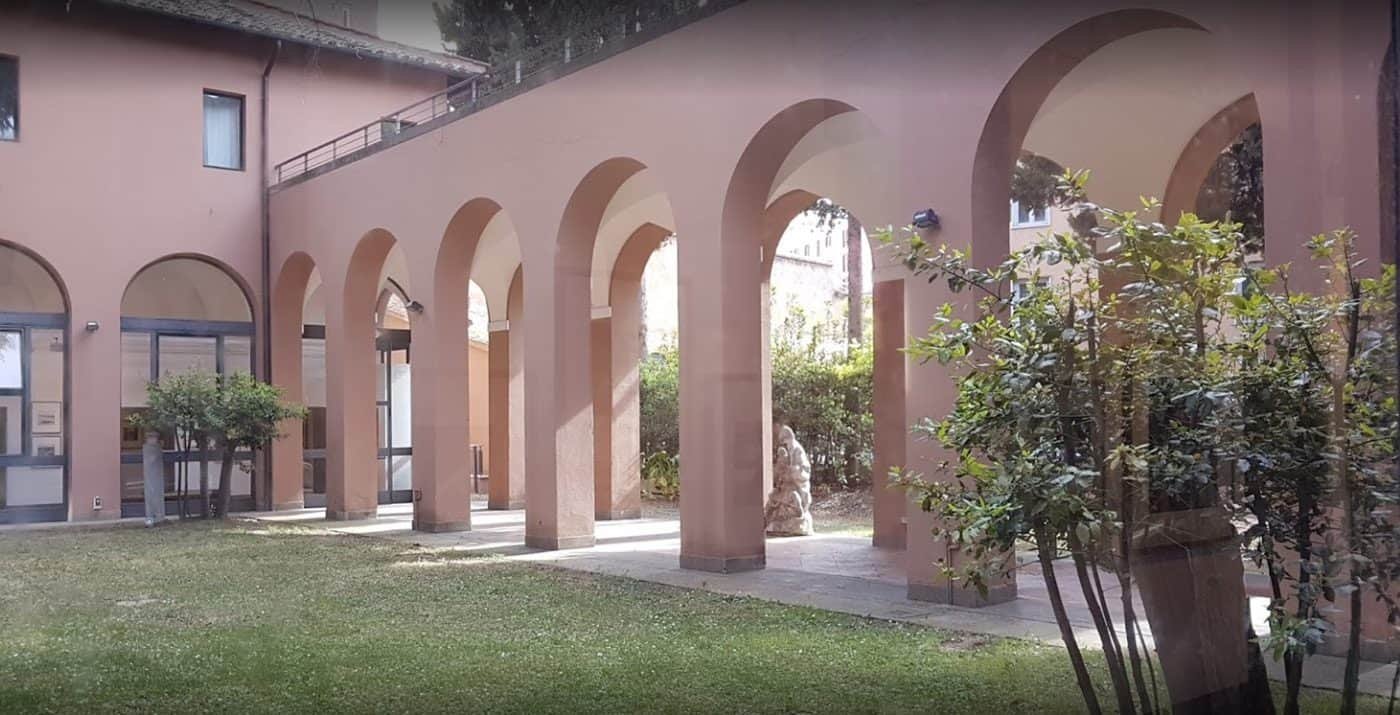
In 1723 the nuns commissioned Francesco De Sanctis for work on the architecture of the complex. He's the same architect who a few years later would sign the Spanish Steps staircase at Trinità dei Monti, and knowing whose hand it is changes how you look at the cloister: the measure of the arches, the relationship between solids and voids, the economy of means belong to a professional who knew how to get an effect with little. Set into the walls of the cloister are finds from the medieval churches demolished in the area: fragments of screens, inscriptions, Cosmatesque elements that made it here because someone, in the 19th or 20th century, had the good sense not to throw them away.
The cloister is the most beautiful thing in the building and the least looked at. Walk through it slowly twice, going and coming back.
1875, the expropriation and the 60 civil years
After the unification of Italy, with the liquidation of church property, the monastery was expropriated by the State. From 1875 the complex was split into distinct properties with different uses. One portion went to the Municipality of Rome, which made it first a barracks for the municipal guards, then the Pretura of the fifth district with the praetor's residence attached. In the early 20th century it became a Casa di Contumacia, that is, a quarantine place. Then a lazaretto for the refugees of the Marsica earthquake. Finally a shelter for sick and infected soldiers of the Great War.
Try to hold the images together: the same vaults under which the Carmelite nuns had prayed filled up with cots, with displaced people from Abruzzo and with infantrymen back from the front with the Spanish flu on them. In 60 years the building passed through almost the whole of Italian social history.
The Ettore Marchiafava sanatorium
In the second decade of the 20th century, by will of the Governatorato, the public function stabilized: the complex became an anti-malaria sanatorium for children. In 1921 it was named after Ettore Marchiafava, physician, senator of the Kingdom, malaria scholar and councilor for Hygiene. The plaque commemorating the naming is still at the entrance of the museum, and almost nobody reads it.
It's worth stopping for a second: malaria in Rome was not an exotic memory, it was a public health problem that concerned the Agro and the poor children of the city. That this address, known today for its watercolors, was for decades a place where malaria-stricken children were treated is the thing nobody expects.
Attilio Spaccarelli's restoration and the birth of the museum
In the 1960s the Municipality, which in the meantime had also acquired the other two wings overlooking the cloister, launched an architectural recovery project signed by Attilio Spaccarelli with the collaboration of Fabrizio Bruno. Spaccarelli is the designer who, together with Marcello Piacentini, drew via della Conciliazione: a heavy name, with a career that not everyone judges the same way. Here, though, the work was one of restoration, not of gutting: the intervention brought back to light the 18th-century architecture commissioned by the nuns, and the works ran from the late 1960s into the early 1970s.
The museum opened between 1976 and 1977 under the name Museo del Folklore e dei Poeti Romaneschi. The museum's official sources give the spring of 1976 for the birth of the institution and 1977 for the opening of the venue to the public. The two dates coexist without really contradicting each other, because one concerns the administrative act and the other the ribbon-cutting.
From the Museo del Folklore to the Museo di Roma in Trastevere
The exhibited holdings weren't born here. They come from far away, and reconstructing the chain explains why the collection has the shape it has.
Between 1930 and 1939 there was a Museo della città di Roma set up in the former Pantanella pasta factory, near the Bocca della Verità. From there the materials went to Palazzo Braschi, where they stayed squeezed into rooms that weren't suited to hosting them. The Scene Romane, in particular, were confined at Braschi to unhappy rooms, poorly seen and worse understood. When the piazza Sant'Egidio site opened in the 1970s, the layout of the spaces around the cloister finally made it possible to give that nucleus the central position it deserved.
At the end of the 1990s the administration decided to make the link of origin between the two sites explicit and changed the name: in 2000 the institution became the Museo di Roma in Trastevere, recognizing its direct descent from the Museo di Roma di Palazzo Braschi. It wasn't an operation of the sign alone. Along with the name, the mission changed: the ground floor was equipped for temporary exhibitions and conferences, and the museum chose to focus on cinema, multimedia and photography, with the idea that contemporary chronicle, well documented, becomes in its turn a historical document.
On the same occasion the materials of the Studio Trilussa, which had long since come to the museum along with the poet's archive, received a new display more in tune with the times.
A clear opinion: the name change was right in substance and wrong in communication. Today the Museo di Roma in Trastevere is mistaken for the branch of Palazzo Braschi by half of the visitors who come here, and it isn't one. The two sites have different collections and different vocations, and whoever looks for Roesler Franz's watercolors at Braschi goes home disappointed.
The room-by-room visit of the Museo di Roma in Trastevere
The route unfolds on two levels around the cloister. Temporary exhibitions on the ground floor, the permanent collection on the first floor. Here is the order in which it's best to do it.
The cloister of the Museo di Roma in Trastevere
You walk in and you're immediately in the cloister. It's square, measured, with the portico onto which the exhibition rooms open. Look at the walls: the ancient and medieval fragments set into them aren't decoration, they're the lapidary deposit of churches that no longer exist. In a city where ruins are visited by paying, here you have a free sample in the courtyard of the ticket already paid.
On summer evenings the cloister hosts presentations and small concerts. If you happen to be here in August, check the program: they're occasions with few people and surprising acoustics.
The ground floor and the temporary exhibitions
The ground-floor spaces, created by the renovation completed in 2000, are the living engine of the house. They are white rooms, of domestic size, that work well with photography and badly with large-format painting. The museum knows it and programs accordingly.
Pay attention to a practical point that weighs on the wallet: when the exhibitions are open the ticket goes up to €13.00 because it also includes the permanent collection. In current practice there is no ticket for the permanent collection alone when exhibitions are on. If your only interest is Roesler Franz, the period without exhibitions saves you €3.50. If instead you love photography, the full ticket is one of the most honest in the city.
The Scene Romane of the Museo di Roma in Trastevere
There are eight, and they're the reason this museum exists. Life-size reconstructed settings, with mannequins dressed in period clothes, authentic objects and painted backdrops that simulate depth.
Their origin is more interesting than their fame. They were designed for the great Exposition of 1911, the year of the 50th anniversary of Italian unification, when Rome filled up with pavilions and regions in costume. The project answered an explicit political need: to build a national identity by showing popular costumes and customs as a common heritage. This has to be said without pretense, because it's the key to reading them. They aren't neutral documents, they're a cultural operation with a thesis.
That said, their documentary value is real and remains. The objects are real, the fabrics are real, the proportions of the settings are studied from iconographic sources. Whoever dismisses them as 19th-century stereotype makes a drawing-room mistake: inside those display cases is how bread was cut, how meat was hung, how low an osteria ceiling was, how much a sedan chair weighed.
The saltarello, the osteria and the public scribe
The first three scenes were conceived by Antonio Barrera, who drew them from Tomas's prints: the Roman saltarello, the osteria and the public scribe.
The saltarello is the popular dance of Lazio, in triple time, which Grand Tour foreigners adored and which in 19th-century iconography becomes almost a logo of Romanness. The scene fixes it in a single frame: twisting bodies, the tambourine, the fifes.
The osteria is the scene I recommend looking at the longest. Rome before unification had a number of osterie that seems implausible today, and they were the real public place of the working-class city: people ate, drank the wine of the Castelli brought in barrels, gambled, bargained, arranged marriages and ended up in knife fights. Look at the vessels, the foglietta, the way the wine was measured: that was the social unit of measure of the rione.
The public scribe, on the other hand, tells of illiteracy. In a square there was a man with a little table who wrote letters for those who couldn't, and read the ones that arrived. It's the crudest and most exact portrait of the Rome of that time: a city of four parishes of people who couldn't put their own name on a sheet.
The pipers, the wine cart, the sedan chair, the pharmacy
The other scenes were made with the same criteria by Orazio Amato (1884-1952): the pipers, the wine cart, the sedan chair and the pharmacy.
The pipers are the shepherds who came down from Abruzzo and Molise at Christmas, with the zampogna and the ciaramella, and played in front of the sacred shrines. They weren't a postcard: it was a seasonal trade that supplemented the income of mountain families.
The wine cart is the economic nerve of the Castelli: wine arrived in Rome on two-wheeled carts with a canopy and the dog underneath, and the carter slept while the horse took the road it knew by heart. The sedan chair, on the other hand, tells of the other Rome, that of prelates and ladies, and serves as a social counterpoint in the same run of rooms.
The pharmacy, or spezieria, is the scene that strikes visitors with some scientific competence the most: pharmacy jars, mortars, scales, drawers with labels. What we call medicine was largely a preparation made right there, and the pharmacist was often the first doctor a poor person met.
The Roman nativity scene of the Museo di Roma in Trastevere
In the 1970s, with the same intent as the Scene, the nativity scene with papier-mâché figurines by Angelo Urbani del Fabretto, inspired by the scenes of popular life drawn by Bartolomeo Pinelli, was added to the route.
Here is a point that deserves clarity. It's not a devotional nativity scene. It's an ethnographic nativity scene set in 18th-century Rome, where the Nativity is a pretext for representing trades, human types and architecture of the city. It's the same mechanism as the Neapolitan nativity scene, but applied to a recognizable Roman topography. The monumental nativity scene set up every year on the Spanish Steps staircase is often compared to this model. It's a comparison that has been around for a while, and it's best taken for what it is, a family resemblance more than an archival fact.
Bartolomeo Pinelli (1781-1835) is the draftsman who invented the popular image of Rome for two centuries of iconography. Whoever knows him only for the brigands in costume should look at his series on Roman costumes with different eyes: they're the visual source on which half of Italian ethnographic museography was built, including the display cases of this room.
The Ettore Roesler Franz Room, the memory of places
The route named after the artist runs along the first-floor gallery. It's the documentary heart of the Museo di Roma in Trastevere, and whoever walks in knowing what to look at comes out changed.
The complete series counts 120 large-format watercolors, each about 53 by 75 centimeters, divided into three series of 40, all made between 1878 and 1896. The title the artist gave the cycle wasn't Roma sparita: it was Roma pittoresca. Memorie di un'era che passa. The wording by which we know them today is a popular shortcut that caught on.
Of the cycle the museum holds 119 sheets: one was lost in Cologne in 1966, during an exhibition loan. It's the kind of detail that rarely makes it into guidebooks and that says a great deal about the risks of moving works on paper.
How to read the watercolors of vanished Rome
Rotation is mandatory: the paper and pigments of watercolor degrade irreversibly in light, so you'll never find all the sheets together in the room. Whoever arrives with the idea of seeing the complete works is disappointed, and the disappointment is the fault of the expectation, not of the museum.
Roesler Franz's method deserves explanation, because it dismantles the romantic image of the watercolorist painting from life in a single morning. The artist worked with photographs and preparatory sketches, and transferred the drawing onto the final sheet with a pounce tracing technique. It's the procedure of a documentarian, not of an improviser. The result has a topographical precision that still allows us today to identify vanished buildings, signs and street levels.
What they really document. First of all the banks of the Tiber before the muraglioni: the river in Rome was an urban river, with houses that went down into it, the little stairways, the barges, the mills, the women washing clothes on the bank. After the flood of December 1870 it was decided to embank the river with the muraglioni, and the construction site occupied the last decades of the 19th century, erasing the entire riverfront. Then the ports: Ripa Grande, the port of Trastevere below San Michele, and Ripetta with its semicircular staircase, both sacrificed. Then the ghetto, demolished starting in 1885, with via Rua and the glimpses of the Portico d'Ottavia. Then the corners of Trastevere that no longer exist, eaten by the opening of viale del Re, today's viale di Trastevere.
An honest warning: there's also direction in the watercolors. The little figures of working-class women, the hanging laundry, the fishermen are composed with a picturesque taste, and in some cases the artist arranges the scene to make it more legible. The topography is reliable, the anecdotes are literature. Knowing that, the sheets are worth double.
The multimedia station with the 119 watercolors
To compensate for the rotation, the museum has installed a touch-screen station that lets you browse all 119 watercolors with their explanatory sheets. It's the best tool in the house and the least used by visitors, who walk past the screen and keep going.
An operational tip: give it 20 real minutes, seated if there's a way. Look for your neighborhood, look for the bridge you cross every day, look for the address of the hotel where you're sleeping. The museum becomes immediately personal, and you'll leave looking at the lungotevere with different eyes.
The Stanza di Trilussa
Carlo Alberto Salustri, known as Trilussa (Rome, October 6, 1871 - December 21, 1950), is the second pillar of the Museo di Roma in Trastevere. From 1915 he lived and worked at via Maria Adelaide 7, in a Umbertine building behind piazza del Popolo: the Corrodi studios, a building conceived from the start as a set of ateliers for artists. Among his landing neighbors were Giulio Aristide Sartorio, Pio Joris, Ernesto Coleman and Onorato Carlandi. It wasn't just any house, it was a condominium of painters.
The studio was tall and spacious, divided on two levels: a private area up above, reached by a gallery, and below the studio proper, where the poet's vast collection had its place.
The museum room has been redisplayed and today presents a selection of the materials inside a video installation conceived by Studio Azzurro, the Milanese group that set the standard in the narrative use of video in museums. Whoever expects the philological reconstruction of the room, with the furniture in its place, needs to know beforehand: the choice was a different one, and it's a choice of storytelling.
The Fondo Trilussa among papers, objects and stuffed animals
Trilussa's collection was a conscious and slightly mad accumulation: photographs, books, knickknacks, stuffed animals, botanical specimens and the most disparate bizarre objects or objects without any value. A man who spent his life writing fables with talking animals had a small embalmed ark at home, and the coincidence is too good not to point out.
The story of the donation is instructive. Shortly after the poet's death the studio was declared of particularly important interest under the 1939 law on protection. In 1954 the rights passed to the heirs, and the following year the materials were donated to the Municipality of Rome. The fund stayed for about 10 years at the Museo di Roma di Palazzo Braschi, then was assigned to the Museo del Folklore e dei Poeti Romaneschi, opened in 1977. To the objects is added a substantial body of documents, correspondence and photographs that allow us to read the poet's life and the scene in which he moved.
On the literary value, opinions diverge. Trilussa has been reduced to a poet of calendar maxims, and it was his popularity that did him the wrong. The political fables of the 1920s and 1930s, read today with the date next to them, show a boldness that surprises: under Fascism he wrote apologues that anyone understood and that no one could formally contest. The real Trilussa museum is his papers, not his knickknacks.
Rome painted between the 18th and 20th centuries
Alongside the main nuclei, the Museo di Roma in Trastevere keeps a collection of painting and graphics devoted to the city between the 18th and 20th centuries. There you'll find Amedeo Simonetti (1874-1922), the two Corrodis, Salomon (1810-1892) and Arnoldo (1846-1874), Pasquale Ruggero (1851-1915), Achille Pinelli (Rome 1809-1841), Francesco Coleman (1851-1918) and even Gino Severini (1883-1966), who in this context is the surprise. Among the foreigners are Adolphe Roger (1800-1880) and Franz Theodor Aerni.
They are works of medium and small format, often night views or street scenes: a Veduta notturna di Roma, a Caldarrostaro a Via Sistina, a Piazza Colonna di notte. The thread that holds them together is Rome lit by oil and gas, the city before electricity, which is a much rarer iconographic theme than you'd think.
Achille Pinelli, son of Bartolomeo, deserves a stop of his own: his series of views of Roman churches is a precious topographical catalog, because many of those facades were later rebuilt, demolished or absorbed.
The festa and the Roman Carnival
One section of the collection is devoted to festivals, costumes and traditions, and within this chapter the Carnival has a dominant presence. Watercolors, paintings and engravings tell of the moment of greatest splendor of the Roman Carnival, which the 19th century brought to its peak before Rome as capital scaled it down.
The Roman Carnival took place on the Corso, and it wasn't a parade of floats. It was a week of suspended rules with the race of the barberi, the horses launched without riders along the street to piazza Venezia, the battle of plaster confetti and the moccoletti of the last evening, when everyone tried to snuff out the other's candle while shouting. Goethe wrote a famous account of it. Among the preserved objects are also carnival masks of the anthropomorphic type, that is, faces built to deform the human, very far from Venetian grace.
Personal opinion: this is the section where the museum could do more. The material is there and the story is formidable, but the narration in the room stays understated compared with the strength of the subject.
Prints, photographs and the photographic collections
The museum holds a heritage of prints and historical photography that sits alongside the painting sections and feeds a good part of the house's exhibitions. There are photographic collections acquired by the museum, among them those of Mario Carbone and Emilio Gentilini, and there is a nucleus of manuscripts by the Roman-dialect poets, starting with Giuseppe Gioachino Belli, which historically justifies the second half of the institution's old name.
Among the paintings there are also foreign authors of the Grand Tour, such as Samuel Prout, who drew Rome for a public that would never see it. And the theme of the talking statues is present, those on which Romans hung satirical notices against power: Pasquino, Marforio, the Babuino, Madama Lucrezia and the Abate Luigi. Anonymous satire is the only form of free press Rome had for three centuries, and the fact that this museum documents it together with Belli and Trilussa is not a case of collecting, it's a coherent line.
Ettore Roesler Franz, who he was and why he matters
He was born in Rome on May 11, 1845 and died in the same city on March 26, 1907. The family is of Central European origin, with commercial and hotel roots: the Roesler Franzes were people who, in papal Rome, kept up relations with the world of foreign travelers. This double belonging, Roman and cosmopolitan, explains a lot: the artist looks at Rome from inside, but with the eye of someone who knows that foreigners are interested in that city as a document.
The public acquisition of the cycle happened in two stages. In 1883 mayor Leopoldo Torlonia bought the 40 watercolors of the first series. On May 4, 1908, a year after the artist's death, the Municipality of Rome under mayor Ernesto Nathan bought the remaining 80 sheets of the second and third series from his brother Adolfo. Nathan, the secular, reformist mayor of the popular administration, bought with public money the visual archive of a city that his own administration was transforming. It's one of the most elegant contradictions in Roman administrative history.
Why it matters, concretely. Because no other visual corpus covers that decade with that systematicity. Roman photography of the 19th century exists, and it's precious, but it's discontinuous and often built for the souvenir market. Roesler Franz instead worked methodically, neighborhood by neighborhood, knowing he was racing against the bulldozers. If today we can say precisely how wide the front of houses on the Tiber was before the muraglioni, we owe it in very large part to him.
Current exhibitions at the Museo di Roma in Trastevere
The ground floor works all year with a program that holds together great international photography and views of the city. The museum's calendar for this period includes three exhibitions open at the same time.
A Rome la nuit, photographs by Herve Gloaguen
A Rome la nuit gathers the story in images of the Roman journeys of the French photographer Herve Gloaguen between 1974 and 1995, and is open from March 25 to September 6, 2026. 20 years of Roman nights seen by a Frenchman who knew the city well enough not to be a tourist. These are the years in which Rome changes its social skin, and night is the moment when the change shows best.
Lungo le Strade Blu, photographs by Francesco Conversano
Lungo le Strade Blu. Along the Blue Highways presents the photographs of Francesco Conversano curated by the Fondazione Massimo e Sonia Cirulli, from March 18 to October 4, 2026. The blue highways are the American secondary roads, those marked in blue on old road maps. The project is a journey through minor America, far from the interstates.
New York by Matilde Damele
New York di Matilde Damele is a photographic and inner journey along the streets of the American city, open from June 10 to September 13, 2026.
Before leaving, check the updated calendar on the official website: closing dates are sometimes extended, and the makeup of the rooms changes. Frank advice: if you have to pick only one, go to the one where the photographer worked longest on the same subject. In photography exhibitions the length of the work always shows.
The photographic vocation of the Museo di Roma in Trastevere
From 2000 onward this venue built a precise identity: it's the Roman civic place where photography is treated as an autonomous discipline and not as an accessory to other exhibitions. Retrospectives of international authors and surveys of the city's collections have passed through here, and the conference room has hosted meetings on themes and personalities tied to the life of the city.
Why it has worked. Because the domestic size of the rooms forces you to show little and show it well, and small-format photography holds up at close range. Because the ticket stays affordable. And because Trastevere brings spontaneous audiences: many people come in here because it's raining or because they've finished the round of churches, and they discover an exhibition they didn't know existed.
If you follow photography, this, together with the circuit of the civic museums, is the only Roman program worth keeping a standing reminder for. The rest of the city, on this subject, is far more intermittent than its reputation suggests.
How to visit the Museo di Roma in Trastevere: duration and route
The right amount of time is an hour and a half if you're interested in everything, 40 minutes if you come only for the watercolors, two and a half hours if you add two exhibitions read at an easy pace.
The route I recommend: cloister, then straight to the first floor, because the permanent collection is better enjoyed with a fresh head. Scene Romane in order, without skipping any, with the nativity scene at the end of the group. Then the Roesler Franz gallery, giving it at least 25 minutes between the sheets on the wall and the multimedia station. Then Trilussa. Only at the end do you go down to the temporary exhibitions: they're the part that tires the eyes most, and it makes sense to take it on when you no longer need to save attention for anything else.
There are no lines. This is one of the few Roman institutions where you can show up without booking, even in high season, and find the ticket desk free. The exception is the big photography exhibitions in the last two weeks of their run and rainy Saturday afternoons, when half the neighborhood takes shelter in here.
The captions in the rooms are drier than necessary. If you come without a guide, the multimedia station and the museum bookstore fill a good part of the gap.
The Museo di Roma in Trastevere with kids
It's one of the three or four Roman museums that really work with kids between six and 12, and the reason is simple: the Scene Romane are, in effect, eight dioramas. Kids read them the way you read a big nativity scene, hunting for details.
A game that always works: in front of each scene, ask them to find three objects that no longer exist in our homes. The result is that the kids take apart on their own the difference between their life and that of a peer in 1850, and the history lesson happens by itself without anyone reciting it.
The nativity scene with papier-mâché figurines holds court in December and stays interesting out of season too. The watercolor gallery, on the other hand, works through comparison: pick a sheet that shows a spot you've just walked through and ask them to list the differences. With the youngest, six-year-olds, be realistic: the visit holds for 40 minutes, no more, and the cloister is the outlet.
School groups get in free with the school's official documentation, with one chaperone for every 10 pupils. Some temporary exhibitions ask for a reduced €2.00. The museum has a structured educational offering with itineraries dedicated to schools, booked through the 060608 call center.
Accessibility and services at the Museo di Roma in Trastevere
The building is a repurposed former monastery, and this brings the typical limits of that kind of structure: thresholds, minimal level differences between rooms, a layout that wasn't born for the public. The museum has a bookstore and spaces for conferences, in addition to the exhibition rooms.
If you need a certain answer on wheelchair access, on the elevator to the first floor or on storage for strollers and luggage, the quickest and most reliable way is to call 060608, open every day from 9.00 to 19.00, or write to bstrastevere@zetema.it. The accessibility conditions of this site change when the layout of the ground-floor exhibitions changes, and a two-minute phone call saves a pointless trip.
On photographs in the rooms, the general rule of the Roman civic museums applies: shots without flash and for personal use are normally allowed, while individual temporary exhibitions may have restrictions imposed by lenders or rights holders. The sign at the room entrance is always the reference.
How much it costs and how to save at the Museo di Roma in Trastevere
The math is quick, but it has to be done right because here the ticket logic is less trivial than it seems.
With exhibitions on: full €13.00, reduced €8.50. Without exhibitions: full €9.50, reduced €5.00. Presale online or at the call center: €1.00 more, with a ticket that is neither refundable nor changeable.
The MIC card costs €5.00 and gives free access for 12 months to the entire Sistema Musei di Roma Capitale. It's the most convenient card that exists in Italy and the calculation is elementary: it pays for itself on the first visit in here, with change left over. The MIC card is meant for those who live or study in Rome. The exact requirements should be read on the museum system's website before buying.
Since February 2026, residents of Rome and the Città metropolitana get in free by showing their ID card at the ticket desk. It's a measure that changes the cultural life of the city and that many Romans haven't yet realized they have. If you live here, this museum costs you nothing, and the cost of going in for half an hour, looking at three watercolors and leaving has become zero. It's the best way to use it: a few times, a little at a time, with real attention.
Groups of five to 25 people accompanied by a guide book for free at 060608, with at least five tickets bought in advance.
When to go to the Museo di Roma in Trastevere
The best time is a weekday morning, between 10.00 and 12.00, when the light in the cloister is high and the rooms are empty. Tuesday is the quietest day of the whole year, because it follows the Monday closure and nobody thinks of it as a museum day.
To avoid, if you can: Saturday afternoon, which in Trastevere is unmanageable for reasons that have nothing to do with the museum, and the Sundays of long weekends, when the square out front becomes a funnel. In August, contrary to what people believe, the city works very well for indoor museums: in here it's cool and there's nobody.
The ideal season remains autumn. October and November in Trastevere are the months when the rione goes back to looking like itself, and a visit here followed by a sunset walk toward the river is the cheapest way I know to spend a memorable afternoon in Rome.
If you come in winter, check the program of evenings in the cloister. If you come in December, the nativity scene is worth the ticket on its own.

What's around the Museo di Roma in Trastevere
This address has a location that few Roman museums can claim: you are in the exact center of the rione, with everything reachable on foot in under a quarter of an hour.
At 70 meters there is the Basilica di Santa Maria in Trastevere, with its 13th-century apse mosaics and the square in front of it. It's the natural pairing, and it has one more logic: the watercolors you've just seen show exactly these alleys before the demolitions, and leaving the museum with those images in your head changes the way you look at the square.
Climbing toward the river, in 10 minutes you reach Villa Farnesina, with Raphael's Galatea and the rooms of Baldassarre Peruzzi, and the Rome Botanical Garden, which is the least crowded big park in the center and has the bamboo grove and the staircase of the 11 fountains. Above is the Janiculum, with the view over the city and with the Fontana dell'Acqua Paola, the Fontanone, which is the spot where Romans take whoever they want to impress. On the same climb is San Pietro in Montorio with Bramante's Tempietto in the courtyard.
Going down toward lower Trastevere: the Basilica of Santa Cecilia in Trastevere with Stefano Maderno's sculpture and Pietro Cavallini's Last Judgment, the Church of San Francesco a Ripa with Bernini's Blessed Ludovica Albertoni, and the Church of Sant'Agata in Trastevere, which nobody visits. On Sunday morning, a couple of steps away, there is the Porta Portese market.
Toward the river, Tiber Island completes the picture. And if you want the most instructive comparison you can make in the city, cross Ponte Sisto and in 20 minutes you're at Palazzo Braschi: same museum family, two complementary tellings of the same city.
A curiosity about the Museo di Roma in Trastevere
The curiosity to keep for last concerns a sheet that isn't there. Of Ettore Roesler Franz's watercolors the museum owns 119, not 120: one was lost in Cologne in 1966, during an exhibition trip. It is not a novelistic mystery, but what happens when fragile works travel, and the episode is recorded in the documentation of the cycle. Whoever visits the first-floor gallery looks at a series with a permanent hole, and doesn't notice, because the forced rotation makes the absence invisible.
There's a second curiosity, less dramatic and more useful. The name by which we all know that cycle, Roma sparita, is not the name the author gave it. Roesler Franz titled it Roma pittoresca. Memorie di un'era che passa, a more melancholy and more exact formula, because it speaks not of disappearance but of passage. The substitution happened in common usage, and it ended up conditioning how the works are read: by calling them Roma sparita we turned them into a list of mournings, while the artist conceived them as the portrait of a city in motion.
Third, for those who love administrative coincidences: the 80 sheets of the second and third series were bought by the Municipality on May 4, 1908 under mayor Ernesto Nathan, the administrator who more than anyone pushed for the modernization of Rome. He bought with public money the archive of the city he was helping to erase. Nobody blamed him for it, and rightly so: without that purchase, those sheets today would be scattered across three continents.
Something nobody tells you about the Museo di Roma in Trastevere
That the ticket has two different prices depending on what's on the ground floor, and that almost nobody knows it before reaching the desk. With the exhibitions open you pay €13.00. Without exhibitions you pay €9.50. The difference of €3.50 ruins nobody, but the surprise at the ticket office puts you in a bad mood, and with a family group of four people it becomes €14 of difference.
The second thing nobody tells you is more important and concerns the most frequent disappointment in this museum: Roesler Franz's watercolors are displayed on rotation, always and in any case. The paper and pigments of watercolor fade with prolonged exposure to light, and the damage is irreversible. So in the rooms you find a selection, never the whole series. People who arrive here expecting to see 120 views leave annoyed, and the fault is not the museum's but of communication that on this point has always been timid. The compensation exists and is excellent, the touch-screen station with all 119 sheets cataloged, but you have to know it's there.
A third unmentioned thing: part of the old monastic complex, a sector of which the museum occupies, is the main seat of the Community of Sant'Egidio. The name of the association, known all over the world for conflict mediation, comes from this very square and this church. Many visitors cross piazza Sant'Egidio without connecting the two things, and the connection is literal: same block, same toponymic origin, two completely different destinies that started from the same Carmelite cloister.
The advice I give you for visiting the Museo di Roma in Trastevere
First rule: come on a weekday morning and start from the first floor. The temptation is to go into the temporary exhibitions because they're the first ones you meet, but that's the wrong order. The permanent collection asks for attention and memory, and should be tackled when your eyes are rested. The photography exhibitions, which are often the densest part, are absorbed better when you've already understood where you are.
Second rule: in front of the watercolors, don't look at the pictures, look at the places. Take three sheets and identify exactly where the artist's point of view was. Then, on the way out, walk to those three spots. It takes 20 extra minutes and turns a visit into an experience of historical topography that stays with you for years. The Tiber front before the muraglioni, the river ports, the corners of the ghetto: all reachable from here.
Third rule, the one few follow: stop at the multimedia station and sit down. 20 minutes, not three. Look for your neighborhood, look for a bridge, look for the address where you're sleeping. The museum immediately stops being a collection of other people's things.
Fourth: if you live in Rome or the Metropolitan City, since February 2026 you get in free with your ID card. Use this free entry the way you use a neighborhood library, that is, often and for short stretches. 20 minutes devoted to a single room are worth more than two hours of the full route done once in a lifetime. And whoever isn't a resident should buy the MIC card at €5.00 if they plan even just two civic museums: the account closes in the black from the second visit.
Fifth and last: don't come here in a hurry with two other museums planned the same day. It's a place that opens slowly and punishes those who rush.
Another well-known fact, yet rarely cited
That the Scene Romane were born for a fair. They were designed for the great Exposition of 1911, the year Rome celebrated the 50th anniversary of Italian unification by filling up with pavilions, and their reason for being was political before it was ethnographic: to show the national and international public Italian popular costumes and customs as the shared heritage of a country that had 50 years and 1,000 different stories behind it.
The first three, conceived by Antonio Barrera on the basis of Tomas's prints, reproduced the Roman saltarello, the osteria and the public scribe. The others were made later by Orazio Amato (1884-1952) with the same criteria: the pipers, the wine cart, the sedan chair, the pharmacy. Eight settings in all, which after the Exposition had a wandering life, passing from the Museo della città di Roma to the Pantanella pasta factory, then to Palazzo Braschi in unsuitable rooms, and landing here only in the 1970s.
The well-known fact is that they are reconstructions. The rarely cited one is that this awareness, instead of weakening them, makes them more interesting. They are a double document: they tell of early 19th-century Rome in their contents and of the Italy of 1911 in their way of telling it. Whoever looks at them only as a folkloric postcard loses half of the information. They are a piece of the history of European museography, contemporary with the big ethnographic sections of the world's fairs, and they should be read with the same critical respect reserved for a colonial pavilion: as objects that say a great deal about those who built them.
The right photo to take at the Museo di Roma in Trastevere
The cloister, from the portico, with slow time. You stand under an arch on the shaded side and frame the lit opposite side, keeping a piece of column in the foreground on the left or right. It's a banal geometry that always works here, because the 18th-century proportions do the work for you. The best time is between 10.30 and 11.30, when the light comes in high and cuts the quadrangle in two.
The second photo, the one nobody takes: the fragments set into the walls of the portico. A medieval inscription or a piece of Cosmatesque screen photographed tight, without context, gives an abstract and strong image, and has the advantage of telling what the museum really is, a deposit of memory.
Inside the rooms, the rule changes. The Scene Romane are in display cases or niches with museum lighting, and a frontal photograph with a phone returns reflections and flat colors. If you want to try, approach the glass at an angle and photograph a detail instead of the whole: a utensil, a mannequin's hand, the label of a pharmacy jar. The watercolors, in anti-reflective cases and with very low lights for conservation reasons, are the worst subjects in the museum: leave them alone and buy the reproduction in the bookstore.
Remember that flash is forbidden everywhere and that individual temporary exhibitions may have specific bans imposed by lenders. The sign at the room entrance is always authoritative. And outside, in piazza Sant'Egidio, you get the best photo at sunset, with the church facade on the right and people sitting on the steps.
Some important events that happened here in history
1610 is the starting date: the church of Sant'Egidio, restored by Agostino Lancellotti, is granted with the attached house to the Discalced Carmelite nuns. In 1622 the canonization of Teresa of Avila gives the reformed order a push that in Trastevere translates into a cycle of foundations: Santa Maria della Scala, the large Regina Coeli complex on via della Lungara, Santa Maria dei Sette Dolori. In 1630 the church of Santi Crispino e Crispiniano, the old San Biagio, is rebuilt, and ends up absorbed into the monastery. In 1723 the nuns commission Francesco De Sanctis for the architectural work that gives the complex the form we still recognize today.
1875 is the break. With the liquidation of church property the State expropriates the monastery and divides it into properties with different uses. The Municipality of Rome made out of it first a barracks for the municipal guards, then the Pretura of the fifth district with the praetor's residence. In the early 20th century came the Casa di Contumacia, then the complex hosted the refugees of the Marsica earthquake, then the sick and infected soldiers of the Great War. In 1921 it became an anti-malaria sanatorium for children named after Ettore Marchiafava, physician and senator of the Kingdom, and the plaque at the entrance still recalls it.
In the 1960s the Municipality launched the architectural recovery designed by Attilio Spaccarelli with Fabrizio Bruno, which restored the 18th-century layout. The museum opened between 1976 and 1977 as the Museo del Folklore e dei Poeti Romaneschi. In 2000, after a new renovation, the institution took its current name and opened spaces for exhibitions and events on the ground floor.
Three and a half centuries in which the same quadrangle of walls has been a cloister, barracks, court, lazaretto, hospital for malaria-stricken children and museum. Few Roman buildings have such a varied résumé, and none declares it so little.
Who has passed through the Museo di Roma in Trastevere
Before the visitors come the inhabitants. For two and a half centuries generations of cloistered Discalced Carmelite nuns passed through here, of whom we know almost no names. It's the paradox of this building, inhabited longest by people of whom no individual trace remains.
Ettore Roesler Franz (1845-1907) didn't pass through here in life, because the museum didn't exist, but his work arrived through two mayors. Leopoldo Torlonia bought for the Municipality the first series of 40 watercolors in 1883. Ernesto Nathan bought the other two series, 80 sheets, on May 4, 1908 from his brother Adolfo. They are two names that say a great deal about administrative Rome between the 19th and 20th centuries, the aristocrat and the secular reformer, united by having saved the same corpus.
Trilussa, that is Carlo Alberto Salustri (Rome, October 6, 1871 - December 21, 1950), is here with his things and his papers. His studio at via Maria Adelaide 7, in the Corrodi studios, was a landing of artists: among the neighbors were Giulio Aristide Sartorio, Pio Joris, Ernesto Coleman and Onorato Carlandi. From that studio come the objects, documents and photographs that make up the Fondo Trilussa, donated to the Municipality in 1955.
The collection includes Bartolomeo Pinelli (1781-1835), who gave the iconographic matrix to the nativity scene and to half of Italian popular museography, and his son Achille (1809-1841) with the views of churches. There are Salomon and Arnoldo Corrodi, Francesco Coleman, Pasquale Ruggero, Amedeo Simonetti, and there is Gino Severini, the Futurist, who in this context is the name nobody expects. Among the foreigners who passed through Rome and ended up in these rooms are Adolphe Roger, Franz Theodor Aerni and Samuel Prout, English watercolorist of the Grand Tour.
Then there are the photographers: Herve Gloaguen, who traveled through Rome at night between 1974 and 1995, and the many Italian and international authors the ground floor has hosted from 2000 onward. And there is Studio Azzurro, the collective that signed the video installation of the Stanza di Trilussa.
Quick questions about the Museo di Roma in Trastevere
Where exactly is the Museo di Roma in Trastevere
At piazza Sant'Egidio 1/b, 00153 Roma, in the Trastevere neighborhood, 70 meters from piazza Santa Maria in Trastevere.
What are the opening hours of the Museo di Roma in Trastevere
Tuesday to Sunday from 10.00 to 20.00, with last entry one hour before closing. On December 24 and 31 the hours are reduced to 10.00-14.00.
When is the Museo di Roma in Trastevere closed
Every Monday, plus May 1 and December 25.
How much does a ticket to the Museo di Roma in Trastevere cost
With exhibitions on, €13.00 full and €8.50 reduced. Without exhibitions, €9.50 full and €5.00 reduced. Advance purchase online or by phone adds a €1.00 presale fee.
Why does the ticket have two different prices
Because the ground floor hosts temporary exhibitions: when they are open the ticket includes those too, and the price goes up. When there are none, you pay only for the permanent collection.
Do Rome residents get into the Museo di Roma in Trastevere for free
Yes. Since February 2026 admission has been free for those who live in Rome and the Metropolitan City, by showing an ID card at the desk.
Is the MIC card valid at the Museo di Roma in Trastevere
Yes, MIC card holders get in free. The card costs €5.00 and gives access for 12 months to the Sistema Musei di Roma Capitale.
Do you need to book to visit the Museo di Roma in Trastevere
No, booking is not mandatory for individual visitors. Groups of five to 25 people with a guide book for free at the 060608 call center.
How long does a visit to the Museo di Roma in Trastevere take
An hour and a half for the permanent collection with attention, 40 minutes if you come only for the watercolors, two and a half hours if you add two exhibitions read at an easy pace.
What can you see at the Museo di Roma in Trastevere
The eight life-size Scene Romane with mannequins, the Roman papier-mâché nativity scene, the gallery of Ettore Roesler Franz's watercolors, the Stanza di Trilussa, Roman painting between the 18th and 20th centuries, the section on festivals and carnival, prints and photographic collections, and the temporary exhibitions on the ground floor.
Are all 120 watercolors of Roma sparita really there
No, and they never are. The preserved series counts 119 sheets, one was lost in Cologne in 1966, and for conservation reasons they are displayed only on rotation. A touch-screen station lets you see all 119 with their sheets.
What's the difference between the Museo di Roma in Trastevere and Palazzo Braschi
They belong to the same museum family but have different collections. Roesler Franz's watercolors and the Scene Romane are here. At Palazzo Braschi is the large collection on the history of the city. Whoever looks for vanished Rome at Braschi has the wrong address.
Is the Museo di Roma in Trastevere suitable for kids
Very much so. The Scene Romane work like dioramas and the nativity scene captures even the youngest. Under six, count on 40 minutes of attention, no more.
Do school groups pay
No, admission is free with the school's official documentation and one chaperone for every 10 pupils. Some temporary exhibitions require a reduced €2.00.
Can you take photographs inside the Museo di Roma in Trastevere
Shots without flash for personal use are normally allowed in the Roman civic museums, but individual temporary exhibitions may have restrictions. The sign at the room entrance is the reference.
Is the Museo di Roma in Trastevere wheelchair accessible
The building is a repurposed former monastery and conditions change with the displays. For a certain answer call 060608, open every day from 9.00 to 19.00, or write to bstrastevere@zetema.it.
How do you get to the Museo di Roma in Trastevere by public transportation
Trams 3 and 8, buses 23, 44, 75, 116, 280 and 630, with stops on the lungotevere or along viale di Trastevere and five minutes on foot. There's no subway: Trastevere has no metro stations.
Are there long lines at the Museo di Roma in Trastevere
Almost never. It's one of the few Roman museums where you get in without waiting even in high season. The exceptions are the last weeks of the big photography exhibitions and rainy Saturday afternoons.
Which exhibitions are on now at the Museo di Roma in Trastevere
The museum's calendar includes A Rome la nuit by Herve Gloaguen until September 6, 2026, Lungo le Strade Blu by Francesco Conversano until October 4, 2026 and New York by Matilde Damele until September 13, 2026. Dates may be extended: check the official website.
Is it worth going in just for the watercolors
Yes, if you accept seeing a selection of them and using the multimedia station for the rest. 40 minutes well spent, and in the period without exhibitions the ticket costs €9.50.
What was the building before the museum
A monastery of Discalced Carmelite nuns from 1610, then from 1875 a barracks, pretura, casa di contumacia, lazaretto, military shelter and finally an anti-malaria sanatorium for children named in 1921 after Ettore Marchiafava.
Can you visit the cloister
Yes, you pass through it on the way in and it's part of the route. It contains architectural fragments from the demolished medieval churches of the area.
Who was Trilussa and why is he here
Carlo Alberto Salustri, Roman-dialect poet (1871-1950). The contents of his studio on via Maria Adelaide were donated to the Municipality in 1955 and are presented today in the Stanza di Trilussa with a video installation by Studio Azzurro.
What to see near the Museo di Roma in Trastevere
Santa Maria in Trastevere at 70 meters, Villa Farnesina and the Orto Botanico toward the river, the Janiculum and the Fontanone uphill, Santa Cecilia and San Francesco a Ripa in lower Trastevere, Porta Portese on Sunday morning.
What is the best time to visit the Museo di Roma in Trastevere
A weekday morning between 10.00 and 12.00, and Tuesday more than any other day. In August it's cool and empty. In autumn the neighborhood is at its best.
Can you combine it with Palazzo Braschi on the same day
Yes, and it works well: Braschi in the morning, lunch along the river, this museum in the afternoon. From piazza di San Pantaleo to piazza Sant'Egidio it's about a 20-minute walk via ponte Sisto.
One thing, though, can be guaranteed. If you come in here thinking you're visiting a minor museum, you'll leave with the feeling of having understood Rome better than you did in many major museums. Not because there are masterpieces, but because it's the only place in the city where the Rome that no longer exists is shown with the face it really had, without embellishment and without conventional nostalgia. It's the right way to use it, and now that it's free for Romans there's not even the excuse of the ticket.
Article written by the editorial team of TourLeaderPro, contact them for Private/Corporate/V.I.P. Tours and Experiences.
Planning a trip to Rome? The English-language guides to visiting the city are on ItalyPlanner.com.