Church of Sant’Agata in Trastevere
In short. The Church of Sant'Agata in Trastevere is at Largo San Giovanni de Matha 91, 00153 Rome, in rione XIII Trastevere, about 50 steps from Piazza Sidney Sonnino and the Basilica of San Crisogono.
The Church of Sant'Agata in Trastevere is at Largo San Giovanni de Matha 91, 00153 Rome, in rione XIII Trastevere, about 50 steps from Piazza Sidney Sonnino and the Basilica of San Crisogono. The phone number published both on the GCatholic page and on the Mass-schedule portals is 06 5803717. It isn't a parish: it's a rectory, a subsidiary place of the parish of San Crisogono, and that alone explains half of what happens in front of you when you get there and find the door closed.
The closed door is the point where people lose their afternoon. The Church of Sant'Agata in Trastevere is a church with limited hours, kept by a confraternity, not by a permanent clergy with the sacristan opening up at eight. The hours you find around don't agree with each other, and they're all listed further down. The working rule is just one: if you want to get in, go in the late afternoon, and call first.
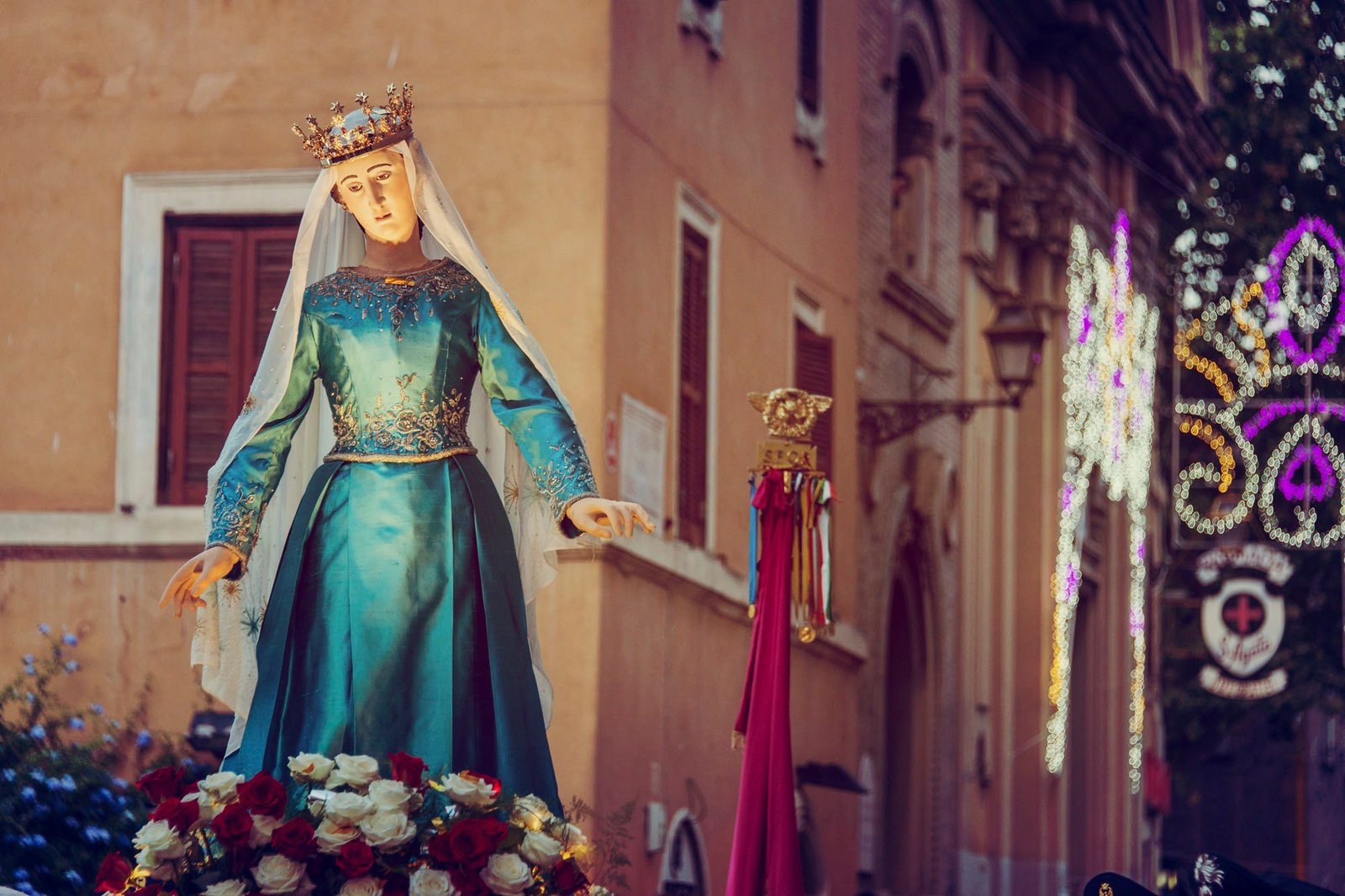
And then there's the real reason why this small church, which stands in a little passing-through square that everyone crosses looking at their phone, counts for more than far more photographed basilicas. Inside the Church of Sant'Agata in Trastevere is the wooden statue of the Madonna del Carmine, the one the people of Trastevere call the Madonna de' Noantri. It's the image around which the festival that best expresses the identity of the rione revolves. It leaves from here once a year, in July, and for those days Trastevere stops being a neighborhood of venues and goes back to being a village.
Where exactly the Church of Sant'Agata in Trastevere is and how to get there
The official address is Largo San Giovanni de Matha 91. The coordinates given on the info.roma.it page are 41.889647 and 12.4735084. A note on precision, because if you search on a map it can happen to you: the site lechiesediroma.info writes "Piazza di San Giovanni de Matha, 91", while Rome's city tourism portal, the GCatholic page and the Festa de' Noantri site all write "Largo". The little square is the same, the street number is the same, only the word changes.
The largo has had this name since 1961: before that it was a stretch of Via della Lungaretta. This is written by the Roman place-name blog Rerum Romanarum, which is a specialist blog and not an institutional source. Giovanni de Matha, according to the same page, was born in Faucon-de-Barcellonette in 1154, died in Rome in 1213 and is the founder of the Trinitarian order, present at San Crisogono, which is 40 meters away. So yes, the largo is named after a French saint and hosts a church dedicated to a Sicilian martyr. Rome does that.
The public transport reference is tram 8, which comes down from Casaletto along the Circonvallazione Gianicolense, enters Viale Trastevere and stops at Piazza Sonnino, literally around the corner. But there's one thing that drove half of Rome crazy in 2026: this year tram 8 has been replaced by buses more than once.
According to the Roma Servizi per la Mobilità site, between June 8 and 14, 2026 lines 3 and 8 were modified for the works connecting the depot on Viale Trastevere to the electricity distribution network and for the redevelopment of the Parco del Celio. Then, from July 13 to 31, 2026, line 8 was replaced by shuttle buses on the whole stretch from Casaletto to Via degli Astalli, for the rebuilding of the tracks on the Circonvallazione Gianicolense between Piazzale Flavio Biondo and Piazzale Dunant. In that period the replacement bus, again according to Roma Servizi per la Mobilità, reached the center via Via del Plebiscito, Corso Vittorio Emanuele and Via di Torre Argentina, then Via Arenula and Ponte Garibaldi.
For August 2026, the press headlines of August 3 and 4 talk about trams 3, 5, 14 and 19 stopped until September 7, without mentioning the 8, and the information is not confirmed by an institutional source. The practical rule is this: before leaving, open romamobilita.it and check if the 8 is currently a tram or a bus. It makes little difference for getting to the Church of Sant'Agata in Trastevere, because the temporary terminus still drops you at Ponte Garibaldi and from there it's five minutes on foot along Via della Lungaretta, but it makes a huge difference if you then have to head back up toward Monteverde.
Walking is the best solution anyway. From Largo di Torre Argentina you cross Ponte Garibaldi and you're there: a bit under 10 minutes, all flat. From Trastevere station you go up Viale Trastevere and walk a good quarter of an hour. From the Tiber Island, via Ponte Cestio and Via della Lungaretta, it's five minutes.
What is the nearest stop to the Church of Sant'Agata in Trastevere
Piazza Sonnino, along Viale Trastevere. From there to the Church of Sant'Agata in Trastevere it's less than 100 meters: take the start of Via della Lungaretta and the little square opens right away on the right as you go down. The stop is served by tram 8 when the 8 is a tram, by replacement buses when the 8 is a bus, and by the other lines that run along Viale Trastevere. There's no metro: Trastevere has no metro, and it's pointless to look for it. Those arriving from Termini station generally do Termini, Torre Argentina, then walk across the bridge.
Can you get to the Church of Sant'Agata in Trastevere by car
Technically yes, in practice no. Largo San Giovanni de Matha is inside the fabric of Trastevere, with the ZTL and with streets that are corridors one and a half cars wide. The exact hours when the Trastevere ZTL is in force should be checked on the Roma Capitale site before you set out. The advice is banal and true: forget the car, arrive on foot or by tram. Even a taxi leaves you on Viale Trastevere or at Ponte Garibaldi, it doesn't go into the alleys.
Hours, admission and Masses: what the sources say
The sources on the Church of Sant'Agata in Trastevere don't say the same thing about hours. Here they are as they stand.
| Source | What it says about hours |
|---|---|
| festadenoantri.it, page of the church | 9:00-12:00 and 16:00-19:00 on weekdays, Sunday and holiday Masses at 9:30 and 17:00 |
| lechiesediroma.info | Monday-Friday 16:00-19:00 |
| Churches of Rome Wiki | reports, stating that it is unofficial and refers to 2017, opening Monday-Friday 16:00-19:00, with Masses on Saturday and Sunday at 17:00 |
| Mass schedule portal cercamesse.it | Saturday 17:00, Sunday 9:30 and 17:00, no weekday Mass |
| turismoroma.it, Roma Capitale portal | doesn't publish the hours and refers to the site of the archconfraternity of Carmine |
The city tourism portal therefore refers to the archconfraternity's site.
The window on which all the sources agree is late afternoon, roughly between 16:00 and 19:00, and the weekend Masses. In the morning some give it as open and others don't. The hours of this church change often, check before leaving, and if you really care, call 06 5803717.
Admission is free. There's no ticket office, no booking, no audio guide, no bookshop. It's a neighborhood church kept by a confraternity, not a museum.
Is the Church of Sant'Agata in Trastevere always open
No, quite the opposite: it's one of the churches in Trastevere you find closed most often. It has no resident clergy, depends on the parish of San Crisogono and is opened by the archconfraternity that looks after it. Anyone passing through the square at noon almost always sees the door left ajar. Anyone passing at six in the evening on a weekday has a good chance of getting in. If you have only one chance, aim for the weekend near the Masses, Saturday at 17:00 or Sunday at 9:30 and 17:00, which is the schedule the portals agree on most.
How long does it take to visit the Church of Sant'Agata in Trastevere
You have more than enough with 20 minutes if you only look at the nave. If instead you want to read the facade from the sidewalk across the way, go in, walk around the six chapels, look up at the vault and really stop in front of the Madonna del Carmine, allow 40. It isn't a church where you spend two hours: it's a single short nave, three chapels per side, and in five minutes you've seen it all. The value is in looking at it well, not in looking at it for long. In the same half hour of walking you have San Crisogono 40 meters away and Santa Maria in Trastevere five minutes away, and that's the right way to fit it into a day.
Is there a ticket to enter the Church of Sant'Agata in Trastevere
No. No source indicates an admission ticket, and in practice there never was one: it's a church open for worship. Be wary of anyone who offers you a paid tour presenting entry to this church as part of the package. A serious guided visit that includes it may exist, but what you pay for is the guide, not the entrance, and in Trastevere this distinction makes the difference between a sensible expense and a rip-off.
The foundation: Pope Gregory II, the year 727 and the doubt nobody tells you about
The story you find written everywhere is this: the Church of Sant'Agata in Trastevere was born in the eighth century from the family home of Pope Gregory II, who supposedly turned it into a place of worship with an attached monastery on the death of his mother. The ancient source cited is the Liber Pontificalis. The Festa de' Noantri site writes it exactly that way. The English Wikipedia entry repeats it, specifying that Gregory II was bishop of Rome between 715 and 731.
On the exact year the sources don't agree. Churches of Rome Wiki reports that there's a plaque in the church indicating 727. The site lechiesediroma.info writes instead "around 716". The Festa de' Noantri site and turismoroma.it limit themselves to the eighth century, without a year. Take it this way: an eighth-century tradition, year uncertain among the sources.
And now the part that almost no tourist page on Sant'Agata in Trastevere tells you, and which is actually the most interesting thing in the whole story. Churches of Rome Wiki points out that scholars question the attribution: it's by no means certain that the church of Sant'Agata cited in ancient sources in connection with Gregory II is this one, because it could be Sant'Agata dei Goti, which is on the other side of the river, on the Quirinal. The same source adds a fact that explains the mess: in Rome there were four other churches dedicated to Saint Agatha, all gone by the end of the Middle Ages. With five namesakes in circulation, you can well understand that attributing a document to one or the other is a job for specialists, not for commemorative plaques.
The same source proposes a more cautious alternative reading: the Church of Sant'Agata in Trastevere would most probably be one of the many parish churches that arose in Rome after the recovery of the city at the end of the tenth century. Less romantic, more credible. It should be told in this order: first the tradition, then the doubt. Because the doubt is the real part.
Who founded the Church of Sant'Agata in Trastevere
Tradition says Pope Gregory II, in the eighth century, on the house of his family, on the death of his mother. The oldest historical document that names this church with certainty, however, is much later: it's a bull of Pope Callixtus II of 1121, cited consistently by the English Wikipedia entry, the Festa de' Noantri site, turismoroma.it and lechiesediroma.info. Between the tradition and the first document four centuries go by. Anyone who sells you the exact year of foundation as a certain fact is telling you a legend with the face of a footnote.
How old is the Church of Sant'Agata in Trastevere
It depends on what you count, and the answer changes a lot. If you count the tradition, the eighth century, so about 1,300 years. If you count the first sure document, 1121, about 900. If you count the building you actually see today with your own eyes, the rebuilding is from 1710-1711, so a little over three centuries. Three answers, all true and all different. The church you go in to see is an early 18th-century building with, literally, pieces of medieval wall inside.
1121 and the bull of Callixtus II: the first documentary foothold
1121 is the year in which the Church of Sant'Agata in Trastevere enters written history without margins of ambiguity, thanks to a bull of Pope Callixtus II. It's a fact repeated identically by four different sources, which in the world of Roman church entries is almost a record of agreement.
What this means concretely. In the 12th century Trastevere was a dense rione, with a population of artisans, boatmen, fishermen and merchants tied to the river, and with a quantity of small parish churches, one every two blocks. Sant'Agata was one of those. Not a sanctuary, not a basilica: a neighborhood parish. This is its original identity, and it's an identity that, in a different form, has been preserved to this day.
Is the Church of Sant'Agata in Trastevere medieval or Baroque
Both, and that's the thing to understand. What you see is a late Baroque shell of 1710-1711. Churches of Rome Wiki specifies, however, that Recalcati's intervention, though equivalent to a reconstruction, left traces of medieval wall fabric in the building, particularly in the side walls, and reports that in the courtyard behind the apse fragments of walls dated to the fifth century would be visible. The courtyard behind the apse, however, is not a space open to the public: the information remains attributed to the source.
1575: the suppressed parish and the "Agatisti"
In 1575 the thing happens that changes the nature of the Church of Sant'Agata in Trastevere forever. Pope Gregory XIII suppresses the secular parish and entrusts the church to the Compagnia della Dottrina Cristiana, a sodality founded in 1560. The English Wikipedia entry, info.roma.it, lechiesediroma.info and Churches of Rome Wiki all write it in agreement.
The context is that of post-Tridentine urban policy: in Rome parishes are merged and closed, and churches emptied of parish function are given to confraternities and congregations that use them as operating bases. Sant'Agata becomes the center of the pastoral activity of the Christian Doctrine in Trastevere, that is essentially a neighborhood catechism school.
The most curious detail is the nickname. The members of the company, according to the English Wikipedia entry and Churches of Rome Wiki, ended up being called by the Romans "Agatisti", from the name of the church. Not from the name of the order: from the name of the church. It's the kind of thing that happens only when a building becomes more recognizable than the institution that inhabits it. The English Wikipedia entry adds that in 1725 the Agatisti merged into the Doctrinaires.
Why isn't the Church of Sant'Agata in Trastevere a parish
Because it stopped being one in 1575, when Gregory XIII suppressed the parish. Since then it has passed from hand to hand among lay sodalities, and today, according to the GCatholic page and lechiesediroma.info, it's a rectory, a subsidiary place of the parish of San Crisogono. Translated: parish acts are done at San Crisogono, here they celebrate and look after it. It's the technical reason why the Church of Sant'Agata in Trastevere has such short hours, and the emotional reason why it has remained a neighborhood church and hasn't become a tour-bus stop.
1710-1711: Giacomo Recalcati rebuilds everything
The architectural turning point is the first decade of the 18th century. In 1671 works begin that, as the Festa de' Noantri site writes, are "immediately suspended". Then, between 1710 and 1711, the church is substantially rebuilt by the architect Giacomo Onorato Recalcati. The English Wikipedia entry, info.roma.it, lechiesediroma.info, turismoroma.it and Churches of Rome Wiki converge on this. The site lechiesediroma.info gives Recalcati's dates as 1684-1723.
Here the sources contradict each other. The English Wikipedia entry places the reconstruction "under the pontificate of Clement XI". The site lechiesediroma.info writes instead that the radical restoration of 1710-1711 took place "under Benedict XIV". They are two different popes and two different eras, and no third source settles the question. There is, however, an objective element: on the frieze of the facade, according to the detailed description of Churches of Rome Wiki, the inscription "In honorem S. Agathae V. et M. MDCCX" is carved, and MDCCX means 1710. The date of the building site is therefore well anchored. The name of the pope reigning at that moment, according to the two sources, is not.
The thing to understand about 1710 is that it wasn't a restoration: it was a remaking. The portal info.roma.it records it as "restoration and new facade". Churches of Rome Wiki is blunter and says the intervention "was equivalent to a reconstruction". So when you enter the Church of Sant'Agata in Trastevere you are not looking at a medieval church in disguise: you are looking at an 18th-century church built inside and on top of the walls of a medieval one.
Who built the Church of Sant'Agata in Trastevere that we see today
Giacomo Onorato Recalcati, between 1710 and 1711. He's the one who designs the late Baroque two-order facade with Borrominian-style inserts, and he's the one who gives the church its current layout with a single nave and three chapels per side. Churches of Rome Wiki adds a name you almost never find cited: Domenico Guidi, the master builder who assisted Recalcati in the reconstruction, is said to be buried in the center of the church and to have died in 1728. The news appears in this source alone, which is a specialized wiki and not an institutional source: take it as an indication, not as an established fact.
The facade: how to read it from the sidewalk across the way
Stand on the opposite side of the largo, with your back to Viale Trastevere, and look at it for two minutes before going in. The facade of the Church of Sant'Agata in Trastevere is the most interesting object of the whole complex, and it's also the only one you can always see, even with the church closed. Which at these latitudes is no small detail.
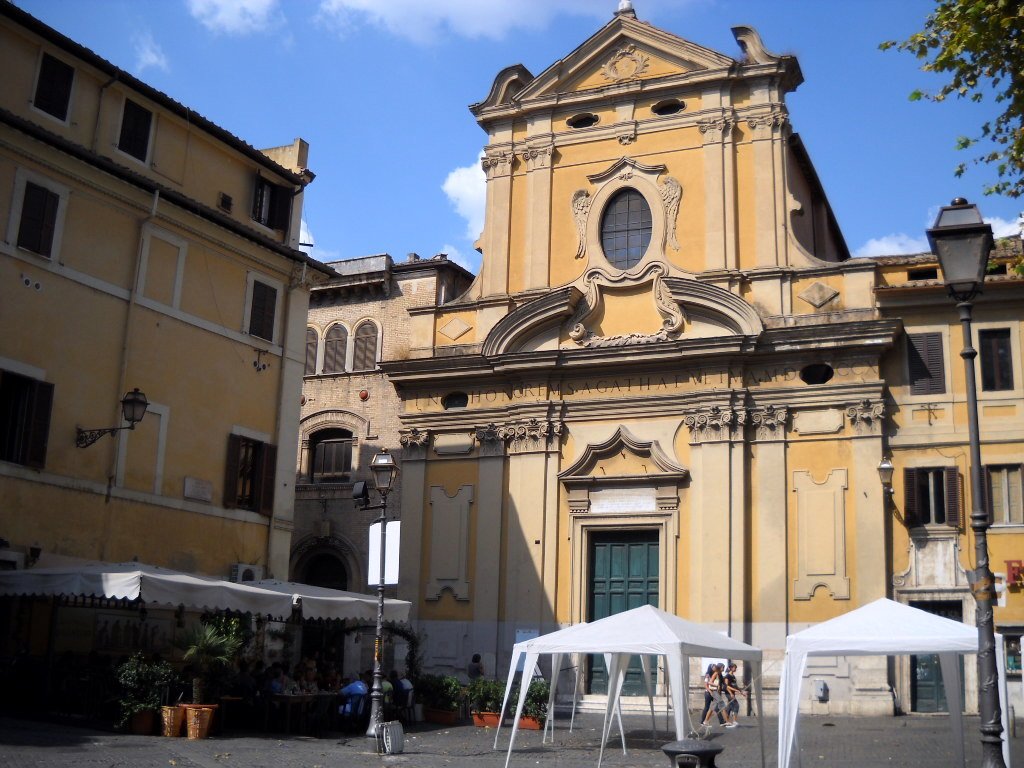
Churches of Rome Wiki gives a meticulous description. Ocher yellow plaster with the architectural details in white. Two orders. In the lower order six Ionic pilasters, the four inner ones paired and the two outer ones grouped in threes, supporting an entablature with a strongly prominent molded architrave. On the frieze runs the dedicatory inscription with the date 1710. Between the pairs of pilasters there are three Baroque panels of different shape, one square, one vertical rectangular and one horizontal rectangular, all with reliefs. Above the single portal, a pentagonal tympanum with curved sides.
In the upper order things get stranger: six stubby pilasters without capitals, a large elliptical broken and shifted tympanum with volutes and foliage, then two pairs of doubled Ionic pilasters that frame a large vertical elliptical window topped by a pair of angel wings and a small curved pediment. At the top, a small triangular tympanum with a palm crown, flanked by broken double-curve pediments.
The site lechiesediroma.info adds an element that from the largo you see only if you know where to look: a bell gable with two bells, one of which would date to the 16th century and be decorated with four medallions with episodes from the New Testament. Look up above the roof.
Why the facade of the Church of Sant'Agata in Trastevere looks "crooked"
It isn't crooked: it's Baroque to the core, and it plays with the rules on purpose. The broken tympana, the shifted elliptical pediment, the pilasters without capitals and the pentagonal tympanum with curved sides above the door are all devices of the Borrominian vocabulary, that is, of a way of doing architecture that treats the facade as an elastic surface instead of a grid. On a large building this language impresses. On a facade as narrow as this one, squeezed between two buildings, it produces the effect of a wind-up toy. It's the reason it's worth looking at it from the other side of the largo and not from underneath.
Inside the Church of Sant'Agata in Trastevere: the nave, the six chapels, the vault
You enter through a single door and find yourself in a single short nave, with three chapels per side carved along the flanks. Churches of Rome Wiki describes the structure in a technical and useful way: the plan is that of a nave with aisles of four bays, but the aisles were divided into chapels by infill walls, so that what you perceive is a single space with six deep niches. Above the nave and the presbytery runs a single barrel vault. At the sides of the presbytery there are two cantorie, that is two balconies for the singers. The apse is rectangular and shallow. The floor, according to lechiesediroma.info, is white marble.
The first thing you notice on entering is that the church is much brighter than the narrow facade leads you to expect, and the credit goes to the large elliptical window above the portal, which in the afternoon shoots light onto the inner facade and the first bay of the vault. It's no accident that Girolamo Troppa put his Assumption right there.
Girolamo Troppa and the vault
The painted decoration of the vault is by Girolamo Troppa. Churches of Rome Wiki specifies that Troppa frescoed the ceiling of the entrance bay with the Assumption of the Madonna surrounded by angels, and that he also worked on the apse vault and on the tympanum. The portal info.roma.it dates the decoration to 1710, that is to Recalcati's building site, describes the Assumption with angels in the lunettes, and adds a work almost nobody cites: a Prayer in the Garden of Olives painted by Troppa in the sacristy. The sacristy isn't a space for ordinary visits, so don't count on it.
The tourism portal of Roma Capitale places the vault fresco between the 17th and 18th century and attributes it to Troppa. The site lechiesediroma.info speaks of a barrel vault decorated with angels, medallions and the Assumption, frescoed in the 18th century by Troppa. The four sources say the same thing with slightly different chronological precision: 17th-18th century for turismoroma, 1710 for info.roma.it, 18th century for lechiesediroma. There's no substantial contradiction, only a different degree of precision.
What is painted on the vault of the Church of Sant'Agata in Trastevere
The Assumption of the Virgin with angels, by Girolamo Troppa. It's on the entrance bay, so you see it better if, after going in, you turn around and look back toward the portal. It's the mistake everybody makes: you go in, look straight toward the high altar, leave, and the Assumption stays behind you unseen. Do it the other way around. Go in, take three steps, turn and lift your head. The light from the large elliptical window lights it from below in the afternoon.
Biagio Puccini and the Martyrdom of Saint Agatha
The altarpiece of the high altar is the Martyrdom of Saint Agatha by Biagio Puccini. Churches of Rome Wiki dates the work to 1713 and gives Puccini's years as 1673-1721. The tourism portal of Roma Capitale cites it as the main work of the church. The portal info.roma.it places Puccini's altarpieces in 1713.
A note of fairness: the info.roma.it page gives for the high altar a title that indicates a saint other than Agatha. All the other sources, including turismoroma.it, lechiesediroma.info and Churches of Rome Wiki, say in agreement Martyrdom of Saint Agatha, and the overwhelming majority of the sources is on this side.
Puccini is not a name that means anything to you, and that is exactly why the Church of Sant'Agata in Trastevere stays empty while 200 meters away there's a line. He's a Roman painter of the late 17th and early 18th century, good, prolific, not at all revolutionary. In this church there are at least three of his works according to concordant sources: the Martyrdom at the high altar, a Madonna of the Rosary with Saints Dominic and Catherine, and a Crucifixion. Look at them for what they are: painting commissioned by a confraternity, made to be seen by people who came in to pray, not by critics.
The six chapels, and why the sources don't tell them the same way
The two most detailed sources, Churches of Rome Wiki and lechiesediroma.info, assign the works to the chapels in a way that doesn't entirely overlap. The table reports both, with the points where they diverge: once inside, it's worth knowing that you are looking at a discordant list and not an infallible guide.
| Position | Churches of Rome Wiki | lechiesediroma.info |
|---|---|---|
| First right altar | Saint Michael the Archangel, 18th century, plus a portrait of Pope Saint Pius X by Giuseppe Bevilacqua, commissioned by the archconfraternity out of gratitude | Saint Michael the Archangel, unknown author, 18th century |
| Second right altar | the statue of the Madonna del Carmine was once here, later moved to the left | n/a |
| Third right altar | Madonna of the Rosary with Saints Dominic and Catherine, by Biagio Puccini | Madonna of the Rosary between Saints Dominic and Catherine, by Biagio Puccini |
| Second left altar | the venerated statue of the Madonna del Carmine | Apparition of the Madonna to Saint Anthony of Padua, 17th-18th century, unknown author |
| Third left altar | Crucifixion by Biagio Puccini and a 19th-century triptych with scenes from the life of Saint Joseph | Madonna appearing to Gregory II, by Domenico Monastello. Puccini's Crucifix is indicated generically on a left altar |
| High altar | Martyrdom of Saint Agatha, Biagio Puccini, 1713 | Martyrdom of Saint Agatha, Biagio Puccini |
The two sources agree on the high altar, on the third right altar and on the general attribution to Puccini. They differ on what exactly is in the second and third left altars. The painting of the Madonna appearing to Gregory II attributed to Domenico Monastello appears only on lechiesediroma.info: it's a subject very consistent with the founding tradition of the church, which makes it plausible, but plausible doesn't mean verified.
What works of art can you see in the Church of Sant'Agata in Trastevere
The works on which more sources converge are four. The Martyrdom of Saint Agatha by Biagio Puccini at the high altar, dated 1713. The Assumption frescoed by Girolamo Troppa on the vault. The Madonna of the Rosary with Saints Dominic and Catherine, again by Puccini, on the third altar on the right. And the polychrome wooden statue of the Madonna del Carmine, which isn't a work of art in the museum sense but is the most important object in the building. To these is added, according to Churches of Rome Wiki, a portrait of Pope Pius X painted by Giuseppe Bevilacqua at the wish of the archconfraternity.
The Madonna del Carmine, that is the Madonna de' Noantri
Now we get to the reason this church still exists in the minds of Romans. In the Church of Sant'Agata in Trastevere is kept a polychrome wooden statue of the Madonna del Carmine, whom the people of Trastevere call the Madonna de' Noantri. The English Wikipedia entry uses exactly this formula. The tourism portal of Roma Capitale defines her as patron of the rione. The Festa de' Noantri site calls her "the real driving force" of the festival.
The name comes from Romanesco: "de noantri" stands for "di noi altri", that is of us, the people of Trastevere, those on this side of the river, as opposed to "voantri", those on the other side. Churches of Rome Wiki explains the formula in the same way. It isn't a folkloric affectation: it's neighborhood pride turned into language, and it's old.
Churches of Rome Wiki describes the setup: the statue is displayed under a gilded metal canopy decorated with bronze putti of different sizes, and would have been moved from the second right chapel to the second left chapel. The Festa de' Noantri site calls it "the venerable wooden statue of the Madonna del Carmine". The Roma Capitale portal notes that it is dressed every year in new clothes.
Where is the statue of the Madonna de' Noantri
Inside the Church of Sant'Agata in Trastevere, in Largo San Giovanni de Matha, in one of the side chapels, under a gilded canopy. The tourism portal of Roma Capitale, in the page dedicated to the Madonna de' Noantri 2026, writes that the sacred statue leaves its seat only once a year. Outside that week of July, if you want to see her, you have to come here and find the church open. She isn't in a museum, she isn't on loan, she doesn't travel. She's here.
1535, the fishermen and the Tiber: the story, and the contradiction that has to be told
The story of the statue is the one everybody in Trastevere can tell, and which is found in serious sources. In 1535 some fishermen recovered from the Tiber a large wooden statue made of cedar wood depicting the Madonna. They gave it to the Carmelites, who at the time were in charge of the Basilica of San Crisogono. From the Carmelites the image then passed to the Church of Sant'Agata in Trastevere. This is the version of Vatican News, which places the discovery at the mouth of the Tiber. The diocesan weekly RomaSette adds a detail: the fishermen were supposedly Corsican. Churches of Rome Wiki speaks of fishermen who found the statue in the Tiber after a storm in 1535 and took it to the Carmelites of San Crisogono, and confirms the link: the presence of the Madonna del Carmine in Sant'Agata is a reminder of the fact that the mother church of the confraternity, San Crisogono, was run by the Carmelites.
Here is the most serious contradiction among the sources. The weekly RomaSette states that the original statue is the one kept today in the Church of Sant'Agata in Trastevere. Churches of Rome Wiki states instead, just as explicitly, that "the current statue is 19th-century". The Festa de' Noantri site, turismoroma.it and the English Wikipedia entry speak of a venerated wooden statue without dating it. So: the sources don't agree. Whoever says that what you see is the cedar wood fished out in 1535 is following one version. Whoever says it's a 19th-century statue is following the other. There are two versions in the field, and no decisive document turns up.
A consideration, which is not a fact but a way of looking at the matter. For the rione the question is irrelevant. The wood may be 16th-century or 19th-century, the statue is the same thing: it's the Madonna that the grandparents of the grandparents carried on their shoulders. Popular devotions don't work like museum catalogs. But for anyone who wants to know how things stand, the contradiction should be told, not hidden under an adjective.
Why is she called Madonna Fiumarola
Because she comes from the river. "Fiumarola" is the Romanesco adjective that indicates the people and things of the Tiber, the boatmen, the fishermen, the workers of the riverbank. The name derives from the story of the 1535 discovery and is kept alive by the river procession that, every year, reenacts that recovery by carrying the statue on a boat along the Tiber before bringing it back to land. Vatican News describes exactly this passage. It's the reason why in Trastevere the Madonna del Carmine has two names that count equally: Madonna de' Noantri for the rione, Madonna Fiumarola for the river.
The Festa de' Noantri: how it really works, and what this church has to do with it
If you've read only the posters, the Festa de' Noantri looks like a street fair with concerts in Piazza Santa Maria in Trastevere. It's that too, but the real mechanism is another one, and it starts precisely from the Church of Sant'Agata in Trastevere.
The liturgical calendar is this: on the first Saturday after July 16, the feast of the Blessed Virgin of Mount Carmel, the statue of the Madonna del Carmine leaves Sant'Agata and is carried in procession to the Basilica of San Crisogono, where it stays eight days. Then it returns. Vatican News writes it, and the Festa de' Noantri site confirms it, indicating the solemn procession on the first Saturday after July 16.
On top of this liturgical core, since the 1920s, the civic festival of the neighborhood has been grafted on. Vatican News says so explicitly. Churches of Rome Wiki places the current form of the festival around 1920. So the religious part is old, the part with the stages and the shows is a little over a century old.
Vatican News adds a notable detail: 16 brothers act as bearers of the processional float, and the statue is adorned with precious clothes and jewels. 16 men under a litter. Churches of Rome Wiki specifies that the litter on which the Madonna is carried to San Crisogono was supposedly designed by Domenico Gregorini, the architect of the facade of Santa Croce in Gerusalemme. This news too appears in this one source alone.
When does the Madonna leave the Church of Sant'Agata in Trastevere
Once a year, in July. The traditional rule is the first Saturday after July 16, that is after the feast of the Madonna del Carmine. In 2026 that Saturday was July 18. There is, however, a discrepancy: Churches of Rome Wiki writes that the statue leaves on July 16, while the Festa de' Noantri site and turismoroma.it agree on the first Saturday after the 16th. The actual program of the 2026 edition, published on the Roma Capitale portal, confirms the second version: Saturday, July 18.
The 2026 program of the Festa de' Noantri
The sources are the page of the 2026 edition on the tourism portal of Roma Capitale and the report with the detail of the road closures published by IlFaroOnline on July 16, 2026. Here is what they say.
| Date 2026 | What happened |
|---|---|
| July 13-27 | full span of the event |
| July 17-25 | nine evenings of free-admission shows in Piazza Santa Maria in Trastevere |
| Saturday, July 18, 16:30 | pontifical Mass at San Crisogono in honor of the Madonna del Carmine, presided over by Cardinal Enrico Feroci |
| Saturday, July 18, 17:50 | the mayor's tribute to the Madonna del Carmine |
| Saturday, July 18, 18:00 | procession through the streets of Trastevere |
| Saturday, July 25, 16:30 | pontifical Mass at San Crisogono in the Corsican language |
| Sunday, July 26, 19:30 | departure of the procession of the Madonna Fiumarola, presided over by Cardinal Augusto Paolo Lojudice |
| Sunday, July 26, 20:30 | arrival at the landing stage of Ponte Garibaldi and procession on foot to Santa Maria in Trastevere |
| Sunday, July 26, 21:30 | fireworks in Largo San Giovanni de Matha |
| Monday, July 27 | return of the statue to Sant'Agata, and according to IlFaroOnline a closing Mass at 19:00 at Santa Maria in Trastevere |
A clarification on the starting point of the river procession of July 26, because the two pages of the city portal don't say the same thing. The English page dedicated to the Festa de' Noantri 2026 gives as the starting point the Circolo Canottieri Lazio, with the statue then going down by boat along the Tiber to Ponte Garibaldi. The page dedicated to the Madonna de' Noantri 2026 instead gives 19:30 as the departure time from Sant'Agata in Largo San Giovanni de Matha. The two readings can be reconciled by thinking of a procession that leaves from the church and an embarkation upstream, but this reconciliation is not attested by the sources, so it should be taken as a hypothesis and not as a fact.
A practical piece of information that's worth gold and that almost nobody publishes: IlFaroOnline reports that on July 18, 2026, from 17:30, Viale Trastevere, Via Santini, Via dei Genovesi, Via Anicia, Piazza San Francesco d'Assisi, Via di San Francesco a Ripa, Via Morosini, Via Roma Libera, Piazza San Cosimato and Via delle Fratte di Trastevere were closed. Again according to the same source, from 17:30 to 22:00 lines H, 8Bus and 115 were diverted onto Ponte Sublicio and the lungotevere, while lines 44 and 75 followed alternative routes on the Circonvallazione Gianicolense until 21:00. If you find yourself in Trastevere on that summer afternoon, get it into your head that the neighborhood is closed and that you move only on foot.
The festival contacts given on the Roma Capitale page are the site festadenoantri.it and a WhatsApp number, +39 328 669 2116. The program of the next edition is not yet something you can read: when they publish it, the right place to look for it is the festival's site and the City's portal, not ticketing sites.
Is it worth coming to the Church of Sant'Agata in Trastevere during the Festa de' Noantri
Yes, but knowing what awaits you. During the festival the church is the starting and arrival point of the processions, so you see it alive as you'll never see it the rest of the year. On the other hand Trastevere in those days is packed, the streets are closed, the buses diverted and the venues pack in the crowds and charge packed-house prices. The contrarian advice is this: if you come for the festival, come for the Saturday afternoon procession and for the return of the statue, not for the evening concerts in Piazza Santa Maria in Trastevere. The concerts are pleasant and free, but they are shows you could see anywhere. The procession with the 16 bearers under the float, on the other hand, exists only here.
The archconfraternity: who holds the keys
The Church of Sant'Agata in Trastevere isn't run by a parish but by a confraternity, and it's good to know it because it explains everything: the hours, the care of the furnishings, the relationship with the rione and even the reason why, going in, you have the feeling of being in someone's home.
The chronology that emerges from the sources is this. In 1575 Gregory XIII entrusts the church to the Compagnia della Dottrina Cristiana, founded in 1560. In 1710-1711, according to lechiesediroma.info, on the occasion of the rebuilding the church is granted to the Oratorio della Madonna del Carmine, which brings in the statue of the Madonna de' Noantri. In 1911, according to info.roma.it and Churches of Rome Wiki, Pope Pius X entrusts the church to the Archconfraternity of the Most Holy Sacrament and of Maria Santissima del Carmine, which still holds it. Vatican News writes that the Archconfraternity of the Carmine of Trastevere, which keeps the statue and organizes the celebrations, dates back to the early 17th century.
Churches of Rome Wiki links the portrait of Pope Pius X painted by Giuseppe Bevilacqua and kept in the first right chapel precisely to the gratitude of the archconfraternity for that grant of 1911. It's the kind of detail that makes an otherwise anonymous painting readable: that picture isn't generic devotion, it's a thank-you.
Who runs the Church of Sant'Agata in Trastevere today
The Archconfraternity of the Most Holy Sacrament and of Maria Santissima del Carmine, under the parish of San Crisogono. The tourism portal of Roma Capitale, for Mass times, refers to the site arciconfraternitadelcarmine.it. If you need certainty, the phone 06 5803717 and the parish of San Crisogono at 06 5818225 are the two right ways.
The restorations: 1820-1821, 1984, 2006
The Church of Sant'Agata in Trastevere has gone through three documented seasons of restoration after Recalcati.
- 1820-1821. Pope Pius VII orders a restoration. The portal info.roma.it records the reconsecration of the church by Pius VII in 1821. Churches of Rome Wiki dates the intervention to 1820-1821.
- 1984. Churches of Rome Wiki indicates this as the last documented structural restoration.
- 2006. The neighborhood online daily abitarearoma.it, in an article of May 20, 2006, announces the start of a campaign to recover the paintings of the church, starting from the one on the inner facade, uncovered during an inaugural event held on that same May 20, 2006 at 16:30. The same article names as funders the Casa Vinicola Fontana di Papa and the Fondazione Nuova Italia, and as promoter the Archconfraternity of the Most Holy Sacrament and of Maria Santissima del Carmine, then led by Giampiero Romani.
20 years have passed since that article: the overall outcome of that campaign is not documented, and no building works are on record in 2025 or 2026 on the Church of Sant'Agata in Trastevere.
How to fit the Church of Sant'Agata in Trastevere into a day in Trastevere
This church can't carry a day trip on its own: it lasts 20 minutes and sits on a small passing-through square. It works very well, instead, as the first or last piece of a well-made walk, because it sits exactly on the threshold of the rione, where the bridge drops people off.
The most advisable route starts from the Tiber Island, crosses Ponte Cestio, takes Via della Lungaretta and in five minutes you're here. From Largo San Giovanni de Matha you walk to the Basilica of Santa Maria in Trastevere, which is the main square of the rione, then you go down toward the Basilica of Santa Cecilia in Trastevere and the Church of San Francesco a Ripa, which has inside Bernini's Blessed Ludovica Albertoni and is one of the most underrated things in Rome.
Anyone with legs and half a day can extend the walk uphill: from the riverbank you climb to the Janiculum and to San Pietro in Montorio, where Bramante's Tempietto is. On Via della Lungara side there are the Villa Farnesina with Raphael's frescoes and, across from it, Palazzo Corsini with the Galleria Nazionale d'Arte Antica, as well as the Rome Botanical Garden, which in summer is the coolest place in the rione.
For those who want to understand what Trastevere was like before it became what it is now, the right stop is the Museo di Roma in Trastevere, in Piazza Sant'Egidio: watercolors, scenes of popular life, photography. And if you happen to be here on a Sunday morning and like chaos, Porta Portese is a quarter of an hour away on foot. Another little-visited stop nearby: the cloisters of San Cosimato, inside the hospital complex, which almost no tourist knows can be seen.
A curiosity about the Church of Sant'Agata in Trastevere
The best-known curiosity concerns a nickname. When in 1575 Pope Gregory XIII suppressed the parish and entrusted the Church of Sant'Agata in Trastevere to the Compagnia della Dottrina Cristiana, the brothers weren't called by the Romans by the name of their sodality. They were called "Agatisti", from the name of the church they occupied. Both the English Wikipedia entry and Churches of Rome Wiki report it.
Stop for a moment on this. An institution with a precise official name, the Compagnia della Dottrina Cristiana, is rechristened by the neighborhood according to its address. It's Rome doing what it has always done: calling things as it sees them, not as they are named. The Agatisti were the ones from Sant'Agata, period. The English Wikipedia entry adds that in 1725 they merged into the Doctrinaires, and at that point the nickname stayed attached to the place more than to the people.
There is a second curiosity that hooks onto this one and that holds the whole rione together. The largo in front of the church has been called San Giovanni de Matha only since 1961, as the place-name page of Rerum Romanarum reports: before, it was simply a stretch of Via della Lungaretta. Giovanni de Matha is the founder of the Trinitarians, present in nearby San Crisogono. So in 50 square meters of Trastevere you have a church dedicated to a martyr from Catania of the third century, a square named after a Frenchman of the 12th century, and inside the church a Carmelite Madonna fished out of the Tiber in the 16th century. Nobody designed this combination: it settled.
Why is the church dedicated to Saint Agatha if Saint Agatha is from Catania
Because the cult of Saint Agatha, a martyr from Catania, spread to Rome very early and in a widespread way. Churches of Rome Wiki points out that in Rome there were at least four other churches dedicated to her, all gone by the end of the Middle Ages, besides Sant'Agata dei Goti which survives. Five or six churches dedicated to the same Sicilian saint in the same city tell you how strong that devotion was. The Church of Sant'Agata in Trastevere is the only one of that Trastevere group to have made it. According to Churches of Rome Wiki the feast of the saint is celebrated here on February 5 and the dedication of the church on February 4.
Something nobody tells you about the Church of Sant'Agata in Trastevere
That this church is very probably the victim of a case of mistaken identity centuries old, and that almost nobody writes it.
The plaque inside the church, according to Churches of Rome Wiki, gives 727 as the year of foundation in the family home of Pope Gregory II. Only the same source points out that scholars doubt that the church of Sant'Agata cited in ancient sources in connection with Gregory II is this very one: it could be Sant'Agata dei Goti, on the other bank. And, again according to the same source, the more sober reconstruction holds that the Church of Sant'Agata in Trastevere is one of the many parish churches that arose after the recovery of Rome at the end of the tenth century.
No source closes the question one way or the other. Three elements remain: an eighth-century tradition collected from the Liber Pontificalis, a plaque with a date, and a well-grounded scholarly doubt. The first indisputable document remains the bull of Callixtus II of 1121.
What remains here is a method, not a fact. In Roman churches, plaques aren't historical documents: they are declarations of identity, often written centuries after the event they tell, by people who had every interest in tracing their own place back as far as possible. Read them. But read them knowing what they are.
Is the Church of Sant'Agata in Trastevere really from the eighth century
There is no documentary proof that shows it, and there is a serious objection circulating among scholars. The eighth-century tradition is old and respectable, but the first certain document that names this church is from 1121. What you see today is in any case a building of 1710-1711 with inserts of medieval masonry. If someone tells you with confidence that you are entering an eighth-century church, they are repeating a tradition, not a fact.
What is behind the apse of the Church of Sant'Agata in Trastevere
According to Churches of Rome Wiki, in the courtyard behind the apse fragments of fifth-century walls would be visible. It isn't a space accessible to the public, so the information remains attributed to the source, without guarantees. If it were confirmed, it would push back by centuries the building history of the site, regardless of who founded the church. It's exactly the kind of detail that makes these small churches more interesting than the basilicas: the history isn't on display, it stayed in the service walls.
The advice I give you for visiting the Church of Sant'Agata in Trastevere
Go there at six in the evening on a weekday, outside July, and expect to find it closed.
This is the real advice, and the reasoning is simple. The time window on which all the sources converge is late afternoon: lechiesediroma.info and Churches of Rome Wiki say 16:00-19:00 Monday to Friday, the Festa de' Noantri site adds the morning too. Nobody guarantees you anything. The Church of Sant'Agata in Trastevere is kept by a confraternity and opens when there's someone to open it. So: call 06 5803717 first, or organize yourself so that if it's closed you haven't lost your afternoon.
The second piece of the advice is precisely that: build the walk so that this church is a bonus and not the pivot. It's 100 meters from Piazza Sonnino and 40 from San Crisogono, which is open much more often and has real archaeological excavations underneath. The tourism portal of Roma Capitale, in the page on San Crisogono, gives weekday Masses at 7:30, 10:00 and 18:00 and Sunday Masses at 10:00, 12:00 and 18:00. If Sant'Agata is closed, you still have a fourth-century church with its excavated foundations 40 meters away, and you've lost nothing.
The third piece is contrarian. If you have only one afternoon in Trastevere and you're choosing between standing in line to get into Santa Maria in Trastevere among 200 people and doing four small churches in a row, do the small churches. Santa Maria in Trastevere is beautiful and the mosaics are absolutely worth it, but you see it in terrible conditions: noise, flash, people passing through. Sant'Agata, San Crisogono, Santa Cecilia and San Francesco a Ripa in one afternoon give you a reading of the rione that the main square, on its own, doesn't give you.
What is the best time of day to visit the Church of Sant'Agata in Trastevere
Between 17:00 and 19:00. For two reasons. The first is practical: it's the only time slot in which all the sources agree the church may be open. The second is visual: the elliptical large window of the facade looks east relative to the interior, so in late afternoon the light comes in low and diffuse and the Troppa fresco on the entrance bay reads much better than at noon. At summer noon, moreover, the largo is an oven and Trastevere is unlivable.
Do you need to book for the Church of Sant'Agata in Trastevere
No. There's no booking, no ticket office, no limit on numbers. You go in when it's open and that's it. The only case in which access is regulated is during the celebrations of the Festa de' Noantri in July, when the church and the largo become the starting and arrival point of the processions and there are a lot of people: at those moments you get in as you can, and it's best to arrive before the time given in the program.
Another well-known fact, and yet rarely cited
That the link between the Madonna del Carmine and this church is not devotional but administrative, and that it comes from a move.
Vatican News, Churches of Rome Wiki and lechiesediroma.info say it in agreement. The statue fished out of the Tiber in 1535 was given to the Carmelites who ran San Crisogono. San Crisogono is the mother church of the confraternity. When the Church of Sant'Agata in Trastevere was rebuilt and granted to the Oratorio della Madonna del Carmine, the statue was brought inside. Churches of Rome Wiki says it with a formula worth keeping in mind: the presence of the Madonna del Carmine in Sant'Agata "is a reminder of the fact that the mother church of the confraternity, San Crisogono, was run by the Carmelite friars".
This is why the July procession goes from Sant'Agata to San Crisogono and not elsewhere. It isn't a postcard route chosen for the scenery: it's the statue returning for eight days a year to the church where it had arrived first. No guide explains it, and without this information the procession looks like any walk around the rione. With this information it becomes a movement with a precise meaning, repeated for centuries.
There is a corollary that makes it even more concrete: the statue isn't the property of the church, it is kept by a confraternity that has its own history, its own statutes, its own bearers. 16, according to Vatican News. It's a piece of lay society inside a place of worship, and it's the reason why the Church of Sant'Agata in Trastevere has withstood all the parish reorganizations of the last four centuries without being deconsecrated as happened to dozens of small Roman churches.
Why is the Madonna del Carmine at Sant'Agata and not at San Crisogono
Because she was moved there, and the sources link the move to the grant of the church to the Oratorio della Madonna del Carmine, which according to lechiesediroma.info happened on the occasion of the rebuilding of 1710-1711. San Crisogono remains the mother church of the confraternity and it's there that the statue returns every July for eight days. In practice: home is Sant'Agata, the grandparents' house is San Crisogono, and once a year you go to visit. Put like that it sounds like a joke, but that's exactly how it works.
The right photo to take at the Church of Sant'Agata in Trastevere
The right photo is taken from the opposite sidewalk of the largo, not from under the portal, and it's taken in late afternoon.
The reasons are technical. The facade of the Church of Sant'Agata in Trastevere is narrow and tall, with two superimposed orders and a crowning tympanum. If you stand in front of the door and point up, you get that photo with the vertical lines converging and the church looking like it's about to fall on you: it's the standard mistake, everybody makes it. By backing up to the opposite side of the largo you gain distance, reduce the tilt and the facade comes back straight.
The second reason is light. The plaster is ocher yellow with the details in white, according to the detailed description of Churches of Rome Wiki. Ocher yellow at summer noon becomes a burnt slab with no midtones. In late afternoon, with raking light, the relief panels between the pilasters, the pentagonal tympanum above the portal, the angel wings around the elliptical large window and the broken pediments of the upper order take shadow and can be read one by one. It's the difference between a photo of a yellow wall and a photo of architecture.
The third framing, recommended to those who have already done the first two, is vertical and tight: only the upper order, the elliptical large window with the wings and the small tympanum with the palm crown. Cut away everything else. That part of the facade is a small Baroque exercise done in a handkerchief-sized space, and isolated it holds up very well.
Then there's the environment photo, in our view the best. Largo San Giovanni de Matha isn't a monumental square: it's a passing-through widening between Viale Trastevere and Via della Lungaretta, with traffic flowing, scooters, people cutting through. Stand in a corner, wait, and photograph the facade with the flow in front of it. That is the Church of Sant'Agata in Trastevere as it really exists: a piece of the 18th century wedged into a pedestrian crossing. Clean photos of this church, without people, tell a lie.
Can you take photos inside the Church of Sant'Agata in Trastevere
No regulation that explicitly forbids or allows photographs inside has been published. The general rule of Roman churches open for worship applies: no flash, no tripod, no photos during services, and if there's someone from the confraternity opening and closing, you ask. In a small church kept by volunteers, asking isn't a formality: it's the only way not to be the one who walks in as if it were a museum.
What is the best spot to photograph the facade
The side of the largo opposite the church, shifted slightly toward Via della Lungaretta to keep the lampposts and signage poles from cutting the facade in half. From there you get the facade almost frontal, with enough distance not to have to tilt too much. If you have a lens that starts from 35 millimeters equivalent and up, better: an extreme wide angle on a narrow and tall facade distorts everything and gives you back a building that doesn't exist.
Some important events that happened here in history
This is the chronology of the Church of Sant'Agata in Trastevere as the sources reconstruct it. Where the sources diverge, it's indicated inside the row.
| Date | Event | Source |
|---|---|---|
| Eighth century, perhaps 716 or 727 | according to tradition Pope Gregory II turns the family home into a church with an attached monastery, on the death of his mother. The year changes from source to source and the attribution itself is contested | Festa de' Noantri, English Wikipedia, lechiesediroma.info, Churches of Rome Wiki |
| 1121 | the church appears in a bull of Pope Callixtus II: it's the first sure documentary mention | English Wikipedia, Festa de' Noantri, turismoroma.it, lechiesediroma.info |
| 1535 | some fishermen recover a wooden statue of the Madonna from the Tiber and give it to the Carmelites of San Crisogono. From there it will pass to Sant'Agata | Vatican News, RomaSette, Churches of Rome Wiki |
| 1560 | the Compagnia della Dottrina Cristiana is founded | English Wikipedia, info.roma.it |
| 1575 | Pope Gregory XIII suppresses the parish and entrusts the church to the Dottrina Cristiana. The brothers will be called "Agatisti" | English Wikipedia, info.roma.it, lechiesediroma.info, Churches of Rome Wiki |
| early 17th century | date to which Vatican News traces the Archconfraternity of the Carmine of Trastevere | Vatican News |
| 1671 | works on the church begin and are immediately suspended | Festa de' Noantri |
| 1710-1711 | rebuilding of the church and new facade by Giacomo Onorato Recalcati. On the frieze the date MDCCX. The sources don't agree on the reigning pope, Clement XI according to English Wikipedia, Benedict XIV according to lechiesediroma.info | English Wikipedia, info.roma.it, turismoroma.it, lechiesediroma.info, Churches of Rome Wiki |
| 1713 | Biagio Puccini signs the Martyrdom of Saint Agatha for the high altar | Churches of Rome Wiki, info.roma.it |
| 1725 | the Agatisti merge into the Doctrinaires | English Wikipedia |
| 1728 | year of death of Domenico Guidi, Recalcati's master builder, who according to one source alone is buried in the center of the church | Churches of Rome Wiki |
| 1820-1821 | restoration ordered by Pope Pius VII. In 1821 the church is reconsecrated | info.roma.it, Churches of Rome Wiki |
| 1911 | Pope Pius X entrusts the church to the Archconfraternity of the Most Holy Sacrament and of Maria Santissima del Carmine | info.roma.it, Churches of Rome Wiki |
| the 1920s | the Festa de' Noantri takes on the civic form it still has today, alongside the liturgical celebrations | Vatican News, Churches of Rome Wiki |
| 1961 | the largo in front of the church, until then part of Via della Lungaretta, is named after San Giovanni de Matha | Rerum Romanarum |
| 1984 | last documented structural restoration | Churches of Rome Wiki |
| May 20, 2006 | a campaign to recover the paintings promoted by the archconfraternity begins, with the first painting on the inner facade uncovered during a public event | abitarearoma.it |
| July 18 and 26, 2026 | procession of the Madonna del Carmine to San Crisogono and river procession of the Madonna Fiumarola, with departure and fireworks in Largo San Giovanni de Matha | turismoroma.it, IlFaroOnline |
What happened to the Church of Sant'Agata in Trastevere in 1575
It lost its status as a parish. Pope Gregory XIII, in the framework of the reorganization of Roman parishes after the Council of Trent, suppressed the secular parish of Sant'Agata and assigned the building to the Compagnia della Dottrina Cristiana, founded 15 years earlier. From that moment the church stopped being the administrative center of a portion of the rione and became the base of a sodality devoted to teaching catechism. It's a watershed date: without 1575 there would have been no succession of confraternities that brought the Madonna del Carmine here and, as a consequence, there would be no Festa de' Noantri as we know it.
Has the Church of Sant'Agata in Trastevere ever been closed or deconsecrated
No source says so. The church lost its parish in 1575, but it was never deconsecrated or turned to other uses, and it passed without interruption from one sodality to another until it was entrusted to the Archconfraternity of the Most Holy Sacrament and of Maria Santissima del Carmine in 1911. It's a rare case: in Rome dozens of small churches lost their function and ended up demolished, converted or absorbed into apartment buildings. This one made it because it had inside something a whole rione cared about.
Who has passed through the Church of Sant'Agata in Trastevere
The list includes only names linked to this church by a source, and for each one it's indicated how the link is documented. Anyone who wants anecdotes about famous people who supposedly passed through by chance has to look elsewhere.
- Pope Gregory II (bishop of Rome from 715 to 731). The tradition collected from the Liber Pontificalis names him as founder, on the house of his family. The attribution is contested by scholars, as Churches of Rome Wiki points out, which also reports that the feast of Saint Gregory II falls here on February 13.
- Pope Callixtus II. His bull of 1121 is the first to name the Church of Sant'Agata in Trastevere with certainty.
- Pope Gregory XIII. In 1575 he suppresses the parish and entrusts the church to the Dottrina Cristiana.
- Giacomo Onorato Recalcati, architect. Rebuilds the church and the facade between 1710 and 1711. The portal lechiesediroma.info attributes to him the dates 1684-1723.
- Biagio Puccini (1673-1721), painter. His is the altarpiece of the high altar with the Martyrdom of Saint Agatha, dated 1713, and at least two other canvases in the chapels.
- Girolamo Troppa, painter. Frescoes the vault with the Assumption, the apse vault and the tympanum, and according to info.roma.it also a Prayer in the Garden in the sacristy.
- Domenico Guidi, master builder. According to Churches of Rome Wiki he assisted Recalcati in the reconstruction and is said to be buried in the center of the church, dead in 1728. Single source: to be verified.
- Domenico Monastello, painter. The portal lechiesediroma.info attributes to him a Madonna appearing to Gregory II on a left altar. Here too, single source.
- Domenico Gregorini, architect of the facade of Santa Croce in Gerusalemme. According to Churches of Rome Wiki he is said to have designed the litter on which the Madonna del Carmine is carried in procession. Single source.
- Pope Pius VII. Orders the restoration of 1820-1821 and reconsecrates the church in 1821, according to info.roma.it.
- Pope Pius X. In 1911 he entrusts the church to the Archconfraternity of the Most Holy Sacrament and of Maria Santissima del Carmine. His portrait, painted by Giuseppe Bevilacqua, is kept according to Churches of Rome Wiki in the first chapel on the right precisely as a sign of gratitude for that grant.
- Cardinal Enrico Feroci. He presided over the pontifical Mass of July 18, 2026 at San Crisogono in honor of the Madonna del Carmine, according to the program published by the Roma Capitale portal.
- Cardinal Augusto Paolo Lojudice. He presided over the procession of the Madonna Fiumarola of July 26, 2026, according to the same source.
- The mayor of Rome. The 2026 program provided for the mayor's tribute to the Madonna del Carmine at 17:50 on July 18. The portal does not give the name.
- Giampiero Romani. He led the Archconfraternity of the Most Holy Sacrament and of Maria Santissima del Carmine at the time the campaign to restore the paintings began in May 2006, according to abitarearoma.it.
Has any pope actually set foot in the Church of Sant'Agata in Trastevere
The popes that the sources link to this church almost always do so through acts of government, not visits. Gregory II for the founding tradition, Callixtus II for the bull of 1121, Gregory XIII for the suppression of the parish in 1575, Pius VII for the restoration of 1820-1821 and the reconsecration of 1821, Pius X for the entrusting of 1911. If any of these circumstances involved a physical presence in the church, the sources don't say so, except for the reconsecration decided by Pius VII, where however the verb used is "reconsecrated" and not "reconsecrated by him in person".
Trastevere around the church: the traps and how to avoid them
Largo San Giovanni de Matha is one of the points where Trastevere is most aggressive with new arrivals. The stretch between Ponte Garibaldi, Piazza Sonnino and the start of Via della Lungaretta is the corridor where most visitors disembark, and it's precisely the corridor where the venues that live off people passing through just once are concentrated.
No restaurant names are given here, for good or ill, for a precise reason: venues change management, change cuisine and change prices within a season, and a page that recommends an address checked three years ago is doing you harm, not a favor. What never changes, instead, are the signals. Those are valid forever.
- The menu with photographs of the dishes. If the displayed menu has photos, and maybe the same photos translated into six languages, that venue doesn't cook for people who come back. It's signal number one and it's almost never wrong.
- The person who invites you in. In Rome he's called a buttadentro. A place where you eat well doesn't need someone who stops you in the street. If they stop you, move on.
- The tourist menu at a fixed price with first course, second course, side dish and water. No serious Roman trattoria sets up service that way. It only serves to send the same dish out of the kitchen to everyone at minimum cost.
- The cover charge and the service charge. Look at how much they are per person before sitting down: they must be written on the menu, and it's your right to see them first. If you don't find them displayed, that's a problem.
- The kitchen open at any hour. In Rome lunch is between 12:30 and 14:30 and dinner is from 20:00 on. A venue that serves hot dishes non-stop from 11 in the morning to midnight isn't cooking, it's reheating.
- The main square. The tables on Piazza Santa Maria in Trastevere are all paid for, always. It isn't a scam, it's rent: that position costs and you pay for it in the dish. If you want the square, get a coffee or a glass and that's it, and eat two streets farther on.
The positive rule: move three or four blocks away from the axis of Ponte Garibaldi, Piazza Sonnino, Piazza Santa Maria in Trastevere. You don't need to go far. 300 meters toward Via della Luce, toward Piazza San Cosimato, toward Via dei Genovesi completely change the kind of venue. The second indicator is the language: if at the tables you hear Italian spoken with a Roman accent, you're fine. The third is the length of the menu: the shorter, the better.
And then there's the most advisable option for those who have an afternoon and don't want to spend: Piazza San Cosimato, where the neighborhood market is, and the bakeries of the neighborhood. A piece of pizza rossa taken at the bakery and eaten standing costs you a fraction of a dinner in the square and gives you a much more precise idea of how people eat in Rome. The hours of the San Cosimato market should be checked: Roman neighborhood markets generally work in the morning and close early.
Where do you eat well near the Church of Sant'Agata in Trastevere
Not within 100 meters, and it's the most useful answer. The area immediately around Largo San Giovanni de Matha, between Piazza Sonnino and the bridge, is the point of maximum foot traffic and minimum value for money in the rione. Walk five minutes to the south, toward Via dei Genovesi and Piazza San Cosimato, or to the west beyond Viale Trastevere. No names, because venues change: the criteria count, and they're worth more.
Is Trastevere dangerous in the evening
Dangerous no, crowded and disorderly yes. The serious problem of Trastevere in the evening on weekends is the crush and the pickpocketing at the choke points, that is exactly where you are when you're in front of the Church of Sant'Agata in Trastevere: the start of Via della Lungaretta and the exit of Ponte Garibaldi are two funnels. Keep your wallet in front and your backpack on your chest when you cross those two points at peak hours. For the rest it's a neighborhood full of people until late, which is the exact opposite of dangerous.
When to go and when to avoid
The best period for the Church of Sant'Agata in Trastevere and for Trastevere in general is the shoulder season: late March, April, May, or late September and October. Good light, livable temperatures, churches open with regular hours.
The period to weigh carefully is July. In the second half of July in Trastevere there's the Festa de' Noantri: in 2026 the calendar ran from July 13 to 27, with the main dates on the 18th and the 26th. In those days the Church of Sant'Agata in Trastevere is at the center of everything and it's worth being there, but the rione is packed, the streets are closed in stretches and the buses diverted. If you're looking for a quiet visit, July isn't your month. If you're looking for the rione alive, it's the only month.
The worst period, in our view, is August, and not only because of the heat. In August many businesses in the neighborhood close for vacation, the confraternities reduce their openings and a limited-hours church like this one becomes a lottery. If you're in Rome in August, expect that you might find everything closed and plan accordingly.
Is the Church of Sant'Agata in Trastevere open in August
No source publishes a specific summer calendar for this church. The ordinary hours given by the sources remain late weekday afternoons and weekend Masses, and in Rome in August the openings of non-parish churches are often reduced without notice. Call 06 5803717 before crossing the bridge.
How crowded is the Church of Sant'Agata in Trastevere
Not at all, and this is its main merit. It isn't on any tour-bus itinerary, it doesn't have a cover-star artwork, it doesn't appear in the lists of the 10 places to see. So when it's open, it's you and maybe two people from the rione. In a neighborhood where Piazza Santa Maria in Trastevere is a permanent fair, being able to spend 10 minutes in silence inside an 18th-century church is a concrete luxury. The only exception is July: in the days of the Festa de' Noantri half the rione is in here and out front.
Accessibility, children, costs
On the accessibility of the Church of Sant'Agata in Trastevere no page declares the presence of ramps, accessible restrooms or dedicated routes. What can be said is that the church faces directly onto a flat largo, that the entrance is single and that the interior is a single nave with no interior level changes noted by the sources. The urban context around it, however, is that of Trastevere: cobblestones, narrow and uneven sidewalks, scooters parked everywhere. With a wheelchair or a stroller, the problem isn't the church, it's getting there.
With children it works better than you think, as long as you don't promise them a long visit. It's 20 minutes, there's a statue dressed in real clothes under a gilded canopy with bronze putti, and there's a story to tell that children understand perfectly: a wooden Madonna fished out of the river by fishermen, who once a year leaves the church, gets on a boat and crosses Rome on the water. Tell it that way. It works.
On costs there's not much to say and that's good news. Admission to the Church of Sant'Agata in Trastevere is free, there are no tickets, no bookings. The cost of a day in Trastevere is made by lunch and drinks, not by monuments: almost all the churches of the rione are visited for free. If you want to spend something that's really worth it, spend it on a guide who opens the right churches at the right times, not on a tour that takes you where you get in for free anyway.
Is there a restroom near the Church of Sant'Agata in Trastevere
The presence of public restrooms in Largo San Giovanni de Matha or in its immediate surroundings does not appear in published sources. The Roman practice is the one everybody knows: you go into a bar, buy something and use the restroom. In a pass-through area like this there are bars, and they are the simplest solution.
Can you visit the Church of Sant'Agata in Trastevere in a wheelchair
There is no official declaration of accessibility. The church is flush with a flat largo and the entrance is single: the realistic difficulties are the possible threshold step, not verified, and the approach route on the cobblestones. If accessibility is a necessary condition for you, call 06 5803717 first and ask directly.
What to see within 10 minutes on foot from Largo San Giovanni de Matha
The position of the Church of Sant'Agata in Trastevere is its best asset: it stands in the exact center of the visitable part of the rione.
- Basilica of San Crisogono, Piazza Sidney Sonnino 44, 40 meters. Fourth-century foundation under Pope Sylvester I, 12th-century rebuilding and a new intervention in 1626 with Giovanni Battista Soria for Cardinal Scipione Borghese. Romanesque bell tower of the 12th century, Cosmatesque floor, works linked to Pietro Cavallini, excavations under the church investigated starting in 1907. Source: the tourism portal of Roma Capitale, which also gives the parish phone, 06 5818225.
- Piazza Belli and the Anguillara tower, right next door, on the same axis.
- Santa Maria in Trastevere, five minutes on foot to the west, with the apse mosaics.
- Santa Cecilia in Trastevere, eight minutes to the south, on Via dei Genovesi side.
- San Francesco a Ripa, 10 minutes to the south, with Bernini's Blessed Ludovica Albertoni.
- Tiber Island, five minutes to the east, crossing Ponte Cestio.
- Museo di Roma in Trastevere, Piazza Sant'Egidio, eight minutes.
- Piazza San Cosimato with the neighborhood market and the cloisters of San Cosimato, 10 minutes.
With this list in hand, the question "is it worth making a special trip for the Church of Sant'Agata in Trastevere" has a clear answer: no, not on its own, and anyone who tells you otherwise is selling you something. It's worth a great deal, however, as a two-minute stop inside a walk you're doing anyway, and as a church to look at from outside even when it's closed.
Sant'Agata, the saint: who she was and why you find her portrayed this way
The portal lechiesediroma.info defines Agatha as a "young martyr from Catania of the third century". It is the only biographical information on the saint present in the sources directly linked to this church.
What is documented and useful for the visit, however, is the calendar. Churches of Rome Wiki gives five main feast days for this church: the dedication on February 4, Saint Agatha on February 5, Saint Gregory II on February 13, the Nativity of Mary on September 8 and the Immaculate Conception on December 8. If you want to see the Church of Sant'Agata in Trastevere at a moment when it is almost certainly open and when the rione really uses it, February 5 is a much better date than any ordinary summer Sunday. It's cold, there's nobody around, and the church is alive.
When is Saint Agatha celebrated at the Church of Sant'Agata in Trastevere
On February 5, with the dedication of the church celebrated the day before, on the 4th. Churches of Rome Wiki reports it in its list of the main feasts. A program for next year's edition is not on record as published: the date is that, the hours should be asked at 06 5803717 or at the parish of San Crisogono.
Quick questions about the Church of Sant'Agata in Trastevere
Where exactly is the Church of Sant'Agata in Trastevere
Largo San Giovanni de Matha 91, 00153 Rome, rione XIII Trastevere. It's the address reported in agreement by the tourism portal of Roma Capitale, the GCatholic page and the Festa de' Noantri site. The coordinates given by info.roma.it are 41.889647 and 12.4735084. In practice: leave Ponte Garibaldi, cross Piazza Sonnino and the little square opens right away at the start of Via della Lungaretta. If you see the Basilica of San Crisogono you've already gone 40 meters too far, go back.
What is the difference between Sant'Agata in Trastevere and Sant'Agata dei Goti
They are two different churches, in two different rioni, on the two opposite banks of the Tiber, dedicated to the same saint. And it's precisely this shared name that is at the center of the historiographical doubt about the foundation: Churches of Rome Wiki points out that the church of Sant'Agata cited in ancient sources in connection with Pope Gregory II could be Sant'Agata dei Goti and not this one. If you're looking for information online, always check which of the two you're reading: it's a mistake you make in a second.
Does the Church of Sant'Agata in Trastevere have underground excavations you can visit
No, and it's not on record that it has any. The excavations you can visit in this area are those under the Basilica of San Crisogono, investigated starting in 1907 according to the tourism portal of Roma Capitale, which is 40 meters away. If you've read somewhere about underground spaces under Sant'Agata, most likely the text was confusing the two churches. The only news of ancient structures linked to Sant'Agata concerns fragments of fifth-century walls that, according to Churches of Rome Wiki, would be visible in the courtyard behind the apse, which is not a space for visitors.
Are weddings celebrated in the Church of Sant'Agata in Trastevere
No source indicates it. The structural point is that this is not a parish but a rectory dependent on San Crisogono, so any request of this kind goes through the parish. The phone of the parish of San Crisogono given by the tourism portal of Roma Capitale is 06 5818225, the email published on the same page is parrocchiasancrisogono792@gmail.com.
How far is the Church of Sant'Agata in Trastevere from Trastevere station
About a quarter of an hour on foot going up Viale Trastevere, or a handful of stops on the vehicles that run along the avenue. Watch the name: the Roma Trastevere station is not inside the tourist rione of Trastevere, it's much farther south, beyond the Circonvallazione. It's the misunderstanding that catches out thousands of people every year who book a lodging "near Trastevere station" thinking they'll sleep in the alleys.
How do you get to the Church of Sant'Agata in Trastevere from the Vatican
On foot along the river, and it's also the most beautiful way: from Saint Peter's you go down to the lungotevere and walk south keeping the river on your left, passing in front of Castel Sant'Angelo, then Via della Lungara with the Villa Farnesina and Palazzo Corsini, and you enter Trastevere from the north. It's a good half hour of flat walking. Alternatively there are vehicles connecting the Vatican area to Trastevere, but with the tram works of 2026 you're better off checking the updated routes on romamobilita.it the same day instead of trusting a printed map.
What is the relationship between the Church of Sant'Agata in Trastevere and San Crisogono
A relationship of dependency and kinship. Sant'Agata is a rectory and subsidiary place of the parish of San Crisogono, according to the GCatholic page and lechiesediroma.info. San Crisogono is also the mother church of the confraternity that keeps the Madonna del Carmine, and it's there that the statue returns every July for eight days, as Vatican News and the Festa de' Noantri site tell it. It's 40 meters of distance and four centuries of ties.
Are the Madonna de' Noantri and the Madonna del Carmine the same thing
Yes, and they're also the same thing as the Madonna Fiumarola. They are three names for the same statue kept in the Church of Sant'Agata in Trastevere: Madonna del Carmine is the Carmelite Marian title, Madonna de' Noantri is the name the rione gives her, Madonna Fiumarola is the name tied to the river and to the story of the 1535 discovery. The English Wikipedia entry and the Roma Capitale portal use the first two, Vatican News and RomaSette the third.
Why do they say "de' Noantri"
Because in Romanesco "noantri" means "noi altri", that is us, those of Trastevere, as distinct from "voantri", everyone else. Churches of Rome Wiki explains the formula exactly that way. It's a saying born of neighborhood pride: for centuries Trastevere considered itself a world apart from the Rome on the other bank, with its own trades tied to the river, its own dialect and its own festivals. The July festival is called "de' Noantri" because it's ours, not yours. Said today, with the neighborhood full of visitors all year, it has a different flavor. But the name has stayed.
How long does the Festa de' Noantri last
In 2026 the full span ran from July 13 to 27, with nine evenings of free shows in Piazza Santa Maria in Trastevere between the 17th and the 25th. The main dates were Saturday, July 18, with the pontifical Mass at San Crisogono and the procession of the Madonna del Carmine, and Sunday, July 26, with the river procession of the Madonna Fiumarola and the fireworks at Largo San Giovanni de Matha at 21:30. The statue's return to Sant'Agata took place on the 27th. The dates change from year to year because they depend on where the first Saturday after July 16 falls.
Can you watch the procession of the Madonna Fiumarola
Yes, it's public and free. In 2026 the departure was planned for 19:30 and the arrival at the landing stage of Ponte Garibaldi at 20:30, with the procession on foot that from there reached the Basilica of Santa Maria in Trastevere. The practical advice is simple: if you want to see the boat arrive, position yourself on the lungotevere or on the parapets of Ponte Garibaldi well before 20:30, because the good spots fill early. If instead you want to see the fireworks, those were planned for 21:30 right in Largo San Giovanni de Matha, in front of the church.
What is the Mass in the Corsican language celebrated in July
It's one of the celebrations in the calendar of the Festa de' Noantri: the 2026 program published by the Roma Capitale portal gives for Saturday, July 25 at 16:30 a pontifical Mass in the Corsican language in the Basilica of San Crisogono. The link with Corsica comes back in the story of the statue's discovery too: the diocesan weekly RomaSette writes that the fishermen who recovered it from the Tiber in 1535 were Corsican.
Does the statue leave the Church of Sant'Agata in Trastevere at other times during the year
No. The Roma Capitale portal page dedicated to the Madonna de' Noantri 2026 says the sacred statue leaves its seat only once a year. Outside that week of July, if you want to see her you have to come here and find the church open. It's one of the few things on which all the sources agree without nuance.
Who carries the statue in procession
16 brothers of the Archconfraternity of the Carmine of Trastevere, according to the Vatican News report. The same source specifies that the image is adorned with precious clothes and jewels, and the Roma Capitale portal notes that the statue is dressed every year in new clothes. If you're lucky enough to see the change of bearers along the route, watch it: it's a rehearsed collective maneuver, not an improvised one, and it's worth more than any explanation.
Is it worth going into the Church of Sant'Agata in Trastevere with little time in Rome
If you have two days in Rome, no: 20 things come before it. If you have five days and you're devoting an afternoon to Trastevere, yes, because it's on the way, it costs nothing and takes 20 minutes. Our opinion is that the value of this church doesn't lie in the works but in understanding how a rione works: a church without a parish, kept by a lay confraternity, that holds the image around which the neighborhood's most identity-defining festival revolves. Anyone who wants textbook works of art has, in Trastevere, San Francesco a Ripa with Bernini and Santa Cecilia with Cavallini, and should do those.
What is overrated in Trastevere
Overrated is dinner in Piazza Santa Maria in Trastevere: you pay for the square, not the dish. Overrated is the "nightlife of Trastevere" told as an authentic experience, which on weekends is a line of people drinking in the street. Overrated is the tour of the alleys done following an Instagram map, because the photogenic alleys are always the same four and they're always full. Underrated, instead, are minor churches like this one, the cloisters, the market in the morning, and the part of the rione south of Viale Trastevere, where people still live. The golden rule of Trastevere is that the neighborhood gets better the farther you move from the point where the bridge dropped you.
What is the one thing I'd regret not having seen
The procession. If you happen to be in Rome in the second half of July and you find yourself in Trastevere on the day the Madonna leaves the Church of Sant'Agata in Trastevere, forget any other plan and stay. It isn't a reenactment for tourists, there's no ticket, there's no stage. There's a statue dressed up for the feast carried on the shoulders of 16 people who have always carried that statue, and there's a neighborhood that stops. Of things like this, in Rome, few remain truly alive. This one is.
How do I know if it's open before crossing the bridge
Call 06 5803717, which is the number published both by the GCatholic page and by the Mass-schedule portals. Alternatively try the parish of San Crisogono at 06 5818225. If nobody answers, the strategy is to go anyway, but fitting it into a walk where it isn't the only stop: 40 meters farther on there's San Crisogono, five minutes farther on there's Santa Maria in Trastevere. That way, if you find it closed, you've lost two minutes and not an afternoon.
What should I look at first as soon as I enter
Turn around. The first thing to do as soon as you're inside the Church of Sant'Agata in Trastevere is to turn toward the portal and lift your head, because Girolamo Troppa's Assumption is frescoed on the entrance bay, that is above your head as you walk in, and it's exactly the thing everybody misses. Having done that, go straight to the chapel of the Madonna del Carmine and stay there as long as it takes. Then the high altar with Puccini's Martyrdom of Saint Agatha. Then, if you still have 10 minutes, the other chapels. In this order, not in the order in which they present themselves as you walk.
Contact Information
Largo san Giovanni de Matha,
Roma Roma Città, Roma Città