Cloisters of San Cosimato in Rome
In short. The Cloisters of San Cosimato in Rome are the surviving part of an ancient monastery of Trastevere that today is, literally, inside a working hospital: the Nuovo Regina Margherita facility, in piazza di San Cosimato, a few steps from…
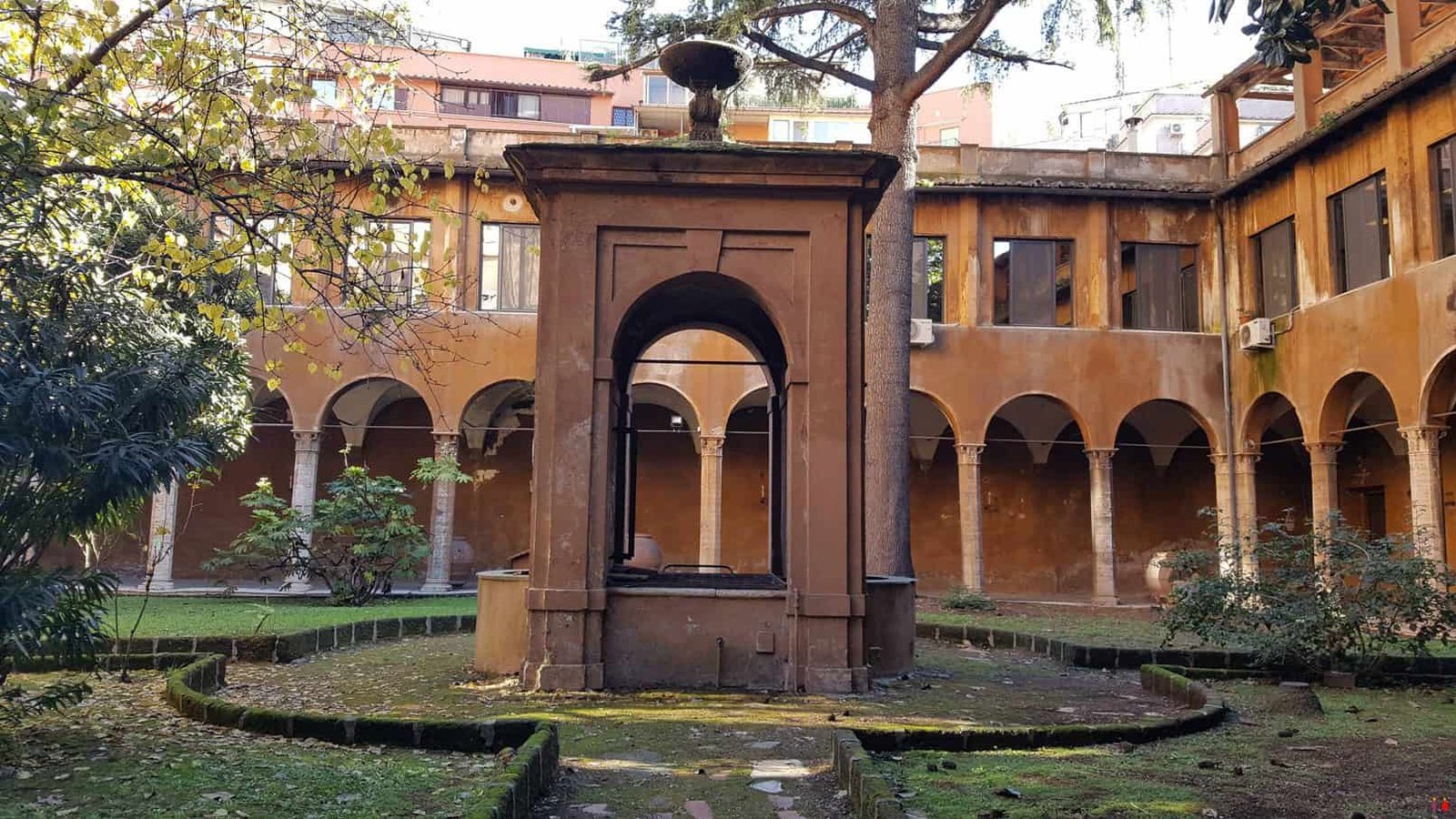
The Cloisters of San Cosimato in Rome are the surviving part of an ancient monastery of Trastevere that today is, literally, inside a working hospital: the Nuovo Regina Margherita facility, in piazza di San Cosimato, a few steps from Viale Trastevere and a quarter of an hour's walk from Santa Maria in Trastevere. Whoever arrives in the square sees a long, severe front, a 15th-century portal, a small, crooked Romanesque bell tower poking out over the roofs, and does not imagine that behind that wall open two cloisters of different eras, a monastic church with a Renaissance fresco in the presbytery and an ancient granite basin that has stayed in its place for centuries. It is one of the most layered places in the rione and at the same time one of the least visited, for a very simple and very concrete reason: the building that contains them is a hospital, access is subordinate to the needs of the health facility and there is no ticket office. Whoever wants to understand this place must accept from the start that it doesn't work like a museum. In exchange they get one of the most beautiful architectural sequences in Trastevere, a few dozen meters from the neighborhood market and the osterie of via di San Francesco a Ripa.
Where the Cloisters of San Cosimato in Rome are and how to get there
The address is piazza di San Cosimato, in the rione Trastevere, the 13th and largest of the historic rioni of Rome. The square opens halfway between Viale Trastevere and via di San Francesco a Ripa, in a zone where the medieval fabric of the rione suddenly widens into a rectangular space that the people of Trastevere have used for generations as a market, a playground for children and an open-air living room. The monumental complex occupies the whole western side of the square. The facade of the church faces the square at a lower level than the current one, because the street level has risen over the centuries: it is a detail you notice at once and that by itself tells how many centuries this building has.
On foot from Viale Trastevere
The most natural way to arrive is on foot. From Viale Trastevere, at the tram stop of piazza Mastai or Ministero dell'Istruzione, you take via di San Francesco a Ripa and walk west for three or four minutes: the square opens on the right. Whoever comes from Santa Maria in Trastevere goes down via della Fonte d'Olio or via della Paglia, takes vicolo del Cinque or via del Moro and then heads south toward via di San Francesco a Ripa: it is eight to 10 minutes of alleys, which are worth the trip by themselves. From Lungotevere Ripa and from ponte Cestio, that is, from the Tiber Island, the time is similar.
By tram and bus
Tram 8 runs along Viale Trastevere from piazza Venezia to Casaletto and is the reference vehicle for the whole rione. The useful stops are the central ones on the avenue: from there you climb on foot for five minutes. Tram 3 connects Trastevere with the Aventine, the Colosseum, San Lorenzo and Valle Giulia and lets you arrive from half the city without changing. The buses serving the area, together with the electric service that enters the alleys, change numbering and route with some frequency: it's best to check the updated route on the transport company's website the same day, because in Trastevere detours for events, processions and construction sites are the norm and not the exception.
By train and from Roma Trastevere station
Roma Trastevere station, served by the regional lines FL1, FL3 and FL5 and by the connections with Fiumicino airport, is about a kilometer and a half from the square, along viale Trastevere: on foot it's a good 20 minutes, by tram 8 a little over five. Whoever arrives from the airport and wants to sleep in the area finds here the most convenient landing point, because the rest of the rione is largely closed to traffic and taxis struggle in the alleys.
By car: the worst choice
Arriving by car at piazza San Cosimato is possible but not advisable. The rione is largely limited-traffic, with electronic gates active in time slots that change between weekdays and weekends, and surface parking spots are very few and almost all reserved for residents. Whoever absolutely must use the car leaves it in the lots of the Gianicolense or along the Tiber and completes the trip on foot. It's worth remembering that part of the few spaces around the complex is reserved for medical vehicles and hospital staff: occupying them is not only forbidden, it is discourteous to those who work in an emergency room.
What the San Cosimato complex really is: a monastery inside a hospital
This is where the whole misunderstanding that goes with this place plays out. Whoever reads the word cloister imagines a monument with hours, tickets, guides and a bookshop. San Cosimato is not that. The complex is a medieval and Renaissance monastery that, after the 19th-century expropriation, changed its use three times and is today an integral part of a public health facility, the Nuovo Regina Margherita, which hosts clinics, local services and clinical activities.
The practical consequence is that the cloisters exist, are restored, are beautiful, and at the same time are connecting corridors, waiting areas, service spaces of a facility where people go to be treated. There is nothing degrading in this: on the contrary, it is one of the oldest and most honest forms of reuse in Rome, where monastic structures have become barracks, schools, ministries, courts and hospitals without a break. But it radically changes how the visitor must approach.
Whoever comes in here is entering a hospital. The priorities of the space are different. You pass through without making noise, you don't photograph people, you don't go into the wards, you don't treat a waiting area as a stage set. The possibilities of access to the cloisters depend on the conditions of the facility and on the initiatives organized from time to time: over the years the structure has hosted special openings, guided visits tied to heritage days, conferences and concerts, but there is no stable calendar published once and for all. Whoever wants to be sure must find out beforehand from the medical management or from the cultural associations that organize the openings from time to time.
On this point I prefer to be blunt and not sell illusions: there are no fixed visiting hours, there is no entrance ticket, there is no standard online booking. Any page that promises you otherwise is telling you a fairy tale. The honest thing to say is that San Cosimato is seen when it can be seen, and that the square, the portal, the bell tower and the front of the complex are instead always visible and free, at any moment of the day.

The name: Santi Cosma e Damiano in Mica Aurea
The official name of the monastery was Santi Cosma e Damiano in Mica Aurea, and the form San Cosimato is the popular Roman contraction of the two names, exactly as Sancta Maria in Cosmedin became in everyday speech Santa Maria in Cosmedin and as so many other Roman titles were shortened in the mouths of the faithful. The passage from Cosma e Damiano to Cosimato is a linguistic phenomenon, not a mistake.
Who Cosmas and Damian were
Cosmas and Damian were two physician brothers, of Arab origin according to tradition, trained in Syria. They are called anargyroi, that is, without money, because they treated free of charge those who could not pay. Tradition has them martyred during the persecution of Diocletian, beheaded after long tortures, and buried at Cyrrhus, in Syria, near Antioch. The date that circulates most often is 303, but for martyrs of the Diocletian era the chronologies are late reconstructions and should be taken for what they are: hagiographic tradition, not chronicle.
There is an irony worth picking up, because it is not a rhetorical stretch but a matter of fact. The complex is dedicated to the two patron saints of physicians, surgeons and pharmacists, and today it is a hospital. Between the title of the 10th century and the use of the 21st century runs a straight line of a thousand years. Rome is full of involuntary continuities of this kind, but few are so clean.
What Mica Aurea means
The specification in Mica Aurea indicates the place. The erudite sources explain it with the presence, on the slopes of the Janiculum and along the bank of the Tiber, of river sand of a yellowish color, golden under the sun. Mica, in medieval Latin, means grain, crumb: the mica aurea is therefore the golden sand. Some 19th-century topographers, among them Nibby, Fea and Canina, placed the monastery on the site of the Naumachia Augusti, the great artificial basin that Augustus had dug in Trastevere for simulated naval battles. The identification is debated and should not be presented as certainty: it is an authoritative topographic hypothesis, repeated for two centuries, but not confirmed by a decisive excavation.
A curiosity about the Cloisters of San Cosimato in Rome
In the first courtyard, the one reached from the porch on the square, there still stands in its place today a large granite bath vessel, with rings and sculpted lion heads. It is an ancient basin, reused, arrived here at an unspecified time and never moved since. The erudite guides of the 19th century noted it as a rarity and described it almost with amazement, because a piece of this kind should have ended up in a noble courtyard or in a museum, and instead it stayed where the monks and then the nuns used it.
The real curiosity, however, is not the basin itself: it is that pieces like this, at San Cosimato, are not the exception. The porch that precedes the facade is built with reused material, that is, with columns, capitals and blocks taken from Roman buildings and reassembled in the 12th century. The columns of the oldest cloister are not all alike. Walking here means walking inside a building made of other buildings, which is after all how Rome built itself for 15 centuries. Ancient marble, in Trastevere, was not a cultural asset: it was building-site material that cost less than new because it was already there.
There is an amusing detail to notice. The facade of the complex faces the square at a lower level than the current one. It means that the walking surface of the square has risen considerably over the centuries, through floods, fill, street rebuilding. When you look at the front of the church from the height of your hiking boots, you are looking at a partially sunken building: it did not go down, you went up.
The two cloisters of San Cosimato: the 13th-century one and the one with the well
The monumental heart of the complex is the two cloisters, of different eras and different languages. It is not a duplicate: it is a chronological sequence readable with the naked eye, and this is why architectural historians hold San Cosimato in great regard.
The medieval cloister
The first cloister, the oldest, opens on the right of the church. The sources date it to the mid-13th century and indicate 1240 for its construction, in the full season of the Poor Clares. It was originally on two floors: a lower portico on small columns and an upper loggia. The arches of the upper floor were walled up during the 15th-century works, and this explains the somewhat closed and massive look of the upper register today, which at first sight seems inconsistent with the lightness of the portico below. It is not a design error: it is a late modification that stiffened a building born airy.
The language is that of the Roman cloisters of the 13th century: round arches on slender small columns, varied capitals, contained proportions, no ostentation. Whoever knows the cloister of the Santi Quattro Coronati or that of San Giovanni in Laterano finds here the same formal family, on a smaller scale and without the Cosmatesque inlays. San Cosimato is a cloister of poor nuns, not of rich canons, and you can see it: the beauty is in the rhythm, not in the material.
The 15th-century cloister, called the one with the well
The second cloister belongs to the great campaign of works of the late 15th century. It is built on pillars and not on columns, has wider proportions, broader arches, an already Renaissance character and an almost domestic sobriety. At the center is a covered well, which gave it the name by which the people of Trastevere know it: the cloister of the well.
To the same season of works is owed the chapter house, that is, the room where the monastic community met for collective decisions and for the reading of the rule. The presence of a recognizable chapter house is one of the elements that make this complex precious: of many Roman monasteries suppressed in the 19th century nothing readable remains, while here the functional structure of the monastic building can still be read.
How to read the difference between the two
If you are lucky enough to see both in sequence, the comparison is the most instructive thing about the visit. The 13th-century cloister is vertical, small, made of slender, repeated elements. The 15th-century one is horizontal, wide, made of wall masses and regular voids. 200 years of architectural history in 10 meters of distance. You don't have to be a scholar to notice: just look at the thickness of the supports.
Something nobody tells you about the Cloisters of San Cosimato in Rome
The thing almost nobody tells you concerns the nuns. The Poor Clares of San Cosimato did not die out in 1891 with the expropriation: they continued to exist, moved four times in 40 years and their community is still alive in Rome. After leaving Trastevere they went to San Gregorio al Celio, then in 1920 to via Aurelia, then in 1926 to a new monastery on the Vatican hill, and finally in 1933 settled on via Ambrogio Contarini, in the southwestern quadrant of the city, where they still are. They continue to call themselves the Poor Clares of San Cosimato, even though their San Cosimato has been a hospital for more than half a century.
It is a detail that changes how you look at the cloister. You are not looking at the remains of a vanished community, as happens in so many suppressed monasteries in Europe. You are looking at the lost home of a community that still exists, that took with it archives, memories and title, and that considers those stones its origin. The continuity was broken in the place but not in the people.
The second thing rarely said is that the 19th-century transformation was neither an isolated act nor a personal cruelty. After 1870 and with the laws suppressing ecclesiastical bodies, the Italian State and then the City of Rome found themselves having to find spaces for an improvised capital: offices, barracks, schools, almshouses, hospitals. The great convent complexes were the only real estate available in bulk inside the walls. San Cosimato became a shelter for sick and destitute elderly people because a shelter was needed and because there was a large empty building. The Roman history of the 20th century is in large part the history of these changes of use.
The third thing, the most uncomfortable, is that attributing the complex to the most famous popular festival of Trastevere is a misunderstanding that circulates widely. The Festa de' Noantri, celebrated between July 16 and 30 in honor of the Madonna del Carmine, revolves around the statue kept in the church of Sant'Agata in Trastevere, the basilica of San Crisogono and Santa Maria in Trastevere, not the church of San Cosimato. The procession crosses the rione and touches the area, but the liturgical pivot of the festival is elsewhere. If someone tells you that the Noantri were born at San Cosimato, correct them gently.
The advice I give you for visiting the Cloisters of San Cosimato in Rome
The advice is to reverse the order of expectations. Don't organize a day around the cloisters, because you risk finding the door closed and going home disappointed. Organize a morning in Trastevere and put San Cosimato inside that morning, as a possibility and not as a goal.
In concrete terms: arrive at piazza San Cosimato early in the morning, between eight and 10, when the neighborhood market is working and the square still has its original function as a place of exchange. Look at the front of the complex unhurriedly, look for the 15th-century portal, raise your eyes to the Romanesque bell tower, find the porch. This part requires no permits and costs nothing: it is 20 minutes that are worth more than many hurried visits.
Then, if you want to try the interior, politely ask the hospital staff whether at that moment it is possible to look into the cloister. The answer depends on the day, the hour, the works in progress and the workload of the facility. If the answer is no, take it for what it is: you are asking to enter a health facility.
The most reliable route
The route that works best, for those who really care, is to look for the special openings. Rome organizes many during the year, with formulas that change name and promoter: heritage days, initiatives of the Fondo per l'Ambiente, series opening places normally inaccessible, visits promoted by cultural associations of the rione. San Cosimato appears in these calendars with some regularity, precisely because it is a place that is never seen. Signing up for the newsletters of these initiatives and checking the programs in the spring and autumn months is, from experience, the approach that gives the best results.
If you want a guide
Frequently asked questions about the Cloisters of San Cosimato in Rome
Can you visit the Cloisters of San Cosimato?
Not freely and not with fixed hours: the Cloisters of San Cosimato are part of a working hospital facility, the Nuovo Regina Margherita, and access depends on the needs of the structure. The most reliable occasions remain the special openings organized during the year by cultural initiatives and associations, to be looked up from time to time.
Where exactly are the Cloisters of San Cosimato?
The Cloisters of San Cosimato are in piazza di San Cosimato, in the rione Trastevere in Rome, halfway between Viale Trastevere and via di San Francesco a Ripa. The square is a rectangular space that the people of Trastevere have used for generations as a market, a playground for children and an open-air living room.
Why is the complex called San Cosimato?
The official name of the monastery was Santi Cosma e Damiano in Mica Aurea, and San Cosimato is the popular Roman contraction of the two names, exactly as Sancta Maria in Cosmedin became in everyday speech Santa Maria in Cosmedin. It is therefore a linguistic phenomenon, not a transcription error.
How many cloisters are there at San Cosimato and how do they differ?
Inside the San Cosimato complex there are two cloisters, of different eras and languages: the first, older, opens on the right of the church and the sources date it to the mid-13th century, while the second is known as the cloister of the well. It is not a duplicate but a chronological sequence readable with the naked eye, which is why architectural historians hold San Cosimato in great regard.
What is the best time to see the facade of the Cloisters of San Cosimato?
The best time to see the front of the Cloisters of San Cosimato is a weekday morning, between eight and 11, when the neighborhood market is working and the light comes from the east, lighting the facade with the Romanesque bell tower head-on. Toward noon the light turns flat and, from May to September, the heat makes standing around less pleasant because of the little shade in the square.
Do the nuns who lived at San Cosimato still exist?
Yes, the Poor Clares of San Cosimato did not die out with the 19th-century expropriation of 1891: they moved several times in the following decades, first to San Gregorio al Celio, then to via Aurelia in 1920 and to a new monastery on the Vatican hill in 1926, and their community is still alive in Rome today.
What is there to see around the Cloisters of San Cosimato in Trastevere?
Around the Cloisters of San Cosimato is piazza San Cosimato with its historic neighborhood market, one of the few Roman markets that has resisted the touristic transformation of Trastevere. The complex is in one of the best-served points of Rome for attractions reachable in a few minutes on foot.
A licensed tour guide who knows the rione knows when and how to get in, knows whom to ask and knows how to tell the story of the cloister without making things up. On a place like this, where half the information circulating online is approximate, the difference between a successful visit and half an hour of confusion lies entirely in the person who accompanies you. Whoever organizes groups or wants a morning built around Trastevere finds the service on the TourLeaderPro contact page.
Rules of common sense
Three things that seem obvious and are not. You don't photograph patients, ever, for any reason. You don't speak loudly in the corridors, because behind the doors there are people waiting for results. You don't take the seats of the waiting rooms to rest during the tourist tour. Whoever respects these three rules almost always finds helpful staff. Whoever doesn't closes the door even to those who come afterward.
The church of San Cosimato, the porch and the bell tower
The church is small, because it was born as a monastic church and not as a parish church: it served a closed community, not a neighborhood. It was entered from the courtyard on the square through the porch, now closed, and from the right of that courtyard opened the entrance to the oldest cloister, from which you passed to the cloister of the well. The sequence square, porch, courtyard, cloister, cloister was the gradual filter between the world and the enclosure: each passage took away noise.
The porch
The porch is the small porticoed structure that precedes the portal, supported by columns and covered by a pitched roof. At San Cosimato it is datable to the 12th century and is built with reused material. The columns are of granite. It is a recurring element in the sacred architecture of medieval Rome: the same scheme is found above the main entrances of the Basilica of San Clemente, of Santa Prassede on the Esquiline and of the Basilica of Santa Maria in Cosmedin, which with its Bocca della Verità is much more visited today but architecturally speaks the same language.
The porch is not a decorative whim. It had a precise function: to protect from the rain those waiting in front of the door, to mark the threshold between civil space and sacred space, to host the burials and inscriptions of those who wanted to be remembered at the entrance of the church. When a Roman porch is walled up or closed, as happened here, the meaning of the entrance changes completely and the building goes mute.
The 15th-century portal and the inscription of Sixtus IV
The portal seen today belongs to the 15th-century campaign. On the architrave runs the inscription recalling the intervention of Pope Sixtus IV della Rovere, carried out on the occasion of the Jubilee of 1475. Sixtus IV is the pope who rebuilt half of Rome in view of that holy year: ponte Sisto, the hospital of Santo Spirito, the paving of many streets of Trastevere, the Chapel that bears his name in the Vatican. San Cosimato enters that list. Reading that name on the architrave means placing the building within the greatest urban renewal program of 15th-century Rome.
The interior and the Pastura fresco
The interior is a single nave and was reworked in 1871, shortly after the capture of Rome and shortly before the expropriation: a late intervention that erased a good part of the earlier layers. Of the 15th-century phase essentially only one painted element survives, but of quality: the fresco in the presbytery with the Madonna and Child between Saints Francis and Clare, attributed to Antonio del Massaro da Viterbo, known as il Pastura.
The subject is consistent with the history of the place. Francis and Clare are the founders of the two branches of the order, and the presence of Clare next to the Madonna declares without ambiguity that this was a monastery of Poor Clares. The Pastura was an Umbrian-Lazio painter of the circle of Pinturicchio and his hand is recognized in the sweetness of the faces and the cleanness of the drawing. For a surviving fresco in an environment so heavily reworked, it is a fortunate survival.
The bell tower
The bell tower is small and Romanesque, and belongs to the medieval season of the complex. It does not have the monumentality of the bell towers with several orders of mullioned windows seen at Santa Maria in Trastevere or at Santa Maria in Cosmedin, but it has the merit of authenticity: it has remained what it was. From the square it can be glimpsed beyond the line of the roofs and it is the most recognizable signal of the monastery's presence inside the modern hospital fabric.
Another well-known fact, yet rarely mentioned
The fact is known to historians and almost unknown to visitors: the Poor Clares arrived here because the Benedictines left, and the passage was not entirely serene. The monastery was originally Benedictine, founded in the 10th century. In 1229 Pope Gregory IX assigned it to the Camaldolese Benedictines, who stayed a few years. Then the same pontiff decided to entrust it to a group of Poor Ladies sent by Clare of Assisi, who in those years lived in seclusion with her companions in the monastery of San Damiano in Assisi, and who for that reason were called Recluses of San Damiano even before they were Poor Clares. The official reason, reported by the sources, was to mitigate with a life of prayer and sacrifice the wrath of God on the eternal city.
Beneath the devotional formula, local tradition has always read a replacement motivated by disciplinary and managerial problems of the previous religious. It is hearsay, not a document: it must be reported as such. But it is hearsay consistent with what we know of the Rome of the 13th century, when many urban monasteries lived through a crisis of observance and the popes used the new mendicant orders as a tool of reform.
On the exact date of the Poor Clares' arrival the sources waver between 1233 and 1234. The difference of one year depends on the type of document considered, whether the papal act or the actual settling of the community. It is not a detail to settle on a popular page: it is right, however, that the reader knows that both dates circulate and that neither is wrong in the strict sense.
The second fact little cited concerns the 15th century. The internal reform of the monastery did not come with Sixtus IV, but before: in 1447 the blessed Margaret of Sulmona started the reform of the Roman community with the support of Saint John of Capistrano, and from San Cosimato reform initiatives then set out toward other monasteries. The Roman monastery, put another way, was not only the object of papal interventions: for a period it was a driving center of women's Franciscan observance. This also explains why, 30 years later, it was worth investing the Jubilee's money in it.
The right photo to take at the Cloisters of San Cosimato in Rome
I start with the photo you can always take, without permits and without entering anywhere. Stand on the eastern side of piazza San Cosimato, that is, on the opposite side from the complex, step back to the edge of the square and frame the whole front with the Romanesque bell tower poking out over the eaves line. The right time is early morning, when the sun comes from the east and lights the facade head-on: the brickwork glows, the bell tower stands out against the sky and the difference in level between the square and the threshold of the church becomes evident. If you include the market stalls in the frame, you have in a single image a thousand years of history and the life of today.
The detail photo
The second framing is a close one: the 15th-century portal with the inscribed architrave. Move in until you fill the frame with the band of the inscription, use raking light from early morning or late afternoon because the incised letters need shadow to be read, and shoot slightly from below. It is the kind of photograph nobody takes and that tells the monument better than an overall view.
The photo of the cloisters, if you get in
In the 13th-century cloister the photograph that works is the corner one, taken from the vertex of the portico, with the two wings fleeing diagonally and the sequence of small columns compacting in perspective. Look for the moment when the light comes in obliquely and the portico stays in shadow: the contrast between the lit courtyard and the dark portico is exactly what makes a cloister readable in a photograph. A cloister photographed at noon, in flat light, becomes a box without depth.
In the cloister of the well the subject is the covered well at the center, framed from the front with the symmetrical pillars at the sides. Here the geometry is Renaissance and the symmetry must be respected: stand on the axis, not at an angle. Whoever has a camera with a wide-angle lens must watch out for converging lines: keep the camera level, even at the cost of leaving more floor in the frame.
What not to photograph
Hospitalized people, medical staff at work, signs with patients' names, ward doors, ambulances maneuvering. It is not only a matter of manners: it is a matter of people's privacy. A photograph that contains the face of a patient is not to be taken and not to be published. Inside a hospital you photograph the landscape, not the people.
Some important events that happened here in history
The chronology of San Cosimato is long and, in its main junctures, well documented. I give it in order, distinguishing what is certain from what is tradition.
The 10th century and the foundation
A document of the Regesto Farfense, the great documentary collection of the abbey of Farfa, attributes to a Roman nobleman named Benedetto Campagna the foundation, around the middle of the 10th century, of a monastery dedicated to the Santi Cosma e Damiano in Mica Aurea. The church is recorded as arising in the 10th century and this is the datum on which the sources agree. The name of the founder and the precise dating depend on the reading of that document and should be cited with their reference, not as chronicle.
1069: the consecration of the church
Local tradition places in 1069 the conclusion of the works and the consecration of the church by Pope Alexander II. In support there is a tablet, found in 1892 during the works of transformation of the complex and kept on site. It is an interesting case of documentation recovered precisely at the moment when the monastery ceased to be one: the last archaeological discovery of the monastery coincides with its end as a place of enclosure.
1229 and the passage to the Camaldolese
Pope Gregory IX assigned the monastery to the Camaldolese Benedictines. The stay was brief, only a few years.
1233 or 1234: the Poor Clares arrive
The Recluses of San Damiano, that is, the Poor Clares, take over from the Benedictines by the will of the same Gregory IX. It is the juncture that defines the identity of the complex for the following six and a half centuries.
Mid-13th century: the first cloister and the first great renovation
The oldest cloister is built around 1240. In the same years the Poor Clares start a renovation of the church and the convent building, made possible also by the resources made available by the family of the abbess Jacopa Cenci. A part of the tradition places this campaign in 1246. The two dates, 1240 for the cloister and 1246 for the works as a whole, are not in contradiction: they probably describe different phases of the same long building site.
1447: the reform of Margaret of Sulmona
The blessed Margaret of Sulmona, with the support of Saint John of Capistrano, reforms the community and makes San Cosimato a point of reference for women's Franciscan observance in Rome.
1475: the Jubilee and Sixtus IV
In 1475 the complex was in a state of serious decay despite the interventions of the two preceding centuries. Pope Sixtus IV had the church and part of the monastery rebuilt from the foundations, on the occasion of the holy year. To this campaign are owed the portal with the inscription, the second cloister with the well, the chapter house and the walling up of the upper arches of the 13th-century cloister.
1871: the reworking of the interior
The interior of the church is reworked, erasing much of the earlier layers and leaving standing, from the 15th-century phase, almost only the Pastura fresco.
August 12, 1891: the end of the monastery
The abbess receives the official order to leave San Cosimato. An act of expropriation of the religious congregation follows, and then an act of transfer and handover of the monastery to the City of Rome, for transformation into an almshouse. The nuns are moved the following year to the monastery of San Gregorio al Celio. After 650 years women's enclosure at San Cosimato ends on an August afternoon.
From 1891 to the 1920s: shelter and almshouse
The complex becomes a shelter for sick and destitute elderly people, then the Ospizio Umberto I in San Cosimato. In 1925 it becomes part of the Istituti Riuniti di Assistenza e Beneficenza di Roma.
From the 1960s to today: the hospital
Starting in the 1960s the complex is adapted into a hospital specializing in orthopedics and surgery. The renovation is the work of the architect Alegiani and the engineer Secchi, and the inauguration under the name Ospedale Nuovo Regina Margherita is recorded in March 1970. Some sources give 1960 as the year in which the complex became a hospital site: the discrepancy is presumably explained by the distance between the start of the health use and the inauguration of the renovated facility, but it is a point on which the sources do not agree and it must be said.

Who has passed through the Cloisters of San Cosimato in Rome
It is not a place of celebrities and it makes no sense to build a gossip-magazine list of them. The people who count here are those who lived in, reformed or rebuilt the monastery.
Clare of Assisi, through her community
Clare never came to settle in Rome, but the group of Poor Ladies that gave rise to the Roman community left San Damiano in Assisi by her decision. San Cosimato is therefore one of the first Roman offshoots of the women's branch of Franciscanism, in a phase when the order was still under construction and the rule under discussion.
Gregory IX
Ugolino of the counts of Segni, Pope Gregory IX, is the pontiff who more than any other determined the fate of this complex: first assigning it to the Camaldolese, then entrusting it to the Poor Clares. He was also the great protector and regulator of the Franciscan order, and his intervention at San Cosimato fits into a precise policy of rooting the new orders inside Rome.
The abbess Jacopa Cenci
A name little known outside specialist studies, but decisive: the financial means of her family made possible the first great 13th-century renovation. The Cenci were one of the families of the Roman patriciate and their name remains tied to the district between the ghetto and the Tiber. Without that money, the medieval cloister might not exist.
Margaret of Sulmona and John of Capistrano
The pair who in 1447 reformed the community. John of Capistrano is a leading figure of 15th-century Europe, preacher and organizer, and his passage through San Cosimato places the monastery within the network of continental Franciscan observance.
Sixtus IV della Rovere
The pope of the Jubilee of 1475, of ponte Sisto, of the Sistine Chapel and of the urban reorganization of Trastevere. His name on the architrave of the portal is the most illustrious signature the complex preserves.
Antonio del Massaro called il Pastura
The painter from Viterbo to whom the surviving fresco of the presbytery is owed. Active between Viterbo, Rome and Umbria at the turn of the 15th and 16th centuries, close to Pinturicchio, he is one of those artists of solid craft who filled the minor churches of central Italy with good painting.
Alegiani and Secchi
The architect and the engineer who signed the 20th-century transformation into a hospital. It is right to cite them, even though their name never appears in the guides: the coexistence of medieval cloister and hospital ward, which seems obvious to us today, is the result of their project.
When to go to piazza San Cosimato and when to avoid it
The best moment to see the front of the complex and breathe the square is a weekday morning, between eight and 11. The neighborhood market is working, the light comes from the east and hits the facade, the children are at school and the square belongs to those who live there. Toward noon the light turns flat and the heat, from May to September, makes standing around unpleasant because the square has little shade.
Late afternoon has a different charm: the square fills with families, the playground works at full capacity, the bar tables spread out. It is the right moment to understand the social function of the place, less so to photograph the architecture, because the sun goes down behind the Janiculum and the front of the complex stays backlit.
Summer and evenings in the square
In the summers of recent years piazza San Cosimato has hosted one of the most followed open-air cinema series in Rome, with free screenings and very crowded evenings. It is an event that changes program and formula every year and that should be checked from season to season on the organizers' channels. On screening nights the square is transformed: thousands of people, chairs, screen, crowd control. Wonderful to experience, terrible for those who wanted to look in peace at a medieval facade. Plan accordingly.
The days to avoid
The summer Sundays of full tourist season, when Trastevere absorbs a number of visitors out of proportion to its size. The week of the Festa de' Noantri, between mid and late July, if you are looking for tranquility: the rione is in festival mode, the streets are full, the processions change the traffic. If instead the festival interests you as a phenomenon, it is exactly the right period to come, provided you know that the pivot of the event is Sant'Agata, San Crisogono and Santa Maria in Trastevere.
The best season
October and November, or March and April. Trastevere in the in-between seasons is at its best: the light is low and warm, the temperatures allow you to walk for hours, the alleys become passable again. They are also the months when the cultural initiatives that open normally closed places are concentrated, so the chances of finding the cloisters accessible increase.
What's around the Cloisters of San Cosimato in Rome
The complex is in one of the best-served points of Rome in terms of what there is to see within a 10-minute walk. Building half a day around San Cosimato is easy, indeed it is the best way to use it.
The square and the market
Piazza San Cosimato hosts the historic neighborhood market of Trastevere, one of the few Roman markets that has resisted the touristic transformation of the rione while keeping a neighborhood clientele. Fruit, vegetables, fish, cheeses, stalls that work in the morning and close in the early afternoon. Around it, the fenced playground, the benches, the bars. It is one of the last spaces in Trastevere where you hear Romanesco spoken more than English, and it is worth stopping even for just 10 minutes.
The churches of Trastevere
Five minutes away is the church of San Francesco a Ripa, with Bernini's Blessed Ludovica Albertoni, one of the most intense sculptures of the Roman Baroque and almost always deserted. A little farther is the Basilica of Santa Cecilia in Trastevere, with Pietro Cavallini's Last Judgment in the nuns' choir and the excavations of the Roman domus under the floor. To the north, the Basilica of Santa Maria in Trastevere with its apse mosaics and the mosaic facade that lights up in the evening. On the route of the Festa de' Noantri, the church of Sant'Agata in Trastevere.
The museums and the villas
The Museo di Roma in Trastevere, in the former convent of Sant'Egidio, preserves the documentation of popular Roman life and hosts photography exhibitions of good level. Going up toward the Lungara you reach the Villa Farnesina, with the frescoes of Raphael and his workshop, and the Rome Botanical Garden, 12 hectares of greenery on the slopes of the Janiculum that on hot days are worth the ticket by themselves.
The climb up the Janiculum
Whoever has the breath climbs the Janiculum and finds the Acqua Paola Fountain, the so-called Fontanone, and the church of San Pietro in Montorio with Bramante's Tempietto in the adjacent courtyard, which is one of the manifestos of Renaissance architecture. The panorama from piazzale Garibaldi is the one everyone knows and that keeps working.
Toward the river
Going down toward the Tiber you reach in a few minutes the Tiber Island, which is also the other great hospital island of Rome: here is the Fatebenefratelli, and before that stood the temple of Aesculapius, god of medicine. If you are looking for a constant in the health topography of Rome, you find it: places of care remain places of care for two millennia. On the opposite bank, a short distance away, the Basilica of Santa Maria in Cosmedin.
Where to eat, in a few words
The area between piazza San Cosimato and via di San Francesco a Ripa still keeps some trattorias of traditional layout, along with many signs designed for passing tourism. The rule of thumb: if the menu is translated into six languages and someone at the door invites you in, walk another 100 meters. If the dining room is full of Romans at noon on a Tuesday, sit down.
Quick questions about the Cloisters of San Cosimato in Rome
Can you visit the Cloisters of San Cosimato?
Not freely and not with fixed hours. The complex is part of a working hospital facility and access depends on the needs of the structure. The most reliable occasions are the special openings organized during the year by cultural initiatives and associations, to be looked up from time to time. The square, the facade, the portal and the bell tower, on the other hand, are always visible from the outside.
How much is the ticket?
There is no entrance ticket, because there is no permanent visiting circuit. Any guided visits organized by associations may carry a participation contribution set by the organizers.
How many cloisters are there?
Two. The first, on the right of the church, dates to the mid-13th century and was originally on two floors. The second, with the covered well at the center and the pillar supports, belongs to the 15th-century campaign tied to the Jubilee of 1475.
Why is it called San Cosimato?
From the popular contraction of the names of the titular saints, Cosmas and Damian. The full name of the monastery was Santi Cosma e Damiano in Mica Aurea, where Mica Aurea indicates the yellowish river sand of the slopes of the Janiculum.
When was the monastery founded?
In the 10th century. A source in the Regesto Farfense attributes the foundation to the Roman nobleman Benedetto Campagna around the middle of that century. The consecration of the church is traditionally placed in 1069 by Pope Alexander II, with a tablet found in 1892 in support.
Are the nuns still there?
Not here. The Poor Clares left San Cosimato in 1891 after the expropriation and passed through San Gregorio al Celio, via Aurelia and the Vatican hill before settling in 1933 on via Ambrogio Contarini, where the community still is and where it continues to bear the name of Poor Clares of San Cosimato.
What is the relationship with the Festa de' Noantri?
None directly. The festival, celebrated between July 16 and 30 in honor of the Madonna del Carmine, revolves around the statue kept at Sant'Agata in Trastevere, the basilica of San Crisogono and Santa Maria in Trastevere. The procession crosses the rione, but the San Cosimato complex is not its pivot.
What can you see inside the church?
A single-nave interior, reworked in 1871, which from the 15th-century phase keeps above all the fresco in the presbytery with the Madonna and Child between Saints Francis and Clare, attributed to Antonio del Massaro called il Pastura.
How much time do you need?
For the exterior, 20 minutes. If you manage to get into the cloisters, a good hour. Included in a tour of Trastevere that touches Santa Cecilia, San Francesco a Ripa and Santa Maria in Trastevere, it comfortably comes to half a day.
Is it suitable for children?
The square yes, with the playground and the market. The interior of the complex, being a hospital, requires controlled behavior and is not the right place for a visit with small and lively children.
Is it accessible to people with mobility difficulties?
The hospital facility is equipped for access, being a health facility. The historic areas, with thresholds, level differences and ancient paving, present the typical difficulties of medieval buildings. Those with specific needs should find out beforehand from the facility.
In our view San Cosimato is the right place for those who have understood that in Rome layering is not a metaphor for tour guides but a physical condition of the buildings. Here a Roman basin, a 12th-century porch, a 13th-century cloister, a jubilee portal of 1475, a 19th-century reworking and a hospital ward of the 1960s occupy the same volume of air. None of these layers has entirely erased the previous one, and none claims to be the only legitimate one. Whoever is looking for the intact, presentable monument will be disappointed. Whoever is trying to understand how a city 3,000 years old really works will find few lessons clearer than this, a stone's throw from the fruit stall.
Article written by the editorial team of TourLeaderPro, contact them for Private/Corporate/V.I.P. Tours and Experiences. For a morning built around Trastevere with a licensed tour guide, including the churches and cloisters that don't open by themselves, start from the TourLeaderPro contact page. Tour operators who put Rome inside wider programs will find the consulting service in the section for tour operators.
Planning a trip to Rome? The English guides for visiting the city are on ItalyPlanner.com. Whoever wants to understand how to get around the rioni without losing half a day in transport will find a starting point in the section devoted to Rome, while those thinking in day trips out of town can read the guide to the best day trips from Rome.