Imperial Forums Museum at Trajan’s Markets
In short. The Imperial Forums Museum occupies Trajan's Markets and has its entrance at via Quattro Novembre 94, 00187 Rome, on the slope that connects piazza Venezia to largo Magnanapoli.
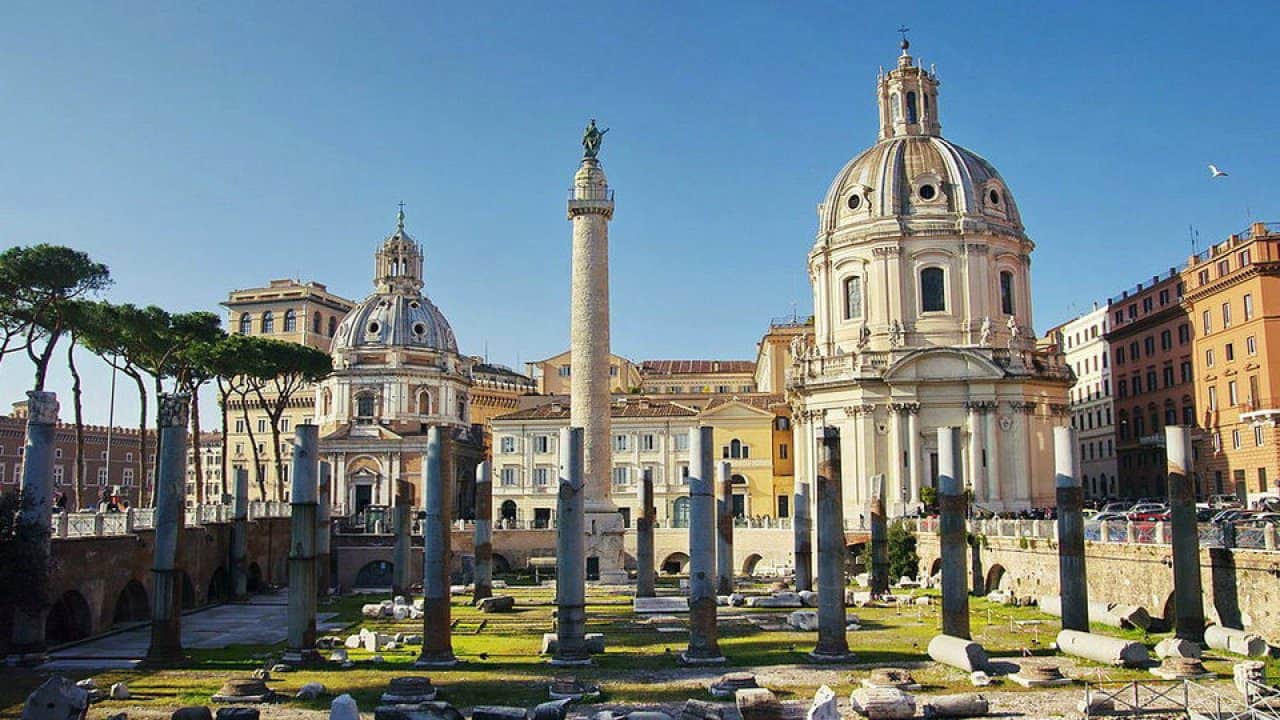
The Imperial Forums Museum occupies Trajan's Markets and has its entrance at via Quattro Novembre 94, 00187 Rome, on the slope that connects piazza Venezia to largo Magnanapoli. The museum is open every day from 9.30 to 19.30, with last entry at 18.30. The only annual closures fall on May 1 and December 25, while on December 24 and 31 the hours end at 14.00. The standard ticket costs 15,00 euro full and 9,50 euro reduced, plus a 1,00 euro advance booking fee for those who buy online. When an exhibition is on, the fare goes up to 19,50 and 14,00 euro for non-residents. From February 2026, those who live in Roma Capitale or the Città metropolitana enter for free by showing an identity document. For the individual visitor, booking is not necessary. You buy at the cash desk, and the queue rarely exceeds five minutes. It's a five-minute uphill walk from piazza Venezia, or a quarter hour's walk along the Forums from the Colosseum stop on Metro B. Official information is available through the contact center at 060608, open every day from 9.00 to 19.00. This listing is part of our collection dedicated to museums in Rome.
The scene repeats every day: people photograph the Grande Emiciclo from the sidewalk of via dei Fori Imperiali, comment on how well preserved it is, and head straight for the Colosseum. They're wrong. The Imperial Forums Museum is the only place in Rome where ancient architecture is explained by reassembling it before the visitor's eyes, fragment by fragment, cast by cast, inside the best-preserved Roman building in the whole Forum area. Anyone who wants to understand how the monumental center of the empire worked, and not just look at it, spends their two hours here better than half a day of queues elsewhere. It's hard to leave regretting the ticket.
One clarification needs to be made right away, because at the ticket office it causes daily confusion: Imperial Forums Museum and Trajan's Markets are not two separate visits and do not require two tickets. The museum is the display, the Markets are the building that contains it, and a single entrance opens both. The full official name, the one printed on the panels and access tickets, is «Mercati di Traiano Museo dei Fori Imperiali»: container and contents stuck together, without even a separating comma.

How much does it cost to enter the Imperial Forums Museum in 2026
The price of the Imperial Forums Museum depends on just one variable: whether or not there is a temporary exhibition. Without exhibitions the standard ticket applies, and that's the situation at the moment, after the summer closing of the major exhibition dedicated to Constantin Brâncuși. The prices are as follows:
- Full 15,00 euro
- Reduced 9,50 euro
- Advance booking fee 1,00 euro, both online and at the ticket office for a later day
- Free for residents of Rome and the Città metropolitana, with an identity document
When an exhibition is open, the Imperial Forums Museum ticket becomes integrated and goes up: full non-resident 19,50 euro, reduced non-resident 14,00 euro. This is what happened with Constantin Brâncuși. Le origini dell'Infinito, on display from February 20 to July 19, 2026, for the 150th anniversary of the birth of the Romanian sculptor: almost five euros of difference per person compared with the standard fare. For a future trip, it's worth checking the program on the museum's official website first, because the exhibition calendar changes the final cost of the day.
Rome residents get into the Imperial Forums Museum for free
It's the most significant news of recent years, and it has gone unnoticed among many of those concerned. From February 2026, entry to the civic museums is free for those who live in Roma Capitale and the Città metropolitana di Roma. At the cash desk you show your identity card and collect the ticket at no cost. The administrative rule is strict and worth knowing, because without the residence requirement you pay the full or reduced non-resident ticket. The check is real: the document must be shown, and a driver's license lent by a Roman friend doesn't make anyone a resident.
Free admission applies at the Imperial Forums Museum, as it does at the other paid civic museums, which are 14: Capitoline Museums, Museo di Roma, Trajan's Markets, Museo dell'Ara Pacis, Centrale Montemartini, Museo di Roma in Trastevere, Galleria d'Arte Moderna, Musei di Villa Torlonia, Museo Civico di Zoologia, Museo Bilotti, Museo Barracco, Museo Napoleonico, Museo Canonica and Villa di Massenzio. Four venues remain free for everyone, resident or not: Museo della Repubblica Romana, Museo delle Mura, Casal de' Pazzi and Casa Museo Alberto Moravia. For a Roman, the civic system has suddenly become the city's largest free cultural offering, and the Imperial Forums Museum is one of its major venues.
Is the MIC card still worth it?
For residents, after the free admission of 2026, it's much less necessary than before. It remains a good deal, though, for two specific groups: temporary residents of Rome and students at public and private universities in the city and the Metropolitan City. It costs €5.00, is valid for 12 months from activation, and gives free entry to the entire civic museum system, Imperial Forums Museum included. You can apply at miccard.roma.it. An out-of-town student who stays in the city for a semester gets their money back by the second visit, and they also get access to the aMICi calendar, which I'll cover later and which alone is worth the card.
One detail that saves 10 minutes of arguing at the cash desk: anyone who has the MIC card, or who is entitled to free admission, still has to get a free ticket issued, either by calling 060608 or by showing up at the ticket office. It's not a pass you can skip: it's a ticket that costs zero. The distinction seems Byzantine until you reach the entrance gate with nothing in hand.
Wednesday afternoons at the Imperial Forums Museum cost half price
Few people know about this discount, and I'm happy to pass it along to non-residents who want to spend less. The regulations on discounts of the Sistema Musei di Roma Capitale state, word for word, a 50 percent reduced rate for non-residents every Wednesday during the last two hours the museums are open. The Imperial Forums Museum closes at 19.30, so the useful window starts at 17.30, with the last entry still set at 18.30.
In euros, that's half price. In time, it's two full hours of museum for anyone who walks through the door at 17.30, and a little over an hour for anyone who arrives at the 18.25 limit. In my opinion, that window is the best time of all for a visit: it costs half, the organized groups have left, and the late afternoon light flatters the brick vaults like no other hour of the day.
Discounts and free admission at the Imperial Forums Museum: the list few people read
The official list of benefits is long, and it's worth going through it, because many people pay the full ticket when they're entitled to a discount. Free admission is granted to, among others, children under 6, people with disabilities with a family member or companion, European Union tourist guides and interpreters with a valid license, ICOM and ICOMOS members, journalists with a professional card, citizens of Paris under the exclusive twinning between the two capitals, and teachers and students of faculties of architecture, cultural heritage conservation, education sciences, and degree programs in archaeology or art history of the European Union.
There is also a seasonal free admission that almost nobody uses: blood donors and one companion enter free during the Summer Campaign, from July 1 to October 15, by presenting proof of donation. Anyone who donates and spends the summer in Rome would do well to keep the slip in their pocket.
Reduced admission is available to non-resident citizens between 6 and 25 years old, permanent teachers at state and municipal schools, holders of a Biblioteche di Roma Bibliocard, holders of an annual ATAC or annual Metrebus pass, groups of at least 20 people and, until December 2026, DXC Technology Italia employees with a company badge. The last item sounds like a joke, but it's written in black and white in the museum system's agreements. Public fees have curious quirks, and reading them in full now and then pays off.
Roma Pass at the Imperial Forums Museum: when it's worth it and when it's not
According to the website of the Sistema Musei di Roma Capitale, the Roma Pass costs €38.00 in the 48-hour version and €62.90 in the 72-hour version. The first gives one free entry and reduced admission from the second site onward. The second gives two free entries and reduced admission from the third. Both include unlimited city public transport for the card's validity period.
Going against what you hear around: using up the free entry on the card for a €15,00 ticket is a poor way to manage your money. The free entry should go where the ticket costs the most, that is, at the Colosseum with Palatine Hill and the Roman Forum, or at the Domus Aurea on the weekends when it is open to visitors. At the Imperial Forums Museum you enter with the card's reduced fare, and the day's total stays light anyway. I'll add a caution: tourist card prices change more often than museum prices, and the same civic portal refers to romapass.it for updated details. Before paying, that page needs to be opened.
The first Sunday of the month, the Imperial Forums Museum is free for everyone
The initiative by the Civic Museums of Roma Capitale provides free admission for everyone, residents and tourists alike, on the first Sunday of every month, in the museums of the system and in some archaeological areas. In 2026 the calendar has repeated regularly: March 1, April 5 (which fell on Easter), May 3, June 7, July 5, and August 2. The dates are confirmed month by month with a notice on the civic museums portal, and that is where it's worth checking before you plan.
As someone who works those days, though, I have to warn you: the free Sunday fills the civic museums like no other day, and a route through narrow rooms, ramps and uphill passages, like the one at the Imperial Forums Museum, is much less enjoyable in a crowd. If you can choose, pay €15,00 on a Tuesday morning, or €7,50 on a Wednesday at 17.30. The difference in experience is worth more than the difference in price.
The very reduced €2,00 ticket, when it shows up
A clause regularly catches visitors off guard during some exhibitions: even the categories that would be entitled to free admission under a city council resolution must get a very reduced €2,00 ticket, which applies only if it is listed in the current rates. In those cases, full free admission is guaranteed only for elementary and middle school students, for people with disabilities with an escort, and for holders of a MIC card.
In practice: when a major exhibition comes to the Imperial Forums Museum, check the rates of the moment, even if you're sure you'll get in for free. Two euros won't ruin any vacation. An argument at the register in front of 20 people waiting in line, on the other hand, ruins anyone's quarter of an hour.
Opening Hours, Last Entry and Closing Days at the Imperial Forums Museum
The Imperial Forums Museum is open every day from 9.30 to 19.30, with no weekly closing day, a detail that is far from a given in a city where half the museums pull down the shutters on Monday. The exceptions are few: on December 24 and December 31 it closes at 14.00, while on May 1 and December 25 the museum remains closed. On January 1, by recent tradition, opening is moved later, with extended evening hours. The exact confirmation arrives every year on the official pages.
The last entry is one hour before closing, so 18.30 on a regular day. And here's the thing that really matters: one hour isn't enough. The route runs across several levels between the Grande Aula, the Corpo Centrale and via Biberatica, with stairs, ramps and outdoor passages, and anyone who enters at 18.25 rushes through the Imperial Forums Museum seeing only half of it. The reasonable minimum is an hour and a half. Two hours for those who read the panels, which here are well written and deserve the time.
The Best Time to Visit the Imperial Forums Museum
Two windows beat all the others. The first is opening, at 9.30 on weekdays: the upper rooms get natural light from the windows and openings, the complex is almost empty, and in summer the temperature is still comfortable for people. The second is late afternoon, after 17.00, when the organized groups have already moved on. On Wednesdays that slot also becomes the cheap window for the 50 percent reduced fare. One professional warning: don't leave the visit to the last day of the trip, because an unexpected event, a strike or a partial closure would leave no room to make up for it.
How Much Time You Need for a Visit to the Imperial Forums Museum
An hour and a half for an honest visit. Two and a half hours for those who read everything and stop at Sala Multimediale. 20 extra minutes to climb up to Giardino delle Milizie, and it's worth adding them, because the view from up there is the right farewell. If you rent the audio guide, allow about 20 extra minutes: you stop in front of the reconstructions, compare the screen with the fragment, and time slips by without anyone noticing. Don't go below a full hour. The Imperial Forums Museum is a building where half the time goes to climbing up and down from one section to another, and anyone who gives it 40 minutes leaves without having walked along via Biberatica, which is the best part.
Special Openings and Unexpected Closures at Trajan's Markets
They exist, and the museum posts them on the Avvisi page of the official website, not on the opening hours page. The distinction matters, because anyone who only checks the hours won't see them. In 2026, for example, the calendar listed an extraordinary opening on Pasquetta, Easter Monday, April 6, and a late opening at 10.30 on Tuesday, March 17, for security measures linked to the Giornata dell'Unità Nazionale celebrations, which also affected the Archaeological Area of the Imperial Forums. The practical rule is simple and it works: the evening before your visit, open the Avvisi page. It takes 30 seconds, and the next morning there are no surprises at the front door.
The Imperial Forums Museum When It Rains
The indoor rooms stay open in any weather, but part of the route runs outdoors: Via Biberatica, the external walkways, Giardino delle Milizie. In case of a weather alert, the Sovrintendenza can close the open areas or individual sections of the complex, and there is a precedent. On February 19, 2026, by ordinance of the Mayor of Roma Capitale the day before, the Torre delle Milizie stayed closed to the public because of bad weather, along with other civic sites. In heavy rain, plan on seeing only the indoor rooms, which are still the richest part of the exhibition. In strong wind, what gets cut are the high levels, that is, the views.
How to Get to the Imperial Forums Museum
The entrance is at Via Quattro Novembre 94, which many maps write as Via IV Novembre. This is where the number one mistake of first-time visitors begins: the Imperial Forums Museum can be seen very well from Via dei Fori Imperiali, but you don't enter from there. Access is on the opposite side of the complex, up high, along the road that climbs from Piazza Venezia toward Largo Magnanapoli. The building is set against the cut side of the Quirinale, and visitors enter from the upper level, directly into the Grande Aula, then descend in elevation as the route goes on. Anyone who shows up at the balustrades of the Forums looking for a ticket office loses a good quarter hour. It happens every day.
On Foot, the Route I Recommend
From Piazza Venezia, take Via Quattro Novembre and climb for just under five minutes, keeping to the right. On the opposite side of the street you'll come across the Domus Romane di Palazzo Valentini, which together with the museum makes a perfect pairing for a day of underground and elevated Rome. A few more steps and the museum's entrance is in front of you. Alternatively, go down from Largo Magnanapoli, which is convenient if you're coming from the Quirinale or the Scuderie. From the Altar of the Fatherland the distance is 300 meters. From the Capitoline Hill, going down the Capitoline Cordonata to Piazza Venezia and turning right, it's 10 minutes in all.
Bus and Metro for the Imperial Forums Museum
On surface transit, you need to be upfront: the museum's official website doesn't publish a list of lines, only an interactive map. The indication that follows is therefore that of a guide who works here, not an official figure. The practical reference point is Piazza Venezia, a natural terminus for half the network of the Historic Center, from which it's five minutes on foot uphill. By metro, the useful stop is Colosseo on Line B, with a quarter-hour walk along Via dei Fori Imperiali, which is itself part of the visit. You walk with the Forum of Trajan and the Column on your left, and you arrive already oriented. Anyone with walking difficulties should factor the climb from Piazza Venezia into the day's plan. It's not steep, but it's continuous, and in July heat it weighs double.
By Car: The Answer Is No
The museum is inside the Zona a Traffico Limitato (ZTL) of the Historic Center, the access gates stay active for most of the day, and parking in the surrounding area is an exercise in patience that almost always ends in defeat. If you come by car, leave it in a park-and-ride lot along metro Line B and do the last few kilometers underground. It's the least brilliant advice, and it's the one that saves the most days. At Largo Magnanapoli nobody parks happily.

Trajan's Markets, the Building That Houses the Imperial Forums Museum
Before the collections comes the building, because here the building is the first piece of the museum. Trajan's Markets are a brick complex laid out on six levels, built in the early 2nd century AD on the flank of the Quirinal Hill, which was cut away to make room for Trajan's Forum, the last and largest of the Imperial Forums, inaugurated in 112. The brick stamps, that is the manufacturers' marks impressed on the bricks, indicate that construction dates for the most part to the reign of Trajan. Some scholars believe the project was already conceived under Domitian, in the 90s of the 1st century AD, with the first excavations beginning. The question remains debated, and it should be presented for what it is: a hypothesis supported by the materials, not a certainty.
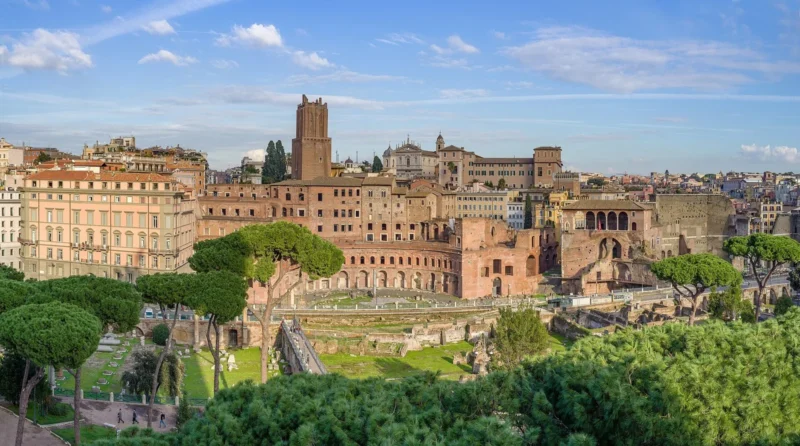
The structure is read from the bottom up. At the level of the Forum opens the Great Hemicycle, the curved facade on three floors that everyone photographs from the street, closed at its ends by two end halls. Beside it, the Small Hemicycle repeats the scheme on a smaller scale, with rooms on three floors. Halfway up runs Via Biberatica with its tabernae, the vaulted rooms with doorways opening onto the street. Above that extends the Central Body, with shops at street level and three floors of stacked rooms. At the top is the Great Hall, the enormous space covered by groin vaults, where the entrance to the Imperial Forums Museum opens today, with two tiers of rooms overlooking it. Six levels held together by steep, narrow internal stairs, which are Roman as well and still have to be climbed on foot.
Apollodorus of Damascus and the Cutting of the Quirinal
The name that keeps coming up is Apollodorus of Damascus, Trajan's architect, the same man ancient sources link to the bridge over the Danube and to whom scholars attribute the design of the Forum. On the word "attribute," it's worth pausing. For Trajan's Markets there is no signature and no building inscription, and the assignment to Apollodorus is a modern inference, as reasonable as you like but still an inference. Anyone who presents it as a documented fact takes a liberty the sources don't grant.
What is certain, by contrast, is the engineering feat. To build Trajan's Forum, an entire flank of the Quirinal was removed, an enormous volume of earth and rock taken out by hand. Trajan's Markets also came into being as a gigantic retaining work: the wall that holds up what remained of the hill. The Great Hemicycle should be looked at with this in mind. The curve is not a stage-set flourish, it is the shape that best discharges the thrust of the earth. A building and a retaining structure in the same design, the kind of dual solution that sets major Roman engineering apart from ordinary construction.
The Petra Connection: How Much It's Really Worth
Apollodorus came from Damascus, in Roman Syria, a few days' caravan journey from the Nabataean world of Petra. This geography gives rise to a comparison that often appears in print: Trajan's Markets' curved fronts, niches and broken pediments supposedly have something of Nabataean rock architecture, the kind of facades carved into stone. It needs to be said plainly: this is a visual comparison, not a proven thesis, and no ancient source connects the two. Still, comparing the Great Hemicycle with a photograph of the Khazneh remains instructive, because the way it treats a wall as a stage set, with shadow used almost as if it were a building material, is surprisingly similar. It should be taken for what it is: an exercise in looking, not a philological discovery.
The Great Hall of Trajan's Markets
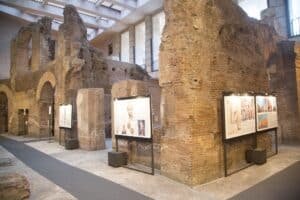
The Great Hall is the space that welcomes visitors, and it is one of the most impressive surviving Roman interiors in the city: a basilica-like space covered by six concrete groin vaults, with two floors of rooms opening onto the central void through piers and openings. The roof spans the entire bay without intermediate supports, and light falls from above along the brick walls. For anyone who walks in expecting a covered market, the first impression already proves them wrong. The quality of construction, the monumentality, and the care in the details speak of a formal public building, not a commercial shed. The museum uses it intelligently, letting it breathe: the reconstructions placed here have air around them, and the ancient architecture remains the star. At the level of the entrance, inside a 17th-century cistern, a collection of amphorae is on display that tells the other side of the ancient economy, that of transport containers. It's a curious aside that many hurry past and that instead deserves two minutes.
The Ancient Stairs, My Favorite Detail
Of all the spaces in Trajan's Markets, the moment I recommend not skipping is the humblest: the internal stairs that connect the levels. They are narrow, steep, in semi-darkness, with worn steps, and they are among the oldest things you can touch during the entire visit to the Imperial Forums Museum. Climbing a flight in silence, without taking photos, gives the building back its original function better than any panel could. For a moment you're no longer a museum visitor, you're a person moving through a working Roman building. 2,000 years of feet have polished that stone, and ours are just the latest in the series.
Why the name "Trajan's Markets" is a misunderstanding
At school, in documentaries and in half of all guidebooks, you read that Trajan's Markets were the shopping center of Ancient Rome, a kind of multi-story department store with 150 shops. It's an effective image, easy to tell, and for decades no serious scholar has backed it. The name is a creation of the twentieth century. It came out of the excavations of the 1920s and 1930s, when the complex was cleared of the houses of the Alessandrino neighborhood, demolished to open Via dell'Impero, today's Via dei Fori Imperiali. Whoever directed that work saw rows of vaulted rooms opening onto a street and a semicircular exedra, and read them as shops: a small room with a threshold on the street, for the archaeology of the time, meant taberna, then shop, then market. The syllogism was quick, and wrong.
What the rooms of Trajan's Markets really were
The prevailing reading today, adopted by the Sovrintendenza Capitolina itself, is administrative: the rooms were most likely offices and archives connected with the administrative and judicial activities carried out in the Imperial Forums, along with service warehouses and seats of public functions linked to managing the area. The Grande Aula is the strongest clue: too monumental, too carefully finished, too expensive for an indoor neighborhood market. And there's an argument from absence that I find more convincing than any reasoning about style: none of the material traces that Roman markets always leave has been found here. No fish stalls, no dedicated drainage system, no guild inscription claiming the place. In Ostia you can recognize a market in five minutes, here, after a century of study, it has never been recognized.
Honesty requires one final step, however: the administrative reading is also an interpretation, however well-established. No inscription says what went on in those rooms, and anyone who describes the function of Trajan's Markets with absolute certainty, one way or the other, goes beyond what the sources allow. The appeal of the place, for those who love real archaeology, is also this: a perfectly preserved building whose intended use we don't know for certain.
Why the name stays, and why it's worth knowing before you go in
The name stays because it won out: it appears on maps, on street signs, in the domain name of the official site, on bus stop signs. The museum itself is officially called in full "Trajan's Markets Museo dei Fori Imperiali," the old name of the container placed alongside the true name of the contents: a compromise by an institution that knows it carries an imprecise label and also knows that changing it would leave half the city lost. It's worth knowing before you go in, and not out of pedantry: it changes how you look. Anyone who goes in looking for shops leaves disappointed, anyone who goes in knowing they're walking through the administrative machinery of an empire sees the same rooms turn into something far more interesting.
The Imperial Forums Museum route, section by section
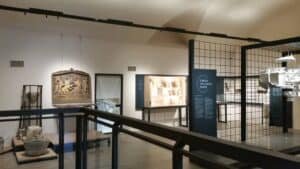
The Imperial Forums Museum, opened in autumn 2007 after the structural restoration of the complex, is dedicated to the architectural and sculptural decoration of the Forums, and its stated purpose is to restore the original view of the buildings. This is where it differs from any other archaeological museum in the city: the fragments are not displayed in cases as standalone finds. They are reassembled in their original relative positions, with restorations and casts, and the reconstructions also rise to full height so that visitors perceive the true spatial relationship, not just the technical data sheet. The official route is organized into eight sections: Introduction to the Imperial Forums, Introduction to the Forum of Trajan, Forum of Caesar section, "Memoria dell'Antico" section, Forum of Augustus section, Forum of Nerva section, Temple of Peace section, Multimedia Room. I'll walk you through them one by one, in the order you meet them.
The introduction in the Grande Aula: the five Forums in one room
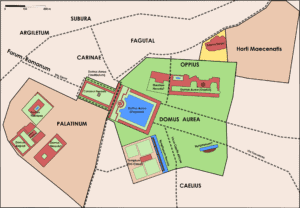
On the ground floor of the Grande Aula, the Imperial Forums Museum opens with a presentation of the entire Forum area: a multimedia setup and a series of rooms devoted to the individual Forums, each symbolized by a particularly significant piece. This is the section not to rush through, because it sets the vocabulary for everything else. The Imperial Forums are five monumental complexes commissioned by emperors, built in topographical continuity with the old Roman Forum and meant to replace it as the religious, political, and administrative center: the Forum of Caesar, the Forum of Augustus, the Temple of Peace, the Forum of Nerva, and the Forum of Trajan. Five colonnaded squares built over 150 years, side by side, each more ambitious than the last. When the Roman Forum was no longer enough, Rome didn't enlarge it: it built five more alongside it, one for each dynasty, and the Imperial Forums Museum is the only place where this urban story is told all together and in order.
The Forum of Caesar section at the Imperial Forums Museum
Upstairs from the Aula, in the rooms facing Via Biberatica, the section dedicated to the Forum of Caesar opens. It is the forerunner of the series. Caesar dedicated it in 46 BC, still unfinished, next to the Curia he was rebuilding: a colonnaded square dominated by the Temple of Venus Genetrix, the goddess from whom the Julian family claimed descent through Aeneas and his son Iulus. It was not just devotion. It was a political manifesto in marble, the proclamation that a man and his gens descended from the gods. The forum was then completed by Augustus and entirely renovated in the Trajanic age, when the fire and the large construction sites around it made a rebuilding necessary. The materials displayed at the Imperial Forums Museum document mainly this second life, with the friezes of acanthus scrolls and the cornices from the Trajanic phase. Standing before these pieces, it's worth remembering that the Temple of Venus was the place where Caesar piled up works of art and votive gifts like a Hellenistic king. The square was small, the ambition wasn't.
The «Memoria dell'Antico» Section: When the Forums Became a Model
Next door, the section «Memoria dell'Antico» is built around sculptures and architectural elements from the Temple of Mars Ultor that artists and treatise writers knew, drew and reproduced as early as the Quattrocento. It is the most subtle section of the Imperial Forums Museum, because it doesn't tell the story of antiquity. It tells the fortune of antiquity, the way these marbles, half-buried and built into houses, continued to teach architecture for centuries. A capital from the Forum of Augustus drawn by a Renaissance architect is no longer just an artifact. It is a link in transmission between Imperial Rome and modern Rome. Anyone who has seen sixteenth-century palaces in the city will find here, with a slight sense of vertigo, the origin of details they believed were Renaissance.
The Forum of Augustus Section: The Hall of the Colossus and the Porticoes
The route continues in the rooms of the Central Body with the richest section of the Imperial Forums Museum, that of the Forum of Augustus. The square was inaugurated in 2 BC around the Temple of Mars Ultor, the Mars «Avenger» that Octavian had vowed with an oath before the battle of Philippi, when he was hunting Caesar's assassins. 40 years passed between the vow and the dedication, and the result was the most ideological of all the forums, an Augustan propaganda manual carved in marble. The rooms display the decoration of the porticoes, the exedrae and the Hall of the Colossus, the space that housed a colossal statue, with original fragments, loans and casts of materials that no longer exist in Rome. In some cases the pieces are known only through the imitations made shortly after for the forums of provincial capitals, and to understand what Rome was like, the museum had to go and study its provincial copies. Among the reconstructions worth stopping for are the relief with Cupids sacrificing bulls in a divergent pattern, a bracketed cornice reassembled piece by piece, and the fragment of a clipeus with the head of Jupiter. That decorative shield from the porticoes appears in every Roman art textbook, yet almost no one knows where the original is. It's here.
The Piece That's Worth the Ticket: The Reassembled Facade of the Porticoes
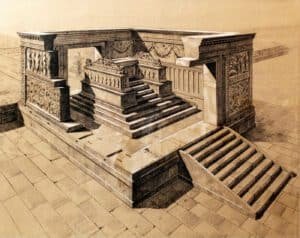
If I could save only one thing from the Imperial Forums Museum, I would save the reconstruction of the architectural order of the facade of the porticoes of the Forum of Augustus, made by combining original fragments and resin casts. The mechanism is understood in a minute, and in that minute the perception of everything else changes. That, before your eyes, is the true height. It's worth stopping, looking at where the entablature ends, and raising your head to the point where it would have continued. The Forum of Augustus was not a square with a few columns. It was an architectural box as tall as a five-story palace, closed at the back by that wall of blocks still visible today from Via dei Fori Imperiali, built to separate the monumental square from the popular neighborhood of the Suburra and its fires. The wall has always been there, in plain view. The museum finally says what it was hiding.
The Temple of Peace Section at the Imperial Forums Museum
The Templum Pacis is the forum that almost nobody mentions, and its section is one of the reasons the Imperial Forums Museum really matters. Vespasian built it after 71 AD with the spoils of the Jewish war, and displayed in it the treasures taken from the Temple of Jerusalem alongside masterpieces of Greek art. More than a political square, it was a large enclosure with gardens, water and exhibition halls, something we would today call a public museum, frequented by those who wanted to see works of art without entering the palaces of power. Ancient sources counted it among the city's marvels. The section displays materials from its decoration and tells its layout, restoring a protagonist that modern topography has almost erased. Of all the Forums, it is the one that has left the fewest visible traces on the surface, and without this room the visitor wouldn't even know to look for it.
The Forum of Nerva Section: Minerva, Arachne and the Colonnacce
The Forum of Nerva, also known as the Transitorio because it occupied the passage between the earlier complexes and connected the Suburra with the Forum area, was begun by Domitian and dedicated by his successor Nerva in 97 AD: a long, narrow square, cleverly carved out of leftover space, with the Temple of Minerva closing it off. The section of the Imperial Forums Museum devoted to it displays its decoration, linked to the frieze that celebrated Minerva and women's crafts, with the myth of Arachne, the weaver who dared to challenge the goddess and paid the price. Two bays of the enclosure wall are still standing along Via dei Fori Imperiali, with the engaged columns that Romans have called the Colonnacce for centuries. After your visit, it's worth walking past them, looking up at the surviving frieze and recognizing what the museum has just explained. It's one of the rare cases where you leave a museum and check the lesson against the monument, 200 meters away, for free.
The Introduction to the Forum of Trajan and the Multimedia Room
The story of the Forum of Trajan, the largest of them all, runs through the dedicated introduction and the Multimedia Room, where animated reconstructions put the monumental sequence back together: the great square with the emperor's equestrian statue, the Basilica Ulpia with its five naves, the libraries, and Trajan's Column with its carved account of the Dacian Wars. It was the plunder from Dacia, today's Romania, that paid for the construction: an entire region of gold turned into marble. The Multimedia Room is also where kids light up again, and the films have a quality that doesn't age. The exhibit's three-dimensional animations bear the signature of Studio Inklink, a detail almost no visitor knows, and one that shows the care that went into designing this museum. From here, and from the outdoor walkways, Trajan's Column can be seen from above: a view that is simply impossible from the sidewalk.

Casts, Reassemblies and the 40,000 Fragments Behind the Scenes
The method of the Imperial Forums Museum deserves a chapter of its own, because it is the real content of the visit. From 1985 to today, in the storerooms that formed in the Forum area after the excavations of the twentieth century, over 40,000 architectural and sculptural fragments have been inventoried and documented, and the museum itself notes that this is only a small percentage of the enormous quantity of marble facing and blocks that decorated the Forums. Every cornice reassembled in the room is the result of years spent comparing profiles, thicknesses and veining across tens of thousands of pieces, with no guarantee that the right fragment still existed. Where the original is missing, a resin cast takes its place, recognizable and declared as such. Where not even a cast exists, a drawing does. This painstaking work is the museum's true collection, more than the individual marbles: when you look at a reassembled entablature, you are seeing, as if through a watermark, the method of architectural archaeology. In its captions the museum insists on a point that overturns received ideas: the decoration was one with the architecture from the design stage on, it was not a facing applied afterward, and color was an integral part of the design, laid not only on the plaster but also on the marble surfaces, pairing polychrome marbles from half the Mediterranean.
Via Biberatica and the Outdoor Paths of the Imperial Forums Museum
The part of the Imperial Forums Museum that stays in everyone's memory is not a room: it is a street. Via Biberatica cuts across the complex on the slope, with the ancient paving still in place, the ruts of the carts, and the thresholds of the tabernae lined up along one side. You walk on it, not behind a barrier: on it. It is one of the very few Roman urban streets that can be walked at its original level, with the ancient buildings lining it on both sides, and it offers the most complete illusion of Ancient Rome that the center can provide. A note on method about the name: the traditional explanation derives it from the Latin biber, drink, in reference to the taverns and inns that supposedly opened onto it. This is the etymology you read on signs and in books, not a fact proven by inscriptions, and like all etymologies based on sound similarity it should be handled with caution. I'll come back to it later, because the story of the taverns has a specific role in keeping the myth of the shopping center alive.
Giardino delle Milizie, the Panoramic Terrace of the Imperial Forums Museum
Higher up, behind the complex, opens Giardino delle Milizie, the green space at the foot of the Tower that serves as the panoramic terrace of the Imperial Forums Museum. From up there, the view clears the rooftops and takes in, in a single frame, Trajan's Column, the area of Trajan's Forum, the axis of Via dei Fori Imperiali and, in the background, the silhouette of the Colosseum: the Forums seen from above, the perspective that does not exist from ground level. From the Giardino and from Via Biberatica, footbridges and easier passages open the external routes onto the monument, with walkways and overlooks that alone justify the extra 20 minutes. A practical note: the high levels are the first to close in case of strong wind or weather alerts, so anyone who cares about the view should go up as soon as possible, without leaving the panorama for the end of the visit. The late afternoon, with the low sun behind the Capitoline, is when this terrace gives its best.
From Castle to Barracks: The Lives of Trajan's Markets
Here is the part that makes the Imperial Forums Museum different from any other Roman archaeological site: the buildings were never abandoned and then rediscovered. They were used without interruption for two millennia, and every era left its mark on the walls. The official presentation sums up the sequence with a formula I find perfect: from a strategic administrative center of the Forums, to a noble residence, to a military fortress, to a convent, to a barracks. Six functions in 20 centuries, within the same bricks.
The Castellum Miliciae and the Torre delle Milizie
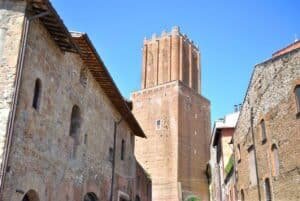
Once the empire declined, noble Roman families took possession of the buildings, divided up their ownership and turned the complex into the mighty castellum Miliciae, an urban fortress that dominated the city. Boniface VIII took possession around 1300, investing money in it without managing to hold on to it for long. In 1312 Emperor Henry VII, who had come to Rome to be crowned at the Lateran, established his headquarters there with the court and the troops, using the Torre delle Milizie, which occupies the loggia of an earlier palatium. For centuries a stubborn legend has circulated about the "tower of Nero," from which the emperor supposedly watched Rome burn. It is a fable, and doubly so. The tower is medieval in every stone, and the fire of 64 predates its construction by more than a millennium. There is also a construction detail few know: between 1200 and 1250 the tower was tall and slender, built entirely of tufelli, small tuff blocks. Between 1250 and 1280 it was lined with a massive brick wall, and that lining gives it the squat profile visible today from half of Rome. The slant that can be seen with the naked eye tells instead of the earthquakes it has survived.
The Hayloft, the 1349 Earthquake and the Palaces That Copied From Here
Meanwhile the Great Hall, badly damaged, was downgraded to a hayloft and took the name Thermae de Paliariis, probably for the straw stored there. The facade of the Central Body on Via Biberatica was rebuilt with makeshift materials and lost its end section: the sign of a ruinous collapse, perhaps linked to the 1349 earthquake and made worse by decades without maintenance. In the views of the 15th and 16th centuries, the Great Hall appears without a facade by then, and the Great Exedra is partly buried. And here the most curious thing in the whole story happens. What remained of the brick decoration of the aedicules ended up inspiring Renaissance treatise writers and architects for the facades of the new noble palaces. The windows framed by pediments on brackets that dot the Historic Center have a recognizable ancestor in this 2nd-century brick wall, then half buried inside a working-class neighborhood. Architects came here to draw, the way one goes to a library, and half of Renaissance Rome copied, knowingly, from an ancient administrative building.
The Convent of Saint Catherine of Siena and the Goffredo Mameli Barracks
In 1574, at the wish of Pope Pius V Ghisleri, the area was assigned to the convent of Saint Catherine of Siena, with the design initially entrusted to the architect Sallustio Peruzzi, son of the more famous Baldassarre. The convent structures radically transformed the ancient buildings, upending their spatial organization and internal connections, and for three centuries the Great Hall and the Central Body lived as a cloistered monastery. At the beginning of the 19th century, during the Napoleonic occupation, the first excavations were planned in the area of the Basilica Ulpia, carried out later under Pope Pius VII. The southern end of the Great Exedra was also investigated, bringing to light the paved road that separated Trajan's Markets from the Forum. After Italian unification, in 1885, the convent was removed to make way for the "Goffredo Mameli" barracks. In the same building, within a few years, the nuns' cells became soldiers' dormitories. Few buildings anywhere can tell such a history without ever having shut down.
The Excavations of Corrado Ricci and the Restoration That Made the Museum
Between 1926 and 1934, as part of the excavation project for the Imperial Forums wanted by senator and archaeologist Corrado Ricci, the uncovering and isolation work erased almost all the later additions to antiquity in order to bring Roman architecture back to light. It is the intervention that gave the complex its current face, with its enormous merits and its misconceptions, including the wrong naming as «mercati». After World War II came abandonment. Via dei Fori Imperiali and via Quattro Novembre became traffic arteries, pollution grew, and the archaeological areas were reduced to backdrops for cars. The turnaround came in the mid-1980s, when funding returned and recovery and refunctioning began with a view to museum use. The major restoration and seismic upgrade site opened in February 2004, described by the Superintendency as the most demanding intervention in the area in 70 years since the Governatorato's works. It concluded with the opening of the Imperial Forums Museum in autumn 2007. This museum arrived late, and precisely for that reason it turned out well. Set up in the 1930s, it would have been a gallery of fragments on pedestals. Opened in the 2000s, it could afford the reconstructions in height, the multimedia, and the discussion of color. Some good fortune takes the form of a delay.

Accessibility and services at the Imperial Forums Museum
A museum inside a six-level Roman building, set against a cut hillside, raises the question of accessibility in serious terms. It should be said that here the answer is among the best of the Rome civic museums, which for a 2nd-century structure is no small compliment. The official site states that the entire upper monumental complex of Trajan's Markets has been adapted for access by people with disabilities. The accessible route works like this: from the Grande Aula, a lift platform and an elevator lead to via Biberatica, to the upper floor of the museum and to Giardino delle Milizie. From there, footbridges and accessible passages open the outdoor routes with the views over the Forums. The museum also provides a wheelchair for people with mobility difficulties. It must be requested at the entrance.
Elevator, notices and the phone call worth making
The whole accessible route depends on the systems, though, and the systems occasionally stop. In summer 2026 a fault kept the elevator out of service for weeks, with a notice posted on the museum's website. When that happens, the museum remains visitable on foot for most of the rooms, but those with walking problems, a stroller, or a bad knee face a real change in level. For this reason the practical advice is twofold: the evening before, check the Avvisi page of mercatiditraiano.it, and if in doubt, call 060608, open every day from 9.00 to 19.00, and ask about the state of the systems that day. Online reviews are no use for this purpose: they describe someone else's day.
The LIS video guide and the tactile tours of Trajan's Markets
Two services deserve a mention that almost no one makes. The first: at the entrance to the Imperial Forums Museum, a screen welcomes visitors with a video guide in LIS, Italian Sign Language, subtitled in Italian, that introduces the very concept of the Imperial Forums. For those accompanying a deaf person, it is real access to the content, not a symbolic gesture. The second: throughout 2026, from January 2 to December 31, the museum schedules two tactile and sensory guided tours with specialized staff, available on request. One is dedicated to the collections («Let's Explore Trajan's Markets with Our Hands: The Museum») and one to the architecture («Let's Explore Trajan's Markets with Our Hands: The Building»). They are booked at 060608, and "on request" should be taken literally: there are no fixed times. You call and arrange it in advance, because there are few specialized staff.
Cloakroom, bags and visit rules at the Imperial Forums Museum
The cloakroom exists, it is free, included in the ticket and self-service, and it really is needed. Bulky bags and backpacks may not be taken on the visit, and neither may umbrellas. Eating, drinking and smoking are not allowed inside. As for dogs, the services regulations bar pets from entry, with the exception of small dogs in a carrier, without prejudice to the rules on guide dogs: a small dog closed inside a bag gets in, a dog on a leash does not. Considering that part of the route is outdoors, an umbrella left at the cloakroom on an uncertain day becomes an awkward paradox. The solution is to dress with a hood and forget the umbrella at your hotel.
Video Guide, Guided Tours and Digital Museum of the Imperial Forums Museum
The video guide costs €6.00 and the audio guide costs €4.00. Both can be rented at the cash desk, both cover the permanent exhibition, and both are available in five languages. There are also paid guided tours that require a booking, and an official museum app that can be downloaded for iOS and Android. My recommendation is clear: the video guide, no hesitation. In a museum built on reconstructions, seeing the whole piece on screen while you have the fragment in front of you is exactly the point of the visit. The audio guide tells the story, the video guide rebuilds the object, and those two euros of difference are the best money you'll spend all day. I'll make one exception for patient readers: the panels at the Imperial Forums Museum are carefully written, and if you like to read at your own pace, you can walk through on your own without feeling abandoned.
The virtual tour of the Imperial Forums Museum, to watch the night before
A service that almost no one takes advantage of: the museum has been digitized with Google Arts and Culture technology and offers a virtual tour, which you can reach from Museo digitale section of the official website. 10 minutes of exploring on screen, the night before, solves the most practical problem of the visit, which isn't tiredness but orientation. The Imperial Forums Museum occupies a six-level building with stairs, ramps and outdoor areas, and anyone who arrives already understanding the layout of the complex gains a good half hour and doesn't miss anything. It sounds like advice for technology enthusiasts, but it's actually the most practical of all.
aMICi Tours at the Imperial Forums Museum
aMICi is the program of tours reserved for MIC card holders: free appointments led by the archaeologists and officials of the museum, that is, by the people who work with those storerooms and those rooms every day. These aren't scripted commercial tours: you might hear a piece described by the person who inventoried it. The Imperial Forums Museum calendar periodically offers appointments dedicated to individual parts of the complex, such as the Grande Emiciclo, the section directly connected to Trajan's Forum and modeled on the exedra of its eastern portico. Anyone who holds the €5 MIC card is holding, above all, this: a subscription to expert-led tours that nine out of 10 Romans never book. Places are limited and sell out, and bookings are made through 060608.
Groups, schools and advance sales at the Imperial Forums Museum
It's worth knowing the official rules beforehand, because at the cash desk they save time and arguments. For groups, the range is 11 to 25 people plus the guide. The booking is free, it's made by calling 060608, and it requires prepayment for at least five tickets. Individual visitors can't book by phone: if you want to guarantee entry, buy online in advance, with a surcharge of €1.00. For schools, booking is mandatory and free, and entry to the Imperial Forums Museum is free when you present a named list on school letterhead, signed by the school principal, with one free accompanying person for every 10 students. The letterhead must be the real one and signed, because they really do check it at the cash desk.
About advance sales, here are two warnings from someone who has seen many other people's bookings go wrong. First: tickets bought in advance online or through 060608 are neither refundable nor changeable, so if your travel plans are up in the air, you're better off buying at the cash desk on the day, since the line here isn't like the one at the Colosseum, and on the worst days it clears in five minutes. Second, on the positive side: you don't need to print anything, the digital receipt on your phone is enough, and with a booking you skip the line at the ticket office. On the first Sundays of the month and during exhibitions, that one euro of advance sale is money well spent.
A curiosity about the Imperial Forums Museum at Trajan's Markets
The Imperial Forums were colorful. Not vaguely colorful: really colorful, with yellow, purple, green and red marbles quarried from across the Mediterranean and placed side by side on purpose for contrast. The museum itself states this in its captions, explaining that the decoration was part of the architecture from the design stage on, and that color was applied not only to the plasterwork but also to the marble surfaces, with the systematic use of polychrome marbles. The giallo antico from Numidia, the pavonazzetto from Phrygia with its purple veining, the portasanta, the green cipollino from Euboea: the names you read on the labels at the Imperial Forums Museum aren't variations of white, they're solid colors. Seen with today's eyes, the Forum of Augustus was an architecture we would call brazen.
So why did we become convinced that antiquity was white? For two reasons, and neither of them has to do with the Romans. The first is chemistry: polychromy lives on the surface, and the surface is the first thing that 2,000 years of rain, frost and pollution wear away, leaving the marble bare. The second is taste: from the Renaissance onward, and especially in the neoclassical eighteenth century, white became the sign of antiquity's supposed purity, and anyone who found traces of color tended to consider them an anomaly, when they didn't remove them outright. For four centuries the West told itself an antiquity in black and white because it found it more noble. The Imperial Forums Museum is one of the few places in Italy where this story is told to the visitor's face, with the fragments to back it up, instead of being hidden in a footnote. Leaving here and looking at a postcard of the Forums, all white, has a strange effect: it's a sign the visit worked.
Something nobody tells you about the Imperial Forums Museum at Trajan's Markets
The Imperial Forums Museum is small. Not in space, which is enormous, but in the number of original pieces on display, and the exact figure is public even though almost nobody cites it. An Archeomedia article from April 2008, devoted to the museum as the first museum of ancient architecture in the world, reports the numbers of the opening display: 2,078 square meters of exhibition space, 172 original marble fragments, 15 resin casts, 12 reconstructions, four of which are of large architectural elements, three from the Forum of Augustus and one from the Forum of Nerva.
172 originals across 2,000 square meters. The proportion says it all: the Imperial Forums Museum isn't a museum of objects, it's a museum of arguments, where every fragment has its place because it demonstrates something, not because it's beautiful. It's the exact opposite of the logic of the storeroom dumped into display cases, and it's why anyone who enters expecting a traditional archaeological museum is thrown off in the first 20 minutes, then changes their mind halfway through the route. The same article credits the people behind the project: the scientific direction of Lucrezia Ungaro with Anna Maria Cusanno, Antonella Malatesta and Massimo Vitti, the structural restoration by Studio Croci e Associati, the exhibition design by Studio il Laboratorio with Paolo Martellotti, and the 3D animations by Studio Inklink. A necessary note on method: those numbers capture the situation on the 2007 opening day, as reported by a 2008 source. Since then there have been new restorations, revised sections and loans, and the museum doesn't publish an updated count, so anyone who cites those figures as current is using an old photograph without saying so. Take it for what it is: a measure of an idea of what a museum can be, one that stayed intact even where the numbers have changed.
The advice I give you for visiting the Imperial Forums Museum at Trajan's Markets
Wednesday, the last two hours, arriving at 17.30. The economic basis is written in the regulations on free admission and discounts of the Sistema Musei di Roma Capitale, which grants non-residents a 50 percent reduced rate every Wednesday during the last two hours of opening: with closing at 19.30, the window starts at 17.30, and the last entry remains at 18.30. For those who don't live in Rome, that Wednesday halves the ticket.
But the real reason I recommend it isn't the savings: it's the light. The Imperial Forums Museum has outdoor routes, the via Biberatica open to the sky, Giardino delle Milizie up high, and all of it faces south-west, over the Forums. At 18.00 the sun comes in at an angle through the vaults of the Corpo Centrale and sets the brick aglow orange, at 11.00 the same wall is flat and mute. The stones are identical, the visit isn't. I'll add the detail that matters most to anyone traveling: at 17.30 on an ordinary Wednesday the museum is empty. Not quiet: empty. You can end up alone for 10 minutes in the room of the Forum of Augustus, in front of the reassembled facade, in a silence that is a rare luxury in Roman museums. And the first Sunday of the month, which is free? Truly free, and crowded like no other day: if you want to save money, go then, if you want to understand, choose Wednesday. Without qualification: 7.50 euros and the room to yourself beats zero euros and the necks of 20 people between you and the marble. Then everyone manages their own wallet.
Another well-known fact, yet rarely mentioned
The facades of Roman Renaissance palaces were copied from here. The official history of the complex says so, with the ease of something obvious: in the fifteenth and sixteenth centuries, when the Great Hall no longer had its facade and the Great Hemicycle was partly buried, what remained of the brick decoration of the aedicules inspired treatise writers and architects for the facades of the new noble palaces. It's worth pausing on what this means: the windows with a triangular or curved pediment on brackets, the ones that define half of Rome's Historic Center and then three centuries of European architecture, have a recognizable ancestor in a brick wall of an administrative building from the 2nd century, then half-buried inside a popular neighborhood. Architects went there to draw the way one goes to a library, and what they drew ended up on the cardinals' palaces. It is well known to every architectural historian and ignored by almost all tourist guides, for a simple reason: it is a story that doesn't produce a photograph. It does, however, produce a way of looking: once you've heard it, a walk along Via Giulia or through the rione Monti becomes an exercise in recognition.
I'm adding the corollary about Via Biberatica, which I promised a few chapters ago. The traditional etymology from biber, to drink, along with its taverns and inns, is the explanation found on signs and in books, not an epigraphic fact. It makes you suspect that this little story suits those who want to keep alive the idea of a shopping center, because if the street was full of taverns, then the Markets really were markets. The reasoning works, but it works backward: it starts from the conclusion and then goes looking for the premises. Being wary of etymologies that are too useful is good mental hygiene, in Rome more than anywhere else.
The right photo to take at the Imperial Forums Museum at Trajan's Markets
The first photo is taken from Giardino delle Milizie, on the side that looks over the Forums, waiting for the right moment. From up there, all of these fit into a single frame: Trajan's Column below, the area of the Forum of Trajan, the axis of Via dei Fori Imperiali and, in the background, the profile of the Colosseum. It's the shot that nobody can get from street level, because from the ground the Forums are seen from the side and never from above. The right time is late afternoon, with the sun setting behind the Capitoline Hill and stretching shadows across the paving stones. Dawn is not needed here, and midday flattens everything. In winter the good moment arrives around 16.00, and it's a good idea to go in at 15.00 so you don't arrive late for your appointment with the shot.
The second photo, the one I consider the most beautiful and that almost no one takes, is taken indoors: at the far end of Via Biberatica, where the street curves, aiming along the paving with the thresholds of the tabernae lined up on one side. No sky, no famous monuments: an empty Roman street with the shadow of the vaults, which looks like Ostia Antica but is actually breathing just 200 meters from Piazza Venezia. On the rules, precision is a must, because you can read anything online: the official page on permits covers professional filming for publishing or advertising projects, which require permission from the Sovrintendenza Capitolina, with an application submitted to the Ufficio Protocollo at Piazza Lovatelli 35 at least 30 days in advance. On personal photos, flash and tripods, that page says nothing. For a tourist shot with your phone, it's best to ask the staff in the Great Hall, and for a tripod, expect a refusal, because in Rome's civic museums it is almost always turned down for safety reasons.
Some important events that happened here in history
The sequence is worth seeing all in a row, because few buildings in the world can withstand one like it: imperial construction site, baronial castle, headquarters of an emperor, hayloft, cloistered convent, barracks of the Royal Army, museum. At the beginning of the 2nd century, between about 100 and 110, the complex rose alongside the construction site of the Forum of Trajan, inaugurated in 112, cutting away an entire flank of the Quirinal Hill. The brick stamps place construction in the Trajanic period, while the hypothesis that the design began under Domitian is still debated. After the empire fell, baronial families divided up the buildings and made them the castellum Miliciae. Between 1200 and 1250 the Torre delle Milizie rose, tall and thin, built of tufelli, and it was later lined with brick between 1250 and 1280 up to its current silhouette. Around 1300 the complex passed to Boniface VIII, who lost it quickly despite the money invested. In 1312 Henry VII set up the imperial headquarters there, with court and troops.
In the same decades the Great Hall, badly damaged, slides down to the status of a barn under the name Thermae de Paliariis. The collapse of the upper part of the facade on the Biberatica is linked, as a hypothesis, to the earthquake of 1349. In 1574 the nuns arrive. Pope Pius V assigns the area to the convent of Santa Caterina da Siena, first designed by Sallustio Peruzzi. At the start of the nineteenth century, under Napoleonic occupation, the first excavations of the Basilica Ulpia are planned, later carried out under Pius VII, and the southern end of the Great Exedra is freed. In 1885 the convent gives way to the "Goffredo Mameli" barracks. Between 1926 and 1934 the excavations of Corrado Ricci recover the Roman architecture, erasing almost everything else. From February 2004 the restoration with seismic upgrading begins, and it ends with the opening of the Imperial Forums Museum in autumn 2007. The last chapter is very recent. In 2026 the rooms hosted the exhibition dedicated to Constantin Brâncuși, "Le origini dell'Infinito," from February 20 to July 19, marking 150 years since the sculptor's birth. 20 centuries, and the register of uses has never closed.
Who Passed Through the Imperial Forums Museum to Trajan's Markets
We need to distinguish between those documented in this place and those associated with it by deduction. The reader deserves to know which name rests on a source and which on reasoning. Trajan commissioned the Forum and the complex that bears his name. That he went up to these levels during the construction is more than likely, but no ancient source says so. Apollodorus of Damascus is the architect to whom scholars attribute the design. That is a modern attribution, not a signature. Those who certainly passed through, every day and for generations, were the officials of the imperial administration, the men of the records and the distributions whose names we don't know. And that is what I find fairest about this museum, because the rooms you walk through were not built for an emperor but for clerks.
The Middle Ages hand down heavy names. Boniface VIII, the pope of the first Jubilee, owns the complex around 1300. Henry VII of Luxembourg is the only figure whose residence is certain. In 1312, having come down to Rome for his coronation in the Lateran, he sets up his headquarters here with his court and troops, relying on the Torre delle Milizie. For those who have read Dante, I point out the vertigo. Henry VII is the emperor in whom the poet placed every political hope, the one whose seat was already prepared in the Empyrean of Paradise. His Roman command operated within these walls. There is no record, however, that Dante ever came up here, and I won't tell it any differently. The modern age adds Pius V, who assigned the area to the convent of Santa Caterina, the architect Sallustio Peruzzi, son of Baldassarre, author of the first convent project, and Pius VII, under whom the nineteenth-century excavations of the Basilica Ulpia were carried out. As for the Renaissance draftsmen who came to study the brick aedicules, the history of studies records their passage without handing down a list of names. Last in line is Corrado Ricci, senator and archaeologist, the man who between 1926 and 1934 decided what of the complex should remain and what should fall. We owe him the very existence of the Imperial Forums Museum, and we also owe him the wrong name we search for on maps. The two legacies travel together.
How to Fit the Imperial Forums Museum Into Your Day
The location is strategic, and the official presentation claims it. On one side are the Capitoline museum complex and Palazzo delle Esposizioni. On the other is the central archaeological area with the Colosseum, Roman Forum and Palatine. In practice, you can reach everywhere on foot from here. Three possible days, with real timings.
Half a day "understanding the Forums" starting from the Imperial Forums Museum
Entry at 9:30 when it opens, an hour and a half inside, then a walk down Via dei Fori Imperiali with a stop at the Mamertine Prison and finishing at the Colosseum in the early afternoon. The order is the part I care about. First you understand how the buildings were made, with the reconstructions in height in front of your eyes. Then you look at the ruins and finally you can read them. Done the other way around, the route turns the Forums into a field of stones. Unfortunately, almost everyone does it the other way around.
Civic museums day, from the Imperial Forums Museum to the Capitoline Museums
Imperial Forums Museum in the morning, a quick lunch toward Magnanapoli, and the Capitoline Museums in the afternoon, climbing up from the Cordonata. With the MIC card, or with residency in Rome and the Metropolitan City, the whole day costs zero euros in tickets. If you still have energy, add the Crypta Balbi. Or save Centrale Montemartini for a separate afternoon. The site on the Ostiense deserves calm, not a rushed add-on.
"Rome in Vertical" day with the Imperial Forums Museum
Museo dei Fori Imperiali in the morning, then the Domus Romane at Palazzo Valentini, which is practically across the street, and in the afternoon the Basilica of Maxentius and the Palatine Hill for those who booked the archaeological area. You need trained legs, serious shoes and a bottle of water: in a single day you go from the underground rooms of Palazzo Valentini to the height of Giardino delle Milizie, 20 meters of elevation gain and nearly 2,000 years of distance. For small children, it's better to lighten the program and finish at the Circus Maximus, where they can finally run. If you want to save your itinerary and find it again later, use My Trip, so you don't have to start the search from scratch.
Quick Questions About the Imperial Forums Museum at the Trajan's Markets
How much does a ticket to the Imperial Forums Museum cost?
At the regular rate, €15,00 for a full ticket and €9,50 for a reduced one, plus a €1,00 presale fee if you buy one in advance. When an exhibition is running, the combined ticket rises to €19,50 and €14,00 for non-residents. Residents of Rome and the Metropolitan City of Rome get in free by showing an ID.
Is the Colosseum ticket also valid at the Imperial Forums Museum?
No. The Colosseum with the Roman Forum and Palatine Hill belongs to the state circuit, while the Imperial Forums Museum is a civic museum of Roma Capitale: two ticket offices, two rates, two management bodies. No official ticket combines them, and anyone selling a "unique" pass is selling a commercial package.
Are the Imperial Forums Museum and the Trajan's Markets the same thing?
Yes. The full name of the institution is "Trajan's Markets Imperial Forums Museum": the Markets are the building, and the museum is the exhibition setup that occupies it. One entrance, one ticket, one visit. The two separate ticket offices some people look for don't exist.
Is entry free on the first Sunday of the month at the Imperial Forums Museum?
Yes, for everyone, as part of the initiative of the civic museums of Roma Capitale, confirmed month by month with a notice on the museum system's website. In 2026 the event has been repeated regularly, from March 1 to August 2, including Easter Sunday. Before making plans, it's best to check the date on the official calendar.
Do Rome residents really get in for free?
Yes: since February 2026, free admission to the civic museums applies to residents of Roma Capitale and the Metropolitan City of Rome, with ID in hand. The zero-cost ticket still has to be issued at the box office: you can't walk through the gates empty-handed, and knowing this in advance saves you from standing in line twice.
Is the MIC card still worth it?
It costs €5,00, lasts 12 months and gives free access to the civic museum system, with discounts on exhibitions that have separate ticketing. You apply at miccard.roma.it. For residents, after the free admission of 2026, it's mainly useful for the aMICi calendar. For students and people with a domicile, it remains an excellent deal.
Do I need to book for the Imperial Forums Museum?
For an individual visitor, no: you buy at the box office. The online presale ticket for €1,00 lets you skip the line and secure entry on busy days, but it isn't refundable or changeable. Groups of 11 to 25 people can book at 060608, with prepayment for at least 5 tickets.
How long does a visit to the Imperial Forums Museum take?
An hour and a half for a serious visit, two and a half hours if you read everything and stop at Sala Multimediale, plus 20 minutes for Giardino delle Milizie. With last entry at 18:30 and closing at 19:30, arriving at the last minute means seeing half of it.
What is the museum's weekly closing day at the Imperial Forums Museum?
There is no weekly closing day: it's open every day from 9:30 to 19:30. The annual closures are May 1 and December 25. On December 24 and December 31, it closes at 14:00. Extraordinary changes appear on the Notices page of the official website.
Are there any exhibitions running at the Imperial Forums Museum?
At the moment, no: after the closing, on July 19, 2026, of the exhibition dedicated to Constantin Brâncuși, no exhibitions are listed as running or planned on the official pages. The calendar changes, so before your visit it's worth taking a look at the museum's website, especially since the presence of an exhibition changes the rate.
Can you see Trajan's Column from the Imperial Forums Museum?
Yes, and from above, which is how almost nobody sees it: from the external walkways and Giardino delle Milizie, you get a view over the Trajan's Forum and its column. It's one of the reasons to climb to the top instead of stopping at the galleries.
Can you climb the Torre delle Milizie?
The tower is part of the complex and appears in the museum's official communications, such as the closure for bad weather on February 19, 2026. However, the website doesn't publish a clear and stable rule about access to its interior, and I'm not making one up. The up-to-date answer comes from 060608 and the staff of the Grande Aula. Be wary of sites that present the climb to the top as a given.
Is the Imperial Forums Museum wheelchair accessible?
Under normal conditions, yes: a lift platform in the Grande Aula, an elevator, ramps and easier passages, with a wheelchair available on request at the entrance. Since the accessible route depends on the facilities, it's worth checking the Avvisi page or calling 060608 before setting out.
Is the Imperial Forums Museum suitable for children?
From nine or 10 years old on, it works, carried along by the Multimedia Room and the reconstructions. Below that age, the route of rooms, panels and fragments wears them out quickly. With little ones, it's better to pace yourself: one hour inside, then open air, and the Circus Maximus in the afternoon pays off for everyone.
Can you take photographs at the Imperial Forums Museum?
For professional filming for editorial or advertising purposes, you need authorization from the Sovrintendenza Capitolina, to be requested at least 30 days in advance. For personal photos, the official pages don't publish a specific rule. For taking a picture with your phone, it's best to ask staff, and for a tripod, expect a no.
Is there a coat check at the Imperial Forums Museum?
Yes, free of charge, included in the ticket and self-service. Bulky backpacks and umbrellas are not allowed into the visit, and eating, drinking and smoking are not allowed inside. With part of the route outdoors, on a rainy day a hood works better than an umbrella.
Is there a bar inside the Imperial Forums Museum?
The official services page lists the coat check, publications, guided tours by reservation and assistance in the rooms, and it does not mention a café. Lacking a certain fact, I don't take it for granted in either direction. The practical solution is outside: 100 meters toward largo Magnanapoli or along via Quattro Novembre, bars are not in short supply, at neighborhood prices and not museum prices.
What's the difference between the Imperial Forums Museum and the Forums archaeological area?
The museum occupies Trajan's Markets. You pay to enter and visit it along an internal and external route. The Imperial Forums archaeological area is the set of excavations along the road, which you can look at for free from the balustrades and which can only be visited on dedicated routes and at dedicated opening times. Two different systems, and mixing up the two is the most common mistake I hear at the entrance.
Does the Imperial Forums Museum close when it rains?
The rooms don't, the external routes can close. There is a documented precedent: on February 19, 2026, due to a weather alert and by order of the Mayor, the Torre delle Milizie was closed to the public. With wind or heavy rain, expect to lose the high levels, meaning the views, while the indoor exhibition remains open to visitors.
What to see near the Imperial Forums Museum?
Within a 10-minute walk: the Domus Romane di Palazzo Valentini across from the entrance, the Altar of the Fatherland and the Capitoline Hill toward piazza Venezia, the Cordonata that climbs to the Capitoline Museums, and the descent of via dei Fori Imperiali toward the Basilica of Maxentius and the Colosseum. The other listings are collected on the page on Rome museums.
One last thought. The Imperial Forums Museum is not spectacular at first glance. It doesn't have the room that draws a "wow" from the threshold, and anyone looking for that will stay lukewarm for the first 20 minutes. It becomes spectacular halfway through, at the exact moment you realize you're walking inside a 2nd-century building that has been a castle, a convent and a barracks, while someone inside has put back together, piece by piece, the facade of a forum that no longer exists. At that point, the visit changes pace on its own. The final tip is all here: a Wednesday, at 17.30, a good hour and a half ahead of you, your phone in your pocket until the terrace. The place does the rest.
Article written by the editorial team of TourLeaderPro, contact them for Tours and Private/Corporate/V.I.P. Experiences.
Planning a trip to Rome? The English-language guides for visiting the city are on ItalyPlanner.com.
Contact Information
Nearby
 Trajan’s Markets – Imperial Forums Museum100 m
- Leaning Tower of Rome100 m
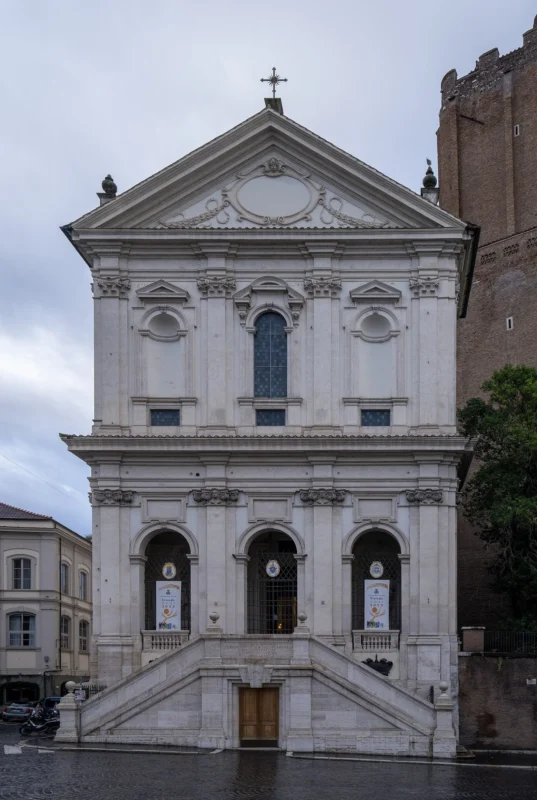
- Santa Caterina da Siena a Magnanapoli100 m
- Trajan’s Column100 m
- Trajan’s Forum100 m
- The Two Churches of Trajan’s Forum100 m



Upcoming events nearby
- FOROF Experience at FOROF, November 7, 2026 to July 18, 2027100 m
- Manifesto 2026, day 2: Blak Saagan and Laura Agnusdei at Chiesa Valdese, November 27, 2026100 m
- Rome and Of The Wand and The Moon at the Waldensian Church: Saturday, March 27, 2027100 m
- Rome Marathon 2027, Run Rome The Marathon, Sunday, March 14200 m