Forum Boarium
In short. Address: Piazza della Bocca della Verità, in Rome, between the Tiber and the Circus Maximus, with the Sacred Area of Sant'Omobono opening on the opposite side of the roadway, entrance from Via Petroselli, gate next to number 45.
Address: Piazza della Bocca della Verità, in Rome, between the Tiber and the Circus Maximus, with the Sacred Area of Sant'Omobono opening on the opposite side of the roadway, entrance from Via Petroselli, gate next to number 45. The useful metro stop is Circo Massimo, Line B, five minutes on foot going down the valley. The surface lines given as references for the square are the 44, 83, 170, 716 and 781, but in the center detours are frequent, so it's worth checking the route on the day itself. Looking at the monuments costs nothing: the square is public, open 24 hours a day, with no fence and no ticket office. Going inside is another matter. The Temple of Portunus is accessible only during special openings and events. For the round Temple, visits are suspended for works to restore the area. The Sacred Area of Sant'Omobono, managed by the Sovrintendenza Capitolina, has free entry but is visited only in guided groups of no more than 15 people, with mandatory reservation at 060608 every day from 9.00 to 19.00, and it is closed on Mondays. The Capitoline portal lists it as temporarily closed for works and visible from outside. Before setting out, a phone call to 060608 saves a wasted trip.
It's worth making clear right away what you're buying with your time. Within 200 meters across the square, two Republican temples still stand in a row, along with a late-antique four-way arch, a Severan arch from 204 AD wedged into the side of an early medieval church, a basilica with the most beautiful Romanesque bell tower in the rione, and the Mouth of Truth under the portico. Under the asphalt runs the Cloaca Maxima. Beneath the church of Sant'Omobono lies the oldest archaeological sequence ever excavated in Rome. It is a density of this kind that, in the city, you find only here and in the valley of the Forums. The difference is that there you pay for a ticket and here you don't.
If you want to place this area within a wider tour, the general picture of the city is on the page about tourist attractions in Rome, which gathers the main monuments and helps you understand where the Forum Boarium fits relative to the rest.
What you can see today at the Forum Boarium, monument by monument
Anyone who arrives here expecting a fenced archaeological area, with a ticket office and a marked route, is caught off guard. The Forum Boarium is a lively square, crossed by traffic, with cars circling the flower beds and the line of tourists stretching under the portico of Santa Maria in Cosmedin. The monuments stand inside the square, some on earth embankments raised above the road level, and they are seen from the sidewalk or the grass. This makes them, paradoxically, less visited than they deserve. Without a gate, nobody thinks there's something to see.
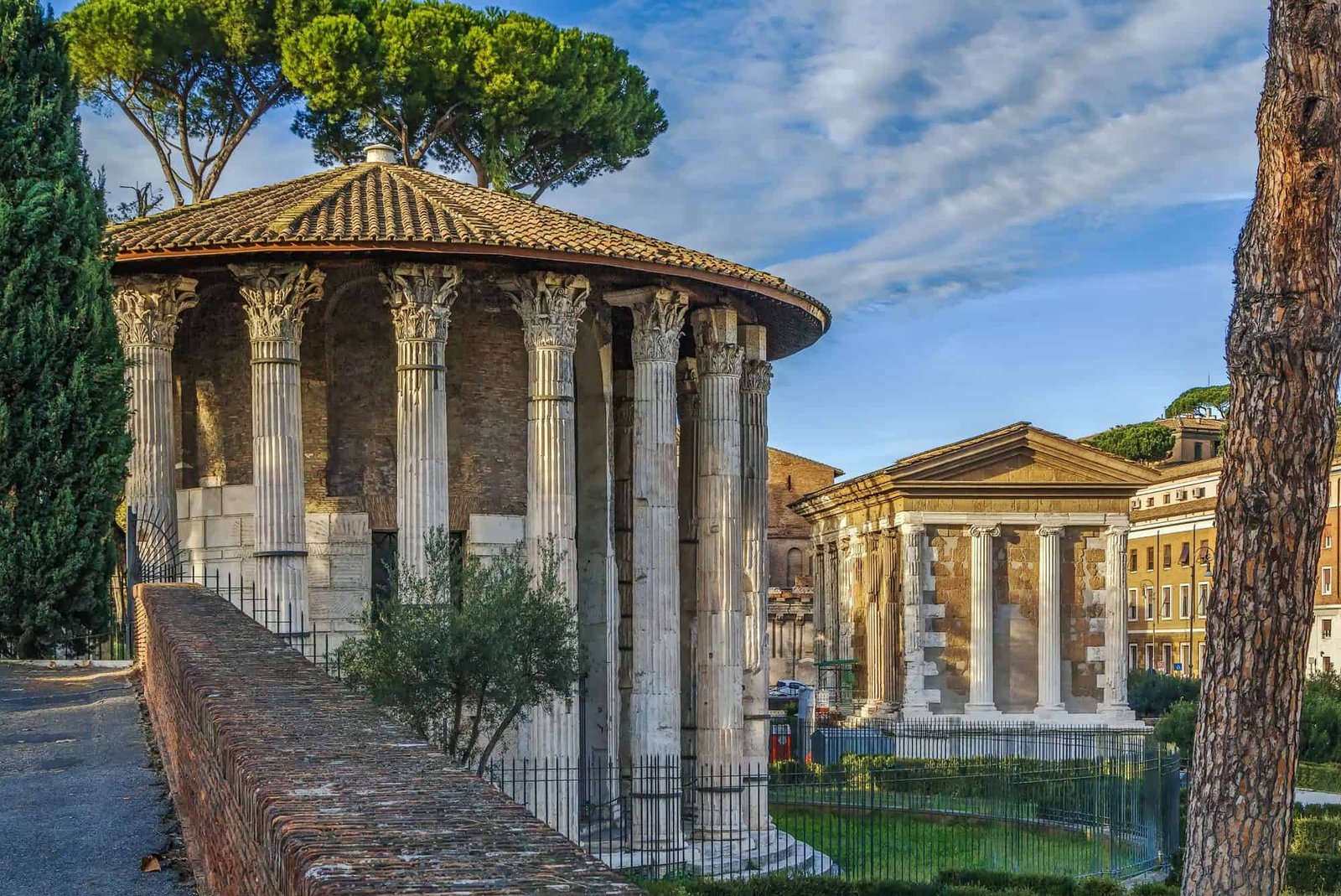
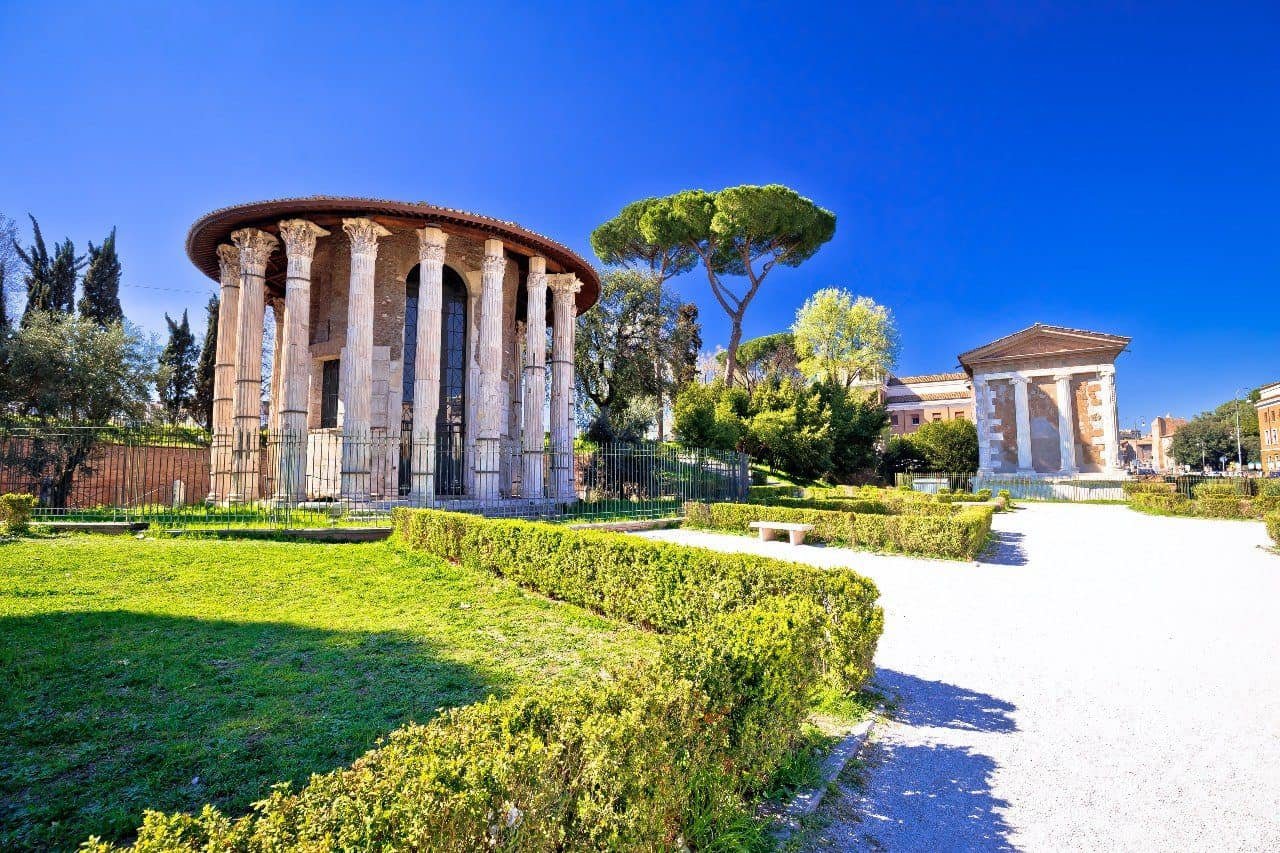
The list, going from south to north, is this. The Temple of Portunus, rectangular and Ionic, with four columns on the front and half columns attached to the wall of the cella: the best-preserved building in the entire complex. The round Temple, monopteral, with 20 fluted Corinthian columns in marble, the oldest surviving marble building in the city. The four-way arch that everyone calls the Arch of Janus, a late-antique tetrapylon built with reused marbles. The Arch of the Argentarii, leaning against the flank of the church of San Giorgio in Velabro, with its eastern pillar literally swallowed by the church masonry. The basilica of Santa Maria in Cosmedin with its seven-story bell tower and the mask of the Mouth of Truth in the portico. Beyond Via Petroselli, the Sacred Area of Sant'Omobono, a rectangle excavated below street level with a Renaissance church sitting in the middle.
In our view the Forum Boarium is the most underrated spot in Rome's historic center, and it is so for a fairly plain reason. There is no threshold. There's no turnstile telling the visitor "now the visit begins," so the visitor never begins. They walk past, photograph the Mouth of Truth, and move on. You miss the first marble building in the capital, an intact Republican temple with early medieval painting inside and the stratigraphy that tells the story of the city's birth. Five extra minutes of attention here are worth more than an hour of queuing elsewhere.
Who manages what at the Forum Boarium
A detail that sounds bureaucratic but actually helps you plan the day: the monuments in the square don't all have the same owner. The two Republican temples and the arches are under state jurisdiction, entrusted to the Soprintendenza Speciale di Roma. The sacred area of Sant'Omobono belongs to Roma Capitale and is managed by the Sovrintendenza Capitolina, with its own booking number and its own calendar. Santa Maria in Cosmedin is a basilica run by the Greek-Melkites and follows worship hours, not museum hours. San Giorgio in Velabro is entrusted to the Crociferi community. Four different bodies, four different calendars, no combined ticket. It's the same fragmentation that separates the Colosseum and the Palatine, both state-run, from the Circus Maximus, which belongs to the city, with only 200 meters between them.
The Temple of Portunus, the best-preserved monument in the Forum Boarium
If you only look at one thing in the Forum Boarium, look at this one. The Temple of Portunus is a Republican building that has survived with its podium, staircase, pronaos, colonnade and cella walls: a completeness that very few other ancient buildings in Rome have. It isn't large, and it doesn't try to be. It's a medium-sized urban temple, built to be seen at a three-quarter angle by those arriving from the river, and its elegance lies entirely in its proportions.
The right name of the Ionic temple in the Forum Boarium
For centuries the building was called the Temple of Fortuna Virilis. That name was an antiquarian conjecture, not a fact, and twentieth-century research dismantled it: the correct identification is with the Temple of Portunus, the god who presided over river ports, recorded by Marcus Terentius Varro. The identification dates to the 1920s, and since then it has been the name accepted by the heritage authorities.
There's a logic to it that becomes clear when you look around. We are at the portus Tiberinus, the river landing of the archaic city, the point where goods coming up from the mouth of the river were unloaded. The god of the port has his temple at the port. The Fortuna Virilis, if anything, had a different address. The old name still survives on several guidebooks and on some signs, and you can hear colleagues who haven't updated their notes pronounce it with confidence. Anyone reading this now knows how things really stand, and can gently correct it.
The date of the Temple of Portunus: what the foundations tell us
The date of the building you see today rests on the materials found in its foundations and points to 80-70 BC, that is, the Sullan age, the full late Republic. It's solid data, not a stylistic impression. Underneath, however, there was already an older temple, dating between the late fourth and early third century BC, of which traces remain in the lower structures. During the third century BC the building was connected to the Ponte Emilio by a masonry link, and around the first half of the second century BC it underwent significant changes.
Some tourist listings continue to present the ancient date as the date of the visible monument, mixing up the phases. The careful and correct way to put it is this: the temple as a religious institution was born between the fourth and third centuries BC, while the building you photograph today dates to the first century BC. Anyone telling a group about the monument should say exactly that, because the difference between the two is two and a half centuries of Roman history.
The embankment, the river and the ancient level of the Forum Boarium
The temple stands on the large embankment built starting in the second century BC to regulate the banks of the Tiber, a project connected to the ancient river port. This information, which sounds technical, is the key to understanding the whole square. The level we walk on is not the ancient level: between the archaic level and the modern one there are meters of landfill, alluvial deposits, rubble and deliberate fill. That's why at Sant'Omobono, just a few dozen meters further on, reaching the sixth-century BC phase required digging deep.
Looking at the podium of the Temple of Portunus and remembering that its original floor is lower than you'd imagine is the mental exercise that makes the Forum Boarium readable. The ancient city, here, is under the feet of anyone searching for it with their eyes.
How the Ionic temple in the Forum Boarium is built: order and pseudoperipteral plan
The Temple of Portunus is tetrastyle, meaning it has four columns on the front, and it is in the Ionic order. The plan is pseudoperipteral: the colonnade, instead of running freely all around the cella as in Greek peripteral temples, continues along the flanks and at the back in the form of half-columns attached to the wall. The optical effect is that of a temple surrounded by columns, the structural reality is a wider and more economical cella.
Along the long sides, five half-columns run on each side, and four along the back. The pronaos is two columns deep. The podium is high and you climb it by a frontal staircase, following the Italic scheme that favors the front and the direction of access, the opposite of Greek centrality. It's a building that shows, through its plan alone, how much Rome had absorbed Hellenistic grammar and bent it to its own ritual habits.
Travertine, tuff and stucco: the materials of the Temple of Portunus
The columns of the pronaos and those placed at the corners of the cella are in travertine. All the others are in Aniene tuff. It's no whim. Travertine costs more and holds up better, and it goes where the load is heaviest and where the eye arrives first. The rest is built with local stone.
The trick, however, was something else. The entire building was covered in stucco, now lost almost everywhere, which unified tuff and travertine into a white, smooth surface that imitated marble. The temple that appears gray and porous today, with the two materials showing like a darn, was originally white and uniform. It's worth remembering. What we call "ancient beauty" is often the skeleton of a building that was meant to be a continuous, luminous surface. Ruins have a charm the ancients never anticipated.
The church inside the temple: from Santa Maria Secundicerii to Santa Maria Egiziaca
The reason this temple is still standing has a specific name: the Church. In the early Middle Ages the building was consecrated to Christian worship and dedicated to the Virgin, taking the title Santa Maria in Secundicerio, or Secundicerii, after Stefano Stefaneschi, a judge and secundicerius of the papal court to whom the structure was entrusted. The sources waver between the eighth and ninth centuries for the date of the transition, and the question remains open among scholars. On the fact itself, there is no doubt.
In 1492 the title Santa Maria in Secundicerio no longer appears, and in its place Santa Maria Egiziaca emerges, named for the penitent saint whom Roman popular devotion had chosen as patron of lost women. Under that title the church goes through the whole modern age, serving for a period also the city's Armenian community. Walls built up between the columns, windows opened in the cella, an altar at the back. The pagan temple survives because it becomes something else. It's the general rule of conservation in Rome, and here you can read it with the naked eye.
The return to antiquity and the early medieval frescoes
In the early twentieth century the church was deconsecrated, and work began to restore the building's ancient appearance under the direction of Antonio Munoz, the architect who in those same years redesigned half of Rome's historic center in the name of a return to the Middle Ages and antiquity. The sources place the intervention between 1916 and the 1920s, depending on whether one considers the deconsecration or the restoration site.
During that work, an important cycle of early medieval frescoes came to light on the interior walls of the cella. It's the detail that makes the Temple of Portunus an almost unique case: inside a Republican building there survives painting from the early Middle Ages, preserved because it was protected by its ecclesiastical function. A temple from the first century BC houses Christian images a thousand years later, and it keeps them precisely because it has stopped being a temple.
How the Temple of Portunus is visited today
The interior is not open on a regular basis. Access is only possible during special openings and events, and when it happens the wait is worth it, because entering a Republican temple preserved in its original forms is an opportunity you can count on one hand in Italy. The rest of the year the building is viewed from outside, and it should be said that from outside you can see almost everything: the podium, the staircase, the colonnade, the wall of the cella.
The practical tip: walk around the building counterclockwise, starting from the front and stopping at the southwest corner, where the transition between the free columns of the pronaos and the engaged half-columns reads best. From there the pseudoperipteral plan makes sense without any explanation, and the photo comes out with the afternoon light behind you.
The Round Temple of the Forum Boarium, the oldest marble building in Rome
A few meters from the Temple of Portunus, on the same lawn, stands a small circular temple with 20 columns. It has a quality no other building in the city can claim: it is the oldest marble building in Rome among those still standing. Not one of the oldest. The oldest. Those who pass it on a scooter don't even suspect it.
20 columns, a roof that isn't the original one
The plan is circular, with a peristyle of 20 fluted columns with Corinthian capitals running around a cylindrical cella. The overall diameter is about 14.80 meters, and the columns exceed 10.5 meters in height. The material of the original construction is Pentelic marble, that is, Greek marble brought from Attica: a huge investment for Rome at the end of the second century BC, when Italian marble from Luni had not yet entered industrial-scale production.
The conical roof seen today is not ancient. It is a restoration covering, needed to protect the structures. The original entablature is lost. This explains the feeling many have, and few can account for, that the little temple looks unfinished or "squat": the element that gave it upward thrust is missing. Whoever wants to picture it as it was should mentally add a tall marble entablature above the capitals and a lower, more elegant roof.
Who paid for it: an olive oil merchant and the guild of the olearii
The story of who commissioned it is the most Roman story you could tell. The temple was commissioned by Marco Ottavio Erennio, an olive oil merchant, who toward the end of the 2nd century BC dedicated a tenth of his earnings to Hercules as a hero and protector god of the guild of the olearii. So a private citizen, not the Senate, not a victorious general: a merchant who sets aside 10 percent of his profits and uses them to build the city its first entirely marble building.
Sources disagree about the man's origins, Roman for some, from Tibur for others, but the core of the story doesn't change. It is private money buying public standing in a commercial square, 21 centuries ago, with a gesture that is at the same time devotion and advertising. Anyone unloading amphorae of oil at the port could see who was in charge of the trade. Besides, paying a tithe to Hercules was a very old custom in this very square: the god guaranteed fair trade and in exchange took his share of the profits.
The Hercules Olivarius inscription and the sculptor Scopas Minor
For centuries the building was called the Temple of Vesta, for the sole reason that it is round like the one in the Roman Forum. The mistake was cleared up thanks to an inscription that names Hercules Olivarius, that is, Hercules of the Olive Trees, and that also records the author of the cult statue: the Greek artist known as Scopas Minor, active in the 2nd century BC and not to be confused with the namesake sculptor from Paros of the 4th century.
The temple, then, belongs to Hercules. The statue is gone, but knowing that a Greek carved it for a Roman merchant, inside a building designed with Hellenistic criteria and built with Attic marble, says everything about Rome of that generation: a city that bought skills, materials and prestige in bulk from the Greek world, and reassembled them its own way.
Hermodoros of Salamis and Greek architecture in the Forum Boarium
Scholars attribute the design to a Greek architect, in all likelihood Hermodoros of Salamis, the same architect to whom other Roman building sites of the period are attributed. The attribution is a reasoned hypothesis, not an archival fact, and it should be presented as such: no inscription names him as the designer of this building.
What is certain, by contrast, is the documentary value of the monument: it shows how much and how Greek culture contributed to the formation of the Roman world. A round peripteral temple is a Greek type. The marble is Greek. The sculptor is Greek. The patron is an Italic shopkeeper who got rich. The result is 100 percent Roman. Half the history of Western art is built on this step, and you can observe it for free from a sidewalk, with buses passing by.
The ancient restoration: Tiberius, the flood and the marble of Luni
The temple was restored in the imperial age, under Tiberius, in all likelihood after the flood of AD 15, one of the Tiber floods that the annalistic sources record as ruinous. In the work, 11 columns and nine capitals were replaced with Apuan marble from Luni, the white Italian marble that had in the meantime become the standard for imperial construction.
Here is an exercise I recommend to anyone with 10 minutes and a bit of patience: walk around the little temple looking at the color and grain of the columns. Pentelic and Luni marble are not identical, and with the right light the difference can be seen. In practice, you're looking at the scar of a flood 2,000 years ago.
Santo Stefano, Santa Maria del Sole and the survival of the Round Temple
This building also owes its survival to Christian reuse. No records of use appear after antiquity until the 12th century, when the temple is dedicated to Saint Stephen by the Savelli family. The proposed dates range between 1132 and 1140, and popular tradition attached the name Santo Stefano delle Carrozze to it. Later the church was renamed Santa Maria del Sole, with dates that the sources place between the 16th and 17th centuries, because of a Marian image that, according to legend, was fished out of the Tiber surrounded by a ray of sunlight.
In the 1800s, the work of Giuseppe Valadier gradually freed the monument from ecclesiastical additions, restoring the circular form we see today. The temple has therefore lived three lives: a sanctuary of a merchants' guild, a Marian church, an archaeological monument. Those who look at it today see the third, but the second is the one that preserved it.
Why the Round Temple is not the Temple of Vesta
I'll repeat it because it is the most common mistake of all about this square, and because it keeps circulating in printed materials. The Temple of Vesta is in the Roman Forum, next to the House of the Vestals, and it is a different building with a different story. The small round temple in the Forum Boarium belongs to Hercules. The confusion comes from a shared shape and from a scholarly tradition that has run through centuries of vedute painting and guidebooks: Piranesi engraved it calling it the Temple of Vesta, and from there the name spread everywhere.
The point isn't pedantry. Calling it the Temple of Vesta means losing all the interesting history: the olive merchant, the tithe, the guild, the Greek marble, the sculptor. Calling it the Temple of Hercules means understanding why it stands exactly at this spot, 200 meters from the Ara Maxima, where according to myth the hero brought Geryon's cattle.
The Ara Maxima of Hercules, the real religious center of the Forum Boarium
Before the marble temples, before the arches, before the churches, the Forum Boarium had an altar. It was called Ara Maxima Herculis Invicti and was the oldest and most revered sanctuary in the area, with a presence dating back to the proto-urban period, before the 8th century BC, when Phoenician, Greek and Etruscan merchants landed in this bend of the river.
Hercules, Cacus and Geryon's cattle at the Forum Boarium
Everyone knows the legend halfway. Hercules, returning from the far west with the herd stolen from the monster Geryon, stops to rest along the Tiber. Cacus, a monstrous creature who lived in a cave on the Aventine, steals part of the cattle, dragging them by the tail so that the tracks point the wrong way. The hero finds out, kills the thief and, as an expression of gratitude, founds an altar on the spot where the revenge was carried out.
The historical reading that scholars propose is more interesting than the story. At the origin there would be a local deity tied to trade and to the protection of caravans, assimilated to the Phoenician Melqart and later identified with the Greek Heracles and then with the Latin Hercules. The presence of a Herculean cult in a river port is not an isolated case in the ancient Mediterranean. Where merchants arrive from far away, there is a need for a god who guarantees agreements between foreigners. The myth of Cacus is the narrative version of an economic function.
The tithe, agreements and the altar's rule
The relationship between Hercules and the merchants of the Forum Boarium rested on a precise religious contract: the tithe. Whoever concluded a fortunate deal dedicated 10 percent of the profit to the altar, in money or in banquets offered to the community. The god guaranteed the honesty of transactions and took his share. Marcus Octavius Herennius, four or five centuries later, does nothing but carry that custom to its extreme: he builds an entire temple out of the tithe.
The cult of the Ara Maxima was tied to particular ritual rules, including the tradition that women were excluded from sacrifices, and the ancient management entrusted to the families of the Potitii and the Pinarii, later transferred to public priests. These are elements that ancient sources report and that scholars have debated for two centuries. They should be presented as literary tradition, not as chronicle.
Where the remains of the Ara Maxima of the Forum Boarium are
This is where the Forum Boarium shows its nature as layered history. The core of tufa blocks recognized as the foundation of the Ara Maxima lies beneath and inside the basilica of Santa Maria in Cosmedin. Pope Adrian I, expanding the church in 782, used that mass of stone as a base, carving a crypt into it. The tufa is still visible at the back of the building.
Put another way, the basilica isn't there by chance. It stands above the city's oldest altar, and building a Marian church over the altar of Hercules is a perfectly deliberate act of religious substitution. Anyone who goes down into the crypt and rests a hand on those blocks is touching the 6th or 5th century BC. The line that forms 30 meters further on, in front of the mask, almost always ignores that it has this under its feet.
Santa Maria in Cosmedin, the basilica of the Forum Boarium
On the east side of the square stretches one of Rome's most intact medieval churches. The diaconia already existed in the 6th century, in a neighborhood inhabited by a sizable Greek community, originally made up mostly of officials. So much so that the original title reads Sancta Maria in Schola Graeca. The first explicit written mention appears under Pope Adrian I, between 772 and 795.
Address: Piazza della Bocca della Verità 18. The daily opening hours listed by the basilica run from 9:30 to 17:50, closed on January 1. The Sunday Divine Liturgy is at 10:30. It is celebrated according to the Greek-Melkite Catholic rite, which means the interior functions as an Eastern church and not a museum: if you enter during a service, behave accordingly. For the full picture, check the page dedicated to Santa Maria in Cosmedin.
The campanile of Santa Maria in Cosmedin, the most beautiful in the Forum Boarium
The Romanesque bell tower is the most beautiful thing in the square, and almost nobody photographs it, because everyone looks down at the mascaron. It was raised in the twelfth century, as part of the works promoted under Pope Callixtus II by the chamberlain Alfano, and it reaches 34 meters and 20 in height, articulated into seven levels divided by cornices with marble corbels. The upper levels open with triple-arched windows on each side, and the oldest bell dates to the thirteenth century, of Pisan workmanship.
If you want the right photo, stand on the opposite sidewalk, toward the round temple, and frame the bell tower with the temple in the foreground: 1,200 years of architectural history in a single shot, without moving more than 10 meters. The late afternoon, when the sun hits the brickwork from the west, is the right time.
The schola cantorum, the Cosmatesque floor and the ciborium
The interior has three naves divided by piers and by ancient columns reused from earlier buildings, topped with Corinthian capitals. The floor is Cosmatesque, in opus sectile of polychrome marbles with mosaic inserts, and belongs mostly to the twelfth-century reconstruction, with older elements in the area of the presbytery.
The schola cantorum occupies the second half of the central nave, bounded by marble screens, and keeps the two ambos: the epistle ambo on the left, of the garden type, in pavonazzetto on a base of Greek marble, the gospel ambo on the right, of the loggia type, in pavonazzetto with inserts of Pyrenean breccia and gray porphyry. Above the high altar rises the Gothic ciborium by Deodato di Cosma, dated 1294, supported by four Corinthian columns, with gold-background mosaics on the front.
A clear opinion: the schola cantorum of Santa Maria in Cosmedin is the place where you understand, better than anywhere else in Rome, how medieval liturgical space worked before the Council of Trent reorganized everything. 10 minutes of silence is worth it, seated at the back, watching how the marble screens divide the roles inside the nave.
The crypt of Adrian I under Santa Maria in Cosmedin
Under the schola cantorum opens the crypt carved in the eighth century into the tufa core of the Ara Maxima. It is a rectangular space with three small aisles, divided by Corinthian colonnettes, with semicircular niches along the side walls originally intended for the reliquaries of saints. Scholars consider it one of the oldest examples of this type of crypt.
Anyone lucky enough to go down notices the quality of the space right away: low, compressed, silent, with ancient stone showing through the masonry. It's not an extra curiosity, it's the physical link between the Rome of Hercules and the Rome of the popes. The natural next step, for anyone who wants to understand the religious stratification of the area, is the page on the Mouth of Truth, which covers the portico and the mascaron.
The Epiphany mosaic and Giovenale's restoration
In the sacristy you'll find a mosaic fragment from the oratory commissioned by Pope John VII in the old basilica of Saint Peter, at the beginning of the eighth century. It depicts the Adoration of the Magi, with an angel standing between the Virgin with the Child and the Magi themselves, and it belongs to the small group of surviving fragments from that lost complex. It is one of the oldest and least visited pieces in the whole square.
The current look of the basilica depends largely on the restoration directed by Giovanni Battista Giovenale at the end of the nineteenth century, completed with the rededication in October 1899. Giovenale demolished the eighteenth-century Rococo facade by Giuseppe Sardi, reopened all the arches of the narthex, removed the barrel vault to bring back into view the twelfth-century frescoes and the single-light windows, and rebuilt the pergula with the screens from the Paschalian age. It was a restoration celebrated for its philological rigor and debated for its criteria of reintegration: like all nineteenth-century restorations, it gave us a Middle Ages a little more medieval than the real one.
The Bocca della Verità and the line you see from the square
The marble mascaron in pavonazzetto that everyone comes to photograph has been placed under the basilica's portico since 1623. About its original purpose, scholars lean toward a sewer manhole cover or an element connected to an ancient hydraulic system, possibly linked to the Cloaca Maxima system itself: in short, a monumental drain cover with the face of a river god.
The legend of the hand bitten by liars is medieval and had a second life on screen in 1953, with the scene in Roman Holiday that made the mascaron one of the most recognizable images in Italy. The line that forms at the portico on high-season days can last over an hour. If time is short, the choice is clear: look at the mascaron from the side, for free, without waiting in line, and spend those 60 minutes inside the basilica and in the crypt, which are worth infinitely more. Nobody says it out loud because the photo with the hand in the mouth is a social ritual, but the ratio of time spent to things seen, there, is the worst in Rome.
San Giorgio in Velabro and the Arch of the Argentarii, the north side of the Forum Boarium
100 meters north of the Temple of Portunus, in a corner most visitors never reach, stands one of the most moving churches in the city. San Giorgio in Velabro began as a diaconia in the early Christian era. The oldest certain record appears in the biography of Pope Zachary, between 741 and 752, which mentions the translation of the head of Saint George to the venerable diaconia in Velabro. The current layout, with three aisles and an apse, dates to the radical intervention promoted under Pope Gregory IV, between 827 and 844.
A crooked floor plan and secondhand columns at the Forum Boarium
The floor plan is strikingly irregular. The hall is trapezoidal, with walls that don't run parallel, almost certainly because the building absorbed existing structures. The aisles are divided by round arches supported by reused Roman columns, in granite and other precious stones, all different from one another in size and material, with capitals that were also salvaged.
This is a church built from the pieces of a dead city, and it doesn't hide that. The charm of San Giorgio in Velabro lies exactly in this noble poverty: bare brick walls, no baroque decoration, low light, the floor sloping slightly down. Anyone who arrives here after the racket of the square notices the change in acoustic temperature within three steps.
The portico, the bell tower and the apse fresco
The portico was built in the 13th century on the initiative of the prior Stefano Di Stella, with four ancient columns with Ionic capitals. Of the original six bays, five remain. The Romanesque bell tower, documented from 1259, rises five stories and rests in part directly on the arch of the Argentari.
In the apse conch is painted a late 13th-century fresco showing Christ between the saints George, Mary, Peter and Sebastian. It is today attributed to Pietro Cavallini and was formerly ascribed to Giotto. The attribution to Cavallini is the one commonly accepted among art historians, and it should be understood as such. It is a stylistic attribution, soundly argued, not a signature. Anyone who knows the Last Judgment at Santa Cecilia in Trastevere will recognize the hand.
The Arco degli Argentari, the bankers' monument at the Forum Boarium
Leaning against the left side of the church is one of the most unusual monuments in Rome. The Arco degli Argentari was erected in 204 AD at the point where the ancient urban road of the vicus Iugarius opened onto the square of the Forum Boarium. It is not a triumphal arch. It is an honorary arch funded by a professional category.
The inscription says so without beating around the bush. The dedicators are the argentarii, that is, the bankers and money changers, and the negotiantes boarii huius loci, the local livestock traders. They dedicated the monument to Septimius Severus and Caracalla, to the caesar Geta, to Julia Domna and to Fulvia Plautilla. The whole reaches 6 meters and 15 in height, and the passage is 3 meters and 30 in width. These are the dimensions of an alley, not of a triumphal way.
The damnatio memoriae carved into the marble
Here you can touch with your own hands one of the most striking phenomena in Roman history. Plautilla, wife of Caracalla, was exiled in 205 and killed in 211. Geta, brother of Caracalla, was murdered in 212. In both cases the damnatio memoriae followed, and their names were chiseled off the inscription while their figures disappeared from the reliefs.
The monument therefore keeps the gaps: deliberate voids, holes in the text, surfaces smoothed where a face once was. Looking at those erasures is more eloquent than any manual on the succession of the Severans. Anyone leading a group in front of the Arco degli Argentari is holding the best Roman example of political erasure carved in stone, and it's worth making the most of it.
The reliefs and the pillar swallowed by the church
The inner and outer surfaces are covered with bas-reliefs: sacrifice scenes with the two rulers facing each other, winged victories, eagles, barbarian prisoners, military insignia, garlands. The quality is not refined, and that is exactly why it is valuable. It is sculpture commissioned by a guild, not by a court, and it tells us how a category of merchants imagined it had to present itself before power.
During the early Middle Ages, the eastern pillar was half absorbed into the masonry of San Giorgio in Velabro. The result is that the arch and the church are today a single building, a Severan monument and an early medieval diaconia welded together. In any other European capital, something like this would have its own fence and its own ticket booth. Here you walk right past it on your way to catch the bus.
The night of July 27, 1993 at the Forum Boarium
Between July 27 and 28, 1993, a car bomb with about 100 kilograms of explosives devastated the portico of San Giorgio in Velabro as part of the bombing campaign of that summer. The portico's columns were pulverized, and the interior suffered serious damage to its structures and frescoes.
The restoration proceeded by anastylosis, recovering and reassembling the original fragments wherever possible, and the church was reopened for worship on July 6, 1996. Anyone who enters today sees a building reassembled piece by piece. It needs to be said clearly: in front of that portico you are facing an event of recent history, not just a medieval monument. It's worth a minute of silence.
Arch of Janus, the quadrifrons of the Forum Boarium
At the northern end of the square rises the large four-sided arch that everyone calls the Arch of Janus, out of a scholarly habit with no basis in ancient sources. The original name, recovered from the inscriptions, seems to have been arcus divi Constantini. Epigraphic fragments kept at the church of San Giorgio have suggested a possible rededication to Constantius II, on the occasion of his victory over Magnentius.
How the Arch of Janus Is Built
It is a tetrapylon, that is, a four-faced arch: four massive piers support a cross vault, opening a passage in every direction. The plan is square, each side measures about 16 meters, and the height is 12 meters. The piers are concrete core faced with reused marble blocks, taken from older monuments: a normal practice in the fourth century, when the city stopped producing new marble and began recycling its own.
The faces are divided by rows of niches meant to hold statues, all empty today. Four deities survive on the keystones. Roma and Minerva can be recognized, with Juno and Ceres proposed for the other two. The building's function was practical before it was celebratory: a covered, shaded passage at the crossing of several roads, for the use of people working at the market who needed to shelter from the sun or rain.
The Frangipane Middle Ages at the Forum Boarium and the Lost Attic
In the Middle Ages the Frangipane family turned the arch into a fortress, as they did with the Colosseum and the Arch of Titus. The structure was raised, crenellated, and integrated into a defensive system that controlled the passage between the river and the Palatine. That addition stood for centuries, and for centuries it was mistaken for part of the ancient building.
In 1827 the attic was demolished as part of the clean-up work on ancient monuments that characterized papal Rome in the nineteenth century. The demolition restored the ancient profile, but it also made the arch squatter than it had ever been: without the attic, the proportion between piers and vault looks squashed. It is one of those cases where a restoration that is correct from a philological standpoint produces a visually less pleasing result, and it's worth knowing this before judging the building with today's eyes.
The Sant'Omobono Sacred Area at the Forum Boarium, the Oldest Excavation in Rome
Once you cross Via Petroselli, you change both administration and era. The Sant'Omobono sacred area is a rectangle open below street level, with a Renaissance church sitting in the middle, which at first glance promises nothing. Beneath that floor, however, is preserved the oldest archaeological sequence ever investigated in Rome.
The 1937 Excavation at the Forum Boarium and the Discovery of the Twin Temples
Excavation work began in 1937 to build a new municipal building on the northern edge of the Forum Boarium, between the vicus Iugarius and the via del Mare, today Via Petroselli. A large platform made of tuff blocks came to light and, above it, the remains of two side-by-side temples from the Republican period, identified on the basis of literary sources with the sanctuaries of Fortuna and Mater Matuta.
Two female deities, one linked to luck and prosperity, the other to dawn and motherhood, with a cult celebrated at the Matralia in June from which slaves were excluded: two twin temples, side by side, inside a single enclosure. The pair is attested by tradition to King Servius Tullius, and it should be presented as ancient tradition, not as excavation evidence.
The Eighth-Century Hut and the Etruscan Inscription
The most extraordinary find came from the wells dug to underpin the church. At depth, a hut from the eighth century BC appeared, that is, from the Rome of the kings or a little later. In the following century, a cult area with altars and remains of animal bones is documented, from which comes a vase fragment with an Etruscan inscription, perhaps the oldest found in Rome.
It's worth pausing for a moment on this point, because it's the kind of detail that changes how you see the city. The oldest Etruscan inscription found in Rome does not come from the Capitoline, does not come from the Palatine, does not come from the Roman Forum. It comes from here, from the port, from the market, from the place where foreigners arrived. The city writes because it trades, not because it governs.
The 580 BC Temple and the Heracles and Athena Group
The monumental transformation of the area takes place around 580 BC with the construction of two temples, only one of which has been found, deep down and at an oblique angle beneath the church's foundations. It is a textbook Etruscan-Italic building: a tall tuff podium, a timber load-bearing structure, mudbrick walls, a single cella with two columns on the front, and the access stairway in the center.
Large terracotta plaques and revetment slabs belong to this building, along with four acroterial volutes that crowned the roof slopes and, above all, a terracotta statue group depicting Heracles and Athena. The group, together with the votive deposit of perfume jars, Greek ceramic cups, bone pendants, amber, and miniature objects, is not kept on site: it is in the Capitoline Museums, in the Palazzo dei Conservatori.
Practical, non-negotiable advice: anyone who visits Sant'Omobono should then climb up to the Capitoline Museums, and anyone who visits the Capitoline Museums should know that those terracottas come from here. It's a 10-minute walk up the climb to Capitoline Hill. Seeing the roof without the temple, or the temple without the roof, cuts both visits in half.
Destructions, raised ground and Hadrianic restorations
At the end of the sixth century BC the temple was systematically destroyed, with a violence that archaeologists read in the collapse layers. A century of abandonment followed. Then the level of the area was artificially raised by almost four meters to rebuild the two twin temples, with an orientation slightly different from the previous one.
After more fires and more destructions, the temples were restored in the Hadrianic period, between 117 and 138 AD. Today only the Temple of Fortuna is fully visible, because the cella of Mater Matuta was most likely reused at the end of the fifth century AD as a Christian place of worship, then remodeled in the Middle Ages with a raised presbytery and Cosmatesque floors. The documents call it San Salvatore in Portico.
From San Salvatore in Portico to Sant'Omobono
In 1482 a new church was built over that one, with the opposite orientation, and in 1575 the building was dedicated to Sant'Omobono, a 12th century merchant from Cremona and patron saint of tailors. Choosing this saint, in a square full of traders, closes the circle in an almost ironic way: from the god of merchants to the saint of merchants, at the same address, after 25 centuries.
How to visit the Sant'Omobono sacred area
The conditions are set by the Capitoline Superintendency and they are particular, so it's worth knowing them clearly. Entry is free. You can only enter in guided groups, with a maximum of 15 people per visit, and booking is mandatory at 060608, every day from 9.00 to 19.00. For individual visitors, individual visits are offered according to a specific schedule, again always with prior booking at the same number. The entrance is from Via Petroselli, through the gate next to number 45, and it's closed on Mondays. At the moment the Capitoline website reports a temporary closure for works, although the site is still visible from outside.
The advice on clothing is not just for show: they ask for low, closed, comfortable shoes with non-slip soles, because the route involves the risk of slipping, bumping into things and falling. You walk among ancient structures at uneven levels, on surfaces that are not level. Anyone who arrives in sandals stays out, and the people who keep them out are right.
The Cloaca Maxima, the work that made the Forum Boarium possible
Without the Cloaca Maxima this square would not exist, because the area was a seasonal marsh squeezed between three hills and the river. The great sewer was built toward the end of the sixth century BC, and tradition credits its start to Tarquinius Priscus. Its primary purpose was not to dispose of waste: it was to drain the water that stagnated between the Forum, the Velabrum and the Forum Boarium, making the center of the emerging city buildable.
The course of the sewer to the Forum Boarium
The conduit starts in the Subura and, passing through the Argiletum, the Roman Forum, the Velabrum and the Forum Boarium, empties into the Tiber. Under the Forum it runs in two parallel galleries, to make up for the lower height available. The materials change according to the periods of work: cappellaccio, tuff, peperino, travertine, opus caementicium. In the accessible stretch near Tor de' Conti the conduit reaches about three meters in height, with its floor 12 meters below the modern street level.
The outlet on the Tiber, still visible today
The ancient outlet is still visible near the remains of Ponte Rotto, close to the Ponte Palatino: an arch with three rings of voussoirs in Gabine stone that opens into the retaining wall, on the hillside side. You have to lean over the parapet of the Tiber embankment road and know where to look, and nobody points it out.
I'll be clear: of all the things you can see for free in this area, the arch of the Cloaca Maxima is the one that gives the most satisfaction to anyone who loves ancient engineering. You're looking at a work from the sixth century BC that kept working for 25 centuries, and that in part still works. Rome was made possible by this, not by the temples.
Venus Cloacina and Agrippa's maintenance
The conduit was protected by its own deity, Cloacina, later identified with Venus, to whom a small circular shrine was dedicated at the point where the sewer entered the Roman Forum, in front of the Basilica Aemilia. A goddess of the sewer is no joke: in Roman religious thinking every vital infrastructure has its own guardian deity, and the drainage network was as vital as the drinking water.
In 33 BC Marcus Vipsanius Agrippa, during his famous aedileship, carried out an inspection and a campaign of drainage and clearing of the work. This is the episode that gave rise to the anecdote of sailing a boat through the sewer, told by ancient sources and repeated by every guide in the city. It should be presented as a story handed down, not as a verified account.
The port and the market: why the Forum Boarium was born here
The name comes from the cattle market, Forum Boarium or Bovarium, and this already defines the character of the place: not a representative district, but the commercial zone of the archaic city. The Forum Boarium occupied the left bank of the Tiber between the Capitoline Hill, the Palatine and the Aventine, with the Circus Maximus to the southeast, the Velabrum to the northeast, the vicus Iugarius to the north at the foot of the Capitoline hill, the river to the west and the slopes of the Aventine to the south.
The portus Tiberinus and the ford of Tiber Island
Next to the market was the portus Tiberinus, the river landing, the first commercial port of the city. Here the routes coming down the Tiber valley converged, and here the trade between Etruria and Campania passed, which originally forded the river at the height of the Tiber Island. From the north, salt from the saltworks at the river mouth came down along Via Salaria, and salt, in an archaic economy, is a currency.
Before the bridge there was the ford. Then, according to tradition, Ancus Marcius had the pons Sublicius built, the wooden bridge, and traffic settled on a fixed point. A ford moves, a bridge doesn't: the market arises around the bridge, and the neighborhood arises around the market. Rome's commercial topography starts from this simple hydraulic fact.
The Forum Boarium outside the walls, by choice
For centuries the area was considered outside the actual urban perimeter and stayed outside the oldest walls. This is the norm in ancient cities: the goods that arrive and the foreigner who brings them are kept outside the gate, in a free zone where trade can happen without contaminating the sacred space of the community. The cult of Hercules, god of agreements between strangers, is the religious counterpart of this urban planning choice.
In Augustus's division into 14 regions, the Forum Boarium ended up straddling the eighth and eleventh regions, a sign that the area no longer had an autonomous administrative identity. The port, after all, had already left.
From the Emporium onward: the end of the port
Starting in the second century BC, the port facilities moved downstream, to the Emporium at the foot of the Aventine, where the depths and spaces made it possible to handle incomparably larger volumes of goods. The Forum Boarium stopped being a landing and filled up with private houses and insulae, becoming a dense neighborhood, served by a few prestigious monuments that remained to bear witness to the past.
Anyone who wants to see what that trade moved further downstream has become must reach the Monte dei Cocci, the artificial hill made of crushed olive oil amphorae that rises in Testaccio, and pass by the Pyramid of Cestius. The Forum Boarium, Aventine, Testaccio route tells the whole story of Rome's river port in three kilometers.
A curiosity about the Forum Boarium
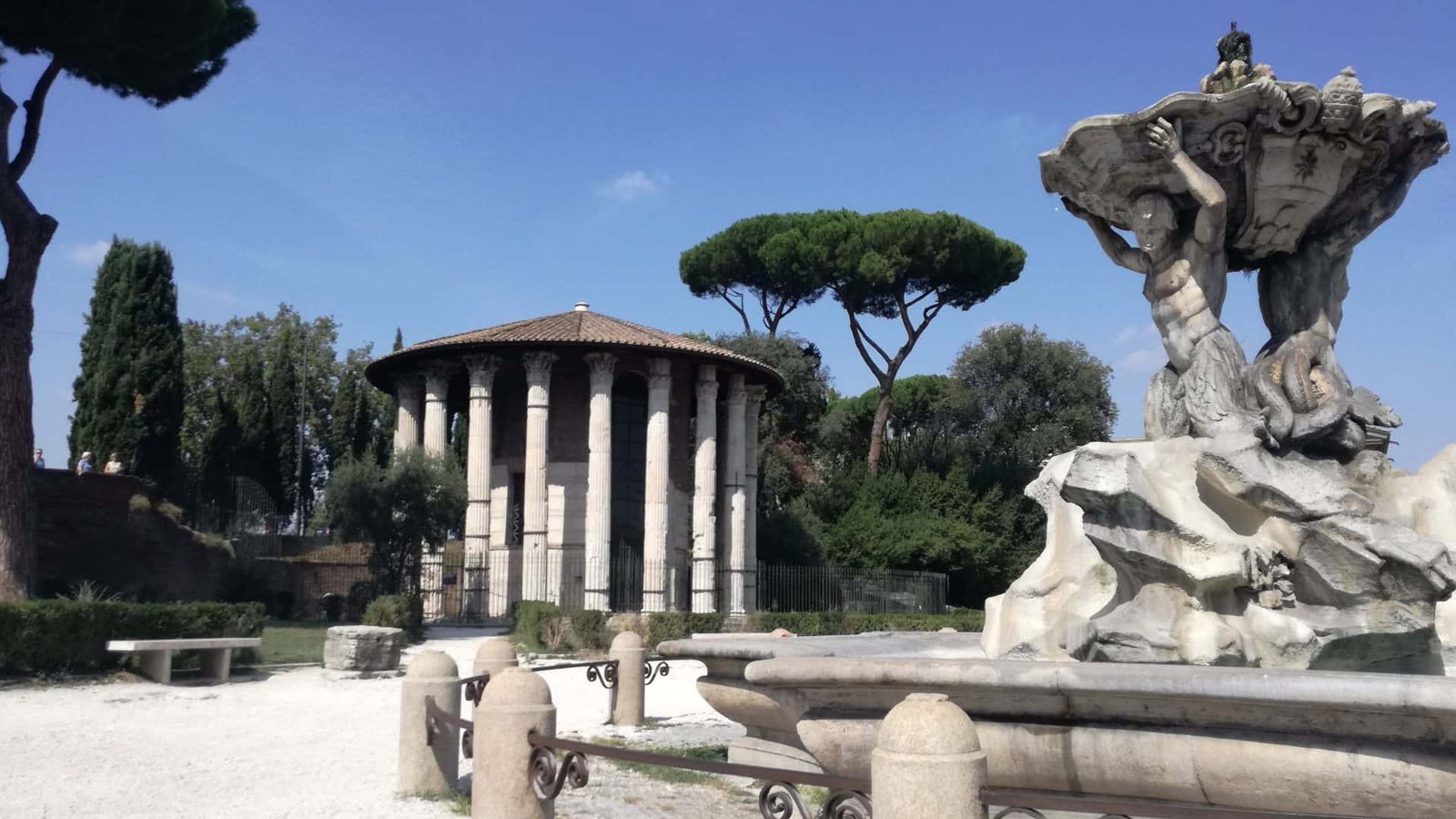
The most lovely curiosity about this square concerns a man who was not a noble, not a general, not a magistrate, and who left the city a building that no Roman aristocrat had yet given it. His name was Marcus Octavius Herennius, and he traded in olive oil. Toward the end of the second century BC he dedicated the tenth of his earnings to Hercules, and with that 10 percent he had the small round temple built that can still be seen today: the oldest marble building in Rome among those that survive.
Let's stop on the meaning of the gesture. Until then, marble in Rome was a material of conquest: it arrived from the spoils of war, decorated temples vowed by victorious commanders, and communicated military power. Herennius uses it to say something else. He says that money earned by selling oil buys the same immortality as the bronze of the triumphs. He hires a Greek architect, in all likelihood Hermodorus of Salamis. He commissions the cult statue from a Greek sculptor, that Scopas whom scholars call the Younger to tell him apart from the master of the fourth century BC. He orders Pentelic marble from Attica, which means ships, duties and months of waiting. Then he puts the whole thing in the middle of the market where he works, where all his competitors pass every day.
The guild of the olearii thus had its own temple, and its temple was the most modern in the city. The inscription with the name Hercules Olivarius, found centuries later, is what made it possible to restore the correct dedication to a building that everyone called, out of laziness, the Temple of Vesta.
I think this is the curiosity worth telling, because it debunks a stubborn cliché: the idea that ancient architecture was only the business of emperors and senators. Rome's first marble was paid for by a wholesaler. And he paid for it with the voluntary tax that his trade required him to pay to the god who guaranteed business. 2,200 years later, that 10 percent is still standing, in the middle of traffic, and it doesn't charge anyone admission.
Something nobody tells you about the Forum Boarium
No one says that inside the Temple of Portunus there are early medieval frescoes, and that those are the real reason to look for the extraordinary openings instead of settling for photographing the colonnade from outside.
The story goes like this. The temple survived because in the early Middle Ages it was turned into a church, dedicated to the Virgin under the title of Santa Maria in Secundicerio, after Stefano Stefaneschi, a judge and secundicerius of the papal court to whom the building was entrusted. In 1492 that title disappears from the documents and the title of Santa Maria Egiziaca appears. Between one dedication and the next, someone painted inside the cella of the republican building. When the church was deconsecrated in the early twentieth century and the restoration of its ancient appearance went ahead under the direction of Antonio Munoz, the works brought to light an important cycle of early medieval frescoes.
The result is a short circuit that has very few parallels in Rome: a pagan sacred building from the first century BC that preserves Christian painting on its walls a thousand years later, and preserves it precisely thanks to the conversion that should have erased it. Whoever goes in, and that happens rarely, sees two religions layered on the same masonry.
There is a second layer to this story that almost no one tells. The survival of the two temples in the Forum Boarium is not due to their beauty or to some archaeologist's sensitivity. It is due to the fact that both were taken over by a church. The Temple of Portunus became Santa Maria Egiziaca, and the round temple became Santo Stefano and then Santa Maria del Sole. All the ancient buildings in the area that did not have this luck have disappeared, dismantled to make lime or absorbed into houses. Christianity, which here had every reason to erase the temples of the gods, instead preserved them by using them. The lesson holds for all of Rome, and nowhere is it as clearly legible as in these 200 meters of piazza.
The advice I give you for visiting the Forum Boarium
Get there by coming down from the Circus Maximus rather than up from the Capitoline Hill. It's trivial-sounding advice, and it completely changes the day. Those who arrive from the Circus valley find the monuments in front of them in the right order, with the Temple of Portunus appearing first, in three-quarter view, and above all they don't have to cross the carriageway of Via Petroselli twice, which with that traffic is the worst part of the visit.
Second point: give the square between 20 and 30 minutes, no more and no less. 20 minutes is enough to look properly at the two temples by walking around them, read the Arch of the Argentarii and look out over San Giorgio in Velabro. Less than 20 reduces it to a photograph. More than 30, if you don't go into anywhere, becomes wasted time. The Forum Boarium works very well as a hinge between two long visits, and works badly as the only destination of a morning.
Third point, the most important and the one almost no one follows: don't separate the Forum Boarium from the Capitoline Museums. The architectural terracottas from Sant'Omobono, the group of Heracles and Athena, the acroterial volutes and the votive deposit are displayed in the Palazzo dei Conservatori, 10 minutes on foot away. Visiting the sacred area without seeing the finds, or seeing the finds without knowing where they come from, means cutting the same visit in half twice.
Fourth point, on logistics for entry. Sant'Omobono requires a reservation at 060608 and has visits limited to 15 people. The two temples can only be visited during special openings. A phone call before leaving the house saves a wasted trip, and during periods of works it also spares you the disappointment of finding construction sites.
Fifth and last: bring decent shoes. Not so much for the square, which is paved, but because the natural continuation of this visit is the climb up to the Aventine or the climb up to the Capitoline Hill, and in both cases these are real inclines in the sun. Anyone who comes here in flip-flops ends up giving up the best part of the day.
Another well-known fact, yet rarely cited
Everyone knows, or almost everyone, that the Forum Boarium was the cattle market. Few know it was the site of the first documented gladiatorial combat in Roman history, and almost no one thinks about it enough.
The episode is dated to 264 BC. These were funeral games held in honor of Giunio Bruto Pera, organized by his sons for their father's funeral, with three pairs of gladiators who fought in the open space of the market square. Not an amphitheater, not an arena, not a building for spectacles: a cattle market, with spectators standing around it.
It's worth understanding what this means. The gladiatorial munus was born as a private funeral rite, not as public entertainment. It was a blood sacrifice offered to the manes of the dead by an aristocratic family, and it was held where there was space and where there were people, that is, at the market. From that domestic ceremony of 264 BC to the imperial machine of the Colosseum, a little more than three centuries pass. During that time the private rite becomes a state spectacle, the aristocracy loses its monopoly on the games, and the emperor appropriates them as a tool of consensus.
Anyone standing at the Forum Boarium and looking southeast sees the valley of the Circus Maximus and, beyond it, the outline of the Flavian Amphitheater. The physical distance is one and a half kilometers. The historical distance is the entire arc of the Republic. Just point at it, and the square stops being a parking lot with some ruins.
I'll add the detail that makes it even more concrete: in 210 BC, after the conquest of Aegina, the consul Publius Sulpicius Galba brought a gilded bronze bull here, and it became the emblem of the area. A golden bull above the cattle market, Greek war booty set down among the herdsmen. Nothing more is needed to understand the Romans' taste for symbols.
The right photo to take at the Forum Boarium
The photo everyone takes here is the hand inside the Mouth of Truth, and it's the least interesting of all: the framing is forced, there's a line behind you, and the light comes from the portico. The right photo is a different one, and it doesn't require standing in line.
Stand on the western sidewalk of the square, the one on the river side, level with the round temple. From there, with a slight step south, you line up in a single frame the small circular temple in the foreground, the Temple of Portunus right behind it on the left and, in the background, the Romanesque bell tower of Santa Maria in Cosmedin Church. Three buildings, three eras: first century BC, second century BC, twelfth century AD. All in one frame, without changing lenses.
I'm firm about the light. The best time is late afternoon, when the sun comes from the west, that is from the river, and grazes the travertine of the temples and the brick of the bell tower. The fluted shafts of the columns stand out, the engaged half-columns of the Temple of Portunus stop flattening against the wall, and the ochre of the medieval brick lights up. In the morning the square is backlit from this position, and the photos come out flat and gray.
A second shot I recommend, less obvious: the Arch of the Argentarii framed from below upward, with the bell tower of San Giorgio in Velabro peeking above the entablature. In the same image you capture a Severan monument from 204 AD and a 13th-century bell tower that literally sits on top of it. It's the photo that explains Rome better than any caption: nothing gets demolished here, it gets stacked.
The third, for those with patience, is the arch of the Cloaca Maxima where it meets the Tiber, near the remains of the Broken Bridge. You have to lean out over the parapet of the Lungotevere on the side facing the hill of the Ponte Palatino and use a modest zoom. It's not a spectacular photo, but it's the one nobody has, and the small effort of finding the spot is worth it.
A word of warning about traffic, which here is the real variable. For the first shot you have to cross Via Petroselli or Via della Greca, depending on where you arrive, and there aren't many protected crossings. Take it slow, cross at the crosswalk, and don't cut through the middle of the roadway to get the angle: every year someone does it and every year someone regrets it.
Some important events that happened here in history
This square hosted, in order, the city's first gladiator show, one of the most chilling human sacrifices recorded in Latin sources, a series of fires and floods that remade its face, the construction of Rome's first marble building and, very recently, an attack with explosives. That's a lot of events for 200 meters of asphalt.
The first gladiatorial munus at the Forum Boarium, 264 BC
In 264 BC, for the funeral games of Junius Brutus Pera, his sons had three pairs of gladiators fight in the open space of the market. This is the first documented gladiatorial combat in Rome. Everything that followed, the ludi, the amphitheaters and the profession of gladiator, traces back to that private funeral rite.
The human sacrifices of the Second Punic War
Livy tells that, in the darkest years of the war against Hannibal, after prodigies deemed intolerable, the Romans had a Gallic man and woman and a Greek man and woman buried alive in the Forum Boarium. Four people walled up under the market floor, in a city that considered itself alien to human sacrifice and that in fact remembered them with embarrassment.
This is the right episode for anyone who describes the Romans as practical rationalists. Beneath the square where cattle were sold, at the moment the state feared it might disappear, they went back to the most archaic rite Mediterranean culture knew. It should be presented for what it is: an annalistic account, reported by a historian writing two centuries after the events, but consistent with other attestations of exceptional rites in moments of collective panic.
Fires and Tiber floods at the Forum Boarium
The annalistic sources record fires in the Forum Boarium in 213, 203 and 196 BC, and ruinous floods of the Tiber in 363, 202, 193 and 192. A neighborhood of warehouses, stables and timber depots, built right at the water's edge, burns and floods regularly. That is why the level of the floor has risen over the centuries, and why the monuments that survive are the ones that stood on high podiums.
The flood of 15 AD is most likely the one that made the Tiberian restoration of the Round Temple necessary, with the replacement of 11 columns and nine capitals in Luni marble. Water, here, is not an accident: it is the factor that wrote the building history of the square.
The golden bull of Aegina, 210 BC
After the conquest of Aegina, in 210 BC, the consul Publius Sulpicius Galba had a bronze bull covered in gold brought to the Forum Boarium, and it became the emblem of the area. A Greek war trophy displayed in the cattle market, with a double meaning that Romans appreciated very much.
The 1937 excavation and the discovery of archaic Rome
Excavation work begun in 1937 for a new municipal building brought to light the sacred area of Sant'Omobono and, with it, the hut from the eighth century BC, the cult area of the seventh century, the temple of 580, and the fragment with the Etruscan inscription that may be the oldest in Rome. It was the discovery that pushed back the archaeological record of the city by centuries and showed how much archaic Rome depended on the river and on trade.
The bombing of July 27, 1993
In the night between July 27 and 28, 1993, a car bomb with about 100 kilograms of explosives destroyed the portico of San Giorgio in Velabro. It was one of the attacks of that deadly season, and it struck a building that had come through 12 centuries unharmed. The anastylosis restoration reassembled the portico with the original fragments that were recovered, and the church reopened on July 6, 1996.
Anyone visiting the Forum Boarium today therefore walks through a place where history did not stop in antiquity. The colonnade seen from Via del Velabro was put back up piece by piece after an attack 33 years ago. It's worth knowing that before you look at it.
Who has passed through the Forum Boarium
The list is long and starts with a figure who never existed, which, in this square, is fitting. According to the mythico-historical tradition about the city's founding, Hercules arrived here with the cattle of Geryon, killed Cacus, and founded the Ara Maxima. All of the site's commercial and religious vocation descends from that story, and no history of the Forum Boarium can begin anywhere else.
Then come the kings, or those the tradition calls that. Ancus Marcius, to whom the Pons Sublicius that replaced the ford is attributed. Tarquinius Priscus, to whom the start of the Cloaca Maxima is linked. Servius Tullius, to whom tradition assigns the founding of the twin temples of Fortuna and Mater Matuta, the ones that resurfaced in 1937 under Sant'Omobono. They are semi-legendary figures, and they should be named as such, but their names remain attached to the works that made this corner of the city livable.
With the Republic, documented names begin. Marcus Octavius Herennius, the olive oil merchant who paid for the Round Temple with a tenth of his earnings. Hermodoros of Salamis, the Greek architect to whom scholars attribute the design. Scopas Minor, the Greek sculptor who made the cult statue mentioned in the inscription. Publius Sulpicius Galba, who brought the golden bull of Aegina here in 210 BC. The sons of Junius Brutus Pera, who organized the first munus in 264. Marcus Vipsanius Agrippa, who in 33 BC inspected and had the Cloaca Maxima cleared out.
The imperial age leaves its most visible signature. Septimius Severus, Caracalla, Julia Domna, Geta, and Fulvia Plautilla appear on the inscription of the Arch of the Argentarii, erected in 204 AD by the local bankers and cattle merchants. Two of them, Geta and Plautilla, were later chiseled out of it after the condemnation of their memory: they passed through here and were then removed from here, literally. Tiberius financed the restoration of the Round Temple after the flood of 15. Hadrian, or his administration, worked on the temples of Sant'Omobono between 117 and 138. Constantine, or more probably his son Constantius II after the victory over Magnentius, gave his name to the four-way arch.
The Middle Ages bring the popes. Zachary, between 741 and 752, is remembered for the translation of Saint George's head to the diaconia in Velabro. Gregory IV, between 827 and 844, rebuilt San Giorgio in the form it still retains. Adrian I, between 772 and 795, doubled Santa Maria in Cosmedin, using the tuff core of the Ara Maxima as its foundation and building the crypt into it. Callixtus II, in the 1120s, promoted the narthex and the bell tower through the chamberlain Alfano. John VII, at the start of the eighth century, never came here, but a fragment of the mosaic from his oratory in the Vatican ended up in the basilica's sacristy.
Then the Roman families: the Savelli, who in the 12th century dedicated the round temple to Santo Stefano, the Frangipane, who turned the four-way arch into a fortress, the Cosmati, and in particular Deodato di Cosma, author in 1294 of the Gothic ciborium of Santa Maria in Cosmedin, Stefano Di Stella, a prior who in the 13th century wanted the portico of San Giorgio.
The modern and contemporary age brings the architects. Giuseppe Sardi, who in the eighteenth century gave Santa Maria in Cosmedin the rococo facade later demolished. Giuseppe Valadier, who in the nineteenth century freed the round temple from the ecclesiastical structures. Giovanni Battista Giovenale, who between 1896 and 1899 restored the basilica to its medieval appearance. Antonio Munoz, who in the early twentieth century restored the ancient appearance of the Temple of Portunus and on that occasion brought to light the early medieval frescoes.
Among the distinguished visitors, the engravers of the Grand Tour hold a place of their own: Giovanni Battista Piranesi worked in this square for his views, and the plates that call the two buildings of the Forum Boarium the temple of Vesta and the Temple of Fortuna Virilis fixed the European image of the place for two centuries, wrong names included.
Finally, the moment that made this square familiar to half the world: in 1953 Gregory Peck and Audrey Hepburn filmed the Bocca della Verità scene under the portico of Santa Maria in Cosmedin in Roman Holiday. Since that day the line under the portico has never stopped, and the square owes to the seventh art a popularity that its republican temples, on their own, had never managed to win.
How to get to the Forum Boarium
The reference point is Piazza della Bocca della Verità, with the Sant'Omobono sacred area on Via Petroselli, gate next to number 45. By metro, the useful stop is Circo Massimo, on line B: you exit, take the valley downhill toward the river, and after five or six minutes at an easy pace you arrive. This is the access I recommend to anyone, because it doesn't require dangerous crossings and because it presents the monuments in the right order.
By bus, the lines indicated as references for the square are the 44, 83, 170, 716 and 781. In the center, detours for demonstrations, roadwork and events are routine, so it's worth checking the route on the day of your visit. Anyone arriving from the Ghetto, Tiber Island or largo Argentina can walk down past the Theater of Marcellus and approach from the north: the route is short and the view of the square, arriving from above, is excellent.
By car it's a terrible idea. You're inside the limited traffic zone of the historic center, surface parking is almost nonexistent, and the lungotevere in that stretch is one of the busiest arteries in the city. The taxi can drop you conveniently at the start of Via Petroselli or on the lungotevere Aventino, and from there you continue on foot.
When to go to the Forum Boarium and when to avoid it
The best time, without question, is the late afternoon on a weekday, between 16:00 and sunset. The sun comes from the west, the temples are lit from the side, the line for the Bocca della Verità has gotten shorter, and the homeward traffic has not yet peaked. In spring and autumn that light lasts longer, and the square becomes a pleasant place to be even just sitting on the edge of the flower bed.
The worst time is late morning on a holiday during high season, when organized tour groups unload in front of the basilica's portico and the line for the big mask turns the corner. Between 10:00 and 13:00, in July or August, the square is also one of the hottest spots in the center: asphalt, little shade, glare. Anyone bringing children or elderly people in those hours makes a choice you'll pay for.
One seasonal note that few people consider: in summer the area is crossed by the audiences heading to shows at the Circo Massimo and the Baths of Caracalla. On concert evenings traffic around Piazza della Bocca della Verità comes to a standstill and some lines are diverted. It's great news for people who have a ticket and terrible news for anyone who just wanted to look at two temples in peace.
The Forum Boarium with children
Worth seeing, yes, but to be explained with some caution. The square has no equipped routes, no panels designed for younger children, no spaces protected from traffic. The visit comes down to looking and listening, and with children under seven or eight the payoff is low.
That said, there is a story that always works here and that I recommend to any parent: the one about Hercules, Cacus and the oxen dragged by their tails so their tracks would point in the wrong direction. It's a tale with a monster, a theft, a trick and revenge, and it has the advantage of being set exactly where it's told, with the Aventine visible a few steps away. From there it's easy to get to why there's a temple of Hercules and why there was a cattle market.
The natural follow-up with children is the climb to the Musei Capitolini to see the Sant'Omobono terracottas, or the walk up the Aventine to the Orange Garden, where at last they can run around. The keyhole of the Priory of Malta, a little further up, is a game that works at any age.
Accessibility of the Forum Boarium
The square is flat and the sidewalks are passable, but there are few crosswalks and the traffic is heavy. Anyone using a wheelchair or with mobility difficulties should plan to cross at the traffic lights and not cut across. The two temples can be viewed from the edge of the flower beds, with no steps to climb, so the outside visit is essentially accessible to everyone.
The sacred area of Sant'Omobono is a different story. The route runs over ancient structures at uneven levels, with changes in elevation and broken surfaces, and the Sovrintendenza Capitolina itself warns of risks of slipping, bumps and falls and requires low, closed, non-slip shoes. Anyone with particular needs should mention it when booking at 060608, so they get an answer before arriving at the gate.
Santa Maria in Cosmedin has a level portico and the entrance to the nave is accessible. Going down to the crypt involves steps. San Giorgio in Velabro is reached through a portico raised a few steps above street level.
How much the Forum Boarium costs and how to save
The short answer is that it costs nothing. The square is public, the two temples and the arches can be seen from outside for free at any hour, entry to the sacred area of Sant'Omobono is free even when the visits are running, and entry to the Santa Maria in Cosmedin basilica requires no ticket, as with any functioning church.
The long answer is that the Forum Boarium is the best free introduction to ancient Rome there is, and it's worth using it exactly for that: as the start or the end of a day that includes paid visits. An afternoon that combines the square, the climb up the Aventine and the sunset from the Giardino degli Aranci doesn't cost a single euro and holds its own against any paid itinerary in the city.
The only expense I really recommend in the area is the ticket to the Capitoline Museums, and I recommend it for the reason I've mentioned several times: without those rooms, the visit to Sant'Omobono is incomplete. If you want to broaden the picture of ancient sculpture displayed on the outskirts, the Centrale Montemartini offers a less crowded and more surprising follow-up to the Capitoline collection.
How to fit the Forum Boarium into your day
Three routes that really work.
Classic archaeological morning
Colosseum at opening, Palatine next with a stop at the Palatine Museum, down into the Circus Maximus valley and finish at the Forum Boarium with the Mouth of Truth and the two temples. It's the standard tour and it has one advantage: the Forum Boarium comes at the end, when you're tired and want something you can look at without lines and without turnstiles.
Slow afternoon on the Aventine
Start from the square, climb the Aventine with the Basilica of Santa Sabina and the Giardino degli Aranci, detour to the Roseto di Roma if it's the season, walk down toward Testaccio and finish at the Pyramid of Cestius. Just under four kilometers, almost all in shade in the upper part, with two viewpoints and no lines.
The city's origins tour from the Forum Boarium
This is what I suggest to anyone coming back to Rome for the second or third time who has already seen the big sights. Forum Boarium and Sant'Omobono in the morning, climb to the Capitoline Hill and the Capitoline Museums to see in person the group of Heracles and Athena and the materials from the votive deposit, a quick lunch, and in the afternoon Tiber Island, the Ghetto and the Sinagoga di Roma, which is the natural continuation along the river. A day that brings together the museum and the place where the finds came from. There are few like it in Rome, and this is the best one.
What's around the Forum Boarium within 10 minutes on foot
The advantage of this square is its location. Within 10 minutes of walking, without transport, you can reach places that elsewhere would justify a separate trip.
To the southeast, the Circus Maximus valley, with its one-kilometer track and the view of the arches of the Palatine. Continuing on, the Baths of Caracalla are a good 20 minutes away, but in summer they're worth the walk for the outdoor opera season.
To the south, the climb up the Aventine with the Basilica di Santa Sabina, the Giardino degli Aranci and, in season, the Roseto di Roma.
To the north, the Theatre of Marcellus, the Portico of Octavia and the Ghetto, with the Synagogue. On the river, Tiber Island and the remains of the Ponte Rotto.
To the northeast, the climb to the Capitoline Hill with the Capitoline Museums, the Carcere Mamertino at the foot of the hill and, a little further on, Trajan's Markets.
If the cult of Hercules has caught your attention and you want to see what that cult became when a whole city funded it instead of a single merchant, the destination is outside Rome: the Sanctuary of Hercules Victor in Tivoli is one of the largest sanctuary complexes of ancient Italy, and comparing it with the small round temple in the Forum Boarium is as instructive as a university course.
If you want to line up these stops without reopening 20 pages, you can save them one by one in Il mio viaggio and find them again on the day of your visit.
Quick questions about the Forum Boarium
Does the Forum Boarium cost money?
No. The Forum Boarium is a public square: the two Republican-era temples, the four-faced arch and the Arch of the Argentarii can be seen from outside for free, every day, at any time, without a ticket or a reservation. The Sant'Omobono sacred area also has free admission when visits are active. The only possible cost is for the museums you visit nearby.
How much time do you need to visit the Forum Boarium?
20 to 30 minutes if you look at the monuments from outside at a proper pace, walking around both temples and stopping to look onto San Giorgio in Velabro. If you add a visit inside Santa Maria in Cosmedin with the crypt, you get to a good hour. With the guided visit to Sant'Omobono, when it's available, you go past an hour and a half.
Can you go inside the Temple of Portunus?
Not normally. Access inside happens only during special openings and for events. When it does happen, the wait is worth it, because inside are preserved the early medieval frescoes that came back to light with the early 20th-century restoration, and because entering a Republican temple preserved in its original form is a rare opportunity.
Is the round temple in the Forum Boarium open to visitors?
Visits are suspended due to work on the area. From outside, however, you can walk all the way around it without restrictions, which, after all, is how the monument has always been looked at by Romans and travelers.
What is the difference between the Forum Boarium and the Roman Forum?
They are two distinct places, about one kilometer apart. The Roman Forum is the political, judicial and religious center of the ancient city. It stretches between the Capitoline Hill and the Colosseum, is fenced off, and is visited with the ticket for the archaeological circuit. The Forum Boarium is the cattle market and river port, located on the Tiber between the Palatine and the Aventine, and it is open and free of charge. Confusing them is the most common mistake of all about this area.
Is the round little temple the Temple of Vesta?
No, even though it has been called that for centuries and in many tourist materials, including Piranesi's engravings. The inscription naming Hercules Olivarius settled the question: it is a temple of Hercules, protector of the guild of the olearii. The real Temple of Vesta is in the Roman Forum, next to the House of the Vestals.
Why was the Temple of Portunus called the Temple of Fortuna Virilis?
Because of an old antiquarian guess, never based on documents. The correct identification with the Temple of Portunus, god of river ports mentioned by Varro, dates back to the 1920s and is now accepted by the preservation agencies. The old name keeps circulating in tourist materials out of sheer inertia.
Why is the square called Bocca della Verità?
Because the marble mask known as the Bocca della Verità has been placed since 1623 under the portico of the Santa Maria in Cosmedin basilica, on the east side of the square. The line you almost always see is not for the temples: it's for the photo with your hand inside the mask. Details on hours and queues are on the Bocca della Verità page.
What is the Bocca della Verità really?
A large disc of pavonazzetto marble with the face of a river god. The prevailing hypothesis among scholars is that it is a manhole cover for a sewer or an element connected to an ancient hydraulic system. The legend of the hand biting liars is medieval, and its worldwide fame comes from the 1953 film.
How long is the wait in line for the Bocca della Verità?
It depends on the season and the time of day. On summer mornings and weekends the wait can exceed an hour. On weekday late afternoons in the off season, you get in within a few minutes. If you have little time, you can look at the mask from the side from the portico without getting in line, and use those minutes for the basilica and the crypt.
How do you book the visit to the Sant'Omobono sacred area?
By calling 060608, every day from 9.00 to 19.00. Booking is mandatory, entry is only with guided groups of no more than 15 people, and for individual visitors there is a dedicated calendar. Admission is free. You enter from via Petroselli, through the gate beside number 45. It is closed on Mondays, and during construction work access may be suspended.
Where did the finds from the Forum Boarium end up?
At the Capitoline Museums, in the Palazzo dei Conservatori: the terracotta group of Heracles and Athena, the plaques and facing slabs, the four acroterial volutes, and the votive deposit with balsamaria, Greek ceramic cups, bone pendants, amber and miniature objects. They are 10 minutes on foot away and make up the logical second half of the visit.
Is the Forum Boarium wheelchair accessible?
The square is flat and the monuments can be seen from the sidewalk, so the outside visit is doable. The difficulty is the road crossings, which are few and busy. The Sant'Omobono sacred area, instead, involves a route over ancient structures at uneven levels, with changes in height and a risk of slipping. It's best to report any needs when you book at 060608.
Can you take photos at the Forum Boarium?
Outside, yes, freely, at any time: you are in a public square. Inside churches, the rules of the place of worship apply, so no photos during services and generally no flash. The best photo, however, is the one that lines up the Round Temple, the Temple of Portunus and the bell tower of Santa Maria in Cosmedin from the western sidewalk in the late afternoon.
Is the Forum Boarium suitable for children?
Worth looking at, yes, but explaining it takes some care. There are no equipped paths or traffic-free areas, so the visit depends on the storytelling. The story of Hercules, Cacus and the oxen dragged by their tails works at any age, and the ideal follow-up is a run in the Giardino degli Aranci or the terracotta room at the Musei Capitolini.
What is the best time of day to visit the Forum Boarium?
The late afternoon on a weekday. The light comes from the west and brings out the columns, the line for the Bocca della Verità has gotten shorter, and the heat coming off the asphalt has dropped. Avoid late mornings on public holidays in high season, when organized groups fill the portico of the basilica.
What is the four-faced arch in the Forum Boarium?
It is a late antique tetrapylon, commonly called the Arch of Janus, because of an erudite tradition that has no basis in the sources. The name returned by the inscriptions refers to arcus divi Constantini, with a possible rededication to Constantius II after the victory over Magnentius. About 12 meters high, with a side of 16, it served as a covered passage at the crossroads of the market streets.
Why is the Arch of the Argentarii attached to a church?
Because the eastern pier was absorbed halfway into the masonry of San Giorgio in Velabro over the course of the early Middle Ages, and the 13th-century bell tower rests partly on the arch itself. The result is a single building complex that holds together a Severan monument from 204 AD and an early medieval diaconia.
What are the erased parts on the inscription of the Arch of the Argentarii?
They are the result of damnatio memoriae. The names of Fulvia Plautilla, exiled in 205 and killed in 211, and of Geta, murdered in 212, were chiseled away, and their figures were removed from the reliefs. The erasures are still perfectly visible and are one of the most legible examples of political erasure carved in stone in Rome.
Can you visit the Cloaca Maxima from the Forum Boarium?
You can't go down into the sewer from here. You can, however, see its ancient outlet on the Tiber, near the remains of the Ponte Rotto, close to the Ponte Palatino: an arch with three rings of Gabine stone blocks, visible by leaning over the parapet of the Lungotevere. The stretch of the drain that has been made accessible and walkable is instead in the Forums area.
What is the relationship between the Forum Boarium and the Circus Maximus?
They border each other: the Circus Maximus valley opens immediately southeast of the square and marked its limit in ancient times. Today the walk between them takes five minutes, and the Line B metro stop that serves both is the same one. Anyone visiting the Circus Maximus should always extend the visit to the Forum Boarium, and vice versa.
Are there events and shows at the Forum Boarium?
Not in the square itself, and that's understandable, since it is a monumental area crossed by traffic. But you are a short walk from the Circus Maximus, which hosts big outdoor concerts in summer, and from the Baths of Caracalla, which host the opera season. Some evenings the surface bus lines in the area are rerouted precisely for those events.
What is the difference between the Forum Boarium and the Forum Holitorium?
They were two neighboring, specialized markets: the Forum Boarium for livestock, the Forum Holitorium for vegetables. The second extended a little further north, toward the Theater of Marcellus, where the remains of the Republican temples are incorporated into the church of San Nicola in Carcere. If you still have 20 minutes after the square, walk that short stretch: it is the natural complement to the visit.
What is the oldest monument in the Forum Boarium?
If you look at what is visible above ground, the Round Temple, which is the oldest surviving marble building in Rome. If you also consider what lies underground, the title belongs, beyond any comparison, to the sacred area of Sant'Omobono, where the documented sequence begins in the eighth century BC with a hut and continues with the Etrusco-Italic temple of 580.
Is it worth visiting the Forum Boarium if you only have two days in Rome?
Yes, on one condition: that you fit it between two major visits and don't treat it as a destination in its own right. 20 minutes between the Circus Maximus and the climb up to the Capitoline Hill gives a very high cultural return at no cost. If instead you have already seen the main sights and are returning to the city, you should give it an entire morning together with the Musei Capitolini.
We'll close with our opinion on this square. The Forum Boarium rewards those who stop and punishes those who pass, and the difference between the two is five minutes. Those who pass see two round ruins in the middle of traffic and a line for a famous manhole cover. Those who stop see the oldest marble in the city, paid for by an olive oil merchant, a Republican temple that houses early medieval painting, a Severan arch with names chiseled out on the orders of a fratricidal emperor and, underfoot, the stratigraphy that tells the story of the birth of Rome. There's no gate telling you the visit has started. You have to decide for yourselves. Do it, then climb up to the Capitoline Museums to look into the eyes of the terracotta Hercules that crowned the roof of a temple in 580 BC, down here, 30 meters from where you parked your patience.
Article written by the editorial team of TourLeaderPro, contact them for Private/Corporate/V.I.P. Tours and Experiences.
Planning a trip to Rome? English-language guides for visiting the city are on ItalyPlanner.com.