Church of Santo Stefano Rotondo on the Celian Hill
In short. The Church of Santo Stefano Rotondo on the Celian Hill is on Via di Santo Stefano Rotondo, on the Celian Hill, a few minutes' walk from the Colosseum and from the basilica of San Giovanni in Laterano.
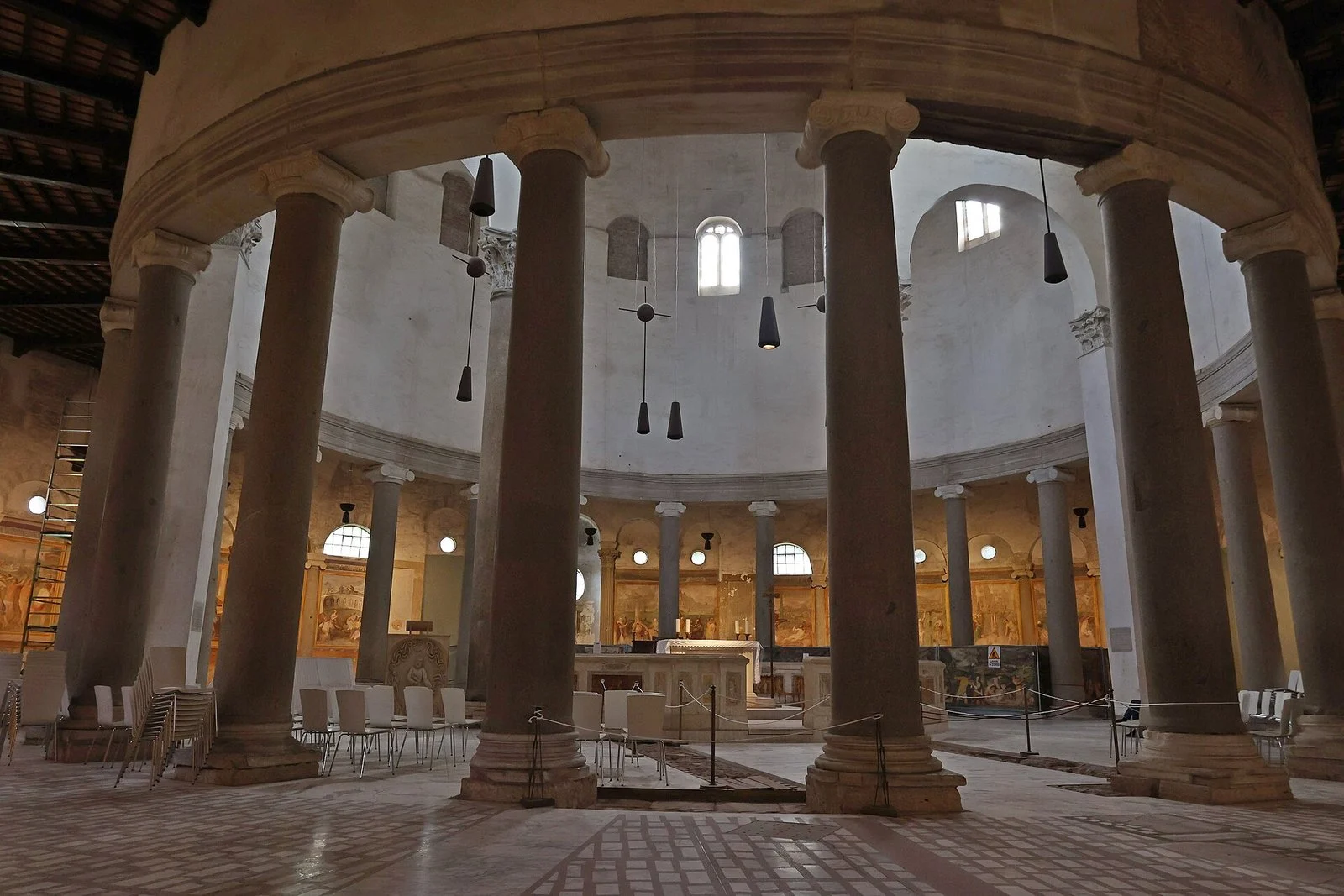
The Church of Santo Stefano Rotondo on the Celian Hill is on Via di Santo Stefano Rotondo, on the Celian Hill, a few minutes' walk from the Colosseum and from the basilica of St. John Lateran. It is the oldest circular church in Rome, built in the fifth century on a plan of three concentric circles, and it keeps on the walls of the ambulatory one of the rawest and most debated fresco cycles in the city: 34 martyrdom scenes painted in the late 1500s to prepare future Jesuit missionaries for the prospect of sacrifice. Beneath the building, and not open to the public, remain the remains of a mithraeum of the second century tied to the nearby barracks of the Castra Peregrinorum. The church has been entrusted since 1580 to the Pontifical Germanic-Hungarian College and remains, along with the Baths of Caracalla and Villa Celimontana, one of the least crowded and most surprising stops on the Celian Hill. It is not a building designed for immediate wonder, but for a slow reading, and precisely for this reason it deserves more time than most tourist itineraries give it.
Where the Church of Santo Stefano Rotondo on the Celian Hill Is and How to Get There
The address is Via di Santo Stefano Rotondo 7, in the Celio rione, on a little-trafficked side street that connects Via della Navicella to Piazza di Porta Metronia. The position is secluded compared with the big tourist flows of the Colosseum and the Roman Forum, even though it is a few minutes' walk from both: it's one of the reasons the church is ignored by most first-time visitors to Rome, who climb the Celian Hill without noticing they have next to them an early Christian building unique of its kind.
On Foot from the Colosseum and the Celian Hill
From the Colosseum you reach the church in a 10 to 12 minute walk, going up Via Claudia or the Clivo di Scauro, among the trees that cover the flank of the hill. The route goes through the complex of the Roman Houses of the Celian Hill and skirts the church of Santi Giovanni e Paolo, before coming out on Via della Navicella. Those arriving from San Giovanni in Laterano have a similar walk, of about 15 minutes, along Viale del Monte Oppio or along Via di San Giovanni in Laterano up to Piazzale Metronio, with a view of the Aurelian Walls.
By Metro, Bus and Tram
The nearest metro stop is Colosseo, on Line B, from which you walk up toward the Celian Hill in 10 to 15 minutes. On the surface, the Navicella-Villa Celimontana stop, served by bus 81 and tram 3, leaves you a short step from the church entrance. Lines 673 and 714 instead stop at Porta Metronia, on the other side of the hill. Tram 3, in particular, is convenient for those arriving from Trastevere or from the Nomentano neighborhood without passing through the center.
By Car and Nearby Parking
Most of the Celian Hill falls in a limited traffic zone and free parking around the church is scarce and regulated by blue lines. On weekdays it's best to leave the car in one of the paid parking lots closest to San Giovanni in Laterano or Porta Metronia and complete the trip on foot. Those arriving in an organized group by coach find the authorized stopping areas along Viale Carlo Felice, about 10 minutes' walk away.
The Oldest Circular Church in Rome
Santo Stefano Rotondo was born in the fifth century at the wish of Pope Leo I, who began its construction in the last years of his pontificate, which ended in 461. The building was consecrated by his successor, Pope Simplicius, between 468 and 483. The dating doesn't rest only on written sources: coins of the emperor Libius Severus, in office between 461 and 465, have been found in the foundations, and dendrochronological analysis of the wooden roof beams gives a date around 455, consistent with the final phase of the construction.
The Three Concentric Circles and the 22 Ionic Columns
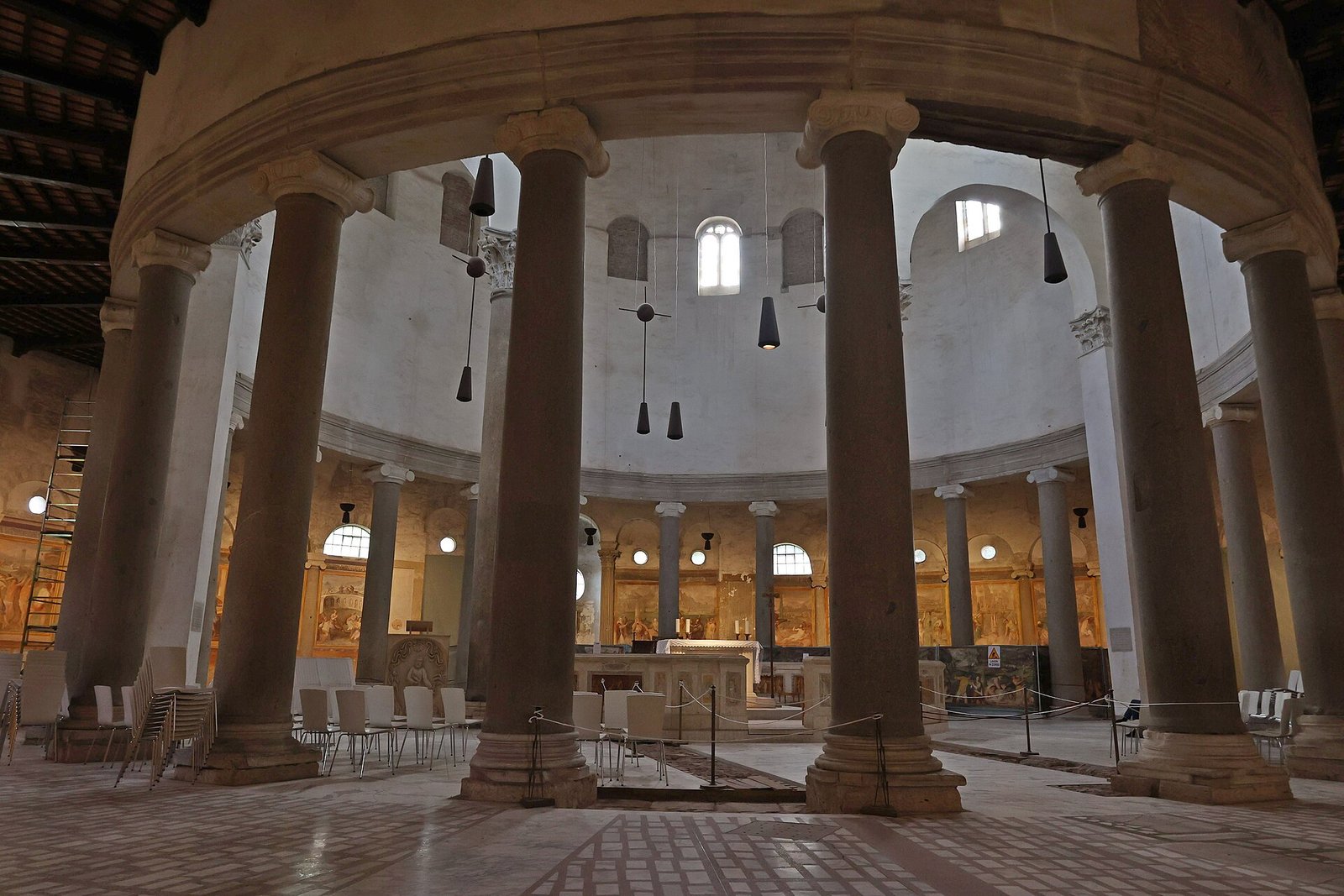
The original plan is conceived in concentric circles. At the center opens a space 22 meters in diameter, bounded by 22 columns with architraves and Ionic capitals carved expressly in the fifth century. Around it runs a first ambulatory up to a diameter of 42 meters, and beyond that a second, outer ambulatory that reached 66 meters, now gone. The central drum, a little over 22 meters high, was once pierced by 22 windows, some of them walled up in the 15th-century restorations for structural reasons. The columns of the inner circle are largely reused, recovered from older buildings and readapted with different heights compensated by bases of variable thickness: a practical solution, typical of late antique Roman building, which reuses already worked marbles rather than quarrying new ones.
The result is a building that, seen from above, draws a Greek cross legible from outside too thanks to the difference in height of the roofs: four rectangular arms join the central circle, added perhaps already in late antiquity to give stability to a structure otherwise without buttresses. The floor was in cipollino marble, and the walls of the central hall were covered with marble slabs, of which only traces remain today.
The Restoration by Innocent II and the Reduction of the Building
Between 1139 and 1143 Pope Innocent II intervened on a structure by then decrepit and decided to close the outermost ring, drastically reducing the size of the church: since then only the inner circle survives with one extended arm, the one that today houses the chapel of Saints Primus and Felician. It's the configuration, more compact than the late antique original, that you still see today entering from the portico. Three centuries later, between 1447 and 1455, Pope Nicholas V entrusted a new intervention to Bernardo Rossellino, with the rebuilding of the roofing, of the floor and of a new marble altar at the center of the hall.
The Apse Mosaic with Saints Primus and Felician
In the surviving arm, a seventh-century mosaic tells a different chapter of the church's history: Pope Theodore I, between 642 and 649, transferred to Santo Stefano Rotondo the relics of Saints Primus and Felician, martyrs of Via Nomentana, and had the apse decorated with a mosaic showing them on either side of a large jeweled cross on a gold background. The work, attributed to an artist of Byzantine training, is one of the rare seventh-century Roman mosaics to have come down to us and is often overlooked by those who enter the church drawn by the much showier 16th-century frescoes of the ambulatory.
The Cycle of Martyrs' Frescoes in the Ambulatory
The walls of the inner ambulatory, over a stretch of tens of meters, are covered by a cycle of 34 large scenes painted between 1582 and 1583 by Niccolò Circignani, called Pomarancio after the Tuscan town he came from, with the collaboration of Matteo da Siena. The commission came from Pope Gregory XIII, the same pontiff who a few years earlier had brought together in the church the Germanic College and the Hungarian College of the Jesuits: the aim was not decorative but pedagogical. The young seminarians destined for the missions, often in territories where martyrdom was a concrete risk, had to have before their eyes, every day, the fate that befell the first Christians.
What the Scenes Really Show
It must be said clearly, because whoever enters without expecting it may be struck: the frescoes depict supplications, beheadings, burnings, crosses, red-hot irons and mangled bodies, with captions in Latin and Italian giving the name of the martyr, the persecuting emperor and the manner of execution. It isn't an allusive or symbolic language as in so much sacred painting: it's a direct and insistent depiction of the violence suffered by the martyrs of the origins, from the massacre of the Innocents to the torments of the apostles. In 1586 Antonio Tempesta added, in an adjacent chapel, other scenes dedicated to the martyrdom of Saints Primus and Felician, with the same raw figurative register.
The Martyrs Depicted and the Literary Sources
The scenes don't come from the free invention of the painters: each episode is drawn from precise hagiographic sources, largely from the Roman Martyrology and from the collections of saints' lives then in use in Jesuit colleges, and the choice of subjects follows an order that goes from the origins of persecution, with the massacre of the Innocents and the first martyrs of the Church of Jerusalem, to the torments of the apostles and the martyrs of the imperial persecutions of the early centuries, under Nero, Diocletian and the other emperors most cited in the hagiographic tradition. Each panel carries, at the bottom, a bilingual caption identifying the saint, the manner of the martyrdom and sometimes the source from which the scene is taken: an almost encyclopedic apparatus, designed so that the seminarian could study, not just look.
In our view the frescoes should be explained before being shown, not after. An adult reads them as a document on the mentality of the Counter-Reformation and on the training of Jesuit missionaries. A small child, without explanation, risks being simply frightened by images of tortured bodies on a monumental scale. This is not a judgment on the value of the work, which remains one of a kind in Counter-Reformation Roman painting, but a practical warning for those organizing the visit with family.
It's worth adding that the impact of the scenes changes a lot depending on the light of the moment: on the brightest days, with the sun filtering through the windows of the drum, the vivid colors of the frescoes look almost theatrical, while on a gray day the ambulatory takes on a gloomier and quieter tone, which accentuates the sense of recollection and makes the impact of the martyrdom scenes even more direct. Those who visit the church several times, in different seasons, often report very different impressions of one another, even in front of the exact same paintings.
The Historical and Pictorial Value of the Cycle
Beyond the emotional impact, the cycle of Santo Stefano Rotondo is a fundamental document for understanding how the post-Tridentine Church used the image as a tool of training and propaganda, at a time when Jesuit missions reached as far as Asia and the Americas and martyrdom was not a remote memory but a concrete possibility for those who set out. Art historians have often discussed the pictorial quality of Circignani, considered inferior to that of contemporaries like Federico Zuccari, but nobody disputes the communicative effectiveness of the whole: few Roman fresco cycles stay imprinted with the same force after a single visit.
It should be added that models similar to that of Santo Stefano Rotondo were made in other Roman churches tied to missionary colleges, a sign that the choice was not isolated but part of a broader figurative strategy of the post-Tridentine Church: cycles of martyrs with the same pedagogical function appear, with different pictorial solutions, in other buildings tied to the training of clergy destined for the missions. None of these cycles, however, reaches the extent and narrative coherence of the one painted by Circignani along the whole ambulatory of Santo Stefano Rotondo, which explains why it remains today the reference case cited in manuals when talking about the iconography of martyrdom in Counter-Reformation Rome.
Central-Plan Architecture in the Ancient Christian World
Buildings with a circular or polygonal plan, with a central space covered by a dome or a hipped roof and ambulatories surrounding it, were not born with Christianity: they derive from Roman funerary and commemorative models, from the Pantheon to the imperial mausoleums, passing through bath buildings with round halls. The first Christians readapted this architectural language for two specific functions, both foreign to the longitudinal-plan basilica used for ordinary worship: the baptistery, where the believer is immersed in water at the center of a space that symbolically recalls death and rebirth, and the martyrium, the building constructed over or next to the tomb of a martyr, where the central plan allows a flow of pilgrims to circle the sacred point without getting in each other's way.
Santa Costanza, the Lateran Baptistery and the Comparison with Santo Stefano Rotondo
In Rome few other examples of this type survive in readable condition: the mausoleum of Santa Costanza on Via Nomentana, built in the fourth century for Constantine's daughter and turned into a church only later, and the Lateran Baptistery, built next to the basilica of San Giovanni in Laterano precisely with the liturgical function of baptism. Compared with both, Santo Stefano Rotondo stands out for its scale: its original plan, with the two concentric ambulatories and the total diameter of 66 meters before the medieval demolitions, made it the largest central-plan building constructed in Rome after the Pantheon, a record that no city guide underlines enough. It was neither a baptistery nor, strictly speaking, a martyrium tied to a single burial: its original function remains partly debated among scholars, and it is perhaps precisely this functional ambiguity that makes it such a frequently cited case study in manuals of early Christian architectural history.
The Exterior of the Church, the Portico and the Small Garden
From outside, Santo Stefano Rotondo presents itself as a brick building with a low and unshowy profile, almost hidden by the vegetation surrounding the college complex: it's one of the reasons why, strolling along Via di Santo Stefano Rotondo, you can easily miss the entrance if you don't look for it carefully. A short portico precedes the facade, with a small side garden that introduces the visit in a recollected way, very different from the scenic monumentality of so many other Roman basilicas with wide churchyards and Baroque facades.
A Building That Doesn't Seek Wonder at First Sight
This exterior sobriety is consistent with the history of the building: after the reduction ordered by Innocent II in the 1200s, the church lost much of its original monumentality and took on the more compact proportions seen today. It is a case, not isolated in Rome, in which the interior holds a much bigger surprise than the exterior lets you guess: those who expect a triumphal entrance are often thrown off by the modest facade, only to find themselves, once across the threshold, in one of the most unusual and best preserved spaces of early Christian Rome.
The Mithraeum of the Castra Peregrinorum Under the Church
Below the floor level of Santo Stefano Rotondo are preserved the remains of a mithraeum, a place of worship dedicated to Mithras, established around 180 AD and brought to light by excavations carried out between 1973 and 1975. The underground sanctuary was tied to the nearby barracks of the Castra Peregrinorum, where the frumentarii and later the peregrini lived, special units coming from the provinces of the empire and detached to Rome for liaison and control duties. The cult of Mithras, widespread above all among soldiers, found in these barracks one of its favored settings, and it is common to find small mithraea carved out under Roman military structures.
Who the Castra Peregrinorum Were
The name Castra Peregrinorum literally means the camp of the foreigners, but the definition must be understood in a technical sense: here were lodged the soldiers detached from the provincial legions and sent temporarily to Rome for liaison services between the emperor and the governors of the provinces, and in later times also the frumentarii, a corps that over time took on surveillance and political police functions, reaching an unflattering reputation in the ancient sources. The headquarters of these units was located right in the area where Santo Stefano Rotondo stands today, and remains of the barracks have also been identified in other points of the Celian Hill in the course of later excavations. It is in this military, cosmopolitan-by-definition context that the cult of Mithras, of Persian origin but spread throughout the empire through the army, finds a natural ground.
Why You Can't Visit It
The mithraeum of Santo Stefano Rotondo is not open to the public: the underground rooms, with the two side podiums typical of these sanctuaries and the traces of the depiction of the tauroctony, remain accessible only for study purposes or on occasions of extraordinary openings organized by the Soprintendenza, when planned. It is one of the many Roman mithraea left outside the ordinary visiting circuits, along with the better-known ones under San Clemente and under the Baths of Caracalla: those interested in Mithraic archaeology in Rome find in this church an important piece, even if not directly visitable.
The Germanic-Hungarian College and the National Church of Hungary
Until the 16th century the church was entrusted to Hungarian religious of the Pauline order, but in 1579 Pope Gregory XIII established the Hungarian College and the following year, in 1580, joined it to the already existing Germanic College, entrusting both to the Jesuits and assigning them Santo Stefano Rotondo as their reference church. Since then the basilica has been both a place of worship open to the faithful and the training seat of the Pontifical Germanic-Hungarian College, one of the oldest ecclesiastical colleges in Rome, still active in the training of priests coming from the German-speaking area and from Hungary.
A College with a Longer History than the Church That Hosts It
The Germanic College, from which the Germanic-Hungarian College was born in 1580, had been founded as early as 1552 by Ignatius of Loyola, the founder of the Society of Jesus, with the explicit aim of training a Catholic clergy able to work in the German territories crossed by the Protestant Reformation. It is therefore a foundation that predates by almost 30 years the union with the Hungarian college and the settlement at Santo Stefano Rotondo, and that explains why the students of the college, the so-called Germanics, are historically also known in Rome by the nickname of red shrimps, because of the color of their cassocks. Even today the college keeps an international community of seminarians who follow theological studies at the Roman pontifical universities, lodging in the building adjacent to the church. Over the centuries the college has continued to represent a bridge between Rome and the German- and Hungarian-speaking territories, maintaining the formative vocation that had motivated its founding.
This dual nature explains some practical features of the visit: the hours are tied to the life of the college community and to liturgical celebrations, and not to a normal museum calendar, so it's always best to check them before planning a stop. The church also keeps the title of national church of Hungary in Rome, a role it ideally shares with few other city basilicas tied to specific national communities.
The Celian Hill, a Hill of Convents, Gardens and Ancient Churches
To understand why a church like Santo Stefano Rotondo survived almost intact in the heart of Rome, without being swallowed up by buildings and roads as happened to so many other late antique buildings, you need to look at the hill that hosts it. The Celian Hill is, among the seven historic hills, the one that has kept the greenest and quietest character: unlike the Quirinal or the Esquiline, large modern residential neighborhoods never settled here, and from the Middle Ages the hill filled up mostly with convents, vegetable gardens, vineyards and monastic gardens.
A Topography Made of Overlapping Churches
Climbing from the Colosseum toward Santo Stefano Rotondo you meet, within a few hundred meters, some of the most layered churches in Rome: Santi Giovanni e Paolo, built over a Roman domus of the third century whose rooms remain visible in the Roman Houses of the Celian Hill. San Gregorio Magno al Celio, facing a wide tree-lined churchyard. Santa Maria in Domnica, known as the Navicella for the small ship-shaped fountain in front of the entrance. It's a pattern that repeats across the whole hill: under almost every medieval or Renaissance church there is a Roman layer, and under that often another, even older one. Santo Stefano Rotondo, with its buried mithraeum, is no exception: it is simply the case in which the layering is most legible, because the excavations of the 1970s brought it to light with precision.
The Navicella and the Ship-Shaped Fountain
A few steps from Santo Stefano Rotondo, on the little square in front of Santa Maria in Domnica, stands the fountain of the Navicella, a small marble boat that gives its name to the whole area and to the main street of the neighborhood, Via della Navicella precisely. The fountain was made in the early 16th century on commission from Pope Leo X, taking up the model of an ancient Roman votive offering that stood on the same spot in classical times, perhaps tied to the presence of the nearby military barracks. It's a detail that few visitors connect to the church not far away, and yet it tells the same story: this area of the Celian Hill was, in imperial times, a neighborhood marked by the presence of soldiers, before it became a land of convents and vegetable gardens.
Recent Restorations and the Conservation of the Frescoes
After centuries of partial interventions, the second half of the 20th century brought Santo Stefano Rotondo a more systematic season of study and restoration, begun in 1958 and continued in successive phases up to the excavations of the mithraeum in the 1970s. The interventions concerned both the masonry structures, stressed over the centuries by settling and seepage, and the painted surface of the ambulatory, exposed for centuries to the humidity and temperature swings typical of a semi-open building like this one.
The Difficulties of Conserving Such an Extensive Cycle
Conserving 34 frescoed scenes along an entire ring of wall poses different problems from those of a single altarpiece or an isolated chapel: the overall surface is enormous, the microclimatic conditions vary from one stretch of the ambulatory to another depending on exposure and proximity to the openings, and every cleaning intervention requires a case-by-case evaluation of the original pigments against the later retouchings accumulated over the centuries. The specialists who have worked on the cycle have repeatedly pointed out that the overall reading of the scenes, with their vivid and at times almost comic-strip colors, is today more faithful to the 16th-century original than it was before the most recent restorations, when layers of dirt and yellowed protective varnishes weighed on the perception of the whole.
A Curiosity About the Church of Santo Stefano Rotondo on the Celian Hill
Few know that the circular shape of Santo Stefano Rotondo is not an isolated architectural whim, but recalls a precise model: the central-plan buildings of Christian late antiquity, often built to guard important relics or to mark burial places, on the model of buildings like the mausoleum of Santa Costanza on Via Nomentana. Tradition has it that the choice of the circular plan at Santo Stefano Rotondo recalls the Rotunda of the Anastasis in Jerusalem, the structure that encloses the tomb of Christ in the Church of the Holy Sepulchre: building in Rome a structure with the same geometry meant, for the Christians of the fifth century, symbolically bringing Jerusalem inside the walls of the city.
A second curiosity concerns the lost dimensions: the outer ring demolished in the 1200s brought the overall diameter of the building to 66 meters, a measure that would have made Santo Stefano Rotondo, in its original form, one of the largest covered central-plan spaces in all of late antique Rome, second only to the Pantheon. Walking today in the frescoed ambulatory, you walk inside what remains of a building much bigger than its current outline lets you guess.
A third little-known element concerns the columns themselves: being reused, they come in all likelihood from several different Roman buildings, demolished or abandoned during the fourth and fifth centuries, and the builders of the church had to solve on the spot the problem of non-uniform heights and diameters, compensating for the differences with taller or shorter bases. Looking carefully at the inner colonnade, whoever has an eye for details can notice the small discrepancies between one shaft and another, silent traces of a construction site that reused with practical intelligence what the city had already built centuries earlier.
One Thing Nobody Tells You About the Church of Santo Stefano Rotondo on the Celian Hill
Almost all guides tell of Pomarancio's frescoes as a macabre curiosity to photograph quickly, but very few explain why that specific church, and not another, was chosen for such an explicit cycle. The answer lies in the function of the place: Santo Stefano Rotondo was not, at the end of the 1500s, an ordinary parish, but the church of a college that trained missionaries destined to leave for Elizabethan England, for central-eastern Europe crossed by the wars of religion, for the overseas missions. Many of those young men would indeed die as martyrs in the following decades. The frescoes were not an abstract warning: they were, for those who looked at them every day before leaving, a concrete anticipation of the risk they were about to run.
Another detail that is rarely mentioned: the reduction of the building ordered by Innocent II in the 1200s was not just any restoration, but an almost forced choice faced with a building that, without maintenance for centuries, risked collapse. The demolished outer ring was not lost through sudden neglect: a large part of its marble materials was reused elsewhere in Rome, according to a common practice in the medieval city, where ancient ruins were above all an open-air quarry.
A third aspect little told concerns the relationship between the church and the mithraeum beneath it: for centuries nobody in Rome knew that the pagan sanctuary was located exactly there, right under the feet of the seminarians who studied in the college above. Only the excavations of the 1970s revealed this overlap, which today appears almost symbolic, but which for centuries remained simply invisible, buried under layers of earth and rubble accumulated over the centuries between the end of the empire and the construction of the Christian basilica.
The Advice I Give You for Visiting the Church of Santo Stefano Rotondo on the Celian Hill
The main advice is not to enter Santo Stefano Rotondo as the last stop of a day already full at the Colosseum and the Roman Forum. The frescoes demand attention and a minimum of residual energy to be read as a whole, not just photographed. Arriving tired, in the last hour before closing, means coming away with the impression of a gloomy place without grasping its historical logic. It's better to make it the first stop of the morning, perhaps pairing it with the climb toward the Roman Houses of the Celian Hill, when the light filtering through the windows of the central drum still lights the hall well.
The second piece of advice concerns the pace of the visit: stop in the center of the hall, under the drum, before walking the ambulatory. It's from there that you best understand the logic of the concentric circles and the particularity of the plan, and only after grasping the geometry of the building does it make sense to move along the walls to follow, scene after scene, the cycle of the martyrs. Those who do the route in reverse risk leaving remembering only the painted blood and not the architecture, which is the real distinction of this church.
One last piece of advice concerns the time given to reading the captions: many visitors walk the ambulatory looking only at the images, without stopping at the Latin and Italian inscriptions that accompany each scene. It is precisely those captions, with the name of the martyr, of the persecuting emperor and the hagiographic source, that turn the cycle from a simple gallery of strong images into a readable historical document. Even just 10 minutes spent choosing three or four scenes and calmly reading their explanation completely change the perception of the visit.
Another Well-Known Fact, Yet Rarely Cited
It is fairly well known, among those who deal with art history, that the frescoes of Santo Stefano Rotondo had a direct influence on the iconography of martyrs spread across Catholic Europe in the following decades, through the prints and engravings taken from the original scenes. What is cited much less often is the role of model that the church itself, as a central-plan building, had in the studies of Renaissance architects: Santo Stefano Rotondo appears in the drawings and studies of several treatise writers between the 15th and 16th centuries, interested in an ancient Roman circular plan that was not the Pantheon, already amply measured and reproduced by everyone.
Cited even less is the fact that the church, despite its reduced size compared to the original, remains today one of the very few places in Rome where it's possible to observe, in the same building, three completely different historical phases overlaid without a break: the late antique architectural structure of the fifth century, the Byzantine-style mosaic of the seventh century in the apse, and the late 16th-century painted cycle along the ambulatory. Very few Roman buildings allow such a wide chronological leap while staying physically in the same space, without needing to move between different rooms of a museum.
The Right Photo to Take at the Church of Santo Stefano Rotondo on the Celian Hill
The most effective photograph is taken from the exact center of the hall, pointing the lens upward toward the drum: you frame together the Ionic columns of the inner circle, the ring of windows that filters the light and the wooden ceiling, in a single image that tells the geometry of the building better than any description. It's a shot that requires natural light, so it should be tried in the middle hours of the morning, when the sun enters with most force from the openings of the drum.
A second interesting framing is obtained from the ambulatory, with the columns in the foreground and the frescoes running in the background along the curved wall: it conveys well the idea of the circular route the visitor makes around the central hall. Remember that, since it's a place of worship in use, the use of flash should be avoided in any case, both out of respect for the services and so as not to contribute to the deterioration of the 16th-century pigments.
Some Important Events That Happened Here in History
In the fifth century the consecration of the church by Pope Simplicius marks the introduction in Rome of a central-plan architectural model that would set the standard in the following centuries. In the seventh century the transfer of the relics of Saints Primus and Felician, ordered by Pope Theodore I, turns Santo Stefano Rotondo into a pilgrimage site tied to two martyrs of Via Nomentana, celebrated by the apse mosaic still visible.
Between 1139 and 1143 the intervention of Pope Innocent II reduces the building to its current size, a turning point that changes forever the Romans' perception of the church: from a large basilica with a fully circular plan to a more compact building, with a single extended arm. In 1580 the entrusting to the newly born Germanic-Hungarian College starts the best-known phase of the church's recent history, the one tied to the cycle of frescoes commissioned by Gregory XIII between 1582 and 1586. In the 20th century, between 1973 and 1975, the excavations that bring to light the mithraeum below add a further chapter to the layering of the site, confirming the long continuity of life of this area of the Celian Hill from the imperial era to today.
Between 1447 and 1455, the intervention ordered by Pope Nicholas V and entrusted to Bernardo Rossellino marks another turning point, less told than the fresco cycle but just as relevant for the survival of the building: without the rebuilding of the roofing and of the floor in those years, the church would probably have arrived in much worse condition at the appointment with the commission of the frescoes ordered by Gregory XIII a century later. It's a useful reminder of how the conservation of a monument like this depends on an unbroken chain of interventions, each made possible by the previous one.
The Domus Valeriorum and the Ancient Residential Fabric of the Celian Hill
Not far from Santo Stefano Rotondo, excavations carried out in the course of the 20th century have identified the remains of the so-called Domus Valeriorum, an aristocratic residence datable between the third and fourth centuries that belonged, according to the most accredited identification, to the powerful senatorial family of the Valerii. Its presence, together with that of the Castra Peregrinorum and of the mithraeum, confirms that the stretch of the Celian Hill occupied today by the church was not at all peripheral in the imperial age, but a mixed neighborhood, inhabited by families of high rank and at the same time crossed by the military presence tied to the nearby barracks. It is in this dense and layered context that, in the fifth century, the builders of the new Christian basilica chose to place a building of such ambitious dimensions.
Who Has Passed Through the Church of Santo Stefano Rotondo on the Celian Hill
For centuries, before leaving for the missions in central Europe, in England or overseas, the young seminarians of the Germanic-Hungarian College crossed the frescoed ambulatory of Santo Stefano Rotondo every day: among them some would become bishops, others martyrs, according to the fate that the fresco cycle showed them from the first months of training. It is one of the few Roman churches in which the public that has frequented it over the centuries, more than occasional visitors, coincides with generations of students destined for a difficult future.
Among the scholars and art historians who have devoted important pages to the painted cycle are generations of specialists of the Counter-Reformation, interested in the way post-Tridentine religious painting used the image of martyrdom as a pedagogical tool. Photographers and filmmakers too have repeatedly chosen the ambulatory as a setting for documentaries on early Christian Rome, attracted by the rarity of an interior that combines late antique architecture and 16th-century painting in a single space.
Among the most assiduous visitors of the church, in a sense different from that of the tourist, must be counted the architects and art historians who from the Renaissance onward have used Santo Stefano Rotondo as a case study for central-plan architecture: from the 16th-century treatise writers interested in measuring its proportions, to the contemporary scholars who continue to discuss the original function of the building at conferences of Christian archaeology. Few Roman places have generated as much specialist bibliography relative to their actual fame among the general public.
What to See Around Santo Stefano Rotondo
The Celian Hill is one of the seven hills least trodden by the big tourist flows and for this very reason among the most pleasant for a walk after visiting the church. A few minutes' walk away is Villa Celimontana, a public park carved out of an ancient noble garden, shaded by centuries-old trees and frequented above all by the residents of the neighborhood: it is the ideal place for a break after the historical and emotional density of the visit to the frescoes, with shady paths, a small Egyptian obelisk and lawns where outdoor music events are organized in summer. The already mentioned Roman Houses of the Celian Hill, under the basilica of Santi Giovanni e Paolo, preserve a complex of imperial-era dwellings with clearly legible frescoes, and round out well a morning dedicated to the historical layering of the hill.
Heading south you reach the Baths of Caracalla, one of the best-preserved bath complexes of Roman antiquity, with its imposing vaults and the remains of floor mosaics still visible in some rooms. In summer the area also hosts open-air shows and opera performances. Toward the east, a 15-minute walk away, you reach the basilica of St. John Lateran, cathedral of Rome and seat of the pope as bishop of the city, with the nearby Lateran Baptistery offering a direct comparison with the central-plan architecture seen at Santo Stefano Rotondo. Toward the north, in a few minutes, you return to the Colosseum, closing an itinerary that in half a day crosses 2,000 years of Roman history without ever leaving the Celian Hill.
Those with more time can continue the walk along the Clivo di Scauro, an ancient paved lane that runs under a system of Roman arches between Santi Giovanni e Paolo and the top of the hill, one of the least photographed and most evocative corners of this part of Rome. The whole itinerary, from the Colosseum to Villa Celimontana via Santo Stefano Rotondo, can be comfortably walked in a morning, with no need for public transport between one stop and the next.
For those who want to entrust the telling of such a layered neighborhood to an expert guide, a useful tool is TourLeaderPro, designed for those who organize groups, schools or parties and need a professional guide on site. For the overall organization of the Roman stay, with transfers and multi-day itineraries, ItalyPlanner is also useful, helping to line up the city's stops in a coherent route.
Hours and Admission of the Church of Santo Stefano Rotondo on the Celian Hill
The church, as the seat of the Pontifical Germanic-Hungarian College, follows hours tied to the life of the community that keeps it, generally split between morning and afternoon with a break in the middle hours of the day and a weekly closing on Monday. Afternoon hours extend longer in the summer months. Admission is free, as for most Roman churches open for worship, but the hours change over time and should always be checked on the college's site or by phone before planning the visit, especially near religious holidays, when the church may stay closed or have reduced hours.
The church maintains regular liturgical celebrations, tied to the daily life of the college community, and during services access for visitors may be suspended or limited, out of respect for the faithful gathered in prayer. Those organizing large groups or wanting a more in-depth guided visit, including explanations of the fresco cycle and the history of the college, can write directly to the college to check availability: it is not unusual for requests to need to be arranged a few days in advance, since it is a place of religious training and not a museum with guaranteed opening every day of the year.
One last practical warning: unlike the big state museums, Santo Stefano Rotondo has no ticket office nor a standardized online booking service, and is therefore more exposed than other Roman monuments to unexpected closures tied to the needs of the college, to maintenance work or to periods of spiritual retreat of the community. Those arriving in Rome with a very rigid itinerary, perhaps with only one day available for the Celian Hill, should consider this church a desirable stop but not 100 percent guaranteed, and plan an alternative nearby, such as the Roman Houses of the Celian Hill or Villa Celimontana, in case they find it closed. A margin of flexibility in the itinerary, more than a reservation, is the real key to not being disappointed.
Frequently Asked Questions About the Church of Santo Stefano Rotondo on the Celian Hill
When is the Church of Santo Stefano Rotondo on the Celian Hill open?
The Church of Santo Stefano Rotondo on the Celian Hill follows hours tied to the community of the Germanic-Hungarian College that keeps it, generally open in the morning and afternoon and closed weekly on Monday. The hours change over time and across seasons, so it's always best to check them before planning the visit, by phone or by consulting the college's official channels.
Is admission to the church free?
At the Church of Santo Stefano Rotondo on the Celian Hill admission is free, as in most Roman basilicas open for worship. No ticket is required to access the main hall and the frescoed ambulatory. Any more in-depth guided visits must instead be arranged separately with the college.
Are the martyrs' frescoes suitable for children?
The frescoes of the Church of Santo Stefano Rotondo on the Celian Hill depict very explicit martyrdom scenes, with beheadings, burnings and tortures painted in a direct way, and not all children can handle them without a prior explanation. With an adult ready to tell the historical context, many older kids find the visit interesting. With small children it's better to judge case by case, perhaps focusing attention on the circular architecture before dwelling on the rawest scenes, or limiting the time spent in the ambulatory.
Can you take photos inside the church?
At the Church of Santo Stefano Rotondo on the Celian Hill photography without flash is generally allowed, so as not to disturb any services in progress and to protect the 16th-century frescoes from repeated exposure to artificial light. During liturgical celebrations it's best to avoid taking any shots.
How long does it take to visit Santo Stefano Rotondo?
A visit to the Church of Santo Stefano Rotondo on the Celian Hill takes on average 20 to 30 minutes, including a look at the circular structure, the apse mosaic and the fresco cycle along the ambulatory. Those who dwell on every scene of the painted cycle, reading the captions, can easily reach 45 minutes or a little more.
How should you dress for the visit, and do you need to book?
The Church of Santo Stefano Rotondo on the Celian Hill, being an active place of worship and the seat of an ecclesiastical college, requires sober dress: covered shoulders and knees are the most widespread rule in Roman churches, and tank tops, swimsuits or overly low-cut clothes are not suitable for the visit, especially in the summer months. For the ordinary visit no booking is needed. Only large groups or requests for an in-depth guided visit must be arranged in advance with the college.
Is it worth combining the visit with the Colosseum or the Roman Houses of the Celian Hill?
The Church of Santo Stefano Rotondo on the Celian Hill combines well with both the Colosseum, reachable in 10 minutes on foot, and the Roman Houses of the Celian Hill, which lie along the same route: a half-day walking itinerary can easily include both stops together with Villa Celimontana, with no need for transport.
Can you visit the mithraeum under the church?
The mithraeum under the Church of Santo Stefano Rotondo on the Celian Hill is not open to the public in an ordinary way, because the underground rooms tied to the nearby barracks of the Castra Peregrinorum remain accessible only for study purposes or on rare extraordinary openings organized by the Soprintendenza. Those interested in Roman mithraea can still read about the remains of the sanctuary in the publications dedicated to the excavations of the 1970s.
Why does the church have such an unusual circular shape?
The Church of Santo Stefano Rotondo on the Celian Hill adopts a plan of concentric circles typical of some Christian buildings of late antiquity, a model tied to commemorative constructions and to buildings like the Rotunda of the Anastasis in Jerusalem. It remains, still today, the oldest circular church preserved in Rome.