Forte Bravetta
In short. Forte Bravetta is at Via di Bravetta 739-741, in Municipio XII, between Via Aurelia and Via Portuense.
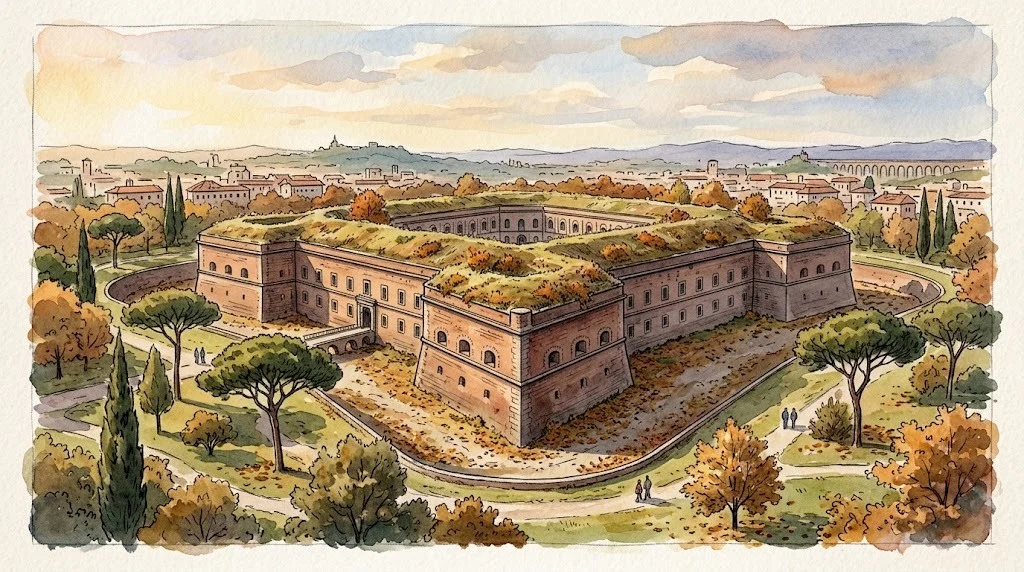
Forte Bravetta is at Via di Bravetta 739-741, in Municipio XII, between Via Aurelia and Via Portuense. The fort and the green area belong to Roma Capitale: the Parco dei Martiri di Forte Bravetta has free entry and the city's tourism portal lists it as open from morning to sunset. The inside of the fort, that is, the parade ground, moat and casemates, can be seen only in the guided tours by booking that the city announces from time to time.
The fort belongs to the Entrenched Camp, the ring of 15 forts and three batteries built around Rome between 1877 and 1891. As a military work it aged almost at once. Its real story is another: from 1932 to 1945 death sentences were carried out here, first those of the Fascist Special Tribunal, then those of the German courts during the occupation, finally those against the Fascist leaders after the liberation of the city.
The practical information, that is, address, park opening, booking channels and bus lines, comes from the official sources consulted on September 28, 2026: the tourism portal of Roma Capitale, the program of Municipio XII for the Resistance Festival, the pages of RomaNatura, as well as the historical documents of the ANPI and the ANFIM cited further on. The visits inside change calendar every year: before setting out call 060608 and ask if there are dates scheduled.
Where it is and what you really see
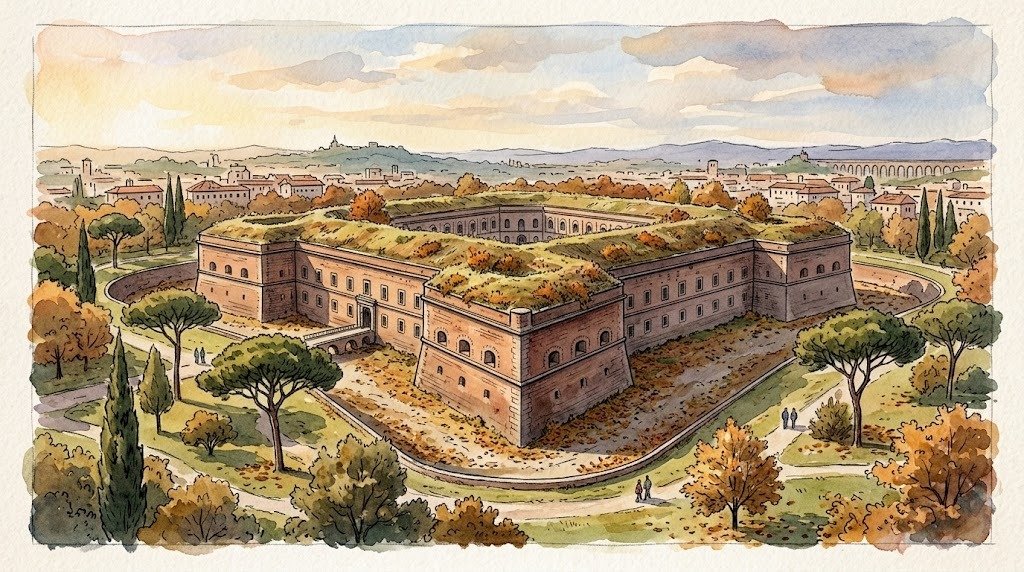
The fort occupies a plateau in the Gianicolense suburb, inside the residential neighborhood that takes its name from the street. Historical reconstructions give it a surface of a little more than 10 hectares, and the park that surrounds it has similar dimensions: the city's tourism portal speaks of about 11 hectares, included within the boundary of the Valle dei Casali Nature Reserve. From outside it looks like a wooded hill. It's an earthwork, built on purpose not to be seen.
From the park, without booking anything, you walk along the outer perimeter and understand the shape: embankments covered with trees, the moat that runs around, the air vents of the underground rooms, the sentry boxes, the guardhouse at the entrance. The monument with the names of the executed stands right at the entrance, and it's the first thing you see arriving from Via di Bravetta. Stop there before everything else, not after.
The park has the services of a neighborhood park, and the city's portal lists them: restrooms, nature trails, bike paths, outdoor exercise equipment, a dog area and play equipment for children. You'll find people running, families, elderly people on benches. It's not a lack of respect. It's the choice the city made: to keep memory inside everyday life instead of shutting it behind a gate.
Inside, with the guided tour, you enter the parade ground and follow the ring of the old defensive moat. The route announced by the city measures about a kilometer, is easy, and touches the military structures, the informational plaques devoted to the martyrs and the spot of the executions. The length given for the 2025 tours was about two hours, with groups of up to 40 people.
What you don't see: a museum. In 2011 a museum of memory was announced in the fort's buildings, but as of the date of checking an exhibition venue with its own hours doesn't appear on the city's channels. The interior rooms stay closed outside the tours. Anyone who arrives expecting rooms with display cases, panels and audio guides finds instead a place that speaks almost only through the voice of whoever accompanies you.
The neighborhood around grew mainly in the second postwar period, with small apartment buildings and public housing that filled the countryside between Monteverde and Portuense. In the years of the occupation, instead, the fort was still isolated among vineyards and farmhouses. Keep that in mind when you read the testimonies of the time: those brought here crossed open fields, not city streets, and the neighborhood you see around today didn't yet exist.
A curiosity about Forte Bravetta
Very many people have already seen Forte Bravetta without knowing it. In the finale of Rome, Open City, Roberto Rossellini's film, the priest Don Pietro is shot on the outskirts of the city, in front of the neighborhood boys. That scene recalls the death of Don Giuseppe Morosini, shot here on April 3, 1944. The character played by Aldo Fabrizi is one of the best-known portraits of the Roman Resistance.
The character, though, is not just Morosini. The reconstructions describe him as a blend of two Roman priests of the Resistance: Morosini, precisely, and Don Pietro Pappagallo, who was killed at the Ardeatine Caves on March 24, 1944. The name recalls the second, the death before the firing squad the first. Anyone who also visits the Ardeatine Caves Mausoleum finds the other half of that figure.
Of Morosini's real story the documents say this. Born in Ferentino in 1913, ordained a priest in 1937, a military chaplain, after September 8 he helped the Resistance. He was arrested in Rome on January 4, 1944 after a tip from an informer of the German police, held at Regina Coeli, sentenced to death by a German court on February 22. He was awarded the Gold Medal of Military Valor posthumously in February 1945.
My suggestion is to watch the film again before coming, and to forget it as soon as you enter. Cinema did enormous work for the memory of this place, but it also concentrated on a single face a story that has dozens. Most of the names carved at the entrance never had a film, a stamp or a square. Reading them one by one, in silence, is the right way to restore the proportions.
One thing nobody tells you about Forte Bravetta
The public account of the fort focuses on the nine months of the German occupation, and it is right to do so. What is said less is that the same place served for three different seasons of the death penalty in Italy. First the Fascist regime, with the Special Tribunal for the Defense of the State. Then the German military courts. Then, after June 4, 1944, the justice of liberated Italy against those who had collaborated with the occupier.
The first documented executions date to June 17, 1932: the republican Domenico Bovone and the anarchist Angelo Sbardellotto, sentenced by the Special Tribunal for planning attacks against Mussolini. In January 1943, with the war under way, Laura D'Oriano was shot here, an agent of the British secret service, who according to the research of the local ANPI is the only woman sentenced to death by the Special Tribunal and actually executed.
After the liberation the embankment went back to being used. On September 22, 1944 Pietro Caruso was shot, police chief of Rome during the occupation, sentenced for his role in preparing the Ardeatine massacre. On June 5, 1945 it was Pietro Koch's turn, head of the special police unit responsible for the torture of resistance fighters. The ANFIM's historical booklet counts 10 executions of this period, all of people convicted of crimes tied to Fascism and the occupation.
A useful clarification, because the confusion circulates. The last death sentences carried out in Italy were not carried out at Bravetta. On March 4, 1947, at the Basse di Stura shooting range in Turin, the three convicted of the Villarbasse massacre were shot, an ordinary crime. The next day, March 5, in La Spezia, the last three sentences for crimes of the Fascist period were carried out. The Constitution came into force on January 1, 1948.
Lined up, the story of Bravetta is therefore the story of the whole capital punishment of 20th-century Italy in a single courtyard of earth. The regime used it against opponents, the occupier against resistance fighters, liberated Italy against those responsible for the massacres, then it stopped for good. Anyone who comes here only for the page of 1944 loses half the meaning of the place. Ask the guide: the answer is usually long.
The Entrenched Camp, in concrete terms
The system was born with a decree of 1877, a few years after Rome became the capital. The city's tourism portal describes it like this: 15 forts and three batteries, built between 1877 and 1891, on a ring of about 37 kilometers, about four kilometers from the Aurelian Walls and about three kilometers from one another. Back then they were in open countryside. Today the city has swallowed them all.
The 15 forts are Monte Antenne, Pietralata, Tiburtina, Prenestino, Casilina, Appia Antica, Ardeatina, Ostiense, Portuense, Bravetta, Aurelia Antica, Boccea, Braschi, Trionfale and Monte Mario. The batteries are Appia Pignatelli, Porta Furba and Nomentana. Bravetta was built between 1877 and 1883, so in the first phase, and guarded the western sector between Via Aurelia and Via Portuense, that is, the approaches from the sea.
The form is that of all the forts in the system: a central parade ground, embankments all around, barracks for the troops, ammunition stores and powder magazines dug underground, gun emplacements, the outer moat. Works designed to absorb artillery, not to show themselves. From the construction point of view the easiest to understand remains Forte Antenne, inside Villa Ada.
Now a contrarian position. The Entrenched Camp is often told as a masterpiece of military engineering. It wasn't. The new artillery made it obsolete right around its completion, and the system was decommissioned from 1919 without ever having defended the city from anyone. It was a big public investment that arrived late on the technology of its time.
The value of the forts, today, is measured by what happened afterward. Some became barracks, some warehouses, some parks, some were occupied and turned into social centers. Bravetta took the hardest road, that of a place of execution, and then that of an ammunition depot. Anyone who wants to understand the relationship between the army and the city has in the Infantry Historical Museum a good starting point.
The advice I give you for visiting Forte Bravetta
Come on a Sunday with a guided tour, not on April 25. I know it sounds odd. Liberation Day is when the fort fills up, and that's perfectly fine: there's the ceremony, the wreath, the choirs. But for a first visit, to understand the space and read the names calmly, you need an ordinary morning with a small group and a guide who has time to answer.
Call 060608 and ask if there are tours on the calendar. The number is the tourist contact center of Roma Capitale, and for the 2025 tours it answers every day from 9:00 to 19:00. For the days of the 2026 Resistance Festival, Municipio XII used instead the address fortebravetta.visite@gmail.com. Have the meeting point, time and length confirmed, because they change from one cycle of tours to the next.
Arrive 20 minutes early and do the outer loop on your own first. The perimeter of the park gives you the scale of the work, and when you enter the parade ground you already know where you are. Then stop in front of the monument at the entrance and count the names. It sounds like a school exercise. It isn't: the number changes depending on the sources, and understanding why is half the visit.
Closed shoes, always. The route is easy but it's on packed earth and grass, and after rain the bottom of the moat turns to mud. In summer bring water: the park has trees, but the exposed stretches on the parade ground at noon are hard. In winter, early in the morning, the dampness of the moat gets into your bones. An extra jacket weighs nothing.
One last thing on behavior, and I don't say it for rhetoric. The spot of the executions is marked. You don't sit on it, you don't pose on it, you don't make videos with music. For many Roman families this is the place where a relative died. The rule you would use in any cemetery applies: low voice and phone in your pocket.
If you can, prepare at home with a short reading. The ANFIM booklet on those executed at Forte Bravetta can be downloaded free from the association's website and lines up dates, names and groups of affiliation. Arriving knowing who the 11 of Bandiera Rossa were or who Laura D'Oriano was changes the visit: in front of the monument you will no longer see a list, you will see people with a trade, an age and a neighborhood they came from.
How to get in: hours, tours, costs
The park is free and open to everyone. The tourism portal of Roma Capitale lists opening from morning to sunset, without a time down to the minute: in practice the gates follow the light, later in summer, earlier in winter. No booking is needed, there are no tickets and no advance sales. Anyone who offers you a paid ticket to enter the park is selling you something that is public.
For the inside of the fort the only channel is the public one: the 060608 contact center or the dedicated address that Municipio XII lists from time to time, such as fortebravetta.visite@gmail.com for April 25 and 26, 2026. No fee appears in the programs published by the city. There are no resale products dedicated to this place on the big tour portals, and it makes no sense to look for them: the visit is a civic service, not a commercial attraction.
In 2025 the tours were included in the Unexpected Itineraries of Rome, a program of Roma Capitale funded by the Ministry of Tourism to bring visitors outside the center. The published calendar ran from June 8 to December 14, 2025, with a meeting at 10:00 at Via di Bravetta 739-741, a route of about a kilometer and groups of up to 40 people. For December 7 two shifts were announced, at 10:00 and 10:30.
On April 25 and 26, 2026 Municipio XII organized the Resistance Festival at the Parco dei Martiri, with free entry. The published program included on April 25 the laying of the wreath at 12:15 with Mayor Roberto Gualtieri, the choirs, a guided visit to the fort at 13:00, and on April 26 a visit at 10:00, workshops for children and concerts until 21:00. The 2027 program is not yet published.
For everything you can't find online there are two official contacts: 060608 for tours and tourist information, and the presidency of Municipio XII, presidenza.mun12@comune.roma.it, for initiatives in the park. For excursions in the surrounding reserve the reference is RomaNatura at escursioni@romanatura.roma.it. The operator doesn't publish a fixed annual calendar: dates come out a few weeks in advance.
Another well-known fact, yet rarely cited
On February 2, 1944, 11 militants of the Communist Movement of Italy, the underground group known as Bandiera Rossa, were shot here. They had been sentenced by the German field court in Rome on January 27 for attempted acts of violence against the occupying troops. Among the charged actions was the distribution of anti-Fascist leaflets in Roman movie theaters in December 1943. The date is recalled by the provincial ANPI of Rome.
The well-known fact is the German sentence. What is rarely cited is who carried it out. According to the reconstruction published by the ANPI of Rome, the German command entrusted the shooting to an Italian platoon of the Italian Africa Police, under the command of a colonel. Italians shooting Italians on the occupier's orders: it's the part of Rome's story that the narrative of the good Roman people tends to leave out.
The second rarely cited fact concerns the postwar period. When the war ended, the fort did not immediately become a place of memory. It stayed with the army and was used for decades as an ammunition depot, closed to the public. For decades the memory of the place was left to the monument, the partisan associations and the families. The handover to the city and the opening of the park come only in the new century.
On the opening date the sources don't agree. The encyclopedia entry on the fort places the inauguration of the Parco dei Martiri in September 2009, with 10 hectares, while the city's tourism portal speaks of a reopening in 2011. It probably concerns two different moments of the same operation. The meaning doesn't change: for more than 60 years the most painful place of the Roman Resistance remained inside a military area.
One last observation on who fell here during the occupation. The ANFIM booklet lists militants of Bandiera Rossa, of the Patriotic Action Groups, of the Action Party and of the Clandestine Military Front, that is, the officers and soldiers who stayed loyal to the legitimate government after September 8. Communists, members of the Action Party, monarchists in uniform. The fort puts on the same embankment a Roman Resistance far more varied than partisan memory has told for decades.
The right photo to take at Forte Bravetta
You take the right photo in the moat, during the tour with the guide. Stand in a curved stretch and shoot the passageway that disappears behind the wall of earth, with the trees growing on top of the embankment. It's the image that explains the fort better than any plan: an excavated architecture, made to hide. It works in vertical, with the low morning light coming in sideways between the trunks.
The second image is the monument with the names, at the entrance. Photograph it without people in front and without yourself in the frame. Get close enough to make the carved lines legible: a photo in which the names can be read is worth more than 10 overall shots. On commemoration days avoid shooting close-ups of family members and the elderly people laying flowers, unless they ask you to.
The third shot is a landscape. The park's trees are a real part of the visit: the city's program mentions wild lindens, black locusts, downy oaks, and then olive and almond trees that come from the old countryside. In spring the almond trees in bloom in front of the dark mass of the embankments give a sharp contrast. The right spot is the edge of the park, on the side that looks toward the valley.
What you don't do: climb the embankments for the view from above, go into closed openings, climb over fences to frame the parade ground when there's no tour. The structures are almost 150 years old and the routes were designed for those who stay on the path. Leave the drone at home, in an urban area and in a place of memory. The best photo, here, is always the one taken from the ground.
How to get there
By public transport the tourism portal of Roma Capitale lists ATAC lines 98, 786 and 889, which serve Via di Bravetta. There is no metro nearby, and from Termini Station you need at least one change and a time that depends a lot on traffic on Via Gianicolense. The concrete advice is to set up the route on the ATAC app or website the evening before, with the address of Via di Bravetta 741 as the destination.
By car you reach Via di Bravetta from Via Aurelia Antica or from the Monteverde area, with narrow residential streets that are busy at rush hours. The city doesn't list a parking lot dedicated to the park. You park on the street in the surrounding roads, with the patience needed in a neighborhood of houses. Saturday morning is the worst moment, Sunday morning the best.
By bicycle the most sensible link passes through the avenues of Villa Doria Pamphilj and the Valle dei Casali, which the encyclopedia entry on the reserve describes as the ideal continuation of the villa. Inside the fort's park the city lists bike paths. Between the villa and the fort the stretch on the road remains, and the roadways of the sector have no continuous protected lanes.
RomaNatura, for the excursions it organizes in the reserve, lists as the meeting point the circular parking lot in front of number 283 on Via del Forte Bravetta, a different street from Via di Bravetta even if the name confuses. If you take part in one of those outings, check carefully which of the two addresses they gave you. Anyone who gets the street wrong loses half an hour circling the valley.
Some important events that happened here in history
In 1877 a decree launches the Entrenched Camp of Rome. Bravetta is built between 1877 and 1883, in the western sector, guarding the roads that arrive from the sea. Historical reconstructions place the fort over the remains of a Roman villa attributed to Lucio Fabio Pollione, an attribution that is repeated in local sources but that no document visible to the public on site allows you to check.
On June 17, 1932 the fort becomes a place of execution. The Special Tribunal for the Defense of the State sends Domenico Bovone and Angelo Sbardellotto before the firing squad. The historical booklet published by the ANFIM counts 37 executions between 1932 and 1942. On January 16, 1943 Laura D'Oriano is shot.
After September 8, 1943 the Germans occupy Rome. According to the encyclopedia entry, between October 11, 1943 and June 3, 1944 partisans and soldiers sentenced by the German courts are shot at Bravetta, on the orders of Herbert Kappler's security police. On December 30, 1943 the anarchist Riziero Fantini dies. On February 2, 1944 the 11 of Bandiera Rossa fall. On April 3, 1944 Don Giuseppe Morosini is shot.
On June 3, 1944, the day before the Allies enter the city, the last shootings of the occupation are carried out here. The city's portal recalls the six patriots killed that day, the encyclopedia entry counts seven. On June 4 Rome is free. At Bravetta the liberation arrives literally one day late for the lives of those men.
On September 22, 1944 the former police chief Pietro Caruso is shot, on June 5, 1945 Pietro Koch. They are two of the postwar executions, 10 in all according to the ANFIM, ordered against those responsible from the Fascist period and the occupation. Then the fort goes back to the army, which uses it as an ammunition depot. The death penalty for ordinary and peacetime military crimes leaves the legal system with the Constitution of 1948.
At the end of the 1960s the monument with the names of the fallen is placed at the entrance. On the date the sources don't agree: the encyclopedia entry lists 1967, the ANFIM booklet speaks of a marble plaque of 1970. It may be two distinct interventions. The monument carries 77 names, a figure that the city's portal repeats and that historians debate.
In the new century the fort passes to Roma Capitale and the area becomes the Parco dei Martiri di Forte Bravetta, with the inauguration placed in 2009 and the reopening in 2011. In 2025 the site enters the Unexpected Itineraries of Rome, with guided tours from June to December. On April 25, 2026 the mayor lays the wreath during the Resistance Festival organized by Municipio XII.
Who has passed through Forte Bravetta
Domenico Bovone and Angelo Sbardellotto, on June 17, 1932. The first a republican, the second an anarchist, sentenced by the Special Tribunal for planning attacks on the life of the head of government. They are the first two names in the fort's history as a place of execution, and they open a season that will last 13 years.
Laura D'Oriano, shot on January 16, 1943. Born in Istanbul to Italian parents, recruited in Paris by the British secret service, she was sent to Italy at the end of 1941 to gather information on military ships and on the shipyards of Genoa and Naples. The research published in 2025 by Ugo Fanti, president of the ANPI Aurelio-Cavalleggeri section, lists her as the only woman sentenced to death by the Special Tribunal and shot.
Riziero Fantini, from Abruzzo, an anarchist, emigrated to America, a friend of Sacco and Vanzetti, a contributor to libertarian newspapers. Shot on December 30, 1943. His death at Bravetta was established only in 2020, according to the association Stampa Romana, which remembers him together with two other journalists who fell here. It's a good example of how the list of the executed is still open work, not a closed list.
Ezio Malatesta and Carlo Merli, shot on February 2, 1944 with the other nine of Bandiera Rossa. Malatesta was a teacher, had edited a film and theater magazine and wrote for the movement's underground newspaper. He was awarded the Gold Medal of Military Valor posthumously. Merli, from Milan, had passed through the German prison on Via Tasso, today the Historical Museum of the Liberation.
The other nine of that February 2, according to the list published by the provincial ANPI of Rome, are Romolo Iacopini, Filiberto Zolito, Branko Bitler, Gino Rossi, Ettore Arena, Quirino Sbardella, Augusto Paroli, Benvenuto Badiali and Ottavio Cirulli. The youngest, Ettore Arena, was 21. The oldest, Gino Rossi, 50. We put them in full because the names are the only thing this place really has to show.
Don Giuseppe Morosini, a priest from Ferentino, military chaplain, shot on April 3, 1944 after a conviction for spying in favor of the Allies. In national memory he is the priest of Rome, Open City, and this has made him the best known of those who fell at Bravetta, often at the expense of the others.
On the other side, Pietro Caruso and Pietro Koch, shot here after the liberation. The first had headed the Rome police headquarters during the occupation and had been sentenced for his role in the Ardeatine massacre. The second had commanded the special police unit responsible for the torture of captured resistance fighters. Their names on the register of the same fort close the circle, and history remembers it without need for comment.
The names and numbers of memory
How many were shot at Forte Bravetta? The honest answer is that the sources don't agree, and that the differences have precise reasons. The monument at the entrance carries 77 names referring to the occupation, and the city's portal repeats that figure. The encyclopedia entry on the martyrs speaks of 68 soldiers and partisans. The ANFIM counts 69. The association Stampa Romana writes of about 74 executions, 66 of them of partisans.
The reasons for the difference are known to historians. The carved list contains names repeated by transcription error and includes some people convicted of ordinary crimes, who were not partisans but were shot in the same period. Other names, like that of Riziero Fantini, emerged only with recent research. A stone list made in the 1960s couldn't know what the archives have given back since.
On the total for the whole period from 1932 to 1945 the gap widens. The ANFIM booklet adds up 116 executions: 37 under the Special Tribunal, 69 during the occupation, 10 after the liberation. The ANPI Aurelio-Cavalleggeri research published in 2025 speaks of more than 100 shootings, with an estimate of 103. They are compatible orders of magnitude, not identical figures, and here we report them all.
Anyone who wants to read the complete lists has three ways. The ANFIM booklet on those executed at Forte Bravetta, published in 2023, is the most orderly collection. The museum on Via Tasso holds documents on many of the prisoners who passed through there before the execution. The House of Memory and History in Trastevere hosts the archives of the Roman Resistance associations.
A note on method that applies to all places of memory. When you find a round number, be wary. When you find a precise number, ask who counted it and when. The numbers of Bravetta have been corrected several times, and each correction gave a name back to a family. For a general picture of the city it's best to start from our guide to the places of memory in Rome.
The park and the Valle dei Casali
The Parco dei Martiri is included in the Valle dei Casali Nature Reserve, established in 1997 and managed by the regional body RomaNatura. The reserve covers a plateau that slopes toward the Tiber between the Gianicolense and Portuense neighborhoods, with hills and ditches, and the pages of the Lazio parks describe it as one of the last strips of the agricultural landscape of the Roman countryside inside the city.
Inside the reserve are historic buildings that many Romans have never seen: Villa York, from the 1700s, Villa Consorti, the Buon Pastore complex designed by Armando Brasini, and Torre Righetti, a hunting lodge that looks over the Tiber valley. Forte Bravetta is its best-known edge, the one with the heaviest history. The rest of the valley tells another Rome, made of vineyards, farmhouses and landowners.
The vegetation mixes pines, maples, palms, poplars and willows with the olive and mulberry trees of the old agriculture. Among the animals reported are hedgehogs, foxes, weasels, kestrels and buzzards, and in recent years colonies of parakeets. Early in the morning, in the meadows around the fort, it's not rare to see a bird of prey above the embankments. It's one of the things the city's guided tours put together with the history.
RomaNatura organizes excursions in the reserve, by booking at escursioni@romanatura.roma.it, and announces them on its website. They are nature outings, not visits to the fort, but they help you understand why a piece of countryside survived right here: the military restrictions around the fort kept construction away for decades. The ammunition depot, paradoxically, protected the green. This is an interpretation, not an archive fact.
The natural link is with Villa Doria Pamphilj, one of the largest historic parks in the city, which the reserve continues toward the south. Anyone with a whole morning can enter the villa, exit on the valley side and reach the fort on foot, remembering that between the two green stretches there remains a piece of road without a continuous sidewalk.
When is it closed and what not to expect
The park closes at sunset and reopens in the morning. The inside of the fort is closed on all days when there isn't a scheduled visit, that is, almost always. Showing up at the gate of the parade ground without booking means staying outside. On days of heavy rain the tours may be canceled, and the city doesn't always give a make-up date: ask at the time of booking.
Don't expect museum services. There is no ticket office, no bookshop, no audio guides or multilingual panels along the whole route. The internal informational plaques are in Italian. The city lists no refreshment points inside the park on ordinary days, while on the April holiday days the program included food stalls. Bring with you what you need.
On accessibility, the visit route is described as easy and about a kilometer, on natural ground. The tourism portal refers to the Roma Accessibile section for specific information, and a complete accessibility statement for the internal route doesn't appear to be published. Anyone using a wheelchair or with mobility difficulties should ask 060608 which stretches are passable, especially after days of rain.
Don't expect the spectacle of other forts either. Bravetta has no murals of a social center, no concerts every evening, none of the charm of abandonment that attracts urban photographers. It's a sober, green, silent place. Its strength lies entirely in the history that runs through it, and if you don't know it before arriving you risk seeing just a neighborhood park.
A practical tip on the season. Spring, with the almond trees and green meadows, and autumn, with the low light and the leaves of the lindens, are the best moments for the park. The Roman summer on the parade ground is hard in the middle hours, and the city tours start in the morning anyway. In winter the short days reduce the useful time in the park, which closes at sunset.
Eating in the area
Bravetta is a residential neighborhood, and around the park the food is that of the people who live there: neighborhood bars, pizza-by-the-slice shops, a few trattorias with regular customers. Tourist traps here are rare, because tourists are rare. The problem comes back if you end the morning by heading down toward Trastevere or the Janiculum, and that's where it pays to keep your eyes open.
First sign: the menu with photos of the dishes, translated into five languages and laminated. A place that has to show you the picture of an amatriciana is talking to people who have never eaten it. Second sign: the lady rolling out pasta dough in the window or on the sidewalk. It's theater, not a guarantee. Serious fresh pasta is made in the morning, in the kitchen, away from car exhaust.
Third sign: the person at the door who stops you to invite you in. A place that has to get its customers on the street has no regular customers. The same goes for kitchens open without a break from noon to midnight: a real kitchen has a pause, because the crew has to prep. Fourth sign: items without a price, the fish of the day at a figure to be asked, a different menu between the inside room and the outside tables.
Places in front of monuments tend to adjust the bill to the customer, and signs repeated identically in five squares work as attractions, not as trattorias. They are convenient and predictable, and anyone traveling with tired kids picks them for good reasons. It's simply that Romans don't go there, because they know that 300 meters away, on a street without a view, you eat better and spend less.
The criterion is to look at who is sitting. If at 14:00 on a weekday there are office workers, laborers and neighborhood families, you've found it. To avoid trial and error, here is our list of the places where we eat, in Rome and the surroundings, updated when places change and without sponsorships of any kind.
What to combine in a day
The most sensible day is a route of memory. In the morning the fort, then the Historical Museum of the Liberation on Via Tasso, where many of those shot at Bravetta were held before trial, and in the afternoon the Ardeatine Caves Mausoleum. They are three places that explain one another, and seen on the same day they give the measure of the nine months of the occupation.
Anyone who prefers a day on foot on the western side can combine the fort with Villa Doria Pamphilj, then go down to the Janiculum passing by the Acqua Paola Fountain and San Pietro in Montorio. There memory changes century: the Janiculum Ossuary Mausoleum and the Museum of the Roman Republic tell of 1849.
The link between the two moments is geographic: the Janiculum and Bravetta tell, a century apart, how Rome was defended and occupied from its western side. From there you can finish at Villa Sciarra, in Monteverde, or go down toward Trastevere, where the House of Memory and History keeps the papers of the partisan associations.
For anyone following the trail of the Resistance in the rest of the city, the stops are Porta San Paolo, where fighting took place on September 10, 1943, the Quadraro of the roundup of April 1944, the Jewish Ghetto with the memory of the raid of October 16, 1943. Anyone who wants the comparison with another fort of the Entrenched Camp should go to Forte Antenne, inside Villa Ada.
If instead you're in the city for the industrial and urban Rome of the 20th century, the same southwest sector connects to the Gasometer, the former River Port and the Necropolis of Via Portuense. For another page of Rome's 20th century there is the Sapienza University City, and on Sunday morning the Porta Portese market is on the way back.
Frequently asked questions
Can you visit Forte Bravetta?
The park around the fort, the Parco dei Martiri di Forte Bravetta, is public and free to enter from morning to sunset. The inside of the fort, with the parade ground and the moat, can be visited only in the guided tours that Roma Capitale and Municipio XII schedule from time to time, by booking at 060608 or at the address given in the program of each initiative.
How much does it cost to enter?
Entry to the park is free and requires no booking. In the guided tour programs published by the city for 2025 and for the 2026 Resistance Festival no fee appears, and the Festival of April 25 and 26 had free entry. Be wary of anyone selling tickets for this place: the only channel is the city's public one.
Where exactly is the entrance?
The main entrance to the park is at Via di Bravetta 739-741, in Municipio XII, in the sector between Via Aurelia and Via Portuense. The monument with the names of the executed is right at the entrance. Be careful not to confuse Via di Bravetta with Via del Forte Bravetta, a different street used by RomaNatura as a meeting point for excursions.
How many people were shot at Forte Bravetta?
The sources don't agree. The monument lists 77 names tied to the German occupation, while historical research counts between 68 and 74 executions between October 1943 and June 1944. For the whole period from 1932 to 1945, ANFIM adds up 116 executions, and the local ANPI speaks of more than a hundred. The lists have been corrected several times.
Were the last death sentences in Italy carried out here?
No. The last capital executions in Italy took place on March 4, 1947 at the Basse di Stura shooting range in Turin, for the Villarbasse massacre, and on March 5, 1947 in La Spezia, for crimes of the Fascist period. Among the last documented executions at Forte Bravetta is that of Pietro Koch, on June 5, 1945, after a sentence by the High Court of Justice.
How do you get there by public transport?
The tourist portal of Roma Capitale lists ATAC bus lines 98, 786 and 889, which serve Via di Bravetta. There are no subway stations nearby, so from the center you need at least one transfer. It's best to plan the route with ATAC's official tools the day before, keeping in mind the traffic on Via Gianicolense at rush hour.
When are the commemorations held?
The most recent documented date is April 25, 2026, when the wreath-laying with the mayor of Rome took place at 12:15, as part of the Festa della Resistenza of Municipio XII. The provincial ANPI also marks the anniversaries of the individual shootings, such as the one on February 2, 1944. The program for 2027 has not been published yet.
Is the fort suitable for a visit with kids?
The park has playgrounds, lawns and easy paths, and the guided visit covers about a kilometer without difficulty. The content, though, is serious and concerns executions and war. It works well with kids from middle school up, better if they've been prepared beforehand with the story of the occupation of Rome, and the City's guides know how to adapt the tone for school groups.
Who wrote this page
This page comes from the editorial team of Tour Leader Pro, the Rome-based company that designs itineraries, tours and cultural events in Rome and Lazio. The dates, contacts and visiting arrangements given here come from the official sources cited in the text, as of the date stated at the top. Since this is a site with occasional openings, double-check everything before you set out, and let us know what you find has changed.
Lining up a day at sites of memory means fitting together visits by reservation, museums with reduced hours, suburban buses that thin out on Sundays, and the respect that places like this demand, for yourself or for a class of 30 kids. If you face this kind of work, on Tour Leader Pro you'll find materials designed for people who lead groups and for people who organize on their own.
For the bigger picture, meaning regional trains and seasonal schedules, airports, trips between one province and another and destinations in Lazio outside the center of Rome, from the Castelli to the volcanic lakes of the north, down to the Tyrrhenian coast and the villages of the interior, a useful resource for putting together a multi-day itinerary is Italy Planner.