Villa Sciarra
In short. Villa Sciarra is a public park in Rome that stretches over the slopes of the Janiculum, at the point where the hill descends toward Trastevere on one side and toward Monteverde Vecchio on the other, in the territory of Municipio I.
Villa Sciarra is a public park in Rome that stretches over the slopes of the Janiculum, at the point where the hill descends toward Trastevere on one side and toward Monteverde Vecchio on the other, in the territory of Municipio I. The main entrances are on Via Calandrelli, Via Dandolo and Via delle Mura Gianicolensi, with the gate of Piazzale Wurts as the historic access and the one at Largo Mintilli as a secondary door toward Monteverde. According to the official listing of the City of Rome the park measures about 70,000 square meters, just under seven hectares, a small handkerchief of green compared with Villa Doria Pamphilj but dense with statues, fountains, rare trees and a history that spans 25 centuries. The very name of the park sums up three centuries of different owners, from the Barberini to the Colonna di Sciarra to the American Wurts, and it is precisely this layering of families and tastes that makes the visit more interesting than its modest size would suggest. Entry is free and access is on foot from three different sides of the hill, which makes Villa Sciarra a natural stop for those already visiting the Janiculum, the Acqua Paola Fountain or Villa Farnesina in Trastevere, and who want to end the day in a shady garden, away from traffic and from the crowd of the most beaten paths. Unlike much larger parks such as Villa Doria Pamphilj, Villa Sciarra can be walked in its entirety in barely an hour, which makes it a convenient stop to fit into a day that already includes other visits between Trastevere and the Janiculum, without having to give anything up for lack of time. It is also one of the few historic Roman parks where, on the same avenue, the visitor meets a pre-Roman sanctuary, the remains of an estate from the age of Caesar, a 19th-century battlefield and a sculptural collection imported from Lombardy: few other public gardens in the capital manage to bring together so many different eras on so contained a surface.
Where Villa Sciarra is and how to get there
Villa Sciarra occupies a south-facing slope of the Janiculum, between the ridge of the Mura Gianicolensi and the upper part of Trastevere, in a quiet residential area that few tourists cross unless they are headed precisely for the park. It has no metro station nearby: the closest stop on line B, Circo Massimo, is about 20 minutes' walk uphill, and the most practical choice for those arriving from the center is surface transportation or a walk down from the Janiculum.
By bus and tram to Villa Sciarra
ATAC bus lines 44 and 75 pass through the area of Viale Trastevere and Via Dandolo and are the most direct way to arrive for those who don't want to tackle the climb on foot from Trastevere. Those starting from Termini or the historic center can also rely on tram 8, get off near Viale Trastevere and continue on foot along Via Dandolo to the main entrance. The runs are regular in daytime hours, less frequent in the evening, and it's always worth checking the times on the ATAC app before going out, because frequencies change between the school period and summer.
On foot from the Janiculum and from Trastevere
Those already strolling on the Janiculum, perhaps after seeing the Fontanone and the terrace with the view over Rome, can go down toward Villa Sciarra following Via Garibaldi and then Via Dandolo or Via delle Mura Gianicolensi: it's a 10 to 15 minute descent that crosses a neighborhood of early 1900s villini, quiet and shaded. In the opposite direction, from Trastevere the most direct route starts from Viale Trastevere, goes up Via Dandolo and reaches the entrance on Via Calandrelli in about 20 minutes of walking, with a change in elevation you feel on hot days. The practical advice is to bring water if you choose this route in summer, because between Trastevere and the park entrance there are not many drinking fountains.
By car and parking nearby
Arriving by car is possible but it's not the best solution: the area is residential, with paid blue-line parking on weekdays and limited availability of spots, especially on weekends when residents and park visitors compete for the same spaces. Anyone coming from outside Rome by car would do better to leave it in one of the outer park-and-ride lots and finish the trip by public transportation, keeping their own car for a weekday off season, when finding a spot along Via delle Mura Gianicolensi becomes realistic.
By train to Trastevere station
Those arriving in Rome by train from outside the city can use Roma Trastevere station, served by regional lines and by some lines of the suburban rail network, and from there continue toward Villa Sciarra with a short bus ride or a longer walk through the neighborhood. It's a convenient option above all for those staying outside the historic center, perhaps in the Ostiense area or along the line to Fiumicino airport, and who want to reach the Janiculum without necessarily passing through the center of Rome. From Trastevere station the walk to Villa Sciarra takes about 25 minutes, mostly uphill, while with a bus from the area the time is noticeably reduced.
The history of Villa Sciarra, from the Barberini to the Wurts
Under the lawns of Villa Sciarra at least three different eras overlap, and understanding them helps you read the park differently as you cross it: a pre-Roman place of worship, a luxury estate from the age of Caesar, and finally the sequence of noble villas that gave the park the look it has today.
The sanctuary of the nymph Furrina and the Gardens of Caesar
Even before Rome, this strip of hill hosted a sanctuary dedicated to Furrina, an ancient Italic deity later demoted to nymph in the Roman tradition and tied to crossroads, fire, healing herbs and the cult of the dead: a sacred grove, a spring and a small temple formed a religious space that dominated this area for centuries. In the late Republican age the zone was absorbed into the Horti Caesaris, the estate that Julius Caesar bought around 49 BC to make of it, according to the ancient sources, a pasture for his sacred horses and then a representative suburban residence, enriched with columns, marbles, mosaics and frescoes with mythological subjects. The historiographic tradition holds that Caesar hosted Cleopatra in these very gardens during her Roman stays between 46 and 44 BC, even though the sources on the point remain indirect and the precise location of the buildings remains a matter of archaeological hypothesis more than documented certainty.
From Casino Malvasia to the Barberini
The more recent and better documented history begins in the 1500s. In 1549 the land passed to private owners, and in 1575 Monsignor Innocenzo Malvasia had the Casino Malvasia built there, a two-story building with a loggia that represents the first residential core of the future villa. In 1614 the property passed to Gaspare Rivaldi, contractor of the papal customs, and acquired growing importance when the construction of the Mura Gianicolensi ordered by Urban VIII transformed this area from an isolated suburban villa into a property inside the fortified perimeter of the city.
In 1647 Cardinal Antonio Barberini bought the complex, and the family kept it for over half a century, with an interlude between 1710 and 1740 during which the villa was carefully managed by Cardinal Pietro Ottoboni. The change that gave the park its present name occurs in the 1700s, when Cornelia Costanza Barberini marries Giulio Cesare Colonna di Sciarra: from that marriage descends the Colonna di Sciarra branch, which enlarges the property significantly and, in 1811, also incorporates the Orto Crescenzi, further extending the estate.
The damage of the siege of 1849
1849 marks one of the most dramatic pages in the history of the place. During the French siege of the Roman Republic, the fighting between Garibaldi's troops and General Oudinot's forces hit the Janiculum directly, and both the Casino Barberini and the Casino Malvasia were damaged in the clashes. The Barberini later restored the buildings, but the economic losses tied to those years contributed, together with other financial difficulties, to the gradual disposal of the property: between 1896 and 1902 Prince Maffeo Sciarra Colonna, in financial difficulty, found himself selling the lands surrounding the villa. Even today four interior avenues of the park bear the names of the fallen of that siege, among them the Belgian volunteer Adolfo Leducq, Paolo Narducci, Gustavo Spada, defender of nearby Villa del Vascello, and the Polish captain Giuseppe Wern. Other avenues instead recall female figures such as the writer Antonietta Klitsche de la Grange, the American journalist Margaret Fuller Ossoli, who tended the wounded during the siege, and the educator Rosa Vagnozzi.
George Wurts and Henrietta Tower
The chapter that made Villa Sciarra what we see today begins on May 15, 1902, when the American diplomat George Washington Wurts and his wife Henrietta Tower buy the property. Wurts, born in Philadelphia in 1843 and died in Rome in 1928, had behind him a long career in the US diplomatic corps, with posts in Madrid, Turin, Florence and Saint Petersburg, without ever reaching the rank of ambassador that he would have liked. Henrietta Tower, heir to a large family fortune, provided the means for a complete renovation of the villa in a neo-Renaissance key and for a total redesign of the gardens according to the eclectic taste of the early 1900s.
To the Wurts couple we also owe the Castelletto, a neo-Gothic building built between 1906 and 1910, and the arrangement of the entrances on Via Calandrelli begun in 1908. The couple introduced rare tree species from America and Asia, had a large iron aviary set up for raising white peacocks, so much so that the park was long nicknamed Villa of the White Peacocks, and enriched the gardens with 1700s statues and fountains bought from a Lombard villa, now the most recognizable feature of the whole park.
The donation to the State and the Institute of Germanic Studies
George Wurts dies in 1928. Left a widow, Henrietta Tower decides a few years later, in the early 1930s, to donate the villa to the Italian State with a precise condition: that it become a park open to the public. The donation, known at the time as a gift to the city of Rome, is still remembered by a plaque kept in the park. The main palace, the Casino Barberini, takes on a new purpose in the following years: it becomes the seat of the Italian Institute of Germanic Studies, a research body that still occupies the spaces of the villa on the Janiculum today, while the neo-Gothic Castelletto wanted by the Wurts hosts in more recent times the Museum of Mathematics. In April 1936 the German philosopher Martin Heidegger gave a lecture titled Hölderlin and the Essence of Poetry in these very spaces, one of the most cited cultural episodes in the recent history of the place.
The later 1900s and the public administration of the park
In the decades after the donation, Villa Sciarra enters permanently into the network of public parks managed by Italian institutions, first under state protection and then, for the daily management of the greenery and the paths, under the responsibility of the city administration of Rome. The surrounding neighborhood, which grew rapidly between the 1920s and the 1950s with the building of the villini of Monteverde Vecchio, ended up absorbing the villa into a residential urban fabric, transforming it from an isolated estate on the hill into a neighborhood park used every day by the people of the area, as well as an occasional destination for those visiting Rome and looking for a quieter alternative to the great historic gardens of the center. This double nature, a place of daily leisure for residents and a niche tourist destination, is probably the most characteristic trait of Villa Sciarra still today.
The 1700s statues and fountains that came from a Lombard villa
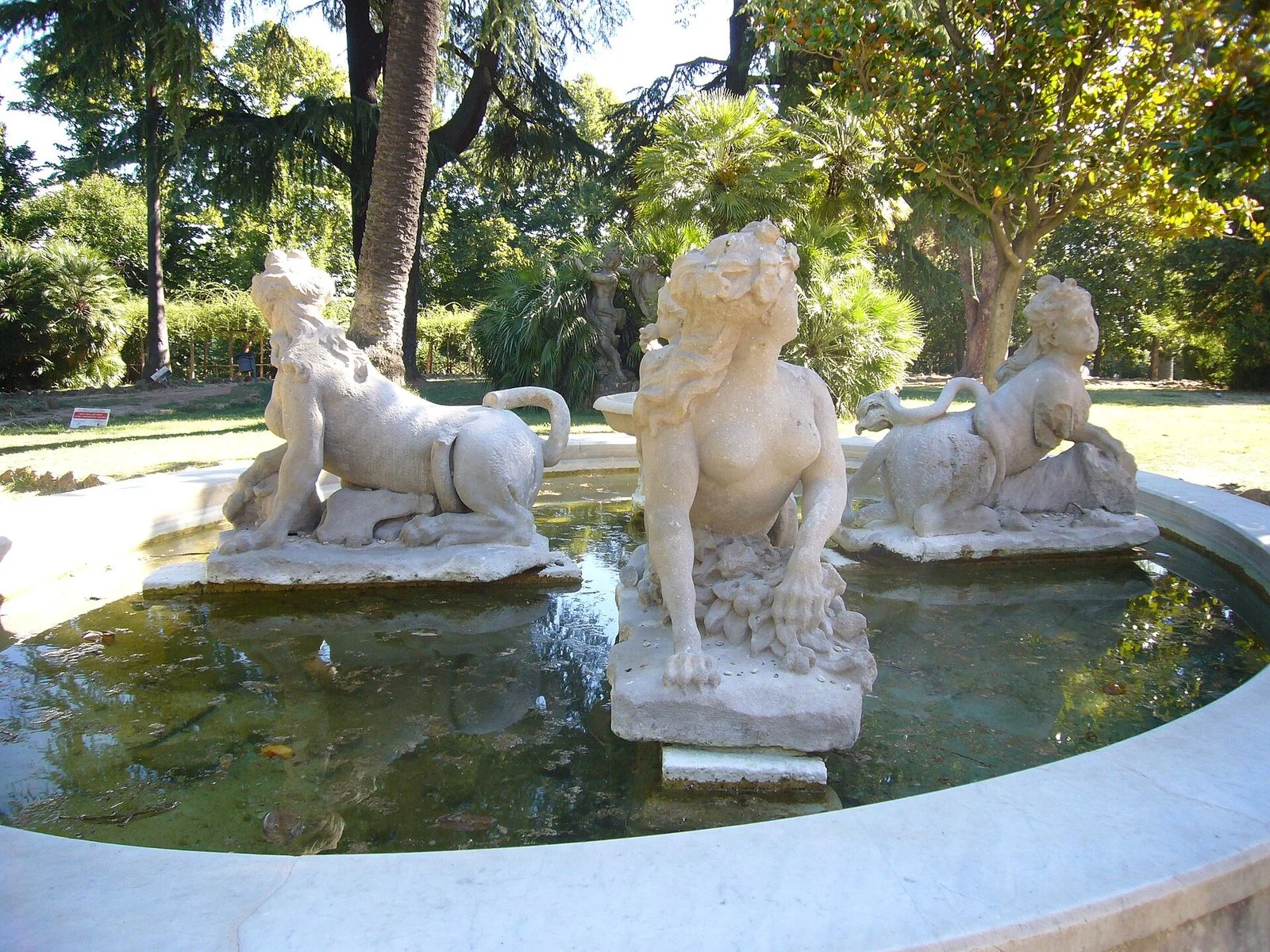
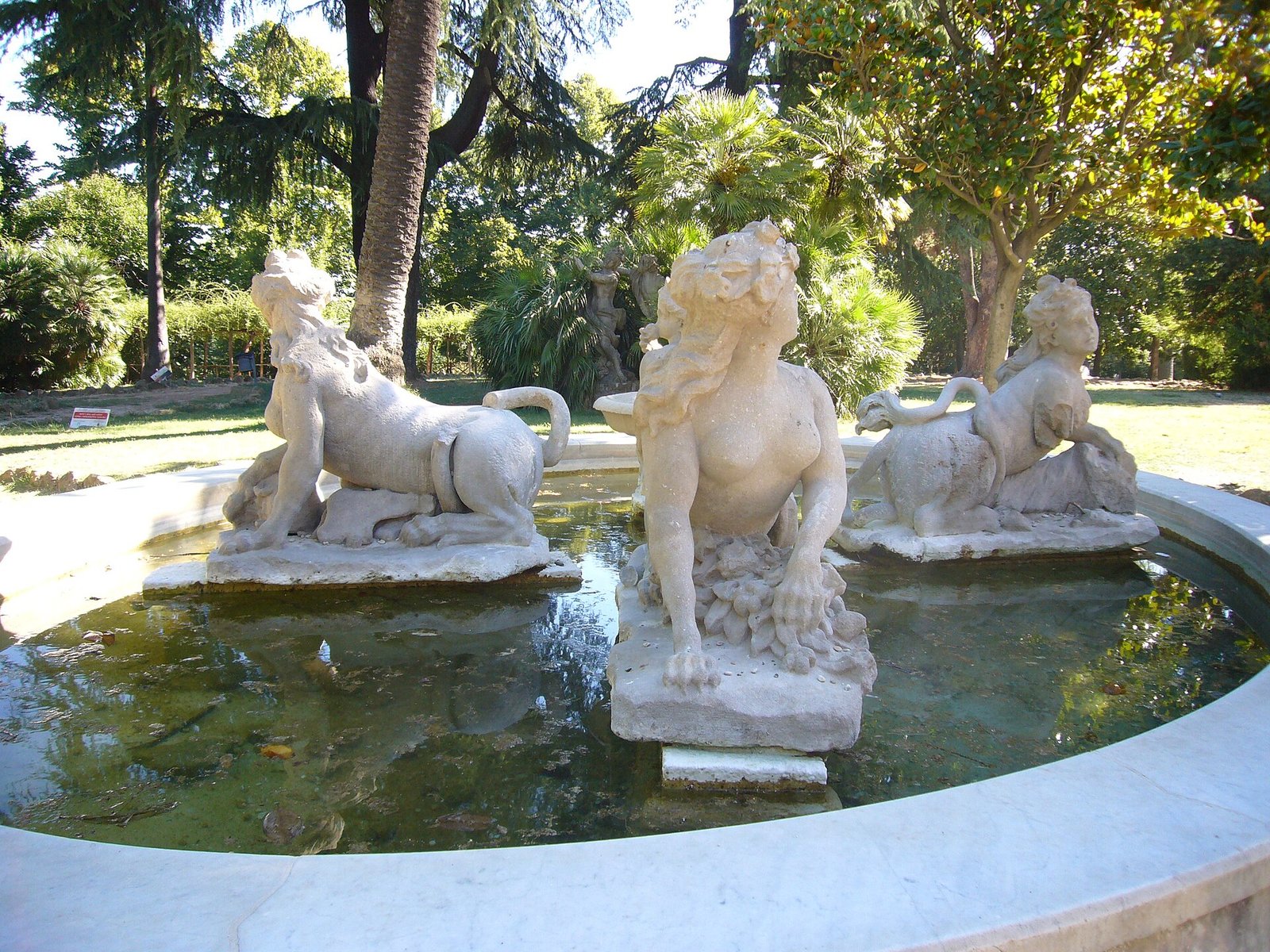
The most photographed feature of Villa Sciarra is not Roman by birth. The sandstone statues and fountains that dot the park's avenues came, at the wish of the Wurts couple, from a noble villa in Lombardy, the Visconti complex at Brignano Gera d'Adda, in the province of Bergamo, sold at auction at the end of the 1800s: George and Henrietta Wurts bought an entire 1700s sculptural set and moved it to Rome to enrich the gardens of their new property, in a gesture of collecting typical of the great transatlantic fortunes of the early 1900s.
The park's main fountains
Walking along the main avenues you often come upon a fountain before you have worked out where its water comes from, because the park's water system was originally designed for an effect of continuous surprise, typical of the eclectic gardens of the early 1900s. Among the best-known works are the Fountain of the Satyrs and the Fountain of Diana and Endymion, both of Lombard origin, the Sphinx Fountain, which depicts allegorically the four cardinal vices, and the Putti Fountain, located near the Casino Barberini. To these is added the Belvedere Fountain, a later work designed between 1910 and 1912 by the architects Enrico and Ugo Gennari on commission from the Wurts themselves, meant to dialogue with the eclectic style of the whole without being confused with the original 1700s pieces. There is no lack of a small fountain with an animal subject, the one of the tortoise, more discreet but loved by the children who come across it along the side paths.
The arboreal exedra and the statues of the 12 months
One of the most scenic corners of the park is the arboreal exedra, a semicircular space carved out within hedges pruned into an arch, in whose green niches are placed 12 statues representing the months of the year. It's a setting designed to be discovered on foot, walking slowly along the curve of the hedge, and it is probably the spot where the scenic component of the 19th-century garden can best be seen, even more than in the individual fountains scattered across the lawns.
The garden, the rare trees and the wisteria bloom
Villa Sciarra holds about 122 different tree species, of which 58 originate from America and Asia, as well as about 10 species of palms that live alongside the holm oaks, laurels and pines typical of Mediterranean Roman vegetation. It is a botanical garden more varied than its size lets you imagine, the result of the Wurts' passion for nature and of a century of maintenance by the administrations that have succeeded each other at the head of the park.
The mound and the wisteria pavilion
Heading up toward the highest point of the park, you come to the mound, an artificial rise enclosed by a screen of laurels with a marble fountain at its center, and right on this rise stands the wisteria pavilion, a small pergola structure designed from the start to be wrapped in the climbing branches of the plant. In spring, when the wisteria blooms, the lilac clusters hang down along the structure and turn that corner of the park into one of the most photographed spots for people looking in Rome for a less crowded alternative to the city's better-known gardens. The wisteria bloom depends on the temperatures of the season and changes slightly from year to year, but it typically falls between the end of March and the end of April. Anyone who wants to catch it at its best would do well to stop by several times during the spring, because one week can make the difference between closed buds and full bloom.
Topiary and the eclectic design of the garden
The overall design of the park, laid out with an eclectic taste in the early 1900s, alternates open lawns with topiary hedges, with geometric and figurative shapes that recall the ornamental taste of the country villas of the period. It is not a rigidly symmetrical Italian garden, but a set of different landscape episodes, joined by curving paths that invite you to stroll with no set direction, a layout that stands clearly apart from the more regular one of the Rome Botanical Garden, not far away on the other side of the Janiculum.
The wildlife and the old aviary of Villa Sciarra
An important part of the appeal of Villa Sciarra in the early 1900s came from the animals the Wurts kept in the gardens, and in particular from the white peacocks that gave the park the nickname by which it was known in the city. The large iron aviary the American couple had built to house these birds is still visible, though in worse condition than in its heyday, and it is one of the spots that best conveys the somewhat theatrical taste with which the American owners conceived the whole property, closer to a private zoological garden in the European taste than to a simple English park.
The birds of today among the branches of Villa Sciarra
Today the wildlife of the park is typical of the great historic gardens of Rome, dominated by blackbirds, tits and doves, and by the monk parakeets and rose-ringed parakeets that in recent decades have colonized a good part of the capital's greenery, including the highest branches of the pines and cedars of Villa Sciarra. If you walk in the early morning hours, when the park is less busy, you have a good chance of watching these birds up close, along with the squirrels that move easily among the trunks of the oldest trees.
It is not unusual, in a park with so many tall trees and thick hedges, to also run into hedgehogs and the occasional lone fox, especially in the evening hours when the number of visitors drops and the shyer animals come back toward the central lawns. This is not wildlife that is managed or monitored as in a true nature reserve, but the normal consequence of a large urban park, poorly lit in some outlying areas and surrounded by a residential fabric where, in recent decades, Rome too has seen a growing presence of wild species used to living alongside people.
The entrance at Piazzale Wurts and the minor architecture of the park
Many visitors walk through the main entrance at Piazzale Wurts without knowing that even that gate has a precise design history: the architect Pio Piacentini, a prominent figure of Roman architecture at the turn of the 20th century, designed the entrance on Via Calandrelli, meant to introduce the visitor to the eclectic character they would find inside the park. It is a detail that rarely appears in the shorter guides, but that is worth noticing right at the start of the walk, even before you meet the first Lombard statues.
The Casino Malvasia, the original core of the villa
Less showy than the Casino Barberini, the Casino Malvasia is chronologically the first residential building to rise on this land, commissioned at the end of the 1500s by Monsignor Innocenzo Malvasia. Also damaged during the siege of 1849, the building keeps in its two-story layout with a loggia the original stamp of a Renaissance suburban villa, before the following centuries of Barberini expansions and then the neo-Renaissance renovation commissioned by the Wurts profoundly changed the overall look of the property. Walking from the Casino Malvasia to the Casino Barberini, in a few minutes, means crossing four centuries of Roman residential architecture condensed into a few hundred meters, a route that no other park on the Janiculum lets you follow with as much stylistic clarity, because two buildings so far apart in time rarely live together within a simple stroll inside the same public garden. Between the two buildings, along the way, you also pass some of the oldest tree species in the park, probably planted already in the Barberini period and surviving all the later changes of ownership, silent witnesses of a botanical continuity that goes hand in hand with the architectural one.
What to see during your visit to Villa Sciarra
A visit to Villa Sciarra comfortably takes an hour or two, but it is worth treating it as an unhurried walk rather than a route with fixed stops, because the value of the park lies in the succession of unexpected views more than in a single monument to tick off a list.
The Casino Barberini and the Castelletto
The Casino Barberini, the main building of the villa, is recognizable by the panoramic turret that looks out over the city and that on clear days frames the Alban Hills. Today it houses the Italian Institute of Germanic Studies and so cannot be visited as a museum open to the public, but it can be seen perfectly well from the outside as you walk along the surrounding paths. Not far away stands the neo-Gothic Castelletto commissioned by the Wurts, now home to the Museo della Matematica. If you are visiting the park with school-age children, you can consider pairing the walk with a stop at the museum, checking opening days and hours in advance, which follow a calendar of their own, independent of the park's.
The water lily pond and the playground
In the lower part of the park is the water lily pond, a small enclosed stretch of water that in the best seasons hosts aquatic blooms. According to the official page of the City of Rome, the area is currently closed for restoration work, a detail to keep in mind if you are planning your visit around that corner of the garden. Not far off, near the old aviary, is an equipped playground much used by local families, a good landmark if you are visiting Villa Sciarra with small children and want to alternate the walk with a freer break. The park also has an area for dogs, separate from the main lawns, useful if you are traveling with your pet.
Park hours
Like all the great historic parks of Rome run by the city administration, Villa Sciarra follows seasonal hours tied to daylight, typically opening at seven in the morning, with a closing time that stretches in summer until late in the evening and shortens in the winter months to late afternoon. The exact hours are posted at the gates and can vary from one year to the next, so the safest choice is still to check the signs at the entrance or the City of Rome website on the day of your visit, especially at the turn of the seasons, when the hours change.
The restoration under way and what to expect from an open construction site
With the start of the restoration plan funded by the National Recovery and Resilience Plan, parts of Villa Sciarra are affected by planned work over a multi-year period, spread across the historic buildings, the fountains, the statues and the trees. This means that, depending on when you plan your visit, some areas of the park may show up with temporary fencing, scaffolding on individual fountains or detours from the usual paths. It is no reason to skip the visit: the area affected by the work is generally limited to one portion of the park at a time, while the rest of the garden, including the most scenic areas such as the tree exedra and the mound, normally stays accessible.
A curiosity about Villa Sciarra
Anyone walking absentmindedly among the flower beds of Villa Sciarra will hardly imagine that under those lawns lie, one on top of the other, an Italic sanctuary, an estate of Julius Caesar and a battlefield of 1849. The most surprising curiosity, though, concerns a less dramatic detail: almost all the most photographed statues and fountains in the park were never meant for Rome. They were made to adorn a Lombard villa near Bergamo, were sold at auction when that property fell into financial trouble, and ended up by chance, thanks to the collecting taste of an American couple living on the Janiculum, in one of the most Roman parks you can imagine. Strolling among the sphinxes and satyrs of Villa Sciarra means, without knowing it, also retracing a piece of the history of Lombard collecting in the late 1800s.
Another lesser-known curiosity concerns the name of the park itself. Sciarra is not a surname of Roman origin, but derives from a medieval nickname of the Colonna family, tied to the dialect word for a quarrelsome or combative person. One branch of the Colonna, distinct from the other branches of the house, took this very nickname as its own surname, and it is that branch, the Colonna di Sciarra, that left its name to the villa after the marriage with Cornelia Costanza Barberini in the 1700s. A park now associated with quiet and contemplation thus carries, in its own name, the echo of a family history that was anything but peaceful.
One thing nobody tells you about Villa Sciarra
What almost no guide tells you is that Villa Sciarra changed owners much more recently than you would think. Until 2024 the park was formally a property of the Agenzia del Demanio, that is, of the State, even though the day-to-day management was already entrusted to the City of Rome. Only in that year did the transfer of ownership from the State to the City become effective, free of charge, completing a bureaucratic process that had dragged on for a long time and that finally unlocked a restoration plan funded with more than 11 million euros from the National Recovery and Resilience Plan. The project covers the functional restoration of the historic buildings, the fountains, the statues and the decorative elements, with a section devoted to the greenery funded with more than 2 million euros, and provides for work spread over a multi-year period. If you visit the park in these years, you may therefore run into partial construction sites or areas temporarily fenced off. It is not a sign of neglect, but the direct result of a restoration that has been awaited for decades.
There is a second aspect that explains even better why the 2024 transfer of ownership was welcomed as a turning point and not as a simple change of administrative nameplate. As long as the property remained formally state-owned, extraordinary maintenance and restoration work had to go through procedures involving the Agenzia del Demanio and not just the city administration, typically with longer timelines and less direct planning than for a park already owned by the City. With the free transfer from the State to the City of Rome, the City was able to plan the use of the National Recovery and Resilience Plan funds on its own, shortening the chain of decisions and allowing work to start much faster than would have happened under the previous dual ownership regime. It is an administrative detail, but it is also the concrete reason why, after decades of small emergency repairs, Villa Sciarra is finally getting an organic restoration and no longer just maintenance chased from year to year.
The advice I give you for visiting Villa Sciarra
The most useful advice is not to treat Villa Sciarra as an isolated stop, but as the last stop of a longer walk on the Janiculum. If you arrive already tired from Trastevere or from the Fontanone, you tend to go through the park quickly, looking at little more than the lawns near the entrance, and you end up missing the tree exedra, the wisteria pavilion on the mound and the turret of the Casino Barberini, which you only see by climbing toward the upper part of the garden. The practical suggestion is to set aside at least three quarters of an hour for Villa Sciarra, as a stop of its own and not just a pass-through, to enter preferably from Via Calandrelli entrance, closer to the scenic area of the Lombard fountains, and to leave from Via Dandolo side if your next stop is Trastevere. In the hot months, the best time is still late morning or late afternoon, when the light filters well through the sparse trees without the heat of the middle of the day, and the park, being little touched by the big tourist flows, stays manageable even on a Saturday.
A second piece of advice concerns the season. Villa Sciarra changes face sharply between spring and summer: in the spring months the wisteria bloom and the burst of new greenery make the park especially photogenic, while in high summer the thicker vegetation offers precious shade in the middle hours of the day, no small advantage for anyone arriving in Rome in the hottest months and looking for a cool alternative to the sunbaked streets of the historic center. If you plan a visit in autumn or winter, when the big tourist flows thin out, you will instead find an almost silent park, with the low afternoon light bringing out the sandstone statues and the fountains, often overlooked by the more hurried visitors of the peak seasons.
Another well-known fact, yet rarely cited
It is fairly well known, among people who study Roman history of the early 1900s, that Villa Sciarra was donated to the Italian State by an American widow on the explicit condition that it become a public park. That is the version that appears in most guides. Less often cited is the fact that the donation came after a century of economic decline of the original owning family, the Colonna di Sciarra, who at the end of the 1800s found themselves forced to sell the lands around the historic villa to cover family debts. So the park we now associate almost automatically with the generous gesture of the Wurts couple exists in its present form also because a Roman noble house went through decades of financial difficulty, and without that collapse the property would never have come onto the market in the form in which the Americans bought it in 1902. The story of the villa, read carefully, is as much a story of generosity as a story of financial crises of the old Roman aristocracy.
There is also a second little-told aspect, which is the scale of the art collection the Wurts brought with them to Rome. The statues and fountains installed at Villa Sciarra were only part of a much larger collection, which the couple expanded over decades until it reached, according to the most reliable reconstructions, about 4,000 pieces among paintings, ceramics, textiles and sculptures. The park you can visit for free today therefore keeps only a portion of that heritage: the rest of the collection, after the death of the two spouses, went separate ways, partly ending up in Rome's public collections. Anyone walking among the statues of the park is therefore looking at the surviving fragment left in place of a collecting project far larger than the size of Villa Sciarra would suggest, a detail that helps explain why so many different fountains and statues coexist on a relatively small area without feeling overloaded: they were conceived as part of a much larger whole, of which what remains today is mostly the core installed in the gardens.
The right photo to take at Villa Sciarra
The photo that best captures the identity of Villa Sciarra is not the one taken at the entrance, but the one taken from the mound toward the wisteria pavilion, in spring, with the lilac clusters in the foreground and the silhouette of the Casino Barberini turret appearing in the background among the trees. It is a shot that requires climbing to the highest point of the garden, so a few more minutes of walking than for those who stop at the lawns near the gates, but it gives you in a single frame three elements that tell the story of the park better than any other corner: the eclectic greenery wanted by the Wurts, the seasonal bloom that attracts the most attentive visitors, and the historic architecture in the background. Alternatively, if you visit the park off-season, the tree exedra with the statues of the 12 months framed by the hedges offers an equally recognizable composition, one that works in any period of the year.
Some important events that happened here in history
In the spring of 1849 the hill on which Villa Sciarra stands became one of the fronts of the fighting between the defenders of the Roman Republic and the French troops of General Oudinot, and the Casino Barberini and the Casino Malvasia took direct damage from the combat. Even today four inner avenues bear the names of some of those who fell in those days. In the early 1930s the widow of George Wurts, Henrietta Tower, donated the entire property to the Italian State on the condition that it become a public park, an act that definitively changed the fate of the place, turning it from a private estate into a green space open to all Romans. In April 1936 the philosopher Martin Heidegger gave, in the spaces of the villa, the lecture Hölderlin and the Essence of Poetry, an episode that ties the park to one of the most debated pages of 20th-century European philosophy. More recently, in 2024, the property passed formally from the State to the City of Rome, opening the way to a restoration plan funded with National Recovery and Resilience Plan money that is affecting the buildings, fountains, statues and trees of the park.
Who passed through Villa Sciarra
Among the most significant figures tied to the history of the place is Margaret Fuller Ossoli, an American journalist and intellectual who, during the siege of 1849, helped the wounded of the Roman Republic in this part of the Janiculum, an episode that earned her a dedicated avenue inside the park. A century later it was the German philosopher Martin Heidegger who passed through the gates of the villa, when in April 1936 he gave his lecture on Hölderlin at the Casino Barberini, which was by then the seat of the Italian Institute of Germanic Studies. Earlier still, between the end of the 1800s and the early 1900s, it was the couple George Wurts and Henrietta Tower who marked the fate of the park more than anyone else, bringing a Lombard sculpture collection to Rome and turning a declining noble estate into the eclectic garden that visitors still walk through today. And according to the oldest historiographical tradition, tied to the Gardens of Caesar that occupied part of this area in the late Republican period, Julius Caesar and Cleopatra too would have stayed in this part of the Janiculum, although on this episode there remain, as noted, more hints than documentary certainties.
A walking route for visiting Villa Sciarra step by step
If you want to organize your visit without improvising, an orderly route helps you not miss the best corners of the park even with little time. The most logical starting point is still the entrance at Piazzale Wurts on Via Calandrelli, designed by Pio Piacentini, which immediately introduces the eclectic character of the villa.
First stop: the Lombard fountains near the main entrance
From Via Calandrelli entrance, head without hurry toward the area where the fountains of Lombard origin are concentrated, Diana and Endymion and the Fountain of the Satyrs, to appreciate up close the work in 1700s sandstone before the midday sun flattens the sculptural details with overly direct light.
Second stop: the tree exedra and the 12 months
Continuing along the central paths you reach the tree exedra, with the statues of the 12 months framed by the trimmed hedges. This is the spot where it is worth slowing down the most, because the composition changes noticeably depending on the time of day and the season, with the shadows of the hedges stretching differently in winter and in summer.
Third stop: the climb to the mound and the wisteria pavilion
The most demanding part of the route, but also the most scenic, is the climb toward the mound, where the wisteria pavilion stands. From here the view opens toward the Casino Barberini with its turret, and it is the best spot for a longer stop before heading down toward the exit.
Fourth stop: the pond, the playground and the exit toward Trastevere or Monteverde
Closing the loop toward the lower part of the park you come to the water lily pond, when accessible, and the playground near the old aviary. From here the exit toward Via Dandolo leads directly toward Trastevere, while the exit on the side of Via delle Mura Gianicolensi or Largo Mintilli is the most convenient choice if you are continuing toward Monteverde Vecchio or the rest of the Janiculum.
Villa Sciarra in the context of the Janiculum and the historic villas of Rome
Villa Sciarra should not be read as an isolated case, but as one piece of a network of historic villas and parks that occupy the whole slope of the Janiculum, from Villa Doria Pamphilj farther north to the Acqua Paola Fountain and the panoramic terrace of the Janiculum. If you plan a day on this hill, you can build a walking itinerary that touches several stops without ever going too far, alternating the big open spaces of Villa Doria Pamphilj with the more intimate and scenic dimension of Villa Sciarra, with a final stop at the Fontanone for sunset over Rome. It is the kind of day that rewards people with time and good legs more than those looking for a single monument to tick off, but it gives a more complete reading of how Romans, from the 1600s onward, chose this very hill to build their showpiece residences.
It is also worth remembering that the Janiculum, unlike the seven historic hills of Rome, was never included in the perimeter of the ancient city and for centuries remained a suburban area given over to farming and luxury housing. This very condition made possible, from the 1500s onward, the later settlement of large properties like the one we now know as Villa Sciarra, along with Villa Doria Pamphilj farther north and the many smaller villas that once dotted the whole slope. The Janiculum Walls built by Pope Urban VIII in the 1600s then took in a good part of these properties within the fortified perimeter of the city, without erasing their character as out-of-town residences, a balance you can still sense today walking among the lawns of Villa Sciarra a few minutes from one of the densest and liveliest neighborhoods in Rome.
If you are coming to Rome from elsewhere and planning a longer stay that also includes the Janiculum and Trastevere along with other parts of the city, planning your itinerary ahead helps you avoid wasting time on transfers. Tools like ItalyPlanner can be useful for organizing the stops of a trip to Italy in an orderly way, while if you prefer to rely on an expert guide on the spot, perhaps for a walking tour that combines Trastevere, the Janiculum and the historic villas of the area, you can consider the guiding services offered by organizations like TourLeaderPro. A guide who knows the Janiculum thoroughly can also tell you the best order in which to take the different stops depending on the time of day, a detail that makes the difference especially in summer, when light and heat shape the choice of route more than a first-time visitor to Rome can imagine.
Frequently asked questions about Villa Sciarra
Is Villa Sciarra free?
Villa Sciarra is a public park with free admission, with no ticket and no booking hours. You can enter by one of the three entrances on Via Calandrelli, Via Dandolo and Via delle Mura Gianicolensi at any time during the park's opening hours, which vary with the seasons. The exceptions are any independently run facilities inside, such as the Museo della Matematica housed in the Castelletto, which may have their own ticket and their own hours, independent of the park.
When does the wisteria bloom at Villa Sciarra?
The wisteria of Villa Sciarra, which covers the pavilion on the mound, typically blooms between the end of March and the end of April, with some variation from year to year depending on how the spring temperatures run. There is no fixed date, so anyone who wants to catch the bloom at its peak does well to check in the weeks just before or to stop by several times during the spring, because the peak can last only a few days before the flowers begin to fade.
Does Villa Sciarra have a playground?
Villa Sciarra has an equipped play area for children, located in the zone near the old aviary of the park, and it is a spot much frequented by local families on weekends and on afternoons in the good season. It is an area designed mainly for small children, with simple play equipment and a fenced space, and it requires no entrance ticket separate from the park.
Can you enter Villa Sciarra with a dog?
Yes, Villa Sciarra is a park that admits dogs and has a dedicated area, separate from the main lawns and from the zones with the most delicate fountains, meant precisely for letting your dog off the leash safely. In the rest of the park the general rule of Rome's public gardens applies, with leash required and waste to be picked up, especially in the areas near the 1700s statues and the tree exedra.
How big is Villa Sciarra?
Villa Sciarra covers an area of about 70,000 square meters, just under seven hectares, according to the official page published by the City of Rome. It is a modest size compared with the great Roman parks like Villa Doria Pamphilj or Villa Ada, but enough to host a botanical garden with more than 100 different tree species, statues, fountains and several historic buildings.
Is Villa Sciarra near Trastevere?
Villa Sciarra is on the slope of the Janiculum facing Trastevere, about 20 minutes' walk uphill from the heart of the district, along Via Dandolo. It is a distance you can comfortably walk if you have the time and the wish for a walk, or you can reach it in a few minutes by the bus lines that run on Viale Trastevere and Via Dandolo if you prefer to avoid the climb.
Who designed the fountains of Villa Sciarra?
The oldest fountains of Villa Sciarra were not made for the Roman park, but for a noble Lombard villa near Bergamo, and were bought at auction by the Wurts couple at the end of the 1800s to be installed on the Janiculum. Alongside them is the more recent Fontana Belvedere, designed between 1910 and 1912 by the architects Enrico and Ugo Gennari specifically for the new layout of the villa wanted by the American owners.
Is the pond at Villa Sciarra always open to visitors?
The water lily pond of Villa Sciarra is, according to the official page of the City of Rome, closed for restoration work, so it is advisable not to count on this attraction as a central point of the visit in the short term. The park remains fully accessible in all its other parts, including the historic fountains, the tree exedra and the playground, which do not depend on the reopening of the pond.
How much time do you need to visit Villa Sciarra?
To visit Villa Sciarra at an easy pace, including a stop at the main fountains, the tree exedra and the mound with the wisteria pavilion, anywhere from 45 minutes to an hour and a half is enough, depending on your pace and how much you want to stop and photograph the sculptural details of the Lombard statues. It is a length of time that fits well into a broader day devoted to the Janiculum and Trastevere, without weighing down the overall schedule of the visit and leaving room for other stops on the same outing.