Termini Station
In short. Termini Station is in Piazza dei Cinquecento, in Rome, with two side entrances at Via Marsala 49 and Via Giolitti 40, and you can walk through it freely without a ticket.
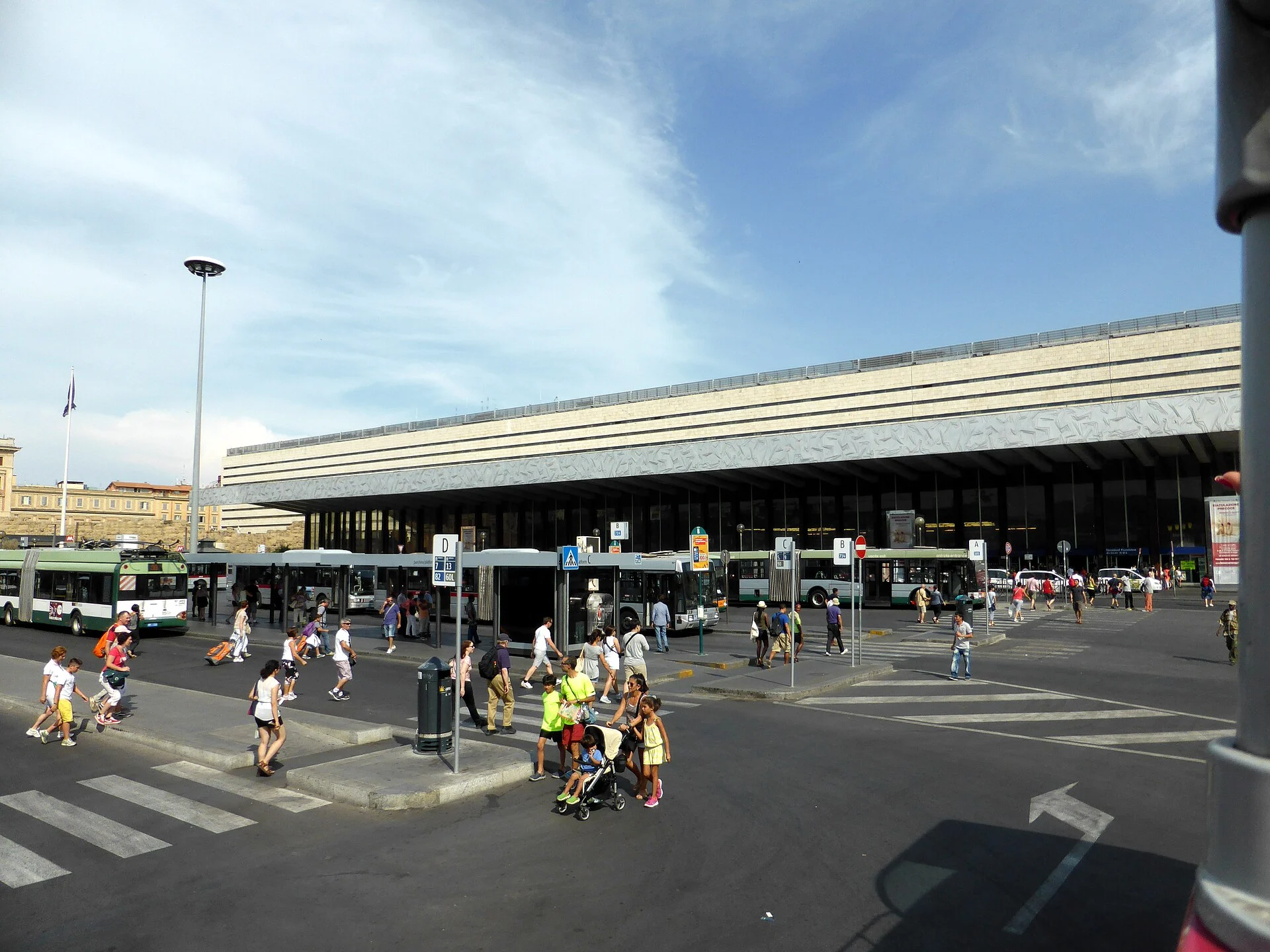
Termini Station is in Piazza dei Cinquecento, in Rome, with two side entrances at Via Marsala 49 and Via Giolitti 40, and you can walk through it freely without a ticket. The waiting areas with free seating are open every day from 5:45 to one in the morning. The rail infrastructure belongs to RFI, the station complex is run by Grandi Stazioni Rail, and the trains that leave from here are Trenitalia and Italo.
The numbers Grandi Stazioni Rail publishes give the measure of the place: about 480,000 people a day, over 150 million a year, 850 trains daily, 225,000 square meters of surface area. Behind this machine there is a piece of postwar Italian architecture that few people look at, the great 1950 hall called the Dinosaur, plus a stretch of the Servian Walls over 10 meters high planted in front of the facade.
The hours, prices and services reported here come from the official pages of RFI, Grandi Stazioni Rail, Trenitalia, ATAC, Roma Capitale and Aeroporti di Roma, consulted on September 28, 2026. Train times for the airport change with the railway timetable changes of June and December, and the station offices update their opening hours without notice. Before a trip with tight connections, check again on the carrier's website and on the departures board.

Where the station is and how it's laid out
Termini occupies the plateau between the Esquiline and the Viminal, on the eastern side of the center. In front is Piazza dei Cinquecento, redone for the Jubilee, and beyond the square the Baths of Diocletian with Piazza della Repubblica right behind. With the square at your back, Via Marsala runs on the left side and Via Giolitti on the right. The neighborhood around is the Umbertine Esquiline Hill, all late 19th-century buildings and arcades.
The numbered platforms run from 1, at the far left end toward Via Marsala, to 24, at the far right end toward Via Giolitti. Then there are the platforms that make you miss trains: 1 Est and 2 Est are reached with about 500 meters on foot from platform 1 or directly from Via Marsala 49, and the platforms called Laziali, 25 to 29, with another 500 meters from platform 24 or from the entrance at Via Giolitti 60.
The complex reads in three bands. At the front the 1950 building with the ticket hall and the transverse gallery that joins Via Marsala to Via Giolitti. On the two long sides the wings built for a good part to the design of Angiolo Mazzoni in the years between the end of the 1930s and the war. At the back, the head of the platforms. On the level minus one there are the subway entrances and the shopping gallery, on the first floor the food court.
What to expect, in concrete terms. It's a terminal station, so trains arrive and leave in the opposite direction, and the flow of people all goes the same way, toward the hall. At rush hour the transverse gallery becomes a crowded corridor, and anyone who stops suddenly in the middle of the passage to look at their phone blocks dozens of people. Step to the side, always, even just to read the departures board.
A curiosity about Termini Station
The name does not come from the fact that trains end their run here. It comes from the Baths of Diocletian, the largest bath complex of ancient Rome, which stands right across the way, and the fact that Termini is a terminal station is a happy coincidence, not the etymology. The same goes for the streets of the neighborhood: Via delle Terme di Diocleziano, San Bernardo alle Terme, all the place names revolve around that enormous ruin.
The second curiosity concerns what was here before. Under the station one of the largest villas of modern Rome disappeared, Villa Montalto, wanted by Cardinal Felice Peretti, later Pope Sixtus V, who bought land in the area from the 16th century and stepped up his purchases after 1585. The main building was built by Domenico Fontana. The villa then passed to the Massimo family and vanished piece by piece with the arrival of the railway in the second half of the 19th century.
Historical reconstructions also report the figure of the 1865 expropriation, over 60,000 scudi, paid to the owners of the villa to widen the station yard. Sixtus V's mark around Termini remains, though, and can be read on foot: the Esquiline Obelisk behind Santa Maria Maggiore, and the Fountain of Moses, the display of the Acqua Felice, which carries the pope's baptismal name. It is late 16th-century city planning designed for pilgrims.
There is a third layer. In the excavations for the subway in 1948, in the station area, the remains of a private bath building came to light, along with shops and rental houses with mosaic floors, later demolished to make room for the works. Already in the 19th century Rodolfo Lanciani had documented the finds of the railway construction site. The whole subsoil of Termini is a stratigraphy of Rome, crossed every day by people running to catch a train.
Something nobody tells you about Termini Station
The Servian Walls are not only outside. On the basement level of the station, inside a retail space, you can see the inner retaining wall of the defensive embankment, the agger: squared tuff blocks resting on a modern brick wall that supports them. It is a piece of fortification of Republican Rome absorbed into a passageway, and most people who walk past it mistake it for decorative cladding.
The big stretch is the outer one, on the northern side of Piazza dei Cinquecento, to the left of the facade looking at the station, toward Via Marsala. The Sovrintendenza Capitolina points to the remains next to Termini as the most monumental of the whole circuit, at the point where the Porta Viminale opened. Current descriptions speak of about 94 meters in length and a height that exceeds 10 meters. With the redesign of the square for the Jubilee that stretch was enhanced inside a green area.
To understand what you're looking at, you need three facts from the Sovrintendenza. By tradition the walls date to the sixth century BC, but most of what remains is the reconstruction of the first decades of the fourth century, after the sack by the Gauls in 390. They are made of large blocks of yellow tuff called Grotta Oscura. The circuit measured about 11 kilometers and enclosed 426 hectares.
On the eastern side, where there were no hills to protect the city, the wall was reinforced by a great embankment with a moat, and it is exactly that system you see at Termini. Other stretches are found not far away, in the garden of Piazza Manfredo Fanti, and in the crypt of the church of San Vito. The Museum of the Walls instead tells the story of the later circuit, the Aurelian Walls, seven centuries younger.
The distance between the value of the find and the attention it gets is striking. In 2025 the Sovrintendenza built an educational itinerary that started precisely from the agger in Piazza dei Cinquecento, and this says the subject is recognized. But anyone arriving by train has no sign that leads them there. Five minutes of detour from the taxi, and you touch the city of four centuries before Christ.
The Dinosaur and the 1950 facade
The facade you see today comes out of a competition announced in 1947 to complete the station left half done by the war. First prize was awarded ex aequo to two groups: the architects Leo Calini and Eugenio Montuori on one side, on the other Annibale Vitellozzi with Massimo Castellazzi, Vasco Fadigati and Achille Pintonello. The new station was inaugurated on December 20, 1950 by the President of the Republic Luigi Einaudi.
The piece everyone remembers is the reinforced concrete canopy over the square, immediately nicknamed the Dinosaur for its wavy profile. The technical sheets report an overhang of 19 meters over Piazza dei Cinquecento, a height that varies between about 13 and a half meters and less than 10, 33 spindle-shaped pillars placed every four meters. The company that built it was Rusconi. Under that cover the passenger hall looks toward the Baths.
The design organizes the front in three parts that work independently: the portico for cars, the passenger hall with the ticket offices, and the long office block that serves as a link between the two pre-existing side wings. Behind the hall the transverse gallery connects Via Giolitti and Via Marsala. It's a clear scheme, which you understand by entering just once and which has held up through 70 years of traffic that has grown many times over.
Critics of the time welcomed it well, and many read the wave-shaped canopy as a sign of postwar Italian vitality, far from the rhetoric of the side wings. Some have seen in that irregular profile an echo of the line of the Servian Walls that the canopy frames, and it is a suggested reading, not a statement by the designers. What is certain is that the roof looks light, and it is, compared with what it had to replace.
Here is the contrarian view. Termini is described as a place to escape from as soon as possible, and the Roman tourist system treats it as a non-place. It is the most widespread mistake I see being made. The 1950 facade is one of the most successful public buildings of the Italian postwar, much more interesting than many buildings in the center that groups photograph out of duty. It deserves 10 minutes of looking, from outside, slowly.
Mazzoni's wings and Bianchi's station that is no more
Before the current building there were two stations. The first, temporary, was built from 1862 and opened on February 25, 1863 under the name Stazione Centrale delle Ferrovie Romane, coinciding with the opening of the line to Naples. A service shack more than a building. Within a few months the lines for Frascati and Civitavecchia also converged on it, and it was clear right away that something else was needed.
The second is the station by the architect Salvatore Bianchi. The design was approved between 1867 and 1869, according to the sources, and work started on July 2, 1868 with a ceremony in the presence of Pius IX. It was tested and accepted on January 8, 1874. Two symmetrical porticoed blocks, arrivals on one side and departures on the other, linked by a metal shed supplied by a Paris firm, with six terminal tracks. Today nothing of it remains in view.
In the 1930s that station had become too small. Angiolo Mazzoni, head of the architecture office of the Ferrovie dello Stato, presented a first rationalist proposal in 1937 and a second in 1938 with a double row of monumental columns on the square. The final design was approved in 1939. Demolitions and construction of the side blocks began, then in 1943 the war stopped everything, and in 1946 the design for the facade was discarded.
Of Mazzoni's wings the stretches along Via Marsala and along Via Giolitti were built, and that is what we see on the flanks. FS recalls two tapered water towers, of Futurist taste, with external helical staircases, and on Via Giolitti side a very long arched corridor. The Mazzoni wing toward Via Giolitti has been redeveloped as a retail area, with the glass walls toward the platforms reopened, according to what was reported in November 2025.
The result is a building with two voices, and it's best to look at it knowing that. On the sides the regime rhetoric of repeated arches and stone cladding, on the front the lightness of postwar concrete. Many visitors think it is all from the same period. It is not, and the seam between the two eras shows clearly at the ends of the transverse gallery, where the 1950 block meets the wings.
My advice for visiting Termini Station
Enter and exit at least once from the square, not from the subway. Anyone arriving by subway comes up from the basement level straight into the gallery and never sees the facade, which is the best part of the building. Go out under the canopy, walk away about 30 meters toward the Baths, turn around. From that point you can read the whole design: the Dinosaur, the office block, the Walls on the left.
Then walk the transverse gallery from one end to the other, from Via Marsala to Via Giolitti, without hurrying. It's the simplest way to understand how the station works and where the services are. On Via Marsala side you find the Sala Blu and the law enforcement offices, on Via Giolitti side the subway entrances, the luggage storage and the farthest platforms. Five minutes of orientation save frantic running later.
If your train leaves from platforms 1 Est, 2 Est or from the Laziali, allow at least 10 more minutes of walking compared with the main departures board. They are real platforms, with regional trains and also long-distance connections, but they are half a kilometer from the hall. Anyone who arrives at the last minute looking only at the number thinks the platform is next to the others and ends up running with a suitcase along an endless platform edge.
Buy tickets only from the official channels: the Trenitalia and Italo ticket offices on the ground floor, the self-service machines of the two carriers, the official apps and websites. The lounges on the first floor are reserved for customers of the respective carriers with a suitable ticket, while the free seating is open to everyone. If you need to wait a long time, the seats in the hall and in Via Giolitti area are the quietest.
One last thing, for those who arrive in the morning and leave in the evening. Instead of dragging your suitcase around the center, leave it at the luggage storage and use the station as a base. From here on foot you reach in a quarter of an hour Palazzo Massimo, the Baths, Santa Maria Maggiore and the Monti district. It is the best possible use of a transit day.
Luggage storage, waiting rooms, restrooms and ticket offices
The luggage storage is at Via Giolitti 40, at platform 24, near the car rental desks, on the ground floor, and is open from 7:00 to 21:00. RFI does not publish the rates on the station page and refers to the service's website, which is indicated as the only official storage at Termini and states prices starting from six euros. For bulky luggage or stays of several days, ask for the conditions before handing over.
Next to the storage RFI points to a baggage check-in desk for Fiumicino airport, open from 8:00 to 16:00, meant for people who want to get rid of the suitcase at the station and travel light until the flight. It's best to check with your airline if the service applies to the ticket you hold, because not all fares and not all carriers include it, and the conditions are not published on the station page.
The free seats are in the ticket hall, in the transit area between Via Marsala and Via Giolitti near Via Marsala entrance, in the area accessible from Via Giolitti 40 and on the first floor, in the food area. They are open every day from 5:45 to one in the morning. On the first floor, with the stairs from the ticket hall, are the Trenitalia lounge, from 5:45 to 21:30, and the Italo one, from 6:20 to 20:55, both reserved for customers.
The ticket offices are on the ground floor. The Trenitalia one is open every day from 6:30 to 21:40, the Italo one from 6:20 to 20:55, and at both you can buy and change tickets. There are three restrooms, all paid at one euro: on the first floor in the food area from 6:00 to midnight, on the level minus one toward Via Marsala from 7:00 to 21:00, on the level minus one toward Via Giolitti from 6:00 to midnight.
Grandi Stazioni Rail lists among Termini's services also a pharmacy, post office, ATM, currency exchange, travel agency and an information point. The infopoint run by the railway companies and Roma Capitale gives information on trains, local transport and tourism. For questions about the train trip the right channel remains the carrier's ticket office, because RFI station staff do not sell tickets and do not change bookings.
Accessibility and Sala Blu assistance
The Sala Blu at Termini is on Via Marsala, near the entrance to platform 1, and can be reached both from inside the station and from Via Marsala 49. It is open every day, holidays included, from 6:45 to 21:30. The national toll-free number is 800 90 60 60 from a landline, the number +39 02 32 32 32 works from a mobile phone and from abroad, and the email of the Rome desk is salablu.roma@rfi.it.
The service is free and RFI addresses it to people with motor, sensory or intellectual disabilities, in wheelchairs, to elderly people and to pregnant women. It includes reception, escort to pick up the ticket, help boarding and getting off with a lift or ramp, a wheelchair and transport of one piece of hand luggage. You can also book with the SalaBlu online service and the SalaBlu+ app, and there is a webchat for people with hearing disabilities.
On advance notice RFI indicates different rules according to the type of station and the channel: from one hour to 12 hours before by phone, up to six hours before by email, up to three hours before with the online service and the app. The advice is to book as soon as you have the ticket, especially if the train leaves from the Est or Laziali platforms, and to ask by phone which rule applies to your combination of stations.
RFI states that the luggage storage, waiting rooms, restrooms and Sala Blu are marked by signs and served by tactile paths, and that the subway access from the level minus one has a route with moving walkways and tactile signage. For people who move in a wheelchair the weak point remains the distance to the outlying platforms: 500 meters is a lot, and with assistance booked the problem is solved.
Another well-known fact, yet rarely cited
Piazza dei Cinquecento takes its name from the Italian fallen of the Battle of Dogali, in Eritrea, in January 1887. The current name dates to 1916, but the link with that clash of arms is older: in 1887 the architect Francesco Azzurri erected in front of the station a monument with a small Egyptian obelisk, dedicated precisely to the soldiers killed in that colonial battle. The square has carried that memory for more than a century.
The obelisk has a history as long as Rome's. It was made under the pharaoh Ramses II for Heliopolis, brought to Rome by the emperor Domitian to decorate the temple of Isis in the Campus Martius, and found by Rodolfo Lanciani in 1883 near Santa Maria sopra Minerva, the same area the little elephant obelisk comes from. Then it ended up in front of the tracks.
The sources do not agree on the number. The most cited reconstructions speak of 413 soldiers and 22 officers fallen, fewer than the 500 of the name. The round number became a place name, as often happens when a city decides to commemorate something in a hurry. In 1925, with the rebuilding of the station, the Dogali Obelisk was moved to the gardens of what is now Viale Luigi Einaudi, in front of the Baths, where it still stands.
Few of those who step off the train know they are crossing a square dedicated to a colonial war. There's no need to put it on trial, but it's useful information, because it explains the most-read name in Rome after the Colosseum's. Anyone who wants to go deeper into the period will find material in the city's historical museums. For me it's enough that, next time, someone looks up at that little obelisk in front of the Baths.
Subway, bus, tram and taxi
Termini is the crossing point of subway Lines A and B. The entrances are on the level minus one, near Via Giolitti access, with moving walkways and turnstiles. ATAC's integrated timed ticket costs €1.50 and is valid for 100 minutes, the daily pass €8.50, the 48-hour pass €15, the 72-hour pass €22, the weekly pass €29. At the turnstiles you can also pay directly with a contactless card.
On the ground floor there is an ATAC point that sells Metrebus tickets and gives public transport information, open Monday to Saturday from 7:00 to 20:00 and Sundays and holidays from 8:00 to 20:00. RFI also lists an InfoAtac WhatsApp number, +39 335 1996079. Line B takes you to the Colosseum in two stops, and the same line heading south reaches the area of the Gasometro and the ex Porto Fluviale.
City buses terminate in Piazza dei Cinquecento, on the left side as you leave the hall. The terminal was reorganized on January 15, 2025 by bays: from A leave the 40 and the 64, from B the C2, the 85 and the 92, from C the H, the 66 and the 170, from D the 38, the 90 and the 310, from F the 714, from E on Viale De Nicola the 223. Night lines have the prefix n.
The tram stops are on the opposite side of the station, on Via Giolitti at number 43. The Roman tram network in 2026 had long suspensions for works, with buses in place of trams: before counting on it, check on the ATAC website if the line is running. Taxis are picked up at the covered taxi bay in Piazza dei Cinquecento or on Via Marsala. Always take the taxi at the official stand, never from anyone who approaches you offering a ride inside the station.
For the Sapienza University City you need no transport: leave from Via Marsala and walk a quarter of an hour. Heading east on foot you reach San Lorenzo and the Verano, heading south Porta Maggiore and the underground basilica. If you feel like walking, you have the whole neighborhood at your disposal without a ticket.
Trains and buses to the airports
For Fiumicino the direct connection is Trenitalia's Leonardo Express: 32 minutes with no intermediate stops, single ticket €14, departures from the dedicated platforms 23 and 24. According to the Trenitalia timetable valid from June 14 to December 12, 2026, the first train from Termini leaves at 4:50 and the last at 23:37, with a run every 15 minutes in peak bands and every half hour in the others, every day of the year.
Aeroporti di Roma lists among the purchase channels the Trenitalia website, the station ticket offices, the self-service machines at the airport and in the station, travel agencies and authorized resellers. Platforms 23 and 24 are at the far right end, Via Giolitti side: from the hall allow a few minutes of walking. For days with restrictions and suspensions the Trenitalia table lists the exceptions date by date, and that is what you should consult.
Watch out for a frequent misunderstanding. The FL1 regional trains for the airport do not stop at Termini: they serve other Roman stations, including Tiburtina. Anyone looking at the Termini board for the FL1 will not find it. From Termini the only direct train to Fiumicino is the Leonardo Express. All the other combinations, including buses and fixed-fare taxis, you'll find in our guide from the airports to central Rome.
For Ciampino, Aeroporti di Roma lists Trenitalia's Ciampino Airlink service, which joins bus and train. The bus leaves every 20 minutes from the forecourt in front of the airport and goes with no intermediate stops to Ciampino station, where you continue by train to Termini, and the same applies in the opposite direction. The airport operator does not publish the price of the combined ticket and refers to the Trenitalia website, which is the source to consult.
The bus shuttles for Fiumicino and Ciampino stop, according to RFI, at Via Marsala 7 and Via Giolitti 34, on the two sides of the station. They are services of different operators with their own prices and times, to be checked on each one's website. In Roman traffic bus times are not guaranteed: for an early morning flight or one with tight margins, the train remains the prudent choice.
The right photo to take at Termini Station
The photo is the canopy from Piazza dei Cinquecento, shot low and at three-quarter angle. Stand on the side of the Servian Walls, crouch until you put the tuff blocks in the foreground in the left third of the frame, and let the wavy edge of the Dinosaur run toward the right. Fourth-century BC tuff and 1950 concrete in the same photo: it's the whole story of Termini in one frame.
The right light is late afternoon. The facade faces the Baths, and with the low sun the edge of the canopy casts a wavy shadow on the glazed front that doubles its design. At noon, instead, the roof flattens everything into a dark line with no depth. In winter the good moment comes early, around four in the afternoon, in summer it's better to wait until after seven.
The second photo is taken from inside the hall looking out. With your back to the gallery, the glass front frames the square and the Baths of Diocletian in the background, and the spindle-shaped pillars of the canopy mark the space like the columns of a portico. Black and white works here, which removes the confusion of the colors of the signs and leaves only the geometry of concrete and light.
Two practical cautions. In the station don't set up the tripod in the middle of the flows, and don't photograph up close the people who are waiting, sleeping or working: it's a place of passage, not a set, and everyone has the right not to end up in a photo. Keep your backpack in front and the camera around your neck while you frame, because with your hands busy and your eye in the viewfinder you are distracted by definition.
If you want a less obvious image, you can frame Mazzoni's water towers with the external spiral staircases, the most Futurist detail of the complex. And then there is the photo almost nobody takes: the departures board. City names scrolling, times, platforms, delays. In 20 years that board will have changed, and it will be the truest image of your passage through Rome.
Safety, without alarmism
Termini is a big, crowded station, open until late at night, with the problems of all big European stations. It is not the dangerous place that certain stories describe, and treating it as hostile territory only makes you lose clarity. The rules are those of any hub of this size: watch your personal belongings, no distractions at the points of greatest crush, no trust in anyone who offers unrequested help.
The moments when something gets lost are always the same: boarding the car in the crowd, waiting in front of the board with your eyes up, stopping at the ticket machines with your wallet in your hand, running to the subway on the moving walkways. Backpack in front, phone in a closed pocket, wallet never in the back pocket. They are trivial precautions, and they are exactly the ones that make the difference.
At the self-service machines nobody is authorized to help you on the street or to act as an intermediary. If someone approaches offering to complete the purchase, to carry your suitcase or to take you to the platform, say thanks and walk away. The same goes for rides in a car offered in the hall. Official railway staff are recognizable by the uniform and the badge, and information is asked for at the counters or at the infopoint.
For emergencies the number is 112. The Polizia Ferroviaria has its office at platform 1, also reachable from Via Marsala 49, open from 8:00 to midnight, and takes reports for lost items, thefts and missing persons. The Carabinieri have a post at platforms 1 and 2 Est, open day and night. If your passport is stolen the report is needed right away, even before calling the consulate.
The new Piazza dei Cinquecento and the recent works
In mid-January 2025 the first section of the new Piazza dei Cinquecento, redone for the Jubilee, was opened. The published data speak of a total area of about 80,000 square meters and an investment of €21.4 million, with Anas as implementing body in coordination with Roma Capitale, RFI, Grandi Stazioni Rail and FS Sistemi Urbani. The bus terminal was redesigned over about 12,000 square meters.
The project brought 30,000 square meters of marble, including travertine, 20,000 square meters of sampietrini, 10,000 of green areas and flower beds, 150 new trees, two bidirectional bike lanes of about two and a half kilometers, the covered taxi bay and information panels. The stated idea is to connect the station to the Baths of Diocletian, the Servian Walls and Palazzo Massimo with a continuous pedestrian route.
At the time of the inauguration about 85 percent of the area was accessible. The schedule published in January 2025 foresaw the second section by summer 2025 and general completion in 2026. The final state of the construction sites is not indicated by the operator on a single page, so if you find barriers in some corner of the square don't be surprised, and follow the marked pedestrian routes.
Inside the station the most visible change of recent years concerns the Mazzoni wing on Via Giolitti, reopened as a retail area with the glass walls toward the platforms free again, according to the news of November 2025. Even earlier, between 1998 and 2000, the station had been renovated for the Jubilee of that year, with the redesign of the shopping gallery and of the basement level that we take for granted today.
Some important events that happened here in history
On February 25, 1863 the temporary station of the Ferrovie Romane opens, still under papal government. On July 2, 1868 Pius IX takes part in the ceremony starting the works on Salvatore Bianchi's station, which is tested and accepted on January 8, 1874, a few years after the annexation of Rome to the Kingdom of Italy. The railway therefore arrives before the unified state, and the station is finished under the Kingdom.
In 1887 the monument to the fallen of Dogali with the obelisk of Ramses II is inaugurated in front of the station. In 1916 the square takes the name Piazza dei Cinquecento. In 1925 the obelisk moves in front of the Baths to make room for the works. In 1939 Angiolo Mazzoni's final design is approved, in 1943 the construction sites stop for the war, in 1946 the facade design is abandoned.
In 1947 the competition for the completion, in 1948 the subway excavations that bring to light remains of the Roman age. On December 20, 1950 Luigi Einaudi inaugurates the new station. On February 9, 1955 the same Einaudi inaugurates the Termini-EUR section of Line B, the first subway of Rome, in regular service from the following day. On February 16, 1980 Line A opens, and Termini becomes the interchange between the two lines.
In 1953 Vittorio De Sica shoots here the film Stazione Termini, set almost entirely in the station, with Jennifer Jones and Montgomery Clift and dialogue worked on by Cesare Zavattini and Truman Capote. Between 1998 and 2000 the renovation for the Jubilee. On December 23, 2006 the station is named after John Paul II in an official ceremony. In January 2025 the new Piazza dei Cinquecento opens.
There is also a minor episode that tells of the Romans' relationship with this place. In May 2011 the bronze statue of John Paul II by Oliviero Rainaldi, about seven meters high, donated to the city by a foundation, is inaugurated in Piazza dei Cinquecento. The criticism of the form and the face is such that in November 2012 the sculpture is repositioned in a second, modified version. Today it is still there.
Who has passed through Termini Station
Pius IX, the last pope-king, who in 1868 blessed the start of work on Bianchi's station and so the arrival of railway modernity in a city still papal. Two years later Rome would enter the Kingdom of Italy, and that station, conceived for the pope, was inaugurated by the state that had taken the city from him. Anyone who wants to see the other face of that passage should go to Porta Pia, 20 minutes on foot.
Angiolo Mazzoni, the railway architect of the Fascist era, who signed stations and post offices all over Italy and here left the side wings, the water towers and the stone porticoes. His design for the facade was never built, and this is one of the few times the war stopped a regime work leaving room for a different idea. Mazzoni paid for a long time, in criticism, for the identification with the regime.
Eugenio Montuori, Leo Calini, Annibale Vitellozzi and their colleagues, the designers of 1947. Their taste for light reinforced concrete, which shows in the canopy, is the signature of the best season of Roman postwar architecture. Luigi Einaudi, then president of the Republic, inaugurated both the station in 1950 and the first subway in 1955, a few meters apart.
Vittorio De Sica, Jennifer Jones and Montgomery Clift, who in 1953 turned the station into a set for the film Stazione Termini, a love story that plays out among the platforms. The film is a precious document of the newly inaugurated station: you see the new hall, the Dinosaur, the platform edges, the crowd of reconstruction Italy. If you find it, watch it before arriving in Rome, and you'll recognize the spaces.
Rodolfo Lanciani, the archaeologist who documented what the 19th-century construction site pulled out of the ground and who in 1883 found the Dogali obelisk. And then the millions of nameless people who made Termini the gateway to Rome: the 20th-century emigrants who left for the north and abroad, the pilgrims of the Jubilees, the out-of-town Sapienza students, the commuters from the Castelli. They are the real story of the station.
Eating in the area
Around a big station the cooking works with a precise rule: whoever passes through doesn't come back, and whoever doesn't come back doesn't need to be treated well. It doesn't apply to everyone, but the density of places aimed at the passing traveler is higher here than in almost any other neighborhood of Rome. The Esquilino has another face too, and you find it by moving a few blocks away from the square.
First warning sign: the menu with photos of the dishes, laminated and translated into five languages. A place that has to show you the picture of carbonara is talking to people who don't know what it is, and Romans don't sit down in a place like that. Second sign: the person at the door who stops you and invites you in. Anyone who has to get customers on the sidewalk has no regular customers, and regular customers are the only guarantee.
Third sign: the lady rolling fresh pasta in the window or on the street. It's a scene staged to stop the passerby, not a sign of quality: serious pasta is made in the kitchen, in the morning. Fourth: the kitchen open continuously from morning to late at night, with no break. A real kitchen crew stops, rests and prepares, and a place that serves the same dish at four in the afternoon and at 11 at night has had it ready for hours.
Fifth sign, the most expensive: items with no price, the fish of the day at an undeclared weight, the menu that differs between inside and the tables outside, the price list that adapts to whoever sits down. It happens above all in places with the best view or in front of monuments. Always ask the price before ordering, and if the answer is vague stand up without embarrassment. Nobody in Rome will be offended.
The neighborhood does have its own real cooking, though, and it's not necessarily Roman. The Esquilino is the most multiethnic district of the city, and the Nuovo Mercato Esquilino tells it better than any guide, with stalls of spices, vegetables and products from half the world. To find your way without trial and error, here is our list of the places where we eat, updated when places change and with no sponsorships.
What to see on foot from the station
The first stop is across the way. The Baths of Diocletian house a branch of the Museo Nazionale Romano, and their great hall was turned by Michelangelo into the basilica of Santa Maria degli Angeli. Next to it, the Aula Ottagona. On the corner of the square is Palazzo Massimo alle Terme, with the frescoes from the villa of Livia and some of the most beautiful ancient bronzes in Rome.
Going south you reach Santa Maria Maggiore in 10 minutes, and in the streets around it Santa Prassede and Santa Pudenziana, two churches with early Christian and medieval mosaics among the most important in the city. Heading east, past Piazza Vittorio, the Porta Alchemica and Sant'Eusebio.
Heading west, along Via Nazionale, you meet the basilica of San Vitale, the Palazzo delle Esposizioni and then the Quirinal. The Teatro dell'Opera is less than 10 minutes from the station. If you prefer the Monti district, going down toward the Colosseum you find the basilica of San Pietro in Vincoli with Michelangelo's Moses.
On the less beaten front, the Viminale district holds the Centro Enrico Fermi, in the rooms where Via Panisperna boys worked, and a little farther the church of San Lorenzo in Panisperna. Further south, beyond the station, the Auditorium of Maecenas and the Domus Aurea, with visiting arrangements to check on their respective pages.
If you have half a day and a train ticket you can leave the city. From Termini leave the regional trains for Frascati and the Castelli, for Civitavecchia and the coast, and trains toward Orvieto. If you stay in the city and have seen the center, you can go by public transport toward Ostiense, or west as far as Forte Bravetta, away from the usual routes.
Frequently asked questions
Who runs Termini Station?
The railway infrastructure, tracks and station services such as the Sala Blu, belongs to RFI, Rete Ferroviaria Italiana, of the Ferrovie dello Stato group. The station complex, with spaces, parking and services, is run by Grandi Stazioni Rail, also of the FS group, while the commercial areas belong to Grandi Stazioni Retail. The trains are Trenitalia and Italo, which have their own ticket offices and lounges on the ground floor and first floor.
Why is the station called Termini?
The name comes from the Baths of Diocletian, the great Roman bath complex that stands across from the station, on the other side of Piazza dei Cinquecento. The fact that Termini is a terminal station, where trains arrive and leave without continuing, is a coincidence. Since December 23, 2006 the station has also been officially named after Pope John Paul II.
Where are the Servian Walls at the station?
The biggest stretch is outside, on the left side of the facade looking at the station from Piazza dei Cinquecento, and is over 10 meters high. According to the Sovrintendenza Capitolina it is the most monumental remnant of the whole circuit, where the Porta Viminale opened. A second stretch, the inner retaining wall of the embankment, is visible on the basement level of the station, inside a retail space.
How much does the train to Fiumicino cost and where does it leave from?
Trenitalia's Leonardo Express costs €14 for a single trip, takes 32 minutes with no stops and leaves from the dedicated platforms 23 and 24, on Via Giolitti side. According to the timetable valid until December 12, 2026 the first train leaves at 4:50 and the last at 23:37, every 15 minutes at peak times and every half hour in the other bands.
Where do you leave luggage and how much does it cost?
The luggage storage is at Via Giolitti 40, at platform 24, near the car rental, and is open every day from 7:00 to 21:00. RFI does not publish the rates on the station page, while the official service's website indicates prices starting from €6. In the same area there is a baggage check-in desk for Fiumicino, open from 8:00 to 16:00.
How do you ask for assistance for a person with a disability?
RFI's Sala Blu is at Via Marsala 49, near the entrance to platform 1, and is open every day from 6:45 to 21:30. You book with the toll-free number 800 90 60 60, the number +39 02 32 32 32, the email salablu.roma@rfi.it, the SalaBlu online service or the SalaBlu+ app. The service is free and the advance notice required varies by station and channel.
Is the station open at night?
The waiting areas with free seating are open every day from 5:45 to one in the morning. The Carabinieri post at platforms 1 and 2 Est is open day and night, the Polizia Ferroviaria office from 8:00 to midnight. The ticket offices close earlier, Trenitalia's at 21:40 and Italo's at 20:55. For emergencies the single number is 112.
Are the station restrooms free?
No. RFI lists three restrooms, all paid at €1: on the first floor in the food area, open from 6:00 to midnight, on the level minus one toward Via Marsala entrance, from 7:00 to 21:00, and on the level minus one toward Via Giolitti, from 6:00 to midnight. They are marked by signs and served by a tactile path, like the station's other services.
Who wrote the page
The page comes from the editorial team of Tour Leader Pro, the Rome-based outfit that designs itineraries, visits and cultural events across Rome and Lazio. The hours, prices and services reported here come from the official sources of RFI, Grandi Stazioni Rail, Trenitalia, ATAC and Aeroporti di Roma as of the date given at the top. In a station that changes constantly, check them again before leaving. Tell us what you find changed.
Getting a group out of Termini means fitting together platforms 500 meters from the hall, luggage to leave, assistance to book, connections with the airport and timetable changes that come twice a year, for yourself or for 40 people. If you're facing this kind of puzzle, on Tour Leader Pro you'll find working materials made for those who accompany groups and for those who organize on their own.
For the wider picture, meaning regional and high-speed trains, rentals, airports, transfers between one city and another and destinations in Lazio outside the center of Rome, from the Castelli to the volcanic lakes of the north, down to the Tyrrhenian coast and the villages of the interior, a useful resource for putting together a multi-day itinerary is Italy Planner.