Moses Fountain
In short. The Moses Fountain is in Piazza di San Bernardo, in 00185 Rome, and it isn't a fountain like the others: it's the visible head of an aqueduct.
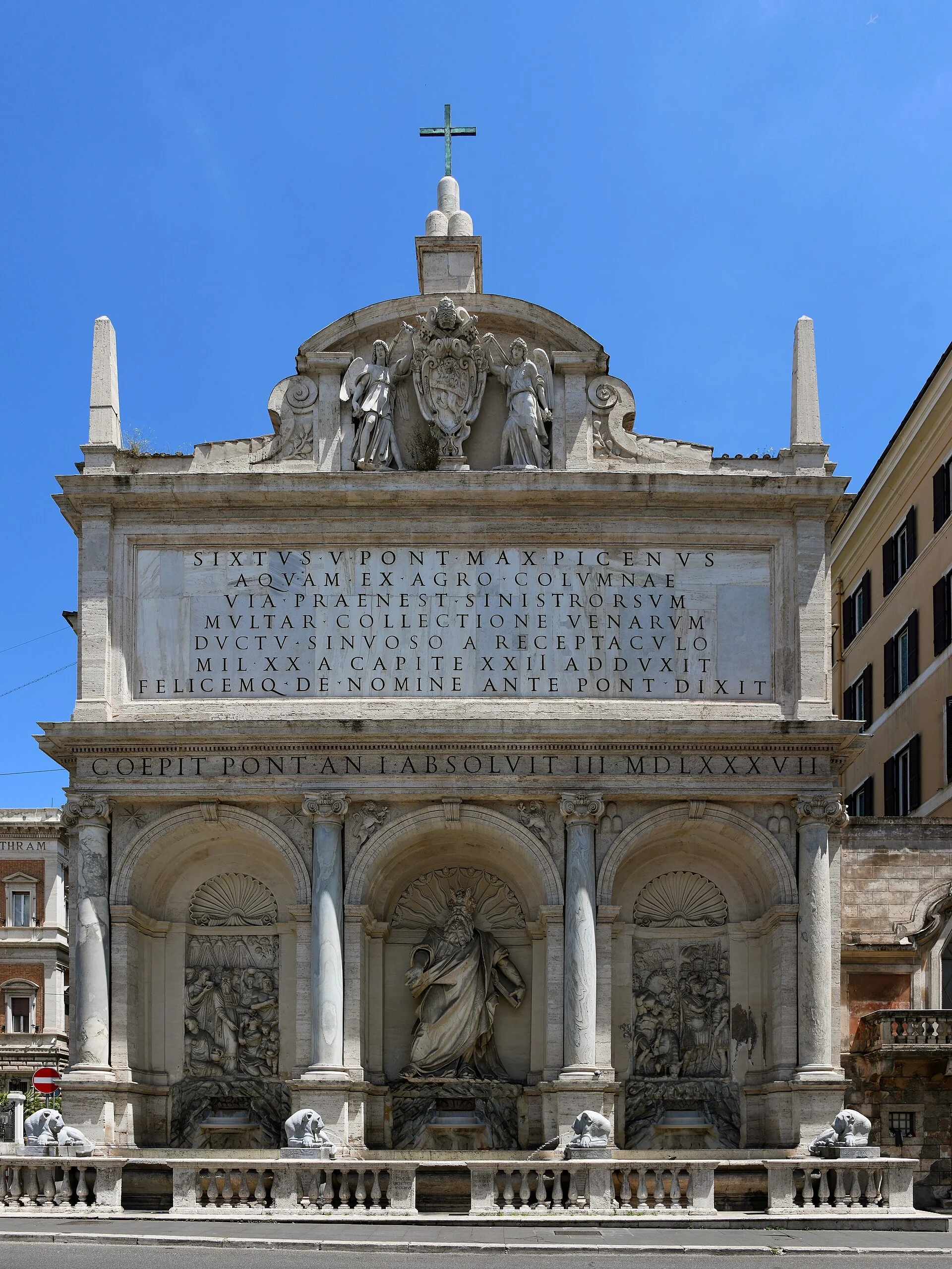
The Moses Fountain is in Piazza di San Bernardo, in 00185 Rome, and it isn't a fountain like the others: it's the visible head of an aqueduct. It's also called the Mostra dell'Acqua Felice because it marks the end point of the Felice Aqueduct, the hydraulic work with which Sixtus V, born Felice Peretti, brought running water back to the eastern hills of Rome after centuries of wells and barrels. The travertine mass that closes the square, with the colossal statue in the central archway and the two biblical reliefs at its sides, was born as a political manifesto and not as street furniture.
The Moses with the raised arm is the most mistreated statue in Rome. The Romans of the 1500s nicknamed it the ridiculous Moses, Pasquino wrote verses about it, and ever since the reputation for ugliness has been handed down more faithfully than any historical fact. Attached to that reputation travels a legend: the sculptor supposedly died of grief, out of shame for the botched work. That story has been going around for four centuries. It doesn't hold up against the documents, and further on you'll see why.
These lines serve to line up three things. What exactly you're looking at, with the right names and the attributions declared where the sources diverge. Why the fountain stands exactly there and not elsewhere, which is a matter of elevations and slopes. And what became of the four Egyptian lions that stood at the base, because the ones you see today are copies and the originals can still be seen, in one specific place.

Where the Moses Fountain is and how to get there
The address is Piazza di San Bernardo, 00185 Rome, in the Castro Pretorio rione according to the Sovrintendenza Capitolina record, although the square sits exactly on the border with the Trevi rione and more than one guide places it over there. The fountain occupies the eastern side of the open space, at the intersection of Via XX Settembre and Largo di Santa Susanna. If you arrive from Via Nazionale, it appears suddenly as you turn the corner, with no scenic warning.
The subway is line A, Repubblica Teatro dell'Opera stop. From the exit you walk less than 300 meters along Via Vittorio Emanuele Orlando, pass in front of the facade of Santa Maria degli Angeli e dei Martiri and come out straight onto the square. The Barberini stop on the same line A works too, with a walk of about 500 meters on a slight uphill along Via Barberini. The two exits serve different itineraries.
The useful buses are the ones that run along Via XX Settembre. Lines 62 and 492 stop at XX Settembre Ministero delle Finanze, which is the stop 50 meters from the fountain, and then continue toward Barberini and the Tritone. Line 910 covers the same stretch of Via XX Settembre and continues to Repubblica and Termini. If you come from Via Nomentana and from Porta Pia, get off at the previous stop, XX Settembre Piave, and walk 200 meters.
The stops and routes above were checked on September 28, 2026 against the published timetables. Surface lines in Rome change route more often than any website can keep up with, because of construction sites, marches and closures around the Quirinale: before leaving with a group, it's worth checking again. On foot, in any case, it's barely five minutes from Piazza della Repubblica and you don't need any transport.
The fountain is outdoors, on public ground, and you can look at it at any hour of the day and night. There's no ticket, no gate, no opening hours. As of September 28, 2026 it's running, with water falling into the three basins. Interruptions happen, usually for maintenance or work on the network, and they last a short time: if you find it dry, the reason is usually work in progress.
What you see: a triumphal arch that works as a faucet
The form is that of a Roman triumphal arch with three archways, built in travertine, marble and stucco. Four columns of colored marble, resting on tall stylobates, divide the front into three large niches. In the center, in the widest archway, stands the colossal Moses. In the two side ones, two reliefs with biblical stories tied to water. Above runs an attic with a long commemorative inscription, the papal coat of arms and two angels.
The message is explicit and reads without any mediation. A pope brings water to a neighborhood that had none, and to say so he borrows the grammar of the imperial arches, that of Constantine and of Septimius Severus. Anyone who has seen the Roman Forum recognizes the scheme at first glance. Sixtus V wasn't decorating a square: he was signing a public work, with the same logic with which today you put a plaque on a viaduct.
The relief on the left shows Aaron leading the Jewish people to the water and is the work of Giovanni Battista Della Porta. The one on the right depicts Gideon choosing his soldiers by watching the way they drink, sculpted by Flaminio Vacca and Pietro Paolo Olivieri. They are two episodes chosen with care: in both, water is a test, a selection, a gift that goes to whoever deserves it. The political reading is sewn into the iconography.
At the base there are three basins and four lions. The water comes out of a fake cliff in cipollino marble, a device that serves to hide the mouth of the conduits and give the jet a natural look. Cipollino is an ancient reused marble, like a good part of the travertine of the structure: in Rome at the end of the 1500s the best quarries were the ruins, and nobody saw anything wrong with that.
The inscription on the attic declares that Sixtus V gathered the waters from the Agro Colonna and led them to Rome along a route of about 22 miles. The text is Latin, in large letters, readable from the opposite sidewalk without binoculars. It's the most reliable document the fountain has: it says who, what, from where and how long, and it says it on the spot.
The Felice Aqueduct: why the fountain stands exactly here
Sixtus V is elected in 1585 and immediately tackles Rome's most concrete problem. The high city, that of the hills, had been without running water for centuries, because the ancient aqueducts were out of use and the only active conduits served the low area of the Campus Martius. The Acqua Vergine was enough for the Trevi Fountain and Piazza Navona, not for the Viminal and the Quirinal.
The new aqueduct collects water in the area of the Agro Colonna, east of Rome, and partly follows the route of the ancient Acqua Alessandrina, built in the third century. Sixtus V renames it Felice after his own baptismal name, Felice Peretti, and the choice is less vain than it seems: it was the standard way to say who paid and who answered for the work. If you want to see the ancestor still standing, you can go to the Aqueducts Park.
The construction site risked ending badly. The initial direction was entrusted to Matteo Bertolani, who got the leveling wrong: with those elevations the water would never have reached the top. The job passed to Giovanni Fontana, Domenico's brother, who corrected the error and brought the aqueduct into the city in about two years. That's the reason the sources argue over names, and the paragraph on attributions comes back to it.
The water arrives in Rome and is inaugurated on June 15, 1587, a date reported consistently by the local sources. The arrival point chosen is the height between the Baths of Diocletian and the Quirinal, exactly where the high city was thirsty. From there the network branches out and feeds a growing number of fountains and small fountains in the eastern rioni, changing the geography of the built-up area within a few years.
A water display, in the technical language of the era, is the monumental terminus of an aqueduct. It serves to show that the work functions, to distribute the water and to sign it. Rome has three big ones and it's worth seeing them as a series: this one for the Acqua Felice, the Acqua Paola Fountain on the Janiculum for the Acqua Paola, and the Trevi Fountain for the Acqua Vergine.
Lined up, the three displays tell the evolution of an idea over 170 years. Here, in 1587, the form is still a rigid, symmetrical arch, with the figures wedged into the openings as in an altar niche. On the Janiculum, in 1612, the facade widens and takes in air. At Trevi, in the 1700s, the wall dissolves into a cliff and the water becomes the protagonist. The first is the clumsiest and the clearest.
The dates: 1585, 1587, 1589 and why the sources don't match
There are three dates going around for this fountain and they aren't interchangeable. 1585 is the year work began, the first year of the pontificate of Sixtus V. 1587 is the year the water arrives and is inaugurated, on June 15. 1589 appears in the Sovrintendenza Capitolina record as the end of the construction of the complex. They don't contradict each other: they describe different moments of the same construction site.
The confusion comes from the fact that the architecture and the sculpture finish at different times. The travertine structure serves the aqueduct and has to be completed with it. The statues come later. The documentation on the Moses speaks of a commission registered in 1587 and an advance paid in 1588, so the central figure was put in place when the water was already flowing. Whoever writes 1585 to 1587 is referring to the hydraulic work. Whoever writes 1585 to 1589 is referring to the finished monument.
The sources also diverge on the name of the architect of the display. The Sovrintendenza Capitolina record names both Fontanas, Giovanni and Domenico. Most of the manuals and the City's tourist portal attribute the design of the display to Domenico Fontana, Sixtus V's trusted architect, the one of the obelisks. Other local sources stress the role of Giovanni, who was the technical savior of the aqueduct. The divergence exists and has to be stated.
The honest way to tell it to a group is this. Domenico Fontana is the reference architect of the project, and it's the name that appears in the majority of the sources. Giovanni Fontana is the man who got the water to arrive, correcting an error in elevations that would have sent everything to ruin, and several records place him alongside or ahead of his brother. Giving only one of the two names is a simplification, not a serious mistake.
Domenico Fontana in those years is doing the most visible work of the century in Rome. He raises the obelisk in Piazza San Pietro in 1586 with a machine of winches and horses that becomes legendary, and then arranges the others, from the Esquiline Obelisk to the Lateran Obelisk. If you want the full picture, you'll find it on the page about the obelisks of Rome.
Who sculpted the Moses: two names and a disputed attribution
There are two names in the running: Prospero Antichi, known as il Bresciano, and Leonardo Sormani. The sources diverge on who did what, and the divergence isn't a scholarly detail: it changes the meaning of the whole story of the ugliness. It's best to follow it in order, because this is one of the cases where popular tradition and archive documentation say different things.
The long version handed down by the guides assigns the Moses to Prospero Antichi alone. The Dizionario Biografico degli Italiani says so explicitly: the exclusivity of the work was long attributed to him. It's the version that has traveled for four centuries, and it's the one on which the anecdote of the sculptor crushed by criticism was built. Convenient, dramatic, and half wrong.
The documentation tells of a handover. The commission to Antichi appears in 1587, with an advance in 1588. The later payments, however, go to Leonardo Sormani, identified by the Dizionario Biografico as the final executor of the work. The current reconstruction speaks of an Antichi struggling with large-scale statuary and a Sormani called in to finish the job. The final result is therefore four-handed, with different weights.
The Sovrintendenza Capitolina record lists both names for the statue of Moses, without distinguishing the phases. The City's tourist portal writes Prospero Antichi completed by Leonardo Sormani. The English-language encyclopedia entry reverses the order and puts Sormani first. None of these formulations is false: they change the emphasis. It's best to remember the two names and to know that the archive speaks of a takeover.
Leonardo Sormani is a well-documented sculptor in the Rome of Gregory XIII and Sixtus V, with works in Santa Maria Maggiore and in other papal projects. He wasn't a stopgap. The fact that it fell to him to finish the Moses says that the patron wanted the work finished quickly and well, not that he had found the first available stonecutter on the street.
The legend of the sculptor who died of grief, and why it doesn't hold up
The story goes like this. Prospero Antichi sculpts the Moses, sees it mounted in the niche, realizes the proportions are wrong, hears the laughter of the Romans and the pasquinades, and dies of a broken heart soon after, crushed by shame. In some versions the end is more violent. It's a perfect tale: guilt, punishment, a moral about the artist who can't bear the judgment of the public.
The ancient source of this tale is Giovanni Baglione, a biographer of artists of the early 1600s. The Treccani Dizionario Biografico degli Italiani dismisses the matter without beating around the bush: Baglione's account must be rejected as an invention. The same entry admits that there is a kernel of truth inside the anecdote, namely that Antichi had really received the commission and had not completed it alone.
The simplest proof is chronological. Prospero Antichi is documented as active for years after the Moses. He works on the model of a bronze crucifix for the Church of the Gesù, executes with Pietro Bordone an angel and a coat of arms for Castel Sant'Angelo in 1591, and in 1592 is a party to a dispute over materials for wax models. His death, according to the reconstruction reported by Treccani, is placed in Rome around 1599.
12 years of documented activity after the supposed death from shame. That's enough. The anecdote has no documentary basis and should be told for what it is: a legend formed around a statue the Romans had decided to mock, fed by a biographer who loved exemplary stories and then repeated by every later guide without checking.
Why does it keep circulating, then. Because it's useful. It explains in 10 seconds a statue that would otherwise take 10 minutes of art history, and it gives the visitor the satisfaction of judging a failed masterpiece. Stories that work well survive even when they're false, and this one works very well. We take it apart and then tell it anyway, but saying that it's an invention.
The pasquinades against the Moses, on the other hand, are real and shouldn't be confused with the legend. Pasquino, the talking statue where the Romans stuck anonymous notes, targeted the figure and its authors with ferocious verses. The public mockery is documented: it's the consequence attributed to that mockery, namely the death of the artist, that is invented. You can have the satire without the corpse.
Why the Moses looks ugly: proportions, viewpoint, comparison
Three things contribute to the effect. The first is scale: the statue is enormous compared with the side reliefs and the space of the archway, and it seems pushed forward as if the wall were expelling it. The second is the viewpoint: you look at it from below, from a few meters away, and the foreshortening squashes the torso and stretches the head. The third is the comparison, which is the real problem.
The comparison is with Michelangelo's Moses, a kilometer away, in San Pietro in Vincoli. 80 years earlier, same subject, same seated pose, same arm. Any sculptor of the late 1500s who accepted that commission was signing a sentence. The Romans knew it and used it: the pasquinades play precisely on the impossible comparison between the two Moseses.
There's also an iconographic inconsistency that feeds the reputation for clumsiness. Moses holds the tablets of the Law while pointing to the water made to gush from the rock, but in the biblical account the water from the rock comes before the tablets. It's a short circuit that to a 1500s eye, used to reading sacred images as texts, jumped out immediately. Today almost nobody notices, and it should be pointed out.
The four lions: the copies are here, the originals are in the Vatican
At the base of the fountain there are four lions. The ones you see today are 19th-century copies in bardiglio marble made by Adamo Tadolini, according to the Sovrintendenza Capitolina record, as part of the restoration placed around 1850. The originals were ancient: two in porphyry and two in marble, coming from the Pantheon and from the area of St. John Lateran.
Two of those originals have a precise identity and a very long history. They are the so-called Lions of Nectanebo, Egyptian sculptures in gray granite from the fourth century BC, which arrived in Rome in antiquity and re-emerged in the 1400s. Pope Clement VII had them placed in front of the Pantheon, and Sixtus V moved them here, to the fountain of the Acqua Felice, in 1586, during the construction of the display.
The definitive transfer happens under Gregory XVI. The record of the Vatican Museums gives 1839 as the year the lions were replaced with copies and placed in the new Egyptian Museum. Today they are in the Museo Gregoriano Egizio, on the Terrazza del Nicchione. Anyone visiting the Vatican almost always walks past them without knowing that those beasts made a trip of 2,000 years between Egypt, the Pantheon and Piazza San Bernardo.
On the dates there's a divergence that has to be declared. The Vatican Museums date the removal of the originals and their replacement to 1839. The Sovrintendenza Capitolina dates Tadolini's bardiglio copies to 1850, within the framework of a restoration of 1850 to 1851. The most economical reading is that the originals were removed earlier and that the copies now in place date from the later restoration. The two records don't say the same thing and shouldn't be merged into a single sentence.
The Egyptian origin of these lions links them to a thread that is everywhere in Rome and that almost nobody follows. Sixtus V's obelisks, the lions, the string of materials brought from the Nile in imperial times: you can build a whole walk on this, from the Macuteo Obelisk in front of the Pantheon to the obelisk of the Minerva and on to the Sallustiano Obelisk.
A curiosity about the Moses Fountain
The curiosity concerns the square, not the fountain. Piazza San Bernardo is one of the few spots in Rome where three different churches look at each other up close and none of the three is the one tourists are looking for. There's San Bernardo alle Terme, carved out of a circular hall of the Baths of Diocletian. There's Santa Susanna, with its facade by Carlo Maderno. And there's Santa Maria della Vittoria.
Inside Santa Maria della Vittoria, 30 meters from the fountain, stands Gian Lorenzo Bernini's Ecstasy of Saint Teresa. The disproportion is comic: in front of the church, lines and groups with headsets form, while the fountain stays empty and serves as a bench. Two works a pedestrian crossing apart, one acclaimed and one mocked, both from the century that invented the modern way of looking at sculpture.
The rotunda of San Bernardo alle Terme deserves one more line. It's a hall of the Baths of Diocletian reused as a church, with a coffered dome that has held up since the fourth century. Anyone who wants to understand how big the bath complex was has to put together that volume, the hall of Santa Maria degli Angeli and the Octagonal Hall. They are pieces of the same building.
Something nobody tells you about the Moses Fountain
Nobody says that this fountain changed the social map of Rome. Before 1587 the eastern hills were vineyards, vegetable gardens and convents, because without running water you can't build a city. After the arrival of the Acqua Felice, the Quirinal, the Viminal and the Esquiline become buildable. The Umbertine Rome of the late 1800s, with its palazzi and ministries, grows on a water network laid out three centuries earlier.
The second fact that's rarely told concerns the material. The structure reuses travertine and ancient marbles, and the fake cliff is in cipollino, a reused marble. This means that pieces of dismantled imperial buildings are inside the fountain, not as a learned quotation but as a construction-site supply. If you look closely at the surfaces, you find differences of grain and color that tell of different origins.
The third concerns color. The restoration carried out between 1987 and 1989 restored the original coloring of the monument, which over time had become uniform under layers of dirt and patina. What you see today is not the indistinct gray of the photographs from the early 1900s: the columns of colored marble and the backs of the niches have a contrast the fountain had lost and that has been given back to it.
The fourth is the most prosaic. This was and remains a working fountain. In Rome at the end of the 1500s people came here with buckets, horses drank here, laundresses worked here. The low basins in front are not a decorative whim, they are watering troughs. Looking at it as only a monument means missing half of what it was for 300 years.
The advice I give you for visiting the Moses Fountain
Go early in the morning, between 7 and half past 8. The fountain faces west, so with the low morning sun the front stays in full shade and the details of the reliefs can be read without the burned-out contrast you get at noon. On top of that, the traffic on Via XX Settembre is still bearable and you can stand on the opposite sidewalk without being pushed around.
Put it in a chain, not on its own. 10 minutes here, then Santa Maria della Vittoria for the Bernini, then 500 meters along Via delle Quattro Fontane to Quattro Fontane and San Carlo alle Quattro Fontane, with a detour to Sant'Andrea al Quirinale. In an hour and a half you cross the whole Roman 1600s, on foot, without tickets.
If you have an extra hour, go down toward Palazzo Barberini and the Galleria Nazionale d'Arte Antica, passing by the Triton Fountain in Piazza Barberini. It's the right route to understand how you get from the rigidity of the Sistine display to Bernini's invention: it's 400 meters and 60 years.
Bring drinking water picked up elsewhere. There are no nasoni in the square right next to the fountain, and drinking from the monumental basins is not recommended, regardless of the quality of the network. There are no public restrooms in the area. The nearest bar is a couple of side streets away and you'll find it by walking, with no need to point to a sign.
Avoid late afternoon on weekdays. Between 17:00 and 19:00 Via XX Settembre becomes a funnel of buses and cars leaving the ministries, the noise drowns out any explanation and the sidewalk in front of the fountain shrinks to a passageway. With a group of 20 people you can't stand in there.
A contrarian position: the Moses isn't ugly, it's just badly placed
There's also something that usually makes people turn up their noses. The Moses of the Acqua Felice is not a badly made statue. It's a statue conceived to be seen from far away and put in an archway that forces you to look at it from below and from close up. The flaw is one of placement and scale, not of hand. Anyone who sculpts a figure for the wrong niche gets the same result.
The proof lies in photographs taken with a telephoto lens from the opposite sidewalk, which bring the figure back to a correct optical distance. From there the drapery holds up, the head returns to proportion with the body and the gesture of the arm works. The clumsiness everyone sees is produced by the three meters of sidewalk that separate the eye from the base: it's an urban planning problem disguised as a sculpture problem.
The second part of the position is more unpleasant. The Roman tradition of mockery, which is one of the best things about this city, has in this case worked as an automatic sentence repeated for four centuries without anyone reopening the file. Pasquino was right to make people laugh. The guides who since 1600 have been copying the anecdote of death from shame are simply wrong.
Eating in the area: how to recognize a place that will fleece you
The area between Piazza San Bernardo, Repubblica and Termini is a minefield, because it lives off offices at lunch and hotels in the evening. The first warning sign is the menu with photographs of the dishes displayed in the window. In a place where Romans eat, nobody needs to see the carbonara photographed: they know what it looks like. The pictures are for people who don't understand the language, and the price adjusts to that customer.
The second sign is the person at the entrance inviting you to sit down. A place that has to stop you in the street is saying it has no clientele of its own and lives off passing trade. Along with that, read the window with the lady rolling out fresh pasta leaning toward the sidewalk: it's a stage call, built for the photograph, and it says nothing about what comes out of the kitchen.
Third sign, non-stop hours. A real kitchen stops between 15:00 and 19:00, because the cook rests and the crew preps. A place open from morning to late at night with no break works with semi-finished products and a microwave. Fourth sign, the price lists: if there are items without a price, or if the sign outside and the menu inside don't match, you leave before ordering.
In the area of the big hotels there are places with repeated signs, the kind you meet identical in several spots in the center. They work as a tourist attraction: they have a recognizable name, English-speaking staff and quick service. Romans don't go there, not out of snobbery but because for the same money you eat better two side streets away. If you end up inside with tired kids, it's not a tragedy.
There is only one criterion and it almost never fails. You stop in front of the door at a quarter past one and look at who is sitting inside and in what language they order. Tables of people who speak Italian and look like they have a job means the place lives off return visits. A room full of backpacks and different languages means it lives off first-time passersby.
If you want to start from a selection that's already made, there's a list on Google Maps with the Roman addresses, neighborhood by neighborhood: Daniele's list. It isn't a ranking and it isn't exhaustive: they are places I've tried, with the expected average spend and the area where they are. It's updated when something changes or gets worse.
Another well-known fact, yet rarely cited
That this fountain is the display of the Acqua Felice, everyone writes. Almost nobody, though, draws the consequence: the Felice Aqueduct is still today part of the city's water history, and its network fed fountains and small fountains in the eastern rioni for centuries. The fountain doesn't commemorate a vanished work: it's the apex of a system that worked for a long time and of which visible stretches remain outside the city.
The second point concerns the name of the square. Piazza San Bernardo takes its name from the church built at the end of the 1500s in the rotunda of the Baths of Diocletian, at the initiative of Caterina Sforza di Santa Fiora. The church therefore comes after the fountain, not before. The open space formed around the arrival point of the water: first the display, then the square, then the name.
Third, maintenance. The Sovrintendenza Capitolina record lists work in 1850 to 1851 with Tadolini, the 1987 to 1989 restoration with the recovery of the original coloring, and maintenance in 2010 to 2011. Three major interventions in 160 years on a monument exposed to the heaviest traffic in the historic center. Anyone who complains that Rome doesn't look after its fountains should look at this list before speaking.
Fourth, the relationship with Trevi. The Trevi Fountain draws 100,000 visitors a day in peak months. This one, which is its older sister by function and by type, sees a tiny fraction of that. The difference doesn't depend on the quality of the sculpture but on the movies, the positioning and the shape of the square. Roman fountains are visited for reasons that have little to do with art.
The right photo to take at the Moses Fountain
The good position is the opposite sidewalk, on the side of Largo di Santa Susanna, backing up to the edge of the wall. From there the whole three-archway front fits in, with the attic and the inscription, and the perspective doesn't distort the columns. With a lens of around 35 millimeters on a full-frame camera you get the complete architecture without having to tilt the camera upward.
The second photo, the one nobody takes, is the Moses isolated with a telephoto lens from the opposite sidewalk, at around 150 millimeters. It's the shot that proves the thesis of the contrarian paragraph: at that optical distance the figure goes back to being proportioned. Bring the telephoto if you have it, because it's the only way to see the statue as the person who sculpted it imagined it would be seen.
The third is on the lions. A close framing of one of Tadolini's bardiglio heads, with the water falling in front. It works well on overcast days, when the diffuse light doesn't burn out the light marble. If you then go to the Vatican Museums and photograph the Lions of Nectanebo on the Terrazza del Nicchione, you have the diptych of copy and original, which is something almost nobody has.
The best time for light is late afternoon, when the sun from the west hits the front full on and lights up the travertine. The problem is that at that hour the square is in the worst traffic and there are buses standing in front. The choice is between good light and a clean background: the clean background of early morning is better, raising the ISO.
To avoid: the frontal photo from two meters with the wide-angle lens. It produces exactly the distortion that gave the Moses its reputation as an ungainly statue, with enormous legs and a small head. It's the shot everybody takes with their phone, and then the statue looks like a disaster. The problem is the lens, not the sculptor.
Some important events that happened here in history
On June 15, 1587 the water of the Felice Aqueduct arrives in Rome and is inaugurated. It's the date that counts more than any other, because it marks the return of running water to the eastern hills after centuries. Local chronicles report that day as a public festival: in the Rome of the 1500s the arrival of an aqueduct was an event comparable to the opening of a subway line today.
Between 1586 and 1587 the Lions of Nectanebo are moved from the forecourt of the Pantheon to this fountain, at the will of Sixtus V. It's one of the many transfers of ancient material ordered by that pontificate, consistent with the obelisk policy: take Egyptian and Roman pieces and put them back where they serve the new urban design. The city as a permanent construction site of reuse.
In 1839, according to the Vatican Museums record, the original lions are removed and taken to the new Egyptian Museum created by Gregory XVI, replaced by copies. Around 1850, according to the Sovrintendenza Capitolina, Adamo Tadolini executes the bardiglio marble lions that you see today. In one decade the fountain loses its oldest pieces and takes on the appearance it has now.
Between 1987 and 1989 the monument is restored, with the original coloring brought back. It's an important intervention because it changes the perception of the whole: earlier photographs show a uniform gray mass, later ones give back the contrast between travertine, colored marbles and the backs of the niches. Further maintenance is recorded in 2010 to 2011.
On the urban level, the square changes face twice. At the end of the 1500s with the building of the church of San Bernardo in the baths rotunda, at the initiative of Caterina Sforza di Santa Fiora. And at the end of the 1800s, when Via XX Settembre becomes the axis of the ministries of the Kingdom and traffic begins to squeeze the fountain between two streams of vehicles, as you can still see today.
Who passed by the Moses Fountain
Sixtus V, who wanted the aqueduct and the display, passed through here in the literal sense: his pontificate lasts five years, from 1585 to 1590, and in that time he reorganizes half of Rome. Domenico Fontana, his architect, and his brother Giovanni, who solved the problem of the elevations, are the two technical names of the story. Matteo Bertolani is the one who got the leveling wrong and left the scene.
The sculptors are Prospero Antichi, known as il Bresciano, and Leonardo Sormani for the Moses, Giovanni Battista Della Porta for the relief of Aaron, and Flaminio Vacca and Pietro Paolo Olivieri for that of Gideon. Vacca is also the author of memoirs on Roman antiquities that scholars still use. Olivieri works in those same years on several Roman construction sites and is a name that recurs in the churches of the center.
Giovanni Baglione, the 1600s biographer, passes by in a figurative sense: he is the one who put the story of the death from shame into circulation, and his pen has done more damage than any bad weather. Adamo Tadolini, a 19th-century sculptor of the Canova school, leaves us the four bardiglio lions. Gregory XVI is the pope who takes away the Egyptian originals.
For Grand Tour travelers the fountain was a fixed stop, because it stood on the road between Porta Pia and the center and because the statue offered material for conversation. It often appears in 1700s prints and views, usually with figures watering horses in the basins. If you want to see how these monuments were looked at back then, find the graphic collections in the city museums of the Capitoline Hill.
Today the people who pass by are those who work in the ministries on Via XX Settembre, those who walk down from the hotels around Piazza della Repubblica and those who take the wrong street heading toward Via Veneto. Among organized groups, the fountain is almost always a two-minute stop between two more famous stops, which is a shame and also a stroke of luck: there's room to breathe.
Visiting today: hours, costs, accessibility
There's no ticket and no opening hours. The fountain is on public ground, visible 24 hours a day, and it's lit at night. No agency publishes a price because there is no price to publish. Anyone searching online for a ticket for the Moses Fountain is looking at the offer of some walking tour that includes the square, not an entrance to the monument.
As of September 28, 2026 the fountain is running. The basins have water and the jets from the fake cipollino cliff work. Shutdowns of the water outlets happen for network maintenance or scheduled work and are usually short. No agency publishes a calendar of these interruptions: you find out when you arrive, and it happens to everyone once in a while.
Accessibility is good for an outdoor Roman monument. The sidewalk in front of the fountain is flat and can be reached in a wheelchair from the side streets, with no mandatory steps. The problems are others: the narrow width of the passage, the constant traffic on Via XX Settembre and the parked vehicles that reduce the view. The best observation point, on the opposite side, requires crossing at a traffic light.
There are no public restrooms in the square, no luggage storage, no information points. If you arrive from Termini with a suitcase, you carry the suitcase. The benches are few and almost always taken. For a large group it's best to gather on the Largo di Santa Susanna side, where the sidewalk widens, and not in front of the fountain, where you block the passage.
The churches around have their own hours and often close in the middle of the day. Santa Maria della Vittoria, with the Bernini, observes a long afternoon break that changes over the course of the year. San Bernardo alle Terme opens in reduced time slots. If you're organizing a combined visit, check the openings the day before on the parish websites, because they vary and don't follow the museum pattern.
What to see within a 10-minute walk
The Baths of Diocletian are a short walk away and can be seen in three distinct pieces. The central hall is now Santa Maria degli Angeli e dei Martiri, reworked by Michelangelo. The museum occupies the complex of the Baths of Diocletian. The Octagonal Hall is the third piece, often closed and poorly signposted.
300 meters away is Palazzo Massimo alle Terme, which on its own is worth an afternoon for the frescoes from the villa of Livia and for the mosaics, and is systematically under-visited compared with the Forums. On the other side, going up toward the hill, in 10 minutes you reach the Quirinal Palace, the Quirinal Obelisk and the Scuderie del Quirinale.
If you want to stay on the theme of fountains, you have material for half a day. The Triton Fountain in Piazza Barberini is 500 meters away, the Trevi Fountain a kilometer, the Barcaccia Fountain at Piazza di Spagna a little farther. Going down toward the center you come to the Fountain of the Four Rivers, the Moor Fountain and the Neptune Fountain.
To the south, 15 minutes away, you enter the Monti rione, which changes register completely: narrow streets, workshops, people sitting on the steps. To the north, crossing Porta Pia, you reach the Nomentana area. To the west, with a 20-minute walk, you go down to Villa Borghese from Via Veneto side.
If you have only one day and want to keep fountains and aqueducts together, the link to make is with the Acqua Paola Fountain on the Janiculum, which is the display built 25 years after this one and takes up its scheme while widening it. Seeing the two on the same day, the morning here and the sunset up there, is the itinerary I recommend most often.
If you want to close the circle on the reuse of the ancient, you can add the Turtle Fountain in Piazza Mattei and a stop at the Crypta Balbi, where the theme of the city that builds itself on top of itself is explained better than in any other Roman museum. They are all stops reachable with the same integrated ticket of the Museo Nazionale Romano.
Frequently asked questions about the Moses Fountain
Why is the Moses Fountain also called the Mostra dell'Acqua Felice?
Mostra, in the technical language of the 1500s, indicates the monumental terminus of an aqueduct, that is, the point where the water arrives in the city and is put on show. This fountain is the terminus of the Felice Aqueduct, commissioned by Sixtus V, born Felice Peretti, who gave it his own baptismal name. The popular name Moses Fountain comes instead from the colossal statue in the central archway.
Who sculpted the Moses of the fountain?
The sources diverge and that has to be said. The commission is recorded to Prospero Antichi, known as il Bresciano, documented in 1587 with an advance in 1588, but the later payments go to Leonardo Sormani, identified by the Dizionario Biografico degli Italiani as the final executor. The Sovrintendenza Capitolina lists both names. Attributing the statue to only one of the two, as many guides do, is a simplification.
Is it true that the sculptor died of grief over the criticism?
No. The tale goes back to the 1600s biographer Giovanni Baglione, and the Dizionario Biografico degli Italiani rejects it as an invention. Prospero Antichi is documented as active for years after the Moses: a model of a bronze crucifix for the Gesù, an angel and a coat of arms for Castel Sant'Angelo in 1591, a documented dispute in 1592. His death is placed in Rome around 1599.
Where are the original lions of the fountain?
In the Vatican Museums. The two Lions of Nectanebo, Egyptian sculptures in gray granite from the fourth century BC, are in the Museo Gregoriano Egizio, on the Terrazza del Nicchione. They had been placed in front of the Pantheon by Clement VII, then brought here by Sixtus V in 1586 and finally transferred to the Vatican under Gregory XVI. The ones in the square are 19th-century copies.
When was the fountain built?
Work starts in 1585, the first year of the pontificate of Sixtus V. The water arrives and is inaugurated on June 15, 1587. The Sovrintendenza Capitolina record gives 1589 as the end of the overall construction, because the sculptures were mounted after the opening of the aqueduct. The three dates describe different phases and are not in contradiction with each other.
Does the fountain work today?
Yes. As of September 28, 2026 the Moses Fountain is running, with water in the three basins. It's a monument on public ground, visible at any hour, with no ticket and no gates. Interruptions for maintenance happen and usually last a short time. Drinking from the monumental basins is not recommended: for drinking water you need the public fountains.
How do you get to the Moses Fountain by public transport?
Subway line A, Repubblica Teatro dell'Opera stop, then less than 300 meters on foot along Via Vittorio Emanuele Orlando. Alternatively the Barberini stop, with 500 meters along Via Barberini. Buses 62, 492 and 910 run along Via XX Settembre and stop at XX Settembre Ministero delle Finanze, 50 meters away. Stops checked on September 28, 2026.
How much time does the visit take?
10 minutes are enough to look at it carefully, read the inscription on the attic and recognize the two side reliefs. With an explanation to a group it goes up to 20. It only makes sense, though, inside a longer route that includes Santa Maria della Vittoria, the Baths of Diocletian and the climb to the Quirinal: on its own it remains a short stop between two bigger ones.
Why does the statue have a reputation for being ugly?
For three reasons that add up. The scale of the figure is out of proportion to the space that contains it and to the side reliefs. The obligatory viewpoint, from below and up close, distorts the body. And the comparison with Michelangelo's Moses in San Pietro in Vincoli, a kilometer away, was impossible for anyone to win in the late 1500s.
Who wrote this page
This page comes from the editorial team of Tour Leader Pro, the Roman studio that designs visits, itineraries and cultural events in Rome and Lazio. The attributions, dates, stops and access conditions reported here were checked, as of the date indicated in the text, against the official sources cited, including the Sovrintendenza Capitolina and the Vatican Museums. Things change: if you find a detail that doesn't add up, let us know.
Anyone lining up a Roman itinerary always runs into the same variables, namely churches open in short slots decided by the parishes, museums with integrated tickets that not everyone knows about, distances that look short on paper and aren't uphill, and surface transport that changes route without warning. Planning tools, operational sheets and materials for those who lead groups are on Tour Leader Pro.
For the wider picture, trains and regional connections, rentals, airports and destinations in Lazio outside the center of Rome, from the Castelli to the lakes to the coast, the resource to keep open next to this one is Italy Planner, which works on the scale of the whole trip and not the single stop.