The Obelisks of Rome: How Many There Are and Where to Find Them
In short. Rome is the city that keeps the largest number of obelisks in the world: 13 ancient monoliths still standing in its squares, plus a handful of modern obelisks that took up the form up to the 1900s.
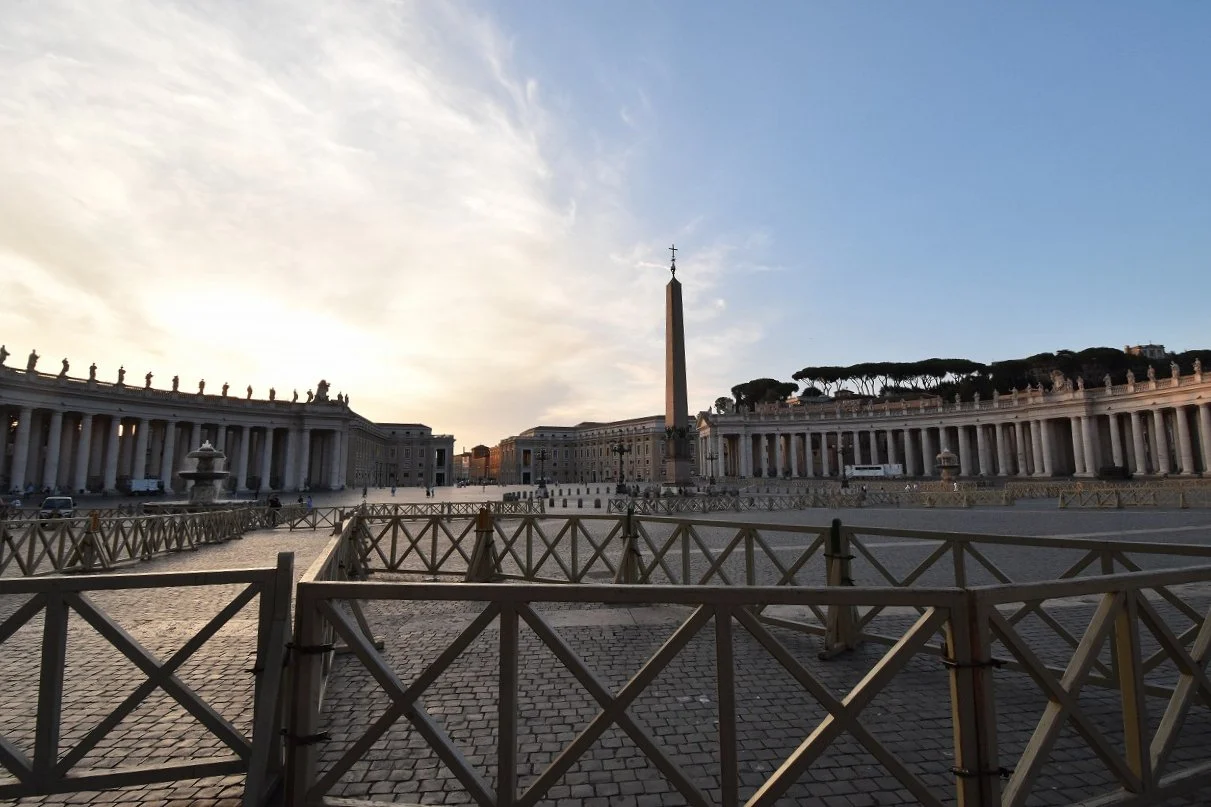
Rome is the city that keeps the largest number of obelisks in the world: 13 ancient monoliths still standing in its squares, plus a handful of modern obelisks that took up the form up to the 1900s. Of those 13, eight are authentic Egyptian obelisks cut and inscribed on the Nile between the 15th and the sixth century BC, and five were manufactured in Rome in the imperial age imitating pharaonic models, sometimes with real hieroglyphs, sometimes with badly copied signs, sometimes without a single inscription. The count, however, is not as simple as the guides tell it: it depends on what you decide to count, and the sources don't agree. The lines that follow review all the obelisks of the city one by one, with origin, pharaoh or period, year of arrival in Rome, the place where they stood before, who raised them again and when, verified height and present state, and explain the context that holds it all together: why Rome in particular, what Domenico Fontana did under Sixtus V, what is really written on those stones and who read it first.
How many obelisks there are in Rome and why the number changes
The figure on which the specialist bibliography converges is 13: there are 13 ancient obelisks in Rome, that is, monoliths dating from antiquity, Egyptian or Roman, now erected in public space or in a city park. On this number agree the Italian encyclopedia entry devoted to the obelisks of Rome, the most widespread popular reference works and the classic bibliography on the subject, starting with the volume by Cesare D'Onofrio published in 1967 and the work of Erik Iversen. Whoever writes that there are 13 obelisks in Rome is not wrong, but is giving a partial answer.
13 ancient ones, but how many in all
The problem arises when you stop counting only the ancient ones. If you include those conceived and cut after the end of the ancient world, the total rises: to the list you have to add the 19th-century copy kept in the gardens of Villa Medici, the two twin monoliths of Villa Torlonia from 1842, the marble obelisk of the Foro Italico from 1932, the Marconi stele at the EUR inaugurated in 1959 and, for those who accept including contemporary sculpture too, Arnaldo Pomodoro's Obelisco Novecento from 2004. The count thus arrives at 18 or 19 pieces, and changes again depending on if you count the two obelisks of Villa Torlonia as one or as two, or if you exclude the copies.
Why the sources don't agree
There is no single official register of the obelisks of Rome, and this is the point that explains almost all the discrepancies. The Sovrintendenza Capitolina looks after the monuments that fall within the municipal heritage, the Vatican Museums and the Fabbrica di San Pietro answer for the Vatican Obelisk, which stands in the territory of Vatican City, and the Ministry of Culture and other bodies have jurisdiction over other pieces. Each list reflects the administrative perimeter of whoever compiles it. On top of this comes a question of definition: is an obelisk fragment less than three meters tall, completed in the 1800s with new stone and crowned with a globe, still an obelisk, or is it a piece of an obelisk mounted on a modern monument? The case is real and it is that of Villa Celimontana, of which only the upper half is original, 2.68 meters high on an assembly that reaches 12.23 meters.
Eight Egyptian and five Roman
Within the 13 ancient ones, the most useful breakdown is by origin. Eight are Egyptian in the full sense: Lateranense, Vaticano, Flaminio, Montecitorio, Macuteo, Minerveo, Dogali and the Matteiano of Villa Celimontana. Five were made in Rome in the imperial age: Agonale, Esquilino, Quirinale, Sallustiano and Pinciano. It's a distinction almost nobody makes while walking through the city, and it overturns quite a few widespread beliefs: the obelisk in Piazza Navona is not Egyptian, the one at the Quirinal doesn't have a single hieroglyph on it, the one in Piazza di Spagna carries signs copied from another Roman obelisk and doesn't mean anything. Paris and London, which inherited one each, treat it as a national relic. Rome has eight and uses them as traffic islands.
Why Rome has more Egyptian obelisks than any other city
The reason is political before it is aesthetic, and it has a precise starting date: 31 BC, when the Battle of Actium hands Egypt to Octavian, the future Augustus. From that moment the Nile valley becomes a province with a special status, administered as the personal property of the princeps, and its monuments become available. 20 years later, in 10 BC, two Egyptian obelisks travel up the Tiber on ships built for the purpose: they are the ones that rise today in Piazza del Popolo and in Piazza di Montecitorio.
Trophies of conquest
Bringing an obelisk to Rome was not a decorative gesture. It was the physical demonstration that a thousand-year-old civilization had passed under Roman control, and that the empire had the technical means to move a single block of granite weighing hundreds of tons across the Mediterranean. Augustus had a dedication to the Sun carved on the bases of his two obelisks that explicitly recalled Egypt reduced to the power of the Roman people.
The spinae of the circuses
The most frequent destination was the spina, that is, the low wall that ran down the middle of the track in Roman circuses and around which the chariots turned. The Circus Maximus hosted two: first the Flaminio, placed by Augustus, then the Lateranense, added by Constantius II in 357 AD. The circus of Caligula and Nero in the Vatican valley had the monolith that today towers in Saint Peter's Square. The circus of Maxentius on the Appian Way, today part of the Villa of Maxentius, received in the fourth century the obelisk that would become the Agonale of Piazza Navona. The Circus Varianus, near the Sessorium, had the one that today crowns the Pincio.
The Isiac sanctuaries of the Campus Martius
The second destination was religious. The cult of Isis and Serapis spread in Rome from the late Republic on and found its monumental seat in the Iseum Campense, the great sanctuary of the Campus Martius that occupied roughly the area between today's Piazza della Minerva and Via del Seminario, a short walk from the Pantheon. That sanctuary was furnished with real obelisks brought from Egypt and with obelisks manufactured on the spot: from there come the Macuteo of Piazza della Rotonda, the Minerva obelisk of the little elephant, the one at Dogali and, in all likelihood, the fragment now at Villa Celimontana. Whoever strolls between the Pantheon and Santa Maria sopra Minerva walks over the foundations of a Roman Egyptian sanctuary of which only the obelisks remain on the surface, relocated a few hundred meters from one another.
The obelisks Rome has lost
It must be added, for honesty of the count, that Rome has lost several. Some ancient obelisks documented in the sources have never been found, others were broken into fragments and reused as building material in the centuries when ancient granite was simply available stone. A case apart is the original obelisk of Villa Medici, taken to Florence in 1790 and replaced by a copy: the only obelisk Rome has exported within Italy. Another is the obelisk of Axum, which was not Egyptian but Ethiopian, taken in 1937 and returned to Ethiopia in 2005.
The eight Egyptian obelisks of Rome, one by one
The eight Egyptian obelisks of Rome were all cut in the granite quarries of Aswan, in Upper Egypt, and originally raised in the sanctuaries of the Nile between the 15th and the sixth century BC, before being transferred to Rome between 10 BC and 357 AD. They come here in order of decreasing height.
Lateran Obelisk, the tallest in the world
The Lateran Obelisk, at the center of Piazza San Giovanni in Laterano in front of the Basilica of San Giovanni in Laterano, is the tallest existing Egyptian obelisk: 32.18 meters of shaft alone, 45.70 meters counting base and cross. It was cut in the 15th century BC for the temple of Amun at Karnak, under the pharaohs Thutmose III and Thutmose IV, and is therefore the oldest of the Roman obelisks. It was the last to arrive from Egypt, in 357 AD, brought by Constantius II and placed on the spina of the Circus Maximus next to the Flaminio. It fell at an unknown date, was found in three pieces in 1587 under about seven meters of earth and raised again by Domenico Fontana in 1588 at the wish of Sixtus V. In the reassembly it lost a few meters of its original height: an archaeological database devoted to Karnak gives about 33.1 meters for the intact monolith, and some sources give values around 32.50 meters for the present shaft. Today it can be seen freely, served by subway line A and by the San Giovanni terminus of line C.
Vatican Obelisk, the only one that never fell
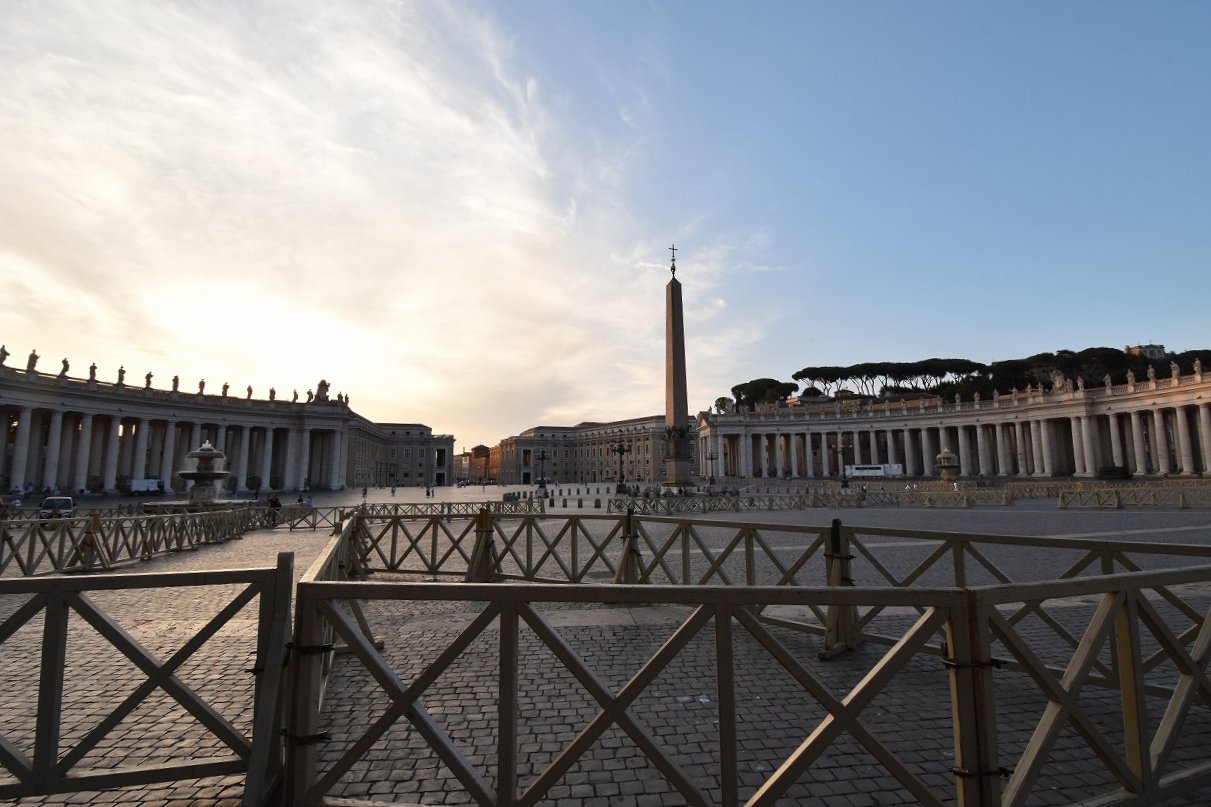
The Vatican Obelisk occupies the center of Saint Peter's Square, in front of the Basilica of Saint Peter, and holds a record that no other Roman obelisk can claim: it has never fallen. The shaft measures between 25.3 and 25.5 meters according to the survey, with a total approaching 40 meters that some records fix at 40.28 meters. It comes from Heliopolis, passed through Alexandria in Egypt and was brought to Rome by Caligula, according to the sources in 37 or 40 AD, for the spina of the imperial circus in the Vatican valley. It doesn't carry a single hieroglyph: the monolith is blank on all four sides, and bears only a Latin inscription of the Roman age. It stood next to the Constantinian basilica for 15 centuries and was moved to the center of the square on September 10, 1586, the first of the four obelisks raised by Domenico Fontana. It can always be seen, without a ticket, but on days of papal celebrations the square may be fenced off several hours earlier.
Flaminian Obelisk, the first to arrive
The Flaminian Obelisk, at the center of Piazza del Popolo where the three streets of the Tridente converge, is the first Egyptian obelisk ever to arrive in Rome. It was quarried at Aswan under the pharaoh Seti I, of the 19th Dynasty, and completed by his son Ramesses II for the temple of the Sun at Heliopolis. Augustus had it brought in 10 BC and raised on the spina of the Circus Maximus. On the height of the shaft the sources diverge notably: the City of Rome records give 25.90 meters, the most widespread reference works give 24 meters and some local guides go down to 23.20 meters, depending on what is included in the measurement. On one figure they all agree: with base and cross the monument reaches 36.50 meters. It was found in 1587 and raised again by Fontana in 1589, as an entrance signal for the pilgrims coming down from Via Flaminia through the Porta del Popolo, a few meters from Santa Maria del Popolo. In the 1800s Giuseppe Valadier built around it the stepped base with the four basins and the Egyptianizing lions.
Montecitorio Obelisk, the needle of a sundial
The Montecitorio Obelisk is an authentic Egyptian obelisk cut at Aswan and raised at Heliopolis under the pharaoh Psamtik II, of the 26th Dynasty, between 595 and 589 BC. It arrived in Rome with the Flaminio in 10 BC, brought by Augustus, but it received a different assignment from all the others: to serve as gnomon, that is, the shadow-casting rod, of the Horologium Augusti, the enormous sundial laid out on the pavement of the Campus Martius. The granite shaft measures 21.79 meters, the whole with pedestal and bronze sphere reaches 33.97 meters: the figure of 30 meters found in some encyclopedias refers to a different measurement and should be taken with caution. It collapsed, was buried, was found in pieces and remained for centuries an unkept promise, until Pius VI had it raised again in 1792 by the architect Giovanni Antinori in front of the Chamber of Deputies, a step from Piazza Colonna. How that instrument really worked, and what relationship it had with the Ara Pacis and the Mausoleum of Augustus, remains a matter of discussion among scholars.
Macuteo Obelisk, in front of the Pantheon
The Macuteo Obelisk is the small monolith planted at the center of the fountain in Piazza della Rotonda, exactly in front of the porch of the Pantheon. It measures 6.34 meters of shaft and 14.52 meters counting the base of the fountain and the cross. It bears the cartouches of Ramesses II: it was cut at Aswan and raised at Heliopolis in the 13th century BC, then shipped to Rome in the imperial age for the Iseum Campense. Buried by the collapse of the ancient city, it was found in the 1300s and planted in front of the little church of San Macuto, in the Colonna rione, from which it takes its name. Only in 1711 did Clement XI have it hoisted above the 1500s fountain by Giacomo Della Porta and Leonardo Sormani, remade for the purpose of receiving it. Some sources point out that the monolith has lost about a meter compared with the original Egyptian dimensions, through later breakage and reductions.
Minerva Obelisk, the smallest of the 13
The Minerva Obelisk is the smallest ancient obelisk in Rome: 5.47 meters of shaft in red granite. Unlike the other Egyptian ones it doesn't come from Heliopolis but from Sais, in the Nile Delta, capital of the 26th Dynasty, and it was commissioned by the pharaoh Apries, whose Egyptian name is rendered as Wahibra, who reigned roughly between 589 and 570 BC. It arrived in Rome for the Iseum Campense, was found in 1665 in the garden of the Dominican convent attached to Santa Maria sopra Minerva and raised again in 1667 at the wish of Alexander VII above a marble little elephant designed by Gian Lorenzo Bernini and executed by Ercole Ferrata. The Romans call it Minerva's chick. In the arrangement the Jesuit Athanasius Kircher also took part on the intellectual side, giving the hieroglyphs a symbolic, Christianizing reading now recognized as completely wrong.
Dogali Obelisk, the least visited
The Dogali Obelisk is a monolith of red Aswan granite 6.34 meters tall in the shaft, inscribed for Ramesses II and raised more than 3,000 years ago at Heliopolis. The complete monument, with its 19th-century base and crowning, reaches 16.92 meters. It is the twin in size of the Macuteo, with which it shares its origin and its arrival in Rome for the Iseum Campense. It re-emerged from an excavation in 1883, and four years later the architect Francesco Azzurri turned it into a memorial to the 500 Italian soldiers who fell on January 26, 1887 at Dogali, in present-day Eritrea, placing it in front of Termini station. In 1925 it was moved to the gardens between Viale Luigi Einaudi and Viale delle Baths of Diocletian, where it stands today: a pharaonic obelisk turned colonial monument, a hundred meters or so from the station exit and ignored by almost everyone who walks past it.
Matteiano Obelisk, the fragment of Villa Celimontana
The Matteiano Obelisk, in the gardens of Villa Celimontana on the Celio, is the most peculiar case of the eight: only the upper half is Egyptian, 2.68 meters tall, while the rest is a modern completion. With the completion, the base and the globe the monument reaches 12.23 meters. The fragment dates from the time of Ramesses II and also comes from the Iseum Campense. In the Middle Ages it stood on the Capitoline Hill, near the side passage of the basilica of Santa Maria in Aracoeli. In 1582 the Roman Senate gave it to Ciriaco Mattei, who had it carried to his villa on the Celio. It was raised again in its present form in the gardens only in 1820. The park is public, entry is free and the obelisk can be reached on foot from the Colosseum in about 10 minutes uphill.
The five obelisks manufactured in the Roman age
Five of Rome's 13 ancient obelisks don't come from the Egypt of the pharaohs: they were cut by the Romans, in the same Aswan quarries, and worked or inscribed in Rome between the first and second century AD. Some bear authentic hieroglyphs composed by Egyptian priests in the emperor's service, others copied signs without meaning, still others no inscription. It's the category that dismantles the most widespread beliefs.
Agonale Obelisk, the fake Egyptian of Piazza Navona
The Agonale Obelisk rises at the center of Piazza Navona on the artificial rock of Bernini's Fountain of the Four Rivers. It measures about 16.53 meters of shaft, with sources ranging between 16.53 and 16.54 meters, and exceeds 30 meters overall counting the base of the fountain and the bronze dove. The granite comes from Aswan, but the monolith was commissioned in the Flavian age under Domitian, and the hieroglyphs were carved in Rome with a text that celebrates him and the deified emperors Vespasian and Titus. Before arriving here it changed home at least twice: the sources link it to the Isiac sanctuary of the Campus Martius or to the Albano area, then in 311 Maxentius had it brought to the spina of the circus of his own villa on the Appian Way, where it collapsed and lay broken on the ground for more than a thousand years. Innocent X had it recovered and Bernini raised it in 1651 at the center of the square, which stands on the basin of the Stadium of Domitian.
Esquiline Obelisk, behind the apse of Santa Maria Maggiore
The Esquiline Obelisk measures 14.75 meters of shaft and stands in Piazza dell'Esquilino, behind Santa Maria Maggiore, that is, on the apse side and not on the facade side. It was manufactured in Rome in the imperial age in imitation of Egyptian models, has no hieroglyphs and stood at the entrance of the Mausoleum of Augustus in the Campus Martius together with an identical twin. It was found in 1527 and raised again in 1587 by Domenico Fontana on the orders of Sixtus V, to mark the perspective focus of the new street the pope was opening. Putting it behind an apse and not in front of a facade was no mistake: it served to close the view of those arriving from the north, following the logic of vanishing points that governs the whole Sistine plan.
Quirinal Obelisk, the separated twin
The Quirinal Obelisk is the Esquiline's brother: same quarry, same entrance of the Mausoleum of Augustus, no hieroglyphs. The shaft measures 14.63 meters, sometimes rounded to 14.64, and the whole monument reaches 28.94 meters. It was found at the foundations of the hospital of San Rocco a Ripetta, during the rebuilding of the building between 1772 and 1776, and raised again in 1786 at the wish of Pius VI in front of the Quirinal Palace. What we call the fountain of the Dioscuri or of Monte Cavallo is not a unified work but an assemblage: three ancient pieces of different origin, arrived here from three different points of the city and assembled over the span of 30 years by different popes and architects. Two stones born equal, cut in the same quarry and raised in the same spot, were separated forever by two pontiffs 200 years apart.
Sallustiano Obelisk, the wrong quotation
The Sallustiano Obelisk stands at the top of the staircase of Piazza di Spagna, in front of the church of Trinità dei Monti, and measures 13.91 meters of shaft. It was manufactured in Rome by Roman workers and then inscribed with hieroglyphs copied exactly from the Flaminian Obelisk in Piazza del Popolo: the result is a long inscription that says nothing, badly copied signs, some upside down, others without syntactic sense, treated as a decorative motif and not as a text. It decorated the Horti Sallustiani, the gardens that took their name from the historian Sallust. Hadrian and then Aurelian carried out work there, and it is in this late phase that the erection is placed according to the most widespread hypothesis. It stayed broken in two pieces for 300 years and lay thrown on the ground next to the Lateran for decades, before Pius VI had it raised by Giovanni Antinori in 1789. On the overall height the sources don't agree: the tourist portal of Roma Capitale gives about 15.20 meters, while some lists report a much higher figure that does not correspond to what you observe in the square.
Pinciano Obelisk, the monument to Antinous
The Pincio Obelisk is the same monument that many call the Obelisk of Antinous, the Barberini Obelisk or the Aurelian Obelisk: four names for a single stone, not for four different obelisks. It measures 9.24 meters of shaft and 17.26 meters with the modern base and the bronze star. It was commissioned by Hadrian after 130 AD in memory of Antinous, the young Bithynian drowned in the Nile, and the hieroglyphs covering its four faces tell at length of the boy's death, his deification, the founding of Antinoupolis at the place of the drowning and the establishment of his cult: it is the only surviving contemporary testimony of those funeral honors, and for this reason Egyptologists treat it as a first-hand historical document. In the third century Elagabalus brought it to the spina of the Circus Varianus. It was found in three pieces in 1589 outside Porta Maggiore, moved in 1633 to the garden of Palazzo Barberini without being raised, then given to Clement XIV, who had it transferred to the Vatican, and finally raised by Giuseppe Valadier in 1822 at the wish of Pius VII on the avenue that leads from the Pincio toward Villa Borghese. If you want to understand Hadrian's relationship with Egypt, you'll find the complementary chapter in the Canopus of Hadrian's Villa at Tivoli.
The modern obelisks, from the private 1800s to the marble of the 1900s
After 1822, the year the last ancient obelisk was raised again, Rome did not stop building them: it manufactured new ones. There are five or six depending on how you count, and they cover a span of 160 years, from private aristocratic commissions to regime propaganda to contemporary sculpture. None of them is Egyptian, and none really claims to be.
The Villa Medici copy
The obelisk in the gardens of Villa Medici, seat of the French Academy on the Pincio, is a 19th-century copy. The original was part of the Medici collection kept in the villa and was taken to Florence in 1790, where it still is. In the 1800s a replica was made and placed in the spot left free. It's the only case in which Rome lost an obelisk to another Italian city.
The two obelisks of Villa Torlonia
The Obelisks of Villa Torlonia are two twin monoliths in pink Baveno granite, just over 10 meters tall in the shaft and weighing more than 22 tons each, raised in 1842 in the park on Via Nomentana at the wish of Prince Alessandro Torlonia, who dedicated them to the memory of his parents Giovanni and Anna Maria. They are the only obelisks in Rome conceived, cut, carved and raised entirely in the modern age for a private patron and with a hieroglyphic text composed for the purpose. The author of the inscriptions was the Bolognese Barnabite Luigi Maria Ungarelli, an Egyptologist expert in hieroglyphs and a collaborator of Champollion: the texts were translated into Latin on the travertine bases so that anyone could read them. The erection, on June 4, 1842, required 190 men and eight winches, with 16 artillerymen operating them to the roll of drums, in front of an imposing crowd and the pope. The park is public and entry is free. The museums of the villa, from the Casina delle Civette to the Serra Moresca, have their own tickets and hours instead.
The obelisk of the Foro Italico
The obelisk of the Foro Italico, at the foot of Monte Mario in front of the sports complex, is the largest marble monolith ever quarried in Italy in modern times. It was commissioned by Renato Ricci for the Opera Nazionale Balilla, designed and put in place by the architect Costantino Costantini, and made from a single block extracted on January 26, 1929 from the Carbonera quarry in Carrara: a block of about 19 meters and an estimated weight of around 300 tons, which some sources raise to 350. The monument as a whole, including the base of blocks of the same marble, reaches 36.59 meters from the walking surface for a total weight of about 770 tons. The transport was the last great river transport in the history of the Tiber: 36 pairs of oxen as far as the coast, then a barge built for the purpose and christened Apuano, arrival in Rome on May 6, 1932 and inauguration in the same year, with sources ranging between October 29 and November 4. Under the foundations a Latin parchment was deposited, the so-called Codex Fori Mussolini, drafted by Aurelio Giuseppe Amatucci, together with gold coins minted for the occasion. On the shaft the inscription MVSSOLINI DVX is still carved, and on the base OPERA BALILLA ANNO X: the monument still stands with its inscriptions, and is periodically the subject of public debate over if to remove them, contextualize them or leave them as they are.
The Marconi stele at the EUR
The Marconi obelisk, at the center of Piazza Guglielmo Marconi along Via Cristoforo Colombo, is 45 meters tall and is the tallest obelisk in Rome, ancient or modern. It is not a monolith: the structure is a truncated pyramid, in reinforced concrete faced with 92 slabs of Carrara marble on which high reliefs are carved, arranged in four registers. The work was commissioned in 1939 from the Carrara sculptor Arturo Dazzi to decorate the central square of the district of the Universal Exposition planned for 1942. Entry into the war in 1940 abruptly interrupted the work, which resumed only in 1951 despite the ministerial intention to demolish the structure, and was concluded thanks to funding obtained in view of the Rome Olympics of 1960: the inauguration took place on December 12, 1959. It stands a few minutes' walk from the EUR lake and is visible at any time, being at the center of a flower bed in public space.
The Obelisco Novecento and the case of Axum
The latest arrival is the Obelisco Novecento by Arnaldo Pomodoro, inaugurated on October 23, 2004 in Piazzale Pier Luigi Nervi, also in the EUR district: a contemporary sculpture that cites the form of the obelisk without trying to imitate its stone or technique, and that enters the counts only of the more generous lists. The obelisk of Axum deserves a separate discussion: it was not Egyptian but Ethiopian, and it was not even, technically, an obelisk but a funerary stele of the Aksumite kingdom. Taken in 1937 during the Italian occupation of Ethiopia and reassembled in Rome in 1937 near the Circus Maximus, it was dismantled and returned to Ethiopia in 2005 after decades of negotiations: anyone reading lists of Roman obelisks compiled before that date still finds it listed, and it is one of the reasons the counts that circulate online don't match one another.
Domenico Fontana and Sixtus V: five years that redrew Rome
Four of Rome's 13 ancient obelisks were raised again in just four years, between 1586 and 1589, by the same architect and at the wish of the same pope: Domenico Fontana for Sixtus V. Vatican in 1586, Esquilino in 1587, Lateranense in 1588, Flaminio in 1589. No other pontificate changed the skyline of Rome with the same speed, and no other engineering project of the 1500s was as well documented by contemporaries.
The 1586 construction site
The most complex operation was the first, because it consisted of taking a monolith of over 300 tons that had stood upright for 15 centuries next to the old basilica of Saint Peter, laying it down without breaking it, transporting it for a few hundred meters and raising it again at the center of the square. On the numbers of the project the sources don't agree: the most widespread Italian tradition speaks of 13 months of preparatory work, 900 men, 75 horses and 40 winches. The English encyclopedia entry gives 800 men, 160 horses and 45 winches. Other publications report 800 workers and 140 horses. The monolith was set upright again on September 10, 1586. Fontana's novelty was as much organizational as mechanical: the synchronization of hundreds of men on dozens of winches, each with a codified task and a command signal.
The machines, which were not new
The lifting system was an orderly multiplication of simple machines: winches, levers, pulleys and inclined planes, the same tools the Egyptians and the Romans had at their disposal. No revolutionary invention, then, but a scale and a discipline of construction without modern precedent. Fontana published in 1590 an illustrated treatise on the undertaking, which for two centuries became the reference manual for anyone who had to move large weights, and explains why later projects, from Antinori's in the 1700s to the one at Villa Torlonia in 1842, followed the same scheme on a reduced scale.
Why Sixtus V did it
The repositioning of the obelisks was not an antiquarian whim. Sixtus V used it programmatically as a signal of the power of the Church and as the linchpin of the urban reorganization he had undertaken, straightening streets and opening straight avenues to link the great pilgrimage basilicas. Each obelisk was planted at a vanishing point: the Lateranense not in front of the facade of the basilica but in line with the Loggia of the Blessings, the end point of the newly opened Via Merulana and in perspective continuity with Santa Maria Maggiore. The Esquilino behind the apse of the same basilica, to close the view from the north. The Flaminio to mark the gate of entry to the city. Each monolith was also exorcised and crowned with a cross, with Latin inscriptions declaring its conversion from pagan emblem to Christian sign: a way of justifying the reuse of stones that came from Egyptian sun temples and imperial circuses.
The popes who came after
The other ancient obelisks stood upright again much later and with different patrons. Innocent X had the Agonale raised in 1651 with Bernini. Alexander VII the Minerveo in 1667, again on a Bernini design. Clement XI the Macuteo in 1711. Pius VI, with the architect Giovanni Antinori, the three of the Quirinal in 1786, the Sallustiano in 1789 and Montecitorio in 1792. Pius VII the Pinciano in 1822 with Giuseppe Valadier. In a little over two centuries, between 1586 and 1822, the city set 11 ancient monoliths upright again that had all been on the ground and mostly buried: this is the reason obelisks belong to the Baroque and neoclassical image of Rome as much as to the imperial one.
The hieroglyphs, and who really read them
For more than 1,400 years nobody in the world was able to read hieroglyphs: the key was lost in late antiquity and was recovered only in 1822, when Jean-François Champollion announced the decipherment starting from the comparison of the texts of the Rosetta Stone, found in 1799. Everything that was said and written about the obelisks of Rome before that date is, from the point of view of reading the text, imagination.
Athanasius Kircher and the invented translations
The protagonist of that season was the German Jesuit Athanasius Kircher, who in the Rome of the mid-1600s was the recognized authority on Egyptian antiquities and who wrote whole volumes on the Roman obelisks. Kircher held that hieroglyphs were a symbolic and allegorical system and not a phonetic one, and built readings accordingly that have no relationship to the real text: philosophical messages, secret doctrines, allusions to the Trinity. His translations are to be considered substantially invented, but they have a historical value of their own, because they document how the 1600s imagined Egypt and because they directly influenced monumental choices like the Minerva elephant.
1822 and what changed
After Champollion the Roman obelisks stopped being mute decorative objects and became documents. It was discovered that the one on the Pincio tells at length the story of Antinous and the founding of Antinoupolis, that the Agonale is a hymn to Domitian and to the deified emperors Vespasian and Titus, that the Flaminio speaks of Ra, Atum and Khepri, that the Minerva one carries the royal titulary of Apries. It was also discovered, and it was a less welcome surprise, that the Sallustiano says nothing, because its signs are a clumsy copy of those of the Flaminio. The difference depends on the patron and the construction site: when the emperor had Egyptian priests able to compose the text, the result was correct. When it was a matter of decorating, the stonecutters copied forms without understanding them.
Real texts, copied texts, mute stones
Going through the 13 ancient ones, the breakdown is clear-cut. The seven pharaonic obelisks with an inscription have authentic hieroglyphs composed in Egypt, that is, Lateranense, Flaminio, Montecitorio, Macuteo, Minerveo, Dogali and the Matteiano fragment. The Agonale and the Pinciano have authentic hieroglyphs but composed in the Roman age. The Sallustiano has copied hieroglyphs without sense. The Vaticano, the Esquilino and the Quirinale have no hieroglyphs at all. Knowing which group the obelisk in front of you belongs to completely changes the way you look at it, and it isn't information you'll find on a panel in the square.
The Egyptologists who read the Roman stones
The work of systematic reading has continued for two centuries. Luigi Maria Ungarelli, the Barnabite who composed the texts of the obelisks of Villa Torlonia, published in Italy a first reasoned collection of the hieroglyphic inscriptions of the Roman obelisks. In the 1900s Erik Iversen signed the reference work in English, while in Italy Cesare D'Onofrio published in 1967 the volume that remains the starting point for anyone studying the history of their moves. On the text of the obelisk of Antinous the Egyptologists Philippe Derchain and Jean-Claude Grenier worked in particular, recognizing in it the hand of a priest from the city of Akhmim.
Seeing the obelisks of Rome: how to plan
All 13 ancient obelisks of Rome can be seen for free, because they stand in public squares or in parks with free access: none requires a ticket, and none has an opening time. The only real variable is the occasional presence of construction sites, barriers or events that temporarily limit approach.
The spot from which you see three together
There is only one spot in the world from which you can see three obelisks at the same time, and it is in Rome: the intersection of Via del Quirinale and Via delle Quattro Fontane, in front of the church of San Carlo alle Quattro Fontane. Looking along the four axes you frame the Quirinal Obelisk in one direction, the Sallustiano of Trinità dei Monti in another and the Esquilino behind Santa Maria Maggiore in the third. It's the effect intended by the urban plan of Sixtus V, and it still works today exactly as calculated four centuries ago. It's worth stopping at the center of the intersection when traffic allows, with care, and turning around on the spot.
Half a day in the historic center
Six obelisks are concentrated in an area you can walk in a little over two hours of net walking. Starting from Piazza del Popolo you have the Flaminio. Going up to the Pincio you find the Pinciano. Going down toward Trinità dei Monti you reach the Sallustiano at the top of the staircase of Piazza di Spagna. Heading toward the Tiber you touch Montecitorio. A short walk away are the Macuteo in front of the Pantheon and the Minerveo on Bernini's elephant, less than 200 meters apart. A little farther on, the Agonale of Piazza Navona. That makes seven in reality, and you can do them in a comfortable morning.
The ring of the giants
The three tallest are instead far from one another and require transport. The Vaticano in Saint Peter's Square is reached by subway line A to Ottaviano, the Lateranense in Piazza San Giovanni by the same line A or by line C. The Esquilino and the Quirinale fit into the trip between the two, with a detour toward the Trevi Fountain that costs 10 minutes. The obelisk of Dogali is on the way for anyone arriving at or leaving from Termini, and it's the stop almost everyone skips without noticing.
The modern ones: EUR, Foro Italico, Nomentana, Celio
The modern ones require longer trips. The Marconi obelisk and the Obelisco Novecento can both be seen at the EUR, served by subway line B. The one at the Foro Italico is reached by the buses that run up the Lungotevere under Monte Mario. The two of Villa Torlonia are on Via Nomentana, just past Porta Pia. The Matteiano is in the park of Villa Celimontana, on the Celio, about 10 minutes' walk from the Colosseum and the Roman Forum. The practical advice is not to try to see them all in a single day: they are spread over an area more than 10 kilometers across.
Current state, restorations and what to check before going
None of the obelisks of Rome is dismantled, removed or permanently inaccessible: all 13 ancient ones and all the modern ones stand in their locations, and can be observed from outside without formalities. The limitations you may run into are always temporary and of three kinds: scaffolding for cleaning and maintenance work, barriers for work on the paving or for events, and closures of squares for public order reasons.
Recurring maintenance
The obelisks placed on fountains are the most exposed to sudden closures, because maintenance of the water system involves emptying and fencing off the basin: this applies to the Macuteo in Piazza della Rotonda and to the Agonale in Piazza Navona, where maintenance sites can open without notice and last a few weeks. The Flaminio in Piazza del Popolo is periodically the subject of work promoted by the Sovrintendenza Capitolina, and anyone planning a visit in a specific period will do well to check in advance if work with scaffolding is under way. For the Vaticano the constraint is not restoration but the liturgical calendar: on days of papal celebration the square is fenced off even several hours earlier.
Where to check
For the obelisks under municipal jurisdiction the reference is the Sovrintendenza Capitolina ai Beni Culturali, which publishes notices on work in progress. For the Vatican Obelisk it is the Holy See that announces the closures of the square. For those inside parks, like Villa Torlonia and Villa Celimontana, the opening hours of the gardens apply, which change with the season. Any list of hours or closures goes out of date in a few weeks, and checking directly before leaving remains the only reliable solution.
Frequently asked questions about the obelisks of Rome
How many obelisks are there in Rome?
Rome keeps 13 ancient obelisks, eight of them Egyptian and five manufactured in the Roman age, and it is the city that has the largest number in the world. Counting the modern ones too, that is, the Villa Medici copy, the two of Villa Torlonia, the one at the Foro Italico, the Marconi stele at the EUR and the Obelisco Novecento, the total rises to 18 or 19 pieces: the number varies by source because there is no single register and because what you agree to count as an obelisk changes.
What is the tallest obelisk in Rome?
The tallest ancient obelisk in Rome is the Lateranense, in Piazza San Giovanni in Laterano, with 32.18 meters of shaft alone and 45.70 meters counting base and cross: it is also the tallest existing Egyptian obelisk in the world. If you also consider modern monuments, the record passes to the Marconi stele at the EUR, 45 meters tall, which however is not a monolith but a concrete structure faced with marble.
What is the smallest obelisk in Rome?
The smallest ancient obelisk in Rome is the Minerveo, in Piazza della Minerva behind the Pantheon, with 5.47 meters of shaft. If you also count fragments, the record goes to the Matteiano of Villa Celimontana, of which only the upper half is original, 2.68 meters tall, completed in the 1800s until it reaches a total of 12.23 meters with base and globe.
Which obelisks of Rome are truly Egyptian?
The truly Egyptian obelisks of Rome are eight: Lateranense, Vaticano, Flaminio, Montecitorio, Macuteo, Minerveo, Dogali and Matteiano of Villa Celimontana. The other five ancient ones, that is, Agonale, Esquilino, Quirinale, Sallustiano and Pinciano, were cut by the Romans in the Aswan quarries and worked in Rome: some bear authentic hieroglyphs composed in the imperial age, one has copied signs without sense, three have no inscription at all.
Why does Rome have so many Egyptian obelisks?
Rome has more Egyptian obelisks than any other city because from 31 BC Egypt was a Roman province administered as the personal property of the emperor, and transporting a monolith of hundreds of tons was both a trophy of conquest and a demonstration of technical power. The obelisks were placed on the spinae of the circuses and in the sanctuaries of Isis in the Campus Martius, and from 1586 the popes unearthed them and raised them again as vanishing points of the city's new urban layout.
Do you have to pay to see the obelisks of Rome?
Seeing the obelisks of Rome is completely free: all 13 ancient ones stand in public squares or in parks with free access, with no ticket office and no opening hours. The only limitations are temporary and concern maintenance sites, barriers for events and, in the case of the Vatican Obelisk, the closures of Saint Peter's Square on days of papal celebration, which can start several hours before the event.
Who raised the obelisks of Rome again?
Four obelisks of Rome were raised again by Domenico Fontana at the wish of Sixtus V between 1586 and 1589: the Vaticano, the Esquilino, the Lateranense and the Flaminio. The others came later and with different patrons: Bernini for Innocent X in 1651 and for Alexander VII in 1667, Clement XI in 1711, Giovanni Antinori for Pius VI between 1786 and 1792, Giuseppe Valadier for Pius VII in 1822.
What is written on the obelisks of Rome?
On the obelisks of Rome the hieroglyphic texts say different things depending on the monument: titularies and solar dedications of pharaohs like Ramesses II, Seti I, Psamtik II and Apries on the eight Egyptian ones, hymns to the Flavian emperors on the Agonale, the account of the death and deification of Antinous on the Pinciano. The Sallustiano bears signs badly copied from the Flaminio and means nothing, while Vaticano, Esquilino and Quirinale have no hieroglyphic inscription at all.
When were the hieroglyphs of the Roman obelisks deciphered?
The hieroglyphs of the Roman obelisks could be deciphered only from 1822, when Jean-François Champollion announced that he had unlocked Egyptian writing starting from the Rosetta Stone found in 1799. Before that date nobody knew how to read them: the translations published in the 1600s by the Jesuit Athanasius Kircher, who held that hieroglyphs were a symbolic and not a phonetic system, are now considered entirely imaginary.
One last suggestion for those who want to really understand them
The most effective way not to turn the hunt for obelisks into a checklist is to choose three stones from different families and look at them one after another in the same afternoon: an authentic Egyptian one with its text, like the Macuteo in front of the Pantheon. A Roman one with real hieroglyphs but of the imperial age, like the Pinciano. And a mute Roman one or one with copied signs, like the Quirinale or the Sallustiano. In an hour and a half of walking you see why two monoliths that look identical tell stories that have nothing in common.
If you're planning a wider itinerary among the squares of the center of Rome, crossing these stops with the other stops of the Tridente and the Campus Martius, you can find useful planning tools on Tour Leader Pro, while for a wider picture of transport and destinations in Lazio, Italy Planner is a good resource.