Porta del Popolo
In short. Porta del Popolo is the northern gate of the Aurelian Walls, the ancient Porta Flaminia.
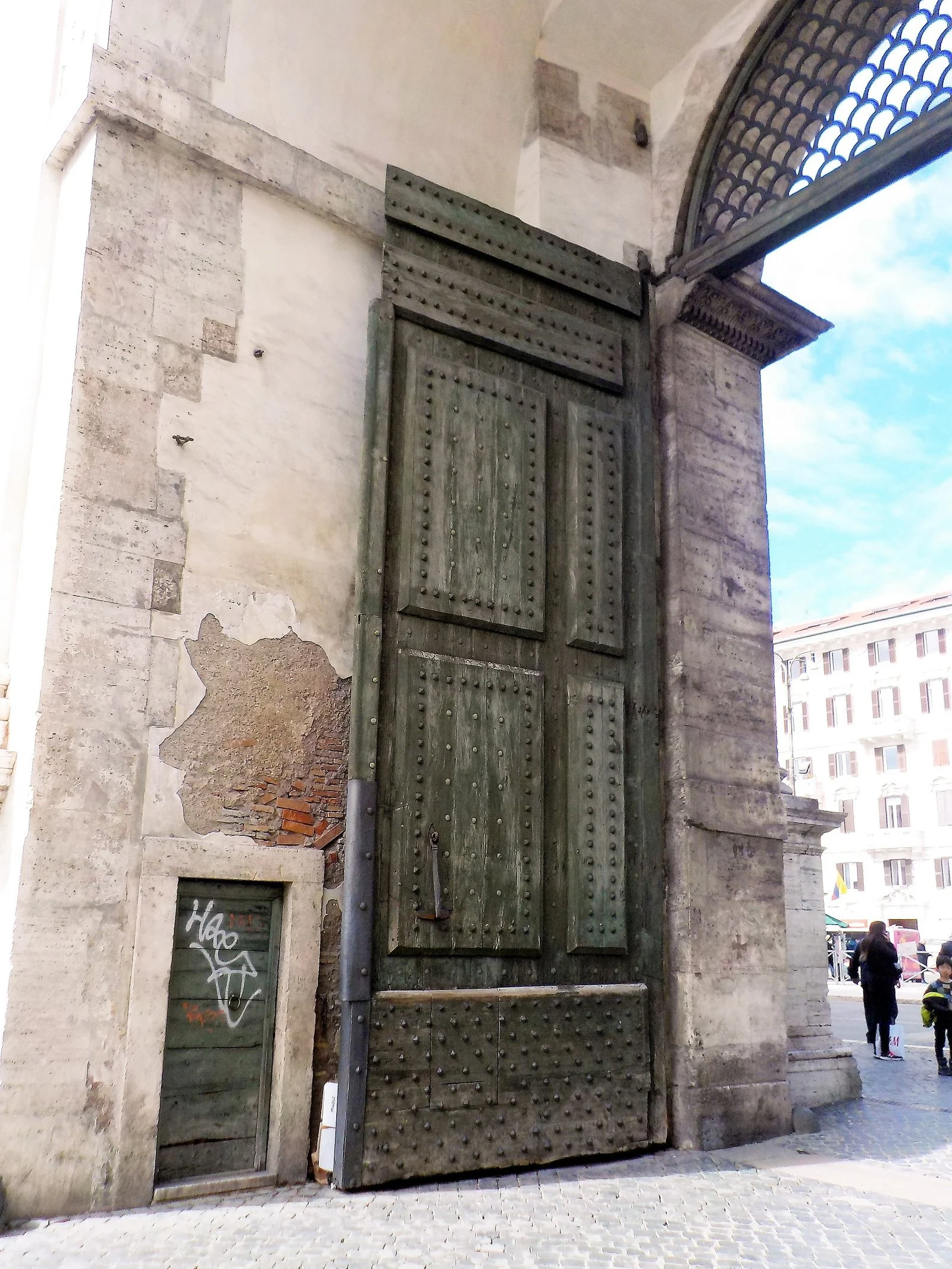
Porta del Popolo is the northern gate of the Aurelian Walls, the ancient Porta Flaminia. For almost 1,800 years it was the entrance to Rome for anyone arriving from the north, that is, for almost all of the pilgrims headed to the basilicas, the Grand Tour travelers, the foreign embassies and the armies coming down Via Flaminia. Anyone passing through it today going from Piazzale Flaminio to Piazza del Popolo often does so without slowing down, convinced they are crossing a simple ornamental arch between two big urban spaces. In reality it is a monument layered in an almost dizzying way: a Roman structure of the 3rd century AD, an outer 16th-century facade ordered by Pius IV, a Baroque inner facade put in place in 1655 for the arrival of a queen, two 17th-century statues with a history of refusals and moves behind them, and two side archways opened in the 19th century to let carriages through. The lines that follow tell what you actually see passing under this arch, who built and rebuilt it, which attributions hold up and which are disputed, and above all what it felt like for someone arriving from the north after weeks of travel to find themselves for the first time in front of Rome.
Where Porta del Popolo Is and How to Get There
Porta del Popolo opens on the northern side of Piazza del Popolo and looks, on the other side, toward Piazzale Flaminio. It is the exact point where the fabric of the historic center breaks off against the curtain of the Aurelian Walls, with Via Flaminia continuing north and the Pincio rising behind on the eastern side. No ticket is needed to see it: the three archways can be walked through freely at any hour, because they are part of the city's pedestrian network.
The Metro Stop
The most convenient stop by far is Flaminio, on metro line A, whose exit opens directly onto Piazzale Flaminio, that is, onto the outer side of the gate. Coming out of the turnstiles you have Porta del Popolo in front of you within about 30 meters, and you cross it to enter the piazza. Piazzale Flaminio is also served by several bus lines and by the terminus of tram 2.
On Foot From the Center
From the historic center Porta del Popolo is an easy walk. From Piazza di Spagna 10 minutes are enough, walking the whole length of Via del Babuino, which comes out in Piazza del Popolo next to one of the two twin churches. From Piazza Venezia the route is even more direct: you take Via del Corso and follow it straight for about a kilometer and a half, arriving in the piazza exactly on the axis that points toward the gate. Those coming down from the Pincio arrive instead from above, along the 19th-century ramps linking the panoramic terrace to the level of the piazza.
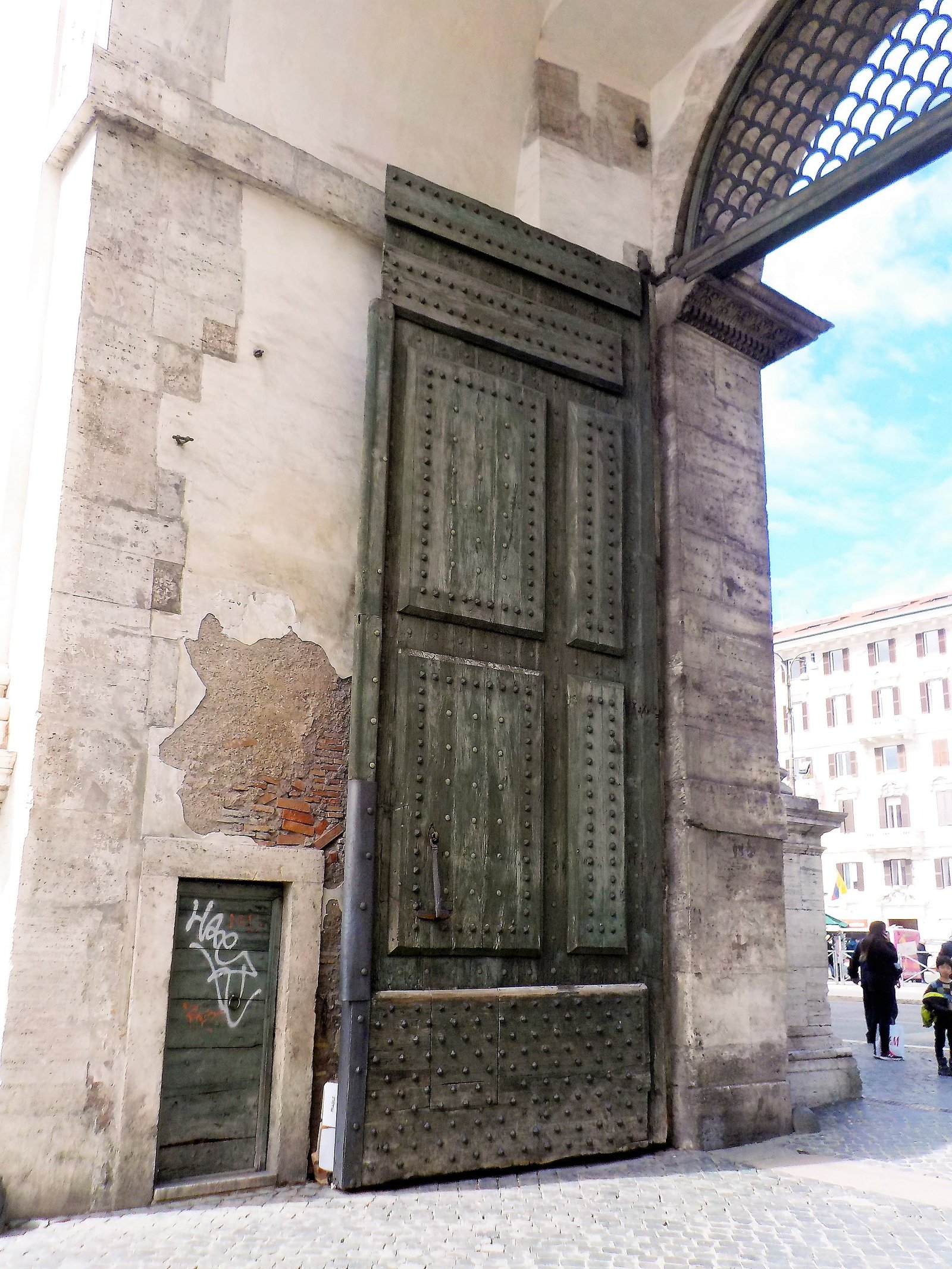
The Roman Porta Flaminia: The Northern Gate of the Aurelian Walls
Porta del Popolo was born as Porta Flaminia, one of the main gates of the Aurelian Walls, the defensive circuit built by the emperor Aurelian between 271 and 275 AD and completed under Probus. The name comes from Via Flaminia, the great consular road opened in the 3rd century BC by the censor Gaius Flaminius, which went up from Rome through central Italy to Ariminum, present-day Rimini, on the Adriatic. It was the road to the north par excellence, and this was the gate that brought it into the city.
The Aurelian Circuit in Numbers
The Aurelian Walls ran for about 19 kilometers, of which just over 12 still stand today, and were marked by 18 main gates as well as many posterns. In the first phase the curtain walls were between six and eight meters high, with square towers at intervals of around 30 meters.
What the Gate Looked Like Originally
According to the reconstruction accepted today by the Capitoline Superintendency, the Aurelian Porta Flaminia had two side-by-side archways, one for each direction of travel, framed by two towers with a semicircular plan. On the upper level ran a row of arched windows, and above that an open, crenellated wall-walk. It was the scheme of the major gates of the circuit, the same one still recognizable, in a more intact form, at Porta San Sebastiano on the opposite side of the city.
Honorius's Rebuilding and the Reduction to a Single Archway
Between 401 and 403 AD, under the emperor Honorius and on the initiative of the general Stilicho, the entire circuit was deeply reworked for defense. The height of the walls was almost doubled, going from the initial six or eight meters to at least 10.5 meters and in some stretches to 15, and the gates were turned into true small forts. At Porta Flaminia this meant closing one of the two archways, facing the front in travertine, adding a dentil cornice and replacing the semicircular towers with two square-plan towers that enclosed the earlier ones. From then on, and for more than a thousand years, the gate had a single passage.
From Porta Flaminia to Porta San Valentino
During the early Middle Ages the gate changed its name and became Porta San Valentino, from the shrine and the catacomb of San Valentino located just outside, along the first stretch of Via Flaminia at the foot of the Parioli. It is a typical step of early medieval Rome, in which place names of pagan or simply administrative origin were gradually replaced by Christian references tied to suburban places of worship. For the pilgrim arriving from the north, moreover, the first point of reference was not the consular road but the shrine where he stopped to pray before entering.
Why It's Called Porta del Popolo Today
The current name comes from the nearby basilica of Santa Maria del Popolo, the church on the right side of the piazza looking south, founded according to tradition in 1099 at the will of Pope Paschal II. On the origin of the term popolo there are two explanations and they don't exclude each other. The first derives it from the Latin populus in the sense of poplar, referring to a poplar grove that is said to have occupied the area. The second links it to the fact that the construction of the church was supposedly financed by the Roman people. It must be said clearly that the most famous story tied to this place, that of the walnut tree haunted by the ghost of Nero that Paschal II is said to have had cut down, belongs to medieval popular tradition and not to a documented historical reconstruction. It is a founding legend, and should be taken as such.
Sixtus IV's Restoration for the Jubilee of 1475
At the end of the 15th century the gate was in poor condition and partly buried, as happened to many Roman monuments because of the gradual rise of the street level. On the occasion of the Jubilee of 1475 Pope Sixtus IV had work done on the structure, with a consolidation that the sources describe as rather sketchy, and the gate remained flanked by the two square towers. He is the same pontiff who had the basilica of Santa Maria del Popolo rebuilt in the form that is still largely visible today. The link between the gate and the church, at that moment, became a single urban planning program, designed to welcome jubilee pilgrims at the exact point where they set foot in the city.
Pius IV's Rebuilding: The 16th-Century Outer Facade
The outer facade of Porta del Popolo, the one you see arriving from Piazzale Flaminio, is a work of the high 16th century ordered by Pope Pius IV, born Giovanni Angelo Medici, and carried out between 1562 and 1565. The commission is certain and documented: the pope wanted a monumental gate that would serve as the city's calling card for those arriving from the north, and not a simple defensive opening. It is exactly in these years that the modern idea of the city gate as a scenographic apparatus took hold in Rome, the same idea that a few years earlier, in 1561, produced Porta Pia, commissioned by the same pontiff from Michelangelo.
The Model: The Arch of Titus
The formal reference chosen for the new facade is declared and recognizable: the Arch of Titus in the Roman Forum, with its single archway framed by engaged columns and topped by an attic. It's a choice that says a lot about the cultural climate of the moment. In mid-16th-century Rome the ancient triumphal arches were not only objects of antiquarian study but an operational repertoire, and designing a city gate on the model of a Roman arch meant asserting a direct continuity between imperial Rome and papal Rome. Anyone coming from the Roman Forum and then looking at this facade recognizes the scheme without needing any explanation.
The Four Columns From Old Saint Peter's
The materially most interesting detail of the facade is the four columns framing the central archway, coming from the Constantinian basilica of Saint Peter, that is, from old Saint Peter's, demolished to make room for the current Saint Peter's Basilica. The construction site of the new basilica, which had been going on for decades, produced an enormous quantity of reused material, and part of this material ended up in the city's papal building projects. The sources describe granite columns, with some variations in the description of the materials from one author to another. Knowing that those columns have seen the inside of Constantine's basilica decisively changes the way you look at this facade.
The Coat of Arms of Pius IV
On the attic stands the coat of arms of Pius IV with the Medici balls. A clarification is needed here that almost no guide makes: Giovanni Angelo Medici belonged to a Milanese family, the Medici di Marignano, which has no ascertained line of descent from the Medici of Florence, although it adopted their arms. The fact that the Medici balls stand on Rome's main gate therefore doesn't mean, as many visitors infer, that the hand of grand-ducal Florence is at work here. It only means that this pope used that coat of arms.
A Curiosity About Porta del Popolo
The attribution of the design of the outer facade is one of the most interesting and at the same time most mishandled points in the literature on this monument, and it's worth reconstructing in full because the version you read almost everywhere is, at best, a simplification.
The Current Version: Michelangelo the Designer, Nanni the Builder
The formula repeated by almost all popular sources, including the institutional tourist portals, is that Pius IV entrusted the commission to Michelangelo Buonarroti, who, by then very old, is said to have passed it on to Nanni di Baccio Bigio, who carried out the work between 1562 and 1565. Some versions add that the inner facade was supposedly built by Vignola on Michelangelesque drawings. It's an elegant reconstruction, with the advantage of linking the monument to a first-rank name.
Why the Current Version Doesn't Fully Hold Up
The problem is that Nanni di Baccio Bigio, whose real name was Giovanni di Bartolomeo Lippi, a Florentine born around 1513 and dead in Rome in 1568, was not a collaborator of Michelangelo. He was his declared adversary. The Dizionario Biografico degli Italiani reconstructs a conflict that begins in 1547 and lasts for years, with Nanni as the spokesman of the Sangallo group that systematically challenged Michelangelo's choices on the Saint Peter's building site. In 1563, when Nanni managed for a moment to get himself appointed superintendent of that site in place of Daniele da Volterra, Michelangelo reacted by threatening to abandon the work, and Nanni was removed after about a month. Imagining that in the same months Michelangelo would spontaneously hand him a prestigious papal commission takes a good dose of optimism.
What the Most Solid Biographical Source Says
The entry in the Dizionario Biografico degli Italiani devoted to Giovanni Lippi simply records that in 1561 Pius IV commissioned Nanni to rebuild the outer facade of the gate, without any Michelangelesque mediation. This doesn't rule out that the general idea of the monument was circulating in the papal court, where Michelangelo was still the reference figure and where the scheme of the ancient arch was common property, but it shifts the burden of proof: the attribution to Michelangelo is a tradition, not a documentary fact.
How It's Best to Tell It
The honest formulation is this: the outer facade of Porta del Popolo was commissioned by Pius IV from Nanni di Baccio Bigio and built in the years between 1561 and 1565. An established tradition, accepted by much of the literature and by the tourist portals, traces it back to an idea of Michelangelo, but the openly hostile relationship between the two architects and the silence of the most rigorous biographical sources counsel caution. Anyone who guides visitors and wants to be accurate can say that the design looks to Michelangelo, not that it is by Michelangelo.
Image: detail of the columns and the attic of the 16th-century facade, with the papal coat of arms in the center.
The Statues of Saint Peter and Saint Paul: A Story of Refusals and Moves
On either side of the central archway, on the outer facade, stand two large statues representing Saint Peter and Saint Paul. They are the work of the Tuscan sculptor Francesco Mochi, one of the protagonists of Baroque sculpture between Rome and Piacenza, and they are probably the piece with the most eventful biography of the whole monument.
Made for Another Church and Rejected
The two groups weren't conceived for the gate. They had been commissioned from Mochi by the Benedictine monks of San Paolo fuori le Mura, who wanted them on either side of the ciborium of Arnolfo di Cambio in their basilica. The sculptures, colossal in size, were finished around 1652, but the patrons rejected them and also refused to pay for them. A lawsuit before the ecclesiastical courts followed and dragged on for a long time, with the two statues sitting in the sculptor's studio.
The Widow, the Pope and the Apostolic Chamber
Mochi died in 1654 without having collected anything, and the two sculptures appeared in the inventory of his estate as unpaid works. It was the widow who pursued the matter through papal channels: with the intervention of Cardinal Girolamo Farnese and Pope Alexander VII Chigi a solution was reached, the Apostolic Chamber bought the two groups settling the artist's debts, and in 1658 the statues were placed on the outside of Porta del Popolo, on either side of the archway, where they stayed for more than three centuries.
Watch the Date: 1638 or 1658
On this point the popular sources are divided, and it's worth pointing out. Many sites, including some institutional tourist portals and the free encyclopedia, give 1638 as the year the statues were placed at the gate. That date is however incompatible with Mochi's biography, since he completed the two groups around 1652 and died in 1654. If the statues were bought by the Apostolic Chamber after the sculptor's death, with the intervention of Alexander VII, elected in 1655, the placement can only have come later. The 1658 given by the Virtual Museum of the Walls of Rome and by the Superintendency's entry is the only date consistent with the rest of the story, and 1638 looks like a typo that spread from one source to another.
The Originals Are No Longer Here
There's one last chapter that almost nobody tells and that changes the way you look at the facade. To protect the marbles from air pollution and washout, the two original groups were removed from the gate and taken to the Museo di Roma at Palazzo Braschi, in an operation that the sources place between the mid-20th century and 1980. In their place, on the gate, copies were installed. Since February 2016, after a restoration and as part of an initiative tied to the Jubilee of Mercy, Mochi's originals have been in the Basilica of San Giovanni Battista dei Fiorentini, where they can be seen for free. Anyone who wants to see Mochi's real marbles, then, shouldn't look for them at the gate but on Via Giulia.
Something Nobody Tells You About Porta del Popolo
Porta del Popolo is not a solid backdrop. It's a building with an interior, and that interior today houses the Documentation Center of Rome's UNESCO site, with service rooms and a panoramic terrace at the top. Practically none of the millions of people who walk through the archway every year know they have visitable rooms over their heads.
What You See From the Terrace
From the terrace on top of the gate the eye takes in two opposite and complementary panoramas: to the south the whole of Piazza del Popolo with the Flaminian Obelisk in the center and the start of the three streets of the Tridente, to the north Piazzale Flaminio and Via Flaminia climbing toward the neighborhood of the same name. It's a raised viewpoint that exists nowhere else and lets you grasp the geometry of the piazza at a glance, something that is much harder from street level.
How to Get In
Access is not open: the visit is organized by the Capitoline Superintendency for Cultural Heritage on specific occasions, generally free, with mandatory booking through the information service of the City of Rome at 060608, groups of at most 15 people and a duration of about 90 minutes. The meeting point given in the official notices is Piazza del Popolo 11D, next to the left archway as you look at the gate from the piazza. The opening calendar changes from year to year and the visits sell out fast, so it's best to check the pages of the Superintendency and of Turismo Roma periodically and book as soon as the dates come out.
A Warning on Accessibility
The climb to the terrace is by internal stairs, with a number of steps that the Superintendency's notices put at around 120, and the route is explicitly marked as unsuitable for people with mobility difficulties. There is no elevator. In some editions the visit has also been offered with Italian Sign Language interpreting, with availability to be flagged at the time of booking: those who need it must ask when making the request, because the service is not automatic.
The Inner Facade and Christina of Sweden's Entry in 1655
Turning toward the piazza you see the other face of the monument, and everything changes. The inner facade of Porta del Popolo was redesigned in 1655 by Gian Lorenzo Bernini on the commission of Pope Alexander VII Chigi, in view of a precise and dated event: the solemn entry into Rome of Christina of Sweden.
Who Christina of Sweden Was and Why Her Arrival Mattered So Much
Christina, daughter of Gustavus Adolphus, had been queen of Sweden, that is, sovereign of one of the leading countries of the Protestant Reformation in Europe. In 1654 she abdicated and converted to Catholicism, a choice that for the Holy See was the most spectacular propaganda coup of the century, in a Europe only recently out of the 30 Years' War. Her arrival in Rome couldn't be treated as a courtesy visit. It had to be a triumph, and it had to be seen.
The Exact Dates
Christina arrived in Rome privately on December 20, 1655, lodging in the Vatican, and made her solemn entry on December 23, 1655. The procession came in through Porta del Popolo and went along Via del Corso, and then through the sequence of streets that by way of San Marco, the Gesù, the Valle, Pasquino, Parione and Banchi led to Borgo and Saint Peter's. The chronicles of the time describe carriages, hundreds of participants among clergy and nobility, tapestries hung on the facades, trumpet blasts and cannon salvos. From December 26 the queen settled in Palazzo Farnese, which the Duke of Parma had had refitted to receive her.
The Welcome Inscription
Bernini placed on the inner facade, above the archway, the inscription that can still be read: FELICI FAVSTOQVE INGRESSVI, with the date ANNO DOM MDCLV. The sense is that of a solemn wish for a happy and auspicious entry, in the year of the Lord 1655. It's a deliberately short Latin formula, meant to be read at a glance by those passing under the arch, and it has a feature that makes it unique among Roman inscriptions: it doesn't celebrate a pope, it doesn't celebrate a military victory and it doesn't commemorate a restoration, but greets a person who at that moment was crossing the gate.
The Coats of Arms and the Decoration
Bernini's decoration of the inner facade is built around the heraldry of Alexander VII, that is, the mounts topped by the star that are the emblem of the Chigi family, accompanied by plant elements and by references to the Swedish royal house, so that the visitor would read in a single glance the pope who welcomed and the sovereign who was welcomed. Some descriptions speak of oak branches associated with the coat of arms. It's a heraldic element recurring in Baroque Rome and it's best to verify it in person by looking carefully at the reliefs, because popular transcriptions don't always agree on the details.
What Exactly Bernini Did
One point to handle with care is the extent of the intervention. The sources speak generically of a redesign of the inner facade, but some reconstructions maintain that the front toward the piazza already existed in a 16th-century form, attributed to Vignola, and that in 1655 Bernini intervened mainly with the decorative apparatus, the coats of arms and the inscription, in very tight time dictated by the December 23 deadline. The two readings don't exclude each other: a Bernini apparatus grafted onto a preexisting structure is still a Bernini intervention, but the most prudent formula is to say that Bernini gave the inner facade the look it has today.
My Advice for Visiting Porta del Popolo
The most useful practical advice is simple and almost nobody follows it: go through the gate twice, in both directions, stopping each time to look at the facade in front of you. The monument is designed as a two-beat device, and whoever walks it in one direction only sees half of it.
The Right Route, in the Right Order
The sequence I recommend to those who bring groups is this: come out of the metro at Flaminio, stand in the middle of Piazzale Flaminio and look at the 16th-century facade from the spot where it was seen by those arriving from the north, that is, head-on and from a distance. Then cross the central archway walking slowly. Then stop right after the arch, turn around and read Bernini's inscription. Only at that point turn back toward the piazza, which opens up all at once. Done in this order, the walk takes 10 minutes and gives back exactly the effect the gate was built for.
The Best Time of Day
The outer facade faces north, so it stays in shade for much of the day and looks best in the diffuse light of the morning or on slightly overcast days, when the reliefs aren't flattened by contrast. The inner facade instead faces the piazza and gets the afternoon sun: toward sunset the travertine takes on a warm color that is the most beautiful moment to observe it. Anyone with time for only one visit who wants the best compromise should choose late afternoon, because it also coincides with the moment when the Pincio above the piazza offers its most beautiful light.
What to Pair in the Same Walk
The gate alone is worth 20 minutes. It makes much more sense to build a half-day itinerary around it that takes advantage of the extraordinary density of this corner of Rome: the basilica of Santa Maria del Popolo with its Caravaggio canvases, the Flaminian Obelisk in the center of the piazza, the climb to the Pincio with the Pincio Obelisk and the view over the piazza from above, and then possibly Villa Borghese with the Borghese Gallery, which however requires mandatory booking with a time slot. Alternatively you can go down toward the Tiber and reach the Ara Pacis and the Mausoleum of Augustus, 10 minutes' walk away.
A Detail Not to Miss on the Left Side
On the left flank of the gate, looking at it from the piazza, there is a plaque placed in 1909, the work of the sculptor Lorenzo Cozza, dedicated to the Carbonari Angelo Targhini and Leonida Montanari, beheaded in Piazza del Popolo on November 23, 1825. It's a small Risorgimento monument that almost everyone walks past without seeing and that opens a window onto a chapter of the piazza's history that is little talked about.
Arriving in Rome: What You Saw Coming In Through Here
This is the chapter for which Porta del Popolo is worth the attention. Until the arrival of the railway, that is until the mid-19th century, anyone coming to Rome from the north entered through here. Not by choice, but because it was the only road. And what they saw in the following 30 seconds had been built, pope after pope, to produce a certain effect.
The Approach: Via Flaminia and Ponte Milvio
The traveler coming down from northern Europe, from Tuscany or from the Marche reached Rome along Via Flaminia. The last obstacle was the Tiber, crossed at Milvian Bridge, the bridge where in 312 AD the decisive battle between Constantine and Maxentius was fought. Once past the bridge, about three kilometers of straight road remained, lined with vineyards and farmhouses, before the walls came into view. They were the last three kilometers of journeys that may have lasted weeks, and it is documented that very many travelers walked them in a state of growing excitement.
The Moment of the Threshold
The 16th-century facade appeared head-on, isolated against the curtain of the walls, flanked by the two square towers that still existed then. It wasn't an elegant arch in the middle of an open square, as it appears today. It was a small fort with a single opening, guarded, and you saw it coming from far off along the straight road. The two statues of the holy apostles, after 1658, framed the passage. Then came the darkness of the arch, a handful of meters, and immediately afterward the piazza.
Why Piazza Is Designed to Make an Impression
Piazza del Popolo works as a perspective machine, and the pieces of that machine were assembled over the course of three centuries. The first element is the Tridente: three streets that start from the piazza and fan out toward the heart of the city. Via di Ripetta was opened in 1518 by Pope Leo X, Via del Babuino in 1525 under Clement VII, while the central axis is the ancient Via Lata, later Via del Corso, which follows the urban course of the Flaminia. The result is that whoever enters through the gate finds in front of them not one street but three, all three receding, and grasps immediately that the city continues well beyond what the eye can measure.
The Obelisk Placed on the Axis
The second element is the Flaminian Obelisk, the Egyptian monolith that Augustus had brought to Rome and set up in the Circus Maximus, and that Pope Sixtus V had moved here in 1589 under the direction of the architect Domenico Fontana. The shaft measures about 24 meters and exceeds 30 counting the base and the cross on top. The placement isn't decorative: Sixtus V used obelisks as urban signals, planting them at the points where important streets converged or branched, so that they would be visible from afar and orient pilgrims. Planting an obelisk exactly on the axis of the gate means giving whoever enters an immediate visual target, and a message at the same time: the pagan monolith is topped by the cross.
The Twin Churches as Wings
The third element is the twin churches of Santa Maria in Montesanto and Santa Maria dei Miracoli, which frame the start of Via del Corso like two theatrical wings. They were wanted by Alexander VII, begun by Carlo Rainaldi and finished with the contribution of Gian Lorenzo Bernini and Carlo Fontana in the second half of the 17th century. On the exact completion dates the sources differ, giving 1675 or 1679 for one and 1678 or 1681 for the other. The real finesse is that the two churches seem identical but aren't: the available lots had different shapes, and the architects solved the problem with domes of different plan, obtaining an apparent symmetry that the naked eye doesn't contradict. It's one of the most elegant perspective tricks of Roman Baroque.
The Fourth Element: Valadier and the Oval Shape
The piazza you see today is not the one Goethe or Christina of Sweden saw. Until the early 19th century the space was trapezoidal and much less monumental. It was the architect Giuseppe Valadier who transformed it, with a neoclassical intervention that the sources place between 1811 and 1822, and that according to other reconstructions continued into the 1830s, when the connecting ramps with the Pincio were completed. Valadier closed the piazza in an oval shape with two large side hemicycles, added fountains, sphinxes and sculptural groups, and above all hooked it to the Pincio hill, creating the panoramic terrace that is still one of the most photographed viewpoints in Rome. The total surface of the piazza is about 16,000 square meters.
The Customs House, the Passport and the Bureaucracy of Arrival
The less romantic side of arriving in Rome was the bureaucratic one. A city gate in the papal age was first of all a checkpoint: duties were paid on goods brought in, travel documents were shown, luggage was subjected to customs inspection. The gate was opened at dawn and closed at sunset, and whoever arrived after closing had to spend the night outside the walls, in one of the inns of the suburb, waiting for morning. The formality of entry, with its waits and checks, is one of the recurring themes of early modern travel memoirs, and it must be kept in mind so as not to imagine a purely aesthetic arrival.
Where They Went to Stay
Just inside the gate, the foreign traveler already found himself in his own neighborhood. The area between Via del Babuino, Piazza di Spagna and Via Margutta was the heart of the foreign colony in Rome, so dense with English, Germans and French that it was known by ironic nicknames among the Romans. The hotels, the boarding houses, the artists' studios, the antiquities dealers, the money changers and the ciceroni who offered guided visits were concentrated in those few streets. Goethe lodged on Via del Corso at number 18, a few minutes' walk from the gate. The apartment today houses the Casa di Goethe, a museum open to the public since 1997, and the sources document his stay from October 1786 to February 1787 and then from June 1787 to April 1788.
Why the Effect Has Weakened Today
It must be said honestly that the scenographic effect designed over the centuries works much less today than it did then, and there are three reasons. The first is that the opening of the two side archways turned the gate from a narrow diaphragm into a triple passage, drastically reducing the contrast between the darkness of the arch and the light of the piazza. The second is that the demolition of the towers took away the outer facade's defensive mass, making it look like an isolated arch. The third, the most banal, is that almost nobody arrives from the north anymore after days of travel: you come out of the metro, and the surprise has no time to form. Anyone who wants to recover at least an echo of it can try walking the last stretch of Via Flaminia from Ponte Milvio toward the gate, perhaps early in the morning.
Image: the piazza seen from under the central archway, with the obelisk on the axis and the two twin churches framing the start of the central street.
Another Well-Known Fact, Yet Rarely Mentioned
The two side archways that everyone walks through today without thinking are neither ancient nor 16th-century: they were opened in the last quarter of the 19th century, after the end of the Papal State, to let vehicle traffic through. To open them it was necessary to demolish the two square towers that flanked the single passage, that is, the oldest part still standing of the gate's medieval casing.
Agostino Mercandetti's Intervention
The operation is attributed to the architect Agostino Mercandetti. On the exact dates the sources don't agree: the Virtual Museum of the Walls of Rome places the intervention between 1877 and 1879, the Capitoline Superintendency's entry gives a range between 1879 and 1887, and other reconstructions date the demolition of the towers to 1879 and the opening of the archways to 1887. The most likely reading is that it was a site carried out in phases, started at the end of the 1870s and concluded in the 1880s. One source gives an overall cost of around 300,000 lire of the time.
What Came Out of the Demolition
The demolition of the square towers had an unexpected and valuable effect: under the late antique and medieval facing, the remains of the semicircular towers of the first Aurelian phase re-emerged, confirming the original two-archway layout of the gate. It was, in short, a case in which a traffic intervention produced, as a side effect, an advance in archaeological knowledge. Some sources also report the discovery of the ancient threshold in 1906.
The Right Photo to Take at Porta del Popolo
The best photograph of Porta del Popolo is not the head-on one everyone takes, but the one shot from the top of the Pincio terrace, where the gate appears as the northern stopper of the oval piazza, with the obelisk in the foreground and Via Flaminia receding beyond the walls. It's a framing that explains the monument instead of just showing it.
The Shot From the Pincio Terrace
From the terrace above the piazza, reachable on foot by Valadier's ramps or from Villa Borghese, you take in the whole geometry: the oval, the hemicycles, the obelisk on the axis, the gate at the far end. The best light is that of sunset, when the sun comes from the right and sets off the volumes. It's also the busiest time: it's best to arrive early to take a position on the parapet.
The Shot From the Archway
The second framing that always works is the one taken from under the central arch, using the archway as a natural frame: you aim toward the piazza, keep the obelisk in the center and let the darkness of the arch frame the bright scene. It takes patience to catch a moment with no passersby in the middle, and it's best to underexpose so as not to blow out the piazza.
The Detail That Deserves a Photo of Its Own
It's worth devoting a close-up shot to Bernini's inscription on the inner facade, filling the frame with the capital letters and the coat of arms above. It's the detail that tells the monument's most beautiful story and almost nobody photographs it up close. A modest telephoto lens or the zoom of a recent phone is enough, because the distance isn't excessive.
Some Important Events That Happened Here
Porta del Popolo and the piazza that opens right after it have hosted, over 17 centuries, triumphal entries, jubilee ceremonies, executions and horse races. Listing them helps to understand that this was not only a passage, but the official stage of arrival in Rome.
The Entry of Christina of Sweden, December 23, 1655
It's the event that left the most visible mark, because it produced the inner facade with the welcome inscription. The queen's procession came in through the gate and crossed the city to Saint Peter's, on a day organized like a perfect propaganda machine, with the city covered in tapestries and the artillery firing salvos. It's the only case in which a gate of Rome was remade for a single person and a single day.
The Executions in Piazza del Popolo
For centuries the piazza just inside the gate was one of the places of capital executions of the Papal State. The most remembered is that of November 23, 1825, when the executioner Giovanni Battista Bugatti, universally known as Mastro Titta, beheaded the Carbonari Angelo Targhini and Leonida Montanari, condemned for lèse-majesté. In 1909 a plaque in their memory was placed on the flank of the gate, the work of the sculptor Lorenzo Cozza. According to the most widespread reconstructions the last execution in this piazza dates to 1826, while the practice continued elsewhere in the city until the 1860s.
The Race of the Barberi
From the 15th century to the 19th the noisiest moment of the year at this point of the city was the race of the barberi, the horse race without jockeys held during the Roman Carnival. The horses started from under the obelisk of Piazza del Popolo and were launched along Via del Corso to Piazza Venezia, where a large hanging cloth marked the finish. The event, tied to the opening of the street ordered by Pope Paul II in 1462, was suppressed in 1874 after a young spectator was run over and killed.
Who Has Passed Through Porta del Popolo
Asking who has passed through this gate is almost a reverse exercise: until the age of the railway, anyone arriving in Rome from the north passed through here, and so the question becomes rather who is worth remembering among the tens of thousands of possible names.
The Grand Tour Travelers
Between the 17th and 19th centuries Porta del Popolo was the threshold of the Grand Tour, the educational journey that brought aristocrats, artists, architects, writers and scholars to Rome from all over Europe. Those arriving from France, Germany, the Netherlands or England, which is to say the vast majority, entered by this gate as a matter of course. This is why collections of 18th-century views devote a disproportionate number of plates to Porta del Popolo and the piazza: it was the image the traveler associated with arrival.
Johann Wolfgang Goethe
The most famous case is that of Goethe, who arrived in Rome at the end of October 1786 after a journey made under a false name, and who wrote the account that shaped the image of the trip to Italy for generations of readers. He settled on Via del Corso at number 18, that is, a few hundred meters from the gate, and stayed there in two documented periods, from October 1786 to February 1787 and from June 1787 to April 1788. The apartment is today the Casa di Goethe, a museum open since 1997.
Christina of Sweden
The queen has already been discussed, but it's worth stressing that she is the only person whose passage physically changed the monument. The inscription Bernini dedicated to her in 1655 is still there, and continues to wish a happy entry to anyone who passes, without almost anyone knowing for whom it was written.
The Pilgrims, That Is Almost Everyone Else
It would be an error of perspective, though, to remember only the illustrious names. The dominant flow through this gate was for centuries that of pilgrims, ordinary people who arrived on foot or on carts from all over continental Europe, for whom crossing Porta Flaminia marked the end of an often dangerous journey and the start of the route to the basilicas. The sequence the popes had built, the two holy apostles on the facade, the obelisk with the cross, the two churches, spoke exactly to them.
Some Attributions to Take With a Grain of Salt
Several guides and several sites list illustrious entries through this gate, among them Constantine after the battle of Ponte Milvio in 312, Charlemagne in 800, Cardinal Bessarion with the relic of the head of Saint Andrew in 1462 and Victor Emmanuel II in 1870. The first is plausible from the topographical point of view, because whoever came from Ponte Milvio had this as the natural gate, but it isn't documented with certainty. The others should be taken with caution, and the last is almost certainly wrong: Victor Emmanuel II arrived in Rome for the first time on December 31, 1870 by train, for a lightning visit during the Tiber flood, and made his official entry on July 2, 1871, in a carriage. The gate that symbolizes the arrival of the Savoys in Rome is not this one but Porta Pia, where on September 20, 1870 the bersaglieri opened the breach.
Frequently Asked Questions About Porta del Popolo
How much is a ticket to Porta del Popolo?
Porta del Popolo is an open-air monument and seeing it costs nothing: you walk through it freely on foot between Piazzale Flaminio and Piazza del Popolo, at any hour of the day or night. The guided visits to the interior rooms and the terrace, organized by the Capitoline Superintendency on specific occasions, have so far also been offered with free entry and mandatory booking.
Can you go up Porta del Popolo?
You can go up Porta del Popolo, but only during the guided visits organized by the Capitoline Superintendency, which houses the Documentation Center of Rome's UNESCO site in the gate. Booking is mandatory at 060608, groups are at most 15 people and the visit lasts about 90 minutes. The dates are published from time to time and sell out quickly.
How do you get to Porta del Popolo by public transportation?
You get to Porta del Popolo by metro line A, Flaminio stop, whose exit opens directly onto Piazzale Flaminio a few meters from the outer facade. Piazzale Flaminio is also served by several bus lines and by the terminus of tram 2. From Piazza di Spagna it's 10 minutes on foot along Via del Babuino, from Piazza Venezia about 20 along Via del Corso.
Why is Porta del Popolo called that?
Porta del Popolo takes its name from the nearby basilica of Santa Maria del Popolo, founded according to tradition in 1099. On the origin of the term popolo there are two explanations: the first derives it from the Latin populus in the sense of poplar, referring to a grove that is said to have occupied the area, the second from the popular financing of the church. The ancient name of the gate was Porta Flaminia.
Who designed Porta del Popolo?
The outer facade of Porta del Popolo was commissioned by Pope Pius IV from the architect Nanni di Baccio Bigio and built between 1561 and 1565, on the model of the Arch of Titus. A very widespread tradition attributes the idea to Michelangelo, but the two architects were declared adversaries and the most rigorous biographical sources don't confirm that handoff. The inner facade was redesigned by Gian Lorenzo Bernini in 1655.
What does the inscription on Porta del Popolo mean?
The inscription FELICI FAVSTOQVE INGRESSVI on the inner facade of Porta del Popolo wishes a happy and auspicious entry, and is dated to the year of the Lord 1655. It was ordered by Pope Alexander VII and made by Bernini for the solemn entry into Rome of Christina of Sweden, which took place on December 23 of that year after her abdication and her conversion to Catholicism.
Are the statues of Porta del Popolo original?
The statues of Saint Peter and Saint Paul visible today on Porta del Popolo are copies: the originals by Francesco Mochi, placed here in 1658, were removed to protect them from pollution and taken to the Museo di Roma at Palazzo Braschi, and since February 2016 they have been in the basilica of San Giovanni Battista dei Fiorentini, on Via Giulia, where they can be seen for free.
How long does it take to visit Porta del Popolo?
20 minutes are enough to visit Porta del Popolo, time to look calmly at both facades, read the inscription and notice the plaque of the Carbonari on the flank. Anyone who wants to make the most of the area should count half a day, adding the basilica of Santa Maria del Popolo, the obelisk in the center of the piazza and the climb to the Pincio terrace, all a few minutes' walk away.
Is Porta del Popolo suitable for children?
Porta del Popolo is suitable for children, because it's in a completely pedestrian and safe area, where the little ones can move freely around the obelisk and the fountains of the piazza. The guided visit to the interior rooms, on the other hand, requires climbing about a hundred steps and isn't designed for small children or for those with mobility difficulties.
One Last Tip for Planning Your Itinerary
Porta del Popolo works very well as the starting point of a Roman day rather than as an isolated stop: it's served by a metro stop, it's at the mouth of the Tridente and lets you choose three completely different directions depending on how you want to set up the route, toward the Pincio and Villa Borghese, toward the Tiber and the Ara Pacis, or straight along Via del Corso toward the monumental center. Anyone with only one day available who wants to understand how Rome is put together would do well to start right here, at the point where the city has always welcomed those who arrived.
Anyone organizing a broader itinerary in the center of Rome, crossing this stop with the other stops of the Tridente and the Tiber area, can find useful planning tools at Tour Leader Pro, while for a broader picture of transportation and of the destinations in Lazio Italy Planner is a good resource.