Flaminian Obelisk
In short. The Flaminian Obelisk is the red granite monolith that rises in the middle of Piazza del Popolo, at the exact point where the three streets of the Tridente converge toward Rome's northern gate.
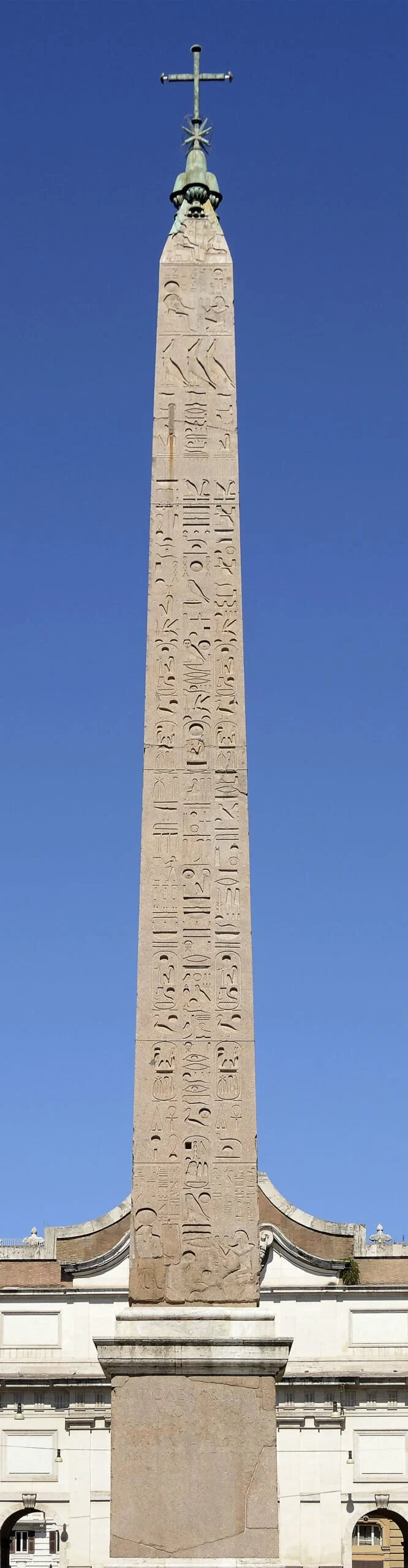
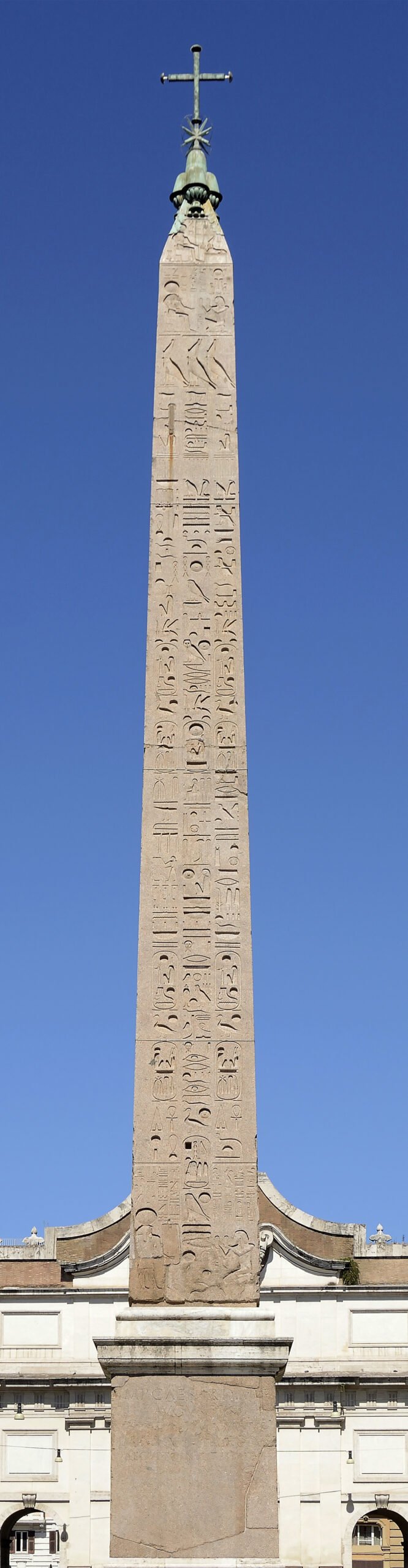
The Flaminian Obelisk is the red granite monolith that rises in the middle of Piazza del Popolo, at the exact point where the three streets of the Tridente converge toward Rome's northern gate. It is the first Egyptian obelisk ever to arrive in the city: Augustus had it loaded onto a ship and brought from Heliopolis in 10 BC, 20 years after annexing Egypt, and had it raised on the spina of the Circus Maximus as a permanent declaration of victory over Cleopatra and Antony. When it arrived in Rome the monolith was already more than 1,300 years old: it had been quarried at Aswan under the pharaoh Seti I, of the 19th Dynasty, and completed by his son Ramesses II for the temple of the Sun at Heliopolis. On its four faces run hieroglyphs that speak of Ra, Atum and Khepri, carved when Rome didn't yet exist even as a village of huts on the Palatine. Fallen and buried for about a thousand years, it re-emerged from the excavations ordered by Sixtus V and was raised again here in 1589 by Domenico Fontana, who made it the entrance signal into the city for the pilgrims coming down along Via Flaminia. In the 19th century Giuseppe Valadier built around it the stepped base with the four basins and the Egyptian-style lions that still spout water at its feet today. The lines that follow tell where this stone really comes from, what is written on it, how it ended up underground and how it came back out, and what is worth looking at when you stop beneath it.
Anyone looking instead for the story of the square as a whole, with the twin churches, the Porta del Popolo and the 19th-century design of the elliptical space, will find it all in the entry devoted to Piazza del Popolo. Here the center of the discussion remains the obelisk, its Egyptian history, its Roman one and its papal one.
Where the Flaminian Obelisk Is and How to Get There
The Flaminian Obelisk stands at the exact center of Piazza del Popolo, in the Campo Marzio district, at the northern edge of Rome's historic center, and the square has been pedestrian since the end of the 1990s, so you reach it on foot from any direction with no through traffic. No ticket is needed, there is no fence, there are no opening hours: it's an open-air monument, visible 24 hours a day.
By Metro
The Flaminio stop on Line A opens a few meters from the Porta del Popolo, just outside the walls, and from the station exit to the obelisk it's a walk of under three minutes through the arch of the gate. It's the most direct way to get here from Termini, from San Giovanni or from Ottaviano and the Vatican area, and it's also the reason this square works well as a starting point for a walking itinerary toward the center: you step off the metro and you're already inside the urban design you want to walk.
On Foot from the Center
From Piazza Venezia you walk up the whole length of Via del Corso in about 25 minutes of straight walking, with the obelisk appearing at the end of the street as a vanishing point and growing with every block. That's the scenic effect the square was designed for, and it's worth walking it in this direction at least once. From Piazza di Spagna you get there in 10 minutes or so along Via del Babuino, the street of the antique dealers. From Piazza Navona and the Pantheon you instead go up along Via di Ripetta, the third arm of the Tridente, in a little over a quarter of an hour. All three streets come out into the square aimed at the obelisk, which holds them together like a pivot.
What the Flaminian Obelisk Is: An Egyptian Monolith Older Than Rome
The Flaminian Obelisk is an authentic Egyptian obelisk, that is, a single block of red granite quarried in Egypt and carved by Egyptian stonecutters, not a Roman copy or a reworked piece. When Augustus brought it to Rome it was already an ancient monument, with more than 13 centuries behind it. This distinction isn't textbook pedantry, because three different categories of obelisks coexist in Rome, and confusing them means losing the sense of what you're looking at.
The Measurements: How Tall It Really Is
On the height of the shaft the sources don't fully agree, and it's worth saying so openly instead of picking a number at random. The institutional entries of the Municipality of Rome give the shaft as 25.90 meters. Other sources, including the main encyclopedias and the reference works on Roman obelisks, give 24 meters. Some local guides drop to 23.20 meters. The difference almost certainly depends on what is included in the count, that is, if you measure only the ancient monolith, or the monolith with the 16th-century reintegrations, or the block down to the laying surface. On one figure, however, the sources converge: with the base and the crowning cross the monument reaches 36.50 meters, the height of a 12-story building. The estimated weight is about 235 tons.
The Red Granite of Aswan
The stone is the red granite of the Aswan quarries, in Upper Egypt, the same material used for almost all the great pharaonic obelisks and for the sarcophagi and colossal statues of the New Kingdom. It's an extremely hard rock, difficult to work with copper and bronze tools, and for exactly that reason the construction of an obelisk was one of the most demanding technical undertakings a Bronze Age monarchy could afford. It meant isolating in the living rock a block more than 20 meters long without breaking it, detaching it, transporting it on barges along the Nile and finally raising it vertically. The pinkish color with dark veining, still clearly visible when the afternoon light catches it from the side, is the unmistakable signature of those quarries.
Why It's Called Flaminio
The name is neither Egyptian nor ancient Roman. It's modern and comes from the location. The obelisk takes its name from Via Flaminia, the great consular road opened in the 3rd century BC toward the north of the peninsula, which entered the city precisely through this gate and continued into the urban fabric with the stretch now called Via del Corso. The same place name gave rise to the name of the Flaminio neighborhood, just outside the walls, and to that of the metro stop. In Egypt and in the Circus Maximus this monolith was never called that. The name is the latest layer in a stratification 33 centuries long.
An Obelisk That Had a Twin
Egyptian obelisks were normally raised in pairs, one on each side of the monumental entrance of a temple, and the Flaminio was no exception: in front of the temple of the Sun at Heliopolis a second monolith of similar size must have stood beside it. No identifiable trace of that twin remains, and it's impossible to say if it was destroyed in Egypt, if it still lies buried, or if it's one of the monoliths now scattered between Rome and other cities. It's one of those documentary gaps worth keeping in mind: what we see in Piazza del Popolo is half of a composition conceived as symmetrical, exactly like the facades of the churches in front of it.
The Hieroglyphs of Seti I and Ramesses II: What Is Written on the Four Faces
The four faces of the Flaminian Obelisk are entirely covered with hieroglyphs carved at two distinct moments, under Seti I and under his son Ramesses II, and the difference between the two hands can be spotted even from the ground if you know where to look. The content isn't a historical narrative but a declaration of a religious and royal nature: the pharaoh offers, the god receives, the sun illuminates the temple.
The Hand of Seti I
Seti I, second pharaoh of the 19th Dynasty, reigned around the beginning of the 13th century BC and was the man who had this block quarried. The historical sources attribute to him an explicit program of producing obelisks for Heliopolis, and one of the columns carved on the monolith states it openly, with a formula that Egyptologists translate as the sovereign who fills Heliopolis with obelisks so that their rays may illuminate the temple of Ra. On the north and south faces appear scenes in which the sovereign is represented in the form of a sphinx offering to the solar deities the statuettes of Maat, the goddess who embodies the just order of the world: to Khepri on one side, to Ra-Horakhty on the other. On the west face the king instead offers vases to Atum.
The Columns Added by Ramesses II
Seti I died before the work was completed, and his son Ramesses II, the most prolific pharaoh in all of Egyptian history when it comes to monuments, finished the work and had it raised. His intervention is recognizable: he had the east face carved in its entirety, with scenes of offering to Atum and with his own royal titles set out in full, and he added side columns beside his father's texts on the other faces. The result is that the monolith bears, superimposed, the signatures of two successive reigns, a thoroughly normal phenomenon in Egyptian monumental practice, where completing or supplementing the work of a predecessor was an act of dynastic continuity and not an appropriation.
Heliopolis, the City of the Sun
Heliopolis, Iunu in Egyptian, stood at the southern tip of the Delta, where the northeastern outskirts of Cairo now extend, and it was the religious capital of the Egyptian solar cult. There the theology was developed that identified in the sun, in its morning, daytime and evening forms, Khepri, Ra and Atum, the three names that recur on the faces of this obelisk. The temple of Ra was the most important sanctuary of the complex, and the obelisks flanking its entrances were not decoration but theological instruments: the pyramidal tip, originally covered with an alloy of gold and silver, was the first point of the city to be touched by light at dawn, and that flash announced the daily rebirth of the god.
Why Nobody Could Read Them for Centuries
Throughout the Roman era, the Middle Ages and much of the modern age these signs remained unreadable. The Romans considered them a sacred and mysterious writing and didn't possess the key. The scholars of the Renaissance and the 17th century, including the Jesuit Athanasius Kircher, who wrote entire volumes on the Roman obelisks, produced wholly fanciful translations, reading in the hieroglyphs philosophical and allegorical messages that the texts don't contain. Only after the decipherment achieved by Jean-François Champollion in the 1820s, starting from the Rosetta Stone, did it become possible to really read what is written on this stone. It means that for more than 1,800 years Rome lived alongside a text that it had in front of its eyes and didn't understand.
Augustus, Egypt and the Voyage of 10 BC
The Flaminian Obelisk arrived in Rome in 10 BC at the will of Augustus, 20 years after the battle of Actium and the annexation of Egypt, and it was the first Egyptian obelisk in the history of Rome: before then no monolith of this kind had ever crossed the Mediterranean toward Italy. The date and the context aren't a scholarly detail, because they explain the political meaning of the operation: bringing to Rome the sacred stone of the defeated enemy and planting it in the city's place of greatest popular attendance meant making the conquest visible to everyone, every day, with no need for explanations.
The Ship and the Port of Pozzuoli
The transport required a ship built or adapted specially, of a size able to bear a load of more than 200 tons along a single axis, and the feat made such an impression on contemporaries that the vessel was preserved as a monument. Pliny the Elder tells that the ship was housed in a dock at Pozzuoli, on the Gulf of Naples, where it stayed on display for years as testimony of the feat, until a fire destroyed it. It's worth pausing a moment on this detail: the Romans, who were used to moving enormous masses, considered the sea transport of that block an undertaking worthy of being turned into a museum piece.
The Other Obelisk That Arrived with It
Together with the Flaminio, in the same phase, Augustus brought a second obelisk, also from Heliopolis, which was destined for the Campo Marzio. It is the one that today rises in front of the palace of Montecitorio, seat of the Chamber of Deputies, and it bears the cartouches of Psamtik II, pharaoh of the 26th Dynasty, and therefore about six centuries more recent. That second monolith was not used as a celebratory monument but as a gnomon, that is, as the needle of an enormous sundial laid out on the pavement of the Campo Marzio, in visual relation with the Ara Pacis and the Mausoleum of Augustus. The two obelisks that arrived together thus had very different fates and functions: a mass spectacle in the circus, an astronomical and ideological instrument on the plain of the Campo Marzio.
Why the Circus Maximus Specifically
The choice of the spina of the Circus Maximus, that is, the long central platform around which the chariots raced, was not casual. The Circus Maximus was the largest public space of the ancient city and the place where the population gathered in numbers that no other building could hold. Moreover the circus had always had a religious link with the Sun, so much so that an aedicula dedicated to that deity stood on the spina. Placing an Egyptian solar obelisk there meant overlaying three messages in a single gesture: homage to the Sun, celebration of victory and visibility before hundreds of thousands of spectators. Anyone who strolls today in the grassy valley of the Circus Maximus walks on the exact spot where this stone stood upright for more than five centuries.
The Augustan Inscription at the Base: Egypt Subjected to the Roman People
On the base of the Flaminian Obelisk Augustus had a Latin inscription carved, recorded in the Corpus Inscriptionum Latinarum as CIL VI 701, declaring Egypt reduced to the power of the Roman people and the monument given to the Sun. It's a short text, of a few lines, but it's one of the densest political documents Augustus left, and it should be read with attention because every word is weighed.
What It Says, in Essence
After the imperial titulature, which lists offices and years of tribunician power according to the official formula, the text states that, Egypt having been reduced to the power of the Roman people, the emperor gave this monument as a gift to the Sun. The two Latin formulas that appear are Aegypto in potestatem populi Romani redacta and Soli donum dedit. The first records the annexation as an accomplished act, the second turns it into a religious offering. The inscription was carved on two faces of the base, the northern and the southern.
Why to the Roman People and Not to Himself
The most interesting point of the text is that formula attributing Egypt to the Roman people and not to the emperor. In fact Egypt did not become a province like the others: it became a province with a special status, governed by a prefect of equestrian rank appointed directly by the emperor, with a ban on senators setting foot there without authorization. It was, in essence, a personal possession of the princeps, the grain reserve on which Rome's supply depended. The inscription therefore says something different from what was really happening, and it does so deliberately: it is the language of the Augustan principate, which presented as a restitution to the people and the Senate what was in reality a concentration of power in the hands of one man.
The Gift to the Sun
The dedication to the Sun isn't a Roman invention laid over an Egyptian object. It is, on the contrary, the recognition of the monolith's original function, which at Heliopolis was already consecrated to the solar cult. Augustus thus carries out a refined operation, because he keeps the stone's religious destination but transfers it under the Latin name of the deity, Sol, which Roman culture associated with Apollo, Augustus's personal protector god and the one to whom he attributed the victory at Actium. The gesture ties together, in a single monument, Egyptian theology, Roman religion and dynastic propaganda.
What You See Today of the Ancient Base
Anyone approaching the monument today expecting to read the Augustan inscription on the spot is in for a disappointment: the current base is the one built in the modern age, first in the 16th century and then redone by Valadier in the 19th, and the inscriptions you read there are those ordered by Sixtus V, not those of Augustus. The Augustan text is documented by the epigraphic tradition and by scholarship, but it isn't part of what a visitor reads by looking up in Piazza del Popolo. It's one of the reasons it's worth knowing beforehand what you're looking at: the monolith is ancient, the apparatus around it is modern.
A Curiosity About the Flaminian Obelisk
Pliny the Elder, who in the Naturalis Historia devotes to the obelisks of Rome some of the best-informed pages antiquity has left us, attributes this monolith to the wrong pharaoh. In the 36th book of his work, describing the obelisk erected by Augustus in the Circus Maximus, Pliny names as its commissioner a sovereign whose name he transcribes in a Hellenized form that scholars have tried to identify with Psamtik, a pharaoh of the 26th Dynasty who lived about six centuries after Seti I. The modern reading of the hieroglyphs, possible only after Champollion, has shown that the monolith bears the cartouches of Seti I and Ramesses II, and that Pliny was therefore wrong by six centuries.
How an Error That Lasts 1,800 Years Is Born
The error is understandable and in some ways instructive. Pliny was writing in the 1st century AD, when in Rome nobody read hieroglyphs anymore and when information about obelisks circulated through translations, oral reports and second-hand Alexandrian sources. His measurements, on the other hand, are surprisingly reliable: for the obelisk of the Circus Maximus he gives 85 feet and 9 inches excluding the base, a figure that, converted to the metric system, comes very close to the measurements accepted today. Pliny thus measured well and attributed badly, which is exactly what you'd expect from a culture that had excellent technical tools and no linguistic key to reading.
Something Nobody Tells You About the Flaminian Obelisk
The Flaminian Obelisk you see today is no longer a monolith: when it was found in the 16th century it was broken into three pieces, and to put it back on its feet Domenico Fontana had to rejoin the fragments and fill in the missing parts with granite worked in the modern age. The word monolith, which is commonly used to describe it, is therefore true of its origin and false of its present state. It is the information the plaques don't report and that almost no guide explains, and it changes the way you look at the stone.
The Three Pieces of 1587
The obelisk fell, according to the most widespread reconstruction, during the events that devastated Rome in the 6th century, and some local sources link the collapse to the Gothic military operations of the 540s, in particular Totila's siege of 547. The precise dating of the collapse isn't documented by direct sources and must therefore be taken for what it is, a plausible reconstruction and not an established fact. What is certain is that the monument remained buried under the debris of the circus for about a thousand years, until the excavations promoted by Sixtus V starting in 1586 brought it back to light, broken into three sections, in the area of the spina.
The Reintegrations and the Loss of Height
For the reassembly the pieces were brought together, trimmed at the fracture points and integrated with new granite blocks. The work was necessary, because without that stitching the monument would not have been structurally able to stand, but it inevitably entailed the loss of a few dozen centimeters and the erasure of part of the hieroglyphs in the reworked stretches. It's plausible that this loss of material accounts for part of the discrepancy between the measurements reported by Pliny and those taken today, although the question remains debated and it isn't possible to give an exact figure for how much was lost.
How to Recognize the Modern Parts
Looking at the shaft up close, in raking light, you notice differences in tone and grain between the ancient stretches and the reintegrated sectors, and above all you notice the zones where the hieroglyphs stop abruptly or don't reach the edge. They are the marks of the 16th-century work site. Anyone with a telephoto lens, or who simply enlarges a photo on the phone, can tell them apart without difficulty: the ancient surface has a sharp, deep carving, the modern one is smooth or bears shallower incisions where a join was attempted.
The Pyramidion and the Lost Gilding
The pyramidal tip that closes the obelisk at the top, the pyramidion, in the Egyptian era was covered with electrum, the natural alloy of gold and silver, so that it would catch the dawn light first. Nothing of that covering remains, and nothing remains on the other Roman obelisks either: the precious metal was the first element to disappear, probably already in antiquity. Today in place of the gilded sheet there is a metal cross, mounted when the monument was raised again in the 16th century, and that passage from solar gilding to the Christian cross sums up in one detail the whole later history of the stone.
The Advice I Give You for Visiting the Flaminian Obelisk
The most useful advice for the Flaminian Obelisk is not to look at it only from below: the monument was conceived as the pivot of an urban composition, and up close you lose the very sense of it. Someone who arrives in the square, walks around the four lions, looks up and leaves has seen a tall stone. Someone who takes 20 more minutes and goes up to the Pincio, or lines up at the end of one of the three streets of the Tridente, understands why that stone is there.
Going Up to the Pincio and Looking Down on It
The terrace of the Pincio, reachable in a few minutes by the ramps on the eastern side of the square, is the viewpoint Valadier had in mind when he designed the link between the hill and the space below. From up there the obelisk reads at the center of the ellipse, with the two churches of the Tridente framing the mouths of the streets and the domes of the historic center piling up in the background all the way to the bulk of St. Peter's. The climb is short and costs nothing, and it's the difference between seeing an obelisk and understanding an urban plan.
The Right Time of Day
Red granite looks its best in the hours of low light, so first thing in the morning and the last hour before sunset, when the color lights up and the carvings take on relief thanks to the shadow. In the middle hours of a summer day, with the sun straight overhead, the shaft instead tends to flatten into a uniform gray and the hieroglyphs almost disappear. The square, it must be said, has no shade at all: anyone who gets here at noon in July will do well to limit the stop and move under the holm oaks of the Pincio or inside Santa Maria del Popolo.
Lining Up at the End of Via del Corso
An exercise that costs five minutes and pays off: walk the last 200 meters of Via del Corso keeping the obelisk at the center of your view and watch how the tip grows, isolating the sky between the two walls of buildings. It's the effect for which the monument was positioned exactly there, and it's the same experience the pilgrims arriving from the north had, except that they lived it in the opposite direction, coming out of the gate and seeing the fan of the three streets open up in front of them.
What to Put Around the Stop
A visit to the obelisk on its own lasts a few minutes, and it only makes sense inside a wider route. The most natural combination is to go into Santa Maria del Popolo, which faces the same square and keeps works of the very first rank, then go up to the Pincio and Villa Borghese, or else go down along Via di Ripetta toward the Ara Pacis and the Mausoleum of Augustus, closing the Augustan circle: in the same morning you see the monument that celebrates the conquest of Egypt, the altar of peace and the tomb of the man who wanted them both.
Another Well-Known Fact, Yet Rarely Mentioned
The re-raising of the Flaminian Obelisk in 1589 was not an isolated episode but the last act of a campaign carried out by Pope Sixtus V over four years, during which Domenico Fontana put four obelisks back on their feet in four different points of Rome. The fact is known to anyone who deals with Roman urban planning, yet it is rarely told to those who stop in Piazza del Popolo, who end up seeing the monument as a case apart instead of as one piece of a precise design.
Four Obelisks in Four Years
The sequence is impressive for its speed. In 1586 Fontana moved and raised the Vatican obelisk in front of St. Peter's Basilica, the feat that gave him European fame. In 1587 it was the turn of the Esquiline obelisk, placed behind the apse of Santa Maria Maggiore. In 1588 came the gigantic Lateran obelisk, the tallest of the ancient world, in front of the Basilica of St. John Lateran. In 1589, finally, the Flaminio in Piazza del Popolo. Four heavy engineering work sites in four years, with a pontificate that lasted five years in all.
Monumental Road Signs
The sense of the operation was urban before it was religious. Sixtus V wanted to connect the great pilgrimage basilicas with one another by straight, walkable streets, and the obelisks worked as signals visible from afar, landmarks that let someone arriving in the city without knowing it find their bearings in the urban fabric. A pilgrim entering through Porta del Popolo saw the Flaminian obelisk. From there, looking toward the other destinations, he could make out the tips of the other monoliths that marked the basilicas. It was a system of orientation on the scale of the city, built with Egyptian monuments from the 13th century BC.
Fontana's Machine
The method with which Fontana raised these blocks is documented by himself in an illustrated treatise that had great publishing success. The technique involved a tower of beams enclosing the obelisk, a system of winches operated simultaneously by teams of men and horses, hemp ropes of enormous diameter and coordination by audible signals, because the traction had to be perfectly synchronized. For the Vatican obelisk, the first and the riskiest of the four, the chronicles speak of hundreds of workers and dozens of horses engaged at the same time. After that experience the later work sites, including the one in Piazza del Popolo, were tackled with procedures that were by then tried and tested.
The Cross in Place of the Sun
Every obelisk raised by Sixtus V received a cross on top and new Latin inscriptions at the base declaring its conversion: the stone that had been dedicated to pagan deities was formally reconsecrated, and the Sistine texts speak explicitly of the monument as a gift to the Cross. On the Flaminio the inscriptions added on the east and west sides of the base follow this logic, stating that the monolith now rises more joyfully in front of a Christian temple. It should be said clearly that this is an ideological operation and not an exorcism in the strict sense of the term, even though in popular accounts the story is often told in more colorful tones than the sources authorize.
It's Not the Tallest, and That's a Good Thing
Among Rome's Egyptian obelisks the Flaminio does not take first place for height: it is surpassed by the Lateran, which with more than 32 meters of shaft is the tallest ancient obelisk in existence, and by the Vatican obelisk. The Flaminio ranks among the first for height and among the very first for antiquity, and it is in any case, depending on the criterion, the second or third Roman obelisk by age. Its superiority is of another kind: no other obelisk in Rome occupies as fortunate an urban position, at the center of a pedestrian elliptical square that isolates it through 360 degrees and with three streets aimed straight at it.
The Right Photo to Take of the Flaminian Obelisk
The photograph that does justice to the Flaminian Obelisk is not the one shot from below with the phone pointed at the tip, which gives you only a stone distorted by perspective and a white sky. The monument works in a photograph when it enters into relation with something: the square, the lions, the terrace, the two domes of the churches of the Tridente.
From the Pincio Terrace, at Sunset
The classic shot, and the best, is taken from the balustrade of the Pincio terrace in the hour before sunset, when the sun goes down behind the domes and the obelisk stands out dark at the center of the lit-up square. The horizontal framing keeps in the whole ellipse, the two hemicycles with Valadier's fountains and the rush of the streets. The vertical one isolates the obelisk and the depth of the historic center behind it. It's a heavily visited spot, so it's best to arrive a few minutes early to find a place at the balustrade.
The Lions in the Foreground
The second framing worth looking for is done in the square, crouching down to the level of one of the four basins: the white marble lion spouting water in a fan fills the foreground, and behind him the granite shaft rises out of focus up to the cross. It's a composition that works because it puts in a single frame the three layers of the monument, the Egypt of the stone, the 19th century of the lions and the Christianity of the cross, and because the jet of water gives movement to a subject that is otherwise motionless.
The Detail of the Hieroglyphs
The third photograph is the one almost nobody takes: a zoom on the carvings of the lit face, with the raking light of the morning or late afternoon digging the shadows into the signs. You need a telephoto lens, or at least the zoom of a good phone, and you need patience to find the right face, because only one at a time receives light at the useful angle. The result, however, is the only image that really shows the object for what it is, that is, an Egyptian religious text of the 13th century BC.
Some Important Events That Happened Here in History
The stone that now occupies the center of Piazza del Popolo has gone through three different histories: the Egyptian one, which lasts five centuries between Heliopolis and the abandonment of the sanctuary, the Roman one, which lasts a little over five centuries between the Circus Maximus and the fall, and the modern one, which begins in 1587 and runs to today. The episodes that follow are the turning points of this third phase, the one that produced the monument as we see it.
The Discovery of 1587
The excavations promoted by Sixtus V in the area of the Circus Maximus brought to light the monolith broken into three sections, buried under the debris accumulated over the centuries of the valley's abandonment. The discovery was not by chance: the pope had started a systematic search, with the explicit aim of recovering the ancient obelisks to reuse them in his own urban program, and he knew from the literary sources that they had to be in the circus. In the same work site the great obelisk of Constantius II was also identified, the one that would end up at the Lateran the following year.
The Re-raising of 1589
The raising in Piazza del Popolo took place in 1589 under the direction of Domenico Fontana, and some sources give March 5 of that year as the date of the lift. The choice of the square answered a logic of urban entrance: anyone arriving in Rome from the north along Via Flaminia, and in the 16th century that was the majority of the pilgrims coming down from continental Europe, entered through the Porta del Popolo and found that stone in front of them. It was the first monument of Rome they saw, and it was a monument the pope had just reconsecrated to the cross.
The Jubilee of 1600 and the Pilgrimages
The first big test of the new layout was the holy year of 1600, when the square worked as an urban vestibule for an influx of pilgrims of exceptional size. From then on, jubilee after jubilee, this has remained the symbolic entry point of the city for those arriving from the north, a role the square has kept even when ways of traveling changed completely. Even in recent holy years the area around the obelisk has been one of the most frequented gathering and transit points of the center.
The Public Executions in the Square
There is a less decorative chapter in the history of this space: for centuries Piazza del Popolo was one of the places where the Papal State carried out death sentences, with the scaffold set up a short distance from the obelisk and the crowd gathered all around. The practice continued until the 19th century and was described by more than one foreign traveler struck by the combination of the neoclassical elegance of the space and the function carried out there. It is an element that rarely appears in tourist presentations of the square and that is nonetheless part of its history in its own right.
Giuseppe Valadier's Redesign
Between the second and third decades of the 19th century Giuseppe Valadier redesigned the area completely, transforming the trapezoidal space of the 16th century into the great ellipse we see today, with the two lateral hemicycles, the fountains of the Goddess Roma and of Neptune and the link by ramps to the Pincio. The obelisk became the exact geometric center of this composition: it was not moved, but everything else was built in relation to it. The sources place the main work site in the years between 1814 and 1828, with the intervention on the base of the obelisk completed in 1823.
The Lion Fountains of 1823
Valadier's most visible intervention on the obelisk is the stepped base with the four lions. In place of the 16th-century arrangement the architect built a multi-tiered base and placed at the four corners as many circular travertine basins topped by stepped truncated pyramids, on each of which crouches a white marble lion spouting water in a fan. The work dates to 1823 and was carried out at the will of Pope Leo XII. The lions are neither Egyptian nor ancient: they are 19th-century sculptures in an Egyptianizing taste, that is, learned imitations of the pharaonic style, in line with the Egyptomania that had swept Europe after Napoleon's campaign in Egypt and the first decades of Egyptology.
Pedestrianization and the Contemporary Square
For much of the 20th century the square was crossed by car traffic and used as a big roundabout, with cars circling the base of the obelisk. The decisive change came at the end of the 1990s, when a comprehensive restoration of the area, carried out between 1997 and 1998, was accompanied by the pedestrianization of the space. Since then the obelisk has been back inside a space that can be walked, and that is the condition in which you find it today. On the lion fountain, later maintenance work is documented, including one in 2015, and the monumental complex of the square is periodically the subject of restoration work sites promoted by the Sovrintendenza Capitolina: anyone planning a visit at a specific time will do well to check beforehand if there are works with scaffolding under way.
Who Has Passed Through the Flaminian Obelisk
No monument in Rome has seen pass beneath it, over its history, a variety of people comparable to that of the Flaminian Obelisk, simply because it occupied for five centuries the most crowded place in ancient Rome and for another four the main northern entrance of modern Rome. Its public has never been the select one of a museum: it has always been the undifferentiated one of a crowd.
The Pilgrims of Via Flaminia
From 1589 onward the obelisk welcomed generations of pilgrims coming down from the north, mostly on foot or on carts, after weeks of travel across the Alps and the Apennines. For a great many of them this was the first image of Rome: the gate, the square, the tall stone with the cross on top. The effect was calculated, and the sources of the time record it as a moment of strong emotional impact. The same threshold function continued to hold for the lay travelers of the Grand Tour, who arrived from the same direction.
The Travelers of the Grand Tour
Between the 17th and 19th centuries the square was the entry point for all the great European travelers heading to Rome. Johann Wolfgang Goethe, who arrived in the city in 1786, came in through this gate and lived not far away, on Via del Corso, in the house that today hosts a museum dedicated to him. His description of the entry into Rome is one of the most quoted passages of the Italian Journey. With him passed through here painters, engravers, architects and writers from half of Europe, and the printed views of the square with the obelisk, produced in series for the market of cultured souvenirs, helped fix the image of Rome in the European imagination before the invention of photography.
Popes, Architects, Archaeologists
On the side of the direct protagonists, the list is short and weighty: Augustus, who wanted it in Rome. Sixtus V, who had it searched for and raised again. Domenico Fontana, who designed and carried out the lifting. Giuseppe Valadier, who built the present square around it. Leo XII, who wanted the fountains with the lions. To these must be added the Egyptologists who since the 19th century have read and published the hieroglyphic texts, giving back to the monument the voice it had lost 2,000 years earlier, and the restorers who in the 20th century and in the new century have taken care of conserving the granite and the 19th-century apparatus.
Today's Romans
For contemporary Romans the obelisk is above all a meeting place and a backdrop: people arrange to meet at the lions, sit on the steps of the base when they aren't fenced off, pass by on the way back from the Pincio or heading toward the shopping streets. It's an everyday, casual relationship, which coexists without problems with the fact that this is the oldest object visible in the open air in that part of the city. It's exactly the way this stone was used for most of its Roman existence: a landmark inside a space of passage, not a find inside a display case.
The Other Obelisks of Rome and Where the Flaminio Fits
Rome has the greatest concentration of ancient Egyptian obelisks in the world, more than remain standing in Egypt, and the Flaminio should be looked at within this family to understand its rank. Knowing where the others are also lets you build a themed itinerary that crosses the city, linking points that are otherwise unconnected.
The Companions in the Campo Marzio
In the quadrant between the Tiber and Via del Corso are concentrated three other monoliths worth linking to this one: the one at Montecitorio, which arrived with the Flaminio and was used by Augustus as a solar gnomon. The one that rises in front of the Pantheon, of the Ramesside era and also from Heliopolis. And the small one that, a couple of steps from there, in Piazza della Minerva, rests on the back of the elephant designed by Bernini in front of the Basilica of Santa Maria sopra Minerva. An itinerary that starts from the Flaminian obelisk and goes down along Via di Ripetta touches them all in a little over half an hour of walking.
The Minor Obelisks and Those Outside the Center
To the list can be added the monoliths of Piazza Navona, Roman in origin and not pharaonic, those of Villa Celimontana and the Quirinale, the pair placed at the entrance of a noble villa like the obelisks of Villa Torlonia, which are 19th-century and not ancient, and the Dogali obelisk near the Baths of Diocletian. Putting them in a row helps you understand that in Rome the word obelisk covers at least three different things: authentic Egyptian finds, Roman imitation productions and modern monuments in style. The Flaminio belongs unambiguously to the first category.
Frequently Asked Questions About the Flaminian Obelisk
What Is the Flaminian Obelisk?
The Flaminian Obelisk is an Egyptian obelisk in red Aswan granite that rises in the middle of Piazza del Popolo in Rome. It was quarried and carved in Egypt under the pharaohs Seti I and Ramesses II around the 13th century BC for the temple of the Sun at Heliopolis, and it was the first Egyptian obelisk brought to Rome, at the will of Augustus in 10 BC.
How Tall Is the Flaminian Obelisk?
The Flaminian Obelisk reaches 36.50 meters counting the base and the crowning cross, a measurement on which the sources agree. On the height of the shaft alone the data diverge: the entries of the Municipality of Rome give 25.90 meters, other reference works give 24 meters and some guides 23.20 meters, depending on what is included in the measurement. The estimated weight is about 235 tons.
How Much Does It Cost to Visit the Flaminian Obelisk?
Seeing the Flaminian Obelisk is completely free and requires no ticket: it stands outdoors in the middle of a public pedestrian square, with no fences or access controls. There is no interior visit because the monument is a solid block of granite. The only possible expense concerns any guided tours of the square or the neighborhood organized by private operators.
What Are the Opening Hours of the Flaminian Obelisk?
The Flaminian Obelisk is visible 24 hours a day, every day of the year, because it stands in an open public space with no gates. The square is lit at night and the monument remains perfectly legible even after sunset. Exceptions may be the days when the square is closed or fenced off for concerts, demonstrations or restoration work sites.
How Do You Get to the Flaminian Obelisk by Public Transport?
You get to the Flaminian Obelisk by Metro Line A, Flaminio stop, which is under three minutes on foot through the Porta del Popolo. The square is also served by several surface lines and by the tram that departs from Piazzale Flaminio. On foot it takes about 25 minutes from Piazza Venezia going up Via del Corso and 10 minutes or so from Piazza di Spagna along Via del Babuino.
How Much Time Do You Need to See the Flaminian Obelisk?
For the Flaminian Obelisk 10 minutes are enough if you just look at it from the base and walk around it among the four fountains with the lions. Going up to the Pincio terrace to see it from above and adding a visit to the church of Santa Maria del Popolo on the same square, the time rises to an hour and a half or two, which is the advisable length for a stop that makes sense.
Is the Flaminian Obelisk Accessible to People with Disabilities?
The Flaminian Obelisk stands in a flat, paved pedestrian square, reachable and walkable in a wheelchair with no significant barriers up to the base of the monument. The climb to the Pincio terrace, on the other hand, runs along ramps with a noticeable slope and partly by staircases, so anyone with mobility difficulties will do well to check the easiest route beforehand.
Can You Photograph the Flaminian Obelisk and Its Hieroglyphs?
Photographing the Flaminian Obelisk is free and requires no authorization, since it is an outdoor monument in a public space. For the hieroglyphs you need a zoom, because the carvings are several meters up, and it's best to choose the face lit by the raking light of the morning or late afternoon, when the shadows inside the signs make them legible.
Is the Flaminian Obelisk Suitable for a Visit with Kids?
The Flaminian Obelisk works well with kids because it stands in a pedestrian square where they can walk freely, with four marble lions spouting water that immediately become the center of attention. The square, however, has no shade and in summer gets very hot in the middle hours, so it's best to pair the stop with the gardens of the Pincio and Villa Borghese, a few minutes' climb away.
The Flaminian Obelisk therefore works better as the opening of an itinerary than as a destination in itself: it is the threshold that Romans, popes and travelers have used to enter the city, and it keeps working in exactly that way for those who arrive today from the metro. It's worth giving it the time to understand it before continuing toward the center, because it is the oldest object you'll meet all day and the one with the longest history to tell.
Anyone putting together a wider Roman itinerary, crossing this stop with the other stops of the historic center and the Campo Marzio, can find useful planning tools on Tour Leader Pro, while for a more general picture of transport and destinations in Lazio, Italy Planner is a good resource.