Basilica of Santa Maria sopra Minerva
In short. The Basilica of Santa Maria sopra Minerva is at Piazza della Minerva 42, 00186 Rome, rione Pigna, a little under 80 meters behind the apse of the Pantheon.
The Basilica of Santa Maria sopra Minerva is at Piazza della Minerva 42, 00186 Rome, rione Pigna, a little under 80 meters behind the apse of the Pantheon. Come out of the Rotunda, turn left alongside the side of the temple, and you'll find it in front of you, with the little marble elephant carrying the obelisk in the middle of the square. Entry to the Basilica of Santa Maria sopra Minerva is free. turismoroma.it writes this under the ticket section as "free admission," and that is what anyone who has pushed open that door will confirm. No booking is needed to come in to pray or to look around. A reservation, and payment, is needed only if you want a guided tour by a private operator, or if you want to see the convent cloister, which is a different thing from the church. The metro doesn't reach here: no station on Line A or Line B is within a reasonable distance, and the square is reached on foot or by bus. The useful stops are three, and the lines that serve them are these: ARGENTINA stop, served by 30, 40, 46, 62, 64, 70, 81, 87, 190F, 492, 628, 916 and 916F. RINASCIMENTO stop, served by 70, 81, 87, 492 and 628. CORSO/MINGHETTI stop, served by 62, 63, 83, 85, 119, 160, 492 and 628. From Largo Argentina to the basilica it's a five-minute walk, slightly uphill. From Corso/Minghetti, it's four minutes. On opening hours, which are the sore point, the sources don't agree. The official website santamariasopraminerva.it publishes the hours only inside an image, so they can't be read as text. turismoroma.it says visits follow the Mass schedule (weekdays 18:00, Saturdays and vigils 18:00, Sundays and holidays 11:00 and 18:00). cultura.gov.it lists Monday 6:45-19:00, Friday 6:45-19:00, Saturday 6:45-19:00 and Sunday 8:00-19:00, and gives Tuesday through Thursday as closed days. monnoroma.it, by contrast, lists Monday to Friday 7:00-19:00, Saturday 10:00-12:30 and 15:30-19:00, and Sunday 8:00-12:30 and 15:30-19:00. dindondan.app, for the summer period, lists every day 11:00-13:00 and 15:00-19:00. These are four different versions, so call ahead. The numbers in circulation are 333 7468785 (turismoroma.it), 06 69920384 (cultura.gov.it and dindondan.app), and 06 792257 or 06 6793926 (monnoroma.it). The email address listed by the Ministry's portal and turismoroma is santamariasopraminerva@gmail.com, while the basilica's website gives the direct contact of the rector, Fra Simone Bellomo, O.P. The practical advice: aim for late morning or mid-afternoon on weekdays, avoid the half hour before the 18:00 Mass, and plan on 40 minutes if you really want to look, not 10. If you're planning a half-day tour of the area, nearby you'll find Piazza Navona, the church of Sant'Ignazio di Loyola, the Galleria Colonna and the Trevi Fountain, all on foot, all less than 15 minutes away.
What Is the Basilica of Santa Maria sopra Minerva, in One Line
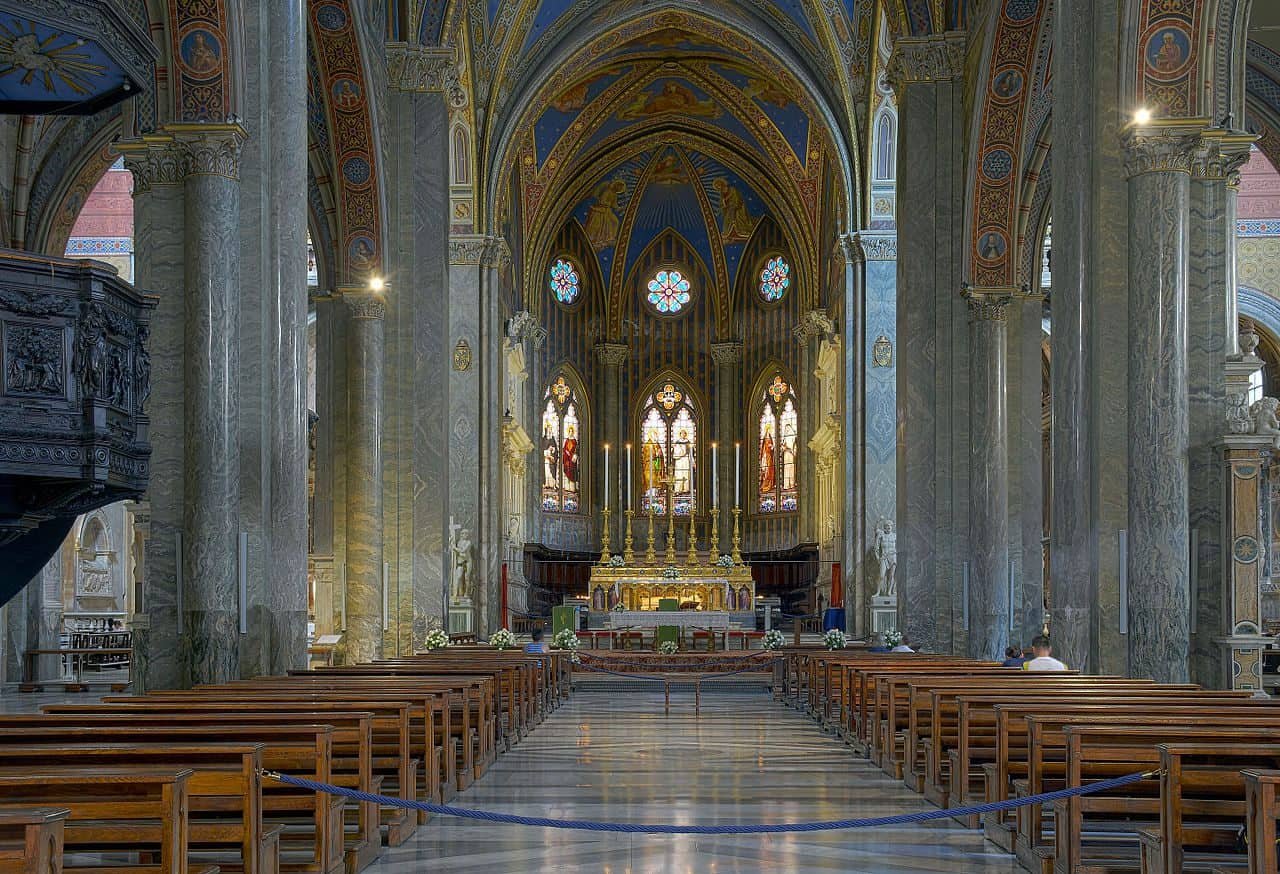
It's a minor basilica in Rome, a cardinal title since 1557, mother church of the Dominicans in Rome, a national and European Catherinian shrine, and the only major church in Rome that the eye reads as Gothic. This last point needs clarifying: the Special Superintendency for Archaeology, Fine Arts and Landscape of Rome, in its entry, defines it as "the only major neo-Gothic church in the city." Neo-Gothic, not Gothic. The 13th- and 14th-century structure is there, and the pointed arches and cross vaults are there too. But everything you see on those stones, the colors, the stars, the painted fake bricks and the blue of the vaults, comes from the 19th-century redecoration of 1848-1855. It is often said that the Basilica of Santa Maria sopra Minerva is "one of the very few examples of Gothic architecture in Rome," and people stop there. The accurate point is that the box is Gothic but the skin is neo-Gothic. Anyone who walks in expecting to find Chartres in miniature is thrown for the first 30 seconds. Then they get it, and start to enjoy it.
Why It's Called "sopra Minerva" and What It Really Stands Above
The name comes from an ancient mistake, which is the most Roman thing there is. In the 8th century there was an oratory here dedicated to the Virgin, with the place name Minervum, because it was believed the building had risen above the temple of Minerva Chalcidica, the one that ancient sources attribute to Domitian in the Campus Martius. The statue of that Minerva is today in the Vatican. Except that later studies moved the temple of Minerva Chalcidica elsewhere, to the site of today's church of Santa Marta in Piazza del Collegio Romano, probably in relation to the Divorum. So the basilica doesn't stand above Minerva, or at least not above that Minerva. It stands within a vast sacred area from the Roman period that housed several cult buildings, in particular the sanctuary of Isis and Serapis, the Iseum Campense, of the 1st century AD. This is the identification the Special Superintendency of Rome gives today. The name stuck because in Rome names cling to stones even when scholars change their minds. It's a good reminder that even antiquarians got things wrong, and that they got them wrong in writing.
So Is There an Egyptian Temple Under the Basilica?
Under and around it was the complex of the Iseum Campense, the great sanctuary of Isis and Serapis in the Campus Martius. This is not a romantic legend: the Egyptian obelisks you see scattered around the center of Rome, including the one that Bernini's elephant carries on its back right here in front, mostly come from that sanctuary. What you can't do is go down and see it. Under the Basilica of Santa Maria sopra Minerva there's no visitable archaeological route like the one at San Clemente. Anyone looking for that kind of experience in Rome has to go somewhere else.
A Curiosity About the Basilica of Santa Maria sopra Minerva
The curiosity isn't inside the church. It's in the square, and you walk over it without looking. The little marble elephant that carries the obelisk in front of the façade of the Basilica of Santa Maria sopra Minerva was sculpted by Ercole Ferrata to a design by Gian Lorenzo Bernini in 1667, and Romans never called it an elephant. They called it the "Pulcin della Minerva," which in the Romanesco of the time meant piglet, a little pig, because of its round shapes and small size. From there came the modern name of the little square and even of a hotel. The actual obelisk is about 5.50 meters tall, and the whole monument reaches 12.70 meters from the ground. On the base is a Latin inscription that is worth more than many audio guides. It says, in essence, that whoever sees the signs of Egyptian wisdom carved on the obelisk and carried by the elephant, the strongest of beasts, should understand that a sturdy mind is needed to bear solid wisdom. It is a Dominican statement dressed up as an Egyptian monument, and it has stood there for more than 350 years. Then there's the legend, the one Romans pass down laughing: it is said that Bernini deliberately aimed the elephant's rear toward the convent, in response to the friars who had questioned the stability of his structural solution. It's a legend, not a document, but in Rome well-made legends outlive documents.
Where Exactly Does the Obelisk of the Minerva Come From?
Here the sources disagree. The Italian Wikipedia entry on the Obelisk of the Minerva dates it to the 4th century BC and says it came from Heliopolis, brought to Rome under Domitian for the temple of Isis in the Campus Martius. The English entry on Santa Maria sopra Minerva says it came from Sais, attributes it to the reign of the pharaoh Apries (589-570 BC, that is, the 6th century BC), and says it was Diocletian who brought the two obelisks to Rome for the temple of Isis. Turismoroma.it, in its English entry, lists it as an Egyptian obelisk of the 6th century BC from the Iseum Campense. Two sources out of three date it to the 6th century BC. One puts it in the 4th. On one point they all agree: it was found in 1665 in the garden of the Dominican convent, and Alexander VII decided to set it up again here. It is the shortest of Rome's 11 Egyptian obelisks.
Is the Elephant Original or a Copy?
What you see is the 1600s sculpture. The sources do not indicate that it has been replaced by a copy. If you ever find it wrapped up, it's a restoration site. That happens to outdoor monuments in Rome, and it happens often.

The History of the Basilica of Santa Maria sopra Minerva, From the 13th Century to Today
The early medieval oratory was entrusted in the 8th century to Greek-rite nuns who had come from Constantinople, and the English Wikipedia entry ties that passage to Pope Zachary (741-752). In 1255 Alexander IV installed a community of converted women there. In 1266 the site passed to the Dominican friars, but full possession came only in 1275, and it is from that moment that the complex enters history as insula sapientiae, island of wisdom. In 1280 construction began on the large three-nave church, modeled on Santa Maria Novella in Florence, the other great Dominican church, though simplifying the Florentine example quite a bit. You sometimes read that the 1280 works were financed by Boniface VIII. That needs correcting, because Boniface VIII ascended to the throne in 1294, 14 years after the start of the construction, and his financial contribution, which the sources record, came during his pontificate, not at the start of the works. On what followed in the construction, the sources diverge by almost a century. The Italian Wikipedia entry says the works continued until 1453, when the main nave was covered with a vault, while the side aisles had been vaulted since the 1300s. The Soprintendenza Speciale di Roma, in its chronology, instead places the completion of the cross vaults of the main nave in 1357-58 and gives 1453 as the definitive conclusion of the works, with the consecration of the church in 1370 according to the English entry. These are different reconstructions of the same construction project, and anyone who tells you the matter is settled hasn't read all three entries.
Who Paid for the Facade?
In 1453 Count Francesco Orsini ordered the construction of the facade at his own expense. The paradox is that the facade remained unfinished, in exposed brick, for almost three centuries. It was finished only in 1725 at the wish of Pope Benedict XIII. In the meantime, in the 1600s, the interior had been heavily reworked in the Baroque style, with the pointed arches of the aisles transformed into round ones. Then, in the 1800s, they went back. Rome is like that: every century runs its coat of paint over the one before, and every so often someone scrapes it off.
What Is the Bianchedi Restoration and Why Does It Matter So Much
Between 1848 and 1855 Girolamo Bianchedi directed a radical restoration of the Basilica of Santa Maria sopra Minerva. Most of the Baroque additions were demolished and the bare walls were covered with Neo-Gothic frescoes, the work of Bernardino Riccardi, Pietro Gagliardi, Tommaso Greggia and Raffaele Casnedi. This is the intervention that gave the church the look everyone photographs today: the starry blue, the banded decorations, the fake ashlar. Anyone who calls the Minerva "the only Gothic church in Rome" and stops there tells half the story. The Soprintendenza's chronology then adds a structural consolidation and a restoration of the frescoes between 1870 and 1900, a restoration of the interiors in the 1980s, and the return of the Dominican friars in 1929.
Has the Basilica Been Closed for Restoration Recently?
Yes, and in part the work isn't finished. On February 18, 2020 arte.it reported the reopening of the transept after a major intervention that covered the Gothic architecture, the Baroque decorations and the Renaissance frescoes, with funding from the Fondo Edifici di Culto and work carried out by the Soprintendenza Speciale di Roma. In that phase access was temporarily moved to the rear entrance on Via Beato Angelico, because the main portal remained closed. The Soprintendenza's page lists as ongoing works the restoration of the choir lofts, the apse and the Altieri chapel and the securing of the side aisles, with Fondo Edifici di Culto funding of €1,500,000, plus a technical sponsorship by Mecenati Roman Heritage for the altar furnishings and for the Carlo Maratta altarpiece in the Altieri chapel. Translated for anyone who has to go: expect scaffolding in some spots, and don't take for granted that every chapel will be visible the day you show up. It's not a flaw of the church, it's a living church putting itself back in order.
Something Nobody Tells You About the Basilica of Santa Maria sopra Minerva
That the Gothic that moves you is largely 19th-century painting, we have already seen. The thing that nobody really tells you is another, and it's subtler: the Basilica of Santa Maria sopra Minerva is not a church, it's an archive of power. For centuries this complex was the operational headquarters of the Dominican order. The Master General and the Procurator were based here, the Congregation of the Holy Office met here, and two conclaves were held here, electing Eugene IV in 1431 and Nicholas V in 1447. Here on June 22, 1633, Galileo Galilei abjured. You walk in and see a beautiful blue church full of tombs. What you are looking at is the place where for 300 years it was decided what a Catholic was allowed to think. The floor you walk on is the same one that inquisitors walked on when they left the trial room. It's not about being dramatic. Once you know this, the visit changes its nature: you stop counting chapels and start looking at doors. And the second thing nobody tells you is that the convent, the building that holds all this together, today does not belong to the Church. It was expropriated by the Italian state after 1870, became the seat of the Ministry of Posts and Telegraphs and the Ministry of Public Instruction, and today houses the Polo bibliotecario parlamentare, with a Dominican community that returned to only part of the rooms. Behind that wall, while you look at Michelangelo, the librarians of the Chamber of Deputies are at work.
Why Does the State Own the Convent but Not the Church?
Because of the eversion laws of the ecclesiastical estate that followed the capture of Rome. The convent had already been used as a barracks during the Napoleonic occupation between 1808 and 1814, then returned, then definitively expropriated after 1870. From there the sequence: ministries, offices, and today the Polo bibliotecario parlamentare in the San Macuto and Minerva palaces. The church, by contrast, remained a place of worship, managed by the Dominicans who returned in 1929. It falls under the Fondo Edifici di Culto for restoration purposes, which are in fact funded by the Ministry of the Interior.
Can You Visit the Convent Cloister?
It's the most interesting point and the most fluid part of the whole complex. On December 22, 2025, the Agenzia del Demanio announced a program to open to the public and enhance the cloister of the Santa Maria sopra Minerva convent, with guided tours dedicated to the history of the complex and its cloister, and with digital tools and immersive virtual tours curated by the Agency itself. The announcement does not specify hours, costs or booking methods. So the picture is this: the program exists and was announced at the end of 2025, and operational details need to be checked on the Agenzia del Demanio website or by asking at the basilica. In the meantime, some private operators include the cloister in their guided tours. visiteromasotterranea.it offers a route covering the basilica and cloister for €12 with earphones included, lasting an hour and 15 minutes, on request and not on a fixed schedule. gea-archeologia.it lists a basilica visit for €10, €5 for ages 11-17, plus €1.50 for the earphones. These are prices from third-party operators, not from the church. Admission to the basilica remains free.
My Advice for Visiting the Basilica of Santa Maria sopra Minerva
Walk in and don't go right. Everyone goes right, because the Carafa Chapel is in the right transept and guides point it out first. You do the opposite: walk up the central nave with your head up, looking at the vaults, reach the triumphal arch, and only there turn back toward the inside of the façade. From that point the Basilica of Santa Maria sopra Minerva opens up as it did for those who entered in the 1300s, with the three naves narrowing toward the apse and light coming from the bifora windows behind your back. It takes 20 seconds and you won't forget it. Then the second tip, which is practical: bring €1 coins. The chapels run on coin-operated lights, as in half of Italy, and without light the Carafa Chapel is a dark rectangle where you can't tell a sibyl from a saint. Third: schedule your visit for when the sun hits the side of the church, so late morning, because the apse bifora windows look much better. Fourth, in our opinion: don't do the Minerva right after the Pantheon. Do it first. After the Pantheon any interior looks small, and this church doesn't deserve to be anyone's second course. And if you only have half an hour, skip the minor tombs and keep three things: Michelangelo's Christ, the Carafa Chapel and the sarcophagus of Saint Catherine under the high altar.
How Long Does It Take to Visit the Basilica of Santa Maria sopra Minerva?
20 minutes if you just walk through, 40 for an honest visit, and an hour and a half if you start reading the inscriptions, which here are a literary genre of their own. With a guide who also takes you into the cloister, according to the program of visiteromasotterranea.it, it comes to an hour and a quarter.
Is There a Dress Code?
It is an active church, following the rules of Roman churches: covered shoulders and no overly short shorts. The official website doesn't publish an explicit dress code, so common sense applies. Bring something to put over your shoulders in summer, which, in fact, is advice that applies across Rome from June to September.
Can You Take Photos Inside?
The official sources don't publish an explicit ban on photography in the basilica, and in Roman churches in general you can shoot without flash or a tripod. A written policy for the Basilica of Santa Maria sopra Minerva on this point doesn't appear to be published, so check the signs at the entrance and use your judgment. One golden rule applies everywhere, though: if Mass is going on, the camera comes down.
Another Well-Known Fact, Yet Rarely Mentioned
On the right side of the facade of the Basilica of Santa Maria sopra Minerva, at eye level and then much higher up, there are marble plaques with an engraved line and a date. They are markers of the level the Tiber reached during floods. Many people know about them, almost no one photographs them, and almost no one stops to do the math they deserve. The oldest dates back to 1422, under the papacy of Martin V. The most recent is from December 1870, the year of the great flood that convinced Rome to build the embankment walls and to close the relationship between the city and its river. In between are the centuries when the Tiber came into people's homes. The sources do not agree about the plaque that marks the highest level. The Italian Wikipedia entry gives January 1548. The English entry generically mentions marks from the 16th and 17th centuries, up to about 20 meters. The question does not appear to have been resolved by any official source, but the plaque can be read with your own eyes on site. Go, look up, and check for yourselves.
Why are those plaques right here?
Because Piazza della Minerva is at a low elevation, inside the bend of the Campo Marzio, and the water reached it. The Pantheon next door has the same problem: the Rotunda gradually became buried precisely because of the accumulation of flood debris. When you look at the staircase that goes down toward the Pantheon's entrance, you are looking at the same phenomenon that produced the Minerva plaques. Anyone who visits the area and doesn't connect these two things misses the point of the whole neighborhood.
How high was the water?
The plaques mark the level with a horizontal line and a pointing hand. In physical terms: the highest ones are above the head of an adult man, and by quite a lot. Anyone who was in the square in those days was not walking, swimming, or shut up on the first floor. Even today, if it rains hard for three days, older Romans check the color of the river before they check the weather.
The Facade of the Basilica of Santa Maria sopra Minerva
The facade is the most debated part of the whole building, and on it the sources clearly contradict each other. The Italian Wikipedia entry defines it as "predominantly Romanesque in style (with Abruzzese and Renaissance influences)" and adds that, as it stands, it does not betray the Gothic style of the interior. The English entry instead defines it as Renaissance, with pilasters and a tripartite arrangement, and attributes it to Carlo Maderno around 1600, with work continuing until 1725 at the wish of Benedict XIII. These are two different stylistic readings. The facts that all the sources agree on, by contrast, are these: the facade was ordered in 1453 by Count Francesco Orsini at his own expense, it remained exposed brick for centuries, and it was completed under Benedict XIII in 1725, as part of the work entrusted to Filippo Raguzzini. The large main portal, by contrast, dates from the 19th century, with a frieze decorated with garlands.
Does the facade hint at the Gothic?
You sometimes read that the facade "thus betrays the architectural style used for the interior, which is Gothic instead." The correct fact is the opposite: the source that sentence comes from says that the facade does NOT betray the style of the interior, that is, it does not let you guess it from outside. A negation had been dropped, and the meaning had been reversed. It is a proofreader's detail, but it completely changes what you expect when you push the door open: from outside, the Basilica of Santa Maria sopra Minerva promises nothing Gothic. And in fact, the surprise when you enter is all there.
Are Raguzzini's decorations Renaissance?
You sometimes read that "his Renaissance decorations are the work of Raguzzini and date back to the eighteenth-century intervention of Benedict XIII." The correct fact is that Filippo Raguzzini is an architect of eighteenth-century Rome, the one behind Piazza di Sant'Ignazio, and his decorations are not Renaissance but late Baroque and Rococo. That sentence contradicts itself in 12 words: Renaissance and eighteenth-century cannot go together.
The Interior: How the Basilica of Santa Maria sopra Minerva Is Laid Out
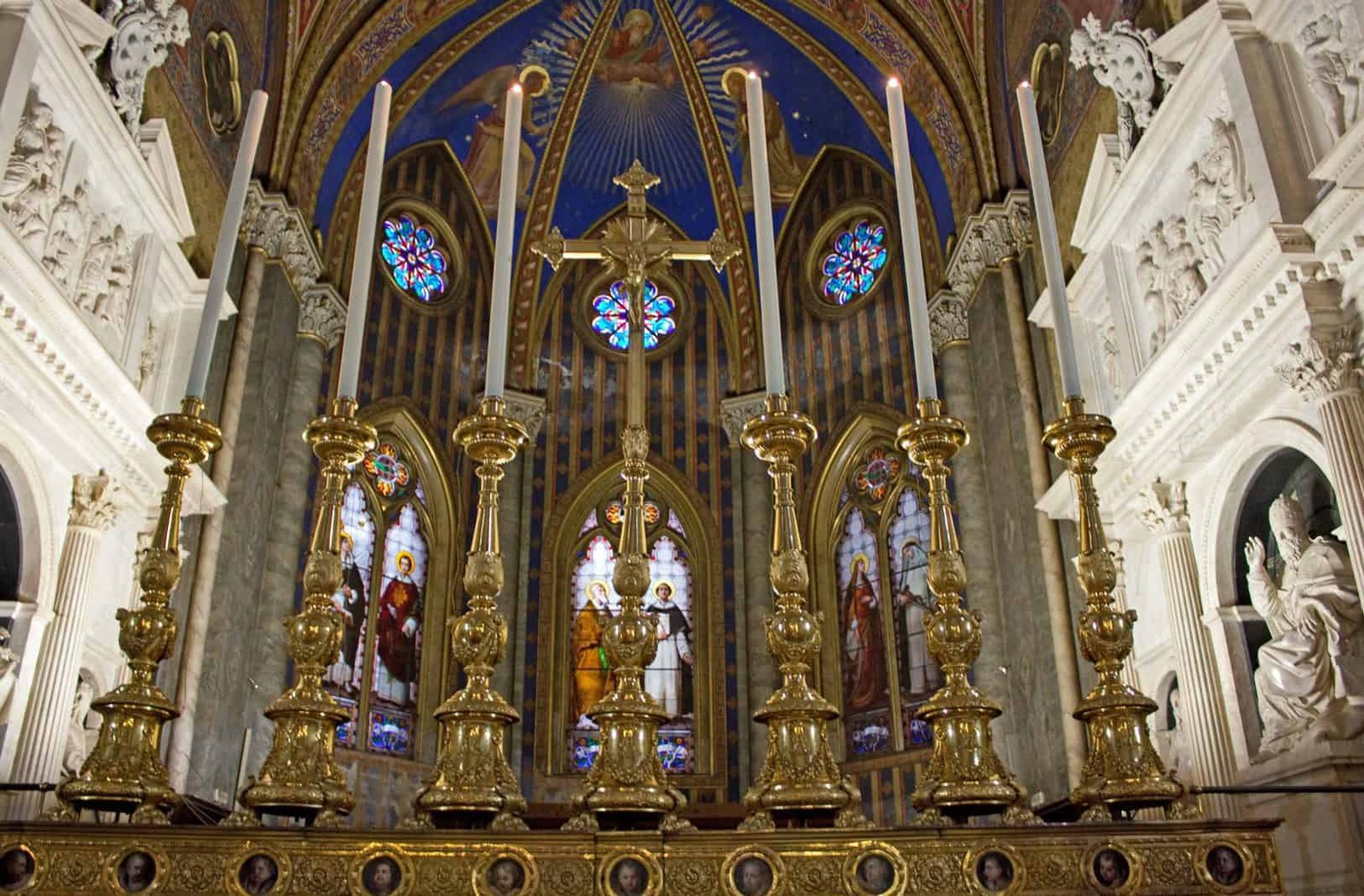
Three naves divided by pointed arches on piers with engaged half-columns, cross-vaulted ceilings, six side chapels per side, a transept and a deep apse: this is how the Special Superintendency of Rome describes it today, and it matches what you see. Along the walls and across the vaults runs the 19th-century Neo-Gothic fresco decoration by Bernardino Riccardi, Pietro Gagliardi, Tommaso Greggia and Raffaele Casnedi. The apse is lit by three large two-light windows. The chapels of the side aisles, unlike the walls, have kept a large part of their Baroque layout, and this creates the strange effect that makes the Minerva unique in Rome: you walk inside a fake 14th century, and every five meters a real 17th-century room opens up on your right or left. It's a short circuit, and it works.
How many chapels are there?
Six per aisle according to the Superintendency's record, plus the transept chapels, plus the baptistery carved into the thickness of the façade. No serious guide will get you into all of them: there are too many, and they are being restored on a rotating basis. The three you should never skip are the Carafa Chapel, the Saint Dominic Chapel, and the Aldobrandini Chapel.
Michelangelo's Christ of the Minerva
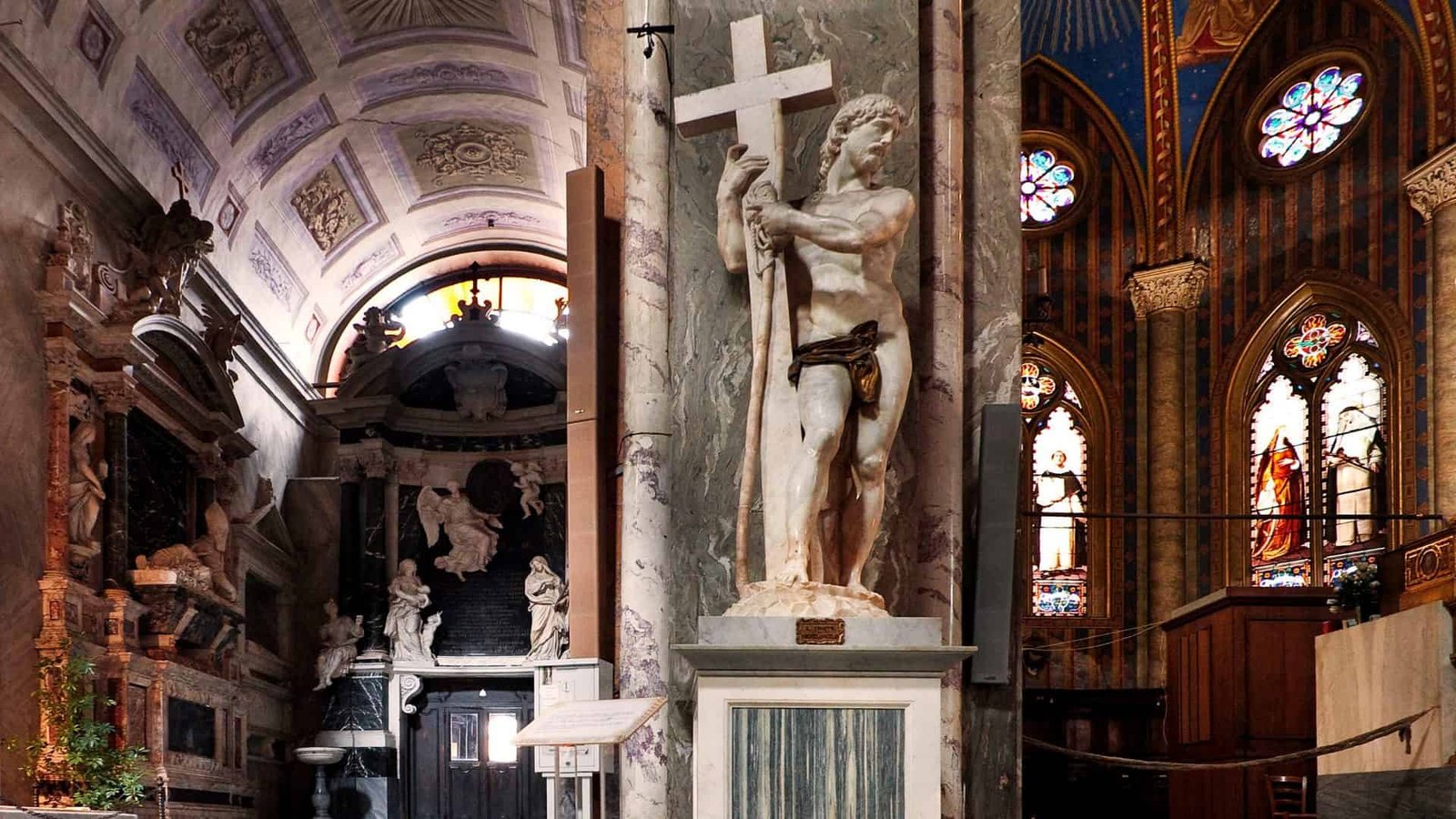
It stands to the left of the high altar, against a pillar of the presbytery, and is 205 centimeters tall. It is a naked, standing Risen Christ holding the cross and the instruments of the Passion. The cross doesn't weigh anything. He carries it the way you would carry any ordinary object, and that lightness is exactly the point of the work. The commission dates to 1514 and came from four private Romans: Bernardo Cencio, canon of Saint Peter's, Mario Scappucci, Pietro Paolo Castellano and Metello Vari. But here is the story that makes the statue far more interesting than the plaque lets on: there are two Christs of the Minerva. The first version was abandoned by Michelangelo when, as it was nearing completion, a black vein in the marble appeared right on the Christ's face. Picture the scene: the block is almost finished, the artist has worked on it for months, and the stone shows him a dark line across the face of God. Michelangelo dropped it and started another, which he completed around 1518-1520 and shipped to Rome in March 1520. The statue was placed in the basilica on December 27, 1521.
Who finished Michelangelo's statue?
Not Michelangelo. The finishing work in Rome was entrusted to one of his assistants, Pietro Urbano, who according to the sources did such a clumsy job that a correction was needed. He was replaced by Federico Frizzi, considered more capable. So what you gaze at is a Michelangelo with surfaces finished by other hands. It bothers purists. Yet it is one of the most honest things a church can show: the masterpiece as a process, not as a miracle.
Why does the Christ have a bronze cloth?
Because it was originally completely nude. The body, with its perfect anatomical modeling, had no drapery at all. The gilded bronze loincloth you see today was added after the Council of Trent, when the Church tightened the rules on the decency of sacred images. The sandals were also added later. If you want just one detail to tell over dinner after visiting the Basilica of Santa Maria sopra Minerva, here it is: the Christ's foot, worn down by the kisses of the faithful, is protected by a metal covering, and the cloth covering him is state censorship applied to Michelangelo.
Where is the other version of Christ?
The first version, the one with the vein, was not destroyed. You won't find it in Rome. Current visiting conditions are not listed in an up-to-date official source, so it's worth checking ahead. If you're looking for it, search for "primo Cristo della Minerva" and you'll find the story of its reattribution, one of the most debated of the last 20 years of art history.
The Carafa Chapel and Filippino Lippi's frescoes
It is the highlight of the Basilica of Santa Maria sopra Minerva and sits on the right side, in the transept. Cardinal Oliviero Carafa commissioned it toward the end of the 15th century, and according to the sources, it was Lorenzo the Magnificent who suggested the name of Filippino Lippi. Filippino is documented in Rome from August 27, 1488, and he finished the work in 1493. Five years for one room. On the vault are four Sibyls: the Cumaean, the Libyan, the Tiburtine and the Delphic. On the back wall is the Annunciation, inside a stucco frame, with the Assumption of the Virgin on the sides and at the top. The Annunciation includes Cardinal Carafa himself, presented to the Virgin by Saint Thomas Aquinas. On the right wall is Saint Thomas Enthroned, also called the Disputation of Saint Thomas, and the Miracle of the Book. The architect of the architectural decoration is not known: the attribution wavers between Giuliano da Sangallo, Bramante and Baccio Pontelli, and no one has settled the question yet.
The giraffe in the Carafa Chapel
This is the thing to look for, and it's the reason you need coins for the lights. In the procession painted by Filippino Lippi there is a giraffe. A real giraffe, drawn from life: Filippino had seen one in Florence, where an animal had been given to Lorenzo the Magnificent a couple of years earlier. In the same setting, within the landscape, appears the equestrian statue of Marcus Aurelius, which at the time was not on the Capitoline but in the Lateran. They're two photographs from 1490 fitted into a sacred scene. Look at them and you'll understand why the word realism feels too narrow for some 15th-century painters.
The monument to Pope Paul IV in the chapel
On the left wall of the Carafa Chapel stands today the funerary monument of Pope Paul IV Carafa, the work of Pirro Ligorio from the 1560s. It came at a historical cost: to install it, the original frescoes of Vices and Virtues painted by Filippino Lippi on that wall were destroyed. A Carafa pope who erases Filippino to build his own tomb inside another Carafa's chapel. Rome is that too.
The other chapels of the Basilica of Santa Maria sopra Minerva, one by one
Here they are, with a few pointers on what to look at.
Annunziata Chapel
The work of Carlo Maderno, with an Annunciation by Antoniazzo Romano. It is the chapel of the Confraternity of the Annunziata, which in Rome had the very concrete role of providing dowries for poor girls so they could marry. Antoniazzo Romano is the quintessential Roman painter of the late 15th century, and the Superintendency also attributes to him, in the basilica, the Stories of the Life of Jesus Christ and the Saints of 1482-1483.
Aldobrandini Chapel
Built in the first decade of the 17th century, the work of Giacomo Della Porta and Stefano Maderno. It holds the funerary monuments of the parents of Pope Clement VIII Aldobrandini, made by Nicolas Cordier, an altarpiece by Federico Barocci and frescoes on the vault by Cherubino Alberti. It is the chapel that best shows the short circuit described above: full Baroque inside a Neo-Gothic box.
The baptistery
Carved into the thickness of the façade, with decorations by Raguzzini and a canvas of the Noli me tangere by Marcello Venusti, a painter from the Valtellina who was very close to Michelangelo, the one who copied the Last Judgment before Daniele da Volterra touched it up. Give it two minutes, if only for the name Venusti, who deserves to be remembered more than he is.
Saint Raymond of Penyafort Chapel
It holds the monument to Cardinal Giovanni Diego de Coca, who died in 1477, the work of Andrea Bregno, and the fresco of Christ as Judge between two angels by Melozzo da Forlì. Andrea Bregno, who was the author of that monument, is also buried in the Basilica of Santa Maria sopra Minerva. A sculptor resting a few meters from his own work happens less often than you'd think.
Saint Dominic Chapel
The work of Filippo Raguzzini, with the tomb of Pope Benedict XIII decorated by Carlo Marchionni and Pietro Bracci, and a Madonna and Child with Saints John the Baptist and John the Evangelist by Francesco Grassia, datable to around 1670. Benedict XIII was a Dominican, and he wanted to be buried in his own house. That explains why his tomb is here and not in Saint Peter's.
Altieri Chapel
It is the one where the restoration work is concentrated. The Superintendency's record lists the restoration of the Altieri Chapel among the work in progress, along with the altar furnishings and the altarpiece by Carlo Maratta, with technical sponsorship from Mecenati Roman Heritage.
Saint Catherine of Siena beneath the high altar
Beneath the altar table of the high altar, inside a 15th-century sarcophagus, are the remains of the body of Saint Catherine of Siena. Her skull and one finger are missing, they are in the Basilica of San Domenico in Siena. The sarcophagus was restored between 1999 and 2000, and on the lid, carved from a statue, the saint is depicted lying down. Catherine is the reason the Basilica of Santa Maria sopra Minerva is a national and European shrine to her: she is patroness of Italy and co-patroness of Europe, and she was proclaimed a Doctor of the Church in 1970. She died in Rome in 1380, in a house on Via di Santa Chiara, not far from here.
The Room of Saint Catherine
Behind the sacristy is the room where Catherine died, rebuilt in 1637 with the very walls of the room on Via di Santa Chiara, dismantled and reassembled here. The English-language entry credits the operation to Cardinal Antonio Barberini. The frescoes that decorate it, from the school of Antoniazzo Romano, are badly damaged. It is a space that is not part of the regular route, and visits have to be arranged in advance. If it matters to you, ask at the sacristy and be prepared for the answer to be no. It should be understood for what it is: an architectural relic. Not a place that resembles Catherine's room, but the real walls, moved 200 meters.
Why is the head in Siena and the body in Rome?
Because the Sienese wanted her back and the Romans wouldn't let go. Dividing relics between two cities fighting over a saint is a documented practice from the late Middle Ages, and in this case it produced the compromise that still holds today: the body in Rome under the altar of the Minerva, the head and thumb in Siena at San Domenico. Put that way, it sounds brutal. By the mindset of the 14th century, it was a diplomatic solution.
Blessed Angelico, the painter who rests in the basilica
Fra Giovanni da Fiesole, whom the world calls Blessed Angelico, died in the adjoining convent in 1455 and was buried in this church. His tombstone is the work of Isaia da Pisa, dated 1455, and shows him lying down in the Dominican habit. John Paul II proclaimed him universal patron of artists in 1984. It is one of the most fitting tombs in Rome: a painter who spent his life painting Annunciations ends up buried 20 meters from the chapel where Filippino Lippi painted one of the finest Roman 15th-century Annunciations. Nobody planned it. It just happened that way, and it's better than any plan.
The popes' tombs and Bernini's monuments
In the apse, beneath the three two-light windows, are the tombs and monuments of popes and cardinals. The two most imposing, and the most similar to each other, are those of the Medici popes, Leo X, who died in 1521, and Clement VII, who died in 1534. The sources disagree about who sculpted the statues. The Italian Wikipedia entry says both monuments contain statues by Baccio Bandinelli. The record from the Special Superintendency of Rome attributes Leo X's tomb to Raffaello da Montelupo and Clement VII's to Nanni di Baccio Bigio. Turismoroma.it, in its English entry, attributes both funerary monuments to Antonio da Sangallo. The three attributions are not necessarily in conflict, because a monument of that scale is worked on by one designer and several sculptors. But naming Bandinelli as the sole author, as is often done, is an oversimplification. The accurate picture is that these tombs were the work of a workshop, with Antonio da Sangallo credited as the architect of the structure and at least three different sculptors cited for the figures.
How many popes are buried in the Basilica of Santa Maria sopra Minerva?
Five: Leo X (1521), Clement VII (1534), Paul IV (1559), Urban VII (1590) and Benedict XIII (1730). Benedict XIII's tomb has a statue of the pope by Pietro Bracci. Urban VII is the pope with the shortest pontificate in modern history, 13 days in September 1590, and he is buried here. If you're looking for a detail no one will ever tell you out loud, this is it.
What's by Bernini in here?
Several funerary monuments and cenotaphs, some his, some attributed to him. Two deserve a pause. The first is the Memorial to Maria Raggi, a slab of colored marble held aloft by two putti, set against a pillar of the nave. It is one of Bernini's freest inventions, a marble drape that seems to weigh as much as a bedsheet. The second is the bust on the tomb of Giovanni Vigevano, which is famous for a technical reason: it is the first portrait Bernini made after being able to study the model while it was still alive, and it marks the turning point in his portraiture. People who walk by quickly walk right past them because they are attached to the pillars and not inside chapels. Stop.
And Pietro Bembo?
Among the floor slabs is the one marking the tomb of the cardinal and humanist Pietro Bembo, who died in 1547. Bembo is the man who decided how Italian is written: his Prose della volgar lingua established that the model should be 14th-century Tuscan. You walk over it without knowing it. Look down every now and then in this church: the floor of the Basilica of Santa Maria sopra Minerva is a list of people who changed something.
The right photo to take at the Basilica of Santa Maria sopra Minerva
It's not the interior, and it's not even the elephant from the front. The right photo is taken from below, very close to the elephant, almost resting the lens against the base and aiming up. Capture the belly of the little elephant, the tip of the obelisk and, in the background, the façade of the Basilica of Santa Maria sopra Minerva rising behind. You get a diagonal that puts Egypt, Baroque Rome and the Dominican Middle Ages in a single frame. Take it in the morning, when the sun comes from the east and lights the side of the obelisk without blowing out the façade, or in the blue hour in the evening, when the artificial lights come on and the marble of the elephant looks warm. A second photo, if you have time: stand at the corner with Via del Beato Angelico and capture the dome of the Pantheon peeking up together with the side of the church. It is the only spot in Rome from which the two buildings fit in the same frame without telephoto tricks. Inside, if you take photos, the only shot worth taking is the one from the back of the central nave toward the apse, with the blue vaults converging. Hold your phone vertically, lean against a pillar because there is little light, and don't use flash. Flash causes two kinds of damage here: it flattens the fresco and disturbs people who are praying.
What's the most common photo mistake in Piazza della Minerva?
Stand head-on to the elephant, 10 meters away. From there the obelisk comes out of the animal's head like a toothpick, and the facade stays a flat wall in the background. The square is small, it doesn't allow a wide head-on shot, and you have to work around it by getting closer instead of moving away. This is true of almost all the squares in the Historic Center of Rome, but here it's twice as true.
Can you use a tripod?
In the square, yes, within the limits of common sense and without blocking foot traffic. Inside the basilica, the Basilica of Santa Maria sopra Minerva has not published any regulation on this point. In the active churches of Rome, a tripod is generally discouraged or banned, and asking in the sacristy costs 10 seconds.
The Organs of the Basilica of Santa Maria sopra Minerva
In 1628 the organ builder Ennio Bonifazi, known as Cerricola, built two nearly identical organs for the basilica and placed them in the two transepts, above the choir lofts. The fate of the two twin instruments has been opposite. The one on the right was stripped of all its internal pipes and then set on fire. The pipes of the one on the left, however, ended up in the organ of the Duomo of Sutri, where in theory part of that 17th-century sound still exists. In 1909 the firm of Carlo Vegezzi Bossi built, opus 1300, inside the case of the left organ, a new instrument with pneumatic action, three keyboards and a pedalboard. It was the first organ equipped with two consoles, the second placed behind the altar, later removed for technical reasons. The cases of both organs are the original 17th-century ones, the work of the Roman architect Pietro Maruscelli. In 1965 the church received a third organ, with two manuals and a pedalboard, from the Mascioni firm of Cuvio, placed in a case behind the high altar. The Vegezzi Bossi organ was restored in 1999.
Can you hear the organs?
During services, when they're in use. The basilica periodically hosts concerts and musical events, but no stable calendar has been published. Check the official website santamariasopraminerva.it and the basilica's social media channels.
Why are the choir lofts under restoration?
Because they're part of the worksite funded by the Fondo Edifici di Culto. The Soprintendenza Speciale di Roma's listing explicitly includes the restoration of the choir lofts among the work in progress, together with the apse and the Altieri chapel, for an amount of €1,500,000.
The Convent, the Cloister and the Biblioteca Casanatense
One of the most important convents of the Dominican order is attached to the Basilica of Santa Maria sopra Minerva. It developed over the course of the 14th century, and in the modern era it became the seat of the order's top leadership, the master general and the procurator. It also housed the Congregation of the Holy Office. The Soprintendenza's chronology dates to 1628 the moment when the convent became the seat of the Inquisition. Architecturally, the complex is organized around two cloisters: the Guidetti cloister, next to the church, completely rebuilt at the end of the 16th century, and the Cistern cloister, built at the end of the 15th century using reused Roman spolia columns. At the end of the 16th century, at the urging of master general Vincenzo Giustiniani, the convent was expanded. Around the Cistern cloister, by raising the structure, were created the master general's apartment, a large hall meant as a library, and a series of reception rooms now known as the Sale Galileo, including the Refectory hall, the Inquisition Halls, the Galileo halls and the Capriate hall. These rooms today are part of the Palazzo San Macuto. Those rooms were decorated around 1660 with a cycle of frescoes celebrating the Dominican order's merits in the fight against heresy, attributed to Francesco Allegrini. At the beginning of the 18th century, in the convent area, the Biblioteca Casanatense was placed with the Sala dei Papi. The Dominicans managed it but did not own it. Its monumental hall is one of the most beautiful reading rooms in Italy, and it can be visited under the library's rules. The convent was used as a barracks during the Napoleonic occupation of Rome between 1808 and 1814. It was permanently expropriated by the Italian State after 1870 and assigned to house the Ministry of Posts and Telegraphs and the Ministry of Public Education. Today the area outside the Casanatense, that is, the San Macuto and della Minerva palaces, houses the Polo bibliotecario parlamentare, based there since 2007, and a community of Dominican friars who regained part of the convent rooms. The Polo bibliotecario serves the Camera dei deputati and the Senate, and this explains why you'll see auto blu in the square every now and then that have nothing to do with the Mass.
Can you really visit the cloister?
What do the frescoes of the cloister look like?
The cloister, according to the visiteromasotterranea.it listing, dates from the thirteenth century but was rebuilt between 1559 and 1569, and the fresco decoration began in 1603. From the outside, nobody suspects it exists. That is why its reopening to the public is the most interesting news about this complex in recent years.
Some important events that took place here in history
The first, in order of weight, is Galileo's trial. On June 22, 1633, in the convent next to the Basilica of Santa Maria sopra Minerva, Galileo Galilei, suspected of heresy, renounced his own scientific theses, namely the Copernican ones, to avoid condemnation by the Inquisition. It did not happen in the church, and it did not happen in the Vatican. It happened in a room of the Minerva convent, and the rooms that bear his name today are there. The second event is twofold: two conclaves were held here, with the election of Eugene IV in 1431 and of Nicholas V in 1447. A conclave inside a Dominican convent, not at Saint Peter's, shows how much weight this house carried in Rome during the Quattrocento. The third is the placement of the obelisk with the elephant in 1667, which turned a service square into one of the most recognizable backdrops of the Historic Center. The fourth is the Bianchedi restoration of 1848-1855, which rewrote the appearance of the church. The fifth is the expropriation of the convent after 1870, which permanently separated the church from its conventual body. The sixth is the return of the Dominican friars in 1929. The seventh is the reopening of the restored transept, announced in February 2020, after work that brought back to light the Christ of Michelangelo, the Carafa Chapel, the tombs of Beato Angelico and Saint Catherine, the sculptures of Bandinelli and Bernini, the frescoes of Melozzo da Forlì, the paintings of Antoniazzo Romano, and the Aldobrandini Chapel. The eighth is the announcement of December 22, 2025, about the cloister. Eight dates, seven and a half centuries, and the story is not over.
Did Galileo really say "eppur si muove" here?
No, or rather: there is no contemporary source that attests it. The phrase first appears more than a century later, in an eighteenth-century biography, and historians consider it a later construction. It's worth saying, because 99 percent of the guides who take you to Piazza della Minerva will tell it as if it really happened. The recantation, by contrast, is documented, with date and text. The rest is myth, and myth has the right to exist as long as it is called myth.
Why was the trial held at the Minerva specifically?
Because the convent was the seat of the Congregation of the Holy Office. The Minerva was not a place chosen for the occasion: it was the office.
Who has passed through the Basilica of Santa Maria sopra Minerva
The list of people buried here is more impressive than that of many more famous Roman churches. Resting in the Basilica of Santa Maria sopra Minerva are: Saint Catherine of Siena, mystic and patron saint of Italy, Beato Angelico, Dominican painter, Pope Leo X, died 1521, Pope Clement VII, died 1534, Pope Paul IV, died 1559, Pope Urban VII, died 1590, Pope Benedict XIII, died 1730, Nikolaus von Schoenberg, the cardinal called Copernican because he encouraged Copernicus to publish, Pietro Bembo, poet, humanist and cardinal, Tommaso De Vio called Gaetano, the cardinal who debated Luther at Augsburg in 1518, Francesco Gaude, cardinal, Latino Malabranca Orsini, cardinal, Michele Mazzarino, cardinal and brother of the more famous Giulio, Matteo Orsini, cardinal, Clemente Micara, cardinal, Laudivio Zacchia, cardinal, Guglielmo Durand, bishop of Mende and great canonist, Diotisalvi Neroni, Florentine politician, Mariano Santo, physician, Giorgio di Trebisonda, Byzantine philosopher and humanist, Uberto Strozzi, man of letters, Loreto Vittori, singer, composer and librettist, Filarete, sculptor and architect, the one who made the bronze doors of Saint Peter's, and Andrea Bregno, sculptor. Galileo Galilei also passed through here, alive and on trial. Michelangelo Buonarroti, Filippino Lippi, Gian Lorenzo Bernini, Ercole Ferrata, Antoniazzo Romano, Melozzo da Forlì, Andrea Sacchi, Carlo Maderno, Giacomo Della Porta, Stefano Maderno, Nicolas Cordier, Federico Barocci, Pirro Ligorio, Filippo Raguzzini, Pietro Bracci and Marcello Venusti all worked here. Line them up and you'll realize that the Basilica of Santa Maria sopra Minerva is, in fact, a textbook of Italian art history from the Quattrocento to the Settecento, all inside a single building with free admission.
Who was the "Copernican cardinal" buried here?
Nikolaus von Schoenberg, a German Dominican, archbishop of Capua and cardinal, who in 1536 wrote to Copernicus urging him to publish his work. That letter was later printed in the opening pages of De revolutionibus. The fact that he rests in the same church where Galileo was tried for Copernicanism a century later is one of those coincidences that happen in Rome, because in Rome everyone is buried within the same two-kilometer radius. But it is still a remarkable coincidence.
Is Michelangelo buried here?
No. He left works in several churches in Rome, and the Christ of the Minerva is one of them, but his tomb is in Florence, in Santa Croce. It's one of the most frequently asked questions in Piazza della Minerva, and the short answer is no.
What's around the Basilica of Santa Maria sopra Minerva
You're in the densest part of the historic center, and you should make the most of it. The Pantheon is 80 meters away, and you'll practically run into it as soon as you turn the corner. Piazza Navona is a seven-minute walk west, and under the square are the underground areas of the Stadium of Domitian, which almost nobody visits and which explain the shape of the square better than any sign could. The church of San Luigi dei Francesi, with the three Caravaggios of the Contarelli Chapel, is five minutes away, and it's free too. The church of Sant'Ignazio di Loyola, with the painted false dome by Andrea Pozzo, is four minutes east. Largo Argentina, with its Republican sacred area and the cat sanctuary, is five minutes south. Palazzo Doria Pamphilj, with its private gallery, is three minutes along Via del Corso, and Piazza Colonna with the Column of Marcus Aurelius is six. Toward the Tiber you'll find the Tiber Island in just under 15 minutes, and toward the Capitoline Hill the Capitoline Museums and the basilica of Santa Maria in Aracoeli. If your theme for the day is Roman churches, with the same metro or bus ticket you can reach Santa Maria Maggiore, St. John Lateran and San Clemente, which is the only one where you can go down three levels to a Mithraeum. To build a wider itinerary, the tourist attractions section and the my trip page help you line up your stops.
Where can you eat nearby without getting burned?
More than the names of the places, one simple geographic rule matters: walk three blocks away from the Pantheon toward Via del Governo Vecchio or Via dei Coronari and the bill drops by a third for the same quality. The tables set out under the windows of the Rotonda are all paid for in plain view.
Are there public restrooms nearby?
Not inside the basilica, which is a church and not a museum. In the area, bars are the practical solution, with a purchase. It's a trivial thing to write in a tourist guide, but it's the most frequent question from people walking around the center with kids.
With kids, with little time, with mobility difficulties
With kids, the Basilica of Santa Maria sopra Minerva works better than you'd expect, but only if you play it right. Don't start with the tombs. Start with the elephant in the square, which kids always like. Tell the story of the nickname and the legend of the rear end facing the convent, and at that point they're yours for 20 minutes. Inside, the two hooks that work are the giraffe hidden in the frescoes of the Carafa Chapel, which turns into a treasure hunt, and Michelangelo's Christ with the story of the veined marble that forced the artist to start over from scratch. With little time, the bare minimum is 15 minutes: the central nave, Michelangelo's Christ, the high altar with Saint Catherine's sarcophagus, and the Carafa Chapel. On accessibility: no accessibility record of the Basilica of Santa Maria sopra Minerva is published in official sources declaring the presence of ramps, the width of the passageways, or whether the route is wheelchair-accessible. Turismoroma.it generally refers to its own section on accessible Rome. A practical note, not certified by any written source: the main entrance has a difference of a few steps from the level of the square, and the interior is flat and spacious. If this matters a great deal to you, call the numbers listed above first and have it confirmed.
Is it cold inside?
In summer it's one of the few free, cool places in the center, like all Roman churches with walls that thick. In winter it's really cold, because it isn't heated like a museum. In January, if you stay for 40 minutes, keep your coat on.
Can you go in during Mass?
You can go in, but you have to stay put. During services the tour is suspended: you sit at the back or wait outside. The Mass times listed by turismoroma.it are 18.00 on weekdays, 18.00 on Saturdays and pre-holiday evenings, and 11.00 and 18.00 on Sundays and holidays. For the summer period, dindondan.app adds the rosary on Saturdays at 17.00 and Eucharistic adoration on Saturdays from 17.00 to 18.00.
Quick questions about the Basilica of Santa Maria sopra Minerva
How much does it cost to enter the Basilica of Santa Maria sopra Minerva?
Nothing. Turismoroma.it, under ticket information, lists free admission. It's a working church, not a museum: you enter freely. The rates you see around, from 10 to 12 euros, are for guided tours offered by private operators and cover their services, not a basilica ticket.
Do you need to book?
No, to go in. Yes, only if you want a guided tour from an operator, or if you want to access the convent cloister as part of the program announced by the Agenzia del Demanio on December 22, 2025, whose operational details have not yet been fully published.
What are the opening hours of the Basilica of Santa Maria sopra Minerva?
The sources say different things. Turismoroma.it says visits follow Mass times. Cultura.gov.it lists Monday, Friday and Saturday 6.45-19.00, Sunday 8.00-19.00, and marks Tuesday through Thursday as closed. Monnoroma.it lists Monday through Friday 7.00-19.00, Saturday 10.00-12.30 and 15.30-19.00, and Sunday 8.00-12.30 and 15.30-19.00. Dindondan.app, for the summer period, lists every day 11.00-13.00 and 15.00-19.00. The official website publishes its own hours only inside an image, which is not readable as text. Call ahead: 333 7468785, 06 69920384, 06 792257, 06 6793926.
Is the basilica closed on Tuesdays?
Only cultura.gov.it indicates this. No other source cited here lists a weekday closure, and monnoroma.it actually lists opening from Monday to Friday. It's not clear which one is up to date. If Tuesday is your only available day, call ahead.
How far is it from the Pantheon?
Just under 80 meters, a one-minute walk. The Basilica of Santa Maria sopra Minerva sits right behind the apse of the Pantheon.
Is there a metro nearby?
No. No metro station serves Piazza della Minerva. You arrive by bus, at the Argentina, Rinascimento or Corso/Minghetti stops, or on foot from the rest of the historic center.
Which buses stop near the Basilica of Santa Maria sopra Minerva?
At the Argentina stop: 30, 40, 46, 62, 64, 70, 81, 87, 190F, 492, 628, 916 and 916F. At the Rinascimento stop: 70, 81, 87, 492 and 628. At the Corso/Minghetti stop: 62, 63, 83, 85, 119, 160, 492 and 628.
Can you drive there?
You physically can, but it's a terrible idea. We're inside the ZTL of the historic center, there is no street parking, and private garages in the area cost as much as a lunch. Take the bus, or walk.
How long does the visit take?
20 minutes for a quick pass, 40 for a visit done properly, an hour and a half for those who read the inscriptions. With a guide and the cloister, it runs to an hour and a quarter according to the program of visiteromasotterranea.it.
What Michelangelo work is there at the Minerva?
The Christ of the Minerva, also called the Risen Christ or Christ Carrying the Cross: a marble statue 205 centimeters tall, the second version of the work, completed around 1519-1520 and placed in the basilica on December 27, 1521. The gilded bronze loincloth and the sandals were added later, after the Council of Trent.
Where is Saint Catherine of Siena buried?
Beneath the altar table of the high altar of the Basilica of Santa Maria sopra Minerva, inside a 15th-century sarcophagus restored between 1999 and 2000. The head and a finger are instead in the Basilica of San Domenico in Siena.
And Blessed Angelico?
Buried in the basilica, with a tombstone by Isaia da Pisa dated 1455. He died in the adjoining convent the same year. He was proclaimed universal patron of artists in 1984.
Where did Galileo recant?
In the convent adjoining the Basilica of Santa Maria sopra Minerva, on June 22, 1633, before the tribunal of the Holy Office, which had its seat here. Not in the church, not in the Vatican.
Why is the elephant called Pulcino?
Because in the Roman dialect of the time, "pulcino" meant "porcino" or "maialino" (little pig), and the nickname came from the round shapes and modest size of the sculpture. That is where the name of the little square comes from, and the common use of "Pulcin della Minerva."
How tall is the Minerva obelisk?
The obelisk measures about 5.50 meters, and the top of the monument reaches 12.70 meters above the ground. It is the shortest of Rome's 11 Egyptian obelisks.
Is the Basilica of Santa Maria sopra Minerva really Gothic?
In its structure, yes. In its appearance, much less so. The pointed arches and the cross vaults are medieval, but the decoration you see is the Neo-Gothic remodeling of 1848-1855 directed by Girolamo Bianchedi. The Special Superintendency of Rome today calls it "the only large Neo-Gothic church in the city."
Is there anything to see under the basilica?
There is no underground archaeological route you can visit. The Roman sacred area of the Iseum Campense lies under the whole neighborhood, but you can't visit it from here. For a layered underground that is open to the public, you have to go to
San Clemente.
Are there visible human remains?
Not like in the catacombs or the Capuchin crypts. There are tombs, sarcophagi and floor slabs, all closed. The Basilica of Santa Maria sopra Minerva is not a macabre place: it's a luxury cemetery where you don't see anything gruesome.
Is it suitable for children?
Yes, if you set it up as a treasure hunt: the elephant outside, the giraffe painted by Filippino Lippi in the Carafa Chapel, Michelangelo's Christ and the story of the wrong marble. You'll get a good 20 minutes of it without any complaints.
Is it wheelchair accessible?
There's no official accessibility listing that certifies it. The main entrance has a difference in level of a few steps compared to the square, and the interior is level, but if this is a deciding factor, call the numbers listed before you go and have it confirmed.
Is there construction work going on?
Yes. The listing from the Soprintendenza Speciale di Roma indicates the following work in progress: the restoration of the choir lofts, the apse and the Altieri chapel, and the securing of the side aisles, funded with €1.500.000 from the Fondo Edifici di Culto, plus the technical sponsorship of Mecenati Roman Heritage for the altar furnishings and the altarpiece by Carlo Maratta. Expect some scaffolding.
How many popes are buried here?
Five: Leo X, Clement VII, Paul IV, Urban VII and Benedict XIII.
What's the difference between this one and the other major Roman basilicas?
The four papal basilicas, namely Saint Peter's Basilica, Saint John Lateran, Santa Maria Maggiore and Saint Paul Outside the Walls, play on scale and mosaic. The Basilica of Santa Maria sopra Minerva plays on something else: Gothic verticality and the density of illustrious burials per square meter. It's much smaller and much denser.
Is it worth it if I've already seen the Pantheon?
Yes, actually: see it before the Pantheon, not after. The Pantheon empties your gaze for a good hour.
Are there organ concerts?
The basilica has three organs, one of them a historic Vegezzi Bossi from 1909, restored in 1999, and it periodically hosts musical events. A stable calendar is not published: check the official website and the basilica's social media channels.
What's the best time of year to go?
All year round, because it's indoors and free. If you can choose, November or February: few people, low light coming in through the bifore windows, and the square empty enough to photograph the elephant without 10 heads in the frame.
What is its exact name in Latin?
Basilica Sanctae Mariae supra Minervam. The Latin name appears in the official title and is the one you'll find in the bulls and acts of the Dominican order.
Why does it have a cardinal title?
It has since 1557. The first titular cardinal was Michele Ghislieri, who became pope in 1566 under the name Pius V, and that same year raised his former title to the rank of minor basilica.
What is its relationship to the Biblioteca Casanatense?
The Biblioteca Casanatense was established at the beginning of the 18th century inside the area of the Dominican convent of the Minerva, with the Sala dei Papi, and was run by the Dominicans, who however never owned it. Today it's a public institution and its monumental hall can be visited: it's a stone's throw from the basilica and is the second recommended stop for anyone with half a day.
What is the Polo bibliotecario parlamentare?
It's the facility that since 2007 has brought together the libraries of the Chamber of Deputies and the Senate, housed in the San Macuto and Minerva palaces, that is, in the buildings of the former Dominican convent. It's the reason part of the complex is not open to the general public.
Does the basilica have an official website?
Yes, santamariasopraminerva.it. You'll find a 360-degree virtual tour of the basilica made on the Matterport platform, useful for getting an idea before you go or for anyone who can't climb the steps.
What's the one thing I absolutely have to see if I have five minutes?
Michelangelo's Christ, to the left of the high altar. Then go out and look at the elephant. Five minutes spent better than that, in the center of Rome, are hard to find.
One last look at the Minerva
It's a church that does nothing to win you over: the façade is silent, the square is small, there's no sign, and the Pantheon, 80 meters away, takes all the people and all the photos. Then you go in, and in three square meters you have Michelangelo, Filippino Lippi, Bernini, a patron saint of Italy, a beatified painter, five popes, and the place where Galileo was forced to say that the Earth stands still. All free, all without a line, all ignored by 95 percent of the people who pass through the square. If there is only one Roman church where you can measure how wide this city's history is without paying one euro, in our opinion it's this one. Bring coins for the lights, go in slowly, and before leaving, stop for a second on the threshold to look at the elephant that's turning its back on you. He too, in his own way, has been teasing someone for 350 years.