Biblioteca Casanatense
In short. The Biblioteca Casanatense is at Via di Sant'Ignazio 52, in Rome, in the Pigna rione, in that rectangle of streets between the Pantheon, the church of Sant'Ignazio di Loyola and the Basilica of Santa Maria sopra Minerva.
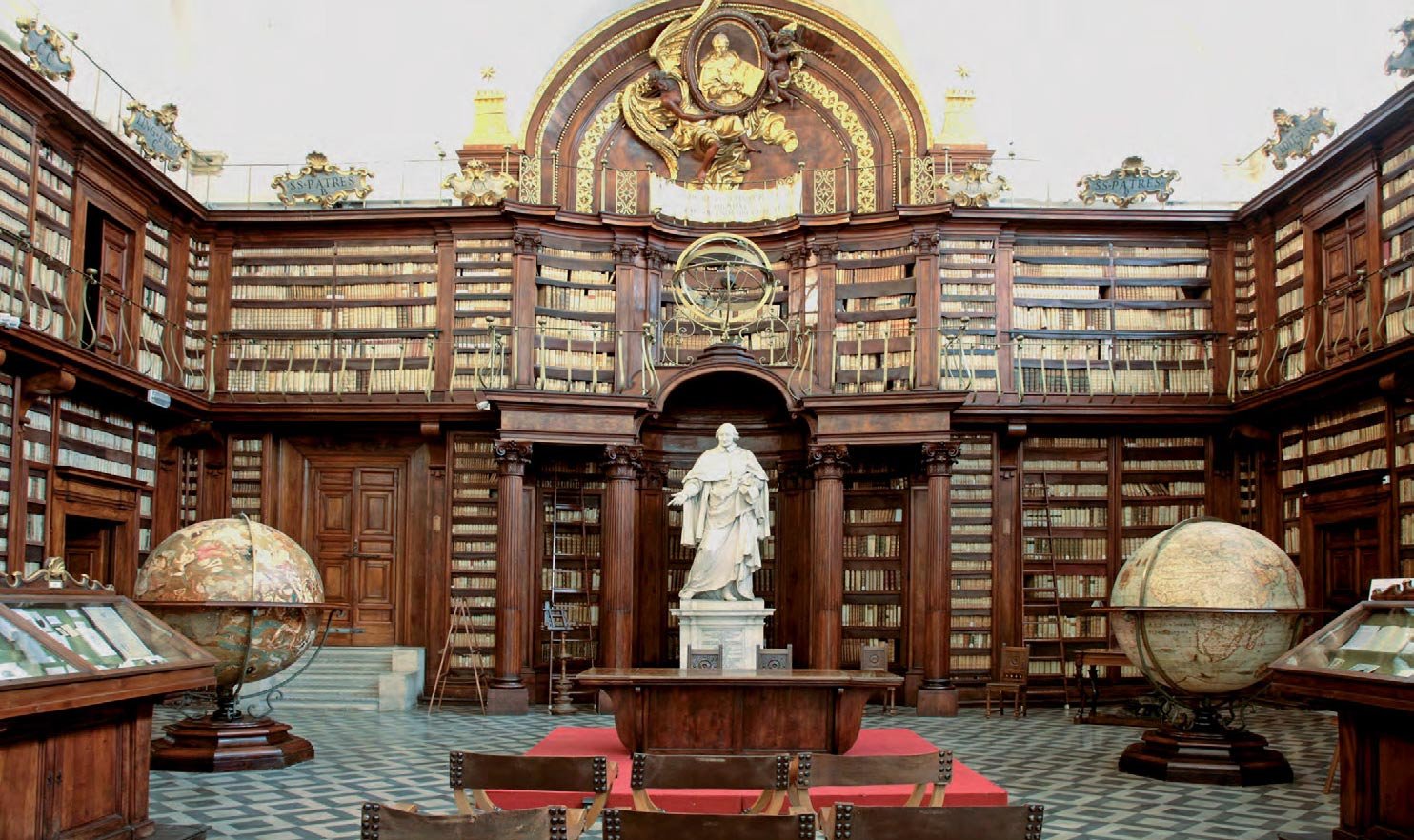
The Biblioteca Casanatense is at Via di Sant'Ignazio 52, in Rome, in the Pigna rione, in that rectangle of streets between the Pantheon, the church of Sant'Ignazio di Loyola and the Basilica of Santa Maria sopra Minerva. It's a state public library of the Ministry of Culture, that is, a real research institution, with reading rooms, a membership card and consultation rules. It's not a museum, even though it has a Monumental Hall that anyone can walk through for free and a few museum collections displayed right inside. The distinction matters, and I'll repeat it several times in these pages, because it's the key to not arriving with the wrong expectations.
The street number is discreet, the doorway announces nothing, and the stairs up to the library floor are a 19th-century staircase with no staging. Then you reach the top and walk into a room 60 meters long, with books on two tiers of wooden shelves, a gallery running at mid-height and a marble statue at the far end. That's when you understand why the Casanatense has the reputation it has in Rome.
Where the Biblioteca Casanatense is and how to get there
The address is Via di Sant'Ignazio 52, 00186 Rome. The street is short, runs behind the apse of the church of Sant'Ignazio and comes out on Piazza del Collegio Romano on one side and toward the Minerva on the other. From the Pantheon it takes three minutes on foot: take Via del Seminario, turn behind Sant'Ignazio and you're in front of it. From Piazza Venezia it takes seven, going by Via del Plebiscito and Via del Corso.
Public transport to the Biblioteca Casanatense
The area is closed to private traffic for much of the day, so it's best to think in terms of walking and surface transport. The buses serving Via del Corso, Largo di Torre Argentina and Corso Vittorio Emanuele II all drop you between five and 10 minutes' walk away. The metro doesn't come this way. The useful stop is Barberini on line A, which is still a good quarter of an hour's walk, or Colosseo on line B, farther still. You get across the Historic Center of Rome on foot, and the Casanatense is one of those places that's better reached that way.
The neighborhood around the Biblioteca Casanatense
The block is that of the Minerva complex, the old Roman headquarters of the Order of Preachers, the Dominicans. The Basilica of Santa Maria sopra Minerva is 50 meters away, with its Bernini elephant holding up the obelisk in the square. The Collegio Romano, which belonged to the Jesuits, is across the street, and this physical closeness between Dominicans and Jesuits was not always peaceful, as I'll tell you further on in connection with a lawsuit that stopped the works for years. Palazzo Doria Pamphilj with its gallery is a short walk away, and the gallery of Palazzo Doria Pamphilj is also worth the detour if you have time.
What the Biblioteca Casanatense really is
I'll start with the most important thing, the one that saves you disappointment. The Biblioteca Casanatense is a state public research library. Its job is to preserve old and modern books, catalog them, restore them and make them available to people who need to read them for study. It has a catalog room and two study rooms, an armored storage vault, a gifts office, an interlibrary loan service, a reproductions office. The people you see sitting at the tables are there to work, not to sightsee.
The visitable part of the Biblioteca Casanatense
That said, the Biblioteca Casanatense opens the Monumental Hall and the museum collections to the public for free, without a guided tour, on weekdays during a central slot of the day. You go in, sign in or announce yourself to the staff, go up, walk through the Hall, look at the globes and the armillary sphere, and leave. No ticket, no reservation for the free visit. Real guided tours work differently. They're reserved for upper secondary schools, universities, academies and cultural institutions, by appointment agreed with the relevant office, on set days and time slots. Cultural associations, tour operators specializing in historical and artistic itineraries and organized groups can request private visits for a fee, with a display of illustrated antique volumes presented by a curator if wanted.
Why the difference between library and museum changes the visit
In a museum the route is designed for the visitor: signs, lighting, a coat check, a bookshop, floor staff trained to answer questions. In a research library open to the public, the visitor is a guest in a workplace. There are no captions everywhere, there's no audio guide, the staff is busy with registered users. If you arrive knowing this you behave accordingly, speak softly, touch nothing, and enjoy one of the most beautiful 18th-century rooms in Europe without paying a euro. If you arrive expecting an interactive museum, you'll be lost. I'd rather tell you beforehand.
Girolamo Casanate, the cardinal who imagined the Biblioteca Casanatense
The founder was named Girolamo Casanate, born in Naples in 1620 to a family of Spanish origin from Aoiz, in Navarre. He took his degree in utroque iure, that is, in civil and canon law, in 1635. He was 15, a fact that by itself says a lot about the man. His father wanted him to be a lawyer and, to please him, he practiced law for some time before finally taking the ecclesiastical path he had been thinking of since he was a boy.
Girolamo Casanate's career before the Biblioteca Casanatense
The Holy See put him to work right away and put him to good use. He was governor of the Sabina, Fabriano, Camerino and Ancona, and everywhere he earned a reputation as a capable administrator, attentive both to public order and to the reorganization of the territories. In 1658 he was appointed Inquisitor in Malta, a very delicate post because it was not only a matter of watching over orthodoxy but of balancing the interests of the Holy See with those of the Order of St. John of Jerusalem, that is, of the Knights of Malta, who on the island were in fact the power. He came out of it with his reputation intact.
Back in Rome in 1663 he accumulated offices that today we would call top-level: Secretary of the Congregation of Rites, Secretary of Propaganda Fide, Assessor of the Holy Office, protector of several religious orders and finally Librarian of the Holy Roman Church, that is, head of the Vatican Library. A résumé like that, in the middle of the 17th century, meant one thing only: he was one of the best-informed men in Europe.
The book-collecting passion that gave rise to the Biblioteca Casanatense
His passion for books was passed on to him by his father, Mattia, together with an already respectable library: 1,639 volumes among manuscripts, incunabula and rare editions of the 16th and 17th centuries. Inside were sacred, liturgical and patristic texts, legal texts, trial records, the Decisiones of several courts including the Sacred Roman Rota, and then historical works, political treatises, geography books, Greek and Latin classics and, a detail I like a lot, authors of the new science such as Kepler, Della Porta, Cardano. A cardinal of the Holy Office who kept Kepler on his shelf is news in itself.
Casanate added to that collection all his life until, at his death in 1700, it stood at over 25,000 volumes. It was not a collection for show. It was a working tool, and his contemporaries knew it. Giovan Pietro Bellori, the great scholar and biographer of artists, frequented it. Carlo Bartolomeo Piazza called it a compendium of all the sciences, a phrase that perfectly sums up the ideal of the Baroque library, where the universality of knowledge was to be physically contained in one room.
The 1698 bequest and the birth of the Biblioteca Casanatense
In 1698, two years before his death, Girolamo Casanate left by will the largest part of his estate to the Dominican fathers of the convent of Santa Maria sopra Minerva. The declared aim was twofold: to open a public library and to create a center for propagating Thomist doctrine, that is, the thought of Saint Thomas Aquinas, who was and is the Dominicans' master par excellence.
The conditions imposed on the Biblioteca Casanatense
The donation was not without strings. The cardinal's private library passed to the Dominicans on condition that public use be guaranteed. Not use by the convent, not use reserved for scholars accredited by the Order: public use. The clause came with an obligation to keep the library open for a substantial number of hours every day, except holidays. In Rome in 1698, a provision like that was revolutionary: it meant that a provincial cleric, an artist, a lawyer, a preacher could climb a staircase and walk into one of the best book collections on the continent.
The college of theologians established along with the Biblioteca Casanatense
Casanate also wanted a college of Dominican theologians, doctors of different nationalities, charged with defending Catholic doctrine, and he funded chairs for teaching the thought of Saint Thomas. This explains an aspect of the collection that surprises people who discover it today: to refute opponents you had to read them, and so the library also had to own the books of the opposing side, the ones that elsewhere were kept out of sight. The Casanatense was therefore born with a two-sided vocation, apologetic and universal at once, and the second ended up prevailing over the first. It's one of the reasons why, three centuries later, it remains a mine for anyone studying 17th- and 18th-century Europe.
November 3, 1701: the opening of the Biblioteca Casanatense
The cardinal died in 1700. A year later, on November 3, 1701, what the documents of the time call the vaso, that is, the container, the building meant to hold the books, was inaugurated. The design was by the architect Antonio Maria Borioni. Giovanni Maria Castellani contributed 12,000 scudi to the operation. He was an archiater, that is, a papal court physician, and a personal friend of the cardinal. Without that money the building site would have been more modest.
Who physically opened the Biblioteca Casanatense
The opening was due to the decision of the Master General of the Order of Preachers, the Frenchman Antonin Cloche, born in Saint Sever in 1628 and died in Rome in 1720, a man with a remarkable nose for prestigious cultural operations. It was he who managed the initial phase, decided on the purchase of the scientific apparatus and set up the library as an institution, not a storehouse. Under his guidance the Casanatense stopped being the private collection of a dead man and became an organism that grew.
The early years of the Biblioteca Casanatense
The cardinal's 25,000 volumes found a place in the Hall. It seemed like a lot. Within 16 years it was no longer enough. Already in 1717 the curator fathers realized that the space was insufficient, because the purchasing policy carried out on the national and European market had swelled the collections at an unexpected speed. They called Borioni back and asked him for an expansion project. The fact that a newborn library was suffocating from too many purchased books is, in its way, the best certificate of good health you could imagine.
Antonio Maria Borioni and the architecture of the Biblioteca Casanatense
Antonio Maria Borioni is not a name the general public knows, and that's unfair. His Hall is one of the masterpieces of European library building, on a par with the great Central European monastery halls that everyone photographs. The difference is that those are in Austria or Bohemia, they charge admission and have to be booked. This one is in Rome, you visit it for free and few people know it.
The original design of the Biblioteca Casanatense
Borioni worked within a severe constraint: he had to build in an area of the Minerva convent complex that had previously been occupied by a cloister, fitting the new volume into an already saturated building fabric. The solution was a longitudinal room of double height, with light coming in from above and the walls entirely taken up by books. No columns, no partitions: a single continuous space, walkable from one end to the other.
The expansion and the new Biblioteca Casanatense
The 1717 expansion project brought the room to the size it has today. The works, however, proceeded in fits and starts and were only finished in 1725, because the Jesuits of the Collegio Romano sued, claiming that the dimensions planned for the new construction were excessive. The dispute between the two great teaching orders of Baroque Rome was fought with legal paperwork, with the masons standing idle. The symbolic completion came in 1729, with the visit of Pope Benedict XIII, himself a Dominican, whose portrait is still in the picture gallery of the building.
The Monumental Hall of the Biblioteca Casanatense
The measurements are these: 60.30 meters long by 15.60 meters wide. These are the dimensions reached with the 18th-century expansion and they are the current ones. Inside, still today, are kept about 60,000 volumes, arranged on a double tier of wooden shelving topped by cartouches, with an intermediate gallery that lets you reach the high shelves without ladders.
How to read the Hall of the Biblioteca Casanatense
Entering from the far end, the eye runs along the axis to the opposite wall. The modular repetition of the shelves, the rhythm of the wooden pilasters, the continuous band of the gallery and the line of the cartouches produce a perspective that looks longer than it is. It's a deliberate effect: Baroque architecture worked on perception, and a library had to convey the idea that knowledge was boundless.
The spines of the books, seen from the floor, form a texture of pale parchment and dark leather. Those 60,000 volumes cover four centuries of European printing history, from 15th-century incunabula to 18th-century editions, and the fact that they are still in their historic arrangement, by subject, makes the Hall a document as well as a room.
The gallery and the cartouches of the Biblioteca Casanatense
The gallery is not a scenographic whim: it was for taking down books. Before the invention of mechanized storage, a library on two tiers with an intermediate walkway was the most efficient technical solution for using the height of a room without making the librarians climb. The cartouches at the top of the shelves indicate the classes, that is, the subjects. They're the signage of the 18th century, painted and carved instead of printed.
The frescoed vault of the Biblioteca Casanatense
Of the decoration of the Hall's vault, a preparatory sketch is also preserved, a precious document because it lets you follow the passage from idea to realization. Looking up, in the Hall, is an exercise almost no one does: most visitors stay hypnotized by the shelves. I recommend raising your eyes at least once.
The 27 classes: how knowledge is ordered in the Biblioteca Casanatense
The books in the Hall are ordered by subject in 27 classes, and the division is one of the most eloquent documents I know on the mentality of an era. 13 classes, almost half, concern religious disciplines: sacred scripture, patristics, history of councils and synods, history of the provincial chapters of religious orders, ecclesiastical history, sacred history, hagiography, rhetoric, treatises on preaching, biblical exegesis, theology, religious and liturgical literature in languages other than Western ones.
The Oriental languages in the Biblioteca Casanatense
That last class deserves a pause. It includes texts in Hebrew, Armenian, Coptic, Syriac, Arabic, Chinese and Japanese. We are in the first decades of the 18th century, in a Roman convent, and on the shelves there are books in Japanese. The explanation has a precise name: Propaganda Fide, the congregation for the missions, of which Casanate had been secretary. The missions produced grammars, catechisms, vocabularies and reports, and that material flowed into Rome. The Casanatense still holds a Chinese collection of texts and manuscript documents from the 17th and 18th centuries, studied and cataloged in recent times.
Law, literature and the sciences in the Biblioteca Casanatense
Next to the theological sciences there is a section of canon and civil law, and then literature, history, philosophy, medicine, mathematics and natural sciences. None of these classes is decorative: the Casanatense's medicine has served generations of Roman doctors, its mathematics the Jesuits and Dominicans who did astronomy, its history the scholars who wrote about ancient Rome. It's the idea of the universal library applied to the letter, and you can still read it today by walking along the shelves and looking at the cartouches.
The quarrel with the Jesuits and the expansion of the Biblioteca Casanatense
The lawsuit brought by the Jesuits of the Collegio Romano against the expansion of the Casanatense is one of those episodes that explain Rome better than 100 pages of general history. On one side of the street the Dominicans, guardians of Thomism, with their new public library. On the other the Jesuits, the most efficient educational machine of Christendom, with their College and their library. In between, a question of volume.
The reason for the dispute around the Biblioteca Casanatense
The Jesuits claimed that the dimensions planned for the new construction were out of proportion. Behind the urban planning argument there was obviously something else: prestige, the competition between two models of culture, the fear that the Dominican institute would attract scholars and donations. The paperwork dragged on for years and the building site stopped several times. The works, begun after 1717, were completed only in 1725.
How it ended and what the Biblioteca Casanatense gained
It ended with the Casanatense getting its Hall 60 meters long. In 1729 the visit of Pope Benedict XIII, born Pietro Francesco Orsini, a Dominican, put the papal seal on the operation. A century and a half later, by a reversal of fortune none of the contenders would have foreseen, the Italian State found itself administering both the Casanatense and the national library installed in the very palace of the Jesuits at the Collegio Romano. History, now and then, has a taste for symmetry.
The statue by Pierre Le Gros in the Biblioteca Casanatense
At the far end of the Monumental Hall is the statue of Cardinal Girolamo Casanate, sculpted in 1708 from a single block of Carrara marble by the Frenchman Pierre Le Gros the Younger, born in Paris in 1666 and died in Rome in 1719. It's the most important sculptural piece in the building and one of the most beautiful late Baroque marbles that can be seen for free in the city.
Who Pierre Le Gros was before the Biblioteca Casanatense
Le Gros arrived in Rome young, as a pensionnaire of the French Academy, and stayed for the rest of his life. He worked for the Jesuits at the Gesù and at Sant'Ignazio, for the Dominicans at the Minerva, for St. Peter's Basilica. His language joins Bernini's theatricality to a control of drapery of the French school, and the Casanate statue is a textbook example: the cardinal's robe has sober, almost severe folds, but the lace of the surplice is worked with a virtuosity that defies the marble.
The original placement of the statue in the Biblioteca Casanatense
The statue was commissioned by the Dominican fathers of the Minerva and meant for the original vestibule of the library, which was above the sacristy of the church. Of that arrangement there remains a drawing by Le Gros himself, kept in the Casanatense historical archive under the shelf mark Ms. Cas. 421. In it the sculpture can be seen inside a niche topped by two winged putti holding the cardinal's hat and coat of arms. Then the statue was moved to the Hall, where you see it today.
How to look at the cardinal's face in the Biblioteca Casanatense
The portrait is idealized just enough, but it's not a mask. The figure is slender and elegant, the expression serene, and on the lips there's a hint of a smile that I've always found remarkable in a man who had spent his life between the Holy Office and Propaganda Fide. The same expression returns in a herm of the cardinal on a wooden pedestal, in terracotta tinted bronze color with gilded details, kept in the library. Anyone who wants to compare the two portraits will have a lot of fun.
The busts, medallions and sculptures of the Biblioteca Casanatense
Besides the statue of the founder, the Biblioteca Casanatense keeps 14 plaster busts of illustrious men and one female portrait. The gallery is a small lay and domestic pantheon, and the list of the figures says a lot about the institution's self-awareness.
Who the 14 busts of the Biblioteca Casanatense are
There are Homer and Cicero, that is, ancient poetry and eloquence. There's Lorenzo Valla, the philologist who took apart the Donation of Constantine, and Pomponio Leto, the animator of the Roman academy. There are Marsilio Ficino, the translator of Plato, and Ludovico Antonio Muratori, the father of Italian historical scholarship. There are Giuseppe Baini, the musician whose collection came here by bequest, Antonio Coppi and Giovanni Antonio Riccy, Roman scholars, Carlo Gargiolli, the first government director, and Ruggiero Bonghi, the politician and scholar who was Minister of Public Education. And then two Poles, Artur Wolynski and Henryk Jozef Piotr Levittoux, a presence explained by the ties between the library and the Polish emigration in Rome in the 19th century.
The sculptors who worked for the Biblioteca Casanatense
Some busts are signed: Mauro Benini, Giovanni Biggi, Augusto Simonetti, Gaetano Ronca, Teodor Rygier, the latter a Polish sculptor, author of the Mickiewicz monument in Kraków. Others are the work of anonymous artists. Above the entrance to the director's office is the marble bust of Giovanni Battista Audiffredi, the prefect under whom the Casanatense reached its greatest splendor. A placement that is a statement of the hierarchy of merit.
Medallions and sculptural curiosities of the Biblioteca Casanatense
Two plaster medallions portray Ignazio Giorgi, director from 1893 to 1923, and Luigi De Gregori, director from 1925 to 1936. The second is the work of the sculptor Carlo Fontana. In the Monumental Hall there's a large gilded wood medallion with the effigy of Saint Thomas Aquinas holding a Bible, supported by two angels. There's a plaster medallion with the profile of Giuseppe Verdi. And there's the plaster death mask of the Polish poet Adam Mickiewicz, placed inside a concave roundel among the bas-reliefs with the coats of arms of Poland and Lithuania.
The paesite cabinet of the Biblioteca Casanatense
Among the minor objects it's worth mentioning an 18th-century cabinet with eight side drawers, each covered by two small squares of paesite, the Florentine stone whose veining looks like painted landscapes. In the center is another drawer, also in paesite, set into an architectural motif that imitates the facade of a classical temple, with pediment and pilasters in green marble. In the drawers are kept remains of shell collections. A library that keeps shells inside a cabinet of landscape stone is a Baroque library to the marrow.
The frescoes and painted ceilings of the Biblioteca Casanatense
If you come in thinking the Biblioteca Casanatense is only the Hall, you miss half the beauty. The rooms before it have frescoed ceilings of quality, and in one of the reading rooms runs a cycle of allegorical figures from the early 20th century that is worth the climb on its own.
The six frescoed rooms before the Hall of the Biblioteca Casanatense
The six rooms before the Monumental Hall all have ceilings with plant and scroll motifs. Three stand out. The reception room has decorations running along the whole rectangular perimeter, floral garlands, assorted ornamental motifs and, on the short sides, an eagle with spread wings inside an oval and the coat of arms of the Casanate family, that is, a tower topped by an eight-pointed star. Learning to recognize that coat of arms is useful: it reappears several times in the building.
The dog with the torch in the Biblioteca Casanatense
The first of the two rooms immediately before the Hall has garlands and polychrome floral decorations on a white ground, with two elements at the center: the Casanate coat of arms topped by the wide-brimmed hat and, above, a dog with a torch in its jaws. That dog is not a chance ornament. It's the emblem of the Dominicans, the Domini canes, the hounds of the Lord, and the lit torch alludes to the spreading of the Gospel message. Whoever spots it has understood in one stroke whose house this was.
The Glory of Saint Thomas in the Biblioteca Casanatense
The next room, which houses the library's historical archive, has on its ceiling a 1736 fresco by Giovanni Mazzetti with the Glory of Saint Thomas. The saint, in Dominican habit, rises to heaven accompanied by his teacher Saint Albert the Great, in golden robes, kneeling in adoration of the Trinity. Around them, putti holding the tiara, the pastoral staff and the open book, symbol of the word of God. Bearing in mind that Casanate had funded chairs of Thomism, the iconography is anything but generic: it's the program of the house painted on the ceiling.
The nine allegories by Giuseppe Cellini in the Biblioteca Casanatense
Along the walls of one of the reading rooms run nine allegorical figures: Astronomy, Arithmetic, Dialectic, Law, Geometry, Grammar, Music, Rhetoric, Theology. Giuseppe Cellini painted them in the early 1900s, and they are young women seated or standing inside architectural niches, surrounded by scrolls and festoons. The reference is explicit to the illuminated decorations of the manuscripts and incunabula kept in the library: an Art Nouveau painter quoting the codices of the house where he works. The seven liberal arts of the Trivium and Quadrivium have here widened to nine, with the addition of Law and Theology, that is, of the two disciplines that counted most in Rome.
The picture gallery of the Biblioteca Casanatense
The collection of paintings numbers 31 pieces. It's not a picture gallery and doesn't claim to be, but it contains some serious things and a lot that tells the story of the institution.
The portraits of the founder in the Biblioteca Casanatense
Three large oil portraits of the cardinal, from the 17th century, come directly from his collection and are distributed between the entrance and the reading room. Then there's the portrait of Benedict XIII, the Dominican pope who reigned from 1724 to 1730 and came to visit in 1729, and a 17th-century portrait of Giovanni Pierluigi da Palestrina, a presence explained by the musical vocation of the house.
The portraits of the librarians of the Biblioteca Casanatense
A series of oil portraits, datable between the 18th and 19th centuries, depicts the Dominican fathers who took turns as librarians, theologians and prefects. The authors are Carlo Pignoli, Anna Vittoria Dolara, Angelo Zoffoli, Giovanni Prasach, David Loreti and Giovanni Biggi. Among them the portrait of Giovanni Battista Audiffredi stands out: half-length, seated at a table, surrounded by a medal, a spyglass, a set square, a compass and a book. Five objects to say five skills. It's a programmatic portrait and, for once, the program matches reality.
The paintings of sacred subjects in the Biblioteca Casanatense
Among the religious paintings there's a Madonna seated cross-legged who embraces the young Saint John with her left hand while with her right she lifts a very light veil to show the sleeping Child, with a landscape of classical ruins in the background in blue, green and gray tones against the salmon pink of the Virgin's robe. It probably comes from the Casanate collection. There's a large Martyrdom of Saint Lawrence attributed to Mathaus Stomer, the Dutch Caravaggesque painter active in Italy, also from the cardinal's picture gallery, with the light concentrated on the saint's body, on the angel and on one of the torturers. There's an Arrest of Christ in Gethsemane, a 17th-century copy after the Cavalier d'Arpino, where the darkness of the night is broken only by the full moon at upper right and by Saint Peter's cloak in the foreground. And there are two small paintings on copper donated by Audiffredi with scenes of the Passion.
The still lifes with shells in the Biblioteca Casanatense
The picture gallery closes with four small tempera still lifes on a black ground, where specimens of brightly colored shells are laid out. The shells return, and they return for a reason: in the encyclopedic culture of the 17th and 18th centuries the shell was the natural-history specimen par excellence, a museum object and a wonder at once. A library that paints them and keeps them is declaring that its field is the whole of knowable things, not just printed paper.
The globes and the armillary sphere of the Biblioteca Casanatense
In the Monumental Hall, among the shelves, two globes are displayed, one terrestrial and one celestial, and an armillary sphere. They are the objects visitors photograph most and also the ones about which the most inaccuracies circulate. It's worth putting the facts in order.
The armillary sphere of the Biblioteca Casanatense
The armillary sphere was bought before March 1703 by Girolamo Caccia, by decision of the Dominican Master General Antonin Cloche, and is still in the Hall. Cloche did not just buy it: he ordered the modifications needed so that it would be, in the words of the documents, richer and of greater intelligence for making known the two systems of Tycho and Copernicus. Translated: the sphere had to be able to illustrate both Tycho Brahe's geo-heliocentric model and Copernicus's heliocentric one. In 1703, in a Dominican convent 200 meters from the place where Galileo had abjured 70 years before, this is a detail that deserves to be weighed well.
Who designed the globes of the Biblioteca Casanatense
The two globes were made in 1715, with expense approved by Cloche himself. They are the work of Silvestro Amanzio Moroncelli, cartographer, abbot of the Silvestrine congregation of Santo Stefano del Cacco, born in Fabriano in 1652. Moroncelli drew and painted the bands of the globes on paper. They are not the work of Vincenzo Coronelli, the famous Venetian Franciscan cosmographer whose monumental globes are found elsewhere. The confusion is frequent because Coronelli is the name everyone associates with Italian globes of that era, but the Casanatense authorship is Moroncelli's, and it's documented.
Why the globes matter in the Biblioteca Casanatense
Globes and sphere were not knickknacks. They were teaching tools and at the same time statements of program: they attested that the library followed the progress of cartography and cosmology and that its astronomical and geographical holdings were living matter. In a room where half the classes concern theology, the physical presence of a Copernican model balances the picture and makes it far more interesting than how it's usually told.
The other scientific instruments of the Biblioteca Casanatense
The science museum of the house doesn't end with the globes. There's a natural magnet, two astrolabes and other material the Dominicans bought with the same logic with which they bought books.
The magnet of the Biblioteca Casanatense
The natural magnet is enclosed in a brass casing. On two opposite faces the poles are marked, with the inscriptions Polus Arcticus and Polus Antarcticus. On the other two faces are two inscriptions worth a lesson in 18th-century experimental physics: Magnetis pondus est unciarum 24, the weight of the magnet is 24 ounces, and Magnes hic trahit usque ad uncias 108, this magnet attracts up to 108 ounces. Its own weight and its carrying force, measured and engraved on the object. The magnet was bought in October 1765, as shown by the Libro delle Ragioni for the years 1764-1781, that is, the library's account register. Knowing that there's an account book that lets you date the purchase of a magnet to the year and month is one of the reasons I love this place.
The astrolabes of the Biblioteca Casanatense
The astrolabes consist of two rectangular copper plates, 25.5 by 36 centimeters, eight millimeters thick, with some parts in brass. They are held in a vertical position by an armilla suspensoria, the support ring that allows the instrument to be kept raised so that the meridian line falls perpendicular to the horizon. The front face is decorated with elegant figurative engravings. At the center is a circular area 16 centimeters in diameter, with the rim divided into 24 sectors corresponding to the hours. On the outer circular band are engraved the names, symbols and allegorical depictions of the Sun, at the top aligned with the support ring, of the Moon and of the five planets then known. One of the two can be dated to the 16th century.
The observatory inside the Biblioteca Casanatense
That the instruments were used and not just displayed is shown by the story of the prefect Audiffredi, a practicing astronomer, who in 1761 observed from the premises of the Minerva fathers the transit of Venus across the Sun and the following year published a historical and astronomical account of it. The Duke of Sermoneta then commissioned him to build a sundial at Palazzo Caetani, where an observatory was set up that Audiffredi used for some years. A Dominican librarian who measures the transit of Venus and then goes back to cataloging incunabula: the Rome of the 18th century in a single biography.
The manuscript collection of the Biblioteca Casanatense
The collection gathers about 6,300 items and covers a chronological span from the 8th to the 20th century. Its origin is the cardinal's private library, and its growth is due to the purchasing policy of the Dominican prefects first and of the directors later. The variety is impressive: very different types of books and documents, contents ranging from liturgy to music, from medicine to geography.
The most famous codices of the Biblioteca Casanatense
Among the best-known items are the liturgical rolls of manuscript 724, a Benedictional, a Pontifical and an Exultet in Beneventan script of the 10th and 12th centuries. Anyone who has never seen an Exultet should find out how it worked: the roll was unrolled from the ambo during the Easter vigil and the images, painted upside down relative to the text, descended toward the faithful while the deacon sang. It's one of the few cases in which the medieval book is a device for spectacle.
There's the Theatrum Sanitatis, manuscript 4182, from the Lombard area, one of the great illustrated codices of medieval medicine, with its plates of herbs, foods, trades and seasons. There are the antiphonaries of the late 15th century from the Dominican convent of Santo Spirito in Siena, manuscripts 4505-4508 and 4510-4511. And there are the autograph music manuscripts of Niccolò Paganini, of which I'll say more further on.
The luxury codices of the Biblioteca Casanatense
Two pieces deserve a discussion of their own. The Historia Plantarum, manuscript 459, belonged to the library of Matthias Corvinus in Budapest. It's one of the corvinas, that is, one of the codices of the most famous humanist library of Central Europe, dispersed after the Ottoman conquest and today reconstructable only piece by piece in the libraries of the world. Having one in Rome, on Via di Sant'Ignazio, is a remarkable fact.
The other is manuscript 2856, a collection of chansons composed on the occasion of the wedding of Isabella d'Este with Francesco Gonzaga. It's direct testimony of instrumental practice at the Ferrara court of the late 15th century, that is, of one of the most refined musical workshops in Europe.
The illuminated manuscripts of the Biblioteca Casanatense
More than 500 manuscripts are decorated and illuminated, and taken together they represent almost all the Western painting trends and in part the Eastern ones too. The collection includes 64 Greek codices, over 200 Hebrew texts among which some Samaritan codices, medieval biblical manuscripts. A substantial part can be consulted in digital reproduction through the library's online resources, which makes it possible to study without handling the originals, a practice any conservator approves.
The incunabula of the Biblioteca Casanatense
Incunabulum is the technical term for books printed with movable type before 1501, that is, in the first 50 years of European printing. The Casanatense owns a little over 2,000. Father Masetti, who wrote about them in the 19th century, called it an outstanding or perhaps unique collection.
What the incunabula collection of the Biblioteca Casanatense contains
The range of disciplines is wide: theology, canon law, philosophy, sciences, Greek and Latin classics, lives of the saints, editions of the Divine Comedy and of other medieval authors, humanist literature. The collection was formed largely in the 18th century, with targeted acquisitions by Gian Domenico Agnani and Giovanni Battista Audiffredi. The latter also published a work on the Roman editions of the 15th century that earned him European fame.
The Chamber of the Quattrocentisti of the Biblioteca Casanatense
The 15th-century editions were originally in the Monumental Hall along with the rest. Then the first of the rooms before the Hall was set aside for them, the one overlooking Via di Sant'Ignazio, for which until 1860 the Casanatense paid rent to the neighboring convent of the Minerva. The move was due to Father Giacomo Alberto Magno, prefect from 1798 to 1840, who gathered and ordered the collection in what was called the Camera dei Quattrocentisti and compiled a three-volume repertory of it ordered chronologically by edition. Later, during the directorship of Ignazio Giorgi between 1893 and 1923, the incunabula were transferred to the present armored vault, for reasons of protection.
The first editions and unique copies of the Biblioteca Casanatense
Among the pieces cited most often are the Horae Beatae Mariae Virginis printed in Paris by Pigouchet for Vostre in 1497, the Breviarium Romanum issued in Venice by Evangelista da San Severino in 1482, the Hortus Sanitatis of Vérard, Paris 1499, the Pratica of Valascus de Tarenta printed in Lyon by Trechsel in 1490, the Legenda Aurea of Jacopo da Varazze issued in Nuremberg by Koberger in 1482 and the Doctrinale of Alexander de Villa Dei, Modena, Vurster, around 1475. These are names that mean little to an ordinary reader and everything to a historian of the book: they are the workshops that invented the modern book.
The theater collection of the Biblioteca Casanatense
If I had to name the reason foreign scholars take a plane to come to Via di Sant'Ignazio, I'd name the theater collection. It's one of the most substantial theater collections in Italy and its origin lies already in the cardinal's private library, which contained 160 miscellaneous volumes of plays from the 16th and 17th centuries.
How the theater collection of the Biblioteca Casanatense grew
The initial core was expanded by the Dominicans mainly between 1728 and 1794, under the prefectures of Minorelli, Agnani, Schiara and Audiffredi, and then in the first half of the 19th century. The collection includes both spoken theater, that is, comedies, tragedies and sacred dramas, and theater for music, that is, opera librettos, cantatas, theatrical festivities, tournaments, serenades, oratorios. The editions in Italian number about 8,000, but there are also texts in Latin, French and Spanish.
The Commedia dell'Arte scenarios in the Biblioteca Casanatense
Here comes the centerpiece. Manuscripts 1211 and 1212 contain 103 17th-century Commedia dell'Arte scenarios, collected in two volumes titled Della scena de' soggetti comici, part one dated 1618 and part two dated 1622, due to Basilio Locatelli, an amateur actor. They are scenarios, that is, the outlines that were hung backstage and on which the comedians improvised. Since the Commedia dell'Arte by definition had no script, these booklets are among the very few direct sources that let us reconstruct how it really worked. Manuscript 4186 keeps another 48 scenarios inspired by the conventions of 17th-century Spanish theater.
Flaminio Scala and the other authors of the Biblioteca Casanatense
Among the printed works is the rare 1611 edition of the Teatro delle favole rappresentative by Flaminio Scala, troupe leader and author, the other great repertory of Commedia dell'Arte scenarios. For opera librettos the library keeps Aurelio Aureli, Giovanni Francesco Busenello, Giovanni Faustini, Pietro Metastasio, Niccolò Minato, Giovanni Andrea Moniglia, Matteo Noris, Francesco Silvani, Arcangelo Spagna, Apostolo Zeno. For spoken theater there are Terence and Plautus, Ariosto and Tasso, Alfieri and Goldoni, Racine, Molière, Corneille, Lope de Vega. A Dominican convent that systematically collects comedies and opera librettos is an image worth keeping in mind when people talk about the Counter-Reformation.
The music collection of the Biblioteca Casanatense
Within the profile of a universal library, the music section of the Biblioteca Casanatense is one of the richest in Rome and covers the Middle Ages to the 20th century. It was formed by stratification, with purchases and bequests grafted onto the cardinal's original core, where there were already texts of music theory and a small group of practical music made up of madrigals and sacred songs of the 16th and 17th centuries.
The medieval music of the Biblioteca Casanatense
The medieval legacy is represented by liturgical books: missals, psalters, hymnals, choir books, pontificals, sacramentaries, processionals, cantorini. Some are in neumatic notation, such as manuscript 1741, a tropary-sequentiary with Nonantolan diastematic notation of the 11th century, or manuscript 54, a monastic collection also of the 11th century, or again manuscript 724 in its three parts, Pontifical and Exultet of Beneventan provenance between the 10th and 12th centuries. Others are in Gregorian notation with square notes on a four-line staff, like the choir books 4504-4511, made between 1472 and 1541 and coming from the convent of Spirito Santo in Siena.
The librettos for music in the Biblioteca Casanatense
The collection of printed librettos numbers about 1,900 copies: Italian operas of the 17th and 18th centuries, some of the 19th, and a series of French editions. Many are enriched with engravings of stage sets, and this makes them visual sources as well as textual ones. Anyone studying Baroque scenography works on these sheets too.
The Baini collection of the Biblioteca Casanatense
In 1844 the library received by bequest the music collection of Giuseppe Baini, singer and then chamberlain of the Papal Chapel, the musicologist who brought Palestrina back to the center of the 19th-century debate. It comprises 197 manuscripts and 819 printed works, with compositions and treatises of practical and theoretical music between the 16th and 19th centuries. Baini's bust is among those kept in the library, and the 17th-century portrait of Palestrina in the picture gallery makes sense precisely in light of this bequest.
Paganini, Sgambati and Respighi in the Biblioteca Casanatense
That the autograph manuscripts of Niccolò Paganini are in a Roman library founded by a cardinal of the Holy Office is one of those short circuits that make the history of collections more gripping than many novels.
The Paganini collection of the Biblioteca Casanatense
The collection belonged to the private collection of Wilhelm Heyer of Cologne and was bought by the Biblioteca Casanatense in 1972 from the Bavarian antiquarian Hans Schneider. It consists of 90 manuscripts, mostly autographs, covering almost the entire corpus of the Genoese composer's musical output. 90 autograph manuscripts of Paganini in one place is a concentration with few equals in the world, and in fact the library devoted an exhibition to it already in 1972, the very year of the purchase.
The Sgambati archive of the Biblioteca Casanatense
Giovanni Sgambati was the pianist and composer who in Rome, in the second half of the 19th century, held together the Italian tradition and the Germanic world, a pupil and friend of Liszt, a promoter of instrumental music in a city that lived on opera. His archive was bought at auction from Christie's in Rome on December 13, 1994 and includes about 300 manuscripts of compositions, sketches, complete drafts, autographs and copies, about 100 printed editions, manuscripts and printed works by several authors, some with autograph dedications, concert programs, the correspondence from 1863 to 1914, with about 2,000 letters, telegrams, postcards and visiting cards, over 300 photographs of illustrious figures, many with dedications, and assorted texts from the maestro's library.
The Respighi papers of the Biblioteca Casanatense
Also in 1994 a small core of papers of Ottorino and Elsa Respighi was acquired, with part of the correspondence of the maestro and his wife. Alongside this is a photographic series showing the two between 1891 and 1970, with family, on tour, with friends and colleagues. Anyone who has the Fountains of Rome and the Pines of Rome in mind finds here the private documents of the composer.
The other music collections of the Biblioteca Casanatense
In 1973 came the largest part of the music library of the Compagnoni Marefoschi family of Macerata, that is, 795 manuscripts of practical music of the 18th and 19th centuries. In 1995 the musicologist Remo Giazotto handed over 38 rare 16th- and 17th-century editions, 22 of practical music and 16 of music theory, including scores by Corelli, Gluck, Mozart, Spontini and others, almost all printed from engraved plates, plus two autograph letters by Spontini and by the Frenchman Auber. In 1993 103 rare scores printed in Paris between 1774 and 1826 were bought, and in 1997 a small collection of documents with 25 handwritten musical sketches by minor Italian authors between the 19th and 20th centuries.
Edicts and notices: 80,000 sheets in the Biblioteca Casanatense
The Edicts and Notices collection is, for its size and specificity, one of the collections that characterize the Biblioteca Casanatense in the eyes of scholars. It numbers about 80,000 documents. They are the printed measures with which power communicated with its subjects: prohibitions, price caps, tariffs, health ordinances, police regulations, notices on games, hunting, the grain trade.
What the notices collection of the Biblioteca Casanatense contains
The edicts and notices of the Papal States, in particular those concerning Rome, are gathered in chronological sequence, not always respected, by date of issue. The shelf marks are PER.EST.18 and its variants, and they cover a span from 1216 to 1870, with the warning that the few documents of the 13th, 14th and 15th centuries are in fact 16th- and 17th-century reprints. One shelf mark is an exception and contains pastoral letters for the diocese of Padua by Bishop Carlo Rezzonico, the future Pope Clement XIII.
Alongside the administrative measures there are bulls, briefs, announcements of jubilees, grants of favors, privileges and indulgences, rules for religious orders, acts of congregations. Among these is a collection of Resolutiones of the Congregation of the Council in six volumes, dense with handwritten annotations by Benedict XIV, that is, by Prospero Lambertini, the canonist pope: the marginal notes of a pontiff on working volumes are first-hand material.
The documentary value of the notices of the Biblioteca Casanatense
The notices are the most direct source there is for understanding how people really lived. From an edict on the price of bread you can infer a food-supply crisis, from a notice on the plague you can reconstruct a quarantine, from an ordinance on carriages you can grasp the traffic of a city. Anyone writing on Roman social history spends weeks on these papers, and the reason the Casanatense holds them in quantity is that the Dominicans collected them systematically, the way the official gazette is collected today.
The other Italian states in the Biblioteca Casanatense
The collection doesn't stop at Rome. The edicts of the Republic of Venice, largely from the 16th century, are found in a few miscellaneous volumes. For the Duchy of Savoy and the Kingdom of Sardinia the coverage runs from 1607 to 1848, partly handwritten and partly printed, including notices and provisions of the Intendancy of Saluzzo. There are also statutes and government acts of cities of the Papal States such as Bologna, Ancona and Perugia, some placed in the Monumental Hall.
The engravings, prints and drawings of the Biblioteca Casanatense
The graphic collection of the Biblioteca Casanatense is the kind that makes people change their plans if they came thinking only of books. A small collection of engravings already existed in the cardinal's private library, but the leap came from 1735, under the prefecture of Father Agnani, and continued with Audiffredi between 1749 and 1794.
How the graphic collection of the Biblioteca Casanatense grew
Rare material flowed into the Casanatense in the years of the French occupation, when the property of some suppressed convents was acquired, and after the Restoration thanks to the substantial bequest of Abbot Antonio Riccy. The increase was such that a dedicated room became necessary, called the print room. Then came the best blow: in 1831 Gregory XVI granted the Casanatense the privilege of receiving free of charge one copy of every print produced by the Calcografia Camerale. A sort of legal deposit ante litteram, which lasted until 1870 and filled the cabinets.
The Italian engravers in the Biblioteca Casanatense
The major names are there. Marcantonio Raimondi, the great translator into copper of Raphael's inventions, and other exponents of the Roman school. Giorgio Ghisi and the Mantuan school for the 16th century. The Neapolitan Salvator Rosa and the Florentine Stefano Della Bella for the 17th. Giovanni Battista Piranesi with the views and Roman antiquities for the 18th. Bartolomeo Pinelli, with his Romans in popular costume, for the first decades of the 19th. Having Piranesi and Pinelli in the same collection means being able to follow the way Rome looked at itself across two generations.
The foreign engravers in the Biblioteca Casanatense
The foreign side is also notable, with a prevalence of the German and Flemish schools: Albrecht Dürer, Hans Baldung Grien, Hendrik Goltzius, Lucas van Leyden, Abraham and Cornelis Bloemaert, and then the dynasties of the Wierix, the Collaert, the Sadeler, present with quality copies. The French school is represented by the bizarre inventions of Jacques Callot and by the landscape artists Perelle and Silvestre. Part of the collection concerns Baroque stage designs, and is directly tied to the theater collection.
The cartography and atlases of the Biblioteca Casanatense
The cartographic collection, made up of printed and handwritten works, documents the passage from the medieval view of the world to the modern one, shaped by the great voyages and by scientific discoveries.
The printed atlases of the Biblioteca Casanatense
Within the print collection there is a set of large geographic editions, 62 volumes, mostly between the 17th and 18th centuries, with the names that matter in Dutch cartography: the Blaeu and Jansson. The major piece is the Atlas maior sive Cosmographia Blaviana in the first edition, Latin text, published in Amsterdam in 1662 by Joan Blaeu. It's the work with which Dutch cartography reached its peak: fine paper, extraordinary miniatures, a publishing luxury with few equals. In the 17th century the map was still both science and work of art, and where data were missing imagination took over: sea monsters, allegories of the continents, decorated cartouches.
The 1482 Ptolemy of the Biblioteca Casanatense
Among the cartographic incunabula the piece to cite is the volume with shelf mark VOL.INC. 732, the German edition of 1482 of Ptolemy's work, with a large plate of the ancient world signed by the engraver Johann Schnitzer. These are the Ulm maps, the first Ptolemaic plates engraved on wood north of the Alps, and seeing a copy in a Roman library is a privilege.
The handwritten nautical charts of the Biblioteca Casanatense
Among the cartographic manuscripts three pieces stand out. The Liber Insularum Archipelagi, manuscript 106, describes the islands of the Aegean with details on ports, towns and villages, accompanying each watercolor with descriptive text. Manuscript 4866, a parchment roll of 1556, contains nautical charts of the Mediterranean with archipelagos, coastal places and islands of Atlantic western Europe shown with great accuracy. Manuscript 4865, a parchment roll of 1588, adds the depiction of three caravels, an obvious reference to Columbus's undertaking. In both nautical charts great prominence is given to Genoa and Venice, the two maritime republics that held the Mediterranean trade.
The heraldry and coats of arms of the Biblioteca Casanatense
The Biblioteca Casanatense is among the state public libraries best known for the quantity and quality of its heraldic material, kept both among the printed works and in the manuscript collection. It's a specialization that surprises at first sight and that in fact derives in a straight line from the nature of the collection: whoever owns family histories, genealogies, records of chivalric orders and diplomatic documents necessarily ends up owning coats of arms.
The heraldic treatises of the Biblioteca Casanatense
Among the printed works there are manuals and treatises on Italian, French, Spanish, English, German and Polish heraldry, including two editions, of 1550 and 1579, of the De insignis et armis by Bartolo da Sassoferrato, the first heraldic treatise of the European legal tradition. Then there are dictionaries, essays, periodicals, armorials, statutes of chivalric orders, collections of emblems, family histories and genealogies of Italian and European noble and ruling houses, published between the 16th and 20th centuries.
The heraldic codices of the Biblioteca Casanatense
In the manuscript collection about 150 heraldic codices are kept, many of great value for rarity and refinement, in addition to as many private and public documents of historical and diplomatic interest, some bound in volume, others in roll form. The first to deal with them systematically was Luciano Gabriele Moricca, Casanatense librarian, who between 1947 and 1949 oversaw the cataloging of 100 heraldic manuscripts in the journal of the Collegio Araldico.
The emblems of the Academies in the Biblioteca Casanatense
One of the most consulted manuscripts is an 18th-century collection of Imprese ed emblemi delle Accademie d'Italia, with 243 emblems carefully drawn and watercolored on the recto of each leaf, accompanied by two cartouches with the motto and the name of each academy. For anyone studying Italian academic culture, that is, the network of literary and scientific societies that held the peninsula together before unification, it's an iconographic source of the first rank. Just as important is the Raccolta di ritratti di cardinali, an 18th-century manuscript containing the portraits of the popes and cardinals between 1153 and 1729: after each pope come the cardinals he created, with coats of arms, a handwritten caption and brief biographical notes.
The periodicals and the Diario ordinario in the Biblioteca Casanatense
The periodicals collection includes about 1,850 titles. There are almost all the Italian learned journals, starting from the first Giornale de' letterati by Nazari and Ciampini of 1668 up to the Giornale de' letterati d'Italia by Apostolo Zeno of 1710, and then notices, gazettes and news journals.
The Chracas of the Biblioteca Casanatense
The piece worth the trip is the Diario ordinario d'Ungheria, later Diario di Roma, universally known as Chracas from the name of the printers. It came out every two or three days and the Biblioteca Casanatense owns the complete run from 1716 to 1848. Anyone studying the Rome of the 18th and early 19th centuries works on this: who arrived in the city, who left, which cardinals were ill, which processions were held, which operas were staged, which carriages overturned. It's the daily newspaper of a capital before daily newspapers, and having it complete in a single place is a rare stroke of luck.
The European panorama in the periodicals of the Biblioteca Casanatense
The old part of the collection documents the cosmopolitan role the library had throughout the 18th century, with constant links to Paris, Leipzig and The Hague. There are the Journal des sçavans, the Histoires and Mémoires of the academies, the Lettres édifiantes of the Jesuit missionaries in China from 1699, the periodicals of the French Revolution, and English periodicals such as Addison and Steele's Spectator. I repeat the detail because it deserves it: a Roman Dominican library that receives the periodicals of the Revolution and the reports of the Jesuit missionaries in China. The universality the founder wanted was not a slogan.
The recent periodical acquisitions of the Biblioteca Casanatense
Contemporary choices follow two lines: deepening the historical themes of the house, that is, theology, Thomism, Church history, medieval history and the history of Rome, and supporting with scientific literature the study of its own collections. It's a coherent acquisitions policy, which avoids dispersion and strengthens specializations: exactly what you expect from a well-run research library.
The photographs of the Biblioteca Casanatense
Besides books, the Biblioteca Casanatense keeps a photographic heritage of about 9,000 pieces, made up mainly of positives, including many black-and-white and color stereoscopic views, postcards and newspaper clippings. The chronological span goes from the first half of the 19th century to the early 2000s.
The Manodori Sagredo collection of the Biblioteca Casanatense
Bought in 1995 from Alberto Manodori Sagredo, it gathers period photographs between 1860 and 1935: positives, stereoscopic views, postcards. Many bear top signatures, such as the Alinari brothers, Giacomo Brogi, Francis Frith, and publishers such as Underwood and Underwood. The subjects are portraits, travel photographs, scenes of everyday life, genre scenes reconstructed in the studio and shots of comedies performed in the theaters of the time. This last core intertwines with the theater collection and completes it from the visual side.
The other photographic collections of the Biblioteca Casanatense
The Respighi collection documents the musician and his wife between 1891 and 1970. The Cairo collection gathers images of Rome between 1990 and 2005, with attention not only to monuments but to street furniture, scenes of everyday life and extraordinary events. The Sgambati collection keeps portraits of pupils, singers, musicians, composers and conductors, Italian and foreign, often with handwritten dedications. The Immagini Casanatense collection, finally, documents the library itself: reading rooms, entrances, the Monumental Hall, in a series that lets you follow the architectural evolution and the management of services over the decades.
The museum collections of the Biblioteca Casanatense
The founder and his successors had in mind something more than a collection of books. In the encyclopedic vision of the 17th and 18th centuries, a library had to contain objects too: coins, finds, instruments, natural curiosities. Hence the formation, inside the Casanatense, of a small museum that today is visited together with the Hall.
The numismatic collection of the Biblioteca Casanatense
The founding act was the purchase, for 30 scudi, of a group of ancient medals. Then came purchases and donations. In 1782, given the growth of the collection, Audiffredi had a wooden medal cabinet made and had an inscription placed on it in memory of the Archbishop of Ragusa Giacinto Maria Milcovich, who lived between 1690 and 1756, whose donation had brought over 400 ancient coins.
The Roman Republic of 1798-1799 inflicted the first mutilation: with the French occupation valuable works were handed over and then taken to Paris, and the library found itself in such difficulty that Father Giacomo Magno, prefect from 1798 to 1840, was led to sell, in his own words with very grave regret, some gold medals of the small museum. Among the pieces sold must have been the precious gold coin of Gnaeus Domitius Ahenobarbus, which Audiffredi had described in an appendix to his 1762 work on the transit of Venus. In 1927 a large part of the numismatic collection was deposited in the medal cabinet of the Museo Nazionale Romano. A small part stayed in the Casanatense, locked in three metal boxes, and is still there.
The 12 Caesars of the Biblioteca Casanatense
Among the pieces on display are white marble bas-reliefs with the profiles of Julius Caesar, portrayed in the years of the dictatorship between 49 and 44 BC, and of 11 Roman emperors, from the Julio-Claudian dynasty to the Flavian one, that is, from 27 BC to 96 AD. The prefect Audiffredi donated them to the library. The series of the 12 Caesars was a codified collecting genre, derived from Suetonius's Lives, and its presence in a library shows that the collecting of coins and antiquities was not a fashion but a tool of erudition and historical reconstruction.
The sulfur casts of ancient gems in the Biblioteca Casanatense
Between 1768 and 1769 the library bought a collection of red sulfur impressions of ancient gems. The impressions physically preserved are 875, arranged in 15 wooden trays stacked to form a small piece of furniture. The manuscript of the sales catalog, kept in the Casanatense, describes 881 impressions and in rare cases indicates the presumed provenance of the original gem, with references to the engravers and the material. The list is divided by subject into six groups: figures and portraits of gods and goddesses, history, philosophers, poets and orators, kings of Macedonia and Egypt, Roman consuls, emperors and empresses, miscellany.
A note in the manuscript also reveals the place of purchase: the shop of Gerolamo Gioni, on Via del Corso, in the block between Via Frattina and Via della Vite. 250 years ago, on that street where today you buy clothes, you bought a sulfur cast of a Roman gem to take home a piece of antiquity. It was the educated souvenir of the Grand Tour, not bulky and ideologically impeccable.
The archaeological collection of the Biblioteca Casanatense
The archaeological collection includes bucchero artifacts, testimony of Etruscan culture, small ex votos tied to everyday religiosity, oil lamps and other objects of common use. Research conducted in the institute has so far not clarified in detail how and when most of these objects entered the library. One certain fact, however, exists: a handwritten letter kept together with an Early Christian oil lamp on display documents its acquisition in 1865 by Father Vincenzo Maria Gatti, who lived between 1811 and 1881.
The vues d'optique of the Biblioteca Casanatense
Vues d'optique are printed images that in the 18th century were used all over Europe for street and square shows. The sheets, engraved and then worked with cutouts, perforations and backing layers, depicted biblical episodes, historical events, landscapes and allegorical subjects, and were shown to the public inside very simple optical devices: wooden boxes with openings and doors, lenses and mirrors for refraction, candles to light the images. By changing the lighting, the same view went from day to night, and the windows of a city lit up. It's the forefather of the cinema show, two centuries ahead of time.
The Casanatense copy was bought in 1993, under the directorship of Angela Cavarra, thanks to extraordinary funds assigned with Law 145 of 1992. It comes from Augsburg, in Bavaria, one of the cities that with Paris, London and Bassano held the exclusive on this production. Its rarity depends both on the excellent state of preservation and on the roll format, less usual than presentation in loose sheets. The whole includes an opening sheet in heavy paper dyed black, with an inscription in Gothic letters within a frame made by perforation, and 69 engravings of about 275 by 410 millimeters, each surrounded by a border of black paper.
The engravings are cut flush with the figured part, so they have no title and no indication of author or publisher, but on the back they bear a progressive numbering from 1 to 71, with numbers 57 and 58 missing, and a caption in German. The captions, all apparently in the same hand, date to the moment the roll was assembled, in the second half of the 18th century. The coloring is in watercolor, in brilliant tones of red, yellow, blue, green and black, executed with great care. All the plates are prepared for night viewing with cutouts, punch marks, perforations and backings in silk of different colors, in some cases reinforced with brush strokes, and with black netting to simulate grilles and railings. Plates 1-4 show the stories of Adam and Eve, 10 to 16 the planets, 17 to 19 and 23 the wonders of the world, five engravings are views of Lisbon, six of Turin.
Giovanni Battista Audiffredi, the astronomer librarian of the Biblioteca Casanatense
If the Biblioteca Casanatense has the character it has, the greatest credit goes to one man. With the prefecture of Giovanni Battista Audiffredi, who lived between 1714 and 1794, the house reached its greatest splendor and acquired that universality of content that characterized its collections until the middle of the 19th century.
Audiffredi's education before the Biblioteca Casanatense
He was born in Saorgio, now Saorge, in the Nice region, on February 2, 1714, and was given the name Giulio Cesare. He changed it to Giovanni Battista on entering the Dominican Order in 1730, attached to the convent of Santa Maria a Formello in Naples. He taught as a lecturer in several convents of the Dominican province of Lombardy, and in 1749 obtained the magisterium in sacred disciplines. In the same year the curator fathers of the Casanatense elected him librarian. 10 years later he became prefect.
What kind of librarian Audiffredi was at the Biblioteca Casanatense
A weighty contemporary, Ennio Quirino Visconti, wrote of him in 1785 that in every kind of news, and in particular bibliographic, Father Audiffredi stood out, first librarian of the Casanatense, versed in letters and sciences, perhaps the most encyclopedic man there was in Rome: a capable astronomer, a learned antiquarian, a good naturalist, an excellent bibliophile. The praise was not a courtesy, because Visconti was the greatest Roman archaeologist of the time and didn't hand out compliments.
Audiffredi ran the library considering it not a field to exploit for his own advantage, but an institution whose resources had to be made available to scholars through rich and well-ordered catalogs. The result is the Audiffredi Catalog, which describes the books owned at that time and which, for part of the historical collections, is still in use today: for certain materials it is the only cataloging tool that exists. An 18th-century catalog still working after two and a half centuries is the best funeral eulogy a librarian could wish for.
Audiffredi the antiquarian and collector in the Biblioteca Casanatense
He was also a collector of ancient medals, archaeological finds, seals and scientific instruments, which he gathered in a small museum inside the library. That museum is the direct ancestor of the museum collections that can be visited today. He died at 80 on July 4, 1794, and his marble bust stands above the entrance to the director's office.
Alberto Guglielmotti, the sailor of the Biblioteca Casanatense
The general consultation room is dedicated to the Dominican Father Alberto Guglielmotti, born in Civitavecchia in 1812 and died in Rome in 1893, Casanatense librarian from November 1850 to 1859, the year he was promoted to Casanatense theologian. He is the most unpredictable figure of the house and is worth telling.
From the sea to the cloister, and back, in the Biblioteca Casanatense
Born in a seaport to a noble family with seafaring traditions, Guglielmotti grew up with the things of the sea in his head. A teacher whose name we don't know took the pupils to listen to the tales of old sailors, and he wrote many years later that he had gathered from his earliest age the last memories of the veterans, actors and witnesses of the previous century, and that he kept the memory of them very much alive. At 15 he wanted the Dominican habit. He took his vows at Santa Sabina, changing his secular name of Francesco to Alberto, in honor of Saint Albert the Great, teacher of Saint Thomas.
The improvised scientist of the Biblioteca Casanatense
He completed his education at the Minerva, then in Viterbo and in Perugia, and in 1838, back in Rome, he took a degree in philosophy and theology. He was entrusted with the chair of physical and natural sciences in the college of Saint Thomas Aquinas. The college had no laboratory, and so Guglielmotti turned directly to the Dominican general, Father Ancarani, obtaining 200 scudi to buy the equipment. To those instruments he added the astronomical ones that had belonged to Audiffredi, and still others that he built himself from everyday materials. A friar who builds his own physics instruments out of what he finds is exactly the kind of character a universal library deserves.
The History of the Papal Navy and the plaque in the Biblioteca Casanatense
He became prior of the Minerva and in 1860 Roman provincial. In 1863 he undertook journeys to see in person the places of naval history: Lepanto, Constantinople, Rhodes, Jerusalem, Egypt, Malta, noting his impressions in six small manuscripts that form his Giornale di viaggio. From that work came the Storia della Marina Pontificia, appreciated by contemporaries for its critical method, for its examination of questions of tactics and strategy and for a sense of history that borders on faith. His other major work, the Vocabolario Marino e Militare, described by Temistocle Mariotti as a historical and psychological monument, came out only in 1889 from the Voghera presses, thanks to the interest of Pope Leo XIII.
Men of arms esteemed him beyond political affiliations. Nino Bixio, who was not exactly a clerical, called him the greatest writer on maritime matters he knew in Italy. In 1894, a few months after his death, the officers of the Royal Navy placed in the consultation room a commemorative plaque with a bronze frieze in the form of a sea trophy: the laurel-wreathed prow of an ancient warship armed with cannons, with a trident, oars, an anchor and a rudder around it. Above, an eagle with spread wings, symbol of intelligence. Below, a scroll with the title of the Storia della Marina Pontificia. That the Navy of the Kingdom of Italy paid homage to a Dominican friar inside a library just taken away from the Dominicans is one of the most elegant paradoxes of post-unification Rome.
1873 and the contested Biblioteca Casanatense
The law on the suppression of the religious corporations of Rome was enacted on June 19, 1873, and with it the Casanatense passed to the Italian State. On November 5 of the same year the notary Bobbio, on behalf of the Liquidation Board of Church Property set up for the occasion, took possession of the library, whose oversight was entrusted to a government director.
The attempt to absorb the Biblioteca Casanatense
A joint administrative management then began with the adjoining Biblioteca Nazionale Vittorio Emanuele II, inaugurated in 1876 and at that time housed in the Jesuit palace at the Collegio Romano. The declared aim was to turn the Casanatense into the theological section of the Nazionale, that is, to erase its autonomy and reduce it to a department. Anyone who knows the history of libraries knows how often, in those years, there was a risk of dismembering historic collections in the name of rationalization.
The Dominicans' lawsuit over the Biblioteca Casanatense
The Dominicans sued the Italian State to retake possession of the library. The dispute lasted until 1884, when the Order lost definitively and left the house. The Casanatense was then declared an autonomous entity and began to have its own management and its own staff. Paradoxically the friars' defeat saved the institute: if they had won, the library would perhaps have gone back to a convent scale. If the State had pressed on with the annexation project, the Casanatense would have vanished as an institution. The middle outcome gave it the autonomy it still has today.
The losses suffered by the Biblioteca Casanatense
The transition was not painless. The collections began to be broken up, and in 1927 a large part of the numismatic collection ended up deposited in the medal cabinet of the Museo Nazionale Romano. Even earlier, the French occupation of the late 18th century had carried off pieces later transferred to Paris and had forced the prefect to sell gold medals to balance the books. A library that crosses three centuries of Italian history comes out with a few scars, and reading them is part of the pleasure of the visit.
The modern Biblioteca Casanatense: windows, storage, reading rooms
In the 50 years after 1884 directors such as Edoardo Alvisi, Ignazio Giorgi and Luigi De Gregori followed one another, all engaged in a work of modernization that concerned above all the area meant for study and research.
The separation between storage and rooms in the Biblioteca Casanatense
The architectural criterion adopted is the one that still governs any serious library today: clearly separating the protected storage spaces, that is, the vaults, from the reading spaces open to the public. In the Monumental Hall the books are the wall. In the new rooms the books are elsewhere and the wall opens. The advantage is double: things are preserved better and read better.
The Art Nouveau windows of the Biblioteca Casanatense
Freed of shelves, the walls of the reading rooms could open to the outside with large Art Nouveau windows, which bring in natural light. This is the moment when the Casanatense stops being only a Baroque library and becomes also a library of the early 20th century: two eras living together in the same building, a few meters apart. These are the same rooms where Giuseppe Cellini painted the nine allegories of the arts.
What the Biblioteca Casanatense includes today
Today the house has a catalog room and two study rooms, as well as the armored vault where the incunabula and the most valuable materials are kept. It's one of the state public libraries of the Ministry of Culture, with its own offices, a bibliographic information service, a lending office, a reproductions and publishing rights office, a gifts office, teaching activities and internships, a program of exhibitions and events and a substantial offering of digital resources.
The entrance at Via di Sant'Ignazio 52 of the Biblioteca Casanatense
The current entrance has a history that explains many things. Originally you entered from inside the convent of the Minerva: to reach the books you had to pass through the friars. It was the logic of an institution that, though public by the founder's will, remained physically set inside a religious house.
The staircase project of the Biblioteca Casanatense
A project dated June 8, 1891 provided for the construction of a staircase that would free the library for good from the servitude of Dominican access. The staircase was built in the last years of the 19th century at number 52 of Via di Sant'Ignazio, and is still the entrance to the library today. Climbing it means retracing an act of administrative independence turned into architecture.
How to recognize the Biblioteca Casanatense from the street
From the outside there is nothing monumental: a doorway, a plaque, the facade of a building that blends in with the rest of the block. Many pass in front without noticing, headed to photograph the little elephant obelisk or the interior of Sant'Ignazio. It's one of the reasons why the Biblioteca Casanatense remains, despite free access, one of the least crowded places in the Historic Center.
The Biblioteca Casanatense, the Angelica and the Vallicelliana
Rome has a small system of historic libraries all born from the same idea, that is, from the wish to open a private or convent collection to the public. Knowing them together helps in understanding each one.
The Biblioteca Angelica and the Biblioteca Casanatense
The Biblioteca Angelica, in Piazza Sant'Agostino, was born in 1604 from the bequest of the Augustinian bishop Angelo Rocca and is considered the first European library open to the public. The Casanatense arrived almost a century later, in 1701, with a much more solid financial endowment and a more ambitious architectural project. The two monumental halls resemble each other in layout, with shelves on two tiers and a gallery, and differ in scale: the Angelica's is more intimate, the Casanatense's is 60 meters long. Anyone who wants to understand how a Baroque library worked would do well to see both on the same day: they are a quarter of an hour's walk from each other.
The Biblioteca Vallicelliana and the Biblioteca Casanatense
The Biblioteca Vallicelliana, at the Chiesa Nuova, was born from the Oratorians of Saint Philip Neri, with the monumental hall designed by Francesco Borromini. The comparison with the Casanatense is instructive: Borromini works on spatial invention and light, Borioni on length and repetition. Two opposite ways of saying the same thing, that is, that knowledge is vast.
The Biblioteca Nazionale and the Biblioteca Casanatense
The Biblioteca Nazionale Centrale, today at Castro Pretorio, was born in 1876 at the Collegio Romano with the very funds of the suppressed religious corporations, and for some years had the Casanatense under the same administration. The relationship between the two, as we have seen, was anything but serene. Today they coexist peacefully inside the same national library system, and anyone looking for a book can query their catalogs online before deciding where to go.
How to get into the Biblioteca Casanatense today
Here we need to be precise, because the Biblioteca Casanatense has two different doors for two different publics, and confusing them creates misunderstandings.
The free visit to the Hall of the Biblioteca Casanatense
The Monumental Hall and the museum collections can be visited for free, without a guided tour, on weekdays from Monday to Friday, in a central time slot of the day, with a last entry set shortly before closing. No need to book, no need for a ticket. The library publishes on its institutional website the updated hours and notices about extraordinary closures, summer changes and holidays. Before setting out it's best to check them, because a state library can close for service reasons without long notice.
Registering for the study rooms of the Biblioteca Casanatense
Access to the study rooms is allowed to anyone who has turned 16 and has a valid ID. Registration is required, which leads to the issuing of a card. You can do it on site or through the online portal used by the Roman state public libraries. Consultation requests are limited to four at a time, with the note that for a work in several volumes or a bundle of papers a single request is enough. For justified needs, with prior notice to the distribution office, more requests can be authorized.
The coat check of the Biblioteca Casanatense
There is a coat check where water, food, bags and any other item whose introduction has not been expressly authorized must be left. In the study rooms you can bring laptops, your own books and photocopies. The rule is not a whim: in an environment where manuscripts from the 11th century are handled, a spilled bottle is an irreversible catastrophe.
How to behave in the Biblioteca Casanatense
It's worth spending a few lines on etiquette, because the difference between a welcome visitor and an annoying one is made of tiny details.
Silence in the Biblioteca Casanatense
In the study rooms people work. Anyone who comes in to see the Hall crosses spaces adjoining the reading ones, and noise carries more than you'd think in tall wooden rooms. Speaking at half voice, keeping your phone on silent and not making calls inside are the three rules that solve 90 percent of the problems.
Photographs in the Biblioteca Casanatense
In the Hall you photograph without flash and without a tripod, and it's best to always ask the staff before shooting: conditions can vary on the occasion of exhibitions, filming or works. Flash is harmful to bindings and painted papers, and a tripod is an obstacle in a narrow space. Professional reproductions and those meant for publication follow a different procedure, handled by the reproductions and publishing rights office.
What not to touch in the Biblioteca Casanatense
You don't touch the shelves of the Hall, you don't pull out volumes, you don't lean on the museum collection display cases, you don't go up on the gallery unless accompanied. They seem obvious and they aren't: there are people who try to open a 17th-century volume to see what it was like inside. The answer is that it's made very well, and that to see it there are digital reproductions and exhibitions.
Guided tours, teaching and lessons in the Biblioteca Casanatense
Besides the free visit, the Biblioteca Casanatense offers structured services worth knowing about if you travel with a group or if you teach.
Who the guided tours of the Biblioteca Casanatense are reserved for
The free guided tour service is addressed exclusively to upper secondary schools, universities, academies and Italian and foreign cultural institutions, and is arranged by appointment with the relevant office, which also evaluates any thematic deepening. The dedicated days are fixed and change in the summer period. It's not a service designed for individual tourism: whoever simply wants to see the Hall uses the free visit.
University lessons in the Biblioteca Casanatense
University professors can give single lessons or cycles of meetings for a limited number of students, indicatively 15 or 20, directly using the bibliographic heritage of the house. The arrangements must be agreed with ample notice. Teaching paleography or the history of the book with the originals on the table is an experience no projection replaces, and the Casanatense is one of the few places in Rome where it's possible.
Paid group visits to the Biblioteca Casanatense
Cultural associations, tour operators specializing in historical and artistic itineraries and organized groups can request private guided visits for a fee, which include, on request, the display of a few antique and rare volumes illustrated by a collections curator with an assistant present. The service takes place in the afternoon or evening, according to the criteria set for concessions of use and for services on behalf of third parties. It's the right formula for anyone who wants to see on the table a Commedia dell'Arte scenario or a Paganini autograph instead of a closed display case.
What to see around the Biblioteca Casanatense
The location is such that a visit to the Biblioteca Casanatense fits into half a day of effortless walking. Here is how I usually organize it.
The Minerva next to the Biblioteca Casanatense
50 meters away is the Basilica of Santa Maria sopra Minerva, the only Gothic church in the center of Rome, with its starry vault of 19th-century restoration, Michelangelo's Christ Carrying the Cross, the Carafa Chapel frescoed by Filippino Lippi and the tomb of Catherine of Siena under the high altar. It's the convent from which the Casanatense was born, and seeing it right before or right after gives the right context. In the square, in front of the facade, is Bernini's little elephant holding the obelisk, one of the most photographed monuments in Rome.
Sant'Ignazio and the Pantheon near the Biblioteca Casanatense
On the other side of the block is the church of Sant'Ignazio di Loyola, with the vault painted by Andrea Pozzo and the fake dome on canvas, the masterpiece of perspective illusionism in Baroque Rome. On the floor there's a marble disc that marks the exact spot from which the trick works. Three minutes away is the Pantheon, and a little farther Piazza Navona. In this square of a few hundred meters there is a density of history that elsewhere would be enough for a whole city.
The nearby galleries of the Biblioteca Casanatense
On Via del Corso, a short walk away, there is
Palazzo Doria Pamphilj with its private gallery, where Velázquez's portrait of Innocent X and Caravaggio's Rest on the Flight into Egypt are. For anyone who wants to build a wider itinerary, the overview of the museums of Rome helps in choosing, and anyone traveling on a tight budget will find useful the page on the city's free museums, a category the Hall of the Casanatense fully belongs to.
When to go to the Biblioteca Casanatense
It's not a place with lines, and this is already an enormous advantage in a city where almost everywhere you have to queue to get in.
The best seasons for the Biblioteca Casanatense
The visit is indoors and so the season matters little, but August is the month to consider carefully because state libraries apply reduced summer hours and closures for works or for staff vacations. In the central months of the year it runs at full capacity. In winter the Hall has a low, raking light that makes the spines of the books more beautiful. In summer the light is higher and the room looks more uniform.
The best times for the Biblioteca Casanatense
The free visit takes up a daytime slot on weekdays. I recommend the first hour of public opening, when the room is empty and you can walk without crossing anyone, or the last half hour, when the light drops. In between you may find school groups on a guided visit: they're not a problem, but the room resounds.
How much time to give the Biblioteca Casanatense
For the free visit alone 40 minutes are enough, which become an hour if you look properly at the globes, the armillary sphere, the museum display cases, the Le Gros statue and the ceilings of the preceding rooms. Whoever registers for the study rooms thinks in half days, obviously. Whoever takes part in a guided visit with display of antique volumes should allow a good hour and a half, which passes quickly.
The Biblioteca Casanatense for scholars and for the merely curious
I'll try to answer the question I'm asked most often: is it worth going if you're not a scholar.
Why it makes sense to visit the Biblioteca Casanatense without being a researcher
Yes, it's worth it. Because it's free, because it's one of the most beautiful 18th-century rooms in Europe and because it's almost always empty. Because in the Hall you physically understand what knowledge was before the internet: a quantity of matter, of wood and leather and paper, arranged in a finite space and ordered according to a hierarchy that someone had decided. It's an experience no reproduction conveys.
What the Biblioteca Casanatense offers to those who do research
To scholars, the Casanatense offers collections that exist nowhere else: the edicts and notices, the complete Chracas, the Commedia dell'Arte scenarios, the Paganini autographs, the Sgambati archive, the Chinese collection, the heraldic manuscripts, the graphic collection fed for 40 years by the Calcografia Camerale. The bibliographic information service answers preliminary questions, the digitized historical catalogs let you get oriented from home, and a growing part of the heritage can be consulted in digital reproduction through the institute's platforms.
What to bring to the Biblioteca Casanatense
An ID, always. If you intend to register, the time to do it. If you only intend to visit, nothing but comfortable shoes and a willingness to keep quiet for half an hour. Bags go to the coat check, so it's best to reduce your carry-on to a minimum. And a pencil, if you take notes: in the consultation rooms a pen is not welcome next to antique volumes, and the pencil is the polite choice even when nobody requires it.
A curiosity about the Biblioteca Casanatense
The curiosity I most like to tell concerns the armillary sphere bought before March 1703 and the instructions that came with it. The Master General of the Dominicans, Antonin Cloche, did not just buy it: he ordered that it be modified so that it would be, in the words of the document, richer and of greater intelligence for making known the two systems of Tycho and Copernicus. Put differently, he ordered that the instrument be able to illustrate both Tycho Brahe's geo-heliocentric model and Copernicus's heliocentric one.
Consider the context. It's 1703. Copernicus's De revolutionibus had been put on the Index in 1616 and came off it, corrected, only in 1620. Galileo had abjured in 1633 in a Dominican convent in Rome, that of Santa Maria sopra Minerva, that is, the same complex the Casanatense is part of. 70 years later, in the same block, the head of the order orders an armillary sphere equipped to show the Copernican system too. It's not a rebellion, and it would be wrong to read it that way: in the academic practice of the time cosmological systems were presented as mathematical hypotheses, and this was the formula that allowed them to be taught. But the gesture remains significant, and it's there, among the shelves, within reach of anyone who climbs the stairs.
There's a second layer of curiosity. In 1761, from the same house, the prefect Audiffredi observed the transit of Venus across the Sun and the following year published a historical and astronomical account of it. The 1761 transit of Venus was the first great international scientific undertaking in history, with observers sent to half the world to measure the distance between the Earth and the Sun. The fact that a Dominican librarian of Via di Sant'Ignazio also took part in that campaign, with his own instruments, says something about the real nature of this place that no textbook definition manages to say.
One thing nobody tells you about the Biblioteca Casanatense
That the globes are not by Coronelli. I write it because it's the most widespread error about this house and because correcting it opens a more interesting story than the wrong one.
Vincenzo Coronelli, a Venetian Franciscan, was the most famous Italian cosmographer of his time, author of the gigantic globes built for Louis XIV and of a serial production that flooded Europe. His name is so tied to the very idea of the Baroque globe that anyone who sees a pair of 18th-century spheres in an Italian library thinks of him. The two globes of the Casanatense, however, were made in 1715 on the decision of Antonin Cloche and are the work of Silvestro Amanzio Moroncelli, cartographer, abbot of the Silvestrine congregation of Santo Stefano del Cacco, born in Fabriano in 1652, who drew and painted their bands on paper.
Why it matters. Because Moroncelli was not an imitator of Coronelli but a cartographer with his own business, and because the choice to turn to him says that the Dominicans were not buying the most famous name on the market: they were buying the work that was needed. And because Santo Stefano del Cacco, the Silvestrines' church, is 200 meters from the Casanatense, on the other side of the Minerva block. The globe you look at in the Hall was painted by an abbot who lived around the corner. The geography of the world, drawn in the neighborhood.
I'll add a second thing that is rarely said: in the Monumental Hall there are still about 60,000 volumes, and they are there in their historic arrangement by subject. It is not a scenographic setup built after the fact, as happens in certain museumified spaces where the books are decoration. They are the books the Dominicans bought, in the order in which they put them. What you look at is the thought of a community of 18th-century scholars, frozen in the physical arrangement of objects.
My advice for visiting the Biblioteca Casanatense
There is only one practical piece of advice and it's worth more than all the others put together: mentally separate the two possible visits and choose yours before leaving home. If you want to see the Hall, go during the public opening slot on weekdays, walk in, ask the staff, go up and walk. If instead you have to consult a book, prepare the registration and the requests in advance, because the distribution time is limited and ends before the room closes.
The advice on method concerns the order of the route. Don't run straight to the far end of the room toward the statue. Stop on the threshold for 30 seconds and look at the whole room, then walk along one side keeping your eyes on the low shelves, then come back looking at the gallery and the cartouches, and only at the end turn to the globes and the armillary sphere. This way the space gives itself to you by degrees instead of all at once, and stays in your memory much longer. And before leaving look up at the vault: almost nobody does.
The advice about the preceding rooms is not to cross them in a rush. The six spaces leading to the Hall have frescoed ceilings and in one of them there is the dog with the torch in its jaws, the Dominican emblem. Spotting it changes the reading of everything else. In the consultation room, if you can get through there, look for Giuseppe Cellini's nine allegories and the Royal Navy plaque dedicated to Father Guglielmotti: two objects that tell the passage of the house from the friars to the State better than any sign.
Last piece of advice, about the surroundings. Pair the visit with the Minerva and Sant'Ignazio, which are a step away, and if you have an extra hour go down to Piazza Sant'Agostino for the Biblioteca Angelica. Seeing two Baroque book rooms in the same afternoon is a comparative exercise worth a university course.
Another well-known fact, yet rarely cited
That the Biblioteca Casanatense was born with the obligation to be public. Everyone knows it, it's read everywhere, and for exactly this reason it's passed over like a ritual formula. But the clause in the will of 1698 was not rhetoric: the cardinal left his library to the Dominicans on condition that public use be guaranteed, and with a substantial daily opening requirement, excluding holidays.
I'll try to translate what that meant. In 1701 the great European collections were almost all private or semi-private: you got in with a letter of introduction, by concession, and often only if you belonged to an order, an academy, a court. A statutory obligation of daily opening reverses the relationship: it's not the reader who asks for the favor, it's the library that must be available. It's the principle on which the whole modern public library service rests, formulated in a Roman will of the late 17th century.
There's more, and it's the part that's cited even less. For a library meant as a center for spreading Thomist doctrine to be effective, it had to own the opponents' texts too: you don't refute what you haven't read. From this apologetic need comes the anomalous breadth of the collection, which includes works from every side, including those that elsewhere were kept under lock and key. It's the founding paradox of the house: a Counter-Reformation project that produces, by internal necessity, one of the most effective instruments of intellectual freedom in modern Rome. Three centuries later, what has survived of that project is above all the second half.
The right photo to take at the Biblioteca Casanatense
The photograph everyone takes is the one on axis, from the door of the Hall, with the perspective vanishing of the shelves running toward the far end. It's an effective framing and I recommend it as a first shot, holding the camera low, at chest height, and trying to center the axis of the room: the symmetry of the shelves on two tiers does the rest. Without flash and without a tripod, and asking the staff first.
The best photograph, though, is a different one. Stand on one side, halfway down the room, and frame diagonally a stretch of shelving with the gallery cutting across the image and the cartouches at the top. On the diagonal you lose symmetry and gain depth: the spines of the books become a continuous texture and the wood gains volume. It's the shot that gives back the physical sensation of the place, while the frontal one gives back only its floor plan.
The third shot I recommend is the backlit one on the globes. The spheres are round objects in a room made of straight lines, and for exactly this reason they punch a hole in the composition. If you manage to frame a globe in the foreground with the vanishing shelves blurred behind it, you have in a single frame the whole sense of the Baroque library: the entire world and all knowledge, in the same room. In the low light of winter or in the last part of the afternoon opening slot the result improves a lot.
One technical rule and one of manners. The technical one: raise your ISO instead of using flash, because flash is forbidden for conservation and would flatten everything anyway. The manners one: in the reading rooms you don't take photographs, because there are people at work who did not ask to appear in an image. The Hall and the museum collections are another matter, but even there common sense says to avoid framing the users.
Some important events that happened here in history
The first is the foundation itself. In 1698 Girolamo Casanate leaves by will the largest part of his estate to the Dominicans of the Minerva so that they open a public library. He dies in 1700. On November 3, 1701 the vaso designed by Antonio Maria Borioni is inaugurated, with the 12,000 scudi contribution of the archiater Giovanni Maria Castellani, and the more than 25,000 volumes of the cardinal's library find a place in it. In a year and a half a private collection becomes an institution.
The second is the expansion. In 1717 the curator fathers find that the Hall is no longer enough and call Borioni back. The works are repeatedly interrupted by the lawsuit brought by the Jesuits of the Collegio Romano, who contest the dimensions of the building, and are concluded only in 1725. In 1729 the visit of Pope Benedict XIII, a Dominican, symbolically closes the operation. Since then the Hall measures 60.30 meters by 15.60 and holds about 60,000 volumes on two tiers of shelves with a gallery.
The third is the season of Audiffredi. Elected librarian in 1749 and prefect 10 years later, he brings the Casanatense to the peak of its history. In 1761 he observes the transit of Venus and the following year publishes the historical and astronomical account of it. In 1762 he describes in an appendix to that work the gold coin of Gnaeus Domitius Ahenobarbus from the small museum of the house. In 1765 the library buys the natural magnet recorded in the Libro delle Ragioni. In 1782 he has the wooden medal cabinet built with the inscription in memory of Archbishop Milcovich. He dies on July 4, 1794 leaving a catalog still in use today.
The fourth is the French wound. With the Roman Republic of 1798-1799 the library suffers its first mutilation: valuable works are handed over and taken to Paris, and the prefect Giacomo Magno is forced to sell some gold medals of the museum, which he notes with very grave regret. In the same period, by a reversal of the same coin, rare material flows into the Casanatense from the suppressed convents.
The fifth is the privilege of 1831. Gregory XVI orders that one copy of every print produced by the Calcografia Camerale be delivered free of charge to the Casanatense. The privilege lasts until 1870 and in 40 years builds one of the most substantial graphic collections in the city.
The sixth is 1873. The law on the suppression of the religious corporations of Rome, enacted on June 19, passes the library to the Italian State. On November 5 the notary Bobbio takes possession of it on behalf of the Liquidation Board of Church Property. A joint management follows with the Biblioteca Nazionale Vittorio Emanuele II, inaugurated in 1876 at the Collegio Romano, with the plan of reducing the Casanatense to the theological section of the Nazionale. In 1884 the Dominicans lose the case and leave the house, which is declared an autonomous entity with its own management and staff.
The seventh is the modernization between the 19th and 20th centuries. The project of June 8, 1891 leads to the construction of the staircase at Via di Sant'Ignazio 52, which frees the library from the servitude of convent access. Under Ignazio Giorgi, director from 1893 to 1923, the incunabula are transferred to the armored vault and the institute reorganizes according to modern criteria, with the separation of storage and reading rooms and the opening of the large Art Nouveau windows. Giuseppe Cellini paints the nine allegories of the arts. With Luigi De Gregori, director from 1925 to 1936, the process is completed.
The eighth is the season of the great 20th-century acquisitions. In 1972 the 90 Paganini manuscripts arrive from the antiquarian Hans Schneider. In 1973 the music library of the Compagnoni Marefoschi. In 1993 the roll of vues d'optique from Augsburg and the Parisian scores. In 1994 the Sgambati archive at the Christie's auction of December 13 and the Respighi papers. In 1995 the editions handed over by Remo Giazotto and the Manodori Sagredo photographic collection. In 25 years the Casanatense adds to its 17th- and 18th-century identity an entire 20th-century chapter.
Who has passed through the Biblioteca Casanatense
I'll begin with the founders and the custodians. Girolamo Casanate, a Neapolitan cardinal of Navarrese origin, who never lived here because he died before the opening, but whose statue by Pierre Le Gros has presided over the Hall since 1708. Antonin Cloche, the French Master General who opened the library and bought the armillary sphere and the globes. Antonio Maria Borioni, the architect who designed and then expanded the Hall. Giovanni Maria Castellani, the archiater who put up the 12,000 scudi.
Then the librarians, who are the true protagonists of this house. Gian Domenico Agnani, who from 1735 made the print collection grow. Giovanni Battista Audiffredi, prefect, astronomer, antiquarian and bibliographer, whose portrait shows him among a medal, a spyglass, a set square, a compass and a book. Giacomo Alberto Magno, prefect from 1798 to 1840, who ordered the incunabula in the Camera dei Quattrocentisti and lived through the French occupation. Alberto Guglielmotti, the Dominican from Civitavecchia who wrote the Storia della Marina Pontificia and the Vocabolario Marino e Militare, and to whom the officers of the Royal Navy dedicated a plaque in 1894. Vincenzo Maria Gatti, who in 1865 bought the Early Christian oil lamp. Then the directors of the state era: Carlo Gargiolli, Edoardo Alvisi, Ignazio Giorgi, Luigi De Gregori, and closer to us Angela Cavarra, under whose directorship the roll of vues d'optique was bought in 1993.
Then the early visitors. Giovan Pietro Bellori, the scholar and biographer of artists, and Carlo Bartolomeo Piazza, who wrote of the cardinal's library that it was a compendium of all the sciences: both knew it even before it became public. Pope Benedict XIII, a Dominican, who came to visit in 1729. Ennio Quirino Visconti, the greatest Roman archaeologist of the 18th century, who in 1785 called Audiffredi perhaps the most encyclopedic man there was in Rome. Benedict XIV, whose handwritten marginal notes fill the six volumes of Resolutiones kept here.
Then there are the figures who have passed through the papers, and who in a library count as much as those who passed through in person. Niccolò Paganini, with 90 manuscripts, mostly autographs. Giovanni Sgambati, with about 300 music manuscripts, a correspondence of 2,000 documents between 1863 and 1914 and over 300 photographs of musicians of the time. Ottorino and Elsa Respighi, with their correspondence and photographs from 1891 to 1970. Giuseppe Baini, who in 1844 left by will 197 manuscripts and 819 printed works. Matthias Corvinus, King of Hungary, whose dispersed library is represented here by the Historia Plantarum. Isabella d'Este and Francesco Gonzaga, for whose wedding the collection of chansons in manuscript 2856 was composed. Basilio Locatelli and Flaminio Scala, the two men thanks to whom we know how the Commedia dell'Arte worked. Adam Mickiewicz, whose death mask is kept among the coats of arms of Poland and Lithuania. Giuseppe Verdi, in effigy on a plaster medallion.
And finally there are the anonymous ones, who are the majority and are the reason the house exists. The artists, curial officials, preachers and professors whom the cardinal named as the most assiduous users of his library. The provincial clerics who came to consult a treatise. The scholars who went through the Chracas to reconstruct a chronology. The students who still today climb the staircase of Via di Sant'Ignazio with a document in hand and four requests in mind. Three centuries later, the clause of 1698 continues to work, and this is the most solid monument Girolamo Casanate could leave behind him.
Quick questions about Biblioteca Casanatense
Where is the Biblioteca Casanatense?
You'll find it at Via di Sant'Ignazio 52, in the Pigna rione, between the Pantheon, the church of Sant'Ignazio di Loyola and Santa Maria sopra Minerva. From the Pantheon it's three minutes on foot, from Piazza Venezia seven. The metro doesn't come this way. The useful stop is Barberini on line A, a good quarter of an hour's walk. From the street you see only a doorway and a plaque, so it's easy to walk past without noticing.
Do you pay to visit the Biblioteca Casanatense?
No, the free visit to the Monumental Hall and the museum collections is free of charge. No ticket and no reservation needed: you walk in, announce yourself to the staff and go up. The free guided tours are reserved for upper secondary schools, universities, academies and cultural institutions, by appointment. Associations, tour operators and organized groups can ask for private visits for a fee, also with the display of antique volumes illustrated by a curator.
When is the Monumental Hall open to the public?
The Hall can be visited on weekdays, Monday to Friday, in a central time slot of the day, with the last entry shortly before closing. The exact hours and the notices on extraordinary closures, summer changes and holidays are on the library's institutional website, and you should check them before setting out. Watch out especially in August, when state libraries apply reduced hours and closures for works or vacations.
What can you see in the Biblioteca Casanatense?
The main attraction is the 18th-century Monumental Hall, 60.30 meters long and 15.60 wide, with about 60,000 volumes on two tiers of wooden shelves and a gallery at mid-height. At the far end is the statue of Cardinal Casanate sculpted by Pierre Le Gros. Among the shelves you find two globes, one terrestrial and one celestial, and an armillary sphere. Also look at the frescoed ceilings of the rooms before the Hall.
How long does a visit to the Biblioteca Casanatense take?
For the free visit alone 40 minutes are enough. It becomes an hour if you take your time with the globes, the armillary sphere, the museum display cases, the Le Gros statue and the ceilings of the preceding rooms. For a guided visit with the display of antique volumes allow a good hour and a half. There are no lines, and the quietest time is the first hour of public opening or the last half hour.
Can you take photos in the Casanatense Hall?
Yes, in the Hall you can take photographs, but without flash and without a tripod, and it's best to always ask the staff before shooting because conditions can change on the occasion of exhibitions, filming or works. In the reading rooms, on the other hand, you don't take photographs, because there are people at work. Remember that you're a guest in a research library: speak at half voice, keep your phone on silent and don't touch shelves and volumes.
Article written by the editorial team of TourLeaderPro, contact them for Private/Corporate/V.I.P. Tours and Experiences.

Planning a trip to Rome? The English guides to visiting the city are on ItalyPlanner.com.
Contact Information
Via di Sant’Ignazio , 52
Roma Roma Città, Roma Città