Biblioteca Vallicelliana
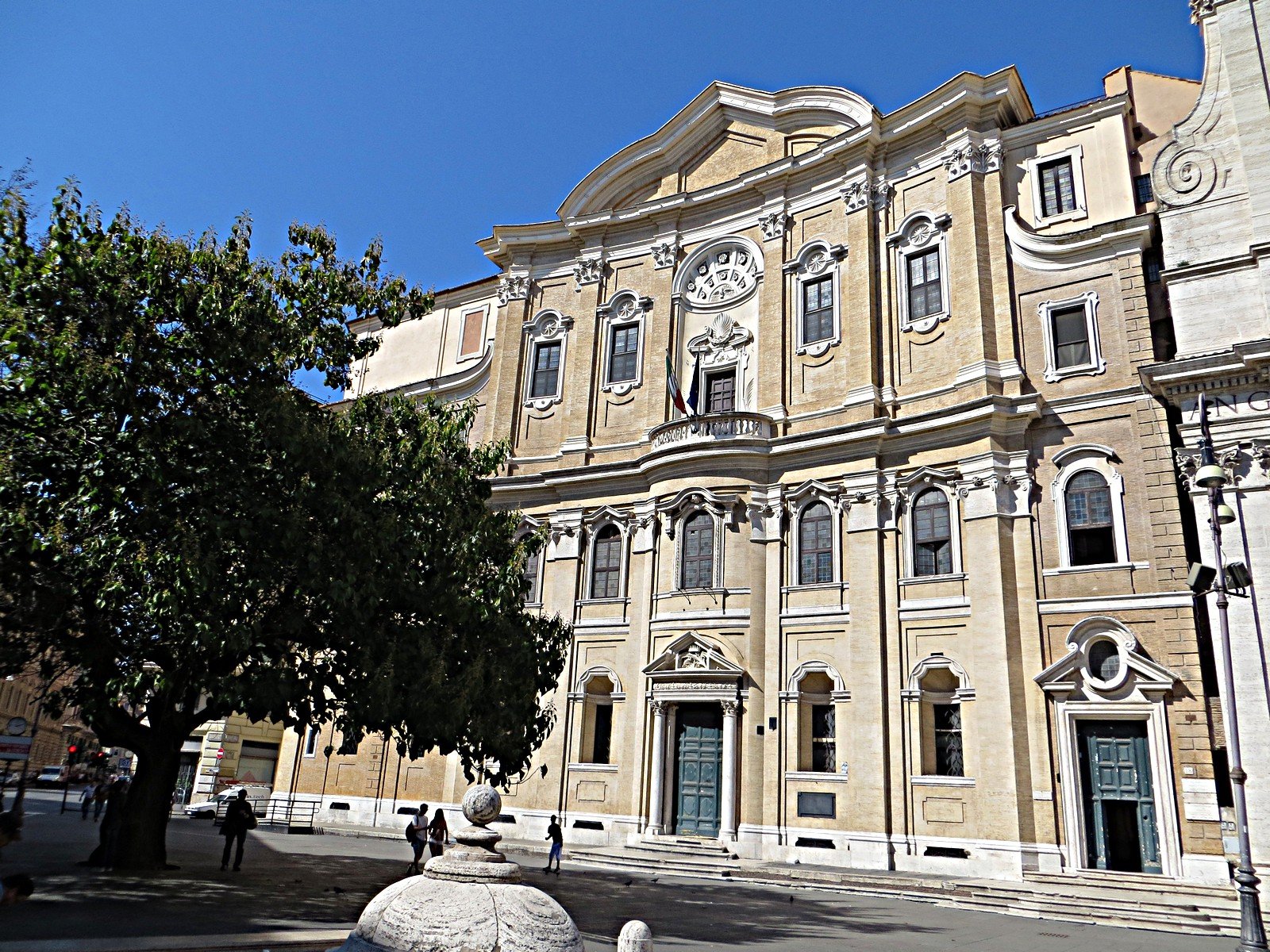
In short. The Biblioteca Vallicelliana is at piazza della Chiesa Nuova 18, 00186 Rome, right next to the facade of the church of Santa Maria in Vallicella, known to everyone as the Chiesa Nuova.
Frequently asked questions about the Biblioteca Vallicelliana
Where exactly is the Biblioteca Vallicelliana?
The Biblioteca Vallicelliana is at piazza della Chiesa Nuova 18, 00186 Rome, right next to the facade of the church of Santa Maria in Vallicella, known to everyone as the Chiesa Nuova. From piazza Navona it's only a five-minute walk along corso del Rinascimento or through the alleys that come out onto corso Vittorio Emanuele II.
How much does it cost to enter the Biblioteca Vallicelliana?
Access to the reading room and to the consultation of the materials of the Biblioteca Vallicelliana is generally free, as for most Italian state libraries. Any special conditions for visiting the Salone Borromini alone should be checked on the institute's official channels, because they can change over time.
Do you need a card to enter the Biblioteca Vallicelliana?
To consult materials in the reading room of the Biblioteca Vallicelliana you need to register with the library service. The library is not a single space that can be visited as a whole, but a system of spaces with different functions and access rules: the reading room on request after registration, and the Salone Borromini, open at specific hours.
What is the Salone Borromini of the Biblioteca Vallicelliana?
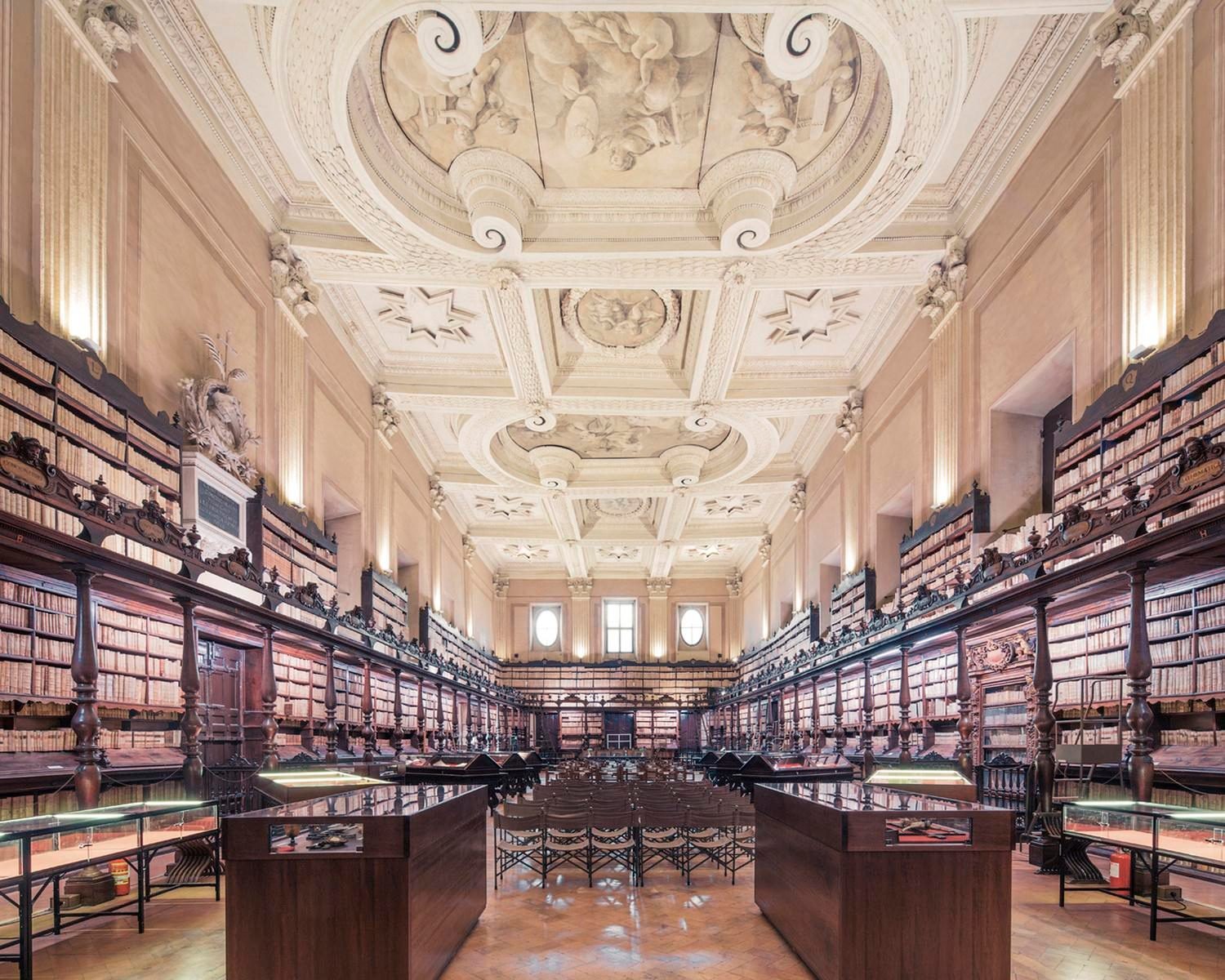
The Salone Borromini is the monumental rectangular space that Francesco Borromini designed to house the growing book collection of the Congregation of the Oratory. Work on the hall began in the 1630s and the hall was inaugurated in 1644, the visual heart of the whole Biblioteca Vallicelliana.
What kind of materials does the Biblioteca Vallicelliana hold?
The first substantial core of the Biblioteca Vallicelliana arrives in May 1581, when the humanist and philologist Achille Stazio leaves to Filippo Neri and the Congregation of the Oratory his personal collection, made up of about 1,700 printed works and 300 manuscripts, an enormous gift for the time that gave the collection its first real substance.
Since when has the Biblioteca Vallicelliana been a state institute?
The Biblioteca Vallicelliana occupies the historic spaces of the Congregation of the Oratory, founded by Saint Philip Neri and officially recognized by Pope Gregory XIII in 1575 with the bull Copiosus in misericordia. It became a state institute in 1874, after having been for centuries a point of reference for scholars, clergy and the learned.
When is it best to visit the Biblioteca Vallicelliana?
The best period to visit the Biblioteca Vallicelliana, above all if the aim is to see the Salone Borromini, is the part of the year when opening hours are most regular, typically in the months from September to June, when the reading room follows a broader and more stable calendar.
The Biblioteca Vallicelliana is on the second floor of the Oratory of the Filippini, the large baroque complex designed by Francesco Borromini next to the Chiesa Nuova, at piazza della Chiesa Nuova 18, in the heart of the Parione district, a step from the Ponte district and from the little streets leading to via dei Coronari and to piazza Navona. It's a state library, entrusted to the Ministry of Culture, and it remains one of the least crowded places in the historic center even though it is a few minutes' walk from corso Vittorio Emanuele II, from campo de' Fiori and from piazza Navona: anyone looking for a quiet and concrete corner in the middle of the area's tourist traffic finds it here, among ancient books and a hall that alone is worth the stop. If you're organizing a Roman stay spread over several days, alternating monumental stops with less-traveled corners like this one, you may find useful the planning offered by ItalyPlanner.com or the tailor-made itineraries put together by TourLeaderPro, two resources designed precisely to fit visits like this one efficiently into the rest of the program in Rome.
Where the Biblioteca Vallicelliana is and how you really get there
The exact address is piazza della Chiesa Nuova 18, 00186 Rome, right next to the facade of the church of Santa Maria in Vallicella, known to everyone as the Chiesa Nuova. Getting there on foot from the center is simple: from piazza Navona it's only five minutes walking along corso del Rinascimento or through the maze of alleys that comes out onto corso Vittorio Emanuele II, the artery the Filippini complex faces. From campo de' Fiori the distance is even less, a few minutes via vicolo del Gallo and via del Pellegrino. Anyone arriving instead from the area of the Pantheon, on the opposite side of corso Vittorio Emanuele II, can walk via del Governo Vecchio or the parallel little streets, a trip of a little over 10 minutes that crosses one of the most authentic stretches of the historic center, far from the main tourist flows. If you arrive by bus you can get off at the stops on corso Vittorio Emanuele II served by several lines crossing the historic center, while if you prefer the metro you need to allow for a longer walk: the nearest stations are in any case 15 or 20 minutes on foot, because in this part of Rome the metro network doesn't reach and the historic center is covered mostly on foot or by surface transport. For those on a bicycle or scooter, the pedestrian area around corso Vittorio Emanuele II and piazza della Chiesa Nuova makes arriving easy, with several bike-sharing stands nearby. There is no parking dedicated to the library: anyone arriving by car has to find their way among the limited traffic zones (ZTL) of the historic center, which cover almost the whole area around the Chiesa Nuova, and it's best to leave the vehicle in one of the paid parking lots outside the ZTL, then continue on foot. The district where the library stands, Parione, is one of the oldest in Rome, its name deriving from a large ancient building, perhaps a stadium or in any case an entertainment structure, that stood in this area in Roman times and of which archaeological traces remain at several points of the neighborhood, including the remains visible beneath piazza Navona. Walking from piazza della Chiesa Nuova toward the heart of Parione therefore means crossing a continuous urban layer that runs from Roman antiquity through the Renaissance to the baroque, without a break between one era and the next, a characteristic that makes this part of Rome particularly dense with historical stratification even a few steps from an apparently specialized institute like the library. The entrance to the library does not coincide with that of the church: you enter by a separate portal that leads into Borromini's courtyard and staircase, and it's good to arrive a few minutes early, because access requires showing a valid ID and, as in all state libraries, a minimum of procedure at the entrance.
What the Biblioteca Vallicelliana really is
The Biblioteca Vallicelliana is a public state library that occupies the historic spaces of the Congregation of the Oratory, the religious institution founded by Saint Philip Neri and officially recognized by Pope Gregory XIII in 1575 with the bull Copiosus in misericordia. The name Vallicelliana derives precisely from the church next door, Santa Maria in Vallicella, which Romans call the Chiesa Nuova because it was rebuilt from scratch in the 16th century over an older church. Today the library holds about 130,000 printed volumes and about 3,000 manuscripts in Latin and Greek, as well as incunabula, 16th-century editions and rare editions covering centuries of Italian and European publishing. Seen from outside, the library may look like an institute for specialists only, but in practice it welcomes a wider public than you might imagine: enthusiasts of art and architectural history interested in the Salone Borromini, university students grappling with bibliographic research, curious travelers looking for a concrete alternative to the crowded big museums of the historic center. It isn't a museum in the strict sense of the term, and not all spaces can always be visited freely: it is first of all an institute of conservation and consultation, with a reading room open to scholars and the interested public, and with the famous Salone Borromini which in the periods and at the hours set can be visited even just to admire its architecture. Part of the library's holdings also includes pieces of exceptional value, such as a 9th-century Bible that belonged to the scholar Alcuin and a 12th-century illuminated lectionary, testimonies that show how layered the history of this place is, grown by accumulation of successive donations more than by a single initial project. Understanding the Vallicelliana therefore means understanding two things together: a history of book collecting tied to the Filippini, and a masterpiece of baroque architecture signed by one of the most important names of the Roman 17th century.
One more point needs clearing up, since it often causes confusion: the library is not the same thing as the church next door, nor as the musical Oratory that gave rise, in these very spaces, to the genre of the oratorio as a form of sacred music. They are three institutions born from the same Congregation, often confused with one another by those visiting the area for the first time, but with distinct functions: the church is an active place of worship, the Oratory in the musical sense left a historical legacy tied to devotional practice with music and song, while the library remains an institute of conservation and study, open according to its own hours and its own access rules, independent of those of the church. Keeping them distinct helps organize the visit better and avoids arriving at a closed door thinking the same hours apply as for the church next door.
The Salone Borromini and the architecture of the complex
The visual heart of the library is the Salone Borromini, the monumental rectangular space that Francesco Borromini designed to house the Congregation's growing book collection. Work on the main hall began in the 1630s and the hall was inaugurated in 1644, but the story of its construction doesn't end there: the collection kept growing and the space soon proved insufficient, so that starting in October 1665 the architect Camillo Arcucci, a pupil and collaborator of Borromini, stepped in to enlarge and complete the space, which reached its current form in 1667. The result is an imposing hall, lit by 16 windows, with a coffered wooden ceiling covered in travertine-colored stucco and a two-tone terracotta floor that guides the eye along the whole length of the room. Originally the wooden shelves of the Salone held about 28,000 printed volumes datable between the 16th and 19th centuries, arranged in an order designed for direct consultation by the scholars of the Oratory. Borromini himself, together with the Oratorian father Virgilio Spada, documented the process of design and enlargement in a manuscript treatise published posthumously in 1725 under the title Opus Architectonicum, accompanied by 67 engraved plates that show in detail how the hall was conceived to integrate with the adjacent spaces, solving not-simple structural problems while the collection continued to grow. The Salone went through an important restoration between 2015 and 2016, which gave back full legibility to the stuccoes, the ceiling and the original floor, and today it remains one of the best-preserved baroque spaces in Rome dedicated exclusively to book conservation, a unicum that deserves to be told alongside the better-known Borrominian interiors of the city, such as that of Sant'Ivo alla Sapienza or of the nearby San Carlo alle Quattro Fontane.
It's worth placing the Salone of the Vallicelliana also within Borromini's professional career in Rome, to understand better why this space is considered so important by historians of architecture. In the same decades in which he was working on the Oratory of the Filippini, Borromini was also busy on other decisive building sites in the city, and precisely the comparison among these projects helps to understand his language: the attention to natural light calculated through openings studied in detail, the taste for complex geometries hidden behind apparently simple surfaces, and a use of decoration always subordinate to the architectural structure, never purely ornamental. The Salone of the Vallicelliana shares this logic: the 16 windows were not arranged randomly, but calculated to guarantee uniform illumination along the whole length of the hall, a fundamental technical requirement for a space intended for reading and book conservation, where direct light must be managed carefully so as not to damage the bindings and the old paper. It is a detail that tells well how, even in his apparently most functional projects, Borromini never separated aesthetics from the practicality of daily use of the space.
A curiosity about Biblioteca Vallicelliana
Few people know that the library's very name tells a small story within the story. Vallicelliana does not come from a founder's surname, as happens with so many other Roman libraries, but from the place name Vallicella, the small valley or depression in the ground where the old church dedicated to the Madonna once stood, later rebuilt and renamed Chiesa Nuova precisely to tell it apart from the earlier building. The library took its name from the church it has always remained physically and institutionally tied to, so much so that for centuries the two places, the church and the library, were run by the same Congregation of the Oratory. Another curious detail concerns the origin of the collection itself: the library was not born from a top-down plan, with a founder who decided to build a great public library, but grew through the spontaneous accumulation of private bequests, starting with that of Achille Stazio in 1581, followed over the next decades by other donations from cardinals, scholars and collectors who chose the Filippini as the ideal keepers of their own books. It's a mechanism typical of many Roman religious libraries of the 1600s, but at the Vallicelliana it has left particularly visible traces: leafing through the old catalogs, you still come across the ownership notes, ex libris and stamps of the original donors, a mosaic of provenances that makes every volume a small historical document in its own right, as well as a text to read.
A second, lesser-known curiosity concerns the relationship between the library and the topography of the area. The term Vallicella, from which the whole complex takes its name, was not just a poetic way of describing a dip in the ground: in medieval and Renaissance Rome the area now occupied by the Chiesa Nuova and the Oratory was actually lower than the surrounding areas, a difference in level that over the centuries was gradually filled in by later construction, until that original shape of the land that gave the place its name became almost imperceptible today. Anyone walking across Piazza della Chiesa Nuova today, with the ground perfectly flat between the church, the Oratory and the surrounding streets, can hardly imagine that the very name of the place tells of a geography that disappeared centuries ago, buried under layers of Baroque and later building.
Achille Stazio's Bequest and the Manuscripts in the Collection
The first truly substantial core of the library arrives in May 1581, when the humanist and philologist of Portuguese origin Achille Stazio leaves his personal collection, made up of about 1,700 printed works and 300 manuscripts, to Filippo Neri and the Congregation of the Oratory. It was an enormous gift for the time, and it is the document that allows scholars to date to that very year the first certain proof of the library's existence as a recognizable collection of books. Curiously, despite the instructions Stazio left in his will on how to preserve and arrange his collection, the volumes were not kept together as a separate collection: over the decades they ended up mixed with the library's other holdings, and only more recent studies have made it possible to reconstruct which pieces originally belonged to Stazio, identifying them by particular woodcut stamps showing the Madonna and Child, accompanied by the donor's initials and the Vallicelliana mark. The figure of Achille Stazio deserves a few more words to be truly understood. Born in Portugal and trained between Coimbra and Italy, Stazio moved to Rome, where he built a solid reputation as a philologist and editor of classical texts, working on Latin authors and producing critical editions that classical philologists still cite today. His closeness to Filippo Neri and the Oratorian community was no accident: Stazio shared with the Filippini a deep interest in the serious study of texts, both sacred and secular, and the choice to leave his personal library to the Congregation, rather than scatter it among private heirs or sell it, reflects precisely this cultural affinity, as well as a religious one. Around the Stazio core, other fundamental bequests were then added over the 1600s and beyond: the collection of Cardinal Cesare Baronio, Church historian and librarian of the Vallicelliana, which arrived in 1607. The book curiosities, and more than books, collected by Virgilio Spada in 1662. About 237 Greek and Latin manuscripts donated by the scholar Leone Allacci in 1669. And later still, the holdings of Giuseppe Bianchini in 1764 and of Ruggero Falzacappa in 1843. It is this stratification of successive gifts, one on top of the other like geological layers, that makes the Vallicelliana's manuscript collection so rich and so hard to describe in a few lines: each collection carries with it the biography and interests of the person who gathered it, from classical philology to Church history, from theology to the scholarly curiosity typical of Roman collectors of the 1600s.
Something Nobody Tells You About the Biblioteca Vallicelliana
Almost nobody, standing in front of the restored and perfectly preserved Salone Borromini, mentions that the library's original home was badly damaged by a fire in 1620, well before Borromini stepped in with his design. It was precisely the need to rebuild the spaces damaged by the fire, together with the continued growth of the book collection, that pushed the Congregation to commission a new, more ambitious room for the library, which then became the Salone we admire today. Put differently, one of the masterpieces of Roman Baroque architecture was born from a disaster too, not only from a positive plan, and this aspect rarely appears in the shorter descriptions of the place. There is also a second, little-told episode, linked to the French occupation of Rome between 1797 and 1799: in those years the library lost 49 rare pieces, taken or scattered in the chaos of the Napoleonic requisitions, and only partly recovered in the following years. A third element that surprises those who discover it concerns the library's legal transformation: until 1874 the Vallicelliana remained a library owned by the religious Congregation, not a state institution, and became a public library only after the laws suppressing religious corporations passed by the unified Italian State. In 1883 it even hosted the Società Romana di Storia Patria, thus becoming a reference point for historical research on the city as well, a role that kept alive a place founded centuries earlier with completely different aims, those of religious and cultural training within the Congregation of the Oratory.
It's worth adding that the passage from religious to state ownership was not an isolated event for the Vallicelliana, but part of a process that in those same years affected many other Italian church libraries, caught up in the laws suppressing religious bodies passed after the unification of Italy. What makes the Vallicelliana's case particularly interesting is that, unlike other collections that were scattered or moved elsewhere in the same period, the library stayed physically in its historic home, inside the Salone built expressly for it by Borromini, keeping intact that bond between content and container, which today is one of the most appreciated aspects for the visitors and scholars who use it.
Finally, there is a detail that directly concerns the Achille Stazio collection, and that is rarely told in full: despite the precise instructions left by the donor on keeping his collection as a single body, recognizable and separate from the other holdings, the librarians of later centuries did not respect this wish, and the volumes gradually ended up mixed with the rest of the collection. Only philological studies carried out centuries later made it possible to identify, one by one, the pieces that originally belonged to Stazio, thanks to a distinctive woodcut stamp. It's a rather concrete reminder of how even a donor's most explicit wishes can, over time, collide with the practical needs of a library that keeps growing.
My Advice for Visiting the Biblioteca Vallicelliana
One thing that often confuses first-time visitors is that the Vallicelliana is not a single space you can visit as a whole, but a system of spaces with different functions and access rules: the reading room, where materials are consulted on request after registering with the library service, the Salone Borromini, which is mainly of architectural value and is opened at specific times even to those who don't need to consult anything, and the offices and storage areas, which naturally remain reserved for staff. Knowing in advance which of these spaces you want to visit helps you understand what to ask the front office and avoid misunderstandings about what is actually included in a visit.
The most practical advice is to always check in advance, through the library's official channels or by calling the front office number, which days and hours apply for access to the Salone Borromini, because the opening hours of the monumental hall don't always match those of the reading room and can vary between the regular period and the summer period. The reading room generally keeps longer hours from Monday to Friday, with some days running into the evening, while access to the Salone for an architectural visit alone is often concentrated in a narrower window in the morning, and in certain periods requires a reservation. Anyone who only wants to see the Salone without consulting materials should therefore find out before showing up, and avoid arriving close to closing time or on a day when access is suspended for service reasons. A second piece of advice concerns documents: to get in you need to have a valid ID with you, which is asked for at the entrance and in some cases held during your stay in the reading room, so it's best to always carry an identity card or a valid passport, not just a photocopy. For those who need to consult a specific volume in advance, the library offers a materials reservation service by phone or email: by contacting the front office you can ask for a given volume or manuscript to be made available in the reading room before you arrive, a useful move especially for people coming from outside Rome with limited time, who can't afford to wait for the ordinary delivery times, which in most state libraries cover only the morning. Third piece of advice, perhaps the most useful for those coming from outside Rome: combine the visit to the Vallicelliana with a visit to the Chiesa Nuova next door, which is free to enter and has longer hours, so you can build a route that includes both the religious architecture of Santa Maria in Vallicella and the civil and library architecture of the Borromini complex, without having to come back to the same area another time. Finally, if you want to build a fuller day in the historic center around this visit, perhaps combining it with Piazza Navona, the Pantheon or Campo de' Fiori, you can save time by relying on tools designed for exactly this kind of planning, like the ones already mentioned.
The Chiesa Nuova and Rubens's Madonna della Vallicella
You can't talk about the Biblioteca Vallicelliana without spending a few lines on the church next to it that gives it its popular name, Santa Maria in Vallicella, that is, the Chiesa Nuova. It is the mother church of the Congregation of the Oratory founded by Filippo Neri, rebuilt starting in the second half of the 1500s on an earlier, smaller church, and it holds inside one of the masterpieces of Roman Baroque painting: the high altar altarpiece painted by Pieter Paul Rubens in the first decade of the 1600s. That altarpiece has a technical peculiarity described in more detail in the page dedicated to this masterpiece, the so-called motorized painting of Rubens: a mechanism lets the large painting be moved aside to reveal, hidden behind it, the miraculous image of the Madonna della Vallicella that tradition links directly to Filippo Neri and the origins of the Congregation. The link between church and library is not only physical, with the two buildings sharing the same architectural complex facing Corso Vittorio Emanuele II and Piazza della Chiesa Nuova, but also historical and institutional: both were born from the same religious community, grew over the same span of time and were in part designed by the same architects who worked for the Filippini during the 1600s. For visitors to the library, stepping into the church next door even for a few minutes helps in understanding the context in which the book collection was born and grew, a context made of preaching, sacred music, which found one of its most famous forms right here with the musical oratorio born in the Congregation's rooms, and study, three activities that the Filippini kept closely intertwined. The facade of the Chiesa Nuova, sober and in travertine, deliberately contrasts with the decorative richness of the interior, where you also find works by Pietro da Cortona on the vault and in the dome, besides the Rubens altarpiece already mentioned: a visual path that, moving from the outside of the church to the inside and then toward the library complex on the upper floor of the Oratory, clearly tells the passage from a public, devotional space to one more reserved for study and preservation.
The practice of evening gatherings with spiritual readings, interspersed with musical moments, that Filippo Neri promoted among his followers in the second half of the 1500s is considered by music historians one of the direct roots of the musical genre of the oratorio, which takes its name precisely from these meetings. It was not an isolated case but part of a broader educational method, in which reading, listening and the study of texts were interwoven every day, the same spirit that in the following decades fueled the growth of the book collection that flowed into the library. Understanding this continuity helps in reading the Salone Borromini not as a merely elegant container, but as the physical space where that culture of reading and communal study finally found a home suited to its size.
Another Well-Known Fact, Yet Rarely Mentioned
Many people know, at least by hearsay, that the Biblioteca Vallicelliana is one of the oldest historic libraries in Rome open to the public, but few stop to consider what this distinction really means in the city's daily practice. Before it became a state institution in 1874, the Vallicelliana had long been a reference point for scholars, clergy and learned men who could consult its collections with a generosity that was not a given for the time, in a historical moment when many Roman book collections remained reserved for narrow circles of specialists or members of an order. This early role of openness toward scholars outside the Congregation helped make the Vallicelliana an important node in the network of Roman church and civil libraries, together with other historic institutions of the city such as the Biblioteca Angelica and the Biblioteca Casanatense, both nearby and with histories that are in some ways parallel, also born from bequests and religious communities later absorbed into the state system. Another less-told aspect is that the Vallicelliana was never conceived as a library for preservation alone: from the beginning, the volumes donated by Stazio and the other benefactors were meant for active use by the members of the Congregation engaged in study and preaching, a practical use of knowledge that is still reflected today in the library's role as a place of research, not as a mere storehouse of rarities to admire from a distance behind a glass case.
The Right Photo to Take at the Biblioteca Vallicelliana
The most successful shot, when access to the Salone Borromini is allowed, is taken from the back of the hall looking upward and along the main axis: this way you capture together the perspective of the 16 windows that light the room, the rhythm of the wooden coffered ceiling with its travertine-colored stucco, and the two-tone terracotta floor that leads the eye to the end of the hall, with the old wooden shelves on either side. It's a framing that conveys the real scale of the room much better than a close-up of a single decorative detail. If the light permits, it is also worth trying a side shot, which highlights the sequence of windows and the way natural light enters the Salone, lighting the spines of the old volumes on the shelves, an effect that changes a lot depending on the time of day and the season. Outside the library, the facade of the Oratory of the Filippini on Corso Vittorio Emanuele II offers another interesting subject: the concave curve designed by Borromini works well in a photo taken from the opposite sidewalk, with a wide-angle lens or at least by stepping back enough to include the whole sweep of the facade, which is especially dramatic in the late afternoon when the raking light accentuates its play of light and shadow. If you carry a reflex camera or other serious photographic equipment, it's worth remembering to ask the library beforehand about any internal restrictions on photography, which in many state conservation institutions include specific rules to protect old materials, different from those that apply to purely architectural spaces like the Salone.
Some Important Events That Happened Here in History
The history of the Biblioteca Vallicelliana spans more than four and a half centuries of events interwoven with those of the Church and the city of Rome. It all starts with the founding of the Congregation of the Oratory, established by Filippo Neri around 1565 and officially recognized by Pope Gregory XIII in 1575 with the bull Copiosus in misericordia: when Filippo Neri dies, in 1595, his personal collection of books flows into the religious community he founded, laying the first, embryonic core of what will become the library. The moment scholars consider the true documented birth of the institution comes, however, in 1581, with the bequest of Achille Stazio. In 1607 comes the donation of Cardinal Cesare Baronio, Church historian and himself librarian of the Vallicelliana. In 1620 a fire badly damages the original home, forcing a reconstruction of the spaces. Between 1637 and 1652 Francesco Borromini works on the design of the new Salone, inaugurated in 1644 and then enlarged by Camillo Arcucci from October 1665 until it reaches its final form in 1667. In 1662 and 1669 come, respectively, the curiosities of Virgilio Spada and the about 237 Greek and Latin manuscripts donated by Leone Allacci. Between 1797 and 1799, during the French occupation of Rome, the library loses 49 rare pieces. In 1764 and 1843 come the holdings of Giuseppe Bianchini and Ruggero Falzacappa, respectively. In 1874, with the laws suppressing religious corporations of the unified Italian State, the Vallicelliana passes from ownership of the Congregation to that of the State, becoming a public state library. In 1883 it hosts the Società Romana di Storia Patria, and in 1725 the Opus Architectonicum by Borromini and Spada had been published, with the 67 plates documenting the construction of the Salone. More recently, between 2015 and 2016, the Salone Borromini underwent a major conservation restoration.
Put in sequence, these steps tell a precise trajectory: from the private collection of a religious community, grown through successive bequests over more than two centuries, to a public state institution open to historical and philological research, passing through an architectural chapter that made the library's very space a work of art in its own right. Few other Roman institutions let you read, in the same physical place, both the history of the book and the history of Baroque architecture with such direct continuity between the two.
Who Has Passed Through the Biblioteca Vallicelliana
Over the centuries the Biblioteca Vallicelliana has been frequented above all by scholars, clergy and learned men who enriched its holdings or made it their research base. Achille Stazio, humanist and philologist of Portuguese origin, remains the founding figure par excellence, the one whose 1581 bequest gave the collection its first real substance. Filippo Neri himself, even before Stazio, should be remembered as the starting point of the whole project: it was his preaching, his way of gathering laypeople and clergy around him for reading and common prayer, that created the cultural conditions in which a library like this could be born and grow, even though his personal collection, which passed to the Congregation after his death in 1595, was much smaller in size than the bequests that came later. Cardinal Cesare Baronio, among the greatest Church historians of his time and author of the Annales Ecclesiastici, not only donated his own library but also served as the institution's librarian, leaving a direct mark on how the holdings were organized in the first decades. The Greek scholar Leone Allacci, philologist and custodian of the Vatican Apostolic Library, enriched the Vallicelliana with hundreds of Greek and Latin manuscripts that are still one of its most precious cores today, the fruit of a career spent between Rome and the Greek Byzantine world, at a time when direct knowledge of Greek sources was still the preserve of very few specialists. Virgilio Spada, an Oratorian father and a key figure in the relations between the Congregation and Francesco Borromini, followed the design of the Salone closely and left a written account of it together with the architect himself. Francesco Borromini and, after him, Camillo Arcucci are naturally the two figures who gave physical shape to the rooms that now house the library, turning a practical problem of space into one of the most celebrated rooms of Roman Baroque architecture. The Oratorian father Virgilio Spada, already mentioned as the go-between for the Congregation and Borromini, must be considered, to all effects, a third protagonist of this architectural story: it was he who mediated between the practical requests of the religious community, tied to the continued growth of the book collection, and the architect's design vision, a connecting role that emerges clearly from the pages of the Opus Architectonicum, where Spada's voice and Borromini's intertwine in telling, plate after plate, the choices made to arrive at the final form of the Salone. During the 1800s and 1900s, with the library's opening to a wider public after the state takeover of 1874, the reading room welcomed generations of historians, philologists and researchers, among them the members of the Società Romana di Storia Patria housed in the institute from 1883, a chapter that shows how much the Vallicelliana has remained, over time, a concrete workplace for those who study the history of Rome, rather than a purely tourist stop.
Cardinal Giuseppe Bianchini and the collector Ruggero Falzacappa, authors of the bequests of 1764 and 1843 respectively, also deserve to be remembered among the figures who helped build, donation after donation, the library's present character. They are names less known to the general public than Borromini or Filippo Neri, but their material contribution, in terms of volumes and manuscripts added to the collection, was as decisive as that of the more famous figures: without this long chain of smaller bequests, spread over almost three centuries, the Vallicelliana would not have reached the size and variety that make it today such a precious archive for those who study the history of the book, classical philology or the history of the Church in Rome.
When to Go to the Biblioteca Vallicelliana and When to Avoid It
The best time to visit the Biblioteca Vallicelliana, especially if the goal is to see the Salone Borromini, is the part of the year when opening hours are most regular and relaxed, typically the months from September to June, when the reading room keeps a longer and steadier schedule, with some weekdays running into the evening. In the summer months, particularly between the second half of July and the end of August, the library instead adopts reduced hours, with days of full or partial closure to the public and limited library services, an arrangement typical of many Roman state institutions during the period of lowest academic attendance. Anyone planning a visit in this period should therefore check the updated calendar with particular care before leaving, to avoid finding closed doors precisely on the days of the summer break. In terms of crowds, the Vallicelliana remains a far less visited place than the big museums of the historic center, so the problem is not so much a crush of people as the actual availability of the spaces at the right hours and on the right days. It should also be considered that, unlike a museum, the library follows a calendar designed first of all for the scholars who use it regularly, not for the city's seasonal tourist flow: this means that in the high season of Roman tourism, such as late spring or the middle months of summer, you shouldn't expect schedule changes designed for occasional visitors, while in the full academic periods, typically between October and May, the reading room is busier with researchers and university students working on theses or specific studies, a different public from the one you meet in the city's big museums. The morning, when natural light enters most clearly from the Salone's 16 windows, remains the best moment for both the visit and photography, while in the late afternoon, if the Salone is still accessible according to the day's hours, the raking light gives a different, warmer atmosphere, especially evocative on the two-tone terracotta floor.
One further element to consider concerns extraordinary closures, which in state conservation institutions can occur for maintenance work, restoration of individual rooms or internal service needs, often announced at short notice on the official channels. For this reason, especially if the visit is part of a tight itinerary, it's always best to have a backup plan in the same area, for example by using the time planned for the Chiesa Nuova or a walk toward Piazza Navona, so as not to be left with a hole in the day's program in case the Salone turns out to be exceptionally closed.
What's Around the Biblioteca Vallicelliana
The library's position, right in the heart of the historic center between Parione and Ponte, makes it a convenient starting point for exploring on foot one of the densest areas of history in Rome. Next door, as already described, is the Chiesa Nuova with Rubens's altarpiece and the mechanism that hides the Madonna della Vallicella. Continuing toward Corso del Rinascimento you reach in a few minutes Piazza Navona, with its Baroque fountains and, underground, the remains of the Stadium of Domitian, which can be visited on a dedicated archaeological route. Also in Piazza Navona area is the Church of San Luigi dei Francesi, famous for Caravaggio's cycle of paintings in the Contarelli Chapel. On the other side, toward Corso Vittorio Emanuele II in the direction of the Tiber, you come to Castel Sant'Angelo, while moving toward Via del Governo Vecchio and Via dei Banchi Nuovi you cross one of the most authentic neighborhoods of the historic center, with artisan workshops and Renaissance palaces that see few tourists. In the opposite direction, toward Largo di Torre Argentina, you find the Pantheon and, a little further on, other important historic Roman libraries such as the Biblioteca Casanatense at Santa Maria sopra Minerva and the Biblioteca Angelica near Piazza Sant'Agostino, both useful stops for those who want to build an itinerary dedicated to the city's great historic libraries, also including the National Central Library of Rome for comparison with an institution founded much more recently. To the south, a few minutes on foot, you also reach Campo de' Fiori, with its morning market and the statue of Giordano Bruno, another symbolic place of the Roman historic center that rounds out a day devoted to this part of the city.
For those with more time, the same area also offers lesser-known ideas: the narrow streets between Via dei Coronari and Via del Banco di Santo Spirito keep an urban fabric that has stayed almost intact since the Renaissance, with antique dealers and small workshops that rarely appear in the most beaten tourist itineraries. Crossing the Tiber on Ponte Sant'Angelo, a few minutes from the library, you enter the Borgo area at the foot of St. Peter's, a natural extension of the walk for those who want to continue the day toward the Vatican without having to use public transport. Those who prefer to stay in the heart of the historic center can instead head back up toward Via del Corso via Via della Scrofa, passing along the way other lesser-known glimpses of the Parione district and the neighboring Sant'Eustachio district, a way to lengthen the walk without ever really leaving the oldest core of the city.
Quick Questions About the Biblioteca Vallicelliana
How much does it cost to enter the Biblioteca Vallicelliana? Access to the reading room and to consulting materials is generally free, as in most Italian state libraries, while any special conditions for visiting the Salone Borromini alone should be checked on the institute's official channels, because they can change over time. Do I need to book? For the reading room alone a reservation is not always necessary, but for access to the Salone Borromini at certain times a reservation may be required, so it's best to ask beforehand by phone or email. What age can you enter? Access is allowed to Italian and foreign citizens who are 16 or older and carry a valid ID. Is the library accessible to people with mobility difficulties? The building has no direct street-level access, but there is an internal elevator that can be used on request by contacting the front office at the dedicated number, and a stairlift has also been introduced to make entry easier still. Can you take photos inside? For architectural spaces like the Salone there are generally no major restrictions, but specific protection rules apply to the library materials and manuscripts kept there, to be checked directly on site. How much time do you need for the visit? For the Salone Borromini alone, 20 or 30 minutes at an easy pace is generally enough, while those who stay to consult materials in the reading room can of course remain all day, according to the opening hours. Is it suitable for a visit with children? It's a place designed above all for scholars and fans of architecture or the history of the book, so it's not the most suitable stop for a family with small children, who will probably find nearby Piazza Navona or the open spaces of the historic center around the library more interesting.
Can the manuscript catalog be consulted online? Many Italian state institutions, the Vallicelliana among them, have gradually digitized part of their catalogs and, in some cases, individual manuscripts of particular value, making them available through the national portals dedicated to bibliographic heritage. For a specific search on a collection or a manuscript, though, it's best to contact the library's front office directly, which can tell you the updated digitization status of the material you're interested in. Are there events or guided tours organized periodically? On national days dedicated to cultural heritage, such as the special openings coordinated by the Ministry of Culture, the Vallicelliana has sometimes taken part with additional openings or guided routes in the Salone Borromini. Here too, the most reliable channel for finding out if similar initiatives are planned remains the institute's official website. Does the library have an external lending service? As with most state conservation libraries, the oldest and most precious material does not leave the premises, while for more recent volumes there may be specific interlibrary loan conditions, to be checked case by case with the staff.
Contact Information
Via della Chiesa Nuova, 18
Roma Roma Città, Roma Città