The Madonna della Vallicella – Rubens’ Motorized Painting
In short. The church of Santa Maria in Vallicella, which Romans have always called Chiesa Nuova, faces Piazza della Chiesa Nuova, on the north side of Corso Vittorio Emanuele II, in the rione Parione.
The church of Santa Maria in Vallicella, which Romans have always called Chiesa Nuova, faces Piazza della Chiesa Nuova, on the north side of Corso Vittorio Emanuele II, in the rione Parione. The house of the Congregation of the Oratory, which runs it, has its entrance at Via della Chiesa Nuova 3. Entry to the church is free and there is no ticket, no booking and no cloakroom. The hours published by the Filippini fathers are these: on weekdays the church is open from 7:30 to 12:00 and from 17:00 to 19:45, on holidays from 8:00 to 12:00 and from 17:00 to 20:00. Weekday Masses are at 8:00 and 19:00, holiday and solemnity Masses at 10:00 and 19:00, and for confessions you ask in the sacristy. The metro does not reach this stretch of the historic center: you get off the buses that run along Corso Vittorio Emanuele II, Chiesa Nuova stop, or you walk from Piazza Navona in four minutes and from Campo de' Fiori in five. The precise calendar on which the mechanism that uncovers the icon is operated is not published on the parish website: you ask in the sacristy, or you pick a solemn celebration, which is the moment when Rubens' machine traditionally goes into action.
If you want to build a whole day in the rione, the starting point is the page of the tourist attractions of Rome. From here on we only talk about what you see inside the Chiesa Nuova, and above all about the 17th-century device that makes this high altar different from any other high altar in Rome.

What Rubens' Motorized Painting Really Is
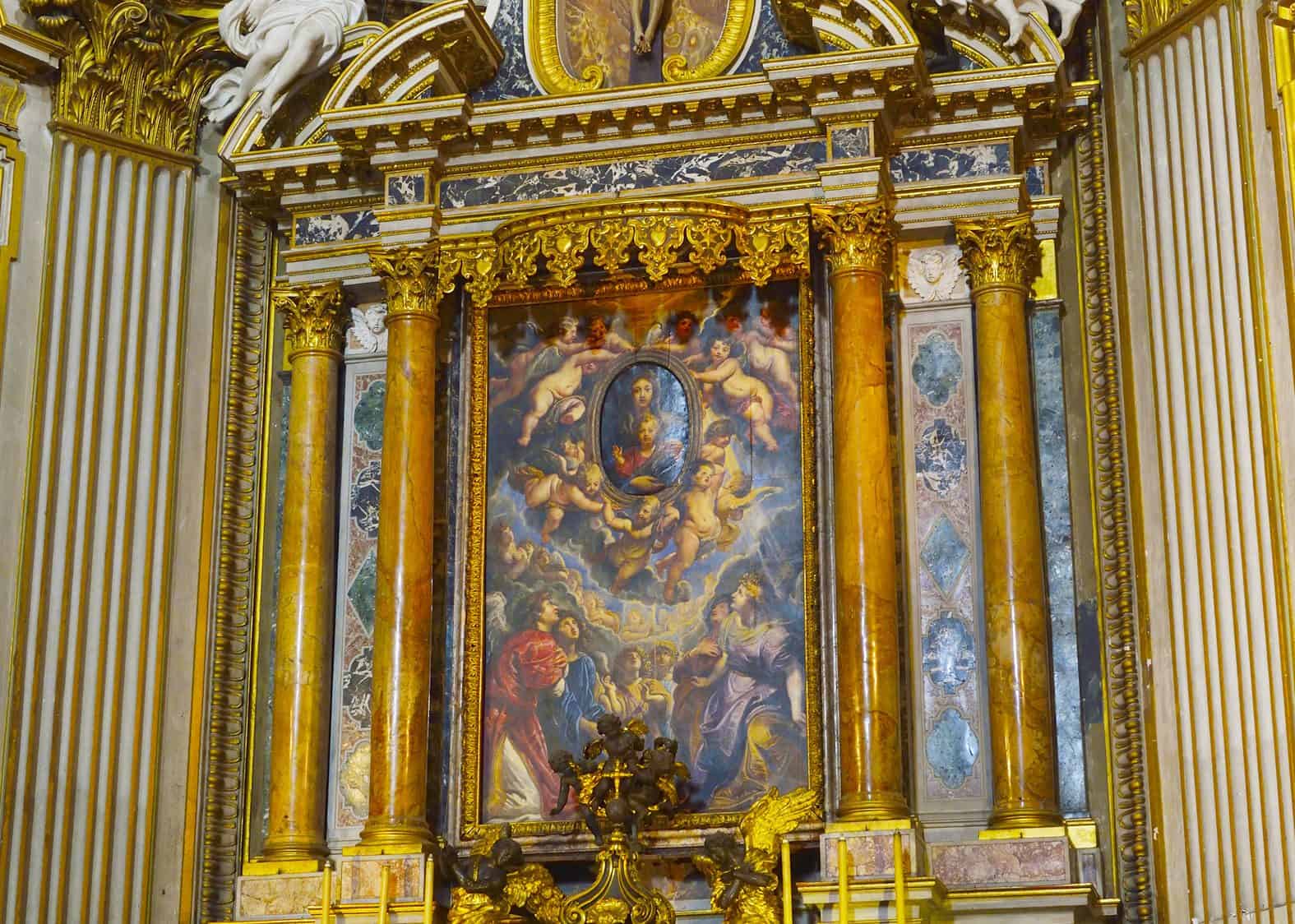
On the high altar of the Chiesa Nuova there is a large altarpiece, 4.25 by 2.50 meters, painted in oil on slabs of slate. It shows concentric circles of angels and cherubs adoring, turning around an oval empty center. That emptiness is not empty: it is occupied by a copper plate, also painted by Pieter Paul Rubens, with a Madonna and blessing Child. The copper plate is movable. A system of ropes and pulleys, operated from the space behind the altar, lifts it. And when the plate rises, another Madonna appears underneath, much older, much stiffer, much smaller: the 14th-century icon of the Madonna della Vallicella, the one the faithful have been coming to pray to for five centuries.
Here is the point that almost all guides dispatch in a line and that deserves to be properly understood. Rubens did not paint a frame around a sacred image. He designed a device. He himself painted the copy that hides the original, so that the faithful would still see a Madonna even with the machine closed, and he made the copy rise to reveal the original at set moments. It is a direction of vision, built in 1608 with the technology available: wood, metal, hemp, counterweights. The Roman 17th century called these inventions machines, and used them for catafalques, for the 40 Hours' Devotion, for ephemeral theaters. This is the only one that has remained set into a high altar, working, in its original place.
The Machine: Copper, Ropes, Pulleys
The principle is elementary and for exactly that reason it has lasted four centuries. The copper plate slides vertically inside a guide cut into the structure of the altarpiece frame. The ropes pass over pulleys placed high up, behind the altarpiece, and come down into the service space behind the altar, where whoever operates it pulls and the plate rises. No electric motor, no automation: the term motorized painting is a modern name, convenient and misleading at the same time, because the driving force is a human arm. Anyone who calls it a Baroque machine is closer to the truth.
A clarification worth making in front of the altar, because it avoids a common misunderstanding: the copper plate is not a neutral covering, a simple shutter. It is an autonomous work by Rubens, and if it were detached and hung alone in a picture gallery people would stop to look at it. Its function as a veil is the reason it is ignored: nobody looks at the lid when waiting for the box to open. The advice is to give it at least three minutes before someone lifts it.
The Slate, or Why the First Version Was Rejected
There is a technical detail that explains Rubens' character by itself, namely his ability to redo everything from scratch when the result doesn't work. The first version of the altarpiece was painted on canvas. It was mounted on the altar and did not convince: the natural light entering the presbytery produced reflections on that support that made the painting unreadable from some points of the nave. The patrons did not accept it. Rubens did not argue: he started over, and chose slate, an opaque schistose stone that absorbs light instead of sending it back, and that let him see the altarpiece legible from every pew.
The change of support is not a stopgap, it is a choice of optical engineering. Slate weighs far more than canvas, requires a sturdy supporting frame, is harder to work, and forgives no second thoughts. Rubens accepted all these drawbacks to eliminate the glare. It is the kind of decision that distinguishes a workshop painter from an artist who thinks about the environment in which the work will live. The first rejected canvas left the church and never returned to the altar.
The Icon Under Rubens' Motorized Painting: The Madonna della Vallicella
What the device reveals is a 14th-century fresco, detached from the wall and transported, of very small dimensions compared with the machine that guards it. Iconographically it belongs to a Byzantine type: the Madonna is frontal, hieratic, with the Child at the center of the chest, following the scheme scholars call Nicopeia, the bearer of victory, or Kyriotissa, the Lady enthroned. Two angels accompany her. It is painting of Greek tradition filtered through the Roman taste of the 14th century, and the effect, next to the rosy flesh of Rubens' cherubs, is of a gap of three centuries concentrated in one square meter.
A Wall Image Turned Relic
The fresco was not born for an altar. It stood in the old church of the Vallicella, a modest medieval building, in an outside service space that the Congregation's sources call the stufa, that is, a public bath room. It was not a major cult image: it was a Madonna painted on a wall, in an ordinary place. Its promotion to miraculous image comes from an episode that should be told with due distinctions.
The Stone and the Blood: Documented, Tradition, Hypothesis
The Oratorian tradition, and on this the Congregation's sources agree, places the attack on the image in 1535: a man hurled a stone at the fresco and, the tradition tells, the Madonna bled. From that moment the image became an object of popular devotion. Here three levels must be separated. It is documented that the fresco was detached from the wall in 1574 and preserved. It is documented that in 1608 it was placed on the high altar of the new church inside Rubens' machine. The episode of the blood is tradition, not an established fact. And any naturalistic explanation of the phenomenon is a modern hypothesis. Whoever tells you the blood as a matter of record is selling you a devotion dressed up as history.
It is worth adding something that changes the perspective. Filippo Neri did not build the machine to show off a miracle. He built it to solve a practical and theological problem at once: a small, ancient devotional icon doesn't hold up visually in a Baroque presbytery 15 meters high, and at the same time it can neither be enlarged nor replaced. The solution was to surround it with a monumental apparatus and show it only at the high moments. The veil increases the value of what it covers: it is the same logic as the 40 Hours' Devotion and of relics enclosed in reliquaries.
From Wall to Altar: 1574, 1575, 1608
The three dates to keep in mind are these. In 1574 the fresco is detached. In 1575 Pope Gregory XIII officially recognizes the Congregation of the Oratory, with the bull of July 15, and entrusts it with the church of the Vallicella. From there starts the decision to demolish the medieval building and build a new one, which is the reason for the nickname Chiesa Nuova, which has stayed even after the church has reached four and a half centuries. In 1608 the icon goes up on the high altar, inside the apparatus just finished by Rubens. 34 years between the detachment and the final placement: haste, on this construction site, was never a virtue.

Rubens in Rome in the Years of the Motorized Painting
Who Pieter Paul Rubens Was When He Arrived at the Vallicella
In 1606 Rubens is 29 years old and is not yet the giant we know. He is a Flemish painter in the service of the Gonzaga of Mantua, in Italy since 1600, who has already worked in Genoa and who in Rome is looking for the commission capable of imposing his name. He has studied the Venetians, copied the ancients, seen Caravaggio. The altarpiece of the Chiesa Nuova is his second public Roman commission, and he takes it on knowing that the busiest presbytery of Oratorian Rome offers him a showcase no private palace can give him.
The patron is Monsignor Jacopo Serra, a Genoese, a curia man tied to the circles of the Congregation. The construction site lasts from 1606 to 1608. In those two years Rubens paints the first version, sees it rejected, repaints everything on slate and designs the mechanism. Then he leaves Italy: in the autumn of 1608 news of his mother's illness calls him back to Flanders, and he will never return. The paintings of the Chiesa Nuova are the only works executed by Rubens in Rome that have remained in their original location. All the rest of his Italian production is in museums, in collections, elsewhere.
The Commission and the Timing of the Work
It is worth understanding why the Filippini fathers rejected the first canvas. It was not a whim of taste. The Congregation of the Oratory had built its pastoral work on visibility: understandable sermons, sung music, readable images. An altarpiece that in the afternoon light became a dirty mirror failed exactly on the point that mattered to them. The rejection, read this way, is an act consistent with the identity of the house. And Rubens' response, redoing everything instead of negotiating, says how much he cared about staying on that altar.
The Two Side Panels on Slate
The central altarpiece is not alone. On the walls of the presbytery Rubens painted, again on slabs of slate, two side panels that complete a widened triptych: on the left Saints Gregory the Great, Papias and Maurus, on the right Saints Flavia Domitilla, Nereus and Achilleus. The choice of figures is not decorative: the Chiesa Nuova holds the relics of those saints, and the panels serve to declare it. Cesare Baronio, the great historian of the Church who lived in this house, had devoted research precisely to the martyrs Nereus and Achilleus, and the link between his scholarly investigations and the iconographic choice of the presbytery is one of the reasons this altar is a cultural document as well as a work of art.
Rubens spaced the two side panels away from the central panel instead of locking them into a single frame. The figures of the saints look toward the center, and the gaze of Gregory the Great and that of Domitilla converge on the ancient icon. The whole presbytery thus becomes a single device: the walls point, the central altarpiece guards, the machine reveals. Critics have proposed that the idea of spacing the panels came to him from the analogous solution adopted a few years earlier by Annibale Carracci in the Salviati chapel in San Gregorio al Celio. It is a scholarly hypothesis, plausible and debated, not a fact documented by the papers.
One last observation on the central panel, which is the one visitors look at least because they are waiting for the mechanism. The painted space seems to break through the frame: the cherubs come out of the edges, the clouds don't stop where the slate ends. That way of making fiction spill over the physical limit of the work will become, 40 years later, the grammar of great Roman Baroque decoration. Here, in 1608, it is still an anticipation.
A Curiosity About The Madonna della Vallicella - Rubens' Motorized Painting
The real curiosity is not that the painting opens. It is that Rubens painted two Madonnas for the same point in space, and that one of the two was conceived from the start to be seen little. Think about it: a 29-year-old painter, staking his Roman reputation on this commission, agrees to sign a work destined to disappear every time someone pulls a rope. It is like asking a tenor to sing the best aria with the curtain closed.
There is more, and it concerns the optical construction. The copper plate is oval, and its format is not accidental: the oval is the shape that best joins the concentric circles of angels painted around it. When the plate is in position, the eye reads a unified, centripetal, perfectly Baroque composition. When the plate rises, the geometry breaks: at the center appears an ancient rectangle, flat, gilded, with a frontal figure that takes no part in the general movement. Rubens built a machine that produces two incompatible images in the same spot, and made sure that the second, the poorer visually, was the more powerful devotionally. It is an extremely sophisticated intellectual operation, and the sophistication consists precisely in accepting to lose on the aesthetic level in order to win on the religious one.
I add the detail almost nobody tells: the copper. Why copper for the movable plate and slate for the fixed altarpiece? Because copper is light, and a plate that must go up and down thousands of times cannot weigh like a stone. The support was chosen according to the movement. In the 17th century copper was the support of precious little collectible paintings, appreciated for the brilliance of the painted enamel. Here it is used for a mechanical reason. This is the best part of the story: a masterpiece born from a weight calculation.
Something Nobody Tells You About The Madonna della Vallicella - Rubens' Motorized Painting
Nobody tells you that you can go there 10 times and never see the mechanism work. On the parish website there is no published calendar of the unveilings. The machine is operated at the most solemn celebrations and at moments decided by the Oratorian community, not at a fixed time like a museum show. The practical consequence is that the tourist who walks in at random at four on a Tuesday afternoon sees the copper plate closed, looks up, thinks they have understood, and leaves without knowing they have missed the whole reason they came in.
There is only one way not to get it wrong, and it requires no booking: go into the sacristy and ask. The sacristy of the Chiesa Nuova is open during the church's opening hours and the fathers answer willingly. Ask when the next unveiling of the icon is scheduled. If there is nothing in sight during the days of your stay in Rome, at least you will know you saw the altarpiece in its closed configuration, which is still a Rubens.
The second thing nobody says concerns the lighting. The presbytery is high and the altarpiece is far from the pews. On overcast days and in the evening hours the details of the slate get lost, and the copper reflects the little it receives. Anyone wanting to really read the painting must come in the morning, with the sun coming through the high windows, and move up to the balustrade. The third thing, said even less: the Chiesa Nuova is not a museum and during services you don't wander through the chapels. If you arrive at 19:00 sharp you find the Mass, and the visit is reduced to a prayer at the back of the nave. It's not a defect, it's the nature of the place.
The Chiesa Nuova Around Rubens' Motorized Painting: The Chapel-by-Chapel Visit
It would be a mistake to walk in, look at the high altar and leave. The Chiesa Nuova is one of the best decorated Roman churches of the 17th century, and the full tour takes a good 40 minutes. Here is the round, in the order it's best done.
The Facade and the History of the Work
Outside, before going in. The travertine facade was designed by Fausto Rughesi. Work began in 1594, was interrupted between 1598 and 1603 and ended in 1605. The staircase in front was completed in 1614. It is a two-order facade, sober, that in no way anticipates the richness of the interior, and this discrepancy is deliberate: Oratorian austerity outside, painted glory inside.
The construction of the church had begun much earlier. The initial commission went to Matteo da Città di Castello. The first Mass in the new hall was celebrated in 1577, with a single nave and four chapels per side. In 1586 Martino Longhi the Elder took over, under the patronage of Cardinal Pierdonato Cesi, and in 1591 the semicircular apse, the transept and the dome were inaugurated. The consecration came in 1599, four years after the death of Filippo Neri.
The Right Aisle of the Chiesa Nuova
Entering, the first chapel on the right holds a Crucifixion by Scipione Pulzone, a painter from Gaeta of the devout late-16th-century manner, with a vault fresco by Giovanni Lanfranco. The second chapel is the one that makes art historians' hearts beat: here stood Caravaggio's Entombment of Christ, painted in 1602. It was carried off by the French in 1797 and in its place today is a copy by Michele Koeck. The original is in the Vatican Museums, in the Pinacoteca. Look at the copy knowing that the light you see is an echo: in front of the original, the hand of Nicodemus holding Christ's legs comes out of the painting toward you, and no copy manages to give it back.
The third chapel houses an Ascension by Girolamo Muziano, from Brescia and transplanted to Rome, the fourth a Pentecost by Giovanni Maria Morandi and the fifth an Assumption by Giovanni Domenico Cerrini. These are names that mean nothing to the general public and that instead tell of the taste of a religious house that commissioned solid, controlled, understandable painters: exactly the opposite of the Caravaggio they had nonetheless welcomed.
The Transept and the Spada Chapel
In the transept you meet a Coronation of the Virgin by Giuseppe Cesari, the Cavalier d'Arpino, who was the nominal master of the young Caravaggio and who for decades represented official Roman taste. On the right side of the presbytery the chapel of the Spada family, completed in 1593 and reworked later by Carlo Rainaldi, keeps a Madonna and Child with Saints Charles Borromeo and Ignatius of Loyola by Carlo Maratta, dated 1675. Maratta is the last great Roman classicist: his clear, composed painting marks the end of the season that Pietro da Cortona had opened.
The Presbytery with Rubens' Motorized Painting
The presbytery is the chapter we have already told: the altarpiece on slate with the circles of angels, the oval copper plate that lifts, the 14th-century icon underneath, the two side panels with the saints. Stop here for as long as needed. First look at the central altarpiece from afar, from the back of the nave, to understand how Rubens calibrated the composition for that distance. Then move up to the balustrade and look for the faces of the cherubs in the outer circles, which are the part where the Flemish brushwork is best recognized. Finally turn toward the walls and read the two side panels as a discourse: those saints have their relics a few meters away.
The Chapel of San Filippo Neri
To the left of the choir opens the chapel that holds the body of the founder. It was built between 1600 and 1606 at the expense of Neri Del Nero to a design by Onorio Longhi, and clad in marbles, alabasters, jasper, mother-of-pearl, lapis lazuli, coral, onyx, agate and amethyst: a list of materials worth reading aloud in front of the walls, because it conveys what celebrating a saint meant in the Rome of the early 1600s. The small dome with lantern is the work of Pietro da Cortona, from 1650. The canvases with episodes from the saint's life are by Cristoforo Roncalli, painted between 1596 and 1599. The altarpiece by Guido Reni with the Virgin appearing to Saint Philip was replaced by a mosaic by Vincenzo Castellani, executed between 1765 and 1774. Under the altar, an urn with the saint's body, the face covered by a silver mask. The remains have been venerated here since 1602.
The Left Aisle and Barocci's Visitation
Going up the left aisle, the fourth chapel keeps the Visitation by Federico Barocci, commissioned in 1582 and arriving in Rome in 1586. This painting has a story that touches directly the spirituality of the house: Filippo Neri loved to stop and pray in front of this canvas, and Oratorian tradition tells of him rapt in ecstasy right here. Barocci, from Urbino, paints with a sweetness of pinkish, shimmering colors that in Rome sounded exotic, and the scene of the Visitation is built as a domestic meeting, with the basket and the hen in the foreground: painting of affections, not of theology. In the left transept, the Presentation chapel houses another altarpiece by Barocci, the Presentation of Mary at the Temple, from 1603, with vault frescoes by Alessandro Salucci from 1635.
The Vault, the Dome and the Apse by Pietro da Cortona
Raise your head. The entire fresco decoration of the vault, the dome, the pendentives and the apse is by Pietro da Cortona, and takes almost 20 years: from 1647 to 1666. In the dome the Triumph of the Trinity, painted between 1647 and 1651. In the pendentives the four prophets Isaiah, Jeremiah, Daniel and Ezekiel, executed in two stages between 1655 and 1660. In the apse the Assumption of the Virgin. In the nave vault the Miracle of the Madonna della Vallicella, from 1664, which tells exactly the episode of the wounded image and takes up from above the theme of the high altar. In 1650 Cortona added a lantern and a small dome to improve the lighting of the interior: an architect's intervention, not a painter's. The white and gilded stuccoes framing the frescoes are by Cosimo Fancelli and Ercole Ferrata, two of the best collaborators of Bernini's Rome.
The Sacristy
The sacristy, begun in 1621 to a design by Mario Arconio and completed by Paolo Maruscelli in 1629, is a space many visitors do not see and that is worth asking to cross. It contains a marble sculptural group with Saint Philip and an angel by Alessandro Algardi, and a ceiling frescoed by Pietro da Cortona with angels carrying the instruments of the Passion, from 1633. Wall frescoes are attributed to Francesco Trevisani and Giovanni Domenico Cerrini.

My Advice for Visiting The Madonna della Vallicella - Rubens' Motorized Painting
The main piece of advice is to go twice, and it's not an affectation. Make the first visit early in the morning, around 8:30, when the church has just opened and the light comes in from the high windows of the transept: it is the only moment of the day when the slate of the presbytery can really be read, because that opaque stone needs abundant natural light to give back its colors. At that hour there are five or six people in the church, no groups, and you can move up to the balustrade without disturbing anyone.
Plan the second visit around a solemn celebration, because it is at the solemnities that the device goes into action. Before scheduling it, stop by the sacristy during opening hours and ask the date of the next unveiling: it's the only information that matters and you won't find it written anywhere. Bring 30 minutes of margin and sit in the first pews of the central nave, aligned with the axis of the altar: if you're to the side, you sense the opening of the plate but don't see it.
Second piece of advice, a technical one. Bring a small pair of binoculars, the opera-glass kind. It's the most useful suggestion of the whole visit. The presbytery is high, the faces of Rubens' cherubs are eight meters from you, and with the naked eye you lose them. With four-power binoculars you see the brushwork, the touches of lead white on the foreheads, the way the Fleming treats flesh. The same binoculars will serve for Pietro da Cortona's frescoes in the dome, which otherwise remain a blur of color.
Third piece of advice, about time. Don't put the Chiesa Nuova at the tail end of a Vatican morning. You'll arrive tired, saturated, and this church asks for slow attention. Better to pair it with a short walk in the rione: Piazza Navona is four minutes away, Campo de' Fiori five, and in front of the church, on the Corso, there is the Fontana della Terrina, which Romans call that for reasons that deserve a two-minute stop. One last sharp opinion, and not everyone will like it: if you have to choose between the Chiesa Nuova and one of the most photographed churches of the center, choose this one. The others you have already seen a thousand times in photographs. Here there is a machine no photograph can explain.
Another Well-Known Fact, Yet Rarely Cited
Everyone knows the Chiesa Nuova is the church of Saint Philip Neri. Almost nobody connects this building to the birth of a musical genre now performed in theaters all over the world. Yet it is here, in the rooms of the Congregation of the Oratory, that the practice of laude sung in several voices during prayer meetings takes shape. From those informal gatherings, in which Filippo Neri inserted musical interludes to keep the boys' attention alive, derives the very name of the genre we call oratorio. It is not a lexical coincidence: the musical genre is called that because it was born in the oratory, that is, in the prayer hall of the Filippini.
The rest of the story is architectural. Next to the church, between 1637 and 1667, the Congregation had its own house built to a design by Francesco Borromini: the Oratorio dei Filippini, with that concave brick facade that anyone passing through Piazza della Chiesa Nuova sees and few know how to read. Borromini used bricks of two colors and two different thicknesses, straw yellow in the center with very thin joints of two or three millimeters, pinkish at the sides with joints of about a centimeter: a masonry virtuosity you can only appreciate by getting within a meter of the wall. Do it, it's worth the 30 seconds it costs.
Inside that building, in 1600, the Rappresentatione di anima et corpo by Emilio de' Cavalieri was performed, one of the first works in the history of Western music to be entirely sung and staged. The hall then went through secular vicissitudes: requisitioned by the State in 1870, home to law courts for 30 years, from 1922 home of the Archivio Storico Capitolino, from 1924 of the Istituto Storico Italiano per il Medio Evo, from 2000 of the Casa delle Letterature. The Biblioteca Vallicelliana, founded on the fathers' books, is still there. Anyone who looks at the Chiesa Nuova seeing only a church loses half the complex: this is a cultural block that has worked without interruption since the 16th century.
The Right Photo to Take of the Madonna della Vallicella - Rubens' Motorized Painting
The most common photograph of this altar is also the most useless: the tourist stands at the back of the nave, frames the whole presbytery from floor to dome and takes home a golden rectangle in which Rubens' altarpiece takes up five percent of the frame. It tells nothing. The machine isn't visible, the icon isn't visible, the circles of angels become a fog.
The right photo is another one and requires a choice. Get as close as possible to the balustrade of the presbytery, on the right side of the axis, and frame vertically only the central part of the altarpiece: the oval copper plate with the Madonna and Child, and around it two or three rings of cherubs. No architectural frame, no floor, no candlesticks. In this crop you read exactly what makes the work unique: a smooth oval, of different workmanship, set into a painting that turns around it. Whoever looks at the photograph will understand that the oval is a separate piece. And that is the whole story.
If you are lucky enough to be there at the moment the mechanism is operated, the sequence to shoot is this: one shot with the plate closed, from exactly the same spot, and one shot with the plate raised, the icon uncovered. Two photographs, same framing, same lens. Placed side by side they explain in a second what in words takes three paragraphs. It is the pair of images no printed guide publishes, because nobody stays long enough to get it.
Practical rules of common sense, valid in all active churches of Rome: no flash, no tripod, phone on silent, and if a service is under way the camera stays in your pocket. The light is poor, so rest your elbows on the balustrade or the pew to steady yourself and raise the ISO instead of using flash, which on a slate surface produces a central glare and ruins everything. One exterior photograph that nobody takes and that deserves it: Rughesi's facade seen from the opposite sidewalk of the Corso, in the evening, when the headlights light up the travertine and the square empties.
Some Important Events Here in History
The first event is the foundation itself. On July 15, 1575 Pope Gregory XIII recognizes the Congregation of the Oratory with the bull Copiosus in misericordia and entrusts it with the old church of the Vallicella. The decision to demolish and rebuild it starts immediately: in 1577 the first Mass is celebrated in the new nave. Rome, in those years, is emerging from the trauma of the Sack of 1527 and from the Council of Trent, and Filippo Neri's Congregation represents a path of Catholic reform made of cheerfulness, music and conversation, different from the severity of other orders born in the same decade.
The second event is the death of the founder, on May 26, 1595, in the house next to the church. Canonization comes in 1622, together with that of Ignatius of Loyola, Francis Xavier, Teresa of Avila and Isidore the farmer: a batch of saints that made Romans say that on that day the pope had canonized four Spaniards and one saint, a joke that has circulated for four centuries and that conveys well the city's affectionate relationship with Filippo. Since 1602 the saint's body has been in the chapel to the left of the choir.
The third event is Rubens' arrival, between 1606 and 1608, with the rejection of the first altarpiece and the assembly of the machine. The fourth is the long decorative campaign of Pietro da Cortona, from 1647 to 1666, which turns the interior into one of the great frescoed vaults of Baroque Rome. The fifth is traumatic: in 1797, following the Treaty of Tolentino, the French carry off Caravaggio's Entombment from the second chapel on the right. The canvas ends up in Paris and will never return to the church. Today it is in the Vatican Museums, and in the chapel there is a copy. Anyone wanting to measure what the Napoleonic era meant for Rome should look at that wall: it is a wound that has stayed open.
The sixth event concerns the building next door. In 1870, with the end of the Papal State, the Oratorio dei Filippini is requisitioned by the Italian State and used as judicial offices for about 30 years, before becoming an archive and a library. The seventh, more recent, is the 2006 restoration, which involved the church and the square in front and restored legibility to the surfaces.
Who Has Passed by the Madonna della Vallicella - Rubens' Motorized Painting
Filippo Neri, before anyone. A Florentine, born July 21, 1515, arrived in Rome in 1534, founder of the Congregation, a permanent resident at the Vallicella from 1588 and died here in 1595. The city called him the saint of joy and saw him going around the streets with a band of boys. Anyone entering this church looking for solemnity has the wrong address: the place was born to be cheerful.
Pieter Paul Rubens, between 1606 and 1608, with the work on the high altar. Michelangelo Merisi da Caravaggio, who delivered the Entombment here in 1602. His presence in this church, in the same years when he was working on the Contarelli chapel in San Luigi dei Francesi, is one of the reasons the first decade of the Roman 17th century remains the densest decade in the history of European painting. Federico Barocci, from Urbino, present with two altarpieces. Girolamo Muziano, Scipione Pulzone, Cristoforo Roncalli, Giuseppe Cesari known as the Cavalier d'Arpino, Guido Reni, Carlo Maratta, Giovanni Domenico Cerrini, Giovanni Lanfranco, Francesco Trevisani: the list of painters who have worked in this church is, in effect, a manual of Roman painting between 1580 and 1700.
On the architecture and sculpture side: Matteo da Città di Castello, Martino Longhi the Elder, Fausto Rughesi for the facade, Onorio Longhi for the saint's chapel, Mario Arconio and Paolo Maruscelli for the sacristy, Pietro da Cortona as painter and as architect of the lantern, Alessandro Algardi with the marble group of Saint Philip and the angel, Cosimo Fancelli and Ercole Ferrata for the stuccoes, Carlo Rainaldi in the Spada chapel and Francesco Borromini in the building next door. It is hard to find, in a single Roman insula, a similar concentration of signatures.
Then there is a lesser-known and decisive presence: Cesare Baronio, an Oratorian, author of the Annales Ecclesiastici, the great historiographic undertaking of the Counter-Reformation. He lived in this house, and his work on the memories of the Roman martyrs explains why on the walls of the presbytery it is precisely Nereus, Achilleus, Domitilla, Gregory the Great, Papias and Maurus who look toward the icon. That altar is also a page of 17th-century erudition translated into painting. And finally the patron, Monsignor Jacopo Serra, a Genoese: without his money and his stubbornness, Rubens would have left Rome without leaving us anything visible in his place.
What Is Around Rubens' Motorized Painting Within a 10-Minute Walk
Leaving the church, on the Corso you immediately find the Fontana della Terrina, moved here in the 20th century from Campo de' Fiori: a marble lid on a basin that Romans have christened the zuppiera, with an inscription inviting you to love God and never fail to do good. Crossing the Corso you go down toward the Tiber and in a few minutes reach the Basilica of San Giovanni Battista dei Fiorentini, a construction site of Sangallo, Michelangelo, Maderno and Borromini.
Toward the east, still on the Corso, the Museo Barracco of ancient sculpture occupies the Piccola Farnesina, and a little further on opens the Basilica of Sant'Andrea della Valle, with the second highest dome in Rome. To the north, in three minutes, you enter Piazza Navona with Bernini's Fountain of the Four Rivers, and below the level of the square you can visit the remains of the Stadium of Domitian. On the north side of the square, Palazzo Altemps keeps the Ludovisi collection.
Still within a few steps are the Museo di Roma at Palazzo Braschi, the Chiostro del Bramante with its exhibitions and the market of Campo de' Fiori. A half-day itinerary that doesn't exceed a kilometer and a half in total and that, if well built, starts from Rubens' motorized painting and returns to it for the evening hours.
Rubens' Motorized Painting with Children, and Accessibility
With children this is one of the Roman churches that works best, as long as you tell it the right way. An eight-year-old gets bored in front of an altarpiece. They don't get bored if you explain that this painting opens like a door and that inside is hidden another image, 600 years older. Rubens' machine is, for a child, exactly what it is: a contraption. Add the hunt for cherubs in the concentric circles, which are dozens and all have different expressions, and you have 15 minutes of real attention.
To avoid, with the smallest ones, is the visit to the urn of Saint Philip without preparation: the saint's body with the silver mask is impressive. Better to explain it beforehand, in the square, in simple words, and let them decide if they want to go into the chapel.
On accessibility. The main entrance is preceded by the staircase completed in 1614, which is the greatest obstacle for anyone using a wheelchair. Active Roman churches often have a level side access usable on request: the right way is to ask in the sacristy during opening hours, or contact the parish in advance. The interior, once inside, is on a single level, wide, with no steps between nave and transepts, except for the steps of the presbytery and those of the major chapels. There are no public restrooms in the church.
When to Go and When to Avoid the Chiesa Nuova
The best time, for light and quiet, is the morning on weekdays, between opening and 10. The worst time is holiday late afternoon, when the church is full and visiting the chapels becomes impracticable. On days of heavy tourist flow on the Corso, the noise of traffic comes in through the portal and accompanies the whole visit: it is a street church, not an isolated abbey, and anyone seeking absolute silence will be disappointed.
May 26, the feast of Saint Philip Neri, is the date when the Oratorian community celebrates the founder, and the church lives its most intense day of the year. Anyone wanting to see the place in its original function should pick that day, knowing that on that day there is no tourist visiting. The great liturgical solemnities, Christmas, Easter, the Assumption, are the other moments when the Chiesa Nuova shows its true face.
One last seasonal warning. In August many Roman religious communities reduce their hours and move their celebrations. The hours published by the Filippini fathers may vary in summer. Before a precisely planned trip it's worth checking the parish website or phoning the sacristy.
Frequently Asked Questions About the Madonna della Vallicella, Rubens' Motorized Painting
How much does it cost to see Rubens' motorized painting in the Chiesa Nuova
Seeing Rubens' motorized painting in the Chiesa Nuova costs nothing. The Chiesa Nuova is an active parish church and entry is free, with no ticket and no compulsory offering. The offering boxes serve to maintain the building and are voluntary.
Do you need to book to visit the Chiesa Nuova and Rubens' motorized painting
No, there is no need to book: you enter freely during the opening hours of the Chiesa Nuova. Booking is needed only for organized group visits, which must agree on the times with the sacristy.
When can you see the mechanism of Rubens' motorized painting at work
There is no fixed time: the machine that opens Rubens' painting in the Chiesa Nuova is operated only at the most solemn celebrations and at moments decided by the Oratorian community, with no calendar published on the parish website. Anyone walking in at random on an ordinary afternoon risks not seeing it work.
What Rubens' motorized painting really hides
Rubens' motorized painting, on the high altar of the Chiesa Nuova, is an altarpiece of 4.25 by 2.50 meters painted in oil on slabs of slate, with an oval empty center occupied by a copper plate also painted by Rubens. When the machine opens it reveals a 14th-century fresco of Byzantine type, the Madonna della Vallicella.
Who Rubens was when he painted this altarpiece for the Chiesa Nuova
In 1606, when he painted the altarpiece of the Chiesa Nuova, Pieter Paul Rubens was 29 years old and was a Flemish painter in the service of the Gonzaga of Mantua, in Italy since 1600. It was his second major Roman commission, a work with which he was trying to make his name in the capital.
What is the best time of day to visit the Chiesa Nuova
The best time for light and quiet is the morning on weekdays, between opening and 10, when natural light comes in from the high windows of the transept and lets you read well the colors of the slate of the presbytery. Holiday late afternoon, when the church is full, is the worst time.
Is a visit to Rubens' motorized painting suitable for children
Yes, the Chiesa Nuova is one of the Roman churches that works best with children, as long as you tell it the right way: an eight-year-old gets bored in front of any altarpiece, but not in front of a painting that opens like a door and hides an image 600 years older.
Who Guides, Who Organizes, Who Writes in English
A couple of words of service for those not coming to Rome alone. Organized groups wanting to include the Chiesa Nuova in an itinerary of the historic center need someone who knows the times of the celebrations and knows how to deal with the sacristy: it is the job of certified tour guides, and the professional network of reference is that of TourLeaderPro in Rome, with its tour guiding service for groups and tour operators. For a direct request, go through the contact page.
Those preparing the trip in English, or having to explain it to foreign guests, will find the general picture in the ItalyPlanner guides: the reasoned list of things to see in Rome, the section devoted to art and history in Italy and the one-week itinerary that fits Rome, Florence and Venice onto the fast trains.
Quick Questions About the Madonna della Vallicella - Rubens' Motorized Painting
How much does it cost to see Rubens' motorized painting?
Nothing. The Chiesa Nuova is an active parish church and entry is free, with no ticket and no compulsory offering. The offering boxes serve to maintain the building and are voluntary.
Do you need to book to visit the Chiesa Nuova?
No. You enter freely during opening hours. Booking is needed only for organized group visits, which must be agreed with the parish so as not to interfere with the services.
What are the opening hours?
The hours given by the Filippini fathers are: weekdays from 7:30 to 12:00 and from 17:00 to 19:45. Holidays from 8:00 to 12:00 and from 17:00 to 20:00. In summer and in holiday weeks the hours may change: it's worth checking the parish website before a precisely planned trip.
What time are the Masses?
Weekdays at 8:00 and 19:00. Holiday and solemnity Masses at 10:00 and 19:00. For confessions you ask in the sacristy.
When is Rubens' motorized painting operated?
The mechanism goes into action at solemn celebrations and at times set by the Oratorian community. There is no calendar published online: the correct information is asked for in the sacristy during the church's opening hours.
What do you see when the plate lifts?
The 14th-century icon of the Madonna della Vallicella appears, a fresco detached from the wall of the old church, of the Byzantine Nicopeia or Kyriotissa type, with the Virgin frontal, the Child at the center and two angels.
Is Rubens' motorized painting really motorized?
No, and the name is misleading. There is no motor: the copper plate rises thanks to a system of ropes and pulleys operated by hand from the space behind the altar. It is a Baroque machine, not an electric device.
What material is Rubens' altarpiece made of?
The large altarpiece is painted in oil on slabs of slate and measures 425 by 250 centimeters, while the central movable oval is painted on copper, chosen because lighter and therefore suited to an element that has to be lifted.
Why didn't Rubens use canvas?
He tried. The first version, on canvas, was rejected by the patrons because the natural light of the presbytery produced reflections that made the painting unreadable. Rubens redid everything on slate, which being opaque eliminates the problem.
Where is the rejected first version?
The canvas left the church and never returned to the altar. Its current location should be checked with the institution that holds it: anyone wanting to follow its traces should do so in museum catalogs, not in tourist guides.
How many Rubens paintings are there in the Chiesa Nuova?
Three plus one: the central altarpiece on slate, the oval copper plate that completes it and the two large side panels on slate with Saints Gregory the Great, Papias and Maurus on the left and Flavia Domitilla, Nereus and Achilleus on the right.
Are they the only works by Rubens left in Rome in their place?
Yes. The paintings of the Chiesa Nuova are the only works executed by Rubens in Rome that have remained in their original location: all the rest of his Italian production is in museums and collections.
Can you take photographs?
Yes, without flash and without a tripod, and never during services. Flash on a slate surface produces a central glare that ruins the shot, so it's best to do without it anyway.
How long does the visit to the Chiesa Nuova last?
20 minutes if you look only at the presbytery with Rubens' motorized painting. 40 or 50 if you go through all the chapels, the chapel of Saint Philip Neri and the frescoes of Pietro da Cortona at leisure.
Is the church wheelchair accessible?
The obstacle is the outside staircase completed in 1614. The interior is on a single level, with steps only at the presbytery and the major chapels. For the possible level side access it's best to ask in the sacristy or contact the parish in advance.
Is the Caravaggio still in the Chiesa Nuova?
No. The Entombment of Christ, painted in 1602 for the second chapel on the right, was carried off by the French in 1797 and is today kept in the Vatican Museums. In the chapel there is a copy by Michele Koeck.
Why is it called Chiesa Nuova if it is four centuries old?
Because the name was born to distinguish it from the old medieval church of the Vallicella, demolished after 1575 to make room for the current building. The nickname stayed and is today more used than the official title, Santa Maria in Vallicella.
Is the Chiesa Nuova suitable for children?
Very much so, if told well: a painting that opens and hides an older image is a story a child grasps at once. The visit to the urn with the body of Saint Philip, instead, needs preparing, as it can impress the youngest.
How do you get to Rubens' motorized painting by public transport?
The metro does not serve this stretch of the historic center. You arrive by the buses that run along Corso Vittorio Emanuele II, Chiesa Nuova stop, or on foot from Piazza Navona in four minutes, from Campo de' Fiori in five and from Largo di Torre Argentina in about 10.
What is the difference between the Chiesa Nuova and Sant'Andrea della Valle?
They are two Counter-Reformation churches on the same Corso, five minutes from each other, but they tell different stories: Sant'Andrea della Valle belongs to the Theatines and impresses with its very high dome and the frescoes of Domenichino and Lanfranco. The Chiesa Nuova belongs to the Oratorians and its masterpiece is a movable device on an altar. Seeing them on the same morning is the best way to understand how different two reforms born in the same decade were.
Is there a cloakroom or luggage storage?
No. The Chiesa Nuova has no cloakroom, luggage storage or public restrooms: it is a parish, not a museum.
Is it worth going in even if the mechanism isn't operated?
Yes. Even with the plate closed you see three autograph works by Rubens in their original place, Barocci's Visitation, the chapel of Saint Philip Neri and Pietro da Cortona's vault. Few Roman churches offer as much without a ticket.
In our judgment the Chiesa Nuova is the church that puts back in their place the ideas about what Roman Baroque was. Not an excess of gold, but a thought about vision. Rubens here did not make a beautiful painting, he solved an impossible problem, and solved it with a copper plate and two ropes. If you have only one hour in the rione Parione, spend it here and not in line in front of a fountain. And if you manage to get the date of the next unveiling from the sacristy, change your travel plans to be there: of 17th-century machines still working, in their original place, in Europe there are very few.
Article written by the editorial team of TourLeaderPro, contact them for Private/Corporate/V.I.P. Tours and Experiences.
Planning a trip to Rome? The English-language guides for visiting the city are on ItalyPlanner.com.