National Central Library of Rome
In short. There are places in Rome that make themselves known from afar, with a dome or a column, and places that instead hide in plain sight: huge, public, free, and yet unknown to most of the people who walk past them every day.
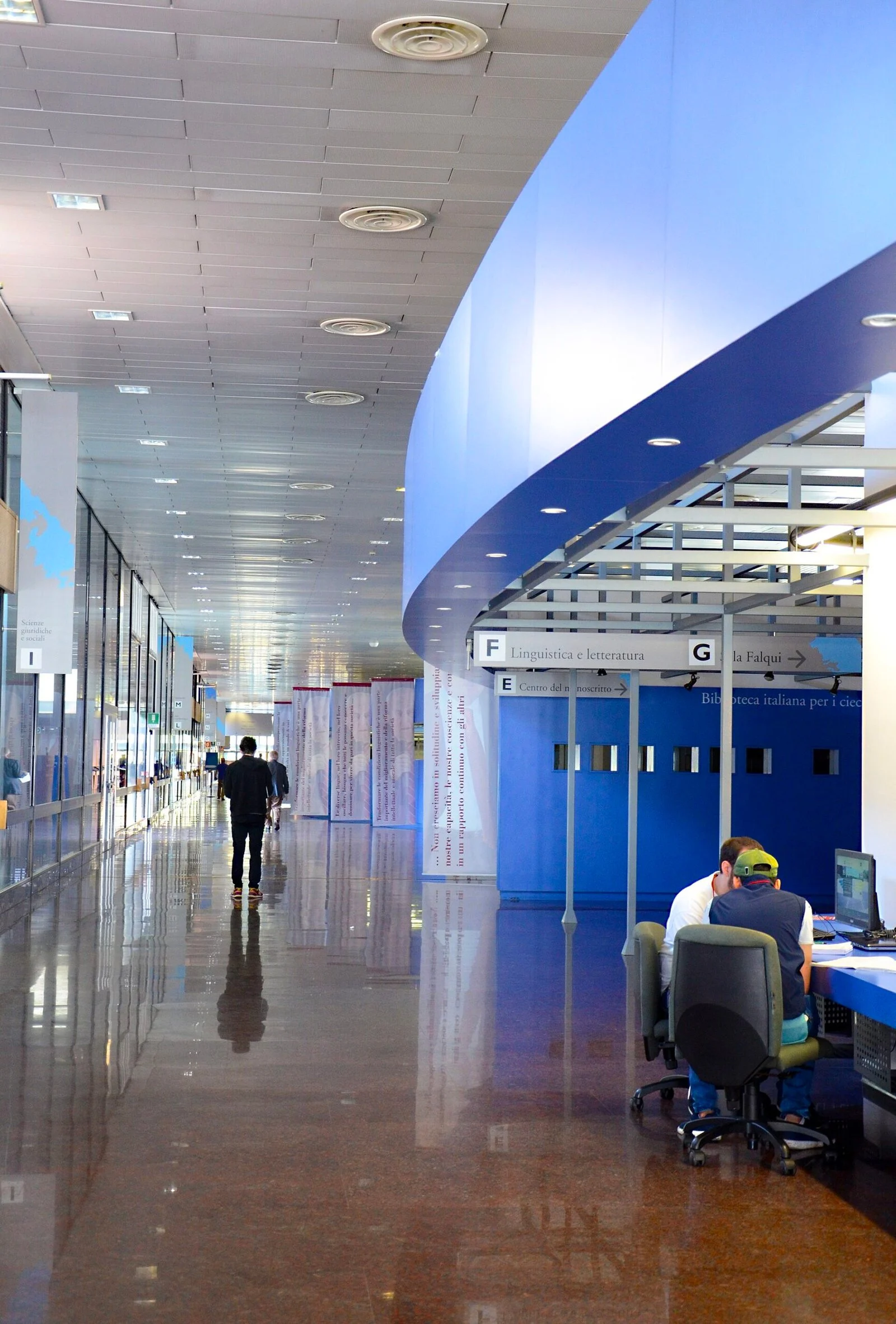
There are places in Rome that make themselves known from afar, with a dome or a column, and places that instead hide in plain sight: huge, public, free, and yet unknown to most of the people who walk past them every day. The National Central Library of Rome proudly belongs to the second category. It's a long, low building on Viale Castro Pretorio, a short walk from Termini, that from the outside looks like a ministry and from the inside is one of the greatest machines of memory ever built in Italy. Inside are millions of volumes. Inside is the country's publishing output, which arrives here by law, day after day, in a kind of slow, uninterrupted breathing. Inside is even Elsa Morante's bedroom, reassembled piece by piece.
In Rome the best reaction never comes in front of the things visitors expect. It comes in the places they hadn't counted on. The National Central Library of Rome is exactly this: not a postcard stop, but a place that changes the way you look at the city. Because it forces you to ask a question nobody usually asks: where does everything Italy writes end up? The answer is here, and partly in Florence. It's an almost moving fact, if you think about it.
Here you'll find the history of the institution, the ground it's built on, the collections that inhabit it, the rooms, the Spazi900, the right way to approach a place that isn't a museum and isn't visited like one. I'll also tell you when it's better to give it a miss, because an honest guide is for this too.
National Central Library of Rome: What It Really Is
Let's start with a clarification that spares disappointment. The National Central Library of Rome isn't a book museum, isn't a permanent exhibition of relics, isn't one of those historic 18th-century libraries with walnut shelves and brass globes where you walk in, take two photos and leave happy. It's a research and conservation library, that is an institution whose primary purpose is to collect, keep and make consultable the national book production. Its natural audience is scholars, doctoral students, thesis writers, journalists, serious curious people. Its heart isn't the facade: it's the storage.
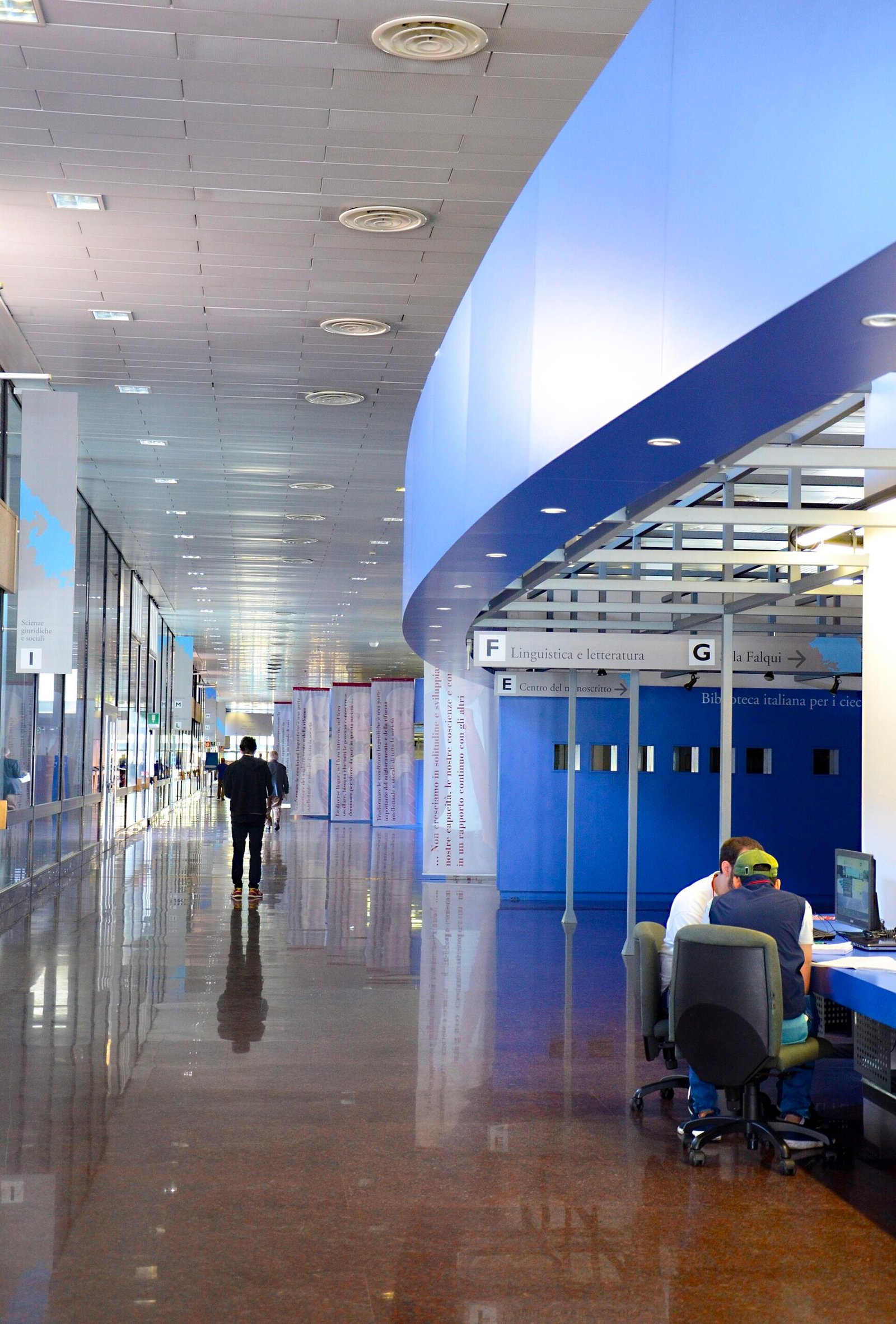
This changes everything about how you approach it. If you arrive thinking of buying a ticket and taking a guided tour among the display cases, you'll be thrown: here you don't buy a ticket, you ask for an admission card, you fill out a request, you wait for the volume to come up from the storage and then you sit down to read it. It's an old and slightly bureaucratic ritual, and that's exactly why it's fascinating: you go looking for the book, the book isn't served to you in a showcase.
A State Library with a Precise Mission
The National Central Library of Rome is an institution of the Italian State, endowed with autonomy and part of the Ministry of Culture system. Its institutional task has three legs: collecting everything published in Italy through the legal deposit mechanism, preserving the historic collections inherited from the post-unification period, guaranteeing public access to this heritage. They are not just any three activities. They are three promises made to citizens and, above all, to the generations to come.
The key word, the one that explains all the rest, is "central." In Italy there are two national central libraries, Rome and Florence, and they share the task of receiving by law the country's publishing output. The other national libraries, from Naples to Turin to Venice, have a different role, often tied to a territory or a historic collection. Rome and Florence are instead the two great funnels through which the printed memory of contemporary Italy passes.
Why a Traveler Should Care
Because it's one of the few places in Rome where the city stops being ancient and becomes contemporary without ceasing to be monumental. Because the building stands on a piece of Roman military history that is among the most underrated in the city. Because the Spazi900 are a small, surprising exhibition route on 20th-century Italian literature that almost no tourist knows. And because, simply, entering a national library makes you feel part of something. That's not little, in a city that often treats you as a spectator.
Where the National Central Library of Rome Is
The address is Viale Castro Pretorio 105, northeast quadrant of the extended historic center, between Termini station and the Nomentano neighborhood. You're in an area that Romans cross in a hurry and visitors almost never cross: offices, university departments, barracks, Umbertine-era buildings, La Sapienza a little further on, the Policlinico, the tracks. It isn't the Rome of Baroque piazzas. It's the Rome that works.
The most useful thing to know is that the metro stop is called Castro Pretorio, line B, and the entrance of the Biblioteca Nazionale Centrale di Roma is right there, practically facing it. There's no need to navigate side streets, no need to look for hidden doorways. You come out, turn around, and there's a long, horizontal building in front of you, the kind that looks better from a distance than up close.
A building that doesn't play the monument
Anyone who arrives expecting columns and pediments is left puzzled. The building is openly modern, with clean volumes, large windows and a low profile that stretches for tens and tens of meters. It is 1960s and 1970s architecture applied to a practical problem: where do you put 7 million books, and how do you get them into a reader's hands in a reasonable time. The answer produced a machine, not a temple. Its merit is exactly that: it doesn't put on a show.
The connection with Termini
Termini is about 10 minutes away on foot, and this puts the Biblioteca Nazionale Centrale di Roma in a strategic position for anyone arriving by train or with a free afternoon before a departure. The route isn't very pretty, I won't lie to you, but it passes by remarkable things: the walls, the Museo Nazionale Romano, the Baths of Diocletian, that tangle of eras that within 200 meters puts the 3rd century, the Cinquecento and the economic boom in front of your eyes. Rome does that: it never gives you one thing at a time.
The Castro Pretorio under the Biblioteca Nazionale Centrale di Roma
The name of the avenue is not decorative. The Castro Pretorio stood here, in Latin Castra Praetoria, the fortified barracks of the Praetorian Guard, the armed corps that protected the emperor and that, with a certain regularity, decided who should be emperor. The camp was built under Tiberius, in the 20s of the 1st century AD, at the suggestion of the praetorian prefect Sejanus, who had the idea of concentrating in a single place cohorts that until then had been scattered around the city. It was a move of military efficiency and, at the same time, one of the most glaring political mistakes in Roman history.
Concentrating the Praetorians meant creating a compact power at the gates of the Palatine. From that moment the guard became the arbiter of successions: it acclaimed, deposed, blackmailed. The most famous case remains the auction of the empire in 193 AD, when the Praetorians, having killed their predecessors, literally put the throne up for auction and gave it to the highest bidder, Didius Julianus, who lasted a few weeks. It's a story that overturns the solemn image of the empire: the most powerful machine of the ancient world depended on a barracks on the outskirts.
The walls you can still see
The perimeter of the camp has not disappeared. When Aurelian, in the 3rd century, had his great circuit of walls built, he incorporated the outer side of the Castro Pretorio, which thus became part of the city's defensive system. This is why, walking around the area, you come across stretches of thick, severe brick masonry that don't belong to any ordinary building: they are the flank of the imperial barracks, reused for 2,000 years. It's the kind of detail that goes unnoticed in Rome because you get used to everything, and that deserves a stop instead.
The end of the Praetorians
The corps was disbanded by Constantine in 312 AD, after the victory over Maxentius: the Praetorians had chosen the wrong side and paid with their final dissolution. The camp lost its military function and for centuries the area remained a zone of vegetable gardens, vineyards and convents inside the walls, one of those urban voids that Rome kept until the 1800s. The military vocation returned after 1870, when the new Italian state built large barracks here. The Biblioteca Nazionale Centrale di Roma was therefore born on ground that was military for almost two millennia, with an agricultural interlude in the middle.
The paradox of the place
The coincidence is remarkable: where for centuries the weapons that decided Rome's political destiny were concentrated, today the books that keep its memory are concentrated. From force to legal deposit. From the sword to the catalog card. I don't think whoever chose the area in the 1900s did it for poetic reasons, but the result is one of the most successful urban metaphors in the city.
The foundation in 1876: how the Biblioteca Nazionale Centrale di Roma began
The Biblioteca Nazionale Centrale di Roma is a young institution by the city's standards. It was founded in 1876, six years after the breach of Porta Pia, at a time when the Kingdom of Italy was building at a forced pace the cultural instruments of a newly conquered capital. Rome had churches full of codices, cardinals' libraries, the immense Vatican Library, the Angelica, the Casanatense, the Vallicelliana: in short, it had everything except a library of the Italian state. Founding one was not just an administrative act, it was a political statement.
The name chosen says it clearly: Biblioteca Nazionale Vittorio Emanuele II, named after the king who had unified the country. For decades Romans simply called it "la Vittorio Emanuele," and even today some older scholars still use that phrase. The official name later became the current one, but the link with its Risorgimento origins remains written into the very structure of the collections.
A collection born from a suppression
Here we have to be precise, because the story is less edifying than it is usually told. The founding core was not purchased: it was seized. The laws suppressing religious corporations, applied in Rome after 1870, transferred to the state the property of tens and tens of convents, colleges and religious houses in the city. Their libraries, accumulated in some cases over three or four centuries, flowed into the new institute. We are talking about several dozen convent collections, from the Dominicans to the Franciscans, from the Augustinians to the Theatines, each with its own physiognomy, its own ownership notes, its own bibliographic obsessions.
The result is that the Biblioteca Nazionale Centrale di Roma holds within itself the intellectual map of the ecclesiastical Rome of the old regime. Opening certain volumes means reading, on the title page, the stamp of a community that no longer exists. It is an archive of vanished worlds, obtained through an act of force by the liberal state. The two things go together, and an honest guide tells both.
The European model
The idea of a great national library was not Italian. It looked to Paris, London, Vienna: capitals where a state library systematically collected the country's printed output and made it available to scholars. Italy arrived late and with a complication all its own: it had too many cultural capitals. Florence already had its own national library with a long history, while Naples, Turin, Milan and Venice claimed their own role. The Italian solution, double and a little anomalous, with two "central" libraries, comes from this polycentric geography. It's a compromise, of course. But it's also the faithful reflection of a country that has never had a single center.
The Collegio Romano, first home of the Biblioteca Nazionale Centrale di Roma
For almost a century the Biblioteca Nazionale Centrale di Roma was not at Castro Pretorio, but in the absolute heart of the city: in the Collegio Romano, the large building that closes the square of the same name a few steps from the Pantheon and Piazza Venezia. If you know that area, you've already seen the old home without knowing it: it's that severe big palazzo with the monumental courtyard and the tower, between Via del Corso and the Minerva.
The Collegio Romano was founded by the Jesuits in the middle of the 1500s, at the wish of Ignatius of Loyola, as a free school open to all. Pope Gregory XIII financed its grand building, and that's why it is also remembered as the Collegio Gregoriano. Over the centuries it became one of the most important scientific centers in Europe: mathematicians and astronomers taught here, here Athanasius Kircher put together his famous museum of curiosities, and here later Angelo Secchi carried out pioneering studies of stellar spectroscopy from the observatory installed on the tower.
From the Jesuit library to the state library
When the Italian state took possession of the building, it also inherited its extraordinary library, the so-called major library of the College. It was that collection, together with the holdings of the suppressed religious houses, that formed the backbone of the new national institute. This is not a technical detail: it means that the Biblioteca Nazionale Centrale di Roma was born with a structure of knowledge of Jesuit origin, very strong in theology, philosophy, mathematical sciences, ecclesiastical history, geography, missions, linguistics.
Anyone who uses the reading rooms today notices it as soon as they dig a little into the old catalog. Certain sections are unbalanced, very rich where you would expect little, because they reflect a library built to train missionaries and teachers, not to serve a general public. It's a legacy that makes the institute far more interesting than a collection assembled on paper.
A hundred years of growth and a crisis of space
The stay at the Collegio Romano lasted from 1876 until the 1970s, and it was a slow suffocation. A library that receives by law everything printed in Italy grows every year by tens of thousands of items. A sixteenth-century palazzo, however imposing, has finite walls. Corridors, attics and covered courtyards were taken over. Anyone who has seen the photographs of those years remembers piles of volumes in every available corner. The library was becoming a victim of its own success, and it was clear that a purpose-built building was needed.
The move and the 1975 building of the Biblioteca Nazionale Centrale di Roma
The solution came with an architecture competition announced in the late 1950s and with the choice of an area then occupied by military structures, in the Castro Pretorio complex. The winning design, signed by the architects Massimo Castellazzi, Tullio Dell'Anese and Annibale Vitellozzi, imagined a layout radically different from any historic Italian library: not an adapted palazzo, but a functional machine built around the flow of books.
The construction site was long, like almost all Roman public works sites, and the inauguration came in 1975. The move was a remarkable logistical undertaking: millions of volumes to be transferred from the historic center to the new site without losing the shelving order, which in a library is everything. Losing the order means losing the book, even if the book is right there.
An architecture designed from the inside out
The logic of the design is that of the great post-war library buildings: sharply separating the three functions. The stacks, that is the towers and storage floors where the volumes sit on compact shelving in controlled conditions. The public services, that is reading rooms, catalogs, distribution. The technical offices, where cataloging, restoration and legal deposit are handled. Between these zones run the internal transport systems that carry the requested volume from the storage to the desk.
Seen from outside, the result is a horizontal, very long structure, dominated by the repetition of its elements. Not everyone likes it, and I understand why: rhetoric is completely missing. But seen with the right eye it has a dry elegance of its own, and the generosity of the interior spaces, with the large windows bringing natural light onto the reading tables, is something that today's libraries can only dream of.
The greenery and the enclosure
Around the building there is a green area that belongs to the institute and that marks a distance from the traffic of the avenue. It's one of those urban filters that are rare in Rome: not a romantic garden, but a buffer space. Walking around it, you understand the scale of the complex better, which from the street tends to escape you because it develops more in length than in height.
Legal deposit and the Biblioteca Nazionale Centrale di Roma
If I had to explain the Biblioteca Nazionale Centrale di Roma with a single idea, I would choose this one: legal deposit. It's the mechanism by which anyone who publishes in Italy is required to hand over a copy of what they have published to the institutions responsible for preserving it. It's not a favor, it's not a courtesy: it's a legal obligation, and it's the way a nation decides not to forget itself.
The principle is ancient and began in France in the 1500s, with the idea that the sovereign should own a copy of everything printed in the kingdom. In Italy the rules were reformed in the early 2000s, with a law of 2004 and the later implementing regulation, which extended the obligation to materials once excluded and redefined the role of the depositories. The two central national libraries, Rome and Florence, remain the main recipients for the long-term preservation of the national publishing output.
What it means in practice
It means that every day, in a part of the building the public doesn't see, packages arrive. Novels and plumbing manuals, scientific journals and auction catalogs, tourist guides and theses published at the author's expense, books destined to sell 100,000 copies and pamphlets destined to be read by no one. Legal deposit doesn't judge. It takes everything, because the criterion is not literary value as perceived today, but documentary interest tomorrow.
I find it one of the most democratic ideas ever put into practice by a state. The masterpiece and the instruction leaflet come in through the same door and end up on the same shelf, ordered by accession number. In two centuries, the historian who wants to understand how we lived will probably find many more answers in the pamphlet than in the masterpiece.
Continuous growth
An institution that receives by obligation everything that is published cannot stop growing. Every year tens of thousands of new items must be registered, cataloged, shelved. It is a constant pressure on space and staff, and it explains why the question of storage is a permanent issue for any national library in the world. Rome is no exception: the story of its move from the Collegio Romano is, at bottom, the story of this pressure.
The digital flip side
To print production, digital production has been added over the years, with all the complications that come with it: a file can't be put on a shelf, it needs formats readable over time, multiple copies, periodic migrations. Digital preservation is more fragile than paper, not sturdier, and this is perhaps the least understood paradox of the age we live in. A parchment from the 1300s can still be read, while a magnetic medium from 30 years ago often can't.
The numbers of the collection of the Biblioteca Nazionale Centrale di Roma
Numbers, in a library of this scale, serve more to make you dizzy than to inform, but it's worth trying. We are talking about a collection on the order of 7 million printed volumes, to which are added periodicals in enormous quantity, maps, prints, drawings, minor materials. These are figures that no one can verify by eye, and that's exactly the point: the Biblioteca Nazionale Centrale di Roma is bigger than a human being can perceive.
To give an idea you need a comparison. If you lined up all the volumes kept here, one next to the other on a shelf, you would get a line of books more than 200 kilometers long: the distance between Rome and Perugia, in practice, all spines. And this row gets longer every single working day, because legal deposit doesn't go on vacation.
The old collection
Alongside the modern mass there is the precious core. The old collections include thousands of manuscripts, a significant number of incunabula, that is books printed by 1500, and tens of thousands of editions from the 1500s, the so-called cinquecentine. These materials are not kept in the same rooms as current books: they have dedicated stacks, controlled climate conditions, stricter consultation procedures and, often, digital reproductions that allow them to be studied without touching them.
An incunabulum, to be clear, is an object halfway between the manuscript and the modern book: set in movable type but still laid out like a codex, often with spaces left blank so that an illuminator could add the initials by hand. Leafing through one, when it's allowed and with all the necessary precautions, is an experience that reorganizes your ideas about the history of technology. The digital revolution we are living through looks very much, in rhythm and in effects, like the one that those sheets document.
The special collections
Then there are the holdings that don't fall into the standard categories: collections of autographs, correspondence, personal archives, private libraries acquired or donated in full. They are the most alive part of the collection, because they preserve not only the text but the context: working papers, corrected drafts, letters, notes on the flaps. For a historian of literature they are worth more than a thousand printed editions, because they show thought as it forms.
Numbers and responsibility
Behind every figure there is a concrete responsibility: dusting, humidity checks, pest monitoring, shelf verifications, reconditioning. The enemy of a library is not fire, which is rare, but humidity, which is daily. A national library is, technically, a large preventive conservation facility with books inside. This part of the work is never seen and absorbs an amount of energy that the public doesn't imagine.
The Jesuit Collection of the Biblioteca Nazionale Centrale di Roma
Among all the collections that flowed into the institute, the one bearing the name of Fondo Gesuitico is the most characteristic. It derives from the libraries of the Society of Jesus tied to the Collegio Romano and the professed house, and it is a mine for anyone studying early modern Catholic culture, the history of the missions, the birth of experimental science, pedagogy, the geography of non-European worlds.
The Society of Jesus, founded in the 1500s, built in two centuries a global network of colleges and missions and, with it, a network of book collections. The Jesuits wrote a lot, translated, compiled grammars of languages that Europeans had never heard, drafted extremely detailed reports from China, Japan, Paraguay, India. Much of that documentation flowed to Rome, the nerve center of the order.
What you find there
Printed and manuscript material: theological and philosophical texts, obviously, but also treatises on mathematics, optics, astronomy, hydraulics, music. The Collegio Romano was a serious scientific laboratory, and this contradicts the simplified image of a Church hostile to science. The historical reality is more interesting and much more conflicted: within the same institutions, advanced experimental research and censorship, encyclopedic curiosity and suspicion lived side by side.
The case of Athanasius Kircher, a German Jesuit active at the Collegio Romano in the 1600s, is emblematic. He collected fossils, machines, miniature obelisks, Egyptian finds. He tried to decipher the hieroglyphs, getting almost everything wrong, but in effect inaugurating Egyptology as an ambition. He wrote on music, volcanoes, the plague, magnets. He was a disorderly genius and a formidable builder of intellectual networks. His shadow stretches over the holdings that the Biblioteca Nazionale Centrale di Roma keeps today.
Why it still matters
Because global history, a discipline now greatly expanding, is also written with these papers. The scholars who reconstruct the cultural contacts between Europe and Asia in the early modern period work on missionary reports, dictionaries, correspondence: materials produced by men who had an explicit religious agenda and who, for that very reason, recorded with obsessive precision what they saw. They are sources to be handled with a critical spirit and not thrown away: exactly the kind of documentation that preservation libraries exist for.
Manuscripts, incunabula and cinquecentine at the Biblioteca Nazionale Centrale di Roma
It's worth spending a few lines on what these three categories really are, because they are words that visitors often hear and rarely understand. A manuscript is a handwritten book, produced in a single copy or nearly so, on parchment or paper. Each copy is an individual, with its own handwriting, its own errors, its own marginal notes. An incunabulum is a book printed in the first decades of typography, conventionally by December 31, 1500. A cinquecentina is a book printed between 1501 and 1600, when typography becomes a mature industry.
The difference is not only chronological. It is a difference of production logic. The manuscript is made-to-order craft. The incunabulum is the first application of technical reproducibility to text. The cinquecentina is the moment when the book takes the form we still use, with title page, page numbering, indexes, editorial paratexts. In three centuries Europe invents reproducible information, and in these rooms are the pieces that document the passage.
Ownership notes, stories inside the story
The part I prefer, when I work on old books, is not the text: it's the margins. Ownership notes show who owned the volume, often with the date and the price paid. Marginal notes show how it was read. Convent stamps tell of the passage from one religious house to another and then, after 1870, to the state. A single volume can carry five or six layers of ownership: a friar, a cardinal, a collector, a suppressed convent, the Nazionale. It's the archaeology of reading.
How they are consulted
With stricter rules, naturally. For rare materials a study reason is normally required, consultation takes place in dedicated rooms and under supervision, without pens, with special supports that prevent the binding from opening too far. It's not pedantry: an old binding forced open to 180 degrees breaks, and that break is permanent. When in a library they ask you to use a support cushion and a lead snake weight to hold the pages still, they are asking you to take part in preservation, not to follow a whim.
Digital as an ally
The digital reproduction of rare holdings has solved a dilemma that for centuries was insoluble: making accessible without wearing out. Every consultation of an original is a micro-wear. Multiplied by thousands of requests it becomes damage. Digitizing means moving most consultations to a surrogate, reserving the original for cases where the physical object is indispensable, for example to study the watermark of the paper or the structure of the binding. It is one of the few recent technological innovations that conservators talk about without ambiguity.
The reading rooms of the Biblioteca Nazionale Centrale di Roma
The rooms are the public face of the institute. They are spacious, bright spaces, organized by major subject areas and by type of material, with long tables, individual lights and, today, electrical outlets that were not foreseen in the original design because no one imagined that readers would arrive with computers. The thematic layout makes it possible to keep the most used reference works on open shelves: dictionaries, encyclopedias, reference works, bibliographies.
The rest, that is the vast majority of the collection, sits in storage and has to be requested. This is the point that radically changes the experience compared to a municipal library. Here you don't stroll among the shelves choosing out of curiosity: you already know what you want, you look it up in the catalog, you note its shelf mark, you request it and you wait. A preservation library presupposes a precise question. It's an intellectual training in itself.
Silence as infrastructure
There is a particular silence in the great reading rooms, made not of the absence of sound but of minimal, repeated sounds: pages, chairs, keyboards, the staff's cart. Anyone who often works in libraries knows that this background noise is productive, much more than absolute silence. It's the reason why, even though everything is available remotely, the rooms keep filling up: it's not the book that's missing at home, it's the environment.
The rules of behavior
The customs of every research library apply: bags and coats in the cloakroom, entering the room with only the essentials, no food, no drinks except in permitted areas, phone silenced and conversations outside. Photographs of your own materials are normally governed by regulation and should never be taken for granted. It's a good rule to ask the staff before pulling out the camera: the answer depends on the material, not on the whim of the attendant.
The relationship with the staff
A piece of advice: librarians are the most underused resource of any library. They know the holdings, they know which reference works work, they have in their heads routes into the catalog that no search engine replicates. A quarter of an hour of conversation with the right person at the consultation desk can save you two days of work. And, not a trivial detail, they are almost always happy when someone asks: it means the collection serves a purpose.
How to get into the Biblioteca Nazionale Centrale di Roma
Clarity is needed here, because this is the point where I see the most misunderstandings. The Biblioteca Nazionale Centrale di Roma doesn't work like a museum with a ticket office. To use the reading rooms you need an admission card, which you request by presenting a valid ID and providing your details. The card identifies the reader, allows you to register requests for volumes and makes people accountable for handling public material. It's a quick procedure, but it has to be done.
Access is designed for an adult public and for study and research purposes. There are specific rules on the minimum age and on the conditions of admission for younger students, and there are special arrangements for consulting rare and valuable materials. Since regulations and hours change over time, the golden rule is just one: always check the updated information on the institute's official website before showing up. Showing up without checking is the most effective way to lose an afternoon.
The logic of the request
Once admitted, the mechanism is this: you find the volume in the catalog, take down its shelf mark, submit the request and wait for the material to be retrieved from storage. The wait depends on the stack where the item is kept and on the workload. Those who regularly use preservation libraries know this and organize the day accordingly: you request the first round as soon as you arrive, work on something else while you wait, and request the second round in mid-morning.
The big beginner's mistake is to arrive in mid-afternoon with a list of 20 titles and expect to see them all. It doesn't work that way, and not out of spite: it works that way because the books are physically somewhere else and someone has to go and get them. The library is a slow machine by design, and slowness is the price we pay for still having those volumes.
What to bring
ID, pencil, notes, a computer if you use one. Pens, in the rooms where old materials are consulted, are forbidden for obvious reasons. The cloakroom is mandatory for backpacks and bags. It's best to keep only the essentials at hand, maybe in a transparent bag, which is the solution adopted by almost all research libraries in the world. Bringing coins for the lockers, where provided, avoids an embarrassing scene at the entrance.
The most useful practical tip
Prepare your research at home. The catalogs can be searched online and let you arrive with shelf marks already noted. Anyone who arrives with their homework done turns a day of research into three well-spent hours. Anyone who arrives improvising spends the time interrogating terminals. This is true for the Biblioteca Nazionale Centrale di Roma as for any great European library, but here, given the size of the collection, it is especially decisive.
Spazi900, the 1900s inside the Biblioteca Nazionale Centrale di Roma
If there is one reason why even a non-specialist visitor should take an interest in this place, it is called Spazi900. It is the permanent exhibition route devoted to 20th-century Italian literature, inaugurated in the second half of the 2010s, which showcases the collections and archives of writers kept by the Biblioteca Nazionale Centrale di Roma. In practice: the library stopped keeping its 20th-century papers only in storage and turned them into a story you can visit.
The idea is simple and very powerful. Literature is not made only of finished books: it's made of notebooks, corrected typescripts, letters, photographs, objects, personal libraries. Showing these materials means showing the craft, not the monument. Seeing a page with the author's crossings-out makes you understand in three seconds what 10 lessons of literary criticism struggle to convey: that writing is rewriting.
The gallery of writers
The route is divided into sections that accompany the visitor through the century, from the first avant-garde movements to the post-war seasons, up to the most recent authors. There are portraits, editions, documents, apparatus that provide context. It is a sober installation, more library than museum in style, that doesn't look for a theatrical effect. To some it will seem austere. To me it seems consistent with the place.
The authors' rooms
The most memorable part is the reconstructed settings, where furnishings, bookcases and objects from the writers' homes are reassembled to give back the environment in which certain pages were born. It's a delicate operation, because it always risks sliding into fetishism. Here it works, because the context is a research library and not a house museum: the objects sit next to the papers, and the papers explain the objects.
Why it's a suitable visit even for non-Italians
Because the Italian 20th century is one of the great chapters of European literature, and because many of the authors represented are translated all over the world. Many foreign visitors know certain Italian novels very well without ever having had the chance to see a handwritten line by their authors. The emotional leap, in those cases, is remarkable. A translated book is a voice. A page corrected by hand is a person.
The room of Elsa Morante at the Biblioteca Nazionale Centrale di Roma
Among the settings of Spazi900, the one devoted to Elsa Morante is the most famous, and rightly so. Furnishings, books and objects from the writer's Roman home have been brought together there, recomposed so as to give back the atmosphere of the domestic space in which she worked. It is not an invented stage set: it is real material, which entered the library along with the papers.
Elsa Morante is one of the strongest voices in 20th-century Italian fiction. Born in Rome in 1912 and died in 1985, author of books such as "Menzogna e sortilegio," "L'isola di Arturo" and "La Storia," she crossed the century with a writing that joins epic breadth and an obsession with childhood, with myth, with the last among us. "La Storia," published in 1974, is the novel that told the war from the point of view of those who suffer it, and it divided Italian critics like few other post-war books.
Why seeing her room changes the reading
Because it shows the domestic scale of an enormous body of work. We imagine that great novels are born in solemn places. They are born instead at a table, among stacked books, with home life all around. Seeing the everyday objects of a writer who built vast worlds scales down the mythology of inspiration and gives back the work. It's the most useful message a library can give a young person who wants to write.
Rome in her pages
Morante is also a deeply Roman writer, and her pages give back a city very different from the one today's visitor sees: working-class neighborhoods, outskirts taking shape, the war and the occupation, post-war poverty. Anyone who visits Rome reading only monumental guides risks never meeting this city. A stop at Spazi900 is an excellent corrective.
An invitation to read
If after the visit you want to take something home, take one of her novels. It's the best souvenir this place can offer, and the only one that keeps working years later. I always prefer to suggest a book rather than an object: it costs little, weighs little and changes the way you will remember the city.
The writers' archives in the Biblioteca Nazionale Centrale di Roma
Behind the display cases of Spazi900 there is an archival heritage that few people know and that represents one of the most singular riches of the institute: collections of writers, critics, publishers, intellectuals of the 20th century, which arrived by donation, purchase or bequest. They are complex sets, which include manuscripts of works, correspondence, preparatory materials, press reviews, photographs, personal libraries with the owner's annotations.
The value of a literary archive lies in its integrity. An isolated manuscript is an interesting object. A complete archive is a laboratory. It lets you follow a work from idea to draft, measure the influence of editors, reconstruct networks of friendships and polemics, date turning points. Many of the critical editions of contemporary classics are born from this kind of material.
How they are consulted
With specific procedures, because personal archives also contain sensitive data and private correspondence subject to protections. A reasoned request is normally needed, and sometimes there are time limits set at the moment of the donation. This is not pointless bureaucracy: it's the pact that makes the donation itself possible. No family would hand over an author's papers without guarantees about how they will be used.
The invisible work of reordering
When an archive enters a library, it usually arrives in disordered boxes. Before it can be consulted it has to be cataloged, ordered according to archival criteria, described in a finding aid. It is long work, which can take years for a substantial collection, and which is done by professionals whose existence the public ignores. Every time a scholar quickly finds the letter they needed, they are using the work of someone who spent months putting other people's papers in order.
A contemporary responsibility
The archives of today's writers are partly digital: files, versions, email. Preserving them poses new and delicate technical problems, from the obsolescence of formats to the management of the multiple versions of the same text. National libraries are facing this transition now, as it happens, without the comfort of established procedures. It's one of the most interesting fronts of the trade.
The Digital Library of the Biblioteca Nazionale Centrale di Roma
A contemporary national library lives twice: in the rooms and online. For years the Biblioteca Nazionale Centrale di Roma has been carrying out digitization campaigns that make manuscripts, old editions, periodicals and materials of particular interest available in electronic format. It is the way a geographically concentrated collection becomes accessible to someone on the other side of the world who doesn't have a plane ticket.
Digitizing doesn't mean photographing in a hurry. It means choosing what makes sense to reproduce, at what resolution, with what attached description. An image without metadata is almost useless: no one will ever find it. The heavy work in a digital library is not the scanner: it's the cataloging that makes the image findable and citable in a stable way over time.
What changes for the reader
Above all, the preparatory phase changes. Before, to know if a volume contained what you were looking for, you had to go there. Today, in many cases, you can check from home and come to the room only for what requires the original. The result is that the visit becomes more targeted and more productive, and that fragile material is handled less. Everyone gains, including the book.
The problem of long-term preservation
There is, however, a problem that non-specialists underestimate: digital is not forever. A file requires redundant copies, periodic integrity checks, migrations to formats readable by future software. A library that digitizes takes on a permanent commitment, not a one-off task. If tomorrow no one maintained those systems, in 20 years nothing would be left. Paper, ironically, forgives neglect far more.
Open access and rights
Not everything that is digitized can be published freely. Works in the public domain, that is those whose rights have expired, can be circulated. For materials still protected, precise limits apply, which often allow consultation only on site at dedicated workstations. It's a restriction that sometimes irritates the user, but it depends on copyright law and not on a choice of the library.
The catalog and the national library system
The Biblioteca Nazionale Centrale di Roma takes part in the Servizio Bibliotecario Nazionale, the network that connects thousands of Italian libraries and feeds a union catalog. It is the tool that lets a student in Palermo know in 10 seconds that a certain volume exists, and where. Before, only local paper catalogs existed, and bibliographic research was an art made of letters, phone calls and trips.
Those who worked with card catalog drawers keep a certain nostalgia, and not only for aesthetic reasons. The paper card forced you to browse, and by browsing you found things you weren't looking for. Digital search is precise but blind: it finds what you ask for, never what you don't know you should be asking. That's why expert librarians still teach how to navigate by subject and by class, and not only by keyword.
The historical catalog
Alongside the electronic catalogs, historical tools survive, often digitized as images, which remain indispensable for the oldest material or for collections not yet fully recovered. It's normal, in a library with this history, to have to consult several tools in sequence. The rule is: don't stop at the first negative result. A title missing from one catalog may be present in another, under a different heading.
The national bibliography
The central national libraries also perform a bibliographic function: recording and describing the country's publishing output according to shared standards. It's apparently dry work that holds up the entire scaffolding of Italian bibliographic information. Every time a bookshop, a municipal library or an online aggregator shows the data of a book, it is benefiting, directly or not, from this work of normalization.
A tip for those searching
If you're looking for a rare edition or a pamphlet, try variants of the title, search for the author with and without first name, try the Latin form if the text is old. Catalog headings follow precise rules but different over time, and a title can hide behind a normalized form you don't imagine. Patience, in bibliography, is a technical skill.
Conservation and restoration at the Biblioteca Nazionale Centrale di Roma
Behind the scenes of every great library there is a world that the public doesn't see and that determines the survival of the collection: conservation work. It includes the control of environmental conditions, periodic dusting, prophylaxis against insects and mold, the production of made-to-measure containers for fragile pieces, the assessment of the condition of each volume before authorizing its consultation or its loan for an exhibition.
Restoration proper is the last stage and the most delicate. Contemporary philosophy favors minimal intervention, reversibility of the materials used, precise documentation of every operation. An old book is not "made like new": it is stabilized, consolidated, and its material history is respected, including the repairs it has already undergone over the centuries. An 18th-century mend is part of the document as much as the text.
The enemies of the book
Humidity first of all, which favors mold and warps paper. Then temperature swings, which stress the bindings. Then light, which fades inks and miniatures and whose effect is cumulative and irreversible. Then insects, the infamous "woodworms," which dig tunnels with an almost elegant geometric regularity that is utterly devastating. Finally the acid contained in the industrial papers of the 1800s and 1900s, which makes them yellow and crumble from within: paradoxically, a book from 1880 is often more fragile than one from 1580.
Deacidification and modern papers
This is one of the most serious problems of contemporary libraries. The paper industrially produced for much of the 1900s contains components that cause its chemical degradation. Millions of volumes, all over the world, are slowly turning to dust on their shelves. Mass deacidification treatments exist, but they are expensive and don't solve everything. It's a time bomb that no one has yet fully defused and that is talked about very little.
Why all this concerns you too
Because when a reader puts a coffee next to a volume, or forces a binding to photocopy it, or uses a pen where it is forbidden, they are offloading a cost onto someone else. Caring for the collection can't be delegated only to technicians: it passes through the gestures of those who use it. It's a lesson in civility that applies well beyond libraries.
Exhibitions, events and public life of the Biblioteca Nazionale Centrale di Roma
It would be a mistake to imagine this place as a silent warehouse. The Biblioteca Nazionale Centrale di Roma has a public life made of temporary exhibitions, presentations, conferences, educational initiatives, special openings on the occasion of city cultural events. These are activities that showcase otherwise invisible holdings and open the institute to a wider public than that of scholars.
Bibliographic exhibitions have their own particular poetics. They can't count on big visual effects: an open book shows two pages, period. They therefore have to work on storytelling, on selection, on juxtaposition. The best ones manage to build a narrative where the visitor understands why that volume, opened to that very page, is important. It is an exercise in curatorial writing that I admire a lot.
How to know what's on
The calendar changes continuously and there's no point fixing it in a listing. Before going, check the institute's official website and the institutional channels of the Ministry of Culture: you'll find the initiatives under way, any special hours and the ways to take part. It's worth doing even if your main goal is something else: you often find a small exhibition open that alone justifies the detour.
The audience you don't expect
During certain evening initiatives the audience changes completely: students, neighborhood curiosity seekers, fans of contemporary literature, people who had never come in before. Seeing a national library full of people who aren't there for work is a rare and encouraging sight. It means the institution is not just a repository, but a living place in the city.
The civic role
There is also a less conspicuous and no less important function: that of a free public space to study. In a city where finding a quiet spot is expensive, a reading room open to anyone who meets the requirements is a social service, not only a cultural one. It's worth remembering when people discuss how much libraries cost.
The neighborhood around the Biblioteca Nazionale Centrale di Roma
Castro Pretorio is not a neighborhood you visit: it's a neighborhood you cross. Yet it has a strong physiognomy, made of post-unification building, large public complexes, barracks, hospitals, university faculties. It's the Rome built in a hurry after 1870 to house the apparatus of an improvised capital, with severe small apartment buildings and wide streets designed for the traffic of ministerial carriages.
Walking through it with a bit of attention, you notice things that escape a fast pace: Umbertine portals, interior courtyards, commemorative plaques, stretches of ancient walls incorporated into modern buildings. It's the Rome that doesn't make it into the guides because it is neither ancient nor Baroque, but that explains contemporary Rome far better than certain famous squares.
La Sapienza and student life
A little further east stretches the University City of La Sapienza, built in the 1930s on a design coordinated by Marcello Piacentini, with that monumental rationalism that still divides opinion today. The presence of the university gives the area a particular rhythm: during exam sessions the streets fill with students, the cafes have lines, the study rooms are full. The Biblioteca Nazionale Centrale di Roma lives inside this ecosystem and is, in part, its documentary backbone.
Where to eat without illusions
I'll be frank: this is not the area of great restaurants. It is, however, the area of honest tavole calde, cafes with quick meals, pizza al taglio places frequented by those who work in the offices. For a functional lunch break it's perfectly fine. If you're after a memorable dinner, shift your center of gravity toward San Lorenzo, a few minutes away, where the offering changes radically and prices stay reasonable.
San Lorenzo, a stone's throw away
Cross the railway and you enter San Lorenzo, a working-class and university neighborhood, with a labor and antifascist history that has left deep traces. Here on July 19, 1943, the Allied bombing hit the area and the basilica of San Lorenzo fuori le Mura hard, in an episode that marked the city's collective memory. It's a walk I recommend to those who have time: from the national library to the Verano monumental cemetery it's less than 20 minutes on foot, and you cross 100 years of Roman social history.
The Baths of Diocletian and the Biblioteca Nazionale Centrale di Roma
A few minutes' walk away, toward Termini, you come to one of the most imposing archaeological complexes in the city: the Baths of Diocletian, built at the turn of the 3rd and 4th centuries and capable, according to estimates, of welcoming thousands of people at the same time. They are the largest baths ever built in Rome, and their plan can still be read in the modern urban fabric, if you know where to look.
The ideal link with the library is closer than it seems. The great imperial baths were not just baths: they were multifunctional civic centers, with gyms, gardens, conversation rooms and, in several cases, libraries. The Roman model of public building envisaged that care of the body and care of the mind would be under the same roof. Going in half an hour from the Baths of Diocletian to the Nazionale means crossing 17 centuries of the same idea: the state offering spaces to the citizen.
Santa Maria degli Angeli
Inside the baths, in the 1500s, Michelangelo carved out the basilica of Santa Maria degli Angeli e dei Martiri, making use of the enormous vaults of the central hall. It is one of the most spectacular reuse interventions in the history of architecture and it has an almost comic effect on distracted visitors: they walk in thinking they're visiting a church and find themselves inside a Roman bath hall with an altar. On the floor also runs the famous 18th-century meridian line commissioned to check the calendar, with the bronze line crossing the nave.
The Museo Nazionale Romano
The museum complex spread across the baths, Palazzo Massimo, Palazzo Altemps and the Crypta Balbi holds some of the absolute masterpieces of ancient sculpture and painting. Palazzo Massimo, in particular, keeps the frescoes of the villa of Livia, with that painted garden that is perhaps the most modern thing Roman art has left us. It's the natural detour for anyone who, coming out of the library, still has two hours and a desire for beauty.
Building a coherent itinerary
An itinerary that works very well, and that I often suggest to those who have only one day in this quadrant, is the following: morning at the Biblioteca Nazionale Centrale di Roma with a visit to Spazi900, a quick lunch, afternoon between the Baths of Diocletian and Palazzo Massimo, and to close a walk along the walls to Porta Pia. Zero lines, zero crowds, four eras.
How to get to the Biblioteca Nazionale Centrale di Roma
The simplest way is the metro, line B, Castro Pretorio stop, which carries the name of the place and comes out practically in front of it. Line B connects directly Termini, the Colosseum, the Circus Maximus, the Piramide and the Eur neighborhood, so from almost all tourist spots in the city you arrive with one change, often with no changes.
From Termini you can easily walk: 10 to 15 minutes at a normal pace, crossing the area of Piazza dei Cinquecento and continuing northeast. It's not the most poetic walk in Rome, but it's short and very useful for getting your bearings. Anyone arriving by train from Fiumicino with the direct connection is therefore a quarter of an hour from the entrance, luggage permitting.
Buses and surface transport
The area is served by several surface lines that run along the main avenues of the quadrant. In a city where traffic is what it is, however, the advice remains the metro: predictable, fast, immune to jams. The bus in Rome is a profound cultural experience, but it is never a means of keeping to a schedule.
By car: better not
I advise against the car without hesitation. The area is dense with offices, free parking is a mirage and traffic restrictions in the extended center change over time. If you're staying outside the city, leave the car in a park-and-ride lot near a metro station and arrive by rail. You'll save money, time and at least two arguments.
Accessibility
The building, being a modern construction designed for large flows of public, is generally easier than many historic Roman sites, where steep stairs and high thresholds are the norm. For specific accessibility needs the right thing to do is to contact the institute in advance and check the routes and services available: it's the quickest way to avoid surprises and an answer usually comes.
The Biblioteca Nazionale Centrale di Roma in summer
In summer Rome changes skin. The center empties of Romans and fills with visitors, the heat turns daytime walks into endurance tests and those who work in the city desperately look for cool places. In this scenario, a large public library becomes a very precious resource, and I'm not saying it to be romantic: from a practical point of view, an air-conditioned reading room in July is gold.
It must be said just as clearly that the hours of public institutions can change in the summer months and on holidays. Before planning a study day in August, checking the official channels is not a suggestion: it's a necessity. Too many people end up in front of a closed door looking like they've just discovered that Italy exists.
Studying in the city when the city is at a standstill
There is something special about working in Rome in the summer. The streets are slower, the neighborhoods quieter, distances seem to shrink. Anyone who spends the morning in the library and the late afternoon out and about discovers a city that hurried tourists never see, because they arrive at noon at the wrong places and leave at six.
How to organize a summer day
The scheme that works: early alarm, breakfast at the bar, enter the library shortly after opening, work until early afternoon, long break, leave around six when the sun starts to be bearable, evening stroll. This way you use the cool part of the day for the static part of the activities and leave the evening for the city. It works in summer, and it also works in November with slightly different hours.
A thought on summer festivals
In the hot months Rome fills with festivals, open-air arenas, concerts, readings, outdoor initiatives in places that usually have other functions. The quadrant between Termini, Castro Pretorio and San Lorenzo takes part in this season with events that change every year. It's always worth checking the updated programs: summer Rome rewards those who find out the same day, not those who plan in March.
Who should visit the Biblioteca Nazionale Centrale di Roma
Not all places are for everyone, and a guide that pretends otherwise isn't doing its job. The Biblioteca Nazionale Centrale di Roma is perfect for some categories of people and essentially useless for others. It's worth understanding which group you belong to before taking the metro.
It's perfect for those who study or do research, obviously. It's perfect for those who love 20th-century Italian literature and want to see Spazi900. It's perfect for enthusiasts of the history of the book, of archives, of post-World War II architecture. It's perfect for those who live in Rome and are looking for a place to work seriously. It's perfect for the slow traveler, the one who at the fourth Baroque church feels the need for something that speaks to him of the present.
Who would do better to skip it
Those who have two days in Rome and haven't seen anything yet. Those traveling with small children looking for visual stimulation. Those who expect a theatrical experience in the style of the great historic European libraries: you'll find that elsewhere in the city, not here. Those who want to walk in, take a photo and leave in 10 minutes. There's nothing wrong with these needs. It's simply that this is not the place that satisfies them.
Families and teenagers
For high school students, especially those who study literature, a visit to Spazi900 can be illuminating, provided you prepare it. Seeing the working materials of a writer studied in class suddenly makes concrete a name that in the textbook is only a date. For younger children, instead, there are far more suitable alternatives in the quadrant, starting with the archaeological museums, where at least there are statues and mosaics to look at.
The foreign visitor
Those who don't speak Italian will have a partial experience of the exhibitions, which are naturally in Italian with apparatus that is not always bilingual. It remains interesting all the same for the architecture and for the general idea of what a national library is in a country with this density of history. And for those who read Italian authors in translation, seeing the original papers still has a remarkable impact.
Mistakes to avoid at the Biblioteca Nazionale Centrale di Roma
I list them to spare you, because the difference between a successful visit and a wasted day almost always lies in the practical details.
First mistake: not checking hours, openings and access conditions before leaving. Italian public institutions have calendars that change, closures for holidays, different openings for the different sections. The official website exists for this reason. Checking it the day before costs two minutes and is worth a day.
Second mistake: showing up without ID. Without a valid document you don't get the card, and without the card you don't get into the room. It's the most trivial thing in the world and it's the number one cause of failed entries.
Mistakes of method
Third mistake: arriving without knowing what you want. In a preservation library generic curiosity isn't enough, because you can't stroll among the shelves. Arrive with at least three precise titles, and if you don't have them, ask for help at the consultation desk by explaining the topic.
Fourth mistake: underestimating delivery times from storage. Those who plan as if the books were already on the table are regularly disappointed. Those who instead organize the day knowing there is a wait, and fill it with other activities, work very well.
Fifth mistake: treating the material as your own. No pens, no marks, no folded pages, no volumes left open face down. Every abrupt gesture on an old book is damage that someone else will pay for.
Mistakes of expectation
Sixth mistake: expecting a museum. I repeat it because it is the source of almost all disappointments. Spazi900 is an exhibition route, but the institute as a whole is a workplace. Going there with the mindset of a museum visitor means finding it disappointing. Going there with the mindset of a reader means finding it extraordinary.
Seventh mistake: casual photography. In many libraries photographing your own materials is allowed under certain conditions, in others it isn't, and for rare materials specific rules apply. Asking first is always the right move, and it spares you that unpleasant moment when someone calls you out in front of everyone.
Frequently asked questions about the Biblioteca Nazionale Centrale di Roma
Here are the most frequent questions, with honest answers. Where the answer depends on regulations that change, I say so clearly instead of inventing numbers.
Can you go in as a tourist?
The reading rooms are intended for study and research and require registration. The exhibition spaces, like the route devoted to the 20th century, have more open access, according to the terms and hours set by the institute. In practice: yes, you can see something even without being a researcher, but it is not a free visit to the whole building.
Do you need to book?
It depends on the periods, the sections and the initiatives under way. Some activities, especially guided tours and events, require a reservation. Checking beforehand on the official channels settles the question in a minute.
Can you borrow a book?
A preservation library has as its primary function to safeguard over time, so the general rule is consultation on site. There are interlibrary loan and document supply services between institutions, but don't expect to walk out with a volume under your arm as from a neighborhood library. It's not rigidity: it's the reason why those books still exist.
How much does it cost?
Access to the rooms for study purposes doesn't work on the logic of a museum ticket: it's a public service governed by an admission regulation. Some ancillary services, such as reproductions and copies, may have fees set by the institute. For exact and always up-to-date figures, the only reliable source is the official website.
Does it take a lot of time?
For the exhibition route, one to two hours is reasonable. For a study session, half a day is the sensible minimum considering the request times for volumes. For a first general reconnaissance, with a tour of the surrounding area and a stop at the Baths of Diocletian, plan on a full day.
Is it suitable for those who don't speak Italian?
Partially, as already said. The best experience, for an international visitor, is the architectural and conceptual one, together with the proximity of top archaeological sites. Those who read Italian, instead, have a mine in front of them.
Why the Biblioteca Nazionale Centrale di Roma is not a museum
I come back to this point explicitly because it is the interpretive key to this whole page. A museum displays objects selected to be seen. A preservation library keeps objects meant to be used, and shows them only occasionally. The two institutions have common origins but opposite functions: the museum works on display, the library on access.
This difference explains everything else: why there is no ticket office, why there is a card, why the books are not under glass, why the staff asks you what you need a volume for, why you can't wander among the shelves. They are not obstacles, they are logical consequences of a different mission.
The museum temptation
In the last 20 years many libraries have succumbed to the temptation to dress up as museums, to attract public and funding. In part it's understandable, in part it's a risk: a library that stops being readable in order to become photogenic has lost the game. The intelligent way to open up, the one chosen here with Spazi900, is to create exhibition routes that tell the story of the collection without distorting the main function.
The value of the unspectacular
There is a specific beauty in places that don't try to please you. The reading rooms are not designed to be photographed, they are designed so that you feel good in them for eight hours. The result is a functional aesthetic that, decades later, looks strangely restful compared to the exhibitionism of some contemporary cultural architecture. You feel good there.
A lesson for the traveler
If you take home just one idea, let it be this: in Rome you can travel inside ordinary institutions too, not only inside monuments. A library, an archive, a neighborhood market, a post office from the 1930s tell the city more directly than many paid attractions. The best trip begins when you stop looking only for what is famous.
The Biblioteca Nazionale Centrale di Roma and the city's other great libraries
Rome is probably the city with the highest density of historic libraries in the world, and this depends on a precise reason: for centuries it was the capital of a power that produced documents, and the seat of religious orders that collected books as a working tool. The result is an extraordinary network in which the Biblioteca Nazionale Centrale di Roma occupies a very particular place: it is the largest, the most modern in its mission, and the least "Roman" in appearance.
Alongside it are the Angelica, open to the public as early as the 1600s and considered one of the first public libraries in Europe. The Casanatense, born from a cardinal's bequest and still today a space of rare elegance. The Vallicelliana, tied to the Philippine Oratory. The Alessandrina, which serves La Sapienza. And of course the Vatican collections, which belong to another state and another history. Each has its own physiognomy, public, character.
Who keeps what
The division of tasks, simplifying a lot, is this: the historic libraries of ancient origin mainly keep their own old holdings, grown over the centuries around a founding collection. The Biblioteca Nazionale Centrale di Roma, besides a very rich old collection, has the unique task of gathering the country's publishing present. It's the difference between a family museum and a national public service. Both are needed, and they are needed in different ways.
Advice for the enthusiast
If you love libraries and have a few days, build a thematic itinerary. One morning at the Nazionale to understand the scale of legal deposit and see Spazi900. One afternoon in one of the historic libraries of the center for the aesthetic experience of the old rooms. A stop in a neighborhood municipal library to see how the everyday service works. In the end you'll have a picture of Italian book culture that no book about libraries could give you.
A note on local pride
Romans, it must be said, are not particularly aware of this wealth. Ask around how many state libraries there are in the city and you'll see puzzled faces. It's a shame, because it is a collection that is accessible, free in substance and extraordinarily underused. If you live here, you have at your disposal one of the densest cultural infrastructures on the planet. Using it is almost a civic duty.
Periodicals, newspapers and the memory of daily life
A huge and little-told part of the collection of the Biblioteca Nazionale Centrale di Roma is made up of periodicals: newspapers, magazines, bulletins, association publications, local sheets. It's material that no one considers precious at the time of publication and that becomes fundamental 30 years later, when it is the only source for understanding how people lived.
Anyone who has done research on a period newspaper knows what effect it has. You look for a specific news item and end up reading the classified ads, the advertisements, the columns, the obituaries, the weather forecasts. In 10 minutes you have a snapshot of society far sharper than an essay would give you. The newspaper is the most democratic historical source there is, because it records what everyone took for granted.
The physical problem of newspapers
There is, however, a serious technical difficulty: newspaper paper is the worst ever produced by industry. Made to last a day, it ages dramatically, yellows and crumbles at the edges. Newspaper collections are among the most fragile materials of any library, and for this reason their consultation is often mediated by microfilm or digital reproductions. Microfilm, a technology that seems antiquated, remains one of the most reliable preservation media we have: it lasts centuries and is read with a lens and a light source.
Magazines and 20th-century culture
The literary and cultural magazines of 20th-century Italy deserve a discussion of their own. They were the laboratory in which generations of writers were formed, the place of polemics, of pioneering translations, of discoveries. Many texts that became classics appeared first in magazines, often in versions different from those later published in book form. For a scholar, comparing the two versions is fascinating work and possible only where the collections are complete.
Why it concerns all of us
Today we produce a quantity of ephemeral content incomparably greater than a century ago, and we preserve, proportionally, much less of it. Web pages disappear, social networks change format, platforms shut down. The work of national libraries on preserving digital memory is the contemporary version of collecting newspapers, and it is just as inconspicuous and just as decisive.
The craft behind the Biblioteca Nazionale Centrale di Roma
Every time a volume reaches a reader's hands, a process has been completed that involves dozens of people and different skills. There are those who register incoming material, those who catalog it according to international standards, those who assign subjects and classifications, those who decide the shelf mark, those who physically shelve it, those who retrieve it on request, those who check its state of preservation, those who digitize it, those who restore it when needed.
Cataloging, in particular, is an intellectual trade that is clamorously underrated. Describing a book so that a person who has never seen it can identify it with certainty and find it requires rules, experience and judgment. The rules changed several times over the 1900s and continue to evolve with the conceptual models of bibliographic description. Those who catalog build the map without which the territory is unusable.
Classification as philosophy
Deciding where to shelve a book means deciding what it is about, and this is anything but neutral. Does an essay on nutrition go in medicine, in anthropology, in social history? The choice influences who will find it. The great classification systems are, at bottom, theories of knowledge disguised as numerical lists, and their rigidities tell the story of the era in which they were born. Studying their evolution is an oblique and fascinating way of studying the history of ideas.
The work in the room
Then there is the public front: the staff who assist readers, interpret vague requests, explain procedures, find alternatives when the volume sought can't be found. It is work of relationship as well as competence, and on busy days it requires remarkable patience. Those who do it well deserve great respect, because they are the link that turns a collection into a service.
Resources and reality
It would be dishonest to tell all this without saying that Italian libraries, including the largest, have been living for years with staffing and resource problems. Staff who retire without being replaced, spaces that fill up, technologies to update. Those who frequent these places sense it, and the most useful thing they can do is behave as civil users: ask properly, return things in order, respect the rules. The quality of a public service also depends on who uses it.
What to see near the Biblioteca Nazionale Centrale di Roma
Within a 20-minute walk there is a surprisingly varied sampler of Rome, ranging from the 3rd century to the 1970s. Here is how I usually organize it, with the idea that the route is worth as much as the stops.
Toward the west: Termini and archaeology
Baths of Diocletian, Santa Maria degli Angeli, Palazzo Massimo, the Octagonal Hall, the remains of the Servian walls visible in the station area. It's the most accessible archaeological concentrate in the city, often overlooked because the Termini area doesn't enjoy a good tourist reputation. Totally unfair: inside Palazzo Massimo there are masterpieces that elsewhere would by themselves make the fortune of a national museum.
Toward the north: Porta Pia and the walls
Going up toward the northeast you meet the Aurelian walls and Porta Pia, the gate reworked by Michelangelo next to which, on September 20, 1870, the bersaglieri opened the breach that ended the temporal power of the popes. It's a place of national memory that foreign visitors walk through unaware. A little further on begins Via Nomentana, with its villas, Liberty-style buildings and Villa Torlonia.
Toward the east: San Lorenzo and the Verano
Past the railway you enter the university neighborhood, with its murals, its venues and the basilica of San Lorenzo fuori le Mura, one of the seven pilgrimage churches of Rome, severely damaged in the 1943 bombing and then rebuilt. Next to it stretches the Verano monumental cemetery, a place of great interest for 19th- and 20th-century funerary sculpture and for the social history of the city.
Toward the south: the city that studies
Finally the University City, with its rationalist layout and severe squares, which is worth a walk even just to understand how the regime imagined knowledge: monumental, orderly, hierarchical. The contrast with the building of the Biblioteca Nazionale Centrale di Roma, designed 30 years later with completely different criteria, is an open-air lesson in the history of architecture.
A curiosity about the Biblioteca Nazionale Centrale di Roma
The curiosity I prefer concerns the relationship between the name of the place and its function, and nobody notices it because we are all used to reading street names without thinking about them. The institute's address is Viale Castro Pretorio, that is "avenue of the praetorian camp." It means that the largest collection of books of the Italian state is located, literally, at the address of the barracks that for three centuries decided by force of arms who ruled Rome.
It is not just wordplay. The perimeter of the Castro Pretorio shaped for 2,000 years the urban planning of this sector of the city: the great military enclosure remained a built-up void inside the walls, then became an area of convents and gardens, then went back to being military with the post-unification barracks, and finally, in the 1900s, that area so long withdrawn from ordinary building turned out to be the only place big enough, and close enough to the center, to build a library building of tens of thousands of square meters. The library is there thanks to Tiberius and Sejanus, who in 23 AD decided to concentrate the cohorts in a single camp.
The chain of events
It's worth reconstructing it in full, because it is a perfect lesson in urban history. An ambitious praetorian prefect convinces the emperor to gather the guard in a single camp. The camp becomes the center of military power and then, once the corps is disbanded, an empty area absorbed into the walls. The void survives the Middle Ages because nobody has any interest in building on it. The unified state puts barracks there. A century later, looking for space for the national library, the state finds that area available because it was already its own. 2,000 years of land-registry continuity, and in the end they put books there.
A second curiosity, of an acoustic nature
There is another one, smaller, that I always notice and that concerns noise. Passing in front of the building you hear the traffic of the avenue, the trams in the distance, the construction sites, the ordinary Roman soundtrack. All you have to do is step in and cross the atrium and all of this switches off. Great libraries are, among other things, acoustic machines: they are designed to create a difference in silence compared to the city. In a noisy metropolis like Rome, that sound threshold is perhaps the most immediate sensory experience the place offers. It's worth stopping for three seconds just inside, and listening to the difference.
Something nobody tells you about the Biblioteca Nazionale Centrale di Roma
The thing nobody tells you is that most of what arrives here will never be read by anyone. It's not a flaw: it's the very meaning of the institution. Legal deposit gathers the entire national publishing output, and the implacable statistics of any large library say that an enormous share of the volumes kept is not requested even once over decades. Millions of books sit there, ordered, dusted, checked, waiting for a question that may never come.
Put like that it sounds like a waste. It is instead the most rational bet a society can make on its own future. Nobody can know today which book will be needed in 80 years. The sources historians use most are almost always those that contemporaries considered insignificant: commercial catalogs, technical manuals, propaganda pamphlets, parish bulletins. Keeping everything is the only possible strategy when you can't predict what questions your grandchildren will ask.
The economics of the useless
There is therefore an idea of value that completely overturns market logic. A publisher keeps a title as long as it sells. A national library keeps it above all when it no longer sells. The point at which the book leaves commerce is exactly the point at which the institution becomes indispensable. Legal deposit is insurance against oblivion paid for by the community, with very low premiums and a potentially enormous payout.
The other side of the coin
Naturally this generates a permanent tension: it costs money to keep what almost nobody asks for, and every now and then someone proposes stricter selection criteria. It's a serious and legitimate debate, which runs through all national libraries in the world. Those who take it on, however, know that every discard is final: you can always digitize later, you can never fish back what you have eliminated. When in doubt, preservation is the prudent choice.
What it means for the visitor
It means that when you enter a place like this you are observing an act of trust in the future carried out every day by people who won't see its results. It's not rhetoric: it's the technical description of what happens in those storage areas. I find it one of the most moving things that can be said about a public institution, and no tourist guide ever tells it.
The advice I give you for visiting the Biblioteca Nazionale Centrale di Roma
The main advice is just one and I say it plainly: decide in advance if you are going as a reader or as a visitor, because they are two different visits and mixing them produces dissatisfaction. The reader prepares the research, brings the ID, arrives early, allows for storage times. The visitor aims for the 20th-century exhibition route, checks the hours, and treats the rest as context.
If you are a visitor, the operational suggestion is: go in the morning, check openings and arrangements in advance on the institute's official channels, and combine the stop with something within a 10-minute walk, because on its own it hardly fills a day. The combination with the Baths of Diocletian and Palazzo Massimo is the most efficient in the area and gives you a remarkable contrast between the ancient and the contemporary.
If instead you come to study
Prepare the list of titles with the shelf marks already noted from the catalog. Arrive at opening and make the first request right away. While you wait, work on the open-shelf material or on your notes. Make a second request in mid-morning, so as to have material available in the afternoon too. Bring a water bottle to use outside the rooms, because dehydration is the real enemy of long sessions, and every two hours get up and walk for five minutes. Those who stay still for eight hours perform less than those who move.
The least obvious advice
Talk to the staff. I know it sounds trivial, but most users never do, out of shyness or the wrong idea of disturbing. A librarian who understands what you are looking for can point you to a reference work, a collection, an access route that saves you days. It's the difference between using a library and merely occupying a table.
And an affectionate warning
Don't come here on the last day of your trip to Rome with your suitcase in tow. The cloakroom isn't designed for luggage and the logistics will ruin your experience. If you have a few hours before the train, better to devote them to a stroll in the quadrant, maybe as far as Porta Pia, and postpone the library to a trip in which you can spend the time it deserves.
Another well-known fact, yet rarely cited
The fact is this: Italy has two central national libraries, not one. Rome and Florence. Anyone who has studied bibliography knows it, and it's written in any manual. Yet outside the specialists almost nobody is aware of it, and many take for granted that the country's national library is a single one, as happens in France, the United Kingdom or Spain.
The reason is purely historical. Florence was capital of the Kingdom before Rome, from 1865 to 1871, and its library, heir to old collections of great prestige, had already taken on national functions. When the capital moved to Rome, the problem arose of giving the new capital an adequate institute, but nobody felt up to downgrading Florence. The compromise, typically Italian and at bottom wise, was to keep both with equal dignity and divide the tasks.
What it means today
It means that the national publishing output converges toward two poles, with advantages and complications. The advantage is obvious and dramatically concrete: redundancy. Having two copies in two different cities means that a local catastrophe doesn't wipe out the country's memory. Anyone who remembers the Florence flood of November 4, 1966, which devastated thousands of volumes of the Florentine Nazionale and gave rise to the modern season of Italian book restoration, knows this is not a theoretical argument.
The lesson of 1966
That flood was a tragedy and, at the same time, a turning point. From that mud came laboratories, techniques, a generation of restorers and a new awareness of the vulnerability of the collection. Even today the emergency procedures of Italian libraries bear the mark of that experience. It is the case, not a frequent one, in which a disaster produced expertise later exported all over the world.
Why it's worth knowing
Because it helps you understand what you are looking at when you enter a building like this. It is not the national library, with the definite article, but one of the two legs on which Italian publishing memory rests. It is a structure that looks like a bureaucratic anomaly and that, when put to the test, has proved to be an insurance policy. Italian anomalies, every now and then, have a hidden rationality of their own.
The right photo to take at the Biblioteca Nazionale Centrale di Roma
A necessary premise: inside a library photography is governed by regulations, and in the reading rooms the general rule is maximum respect for those who study and for the material. So the right photo, here, is not the one stolen of a reader bent over books, which would be pure rudeness, nor the one of the old volume open without authorization. The right photo is taken outside, and concerns the building in its relationship with the city.
The framing I recommend is the side one, taken from the opposite sidewalk, with the building running horizontally and cutting the frame from side to side. It's a construction that doesn't hold up head-on: seen from the front it looks anonymous, seen at an angle it reveals the rhythm of the bays, the repetition of the elements, the almost railway length of the main body. Put a tree or a lamppost in the foreground to give depth, and wait for someone to walk by to give human scale.
The best light
Late afternoon, no doubt. The raking sun brings out the texture of the surfaces and warms a building that at noon looks flat and gray. In winter the useful window narrows to around four. In summer it stretches to almost eight. If you love black and white, this is a perfect subject: the rational architecture of the second half of the 1900s seems almost designed for grayscale photography.
The detail nobody photographs
Look for the point where the modern building dialogues with the ancient traces of the neighborhood: a stretch of Roman masonry, a fragment of brickwork, the curve of the walls. A photograph that holds together the concrete of the 1900s and the brick of the 3rd century tells Rome better than any panorama from the Janiculum. It's the kind of image that, looked at again years later, makes you remember the city as it really is and not as it appears on postcards.
A piece of common-sense advice
If you are inside for a visit to the exhibition spaces, ask the staff what is allowed before shooting, and in any case keep your phone silent and without flash. Flash is harmful to the displayed materials and annoying to everyone. No photograph is worth the disturbance it causes. The golden rule of photos in libraries is the same as for photos in church during a service: if you are asking yourself if you can, you probably shouldn't.
Some important events that happened here in history
The history of this place reads on two overlapping levels: that of the area, which goes back to the 1st century AD, and that of the institute, which begins in 1876. I'll try to line up the passages I consider decisive, because together they tell 2,000 years of Rome through a few hectares of land.
The first event is the construction of the Castra Praetoria under Tiberius, in the 20s of the 1st century, on the initiative of the prefect Sejanus. From that moment the praetorian guard becomes the decisive factor of imperial politics. In 41 AD, after the assassination of Caligula, it is the Praetorians who bring Claudius to power, in a scene that ancient sources tell with almost theatrical detail. In 193 the corps puts the empire up for auction. In 312, after Constantine's victory at the Milvian Bridge, the guard is disbanded for good and the barracks loses its function.
From the ancient enclosure to the modern city
The second passage is the inclusion of the camp wall in the Aurelian circuit, in the 270s: a piece of barracks becomes city wall and for this reason survives to us. Then the long medieval silence, with the area turned into countryside inside the walls. Then 1870, the end of the Papal State, and the construction of large barracks by the young Kingdom of Italy, which militarily reoccupies ground with a millennia-old military vocation.
The dates of the institute
1876 is the year of the founding of the Biblioteca Nazionale Vittorio Emanuele II, installed in the Collegio Romano with the holdings from the Jesuit library and from the collections of the suppressed religious houses. Decades follow of continuous growth and progressive saturation of space, with the collection multiplying thanks to legal deposit.
At the end of the 1950s the competition for the new site is announced, won by the group made up of Massimo Castellazzi, Tullio Dell'Anese and Annibale Vitellozzi. The construction site occupies the 1960s and the start of the 1970s, and in 1975 the building on Viale Castro Pretorio finally opens to the public, after a move of colossal proportions. It is the moment when the library leaves the Baroque heart of the city and moves to the Rome of the railway tracks and the faculties.
The present as history
The following years bring the computerization of the catalogs and entry into the national library network, then the reform of legal deposit in the early 2000s, which updates an ancient legal institution to the new forms of publication. In the second half of the 2010s the route devoted to literary 20th-century opens, which changes the relationship between the institute and the general public. These are events less spectacular than an imperial auction, but they affect the lives of many more people.
Who has passed through the Biblioteca Nazionale Centrale di Roma
The most honest answer is: hundreds of thousands of people whose names we don't know. Students who wrote their thesis here, professors who prepared lectures, journalists who checked a date, enthusiasts who chased the story of an ancestor. A national library is made above all of this anonymous crowd, and it's right to start with it before listing the famous names.
That said, the names are there, and they come by two roads: that of the people tied to the holdings kept here and that of the institutions from which the collection comes. The first road leads straight to Elsa Morante, whose furnishings, books and papers entered the library and are today the heart of the 20th-century route. Her presence here is not symbolic: it is material, made of objects that passed through her Roman home.
The shadows of the Collegio Romano
The second road leads to the Collegio Romano and the Society of Jesus. From that site, and so from those holdings, pass figures such as Athanasius Kircher, the 17th-century Jesuit who gathered a museum of wonders and tried to decipher the hieroglyphs with a disproportionate and fruitful ambition, and such as Angelo Secchi, the 19th-century astronomer who from the College's observatory was among the pioneers of the spectral classification of stars. The library that stands today at Castro Pretorio is, in a direct line, the heir of the library these men used.
And even before them there is Ignatius of Loyola, founder of the Society, who in the 1500s wanted the Collegio Romano as a free school, and Gregory XIII, the pope who financed its monumental building and whose name remains tied to the reform of the calendar. These are figures usually met in other contexts and who here re-emerge through the books they left behind.
The writers of the 20th century
Through donations and acquisitions, the institute keeps materials of many protagonists of contemporary Italian literature: manuscripts, correspondence, private libraries, working documents. They are silent presences, kept in storage and showcased in rotation in the exhibitions. Every now and then an exhibition brings one to light, and for a few weeks an author goes back to being a person with a handwriting instead of a name in a school textbook.
The Praetorians, who were here before everyone
I can't close without returning to them, because they are the true historical inhabitants of this ground. Thousands of soldiers lived here for three centuries: they slept, ate, swore loyalty, betrayed, acclaimed emperors and killed emperors, in the space that today hosts those who read in silence. Rome is like that, made of overlaps that seem random and that, looked at closely, seem written by a novelist with a taste for poetic justice.
Article written by the editorial team of TourLeaderPro, contact them for Private/Corporate/V.I.P. Tours and Experiences.
Planning a trip to Rome? The English guides to visiting the city are on ItalyPlanner.com.
Contact Information
Viale Castro Pretorio, 105
Roma Roma Città, Roma Città