Sant’Ignazio Church
In short. The Chiesa di Sant'Ignazio di Loyola in Campo Marzio is at Via del Caravita 8/A, 00186 Rome, with its facade facing Piazza Sant'Ignazio, 200 meters from the Pantheon and a little over 100 meters from Piazza Colonna.
The Chiesa di Sant'Ignazio di Loyola in Campo Marzio is at Via del Caravita 8/A, 00186 Rome, with its facade facing Piazza Sant'Ignazio, 200 meters from the Pantheon and a little over 100 meters from Piazza Colonna. Entry and self-guided visits are free, and it is open every day from 9.00 to 23.30 without a lunch break. The church's "Hours and Contacts" page on its official site and the listing from the city tourism office agree on these two details. Masses are every day at 18.30, and on Sundays and holidays at 11.30 and 18.30. Confession is heard in the morning from 10.30 to 12.30 and in the afternoon from 16.00 to 18.00. Office phone 06 6794406 and mobile 345 6549492, both available Monday through Friday from nine to 13, email chiesasantignazio@gesuiti.it. You don't need to book. There is no ticket office and no turnstile. The church cannot be visited freely during services and weddings, and this is the only restriction stated by the Jesuits who run it. If someone sells you a ticket to get in here, they are selling you air.
If you're planning a walking tour of the center, you'll find other sights in the area in our tourist attractions section. The Chiesa di Sant'Ignazio di Loyola in Campo Marzio sits right in the middle of the quadrilateral formed by the Pantheon, Santa Maria sopra Minerva, Piazza Colonna, and via del Corso, and you can reach all of them in 10 minutes of unhurried walking.

Free Admission: The Most Important Point
At the Chiesa di Sant'Ignazio di Loyola in Campo Marzio, you don't pay anything. The official page states word for word that access and self-guided visits to the church are free, and the rector adds an explicit warning: some outside tour agencies sell paid packages that the church has not authorized. The church's official domain is chiesasantignazio.it, which the old address santignazio.gesuiti.it also points to. Anyone who offers you a ticket to skip the line for the Fake Dome of Sant'Ignazio is charging you for an open door. It's worth remembering: here you enter for free, from nine to 23.30, seven days a week.
Guided visits are a different matter. Volunteers from the Pietre Vive initiative lead free tours inside the Chiesa di Sant'Ignazio di Loyola in Campo Marzio on specific dates that they publish themselves. The Pietre Vive page lists afternoon openings from 16.30 to 18.30 and evening openings from 21.00 to 23.00, spread throughout the year. The dates change from season to season, so check them before you go by writing to pietreviverome@gmail.com. On the church's "Events" page, the same service appears with the price listed as free and no mandatory reservation. Free, as noted. If a tour operator resells it, they are reselling the volunteers' work.
As for the paid evening show that sometimes gets mentioned for this church, the answer is clear-cut. Among the church's official pages, which are the home page, "Hours and Contacts," "Events," "History of the Church," "Works of Art," and the English version, none of these pages announces a paid evening show. What is available in the evening on the official channel are the free guided openings by Pietre Vive from 21.00 to 23.00 on certain dates, and the church's regular opening until 23.30. If you find an evening event for sale inside this church, write to the office before paying: it's the only way to find out whether it is authorized.
How to Get to the Chiesa di Sant'Ignazio di Loyola in Campo Marzio
The church is inside the pedestrian area of Campo Marzio. Whatever transport you take, you'll walk the last 5 or 10 minutes, and that's fine, because it's the right way to arrive. From the Pantheon, leave the square on its right side, take via del Seminario, keep straight, and you'll come out in Piazza Sant'Ignazio. It's just under 300 meters, four minutes. From Piazza Colonna, that is, from in front of Palazzo Chigi, take via dei Bergamaschi, and in two minutes you'll be in front of the facade. From Montecitorio it's five minutes, and from the Trevi Fountain 10 minutes at an easy pace.
The exact bus line numbers and the nearest bus stop are not confirmed by an official source. One practical option is to get off at the metro station that is most convenient for where you are, or take one of the buses that head up via del Corso, get off near Piazza San Silvestro or Piazza Colonna, and then walk. Before you leave, check the route on the Rome public transport app on the day you go, because central lines are often diverted for protests, marches, and roadwork, and a number written on a web page 12 months ago is exactly the kind of detail that costs you half an hour in the sun.
By car, forget it. The area is the Centro Storico ZTL, there is no street parking and the private garages in the area cost as much as a lunch. If you are coming from outside Rome, the right approach is to park outside the ZTL near a public transport terminus and enter the center without a car. You save yourself the fine and you enjoy the last stretch on foot, which is worth it here.
Why the Church of Sant'Ignazio di Loyola in Campo Marzio exists: the Collegio Romano
This church was not born as a neighborhood church. It was born as a university chapel, and that changes everything. The Collegio Romano, founded by the Jesuits in 1551, moved in 1560 to the buildings of the Marchesa della Tolfa in the Campo Marzio district, and in 1584 the new college was inaugurated next to the church of the Annunziata: this is the chronology you read on the "History of the church" page of the official website. The problem comes with success. Students increase, the Annunziata becomes too small, and a new building is needed that can hold them all.
The decisive moment is the canonization of Ignatius of Loyola, founder of the Society of Jesus, on March 12, 1622. Pope Gregory XV, who had celebrated that canonization, suggests to his nephew, Cardinal Ludovico Ludovisi, that he build a new church dedicated to the newly proclaimed saint. Ludovisi is sometimes called "bishop", but the correct form, the one used by the sources, is cardinal Ludovico Ludovisi, nephew of the pope. This is not pedantry: Ludovisi's role in this story is political and financial, and the cardinal's title is the reason he could afford it.
A clarification on the dates: the one who dies in 1623 is the pope, not the cardinal. Ludovisi follows the construction during the few years of life left to him and leaves the Society a second sum before dying. The cardinal therefore outlives his uncle.
The link with the Collegio Romano is not a footnote detail. It is the key to reading the whole building. The Collegio was the Jesuits' university, the Society's factory of theologians, mathematicians and astronomers, and the new church had to serve the students, not the public worship of the parish. This is also the reason the decoration of the side chapels could not be contracted out to Roman patrician families as was normally done: no family would buy a chapel in a university chapel. The Jesuits themselves had to pay for them, and it shows.
The architect competition and the Domenichino case
Cardinal Ludovisi's devotion to the Society went back to his school years. He immediately paid 100,000 scudi and wanted the building to be "for breadth and beauty inferior to few". The first move, however, was a miss. The project concerned an area near the novitiate of Sant'Andrea, and the pope immediately objected that the height of the new building would take away his view of the Quirinal. The cardinal had to move everything to the vicinity of the Collegio Romano. And from then on the difficulties began to reach him from the Jesuits themselves.
The conditions of the Society in the 1620s were very different from those of half a century earlier, when it had had to accept in silence the decisions of the powerful Cardinal Farnese. Ludovisi himself admitted that his admiration for the Jesuits depended at least in part on the "power and authority they have with almost all the Princes". Now it was his turn to measure himself against that power, and the results were modest.
The sources agree on one point: the cardinal called a competition for the appointment of the architect, and among those who submitted drawings was Domenichino, his protégé. From here on the mystery begins, and the versions part ways. Passeri, who was a friend of the painter, remains strangely vague: "Domenico, among others, competed on the chance, but God knows what end it came to, and it is superfluous to speak of it". Bellori instead is much more explicit, and tells that the Jesuits went to see Domenichino and "told him not to trouble himself, because they wanted to follow the form of their Church of the Gesù, as the first and the most beautiful, which had served as example and model for the other churches". The painter answered that they should be content with having two models and that he would propose the second, "but it was all in vain".
An eighteenth-century note adds that Domenichino withdrew in anger from the whole affair when Orazio Grassi combined the two designs that he had submitted and the Jesuits had rejected. The Jesuit-side sources, for their part, do not speak of Domenichino at all: they only say that it was Ludovisi who chose Grassi's project among all those submitted to him. Translating from the language of the papers to that of the street: the pressure was strong, and the cardinal who paid did not decide. Ludovisi continued to insist, and even asked that a commission of architects be appointed with Domenichino and Carlo Maderno in it to examine Grassi's designs closely, but the facts say he did not have real control: his role was that of financier, and one of his last acts was to leave the Society another 100,000 ducats.
In our view, Domenichino left for the same reason everyone leaves, namely because he understood that the people really in charge were not the ones signing the checks. And the church we see today bears the marks of that tug-of-war, starting with the dome that isn't there.
Orazio Grassi, the Jesuit Who Argued with Galileo
The commission went to the Jesuit Father Orazio Grassi, an architect, mathematician, and astronomer who taught right at the Collegio Romano. If the name rings a bell outside the history of architecture, it's because Grassi was Galileo Galilei's opponent in the controversy over comets, the dispute that led Galileo to write Il Saggiatore. So the Chiesa di Sant'Ignazio di Loyola in Campo Marzio was designed by the man Galileo argued with in writing.
It is not just an anecdote. Grassi was a mathematician, and the church he designed is a building where the theatrical coup is ultimately pulled off by another man of geometry, Andrea Pozzo, using perspective applied to a ceiling. This place grows out of a Jesuit scientific culture that measured, calculated, and projected, and the vault that opens above your head is a painted theorem, not a decorative whim.
According to a source on Rome's urban history, Grassi also worked from drawings by Carlo Maderno, Paolo Martucelli, and Orazio Torriani. One often reads that the building has been "attributed more than once to several architects," including Domenichino, Girolamo Rainaldi, and Alessandro Algardi, and that the majestic facade is his. But the design of the Chiesa di Sant'Ignazio di Loyola in Campo Marzio is by Orazio Grassi, and the church's own official site attributes it that way. The attribution of the facade to Algardi is an old scholarly tradition, not confirmed by official sources. There are other things by Algardi in the church for certain, described later. Grassi also remained director of the works for a long time. He was later succeeded by another Jesuit, il Sasso, who carried on the project while altering the original design at some points.
The Building Site: 1626, 1650, 1722
There are three dates, and they should be kept separate. The first stone was laid on August 2, 1626, after a four-year delay caused by the need to take down parts of the buildings of the Collegio Romano. The church was opened for public worship, provisionally and with the interior still partly cluttered, in 1650, a Jubilee year. The final solemn consecration did not come until 1722, celebrated by Cardinal Antonfelice Zondadari.
The figure to remember is that 96 years passed between the first stone and the consecration: 1626 for the laying of the stone, 1650 for the provisional opening for the Jubilee, and 1722 for the consecration. 96 years. Just under a century to finish a church, and in the meantime Baroque Rome had changed its taste three times.
That delay explains half the church. It explains why the interior decoration is all from the late 17th century and not from the start of the century. It explains why the square in front is 18th-century and Rococo. And above all, it explains why there is a canvas over the crossing instead of a masonry dome.
The Facade of the Chiesa di Sant'Ignazio di Loyola in Campo Marzio
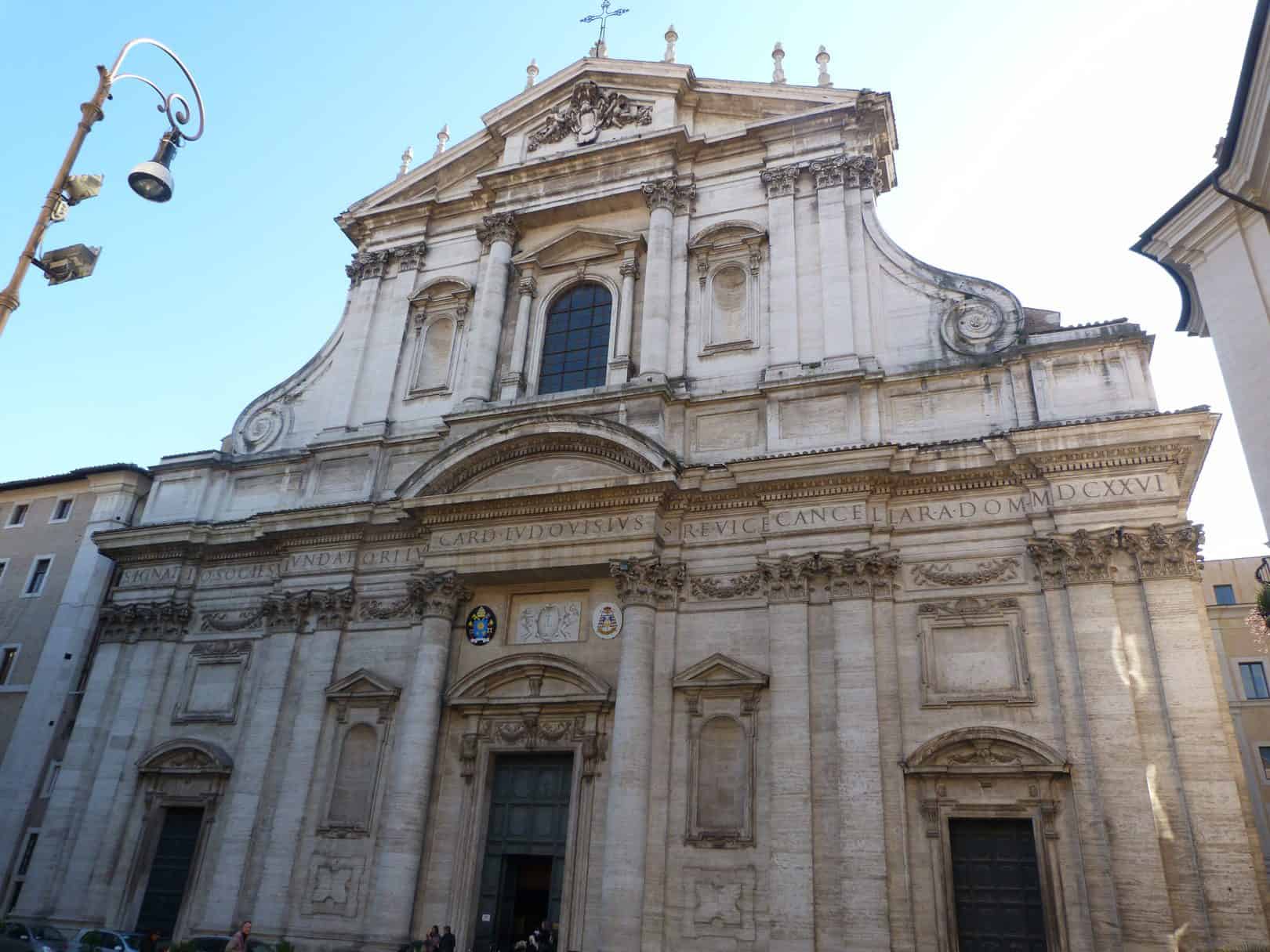
The facade has two levels. On the lower level are three openings that provide access to the building, topped by curved pediments with decorative festoons. The central doorway is accented by two large columns with Corinthian capitals. On the upper level, aligned with the central doorway, is a large window that lets light into the nave. At the ends of the upper level, on both sides, are the large inverted volutes that connect the upper part with the lower sides. They are direct relatives of the ones Leon Battista Alberti invented for Santa Maria Novella in Florence, and whoever designed this facade knew that very well.
A practical tip for the facade: look at it from the far end of via del Caravita or from the corner of via di Sant'Ignazio, not from directly below. From directly below, it looks squashed. The square is small on purpose, and the curved buildings that enclose it are there precisely to give you the minimum distance needed to see the whole facade. The square's story is its own, told later, and in our view it is the second wonder of this place, after the vault.
The Dimensions and Floor Plan of the Chiesa di Sant'Ignazio di Loyola in Campo Marzio
The church has a Latin cross plan, with an apsidal presbytery and six side chapels, three on the left and three on the right. The measurements that circulate put it at 81.5 meters long and 43 meters wide, but these are not confirmed by an official source: the church's website does not publish dimensions, and neither does the tourism office listing. As a rough sense of scale, it is a long church: walking at a normal pace from the door to the high altar takes a good minute.
What matters about the floor plan isn't the length. It's that the nave is unique and wide, with no colonnades to break up the view upward. Grassi, or whoever it was, built a perspective box: a space designed so that anyone who enters has a continuous, clear surface over their head. Andrea Pozzo, 60 years later, found the canvas already stretched. It's unlikely that was luck: the Company knew exactly what it wanted from a space like this, and had already tried it at the Gesù.
Andrea Pozzo's Vault: how the perspective really works
Andrea Pozzo was a Jesuit and a painter, and he arrived at the Chiesa di Sant'Ignazio di Loyola in Campo Marzio around 1685 to do what no one had yet done in that way: break through a ceiling without touching it. The large fresco of the vault is the center of the whole church's decoration, and its subject is stated openly: the glory of Saint Ignatius of Loyola at the center, supported by angels, with the IHS trigram, and at the ends, the allegories of the love of God and the fear of divine punishments. There is also Saint Francis Xavier, the man who brought the Company to Asia. The theme, stated in one line, is the apostolic work of the Jesuits in the world.
Here's how it works in practice. Stand on the spot marked on the floor, in the middle of the nave, and look up. From there, above your head there's no longer a ceiling: there's a second temple, painted, laid over the real one, organized on two levels like true architecture, with columns, arches and entablatures rising in a sinuous movement upward. The perspective is what treatises call "from below upward": Pozzo calculated every line from a single viewpoint, the one where you are standing. At the top, in golden light, is the Glory of Saint Ignatius, with Christ showing the banner of the cross. From Christ's side a beam of light strikes Ignatius, and from Ignatius the light branches out toward four allegorical figures representing the four continents known at the time. It's a map disguised as theology: Europe, Asia, Africa and America receive the light that comes from Christ and passes through the founder of the order. Couldn't be clearer.
The technical point nobody explains to you, and which is actually everything: this perspective works from only one point. Take 3 steps forward and the painted columns start to bend. Take 10 steps forward and the architecture crumples, the arches warp, the second temple collapses. Pozzo knew this and wrote it in his treatises: it was the price of the trick. Walk back and forth along the nave looking up, and you'll have the best experience you can have in here: you watch the illusion form, work and fall apart over 20 meters of floor. It's worth more than 10 audio guides.
The Disc in the Floor and the Second Mark
In the nave floor there's a disc marking the ideal observation point for the vault. Sometimes you read about "a golden disc," but the sources describe it as a marble disc set in the center of the nave floor. That's not a minor difference, because a visitor looking for a shiny golden circle risks walking right over it without seeing it: it's a round piece of marble, flush with the floor, and you have to look for it with your eyes down, in the middle of the nave, more or less at the height of the third bay. If there's a crowd, wait: it's one square meter, and the line to stand on it clears in a minute.
Farther toward the altar there's a second mark in the floor. That's the point from which to look at the fake dome, which is a different work from the vault and has its own vanishing point. These are two separate experiences and should be done separately: first the disc in the nave with your gaze on the vault, then the second mark with your gaze on the crossing. Someone who walks in, stands in the middle and looks up at random sees two things done badly instead of two things done very well. That's why so many people leave here saying they expected more: they looked from the wrong spot.
The advice on this point: arrive early in the morning, around 9 when they open, or late in the evening, after 21, which is possible here because the church closes at 23.30. In those two windows the two marks on the floor are free, and you can stand on them for a good two minutes without anyone pushing you along. In the middle of the day, between 11 and 16, there are the groups.
The Fake Dome and the Real Dome That Was Never Built
Above the crossing of the Chiesa di Sant'Ignazio di Loyola in Campo Marzio there is a dome. Tall, with ribs, with coffers, with light coming down from the lantern. Only it isn't there. It is a flat painted canvas, stretched over the crossing, and from the right spot it looks like a perfect dome. It is Andrea Pozzo's most famous work after the vault, and it is also the only architectural illusion in Rome that still fools people who carry a phone with a camera in their pocket, three and a half centuries later.
Why was the real dome never built? There are two explanations going around, and they need to be kept apart by degree of certainty. The first, which the sources give as the main reason, is lack of funds: there was no money to build the dome. The construction site had dragged on for decades, the two Ludovisi bequests had been burned, and a masonry dome over a crossing of that size was the heaviest expense in the whole project. The second explanation is that the local residents, in particular the Dominican fathers or the neighbors of the Collegio, opposed a large dome that would have blocked their sunlight. This second version is a tradition, much repeated, that isn't documented in any official source: it should be treated as a tradition, not as a fact. The economic reason, on the other hand, holds up, and it is also the more Roman of the two.
Be aware that two sources contradict each other about the diameter of the canvas. The official tourism office page says the fake dome is "a canvas 13 meters in diameter." A source on Roman urban history says instead "a canvas 17 meters in diameter, made in 1685." That's a four-meter difference, and it's not rounding. The sources don't agree, so the exact measurement should be asked of the people who look after the church. On the date of 1685, however, the sources agree, and it is the same as the date of the vault fresco.
There is also another fact, perhaps the most interesting of all. The canvas you see today is not the one by Andrea Pozzo. The original 1685 painting was destroyed by a fire, and in 1823 it was faithfully reproduced by Francesco Manno based on the drawings and studies left by Pozzo. The information comes from an English-language encyclopedia source and is not confirmed on the church's official pages, which talk about the fake dome without mentioning a fire. It is information from a serious but unofficial source, and it deserves confirmation. If it is accurate, then the marvel that leaves you openmouthed is a nineteenth-century copy made so well that no one notices. Which, if you think about it, is the trick within the trick.
The Mirror, the Neck and How to Look at the Vault Without Hurting Yourself
Looking at the vault of the Chiesa di Sant'Ignazio di Loyola in Campo Marzio means keeping your head tipped back for a few minutes, and after three minutes your neck starts to complain seriously. Anyone with cervical problems already knows this. The solution used in churches like this one is the mirror: a large tilted mirror, mounted on a stand or on wheels and placed in the middle of the nave, which reflects the vault and lets you look at it with your head straight, the way you look at a painting set on an easel.
Among the church's official pages, including those dedicated to the artworks and practical information, and the English-language encyclopedia entry, none of these sources mention the mirror. So there is no guarantee it will be there the day you go, nor is it known exactly where it is placed, or whether it is always available or only brought out at certain times. People who have been recently often talk about it, but visitors' accounts are not a verified source. If you find it, use it: stand behind it, look into the mirror, and you'll see the whole vault without tilting your head at all.
If you don't find it, here are three tricks that always work. First: sit down. On a bench, resting your back and the back of your head against the seat back of the row behind you, your neck no longer has to work, and you can keep looking up for 10 minutes. Second: use your phone screen as a mirror, holding it in front of your chest slightly tilted, with the front camera on, it's an ugly thing to say, but it works really well, because it gives you back the vault with the right field of view without you having to bend. Third, and this is the best one: stretch with your gaze, not your body, alternating 30 seconds looking up with 30 seconds looking down. Pozzo's vault is not used up in one go, and looking at it in stages shows you things you miss at first glance, for example the figures of the four continents in the corners, which at first sight look like decoration and are actually the meaning of the whole painting.
The Presbytery, the Apse and the Straight Columns on the Concave Surface
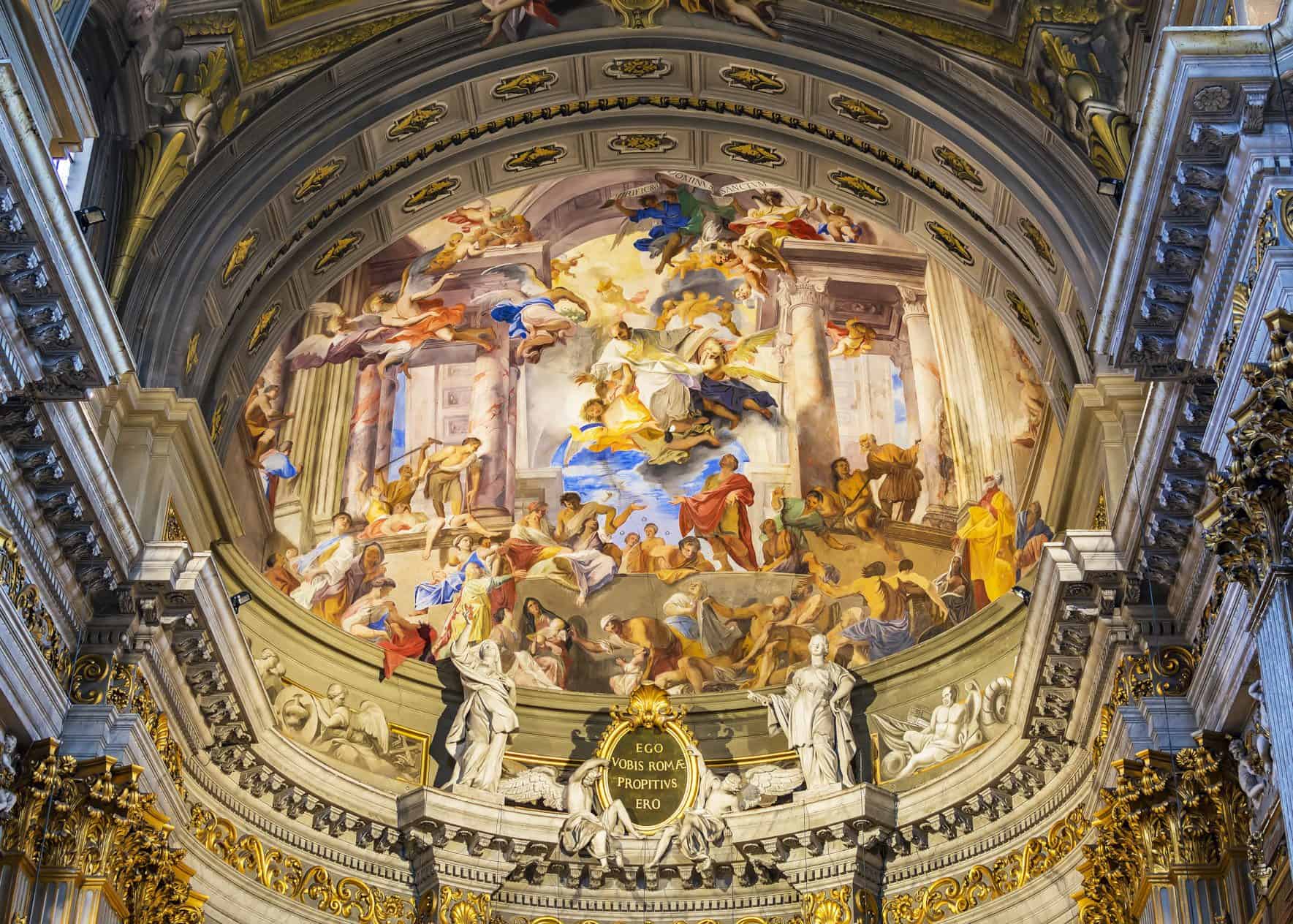
The presbytery and apse of the Chiesa di Sant'Ignazio di Loyola in Campo Marzio are the work of Andrea Pozzo and were carried out, according to the official page, between 1685 and 1701. They are the part people look at least, because they arrive here with their necks already tired from the vault, and they're wrong: here is the technically most demanding virtuosity in the entire church.
In the dome of the apse, Pozzo painted a fictive architecture with four straight columns on a concave surface. Try to think about it for a moment: you have to draw a column that rises perfectly vertical, but the surface you're painting on curves inward. If you draw it straight, it looks bent to the eye. To make it look straight, you have to draw it crooked, and to know how crooked, you have to calculate the distortion point by point. The overall effect, the official page says, is that the apse wall appears polygonal when in fact it is concave. This is mathematics applied to painting, and it is why Pozzo's treatises on perspective were studied across half of Europe and as far as China.
The subjects painted in the presbytery and the apse are scenes from the life of Saint Ignatius: the Siege of Pamplona, where Ignatius was wounded in the leg and where his whole story begins, because it is during his convalescence that he reads the lives of the saints and changes his life, the service to plague victims, the entry of Francis Borgia into the Society of Jesus, and the sending of Francis Xavier to the Indies. In the apse's conch is the Vision of La Storta, the episode in which Ignatius, in a chapel on via Cassia just outside Rome, has the vision that makes him understand where he must go. The scenes appear on the official works of art page, and together they tell an entire life story.
The Side Chapels of the Chiesa di Sant'Ignazio di Loyola in Campo Marzio
Six chapels, three per side, plus the two transepts and the two chapels flanking the presbytery. Here they are in the order you encounter them. Here the church shifts tone: after the phantasmagoria of the vault, the ground level is full of marble, reliefs, and tombs, and it is much more restrained than you might expect.
The inner facade. As soon as you enter, turn toward the door, and you'll see two stucco statues representing Religion and Magnificence, attributed to Alessandro Algardi. This is the spot where Algardi really is in this church, unlike the facade. Nobody looks at them because they stand behind people as they come in: turn around, it takes 10 seconds.
The second chapel on the right, the Sacripante Chapel, was designed by Nicola Michetti and holds the solemn altarpiece with the Transit of Saint Joseph by Francesco Trevisani. It is a piece of full 18th-century Roman art inside a 17th-century church, and you can see it in the light and the colors. Other chapels hold works by Luigi Garzi and Stefano Pozzi, according to an encyclopedia source.
The right transept holds the altar designed by Andrea Pozzo, with the large marble relief dedicated to Saint Aloysius Gonzaga, by Pierre Le Gros, dated according to that same source to 1697-1699. The official works of art page describes this altar as dedicated to Saint Aloysius Gonzaga, with a marble altarpiece and an urn in lapis lazuli. Lapis lazuli is the most precious stone of Roman Baroque, and using it for an urn is a statement of importance.
The left transept has the matching altar, dedicated to the Annunciation, with the altarpiece by Filippo della Valle. The name, as the church's official page gives it, is Filippo della Valle, sometimes written "Filippo Valle": it is the same sculptor, but if you search for it misspelled you won't find it. Here, again according to the official site, Saint John Berchmans is housed.
The Chapel of Saint Joachim holds the body of Saint Robert Bellarmine, the Jesuit theologian who was a key figure in half of 17th-century Rome.
Flanking the presbytery. On the right is the Ludovisi Chapel, with the funerary monument of Pope Gregory XV by Pierre Le Gros, and four stucco statues of the Virtues by Camillo Rusconi. According to the same encyclopedia source, the funerary monument that holds Gregory XV and Cardinal Ludovico Ludovisi was designed by Le Gros around 1709-1714. In the matching space on the left, the one leading to the sacristy, is the colossal plaster statue of Saint Ignatius, also by Rusconi. It is the model for the one later executed in marble for the St. Peter's Basilica. That is, here you see the prototype, and at St. Peter's you see the finished product. It's one of those things that make Rome a city where you can see behind the scenes for free.
A clear rule of thumb for timing: if you have 40 minutes, spend 25 on the vault and the Fake Dome and 15 walking through the chapels at a relaxed pace. If you have 20, stay under the vault and come back another day. Rushing through everything in here is pointless, because this church is built to keep you standing still in two spots, not to make you walk.

The Jesuit Tombs in the Chiesa di Sant'Ignazio di Loyola in Campo Marzio
This is a church cemetery, in the most honorable sense of the term. Inside the Chiesa di Sant'Ignazio di Loyola in Campo Marzio are kept the bodies of three saints of the Society of Jesus: Luigi Gonzaga, Roberto Bellarmino and Giovanni Berchmans. The church's official website says so, and it dedicates a separate page to each of the three figures. They are three very different profiles.
Luigi Gonzaga is the young aristocrat who gives up his marquisate and dies at 23 while caring for plague victims in Rome. He is the saint of young people, and he is the one who draws the devotion here: if you go on June 21, the church is full. The small rooms where he lived, next to the church, were the subject of a restoration that the Jesuits announced on their channels. The official site also has a section dedicated to the Giubileo Aloisiano, that is, the Aloisian anniversary: if you go in a jubilee year for him, expect extraordinary celebrations and more crowds than usual.
Roberto Bellarmino is the other extreme: cardinal, theologian, controversialist, one of the most influential men in the Church between the sixteenth and seventeenth centuries, and a figure who also appears in the story of Galileo. The fact that his body rests in a church designed by Galileo's scientific opponent is a curious coincidence that no guide tells you about.
Giovanni Berchmans is the third, Flemish, also died very young, and he lies in the left transept.
There is then a fourth burial: that of padre Felice Maria Cappello (1879-1962), Jesuit, professor at the Pontifical Gregorian University, a well-known canonist, nicknamed "il confessore di Roma". It is reported that his cause for beatification is open, but this detail is not confirmed by an official source. Still, the story is that of a man who spent decades in a confessional in this church listening to Romans of every walk of life: if you're looking for his tomb, ask in the sacristy. He is the kind of figure who explains why a university church became a point of reference for the neighborhood.
Also buried in the church, according to the encyclopedic source, is Bartol Kasic, Jesuit and linguist, author of the first grammar of the Croatian language. It is exactly the kind of presence one expects in a church linked to the Collegio Romano: scholars from all over Europe and from half the world passed through here.
The First Decoration: Pierre de Lattre and the Church Built on a Budget
There is a chapter in the history of the Chiesa di Sant'Ignazio di Loyola in Campo Marzio that never makes it into guidebooks, and yet it explains everything else. The new building was meant to serve the students of the Collegio Romano and not public worship, so the decoration of the side chapels could not be entrusted to Roman patrician families, as was always done in Rome: no family buys a chapel in a university chapel. The Jesuits themselves took on the task. And since they had to economize, the Society did what it always did in these circumstances: it used one of its own members.
His name was Pierre de Lattre, he came from Saint-Omer, and he had entered the novitiate of Sant'Andrea in 1626, the same year as the first stone. He did practically everything: he frescoed the sacristy vault, completed six paintings for the side chapels, and painted, in an illusionistic manner, a fake altar on the inner wall of the apse. Keep this detail in mind, because it's important: the church's first perspective trick is not by Andrea Pozzo. It is by a modest painter who, 60 years earlier, not having the money for a real altar, painted one. From the little that remains of his work, it's clear he was an altogether insignificant artist.
In 1640 the church was still unfinished. And here is the bitterest moment for the Jesuits: precisely in those years their rivals, the Oratoriani, were starting two works that would prove decisive for the later developments of Baroque art: the fresco by Pietro da Cortona on the sacristy ceiling of their church, and the building by the Borromini intended as a library and a hall for performances of religious music, the kind for which the Oratoriani were famous throughout Rome. The Jesuits had a stalled construction site and a church without a dome, the Oratoriani, five minutes on foot away, had Pietro da Cortona and Borromini.
This is why the arrival of Andrea Pozzo in 1685 is a revenge, and should be read that way. That vault is a response, before it is a masterpiece. The Society, which for 60 years had made do with a mediocre painter and could not afford a dome, takes its revenge by painting a dome that isn't there and a temple that doesn't exist, and does it so well that today people come here on purpose. It's a very Roman story: when there's no money for the real thing, you paint it better than the real thing.
The Organ of the Chiesa di Sant'Ignazio di Loyola in Campo Marzio
In the church there is an organ built by the Pontifical Organ Factory Tamburini of Crema in 1935, replacing an earlier one that had been enlarged in 1905-1906 by Carlo Vegezzi-Bossi. That earlier instrument had been built in 1888 by the organ builder Pacifico Inzoli, inspired by the new Morettini organ of the Basilica of St. John Lateran, and had 37 stops on three keyboards and a pedalboard. The current instrument is placed on the two side walls of the apse, above purpose-built choir lofts with Baroque balustrades, has three keyboards with a concave-radiating pedalboard, and has 53 stops.
These details are not confirmed by an independent source: the church's official website has no page on the organ. A tip: if you happen to be here during a service with the organ playing, stay. A single wide, tall nave without colonnades is a formidable sounding box, and the Chiesa di Sant'Ignazio di Loyola in Campo Marzio sounds much better than you'd expect from a building so decorated.
Filippo Raguzzini's Rococo Square in Front of the Church
Step out of the church, put your back to the facade and look. What you have in front of you is one of the very few pieces of urban Rococo that Rome has, and it's as beautiful as the interior. Piazza di Sant'Ignazio was altered in 1726 at the wish of the Jesuits, with the demolition of the existing structures, and between 1727 and 1728 the architect Filippo Raguzzini directed the construction of the small palaces that enclose it, with curved facades and an elegant design in Rococo taste. The dates come from a source on Roman urban history. The English-language encyclopedic source confirms that the Rococo square in front of the church was designed by Raguzzini, without giving the dates.
Why it matters. Raguzzini didn't design a square, he designed a theatrical set in masonry. The small palaces are arranged like the wings of a stage, with concave and convex facades answering each other, and they form a kind of irregular octagon from which the facade of the church emerges like a backdrop. That is: inside the church Andrea Pozzo paints an architecture that doesn't exist, and outside the church Filippo Raguzzini builds a real architecture that behaves like a painted scene. The two things are the same idea, 40 years apart, one with the brush and one with bricks. This is Roman Baroque at its peak, and it's also the reason it's better to arrive here on foot from Via del Corso and not from the Pantheon: you pop out into the square suddenly, and the effect of the wings works.
A tip: sit on the steps of one of the small palaces around eight in the evening, when the light is low and the facade turns yellow. The square is pedestrian, nothing passes through, and there are few people because the groups are already elsewhere at that hour. Then go in: the Chiesa di Sant'Ignazio di Loyola in Campo Marzio is open until 23:30, and the vault lit up in the evening with the church almost empty is a different experience from the daytime one.
The Other Perspective Tricks of Rome and the Castelli
The Chiesa di Sant'Ignazio di Loyola in Campo Marzio is part of a small collection of Roman optical illusions, and if you like this theme you can build a whole day around it.
Borromini's gallery at Palazzo Spada. The gallery, traditionally dated to 1653, is only 8.82 meters long but seems much longer, and the statue of Mars in the background seems imposing while it is barely 60 centimeters tall. The mechanism is this: columns that shrink, a floor that rises, a ceiling that descends, and the eye that falls for it. The two measurements and the date are traditional figures, not confirmed by an official source. The gallery is described on the page dedicated to the Galleria Spada.
Via Piccolomini. Walking along Via Piccolomini toward the dome of St. Peter's, the dome seems to move away and get smaller and smaller as you get closer, instead of growing. It's the most famous optical illusion in Rome after this church, and it's free, outdoors, and works even from a car.
The Orange Garden. A similar effect can be seen from the Orange Garden on the Aventine, again taking the dome of St. Peter's in the distance as the reference.
The uphill that goes downhill, between Ariccia and Rocca di Papa. The famous Ariccia uphill-downhill, the stretch of road where a car in neutral seems to roll uphill by itself. There's no architect there, just the landscape fooling the horizon.
The thread that holds these five things together is just one, and the Chiesa di Sant'Ignazio di Loyola in Campo Marzio is the leader of the group: the human eye doesn't measure, it compares. If you give it the wrong references, it believes you.
A Curiosity About the Chiesa di Sant'Ignazio di Loyola in Campo Marzio
The most beautiful curiosity about this place is that its most famous work was born out of a renunciation. The masonry dome planned in the design was never built, and sources point to a lack of funds as the main reason. At that point the Jesuits had two choices: leave a hole patched up as best they could above the crossing, or paint what they couldn't build. They chose the second, called in Andrea Pozzo, and the result is that today millions of people come here to see something that doesn't exist.
There's a second layer of curiosity, and it's even more fun. As mentioned, according to an encyclopedia source, the original 1685 canvas burned in a fire, and in 1823 it was faithfully reproduced by Francesco Manno from drawings left by Pozzo. If the information is accurate, and it bears repeating that the church's official pages don't confirm it, then the fake dome of the Chiesa di Sant'Ignazio di Loyola in Campo Marzio is a copy of a fiction. A nineteenth-century reproduction of a seventeenth-century illusion of a dome that was never built. Three levels of "it isn't there," stacked on top of each other, and people still walk out with their mouths open.
Third curiosity, smaller and entirely Roman: tradition holds that it was the neighbors who opposed the real dome, because they didn't want to lose their sunlight. It isn't documented anywhere. It's an oral tradition. But if you know how attached Romans are to the light that comes into the kitchen, you'll understand why the story has survived three centuries.
Something Nobody Tells You About the Chiesa di Sant'Ignazio di Loyola in Campo Marzio
That it closes at 23.30. This is the thing nobody tells you, and it completely changes the visit. Rome is a city where churches close at noon and reopen at four, where you find the doors shut just when you have two free hours, where the average tourist spends half their vacation reading signs with opening hours. Not here. Here the Chiesa di Sant'Ignazio di Loyola in Campo Marzio is open every day from 9.00 to 23.30 without a break: no lunch break, no afternoon closing, and in the evening until half an hour before midnight.
This means you can have dinner downtown, leave the restaurant at half past 10, take a short stroll, and find yourself under Andrea Pozzo's vault practically alone. No groups, no guide speaking five languages at once, no one competing with you for the marble disc. It's one of the most beautiful experiences in the Historic Center: at 11 in the evening there are five people inside, the silence is real, and the vault lit from below has a depth it doesn't have during the day, when natural light comes in through the large window.
The second thing nobody tells you is that the illusion works from one spot only, and anyone who doesn't know this leaves disappointed. The marble disc in the floor is not decoration. It's the only position from which the painting is a painting instead of a smudge. Find it, stand on it, and only then look up.
The Advice I Give You for Visiting the Chiesa di Sant'Ignazio di Loyola in Campo Marzio
The advice is just one, in two words: go twice. Once early in the morning and once late in the evening. The same church, 12 hours apart, is two different buildings.
In the morning, around 9 or 9.30, light comes in through the large window on the facade and cuts across the nave diagonally. You see Pozzo's vault in natural light, which is the light it was painted for, and the colors of the painted sky sit high and bright. At that hour there are the first worshippers, a few students, and no groups. The marble disc is free.
In the evening, after 21, the church lives on artificial light, and the effect is theatrical. The fake dome above the crossing under nighttime lighting gains depth and loses some detail, and in our opinion it looks better that way, because it's exactly how a seventeenth-century audience would have seen it during the great evening celebrations, by candlelight. More than seeing it, you undergo it.
Other practical tips, in order of importance. Bring a sweater even in summer: it's a huge church, made of marble, and at midday in August it's 10 degrees cooler inside than outside. Respect the dress code: shoulders and knees covered. It's an active place of worship, and they do check here. Don't enter during Mass to take photos: at 18.30 every day, and at 11.30 on Sundays, tourism stops and the church is a church. Allow 40 minutes: 20 under the vault and under the fake dome, 20 for the chapels and tombs. Step outside and stay in the square another 10 minutes, looking at Raguzzini's buildings. It's the part everyone skips, and it's half the show.
Another Well-Known Fact, Though Rarely Cited
That this is not a parish church but a university chapel. It's a well-known fact among insiders, and almost nobody mentions it when they talk about Pozzo's vault, yet it's the key to everything. The Chiesa di Sant'Ignazio di Loyola in Campo Marzio was created for the students of the Collegio Romano, that is, for an audience of young people in training, many of whom were destined for missions in America, Asia and Africa.
Now reread the vault with this information in mind. The light comes from the side of Christ, strikes Ignatius, and from Ignatius it branches out toward four allegorical figures that are the four continents known at the time. It isn't a theological ornament: it's a manifesto aimed at young men who would soon be setting sail on a ship. Look up there, where you'll end up. The ceiling of your classroom is a map of the world.
The rest of the building's economic history also follows from this fact. Because it was a church for students and not for public worship, the side chapels could not be sold to Roman patrician families, who were the standard funding system of every Roman church of the time. No families, no money. No money, decoration done in-house by the mediocre Pierre de Lattre, a 96-year-long construction site, and a dome that was never built. The reason there is a canvas above your head instead of masonry is written in the founding act: this church is an annex of a school.
The Right Photo to Take at Chiesa di Sant'Ignazio di Loyola in Campo Marzio
There are three, and they're three very different photos. Here they are in order of difficulty.
The first: the vault from the marble disc. Stand on the disc in the nave floor, phone horizontal above your head, wide-angle lens, and frame the entire vault. This is the photo everyone tries to take and almost everyone gets wrong, because they take it from the wrong spot and end up with a jumble of crooked columns. From the right spot, the second painted temple fits perfectly within the frame, and the columns look vertical. A serious technical tip: lean your back against a bench and keep your elbows tight to your body, because with your arms raised in midair the photo will come out blurry. And don't use flash, which is useless here and ruins everything.
The second: the fake dome from the second mark. Keep walking to the second marked spot on the floor, toward the crossing, and frame just the dome, without trying to include the vault too. The photo that works is the tight one: dome centered, symmetrical ribs, lantern in the middle. Then, and here's the fun part, move five meters over and take the same photo again. Put the two images side by side and you'll have the best demonstration of Pozzo's trick you can bring home: in the first one it's a dome, in the second it's a crooked canvas.
The third, the one nobody takes: Piazza di Raguzzini with the facade in the background. Go outside, head to the entrance of via del Burro' or to the opposite corner of the square, and frame the curved facades of the small palazzi with the church serving as the backdrop. Take it around half past eight in the evening in summer or around five in winter, when the low light catches the plaster. This is the photo that sets you apart from the 10,000 identical shots of the vault, and it's also the only one that really explains where you are.
General rule on behavior: photos are allowed here. It's an open church and there are no bans stated on the official pages, but common sense counts for more than the rules. No photos during the 18.30 Mass, no flash, no tripods in the middle of the nave, and if someone is praying on a bench, turn the other way. It sounds obvious, yet it needs to be said.
Some Important Events That Happened Here in History
March 12, 1622. Ignatius of Loyola is canonized. It doesn't happen in this church, which doesn't exist yet, but it's the event that generates it: without that canonization, Pope Gregory XV would not have suggested to his nephew that he build a new church dedicated to the saint.
1623. Gregory XV dies. The project loses its highest patron after barely a year, and from that point on Cardinal Ludovico Ludovisi finds himself dealing alone with the Society of Jesus, which is much stronger than he expected.
August 2, 1626. The first stone is laid, after four years of delay due to the need to dismantle parts of the Collegio Romano buildings. It is the official birth date of the construction site.
1640. The church is still unfinished, while a short distance away the Oratorians unveil Pietro da Cortona's fresco in the sacristy of their church, and Borromini's building work continues. It is the lowest point in the story.
1650. Jubilee Year. Chiesa di Sant'Ignazio di Loyola in Campo Marzio is opened for public worship on a provisional basis, with the interior still partly cluttered. Rome fills with pilgrims, and the Jesuits could not afford to keep the door closed.
1685. Andrea Pozzo paints the fresco on the vault and creates the canvas of the fake dome. This is the year that turns an unfinished building into one of the most visited places in Rome. The presbytery and the apse will be completed between 1685 and 1701.
1697-1699. Pierre Le Gros carves the large marble relief of Saint Aloysius Gonzaga for the altar of the right transept, according to the dating in an encyclopedic source.
1709-1714 circa. Le Gros again designs the funerary monument that houses Pope Gregory XV and Cardinal Ludovico Ludovisi in the Ludovisi chapel, to the right of the presbytery.
1722. Solemn consecration of the church, celebrated by Cardinal Antonfelice Zondadari. 96 years after the first stone.
1726-1728. On the Jesuits' wishes, the structures in front of the church are demolished, and between 1727 and 1728 Filippo Raguzzini builds the curved palazzetti of the square. The urban stage set is completed.
1823. Francesco Manno faithfully reproduces the canvas of the fake dome, destroyed by a fire, based on the drawings and studies left by Andrea Pozzo. The information comes from an English-language encyclopedia source and is not confirmed by the church's official pages.
1888, 1905-1906, 1935. The three dates of the organ: the construction of the instrument by Pacifico Inzoli, the enlargement by Carlo Vegezzi-Bossi, and the replacement with the current Tamburini of Crema. Dates not confirmed by an official source.
1962. Father Felice Maria Cappello, "the confessor of Rome," dies. He had spent decades at the confessional in this church.
Who Passed Through the Chiesa di Sant'Ignazio di Loyola in Campo Marzio
First, the patrons. Pope Gregory XV, who suggested the project and is buried here, and his nephew Cardinal Ludovico Ludovisi, who financed it with two bequests of 100,000 units each and who rests in the same funerary monument. Two men who paid for a church without seeing it finished.
Then the architects, and this is the most novelistic part. Domenichino, who took part in the competition and who, according to an eighteenth-century note, left in a rage. Carlo Maderno, called onto an oversight committee, whose drawings, according to a source on Rome's urban history, still made it into the project along with those of Paolo Martucelli and Orazio Torriani. And above all the Jesuit father Orazio Grassi, a mathematician and astronomer at the Collegio Romano, the man who won the game and who, in the history of science, is remembered as the opponent of Galileo Galilei in the controversy over comets. After him, in charge of the works, another Jesuit, Il Sasso.
The artists. Andrea Pozzo, a Jesuit and painter, who left his absolute masterpiece here and who afterward became a European reference point for painted perspective. Pierre de Lattre of Saint-Omer, the first and forgotten decorator. Alessandro Algardi, whose two stucco statues on the counterfacade survive. Pierre Le Gros, author of the relief of Saint Aloysius Gonzaga and of the monument to Gregory XV. Camillo Rusconi, with the four Virtues in stucco and the colossal plaster statue of Saint Ignatius that is the model for the marble one in Saint Peter's. Francesco Trevisani, with the Transit of Saint Joseph. Nicola Michetti, who designed the Sacripante chapel. Filippo della Valle, with the altarpiece of the Annunciation. Luigi Garzi and Stefano Pozzi, present in the chapels according to an encyclopedia source. Francesco Manno, who remade the fake dome in 1823. Filippo Raguzzini, who built the square outside.
The saints and the religious. Saint Aloysius Gonzaga, Saint Robert Bellarmine and Saint John Berchmans, the three Jesuits buried inside here. Cardinal Antonfelice Zondadari, who celebrated the consecration in 1722. The Croatian Jesuit Bartol Kasic, author of the first grammar of his language. And Father Felice Maria Cappello, the confessor of Rome, who here listened to the whole city for decades.
And finally, even though no register recorded them, the thousands of students from the Collegio Romano who prayed in this nave before leaving for India, Paraguay, and China. They were the real audience for whom Andrea Pozzo painted the four continents.
Things to See Around the Chiesa di Sant'Ignazio di Loyola in Campo Marzio in 10 Minutes on Foot
This is one of the most fortunate locations in Rome. From Piazza Sant'Ignazio, in 10 minutes of easy walking, you can reach practically anywhere in the old center, and here are the stops, in order of distance.
Three minutes. The Pantheon, on the other side of via del Seminario. If you have only one hour in the center, the pairing of the Pantheon plus the Chiesa di Sant'Ignazio di Loyola in Campo Marzio is the best value in Rome, because they are two domes to compare: a real one, of Roman concrete, with the hole in the center, the other painted on a flat canvas. Do them in whatever order you like, but do them on the same day.
Four minutes. Piazza Colonna with the Column of Marcus Aurelius, and right next to it Montecitorio with the obelisk. This is the part of Rome where Italian political power literally sits on top of Roman imperial power.
Five minutes. The Basilica of Santa Maria sopra Minerva, the only Gothic church in Rome, with Bernini's little elephant out front. The contrast with the church you're reading about is instructive: here the Baroque that fakes the sky, there the Gothic that really raises its vaults.
Seven minutes. The Trevi Fountain, which at this hour of the day is a circle of Dante's Inferno but after 23:00 goes back to being a fountain. And the Galleria Colonna, which Romans themselves don't know and which has one of the most spectacular halls in the city.
Eight minutes. Palazzo Doria Pamphilj on via del Corso, with its private gallery and Velázquez's portrait of Innocent X. If you have time for only one museum in the center, that's the one to choose.
10 minutes. Piazza Navona, the Church of San Luigi dei Francesi with the three Caravaggios in the Contarelli Chapel, Largo Argentina with its sacred area and the four Republican temples. And, a little further on, the Basilica Sant'Andrea della Valle, which has the dome painted by Giovanni Lanfranco and which, together with this church, makes the perfect pair for understanding what it means to paint a sky inside a building.
A suggested route if you have half a day: Largo Argentina, San Luigi dei Francesi, Pantheon, Chiesa di Sant'Ignazio di Loyola in Campo Marzio, Piazza Colonna, Trevi Fountain. Six stops, all free except one, just under 3 kilometers of walking, and enough Baroque to last you a month.
The Chiesa di Sant'Ignazio di Loyola in Campo Marzio with Children
It works great. The reason is that there's a real game here, and kids get it in two seconds.
The game goes like this: put them on the marble disc, have them look up, and then have them walk forward keeping their eyes on the ceiling. They'll see the painted columns bend, the architecture crumple, the fake temple collapse. Then you bring them back to the disc and everything straightens out. It's a kind of mechanical magic, it works with your feet, it costs nothing, and it lasts as long as you like. Then do the same with the fake dome, from the second marker: stand under it, see it round, move 5 meters over and see it flat.
Practical tips: the church is large and there's room to be comfortable, but it remains a place of worship, and running in the nave isn't okay, especially around Mass time. There's no public restroom listed on the official pages, so plan ahead, at one of the bars in the area. Strollers get in without trouble through the central door, which is at street level. If it's raining and you have small kids, this church is one of the best places in the center to wait it out: it's dry, warm in winter, cool in summer, free, and there's half an hour's worth of looking up to do.
Accessibility and Practical Rules
The main entrance of the Chiesa di Sant'Ignazio di Loyola in Campo Marzio faces the square, and the nave is a single, wide level with no interior steps between the entrance and the crossing: generally speaking, it's a church you can get through in a wheelchair or with a stroller. The exterior steps of the façade, the presence of ramps and the existence of a step-free alternative entrance are not confirmed by an official source: the official pages don't have a section on accessibility. If you have a specific need, call the office at 06 6794406 Monday through Friday from 9 to 13 and ask: it's an office that picks up.
The rules that always apply in an active church: shoulders and knees covered, hats off, phone on silent, voices low. During the 18.30 Mass and the 11.30 Sunday Mass, free visiting stops. The same goes for weddings, which are frequent here because it's a very sought-after church: the official pages specifically note that access is limited during services and weddings. If you find the nave taken up by a ceremony, don't push it: come back later, since it closes at 23.30 and you've got time.
None of these are listed on the official channels: cloakroom, luggage storage, audio guide rental, bookshop. Don't count on them. Bring water and use the bars on the square, which are 20 meters away.
When to Visit the Chiesa di Sant'Ignazio di Loyola in Campo Marzio and When to Avoid It
The best times. From 9 to 10 in the morning, right when it opens, when only the worshippers are there and the natural light is just right. After 21, once the city has had dinner and the church is empty. On weekdays in January and February, when Rome belongs to the people who live here. On rainy days, for obvious reasons.
The worst times. From 11 to 16 in high season, when organized groups shuttle between the Pantheon and the Trevi Fountain and this church is the mandatory stop in between: the marble disc turns into a line, and under the vault you stand shoulder to shoulder. On June 21, the feast day of Saint Aloysius Gonzaga, if you're looking for silence: it's a day of intense devotion and the church is full. Saturday afternoons in May, June and September, because of weddings. And obviously the Mass times, if your goal is to look at the ceiling and not pray.
A note on jubilee years and Aloisian anniversaries: the official website has a section dedicated to the Aloisian Jubilee, so on those occasions expect extraordinary schedules, additional celebrations and more people than usual. Check the church's "Eventi" page before you go.
How much it costs to visit the Chiesa di Sant'Ignazio di Loyola in Campo Marzio
Zero. Zero euros, full ticket zero, reduced zero, children zero, groups zero. Access and self-guided visits are free, as the official website states. There is no full ticket, there is no reduced ticket, and there is no free first Sunday of the month because it's free every day.
There are only three possible expenses, and they're all voluntary. The first is the offering: there's a donation box and there are candles, and if you liked the place, leaving something is a good idea, because restoring a church like this costs money, and the official website has a dedicated page for donations. The second is a private guide that you decide to hire: legitimate, but know that the volunteers of Pietre Vive offer the same service for free on published dates. The third is a coffee in the piazza, which at the table costs what it costs in the center of Rome and is no surprise.
What you must not pay for under any circumstances is an entrance ticket, a skip-the-line pass, priority access or a package that includes "the entrance to the church of Sant'Ignazio." The rector has posted an explicit notice on the website precisely because outside agencies sell unauthorized paid packages. If you read about it in an online offer, that's the sign you're being sold a bill of goods.
Quick questions about the Chiesa di Sant'Ignazio di Loyola in Campo Marzio
How much does it cost to enter the Chiesa di Sant'Ignazio di Loyola in Campo Marzio?
Nothing. Access and self-guided visits are free, as the church's official website states. There is no ticket office and no ticket, neither full nor reduced.
What are the opening hours?
Every day from 9.00 to 23.30, open continuously, with no lunch break. This information is confirmed both by the "Orari e contatti" page on the church's website and by the listing from the municipal tourism office.
Does the church close for lunch like other Roman churches?
No, and that's one of its most useful features. It's open continuously from 9 to 23.30. If you have two free hours at noon on a weekday, this is one of the few places in the center where you can walk in without checking the calendar.
Do you need to book to visit the Chiesa di Sant'Ignazio di Loyola in Campo Marzio?
No. No reservation is needed for the free visit. The "Eventi" page of the official website explicitly states that no reservation is required for ordinary opening hours or for Mass.
How long does the visit take?
Between 30 and 40 minutes if you want to see the vault, the fake dome, the presbytery and the chapels well. 20 minutes if you're only interested in the two illusions by Andrea Pozzo. A full hour or more if you stay to watch the vault in stages, which is the recommended choice.
Where exactly is the disc for viewing the vault?
In the nave floor, in the middle, roughly at the height of the third bay. It's a marble disc flush with the floor, so you have to look for it with your eyes lowered.
How many viewing points are there?
Two. The first, in the middle of the nave, for the vault fresco. The second, farther forward toward the altar, for the canvas of the fake dome above the crossing. They are two separate works with two different vanishing points, and they should be viewed separately.
Is the dome of the Chiesa di Sant'Ignazio di Loyola in Campo Marzio real?
No. It's a flat canvas painted in perspective. The masonry dome called for in the design was never built, according to the sources, mainly for lack of funds.
How large is the canvas of the fake dome?
Here the sources disagree: the municipal tourism office listing gives a canvas 13 meters in diameter, while a source on Roman urban history says 17 meters. The sources agree on the date of 1685.
Is the canvas you see today Andrea Pozzo's original?
According to an English-language encyclopedia source, no: the original from 1685 was destroyed by a fire, and in 1823 Francesco Manno faithfully reproduced it based on the drawings left by Pozzo. This detail does not appear on the church's official pages, so it's information that still needs to be confirmed.
Is there a mirror to look at the vault without breaking your neck?
It's not confirmed. The church's official pages and the English-language encyclopedia entry don't mention any mirror. Many visitors say they found one in the nave, but it's not a verified source. If it isn't there, sit on a pew and rest the back of your head, or use your phone screen as a mirror.
Can you take photographs inside the Church of Sant'Ignazio di Loyola in Campo Marzio?
The official pages list no declared ban on photography. Common sense applies: no flash, no tripods in the middle of the nave, no photos during services.
Is the church wheelchair accessible?
The nave is a single wide level, so getting around inside is easy. For the outside steps and any ramps there is no official source: call the office at 06 6794406 Monday to Friday from 9 to 13.
Is it suitable for children?
Very much so. The perspective illusion turns into a game: you step on the disc, look up, walk forward and watch the painted architecture distort. It works at any age and costs nothing.
What time are the Masses?
Every day at 18.30. On Sundays and holidays also at 11.30. This is from the official website, confirmed by the tourism board's listing.
And confessions?
In the morning from 10.30 to 12.30 and in the afternoon from 16.00 to 18.00, according to the "Hours and contacts" page.
Are there free guided tours?
Yes. The volunteers of the Pietre Vive initiative offer free accompanied visits on specific dates, with afternoon slots from 16.30 to 18.30 and evening slots from 21.00 to 23.00. The dates change by season: write to pietreviverome@gmail.com to find out the current ones.
Is there a paid evening show inside the church?
On the official pages, no: no paid evening show is announced by the church. What there is in the evening is the free guided openings by Pietre Vive and the ordinary opening until 23.30. The rector also warns that outside agencies sell unauthorized paid packages.
What is the exact address?
Via del Caravita 8/A, 00186 Rome, which is the address given by the official website. The municipal tourism board's listing instead simply gives Piazza Sant'Ignazio, which is where the facade looks out. They are the same building, seen from two sides.
How do you get there by public transport?
The church is in a pedestrian area and the last stretch is on foot anyway: four minutes from the Pantheon, two from Piazza Colonna. The exact bus line numbers don't come from a reliable source: check the route on the Rome public transport app on the day you go, because in the center lines are often rerouted.
Can you get there by car?
Not recommended. The area is the Centro Storico ZTL and there is no street parking. Better to leave the car outside the ZTL and arrive by public transport.
Who painted the vault?
Andrea Pozzo, Jesuit and painter, around 1685. The same hand made the canvas of the fake dome and, between 1685 and 1701, the presbytery and the apse.
Who designed the church?
The Jesuit father Orazio Grassi, mathematician and astronomer of the Collegio Romano, according to the church's official website. A source on Roman urban history adds that Grassi also used drawings by Carlo Maderno, Paolo Martucelli and Orazio Torriani. The attribution of the facade to Alessandro Algardi, which is often read, is not confirmed.
When was it built?
Cornerstone on August 2, 1626, provisional opening for worship in 1650 for the Jubilee, solemn consecration in 1722 by Cardinal Antonfelice Zondadari.
Who is buried in the Church of Sant'Ignazio di Loyola in Campo Marzio?
Three Jesuit saints, Aloysius Gonzaga, Robert Bellarmine and John Berchmans. Pope Gregory XV and Cardinal Ludovico Ludovisi in the monument of the Ludovisi chapel. Father Felice Maria Cappello, the confessor of Rome. And, according to an encyclopedic source, the Croatian Jesuit and linguist Bartol Kasic.
What is the difference between this church and the Church of the Gesù?
The Gesù is the mother church of the Society of Jesus and the model the Jesuits wanted to follow here too, so much so that, according to Bellori, they told Domenichino not to trouble himself because they intended to repeat the form of the Gesù. The Church of Sant'Ignazio di Loyola in Campo Marzio was instead born as a chapel of the Collegio Romano, that is as a university church, and this is the difference that explains almost all of its particularities.
Why is it near the Pantheon?
Because the Collegio Romano had settled in 1560 in the buildings of the Marchesa della Tolfa in the Campo Marzio district, and the new church had to rise next to the college. The initial project foresaw another area, near the novitiate of Sant'Andrea, but the pope objected that the building would take away his view of the Quirinal.
What can I see around in 10 minutes on foot?
Pantheon, Piazza Colonna, Montecitorio, Santa Maria sopra Minerva, Trevi Fountain, Palazzo Doria Pamphilj, Piazza Navona, San Luigi dei Francesi and Largo Argentina. It's one of the most convenient locations in the historic center.
How long do you wait in line?
There's no line at the entrance because there's no ticket office. The only wait you might face is one or two minutes to step onto the marble disc when there are groups, between 11 and 16 in high season.
Is it worth going back in the evening?
Yes, and it's the most practical advice of all. Between 21:00 and 23:30, the Chiesa di Sant'Ignazio di Loyola in Campo Marzio is almost empty, the vault is artificially lit, and the experience is completely different from the daytime one. There aren't many places in Rome where you can do this for free at that hour, in a building of this level.
The Point of the Visit
The Chiesa di Sant'Ignazio di Loyola in Campo Marzio is the place that explains better than any other how this city works. They didn't have the money for the dome, and they painted it. They couldn't sell the chapels to the nobles, so they decorated them themselves, with a mediocre painter, for 60 years. Then a Jesuit from Trentino arrived with a compass and turned the shortage into the most famous thing about the building. Go there at 11 at night, when there's no one, step onto the disc, look up for a good two minutes without taking the photo, then walk out into the square and look at Raguzzini's curved facades. It's all free, it's 500 square meters of theater, and anyone who wants to sell you a ticket to get in here is taking you for a ride.