Sutri (VT)
In short. Sutri (VT) is about 50 kilometers north of Rome, in Viterbo Province, perched on a tuff spur that overlooks Via Cassia just before Lake Vico.


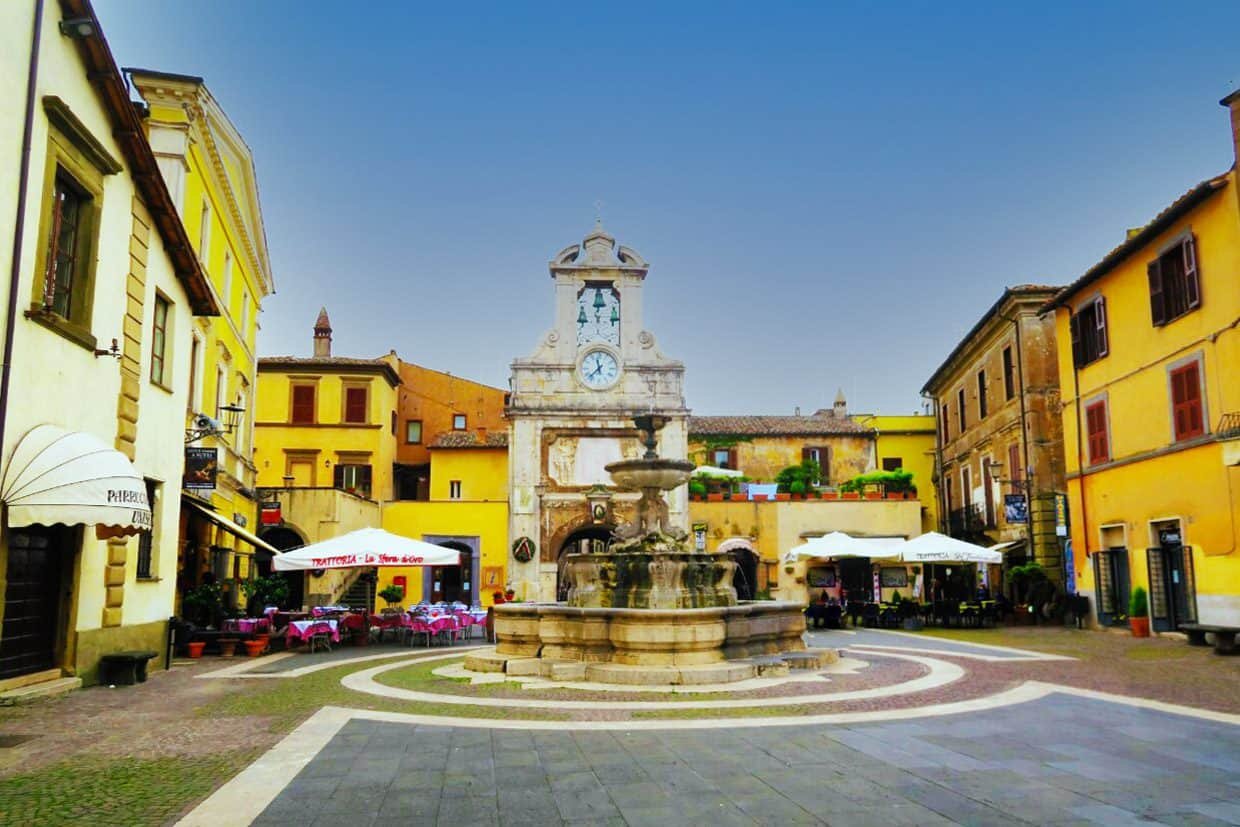
Sutri (VT) is about 50 kilometers north of Rome, in Viterbo Province, perched on a tuff spur that overlooks Via Cassia just before Lake Vico. The center from which to start your visit is Piazza del Duomo, 01015 Sutri VT: here you'll find the Concattedrale di Santa Maria Assunta and the Museo di Palazzo Doebbing, and a few steps away are the archaeological park with the amphitheater and the Chiesa della Madonna del Parto. By car, you can get there from Rome along Via Cassia (SS2) or by taking the Cassia Veientana to Monterosi and then the old Cassia. If you're coming from the A1 highway, exit and head up toward Nepi and the Cassia. By public transport, the Cotral buses that connect Rome and Viterbo, departing from the Saxa Rubra terminal, stop in Sutri. The Capranica train station, on the Rome-Viterbo line, is a few kilometers from the center and is only worth it with a ride by car for the last stretch. The single ticket for the area, the Sutri Pass, costs €17 at full price and includes the Museo di Palazzo Doebbing, the Roman amphitheater, the rock-cut necropolis, the Chiesa della Madonna del Parto (the ancient Mithraeum), and the panoramic viewpoint from the garden of Villa Savorelli. Admission is free for children under 12 and for people with a disability greater than 74 percent. The archaeological park is open Tuesday through Sunday, closed on Mondays, with hours that extend into the afternoon in summer. Before you go, it's best to check the current hours on the website of the organization that runs the circuit, because they change with the season.
If you're planning a quick day trip and want to put Sutri in context, it's worth reading the page on Antica Sutri and the ones on the neighboring villages of the Tuscia, which can be used to build a two or three day itinerary without straying too far from the Cassia.
Why Sutri (VT) Is Worth a Quick Day Trip
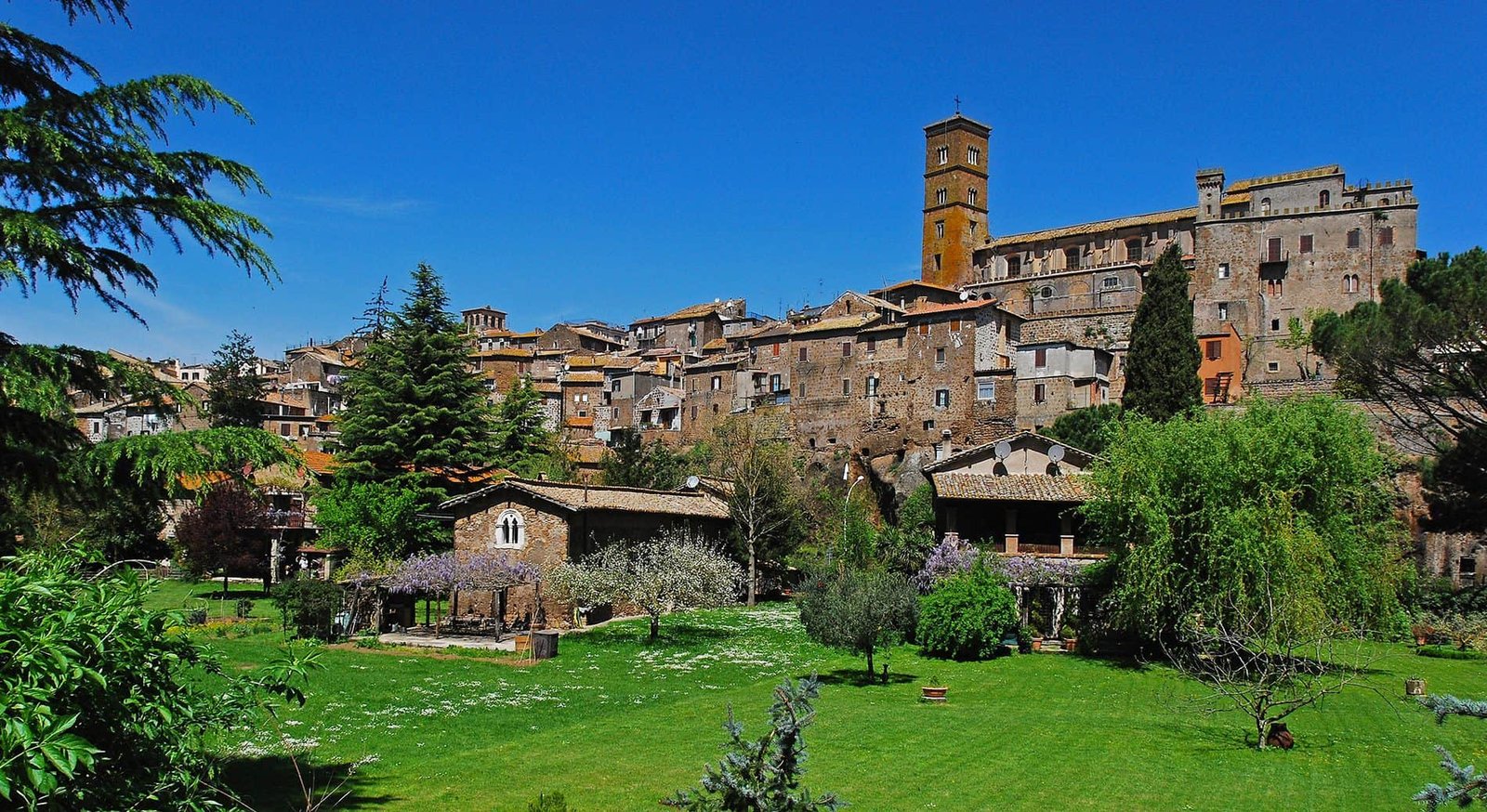
Sutri has held the Bandiera Arancione title since 2003, the recognition that the Touring Club Italiano awards to small inland towns that combine quality hospitality and landscape protection, and it is listed among the Most Beautiful Villages in Italy. It is not just any town in the Viterbo countryside: it is an ancient city, of Italic and Etruscan foundation, which residents like to call the Antichissima Città di Sutri. The historic center sits on top of a sheer tuff plateau, surrounded by walls and crossed by steep alleys, while at its foot, along the Cassia, runs one of the most unusual archaeological areas in Lazio, entirely carved into the rock. Within a few hundred meters you go from a Roman amphitheater carved entirely out of tuff to a rock-cut necropolis, from a church that was once a temple of Mithras to a bishop's palace turned into a museum, and finally to the monumental garden of an eighteenth-century villa. It's the concentration of history in a small space, walkable in half a day, that makes Sutri a rare destination.
Before getting into the details, my advice is not to treat Sutri as a quick in-and-out photo stop. The village is enjoyed slowly: a morning among the ruins and the necropolis, lunch with the fagiolo della Regina, the typical local product, and an afternoon among the churches and the garden of Villa Savorelli, with views over the countryside. Anyone who arrives at 11 and leaves at 13 sees a third of what's there.
How to Get to Sutri (VT) and Get Around
Sutri sits on the historic Via Cassia, the SS2 that used to connect Rome and Florence through the Tuscia. By car from Rome, the most convenient route is the Cassia bis, or Veientana, to the Monterosi junction, then merging onto the old Cassia toward Viterbo. After Monterosi, the village appears on the left, recognizable by its tuff spur. The parking lot is in the lower part, near the archaeological area, and it's the right place to start, because the amphitheater entrance and the circuit ticket office are there.
Those without a car can rely on the Cotral buses on the line to Viterbo, which leave Rome from the Saxa Rubra terminal, the terminus of the regional railway, and stop in Sutri along the Cassia. Travel times depend on traffic on the Cassia and on weekday or holiday schedules, so it's best to check departures in advance. The train doesn't go into town: the nearest station is Capranica, on the line that runs up to Viterbo, and from there it's still a few kilometers by road to reach the center of Sutri. In practice, if you want to enjoy the village at a relaxed pace, the car remains the most practical option, also because it lets you connect Sutri with the other towns in the area on the same day.
Once you arrive, Sutri is visited entirely on foot. The historic center is small and uphill, with ancient paving and a few flights of steps: comfortable shoes are a must, and anyone with mobility problems should keep in mind that the alleys and some archaeological areas carved into the rock are not entirely easy going.
The Roman amphitheater of Sutri, carved entirely from tuff
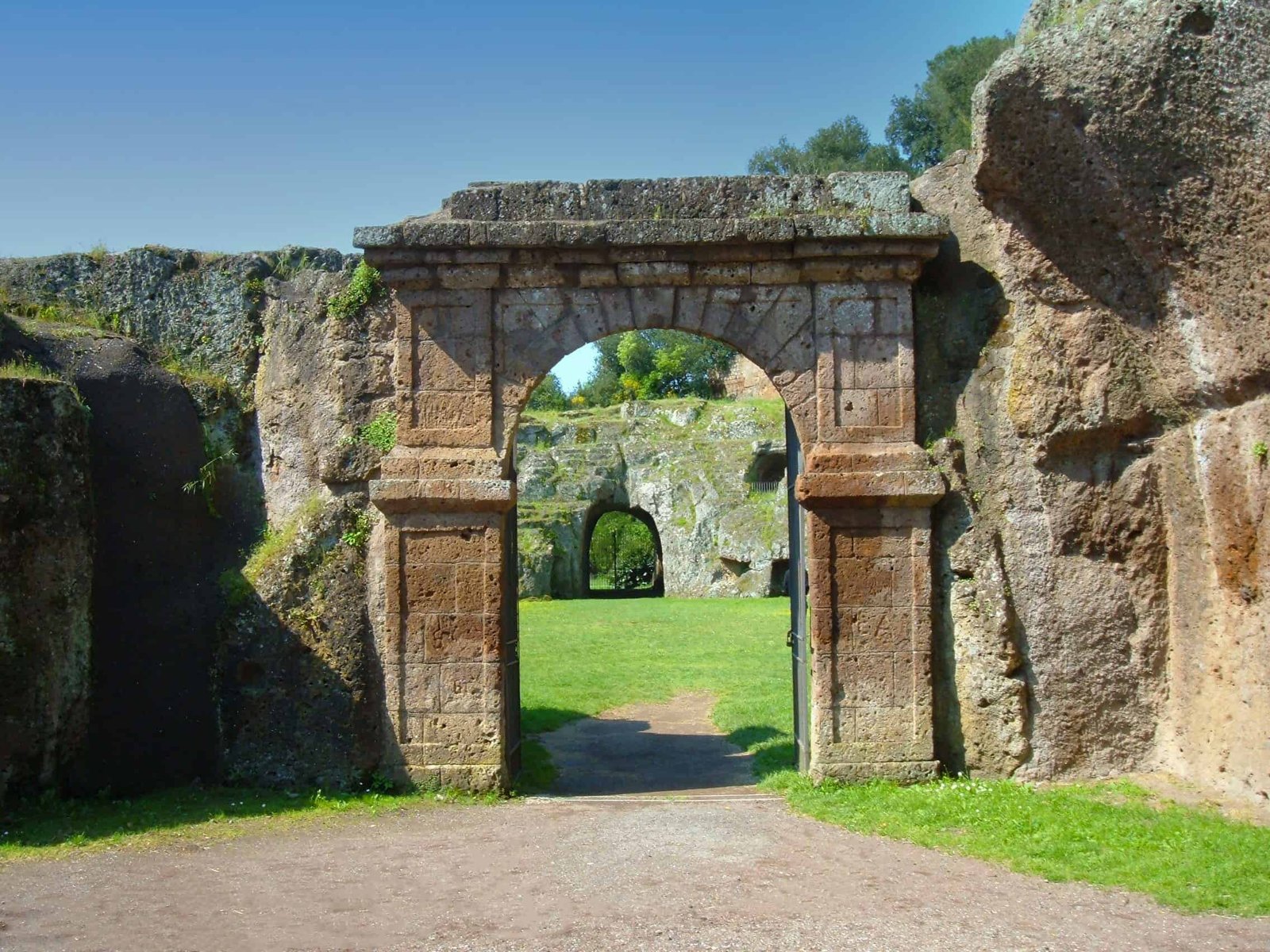
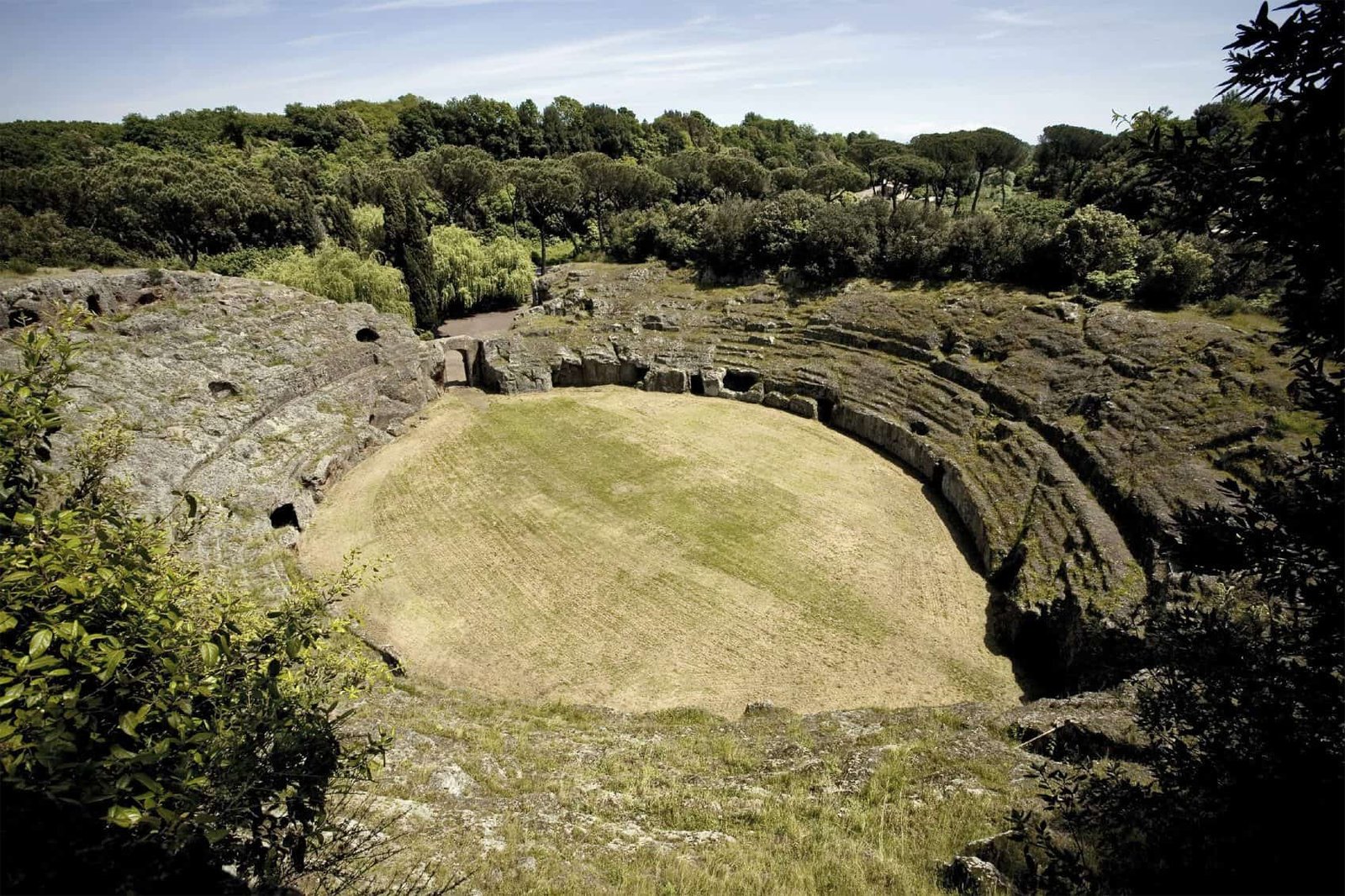
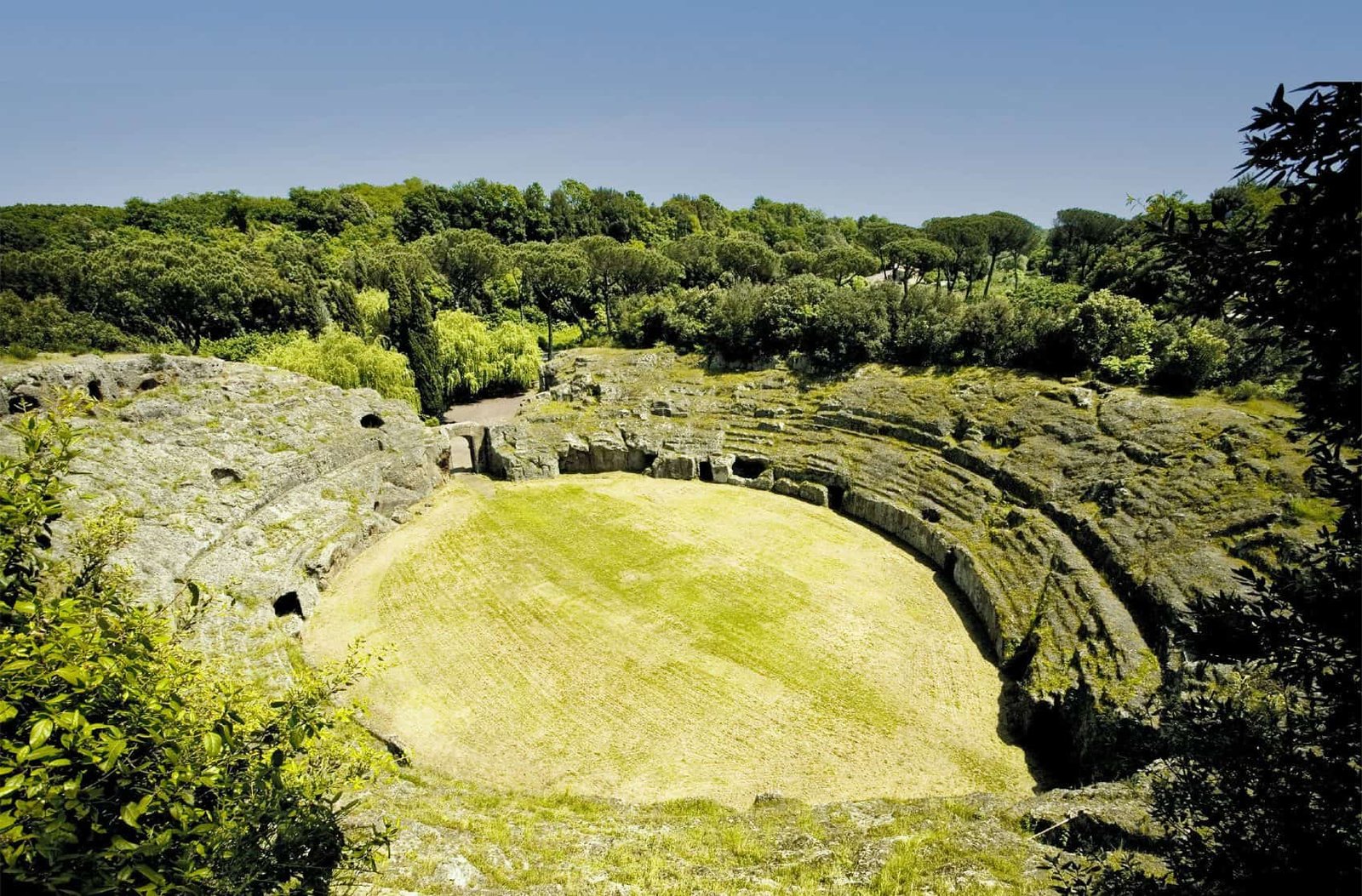
The amphitheater is the monument that makes Sutri unique and the main reason to make the trip. It is not built with blocks and masonry like the Colosseum or the arena in Verona. It is entirely carved out of the tuff bank, obtained by subtraction from living rock, with no supporting masonry. It is an extremely rare case in the Roman world, comparable in technique to only a very few other examples, such as the amphitheaters of Cagliari and Leptis Magna in Libya. Anyone who enters the cavea finds an enormous elliptical bowl cut into the tuff, with the tiers divided into the three classical orders, ima, media and summa cavea. It could hold about 7,000 spectators.
The dating ranges from the late Republican age to the beginning of the imperial age, so roughly between the 1st century BC and the 1st century AD. The amphitheater remained buried for a long time, hidden under vegetation and earth. It was rediscovered and freed by excavations only in the 19th century, when the property passed for a period to the Savorelli family, who promoted the first digs. Walking along the vaulted entrances and corridors that lead to the arena, you notice that everything, steps, vomitoria and niches, is part of the same rock. This is the detail that strikes anyone arriving for the first time and that no photograph truly conveys: the feeling of being inside rock worked as if it were clay.
The practical advice in front of the amphitheater is to take a few minutes to climb to the highest tiers of the summa cavea. From there you can take in the whole ellipse and understand the scale of the work, which is lost from below. The best light for appreciating the warm color of the tuff is late afternoon light.
The Church of the Madonna del Parto in Sutri, the ancient mithraeum in the rock
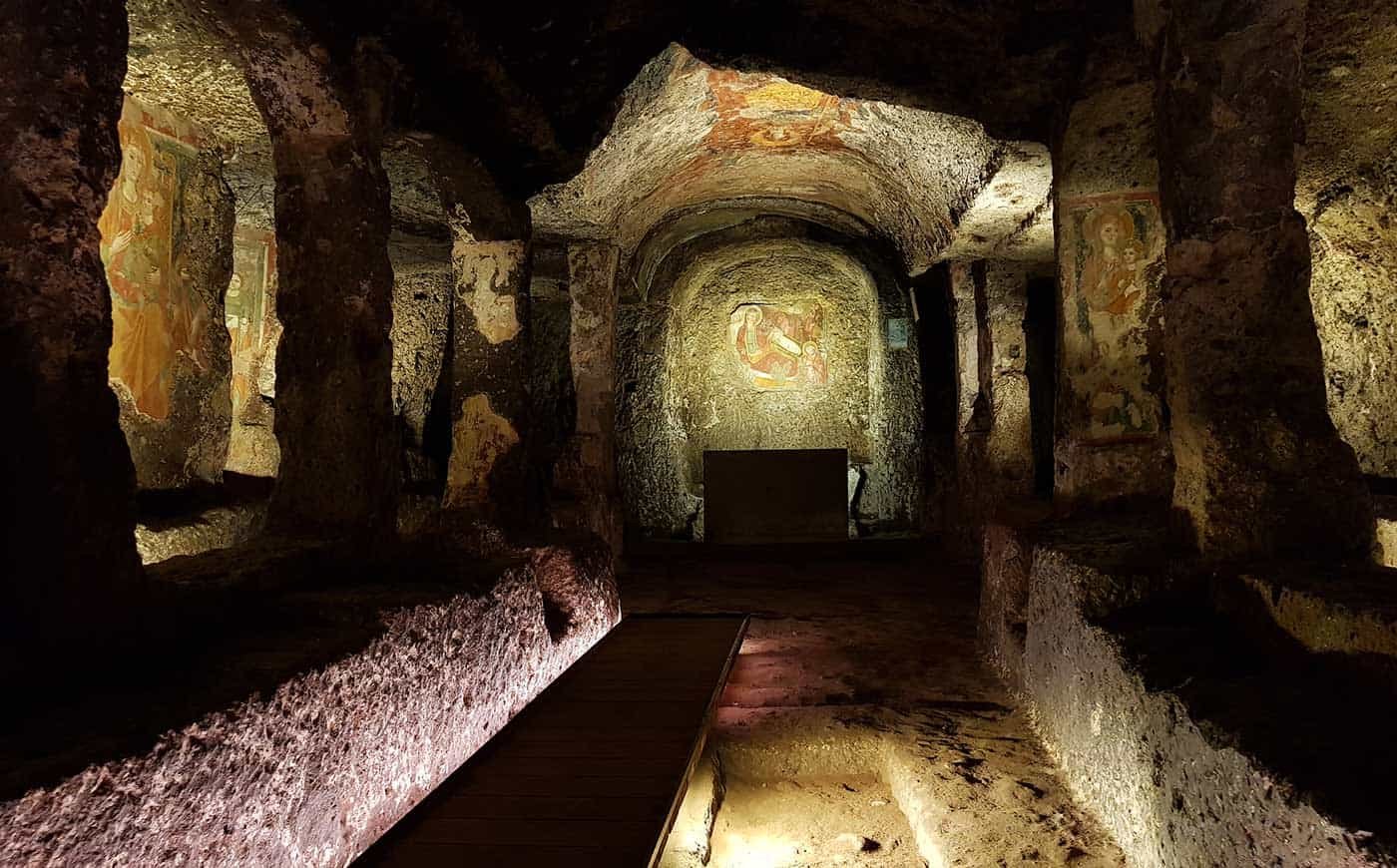
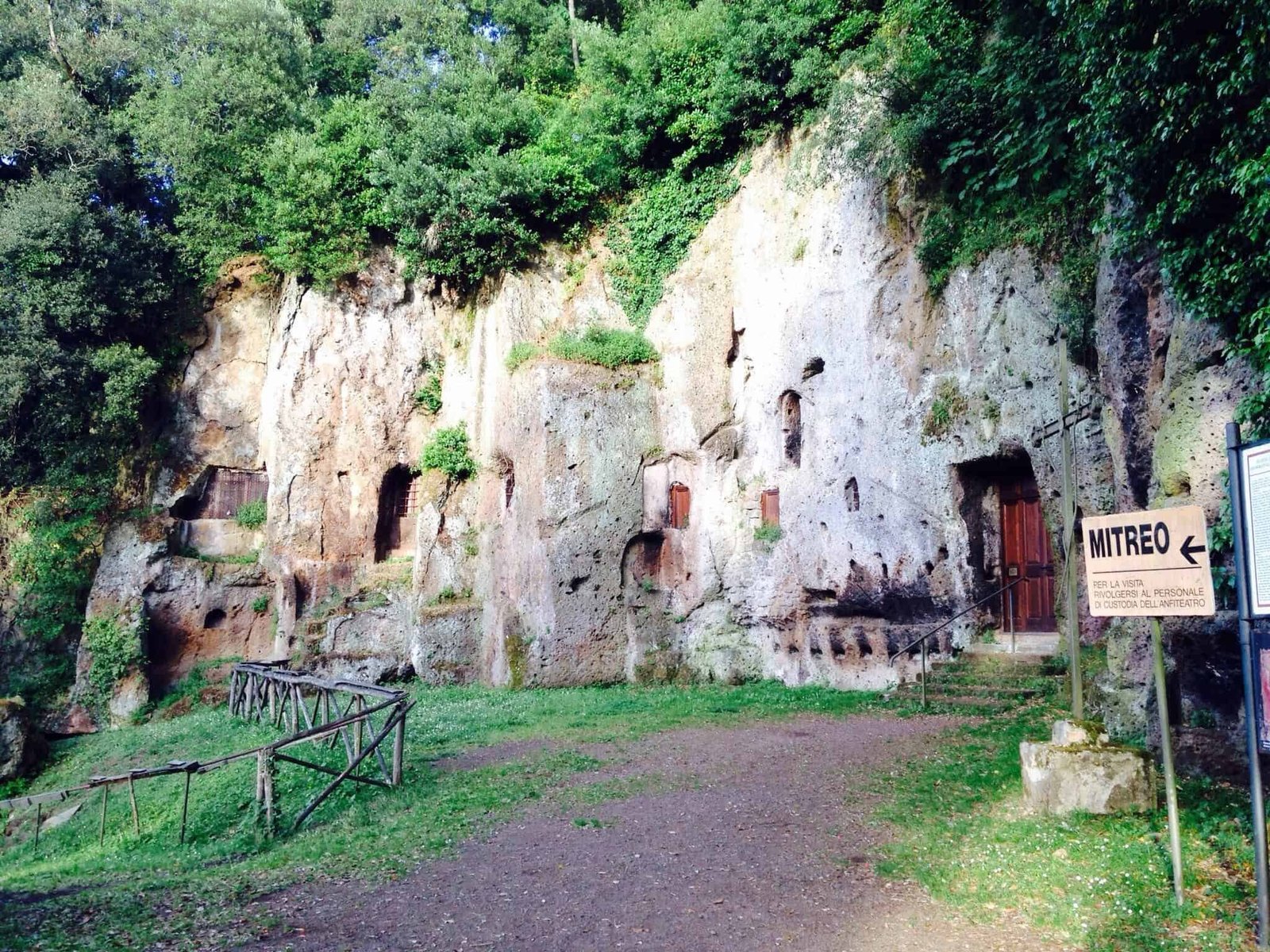
A few steps from the amphitheater, also carved into the tuff along Via Cassia, stands the Church of the Madonna del Parto. It is one of the most fascinating places in the whole Tuscia for the layers of worship it preserves. The building began as a mithraeum, a temple dedicated to the Eastern god Mithras, dating to the 3rd century AD. It stands on an area already used in Etruscan times as a burial ground. With the spread of Christianity the pagan temple was converted into a church, and the continuity of the sacred within a single rock space is what makes this place so dense.
The structure has two parts: a quadrangular, decorated vestibule, and the main body carved into the grotto, divided into three naves marked by small lowered arches resting on tuff pillars. The walls have niches and windows, the ceiling is barrel-vaulted, and near the altar there is an arcosolium and a small grotto once used as a sacristy. The fresco cycle is extremely rich. It includes Christ, Saint Michael the Archangel and the Pilgrims. Saint Michael appears several times, in relief on the central vault and in the vestibule, where frescoes dating to the first and second decades of the 14th century tell the miracle of Monte Gargano in Puglia, the great Saint Michael sanctuary toward which the pilgrims were headed. The presence of the pilgrims is no accident. The church stood along an important transit route, and this explains the devotion to Saint Michael.
The current name comes from the many images of the Virgin Mary with the Child painted on the walls, accompanied by figures of women kneeling in prayer, ex-votos tied to the desire for motherhood. In the apse is a 14th-century Nativity, placed here in 1737. That intervention determined the building's new dedication to the Madonna del Parto. Anyone visiting the church should take the time to follow the frescoes one by one with the audio guide, because reading the cycle of Saint Michael and the Marian scenes is what gives meaning to a space that would otherwise be merely scenic.
The rock-cut necropolis of Sutri along Via Cassia
On the same tuff ridge that holds the amphitheater and the mithraeum lies the rock necropolis, a series of chamber tombs carved into the rock face that flanks the Cassia. These are Roman-era tombs, mostly dating between the 1st century BC and the first centuries of the Empire. They have niched facades, architectural fronts and interior chambers meant to hold several burials. Some tombs were reused in later periods as stables, cellars or storerooms. This reuse has partly altered the interiors, but it has also helped preserve their structure.
Walking through the necropolis means following the old consular road along the hillside, with the tufa wall pierced by tomb openings on one side and the countryside on the other. It is a short route but with a great deal of atmosphere, especially early in the morning or late in the afternoon, when the raking light brings out the cuts in the rock. At Christmas, by tradition, a living nativity scene is set up in this stretch of the necropolis, turning the burial chambers into nativity scenes. It is one of the most heartfelt events of the year in Sutri.
The Palazzo Doebbing Museum in Sutri, in Piazza del Duomo
Overlooking Piazza del Duomo, the Palazzo Doebbing Museum occupies the former bishop's palace. It takes its name from Joseph Bernhard Doebbing, the bishop of German origin who led the diocese of Sutri and Nepi between the 19th and 20th centuries and who promoted major work on the building. Today the palace is the village's main exhibition space and hosts high-level exhibitions, often dedicated to great names in art history, as well as preserving works and materials linked to the area. It is the cultural hub of the historic center and the natural complement to a visit to the archaeological area: the excavated rock tells the story of antiquity, the palace tells the story of art.
The museum is included in the Sutri Pass ticket along with the archaeological park, so it's worth planning your visit to see both on the same day. Temporary exhibitions change, so it's worth checking the current program before you leave: in the past, Palazzo Doebbing has hosted notable exhibition series that were reason enough on their own to make the trip.
The Concattedrale di Santa Maria Assunta in Sutri
The Concattedrale di Santa Maria Assunta dominates Piazza del Duomo and, in its layers, tells the whole history of Sutri. Its current appearance is that of a Baroque church, the result of renovations from the 18th and 19th centuries, but the foundation is Romanesque and several ancient elements survive beneath the later covering. The 13th-century bell tower, sturdy and with twin windows, is the most recognizable medieval part of the complex and rises above the village.
Inside, the Cosmatesque floor deserves attention. It is the work of inlaid polychrome marble that the Roman Cosmati workshops made between the 12th and 13th centuries, a carpet of discs and tiles and one of the most precious things in the church. Below the apse is the Lombard-era crypt, one of the oldest and most austere spaces in Sutri. Its naves are marked by rows of columns, some of them reused, with groin vaults cut into the tufa. Here the bronze bust of Clement II is preserved, the pope who was elected right here in Sutri in 1046. The cathedral also holds memories of local worship and works linked to the saints who are dear to the city. My advice is to go down into the crypt even if it seems out of the way: it is there, in the silence of the columns, that you can feel the true age of Sutri, much more than in the Baroque nave above.
The churches and places of worship of Sutri
Besides the cathedral, the historic center and surroundings of Sutri hold a surprising number of churches, many of them small, some deconsecrated, that tell of centuries of devotion. It's worth visiting them in sequence during a walk through the village, without expecting to find them all open, since several are used for services only on special occasions.
The Chiesa di San Francesco in Sutri
The Chiesa di San Francesco, linked to the Franciscan presence in town, was deconsecrated and later reopened for worship and events. During the summer it hosts some of the concerts of the Festival Barocco della Tuscia, and its acoustics make it a place valued for chamber music.
The Chiesa di San Silvestro and the other churches of the village
Among the religious buildings of Sutri are the Chiesa di San Silvestro, the Chiesa di San Sebastiano, the Chiesa di San Rocco, the Chiesa della Santissima Concezione, the Chiesa di Santa Croce and the Chiesa della Madonna del Monte. Some are now deconsecrated, such as Santa Fortunata, Santa Cecilia and Sant'Andrea, and they survive as part of the village's building fabric. The Chiesa della Madonna del Carmine holds a 15th-century fresco that, in style, recalls the manner of Melozzo da Forlì, the great Romagnol painter of the 1400s known for his illusionistic foreshortening.
The Chiesa di Santa Maria del Tempio and the Templars in Sutri
The Chiesa di Santa Maria del Tempio, also known as the Chiesa della Madonna del Tempio, was linked to the Order of the Templars, who maintained their own buildings and hospices along pilgrimage routes and at mountain passes. Its presence in Sutri confirms the village's role as a stop on an important road that led to Rome. The Templar memory is one of those details that distracted visitors overlook, and yet it tells of the strategic function of this stretch of the Cassia in the Middle Ages.
The civic buildings of Sutri: Porta Vecchia and the Torre degli Arraggiati
The medieval fabric of Sutri preserves some civil architecture that tells the story of the period when the town, enclosed by its walls on the tuff spur, defended itself and controlled its entrances. Porta Vecchia is the old entrance to the historic center, the passage through which you entered the upper town coming from the countryside. Walking through it on foot is the right way to understand how the town was conceived as a natural fortress, with the rock itself serving as a bastion.
The Torre degli Arraggiati is the clearest evidence of the defensive and factional Sutri of the Middle Ages. The name, according to local tradition linked to the factional struggles that divided the town between Guelphs and Ghibellines, refers to that climate of clashes that culminated in the fire of 1433. Walking through the uphill alleys of the center, you still come across stretches of walls, towers and old houses embedded in the urban fabric. They make up the image of a border town, perched and watchful. It is in these minor details, more than in the major monuments, that the everyday life of medieval Sutri can be read.
Villa Savorelli and its garden in Sutri
On the hill overlooking the amphitheater, in a commanding position, stands Villa Savorelli. It is the noble residence tied to the family that in the 19th century owned part of the archaeological area and promoted its excavations. The villa itself cannot be visited inside, but its monumental garden is included in the route of the Sutri Pass and is worth the climb. From the overlook you can see the Tuscia countryside, the amphitheater below and the profile of the town. The garden, with its geometric layouts and avenues, is the viewpoint par excellence of Sutri and the ideal place to end the visit in late afternoon, when the light caresses the hills.
Next to the villa stands the Church of the Madonna del Monte, which completes the small complex at the top. Those who love photography find here the widest view of the entire site, with the amphitheater set into the greenery and the Cassia running down the valley.
The Antichissima Città di Sutri Regional Natural Park
The entire area that includes the amphitheater, the necropolis, the mithraeum and the Villa Savorelli hill is protected by the Antichissima Città di Sutri Regional Natural Park, established to protect both the archaeological heritage and the landscape. It is one of the smallest protected areas in Lazio by size, but one of the densest in historical value: a park that combines nature and archaeology in a single walking route. The holm oaks and the surrounding countryside frame the monuments carved into the tuff, and the walk among the ruins has the rhythm of a true woodland hike.
In the wider surroundings, the Bracciano, Martignano Regional Natural Park also extends. It protects the two volcanic lakes south of Sutri and offers a nature alternative for those who want to extend the trip toward the water. Between the two parks it is easy to plan a weekend that alternates archaeology and lakeside landscapes.
Sutri (VT) | The history, from Etruscan origins to the Papal States
The history of Sutri, ancient Sutrium, is documented by the many archaeological finds in the area, which cover different eras. The origins of the town are very ancient and probably date back to the Bronze Age. Legend attributes its founding alternately to an ancient people of eastern seafarers, the Pelasgians, and to the god Saturn, who appears on horseback with three ears of wheat in the municipality's official coat of arms. Beyond the legend, Sutri grew strongly during the period of Etruscan rule as an agricultural and commercial center, thanks to its position controlling the route that climbed toward inland Etruria.
Roman Sutri and the barbarian invasions
As an obligatory passage toward Etruria, Sutri was permanently conquered by the Romans in 383 BC, after the fall of Veii. In the following centuries, along Via Cassia, the town saw the barbarian hordes heading for Rome pass through, and it served as a bulwark for the consulate first and the empire later. Between the 5th and 8th centuries, Sutri was caught up in the struggles between Lombards and Byzantines, who were vying for control of the area.
The Donation of Sutri in 728 and the birth of temporal power
The most famous moment of Sutri's early medieval history is the donation of AD 728, when the Lombard king Liutprand offered the city and the surrounding lands to Pope Gregory II. Historians consider that cession the birth act of the Church's temporal dominion, the first step toward building the Patrimony of Saint Peter. It is a fact that rarely enters tourist accounts, yet it is one of the decisive turning points in Italian history, and it happened here.
The Council of Sutri in 1046
In 1046 Sutri hosted a council convened by Emperor Henry III to end the schism in which three rivals competed for the papal throne. At the council the triple claim was deposed and Pope Clement II was elected. His bronze bust is preserved in the cathedral crypt. During the Late Middle Ages Sutri was at the center of clashes between Guelphs and Ghibellines, which culminated in the fire that destroyed the town in 1433, set by Nicolò Fortebraccio, a mercenary captain.
Decline and the early modern period
After the fire of 1433 Sutri experienced rapid demographic and economic decline, made worse by the diversion of trade routes along Via Cimina to the advantage of Ronciglione, a center strongly boosted by the Farnese. Reduced to a second-rate rural town in the Papal States, Sutri became a bargaining chip among noble families. At the end of the 18th century it was conquered by French troops and lumped together with Ronciglione, and then it returned to the Papal States with the Restoration. On the religious side, Sutri was an episcopal see at least from the 5th century. The first resident bishop of whom there is certain record is Saint Eusebius, in 465. Tradition holds that Saint Peter himself had sent Saint Romulus there in the earliest days of Christianity. Between 1243 and 1244 the town briefly served as a papal seat, when Innocent IV settled there to escape Emperor Frederick II, who had excommunicated him. In 1435 the diocese was united with that of Nepi, a sign of the decline under way. In 1556 Sutri had as its bishop the future Pope Pius V, later canonized, to whom many works in the cathedral are dedicated.
A curiosity about Sutri (VT)
The curiosity few people know concerns the word Sutri itself and the town's ancient link to the cult of Saturn and to grain. In his account of his return journey from Rome, at the end of the 10th century, the archbishop of Canterbury Sigeric noted the stages of Via Francigena. He called Sutri Suteria, a form that goes back to the Etruscan Suthrina, itself linked to the god the Romans called Saturn. Sutri is the fourth stage of that travel diary, one of the most valuable documents for reconstructing the route of medieval pilgrims bound for Rome.
But the curiosity goes beyond etymology. According to a tradition reported by ancient authors and repeated over the centuries, the territory of Sutri was supposedly the first in Italy to receive the sowing of grain, brought by Saturn. With that gift he tamed the primitive inhabitants and ruled over them peacefully for as long as he lived, and he was later worshipped as a god with a sickle in hand. It is not a historical fact. It is a founding myth, yet it explains why Saturn appears on the town's coat of arms on horseback with three ears of grain. The town built its identity around the idea of being the cradle of Italic agriculture. Few places have such an explicit link between their name, their coat of arms and an origin myth.
Something no one tells you about Sutri (VT)
The thing almost no tour guide tells you is that the amphitheater of Sutri, today admired as one of the most original Roman monuments in Lazio, was for centuries simply invisible. Buried under earth and vegetation, forgotten, it was used as farmland, and no one imagined that beneath that rise covered with holm oaks lay an entire cavea carved into the tuff. Its rediscovery came only in the 19th century, when the area passed for a period to the Savorelli family, who promoted the first digs and brought the tiers back to light. Put differently, the symbol of Sutri remained buried for most of its existence, and what we see today is the result of a relatively recent recovery.
There is a second little-known detail, concerning the sequence of cults in the Church of the Madonna del Parto. That small rock-cut space has been, in order, an Etruscan burial ground, a temple to the god Mithras in the 3rd century, a Christian church dedicated to Saint Michael along a pilgrim route, and finally, from 1737, a Marian sanctuary linked to motherhood. Four layers of the sacred in the same cubic meter of tuff: it is the kind of continuity studied in religious history textbooks, and here it can be touched with one's own hands, without signage that explains it well enough. Anyone who enters expecting a small country chapel leaves with a lesson in the layering of the sacred in central Italy.
The advice I give for visiting Sutri (VT)
The advice for organizing Sutri is to reverse the instinctive order of the visit. Almost everyone arrives, parks below, sees the amphitheater and leaves convinced they have seen Sutri. In reality the amphitheater is only the beginning. Devote the morning to the archaeological area, calmly, in the order that leads from the amphitheater to the necropolis and then to the Church of the Madonna del Parto, taking the audio guide for the mithraeum, which otherwise stays silent without explanation. At midday head up into the town, stop for lunch, and look for the Fagiolo della Regina if you are there in season. In the afternoon, set aside the historic center: the cathedral with its Lombard crypt, Palazzo Doebbing with the exhibition currently on, the alleys and the minor churches. End with the climb up to Villa Savorelli, the garden and the overlook, which at sunset makes the effort worthwhile.
The second tip is about the season. Sutri is best visited in spring and autumn, when the greenery of the park is full and the light on the tufa is soft. Summer is hot and the monuments carved into the rock offer shade, but the central hours of the afternoon are heavy. Winter has the charm of the living nativity in the necropolis at Christmas, but the days are short. Avoid the quick in-and-out visit: the Sutri Pass costs €17 and includes everything, so it's worth using it fully on a full day, not splitting it into a hit-and-run visit.
Another Well-Known Fact, Yet Rarely Mentioned
The fact is well known to locals and scholars, yet it almost always escapes the occasional visitor: in Sutri, according to a stubborn medieval tradition, Orlando, the Paladin of France, the hero of the chansons de geste and later of Ludovico Ariosto's Orlando Furioso, is said to have been born. The legend tells that Berta, sister of Charlemagne, disinherited and exiled for having loved a man of humble origins, stopped in Sutri along the road to Rome and gave birth to her son, Orlando, in a cave. The emperor would later name him a paladin. That cavity, called the Grotta di Orlando, is still today pointed out in the area as the site of the birth.
It isn't documented history, it's epic material, and it should be said clearly: no source proves that Orlando, a character largely legendary, was born here. But the interesting fact is another, and it is well attested: Sutri, because of its position on the road to Rome, entered so deeply into the imagination of the chivalric cantari that, in tradition, it became the cradle of Europe's most famous paladin. The same vein also includes the Casa di Dante, the building where local tradition holds that Dante Alighieri stayed during his trip to Rome for the Jubilee of 1300. This too is a story, not a document, but it shows how much Sutri, a crossroads for pilgrims and travelers, felt involved in the great stories that passed along the Cassia.
The Right Photo to Take in Sutri (VT)
The photo to bring home from Sutri is not the close-up of a flight of steps, but the whole amphitheater seen from above. Climb up to the hill of Villa Savorelli and look for the overlook that dominates the cavea: from up there the ellipse carved into the tufa appears set into the greenery of the holm oaks, with Via Cassia running down below and the Tuscia countryside in the background. It's the only framing that shows both the scale of the monument and the way it was carved out of the rock, and no photo taken inside the arena manages it.
The right light is that of late afternoon, when the low sun warms the tufa and brings out its ochre color and veining. If you want a second strong shot, you'll find it inside the Chiesa della Madonna del Parto: the three naves carved into the rock, with the low arches and the 14th-century frescoes on the walls, make for an image with strong character, as long as you have a steady hand. The light is poor, and flash is forbidden so as not to damage the frescoes. A third classic subject is the 13th-century bell tower of the cathedral rising above the rooftops of the village, to be captured from the uphill alleys of the historic center.
Some Important Events That Happened Here in History
Sutri, for a village of a few thousand inhabitants, has seen an extraordinary number of events that left their mark on the history of Italy and the Church. The first is the Roman conquest of 383 BC, when the city, a strategic stronghold on the way to Etruria, was permanently incorporated into Rome's orbit after the fall of Veii. From that moment Sutri became, as an old saying goes, the gateway to Etruria.
The second major event is the Donation of Sutri in 728, when the Lombard king Liutprand gave the city to Pope Gregory II. That act is considered the beginning of the papal temporal power and the first nucleus of the future Papal States: an event whose consequences would last for more than a thousand years, decided in this corner of Tuscia. The third is the Council of 1046, called by Henry III to end the shameful schism of the three rival popes, which resulted in the election of Clement II: a council that marked the start of the reform of the Church in the 11th century.
Dramatic events are not lacking. In 1433 the mercenary captain Nicolò Fortebraccio set the village on fire, during one of the many wars between factions that bloodied 15th-century Lazio, and the fire marked the beginning of Sutri's long decline. Between 1243 and 1244, instead, the city even hosted the papal court, when Innocent IV took refuge there to escape the troops of the excommunicated emperor Frederick II. Each of these episodes, if it had happened in a large city, would fill books. In Sutri they are all concentrated within a few hundred meters.
Who Has Passed Through Sutri (VT)
The figures who passed through Sutri, or who are tied to the town by history and legend, make up a surprising list. According to the epic tradition, Charlemagne and his sister Berta passed through here, and the paladin Orlando was supposedly born in Sutri. These are largely legendary figures, but they show how present the village was in the medieval imagination. The Lombard king Liutprand passed through Sutri, where in 728 he made the famous donation, and so did Emperor Henry III, who in 1046 convened the council from which Clement II was elected.
Pope Innocent IV stayed there while fleeing Frederick II between 1243 and 1244, and the town was the episcopal seat of the future Pius V, the Dominican pope later canonized, in 1556. Tradition has it that Dante Alighieri also stopped in Sutri, passing through on his way to Rome for the Jubilee of 1300, commemorated by the so-called Casa di Dante. Documented with certainty, however, is the passage of Sigeric, the archbishop of Canterbury who at the end of the 10th century recorded Sutri as the fourth stage of Via Francigena.
There is finally an exceptional witness, and his is a page of verified literature: Petrarch. In the account of his first trip to Rome, in a letter to Cardinal Giovanni Colonna, the poet described Sutri in words that deserve to be read in full.
Sutri (VT) in the Words of Petrarch
In his Letter of Familiar Matters addressed to Cardinal Giovanni Colonna, dated to around 1337, Petrarch describes Sutri in a prose that combines the myth of Saturn with praise of the landscape. I am quoting the passage in the 19th-century translation:
Two miles away lies Sutri, a beloved seat of Ceres and an ancient colony, so they say, of Saturn: where, not far from the walls, they show the field said to have been the first in Italy to receive the sowing of grain, harvested shortly afterward by the foreign king who, having tamed and won the hearts of those first inhabitants with such a benefit, reigned over them peacefully for as long as he lived, and who, after death, having come to be regarded as a god, was revered by the people's gratitude as an old deity holding a sickle in his hand.
Most healthful, as far as my brief stay allows me to judge, is this climate. Countless hills surround the land on every side, neither too high nor hard to climb, and no hindrance to the view, among which shady and cool caves open on their rounded slopes, and leafy woods rise to shelter from the heat of the sun on all sides except the one facing Boreas, where a small hill, lower than the others, spreading out in a sunny valley, provides the bees with a flowery dwelling.
Here is the murmur of the sweetest waters, without shoals. Here are deer, fallow deer, roe deer, and the whole wild flock of the woods wandering the open hills, and an endless host of birds that skim the waves or, hopping through the branches, whisper. I say nothing of the oxen and the herds of domestic cattle, nor of the gifts of Ceres and Bacchus, which answer man's labor with sweet and abundant yields, nor of the natural treasures of the nearby rivers, lakes, and sea, which is also not far away.
Petrarch's testimony confirms what the ancients already said about the link between Sutri, Saturn and grain, and it gives a portrait of the Tuscia landscape that, almost seven centuries later, those who climb to the garden of Villa Savorelli still recognize: the countless hills, the cool woods, the fertile countryside.
Events, Traditions and Folklore in Sutri
Sutri has a calendar of festivals that marks the year and that, for anyone who wants to see the village alive, is worth as much as the monuments. Timing your visit to coincide with one of the great celebrations completely changes the experience.
The Feast of Santa Dolcissima, Patron Saint of Sutri
In the week that includes September 16, the dies natalis (feast day) of the patron saint Santa Dolcissima, the town organizes a series of events that culminate in the procession with the statue of the saint and, on the evening of September 17, in a fireworks show with a torchlight procession inside the amphitheater. Seeing the fireworks reflected on the tufa tiers is one of the strongest images Sutri offers all year.
Sant'Antonio Abate and the Horse Palio
On January 17, the feast of Sant'Antonio Abate, protector of animals, a horse parade is held, and the following Sunday a palio is contested. The festival is tied to a legend that in the 19th century the saint saved the town's animals from a serious epidemic.
Corpus Domini and the Infiorata
In June, for Corpus Domini, the religious procession passes over an infiorata laid out along the town's main street: carpets of petals that form sacred images and are made by residents the night before.
The Festival Barocco della Tuscia
In summer Sutri takes part in the Festival Barocco, the classical music series of the Viterbo area of Tuscia, with often free concerts held in the Church of San Francesco, deconsecrated and later reconsecrated, at Villa Savorelli or in the amphitheater. In the past, musicians of the caliber of flutist Severino Gazzelloni and harpsichordist Gustav Leonhardt have taken part in it.
Mercatantia, the Medieval Festival
For three days, usually in the last weeks of July from Friday to Sunday, Mercatantia takes place. It's the medieval festival that brings the archaeological park of the amphitheater to life with games, duels, shows and historical reenactments among the nature and the ruins.
The Queen's Bean Festival
In early September the Sagra del Fagiolo is held. It was created to promote Sutri's typical product par excellence, the fagiolo della Regina, a legume with a thin skin and a delicate flavor that is cooked according to traditional recipes. For food lovers, it's the right occasion to combine a visit to the village with a meal.
The Living Nativity Scene in the Necropolis
At Christmas, finally, the rock-cut necropolis hosts the living nativity. The burial chambers carved into the tuff become the natural setting for the Nativity, in one of the most original productions in Lazio.
Things to See Around Sutri: the Villages of the Tuscia
One of the reasons it makes sense to reach Sutri by car is the chance to connect it with other notable towns within a few kilometers. The area between the Cassia, the volcanic lakes and the Viterbo Tuscia is packed with villages worth a visit, and from Sutri you can easily build an itinerary of two or three days.
The most famous of the neighbors is Calcata, the village perched on a spur of tuff above the Treja valley, which over the years has become a village of artists. A short distance away stands Ronciglione, the ancient rival strengthened by the Farnese, with its historic center and its famous carnival. Toward the lakes you'll find Lake Bracciano, with its lakeside villages and the Orsini, Odescalchi castle, and Lake Vico, the small volcanic lake set in the Monti Cimini just a short walk from Sutri. Anyone who loves nature carved into rock shouldn't skip the Corchiano Gorges, the tuff gorges cut by streams, real hidden canyons of the Tuscia.
Heading back up toward the provincial capital, you come across Caprarola, with the monumental Palazzo Farnese and its scala regia, and Viterbo, the city of popes with the medieval San Pellegrino quarter. In Viterbo, the carrying of the Macchina di Santa Rosa takes place, the night ritual recognized by UNESCO. For a day out with children, Sant'Angelo di Roccalvecce, the Village of Fairy Tales, with its large murals, is within easy reach. And if you want to head east, the gardens and villas of Tivoli, with Hadrian's Villa and Villa d'Este, complete a picture that, starting from Sutri, takes in the entire crown of wonders north of Rome.
Sutri (VT) with Children
Sutri is a destination that works well with children, and not just for the monuments. The amphitheater carved into the tuff captures the imagination of the youngest visitors better than many traditional ruins. Entering a Roman theater carved inside the rock, with its tiers rising into the stone, has something adventurous about it. The rock-cut necropolis, with the tombs open along the rock face, and the stories of the paladins and of Orlando born in the cave give the visit the flavor of a hunt for legend.
The Christmas period, with the living nativity set up in the burial chambers of the necropolis, is especially suited to families, and so are the medieval reenactments of Mercatantia in July, with duels and shows. The route is almost entirely outdoors, in the greenery of the park, so children can walk without the constraints of a closed museum. The only thing to keep in mind concerns the ground: ancient paving, stretches carved into the rock and some uphill sections make it hard to use a stroller in the archaeological areas, so with the little ones a baby carrier or a backpack carrier is the better choice.
Where to Eat and What to Taste in Sutri
Sutri's cooking is that of the rural Tuscia, made with garden produce, legumes, meats and fresh pasta. The signature dish is the fagiolo della Regina, the typical legume celebrated every September at the festival, with its thin skin and delicate flavor. It's enjoyed in soup, with pork rind, or simply dressed with olive oil. Among the first courses, there is no shortage of handmade pastas with meat sauces, and the tradition of baked sweets continues. The village has several trattorias and osterie in the historic center and along the Cassia, where you can get genuine food at reasonable prices.
My advice as a professional is to plan lunch as part of the visit, not as a parenthesis. Stopping in the middle of the day, after the archaeological area and before going up into the village, lets you break up the walk at the hottest moment and set off again in the afternoon without rushing. If you happen to be there during the days of the Sagra del Fagiolo, the food experience becomes the very reason for the trip.
When to Go to Sutri and When to Avoid It
The ideal season to visit Sutri is the in-between one, spring and fall, when the weather is mild, the archaeological park is at the height of its green and the light on the tuff, as Petrarch already noted in praising this very healthy climate, is soft and warm. In summer the central hours of the afternoon are heavy, but the advantage is that the monuments carved into the rock, amphitheater and mithraeum, offer shade and coolness, and the park's hours extend until evening. It is better, though, to visit early in the morning or after 17:00. Winter gives the appeal of the living nativity scene at Christmas and a silent village, but the days are short and some minor churches are closed.
The time to avoid, if you are looking for tranquility, is that of the big patron saint festivals for those who don't like crowds, while those who want to live the village at its peak of ferment should aim precisely at those days. In general Sutri doesn't know the overcrowding of the better-known destinations in Lazio, and even in high season it can be visited calmly: it is one of its greatest merits.
Orlando Born in Sutri: The Carolingian Legend and the Rock That Hosts It
In Sutri there is a tradition that the village has carried with it for centuries: Orlando, the paladin and nephew of Charlemagne, was supposedly born here, in a cave carved into the tuff where his mother Berta had taken refuge. The cave is pointed out in the rock-cut setting of the Madonna del Parto, along the road that goes down toward the amphitheater. It's best to say it right away: it is not history, it is the stuff of the epic cycle. Orlando as a character is born from chivalric poems, and his birth in Sutri is an episode of those poems, not a documented fact. That said, the legend remains interesting for the opposite reason from the one for which it is usually told: not because it is true, but because it explains well what Sutri was in the Middle Ages.
What the Legend Tells and in Which Texts It Is Found
The most widespread version: Berta, sister of Charlemagne, falls in love with Milone, a knight of lower rank. Marriage is impossible, the two flee the court and end up in Italy, poor and hidden. Berta gives birth in a cave near Sutri, and the child grows up wild until, years later, Charlemagne, traveling to Rome, passes by and recognizes his nephew. The tale has an evident narrative logic: to have the hero born in poverty and recognized by the king, a pattern the epic has always used.
The tradition is documented in specific texts, and this can be said with certainty. The episode appears in late medieval Italian chivalric narrative, in particular in the Reali di Francia by Andrea da Barberino, written between the end of the 1300s and the early 1400s, and in the cantari on Carolingian subjects that circulated in the same period, where the story of Berta and Milone and that of the Orlandino are independent material. They are literary texts, composed six centuries after the events they claim to tell. That those texts exist is documented. That they tell a real event is not.
The Historical Roland: The Little the Sources Say
Behind the paladin there is a real person, but very little is known about him. The Carolingian sources record a Hruodlandus, prefect of the march of Brittany, fallen in 778 in the ambush of the Basques in the Pyrenees during the retreat of the Frankish army from Spain. It is a brief mention, in a list of the fallen. Everything else, the sword Durlindana, the horn, the betrayal of Ganelon, the emperor's favorite nephew, is later literary construction, which starts from the Chanson de Roland and grows for three centuries up to the Italian poems. The birth in Sutri belongs to the final layer of this construction, the Italian one, and is among the latest inventions.
The two things must be kept separate: that a Frankish officer named Hruodlandus died in 778 is documented, that his mother was named Berta and gave birth in a cave in Lazio is not in any way.
Why the Legend Took Root Right Here
The interesting question is not whether it is true, but why a French story put down roots in a village of Tuscia. The answer is the road. Sutri is a junction of Via Francigena, the route that brought pilgrims from Northern Europe to Rome, and in the Middle Ages it was an obligatory stop on the last stretch before the City. For centuries Franks, Burgundians, English and Germans passed through here with their stories, and the storytellers who lived off those stories. Epic material that arrives on foot along a road tends to fix itself on the places the road crosses, and the caves carved in the rock, visible from the edge of the road, are perfect narrative hooks.
Geographic plausibility helped too: the road to Rome really did pass through here, and a Frankish ruler heading into the city had to cross this area. The legend simply filled a real route with an invented scene. The same mechanism appears in other towns along the road, from Nepi to Viterbo, where pilgrim traffic left traditions that no document confirms.
The Madonna del Parto: Mithraeum Then Church, but the Sequence Is Debated
The room identified as Berta's cave is carved into the tufa a few dozen meters from the amphitheater, on the side of the road. The frescoes are unanimously dated between the 13th and 14th centuries and depict, among other things, the pilgrimage to the Sanctuary of San Michele Arcangelo on Gargano, with a Saint Christopher and a Madonna. This is the most solid fact about the site: we are looking at a roadside church, made for people who passed on foot, and the Michaelic theme confirms it.
The earlier phase, however, is genuinely debated, and it's worth reporting. The identification of the room as a mithraeum later converted into a Christian church dates to the 1930s and was proposed in archaeological circles, among others by Claudio Pellegrino Sestieri, with the endorsement of a specialist in Eastern cults such as Franz Cumont. The theory was later accepted in the literature on Mithraism, including the catalogues of Maarten Vermaseren, and is today the standard version in guidebooks and on signage. Those who dispute it, however, argue that the starting point was the formal similarity to other mithraea and not an in situ find: no tauroctony or Mithraic inscription has been recovered in the room, and the known reliefs of Mithras from the area come from other contexts. They attest to the cult in the territory, not in this building. It is also objected that the room opens inside an Etruscan-Roman necropolis that remained in use for a long time, a funerary context where mithraea normally were not located. Those who raise these points, such as Andrea Lonardo in a paper devoted specifically to the question, favor an original funerary or otherwise different use. The question is open: the sequence of mithraeum then church is widely accepted, but it is not proven, and calling it certain is incorrect.
The Context That Makes It All Believable, and the Date That Is Certain
What makes the legend believable, in the eyes of anyone who arrives, is the landscape. Sutri is the gateway from Etruria to Rome, a tufa plateau isolated on three sides, with an amphitheater carved entirely out of the rock rather than built, a rock-cut necropolis along the road and dozens of rooms cut into the tufa bank: a place where a birth in a cave seems ordinary, because people really did live, get buried and pray in that rock for 2,000 years. The Parco dell'Antichissima Città di Sutri brings these elements together within a few minutes' walk.
Quick Questions About Sutri (VT)
Where Is Sutri (VT)?
Sutri is in the province of Viterbo, in Lazio, along Via Cassia, about 50 kilometers north of Rome, on a spur of tufa just before Lake Vico. The town center revolves around Piazza del Duomo, 01015 Sutri VT.
How Much Does It Cost to Visit Sutri and the Archaeological Area?
The single ticket, the Sutri Pass, costs €17 at full price and includes the Museo di Palazzo Doebbing, the Roman amphitheater, the rock-cut necropolis, the Chiesa della Madonna del Parto and the viewpoint from the garden of Villa Savorelli. It is free for children under 12 and for people with a disability over 74 percent.
What Does the Sutri Pass Include?
It includes admission to the Museo di Palazzo Doebbing and the Parco Archeologico, which covers the Roman amphitheater, the rock-cut necropolis and the Chiesa della Madonna del Parto (the former mithraeum), as well as the panoramic viewpoint from the garden of Villa Savorelli. The villa itself cannot be visited inside.
What Are the Opening Hours of the Sutri Archaeological Park?
The park is open Tuesday through Sunday and closed on Mondays. Hours vary by season, with longer afternoon openings in summer. Since they change over the course of the year, it's best to check them on the official website of the body that manages the circuit before your visit.
How Do You Get to Sutri from Rome?
By car, take Via Cassia or the Cassia bis to Monterosi, about an hour unless there is traffic. By public transport, the Cotral buses on the line to Viterbo leave Rome from Saxa Rubra and stop in Sutri. The Capranica train station is a few kilometers from the center.
How Much Time Do You Need to Visit Sutri?
To see the archaeological area and the historic center properly, you need at least a full half day, but a full day lets you add lunch with typical products, the climb up to Villa Savorelli and a more relaxed visit to the churches and Palazzo Doebbing.
Why Is Sutri's Amphitheater So Unusual?
Because it is entirely carved out of tuff, cut from the living rock without any supporting masonry. It is a very rare case in the Roman world, comparable in technique to only very few other amphitheaters, such as those in Cagliari and Leptis Magna. It could hold about 7,000 spectators.
What Is the Church of the Madonna del Parto in Sutri?
It is a rock-cut church carved into the tuff along the Cassia, originally built as a Roman Mithraeum of the 3rd century on an area that was already Etruscan, and later converted into a Christian place of worship. It preserves 14th-century frescoes with Saint Michael the Archangel, the miracle of Monte Gargano and the Virgin with the Child. The current name dates to 1737.
Is it true that Orlando, the paladin, was born in Sutri?
It is a medieval legend, not a documented fact. According to tradition, Berta, sister of Charlemagne, would have given birth to her son Orlando here in a cave, still today shown as the cave of Orlando. The story shows how present Sutri was in the chivalric imagination.
Is Sutri suitable for children?
Yes. The amphitheater carved into the rock, the necropolis with its carved tombs and the legends of the paladins stir the imagination of the youngest visitors, and the route is almost entirely outdoors. Watch out for the ancient paving and the uphill stretches, which are not well suited to strollers in the archaeological areas.
Is Sutri accessible to people with mobility problems?
The historic center is uphill, with ancient paving and staircases, and some archaeological areas carved into the rock are not entirely easy to access. Anyone with mobility difficulties should keep this in mind, and for details on the accessibility of individual sites, it is best to check with the tourist office or the managing body.
Can you take photographs in Sutri?
Outdoors, in the amphitheater and in the necropolis, yes. Inside the Church of the Madonna del Parto, photos are generally allowed without flash, so as not to damage the frescoes. For the exhibitions at Palazzo Doebbing, the rules shown at the entrance each time apply.
What is the best time to visit Sutri?
Spring and autumn, for the mild weather and the soft light on the tuff. Summer is hot, but the rock-cut monuments offer shade and the hours get longer. At Christmas there is a living nativity scene in the necropolis.
What is there to eat in Sutri?
The cuisine is the peasant cooking of the Tuscia. The signature product is the fagiolo della Regina, celebrated in September at the food festival, alongside handmade pasta and meat dishes. The trattorias in the center and along the Cassia serve genuine food at reasonable prices.
Can you visit Villa Savorelli?
The villa cannot be visited inside, but its monumental garden is included in the Sutri Pass and offers the most beautiful panoramic view of the village, the amphitheater and the Tuscia countryside.
What festivals take place in Sutri during the year?
The main ones are the feast of the patron saint Santa Dolcissima in September with fireworks in the amphitheater, Sant'Antonio Abate with the horse parade on January 17, the infiorata for Corpus Domini in June, the Festival Barocco e Mercatantia in summer, the Sagra del Fagiolo in early September and the living nativity scene at Christmas.
Is Sutri one of the Most Beautiful Villages in Italy?
Yes. Sutri is listed among the Most Beautiful Villages in Italy and has held the Orange Flag of the Touring Club Italiano since 2003, the recognition for the tourism and environmental quality of small inland towns.
What is there to see near Sutri in a day?
Within a radius of a few kilometers are Calcata, Ronciglione, the lakes of Bracciano and Vico, the Forre di Corchiano, and further north Caprarola with Palazzo Farnese and Viterbo. From Sutri it is easy to build a two- or three-day itinerary in the Tuscia.
Why is Sutri called that?
The name comes from ancient Sutrium, a Latin form that goes back to the Etruscan Suthrina, linked to the god the Romans called Saturn. Archbishop Sigerico, at the end of the 10th century, recorded it as Suteria among the stages of Via Francigena.
What is the connection between Sutri and Via Francigena?
Sutri is the fourth stage of Via Francigena in the travel diary of Sigerico, Archbishop of Canterbury, who at the end of the 10th century noted the stops on the return journey from Rome. The town was a rest stop for pilgrims heading to the holy city.
Final Verdict on Sutri (VT)
Sutri is one of those destinations that reward those who give them time and disappoint only those who dismiss them quickly. In just a few hundred meters it offers a Roman amphitheater that has almost no equal in the way it is carved into the rock, a church that brings together four cults in the same space, a necropolis, a cathedral with a Lombard crypt that alone is worth the climb, and a garden from which you can overlook the Tuscia. If I had to say what not to miss above all, I would say the amphitheater seen from above Villa Savorelli and the Church of the Madonna del Parto with the audio guide: they are the two moments that stay with you. Go on a spring morning, take the Sutri Pass, wear comfortable shoes and don't rush. Sutri reveals itself to those who walk slowly.
Article written by the editorial team of TourLeaderPro, contact them for Tours and Private/Corporate/V.I.P. Experiences.
Planning a trip to Rome? English-language guides to visiting the city are available at ItalyPlanner.com.