Ancient City of Sutri Regional Natural Park
In short. The Ancient City of Sutri Regional Natural Park covers seven hectares along Via Cassia, at kilometer 49, in the municipality of Sutri in the province of Viterbo.
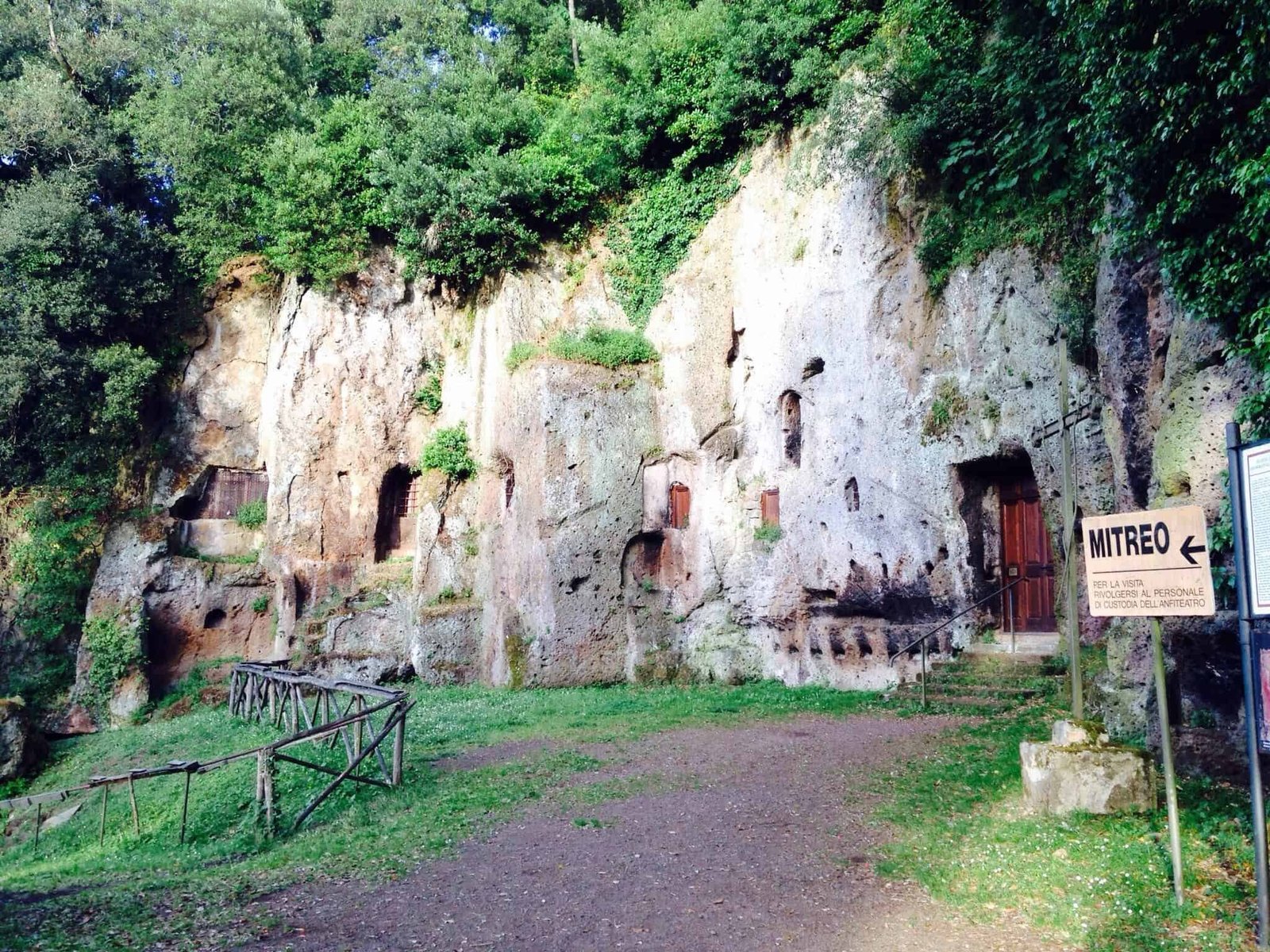
The Ancient City of Sutri Regional Natural Park covers seven hectares along Via Cassia, at kilometer 49, in the municipality of Sutri in the province of Viterbo. The entrance to the archaeological area opens on the state road, in front of the tuff spur on which the village stands. The Park's headquarters is at Villa Savorelli, at the top of the hill, at kilometer 50 of the Cassia, while the administrative address of the managing body, the Municipality of Sutri, is Piazza del Comune 32, 01015 Sutri (VT). The Park's contacts are the number 0761 634660 and the mailbox parcosutri@regione.lazio.it. For hours and visits, the Municipality answers at 0761 609380. The amphitheater and the archaeological area are closed on Mondays and open from 10:00 to 19:00, with last entry half an hour before closing. It is worth double-checking the extended hours on Saturday and Sunday on the website of the Municipality of Sutri, which publishes the updated calendar. The full-price ticket for the whole archaeological area, amphitheater and Mithraeum included, costs 8 euros. The amphitheater alone costs 5 euros. The reduced ticket is 6 euros for the whole area and 3 euros for the amphitheater alone, reserved for groups of more than 20 people and for visitors between 18 and 25 years old. There is a combined ticket with Palazzo Doebbing at 15 euros, 12 reduced. Entry is free for residents, for those under 18, for people with disabilities, for accredited journalists, for university professors, for students of archaeology, art history and architecture, and for licensed tour guides. You don't need to book for the amphitheater or the archaeological area. For the Mithraeum you always do. You enter in shifts of a few minutes, every 20 minutes, in limited groups that the Municipality sets at a maximum of 10 people, with a gap between one group and the next to renew the air. Mithraeum entries run from Tuesday to Friday between 10:20 and early afternoon, and on Saturdays, Sundays and holidays until late afternoon, with a final shift under special lighting.
From Rome you get there in a little under an hour by car, going up the Cassia bis and coming back onto the historic Cassia. If you come by train, get off at Capranica or Viterbo and continue by bus, because Sutri has no railway station. The most convenient parking is the dirt lot in front of the amphitheater entrance, on the Cassia. If you want to place the site within its area, the page on Sutri tells the story of the village, and the one on Via Francigena explains the trail that crosses the park from one end to the other.

What the Ancient City of Sutri Regional Natural Park really is
The Lazio Region established it with regional law number 38 of June 24, 1988, in the form of a regional urban park. The administrative definition says little to the visitor, but it says a lot about the nature of the place. It is not a mountain protected area or a valley-floor reserve. It is a piece of an ancient city placed under protection together with the woods that grew over it. Seven hectares. The smallest of the regional parks of Lazio, and among the smallest in Italy.
The disproportion between the surface and the content is the real character of the place. In seven hectares you find a Roman amphitheater carved entirely into the rock, a rock-cut necropolis lined up along a consular road, an underground place of worship that became a church, an eighteenth-century villa with its boxwood garden, a church with two bell towers and a holm oak wood with porcupines and great spotted woodpeckers. There are protected areas 20 times larger with a tenth of this density.
Why the Ancient City of Sutri Regional Natural Park is an urban park and not an archaeological one
The choice of the 1988 formula was anything but bureaucratic. An urban park protects the landscape and the historic fabric that produced it together, and it allows the tuff of the amphitheater and the holm oak growing around it to be put under the same protection. The result is that here the monument is not isolated inside a fence. The necropolis is at the roadside, the woods reach the podium of the arena, and the villa's garden looks down on the same tuff bank in which the cavea is carved. Anyone who arrives expecting a fenced archaeological area and nothing else gets the forecast wrong and, usually, gets the time to allow wrong too.
The managing body and the headquarters of the Ancient City of Sutri Regional Natural Park
Management is entrusted to the Municipality of Sutri, which has the Park's operational headquarters inside Villa Savorelli, on San Giovanni hill, at kilometer 50 of the Cassia. You can feel this choice as you walk. The park's custodian and the city administration are the same thing, and the boundary between the protected area and the built-up town is as wide as a street. Archaeological oversight of the amphitheater and the Mithraeum, instead, falls to the Superintendency responsible for the territory of Viterbo and southern Etruria, which publishes the hours of the two monuments together with the Ministry of Culture.
How to get to the Ancient City of Sutri Regional Natural Park
By car from Rome
The fastest route is the Cassia bis Veientana, the expressway that leaves Rome at Giustiniana and runs fast to Monterosi. From there you rejoin the historic Cassia and reach Sutri in about 10 minutes. If you have time and want to understand the area, take the old Cassia all the way instead, passing through La Storta, Campagnano, Monterosi. It is the road pilgrims have walked for a thousand years, and the last stretch enters Sutri right in front of the amphitheater. The monument is on the right coming down from the north, with the dirt parking lot just before the entrance.
By train and bus
Sutri has no railway station. The two sensible options are the Rome Viterbo line, getting off at Capranica Sutri and continuing by bus or taxi for the last kilometers, or the direct coach from Rome toward the Tuscia, which stops along the Cassia. For times and frequencies it's best to check the carrier's website the day before. The holiday service is reduced, and anyone planning to return to Rome on Sunday evening risks being left without runs. For those traveling without a car, the most efficient day is the one that pairs Sutri with Viterbo, on the same route.
On foot, along Via Francigena
There is a third way to arrive, and it is the one the place was designed for. Stage 42 of Via Francigena of Lazio starts from the Cathedral of Vetralla and ends exactly at the amphitheater of Sutri: 23.6 kilometers, about 292 meters of elevation gain and 332 of descent, five hours of walking, medium hiking difficulty. Whoever arrives this way sees the park as the pilgrims saw it, that is from above and from the north, with the village standing out on the tuff. The next stage, the Sutri variant, starts again from the amphitheater and runs along the monumental necropolis in the direction of Rome: 7.3 kilometers of tourist difficulty, 30 meters of elevation gain and 45 of descent, with the fork for Trevignano Romano after about a kilometer and a half, then the provincial road, Strada Vallicella, three kilometers among cultivated fields and olive groves, the locality of San Martino with its fontanile and finally the perimeter of the Golf Club Le Querce.
Hours, tickets and reservations for the Ancient City of Sutri Regional Natural Park
How much it costs to get in
The price list distinguishes two things that many people confuse: the archaeological area and the amphitheater alone. The full-price 8 euro ticket includes the amphitheater and the Mithraeum, that is the two monuments you visit with an entry ticket. The 5 euro one opens only the amphitheater. The reduced ticket drops to 6 and 3 euros respectively for groups of at least 20 people and for visitors between 18 and 25 years old. With 15 euros, 12 reduced, you add Palazzo Doebbing, the exhibition venue of the village. The garden of Villa Savorelli and the park's woods are accessible without a ticket.
Who gets in free
Free entry covers residents of Sutri, those under 18, people with disabilities, accredited journalists, university professors, students of archaeology, art history and architecture courses, and licensed tour guides. It's a wider list than the average of state sites and worth knowing. A family with two minor children pays for two tickets instead of four, and the difference over a day in the Tuscia is not negligible.
How to book the Mithraeum
The Mithraeum is the only space in the Ancient City of Sutri Regional Natural Park that you visit with limited numbers, and the reason is conservation before organization. You enter every 20 minutes, in shifts of a few minutes, in groups that the Municipality limits to a maximum of 10 people, with a pause between one shift and the next so the air renews. The medieval frescoes that cover the rock wall suffer from the humidity brought by bodies and breath. From Tuesday to Friday the shifts start at 10:20 and continue until early afternoon. On Saturdays, Sundays and holidays they go until late afternoon, with a last entry under special lighting that is worth choosing if you can. Booking is mandatory and is done in advance through the Municipality of Sutri.
The practical advice on hours
If you are coming for the Mithraeum, build the day around the shift they give you and not around lunch. The rest of the park absorbs any wait. The amphitheater deserves 40 minutes by itself, the necropolis 20, the villa's garden another 30. Whoever books the first shift of the morning comes out of the hypogeum at 11 and has the whole day for the village.
The geology: the red tuff with black scoria beneath the Ancient City of Sutri Regional Natural Park
Everything you see here exists because a volcano stopped erupting at the right moment. The area belongs to the Vico volcanic domain, generated by the eruptions of the Vico crater between about 200 thousand and 100 50 thousand years ago. The pyroclastic flows of those phases deposited the red tuff with black scoria, a rock with two qualities that usually don't coexist: it is extremely compact and at the same time remarkably workable. It is cut with simple tools and then it holds. From those flows came the tuff plateau on which the park extends.
Everything else follows from this combination. An amphitheater carved instead of built, tombs made with pickaxe blows in the wall of a road, an underground place of worship as large as a church, cellars and stables that still open today under the houses of the village. The Etruscans and then the Romans did not bring stone to Sutri. They took stone away from Sutri, and what remains is the void they left. It is a conceptual reversal worth explaining to kids before entering the arena, because it completely changes the way they look at the steps.
Why the tuff changes color with the light
The red tuff with black scoria is a rock that reacts to the sun in a showy way. At noon in July the cavea of the amphitheater looks yellowish and flat. At seven in the evening in September it shifts to a warm red that leans toward brown, and the black scoria emerge as speckles. It is not a photographic effect, it is the composition of the rock. Anyone who photographs the Ancient City of Sutri Regional Natural Park at noon takes home the wrong monument.

The Roman amphitheater carved into the tuff
It is the monument that brings people here, and rightly so. The amphitheater of Sutri was not built, it was extracted. The ancients attacked a bank of tuff facing the city and hollowed out the rock until they got the ellipse, the cavea, the corridors and the doors. There is no load-bearing masonry block, no barrel vault, no facade arch. There is the wall of the quarry turned into architecture.
The measurements of the amphitheater of the Ancient City of Sutri Regional Natural Park
The Ministry of Culture gives the dimensions as 49.60 by 40.80 meters. These are modest proportions in absolute terms: the Colosseum measures almost four times as much on the major axis. But size, here, is not the point. An amphitheater built in Rome with those dimensions would be a minor provincial building. Carved into a bank of tuff, with the cavea rising continuous without a joint, it produces an effect of unity that buildings in concrete work never have. You walk in and understand in three seconds that the whole basin is a single piece of rock.
The cavea, the podium and the 10 doors
The layout has two opposite entrances on the major axis, following the canonical scheme of amphitheaters. The arena is surrounded by a podium, the barrier that separated the space of the show from the audience, and along the podium 10 doors open onto a covered corridor. It was the arena's service system, the one the beasts and the men destined for the show came out of. The cavea, that is the seating, turns out to be divided into three superimposed sectors, the classic tripartition that mirrored the social hierarchy of the Roman audience. The lowest sector served the notables, the highest the common people. The furnishings and the inscriptions that assigned seats are gone, but the division can still be read in the rock.
The dating of the amphitheater
The simplicity of the layout points the dating toward an early moment. The Ministry's indications place the construction between the last decades of the 1st century BC and the first years of the 1st century AD. This means that when the amphitheater of Sutri was new the Colosseum was not even a project. A good 70 years were still missing. Whoever visits the park keeping this chronology in mind looks at the arena with the right eye, because they see it for what it was, an Augustan-age entertainment building in an agricultural colony on the Cassia, not a Colosseum in miniature.
What was seen in this arena
Munera gladiatoria and venationes, that is fights between gladiators and hunts with animals. The 10 doors along the podium served exactly this. You have to size the show correctly, though: an arena of 40 meters by 50, in a colony of a few thousand inhabitants, hosted fights on a local scale, financed by city magistrates out of electoral obligation and for prestige. The great imperial gladiator companies never set foot here. It is a fact that deflates expectations and makes the place more interesting, not less.
How to visit the amphitheater of the Ancient City of Sutri Regional Natural Park
You enter from the Cassia, go down a ramp and find yourself on the arena. The route is short and has no serious architectural barriers on the arena floor, while climbing back up the seating requires a steady foot. The rock is smooth, and in the rain it becomes seriously slippery. Make the complete circuit of the podium before climbing, looking at the doors one by one. Their regular sequence is the thing that, more than any other, gives back the building's operating logic. Then climb to the last sector and look toward the village. 40 minutes is enough, an hour if you have brought someone who takes photos.

The Mithraeum and the church of the Madonna del Parto
A few steps from the amphitheater, still on the Cassia front, opens the space that makes the Ancient City of Sutri Regional Natural Park a case study and not just a nice walk. It is a large hall carved into the tuff, today the church of the Madonna del Parto, which archaeological studies trace originally to a place of worship of the god Mithras, excluding the apse area, which is more recent. The date proposed for the Mithraic phase is the 1st or 2nd century.
Who Mithras was and why his cult was underground
Mithraism arrives in Rome from the East between the 1st and 2nd century and takes root above all among soldiers, customs officers, merchants, people who moved along the roads. It was an initiatory and male cult, organized in seven grades, celebrated in deliberately underground or artificially darkened spaces. The spelaeum, the cave, reproduced the cavern in which according to the myth Mithras killed the primordial bull. A city like Sutri, leaning on the Cassia and used to the continuous passage of travelers and soldiers, was the ideal ground. And a city that knows how to dig tuff had the right material to build the cave without having to look for it.
The baptismal font in the floor
In the floor of the space you can still make out the basin in which the baptism by water was carried out, with which believers were initiated into the Mysteries of the cult. It is the detail that most strikes visitors, and the reason is obvious. It puts before your eyes the continuity of gestures between two religions that contended for the same space. Christianity did not invent initiatory immersion, it inherited it from a shared Mediterranean ritual repertoire, and here you can see it in one square meter of floor.
The Christianization of the hypogeum
In the 4th century the space was Christianized and turned into a church. The central slab of the Mithraic taurobolium was removed. Today it can be seen walled into the wall of a farmhouse along Via Cassia, in the locality of La Botte, a few meters from the road. This moving of a stone from one cult to the other is the religious history of inland Lazio in a single object: nothing is destroyed, everything changes function and moves a few kilometers.
The frescoes and the pilgrimage to San Michele
The walls of the church of the Madonna del Parto preserve medieval frescoes of great interest, among them a cycle tied to the legend of Saint Michael the Archangel and to votive pilgrimages. The reference is not accidental: Sutri was a stop on the route that took pilgrims from the North toward Rome and, for some, beyond Rome to the sanctuary of San Michele on the Gargano. A rock-cut hall dedicated to the Virgin of Childbirth, frescoed with stories of Saint Michael, along the pilgrims' road, inside a former temple of Mithras: four layers of worship in the same void carved into the tuff. I don't know another space in all of Lazio that stacks them like this.
What to look at in the seven minutes of the visit
The shift is short and has to be used well. As soon as you enter, stop on the threshold and let your eye adjust. The first look is always wasted. Then look for three things in this order: the basin in the floor, the point where the rough rock passes to the plastered and painted surface, and the apse area, which is the latest addition and stands apart from the rest. If you have time left, look at the ceiling, where the tool marks have remained legible.
The rock-cut necropolis along Via Cassia
Leaving the amphitheater and continuing toward Rome, the tuff wall that runs along the road opens into dozens of quadrangular chambers. This is the monumental necropolis of Sutri, a line of rock-cut tombs of the Roman age carved directly into the face of the cliff, on both sides of the consular road. The sources remember it as one of the most extensive rock-cut funerary complexes in central Italy.
How a roadside necropolis worked
Roman law banned burials inside the city limits, and the result is the look we know from all the consular roads: tombs line up along the road, just outside the gate, so that people coming in and going out can see them. It wasn't macabre, it was advertising. A tomb visible from the road kept the family name alive in front of every passerby, and the busier the road, the more the spot was worth. The Cassia at Sutri was one of the great trade routes between Rome and north-central Italy: a prestigious address, in the literal sense.
What you can see today in the necropolis of the Antichissima Città di Sutri Regional Natural Park
Rectangular chambers, often with niches carved into the walls for urns or loculi for burials, a few more complex rooms with benches and pillars left standing in the tufa. Many tombs were reused over the centuries as shelters, stables, storerooms, and this wiped out a large part of the decorative elements. But the sequence is impressive precisely in its repetition: you walk for hundreds of meters with perforated rock over your head. The most readable stretch is covered on foot, and it coincides with the start of the Francigena variant toward Rome.
A warning, and not a rhetorical one
A large part of the necropolis faces a state road used by heavy vehicles at high speed. It is not a pedestrian route equipped along its whole length. With children, hold their hands and stay on the protected stretches. With a camera, resist the temptation to cross the road to shoot the opposite front against the light.

Villa Savorelli, the seat of the Antichissima Città di Sutri Regional Natural Park
On top of San Giovanni hill, the high spur of tufa that overlooks the village and the Cassia, stands the villa that gives the park its seat and its most recognizable profile from a distance. It was built in the early 18th century at the wish of the family of the Muti Papazzurri marquises, on an area that already had a long history of lordly settlement.
The families that passed the villa on
The property passes through four noble houses: the Altoviti, the Muti Papazzurri who built it, the Savorelli, from whom it takes its current name and with whom it entered the local place names, and finally the Staderini. In 1987 the villa became municipal property, and a year later the regional law established the park that has its seat there. The sequence is orderly and says one precise thing: for centuries this hill was where whoever ruled Sutri settled in, first with a castle, then with a pleasure villa.
The 1944 fire and Giorgio de Chirico's restoration
In 1944 the retreating German troops set fire to the villa. The rebuilding that followed involved the painter Giorgio de Chirico, who oversaw the facade. It's a fact that usually surprises people who hear it for the first time, and it changes the way you look at the front: that rhythmic, silent surface, seen out of the corner of your eye as you climb up from the garden, has something of the metaphysical piazzas painted by its author 30 years earlier. Today the villa hosts conferences, the seat of the regional park and, in the administration's plans, hospitality facilities for pilgrims of Via Francigena.
The Italian garden
The villa's garden is open to the public and is worth the climb on its own. It's laid out according to 18th-century canons: boxwood hedges designed as a maze, closed geometries, and at the center a peperino fountain with a circular basin. Peperino is the local stone par excellence, worked for centuries in the Cimini, and the contrast between its gray and the dark green of the boxwood is the reason this garden photographs well in any season. Add that from the parapet you look at the valley and the tufa bank of the amphitheater from above. Better to come up here at the end, not at the beginning: after walking in the arena and along the tombs, the view from the garden pulls together everything you've seen in a single glance.
The church of the Madonna del Monte
Next to the villa, on the highest point of the hill, the church of the Madonna del Monte closes the scene toward the village. The original structure dates presumably from the early 13th century and was a simple hall on a Greek-cross plan. It belonged to the Altoviti and passed to the Muti Papazzurri in the 17th century.
Sebastiano Cipriani and the 1725 construction site
In 1725 Marquis Giovanni Battista Muti Papazzurri entrusted the architect Sebastiano Cipriani with a wide-ranging renovation. Cipriani opened up the apse space to hold the high altar, carved out two side chapels by setting columns against the walls and built a monumental facade developed vertically, with two bell towers. The goal was stated openly: to make the church a soaring building, clearly visible from the town below. Anyone who looks at Sutri from the Cassia understands that the operation succeeded, because the two-bell-tower silhouette is the first thing that stands out against the sky.
The frescoes of Gaetano Sardi
The interior decoration was completed by Gaetano Sardi, who painted the ceiling vaults and the high altar. The theme running through the frescoes is consistent with the purpose of the place: the solitude of the dwelling and the possibility of withdrawing into prayer in total quiet. It was the chapel of a country villa, not a parish church, and the iconographic program says exactly what the patron was looking for when he came up here.
The Castle of Charlemagne and San Giovanni hill
On the same hill, not far from the villa, stands a building that local tradition calls the Castle of Charlemagne. The name comes from the legend of a stay by the Frankish ruler in this place while he was going down toward Rome for the imperial coronation. It must be said clearly that this is tradition, not documentation: the masonry, made of tuff blocks of uniform height, points the dating of the building to around the 14th century, so 500 years after Charlemagne.
What the documents say instead
The first documented mention dates to 1367, when an inventory of the Hospital of Santo Spirito in Sassia records a palatium comitis Anguillarie on San Giovanni hill, later called Savorelli hill. The building is recognizable as one of the structures that made up the castrum of the Anguillara family, the lords who controlled Lake Bracciano and the lands between the Sabatini and the Cimini. Today the property belongs to the Staderini family. The distance between the Carolingian legend and the palace of the Anguillara is instructive: it tells how a place name is born and how little it has to do with chronology.
The nature of the Ancient City of Sutri Regional Natural Park
Above and around the archaeology there is a real wood, and it would be a shame to cross it without looking at it. The dominant formation is the holm oak grove, a wood of holm oak, with a floral entourage rich in laurel and with specimens of strawberry tree and viburnum. It is the evergreen Mediterranean vegetation found at altitudes and latitudes like this when the volcanic soil drains well and the exposure is warm.
The trees, the clearings, the valley floor
In the natural clearings that open among the holm oaks grows an abundant herbaceous component, which changes appearance completely between April and July. In the valley floor area, where water stagnates, species typical of riparian and lake environments appear instead: poplars, willows, reed beds of common reed. In two hours of walking you go from the dry Mediterranean wood to water vegetation, and the transition is sharp.
Ferns and mushrooms
The park hosts several ferns, among them maidenhair fern, which looks for dripping walls and finds them easily in an environment of carved tuff, and the bracken of the clearings. On the edible mushroom front, Boletus aereus, the black porcini, and Cantharellus cibarius, the chanterelle, are reported. It is worth remembering that in a protected area gathering is regulated and should be checked with the managing body before filling a basket.
The fauna of the Ancient City of Sutri Regional Natural Park
Among mammals the protected area hosts porcupines, foxes, wild boars and stone martens. The porcupine leaves its quills on the paths, and whoever walks early in the morning finds them without looking. They are the most honest souvenir the park can offer, and picking up a fallen one harms no one. Among the diurnal raptors there are kestrels, sparrowhawks and buzzards. Among the nocturnal ones, barn owls, long-eared owls and little owls. The kestrel hunting above the tuff, still in the air as if hanging from a thread, is one of the recurring sights in the middle hours.
The birds you will surely hear
The common company includes jay, blue tit, great tit, green woodpecker and great spotted woodpecker. The green woodpecker is heard before it is seen, with that laugh bouncing among the tuff walls. The great spotted woodpecker announces itself by drumming. Water birds are limited by the presence of a single stream inside the protected area, but they still include gray heron, little egret and mallard. Whoever arrives early in the morning with binoculars and an hour of patience makes a haul out of proportion to the seven hectares.
The history of the ancient City of Sutri
The origins and the legend of Saturn
The origins of Sutri, anciently Sutrium or Suteria, are remote and are traced back to the Bronze Age. Local tradition attributes the founding to the god Saturn, whose image on horseback with three ears of wheat still appears today in the town coat of arms. Another legend invokes the Pelasgians, pre-Hellenic peoples. These are foundation tales, not historical news, and should be kept in their place: they tell how the people of Sutri imagined their own antiquity, not when the city was born.
Prehistory and protohistory: what the finds say
On documented ground there are fragments of impasto materials dated to the 10th century BC, that is the Final Bronze Age, and remains of pit and trench tombs with ceramic finds from the mid-8th and early 7th century BC. Near the heights of Monte Rocca Romana and Monte Calvi, about 70 minutes on foot to the south in the direction of Trevignano, remains of Iron Age settlements have emerged, abandoned around the middle of the 7th century BC. The most accredited reading is that the first settlement of Sutri was born from the confluence of several scattered villages, whose inhabitants were looking for a defensible place rich in new resources. The tuff high above the valley was exactly that place.
Between Veii and the Faliscans
Sutri developed along the roads that connected the inland Etruscan world to the coast and, later, the rising Roman power to the north of the region. In the historical age it lay on the border line between the area of Veii influence, hence Etruscan, and the Faliscan one, and today it is hard to say with certainty which of the two civilizations prevailed over the city. Whoever wants to see the Etruscan point of comparison should go to Cerveteri and Tarquinia, and then come back here. The difference between an Etruscan tumulus necropolis and a Roman rock-cut roadside necropolis explains by itself two opposite ways of thinking about death.
383 BC: the Latin colony
The fall of Veii in 396 BC marked Sutri's entry into the Roman world. The ancient sources link the capture of Sutrium to Marcus Furius Camillus, with a chronology that the Enciclopedia Italiana places in 394 BC. In 383 BC the city was founded as a Latin colony, and took on a significant military role for the Roman penetration into Etruria. Together with nearby Nepi, Sutri became a stronghold of the Urbs in the territory just taken from Veii and a bridgehead for the push northward. The ancients called it, in a felicitous phrase, one of the gates of Etruria.
The years of the siege
They were hard decades. The city was besieged by the troops of Tarquinia and, according to tradition, saved by the intervention of Furius Camillus. It suffered more than one Etruscan attack without falling. The definitive submission of Tarquinia in 281 BC, the destruction of Volsinii in 264 and that of Falerii in 241 progressively took away Sutri's military function and pushed it toward a rural vocation. It was not a painless passage: the long war fought on the front line had impoverished the city, which at the end of the 3rd century BC, during the Second Punic War, refused Rome the annual tribute together with other Latin centers.
The imperial age
The most prosperous period, from the economic and demographic point of view, was the imperial one, and the monuments that today form the Ancient City of Sutri Regional Natural Park bear witness to it: the amphitheater, the necropolis, the many agricultural settlement clusters scattered across the territory. The city was colonized again at the end of the 1st century BC, perhaps because of its closeness to the party of the defeated Lucius Antonius at the time of the Perusine War, between 41 and 40 BC. After the Social War it had acquired municipal status. Strabo remembers it as a flourishing city. The economy rested on agriculture and small craft activities, and the engine of everything was Via Cassia, which had become one of the great trade routes between Rome and north-central Italy.
The end of the empire seen from the Cassia
The people of Sutri watched the collapse of the empire from the front row, because the hordes coming down toward Rome passed beneath their walls. It was also their salvation: closeness to the consular road and its traffic let the city get past the critical phase without dying out, while other centers of the inland Tuscia shrank until they disappeared.
The Middle Ages: the Donation of Sutri and the council of 1046
Between the 5th and the 8th century Sutri was a battleground between Lombards and Byzantines, and its position on the Cassia made it a permanent target. Then came the event that put this city's name in every medieval history textbook.
728: the Donation of Sutri
In 728 the Lombard king Liutprand offered the city to Pope Gregory II. That donation is considered the beginning of the temporal dominion of the Church, that is the birth certificate of what would become the Papal State. It is worth dwelling on the disproportion: a center of a few thousand inhabitants on a tuff spur becomes the first brick of a territorial power that will last until 1870. Whoever walks in the park does so over the piece of land where it all began.
1046: the council that deposed three popes
In 1046 Sutri hosted a council that remained famous. There Gregory VI, Benedict IX and Sylvester III were deposed, the three pontiffs who were simultaneously contending for the throne, and the see was assigned to Clement II. It is one of the very few moments in history in which three popes are removed in the same assembly, and it happened here, in a provincial city chosen because it was close enough to Rome to matter and far enough to be safe.
The refugee popes and the end of the medieval village
The position as a papal outpost guaranteed Sutri a role throughout the Middle Ages: Eugene III and Innocent IV found refuge inside the walls in difficult moments of their pontificates. The arc was abruptly interrupted in 1433, when the condottiero Niccolò Fortebraccio set the city on fire during the struggles between Guelphs and Ghibellines. The medieval village outside the walls, the one crossed by pilgrims, never recovered: it was devastated by Fortebraccio and completely destroyed by a flood in 1493. From then on the economic decline continued, worsened by the shift of trade routes, until the French occupation of the 1700s and entry into the Kingdom of Italy.
The village of Sutri outside the Ancient City of Sutri Regional Natural Park
The protected area and the historic center touch, and visiting one without the other is a planning mistake. From the amphitheater parking lot to the first alley of the village it is a 10-minute uphill walk.
The Cathedral of Santa Maria Assunta
Sutri is one of the oldest known episcopal sees: local tradition fixes the episcopate of Saint Eusebius, indicated as the first bishop, at 465 AD. The current cathedral was consecrated in 1207 by Pope Innocent III, at the end of a building site that lasted roughly 50 years, on a building that Pope Sergius III had already enlarged in 908. On the occasion of the consecration Innocent III gave the city a panel with the Byzantine Christ, still on display.
The bell tower, the Cosmatesque floor, the crypt
Three things deserve attention inside and outside the cathedral. The Romanesque bell tower, preserved in its full height, is the vertical signal of the village and can be seen from the garden of Villa Savorelli. The Cosmatesque floor, with its porphyry and serpentine discs interwoven by the Roman marble workers, belongs to the great medieval season of Lazio, the one that also produces the floors of San Clemente and Santa Maria in Cosmedin. The crypt, finally, is the space scholars argue about: some even consider it of Lombard date, which would bring it close to the donation of Liutprand. It is one of the most beautiful crypts in the Tuscia and almost nobody looks for it.
The Museo del Patrimonium
Created by the municipal administration, the Museo del Patrimonium occupies a 15th-century palace that was the seat of the Community of Sutri and of the Civic Hospital. It displays canvases from the church of San Francesco, three medieval frescoes recovered from the abandoned church of Santa Fortunata and a group of stone finds kept in the third room, among them the notable slab of the Colony of Sutri. That slab is the epigraphic document that ties the village to the colonial foundation of 383 BC: whoever has just walked in the amphitheater should see it.
The Torre degli Arraggiati
Arriving from Viterbo along the original route of the Cassia you meet a tall, austere ruin, called Torre degli Arraggiati or Torre di San Paolo. It was the bell tower of the church of the same name, with an attached convent inhabited by Carmelite friars. The construction dates to the 12th or 13th century: rectangular plan, load-bearing structure in hand-squared tuff blocks, lime and pozzolana mortar, and an entrance with triple concentric pointed arches with multiple rings, resting on small pillars with leaf capitals. It is one of the last remains of the medieval settlement destroyed in the 1400s.
Where that name comes from
The name comes from the Carmelite monks who lived in the convent. They came from Sicily, quite far from their destination, and in town they called them the angry ones, which in Sicilian is pronounced arraggiati. The place name has therefore preserved, for eight centuries, the irritation of a group of friars over a transfer that went badly. Serious guides love these details because they are true and because they give medieval history back its human scale.
The old washhouse
Within the fabric of the village opens the old washhouse, a corner tied to the traditions and popular history of the city. Until 2000 the fountain was squashed by a large building from 1936, demolished for structural reasons: the demolition gave air and light back to Via Giovanni Andrea dell'Anguillara and brought the fountain back into view. Today the washhouse hosts good summer music events, and if you happen to be in Sutri in July it is worth checking the program.
Via Francigena and the Ancient City of Sutri Regional Natural Park
Sutri is a historic stop on Via Francigena, and this is not decorative: much of what you see in the park exists because for centuries people on foot bound for Rome passed through here. The city became a nerve center close to the city of Saint Peter, and the ruins of churches, hospitals and Templar seats scattered across the territory say so. The church of Santa Maria del Tempio, near Via Cassia, was one of the main Templar reception stations in the area.
A three-hour itinerary to understand it all
The general itinerary of the city, proposed by the park authority as a jubilee trail for those arriving from Viterbo, measures seven kilometers, takes about three hours and has hiking difficulty. It starts from the remains of the old village, touches the medieval tower of San Paolo with its pointed portal and three pointed arches, climbs toward the Madonna del Carmine on Monte Bono, takes the nature trail toward Valle Mazzano where wild orchids grow spontaneously, and ends at Villa Savorelli and the archaeological area. It is the best way to spend half a day: you see the park, you see the village, you see the landscape that holds them together.
Where to sleep and where to eat
The village has small, good-quality lodging, with a few facilities designed expressly for pilgrims, and the administration has long been working to equip Villa Savorelli as Francigena hospitality. Those who walk should book in advance in the months of heavy flow, April, May, September and October, because the available beds are few and the stages before and after have no comfortable alternatives.
A curiosity about the Ancient City of Sutri Regional Natural Park
The real curiosity is in the name, and almost nobody notices. In the list of protected areas of the Lazio Region this park appears as Parco Regionale Urbano Antichissima Città di Sutri: it doesn't carry the name of a mountain, a lake, a river or a promontory, as all the others do. It carries the name of a quality, antiquity, applied to a city. It is the only case in Lazio, and one of very few in Italy, of a protected natural area named not for a geographic feature but for a historical judgment.
The choice goes back to regional law 38 of June 24, 1988 and is anything but random. In 1988 the notion of an urban park was young and served to protect pieces of landscape absorbed into the built-up area. At Sutri they wanted to say that the object of protection was the relationship between the ancient city and the rock that supports it, not one of the two terms separated from the other. Hence the unusual formula.
Then there is the numerical sequel to the curiosity, namely that this is seven hectares. Seven. To get an idea: the Circeo National Park exceeds 8,000 hectares, the Monti Simbruini one 30 thousand. Seven hectares are a square of a little over 260 meters per side. Inside that square there are a Roman amphitheater carved entirely in the rock, a rock-cut necropolis, a Mithraeum turned church, an eighteenth-century villa with a boxwood garden, a church with two bell towers designed by a Roman architect, a fourteenth-century castle and a holm oak wood with diurnal and nocturnal raptors. Few Italian protected areas hold up to this ratio between surface and content. The first thing to do here is to forget the word park in the sense of a large green space: the Ancient City of Sutri Regional Natural Park is a concentrate, and should be visited slowly precisely because it is small.
Something nobody tells you about the Ancient City of Sutri Regional Natural Park
The Mithraeum can be visited only by reservation, in limited groups, for a few minutes each, every 20 minutes. This information is published, but it reaches people badly and late, and I see the result every season: groups arriving at 11 on a Saturday convinced they'll get in with the amphitheater ticket and finding out that the day's shifts are already assigned. The 8 euro ticket includes the Mithraeum, but buying it isn't enough: without a reservation you don't get in.
The reason for the limit is not an office's whim. The church of the Madonna del Parto is a closed hall carved into the tuff, with medieval frescoes applied directly to the rock. Every human body that enters brings heat and water vapor. In a hypogeal space the relative humidity rises quickly and condenses on the painted surfaces. The protocol provides for small groups, very short stays and an interval of a few minutes between one entry and the next so the air renews. It is the same logic that governs access to painted caves all over Europe, applied here on a tiny scale.
The second thing nobody says is that the end-of-day shift on weekends comes with special lighting. It's no small detail: in a hypogeal space the difference between a service light and a designed light completely changes the legibility of the frescoes and the perception of the carved space. If you have only one afternoon, ask for that shift and organize the rest of the visit backward from there.
Third thing, less dramatic but useful: the Italian garden of Villa Savorelli and the wood don't require a ticket. Whoever is short on time or budget can climb the hill, see the garden, the church with two bell towers and the panorama over the valley without paying anything, and this makes the Ancient City of Sutri Regional Natural Park one of the best-spent free destinations in northern Lazio.
The advice I give you for visiting the Ancient City of Sutri Regional Natural Park
The advice is only one, in this order: book the Mithraeum before deciding anything else, then build the day around that shift, then climb the hill last. Whoever does the opposite, that is arrives, pays, tours the amphitheater and only afterward asks about the Mithraeum, loses the best part.
On duration, be realistic. The Ancient City of Sutri Regional Natural Park with the village is a full day, not a 90-minute stop between Rome and Viterbo. Count 40 minutes for the amphitheater, 20 or 30 for the readable stretch of the necropolis, your shift plus the wait for the Mithraeum, a good hour for the hill with villa, garden and the church of the Madonna del Monte, and at least an hour and a half for the historic center with the cathedral and the Museo del Patrimonium. If you add lunch you're at six in the afternoon without having rushed anywhere.
On shoes I don't compromise. Tuff polished by two millennia of passage is a treacherous surface, and the amphitheater steps after rain are seriously dangerous. Closed shoes with a lugged sole, always, even in August. Smooth city soles in this place have sent more people to the emergency room than you'd imagine.
On season: March, April, May, September and October. In July and August the holm oak grove gives shade on the paths but the amphitheater is an exposed bowl of rock that at noon becomes an oven, and the flat light ruins any photograph. In winter the park is splendid and almost deserted, but the days are short and the evening Mithraeum shift falls almost in the dark.
One last thing, and here I give a firm opinion. Many visitors arrive by car, see the amphitheater from the parking lot, take a photo and leave. It is the most common waste here. The amphitheater without the necropolis, without the hypogeum and without the hill is a fine isolated monument. With the other three it becomes the complete story of how a community used the same rock to amuse itself, bury its dead, pray to an eastern god and then to the Madonna, and finally build a villa of leisure on top of it. That story is worth the trip. The single photograph of the arena is not.
Another well-known fact, yet rarely cited
Many people know that a council was held at Sutri in 1046. That three popes were deposed at that council on the same day is rarely said, and almost never is it explained why it mattered.
The situation of 1046 is among the most embarrassing in the history of the Church. Three men claimed the throne at the same time: Benedict IX, of the family of the counts of Tusculum, who had already left and retaken the pontificate. Sylvester III, elected by the opposing faction. Gregory VI, who had acquired the papacy from Benedict IX in a transaction that contemporaries judged simoniacal. Henry III, who had come down to Italy to be crowned emperor, convened an assembly and held it here, at Sutri. The outcome was the removal of all three and the election of Clement II, who a few days later crowned Henry in Rome.
The reason it is worth telling inside the Ancient City of Sutri Regional Natural Park is geographic before theological. Sutri was chosen because it was the right point on the Cassia: close enough to Rome to be reached in a day's march, far enough and fortified enough to let a German emperor gather an assembly without the breath of the Roman factions on his neck. The same position that in the 4th century BC had made it a military bridgehead made it a diplomatic seat in the 11th century. The city has always sold the same merchandise: distance from Rome.
And there is the precedent, equally well known and equally little explained: the donation of 728, with which the Lombard king Liutprand handed Sutri over to Pope Gregory II. In textbooks that date opens the chapter on the temporal power of the Church. On the ground it means that the first territory held by popes as sovereigns, and not as bishops, is this tuff spur with its empty amphitheater and its tombs carved at the roadside. A pilgrim who arrives on foot from Vetralla and ends the stage in front of the arena walks on the first piece of the Papal State in history.
The right photo to take at the Ancient City of Sutri Regional Natural Park
The photograph everyone takes is from the top of the cavea toward the arena, and it's fine as a souvenir, but it says nothing about the place because it could be any amphitheater. The right one is another and requires two things: going down onto the arena and waiting for the light.
Stand in the center of the arena, on the major axis, and frame toward one of the two opposite doors, with the podium and the row of openings running along the side. With a wide lens, around 24 millimeters in full frame, the whole curve of the cavea fits and the shot shows exactly what needs showing: that there are no joints, that there is no masonry, that the seating and the doors are the same continuous rock. It is the photograph that explains the amphitheater instead of portraying it.
On timing there are no opinions, there are facts. At noon the red tuff with black scoria gives back an inert gray yellow. In the first hour after opening and the last before closing it shifts to a warm red and the dark scoria stand out in relief. In addition the raking light draws the ancient tool marks left on the wall, which in overhead light disappear completely. September and October, with the low sun, are the best months.
The second shot to take home from the Ancient City of Sutri Regional Natural Park is from the parapet of the garden of Villa Savorelli: you overlook the valley, the tuff face and the roof of the village, and with a moderate telephoto lens the scene is compressed so that the hill, the holm oak grove and the Cassia fall into a single plane. At sunset the two-bell-tower silhouette of the church of the Madonna del Monte, behind you, stands out against the sky.
In the necropolis, finally, don't look for the overall photograph, which doesn't exist: look for repetition. A single chamber framed head-on with a person standing on the threshold gives the scale. A sequence of three or four openings on the diagonal gives the rhythm. Inside the Mithraeum photography is normally allowed without flash and without tripod, but the time is very short and the light scarce: raise the sensitivity before going in, because in the seven minutes of the shift you won't have a chance to adjust anything.
Some important events that happened here in history
The list of things that happened on this piece of tuff is out of proportion to the size of the city, and it's worth putting them in line.
396 and 394 BC: Sutri enters the Roman world
The fall of Veii in 396 BC took away the city's Etruscan reference and handed it over to the orbit of Rome. The ancient sources link the conquest of Sutrium to Marcus Furius Camillus, with a chronology that the Enciclopedia Italiana gives as 394 BC. From that moment Sutri stops being an Etruscan border city and becomes an instrument of Roman policy toward the north.
383 BC: the founding of the Latin colony
With the colonial founding of 383 BC the city takes on a front-line military role, together with Nepi, as a base for the Roman penetration into Etruria. It is the act that generates everything you see today in the park, because from it descend the centuriation of the territory, the role of the Cassia and, three and a half centuries later, the construction of the amphitheater.
The Etruscan siege and the intervention of Furius Camillus
Tradition tells that the city, besieged by the troops of Tarquinia, was saved by the arrival of Furius Camillus. Modern historiography treats this episode with caution, because the figure of Camillus in the Latin sources has taken on legendary traits. It remains documented, however, that Sutri suffered more Etruscan assaults without falling, and that this earned it the fame of gate of Etruria.
End of the 3rd century BC: the refusal of the tribute
During the Second Punic War, exhausted by decades on the front line, Sutri refused Rome the annual tribute together with other Latin colonies. It is an episode that textbooks cite little and that says a lot about the price paid by border cities for the Roman military system.
Between 41 and 40 BC: the new colonization
At the end of the 1st century BC the city was colonized again, perhaps because of its closeness to the party of the defeated Lucius Antonius at the time of the Perusine War. These are the years in which Sutri's most prosperous season begins, the one that Strabo records and that the amphitheater documents.
4th century AD: the Mithraeum becomes a church
In the 4th century the hypogeal hall consecrated to Mithras was Christianized, and the central slab of the taurobolium was removed. It can still be seen today, walled into a farmhouse along the Cassia in the locality of La Botte. It is one of the most concrete events one can tell about the religious transition of the late empire: not a decree, a moving of stone.
728: the donation of Liutprand
The Lombard king Liutprand cedes Sutri to Pope Gregory II. That act is considered the beginning of the temporal dominion of the Church. The first territory of the Papal State is this one.
908 and 1207: the cathedral
Pope Sergius III enlarges the cathedral church in 908. Three centuries later, in 1207, Innocent III consecrates it after a building site of about 50 years, giving the city the panel of the Byzantine Christ.
1046: the council of the three deposed popes
The assembly convened by Henry III deposes Gregory VI, Benedict IX and Sylvester III and opens the way to Clement II. No other place in Lazio has hosted an ecclesiastical event of this magnitude.
1367: the palatium of the Anguillara
An inventory of the Hospital of Santo Spirito in Sassia records on San Giovanni hill a palatium comitis Anguillarie, the main building of the Anguillara castrum that local tradition calls Charlemagne's Castle.
1433 and 1493: the end of the medieval village
Niccolò Fortebraccio sets the city on fire during the struggles between Guelphs and Ghibellines. 60 years later a flood completes the destruction of the settlement outside the walls. The Torre degli Arraggiati is one of the very few surviving remains.
1725: Sebastiano Cipriani's construction site
Marquis Giovanni Battista Muti Papazzurri commissions the architect Sebastiano Cipriani to transform the church of the Madonna del Monte, which receives the vertical facade with two bell towers still visible today from the whole valley.
1944: the fire at Villa Savorelli
The retreating German troops set fire to the villa on the hill. The rebuilding that followed involved Giorgio de Chirico, who oversaw the facade.
1987 and 1988: the villa to the Municipality, the park to the Region
Villa Savorelli becomes municipal property in 1987. The following year, regional law 38 of June 24, 1988 establishes the Antichissima Città di Sutri Regional Natural Park and entrusts its management to the Municipality of Sutri.
Who has passed through the Antichissima Città di Sutri Regional Natural Park
A town leaning on a consular road sees everyone pass, and Sutri is no exception. The list of those who came through here, documented or handed down by tradition, is long and must be sorted by degree of certainty.
Marcus Furius Camillus
The Roman commander who took Veii is linked to the conquest of Sutrium and, according to tradition, to the relief of the city besieged by the people of Tarquinia. The Latin sources made him an exemplary hero and must be read with caution, but his presence in the story of Sutri is the first name of weight that the city records.
Strabo
The Greek geographer did not stay there, but his testimony is the one that fixes for us the image of Sutri in the Augustan age: a thriving city along the Cassia. Without that line, the amphitheater would be a building without an economic context.
Liutprand, king of the Lombards
In 728 he was the one who handed Sutri over to the pope. He may have climbed the hill himself, or the act may have gone through his officials. Either way, his name is the one carved into the date that opens the temporal power of the Church.
Pope Gregory II
Recipient of the donation. With him the bishop of Rome becomes, for the first time, the sovereign of a territory, and that territory is this one.
Charlemagne, according to tradition
Local legend has it that the Frankish ruler stopped on San Giovanni hill while going down to Rome for the imperial coronation, and that is where the name of the so-called Charlemagne's Castle comes from. The masonry of the building, in tufa blocks of uniform height, points however to the 14th century, and the first document that names it is from 1367. Tradition remains tradition and must be declared as such.
Henry III of Franconia
In 1046 the future emperor convened and presided at Sutri over the council that deposed three pontiffs. His descent into Italy passed materially through here, and the choice of venue was his.
Three popes deposed and one pope elected
Gregory VI, Benedict IX and Sylvester III lost the throne in this city. Clement II obtained it. Four pontiffs in a single assembly, in a provincial town on the Cassia.
Pope Innocent III
He came to Sutri in 1207 to consecrate the cathedral and gave the city the panel of the Byzantine Christ, still on display. He is one of the most powerful popes of the Middle Ages, and his presence here is documented by a specific act.
Pope Sergius III, Pope Eugene III, Pope Innocent IV
Sergius III enlarged the cathedral in 908. Eugene III and Innocent IV sought refuge inside the walls of Sutri in the difficult moments of their respective pontificates. The city worked as a safe base one day's march from Rome.
The Anguillara counts
The family that dominated Lake Bracciano and the lands between the Sabatini and the Cimini had its own castrum on San Giovanni hill, documented in 1367. Their name survives in the village's place names, in that Via Giovanni Andrea dell'Anguillara onto which the old wash house opens.
Niccolò Fortebraccio
The mercenary captain who in 1433 set fire to the city during the wars between Guelphs and Ghibellines. He is the name that closes Sutri's Middle Ages, and the Torre degli Arraggiati is his involuntary signature.
The Muti Papazzurri marquises, the Savorelli, the Staderini
The families that passed the hill among themselves from the 18th century to today. Giovanni Battista Muti Papazzurri is the patron of the church of the Madonna del Monte in the form we see. The Savorelli gave their name to the villa and, by reflection, to the hill.
Sebastiano Cipriani and Gaetano Sardi
The architect who in 1725 redesigned the church on the hill and the painter who decorated its vaults and high altar. Two Roman professionals called to work in the provinces by a patron who wanted a signal visible from the whole valley.
Giorgio de Chirico
The painter who, after the 1944 fire, took part in the reconstruction of Villa Savorelli, overseeing its facade. He is the most unexpected name on the list, and for many visitors the reason the hill stays in the mind.
The pilgrims, who are the real protagonists
For a millennium Via Francigena has brought tens of thousands of people here on foot, bound for Rome and some of them beyond Rome to the Gargano. They left no names, they left the Saint Michael frescoes of the Madonna del Parto, the ruins of the hospitals, the Templar church of Santa Maria del Tempio. The Ancient City of Sutri Regional Natural Park owes its form to them more than to any emperor.
The Ancient City of Sutri Regional Natural Park with children
It is one of the places in Lazio that works best with kids, and the reason is simple: here you go inside things. In a normal archaeological area children look from behind a barrier. Here they walk on the arena of an amphitheater, enter a tomb carved in the rock, go down into a hypogeum. The small scale helps: 40 meters of arena can be crossed in 30 seconds and tire no one.
Two practical warnings. The first concerns the Mithraeum, which with limited numbers and short shifts is not suited to the very young or to those who suffer in closed spaces. Judge according to age. The second concerns the necropolis along the Cassia: the road is busy, has no continuous sidewalk and is not a place to let a child run ahead. On the hill, by contrast, the garden of Villa Savorelli is an enclosed, safe and free space, where the kids can move freely while the adults look at the panorama.
The game that always works: ask the kids to look on the walls for the marks of the tools with which the tuff was cut. They are visible to the naked eye in many points of the arena and the necropolis, and they turn the visit into a hunt. When they understand that nobody built anything and that everything was taken away, the place stays with them.
Accessibility of the Ancient City of Sutri Regional Natural Park
The situation has to be stated frankly, because half-words do harm. The floor of the amphitheater arena is reachable and walkable, while the steps of the cavea are not: they are carved in the rock, irregular and without handrails. The Mithraeum is a hypogeal space with a narrow access. The park's hiking routes, including Via Francigena in the Sutri stretch, are declared unsuitable for strollers and wheelchairs and lack devices for blind and low-vision visitors. The garden of Villa Savorelli, on the hill, has more regular surfaces but is reached uphill. Entry is free for people with disabilities. Those with specific needs should call the Municipality of Sutri before leaving and ask about the practicable route on the chosen day: conditions change with maintenance and weather.
When to go to the Ancient City of Sutri Regional Natural Park
Spring and autumn, without hesitation. Between March and May the holm oak grove fills with song, wild orchids bloom in the clearings of Valle Mazzano and the low morning light lights up the tuff. Between September and October the colors of the valley floor are added, and the mushroom season in the wood, with black porcini and chanterelle reported among the species present.
Summer has only one advantage, the long hours and the music events at the old washhouse, and two serious defects: the heat inside the amphitheater, which is a bowl of reflecting rock, and the noon light that flattens everything. If you come in July, enter at opening and leave the archaeological area by half past 11, then move to the shade of the hill.
Winter is the season of the solitary. The park is almost deserted, the holm oak grove stays green because it is evergreen, the wet tuff has a deep color you never see in summer. Against: short days, slippery steps, and the need to check the reduced hours. If you accept these conditions, a January morning in the empty amphitheater is an experience that in August you can't buy at any price.
What to see around the Ancient City of Sutri Regional Natural Park
The southern Tuscia is dense and the distances are short. Within 20 or 30 minutes by car you can put together different days depending on your interest.
The nearby villages
To the north, along the Cassia, Capranica, Vetralla and then Viterbo with its medieval quarter. To the west Ronciglione and the Lake Vico Nature Reserve, with the crater that produced the tuff you walk on at Sutri. To the east Nepi, the twin city of Sutri in the Roman strategy of the 4th century BC, with its solfatara, and farther on Civita Castellana, Castel Sant'Elia with its sanctuary in the gorge, Faleria and Calcata on the Treja.
Etruscans, tuff and water
To close the circle on the rock-cut, there are the Forre di Corchiano and, toward the coast, the great necropolises of Cerveteri and Tarquinia. For the day at the lake, Bracciano, Trevignano Romano and Anguillara Sabazia, that is the lands of the Anguillara who had their castrum on the hill of Sutri. For Mannerism, Palazzo Farnese at Caprarola and, a little farther on, the Park of the Monsters of Bomarzo. Whoever has an extra hour and wants to see the other great archaeological park of the Veii countryside should head toward the Veii Park: it is the city whose fall, in 396 BC, handed Sutri over to Rome.
Frequently asked questions about the Ancient City of Sutri Regional Natural Park
How much is the ticket for the Ancient City of Sutri Regional Natural Park?
The full-price ticket for the whole archaeological area of the Sutri Park, which includes the amphitheater and the Mithraeum, costs 8 euros. The amphitheater alone costs 5 euros. The reduced ticket drops to 6 euros for the whole area and 3 euros for the amphitheater alone, reserved for groups of at least 20 people and certain age brackets. The wood and the garden of Villa Savorelli don't require a ticket.
How do you get to the Ancient City of Sutri Regional Natural Park from Rome?
From Rome the fastest route to the Sutri Park is the Cassia bis Veientana, the expressway that leaves at Giustiniana and runs fast to Monterosi, from where you rejoin the historic Cassia to reach Sutri in about 10 minutes. Those with more time can take the old Cassia all the way, passing through La Storta, Campagnano and Monterosi, the same road pilgrims walked for centuries.
Do you need to book to visit the Mithraeum of Sutri?
Yes, the Mithraeum of the Sutri Park can be visited only by reservation, in limited groups, for a few minutes each, every 20 minutes. It is information that is published but often reaches visitors badly and late, with the result that whoever arrives without booking risks finding the day's shifts already assigned. It is therefore best to book the Mithraeum before deciding anything else and build the day around that shift.
Is the Ancient City of Sutri Regional Natural Park suitable for children?
Yes, it is one of the places in Lazio that works best with kids, because unlike a normal archaeological area, where children look from behind a barrier, here you walk on the arena of an amphitheater, enter a tomb carved in the rock and go down into a hypogeum. The reduced scale helps: 40 meters of arena are crossed in 30 seconds without tiring anyone.
Is the Sutri park accessible in a wheelchair?
Partly: the floor of the amphitheater arena of the Sutri Park is reachable and walkable, while the steps of the cavea are not, being carved in the rock, irregular and without handrails. The Mithraeum is a hypogeal space with a narrow access, and the park's hiking routes too, including Via Francigena in the Sutri stretch, are declared not accessible.
Why is the amphitheater of Sutri so special?
The Roman amphitheater of Sutri is special because it was not built but extracted: the ancients attacked a bank of tuff near the city and hollowed out the rock until they got the ellipse, the cavea, the corridors and the doors. There is no load-bearing masonry block and no barrel vault: the whole structure is carved from the rock wall itself, a rare case among Roman amphitheaters.
When is the best time to visit the Ancient City of Sutri Regional Natural Park?
Spring and autumn are the best seasons for the Sutri Park, without hesitation. Between March and May the holm oak grove fills with song, wild orchids bloom in the clearings of Valle Mazzano and the low morning light lights up the tuff. Between September and October the colors of the valley floor are added, and the mushroom season, with black porcini and chanterelle reported among the species present.
Whoever organizes a day in the Tuscia with a guide, or wants to build a private itinerary among Sutri, Nepi and Lake Vico, can turn to the network of professionals of TourLeaderPro, which works on Rome and Lazio with licensed guides and tour leaders. Whoever instead arrives from abroad and wants to understand how to fit the Tuscia into an Italian trip finds English guides on ItalyPlanner, Lazio section and, for organizing day excursions, the day trips page.
Quick questions about the Ancient City of Sutri Regional Natural Park
How much is the ticket for the Ancient City of Sutri Regional Natural Park
The full-price ticket for the whole archaeological area, which includes the amphitheater and the Mithraeum, costs 8 euros. The amphitheater alone costs 5 euros. The reduced ticket is 6 euros for the whole area and 3 euros for the amphitheater alone. The wood and the garden of Villa Savorelli don't require a ticket.
Who is entitled to the reduced ticket
The reduced ticket is for groups of at least 20 people and visitors between 18 and 25 years old.
Who gets in free to the Ancient City of Sutri Regional Natural Park
Residents of Sutri, those under 18, people with disabilities, accredited journalists, university professors, students of archaeology, art history and architecture courses, and licensed tour guides enter free.
Is there a combined ticket with other monuments
Yes. The Municipality of Sutri offers a ticket that combines the archaeological area and Palazzo Doebbing at a cost of 15 euros, 12 at the reduced rate.
What are the hours of the Ancient City of Sutri Regional Natural Park
The archaeological area is closed on Mondays and open from 10:00 to 19:00, with last entry half an hour before closing. The weekend and holiday calendar should be checked on the website of the Municipality of Sutri before setting out.
Do you need to book to get in
For the amphitheater and the archaeological area, no. For the Mithraeum, booking is mandatory and must be done in advance through the Municipality of Sutri.
Why is the Mithraeum visited in limited groups
Because it is a hypogeal space carved in the tuff with medieval frescoes on the walls. The heat and water vapor produced by visitors raise the humidity and condense on the painted surfaces, so you enter in small groups, for a few minutes, with an interval between one shift and the next so the air renews.
How many people enter the Mithraeum at a time
Entries take place every 20 minutes and the Municipality of Sutri indicates groups of a maximum of 10 people per shift. It's best to have the number confirmed at the time of booking, because the limit is updated according to conservation conditions.
How long does a visit to the Ancient City of Sutri Regional Natural Park take
For the archaeological area alone, count an hour and a half, Mithraeum shift included. Adding the hill with Villa Savorelli, the garden and the church of the Madonna del Monte brings it to three hours. With the historic center, the cathedral and the Museo del Patrimonium it is a whole day.
How big is the Ancient City of Sutri Regional Natural Park
Seven hectares. It is the smallest of the regional parks of Lazio.
When was the park established
With regional law number 38 of June 24, 1988, in the form of a regional urban park. Management is entrusted to the Municipality of Sutri.
How big is the Roman amphitheater of Sutri
The dimensions given by the Ministry of Culture are 49.60 by 40.80 meters. The layout includes two opposite entrances, an arena surrounded by a podium with 10 doors onto a covered corridor and a cavea divided into three sectors.
What age is the amphitheater
The simplicity of the layout points the dating between the last decades of the 1st century BC and the first years of the 1st century AD, so roughly the Augustan age, decades before the Colosseum.
Is it true that the amphitheater is carved in the rock
Yes, and it is its main characteristic. The building was entirely obtained by hollowing out a bank of tuff facing the ancient city: there are no load-bearing walls or built vaults.
What is the Mithraeum of Sutri
It is a large hall carved in the tuff, today the church of the Madonna del Parto, which archaeological studies trace originally to a place of worship of the god Mithras datable to the 1st or 2nd century, excluding the apse area, which is more recent. In the floor you can still make out the basin of the baptism by water with which believers were initiated into the Mysteries.
When did it become a Christian church
In the fourth century. On that occasion the central slab of the Mithraic taurobolium was removed, and it can be seen today walled into the wall of a farmhouse along Via Cassia, in the locality of La Botte.
Can you take photos
Outdoors yes, with no limits for personal use. In the Mithraeum shooting is normally allowed without flash and without a tripod, but the time of the turn is very short: set up your camera before going down.
The Antichissima Città di Sutri Regional Natural Park is wheelchair accessible
The arena floor can be walked. The tiers of the cavea, carved in the rock and without handrails, can't. The park's hiking itineraries are declared unsuitable for strollers and baby carriages. Anyone with specific needs should call the Municipality of Sutri before the visit.
Dogs are allowed
Regional protected areas allow dogs on a leash on outdoor routes, while access to closed spaces such as the Mithraeum is excluded. Access conditions must be confirmed with the managing body before you leave.
There is parking
Yes, a dirt lot along Via Cassia in front of the entrance to the archaeological area. On spring Sundays it fills up early: anyone arriving after 11 ends up parking in the village and walking down.
How to get to Sutri from Rome without a car
Sutri has no train station. The options are the Rome-Viterbo railway, getting off at Capranica Sutri and continuing by bus or taxi, or the direct coach toward the Tuscia that stops along the Cassia. Check the holiday runs the day before.
How far Sutri is from Rome
The archaeological area is at kilometer 49 of Via Cassia. By car, via the Cassia bis Veientana, the distance takes a little under an hour outside rush hours.
The Antichissima Città di Sutri Regional Natural Park is suitable for children
Very. You walk on the arena, you go into the rock-cut tombs, the distances are minimal. Watch out, though, for the traffic along the Cassia in the stretch of the necropolis and for the Mithraeum visit, which because of narrow spaces and limited-entry turns isn't suitable for the youngest.
What the difference is between the park and the village of Sutri
The park is the seven-hectare protected area that includes the amphitheater, the necropolis, the Mithraeum, the hill of Villa Savorelli and the woods. The village is the historic center on the rock, with the cathedral, the Museo del Patrimonium and the wash house. They touch and are visited on the same day: from the amphitheater parking lot to the first alley it's a 10-minute uphill walk.
You can visit Villa Savorelli
The villa hosts the park's seat and conference activities, so access to the interiors depends on the calendar. The Italian garden, with its maze-like boxwood hedges and the peperino fountain with a circular basin, is open to the public.
Who rebuilt Villa Savorelli after the war
The villa was set on fire by German troops in 1944 and the rebuilding that followed involved the painter Giorgio de Chirico, who oversaw the facade.
What animals can be seen in the park
Among the mammals, porcupines, foxes, wild boars and beech martens. Among the diurnal raptors, kestrels, sparrowhawks and buzzards. Among the nocturnal ones, barn owls, long-eared owls and little owls. Among the common birds, jay, blue tit, great tit, green woodpecker and great spotted woodpecker. Along the only stream of the protected area, gray heron, little egret and mallard.
You can pick mushrooms
Black porcini and chanterelle are reported in the park, but picking in a protected area is subject to regulations: ask the managing body before going out with a basket.
Via Francigena passes through the park
Yes. Stage 42 of the Lazio route arrives from the Duomo of Vetralla and ends at the amphitheater after 23.6 kilometers and about five hours of walking. The Sutri variant restarts from the amphitheater, runs alongside the monumental necropolis and continues toward Rome for 7.3 kilometers of tourist difficulty.
What the best time is to visit the Antichissima Città di Sutri Regional Natural Park
Spring and fall, for the light, the temperature and the blooming of the clearings. Summer is fine only in the first hours of opening, because the amphitheater is a rock basin that becomes scorching at noon.
Is it worth taking a guide
For the amphitheater alone it isn't essential. To understand the sequence of Mithraeum, church, necropolis, hill and village it is, because the value of the place is in the connections and not in the individual monuments. Anyone who wants a licensed escort for the day can contact TourLeaderPro.
What you can visit nearby in a single day
The most successful pairing is Sutri in the morning and Nepi or Ronciglione in the afternoon, with a possible stop at the Lake Vico Nature Reserve, the crater that produced the tufa of the whole area.
Where to buy tickets
At the ticket office of the archaeological area along Via Cassia. The Mithraeum reservation is made in advance through the Municipality of Sutri, at the contacts published on the municipal website.
I come back to Sutri two or three times a year for 20 years and the feeling never changes: it is the place where you best understand what it means to build by taking away. If you keep only one piece of advice from everything you've read, keep this one: book the Mithraeum, arrive at opening, and before leaving climb to the garden of Villa Savorelli and look down. From up there the seven hectares of the Ancient City of Sutri Regional Natural Park can be seen in full, and you understand in a single stroke why a provincial city on the Cassia served as the cradle of the Papal State and the seat of a council that deposed three popes.
Article written by the editorial team of TourLeaderPro, contact them for Private/Corporate/V.I.P. Tours and Experiences.
Planning a trip to Rome? The English guides to visit the city are on ItalyPlanner.com.