Castel Sant’Elia (VT)
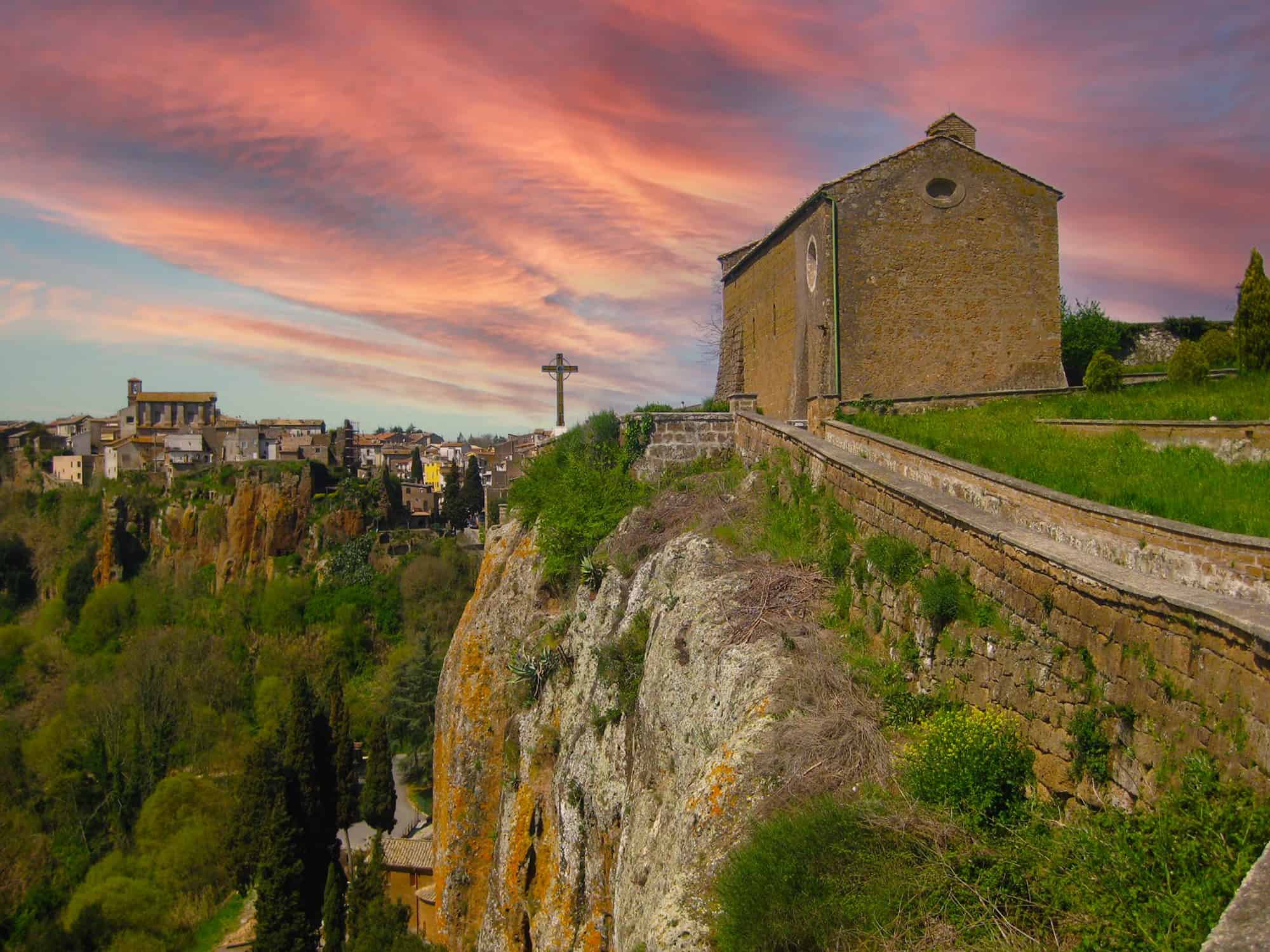
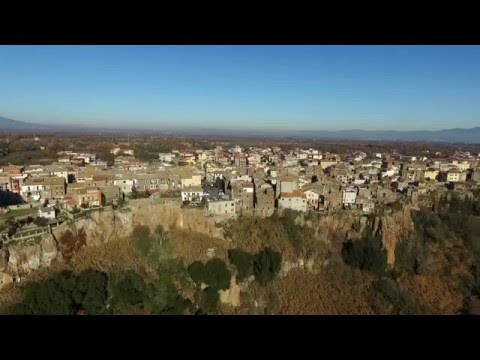
In short. Castel Sant'Elia (VT) is a town of about 2,400 inhabitants in the province of Viterbo, in the Agro Falisco, built on the edge of a tuff cliff that drops into the Suppentonia valley.
Castel Sant'Elia (VT) is a town of about 2,400 inhabitants in the province of Viterbo, in the Agro Falisco, built on the edge of a tuff cliff that drops into the Suppentonia valley. Town hall is on Corso Umberto I, in Palazzo Petretti Lezzani. The sanctuary of Maria Santissima ad Rupes, which is the reason most visitors come up here, is at Piazza Cardinal Gasparri 2, 01030 Castel Sant'Elia (VT), phone 0761 557729. Entry to the sanctuary, the Madonna's grotto and the basilica of San Giuseppe is free and needs no booking. The Romanesque basilica of Sant'Elia is instead at the bottom of the valley, about 20 minutes' walk from the town along the so-called strada dei Santi. Entry is free, opening hours depend on the caretaker and should be checked with the town hall or the parish before you set out, because outside the opening windows the church stays closed and the trip turns into a view. By car you get here from Rome in a little over an hour, taking the Cassia bis as far as Nepi and then provincial road 77, which links Nepi directly to Castel Sant'Elia. By public transport the connections are regional extra-urban buses, and they need to be checked on the website of the Lazio transport company, because runs are few and almost disappear on Sundays. If you come by train, you get off at Civita Castellana and go on by taxi or with a lift: it's 9 kilometers.
The distances that help you plan: Nepi 3 kilometers, Civita Castellana 9, Sutri about 15, Calcata about 12, Viterbo about 40, Rome a little under 50 as the crow flies and about 60 by road. The town is small and you can walk around it in an hour. The full visit, sanctuary plus the descent to the basilica plus the climb back, takes a full half day and legs in good order.

Where Castel Sant'Elia (VT) is and how to get there from Rome
The geography of this corner of Lazio is easier to understand by looking at a map than by reading 10 pages. Castel Sant'Elia (VT) sits on a tuff promontory between two deep cuts, the one carved by the Rio Vicano and the one of the Fosso di Fontana Cupa. The two streams ate into the volcanic bank for millennia until they produced almost vertical walls tens of meters high. These are the ravines, the landscape form that Castel Sant'Elia shares with Nepi, Civita Castellana and Corchiano. The tuff comes from the Vico and Sabatini volcanic complexes, and the water did the rest. The result is a town that looks suspended from above and unreachable from below.
By car to Castel Sant'Elia (VT)
The simplest route from Rome is the Cassia bis, the expressway toward Viterbo. You exit at Nepi and take provincial road 77, which gets to town in barely 3 kilometers. If you come from the Flaminia, meaning from Prima Porta and Monte Soratte, you go through Civita Castellana and then head south. The second road is slower but more beautiful. It crosses the Faliscan countryside, the hazelnut groves and the viaducts over the ravines, and it gives you the first real view of Soratte standing alone out of the plain. A practical tip: the last stretch of the provincial road is narrow and farm vehicles are not rare, so allow 10 minutes more than the navigator says.
By public transport to Castel Sant'Elia (VT)
The Lazio extra-urban service reaches the town with a few daily runs, mostly set around school hours. Times and lines should be read on the regional company's website the day before the trip, because the holiday and summer schedules change the frequency. The nearest railway station is Civita Castellana, on the regional line linking Rome and Viterbo. From there 9 kilometers remain, which without a car you can cover only by taxi. Put plainly: Castel Sant'Elia is a place you can reach by public transport, but badly. If you have a car, use it.
Where to park at Castel Sant'Elia (VT)
The old town is closed to traffic and has no parking spaces. You leave the car in the wide spots along Corso Umberto I and in the areas near the sanctuary, which is also the point where it makes sense to start the visit. On Sundays in May and on the big Marian feasts the spaces run out early. If you arrive after 10:30 you end up parking quite a bit lower down and walking back up. On weekdays, instead, the problem doesn't exist.
The town of Castel Sant'Elia (VT), the tuff and the Suppentonia valley
The first thing to do, as soon as you get out of the car, is to lean over and look. The town is built on the edge, literally. The houses of the old settlement rest on the rock and the rock ends suddenly. Below opens the Suppentonia valley, the name medieval sources give to the basin at the foot of the town, the one that hosts the Romanesque basilica and the monastery that came before it. The vegetation is dense and damp, typical of a valley floor: holm oaks, downy oaks, willows along the water, and in spring an undergrowth that fills everything.
The Suppentonia valley below Castel Sant'Elia (VT)
Suppentonia is an ancient place name and its fortune is tied to a Benedictine monastery founded around 520 by Saint Anastasius, whom the sources call precisely Anastasius of Suppentonia. That community is the core from which everything else descends. The 11th-century basilica stands on the area of the cenobium, the cult of Saint Michael was born there, the Marian devotion of the grotto was born there. Anyone who arrives at Castel Sant'Elia (VT) thinking of visiting two separate churches is wrong: they are two branches of the same tree, grown for 1,500 years on the same piece of tuff.
The ravines of the Agro Falisco around Castel Sant'Elia (VT)
The ravines are not canyons of hard rock. They are wide valleys bordered by sub-vertical walls, carved by erosion into the volcanic substrate. This morphology decided the history of the Agro Falisco long before the Romans. The Faliscans and the Etruscans built on top of it because the tuff offered natural defense on three sides, and they dug into it because tuff can be worked with simple tools: tombs, tunnels, road cuttings, cisterns. Walking on the paths below Castel Sant'Elia you come across cuts in the rock that look natural and aren't. A tip: look up along the walls, the artificial cavities are recognizable by the squared shape of their edges.
A curiosity about Castel Sant’Elia (VT)
The curiosity that almost nobody knows is about administration, not art, and it's more interesting than it sounds. Castel Sant'Elia has not always been in the province of Viterbo. Until 1927 it belonged to the province of Rome, and it passed to the Tuscia only with the administrative reorganization of that year, when new provinces were created and quite a few borders redrawn. It's a bureaucratic detail, but it explains a number of things that visitors sense without being able to explain them: why the town looks to Rome in its speech and habits more than it looks to Viterbo, why Roman families have had their second homes here for generations, why the sanctuary has always drawn pilgrimages from the capital and not from the provincial seat.
The second part of the curiosity is even less known. The devotion to the Madonna ad Rupes has been recognized well beyond the town's borders. Since February 1986 the image venerated in the grotto has been the patron of the entire diocese of Civita Castellana, the ecclesiastical district based at Piazza Duomo 4 in Civita Castellana, which gathers dozens of parishes between the Tuscia and upper Lazio. A town of 2,400 inhabitants giving its patron to a whole diocese is a statistical anomaly. It happens because the grotto has been a place of continuous worship since the 6th century, and 1,500 years of uninterrupted prayer weigh more than demographics. That's the fact that strikes most: not the age of the walls, the duration of the use.
What to see in the upper town of Castel Sant'Elia (VT)
You can see the town in an hour, but it's an hour that deserves attention, because everything that matters is within a space of 200 meters.
Piazza d'Azeglio and the fountain
Opposite the municipal seat opens Piazza d'Azeglio, with a fountain known for its water jets. It's the real public space of the town, the place where people stop in the evening. On the left side the square is closed off by the Farnese walls, which lead into the old town through a gate with a tower. Next to the gate a copy of a plaque recalls the visit of Queen Margherita of Savoy. The square is also bounded by the building that housed the old municipal seat, now a library, and by two other buildings from the 17th and 18th centuries. The whole has nothing monumental about it, and that's exactly why it works: it's a real town, not a restored stage set.
Palazzo Petretti Lezzani, seat of the municipality of Castel Sant'Elia (VT)
On the right of Corso Umberto I is Palazzo Petretti Lezzani, the current town hall. The reason to go in is not the facade. It's the gardens at the back, overlooking the valley. From there the view opens on the left onto Monte Soratte, the isolated limestone ridge that dominates the Tiber valley, and on the right it runs as far as Nepi. Below you can see the vegetation of the valley floor and the bridge that everyone calls Roman but that is 19th-century. Ask at the town hall whether the gardens are accessible when you go: it depends on office hours and on any ceremonies.
The Farnese gate and the old settlement of Castel Sant'Elia (VT)
The oldest part of the town is entered through a gate with a tower that bears the coats of arms of the Farnese. The territory, after belonging to the Apostolic Chamber, passed according to local tradition to the Colonna, then to the Orsini and finally to the Farnese, already lords of Nepi. These are the three families that divided upper Lazio among themselves for three centuries, and their coats of arms on the gates of the villages work as a signature of ownership. Inside the gate the lanes are narrow, uphill, badly paved and beautiful. This way you reach Piazza Doebbing.
Piazza Doebbing and the church of Sant'Antonio Abate
The square bears the name of the German bishop who marked the religious history of the town between the 19th and 20th centuries. The 18th-century parish church of Sant'Antonio Abate stands out here. On the left is the building of the nursery school founded by the sisters of Mother Francesca Streitel, built in the early 1900s. This too is a fact that says something: a small town with an 18th-century parish, a religious nursery school from the start of the century and two basilicas. The density of ecclesiastical institutions here is out of scale with the population, and the explanation is always the same: the sanctuary and the pilgrims.
The little church of Santa Lucia
Small, out of the way, almost always closed. I mention it because it's part of the town's devotional heritage and because anyone wandering the lanes walks past it without noticing. If you find it open, go in. It takes three minutes and completes the picture of how people prayed in a Tuscia village before the sanctuary monopolized everything.

The sanctuary of Maria Santissima ad Rupes at Castel Sant'Elia (VT)
The sanctuary complex is the reason Castel Sant'Elia (VT) has appeared on pilgrimage maps for centuries. It's not a single church. It's a set of rooms layered onto the tuff wall, linked by a hand-dug gallery, run by the fathers of the Congregation of Saint Michael the Archangel, the Micaelites. The address is Piazza Cardinal Gasparri 2. The phone number, for anyone who wants to ask beforehand, is 0761 557729.
The grotto of the Madonna ad Rupes
The devotional heart of the complex is a grotto in the rock whose origins go back to the 6th century. It was the place where the Benedictine monks worshiped the Madonna and withdrew to pray. The image venerated today is a painting that can most probably be dated to the 16th century, which according to scholars replaced an earlier fresco lost to damp. The iconography is unusual and worth the trip by itself: the Madonna adores the Son asleep on her knees. She doesn't nurse him, doesn't show him, doesn't crown him. She adores him while he sleeps. In an iconographic landscape dominated by enthroned Madonnas and nursing Madonnas, this inversion of the gesture, the mother who becomes a worshiper of her own child, is a precise and rare theological choice.
The sanctuary is a destination for the faithful who ask for graces, and in particular for families who ask for the gift of children. The ex votos along the walls tell it better than any information sheet. Since February 1986 this Virgin has been the patron of the diocese of Civita Castellana.
The staircase dug into the tuff by Brother Giuseppe Andrea Rodio
The story everybody tells about Castel Sant'Elia (VT) is the one about the staircase, and for once the story everybody tells is also the right one. Until the end of the 18th century the grotto could be reached only by steep, slippery paths along the wall, and for elderly pilgrims that was a serious risk. In 1777 a Franciscan tertiary arrived in town, Brother Giuseppe Andrea Rodio, whom the bishop appointed custodian of the sanctuary. Rodio decided to open a gallery in the tuff that would descend from the level of the town to the grotto, and he dug it out with a pickaxe. 14 years of work, according to the sanctuary. The gallery bears the date 1782. The result is a 40-meter corridor with 144 steps, which goes down into the dark and the living rock and comes out at the level of the grotto.
Rodio stayed at the sanctuary 42 years. It's the kind of undertaking that today we struggle to imagine: one man alone, with no explosives and no machines, who decides to bore through a mountain so that the old women of the town can get to church without breaking their necks. The verdict is clear: the staircase is the most moving monument in the whole of the southern Tuscia, and it is not a work of art. It is a work of charity with a pickaxe.
A serious practical note: the gallery is narrow, the floor is uneven, the steps are high and worn, the lighting is artificial and the air is damp. If you suffer from claustrophobia you'll notice after 20 steps. If you have knee problems, bear in mind that the 144 steps also have to be done uphill on the way back, and that uphill they weigh double.

The basilica of San Giuseppe
Above the grotto, on the level of the town, stands the basilica of San Giuseppe, built between 1908 and 1910 in the single-nave Neo-Gothic style. The bell tower dates from 1912 and holds three bells tuned to the notes B, A and G. The interior decoration was completed in 1937 with works from the art school of Ferdinando Stuflesser of Ortisei, one of the South Tyrolean workshops that in the early 20th century supplied wooden statuary to half of Catholic Italy. The presbytery was redone in 1967 according to the liturgical criteria that came out of the Council.
One observation: Italian Neo-Gothic of the early 20th century has a terrible reputation, it's dismissed as a historical fake and almost nobody looks at it. Here it's worth looking at, because the stylistic choice is openly Nordic in a town of the Agro Falisco, and that comes from the German bishop who wanted the complex. The basilica of San Giuseppe is a piece of Rhenish Germany landed on the Lazio tuff, and the oddness shows.
The little church of San Michele above Castel Sant'Elia (VT)
On the tuff wall, above the Romanesque basilica of Sant'Elia, stands the old church of San Michele Arcangelo. The cult of Michael developed at Castel Sant'Elia together with the Marian one from the time of the Benedictine monks. The church was built in memory of the apparition of the Prince of the Angels to Abbot Saint Anastasius and other monks, during the Benedictine stay in these places.
The age of the building is documented by a plaque recording that Abbot Bovo had the church's altar restored in the time of Pope Honorius, so between 1124 and 1130. On the left wall there remains an even older marble plaque, from the 9th century. The roof is trussed, with wooden beams painted in oil with great sobriety. Above the altar an 18th-century fresco shows the apparition of the Archangel with Saints Anastasius and Nonnosus. Next to the church is an underground cemetery of the Franciscan friars, placed on the very edge of the rock wall: a burial suspended over the void.
The viewpoint, the cross and the pine grove
From the lookout of the viewpoint you can see the grotto of the Madonna di Castelluccio and the big iron cross that replaced the wooden one, burned by lightning in 1984. It's one of the best panoramic points in the town: from there you can make out the ravine, Soratte and, at the end of the valley, the silhouette of the Romanesque basilica. Behind it opens the pine grove, part of the sanctuary complex, which in July and August is the only shaded place to sit.
Hours, Masses and rules for visiting the sanctuary
The sanctuary is run by the Micaelite fathers and follows a liturgical calendar that changes between summer and winter. In the period from the end of March to the end of October, Sunday Masses are at 8:00, 9:30, 11:30, 17:30 and 19:00. On weekdays Mass is celebrated at 6:45 and 18:00 in the basilica of San Giuseppe, with the rosary preceding some celebrations. On major solemnities, afternoon celebrations are added. Winter hours are different: if you plan the visit off season, check them by phone. The sanctuary celebrates confessions, weddings, baptisms and anniversaries, hosts retreat days and collects prayer intentions.
A common-sense rule that has to be said: this is an active place of worship, not a museum. During Masses you visit the grotto in silence or not at all. The Sundays of May and the Marian feasts are the worst days for those who come as tourists and the best for those who come as pilgrims. Choose which side you're on before you set out.

Something nobody tells you about Castel Sant’Elia (VT)
No guide writes it, but the Romanesque basilica of Sant'Elia has no continuous opening hours, and this single piece of information decides the success or failure of your day. The church is at the bottom of the valley, isolated, with no permanent staff. It's opened in time windows set by the caretaker, which vary with the season and with the availability of volunteers. Anyone who arrives at Castel Sant'Elia at 3 on a January afternoon, walks down the 20 minutes of the strada dei Santi and finds the door closed has thrown away the best part of the trip. The phone call to the town hall or the parish before leaving is not a courtesy recommendation. It's the difference between seeing one of the oldest painted cycles in Lazio and looking at its facade from outside.
The second thing nobody will tell you is about the strada dei Santi. On maps it's a country lane and looks like a stroll. In reality it's a continuous descent on uneven ground, which in winter turns to mud and in summer to dust and loose gravel. You go down in 20 minutes and come back up in 35, with the sun in your face on the last stretch. City shoes don't work here, and that's not excess caution: it often happens that someone who arrives in loafers has to stop halfway up.
Third point, the most curious. Below the basilica, the valley floor is crossed by a route that goes up the ditch to the territory of Nepi. It's a path of water, with fords, and it's the reason many locals know Castel Sant'Elia (VT) from below rather than from above. The perspective changes everything. Seen from the bottom of the ravine, the town is not a scenic village. It's a wall of tuff with some houses on top, and you understand why in the Middle Ages nobody bothered to besiege it.
The basilica of Sant'Elia: the Romanesque of the Suppentonia valley
If I had to name a single reason to come to Castel Sant'Elia (VT), I would name this church. It's an 11th-century basilica, isolated at the bottom of a valley, with frescoes among the oldest in Lazio and a Cosmatesque ciborium on the high altar. It has no lines, no ticket office, no bookshop. It has a caretaker, a wooden door and 1,500 years of continuity.
The origins: the cenobium of Saint Anastasius of Suppentonia
Before the basilica there was a Benedictine monastery, founded around 520 by Saint Anastasius of Suppentonia. The community occupied the valley floor and the grottoes of the wall: a rock-cut monastic settlement, of the kind that in central Italy in the 6th century was the norm and not the exception. From that cenobium derive the name of the valley, the cult of the town's two patron saints and the religious topography we still see today.
The construction of the basilica of Sant'Elia
The present building dates from the beginning of the 11th century, when Abbot Elia had it built on the site of the old cenobium. The church soon enters the papal documents: it is cited by Pope Gregory VII in 1076, Alexander III in 1176 and Innocent III in 1211. Three popes in 135 years, for a valley-floor church in a side valley of the Tuscia, mean only one thing: the community mattered, and mattered quite a lot. It has to be said clearly, because you often read around a dating to the 8th century that doesn't hold up against the sources. The basilica you visit today is of the full Romanesque age, the 11th century, built on a much older monastic settlement.
The architecture: three naves and reused columns
The plan has three naves with a transept, the classic basilica formula. The columns that bound the central nave were not cut for this church. They almost certainly come from the spoils of Roman villas and monuments in the area, reused as building material. It's a common practice in the Middle Ages and in this valley it was also convenient, because the Agro Falisco was full of abandoned Roman structures. In front of the original, look at the capitals one by one. They differ from each other, from different periods and hands, and the uneven sequence is the proof of reuse. The portals deserve separate attention: the one on the right keeps a painted decoration, the others were made by assembling fragments of marble.
The frescoes of the apse of the basilica of Sant'Elia
The paintings are the reason this church appears in every manual of Italian medieval painting. They were executed around the year 1000 by the brothers Giovanni and Stefano together with Niccolò, Giovanni's nephew: a family enterprise, documented, which is already a rarity in itself for that period.
The apse basin is dominated at the top by the figure of Christ the Redeemer, flanked by Peter and Paul. Below runs a row of 12 lambs symbolizing the apostles, and lower down a procession of virgins with crowns, heading toward a central figure of the Madonna that is now lost. The loss of that figure is the real damage to the complex. Without the Marian fulcrum, the composition loses its center of gravity and the virgins seem to walk toward nothing. Whoever looks at the apse has to reconstruct it mentally, and then everything adds up.
The Apocalypse cycle in the transept
The right transept hosts the visions of the Apocalypse, and this is the part that leaves speechless anyone who doesn't expect it. At the top runs a long row of prophets. Below, the procession of the Elders of the Apocalypse advancing toward the Lamb. It's one of the oldest apocalyptic cycles preserved in Italy, and the fact that it's in a country church and not in a cathedral is the reason very few people know it.
The reading of the Apocalypse in figurative form, around the year 1000, was not decoration. It was visual catechesis for a population that didn't read. The Elders who hand their crowns to the Lamb are the translation into images of a text everyone knew by heart from hearing it read. In front of this cycle it's worth standing still for at least 10 minutes and starting from the prophets above, then moving down to the Elders. Read in that order, the fresco tells a story. Read at random, it's a painted wall.
The frescoes of the right nave
The right nave keeps images of saints and of the Virgin, by different hands and from different moments. They are less spectacular paintings than the transept and much more intimate: frontal figures, fixed gazes, inscriptions. Here time is read in layers, because interventions from different periods have been superimposed on the same wall. It's the part of the basilica that visitors rush through to reach the apse, and that's a mistake. The minor devotional painting tells you who really attended this church, namely peasants of the valley, not popes.
The ciborium and the Cosmatesque floor
The high altar is surmounted by a ciborium decorated with a Cosmatesque cross. The floor is also Cosmatesque, of the Alexandrine period. In the central area the design of interlaced porphyry roundels predominates, the typical motif of the Roman marble workshops that for two centuries worked from the city churches to the smaller centers of Lazio. Finding a Cosmatesque floor in a valley-floor basilica, 60 kilometers from Rome, tells you how rich and connected this community was.
A technical note for those who look closely: the Cosmati marbles are almost all salvaged, red porphyry and green serpentine taken from Roman furnishings. The same principle as the reused columns, applied to the paving. In this church the ancient is not quoted. It is materially reused.
The crypt and the tombs of Saint Anastasius and Saint Nonnosus
Going down below the presbytery you enter the crypt, which spreads over two rooms and keeps the first core of the site. Here are the tombs of the town's two patron saints: Saint Anastasius, the founder of the cenobium, and Saint Nonnosus. The crypt is low, dark and damp, and for exactly that reason it conveys better than anything else the idea of what a 6th-century monastery was in this valley. Those short on time tend to skip it. Don't skip it. It's the point where the basilica stops being a Romanesque church and becomes the burial place that generated it.
The winter solstice light effect
In the days around the winter solstice the light that enters through the single-light windows crosses the basilica at a particular angle and lights up the columns and the right nave. It's a phenomenon that local tradition has long pointed out and that draws quite a few people on the right days. It has to be said honestly that the effect depends on the sky. With the valley-floor fog, which is frequent here in winter, nothing happens. If you decide to try, go on a clear morning and be prepared to wait.
The strada dei Santi and the visit to the basilica of Sant'Elia
You reach the basilica by a country lane called the strada dei Santi, which goes from the town down to the valley floor in about 20 minutes. The church looks out over the Suppentonia valley in a scenic position. It is probably the best-set religious building in the whole province of Viterbo. Entry is free. Opening hours should be checked in advance with the town hall or the parish. Restoration work has touched the frescoes in 1960, the portals in 1994, the paving in 1997 and the apse floor in 2003. The church you see today is the result of half a century of care.

The advice I give you for visiting Castel Sant’Elia (VT)
There is one piece of advice and it has to be taken literally: call first and build the day the opposite way from how instinct would build it.
Instinct says to arrive, walk around the town, then go down to the basilica when it's hottest and you're already tired. Wrong. The right sequence is: arrive early, go straight down to the Romanesque basilica with fresh legs and the morning light coming in through the single-light windows, climb back up calmly, have lunch in town, and give the afternoon to the sanctuary and Rodio's staircase, which is indoors and doesn't fear the sun. This way you do the hardest effort when you're rested, and the only part of the visit that depends on natural light when the light is there.
Second tip: check the basilica's hours the day before, not the same morning. If it turns out to be closed, move the trip by a day instead of going anyway. Castel Sant'Elia without the Romanesque basilica is a lovely scenic walk with a remarkable sanctuary, but you've lost half the reason you set out.
Third: light trekking shoes, or at minimum sneakers with a lugged sole. Water, because there are no reliable fountains on the valley floor. A small flashlight, which in the crypt and the gallery is really needed. And no bulky tripod: it won't fit through the gallery.
Fourth, and take it as a firm personal opinion: avoid the Sundays of May if you come for the art. On those days the sanctuary is full of organized pilgrimages, the gallery becomes a line, the grotto is packed. A Wednesday in October at Castel Sant'Elia (VT) is one of the most beautiful days Lazio can offer, and you'll be practically alone.
The paths and the ravine around Castel Sant'Elia (VT)
The settlement is surrounded by nature paths that in a few minutes take you from the town square to the nature of the valley floor. Anyone with an extra half day should use it this way.
The bridge called Roman
From the town hall gardens you can see the bridge that everyone in town calls Roman. It isn't. It's a 19th-century construction, and whoever tells you it's ancient does so in good faith, because the name has circulated for generations. It remains a fine structure, framed by the vegetation of the ditch, and it's the natural starting point for anyone who wants to go up the watercourse.
From the basilica toward Nepi and the Picchio waterfall
Leaving the basilica you reach the bridge, and from there you go up the ditch to the territory of Nepi. It's a nature route inside the ravine, shaded, with passages near the water. Along the way you meet the Picchio waterfall, one of the best-known drops of water in the Agro Falisco. Watch the season: after heavy rain the ditch swells and the fords become dangerous. In July and August, on the contrary, the flow drops a lot and the waterfall loses much of its effect.
Castello d'Ischia and the second ravine
The routes also lead to the other side of the plateau, where the ruins of Castello d'Ischia remain, built on pre-existing Etruscan structures. From up there you overlook a second ravine, the one that marks the border with the territory of Mazzano. It's the right place to understand with your own eyes the Faliscan logic of settlement: a plateau defended by two deep cuts, with only one side to fortify. No theoretical explanation is needed, just lean over and look.
Castel Sant'Elia (VT) and the Parco Valle del Treja
A few kilometers away, to the south, begins the territory of the Treja Valley Park, the regional protected area that safeguards the ravine of the Treja river between Calcata and Mazzano Romano. It's the same landscape, the same geology, the same Faliscan history. Anyone staying two days in the area can combine the Suppentonia valley and the Treja valley without covering more than 20 kilometers. Inside the park are the Monte Gelato waterfalls, the most photographed place in all of upper Lazio and, for exactly that reason, the most crowded on summer weekends.
Another well-known fact, yet rarely cited
That Castel Sant'Elia is in the Agro Falisco, everyone knows, or almost. What almost nobody connects is the practical consequence: the Faliscans were not Etruscans. They were an Italic people speaking archaic Latin, allied with the Etruscans and at war with Rome for centuries, with their capital at Falerii, present-day Civita Castellana. The distinction is not textbook pedantry. It explains why in this area you find necropolises and sanctuaries with their own characteristics, different from those of Cerveteri or Tarquinia, and why Romanization here was late and violent.
The second well-known but rarely cited fact concerns the tuff. Everyone says the villages of the Tuscia are built on tuff. Very few add that they are also built inside the tuff. At Castel Sant'Elia this is visible in an almost didactic way: the Madonna's grotto is dug out, Rodio's gallery is dug out, the Franciscan cemetery is underground, the little church of San Michele leans against the wall, the crypt of the basilica is hypogean. The town lives as much below ground level as above it. In the Agro Falisco tuff is not a building material. It's the material in which you build by subtraction, by taking away instead of adding.
The third element, the most neglected: the continuity of worship. In Italy we have hundreds of ancient churches, but very few places where people have prayed uninterruptedly for 1,500 years in the same spot. The grotto of Castel Sant'Elia (VT) is one of them. The Benedictines of the 6th century, the medieval hermits, the Franciscans of the 18th century with Rodio, the Micaelites of today: four different religious families who have passed the same rock from hand to hand. It's the kind of continuity usually attributed to Montecassino or Subiaco, and that nobody here talks about.
The right photo to take at Castel Sant’Elia (VT)
There are three photographs worth taking home from Castel Sant'Elia (VT), and only one that I consider truly the right one.
The first, the easiest, is the view from the gardens of Palazzo Petretti Lezzani or from the square next to the Farnese gate: the valley below, Soratte on the left, Nepi on the right. It should be taken in the late afternoon, when the low sun lights up the tuff and Soratte becomes a silhouette. At noon the same framing is flat and washed out.
The second is Rodio's gallery. Extremely difficult, because the light is scarce and artificial and the corridor is narrow. You need a fast lens, high sensitivity and a steady hand: no flash, which flattens the tuff and disturbs those who are praying. If it works, it captures the one thing that ordinary photographs of this town never convey, namely the physical effort of the place.
The third, and for me the right photo, is the basilica of Sant'Elia seen from the top of the wall, from the Sant'Anna area and from the lookouts above the valley. From up there you see the whole church, isolated at the bottom of the ravine, with its bell tower and the greenery around it. You understand at a glance why a 6th-century monastery chose that spot and why nobody ever abandoned it. It's a photograph that requires only walking to the right lookout and waiting for the sun to light the valley floor, which in winter happens late and briefly. The best moment is late morning on a clear day between October and March, when the light enters the valley without the harsh contrast of summer.
A serious warning: inside the Madonna's grotto and during celebrations, the camera goes down. It's not a rule written everywhere, it's a matter of decency. The pilgrims you see kneeling are not extras.
Some important events that took place here in history
The chronology of Castel Sant'Elia (VT) is made of a few very dense episodes, spread over 1,500 years.
The first is the founding, around 520, of the Benedictine cenobium of Suppentonia by Saint Anastasius. It's the birth certificate of everything. Without that monastery there would be no basilica, no Marian cult in the grotto, no town in the form it has. The story of that community entered early medieval hagiographic literature, and the two saints buried in the crypt, Anastasius and Nonnosus, are the town's protectors still today.
The second event is the construction of the basilica at the beginning of the 11th century at the wish of Abbot Elia, and its fresco decoration around the year 1000 by the brothers Giovanni and Stefano and their nephew Niccolò. A painting project of that scale, at that moment, in that place, presupposes a strong patron and money. The church will be cited soon after in the documents of Pope Gregory VII in 1076.
The third is the sequence of papal acknowledgments: Alexander III in 1176, Innocent III in 1211. Three popes, in three different eras of Church history, dealing with the same valley-floor abbey. In the 13th century of Innocent III, the most powerful pope of the Middle Ages, a document about Sant'Elia is not a routine act.
The fourth event is documented by a plaque and concerns the little church of San Michele: Abbot Bovo had the altar restored in the time of Pope Honorius, so between 1124 and 1130. A 12th-century restoration on a building that keeps a plaque from the 9th: the stratigraphy of the town can be read in these two lines.
The fifth is the digging of the gallery. Brother Giuseppe Andrea Rodio arrives in 1777, is appointed custodian, begins boring into the tuff with his pickaxe and opens the passage that bears the date 1782. 42 years of residence, 144 steps, 40 meters of gallery. It's the event that turns a local place of worship into a pilgrimage destination accessible to anyone.
The sixth is the season of the German bishop who gives his name to the town square, between the 19th and 20th centuries: between 1908 and 1910 the Neo-Gothic basilica of San Giuseppe rises, in 1912 the bell tower with its three bells, in 1937 the interior decoration is completed with works from the Stuflesser workshop of Ortisei. In the same period the sisters of Mother Francesca Streitel build the nursery school next to the parish church. In 30 years the town doubles its religious heritage.
The seventh is administrative and changes the identity of the town: in 1927 Castel Sant'Elia leaves the province of Rome and enters that of Viterbo.
The eighth is tiny and much told locally: in 1984 lightning burns the wooden cross of the viewpoint, which is replaced by the iron one you see today. In a town where the rock never changes, even a lightning bolt becomes a date.
The ninth, and most recent, is from February 1986: the Madonna ad Rupes is proclaimed patron of the diocese of Civita Castellana. The formal recognition of a devotion 15 centuries long.
Who passed through Castel Sant’Elia (VT)
The town has a list of illustrious passages longer than its size would suggest, and it's worth distinguishing between what is documented and what belongs to tradition.
Documented, and by far the most important, are the three popes who dealt with the basilica: Gregory VII, the pope of the investiture struggle, who cites it in 1076. Alexander III, the adversary of Frederick Barbarossa, in 1176. Innocent III in 1211. There is no proof that they came in person, but their acts concern this place and keep it within the geography of papal power for a century and a half.
Also documented are the painters: the brothers Giovanni and Stefano and their nephew Niccolò, who worked for months inside the basilica around the year 1000. We know little else about them, and for exactly that reason the Castel Sant'Elia cycle is their defining work. Whoever looks at those frescoes looks at the only thing of three men of the year 1000 that has come down to us.
Documented is Saint Anastasius, the founder of the cenobium, whose tomb is in the crypt together with that of Saint Nonnosus: two figures of early Italic monasticism, whose relics the town has kept for 1,500 years.
Documented is the presence of Brother Giuseppe Andrea Rodio from 1777, the Franciscan tertiary who spent the last 42 years of his life here. If there is one figure this town produced and gave back to the world, it's him.
Documented is the visit of Queen Margherita of Savoy, recalled by a plaque next to the Farnese gate: the most popular sovereign of Umbertian Italy, in a village of 2,000 souls in the then province of Rome.
Documented is the activity of the German bishop who gave the square its name and wanted the basilica of San Giuseppe, and that of the sisters of Mother Francesca Streitel, a German nun and founder of a congregation, whose institute built the town's nursery school in the early 1900s.
Belonging to tradition instead, and to be told as such, is the story of Pope Gregory the Great, to whom local memory attributes the reorganization of the settlement as a defensive outpost against the barbarian invasions, and the meeting with the Lombard queen Theodelinda that legend places precisely in the rock grotto of San Leonardo, where the sanctuary later rose. These are tales the town has handed down for centuries and that no document confirms. I report them because they are part of the identity of the place, with the warning that they are tradition and not chronicle.
Finally, the families: after the Apostolic Chamber, the territory passed according to tradition to the Colonna, then to the Orsini and finally to the Farnese, who were already lords of Nepi and to whom the restoration of the basilica of Sant'Elia is owed. The coats of arms on the village gate are their signature.
What's around Castel Sant'Elia (VT)
This is one of the densest territories of Lazio: within a radius of 20 kilometers there are more things to see than fit into a weekend.
Nepi, 3 kilometers from Castel Sant'Elia (VT)
Nepi is the nearest neighbor and the natural complement to the visit. Nepi too stands on the ravines of the Agro Falisco, and it is crossed by the ancient Via Amerina. The Borgia fortress, ringed by powerful walls, hosted Lucrezia Borgia, her brother Cesare known as Valentino, and Popes Alexander VI and Paul III. Antonio da Sangallo the Younger designed the Palazzo Comunale here, begun in 1542, and the Farnese bastions around 1540, which Vasari called impregnable and beautiful. The town is also famous for its mineral waters, so much so that an old motto praises its health-giving baths.
Civita Castellana, the ancient Falerii
Civita Castellana is 9 kilometers away and is the historical capital of the Agro Falisco, as well as the seat of the diocese to which the sanctuary belongs. The cathedral with its Cosmatesque portico signed by the Cosmati and the Sangallo fortress are worth the detour on their own. Whoever has seen the Cosmatesque floor of the basilica of Sant'Elia finds here the monumental point of comparison.
Calcata and the Treja valley
Calcata is the most photographed village on a spur in Lazio, a short distance away, and it's the access point to the Treja valley. Abandoned and then repopulated by artists, it has a completely different character from Castel Sant'Elia: touristy, lively, a bit mannered. It should be seen, knowing that it is the exact opposite of the silence of the Suppentonia valley.
Sutri, Ronciglione and Lake Vico
Sutri is about 15 kilometers away and keeps the amphitheater dug into the tuff, the Mithraeum and the rock-cut necropolis. It is the most spectacular demonstration of what it means to build by subtraction in tuff. Ronciglione and Lake Vico close the northern quadrant, inside the nature reserve. A little farther, Caprarola with Palazzo Farnese is the cultured stop of the area.
The lakes and the other villages of the area
To the south you go down to the area of Lake Bracciano, with Trevignano Romano and Anguillara Sabazia. To the east are Faleria, Civitella San Paolo and Monte Soratte with its military tunnels. To the north, the Corchiano ravines and the provincial capital Viterbo with the medieval San Pellegrino quarter.
Castel Sant'Elia (VT) with children
The town works very well with kids from 7 years up and badly with very small children. The reason is all in the gallery: 144 narrow steps, in partial darkness, with no way in for a stroller. Whoever has a baby in a carrier takes the child in their arms and manages. Whoever has a stroller leaves it up top.
On the other hand, few places in Lazio tell children a story as effective. A friar who digs through a mountain with a pickaxe for 14 years is a story you remember. A grotto with a Madonna looking at the sleeping child is an image that strikes. A church at the bottom of a canyon is won by walking. The descent to the basilica along the strada dei Santi is within reach of an eight-year-old used to walking, with water and a stop halfway back up.
Operational advice: do the gallery going down, telling Rodio's story before you enter, and suggest to the kids that they count the steps. It's an old trick and it always works: they get to the bottom without complaining and tell you the number.
Accessibility at Castel Sant'Elia (VT)
It has to be said clearly, without sugarcoating. The Madonna's grotto, reachable from the town only through the stepped gallery, is not wheelchair accessible. The Romanesque basilica of Sant'Elia is reached by a steeply sloping country lane with uneven ground. It is not accessible to a wheelchair and presents serious difficulties even for those who walk with a cane. The crypt of the basilica is reached by stairs.
With some help, the basilica of San Giuseppe on the level of the town, the square, the viewpoint and the panoramic points of the center remain accessible, and they still offer the view over the valley. Whoever accompanies a person with mobility difficulties should phone the sanctuary at 0761 557729 and ask which route is practicable on the planned day: the situation also depends on the condition of the valley-floor road.
When to go to Castel Sant'Elia (VT)
The best season is wide and includes two windows. The first runs from mid-April to early June: the valley is green, the ditch has flow, the temperature lets you go down and back up without suffering. The second runs from late September to early November, and it's the best: the low autumn light enters the ravine differently, the hazelnut groves around change color and the town is empty.
Full summer is to be avoided for the descent into the valley, which is done with little shade on the upper stretch and with considerable heat on the closed valley floor. If you go in July, move before 9 in the morning. Winter has the advantage of absolute silence and the disadvantage of valley-floor fog, which is frequent here and which erases both the view and the solstice light effect. Clear January day at Castel Sant'Elia (VT): exceptional. Damp January day: postpone.
Eating and sleeping at Castel Sant'Elia (VT)
The offer is that of a town of 2,400 inhabitants: a few trattorias, a couple of bars, small accommodation facilities and some religious houses tied to the sanctuary that host pilgrims and groups on retreat. There are no chains and no nightlife. Whoever wants more choice relies on Nepi or Civita Castellana, which are a few minutes away. For organized stays it's best to contact the facilities directly or the sanctuary, which manages hospitality for groups on spiritual retreat.
On the cooking: we're in the Tuscia, so legume soups, homemade pasta, lamb, mushrooms and hazelnuts, which are the dominant crop of the territory. The advice is banal and valid: eat where the workers and the pilgrimage bus drivers eat. They are never wrong.
Frequently asked questions about Castel Sant’Elia (VT)
How much does it cost to visit Castel Sant’Elia (VT)?
Visiting Castel Sant'Elia costs little or nothing: the village is open, the sanctuary of Maria Santissima ad Rupes and the grotto have free entry, and the Romanesque basilica of Sant'Elia has no ticket either. The only expenses are fuel, parking where provided and lunch in one of the local trattorias.
How much time do you need to visit Castel Sant’Elia (VT)?
The upper town of Castel Sant'Elia takes about an hour to walk around, while the sanctuary with the gallery and the grotto takes a good hour, to which you have to add the descent to the Romanesque basilica in the Suppentonia valley. Whoever wants to see everything unhurried should allow half a day.
Is the basilica of Sant’Elia always open?
No, and this often decides the success of the visit: the Romanesque basilica of Sant'Elia, isolated at the bottom of the Suppentonia valley, has no continuous opening hours, because it has no permanent staff and is opened in time windows set by the caretaker that vary with the season. It's best to phone before going down at Castel Sant'Elia.
Is Castel Sant’Elia (VT) suitable for children?
The town works well with kids from 7 up and badly with very small children, because the gallery that leads to the Madonna's grotto has 144 narrow steps in partial darkness, where a stroller doesn't fit. Whoever has a baby in a carrier can carry him in their arms, while whoever has a stroller leaves it up top.
Is Castel Sant’Elia (VT) wheelchair accessible?
No: the Madonna's grotto, reachable from the town only through the stepped gallery, is not wheelchair accessible, and the Romanesque basilica of Sant'Elia is reached by a steeply sloping country lane with uneven ground, not passable with a wheelchair nor easy for those who walk with a cane.
When is the best time to visit Castel Sant’Elia (VT)?
The best season includes two windows: from mid-April to early June, when the valley is green and the ditch has flow, and from late September to early November, when the low autumn light enters the ravine of Castel Sant'Elia differently and the hazelnut groves around change color. Full summer is to be avoided.
Where was Castel Sant’Elia (VT) before 1927?
Until 1927 Castel Sant'Elia belonged to the province of Rome, and passed to the province of Viterbo only with the administrative reorganization of that year, when new provinces were created and quite a few borders redrawn. It's a little-known detail that explains some historic ties of the town with the capital.
Guided visits and private tours in the Agro Falisco
Castel Sant'Elia (VT) is a place that gains enormously from an accompanied visit, because without someone to explain the Apocalypse in the transept and the story of Rodio, half the meaning stays on the wall. For those who want to organize a day in the Agro Falisco with an authorized tour leader, TourLeaderPro's professional services for Rome and Lazio also cover the villages of the southern Tuscia. Those traveling in a small group and looking for a custom-built day can look at the private experiences for small groups, which include itineraries off the usual circuits.
Whoever arrives from abroad and is building their own trip to Italy will find the guides in English on ItalyPlanner. The general overview is The best things to do in Rome, while whoever has few days and wants to understand how to fit in the visits can start from the itinerary Rome in 3 days and add a day in the Tuscia when the capital begins to wear. It's exactly what I recommend to those who stay a week: four days in Rome, one in the Agro Falisco, and the trip changes register.
Quick questions about Castel Sant'Elia (VT)
How much does it cost to visit Castel Sant'Elia (VT)?
Nothing. The village is open, the sanctuary of Maria Santissima ad Rupes and the grotto have free entry, the Romanesque basilica of Sant'Elia has no ticket. The only expenses are fuel, parking where provided and lunch.
How long does the visit to Castel Sant'Elia (VT) take?
The upper town takes an hour to walk around. The sanctuary with the gallery and the grotto takes a good hour. The descent to the basilica, the visit and the climb back take 2 hours. In total, a full half day, a whole day if you add the ravine paths.
How many steps does the staircase of Castel Sant'Elia (VT) have?
144, along a 40-meter gallery dug into the tuff. You go down and back up: allow for both directions.
Who dug the sanctuary staircase?
Brother Giuseppe Andrea Rodio, a Franciscan tertiary who arrived in town in 1777 and was appointed custodian of the sanctuary by the bishop. He dug the gallery with a pickaxe. The passage bears the date 1782 and the sanctuary credits him with 14 years of work. Rodio stayed at Castel Sant'Elia 42 years.
Do you need to book to visit Castel Sant'Elia (VT)?
Not for the sanctuary and the village. For the Romanesque basilica, instead, it's best to phone the town hall or the parish beforehand and check the opening hours, which are not continuous.
Is the basilica of Sant'Elia always open?
No. Opening depends on the caretaker and varies with the season. It's the reason many visitors find it closed: always check before going down into the valley.
How far is Castel Sant'Elia (VT) from Rome?
About 60 kilometers by road, a little over an hour by car via the Cassia bis, exiting at Nepi.
How do you get to Castel Sant'Elia (VT) without a car?
By regional extra-urban buses, whose runs are few and should be checked on the website of the Lazio transport company. Alternatively, regional train to Civita Castellana and then 9 kilometers by taxi. It's a place you reach with effort without a car.
Where do you park at Castel Sant'Elia (VT)?
Along Corso Umberto I and in the areas near the sanctuary. The old town is pedestrian. On Sundays in May the spaces run out early.
Can you take photographs?
Yes in the outdoor spaces, in the churches and along the paths. Inside the Madonna's grotto and during celebrations it's best to forget it: it's a busy place of prayer. Flash in the gallery is useless and annoying.
Is Castel Sant'Elia (VT) wheelchair accessible?
Only partly. The stepped gallery toward the grotto and the path toward the Romanesque basilica are not. The basilica of San Giuseppe, the square and the town's viewpoints remain reachable.
What is there to see in the basilica of Sant'Elia?
A three-nave church with transept from the 11th century, frescoes executed around the year 1000 by the brothers Giovanni and Stefano and their nephew Niccolò, an apse basin with Christ the Redeemer between Peter and Paul, in the right transept one of the oldest Apocalypse cycles preserved in Italy, a ciborium with a Cosmatesque cross, a Cosmatesque floor and a two-room crypt with the tombs of Saint Anastasius and Saint Nonnosus.
What period is the basilica of Sant'Elia from?
The building dates from the beginning of the 11th century and is the work of Abbot Elia. It stands, however, on the site of a much older Benedictine monastery, founded around 520 by Saint Anastasius of Suppentonia.
Who are the patron saints of Castel Sant'Elia (VT)?
Saint Anastasius and Saint Nonnosus, whose tombs are in the crypt of the Romanesque basilica.
What is the Madonna ad Rupes?
The Marian image venerated in the grotto, most probably datable to the 16th century, in which the Madonna adores the Son asleep on her knees. Since February 1986 she has been patron of the diocese of Civita Castellana.
Who runs the sanctuary of Castel Sant'Elia (VT)?
The fathers of the Congregation of Saint Michael the Archangel, the Micaelites, who have their convent here and look after the celebrations, the retreats and the hospitality of pilgrims.
What are the Mass times at the sanctuary?
In the period from the end of March to the end of October, on Sundays Mass is celebrated at 8:00, 9:30, 11:30, 17:30 and 19:00, and on weekdays at 6:45 and 18:00. Winter hours change and should be checked by phone, at 0761 557729.
What is the Suppentonia valley?
The ravine at the foot of the town, carved into the tuff by the Rio Vicano and the Fosso di Fontana Cupa. It takes its name from the ancient monastic settlement and hosts the Romanesque basilica.
Can you walk in the ravine below Castel Sant'Elia (VT)?
Yes. From the basilica you reach the bridge and go up the ditch to the territory of Nepi, meeting the Picchio waterfall. You need suitable shoes, and after heavy rain the fords become risky.
Is the bridge below the town really Roman?
No. The name is traditional, but the structure dates from the 19th century.
What is Castello d'Ischia?
The ruins of a fortification on the other side of the plateau, built on pre-existing Etruscan structures. From there you overlook the second ravine, the one toward the territory of Mazzano.
Is it worth going to Castel Sant'Elia (VT) in winter?
Yes, if the day is clear: around the solstice the light entering through the single-light windows lights up the columns and the right nave of the basilica. With the valley-floor fog, instead, you see nothing and it's best to postpone.
What is the difference between Castel Sant'Elia (VT) and Calcata?
Calcata is a spur village repopulated by artists, lively and very touristy. Castel Sant'Elia is a town of devotion and silence, with two basilicas and a hand-dug gallery. You can visit them on the same day and they tell two opposite ways of living the same geology.
What can you combine with Castel Sant'Elia (VT) in one day?
Nepi, 3 kilometers away, with the Borgia fortress and the bastions of Antonio da Sangallo the Younger. Or Civita Castellana, 9 away, with the Cosmatesque cathedral. Whoever has more time goes down toward the Parco Valle del Treja and the Monte Gelato waterfalls.
Is Castel Sant'Elia (VT) suitable for children?
From 7 up, very. Below that, the gallery and the valley-floor path complicate the day, and the stroller stays outside.
How many inhabitants does Castel Sant'Elia (VT) have?
About 2,400. It has been in the province of Viterbo since 1927, when it passed from the province of Rome to the Tuscia.
The verdict on Castel Sant'Elia (VT)
It is, in our judgment, the most underrated valley in northern Lazio. Not because nobody knows it, the sanctuary has pilgrimages all year, but because almost everyone stops up top. You go down the gallery, visit the grotto, climb back, go home happy. Nobody goes down into the valley, and in the valley there is an 11th-century basilica with one of the oldest Apocalypse cycles we have.
If you have only one day, devote it entirely to Castel Sant'Elia (VT) instead of spreading it over four villages. Phone first, go early, go down to the basilica in good light, climb back slowly, and leave the afternoon to Rodio's staircase. You'll leave with the rare feeling of having understood a place instead of having passed through it.
Article written by the editorial team of TourLeaderPro. Contact them for Private/Corporate/V.I.P. Tours and Experiences.
Planning a trip to Rome? The guides in English for visiting the city are on ItalyPlanner.com.