Monte Gelato Falls (Mazzano Romano)
In short. Monte Gelato Waterfalls are on Strada Comunale Monte Gelato, in the territory of Mazzano Romano (00060, Metropolitan City of Rome Capital), inside the Treja Valley Regional Natural Park: about 40 kilometers north of Rome, on the border with Viterbo Province.
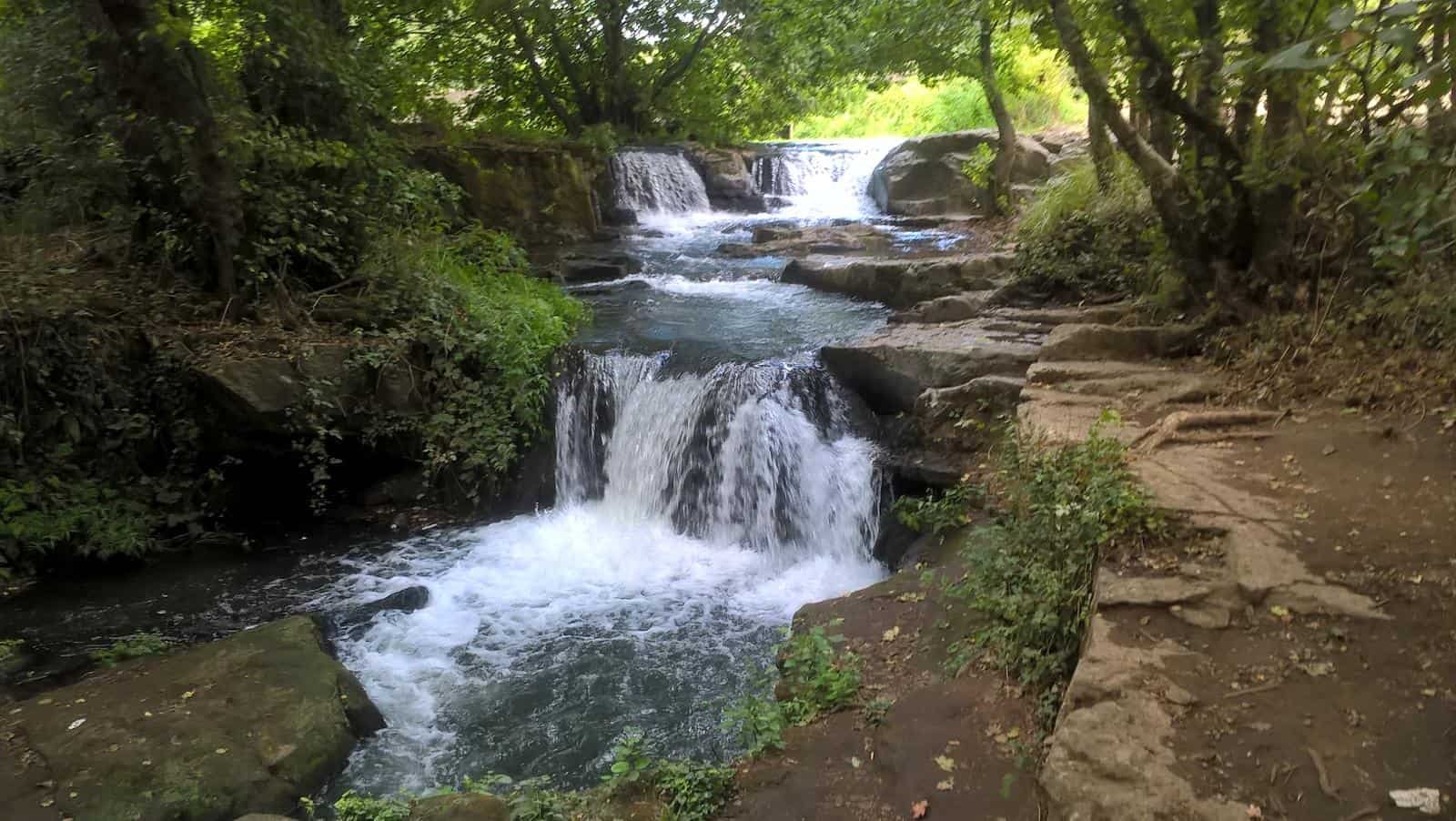

Monte Gelato Waterfalls are on Strada Comunale Monte Gelato, in the territory of Mazzano Romano (00060, Metropolitan City of Rome Capital), inside the Treja Valley Regional Natural Park: about 40 kilometers north of Rome, on the border with Viterbo Province. Entry to the waterfall area is free and there's no ticket. You do pay for parking, which is municipal and run under concession, while parking along the road is prohibited, with towing, on the busiest days. Access to the equipped area is normally allowed from 7 to 20, with seasonal changes decided by the municipality and the Park Authority: the current rate and the hours for the day are posted on the signs at the parking lot and available from the operator, because they change from season to season. You don't need to book, you don't need a guide, there's no turnstile. Swimming in the Treja is prohibited, and it's not a decorative ban: the bed is polished tuff, the water is not drinkable and the flow changes fast after rain. Park Authority headquarters: Piazza Vittorio Emanuele II 4, in Calcata, phone 0761 587617. By car, from Rome you leave the Grande Raccordo Anulare onto the Cassia bis Veientana, follow it to around kilometer 35 and follow the sign for Mazzano Romano.
This page is part of the guide to Treja Valley Park, the protected area that contains the waterfalls and the whole gorge that leads to Calcata.
How to get to Monte Gelato Waterfalls (Mazzano Romano)
By car from Rome to Monte Gelato Waterfalls
There's only one road and you can't go wrong. From the Grande Raccordo Anulare you take the Cassia bis Veientana toward Viterbo and follow it for about 35 kilometers, to the exit marked for Mazzano Romano. From there you go down onto the provincial road, and after a few kilometers you find the signed junction for the waterfalls, on the right. The last stretch runs straight through the fields and ends in front of the agriturismo farmhouse that marks the arrival. From there the waterfalls are about a hundred meters away, on the left, past the row of trees. If you're coming from the north, from the Autostrada del Sole, exit at Magliano Sabina, take the Flaminia toward Rome and then follow the signs for Civita Castellana and for Calcata and Mazzano Romano.
The honest travel time, from a northern neighborhood of Rome, is 40 or 45 minutes in normal conditions. On a Sunday in May, with the line at the Veientana exit and the queue for the parking lot, it can become an hour and a half. If you start from central Rome, count on a good hour.
Parking and shuttle at Monte Gelato Waterfalls
This is the practical point that ruins more visits than any other. On weekends and holidays in the good season, the municipality of Mazzano Romano has been applying for years an ordinance that prohibits parking and stopping along the Monte Gelato municipal road, with towing, and it concentrates all the cars in the Castellaccio parking lot, about 250 meters from the entrance to the equipped area. The parking lot is paid, with separate rates for cars, motorcycles and campers. They are set by a municipal resolution and they get revised, so you need to read them on site or ask the operator before leaving, not take them for granted based on what you paid two summers ago.
When the Castellaccio fills up, and in spring it fills up early, plan B is to park in the parking areas of the town of Mazzano Romano and take the shuttle that connects the historic center to the waterfalls. If you arrive after 11 on an April Sunday, you will almost certainly find this situation. The rule is simple: at 9:30 you walk in without waiting and you find the big pool still in shade and nobody in the frame. At 12:30 you park in Mazzano and wait for the minibus.
To Monte Gelato Waterfalls by public transport
It can be done, but it needs planning. The Cotral buses for Mazzano Romano and Calcata leave from the Saxa Rubra terminus, which you reach from Rome on the Roma Nord railway from Piazzale Flaminio. The schedules are few and they change between weekdays and holidays: check them on the Cotral website the day before, because a missed ride out means half a day lost and a missed ride back means a taxi that doesn't come by on its own in that area. The stop is in the town of Mazzano Romano, not at the waterfalls. From there you take the shuttle on the days it runs, or you walk along the road, which has no continuous sidewalk and on traffic days is not pleasant. If you have the time and the legs, on the other hand, you can use the town as a starting point and walk down into the valley along the trail, arriving at the waterfalls from below. It's the best way to get there, and getting rid of the parking problem is a welcome side effect.

What Monte Gelato Waterfalls really are
Let's clear up right away a misunderstanding that has been going around for 20 years in improvised guides. Monte Gelato Waterfalls are not a single wild drop that fell there from prehistory. They are a succession of drops that the Treja River makes over a tuff threshold, and those drops are partly natural and partly built. The drop was there, the rock was there, the water too. But the geometry that everyone photographs today, with the pools lined up and the wide veil falling evenly, is the result of a 19th-century hydraulic regulation tied to the mill. It's a historic landscape, not a virgin one. Knowing this takes nothing away from the beauty of the place: it adds the pleasure of reading it.
The Treja rises in the Sabatini Mountains, in the volcanic area that also produced Lake Bracciano, and runs north until it flows into the Tiber just downstream of Civita Castellana. For much of its course the river works inside the tuff: it cuts, it digs, it leaves yellowish vertical walls tens of meters high, and at the bottom of those walls it keeps a damp, cool microclimate that is a rarity in inland Lazio. The technical term is gorge. The visual result is a narrow, very green valley inside a countryside that is yellow and parched in August. At Monte Gelato the gorge widens into a basin, and the basin is the reason why the Romans, the millers and then the film crews came through here, and not two kilometers upstream.
The geology in three minutes
The tuff of these valleys comes from the Sabatini volcanic complex, active between about 600,000 and 40,000 years ago. The pyroclastic flows filled the countryside with a soft, porous material, very easy to cut with simple tools and compact enough to hold vertically. Two consequences follow, visible to the naked eye all along the route of Monte Gelato Waterfalls: the walls of the gorge stay straight instead of collapsing into a slope, and people have dug all sorts of things into them, from Faliscan tombs to cellars, from columbaria to stables. Meanwhile the Treja keeps deepening its bed: the waterfall is the step the river hasn't managed to wear down yet.
The woods, the water, the wildlife
Along the water, poplars, willows, alders and the big plane trees planted near the mill dominate. Going up the slopes you enter a mixed wood of downy oak, hornbeam, maple and hazel, with an undergrowth of ivy and ferns that holds the moisture. The protected area covers about 800 hectares and hosts ordinary but lively wildlife: the little egret and the grey heron on the calm bends, the kingfisher that passes like a blue flash half a meter from the surface of the water, the dipper in the fastest stretches, the porcupine and the badger that you don't see by day but that leave unmistakable tracks in the mud, the wild boar that here, as in half of Lazio, is all too present. The easiest birds of prey are the buzzard and the kestrel, often hunting over the high pastures toward the Castellaccio.
Visiting Monte Gelato Waterfalls step by step
From the parking lot to the water it takes a few minutes on flat, packed ground. This is the reason why Monte Gelato Waterfalls are the right place for people who don't hike: you arrive in flip-flops at the most photographed spot in northern Lazio, and only afterward decide whether to go on or not. The loop is described in the order in which it makes sense to do it.
The entrance meadow and the equipped area
You enter a grassy clearing with tables, benches and trash cans, closed off upstream by the farmhouse and downstream by the line of poplars. This is where the families gather, with their spread-out blankets and packed lunches. Picnicking is allowed only in the marked areas, fires and barbecues are prohibited everywhere and you take your trash home: the park is not equipped to dispose of what 2,000 people leave on a Sunday in May. If you want quiet, cross the meadow without stopping and keep going downstream: 300 meters is enough to leave 90 percent of the voices behind.
The main drop and the big pool
The main drop is wide and low, a veil of water a few meters across that falls over a threshold of dark tuff and collects in a large pool, light green when the light comes in from above and dark green the rest of the day. It's the image everybody knows. The rock under the surface is polished like a wet floor: that, as well as the ordinances, is where the swimming ban comes from. The opposite bank can be reached on a path of stones that ends up underwater in winter.
The smaller drops and the upstream pools
Going up the river you meet other steps, smaller and less photogenic, where the water runs over sloping slabs and forms pools half a meter deep. It's the part that hurried visitors skip and it's the most beautiful on high-sun days, when the light filters through the branches and falls in stripes. Here the river is narrow and noisy, and in 10 minutes you see three or four species of birds go by.
The bridge, the left bank and the start of the trails
A small bridge lets you cross to the left bank, where trail 001 starts, the route that leads toward Mazzano Romano and Calcata. If you don't plan to walk for three hours, you can still do the first 200 meters and come back: the view of the waterfalls from that side is the best of all, and almost nobody gets there because everyone stays on the meadow.
The Mola di Monte Gelato, the 1830 mill
Above the waterfalls stands the building that gives the place its historic name: the Mola di Monte Gelato, the water mill built in 1830 by the Del Drago family, owners of the fief. It's not a picturesque ruin put there for show: it's a production plant, with the three-story tower and the system of sluices that served to regulate the flow of the Treja and send the water onto the wheels. The sluices are exactly the reason why the waterfall has the shape it has. The mill ground grain until the early 1960s, then was abandoned and finally restored by the Park Authority in the 1990s. Today the building works as an information point and a park outpost.
It's worth looking at it carefully instead of using it as a backdrop. The masonry in small blocks of local tuff, the small openings, the diversion channel still readable: it's a pre-industrial hydraulic machine in an excellent state of preservation, and in Lazio there are few so complete. Plainly put: the Mola is the most interesting thing at Monte Gelato after the water, and most visitors walk past it without looking up.

Underfoot: the Roman villa and the medieval village of Monte Gelato
The meadow where children run after a ball covers one of the most studied archaeological sites in southern Etruria. Between 1986 and 1990 the British School at Rome, with Timothy W. Potter and Anthony C. King, excavated a settlement here with a continuous sequence from the Augustan age to the Middle Ages, publishing the results in a monograph that is still the reference for the whole valley. After the excavation the main area was covered back over for conservation, so there is no archaeological route to visit: the ruins are under the grass. This explains why almost nobody, among the thousands of people who come to Monte Gelato Waterfalls every year, suspects they are walking on 2,000 years of history.
The Augustan-age villa
The oldest core is a villa built in the Augustan age, that is, straddling the first century BC and the first century AD, and it remained in use until the middle of the fourth century. It wasn't a postcard luxury residence: it was a farm, part of the territory of the municipium of Veii, with residential parts and production parts. From the layers came materials that tell of a rich countryside connected to Rome, not a forgotten corner.
The cattle dealer of Veii
Among the finds is a marble funerary relief with an inscription published in 1990 by C. M. Gilliver in the Papers of the British School at Rome. It commemorates a group of freedmen, and among them Gaius Valerius Faustus, described as mercator bovarius, that is, a cattle dealer, and also a priest of the imperial cult in the municipium of Veii. The piece dates to the early first century AD and shows epigraphic features of an urban taste. It's a fragment of concrete life: a freedman who gets rich selling livestock in Rome, buys himself a local religious office and has his trade carved on his tomb, with the pride of someone who did it all on his own.
The church, the baptistery, the cemetery
During the fourth century the site was occupied by a Christian community. In the eighth century a pre-existing little church was rebuilt on a larger scale, with a small baptistery and a burial area around it: this is the phase the excavators summed up in the well-known formula of the passage from villa to village. In the 10th century the church of San Giovanni de Latregia rose here, whose name preserves that of the river. The building appears to have been destroyed around the 11th century. For anyone who studies the early medieval period in Lazio, this sequence is a textbook case, because it documents with stratigraphic continuity how the Roman countryside moves from late antique property to settlement centered around a church.
The Castellaccio and the Castrum Capracorum
On the southeastern height, the one that now gives its name to the parking lot, stood a medieval fortification identified with the Castrum Capracorum: a ditch dug into the tuff to a depth of over four meters, a circuit wall, a 12th-century tower, artificial cavities carved into the rock. The occupation ends at the end of the 13th century. If you park down there and climb up the trail, you can still see the cuts in the tuff and the profile of the ditch. It's not a castle for a guided visit, but it's proof that this basin was held militarily for centuries, because it controlled a ford and a mill, that is, water and bread.
Narce, the Falisci and the Treja valley before Rome
A little downstream of the waterfalls, still in the territory of Mazzano Romano, is Narce: a tuff plateau washed by the Treja, continuously occupied from the Middle Bronze Age to the third century BC. The settlement is spread over three connected heights, Narce proper, Monte Li Santi and Pizzo Piede, for about 20 hectares in all, and around it there are about 20 necropolis areas, the oldest of which dates to the early eighth century BC. A scholarly tradition has wanted to identify Narce with ancient Fescennium: it's a hypothesis, not an established fact, and it must be presented as such.
On the slope toward the river the sanctuary of Monte Li Santi Le Rote was investigated, a suburban sacred area with very rich votive deposits, studied and published by Maria Anna De Lucia Brolli and Jacopo Tabolli. The sanctuary was deliberately closed after the Roman conquest of the Faliscan territory, which dates to 241 BC, when Falerii Veteres was destroyed and the population moved. The valley, in short, didn't empty by chance: it was emptied by political decision. The materials from Narce can be seen at the Archaeological Museum of the Agro Falisco, housed in Forte Sangallo in Civita Castellana, and it's the visit I recommend combining with a day at Monte Gelato Waterfalls if it rains and the trail is impassable.
The Treja Valley Regional Natural Park
The protected area was established in 1982 by regional law and covers about 800 hectares in the municipalities of Calcata and Mazzano Romano, straddling the provinces of Rome and Viterbo. It's managed by a consortium between the two municipalities, headquartered in Calcata at Piazza Vittorio Emanuele II 4. The park looks after the trail network, the staffing of the Mola, the supervision of the equipped areas and the regulation of access in peak periods. The reference number is 0761 587617.
If you want to understand the park as a whole, there's only one thing to do: don't stop at the waterfalls. The Monte Gelato Waterfalls are the most visited spot and the least representative, because they're easy to reach, open and crowded, while the real valley is the narrow gorge you can only walk through on foot. Between Calcata and Mazzano there are hours of walking in a gorge where the phone gets no signal and the only sound is the water.
The Trail from the Monte Gelato Waterfalls to Calcata
This is the classic itinerary of the valley, and one of the most complete in northern Lazio for the variety of environments it crosses: riverside woods, tuff slopes, abandoned terraces, pastures, historic centers. Park trail numbers: 001, 002, 019, 009. Total length around 7 kilometers. Walking time about three and a half hours, stops excluded. Difficulty: EE, meaning for expert hikers, on the first stretch from the waterfalls to the Fonte di Virginio. E or T on the later stretches.
First of all, a serious warning: the first stretch, right below the waterfalls, has had interruptions and closures in the past, and for a period the trail could only be walked by joining it at Mazzano Romano, from Via della Fontana Salsa or from the historic center. Before leaving, check with the Park Authority that the trail is passable, because a gorge with tuff landslides is not a place to improvise. If you find the stretch closed, go down to Mazzano and start from there: you lose the most spectacular piece and gain an itinerary that is still beautiful.
From the Waterfalls to the Fonte di Virginio
You start from the Monte Gelato Waterfalls by taking the trail on the left bank of the Treja, marked 001. At the beginning the path follows an easy road. Past the waterfalls it narrows and climbs the tuff ridge. This stretch is equipped with steps and steel cables to help you through, but it requires real attention and mountain footwear. In rain or strong wind avoid it, because they increase the risk of slipping and of falling rocks. Once you're past the ridge the difficulty drops suddenly. You cross an area of springs and little streams, beautiful and muddy, and after about 10 minutes you meet a small tributary that comes from the Fontana Salsa, or Fonte di Virginio, to be crossed at an easy ford.
From the Ford to Mazzano Romano
You continue with a series of ups and downs in the woods, always keeping to the path closest to the river. About a quarter of an hour after the tributary the trail turns decisively left and almost immediately crosses a wider track. You continue in the same direction of travel, climbing along the mid-slope. Here you can spot the remains of old stone terraces, and the trail is often cut directly into the tuff, with walls that keep the marks of the tools. Then you go down again to the right, next to a wide pasture. After about an hour and a half of walking from the Monte Gelato Waterfalls you reach Mazzano Romano.
From Mazzano Romano to the Wooden Bridge
Once you reach the historic center you continue along Via del Lavatoio. The road, marked 002, drops quickly to the building of the old wash house. Past that you turn right, and in a few minutes you're back on the Treja. You continue with ups and downs following the course of the river until you reach the provincial road, close to the border between Rome Province and Viterbo Province. You cross the asphalt and take the dirt road on the left bank, closed to vehicles by a barrier, following marker 019. After about a kilometer and a half all along the river, in the shade of big poplars and willows, you arrive at a wooden bridge that lets you cross the Treja.
The Climb to Calcata on Trail 009
Past the bridge you find yourself under the cliff of Calcata, the village abandoned in the 1930s for risk of collapse and repopulated from the 1960s by artists and craftspeople. You climb on trail 009, steep, in 15 or 20 minutes, and come out in the town. A practical tip: organize your return before you leave. The route is not a loop, and walking back to Monte Gelato means doubling the hours. Two cars, one left at Calcata, are the simplest solution. In Calcata the Opera Bosco, museum of art in nature also deserves a stop. It displays works made with materials from the woods along the slope below the village.
The Rules of the Monte Gelato Waterfalls: What You Can't Do
The rules are simple and it pays to know them beforehand, because there is enforcement and the fines are real too.
Swimming is prohibited. The ban covers the whole stretch of the waterfalls and pools: the tuff bed is treacherously slippery, the drops hide currents and rocks, the flow can rise quickly upstream without warning and the Treja water is neither drinkable nor swimmable. Every summer someone pretends not to see the signs. Every summer someone ends up badly. Lighting fires and using barbecues is prohibited. Camping and overnight stays are prohibited. Picnicking is allowed only in the equipped areas and trash must be taken away. Dogs are allowed on a leash and must not go into the water. You don't pick plants, you don't move stones, you don't build stone dams in the pools, a widespread habit that harms the invertebrates living on the bottom. Drones: the area is subject to the rules of the managing authority and to national regulations, so you ask first, not after.
Monte Gelato Waterfalls with children
It's one of the few places in Lazio where bringing a stroller and a group of children really makes sense. From the parking lot to the water the route is short and flat, the meadows are wide, the tables are there, shade is plentiful and the river in the equipped stretch is visible and manageable. The recommendations are the obvious ones but not trivial: closed shoes with a lugged sole even for the little ones, because the wet rock near the pools betrays you. No swimming, and that includes feet dipped in at the edge of the drop. Constant supervision at the points where the meadow ends at the drop-off. For a family with children under six, the right visit lasts an hour and a half including the snack, not more. If you're looking for other ideas for kids nearby, you'll find the selection in the families and children section.
Accessibility at Monte Gelato Waterfalls
The stretch from the parking lot to the equipped area and to the viewpoint over the main waterfall is on packed ground and basically flat. A manual wheelchair can do it with a companion, an electric wheelchair even better, except after days of rain when the ground gets soft. From there on, that is on the gorge trails, accessibility ends: steps, roots, fords, steel cables. There are no equipped restrooms guaranteed all year in the area. Availability must be checked with the Park Authority, because it depends on the season and on the operator of the services. If you have specific needs, call the park first.
When to go to Monte Gelato Waterfalls
The best time is the end of March or the beginning of April, on a weekday: the river still has its winter flow, the woods have just burst into leaf, the light is low and soft and the parking lot is empty. The second best time is the first half of November, with yellow poplars and the water full again after the first autumn rains. May and June are splendid but crowded. July and August are the worst period for two technical reasons: the flow drops and the waterfall shrinks to a veil, and the area fills with people who come to swim, which you can't do. Winter is underrated: on clear January days the gorge has a light you don't find at any other time, and you can have the place almost to yourself.
After a strong thunderstorm, on the other hand, better to postpone. The waterfall turns brown, the trail becomes impassable and the risk of falling rocks on the ridge is not theoretical.

What to see around Monte Gelato Waterfalls
The Treja basin is at the center of one of the densest areas of things to see in Lazio, and a day at the waterfalls stretches easily. Calcata, half an hour by car and three hours on foot, is the most photographed cliff-top village in the valley. Mazzano Romano keeps a compact medieval historic center, with the wash house and the caves in the tuff. To the north, Faleria and Nepi with its gorges and the Borgia fortress. Castel Sant'Elia with the Romanesque basilica at the bottom of the gorge, one of the most impressive places in all of Tuscia. Sutri with the amphitheater carved into the tuff and the Mithraeum.
To the south you enter the territory of ancient Veii and the Veio Park, with its minor waterfalls and Etruscan sanctuaries. To the west you quickly reach the volcanic lakes: Lake Bracciano and, more secluded and with no roads along the shore, Lake Martignano. For anyone who likes odd geology there is the Caldara di Manziana, with its sulfur fumaroles, and for anyone who likes real woods the Oriolo Romano beech forest, a World Heritage site. All destinations that combine with Monte Gelato in a single day without rushing.
Where to eat near Monte Gelato Waterfalls
At the entrance to the area there is an agriturismo farmhouse that works as a refreshment point and a landmark for people arriving by car. Inside the park, otherwise, lunch is what you bring: tables and benches in the equipped areas, no fires. For a real sit-down meal it's best to go up to Mazzano Romano or Calcata, where you eat Tuscia cooking in a few small osterie, or head toward Nepi and Civita Castellana. Practical advice worth gold on weekends: if you want to eat in Calcata on Sunday, you book. The places in the village have few seats and they fill up.
A curiosity about Monte Gelato Waterfalls (Mazzano Romano)
Monte Gelato Waterfalls are in all likelihood the most filmed natural place in Italy, and almost nobody knows it. A systematic search carried out between 2016 and 2021 by the director and researcher Davide Rapp counted at least 180 films, TV series and commercials shot here, starting from 1950. The first on the list is Francesco giullare di Dio by Roberto Rossellini. Then come the peplum, the spaghetti western, the comedy. Among the titles Rapp identified are Francesco d'Assisi by Michael Curtiz from 1961, Lo chiamavano Trinità with Terence Hill and Bud Spencer, Quel maledetto treno blindato by Enzo Castellari, Superfantozzi with Paolo Villaggio, Camping del terrore by Ruggero Deodato from 1987, and later TV dramas like Elisa di Rivombrosa and Distretto di polizia.
From that work came Montegelato, a 28-minute virtual reality film presented in 2021 at the Venice Film Festival and then acquired by Rai Cinema. The point of the research is dizzying: the same tuff threshold, the same pool, the same plane trees have played the Far West, the Holy Land, the jungle, a medieval wood and an American campground, changing only the extras. When you get there the first time and have the impression of having already seen the place, it's not a suggestion: you really have seen it, dozens of times, without knowing where it was.
Something nobody tells you about Monte Gelato Waterfalls (Mazzano Romano)
That the waterfall you're looking at is, in large part, a man-made structure. The natural drop existed, but the current shape depends on the system of sluices built in 1830 together with the Del Drago mill to regulate the flow of the Treja and feed the wheels. The sharp line of the threshold, the uniform width of the veil of water, the alignment of the pools: it's 19th-century hydraulics, not pure geology. The guides that sell Monte Gelato as a corner of untouched nature tell a half truth.
The second thing nobody says is about the subsoil. The picnic meadow covers a Roman villa of the Augustan age, an eighth-century church with baptistery and cemetery, and the foundations of the 10th-century church of San Giovanni de Latregia. All covered back over after the excavations of the British School at Rome in the 1980s, for conservation reasons. There is no sign every 10 meters, no archaeological route, no ticket: there is a meadow. Whoever knows walks differently. The third: the medieval fortification that gives its name to the Castellaccio parking lot, the Castrum Capracorum, had a ditch dug into the tuff more than four meters deep and a 12th-century tower. The parking lot, in short, has a name that is a historical document, and whoever leaves their car there reads it like any ordinary sign.
The advice I give you for visiting Monte Gelato Waterfalls (Mazzano Romano)
Go early in the morning, on a weekday, between the end of March and mid-April. It's not generic advice: it's the only combination that gives you the place as it is. The water still has its winter flow, so the waterfall is full and not reduced to the summer veil. The light enters the basin from the east and lights up the vapor above the pool. The Castellaccio parking lot is empty and you don't need the shuttle from Mazzano. At 11 on a Sunday in May you'll see the same rock with 300 people in front of it and the water at its minimum: it's a different experience, and a worse one.
Second piece of advice, against laziness. Don't stop at the meadow. Cross the little bridge, take trail 001 on the left bank and walk even just 200 meters: the viewpoint over Monte Gelato Waterfalls from that side is clearly the best, and almost all the visitors never get there. If you have three and a half hours and trained legs, do the whole itinerary to Calcata, but first check with the Park Authority whether the initial stretch can be walked, the one equipped with steel cables on the tuff ridge, and don't take it on in rain or strong wind.
Third piece of advice, about gear: closed shoes with a lugged sole, always, even for the short walk. Wet tuff near the pools is as smooth as a freshly washed floor, and the share of ankle sprains you see here every year is almost all on the account of people who arrived in flip-flops.
Another well-known fact, yet rarely cited
That the Treja is a real river, with a basin, a history and an economic function, and not a decorative stream. It rises in the Sabatini Mountains, crosses an area of considerable natural interest and flows into the Tiber just downstream of Civita Castellana. For two millennia it has driven mills, fed fords, marked administrative boundaries: still today, along the itinerary to Calcata, the river marks the border between Rome Province and Viterbo Province. The valley it carved is a gorge, that is, a narrow ravine with vertical walls, and the gorges of northern Lazio are ecological corridors as important as they are fragile, because they concentrate, in a few meters of width, a damp microclimate that the surrounding land no longer has.
The rarely cited fact is the consequence of this geography on human history. The Treja valley has been inhabited continuously since the Middle Bronze Age, because it offered perennial water, soft rock to dig and defensible walls all together. Narce, the great Faliscan settlement just downstream of the waterfalls, developed on exactly this logic: three connected heights, 20 hectares, about 20 necropolises around it. When Rome conquers the Faliscan territory in 241 BC, the system breaks down and the valley empties. Then the Roman villa comes back, then the medieval village, then the castle, then the mill, then the movies. The same half kilometer of river, reused continuously for 3,000 years. This, more than the waterfall, is the reason why Monte Gelato is worth it.
The right photo to take at Monte Gelato Waterfalls (Mazzano Romano)
The photo everybody takes is head-on, from the meadow, with the main drop in the center and the pool in the foreground. It's correct and almost always wrong in its timing: at noon the sun beats down on the threshold, the water burns out white and the woods around stay black. The good photograph is made in the first hour after opening, when the basin is still in shade and the light arrives reflected: the greens stay saturated, the foam keeps its detail, and long exposures work without filters.
The right photo, though, is not that one. It's the shot from the left bank, after the little bridge, on trail 001: from there Monte Gelato Waterfalls are seen at three quarters, with the drops stepping up one behind the other in depth and the plane trees of the Mola closing the background. You need a light tripod, an exposure of around half a second to render the veil of water without erasing its structure, and an aperture closed down to f/11. If you have a polarizer, use it with measure: turned all the way, it removes all the reflections and flattens the scene. Turned halfway, it kills the glare on the wet leaves and brings out the green.
One last framing that almost nobody takes: the Mola seen from downstream, with the mill tower above the drop and the diversion channel in the foreground. It tells in a single frame the relationship between the water and the work of men, which is the real story of this place. And a piece of advice to avoid embarrassment: you don't trample the pools to get the shot, the swimming ban applies to photographers too.
Some important events that happened here in history
The first event is the birth of the villa in the Augustan age, between the end of the first century BC and the beginning of the first century AD: the basin then enters the agricultural economy of the municipium of Veii, with a farm that produces and sells toward Rome. To the same phase belongs the funerary relief of the freedmen published in 1990 in the Papers of the British School at Rome, with the mention of Gaius Valerius Faustus, mercator bovarius and priest of the imperial cult at Veii: a document that captures a rising middle class in the Roman countryside.
The second is the Christianization of the site during the fourth century, when the villa stops functioning as such and a Christian community settles on its ruins. In the eighth century the little church is rebuilt larger, with a small baptistery and a burial area around it: it's the passage from villa to village, the transformation that marks the whole early medieval period in Lazio. In the 10th century the church of San Giovanni de Latregia is built, destroyed around the 11th century.
The third is the fortification of the southeastern height with the Castrum Capracorum, equipped with a ditch more than four meters deep, a circuit wall and a 12th-century tower, and abandoned at the end of the 13th century. The fourth is from 1830: the Del Drago family builds the water mill with the three-story tower and the sluices, giving the waterfalls the shape they have today. The millstone works until the early 1960s. In the 1990s the Park Authority restores the building.
The fifth event is from 1982, when the Lazio Region establishes the Treja Valley Regional Natural Park and entrusts its management to a consortium of the municipalities of Mazzano Romano and Calcata: from that moment the waterfalls stop being private property used as a set and become a regulated public good. The sixth is the excavation campaign of the British School at Rome between 1986 and 1990, directed by Timothy W. Potter with Anthony C. King, which reconstructs the complete sequence from villa to village and publishes it in a monograph that is still today the reference for the archaeology of the valley. The seventh, contemporary, is administrative and concerns whoever comes here today: the municipal ordinances that since the 2010s have prohibited wild parking along the road, imposed the Castellaccio parking lot and set up the shuttle from Mazzano, and the swimming bans that have changed the way the river is used in summer.
Who has passed through Monte Gelato Waterfalls (Mazzano Romano)
The most illustrious passage is that of the movies, and it's documented film by film. Roberto Rossellini shoots some scenes of Francesco giullare di Dio here in 1950: it's the first title in Davide Rapp's census, and it opens a season that has never closed. 11 years later a top American director arrives, Michael Curtiz, the one of Casablanca, for Francesco d'Assisi. In the 1970s the basin becomes the Far West for Lo chiamavano Trinità, the film that definitively launches the Terence Hill and Bud Spencer duo, and a theater of war for Quel maledetto treno blindato by Enzo Castellari, later paid homage by Quentin Tarantino. In the 1980s it moves to comedy with Superfantozzi by Paolo Villaggio and to horror with Camping del terrore by Ruggero Deodato. Television comes later, with popular dramas like Elisa di Rivombrosa and Distretto di polizia.
Before the movies, though, other people passed through here, less well known and more interesting. The Falisci of Narce, who buried their dead in the valley for six centuries and who left votive deposits of extraordinary richness in the sanctuary of Monte Li Santi Le Rote, studied and published by Maria Anna De Lucia Brolli and Jacopo Tabolli. The freedmen of the age of Augustus, with their cattle dealer proud of his trade. The monks and farmers who in the eighth century built the church and had themselves buried around it. The soldiers of the Castrum Capracorum, who cut four meters of ditch into the tuff with hand tools. The Del Drago family, Roman princes and owners of the fief, who put their mill here in 1830. The millers who worked here until the 1960s. And finally the British archaeologists of the British School at Rome, who in the late 1980s put this whole history back in order and then, with a conservation choice that few appreciate, covered it with earth and gave it back to the meadow.
Quick questions about Monte Gelato Waterfalls (Mazzano Romano)
How much does it cost to enter Monte Gelato Waterfalls?
Entry to the waterfall area is free: there is no ticket. You pay for parking, which is municipal and run under concession, with separate rates for cars, motorcycles and campers set by a resolution of the Municipality of Mazzano Romano and updated over time. The current rate must be read on the signs at the parking lot.
Where do you park at Monte Gelato Waterfalls?
In the Castellaccio parking lot, about 250 meters from the entrance to the equipped area. On weekends and holidays in the tourist season, parking along the municipal road is prohibited, with towing. When the Castellaccio is full you park in the parking areas of Mazzano Romano and use the shuttle.
Are there access hours for Monte Gelato Waterfalls?
Access is normally allowed from 7 to 20, with seasonal changes decided by the municipal administration and the Park Authority. It's best to check the hours for the period before leaving, especially in winter when closing is earlier.
Can you swim at Monte Gelato Waterfalls?
No. Swimming is prohibited for reasons of safety and environmental protection: the tuff bed is slippery, the drops hide currents and rocks, the flow can rise suddenly and the water is neither drinkable nor swimmable. The ban is enforced with fines.
Do you need to book to visit Monte Gelato Waterfalls?
No, neither a reservation nor a guide is needed for the equipped area. Booking may be needed for refreshments and for guided excursions organized by the Park Authority or by authorized operators.
How long does a visit to Monte Gelato Waterfalls take?
To see the waterfalls and the equipped area, 45 minutes is enough. For a visit done well, with the loop on the left bank and the Mola, count two hours. For the complete itinerary to Calcata you need about three and a half hours of walking alone.
Are Monte Gelato Waterfalls suitable for children?
Yes, the stretch from the parking lot to the waterfalls is short and flat, with meadows and tables. Closed shoes are needed for children too, and constant supervision near the pools and the edges of the drop-off. Swimming is prohibited for them as well.
Can you go to Monte Gelato Waterfalls with a stroller?
On the stretch from the parking lot to the equipped area, yes, on packed ground. After days of rain the ground gets soft and the stroller struggles. On the gorge trails the stroller can't get through.
Are Monte Gelato Waterfalls wheelchair accessible?
The main stretch, from the parking lot to the viewpoint over the waterfall, can be walked with a companion on compact, flat ground. The valley trails can't: they have steps, roots, fords and stretches equipped with cables. For specific needs it's best to call the Park Authority at 0761 587617.
Can you bring dogs to Monte Gelato Waterfalls?
Yes, on a leash. They must not go into the water and droppings must be picked up. In the picnic areas the same criterion of respect applies as for the other visitors.
Can you have a picnic at Monte Gelato Waterfalls?
Yes, but only in the marked equipped areas, with tables and benches. Fires and barbecues are prohibited everywhere, camping too, and trash must be taken back home.
How do you get to Monte Gelato Waterfalls by public transport?
With the Cotral buses from Saxa Rubra, which you reach from Piazzale Flaminio on the Roma Nord railway, toward Mazzano Romano and Calcata. The schedules, few and different between weekdays and holidays, are checked on the Cotral website. The stop is in town, not at the waterfalls.
How far is Rome from Monte Gelato Waterfalls?
About 40 kilometers from the Grande Raccordo Anulare, along the Cassia bis Veientana to the exit for Mazzano Romano. The real travel time goes from 40 minutes to an hour and a half depending on weekend traffic.
What is the best time to see Monte Gelato Waterfalls?
End of March and beginning of April, with the flow still high and the woods just turned green again. Alternatively the first half of November. In July and August the flow drops and the area is crowded.
What is the difference between Monte Gelato Waterfalls and Calcata?
The waterfalls are an equipped river area on the floor of the Treja valley, in the municipality of Mazzano Romano. Calcata is the medieval cliff-top village that closes the valley to the north, in Viterbo Province. They are the two poles of the same park and are linked by a trail of about 7 kilometers.
Is the trail from Monte Gelato to Calcata difficult?
The first stretch, from the waterfalls to the Fonte di Virginio, is rated EE, for expert hikers, and is equipped with steps and steel cables on the tuff ridge. The following stretches are E or T. It should be avoided in rain or strong wind and whether it can be walked must be checked with the Park Authority.
Can you take photos and videos at Monte Gelato Waterfalls?
Yes, amateur photography is free. For drones the rules of the managing authority and national regulations apply: you ask for authorization first. For professional shoots and sets you need a permit from the Park Authority and the Municipality.
Is there a bar or a restaurant at Monte Gelato Waterfalls?
At the entrance to the area there is an agriturismo farmhouse that works as a refreshment point. For a sit-down meal with more choice it's best to go up to Mazzano Romano or Calcata, where on weekends it's better to book.
Are there public restrooms at Monte Gelato Waterfalls?
Availability of restrooms depends on the season and on the operator of the area. It must be checked with the Park Authority before a trip with children or with elderly people.
Can you see archaeological remains at Monte Gelato Waterfalls?
No. The Roman villa, the early medieval church and the baptistery excavated by the British School at Rome were covered back over after the excavations for conservation reasons. What remains readable on the surface is the Mola from 1830 and, on the height, the traces of the ditch and of the structures of the Castellaccio.
Are Monte Gelato Waterfalls natural or artificial?
Both. The drop exists for geological reasons, but the succession of pools and the current shape depend on the sluices built in 1830 for the Del Drago mill.
How many films have been shot at Monte Gelato Waterfalls?
The census by the director Davide Rapp, carried out between 2016 and 2021, counts at least 180 films, series and commercials from 1950 to today, among them Lo chiamavano Trinità, Superfantozzi and Camping del terrore.
Can you visit Monte Gelato Waterfalls in winter?
Yes, and it's one of the best periods for anyone looking for quiet: the flow is high and the low light enters the gorge. You need waterproof shoes, and after heavy rain it's better to postpone because of the risk of falling rocks on the ridge.
If I had to choose a single day a year to go back, I'd take a Wednesday in early April, I'd arrive at 9:30, I'd do the wide loop on the left bank and I'd leave before noon, when the tour buses arrive. Monte Gelato is not a place to conquer: it's a place to catch at the right moment. Those who go at the wrong pace see an average waterfall in the middle of a crowd. Those who go at the right pace see 3,000 years of history inside a green gorge 40 minutes from Rome. And if you have an extra hour, go up to Calcata: you only understand the valley by looking at it from above after walking it from below.
Frequently asked questions about Monte Gelato Waterfalls (Mazzano Romano)
How much does it cost to enter Monte Gelato Waterfalls?
Entry to the Monte Gelato Waterfalls area is free: there is no ticket. You only pay for parking, which is municipal and run under concession, with separate rates for cars, motorcycles and campers set by the Municipality of Mazzano Romano.
Can you swim at Monte Gelato Waterfalls?
No, at Monte Gelato Waterfalls swimming is prohibited along the whole stretch of the waterfalls and pools. The tuff bed is treacherously slippery, the drops hide currents and rocks and the flow of the Treja River can rise quickly upstream without warning.
How do you get to Monte Gelato Waterfalls from Rome?
To get to Monte Gelato Waterfalls from Rome by car, you take the Cassia bis Veientana from the Grande Raccordo Anulare toward Viterbo, following it for about 35 kilometers to the exit marked for Mazzano Romano. From there you go down onto the provincial road to the signed junction for the waterfalls.
Are Monte Gelato Waterfalls suitable for children?
Yes, Monte Gelato Waterfalls are one of the few places in Lazio where bringing a stroller and a group of children really makes sense, because from the parking lot to the water the route is short and flat. The meadows are wide, the tables are there and shade is plentiful, but closed shoes with a lugged sole are needed even for the little ones.
Are Monte Gelato Waterfalls wheelchair accessible?
The stretch from the parking lot to the equipped area and to the viewpoint over the main waterfall is on packed and basically flat ground, and can be walked with a manual wheelchair with a companion. Beyond that point, on the gorge trails, accessibility ends because of steps, roots and fords.
Where do you eat near Monte Gelato Waterfalls?
At the entrance to the Monte Gelato Waterfalls area there is an agriturismo farmhouse that works as a refreshment point. Inside the park, otherwise, lunch is what you bring, at tables and benches in the equipped areas. For a real sit-down meal it's best to go up to Mazzano Romano or Calcata.
When to go to Monte Gelato Waterfalls?
The best time to go to Monte Gelato Waterfalls is the end of March or the beginning of April, on a weekday: the river still has its winter flow, the woods have just burst into leaf and the parking lot is empty. The first half of November, with yellow poplars, is also a good time.
For anyone organizing groups, school classes or corporate incentives in this area, the professional reference is the network of certified tour leaders of TourLeaderPro in Rome, which works across all of Lazio. The tour leader service also covers day trips out of town like this one. For English-speaking visitors, the Treja valley is included in the ItalyPlanner guides dedicated to mountains and nature and in the regional section on Lazio, while anyone arriving in Rome for a few days will find the general picture in the guide to the best things to do in Rome.
Article written by the editorial team of TourLeaderPro, contact them for Private/Corporate/V.I.P. Tours and Experiences.
Planning a trip to Rome? The English-language guides to visiting the city are on ItalyPlanner.com.