Lake Martignano (RM)
In short. Lake Martignano occupies a volcanic basin about 35 kilometers from Rome, between the municipal territories of Rome, Anguillara Sabazia and Campagnano di Roma, within the boundary of the regional natural park of the Bracciano-Martignano lake complex.
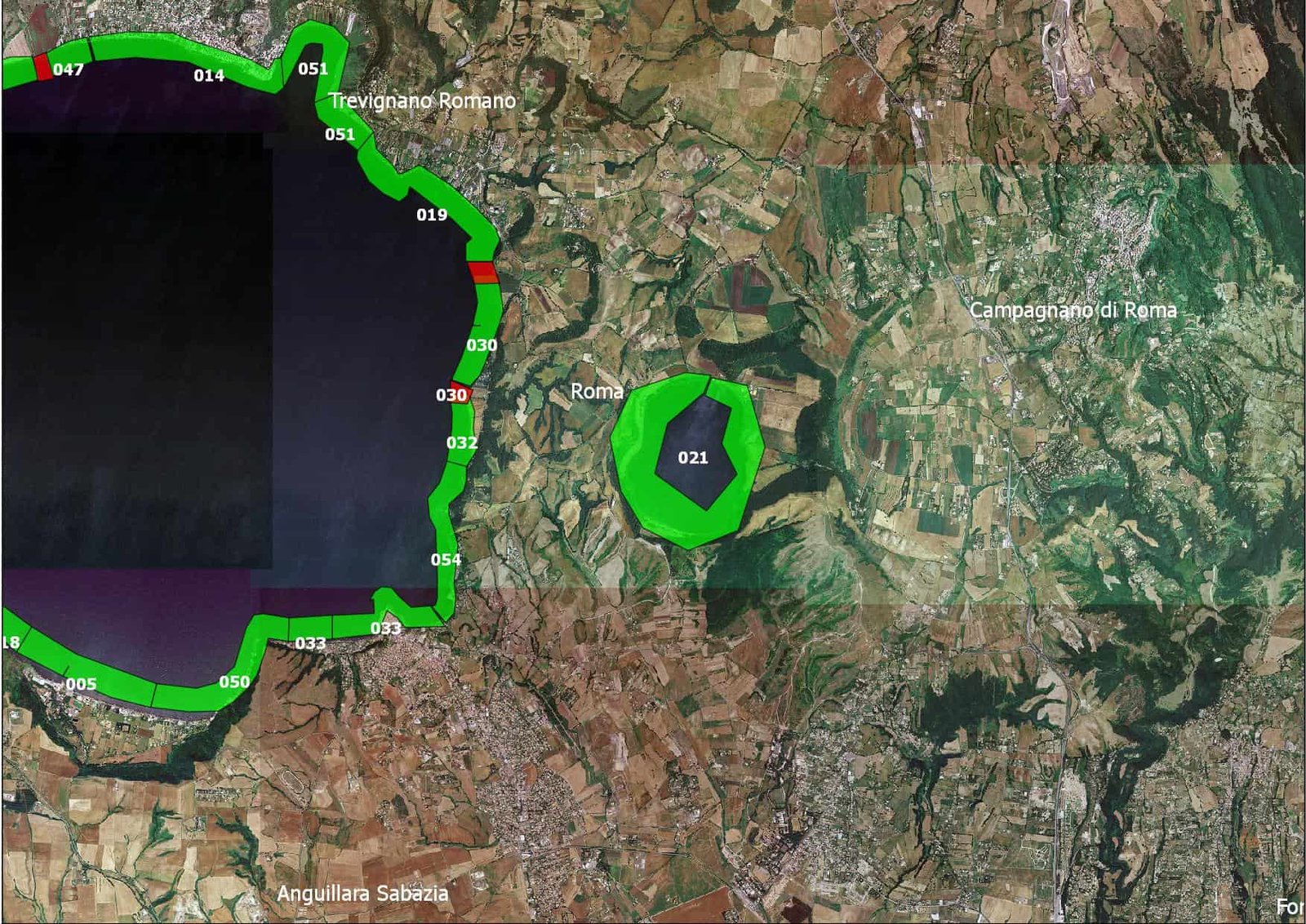
Lake Martignano occupies a volcanic basin about 35 kilometers from Rome, between the municipal territories of Rome, Anguillara Sabazia and Campagnano di Roma, within the boundary of the regional natural park of the Bracciano-Martignano lake complex. You can't reach the shore by car: the last stretch of road is closed to private traffic and the connection is provided by a shuttle. The authorized parking for the 2026 summer season is the one indicated by the Municipality of Anguillara Sabazia on via di Ponte Valle Trave, at the intersection with via dei Caputi. From there the shuttle goes down to the lake. The rates published by the Municipality for 2026: €5 per day for the car of non-residents (€3 for half a day), €3 for a motorcycle, €7 for a caravan, with a reduction to €3 and €2 for residents. Parking is free for people with disabilities holding a permit and for pregnant women. The shuttle costs €2 per person round trip and is free for children under 14, for those over 65, for people with disabilities and for dogs, with a maximum of two allowed per run, on a leash and muzzled. The Municipality declares waiting times of no more than half an hour. 2026 season hours: from June 1 to September 20 every day from 8:00 to 20:00 (with departure at 9:00 on weekdays until June 15), on May 30 and 31, and then from September 21 to October 31 only Friday, Saturday and Sunday from 9:00 to 19:00. Off season, from November 1 to March 31, the service becomes an on-demand shuttle run by the Cooperativa La Clessidra (telephone 393 9375274): same price of €2, booking at least 5 days in advance and a minimum of 4 passengers. Access to the shore is free, there is no entrance ticket to the lake, and there is no lifeguard service either: whoever enters the water does so at their own responsibility. The park's managing body is based in Bracciano, at via Aurelio Saffi 4/A, and can be reached at 06 99801176.
Anyone who wants to place Lake Martignano within the system of lakes and villages north of the capital can start from the page on Lake Bracciano, which is Martignano's big brother and very close by.

How to get to Lake Martignano
The geography of the place is deceptive. On the map Lake Martignano is a bit under an hour from the Grande Raccordo Anulare. In reality the last part of the trip changes nature and becomes a matter of dirt roads, farm gates and prohibitions. It's best to understand this before leaving, because this is where the fines pile up every summer.
By car from Rome to Lake Martignano
From the capital you take Via Cassia heading north and continue toward Anguillara Sabazia, then follow the signs for the lake. Those who leave the Cassia bis, the Veientana, can come down from the Cesano side and reach the same quadrant. In both cases the destination is not the shore. It's the authorized parking area, a few kilometers farther up. The GPS navigator, if you simply ask it for the lake, tends to propose the last cart track, and that's exactly the road you must not take.
The parking and the shuttle for Lake Martignano
The parking area indicated by the Municipality of Anguillara Sabazia for the 2026 season is on via di Ponte Valle Trave, where it crosses via dei Caputi. It's a wide dirt clearing with no shade worthy of the name: whoever arrives at noon in August finds the car interior at oven temperature. Payment is on the spot and the voucher is valid for the whole day or for half, your choice. The shuttle leaves from the same lot and covers in a few minutes the difference in elevation separating the plateau from the shore. It's €2 each, round trip, and free for children, seniors, people with disabilities and dogs. Keep in mind a practical detail that nobody writes on the signs: the last return run coincides with the closing of the service, and the climb on foot from the shore to the parking lot, with the sun still high and cooler bags in hand, is serious work.
Why the final road to Lake Martignano is closed to cars
The restriction isn't a municipal whim. The basin belongs to a regional protected area and the shore has no perimeter road. If traffic were allowed, on a July Sunday the meadow would end up hosting hundreds of cars parked on the grass, with the trash and soil compaction that follow. The area is monitored continuously, and joint checks among park rangers, local police and forestry carabinieri are by now a constant of recent summers. Trying to get through by car means exposing yourself to a double fine, for access and for illegal parking. In our view the shuttle is the reason Lake Martignano still looks like a lake and not like a parking lot with a view.
By public transportation and by bicycle
Public transportation doesn't reach the shore. The useful railway station in the area is Anguillara on the line to Viterbo, but from the station to the lake parking there are still several kilometers of ups and downs, and the road connection isn't designed for swimmers. Those without a car realistically solve it with a local taxi or a car service with driver to the lot, or by fitting Lake Martignano into an organized day that also includes Trevignano Romano and the north side of the larger basin. By bicycle the story changes for the better: there's no bike path, but the dirt roads of the plateau are excellent terrain for gravel bikes, and the final descent to the lake is handled without problems. Watch out for the return, which is all uphill.
Lake Martignano in numbers
A lake's numbers tell more than many descriptions. Those of Lake Martignano speak of a small, deep and closed basin, that is, of a fragile environment.
Surface, depth and perimeter of Lake Martignano
The body of water measures 2.44 square kilometers. The basin is 2.015 kilometers long and 1.545 wide, with a lake perimeter of about six kilometers: the right distance for a walk around it that takes a morning without mountaineering ambitions. The water level is at 205 meters above sea level and the maximum depth is around 60 meters. 60 meters in a lake a little over a kilometer and a half wide means steep submerged walls: a few steps from the shore and the bottom disappears. Swimmers feel it immediately in the temperature, which changes suddenly.
A lake with no outlets
Lake Martignano is endorheic. It receives a few small inflows, mostly seasonal, and has no outlet at all: the water leaves only by evaporation and infiltration. That's the technical reason why the level reacts to dry years with a long delay and a very slow recovery, and why the park authority monitors the water level together with that of Lake Bracciano, with historical series going back to 1921 that can be consulted through the park's water monitoring service. A detail that surprises almost everyone: the larger basin is barely two kilometers away, and yet the two lakes are not hydrologically connected. They are two separate systems that share only the same volcanic origin.
The municipalities of Lake Martignano
The shores are divided among three administrations: Roma Capitale, Anguillara Sabazia and Campagnano di Roma. This three-way division explains why practical information on Lake Martignano is often fragmentary: the parking and the shuttle depend on Anguillara, environmental protection on the regional park authority, surveillance on several corps together. There is no inhabited center on the lake. There are a few farmhouses and three farm stays, and farming activities largely conducted with organic methods. No road runs along the perimeter. It's this absence, more than any written restriction, that has preserved the landscape.
How Lake Martignano was born
The landscape of upper Lazio north of Rome is a landscape of craters filled with water. Whoever looks at the geological map stops being surprised by the round lakes.
The Sabatini volcanic district
Lake Martignano formed more than 130,000 years ago in a basin dug out by the eruptions of the Sabatino volcano, the same system that generated the much wider caldera of the Bracciano basin. It isn't a single, regular crater. The Sabatini district was active for hundreds of thousands of years with multiple eruptive vents, pyroclastic flows and collapses, and every depression that holds water today corresponds to one of those phases. The rock you walk on going down to the shore is tuff, and tuff is the material with which ancient Rome built half the city. Looking at Lake Martignano with this in mind changes how you see the place: that quiet basin is the cooled scar of an enormous geological machine.
The eight terraces of Lake Martignano
Eight terraces can be read on the banks, flat steps that mark ancient shorelines. The first is at 234 meters above sea level, the last about 25 centimeters above the current water level. They document the fluctuations of the level over the last 2,000 years. They're hard to notice if you don't know what to look for, and absolutely obvious when someone points them out. A guide who takes groups here always spends five minutes showing them, because it's the cheapest way to explain to a layperson what geological time means.
How far the level of Lake Martignano has dropped
Originally the basin was wider and the water surface probably reached 330 meters above sea level. Geological surveys indicate that in Roman times the elevation was around 250 meters, and then it gradually dropped over the centuries. The first official measurements date from the nineteenth century and record 207 meters, a figure still confirmed in 1969. In 1993 the elevation had fallen to 203 meters. The overall picture is clear and should be stated without drama: Lake Martignano is a closed basin that over the last century has lost meters of water column, and its health depends on rainfall and withdrawals much more than on the number of swimmers on an August Sunday. The park authority publishes the updated data year by year.
Lake Martignano in Roman antiquity
Here the history of the place stops being provincial history and becomes the history of Rome. Lake Martignano fed one of the imperial aqueducts, and it did so for a reason that sounds almost unbelievable today: the city needed naval battles.
The lacus Alsietinus and Sextus Julius Frontinus
The ancient name of Lake Martignano is lacus Alsietinus. There is only one source that hands it down, and an excellent one: Sextus Julius Frontinus, curator aquarum of Rome under Nerva and Trajan, author of the treatise on the city's aqueducts. Frontinus links the name of the lake to an Aleseo, according to an etymological explanation that should be taken for what it is, that is, an ancient scholarly tradition and not a modern linguistic proof. It's striking that a basin so close to the City appears in practice in only one author: Lake Martignano, already in antiquity, was a secluded place.
The Alsietina aqueduct
The Aqua Alsietina, also called Augusta, was built at the will of Augustus around 2 BC and drew its water from the lacus Alsietinus itself. Frontinus gives its length as 22,172 passus, about 33 kilometers, of which only a short final stretch, on the order of 350 passus, ran on arches. All the rest ran underground, then descending steeply from the Janiculum ridge toward Trastevere. Frontinus's judgment on the quality of that water is ruthless and remains one of the most quoted passages of his treatise: it was not drinking water. The destination didn't require it. Of the Alsietina we know a single epigraphic testimony, an inscribed slab found in 1887, and traces of the channel surfaced as early as the 1700s.
The naumachia of Augustus and Lake Martignano
The purpose of the aqueduct was to fill the artificial basin of the naumachia, the reservoir in which naval battles were staged for the Roman public. Augustus himself left a record of it among his achievements. Historical topography places the site in the area of Trastevere that corresponds to today's Piazza San Cosimato, where you can still visit the cloisters of San Cosimato. The surplus water served to irrigate the private properties on the right bank of the Tiber, and in case of need the pipeline acted as an emergency reserve. It's worth pausing a moment on this chain of facts: Lake Martignano, a silent body of water where people go swimming today, was for centuries the reservoir of a mass spectacle 33 kilometers away. Of all the things that can be told about this lake, this is the most beautiful.
The vanished lakes around Lake Martignano
Lake Martignano is the only survivor of a small lake system. A short distance away there were two other basins, both erased by man.
Lake Stracciacappe
The lacus Papyrianus, known in modern times as Lake Stracciacappe, occupied a basin very close by. The drainage began in 1828 on the initiative of Pope Leo XII, following the land-reclamation logic of the Papal States: remove the stagnant water, reduce malaria, gain arable land. Today the depression is recognizable as a plain enclosed among the hills, and whoever travels the dirt roads between Campagnano and Lake Martignano passes right by it without suspecting that until two centuries ago there was a lake.
Lake Baccano
Lake Baccano, in a crater crossed by Via Cassia, was drained in 1715 on the initiative of Prince Augusto Chigi. Here too the basin is still perfectly readable in the landscape, now occupied by fields. The comparison is instructive: two basins out of three disappeared within a century and a half, by decision of a pope and a prince. Lake Martignano was saved because it was too deep to be emptied conveniently. Sometimes conservation is a matter of bathymetry.
A curiosity about Lake Martignano (RM)
The real curiosity about Lake Martignano isn't about the view. It's about a duck. The basin is a wintering site for the red-crested pochard, a duck with a rust-colored head and a coral-red bill, a rare and protected species whose populations in Italy are very small. It's one of the reasons the area is included in the Natura 2000 network as a Special Protection Area, and why the park authority insists so harshly on the bans on bivouacking along the shore in the cold months. Put another way: the period in which Lake Martignano looks emptiest and least interesting to the tourist, that is, winter, is exactly the period in which the lake works hardest from a natural-history point of view.
A second curiosity follows, an acoustic one. Whoever arrives at Lake Martignano on a January morning, with the on-demand shuttle booked five days earlier and four people at minimum to make it leave, finds a silence that is not easy to come by 30 kilometers from Rome. No perimeter road means no engine noise bouncing off the water. The dominant sound is that of waterbirds taking flight, and the background noise of the city simply doesn't exist. It's the time of year when Lake Martignano looks most like what it must have been when Frontinus was writing its name.
A third curiosity, for those who love place-name details: the modern name doesn't derive from the ancient one. Lacus Alsietinus and Martignano have no etymological relationship to each other. The current name appears in medieval documentation and its origin remains debated among scholars of Lazio place names. The jump between the two names is the simplest proof of a real break: between Augustus's aqueduct and the lake we know today there are centuries in which nobody writes anything more about this body of water.
The park, the rules and the bans at Lake Martignano
The Regional Natural Park of the Bracciano-Martignano lake complex was established by Lazio regional law number 36 of November 25, 1999. It includes the two basins and the territories of nine municipalities, among them Anguillara Sabazia, Bracciano, Trevignano Romano, Campagnano di Roma, Manziana, Oriolo Romano, Bassano Romano and Monterosi. Lake Martignano is its most delicate portion, because it is the smallest, the least urbanized and the most exposed to the recreational use concentrated on summer weekends.
What is forbidden at Lake Martignano
The rules are not many and are all understandable. In the protected area, the following are forbidden: unauthorized camping and bivouacking, lighting fires, leaving trash, off-road circulation of motor vehicles, fishing without a license and the use of detergents in the lake water. None of these bans is a formality. They are the six things that in a closed basin, with no outlet, produce measurable damage that is slow to absorb. Soap that ends up in an endorheic lake doesn't go downstream, because there is no downstream.
The park rangers' checks at Lake Martignano
The surveillance is real and documented. In July 2025 a joint check produced about 15 citations for unauthorized camping and off-road circulation. At the end of August of the same year, a dawn operation by park rangers and the Anguillara Sabazia local police ended with about 10 citations for illegal camping, six for off-road driving and the seizure of tents and materials. Similar operations were repeated in the following summers. Seized material can be recovered at the park authority's office by paying the fine. Whoever arrives at Lake Martignano intending to pitch a tent and spend the night on the shore therefore finds a very different situation from the one circulating in stories from 15 years ago. It isn't a free-for-all zone, and it hasn't been for a long time.
A clarification to avoid misunderstandings: swimming, spreading out a towel, having a packed lunch and taking your own trash away are perfectly lawful activities. Lake Martignano is not closed to the public. It's closed to cars, to fires and to improvised overnight stays. The difference is all there.
One thing nobody tells you about Lake Martignano (RM)
Nobody writes it, yet it changes the day: at Lake Martignano the wind rises almost every afternoon, and it always rises from the same direction. The basin is open to the west and on clear days, between two and four in the afternoon, the lake breeze goes from nothing to about 20 knots within half an hour. Whoever came by canoe in the morning on glassy water finds themselves paddling into the wind on the way back, and whoever left an inflatable mattress unattended watches it head for the middle of the basin. On a lake 60 meters deep and with no lifeguard service, this meteorological detail is worth far more than any advice about the view.
The second thing that doesn't get said concerns the lake bottom. Lake Martignano slopes down quickly: a few meters from the waterline and you lose touch with the bottom, with a thermal gradient that you feel abruptly early in the season. Families with small children tend to take for granted that a lake is safer than the sea because there are no waves. In terms of bathymetry the opposite is true, and it's best to know it before letting children move away from the shore.
Third thing, a practical one. Lake Martignano has no sand. It has a shore of coarse gravel and pebbles, in some stretches mixed with grass. Water shoes solve in three minutes a problem that ruins whole days, and whoever brings only flip-flops finds out on the first step into the water. I'll add one last piece of information that the most experienced know and most take for granted: on the shore the natural shade is scarce and concentrated in a few spots, which early in the morning are already taken. A beach umbrella with a solid base, able to hold up against the afternoon breeze, is the equipment that sets apart those who know the place from those seeing it for the first time.
The typical day at Lake Martignano
Lake Martignano lends itself to a trip of a few hours and to a full day, as long as you organize it respecting two constraints: the shuttle hours and the absence of services on the shore.
Swimming in Lake Martignano
Swimming is practiced freely along the accessible bank. There are no beach establishments in the coastal sense of the term, there is no lifeguard service and the surveillance is not organized as on an equipped beach. The quality of bathing waters in Lazio is classified every year by the regional environmental protection agency, which publishes the results of the seasonal monitoring of the areas under control. It's the right place for those who want updated data before leaving. On site, the elementary rule of every deep volcanic lake applies: cold water below the first meter, no lifeguard, distance from the shore matched to your own abilities.
Canoe, kayak and water sports at Lake Martignano
Lake Martignano is prime terrain for canoeing, kayaking and paddleboarding. Six kilometers of perimeter allow a complete circuit in a couple of hours at an easy pace, with the one precaution of starting early to get back before the afternoon breeze. The absence of motor traffic keeps the water flat and clean, and the view from the water's surface shows the terraces of the banks better than any trail. Anyone comparing with the neighboring basin notices right away: on Lake Bracciano you share the water with sailing and motors, here you don't.
Walking around Lake Martignano
You can walk the perimeter, but it isn't a marked, continuous loop: some stretches cross farm property and must be respected as such. The most sensible route combines the accessible bank with the dirt roads of the plateau, with modest elevation changes and a panorama that on clear days takes in both lakes. The maps of the official trails are published by the park authority. It's best to allow generous time: the unpaved surface and full sun slow you down more than the elevation profile suggests.
Eating at Lake Martignano
There are no restaurants on the shore. The farm stays in the area, few and small, work mainly by reservation and some have their own private access to the lake. A packed lunch remains the most common solution, with the moral obligation, and regulatory one, of taking every bit of trash back home: at Lake Martignano there is no collection service on the bank, and bags left beside a tree stay there. Those who prefer a sit-down meal will find the trattorias of Anguillara Sabazia and Trevignano Romano a few kilometers away, with the advantage of two villages that deserve a stop anyway.
Frequently asked questions about Lake Martignano (RM)
Can you drive all the way to the shore of Lake Martignano?
No, at Lake Martignano the last stretch is closed to private traffic and monitored. You leave the car in the authorized parking lot and continue by shuttle, a detail worth knowing before you leave because every summer it causes fines for those who try to continue by car.
How much does a day at Lake Martignano cost?
For two adults with a car, a day at Lake Martignano costs €5 for parking for the whole day and €4 for the shuttle in total, while access to the shore is free. With two children under 14 the total doesn't change, because the shuttle is free for them.
Is Lake Martignano suitable for children?
Yes, the Lake Martignano shuttle is free for children under 14 and for people with disabilities, and parking is not charged for those with the permit. The limits must be factored in, though: the shore is pebbles, the shade is scarce and the lake bottom drops off quickly.
When is it best to go to Lake Martignano?
From mid-June to mid-September Lake Martignano is a beach destination in every respect and pays the price in weekend crowding. On Tuesdays and Wednesdays in July the shore is instead almost empty, and May and September offer the best compromise between water temperature and quiet.
Why is Lake Martignano also called lacus Alsietinus?
The ancient name of Lake Martignano is lacus Alsietinus, and its waters fed one of Rome's imperial aqueducts, the Aqua Alsietina, which was tapped by order of Augustus in 2 BC to supply a naumachia in Trastevere, where simulated naval battles were staged.
Can you swim in Lake Martignano?
Yes, swimming at Lake Martignano is practiced freely along the accessible bank, although there are no beach establishments in the coastal sense of the term and no organized lifeguard service. The wind rises almost every afternoon from the same direction, usually between two and four, so it's worth keeping that in mind if you arrive by canoe.
What rare bird can you see at Lake Martignano?
The red-crested pochard winters at Lake Martignano, a duck with a rust-colored head and a coral-red bill, a rare and protected species with very small populations in Italy. It's one of the reasons the area is included in the Natura 2000 network as a Special Protection Area, along with coots, great crested grebes, herons and moorhens.
My advice for visiting Lake Martignano (RM)
There is only one piece of advice and it concerns the clock: you get to Lake Martignano early or you don't get there at all. In full season the shuttle opens at 8:00, and the lot on via di Ponte Valle Trave, on July and August Sundays, fills up by mid-morning. Whoever shows up at 11:00 finds a line at the barrier, a line for the shuttle and the shore already taken in the few shaded stretches. Whoever arrives at 8:30 goes down to the lake with the basin still motionless, swims in the clearest water of the day, takes a decent spot and around two, when the wind starts and the peak of crowds arrives, climbs back up in total calm. The difference between the two days is enormous, and it doesn't cost a euro more.
The second piece of advice concerns the season. The best period to really get to know Lake Martignano is not August: it's the second half of May and the first half of September. In those weeks the service runs on weekends, the water is still or already swimmable, the light is slanting and the shore almost deserted. On May 30 and 31 and then from September 21 to October 31 the shuttle runs Friday, Saturday and Sunday from 9:00 to 19:00. Those are the windows I recommend to anyone who wants to photograph the lake or walk its perimeter without meeting anyone.
Third piece of advice, the most unpopular: don't bring to Lake Martignano more than you're willing to carry back up on foot. The shuttle has a capacity and a frequency, it isn't a porter service. Huge cooler bags, gazebos, speakers and folding tables are exactly the equipment that turns a protected shore into a parking area. One bag, a towel, enough water and water shoes are enough, and the lake says thanks. Anyone who wants a day built to measure, with timing calculated around the shuttle and a guide who tells the geology and the aqueduct story while you walk, can turn to the professional tour leaders of TourLeaderPro, who regularly work this quadrant north of Rome.
Fauna and flora of Lake Martignano
The natural-history interest of the basin is the legal reason for its protection, and it's worth knowing even for those who come only to swim.
The waterbirds of Lake Martignano
Besides the red-crested pochard, which winters here, the waters and reed beds host coots, great crested grebes, herons, moorhens and a migratory fauna that varies with the seasons. The area is among the sites of the Natura 2000 network as a Special Protection Area, the European instrument designed precisely for birdlife. Whoever brings binoculars uses them best at dawn and dusk, from the less frequented banks, staying still: waterbirds tolerate a static human presence and move away from a moving one.
The woods around Lake Martignano
The slopes of the basin alternate oak woods, Mediterranean scrub and cultivated land. The park authority protects within its territory significant forest environments, among them the Monte Raschio beech forest, included in the international recognition of Europe's ancient beech forests: a fact that places this area well above the average of Italian peri-urban parks. Whoever wants to see what a beech forest at low altitude means can go to the Oriolo Romano beech forest or to the Macchia Grande wood of Manziana, both inside the park boundary.
The farming activities around Lake Martignano
Multifunctional farms face the lake, largely run with organic methods. It's not a folkloric detail: in a closed basin, the choice not to use certain products in the fields that drain toward the water directly affects the quality of the lake. Three farm stays operate in the area and some allow access to the shore across their properties, under terms and conditions that must be asked of them directly.
Another well-known fact, yet rarely cited
That Lake Martignano is the little brother of Lake Bracciano is something everyone repeats. What almost nobody adds is the practical consequence of that missing kinship: the two lakes don't communicate, so they don't compensate each other. When the larger basin suffers a dry season, Martignano suffers on its own, with different dynamics and different timing, because its basin is smaller, deeper in relation to its surface and has no outlet. It's the reason the park authority's monitoring treats the two bodies of water as two distinct patients, with separate historical series starting from 1921.
The second well-known but little explained fact concerns the proximity to Rome. 35 kilometers as the crow flies is very little, and the question every visitor asks is how a place like this managed not to be built on. The answer isn't the protected area, which only arrives in 1999: it's the conformation. No perimeter road, steep banks, historically consolidated farm properties and no pre-existing settlement around which a housing development could lean. The regional restriction then consolidated a situation that the geography had already prepared. The comparison with the lakes of the Castelli Romani is merciless and instructive: around Lake Albano and Nemi, building reaches the shore almost everywhere.
Third fact, of which even less is said: the season of Lake Martignano does not coincide with summer. The activation of the shuttle service from May 30 to October 31, and its on-demand version from November to March, draw a calendar that the public almost entirely ignores. In October the lake is accessible on weekends, the colors of the oak woods are at their best and the lot on via di Ponte Valle Trave is half empty.

Lake Martignano with children and accessibility
The shuttle is free for children under 14 and for people with disabilities, and parking is not charged for those who show the permit. These are concrete benefits that make Lake Martignano an economically sustainable destination for a family. On the other side, the limits must be put: the shore is pebbles, the shade is scarce, the lake bottom drops off quickly and there is no assistance in the water. With small children it's best to choose the morning hours, bring suitable footwear and not count on restrooms and refreshment points, which the bank doesn't have. For those who move by wheelchair, the final stretch served by the shuttle and the access to the shore have natural surface and slopes: it's best to inquire in advance with the Municipality of Anguillara Sabazia about the conditions on the day.
The right photo to take at Lake Martignano (RM)
The photograph that's worth the trip isn't the one taken from the shore. From the waterline Lake Martignano gives a flat image, a half circle of water with vegetation behind, and looks like any other lake. The right photograph is taken on the way down, from the edge of the plateau along the road the shuttle takes, looking west: from there the basin can be read in full, the closed perimeter is evident and on clear days Lake Martignano in the foreground and the expanse of Lake Bracciano in the background line up in a single frame. It's the framing that explains the geology of the Sabatini district in one stroke, and no caption replaces it.
The conditions: late afternoon light, because the sun sets beyond the larger basin and the water takes on a metallic tone that doesn't exist at noon. You need a moderately wide-angle lens, around 24 or 28 millimeters equivalent, to hold the two bodies of water together without distorting the profile of the hills. A polarizer helps remove the veil of reflection from the surface and bring out the green of the oak woods. If the sky is empty, lower the horizon line and give space to the water. If there are cumulus clouds, the opposite holds.
The second photograph to take home is a close-up and concerns the terraces. With raking light, early in the morning or at dusk, the steps of the ancient shorelines take relief and become readable even in an image. It's a photograph nobody takes and one that tells Lake Martignano much better than a sunset. Third possibility, for those with a canoe: the framing from the water's surface toward the banks, at dawn, when the basin is a mirror. I only remind you that the use of drones in a protected area is subject to authorization, and that the park rules must be checked with the authority before launching anything.
Some important events that happened here in history
The first event is from 2 BC, and it's the most important of all: the waters of the lacus Alsietinus are tapped by order of Augustus and channeled toward Rome. The construction of the Aqua Alsietina turns a peripheral body of water into a State resource. 22 thousand 100 72 passus of conduit, almost entirely underground, bring to the right bank of the Tiber water that Frontinus will judge unfit for human consumption but perfectly sufficient to fill the naumachia basin. It is the first time Lake Martignano enters the written history of Rome, and for many centuries it will also be the last.
The second event is from 1715: Prince Augusto Chigi has the nearby Lake Baccano drained. The third is from 1828, when Pope Leo XII begins the drainage of Stracciacappe. In a little more than a century the small lake system of the plateau loses two basins out of three. They were decisions made with the best intentions of the time, health reclamation and land to cultivate, and they erased two landscapes. Lake Martignano survives for technical reasons more than by choice: emptying a basin 60 meters deep with no outlet was an undertaking that suited nobody.
The fourth event is administrative and recent, but it weighs as much as the others: regional law 36 of November 25, 1999 establishes the Regional Natural Park of the Bracciano-Martignano lake complex. From that moment the regime of access to the shore changes, private circulation is restricted and the framework of rules is born that today the visitor meets in the form of barrier, parking and shuttle. The fifth chapter, still open, is that of the surveillance operations of recent years: the anti-bivouac blitzes of 2023, the joint checks of July and August 2025 with dozens of citations and seizures of tents, the repeated operations in the following summers. It's minor chronicle, but it tells of this lake's passage from no man's land to a guarded asset.
A sixth thread, less solemn, is the cinematic one. The banks of Lake Martignano have hosted filming since the 1970s, from the television serial devoted to Pinocchio directed by Luigi Comencini in 1971 to more recent productions, among them feature films of the 1990s and television series of the following decade. The reason is always the same: half an hour from the Roman studios there is a body of water with no houses, no utility poles and no paved roads in the frame. For a film crew it's a rare piece of luck.
Who has passed through Lake Martignano (RM)
The first name is Augustus, even though the princeps certainly didn't come to swim. Lake Martignano enters his building program as a reservoir, and the Trastevere naumachia that received its water figures among the achievements the emperor wanted remembered. The second name is Sextus Julius Frontinus, the official who around 97 AD put the administration of Rome's waters in order and wrote the treatise thanks to which we know the ancient name of this lake. Without Frontinus, we would know practically nothing of the lacus Alsietinus.
The third name belongs to modern history: Pope Leo XII, who in 1828 began the drainage of Stracciacappe, and with him Prince Augusto Chigi, author a century earlier of the similar operation on Baccano. They are the two men who redrew the plateau, and Lake Martignano is what remains of their decisions.
Then there are the directors. Luigi Comencini shot some scenes of his television Pinocchio around here in 1971, when the lake was still reachable by car and practically unknown to Romans. In the 1990s Tinto Brass chose these banks for a film set in a timeless countryside. In the 2000s a very popular crime series set part of a season here. Lake Martignano is one of those places that Italians have seen dozens of times on television without knowing its name.
Finally, a collective passage that deserves more attention than famous names: that of the Romans. Since the 1970s the lake has been the destination of generations of outings, improvised campsites and summers spent on the gravel. That frequentation left affection and also damage, and the current regulation is born exactly from there. Whoever returns to Lake Martignano after 30 years finds more rules and a lake in better condition. It's a trade-off I recommend accepting without nostalgia.
What to see around Lake Martignano
A day at Lake Martignano is nicely completed with one or two stops within 20 minutes by car, and the quadrant is very rich.
The villages on the nearby lake
The main town of the area is Bracciano, dominated by the mass of the Odescalchi castle, one of the best-preserved Renaissance castles in Lazio. On the opposite shore, Trevignano Romano lines up the most pleasant lakefront of the basin beneath the remains of the fortress. Anguillara Sabazia, the municipality that manages the parking and shuttle of Lake Martignano, faces the water with its own promontory and keeps a compact historic center that can be visited in an hour.
Nature and archaeology a short distance from Lake Martignano
To the south opens the Veio Park, with its gorges and the remains of the Etruscan city, and not far away the Monte Gelato waterfalls, another historic film set. To the northwest the Caldara di Manziana shows the residual volcanism of the district in the form of fumaroles and sulfurous waters, while the Pantane di Trevignano complete the picture of the park's wet environments. Whoever wants to stretch toward the Tuscia will find Sutri with its amphitheater carved into the tuff and, farther north, Lake Vico. On the coast side, the necropolises of Cerveteri and the abandoned village of Monterano are alone worth a second outing.
When to go to Lake Martignano
From mid-June to mid-September Lake Martignano is a beach destination in every respect and pays the price in weekend crowding. On Tuesdays and Wednesdays in July the shore is instead almost empty, and the shuttle runs with no waits. May and September offer the best compromise between water temperature and quiet. October is for walkers and photographers: service active only on weekends through the 31st, full colors, low light. From November to March the lake is visited with the on-demand shuttle, which requires advance booking and a minimum group of four people. It's the season of waterbirds and silence, and it's the one I prefer.
How much a day at Lake Martignano costs
The math is short. For two adults with a car: €5 for parking for the whole day, €4 for the shuttle in total, €0 for access to the shore. €9 in all, to which you add only fuel. With two children under 14 the total doesn't change, because the shuttle is free for them. A family of four therefore spends a full day at Lake Martignano with less than €10 of mandatory spending. It's probably the best ratio of landscape quality to cost of access in the whole province of Rome. Those staying in Rome and thinking in English about outings from the city can get their bearings with the section dedicated to day trips from Italian cities on ItalyPlanner, which frames well the timing and transportation of one-day trips.
Quick questions about Lake Martignano (RM)
Can you drive all the way to the shore of Lake Martignano?
No. The last stretch is closed to private traffic and monitored. You leave the car in the authorized parking lot and continue by shuttle.
How much does parking at Lake Martignano cost?
According to the rates published by the Municipality of Anguillara Sabazia for the 2026 season: €5 per day for the car of non-residents, €3 for half a day. €3 for a motorcycle and €7 for a caravan. Residents pay €3 and €2. It's free for people with disabilities holding a permit and for pregnant women.
How much does the Lake Martignano shuttle cost?
€2 per person, round trip. Free for children under 14, for those over 65, for people with disabilities and for dogs.
Where is the Lake Martignano parking lot?
On via di Ponte Valle Trave, at the intersection with via dei Caputi, in the territory of Anguillara Sabazia. It's the area indicated by the Municipality for the 2026 season.
What are the hours of the shuttle to Lake Martignano?
From June 1 to September 20 every day from 8:00 to 20:00, starting at 9:00 on weekdays until June 15. On May 30 and 31 and from September 21 to October 31 only Friday, Saturday and Sunday from 9:00 to 19:00.
Is Lake Martignano accessible in winter?
Yes, with the on-demand shuttle active from November 1 to March 31: €2 per person, booking at least 5 days in advance, minimum four passengers, at the number 393 9375274 of the Cooperativa La Clessidra.
Do you pay an entrance ticket for Lake Martignano?
No. Access to the shore is free. You pay only for parking and the shuttle.
Can you swim in Lake Martignano?
Yes, swimming is practiced freely along the accessible bank. There is no lifeguard service and the water becomes deep a short distance from the shore. The seasonal classification of bathing waters in Lazio is published by the regional environmental protection agency.
Can you camp at Lake Martignano?
No. Unauthorized camping and bivouacking are forbidden in the protected area, and the checks of recent years ended with dozens of citations and the seizure of tents.
Can you light fires or use a barbecue at Lake Martignano?
No. Lighting fires is forbidden in the park. A packed lunch is allowed, a grill is not.
Are dogs allowed at Lake Martignano?
Yes. They ride the shuttle free, a maximum of two per run, on a leash and muzzled.
Is there sand at Lake Martignano?
No. The shore is gravel and pebbles, grassy in some stretches. Water shoes are very useful.
Are there bars, restaurants or restrooms on the shore of Lake Martignano?
Services on the bank are minimal and shouldn't be taken for granted. A few farm stays operate in the area, mostly by reservation. The nearest trattorias are in Anguillara Sabazia and Trevignano Romano.
How deep is Lake Martignano?
The maximum depth is about 60 meters, over a surface of 2.44 square kilometers.
How far is Lake Martignano from Rome?
About 35 kilometers from the center of the capital, a little under an hour by car in normal traffic conditions.
Can you walk around Lake Martignano?
The perimeter measures about six kilometers, but there is no continuous, marked loop: some stretches cross farm property. The official routes are published by the park authority.
Can you canoe or kayak on Lake Martignano?
Yes, and it's one of the best uses of the basin, helped by the absence of motorized craft. It's best to go out early in the morning to avoid the afternoon wind.
Is Lake Martignano suitable for children?
Yes, with care: a lake bottom that slopes down quickly, cold water, no lifeguard, a pebble shore and little shade. The shuttle is free under 14.
Can you reach Lake Martignano by public transportation?
Not directly. The reference railway station is Anguillara, on the line to Viterbo, but from the station to the lake parking there are several kilometers not served by a connection designed for visitors.
What's the difference between Lake Martignano and Lake Bracciano?
The Bracciano basin is much larger, surrounded by three towns and traveled by boats. Lake Martignano is small, with no inhabited centers on its banks, no perimeter road and accessible only by shuttle. The two lakes are two kilometers apart and are not connected to each other hydrologically.
Why was Lake Martignano called lacus Alsietinus?
It's the name by which Frontinus cites it, who linked its origin to an Aleseo. From that basin Augustus had the Alsietina aqueduct derived around 2 BC.
Can you fish in Lake Martignano?
Fishing without a license is among the violations cited in the park's checks. Whoever intends to fish must have the required authorizations in order and inquire with the managing body.
How much time do you need to visit Lake Martignano?
Half a day is enough for a swim and a short walk. A full day allows a circuit of the accessible banks, an outing by canoe and a stop in one of the nearby villages.
What is the best time to go to Lake Martignano?
The second half of May and the first half of September for swimming with few people. October for walking and photographing. Winter, with the on-demand shuttle, for the waterbirds and the silence.
The verdict on Lake Martignano
Lake Martignano remains the place to recommend with the most conviction to someone who has just one day and wants to understand how the countryside north of Rome is made. It offers no monuments, has no historic center, has no museum. It offers something that on the Lazio coast is by now impossible to find: a body of water with no buildings on the shore. The barrier that so many curse on arriving is the reason that landscape still exists. Go early, bring little, carry everything back up, and allow yourself five minutes sitting on the gravel thinking that that water, 2,000 years ago, served to float warships in the middle of Trastevere. For those preparing a broader itinerary between Rome and the lakes, the English guides to the best things to do in Rome help fit the outing into the rest of the trip, while those organizing the outing for a group or a company will find in TourLeaderPro the support for private and tailor-made experiences around the capital.
Article written by the editorial team of TourLeaderPro, contact them for Private/Corporate/V.I.P. Tours and Experiences.
Planning a trip to Rome? The English guides to visiting the city are on ItalyPlanner.com.