Opera Bosco Museum of Art in Nature
In short. Opera Bosco Museum of Art in Nature is in località Colle, 01030 Calcata (VT), on the side of the Treja Valley gorge that descends below the old village.

Opera Bosco Museum of Art in Nature is in località Colle, 01030 Calcata (VT), on the side of the Treja Valley gorge that descends below the old village. The museum opens on Sundays and holidays from 11:00 to sunset, from March to June and from September to December. On weekdays and in the months of July and August you enter only by reservation. In January and February it stays closed. Admission costs €10.00 with an annual membership card, €5.00 from ages 6 to 18 and is free under 6. The contacts are the phone 0761 588048, the WhatsApp number 328 2769123 and the email address operabosco@operabosco.eu. The official website is operabosco.eu. The route takes about an hour of walking, has an elevation change of about 200 meters downhill and 150 uphill, and is done in closed shoes: it is not a public garden with little paths, it is a real wood on tuff ground. Groups, school classes, educational workshops, midweek visits and August must be arranged in advance. If you arrive by car from Rome, take Via Flaminia north or exit the A1 at Magliano Romano and continue on the provincial road to Calcata. You leave the car in the parking lot in front of Calcata Vecchia, which is closed to traffic, and continue on foot. By public transport, the Cotral bus links Roma Saxa Rubra to Calcata. The runs are few and should be checked on the regional carrier's website before leaving, because the last afternoon return conditions the whole day.
If the trip also includes the village and the valley, the reference pages are those on Calcata and on the Treja Valley Park, the protected area inside which the museum exists.

What Opera Bosco Museum of Art in Nature really is
Calling it a museum is correct and misleading at once. Correct because since 1997 Opera Bosco has been part of the regional museum organization of Lazio and is listed among the museums of the regional network, with a record, address and contacts. Misleading because here there are no rooms, no display cases, no attendants sitting on chairs, no labels with inventory numbers. There is a wood of two hectares in the gorge cut by the Treja, and inside that wood live about 40 installations made with what the wood itself produces: pruned olive branches, manna ash shoots, roots, small blocks and boulders of tuff, stones gathered along the river, fossil clay, colored earths. No metal, no cement, no resin. The constraint is not decorative: it is the founding rule of the place, and from that rule everything else follows, including the thing that makes Opera Bosco different from any Italian sculpture park, namely that the works are destined to end.
The museum was born from a minimal and documented gesture. In 1995 the artist Anne Demijttenaere incised the imprint of her own body on the tuff wall: the work is titled Imprint, measures 178 by 70 centimeters and is the first intervention made in the wood. The following year, in 1996, the route was inaugurated as a museum together with Costantino Morosin, a Veneto sculptor transplanted to Calcata. Since then the number of works has grown by layering, not by program: some date from the first year and remain legible, others have been remade, still others have disappeared and survive only in photographic documentation. The programmatic document signed by the two founders bears the date of September 1995 and speaks of an integrated system between works of art and nature, where wood, nature and works interact forming a single large overall work. It is not a formula of convenience: it is the exact description of what you see as you walk.
In our view Opera Bosco should be explained before you get there, otherwise half of the visitors walk past a work and see a heap of branches. Here the level of attention required is high and the reward is proportionate: whoever walks distracted sees a scenic path, whoever walks informed sees 30 years of research on environmental art concentrated in an hour of walking.
How to get to Opera Bosco Museum of Art in Nature
By car from Rome to Opera Bosco
From Rome the simplest road is Via Flaminia heading north to Morlupo or Rignano Flaminio, then the signs for Faleria and Calcata. Alternatively you exit the A1 at Magliano Romano and continue on the provincial road. The travel time from the Grande Raccordo Anulare ranges between 40 and 55 minutes, with the last part on a narrow, winding road that descends to the valley floor and then climbs back up. Calcata Vecchia is closed to traffic: you leave the car in the parking lot in front of the village and continue on foot. Anyone arriving on a spring Sunday will find the parking lot already half full by mid-morning, because the village also attracts people not headed to the museum.
By public transport to Opera Bosco
The Cotral line linking Roma Saxa Rubra to Calcata exists and is the only workable public transport: from Saxa Rubra, a terminus reachable by the Roma Nord railway from Piazzale Flaminio, the bus takes a little over an hour. The critical point is the frequency, reduced on holidays, which is precisely when the museum opens without reservation. Before organizing the day it is best to check the schedules on the regional carrier's website and allow a margin: missing the last run from Calcata means staying at Calcata. Anyone who wants to avoid the problem joins an organized guided visit or shares a private vehicle.
On foot from the village of Calcata to Opera Bosco
From the parking lot to the museum entrance you walk. The stretch is short but sloping, on natural ground, and gives the measure of what awaits inside: anyone who has trouble on uneven ground understands it at once, before paying for the ticket. Anyone who instead wants to make it longer reaches Opera Bosco from the valley floor, climbing up from the paths of the regional park, and in that case the visit becomes a half-day excursion that ends with the climb to the village.
Hours, seasonality and fees of Opera Bosco Museum of Art in Nature
Seasonality here is not an administrative detail, it is the substance of the museum. Opera Bosco opens from March to June and from September to December on Sundays and holidays, from 11:00 until sunset: the closing time is not a number, it is an astronomical phenomenon, and in December it means just after 16:00, in June almost 20:30. On weekdays and in the months of July and August you enter by reservation, that is, by phoning or writing beforehand. In January and February the museum stays closed: the wood is soaked, the tuff slips, the branch installations are in the worst phase of their cycle. Anyone organizing a winter outing imagining an art park always accessible finds a gate and a sign.
The ticket costs €10.00 in the annual membership card formula, €5.00 for the 6 to 18 age band, and is free under 6. The membership formula is not a technicality: it means that anyone who pays once can come back during the year and see how the works have changed, which is exactly the right way to frequent this place. Some third-party sites report hours and fees different from those on the museum's website. Before leaving it is best to stick to what is published on operabosco.eu and, for a midweek visit or with a group, to phone.
One last thing about hours, which counts as professional opinion: the best slot is not the opening one, it is the two hours before sunset. The gorge is oriented so that the raking light lights up the tuff and the red earths, and several works were conceived precisely for that light. Whoever arrives at 11:00 on a Sunday in May sees a green, uniform wood. Whoever arrives at 17:00 sees a wood that takes on color.
The gorge of the Treja Valley: the wood that hosts Opera Bosco
The Treja is a right tributary of the Tiber, a short and little-known river that has however cut a series of deep, narrow gorges into the volcanic tuff. The Treja Valley Regional Natural Park was established on September 22, 1982 with regional law 43 of 1982, extends over about 800 hectares in the municipalities of Calcata and Mazzano Romano and is managed by a consortium between the two municipalities, based at Piazza Vittorio Emanuele II 4 in Calcata. Official information on the protected area is published by the Lazio Region on the page dedicated to the Treja Valley. The park has 26 walking trails, among them the one that links Monte Gelato to Calcata and the one that joins Mazzano Romano to Calcata through the heart of the protected area.
Understanding the park helps to understand the museum, because the works of Opera Bosco are not laid on the landscape: they are drawn from it. The tuff the artists carve is the same tuff the Treja laid bare by cutting through the volcanic plateau. The manna ash, blackthorn, hazel, oak and heather that supply the branches are the species of the mixed wood covering the slopes. The fossil clay in which the ancient tunnel opens is an outcropping geological layer. Porcupines, wild boar and buzzards live in the valley, and porcupine quills even appear among the materials of one of the installations. The museum, in this sense, is a declared taking: it takes from the wood and gives back to the wood.
Anyone who wants to extend the day finds a few kilometers away the Monte Gelato Falls, the other great draw of the park, with the water drops, the mill and the little lake that have served as the backdrop for dozens of film and television productions.
Who founded Opera Bosco Museum of Art in Nature
Anne Demijttenaere, the artist who incised the first imprint
Anne Demijttenaere is the founder of the museum and the author of most of the works still visible along the route. Her work proceeds by elementary, repeated gestures: incising, bending, stacking, coloring with earths. The figures that recur are anthropomorphic and zoomorphic, and almost always arise from observing a form already present in the material. A manna ash trunk that has curved at a right angle becomes a dragon. A tuff boulder with irregular protrusions becomes a bull. Two boulders side by side become the den of two fish. The method is closer to drawing from life than to traditional sculpture: the artist doesn't impose a form, she recognizes it and makes it visible to others. Anyone who visits attentively understands that the real subject of the works is not the dragon or the bull, but the human capacity to see figures where there are only branches.
The starting signal is from 1995: Imprint, the incision in tuff of the author's body, measures 178 by 70 centimeters and is indicated by the museum itself as the first intervention made in the wood. From then on Demijttenaere has signed dozens of installations, with a surge of production in 2021 that renewed a good part of the route.
Costantino Morosin, the tuff sculptor of Opera Bosco
Costantino Morosin was born in the Veneto in 1950 and graduated in set design from the Academy of Fine Arts in Venice in 1975, with a thesis on the affinities between hunting, agriculture and rammed-earth architecture. Before devoting himself to sculpture he worked in Africa as a director of social anthropology documentaries for the FAO and for African governments. His documentary Rachena won an award at the Habitat world conference in Vancouver in 1976. In 1980 he founded a weekly cultural news magazine in Rome. After moving to Calcata, he produced a body of sculptures in tuff, stones, terracotta, bronze and glass, and since 2002 he has been developing the SIGNA, territorial works built on routes surveyed with GPS.
Inside Opera Bosco his signature is recognizable with the naked eye: where Demijttenaere works on branches, Morosin works on tuff, digging out furnishings built into the rock. The Throne, the Water Throne, the Living Spring, the Heart, the Spring Stone, the Television Set, the Natural Room and the Flat Head are all from 1996 or 1997 and form the founding core of the museum. His research openly cites the building method of the Faliscans, who in the tuff carved out seats, niches, channels and chambers instead of stacking stones.
Jonas Clementoni and the second generation of Opera Bosco
Jonas Clementoni, son of Anne Demijttenaere, is an artist, musician and guide of the museum. His presence explains why Opera Bosco does not have the air of a frozen project: the New Theater of 2019 and The Wave of 2021 are his, and together with Demijttenaere and Simone Bomarsi he signed the Wall Dragon in 2020. He is the one who explains that the museum was born from the need to raise the ecological question, highlighting, with the force of art, the indispensability of the natural environment. The formula is sharp and works as a key to reading the whole route.
The exhibition route of Opera Bosco Museum of Art in Nature, work by work
What follows is the account of the route in the order in which the museum presents it. The works change: some are remade, others left to decay, others added. The measurements and materials given are those declared by the museum in its own exhibition list, and are best read as a snapshot of the present state, not as a definitive catalog.
The entrance to Opera Bosco: Dance, the Little Winter Theater, the Sofa
Dance, from 2021, is by Anne Demijttenaere and opens the route with a stroke of theater. Large pruned olive branches, treated with red earth from Herculaneum, are arranged so as to enhance their anthropomorphic forms: they look like 12 red giants dancing. The installation occupies a cube of about three meters on a side. The choice of material tells the territory: in the Tuscia the pruning of olive groves produces every winter mountains of branches destined for the fire, and here that waste material becomes a body again.
The Little Winter Theater, from 2005, is made of small tuff blocks and measures about four meters by 14. Of the three open-air theaters of Opera Bosco it is the sunniest, and for this reason it is used mainly in the cold season. It is a detail that says a lot about the house method: the theaters are not stage sets, they are tools chosen according to sun exposure, as you would choose a field to cultivate.
The Sofa, also from 2005 and also in small tuff blocks, measures three meters by a meter and a half, with a height of 125 centimeters. It is an installation-furnishing with double seating, and belongs to that family of works called here built-in furnishings: objects of use carved from the material of the place, which the visitor can occupy instead of looking at from afar.
Head Hunters and Mothernaturally
Head Hunters, from 2006, is by Pino Genovese and is one of the few carved wood works of the route: masks and severed heads of large apes, 50 by 40 centimeters at the base and 120 high, which stage the transformation of man into ape. It is the most explicitly sarcastic work in the museum, and in a setting devoted to harmony between man and nature it works as an antidote.
Mothernaturally, from 2006, is by Giancarlo Savino, in tuff and stones, 40 by 80 centimeters and 150 high. The title condenses the statement of poetics of the whole museum: art in nature, the nature of art, art as nature. By the same author, further along the route, you meet an untitled tuff sculpture from 2005, 100 by 100 centimeters.
The New Theater of Opera Bosco and its sets
The New Theater, from 2019, is by Jonas Clementoni: small tuff blocks for a seating area of nine meters by six. Around this space Anne Demijttenaere built in the same year two permanent sets. Wall of Wind is a front of olive branches six meters long and two high. Three Faces brings together olive branches, red earth from Herculaneum, dried lemons, bamboo and porcupine quills on a strip three meters by two high: the list of materials, read by itself, is already a portrait of the agricultural and wild Tuscia.
Concerts and shows are held here. The museum has three open-air amphitheaters and programs live activities seasonally: anyone who happens by on a Sunday with a concert on the bill sees the wood working as it was conceived, that is, as an inhabited place and not as an exhibition.
The Faliscan Votive Chapel and Suspension
The Faliscan Votive Chapel is not a contemporary work: it is a small cave of Faliscan origin, of oval womb-like shape with a bottle-neck opening, measures about 260 by 220 centimeters with two meters of height and is dated by the museum to the Bronze Age, 14th century BC. Its presence inside the route is the reason Opera Bosco is not a simple sculpture park: the wood was already shaped by humans more than 3000 years ago, and the contemporary installations fit into a series of human interventions that begins in prehistory.
At the entrance to the chapel, Suspension, from 2015, is the work of Francesca Checchi and Maria Pia Picozza: carved tuff, 180 by 140 centimeters, a mapping of the spaces immersed in the wood. The dialogue between the void dug by the Faliscans and the contemporary mapping is probably the most intellectually high passage of the visit, and almost nobody notices it unless told.
The Throne, Watch Out! and Love
The Throne, from 1996, is by Costantino Morosin: a large seat facing west, obtained by digging out a big spur of tuff, 230 by 170 centimeters and 120 high. The orientation is not accidental: it looks at the sunset, that is, the moment when the museum closes.
Watch Out!, from 2021, is by Demijttenaere: stones gathered in the valley near the Treja river, stacked and set into the tuff wall, to a height of 180 centimeters. The title with the exclamation mark is a warning, and should be taken literally, because at that point the path runs close to the drop.
Love, from 1996, is a bas-relief on tuff of 150 by 220 centimeters, incised on a boulder three meters by three and four high: two large figures, a man and a woman, in an erotic pose, incised with the ax. The use of the ax instead of the chisel is the technical signature of this phase of Demijttenaere's work: the mark stays wide, irregular, almost Paleolithic. Not far away, Kiss, from the same year, takes up the theme on a boulder two meters by two and three high, with a bas-relief of 100 by 200 centimeters carved in the form of a seat, and the figures of a man and a woman in an amorous pose.
The Staircase of 37 steps
The Staircase, from 1998, is by Anne Demijttenaere and was executed by C. Balaban in small tuff blocks. It has 37 steps. The museum considers it a work in every respect, and the definition it gives is precise: a stretch of roadway that takes on a meaning beyond its own function. Whoever walks it going down feels it as a threshold crossing. Whoever climbs it going up, at the end of the tour, feels it as a bill to pay. Both sensations are part of the work.
The Bull Cave and the Bull of Opera Bosco
The Bull Cave measures 7.40 meters by 5.50 with a height between two and three meters and is indicated by the museum as an ancient seasonal shelter of nomadic hunter-gatherer populations of the Paleolithic: a cautious dating, presented as probable and not as certain. On the wall, Bull, from 2005, is a bas-relief two meters by a meter and a half made with iron oxide: the tuff rock presents a variety of colors and protrusions that invite you to imagine figures, and the artist limited herself to outlining what the wall already suggested. It is the clearest example of the Opera Bosco method applied to cave painting: no conventional archaeological citation, but the same mental procedure as those who painted in the caves.
Memory, Fogliarsi and the suspended boulder by Isabella Nurigiani
Memory, from 2005, is by Ada Impallara: a bowl carved in tuff, 27 by 28 centimeters and 10 high, which holds seawater from Lavinio. A tiny object, very easy to miss, that brings into the wood the sea of the Lazio coast 70 kilometers away.
Fogliarsi, from 2006, is by Francesco Narduzzi: an incision on tuff of 180 by 80 centimeters on a boulder two meters by three high, declared a tribute to the vitality of spring that makes the woodland habitat reborn. The neologism of the title, which turns the leaf into a reflexive verb, is the best thing about the work.
Untitled, from 2007, is by Isabella Nurigiani: a carved tuff boulder, 130 by 120 centimeters and three meters high. The artist has said that her first glance lingered on an immense suspended tuff boulder. Here too the work starts from a fact of geological reality, a boulder in balance, and turns it into a subject.
Fish in a Den and the South Cliff of Opera Bosco
Fish in a Den, from 2013, is by Demijttenaere: olive and manna ash shoots treated with red earth from Herculaneum, 130 by 120 centimeters, thin and flexible branches bent and wedged between two tuff boulders. It is one of the works that best shows the technique of bending the shoots fresh, the artisanal gesture at the origin of almost all the branch installations of the museum.
The South Cliff is an ancient tuff quarry of 15 meters by 15 and seven high, turned into a scenic little square that over the years has hosted different installations. In 2020 the Room of the Giants was made there: three white giants, obtained with olive branches and white earth from Meudon, one traced directly on the tuff wall and two as large silhouettes. The passage from the red earth of Herculaneum to the white earth of Meudon marks a change of chromatic register that the visitor perceives even without knowing its name.
In the same area is the Throne of Sisyphus, from 2017: olive, manna ash and chestnut branches for 440 by 150 centimeters and 280 high. It is a collective installation made by students of the Academy of Fine Arts of Rome on an idea by An Liran. The title declares the condition of the whole museum: building knowing that the material will go back.
Looking at the Fronds, Gathering, The Wave
Looking at the Fronds, from 2021, is a large smiling face lying on the ground, made of manna ash branches and roots: it is seen well only from above and only if you stop. Gathering, from the same year, lines up six faces that watch the visitor pass, made from a dry olive trunk, a tuff slab, manna ash branches and red earth from Herculaneum, over an extent of four meters by a meter and a half and 180 centimeters high. They are the two works children recognize first, and it is no accident: our species is programmed to pick out faces.
The Wave, from 2021, is by Jonas Clementoni: blackthorn and manna ash for a large spiral that rises from the ground unrolling over about 30 meters, four meters high. It is the work with the greatest linear extension of the route and the one that best shows what can be done with shoots bent fresh.
The Terraces of 1955 and the agrarian memory of Opera Bosco
The Terraces are seven steps held up by tuff dry-stone walls, dated by the museum to 1955 and built as a reclamation work within the framework of the agrarian reform of 1950. The museum includes them in the exhibition route on a par with the sculptures, and the choice is anything but neutral: it declares that the agricultural landscape of the post-war period is a form of human intervention on the wood exactly as the installations are. Whoever walks on those terraces walks on the last serious attempt to cultivate this gorge, failed within a generation, when the farmhands left for the city.
Embrace, Aquarium with Fish, Wall Dragon, Toad
Embrace, from 2021, uses heather branches around a tuff boulder, two meters by one and 120 centimeters high. Aquarium with Fish, from the same year, brings together olive and manna ash branches, living trees and red earth from Herculaneum on a front of six meters, two deep and 250 centimeters high: the living trees enter the composition as structural elements, not as background.
The Wall Dragon, from 2020, is signed by Jonas Clementoni, Anne Demijttenaere and Simone Bomarsi: an ancient collapsed dry-stone wall, rebuilt and remodeled in tuff blocks in the form of a large marine animal, 18 meters long by three high. It is the work that joins restoration and invention with the most elegance: the wall goes back to being a wall, and in the meantime becomes something else.
Toad, from 2021, is a tuff boulder carved with stones of the valley, 150 by 60 centimeters and as much in height. Small, off to the side, easy to pass without seeing.
Flat Head, Water HO2?, Divinity, Crocodile
Flat Head, from 1996, is by Costantino Morosin: carved tuff and moss, 40 centimeters. The moss is not an accident, it is working material: it grows, covers, changes color with the seasons.
Water HO2?, from 2018, uses manna ash shoots for 100 centimeters of width and seven meters of height, and suggests a waterfall coming out from under a balanced tuff boulder. The title with the wrong chemical formula and the question mark is a didactic provocation aimed above all at school groups.
Divinity, from 2015, is by Demijttenaere: a high relief on a carved tuff boulder and moss, 150 by 80 centimeters and three meters high, declared as a citation of the fertility deities of prehistory. Crocodile, from 2021, is a bas-relief on tuff of two meters by one with the animal's head outlined in ocher earth: the same technique as the Bull, applied to another wall.
The Room of the Spiders, a work that never ends
The Room of the Spiders, dated 2009-2021, is the installation that best explains the philosophy of Opera Bosco. It uses boulders, tuff lapilli, stones, hazel and olive branches, earth and living trees over an area of six meters by three, and is declared by the museum as an installation in continuous evolution. It has no completion date because none is planned: every season adds or removes something. Whoever comes back after two years finds it different, and that is the point.
Big Dragon, the Faliscan Tunnel and the Dragon with 42 Legs
The Tunnel is, together with the votive chapel, the most important archaeological element of the route: a narrow tunnel of ogival shape dug into fossil clay, with an opening of 40 by 100 centimeters, dated by the museum to the 6th century BC and recognized as part of a complex water-collection system of the Faliscan era. The Faliscans were masters of hydraulic regulation: the tunnels that pierce the Faliscan territory served to drain the plateaus and channel the water, and some are still working after 25 centuries. Seeing one inside a contemporary art museum puts proportions back in order: here human intervention on the tuff has a very long history and the installations are its latest chapter.
Around that opening winds Big Dragon, from 2021: oak branches, a tuff boulder, a fossil clay cave, olive branches and red earth from Herculaneum for 28 meters of length and 140 centimeters of height. The museum describes it as a large snake slipping into the tunnel. The operation shows a remarkable intellectual cunning: the visitor looks at the dragon, and while looking learns of the existence of a Faliscan tunnel that otherwise he would have stepped over without noticing.
The Dragon with 42 Legs, from 2017, is by Anne Demijttenaere: oak, ailanthus, olive and red earth from Herculaneum for 15 meters of length, 120 centimeters of width and three meters of height. The presence of ailanthus in the list of materials deserves a note, because it is an invasive exotic species that in Italy chokes native vegetation: using it as working material means taking it out of the wood and at the same time declaring the problem.
Braid of Solidarity, Imprint and the clay games
The Braid of Solidarity, from 2015, is by Oriana Impei: a tuff boulder of 120 by 40 centimeters and small tuff blocks for 220 by 25 centimeters and 10 high. The braid recalls the Etruscan knots, later taken up by Christians as a symbol: a motif found in the Tuscia on lintels, pluteus slabs and sarcophagi, which here returns horizontally, resting on the ground.
Imprint, from 1995, is the birth certificate of the museum: the incision on tuff of the author's body, 178 by 70 centimeters, the first intervention made in the wood. Anyone who visits well should end the tour here, with a hand resting on that mark, because it is the point where everything began.
The 7 Clay Faces, from 2021, are a game of seven faces each formed of four pieces of fossil clay, over an area of three meters by 180 centimeters. Hopscotch, from the same year, traces with manna ash shoots the layout of the children's game over two meters by eight: the museum recalls that the game of hopscotch goes back to antiquity and was played by the Romans. Portrait of Costantino, also from 2021, is a face in manna ash branches emerging from the mouth of a small volcano of packed earth, three meters by three and two high: Demijttenaere's tribute to the museum's cofounder.
Red Stone, from 1998, is an incised red tuff of 20 by 10 centimeters, gathered on the beach of Jardim do Mar on the island of Madeira. Stones of Naxos, from 1999, are white marble stones found on the beach of Apollonas, on the island of Naxos, placed with moss on a tuff boulder of three meters by three. They are the two smallest works of the route and the only ones that use non-local material: two tiny exceptions to the rule, declared as such, that work as a footnote to the entire museum.
The Oven, the Living Spring and the water works of Opera Bosco
The Oven is a small hollowed tuff boulder that suggests an ancient built-in furnishing used as an oven: it bears neither signature nor date, and belongs to the category of preexisting elements that the museum highlights instead of removing.
The Living Spring, from 1996, is by Costantino Morosin and is perhaps the most ambitious work of the route: hollowed tuff, clay, living willow and a pond, over an area of 50 meters by 40. The museum describes it as a cornucopia fountain fed by a spring with a flow of four liters per minute. Four liters per minute means almost 6000 liters a day: a modest but constant spring, which in a tuff gorge is worth more than a monumental sculpture. The use of living willow, which keeps growing, makes the work literally in motion.
Next to it, the Heart, from the same year and by the same author, is a heart-shaped basin dug in the tuff that collects rainwater, 80 centimeters on a side. The Water Throne, also from 1996, is a large seat carved in the boulder, three meters by 220 centimeters and 130 high, presented as an example of built-in furnishing in the Faliscan style. The Spring Stone, again from 1996, is an almond-shaped anthropomorphic figure with female breasts and a small shelf, 53 centimeters wide by 90 high.
The Television Set, from 1997, closes this series with a joke: an excavation in the shape of a cathode-ray tube, 40 by 60 centimeters, on a boulder of three meters by three. The museum indicates it as a work that gives sense to the set of the artist's tuff works. A cathode-ray tube carved in volcanic stone, in a wood with no electricity, remains 30 years later one of the most effective images this museum produces.
The Natural Room, the inhabited environment of Opera Bosco
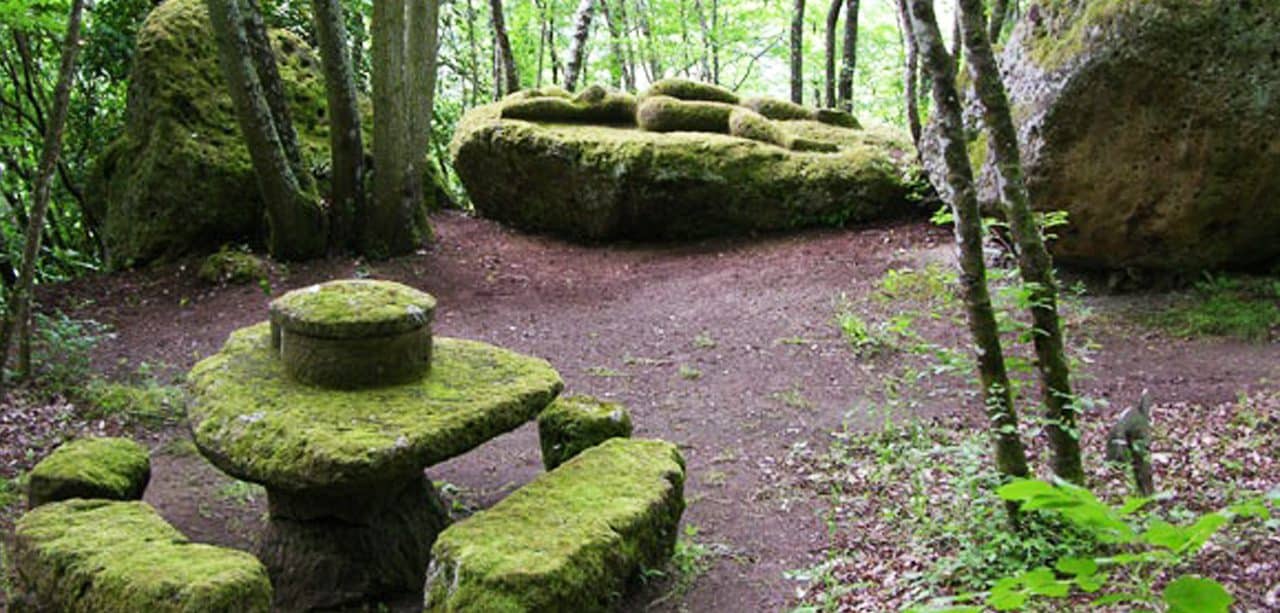
The Natural Room, from 1996, is by Morosin and is the most complex piece of his production here: tuff, dry-stone walls and mosses over a space of 12 meters by 13, covered by the tree canopies. Inside, a female figure 250 centimeters long is carved on a boulder of 350 by 230 centimeters and 180 high, and a table of 220 by 220 centimeters and 100 high occupies the center. It is a humanized space with a plant ceiling: the definition the museum gives of it, a humanized space covered by the tree canopies, describes a house without roof and without walls, that is, the oldest form of dwelling we know.
Acrobat, Dragon with Curls and the uphill finale
Acrobat, from 2021, is a small anthropomorphic figure in olive branches, 90 by 60 centimeters, climbing between two large oaks: look for it up high, and most visitors don't see it. Dragon with Curls, from the same year, highlights the peculiar shape of a thin manna ash trunk that has curved at a right angle, three meters long and two high, completed by roots and a small stone. It is the textbook case of Demijttenaere's method: nature supplies the form, the artist names it.
The Theater of Pan, the scenic heart of Opera Bosco
The Theater of Pan, made between 1995 and 1996 and maintained in 2021, is a natural little theater of 15 meters by 25: a clearing with 100 seats made in packed earth, bordered by shoots of mixed species and immersed in greenery. A hundred seats in a wood, without a fixed structure, without cement, without metal bleachers. Concerts and shows have been held here, and here the museum has demonstrated its central thesis: a public space can be built with earth and branches. The Theater of Pan is worth the ticket by itself, and whoever visits it on a windy day understands what the Greeks meant when they gave a name to the terror that seizes you in the woods.
Mother Earth, The Oak and the tuff sculptures of Oriana Impei
Mother Earth, from 2016, is a four-handed installation by Andriani Kalogridi and Zainab Asaad: mixed branches for 120 centimeters of width and two meters of height, designed to evoke the maternal womb of the Great Mother Earth. The Oak, from 2020, is not a sculpture in the strict sense: it is a large fallen oak, humanized with placed stones. A dead tree treated as a work: the most radical statement of the route.
By Oriana Impei you meet Vital Sap, from 2010, carved tuff of two meters by one and 60 centimeters high, whose sculptural form alludes at once to a leaf with its vessels and to a spermatozoon, and Corselets for Trees, from 2007, in travertine, peperino and tuff, two meters by two and 160 centimeters high: elongated forms like steles and leaves carved with serpentine motifs. The three stones used, travertine, peperino and tuff, are the three building stones of Lazio, and putting them side by side is a lesson in regional geology in three pieces.

The materials of Opera Bosco Museum of Art in Nature
Reading the list of materials of the route amounts to reading a botanical and geological inventory of the Treja Valley. Tuff appears in all its forms: outcropping boulders, squared small blocks recovered from dry-stone walls, lapilli, red tuff, living wall to incise. Alongside come travertine and peperino, the other two stones of Lazio. The wood comes from prunings and shoots: olive, manna ash, oak, chestnut, hazel, blackthorn, heather, ailanthus. The colored earths are three and recur like a fixed palette: the red earth of Herculaneum, the white earth of Meudon, ocher. Then there are the materials no other museum would put on a label: living moss, fossil clay, river stones, dried lemons, porcupine quills, seawater, living willow, standing trees.
The absence is just as significant as the presence. In 40 years of international land art the big names have used steel, glass, cement, electric lights, and European art parks are full of them. Here none of this enters the wood. It is a radical choice that carries a very high price in terms of conservation, and the museum pays it willingly.
Why the works of Opera Bosco decompose
An installation made of manna ash shoots bent fresh, exposed to the rain, frost and sun of a gorge, lasts a few years. The branches lose elasticity, the knots loosen, fungi enter the wood, the colored earth is washed away. The tuff works hold up better, but tuff is a soft rock that flakes and covers itself with moss. The museum does not fight this process: it takes it on as content. The route is described as a continuous work in progress that comes to terms with bad weather and the seasons, and works with a short life are documented with digital techniques before they disappear.
The practical consequence for the visitor is clear: no visit to Opera Bosco is the same as another, and no photograph found online corresponds exactly to what you will find in front of you. It is the reason the ticket takes the form of the annual card, and it is also the reason this museum should be visited at least twice, at different seasons. Whoever sees it only in May, with the wood closed in by leaves, has not seen the same thing as whoever sees it in November, when the structure of the installations stands bare and legible.
Maintenance as artistic practice at Opera Bosco
The museum declares in its own records the maintenance interventions: the Theater of Pan, born between 1995 and 1996, reports the maintenance of 2021. The Room of the Spiders carries the double date 2009-2021. It is a practice that overturns the current idea of restoration. In a traditional museum restoration tries to bring the work back to an original state. Here maintenance is a remaking that accepts change, and the new date is recorded next to the old one. Those who deal with the conservation of contemporary art will find in this route a better case study than many conferences.
Opera Bosco Museum of Art in Nature and education
The educational vocation is not an accessory service: it is half of the project. The museum carries out environmental art education activities with students of every level and organizes guided visits, seminars, workshops, exhibitions, concerts and shows. The annual participation declared by the founders is about 5000 pupils, from nursery school to university. The museum defines itself as an open and proactive educational training system, which puts natural material at the center of attention, highlights the richness and variety of the resources of the wood and offers students creative stimuli with awareness of the ecosystem.
The operating formula is called visit-seminar, and is described as an experience of great emotional impact for its capacity to integrate art, ecology and history in an explicit, innovative and recreational way. In practice it means that a school class is not taken to look, but put to build with the materials of the wood. The Throne of Sisyphus of 2017, made by students of the Academy of Fine Arts of Rome on an idea by An Liran, and Mother Earth of 2016, signed by Andriani Kalogridi and Zainab Asaad, are the proof that works born in the workshops enter the exhibition route on a par with the other works.
The advice I give to teachers is to book on a weekday and not on a Sunday: on weekdays the museum works by appointment, the group has the wood to itself and the workshop time stretches. On Sunday the route is open to the public and the dynamic is different.
The recognitions of Opera Bosco Museum of Art in Nature
In 1997, the year after its inauguration, Opera Bosco obtained accreditation from the Culture department of the Lazio Region and entered the regional thematic historical-artistic museum system. Since then it has been listed among the museums of the Lazio regional network, with a public record that can be consulted in the catalog of the Region's museums.
The most significant international recognition is the mention in the Council of Europe Landscape Prize, obtained for the 2010-2011, 2012-2013 and 2014-2015 editions: three consecutive cycles, something very few Italian organizations can claim. The Landscape Prize comes out of the European Landscape Convention and rewards policies and projects that protect and enhance the landscape in an exemplary and lasting way. Getting the mention repeatedly over six years shows that the project has stood the test of time, which is precisely the criterion of the prize.
The museum was also present at the Venice Architecture Biennale in 2014 and at the Art Biennale in 2015 as part of ministry activities, and in 2019 it was proposed as a candidate for UNESCO World Heritage status. The candidacy calls for an honest clarification: being proposed is not the same as being inscribed, and Opera Bosco does not appear on the World Heritage List. The proposal remains a fact, the inscription does not.
Calcata, the village above Opera Bosco
Opera Bosco exists because Calcata exists, and Calcata is one of the most singular cases in contemporary Italy. The old town stands on a tuff spur overlooking the Treja valley, is reached through a single gate in the walls, and today has just over 900 inhabitants across the whole municipal territory, with the historic center at an elevation of 217 meters. Until 1927 it belonged to the province of Rome. Since that year it has been in the province of Viterbo.
The story that made Calcata what it is begins in 1935, when the government of the time ordered the village evacuated because the tuff spur was declared unstable. The residents moved to a new settlement built a short distance away, Calcata Nuova, and the old village stayed empty for about 30 years. In the 1960s and 1970s artists, foreigners and people fleeing the cities began to arrive, found abandoned houses at ridiculously low prices and decided to stay. That repopulation gave rise to the community of artists that still lives in the town, and within that community, in the 1990s, the Opera Bosco project matured.
The church of the Santissimo Nome di Gesù, founded in the 14th century and renovated in 1793, holds a baptismal font and decorations with Christological scenes. It is the church tied to the town's most debated story: the relic of the Holy Foreskin. According to tradition, in 1527 a Landsknecht who had taken part in the Sack of Rome stole the reliquary from the Sancta Sanctorum of the Lateran, and once imprisoned hid it in his cell, where it is said to have been found in 1557. From that moment the veneration of the relic began in Calcata, with an indulgence of 10 years granted to pilgrims. The procession was held on January 1, for the feast of the Circumcision. In 1983 some thieves carried off the jewel-covered container with its contents, and the tradition ended. Where the relic ended up, nobody knows.
Anyone who wants to learn more about the village will find everything on the page dedicated to Calcata. Here it is enough to say that the museum and the town should be visited together: two hours for the village, a good hour and a half for Opera Bosco, and the day is full.

What to see around Opera Bosco Museo di Arte nella Natura
The province of Viterbo keeps surprising those who travel it slowly, and Opera Bosco fits well into at least three different itineraries. The first is that of artists' gardens and sculpture parks: the Monster Park of Bomarzo, with its Mannerist colossi carved in peperino in the mid-1500s, and the Tarot Garden of Niki de Saint Phalle just beyond the Tuscan border. In the same family falls La Serpara in Civitella d'Agliano, the sculpture garden that the Swiss artist Paul Wiedmer has been creating since 1997 in a valley bought for the purpose, open only on certain days of the year.
The second itinerary is that of Mannerism and historic gardens: Villa Lante in Bagnaia and Palazzo Farnese in Caprarola, with the village of Caprarola around it. The third is that of villages and cliffs: Civita di Bagnoregio, Vitorchiano with its moai boulder, Soriano nel Cimino and the old village of Chia, the place Pier Paolo Pasolini chose as a refuge.
Anyone staying in the Agro Falisco, that is the historic territory of the Faliscans to which the museum's tunnel and votive chapel belong, has Civita Castellana, capital of ancient Falerii, Nepi with its gorges and its castle, and ancient Sutri with the amphitheater carved in the tuff. For those who prefer nature there is the Lake Vico, the lake of volcanic origin enclosed among the Cimini mountains, with the beech forest of Monte Venere that comes down almost to the shore.
Opera Bosco Museo di Arte nella Natura with kids
It's one of the few contemporary art museums where taking children is not an act of optimism. There are three reasons. The first is that the route is outdoors and noise bothers no one. The second is that the works are figurative in an elementary, recognizable way: dragons, fish, horses, toads, crocodiles, giants, faces. A five-year-old spots Convegno and Guardando le fronde before any adult does. The third is that here you can touch almost everything, and sit on the Trono, the Divano, the steps of the Teatro di Pan.
The drawbacks are just as concrete: the elevation change of about 200 meters downhill and 150 uphill, the uneven ground, the sheer walls along some stretches. Strollers are out. With children under four you need a baby carrier backpack and the willingness to carry the child for an hour. Under six admission is free, from 6 to 18 years it costs €5.00. The Campana game traced out with branches is the spot where the smallest ones stop on their own, and it's best to let them do it without rushing.
Accessibility and gear for Opera Bosco
It has to be said bluntly: the route is not wheelchair accessible and is not for anyone with serious mobility difficulties. The gorge requires a descent and a climb back up on natural terrain, with steps cut into the tuff, exposed roots and stretches that get slippery after rain. The museum itself recommends comfortable shoes, but it's better to raise the bar: closed shoes with a lugged sole, never sandals, never city shoes. In spring and fall a light jacket is useful even on warm days, because the bottom of the gorge stays shady and damp. From May to September you need insect repellent and to watch out for ticks in stretches of tall grass. It's best to bring your own water.
When to visit Opera Bosco Museo di Arte nella Natura
March and April are the months when the woods are still see-through and the installations can be read in their structure, with the bonus of flowers on the ground. May and June bring the vegetation to its peak, the green closes off the spaces and some works hide: it's the most beautiful season to see and the hardest to understand. July and August should be tackled only by reservation and late in the day, because the climb back up at 35°C is tiring. September and October are the window I recommend to first-time visitors: the right temperatures, low light, colors. November and December offer the bare woods, bare forms and a melancholy that suits Opera Bosco very well, with the drawback of the earlier sunset that shortens the day. In January and February the museum is closed.
A curiosity about Opera Bosco Museo di Arte nella Natura
In the catalog of the route, between a 2021 installation and a 2006 one, there are two entries with no author and no artist's signature. The first is the Cappella votiva falisca: a small cave dug into the tuff, uterine oval in shape with a bottleneck opening, 260 by 220 centimeters and two meters high, which the museum dates to the Bronze Age, 14th century BC. The second is the Cunicolo: a narrow ogival tunnel dug into fossil clay, with an opening of 40 by 100 centimeters, dated to the 6th century BC and recognized as part of a complex Faliscan water-collection system.
Neither is a work of contemporary art, yet the museum displays them on a par with the sculptures, with the same entry, the same measurements, the same dignity. The same list also includes the Grotta del Toro, described as an ancient seasonal shelter of Paleolithic hunter-gatherers, the Forno dug into a boulder and the Terrazze of 1955, seven steps held up by dry-stone walls built as a land reclamation work under the agrarian reform of 1950.
The curiosity is not archaeological, it is conceptual. Opera Bosco holds that a Bronze Age votive cave, a Faliscan hydraulic tunnel, a farmers' oven, seven terraces of the agrarian reform and a 2021 dragon made of branches belong to the same series: they are all human interventions on the same piece of woods, 3,000 years apart. Visitors realize halfway through the route that the museum does not display 40 works, it displays 35 centuries.
Something nobody tells you about Opera Bosco Museo di Arte nella Natura
That there is no closing time. The museum opens at 11:00 and closes at sunset: that is the wording published on the official site, and it should be taken literally. In mid-March that means shortly after 18:00, in June almost 20:30, in December around 16:30. Anyone leaving Rome at 15:00 on a December Sunday, imagining they have the whole afternoon, arrives when the woods are already in shadow and the time left for a one-hour route has been used up. There's no sign at the entrance to warn you: there's the sun going down behind the gorge.
The second thing almost nobody mentions concerns the ticket formula. The €10.00 doesn't buy an admission, it buys an annual membership card. That means you can come back within the same year, and coming back here is no whim: it's the right way to visit a museum whose works physically change from one season to the next. The installations made of manna ash shoots lose elasticity and give way, the red earth of Ercolano is washed away by the rain, moss covers the tuff, the Stanza dei ragni is declared to be in continuous evolution. The short-lived works are documented with digital techniques precisely because their disappearance is taken into account.
The third concerns weekdays. From Monday to Saturday you enter by reservation, and this is not an inconvenience: it's a privilege. A group that books during the week has two hectares of gorge to itself, with a guide who can stop as long as they like at each work.
The advice I give you for visiting Opera Bosco Museo di Arte nella Natura
Arrive late. Not at 11:00, when the museum opens and the light is straight overhead: aim to be at the entrance two or two and a half hours before sunset, which depending on the month means between 14:00 and 17:30. The gorge is cut into the tuff and the raking afternoon light does two things that overhead light doesn't: it lights up the tuff, which goes from dirty gray to honey, and it brings the carvings out in relief. Amore, Baccio, Toro, Coccodrillo, Impronta are all shallow bas-reliefs: at noon they disappear, at 17:00 they exist.
Second piece of advice: book a guided visit instead of going alone. It's not a matter of convenience, it's a matter of understanding. This museum has a density of information that no sign can carry, and anyone who walks it without someone to explain the difference between a shoot bent while fresh and a dry branch leaned in place sees less than half of what is in front of them. The museum organizes weekly guided visits, and Jonas Clementoni, artist and son of the founder, guides in person.
Third piece of advice, the hardest to get people to accept: allow a good hour and don't squeeze it between two other stops. The fourth work you meet asks for attention, the 30th asks for patience. Anyone who arrives in a hurry to get back to Rome for dinner sees a path with some branches.
Fourth and last: closed shoes with a lugged sole, always. The stated elevation change is about 200 meters downhill and 150 uphill, the ground is tuff and earth, and after rain wet tuff is one of the most treacherous surfaces there is.
Another well-known fact, yet rarely cited
That Calcata is the village of artists everyone knows, and the phrase appears in any list of day trips from Rome. What almost nobody connects is the causal link between an administrative measure of 1935 and the existence of an environmental art museum in 2026.
In 1935 the government of the time ordered the evacuation of Calcata: the tuff spur on which the village stands had been declared unstable, with failing foundations. The residents were moved to a new settlement built not far away, Calcata Nuova, and the old town stayed empty for about 30 years. An entire medieval village, with its single gate, its square and its 14th-century church, abandoned by decree. In the 1960s and 1970s artists, foreigners and people at odds with the city began to arrive, drawn by houses at ridiculously low prices and by a view no other town in Lazio could offer. They stayed. The town was repopulated by people the State had never considered as a population.
Without that community Opera Bosco would not exist. Costantino Morosin, from Veneto, who graduated in stage design in Venice in 1975 and came off years of anthropological documentaries in Africa, moved to Calcata and produced tuff sculptures there. Anne Demijttenaere followed the same path and in 1995 carved the imprint of her own body into the tuff wall. The museum opened the following year is the direct product of that double movement: a State that declares part of a town uninhabitable, and 30 years later a group of artists who declare part of a woods habitable.
There is a second fact, just as well known and just as rarely cited: the relic of the Holy Foreskin, venerated in Calcata since 1557 according to local tradition, vanished in 1983 when the jewel-covered reliquary was stolen before the January 1 procession. Where it ended up nobody knows, and the town that had built its religious identity on that cult is known today for contemporary art.
The right photo to take at Opera Bosco Museo di Arte nella Natura
The photographs of this museum that circulate are almost all wrong in the same way: they frame the single installation isolated against a green background, and in that format a dragon of branches looks like a pile of branches. The right subject here is never the work alone, it's the work with the woods inside it.
The first shot I recommend is Ballo backlit: the 12 red giants made of olive branches treated with red earth of Ercolano work when the low sun passes between the shapes and sets them off in silhouette. The second is L'Onda by Jonas Clementoni: the spiral of blackthorn and manna ash unrolls for about 30 meters, and you need a wide-angle lens held low, almost on the ground, to show how it develops. The third is the Teatro di Pan shot from the top of the cavea: the 100 seats carved into the packed earth can only be seen if you climb to the last step, and from there the clearing reads as architecture.
The hardest and most beautiful photograph is the one of the Cunicolo with Dragone. The big serpent of oak and olive branches, 28 meters long, slips into the ogival fossil-clay opening of the 6th century BC: in a single frame you get Faliscan hydraulics and the sculpture of 2021. You need a long exposure, a support and the patience to wait for nobody to walk through.
One technical tip and one ethical. Technical: damp tuff and moss push everything toward green, so it's better to lock the white balance instead of leaving it on auto. Ethical: you don't climb on the works to photograph them and you don't move anything. They are made of branches bent while fresh and of earth that washes away, and a wrong foothold costs the people who maintain them a repair.
Some important events that happened here in history
The chronology of this piece of gorge begins long before the museum. The Grotta del Toro, 7.40 meters by 5.50, is described as an ancient seasonal shelter of nomadic Paleolithic hunter-gatherers: a dating presented as probable, not as established. Next comes the Cappella votiva falisca, dated by the museum to the Bronze Age, 14th century BC. In the 6th century BC the Faliscans dug the Cunicolo into the fossil clay, part of a water-collection system: the same people who, a few kilometers away, built Falerii and the sanctuary of Monte Li Santi near Narce.
Then a leap of 25 centuries. In 1955 the seven Terrazze with dry tuff walls were built, a land reclamation work under the agrarian reform of 1950: the last serious attempt to farm this gorge.
In September 1995 Anne Demijttenaere and Costantino Morosin signed the programmatic document of the project, and in the same year Impronta was made, the carving of the author's body into the tuff, the first intervention in the woods. In 1996 the museum was inaugurated: from the same year are the Trono, the Fonte viva, the Cuore, the Trono dell'acqua, the Pietra di Fonte, the Stanza naturale and Morosin's Testa piatta, and Demijttenaere's Amore and Baccio. In 1997 came the accreditation by the Culture Department of the Lazio Region and entry into the regional thematic historical-artistic museum system. The Televisore is from the same year. In 1998 the 37 steps of the Scalinata were built.
Between 2010 and 2015 the museum won, for three consecutive editions, 2010-2011, 2012-2013 and 2014-2015, the mention in the Council of Europe Landscape Prize. In 2014 it was present at the Venice Architecture Biennale, in 2015 at the Art Biennale, as part of ministry activities. In 2017 students of the Academy of Fine Arts of Rome made the Trono di Sisifo from an idea by An Liran. In 2019 Jonas Clementoni built the Teatro nuovo and the museum was proposed as a candidate for UNESCO World Heritage status. In 2020 the Drago Muro and the Stanza dei giganti were born. 2021 is the year of the most intense campaign: Ballo, Occhio!, Convegno, L'Onda, Abbraccio, Acquario con pesci, Rospo, Coccodrillo, Dragone, Campana, Acrobata, Ritratto di Costantino and the maintenance of the Teatro di Pan.
Who has passed through Opera Bosco Museo di Arte nella Natura
The first people to pass through here left no name: the hunter-gatherers who used the Grotta del Toro as a seasonal shelter, and the Faliscans who in the 14th century BC dug the votive chapel and in the 6th century the hydraulic tunnel. Then peasants, charcoal burners and day laborers, down to the masons who in 1955 raised the seven dry-stone terraces.
Among contemporary figures, the two founding names are Anne Demijttenaere, author of most of the works and founder of the museum, and Costantino Morosin, born in Veneto in 1950, graduated in stage design at the Academy of Fine Arts of Venice in 1975, author of anthropological documentaries awarded at the Habitat conference in Vancouver in 1976, founder in 1980 of a Roman cultural weekly and since 2002 engaged in the SIGNA, territorial works on GPS tracks. Joining them was Jonas Clementoni, artist, musician and guide of the museum.
The route then preserves the signatures of those who have worked here over the years: Pino Genovese with Cacciatori di teste of 2006. Giancarlo Savino with Madrenaturalmente of 2006 and with a tuff sculpture of 2005. Ada Impallara with Memoria of 2005. Francesco Narduzzi with Fogliarsi of 2006. Isabella Nurigiani with the suspended boulder of 2007. Oriana Impei with Corsaletti per alberi of 2007, Linfa vitale of 2010 and the Treccia della solidarietà of 2015. Francesca Checchi and Maria Pia Picozza with Sospensione of 2015. Andriani Kalogridi and Zainab Asaad with Madre Terra of 2016. An Liran, who conceived the Trono di Sisifo made by students of the Academy of Fine Arts of Rome in 2017. Simone Bomarsi, co-author of the Drago Muro of 2020. C. Balaban, who made the Scalinata in 1998.
Finally, about 5,000 students a year have passed through here, and keep doing so, from preschool to university. In the history of a contemporary art museum it is a number that weighs more than many famous signatures: it means that this woods has been, for entire school generations in Lazio, the first place where art was not hung on a wall.

Quick questions about Opera Bosco Museo di Arte nella Natura
Where is Opera Bosco Museo di Arte nella Natura?
At Località Colle, 01030 Calcata (VT), in the gorge of the Treja Valley, below the village of Calcata Vecchia, about 40 minutes by car from Rome's Grande Raccordo Anulare.
How much is a ticket to Opera Bosco?
Admission costs €10.00 in the annual membership card formula, €5.00 from 6 to 18 years, and it is free under 6.
What are the opening hours of Opera Bosco Museo di Arte nella Natura?
Sundays and holidays from 11:00 to sunset, from March to June and from September to December. On weekdays and in July and August you enter by reservation.
Is Opera Bosco open in winter?
No. In January and February the museum stays closed. The regular calendar resumes in March.
Do you need to book to visit Opera Bosco?
On Sundays and holidays of the opening season, no. You do need to for weekdays, for July and August, for groups, for school classes and for educational workshops.
How do you book a visit to Opera Bosco?
By calling 0761 588048, by writing on WhatsApp to 328 2769123 or by sending a message to operabosco@operabosco.eu.
How long does a visit to Opera Bosco Museo di Arte nella Natura take?
The walking time indicated by the museum is about an hour. With a guided visit and a few photo stops it's best to allow an hour and a half.
How many works are there at Opera Bosco?
The route includes about 40 installations, plus the pre-existing elements enhanced by the museum, such as the Faliscan votive chapel, the Grotta del Toro, the tunnel and the farm terraces.
What materials are the works of Opera Bosco made of?
Exclusively of raw natural materials from the woods: tuff, travertine, peperino, river stones, fossil clay, branches and shoots of olive, manna ash, oak, chestnut, hazel, blackthorn and heather, plus colored earths such as the red earth of Ercolano and the white earth of Meudon.
Why do the works of Opera Bosco decompose?
Because they are made of living or perishable matter and exposed to the weather. The museum takes decomposition as part of the content of the project and documents the shortest-lived works with digital techniques.
Who founded Opera Bosco Museo di Arte nella Natura?
The artist Anne Demijttenaere, in collaboration with Costantino Morosin. The programmatic document is dated September 1995 and the inauguration was in 1996.
Is Opera Bosco a public or private museum?
It began on the private initiative of the artists who founded it and has been accredited since 1997 by the Culture Department of the Lazio Region and included in the network of Lazio regional museums.
Is Opera Bosco wheelchair accessible?
No. The route runs over natural terrain with an elevation change of about 200 meters downhill and 150 uphill, with steps in the tuff and uneven stretches.
What shoes do you need for Opera Bosco?
Closed shoes with a lugged sole. The museum recommends comfortable shoes. After rain wet tuff gets slippery and sandals are out of the question.
Is Opera Bosco suitable for children?
Yes, with some caution. The works are figurative and recognizable and for the most part can be touched, but the elevation change and the uneven ground rule out strollers: under four you need a baby carrier backpack.
Can you take photographs at Opera Bosco?
Yes. You don't climb on the works and you don't move the elements: they are structures of branches bent while fresh and surfaces treated with earths that wash away.
Are there restrooms and a refreshment point at Opera Bosco?
The museum is a route through the woods and does not offer the services of an urban museum. Cafes, restaurants and services are in the village of Calcata Vecchia, a few minutes on foot away.
How do you get to Opera Bosco by public transport?
By the Roma Nord railway from Piazzale Flaminio to Saxa Rubra and then on the Cotral bus to Calcata, in a little over an hour. Runs are few, especially on holidays: check the times on the regional carrier's website before leaving.
Where do you park to visit Opera Bosco?
In the parking lot in front of Calcata Vecchia, which is closed to traffic. On spring Sundays it fills up by mid-morning.
Can you bring dogs to Opera Bosco?
The museum is inside a protected natural area and the route passes through fragile installations: the conditions for bringing in animals should be agreed when you book.
What is the difference between Opera Bosco and the Parco dei Mostri di Bomarzo?
Bomarzo is a Mannerist garden of the mid-1500s with colossi carved in peperino, permanent and monumental works. Opera Bosco is a contemporary art museum in which the works are made of perishable natural materials and change from season to season.
Does Opera Bosco run workshops for schools?
Yes. The museum carries out environmental art education with students of every level in the visit-seminar format, with a stated annual attendance of about 5,000 pupils.
Are there concerts and shows at Opera Bosco?
Yes. The museum has three open-air amphitheaters, including the Teatro di Pan with 100 seats carved into the packed earth, the Piccolo Teatro d'inverno and the Teatro nuovo of 2019, and schedules concerts and shows seasonally.
What recognitions has Opera Bosco Museo di Arte nella Natura received?
The mention in the Council of Europe Landscape Prize for the 2010-2011, 2012-2013 and 2014-2015 editions, presence at the Venice Architecture Biennale in 2014 and at the Art Biennale in 2015 as part of ministry activities, and in 2019 the proposal of candidacy for UNESCO World Heritage status.
What is the best time to visit Opera Bosco?
September and October for first-time visitors, for the temperatures and the light. March and November for those who want to read the structure of the works with the woods bare.
Can you visit Opera Bosco together with the village of Calcata?
Yes, and it's the right way to organize the day: two hours for the village and an hour and a half for the museum, with shared parking.
What is the Treja Valley?
A regional nature park established on September 22, 1982, covering about 800 hectares in the municipalities of Calcata and Mazzano Romano, run by a consortium of the two municipalities, with 26 walking trails and the Monte Gelato Falls as its best-known point.

Why I always happily come back to Opera Bosco Museo di Arte nella Natura
In Lazio quite a few contemporary art parks have been born and have died, and almost all of them died for the same reason: they needed industrial maintenance to stay identical to themselves. Opera Bosco solved the problem by turning it upside down. Here maintenance is an artistic act, decay is part of the plan, and the date added next to the original one, as in the Stanza dei ragni or the Teatro di Pan, is not the admission of a collapse: it's a new signature.
If I have to pick a single reason why it's worth the trip, it's not the number of works and it's not the European recognitions. It's the moment when, halfway along the route, you arrive in front of the Faliscan tunnel of the 6th century BC with the Dragone of branches slipping inside it, and it becomes obvious that art made with the materials of the place in this gorge didn't begin in 1995. It began 3,000 years ago and has never stopped. Go in the late afternoon, with serious shoes, without rushing and ideally with a guide who explains what you have in front of you. And get the membership card: the second visit, in another season, is worth as much as the first.
Article written by the editorial team of TourLeaderPro, contact them for Private/Corporate/V.I.P. Tours and Experiences.
Planning a trip to Rome? The guides in English for visiting the city are on ItalyPlanner.com.