Tarot Garden
In short. The Tarot Garden is in the locality of Garavicchio, in the territory of Pescia Fiorentina, municipality of Capalbio, province of Grosseto, Tuscany.

The Tarot Garden is in the locality of Garavicchio, in the territory of Pescia Fiorentina, municipality of Capalbio, province of Grosseto, Tuscany. The address for your GPS is Strada Garavicchio 2, 58011 Pescia Fiorentina (GR), the Foundation's switchboard answers at (+39) 0564 895122 and the information email is info@ilgiardinodeitarocchi.it. The official calendar has it open from April 1 to October 15, every day, from 14:30 to 19:30, with last entry at 18:15. The park stays open on rainy days and on holidays. The full ticket costs 15.00 euros, the reduced ticket 10.00 euros (young people from 7 to 22 years old, over 65, residents of the municipality of Capalbio, groups of 25 people, licensed tour guides). School groups pay 8.00 euros per pupil with a minimum of 10 participants. Admission is free for children from 0 to 6 years old, for people with a disability above 67 percent and their certified companion, as well as for one adult for every 10 pupils. Booking is not done by phone or by email: only buying a ticket online on Ticketlandia guarantees entry, and the ticket is tied to the date and time slot chosen. From Rome it takes a little under two hours by car on the A12 toward Civitavecchia and then on the SS1 Aurelia, exit Chiarone, following the signs for Pescia Fiorentina. The parking lot in front of the entrance wall is free and unattended. By train you get off at Capalbio Scalo, on the Tyrrhenian line, 10 kilometers from the park, and continue by Autolinee Toscane bus or by taxi. The visit lasts an hour and a half on average. There are no guided tours: that is the artist's choice, not an oversight of the managing body.
If you are building a broader itinerary, the page on tourist attractions collects the other places worth a detour outside Rome.

Where the Tarot Garden is and how to get there from Rome
Let's start by clearing up the geographic misunderstanding that has always followed this place. The Tarot Garden is not in Lazio. It is in Tuscany, province of Grosseto, municipality of Capalbio, on the southern slope of the Garavicchio hill, a few kilometers from the regional border and from the mouth of the Chiarone ditch. The confusion comes from the fact that people who go there almost always start from Rome, and that the landscape of the last stretch of Maremma looks quite a lot like the countryside north of Civitavecchia: the same low scrub, the same maritime pines bent by the mistral, the same Aurelia running within sight of the sea. But administratively and culturally we are in Maremma, not in the Tuscia, and the difference matters: Maremma has its own history of land reclamation, of butteri, of malaria defeated with difficulty, which explains why in the late 1970s such a beautiful hilly plot still cost little and could be given to an artist as a gift.
By car to the Tarot Garden
From Rome there is only one road and it has no sensible alternative: Grande Raccordo Anulare, exit Civitavecchia, the A12 motorway to where it ends, then the SS1 Aurelia north. You exit at Chiarone and follow the signs for Pescia Fiorentina. It is about two hours when the Aurelia flows, a lot more on weekends in July and August, when the two-lane stretch between Tarquinia and Montalto becomes a procession. The practical advice: leave early even though the park opens at 14:30, and use the extra time for the village of Capalbio or for a swim on the coast. Arriving in a rush at 18:00 for a park that closes entry at 18:15 is the best way to waste 15 euros and 140 kilometers.
If you come from Siena, you go down the regional road 223 toward Grosseto and then take the Aurelia south. If you come from Florence, you use the Florence-Siena road and then the SS1. From Civitavecchia, and so from the cruise port, it is less than an hour by car. That is the reason the Tarot Garden often ends up in the day excursions of cruise ship passengers, usually combined with Capalbio or with the lagoon of Orbetello.
By train and bus to the Tarot Garden
The useful station is Capalbio Scalo, on the Tyrrhenian Rome-Grosseto line, served by regional trains. From the station to the park it is 10 kilometers. Walking is not an option, on a provincial road with no sidewalk and with curves. Bus connections are checked on the Autolinee Toscane website, which runs the suburban lines around Grosseto. Alternatively the Foundation lists two local taxi services, Nannoni at 339 703 1080 and Emiliano at 348 363 0623. Book the taxi before you get on the train, not after you get off: at Capalbio Scalo, in the afternoon, the forecourt is almost always empty.
The parking lot and the walk in
The parking lot is unpaved, free, unattended and without shade worth the name. In August, at two 30 in the afternoon, a car left in the sun becomes an oven: bring a sunshade. From the parking lot to the entrance wall it is 100 meters, slightly uphill. The first thing you see is not a sculpture. It is a long blind tuff wall that seems to want to keep you out. That is exactly what it is meant to do.
The Tarot Garden calendar: when it is open and when it is not
Here is the peculiarity that throws off anyone organizing the trip at the last minute. The Tarot Garden is not a civic museum with continuous hours. It is a fragile park, made of ground ceramics, Venetian mirrors and glass mosaics that frost, driving rain and low sun attack constantly. For this reason the Foundation keeps a short season and compressed hours: from April 1 to October 15, every day, from 14:30 to 19:30. Last entry at 18:15. Outside those dates the park is closed to the public and the team works on restoration, which here is not ordinary maintenance but continuous reconstruction of loose tesserae.
The choice of the afternoon is not an organizational whim. The sculptures are covered in mirrors: at 11:00 in the morning the vertical light flattens them and makes them unreadable, while in the late afternoon the low sun enters the tesserae at an angle and lights them up one by one. Whoever designed the schedule also designed the effect. The official calendar also notes, for September 4, 2026, an early closing at 18:00 with last entry at 17:00. If you have that date in your diary, buy a ticket for a compatible time slot.
Tickets and booking for the Tarot Garden
The only channel that guarantees entry is buying online on the Ticketlandia platform, reachable from the Foundation's website. The ticket is tied to date and time slot, cannot be changed and is not refundable, except when the Garden itself closes for technical or weather reasons. In that case the refund request must be sent within 15 days to the Foundation's administrative address. There are no partial refunds. No booking is accepted by phone or by email.
One detail that makes many people lose money: reductions must be documented at the check. If you bought a reduced ticket and at the gate you do not produce the document that justifies it, you pay the difference on the spot. It applies to people over 65, to young people between 7 and 22, to residents of Capalbio, to licensed tour guides.
Who Niki de Saint Phalle was
Catherine Marie-Agnès Fal de Saint Phalle was born on October 29, 1930 in France, the second of five children, with a French father and an American mother, in an aristocratic family that the Wall Street crash had just impoverished. She grew up between New York and France, at 18 married her childhood friend Harry Mathews, and had two children, Laura in 1951 and Philip in 1955. Her first career was as a model: her face appeared in Vogue and in Life. Then, in 1953, a nervous breakdown and a hospital stay. She discovered that painting kept her going and decided to be an artist instead of an actress. She never attended an academy. You can tell, in a good way: no professor ever explained to her that a sculpture 15 meters tall is not built like that.
From the Tirs to the Nanas
In the early 1960s Niki de Saint Phalle invented the Tirs, the shooting paintings: complex assemblages with pouches of paint hidden under plaster, which the artist or the public hit with a pistol, a rifle or a cannon, making the surface bleed. This is the work that established her with international critics and brought her into Nouveau Réalisme, of which she remained the only woman. In 1965, watching her pregnant friend Clarice, she modeled the first Nanas: enormous, round, brightly colored female figures, with no individual face, archetypes of a femininity that takes up space instead of apologizing. From then on the curve became her signature, and the scale grew until it became architecture.
The decisive step came in 1966: Hon, at the Moderna Museet in Stockholm, a reclining Nana as big as a building, which the public entered by passing between her legs and found inside a bar, a cinema, an aquarium. From that moment Niki de Saint Phalle's problem was no longer making sculptures but making places. The Tarot Garden is the logical consequence of Hon, 12 years late and with a Tuscan hill in place of a museum hall.
Jean Tinguely, the husband and the engineer of the Tarot Garden
Jean Tinguely, a Swiss, inventor of useless machines and self-moving sculptures, entered her life in the early 1960s. The two married on July 13, 1971. In the Tarot Garden his role is double and needs to be understood well, because many visitors attribute everything to her. Tinguely makes the bones: the welded steel-bar armatures that hold up the colossi are his, with the Swiss team of Rico Weber and Seppi Imhof. And then he puts in his mécaniques, the assemblages of self-moving scrap iron that live in the Wheel of Fortune, the Injustice inside Justice, the lightning that beheads the Tower, the mechanism that turns the World. He died in August 1991 in Bern. From that moment the Garden lost its engineer and changed rhythm: the later sculptures are lighter, thread-like, less machine-like.
The perfume that paid for the Tarot Garden
This is the part that no other contemporary art building site can tell. In 1982, for the Jacqueline Cochran Company, Niki de Saint Phalle created a perfume that bears her name, with the bottle closed by two intertwined, brightly colored snakes, a collector's item even today. The proceeds went to finance the Garden. In 1986 the Bonnier Gallery in Geneva exhibited her latest works, limited editions made from the sculptures of the Garden, and those takings too ended up in the Garavicchio building site. No ministry, no bank sponsorship, no public call: the expense, which was counted in billions of lire, the artist paid for herself by selling perfume and multiples. When someone tells you that contemporary art lives on public money, take them to Capalbio.
How the Tarot Garden came about: Gaudí, Bomarzo and a plot of land in Maremma
The idea has a precise trigger date, documented by the Foundation: 1955, a trip to Spain, the encounter with the work of Antoni Gaudí and in particular with Park Güell in Barcelona. Niki de Saint Phalle was 25, not yet an established artist, and she understood that you could make a garden in which sculpture is at once house, bench, wall, handrail. The project stayed in incubation for 20 years. In the meantime the other models piled up: between 1960 and 1961 she visited with Tinguely the Palais Idéal of the postman Ferdinand Cheval in the Drôme, a palace built by one man with stones collected during his delivery rounds. In 1962 the two arrived in South Los Angeles and saw the Watts Towers of Simon Rodia, more towers built in solitude by an Italian immigrant with cement, shards and bottles. The fourth model is Italian and is a short distance from Rome: the Park of the Monsters of Bomarzo, with its gaping Orco and its 16th-century dragon.
Marella Caracciolo and the land at Garavicchio
In 1974 Niki de Saint Phalle was convalescing in Sankt Moritz. She told Marella Caracciolo Agnelli her dream: a sculpture garden built on the symbolism of the major arcana of the tarot. Marella's brothers, Carlo and Nicola Caracciolo, made available a family plot at Garavicchio, on the hill that looks over the sea between Capalbio and the Chiarone. It is not a society detail: without that donated land, the Tarot Garden would not exist. An artist who funds herself with perfume could never have bought two hectares of Maremma hillside and then spent 17 years on it.
The building site of the Tarot Garden, 1978-1996
Work began in 1978. 1979 is the year Niki moved almost permanently to Tuscany and the most improbable character in the story came on the scene, Ugo Celletti, a local mail carrier, who began to lay out the stone paths and to apply the wire-mesh nets on the armatures. In 1980 the first two sculptural architectures were born, the Popess and the Magician. In 1983 Venera Finocchiaro arrived, a ceramist, who moved to live in the Garden and became responsible for all the ceramic work. In 1985 Tinguely built the machinery for the Tower and for the Fountain of Fortune. Between 1986 and 1987 the mosaic of the Tower was completed. Between 1987 and 1988 the Pope and Justice. Between 1988 and 1989 the Magician and the Popess. In 1989 Strength was finished. In 1990 the Hanged Man arrived inside the Tree of Life and the Devil was put in place. In November 1991, a few months after Tinguely's death, the Fool was set in place. Between 1995 and 1996 almost all the mosaics were completed.
17 years of work, with a fixed crew of local workers and a rotation of international artists. In 1994, for health reasons, the artist moved to La Jolla, California, where she would stay for eight years, continuing to send models and instructions. The Fondazione Il Giardino dei Tarocchi was established in Rome in 1997 with the aim of preserving the work. Recognition from the Tuscany Region came on July 8, 2002. The Garden opened to the public on May 15, 1998.
The team that built the Tarot Garden
The romantic story of the solitary artist does not hold up here, and Niki de Saint Phalle herself always took care to take it apart. The Tarot Garden is a collective work with a single direction, and knowing the names changes the way you look at the sculptures.
Ugo Celletti, the postman who made the paths
On the wire nets and on the paths worked a mail carrier from Pescia Fiorentina. The artist's words about him have survived: he became a true poet in this art, and he was always afraid that one day there would be no more work for him. To which, she herself recounts, she made him the solemn promise that there would always be something new to do every year. From 1986 Claudio Celletti also joined the building site, and from 1989 Alessia Celletti: an entire family inside a work of contemporary art. The coincidence with Ferdinand Cheval, the other postman builder, is so perfect it seems invented.
Venera Finocchiaro and the ceramics
A Roman ceramist, in charge of all the ceramic work since 1983. Niki de Saint Phalle spoke of her as a total devotion: she lived at the garden, and was receptive to exhortations to do things no one had ever done before. If you look closely at the surfaces of the Empress or the Emperor, what you see is the result of years of experimentation with ground ceramics, that is, cut and sanded to fit surfaces that curve in all directions at once. There was no manual.
Ricardo Menon, Marcelo Zitelli and the others
Ricardo Menon was the artist's personal assistant from 1977. He died of AIDS in 1989 and Niki modeled for him the sculpture of the cat, which carries his name. Marcelo Zitelli took his place from 1986. Dok van Winsen, a Dutchman, welded from 1982 the second group of sculptures: the Emperor's Castle, the Tower, the Pope, Justice, the chapel. Tonino Urtis worked beside him on the welding and would then learn ceramics so well that he was sent to the United States, between 1999 and 2001, to teach it to Niki's California team. Pierre Marie Lejeune, met in Paris in 1978, developed mosaic cladding techniques, built the benches around the fountain at the foot of the Empress, and designed iron and glass furniture and the path decorated with hieroglyphs. The Haligon brothers, Robert, Gerard and Olivier, collaborated on the polyester work from 1972. Alan Davie and Marina Karella also looked in on the building site. The reinforced concrete work is by a Ligurian firm, De Villa of Ventimiglia. The gardener, since 1995, is Giampiero Ottavi: because in a sculpture garden someone has to decide where the scrub ends and the art begins.
Mario Botta's wall: the threshold of the Tarot Garden
The entrance is the only part of the complex she did not invent. The pavilion is signed by the Ticino architect Mario Botta, with the collaboration of the Grosseto architect Roberto Aureli, and consists of a double tuff enclosure wall, long and blind, interrupted by a single large circular opening in the center, closed by a gate. Botta explained that he tried to translate into masonry what the artist asked of him: the sharp separation between the Garden and the world. The wall is a threshold, and you cross it to enter a magic pause.
During the design the wall thickened until it became habitable: the two parallel walls enclose a space paved in porphyry that holds, on either side of the opening, the metal and glass booths of the ticket office and the small shop. It is a first-rate piece of architecture, and it has the psychological function of resetting the view. From the road the sculptures can be glimpsed from afar, brightly colored against the green. Then the wall erases them. Then you cross the circle and they reappear all together. If you arrive in a rush and go through the wall looking at your phone, you miss the only staged effect planned at the drawing table in the whole park. Stop for three seconds inside the circular opening, before coming out the other side.
The central square of the Tarot Garden
Once past the threshold, an unpaved road climbs to the large central square, which works like a natural amphitheater: a circular basin in the middle, greenery all around, the sinuous benches of Pierre Marie Lejeune, and above it all the joined figures of the Popess and the Magician, the first arcana of the route. In the basin gather the waters that cascade down a staircase fed by the gaping mouth of the Popess, and in the center turns the Wheel of Fortune, the self-moving machine of Jean Tinguely.
This is the point where most visitors realize they are not in a theme park. The sound of the water, the creak of Tinguely's machine, the reflection of the mirrors moving over the faces: the effect is of unease and enchantment together, not of advertising cheer. From the square open the roads that run over the hill, climbing or descending along the ridge. There is no obligatory route and there is no arrow: by the artist's explicit wish, everyone gets lost as they like.

The written paths of the Tarot Garden
Look down, every now and then. On the cement covering the paths Niki de Saint Phalle indelibly engraved notes, memories, numbers, quotations, drawings, messages of hope and faith. They are not decorations. They are the diary of the work, written in the material visitors walk on. In 1989 Pierre Marie Lejeune built a path decorated with hieroglyphs, and the play between writing and walking runs through the whole park. That is why this Garden is not only a physical route. It is an initiatory itinerary, and the inscriptions are its road signs.
A blunt and unpopular opinion: most people who visit the Tarot Garden never look at the ground and consider the floor a gravelly nuisance to get through. They miss half the text.
The 22 major arcana of the Tarot Garden, one by one
The park follows the sequence of the major arcana in the numbering of the Marseille tradition, the one with Justice in eighth place and Strength in eleventh. Not all the figures have the same scale: some are habitable architectures up to 15 meters high, others are thread-like steel sculptures, others still are polyester figures hidden in the grove. I find them all, in order, with what is worth looking at in front of the original.
I. The Magician
The Magician shares with the Popess the group that dominates the central square. To his head you climb by a winding staircase of an intense blue, under which is hidden the access to the interior of the Popess's fountain-head. It is the arcanum of the beginner, of the one who has the tools on the table and still has to decide what to do with them: its position at the start of the route is a statement of intent. His work was completed between 1988 and 1989, almost 10 years after the start of the structure. Look at how the face emerges from the blue without ever becoming a portrait: it is the lesson of the Nanas applied to a face as big as a room.
II. The Popess
The colossal head with the gaping mouth from which water plunges is the most explicit citation of Bomarzo in the park: the Orco of the Sacro Bosco, which at Bomarzo swallows visitors with a mocking inscription on its lip, here becomes a spring. The inside of the head is painted sky blue with silvery stars, and you enter it by passing under the blue staircase. The link with the water features of Villa d'Este in Tivoli is no accident: the speaking fountain, the one that sings or rumbles, is a topos of the Italian Mannerist garden that Niki de Saint Phalle absorbed and gave back in ceramic. The Popess is the arcanum of hidden knowledge, and it is right that her knowledge here is something you touch by entering a mouth.
III. The Empress
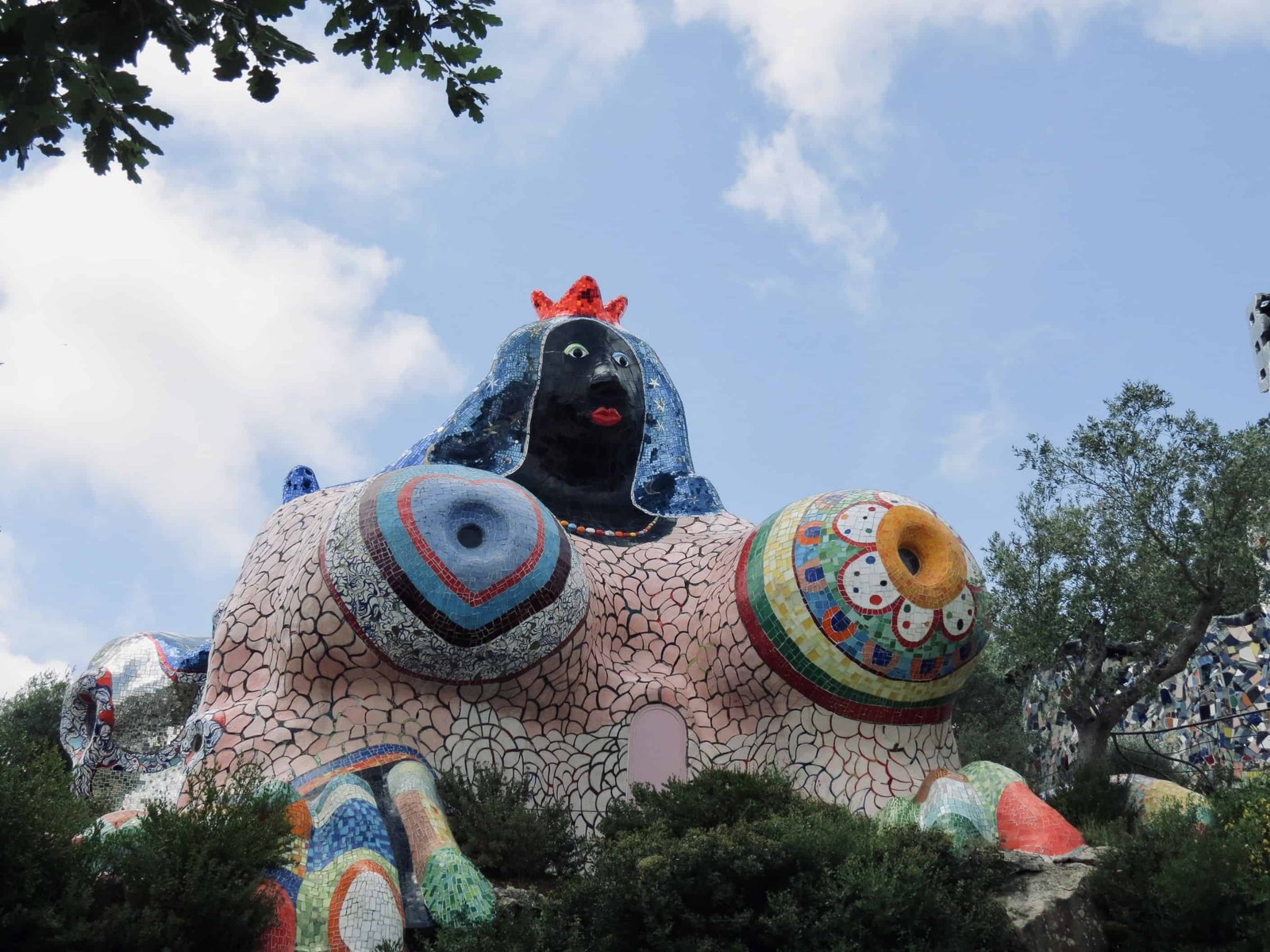
The most important sculpture of the complex is a sphinx, and it was the artist's home. From 1983, for seven years, Niki de Saint Phalle lived and worked inside the Empress: bedroom in one breast, kitchen in the other, living room and studio in the central space, all lined inside with thousands of fragments of Venetian mirrors. I talk about it at length further on, because it deserves a chapter of its own.
IV. The Emperor
The Emperor's Castle is the figure with the greatest architectural completeness in the whole park, the one where Gaudí's legacy can be seen with the naked eye. It is a citadel with towers, a wall walk, an inner courtyard, a fountain and 22 columns, as many as the major arcana, which hold up an undulating loggia. It represents the physical and psychic masculine, ambition, consolidated power: the vertical structures and the red rocket pointed at the sky along the upper walkway say so without subtlety. The repertoire of materials is a catalog of the century: Murano glass and murrine, mirrors from France, Czechoslovakia and Bohemia, decorative reliefs, puzzle pieces, casts of objects. Around one of the columns of the loggia run, in murrine, the names of all those who worked on the Garden, with their faces. It is the collective signature of the work, and it is the spot not to miss. In the center of the courtyard, in a circular basin, four brightly colored nanas bathe, splashing water from their breasts.
V. The Pope
The Pope is Jean Tinguely's favorite sculpture, whose structure he welded alone, without the crew, and it adopts the thread-like technique called skinny: not a solid volume but a drawing in space, made of steel bars that describe the figure while letting the landscape through. The columns enclose a hollow space that acts as counterpoint to the full roundness of the Hanged Man a little further on. It is found right after the Sun, on the staircase that climbs from the square along the right ridge. The work was completed between 1987 and 1988. Tip: look at it against the light, around seven in the evening, when the bars turn black and the figure becomes a hieroglyph hanging in the sky.
VI. The Lovers
A sign points to a detour into the grove: that is where the Lovers are, also called the Choice, two joyful polyester figures sitting on a low wall having their picnic. The model is from 1984, the polyester production is from the Haligon workshop. They are among the few sculptures in the park at almost human scale, and that is exactly why they work: after the colossi, meeting two lovers as big as you having a snack in the middle of the woods is a change of register that the artist had calculated. Arcanum VI, in the tradition, is not the card of love but of the choice between two roads: the detour into the grove, with the sign, is a joke.
VII. The Chariot
The Chariot is one of the three figures placed on August 17, 1996 inside the Empress, together with Judgement and the Stars. You do not see it from the road: it is in the interior space of the great mother, multiplied by the reflections of the Venetian mirrors that line the curved walls. It is the arcanum of the will that holds opposing forces together, and the choice to put it in the belly of the sculpture-house, instead of outdoors, says something about how the artist understood her own energy.
VIII. Justice
Disturbing in its sharp contrast of white and black, Justice has the scales resting on her large breasts and an inner space barred by a gate closed with an enormous padlock. Inside that cage is one of Jean Tinguely's most sinister mécaniques, depicting Injustice. There are few visual comments on the law as ferocious: justice is monumental, black and white, exposed to the sun. Injustice is locked inside her and moves. The work was completed between 1987 and 1988. If you have 15 more minutes, spend them here watching the mechanism through the bars.
IX. The Hermit
The Hermit belongs to the group of the smaller sculptures, modeled in Paris with the help of Marcelo Zitelli and produced in polyester by the Haligon brothers. It dates to 1988, the same year as Death. In the route of the Garden it performs the function it has in the deck: it is the card of withdrawal, of the lamp carried in the hand along a solitary road, and you meet it outside the great architectures, off to one side. Anyone rushing to photograph the colossi skips it without noticing.
X. The Wheel of Fortune
In the center of the circular basin of the square turns the Wheel of Fortune, a self-moving iron machine built by Jean Tinguely, whose machinery dates to 1985. It is the most Tinguely piece in the park: noisy, imperfect, apparently on the point of breaking, exactly like his celibate machines of the 1960s. It also has a practical role worth knowing: it is the only sector of the Tarot Garden reachable in a wheelchair, and from there you see five works.
XI. Strength
Strength shows a woman keeping a dragon under control, tied to her by an invisible thread. It is an original reading of the arcanum: from the Visconti-Sforza deck of the mid-1400s onward, the eleventh card usually shows a woman opening the jaws of a lion. Replacing the lion with a dragon is a declared iconographic debt to the Sacro Bosco of Bomarzo, where a 16th-century dragon looks a lot like this one. The sculpture was finished in 1989. You find it among the five works visible from the sector accessible by wheelchair.
XII. The Hanged Man, or the Tree of Life
The sculpture called the Hanged Man, or Tree of Life, is a massive full-round piece crowned with snake heads, whose surface is covered like a wall newspaper with inscriptions, graphics and drawings signed by Tinguely and by Niki de Saint Phalle. In the tiles of the panel titled My Love the artist recounts her own autobiographical experience: it is the most private page of the whole park. At the center of an oval sector covered in mirrors, outlined with threads of color, appears the figure of the Hanged Man, installed in 1990, who from his upside-down point of view suggests another way of looking at reality. Take the time to read the tiles: they are in English and French, they are legible, and they are the closest thing to an autobiography that the artist left here.
XIII. Death
On a base of mirrors, a golden, grinning figure rides a blue horse and mows down men and animals at its feet. The model is from 1984, the sculpture from 1988. It is the card that in the Marseille deck has no name. Here instead it has a body, gold and a smile. It is located in the wildest and most secluded sector of the park, the one you reach by going down an unpaved path that starts from the Sun. Go there: it is the piece of Garden that nobody photographs and the one where the relationship between sculptures and Mediterranean scrub works best.
XIV. Temperance
Temperance towers over a little chapel-dome of mirrors and cement, at the edge of the left-hand slope, dedicated to the memory of Jean Tinguely and Ricardo Menon. The igloo is lined inside with mirrors and ceramic tiles in the shape of flowers, and it is built around a small altar with the brightly colored bas-relief of a black Madonna watching over the photographs of departed friends. Going in means losing your spatial bearings: the curved surfaces, reflected and shattered, produce a kaleidoscope in which the very idea of infinity becomes almost tactile. It is the most moving place in the Tarot Garden, and the least spectacular. If I had to choose a single room to show someone in a hurry, I would choose this one.
XV. The Devil
The Devil waits at the back of a vegetal niche, with bat wings spread, a brightly colored body, a deliberately uncertain sex and two human figures, one female and one male, at his sides. He was put in place in 1990. It is one of the sculptures where the joyful register of the park cracks: the colors are carousel colors, the pose is an ambush. Niki de Saint Phalle knew perfectly well that arcanum XV, in the tradition, is the card of bondage and dependence, not of absolute evil: the two little figures tied at the sides tell exactly that.
XVI. The Tower
Behind the Emperor's Castle, detached and looming, rises the Tower, entirely covered in mirrors and beheaded by the violence of a lightning bolt made of machinery and scrap iron, conceived by Jean Tinguely, whose machinery dates to 1985. The mosaic was completed between 1986 and 1987. The Tower is the symbol of mental constructions that do not rest on solid foundations, and it is the most brutal card in the deck. Through the rectangular windows cut along the walls you can glimpse the narrow inner rooms, once used as an office. There is an irony worth the trip: the artist had put the administration inside the arcanum of collapse.
XVII. The Stars
Like the Chariot and Judgement, the Stars were placed on August 17, 1996 inside the Empress. In the deck they are the card of hope after the disaster of the Tower, and the sequence XVI-XVII, with the Tower outside and the Stars inside the belly of the sphinx, is no accident: whoever knows the tarot reads in the park a continuous discourse, not a collection of figures.
XVIII. The Moon
The Moon is a silvery skinny sculpture, held up by a red crab, in the middle of a clearing lower down than the Empress. An enlarged version, five meters tall, was modeled between 1992 and 1993 and put in place in June 1993. The crab is the animal that in the traditional card emerges from the pond under the moon, and Niki de Saint Phalle took it literally, turning it into a load-bearing structure. You look at it from above, from the terrace on the back of the Empress: it is one of the rare cases in which the park offers a dominant point of view over one of its own sculptures.
XIX. The Sun
The Sun is a large bird of fire in white, red and yellow, perched above a large blue arch, on the small staircase that climbs from the square along the right ridge. The reference to Native American iconography is evident and should be traced back to the artist's biography, since she grew up between France and the United States. The Sun also works as a junction of the route: from here starts the staircase toward the Pope and, on the other side, the path that goes down toward Death, the Devil, the Fool and the World.
XX. Judgement
The third of the figures placed on August 17, 1996 in the interior of the Empress. In the tradition it is the card of the call and of awakening. In the logic of the Tarot Garden it is one of the three presences that inhabit the artist's home, reflected to infinity by the walls of mirrors. Keep that in mind when you go in: that is not an exhibition hall, it is a bedroom turned into an arcanum.
XXI. The World
The World was made together with Tinguely, who built the iron machine at the base: at regular intervals the mechanism turns a sphere of mirrors squeezed between the coils of a snake and topped by a figure of a woman with open arms, and the tiny particles of reflected light illuminate the greenery around. It was designed in 1989. If you get there when the machine is still, wait: the piece works only in motion, and the moment when the woods fill with sparks lasts a few seconds.
XXII. The Fool
The Fool is a skinny, thread-like sculpture in which the young vagabond is a symbol of chaos, spirit and enthusiasm. Niki de Saint Phalle identified with him. It was put in place in November 1991, three months after the death of Jean Tinguely in Bern. The biographical fact changes how you read the figure: it is the arcanum with no number, the one that can go anywhere in the deck, placed in the Garden at the moment when the author had been left alone. You meet it in the low, wild sector, together with Death, the Devil and the World. No sign points it out to you as such.

The sculptures of the Tarot Garden that are not arcana
Alongside the 22 arcana the park holds a second repertoire, which hurried visitors mistake for furnishings. It is not.
The Prophet, the Oracle and the Snake Goddess
In the grove, alone in the middle of a small clearing, stands the Prophet: a large hollow ghost entirely covered in mirrors, which depending on the hour disappears into the vegetation or bursts with light. Farther along, scattered among the trees, the Snake Goddess and the Oracle, figures of mythic subject that belong not to the deck but to the artist's personal repertoire, populated with snakes ever since the perfume bottles of 1982.
The cat Ricardo
The cat sculpture dates to 1989 and bears the name of Ricardo Menon, the assistant who died of AIDS that same year. It is a funeral monument of rare discretion: a colored cat among the trees, with no plaque, no rhetoric. If you know the story, the park changes color for 10 minutes.
The Nana Fountain, the benches and the animal seats
The model of the Nana Fountain is from 1974, that is, it predates the Garden. The enlarged version was completed in 1990 and put in place in March 1993. Around the fountain at the foot of the Empress run the sinuous benches designed by Pierre Marie Lejeune, who also designs iron and glass furniture and, between 1996 and 1998, the Anti-Boutique. In the small clearings among the greenery stand seat-sculptures in the shape of animals, meant for resting and contemplation. They are works, and you sit on them. In how many museums can you say the same.
The Empress-Sphinx, the house inside a sculpture of the Tarot Garden
If the Tarot Garden has a center, it is not the square. It is the Empress. Set beside the Castle, she looks out over the square below and dominates the whole park. Enormous, opulent, her exaggeratedly full body covered in a phantasmagoria of ground ceramics, she embodies better than any other sculpture the signature of the curve that the artist had adopted in the 1960s with the Nanas. From 1983, and for seven years, she lived in it: studio and home together.
The interior is a space made entirely of undulating roundness, with no corners at all, in the author's words. The layout is memorable: the bedroom in one breast, the kitchen in the other, the central space furnished as a living room and studio. The walls are lined with thousands of fragments of Venetian mirrors, which multiply every gesture and every light. On August 17, 1996 the figures of Judgement, the Stars and the Chariot were placed inside. Access to the interiors is regulated by the Foundation and may vary: check at the time of your visit.
On the back of the sphinx, the strands of her hair, covered in electric-blue mirrors, frame the figure's black face and mark out a terrace-viewpoint made of nooks and hollows, reached by a staircase modeled on the outer flank. From up there you see the Maremma countryside all the way to the sea and, farther down, the silver Moon held up by the red crab. It is the highest point of the route and also the hardest to leave.
An observation: living seven years inside a sculpture of mirrors is not a mere anecdote, it is a methodological choice. The artist lived in her own work while she was building it, cooked inside one ceramic breast and slept in the other, and this explains why the Tarot Garden does not have the coldness of sculpture parks built from a distance. Every curve was tested with the body.
What the critics say about the Tarot Garden
The Tarot Garden is the last stage of a path that began in the mid-1960s, when Niki de Saint Phalle left Nouveau Réalisme and multi-material assemblages for the Nanas, enormous, sinuous female figures that can be walked through and lived in. The first of that family on an architectural scale is Hon, made in 1966 for the museum in Stockholm. The most famous in France is the Tête, finished in 1973 in the woods of Milly-la-Forêt and later declared a national monument.
Critics have read the sculptures of the Garden in terms of a spasmodic dilation of forms and of a sunniness that looks to the masters of chromatism, from Matisse to Picasso, from Kandinsky to Klee, and have described the coverings as a garment of light that turns the figures into a succession of neo-Baroque parures. The point on which there has been agreement is that the visitor does not walk through an amusement park but makes an initiatory journey, with illustrious precedents: Bomarzo, the Palais Idéal of Ferdinand Cheval in the Drôme, Park Güell, the Watts Towers of Simon Rodia in Los Angeles. The difference from all of them is the presence of a maternal and powerful feminine, loaded with symbolic complexity and with connections anything but random to the author's psychic and physical ordeals.
The most widely shared judgment concerns the relationship between art and architecture: from art the Garden takes its figurative and linguistic repertoires, from architecture it has the dimension, human, habitable, tangible. Add design, because the furnishings of the Empress-Sphinx were designed by the artist, and you get what critics have called a total work: integration of art and nature, of tradition and contemporaneity, of form and color, of matter and spirit.
The exhibitions dedicated to the Tarot Garden
In the summer of 1997, a year after the end of the work and a year before the opening, the 17th-century Guzman powder magazine on the Orbetello lagoon hosted an exhibition on the Garden, set up by Gianni Pettena, curated by Anna Mazzanti with contributions by Pierre Restany and Enrico Crispolti, accompanied by Peter Schamoni's biographical film on the sculptor's artistic story. In the summer of 2006 the municipal administration of Capalbio organized at the Castello Aldobrandeschi Collacchioni the first exhibition on the Garden, with about 60 works and building-site documents from private collections. The scientific curator was Roberto Aureli, who for over a decade had worked with Niki de Saint Phalle and with Jean Tinguely on defining the park.
The Tarot Garden and its ancestors
This park does not come from nowhere and is not an isolated whim. It belongs to a precise family of works, that of visionary gardens built outside institutions, often by self-taught people, often with their own money and their own hands.
Bomarzo and the Tarot Garden
The Sacro Bosco of Bomarzo, commissioned by Vicino Orsini in the 1500s, is the closest Italian precedent: monsters of peperino scattered in a wood with no obligatory route, an Orco with a gaping mouth that you enter, a dragon, inscriptions carved in stone that speak to the visitor. All four elements return at Garavicchio, translated into cement and mirrors: the mouth of the Popess, the dragon of Strength, the writing in the floor, the freedom to get lost. Whoever visits the Park of the Monsters and then the Tarot Garden in the same month makes one of the most instructive comparisons possible in Italian art, four centuries apart. In the same area Monte Casoli, with its rock-cut tombs, is also worth a stop.
Park Güell, the Palais Idéal, the Watts Towers
From Gaudí comes the idea of trencadis, the mosaic of ceramic fragments applied to curved surfaces, and the idea that a bench can be a serpentine sculpture 100 meters long. From the Palais Idéal of the postman Cheval comes the proof that one man alone, without training, can build a palace in 33 years. From the Watts Towers of Simon Rodia comes the lesson of discarded materials, shards and bottles, transformed into architecture. Niki de Saint Phalle saw all three in person, with Tinguely, between 1955 and 1962. In the Tarot Garden she put them together and added something that had occurred to none of the three: a coherent symbolic framework, the tarot deck, which holds 22 figures together like a story.
The other designer gardens reachable from Rome
If the genre interests you, within two hours of Rome there are two other experiences, different and complementary: the Garden of Ninfa, a romantic garden built on the ruins of a medieval town, and the Park of Villa Gregoriana in Tivoli, where the vertical nature of the Aniene gorge was tamed into a scenic route in the 1800s. Three very different ways of understanding the word garden.
How to really visit the Tarot Garden
The average duration declared by the Foundation is an hour and a half, and it is an honest estimate for someone who walks without stopping too much. If you want to go into the Temperance chapel, climb onto the back of the Empress, read the tiles of the Tree of Life and wait for the World to start turning, allow two and a half hours. There are no guided tours, private or group, and there is no marked itinerary. It is a decision of the artist, who wanted to safeguard the freedom of movement of whoever enters. The practical consequence is that you have to arrive prepared, because on site there is no one to tell you what you are looking at.
What to bring to the Tarot Garden
Closed shoes with a non-smooth sole: the paths are cement and stone, uphill, and in some spots the surface is uneven. Water, because the park opens in the hottest hours and the shade is patchy. A hat. Sunglasses, which here are really needed: with thousands of square meters of mirrors in the five o'clock afternoon sun, the glare is real. Mosquito repellent from August on, the scrub is dense. Dogs are allowed on a leash. The Foundation's rules also require a muzzle, so bring one. Drones are forbidden.
The route I recommend in the Tarot Garden
Go in, stop in the square for 10 minutes without photographing anything, and let your ear get used to the water and to Tinguely's machine. Then climb to the right: Sun, Pope, Tree of Life, Justice. Detour into the grove for the Lovers and the Prophet. Head back toward the Emperor's Castle, enter the courtyard, look for the column with the names in murrine. Climb up to the Empress and stop on the terrace. Go down to the Temperance chapel, which has to be seen without hurry. Only at the end take the low path toward Death, Devil, Fool and World, when the light is already orange: that sector, with the sun high, shows you nothing.
The Tarot Garden with kids
It is one of the few contemporary art places that really works with kids, and it works without workshops, without mediators and without educational worksheets. The reasons are elementary: the colors are saturated, the figures are enormous, many sculptures can be walked through or touched, and you sit on the animals. A six-year-old walks in and immediately understands that this place was made to be lived in.
A few warnings. The changes in level are constant and there are not railings everywhere: the youngest need to be watched near the low walls and the outer staircases of the Empress. A stroller is not recommended, a baby carrier backpack is better. Admission is free up to age six and the reduced ticket starts at seven. And finally, the least obvious advice: do not explain the tarot to kids before going in. Let them discover it and ask them what they see. Everyone guesses the Fool.
Accessibility of the Tarot Garden
Here we have to be clear, because the risk of a wasted trip is real. The Foundation states that access to the park for visitors with severe mobility disabilities is limited because of the morphology of the hill. If you use a wheelchair you reach the sector where the Wheel of Fortune stands, and from that point you see five works: Strength, the Sun, the Popess, the Magician and the Pope. The rest of the route, with its slopes, is not passable.
There are nonetheless dedicated services: a reserved parking lot with limited spaces, a reserved entrance and a stair lift, a Sherpa N900 model with a maximum load of 90 kilograms, which has to be booked in advance by writing to info@ilgiardinodeitarocchi.it. The visit, they warn, remains partial. For people with a disability equal to or above 67 percent and for the certified companion, admission is free. Practical suggestion: write to the Foundation before buying the ticket and before booking the hotel, not on the same day.
How much it costs and how to save at the Tarot Garden
15 euros for the full ticket and 10 for the reduced are figures that, for two hectares of private park maintained without public contributions, have their own logic: the restoration of the mosaics is permanent and the season lasts six and a half months. The reductions are broad and worth checking before you buy: ages 7-22, over 65, residents of the municipality of Capalbio, licensed tour guides, groups of 25 people and up. School groups pay eight euros per pupil with a minimum of 10 participants, and for every 10 pupils one adult enters free. Children up to six free, disability above 67 percent free with a companion.
The real saving is not on the ticket but on the trip: if you come from Rome, the Tarot Garden alone does not justify the day economically. Build an itinerary. With the same gas you visit Capalbio in the morning, the Garden in the afternoon, and have dinner in Porto Ercole or Porto Santo Stefano. Or you combine the morning with the WWF Oasis of Lake Burano, which is a few kilometers away.
Capalbio and the Maremma around the Tarot Garden
The village of Capalbio is a ring of medieval walls on a hillock, with a walkable wall path that goes all the way around the town and a view that reaches the sea and Argentario. Over the years it became a vacation spot for a certain Roman intellectual and political world, which earned it ironic nicknames and prices that are not for everyone, but the town itself remains small, compact and beautiful, and can be visited in an hour.

The coast and the lagoons near the Tarot Garden
A few minutes from the park is the WWF Oasis of Lake Burano, a coastal lagoon separated from the sea by a dune ridge, with birdwatching observation points. A little farther north, Ansedonia preserves the remains of the Roman colony of Cosa on the promontory and the so-called Tagliata Etrusca, the channel cut in the rock to keep the river mouth clear. Next comes the lagoon of Orbetello, with its oasis and the tomboli, and then the promontory of Argentario with its two ports. From the pier leave the ferries for the Isola del Giglio.
Toward Rome: the Etruscans on the road back
Heading back south along the Aurelia you cross the heart of southern Etruria. Vulci, with its archaeological park and the Abbadia bridge, and Tarquinia, with its painted tombs, are both short detours from the state road, and Montalto di Castro is on the way. If you want to close the circle in Rome, at the Etruscan Museum of Villa Giulia you find the grave goods that come from exactly those necropolises. To stay with the contemporary instead, the MAXXI and the MACRO are the two Roman places where the conversation started by the Nanas goes on.
When to go to the Tarot Garden and when to avoid it
The best month is May, followed by late September and the first half of October. Reasons: the late-afternoon light is already warm but the heat is not fierce, the Mediterranean scrub is in flower or in fruit, and above all the park is half empty. The worst month is August, and not only because of the heat: it is the moment when the Maremma coast is saturated, the Aurelia is blocked, and the park, which has a capacity limited by time slot, sells out online days in advance.
On rain, a minority opinion: the Tarot Garden wet is extraordinary. The park stays open even when it rains, wet mirrors double the reflections, the glazed ceramic becomes more saturated and the colors come out as they never do with the sun straight overhead. If you have a forecast of scattered showers and a raincoat, go anyway. The morning, on the other hand, is never an option: the park opens at 14:30 and that is it.
A curiosity about the Tarot Garden
The most solid curiosity is not about the sculptures but about how they were paid for. In 1982 Niki de Saint Phalle, who needed money to carry on with a building site that would last another 14 years, created for the Jacqueline Cochran Company a perfume that bears her name. The bottle is a small sculptural object: two intertwined, brightly colored snakes that wind around the neck of the bottle, the same snakes that return in the Snake Goddess of the park and in the heads that crown the Tree of Life. The perfume sold well and the proceeds went into the Garavicchio building site. In 1986 the Bonnier Gallery in Geneva exhibited limited editions made from the sculptures of the Garden, and those takings too ended up in the same place.
It is worth pausing a moment on what that means. An environmental artwork of two hectares, with sculptures 15 meters tall, 22 arcana, an entrance architecture signed by Mario Botta, an international crew paid for 17 years: all financed by the sale of perfume, multiples and works. No public body, no bank foundation, no patron putting his name over the door. The only gift received was the land, from the Caracciolo brothers. The rest the artist bought herself, one bottle at a time.
There is an aesthetic consequence too of this autonomy, and it is the reason the Tarot Garden looks like no institutional sculpture park: nobody could ever ask Niki de Saint Phalle to make the route more legible, to put up educational panels, to mark arrows, to plan a one-way system. Whoever pays decides. She decided that you go in and get lost. The fact that to this day there are no guided tours is the long tail of that economic independence, and every now and then some visitor complains without knowing they are complaining about the best thing in the place.
Something nobody tells you about the Tarot Garden
That the park is not accessible, and that this needs to be known before leaving and not in front of the ticket office. The Foundation states it honestly: the morphology of the hill seriously limits access for those with severe mobility disabilities. If you use a wheelchair you get as far as the sector of the Wheel of Fortune and from there you see five works, Strength, the Sun, the Popess, the Magician and the Pope. Five out of 22. The rest of the route, with continuous slopes, uneven ground and hand-modeled staircases, stays out of reach.
What almost no guide tells you is that there are nonetheless dedicated services and they must be requested in advance: a reserved parking lot with limited spaces, a reserved entrance and a stair lift, a Sherpa N900 model with a maximum load of 90 kilograms, which can be booked by writing to the Foundation. The weight limit is a technical fact that changes things and that you will not find written anywhere else: 90 kilograms including the wheelchair is not much, and someone who uses a heavy electric wheelchair has to organize differently.
There is then a second piece of information that is little known, of a different nature: the free admission for disability above 67 percent and for the certified companion is not automatic at the gate. Like all the Garden's reductions, it has to be documented at the check. And since the ticket office takes no bookings by phone, the only serious route is to write first, explain the situation and arrange the reserved entrance and the stair lift. Our view: the Foundation answers and cooperates, but improvises nothing on the same day, and it is right. A stair lift on a Maremma slope is not a service you set up in five minutes.
The advice I give you for visiting the Tarot Garden
Buy the ticket for the last useful time slot and stay until closing. It is the most important advice I can give you and it has a technical reason, not a poetic one. The sculptures are covered in mirrors, Murano glass, ground ceramics and tesserae of Venetian mirror: surfaces that respond to the angle at which light strikes. With the sun high, that is between 14:30 and 16:00 in summer, the covering reflects the sky in an undifferentiated way and the sculptures look dull, almost gray in the mirrored areas. When the sun drops below 30 degrees above the horizon, every tessera becomes an independent point of light and the park literally lights up, one piece at a time, following the exposure of the slopes.
The practical corollary: plan in reverse. The first things you see should be those in shade or those that work even in flat light, that is Botta's wall, the central square, the Emperor's courtyard, the inside of the Temperance chapel. Keep for the end, that is for the last hour, the terrace on the back of the Empress, the Sun, the Pope against the light and the low sector with Death, the Devil, the Fool and the World, which in the morning would not even exist visually.
Second piece of advice, less obvious and more important: arrive having read something about the 22 major arcana. You do not need to believe in the tarot, you need to know the sequence. The Garden is built like a story: the Magician who begins, the Tower that collapses, the Stars that console, the World that closes, the Fool who can go anywhere. Whoever enters without that thread sees 22 beautiful, unconnected sculptures. Whoever enters with that thread sees a discourse. The difference between the two visits is enormous, and since there are no guides here, that work is yours to do beforehand, on the train or in the car.
Another well-known fact, yet rarely cited
That the Tarot Garden is unfinished by testamentary will, and that the incompleteness shows. Walking through you notice that some works were not finished and that one sculpture stays at a stage before completion. It is not neglect by the Foundation and it is not a lack of funds: it is the decision of the artist, who did not want what she herself had not made to be completed. Niki de Saint Phalle died on May 21, 2002 in La Jolla, California, at 71, after years of respiratory problems that many link to the polyester fumes and the working dust she had lived with for decades. With her death the design of the Garden stopped.
The little-cited thing is the consistency of this choice with all the rest of her work. An artist who had built her fame by shooting at paintings to make them bleed, who had let the public enter the body of a woman in Stockholm, who had lived seven years inside a ceramic sphinx, could not accept that someone else would finish her sentences. The Tarot Garden is not a closed monument. It is a building site stopped dead, and it keeps the traces of that slam on the brakes.
There is a second side to the fact, concerning maintenance, and it is the reason the park stays closed from mid-October to the end of March. A two-hectare work made of tesserae glued onto reinforced concrete, exposed to sun, salt air and frost, loses pieces continuously. The Foundation's team spends the winter months regluing, redoing, consolidating, using since the 1990s gluing techniques that are new compared to those of the original building site. Restoring without completing is a rare balancing act: you repair what was there, you do not add what is missing.
The right photo to take at the Tarot Garden
It is not the overall photo from the square, which everyone takes on entering and nobody looks at twice: with that wide field the sculptures become colored blotches with no scale and no hierarchy. The right photo at the Tarot Garden is just one, and it is taken from the terrace-viewpoint on the back of the Empress, in the last hour of opening, keeping in the foreground the strands of hair covered in electric-blue mirrors and letting the Maremma countryside and, below, the silver Moon held up by the red crab appear together in the background. That framing contains the whole project: the habitable sculpture, the landscape, another arcanum, the color, the reflection.
Three technical notes that make the difference. First: expose for the highlights and not for the landscape, because the mirrors blow out before everything else and a blown-out tessera cannot be recovered. Second: use a moderately wide-angle lens but not a fisheye, because the curve of the sculptures is already extreme on its own and a lens that exaggerates it turns a masterpiece into a caricature. Third: if you have your phone, turn off aggressive HDR, which on mosaics produces a flat and fake effect exactly where you would need the contrast between one tessera and the next.
A second photo worth as much as the first, and one that almost nobody takes: the detail of the column of the Emperor's loggia with the collaborators' names in murrine. It is the group portrait of a building site that lasted 17 years, and in it you find the postman, the ceramist, the welders, the gardener. Photograph it in raking light, so the relief of the murrine can be read. And remember that drones are forbidden: the only aerial perspective allowed is the one you give yourself by climbing onto the back of the sphinx.
Some important events that happened here in history
The first event is a conversation. In 1974, during a convalescence, Niki de Saint Phalle told Marella Caracciolo Agnelli about the dream of a sculpture garden founded on the symbolism of the tarot. Her brothers, Carlo and Nicola Caracciolo, made available a family plot at Garavicchio. Without that conversation, the park would have remained a drawing. In 1978 the building site opened. In 1979 the artist moved almost permanently to Tuscany and a local mail carrier, Ugo Celletti, began to lay out the paths and apply the wire nets.
1980 is the year of the first two architectures, the Popess and the Magician, with Jean Tinguely and the Swiss crew welding the armatures. 1982 is the year of the perfume, that is, the year the building site found its economic engine. In the same year the artist developed rheumatoid arthritis, the first sign of a body beginning to give way. In 1983 came the most unusual move in the history of Italian contemporary art: Niki de Saint Phalle went to live inside the Empress, where she would stay seven years.
August 1991 is the date that split the Garden in two: Jean Tinguely died in Bern. Niki's health worsened. In November of the same year the Fool was put in place, the arcanum of the vagabond with whom the artist identified. On August 17, 1996 the figures of Judgement, the Stars and the Chariot were placed inside the Empress, and the building site headed toward its conclusion. In 1997 the Fondazione Il Giardino dei Tarocchi was born in Rome, with the aim of preserving the work, and Stefano Mancini became its administrator. In the same summer the Guzman powder magazine in Orbetello hosted the first major exhibition dedicated to the park.
On May 15, 1998 the Tarot Garden finally opened to the public, 20 years after the first bulldozer scoop. On May 21, 2002 Niki de Saint Phalle died in La Jolla. On July 8 of the same year the Tuscany Region officially recognized the Foundation. Between 1999 and 2001, meanwhile, one of the building site's veteran workers, Tonino Urtis, had made two trips to the United States to teach the Maremma ceramic techniques to the California crew working on Queen Califia's Magic Circle. The Maremma exporting its craft to California is an ending worth telling.
Who has passed through the Tarot Garden
The first name is Jean Tinguely, who did not just pass through here but worked for 11 years, from 1980 to 1991, welding armatures and installing machines. With him the Swiss crew of Rico Weber, whom Niki met in 1966 in the days of Hon in Stockholm, and of Seppi Imhof. The Dutchman Dok van Winsen, who had met the artist in 1981 collaborating on the Cyclop, welded from 1982 the Emperor's Castle, the Tower, the Pope, Justice and the chapel. The Frenchman Pierre Marie Lejeune, met in Paris in 1978, came back every year for the mosaic, the benches, the path of hieroglyphs and the Anti-Boutique.
Then there are the Italian names, which are rarely cited and which are the backbone of the work: Ugo Celletti, the mail carrier, and with him Claudio and Alessia Celletti. The Roman ceramist Venera Finocchiaro, who moved to live in the park in 1983. Tonino Urtis, welder and then ceramics master. Marco Iacotonio, who from 1984 looked after the cement finishing. Giampiero Ottavi, gardener since 1995. Stefano Mancini, administrator since 1997, and Fabio Mancini since 2002, Massimo Menchetti since 2004. Among the personal assistants, the Argentine Ricardo Menon from 1977 to 1989 and Marcelo Zitelli from 1986.
From the world of art and architecture came Mario Botta, author of the entrance pavilion, and Roberto Aureli, the Grosseto architect who worked for over a decade with Niki and Tinguely and who in 2006 was the scientific curator of the Capalbio exhibition. Alan Davie and Marina Karella also collaborated on the building site. At the 1997 exhibition in the Guzman powder magazine in Orbetello took part Gianni Pettena for the installation, Anna Mazzanti as curator, Pierre Restany and Enrico Crispolti with their critical contributions, and the director Peter Schamoni with the biographical film on the sculptor. The Haligon brothers, Robert, Gerard and Olivier, produced the minor sculptures in polyester from Paris models.
Finally, and it is not a society detail: the moral commission of the Garden bears the name of Marella Caracciolo Agnelli, who in 1974 listened to the project, and of her brothers Carlo and Nicola Caracciolo, who made the hill available. Since the park opened, in 1998, hundreds of thousands of visitors have passed through, and the number of contemporary artists who cite this place as formative grows year by year.

Quick questions about the Tarot Garden
Where exactly is the Tarot Garden
In the locality of Garavicchio, in Pescia Fiorentina, a hamlet of the municipality of Capalbio, province of Grosseto, Tuscany. The address for your GPS is Strada Garavicchio 2, 58011 Pescia Fiorentina (GR).
Is the Tarot Garden in Lazio or in Tuscany
In Tuscany, province of Grosseto, a few kilometers from the border with Lazio. You get there from Rome in a little under two hours, and this creates the misunderstanding.
When is the Tarot Garden open
From April 1 to October 15, every day, from 14:30 to 19:30. Last entry at 18:15. Outside these dates the park is closed to the public.
How much is the ticket to the Tarot Garden
Full 15.00 euros, reduced 10.00 euros, school groups 8.00 euros per pupil with a minimum of 10 participants. Free from 0 to 6 years and for disability above 67 percent with a certified companion.
Who is entitled to the reduced ticket at the Tarot Garden
Young people from 7 to 22 years old, over 65, residents of the municipality of Capalbio, groups of 25 people and licensed tour guides. The document that entitles you to the reduction must be shown at the check, otherwise you pay the difference.
Do you need to book for the Tarot Garden
Yes. Only buying a ticket online guarantees entry, and it is tied to date and time slot. You cannot book by phone or by email.
Can the Tarot Garden ticket be changed or refunded
No: tickets cannot be changed or refunded, except when the park closes for technical or weather reasons. In that case the request must be sent within 15 days to the Foundation's administrative address. There are no partial refunds.
How long does a visit to the Tarot Garden last
The average duration given by the Foundation is an hour and a half. If you go into the Temperance chapel, climb onto the Empress and wait for the World to turn, allow two and a half hours.
Are there guided tours of the Tarot Garden
No, and it is not an oversight: by the artist's wish there are no guided tours or obligatory itinerary, so as to safeguard the freedom of movement of whoever enters.
Is the Tarot Garden wheelchair accessible
Only in part. You reach the sector of the Wheel of Fortune, from which you see five works: Strength, the Sun, the Popess, the Magician and the Pope. There are a reserved parking lot and entrance and a Sherpa N900 stair lift with a maximum load of 90 kilograms, to be booked in advance by writing to the Foundation.
Can you bring dogs to the Tarot Garden
Yes, on a leash. The Foundation's rules also require a muzzle. Better to arrive equipped.
Can you take photos at the Tarot Garden
Personal photographs are fine. Drones are forbidden inside the park. For editorial use of images of the works there is an authorization procedure that goes through the archives of the foundation dedicated to the artist.
Is the Tarot Garden suitable for kids
Very. Saturated colors, sculptures you can walk through, seats shaped like animals. Watch out for the changes in level and the outer staircases without continuous protection. A stroller is not recommended.
What happens if it rains at the Tarot Garden
The park stays open on rainy days and on holidays. In the rain the mirrors and ceramics are at their best: it is one of the few places where bad weather improves the visit.
How many sculptures are there in the Tarot Garden
22 figures correspond to the major arcana of the tarot, and they are joined by other sculptures that do not belong to the deck: the Prophet, the Oracle, the Snake Goddess, the cat Ricardo, the Nana Fountain and the animal-shaped seats.
How big is the Tarot Garden
About two hectares on the southern slope of the Garavicchio hill, with sculptures up to 15 meters tall made of steel and cement and covered in mirrors, glass and colored ceramics.
Who built the Tarot Garden
Niki de Saint Phalle, a Franco-American artist, with an international crew in which the main role was Jean Tinguely's, for the metal structures and the machines. The entrance pavilion is by Mario Botta with Roberto Aureli.
How many years did it take to build the Tarot Garden
The building site opened in 1978 and the mosaics were almost entirely completed between 1995 and 1996. The opening to the public was on May 15, 1998. 17 years of actual work, 20 from the start to the inauguration.
Who paid for the Tarot Garden
The artist, with the proceeds of the perfume that bears her name, created in 1982, and with the sale of limited editions made from the sculptures. The land was made available by the Caracciolo brothers.
Can you go inside the sculptures of the Tarot Garden
Some, yes, and it is the point of the whole operation: the Empress-Sphinx, the courtyard of the Emperor's Castle, the Temperance chapel, the head of the Popess. Access to the interiors is regulated by the Foundation and may vary during the season.
How do you get to the Tarot Garden by train
With regional trains on the Tyrrhenian line to Capalbio Scalo, which is 10 kilometers from the park. From there you continue by Autolinee Toscane bus or by taxi, better if booked beforehand.
Is there parking at the Tarot Garden
Yes, free and unattended, in front of the entrance wall. It is not shaded.
What is the difference between the Tarot Garden and the Park of the Monsters of Bomarzo
Four and a half centuries and two opposite commissions. Bomarzo is a 16th-century wood of peperino monsters commissioned by an aristocrat. Garavicchio is a contemporary park of ceramic and mirrors built and paid for by an artist. The method, though, is the same: no obligatory route, figures you walk through, inscriptions addressed to the visitor.
What is there to see near the Tarot Garden
The walled village of Capalbio, the WWF Oasis of Lake Burano, Ansedonia with the remains of the Roman colony of Cosa, the lagoon of Orbetello and the promontory of Argentario with the ports of Porto Ercole and Porto Santo Stefano.
Can the Tarot Garden be visited in a day from Rome
Yes, and it is how almost everyone visits it: leave in the morning, stop in Capalbio or on the coast, enter in the afternoon, return in the evening. Allow at least four hours of driving round trip.
What is the best time to visit the Tarot Garden
May, late September and the first half of October: warm light, reasonable temperatures, few people. August is the worst month for traffic and crowding, and has to be booked days in advance.
I have been going to the Tarot Garden for years, and I still think it is the most radical contemporary art place you can reach in a day from Rome. Not for the colors, which are the easy part, but for the stubbornness behind it: a woman with no academic training decides at 25, in front of a park in Barcelona, that she will build something like it. She takes 19 years to find the land, another 17 to build it, and she pays for it by selling perfume. Then she goes to live inside it. If you have only one day and have to choose between the Tarot Garden and any Roman museum, go to Garavicchio, arrive at five in the afternoon and do not look at the clock until they send you out.
Article written by the editorial team of TourLeaderPro, contact them for Private/Corporate/V.I.P. Tours and Experiences.
Planning a trip to Rome? The English-language guides to visiting the city are on ItalyPlanner.com.