Lake Burano (GR) – WWF Oasis
In short. The visitor center of the Lake Burano WWF Oasis is at Strada Provinciale Litoranea del Chiarone 35, in Capalbio Scalo, in the province of Grosseto.
The visitor center of the Lake Burano WWF Oasis is at Strada Provinciale Litoranea del Chiarone 35, in Capalbio Scalo, in the province of Grosseto. Coming from north Rome you leave the Aurelia at the Chiarone junction and continue toward the sea, and anyone traveling by train gets off at the Capalbio Scalo station on the Rome-Pisa line, because from the platforms you reach the visitor center on foot. The center opens all year with three different calendars: from September 22 to May 10 on Saturday, Sunday and holidays from 9:00 to 16:00. From May 11 to June 14 on Saturday, Sunday and holidays from 10:00 to 13:00 and from 15:00 to 18:00. From June 15 to September 21 every day with the same split schedule. Fixed closures from December 24 to 26 and from December 31 to January 1. You don't enter the reserve on your own: you enter only with the WWF guided visit, and booking is mandatory by 13:00 the day before, at the number 388 4231098, also via WhatsApp, or by writing to lagodiburano@wwf.it. The admission fees are not displayed in detail by the managing body: they have to be asked for at the time of booking or read on the oasis's official page. Closed shoes, binoculars if you have them, no pets, and picnics only in the equipped area next to the visitor center.
The times of the guided visits change with the season, and it is the piece of information that makes the most trips fall through: from September 22 to May 10 they start on Saturday, Sunday and holidays at 10:00 and at 14:30, which become 15:00 when daylight saving time is in effect. From May 11 to September 21 they run on Monday, Wednesday, Saturday and Sunday at 17:30, with an earlier start at 16:30 in September. In case of a yellow, orange or red weather alert issued by the Region of Tuscany, the oasis stays closed, with no exceptions. More ideas for a day out of town are collected on the page of tourist attractions.

What Lake Burano really is
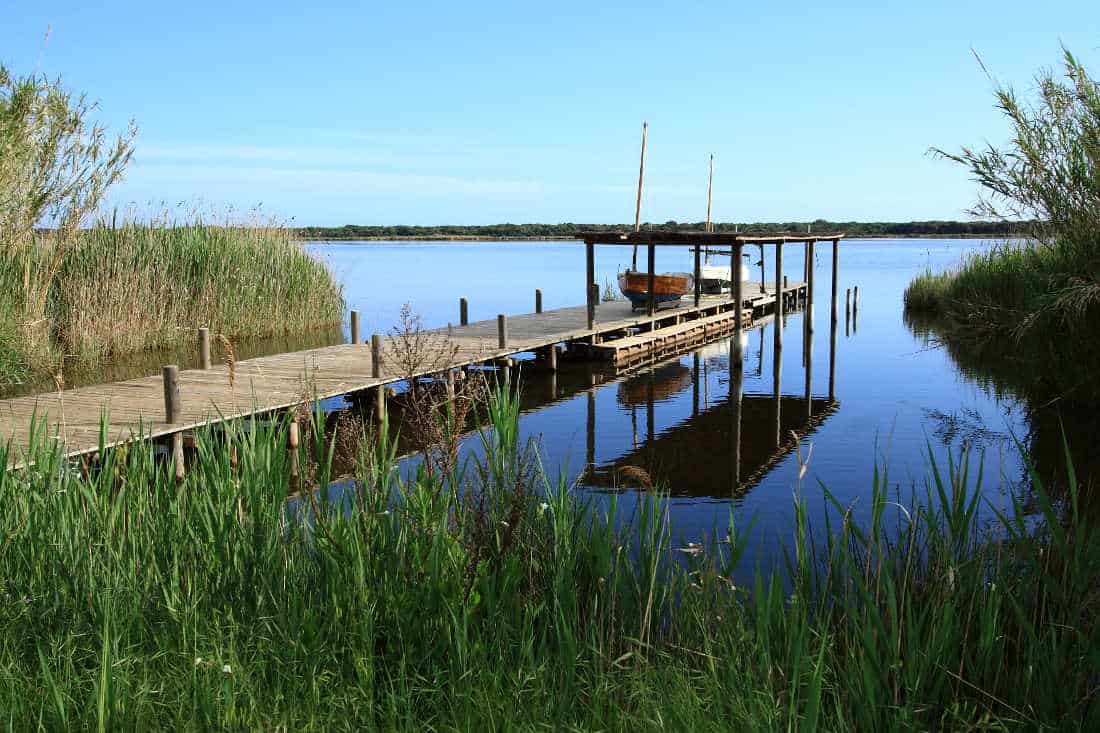
Calling it a lake is a convenience of language. Lake Burano is a brackish coastal lagoon, the remnant of an ancient body of water that the sea has gradually closed off behind a tombolo, that is, a sand bar built by the currents over millennia. Today the body of water measures about 140 hectares, the average depth stays around a meter and the perimeter runs for a dozen kilometers. A meter of water seems little: it is instead the reason the place works. A shallow, brackish bottom warms quickly, produces invertebrates in industrial quantities and sets a table for tens of thousands of birds heading south from northern Europe toward Africa. The rest of the reserve is 410 hectares of dune, scrub, reed bed and woodland, to which another 600 hectares are added, withdrawn from hunting thanks to a closed-ground agreement with the owner of the land, the company SACRA.
Geography matters more than art history here. We are in the southern Maremma, the stretch of coast between Ansedonia and the Chiarone, in the municipal territory of Capalbio, with the promontory of Argentario closing the horizon to the northwest and the countryside of the Lazio border starting a few hundred meters further on. Lake Burano is recognized as a Special Area of Conservation with the code IT51A0031, it is a Special Protection Area with the code IT51A0033 and it is a wetland of international importance under the Ramsar convention. These are bureaucratic codes, and they are worth a chapter of natural history: they mean that this strip of water is considered European heritage, not a provincial little pond.
Why Lake Burano is brackish
Salinity is the trait that sets Lake Burano apart from the volcanic lakes of Lazio, starting with Lake Bolsena. There is no crater here: there is a closed basin that receives fresh water from the inner drainage basin and salt water from the sea through seepage across the dune bar and regulated connections. The result is an unstable environment, where the salt concentration rises in summer with evaporation and falls in winter with the rains. Few plants withstand such an oscillation, and those that do, the glassworts, the rushes, the reed beds of the inner banks, automatically become rare species. The bird colonies follow the same logic: a specialized fisher like the flamingo looks for exactly shallow, brackish waters like these.
The tombolo and the dunes of Lake Burano
Between the lake and the sea runs the double bar of dunes, the most fragile stretch of the whole reserve. The outer dune, the one beaten by the southwest wind, hosts the pioneer plants of the sand: the sea daffodil that flowers white in July, the sea bindweed with its violet corollas, the santolina, the marram-grass stands that hold the grains with their roots. Behind, sheltered, begins the low scrub of juniper, mastic, myrtle, mock privet, heath and rosemary, which rises a few meters and becomes impenetrable. It is the reason the path is marked out and restricted: off the route you trample an ecosystem that takes decades to rebuild. Anyone arriving from the Lazio coast, from Montalto di Castro northward, recognizes the same landscape, here though preserved in a continuity that elsewhere has been broken by construction.
The history of the Lake Burano WWF Oasis
The history of this reserve coincides with the first steps of the WWF in Italy. The association had been born only a few months earlier when, in 1967, it decided to acquire the hunting rights on Lake Burano: it was the first Italian oasis, the prototype of a model that today counts over 100 protected areas and more than 30,000 hectares. It is worth pausing a moment on that choice, because it was less obvious than it seems today. In the 1960s the coastal Maremma was land for hunting and reclamation, and wetlands were considered unproductive territory to be drained. Buying the right to shoot in order not to shoot was a move of surprising modernity: the legal instrument of hunting was used to abolish it in practice over an entire body of water.
The next step was public recognition. Lake Burano became a state nature reserve in 1980, with management entrusted to the WWF, and in the meantime the area was entering the international lists of protected wetlands. The closed ground agreed with the company SACRA added another 600 hectares of quiet to the 410 of the reserve: a buffer strip that, in an area where poaching was a habit, made the difference between a population of birds in transit and a stable population of wintering birds. Anyone who does birdwatching grasps the point at once: birds stop where no one disturbs them, and it takes kilometers, not meters.
Lake Burano as a model for the other WWF Oases
A method born at Burano was exported across Italy: acquisition or agreement on the land, a single patrolled trail, observation blinds, accompanied visits, a visitor center with an educational function. You find it identical in oases very far from here, from the WWF Oasis of Lake Alviano to the Sagittario Gorges, up to the Roman coast of Macchiagrande. The fact that the model worked was not a given: it means a private association can manage a public good well, if it accepts strict rules and limited visits. Our opinion is that the limiting is the real reason you can still see animals here: the oases that opened their gates without rules lost their fauna within a few years.
The guided visit to Lake Burano, stage by stage
The visit to Lake Burano is accompanied by a WWF operator and lasts about 2 hours. You walk along the tombolo, so on the flat, on compact sandy ground that holds up well even after rain, for a couple of kilometers in all there and back. The nature trail is equipped with 7 observation points: 6 blinds and a lookout tower. The operator doesn't recite a script: he reads the lake at that moment, and in an oasis the moment changes everything, because in November you look at the open water and in May you look at the reed bed.
The visitor center of the Lake Burano WWF Oasis
You start from the visitor center, which is not a ticket office but a small field museum: panels on the formation of the tombolo, on the migration routes, on the species you can meet that week. Alongside runs a short trail, 500 meters, which you can walk even without a guide during the center's opening times and which hosts the butterfly garden, a flower bed designed with the host plants of the local butterflies. With children it is the place to start the day: a swallowtail landing on a scabious is worth 10 explanatory panels.
The six observation blinds of Lake Burano
The blinds are low wooden structures, with horizontal slits and an inside bench, set along the dune so as to frame different sectors of the body of water. The rule is only one and it is not a formality: you go in silently and you leave silently. A noisy blind empties the field of view for 20 minutes. The first blinds look at the shallow waters near the reed bed, where coots and mallards concentrate. The central ones open onto the free water, the sector of the diving ducks like the pochard and the tufted duck. The last ones let you work the far banks, and it is there that, with the right light, herons and shorebirds appear. Anyone who brings binoculars should use them from inside, resting the elbows on the slit: stability matters more than magnification.
The lookout tower of Lake Burano
The tower is the high point of the route and it completely changes the scale of the reading. From the blinds you see a portion of shore. From the tower you see the shape of the lake, the line of the reed bed, the relationship between water and dune, and above all you follow the flights. The marsh harrier, which from the blinds appears suddenly, you watch from the tower while it patrols the reed bed in low, wavering flight, with its wings held in a V, and you understand why the whole flock of coots packs into a dark mass as soon as it raises the tone. Stay up there more than 5 minutes. The tower rewards patience.
The return and the beach of Lake Burano
The way back retraces the tombolo, with the sea within sight beyond the dune. The beach inside the perimeter of the reserve is not for swimming at will and it is not a beach resort: it is part of the oasis, and the sand you cross hosts the nesting of very delicate coastal species. Anyone who wants a swim takes it outside the perimeter, toward the Chiarone or toward the Feniglia. This is a place where you look, not where you lie down.

The flora of Lake Burano
The WWF counts over 500 plant species within the perimeter of the oasis. It is a number that says little until you translate it into habitats: here, in 2 kilometers of walking, you cross four different botanical worlds, which elsewhere are separated by tens of kilometers.
The Mediterranean scrub of Lake Burano
The scrub is dense, in places impenetrable, and rests on a few dominant species: the prickly juniper and the Phoenician juniper on the dune, the mastic with its red berries turning black, the myrtle that in September perfumes the whole inner strip, the mock privet with its leathery leaves, the tree heath and the bushes of wild rosemary. In spring wild orchids appear in the sandy clearings, and they almost always escape anyone walking distracted: they are a few centimeters tall.
The holm oak and cork oak forest of Lake Burano
Behind the scrub survives a strip of evergreen Mediterranean forest, the formation that covered the Tyrrhenian coast before the reclamations and the clearing of woods. Holm oaks, cork oaks, downy oaks, maples: a low, compact woodland, with an understory in half-light even at noon in August. The cork oaks still bear the marks of stripping, which in the Maremma was a regular economic activity. A wood like this in central Italy is a rare commodity, and the fact that it survived right behind a dune is no accident: it was hard ground to put under cultivation.
The sea daffodils and the plants of the dune
On the bare sand the specialists are at work. The sea daffodil, which botanists call Pancratium maritimum, flowers between July and August and opens white corollas at sunset, when the pollinating moths become active. The sea bindweed carpets the sand with fleshy leaves and lilac flowers. The santolina of the beaches withstands the salt thanks to a silvery down. These are plants that die under trampling, and their presence is the thermometer of a dune's state of health: where they are no longer there, the dune is already dead and the sand begins to migrate.
The reed bed of Lake Burano
The Phragmites reed bed occupies the inner banks and works as a true factory of biodiversity: it filters the water, offers shelter, feeds the food chain with the insects that live inside it. It is the hardest habitat to observe, because what lives in it is heard and not seen. Learning to recognize the song of the great reed warbler, rough and repeated, or that of Cetti's warbler, is the real skill you take home from a visit to Lake Burano.
The birds of Lake Burano
More than 300 species of birds have been recorded in the oasis. It is the figure that makes Lake Burano one of the most serious birdwatching destinations in central Italy, on a par with the nearby Orbetello lagoon and with the wetlands of the Po delta.
The wintering birds: flamingos, geese and ducks
Winter is the season of big numbers. On the shallow water coots gather in compact flocks, with pochards and tufted ducks diving to feed on the bottom, along with mallards and teals. Wild geese appear in cold years. Flamingos, which in the 1980s were a rarity on this coast, today regularly visit the Maremma lagoons, and their presence at Burano is one of the images the public remembers most: pink on gray water, 200 meters from the dune. Anyone who wants to see them has to come between November and February, and has to bear in mind that an oasis is not a zoo: the presence of the animals is guaranteed by no one.
The birds of the reed bed
In the reed bed live Cetti's warblers, great reed warblers, moustached warblers, reed buntings, the bittern with its dull call that resembles a breath blown into a bottle, and the water rail, which is heard more often than it is seen. These are species tied closely to the Phragmites: where the reed bed retreats, they disappear. This is why the management of the oasis works on water levels, which is a trade of precision.
The herons and the shorebirds
Gray herons hold the banks in every season, with their motionless pose of a patient fisherman. Little egrets work the very shallow waters moving their yellow feet to flush out the fish. During the migration periods Sandwich terns appear over the open sea beyond the dune, along with gulls, and shorebirds on the exposed shores when the level drops. Serious birdwatching here is done in the early morning hours and in the last light: in the middle hours most of the activity stops.
The raptors of Lake Burano
The marsh harrier is the master of the house and is seen on almost every visit in the right season. The osprey appears during the migrations and sometimes stays for weeks, and seeing it fish is one of the most impressive natural spectacles in Italy: it enters the water feet first and comes back up with the prey oriented along the direction of flight. Then there are the buzzard over the clearings, the sparrowhawk hunting low among the trees, the kestrel hovering over the dunes, and in passage the greater spotted eagle. I repeat a point that visitors forget: raptors are seen better from the tower than from the blinds.
The mammals and reptiles of the Lake Burano WWF Oasis
The land fauna is observed far less than the birds, and this creates a misunderstanding: people leave the visit convinced that only feathered creatures live in the oasis. In the scrub and in the sandy clearings of the dune there move instead fallow deer, wild boar, roe deer, porcupines, badgers, foxes, stone martens, polecats, weasels, wild rabbits and hedgehogs. In recent years the WWF also reports the passage of the wolf, which uses the reserve during long-distance movements along the Tyrrhenian coast: a return that tells how much Italian fauna has reorganized itself in half a century.
Animal tracks on the sand
The right way to read this fauna is to look at the ground. On the sandy floor of the trail, early in the morning, the night's footprints are left imprinted: the digitigrade tracks of the fox in an almost straight line, the wide plantigrade ones of the badger, the fallen quills of the porcupine, the deep furrows left by wild boar that have been rooting. WWF operators use them as teaching material and it is the part of the visit that children remember longest. The oasis also has an observatory designed for night viewing of mammals, and its availability depends on the visitor center's seasonal programs.
The reptiles of Lake Burano
Among the reptiles living here are the land tortoise and the pond turtle, the four-lined snake, which is a harmless and useful snake, a great eater of rodents, the very fast western whip snake that flees with a dry rustle among the leaves, the Aesculapian snake, lizards and green lizards, and the viper, present as in all the Mediterranean scrub. The viper is the reason the oasis asks for closed shoes: it is not a decorative requirement. Walking on the trail and without putting your hands into the bushes, the risk is close to zero.

The Torre di Buranaccio, sentinel of Lake Burano
On the tombolo, in the middle of the dune, a square stone tower rises and dominates the whole body of water: it is the Torre di Buranaccio, and its silhouette has become the visual symbol of the oasis. The present fortification dates to the middle of the 16th century, in all likelihood on top of a preexisting medieval structure, and it belonged to the defensive system of the State of the Presidi, the Spanish enclave that from 1557 controlled Orbetello, Porto Ercole, Porto Santo Stefano, Talamone and Ansedonia. Buranaccio was its southernmost outpost, facing the border with the Papal States: a guard post against Barbary raids and, at the same time, a customs post on a political frontier.
The tower is three levels high, with walls two or three meters thick and a top terrace for the artillery piece. The interventions of later centuries have not altered its form. It is not visited inside: its role today is that of landscape, and it is enormous, because it gives historical depth to a place that the public tends to read as pure nature. This shoreline was never empty: it was watched, contested, malarial, and malaria itself kept it uninhabited long enough to bring it almost intact to the 20th century.
The State of the Presidi and the coast between Ansedonia and the Chiarone
The system of coastal towers can still be read today by traveling this coast: from Ansedonia, where Roman Cosa dominates the promontory, to Porto Ercole and Porto Santo Stefano, every useful rise has its fortification. Anyone arriving from Rome who knows the towers of the Lazio coast, from Tarquinia northward, sees here the same principle applied by another power: a chain of lookouts, fire signals, calculated alarm times. The difference is that on this side of the Chiarone the Spanish were in command, on the other the pope.
The Casale della Giannella and the Orbetello Lagoon Oasis
About 20 kilometers from Lake Burano, on the Tombolo della Giannella, the northernmost strip of sand connecting Monte Argentario to the mainland, the WWF manages a second oasis: the Orbetello Lagoon, 870 hectares inside a regional reserve of 1,550. Its visitor center is the Casale della Giannella, on Strada Provinciale 36 della Giannella at kilometer 4, between Albinia and Orbetello, and its hours follow those of Burano: from September 22 to May 10 Saturday, Sunday and holidays from 9:00 to 16:00. From May 11 to June 14 on weekends and holidays with a split morning and afternoon schedule. From June 15 to September 21 every day. The summer guided visits start on Tuesday, Thursday, Saturday and Sunday at 17:30, and off-season they are organized on request. Booking is mandatory by 13:00 the day before, at the same number as Burano, 388 4231098, or by writing to oasiorbetello@wwf.it.
The Casale is an environmental education center built around a large lawn, with an observatory for birdwatching on the lagoon, an educational trail and a butterfly garden. It has a residential vocation that makes it suited to school camps, school tourism, family vacations, summer camps and themed conferences, with a kitchen working on local products. The stay packages, capacity and rates change over time and have to be agreed directly with the WWF: that information is asked for at the visitor center before planning a group. From the Casale the Giannella beach is a few hundred meters away, the Albinia railway station is 5 kilometers away on the Rome-Genoa line and the Albinia exit of the Aurelia is 4. Orbetello, Porto Santo Stefano and Porto Ercole are within a radius of about 10 kilometers.
Two oases in one day
You can do both on the same day, but only in high season, when the afternoon departures fit in with the morning openings, and only by car. My advice is not to do it. Two guided visits of 2 hours each, in the same light, produce a day of tiredness and no sharp memory. Better Burano in the morning and the afternoon at upper Capalbio, or at the Tarot Garden of Niki de Saint Phalle, which is a few minutes away and tells a completely different Maremma.
A curiosity about Lake Burano (GR) - WWF Oasis
The curiosity that throws everyone is that this place was born from a hunting contract. In 1967 WWF Italy, a newly formed association with no means, did not buy the lake: it bought the right to shoot on the lake. It was the only legal instrument available to prevent anyone else from doing so, and it turned a hunting prerogative into a form of protection. The first Italian nature oasis was born, then, not from a law, not from a restriction, not from a ministerial decree, but from the legal cunning of a group of naturalists who had understood how Italian law worked better than many jurists.
The detail has a consequence that still lasts. For decades nature conservation in Italy moved by buying or renting rights, not by expropriating: the closed ground agreed with the company SACRA, which withdraws from hunting another 600 hectares around the 410 of the reserve, is the continuation of the same method. Anyone who arrives at Lake Burano believing they are visiting a public park is actually visiting the result of a long private negotiation, renewed piece by piece. It is a much more Italian story, and much more interesting, than the one usually told to tourists. And it explains why the WWF cares so much about the discipline of the visits: what holds this reserve together is not a gate, it is an agreement.
One thing nobody tells you about Lake Burano (GR) - WWF Oasis
That the guided visit's schedule changes four times a year, and that it is not an organizational detail but the heart of the experience. From the end of September to the beginning of May you start at 10:00 or at 14:30, with the latter slipping to 15:00 when daylight saving time takes effect. From May 11 to September 21 the departure is single and in the evening, at 17:30, moved up to 16:30 during September. Why do you go late in summer? Because between noon and 4 in the afternoon, on a Maremma dune, nothing moves: the birds are motionless in the shade of the reed bed, the mammals sleep, the heat shimmers on the water and even binoculars become useless because of the trembling air. The oasis sends visitors in when life resumes.
The second thing nobody says is that booking has to be made by 13:00 the day before, not the same morning. Anyone who wakes up in Rome with a sudden wish to go to Lake Burano finds the gate closed, even if the visitor center is open: two and a half hours of travel wasted. The third is that the oasis closes in case of a yellow, orange or red weather alert issued by the Region of Tuscany. Yellow means an ordinary disturbance: in winter it happens often. Call 388 4231098 the morning of departure if the sky is heavy, and save yourself the trip.
The advice I give you for visiting Lake Burano (GR) - WWF Oasis
Go in winter, and go by train. The two things together make the day a different category. Winter is the season when this lagoon is at its best: the wintering birds have arrived, the shallow waters teem, the flamingos stay put, the marsh harrier works the reed bed every day, the raking light of 11 in the morning is the best the Maremma coast produces, and there is not a single person on the beach. The Saturday morning visit at 10:00, from September 22 to May 10, is the one to recommend to all groups.
I recommend the train for a practical reason: the Capalbio Scalo station, on the Rome-Pisa line, is a few steps from the visitor center, and the parking in front of the oasis is limited. Arriving without a car removes the anxiety about the return time and lets you take on the day calmly, which matters in an oasis. Bring real binoculars, 8x42 or 10x42, not a pocket theater model: on open water the magnification is needed. Bring a windproof jacket even on nice days, because on the tombolo the mistral gives no respite. And resist the temptation to ask the guide how many animals you will see: no honest naturalist can answer that question.
Another well-known fact, yet rarely cited
That Lake Burano is a Ramsar site, that is, a wetland of international importance recognized by the convention signed in the Iranian city of Ramsar, and that along with this it carries two European codes: the Special Area of Conservation IT51A0031 and the Special Protection Area IT51A0033. They sound like technical-office codes, and yet they are the reason certain things cannot be done here. A Ramsar site is subject to international restrictions on water management and habitat conservation. An SPA requires an impact assessment for any intervention that might disturb the birdlife. On a coast where in the last 50 years people have built everywhere, this package of restrictions explains better than any rhetoric why Lake Burano is still there.
The fact is well known among those who work in conservation and practically unknown to the public that comes to visit. It is worth telling the kids on a school trip: an ecosystem is not defended with affection, it is defended with administrative acts. And it is worth remembering that the protection here is layered, that is, that on the same perimeter sit the state nature reserve, the WWF management, the Ramsar recognition and the two designations of the Natura 2000 network. Four different levels, four different authorities, a single lake of 140 hectares.
The right photo to take at Lake Burano (GR) - WWF Oasis
The photograph worth the trip is only one: the Torre di Buranaccio seen from the dune, with the lake in the foreground and the profile of Argentario fading in the background. It has to be taken in the last hour of light, when the sun drops toward the sea and the stone of the tower goes from ochre to orange, and it has to be taken with a moderate telephoto lens, around 100 or 135 millimeters, which compresses the planes and brings the promontory closer. With a wide-angle the tower becomes a dot and the photograph tells nothing. In high season the 17:30 visit arrives in that light almost by design: it is the unintended gift of the evening schedule.
The second photograph to take home is made from inside a blind, framing the slit from the shadow: the dark frame of the wood, the strip of lit lake, the birds inside. It is the image that gives back the true experience of birdwatching, the waiting behind a crack. A technical tip that saves disappointment: in the blinds you don't use a flash, ever, and you don't rest the lens on the wood, because every vibration is transmitted to the structure and is felt throughout the blind. A third possibility, for those with a steady hand: the sea daffodils in bloom on the sand in July, photographed backlit at sunset, when the white corollas open. Respect one rule only: off the trail you don't set foot, not even for a better photograph. The dunes are photographed from the edge.
Some important events that happened here in history
The first event is from the 16th century. In 1557, with the end of the war of Siena, Spain reserves a handful of strongholds on the Maremma coast for itself and the State of the Presidi is born: Orbetello the capital, Porto Ercole, Porto Santo Stefano, Talamone, Ansedonia. The Torre di Buranaccio, built around the middle of the century, becomes the southernmost outpost of that dominion, facing the border with the Papal States. For two centuries this strip of coast is frontier land, of guards and of smuggling.
The second event is an absence: malaria. For centuries the plain around the lake stays almost uninhabited because it is unhealthy, and the attempts at reclamation follow one another without success until the 20th century. A cruel and fortunate paradox: the disease that impoverished the Maremma is the same one that saved its dunes from construction, handing them intact to the last century.
The third event is from 1967, and it is the one that gave Burano a place in Italian history. WWF Italy, born on July 5, 1966 and strong with 800 members, launched what its own chronicles call a reckless challenge: the acquisition of the hunting rights on Lake Burano, to turn it into a bird protection oasis. There did not even exist at the time an article of law with which to establish a protected area for birdlife. From that gesture was born the network of over 100 Italian oases and a model of protection copied everywhere.
The fourth is from 1980, when Lake Burano is recognized as a state nature reserve, with management entrusted to the WWF: private protection becomes public protection without changing hands. To these are added the international recognitions, the designation as a Ramsar wetland and the inclusion in the European Natura 2000 network as an SAC and SPA. And the fifth event is under way: in recent years the wolf has started again to use the reserve during movements along the Tyrrhenian coast. After a century of absence, the great predator has come back to pass over the dune.
Who has passed through Lake Burano (GR) - WWF Oasis
The name that counts more than any other is that of Fulco Pratesi, born in Rome in 1934 and died in 2025, founder of WWF Italy on July 5, 1966. It was he who pushed the newborn association toward the Burano operation, and his is the sentence that best explains the context of the time: there did not even exist an article of law with which to establish a protected area for birds. Pratesi was a hunter converted to conservation, a talented draftsman and a tireless popularizer: whoever walks on the tombolo today walks inside an idea of his.
Before him, across this dune passed the Spanish soldiers of the State of the Presidi, who stood guard on the tower against the corsairs, and the customs officers of a frontier that divided Madrid from Rome. In the 19th and early 20th centuries came the hunters and the lagoon fishermen, who lived off this body of water and whom the WWF in effect put out of business by buying up the rights. From 1967 on, generations of Italian naturalists have passed through: Burano has been a training ground and a workshop for the ornithologists who later built the national census of wintering waterbirds, and for thousands of volunteers, school camps and class trips.
A few kilometers from here, in the same years, another figure was choosing the Maremma of Capalbio: Niki de Saint Phalle, who chose the countryside of Capalbio to build the Tarot Garden. Two opposite ways of treating the same landscape, the total subtraction of the WWF and the overflowing invention of the French artist, a quarter of an hour by car from each other. It is the contrast that makes this corner of the coast one of the most interesting in Italy.

When to go to Lake Burano, season by season
Winter at Lake Burano
From November to February the lagoon works at full capacity: the wintering birds have all arrived, the diving ducks fill the open water, the flamingos stay on the shoals, the marsh harrier patrols the reed bed every day. The low light is the best of the year for photographing and for observing. The cold here is mild but the wind is constant: dress in layers. It is the best season for Lake Burano, without hesitation.
Spring at Lake Burano
March and April bring the migratory passage northward, which at Burano means unpredictable appearances and new songs every week. The scrub blooms, the wild orchids come out in the clearings, the butterfly garden near the visitor center begins to fill. It is the right season for those who come with children: gentle temperatures, long days, lots of small things to look at up close.
Summer at Lake Burano
July and August are the least productive season from the wildlife point of view and the most crowded on the surrounding coast. The evening visit at 17:30 makes up a lot, and the sea daffodils in bloom on the dune are a botanical spectacle worth the ticket on its own. If you come in summer, bring water and a hat: on the tombolo there is no shade for 2 kilometers.
Autumn at Lake Burano
September and October are the time of the passage southward and, for those who know how to look, the period richest in surprises: ospreys in transit, shorebirds on the exposed shores, the first contingents of ducks. In September the start of the visit moves up to 16:30 and from September 22 the winter calendar kicks in. It is also the month in which the myrtle perfumes the whole scrub.
The Lake Burano WWF Oasis with children
It works, on two conditions. The first is age: under 5, two hours of silent walking and waiting behind a slit are a disproportionate demand, and the result is an unhappy family and a ruined blind for everyone. From 6 years up, on the other hand, it is one of the best-built nature outings in central Italy. The second condition is preparation: explain beforehand that you walk in silence, that the binoculars are passed around in turn, that the animals don't appear on command.
The material on which children truly light up is not the distant flamingo: it is the tracks on the sand, the porcupine quills, the fox footprints, the shells, the feathers, the butterfly garden next to the visitor center. The WWF operators have a long practice of teaching and know how to shape the visit to the age group of the party, if you tell them at the time of booking. Schools find in the nearby Casale della Giannella a facility designed for residential school camps.
Accessibility of the Lake Burano WWF Oasis
The nature trail is equipped also for people with motor disabilities: the route runs on the flat along the tombolo, the ground is compact and holds up even after rain, and this makes it passable with a wheelchair in normal conditions. Compared with the average of Italian protected areas it is a notable result, and it should be said that it was a matter of principle for the WWF from the design of the trail. The real conditions change, however, with the season, with the wind and with the state of the sand: anyone with specific needs should state them at the time of booking, at 388 4231098, and the oasis will indicate the passable route on that day. Even the short 500-meter trail next to the visitor center, the one with the butterfly garden, can be done comfortably and is an alternative when conditions on the tombolo are not ideal.
Frequently asked questions about Lake Burano (GR), WWF Oasis
What exactly is Lake Burano
Lake Burano is a brackish coastal lagoon of the Grosseto Maremma, the remnant of an ancient body of water closed off behind a sand tombolo. It measures about 140 hectares, with an average depth around a meter and a perimeter of about a dozen kilometers. In 1967 the WWF acquired its hunting rights, becoming the first Italian nature oasis.
How do you get to Lake Burano and how far is it from Rome
The visitor center of the Lake Burano WWF Oasis is at Strada Provinciale Litoranea del Chiarone 35, in Capalbio Scalo, in the province of Grosseto. From Rome you get there in about 2 hours by car along the Aurelia exiting at the Chiarone, or by train on the Rome-Pisa line to the Capalbio Scalo station.
How long does the guided visit to Lake Burano last
The visit to Lake Burano is accompanied by a WWF operator and lasts about 2 hours. You walk along the tombolo on compact sandy ground for a couple of kilometers in all there and back, with 7 observation points along the nature trail: 6 blinds and a lookout tower.
What time do the visits to Lake Burano start
The schedules change four times a year. From the end of September to the beginning of May you start at 10:00 or at 14:30, which becomes 15:00 with daylight saving time. From May 11 to September 21 the departure is single and in the evening, at 17:30, moved up to 16:30 during September.
Is Lake Burano suitable for children
It depends on age: under 5, two hours of silent walking and waiting behind a slit are a disproportionate demand. From 6 years up, on the other hand, the visit to the Lake Burano WWF Oasis is considered one of the best-built nature outings in central Italy, provided you explain the rules of silence to the children beforehand.
Is Lake Burano accessible by wheelchair
Yes, the nature trail of the Lake Burano WWF Oasis is equipped also for people with motor disabilities: the route runs on the flat along the tombolo and the ground is compact, passable with a wheelchair in normal conditions. It is a matter of principle adopted by the WWF from the design of the trail.
How many birds can you see at Lake Burano
More than 300 species of birds have been recorded at Lake Burano, the figure that makes it one of the most serious birdwatching destinations in central Italy. In winter the oasis hosts large numbers of wintering birds: flamingos, geese, ducks, coots and pochards on the shallow waters.
When is the best time to visit Lake Burano
Winter, from November to February, is the season when Lake Burano is at its best: the wintering birds have all arrived, the flamingos stay on the shoals and the marsh harrier patrols the reed bed every day. The cold here is mild but the wind is constant, so it is best to dress in layers.
What to see around Lake Burano
The day at Lake Burano rounds out well, because everything that matters is within half an hour by car. Upper Capalbio, the walled village on the hill, is the natural afternoon stop: a walkable 14th-century circuit of walls, long views as far as the sea, a handful of serious trattorias. The Tarot Garden of Niki de Saint Phalle is the perfect counterpart to the oasis, and its hours should be checked because it opens seasonally. Ansedonia offers the ruins of the Roman colony of Cosa on the promontory and the Etruscan Tagliata cut into the rock.
A little further north you enter the system of Argentario, with Porto Ercole, Porto Santo Stefano, the lagoon and the historic center of Orbetello, and from the port leave the ferries for Giglio Island. Toward Rome, going down the Aurelia, you meet Montalto di Castro and the Tarquinia of the painted tombs. A weekend built this way, with an oasis in the morning and an Etruscan necropolis the next day, is one of the best short itineraries you can do starting from the capital, and for those organizing groups the network of professional guides of TourLeaderPro regularly works in this quadrant. Anyone preparing a trip in English will find a general overview of the region in the ItalyPlanner Tuscany guide and the day trips collected in the ItalyPlanner day trips.
Quick questions about Lake Burano (GR) - WWF Oasis
Where exactly is the Lake Burano WWF Oasis?
The visitor center is at Strada Provinciale Litoranea del Chiarone 35, in Capalbio Scalo, in the province of Grosseto, on the coast of the southern Maremma between Ansedonia and the Chiarone.
How far is Lake Burano from Rome?
About 2 hours by car along the Aurelia, exiting at the Chiarone. By train you arrive at the Capalbio Scalo station on the Rome-Pisa line, and from the station the visitor center is reached on foot.
Do you need to book to visit Lake Burano?
Yes, booking is mandatory by 13:00 the day before the visit, by phoning or writing on WhatsApp to 388 4231098 or by sending an email to lagodiburano@wwf.it.
Can you enter the Lake Burano WWF Oasis without a guide?
No. The reserve can be walked only with the guided visit by the WWF operators. Freely accessible, during the visitor center's opening hours, is only the short 500-meter trail with the butterfly garden.
How long does the guided visit to Lake Burano last?
About 2 hours, on a route of a couple of kilometers in all, all on the flat along the tombolo.
What are the times of the guided visits to Lake Burano?
From September 22 to May 10 on Saturday, Sunday and holidays at 10:00 and at 14:30, which become 15:00 with daylight saving time. From May 11 to September 21 on Monday, Wednesday, Saturday and Sunday at 17:30, with departure at 16:30 in the month of September.
What are the visitor center hours at Lake Burano?
From September 22 to May 10 Saturday, Sunday and holidays from 9:00 to 16:00. From May 11 to June 14 Saturday, Sunday and holidays from 10:00 to 13:00 and from 15:00 to 18:00. From June 15 to September 21 every day with the same split schedule.
How much is a ticket to the Lake Burano WWF Oasis?
The rates are not published together with the visit calendar: you ask at the visitor center at the time of booking or read them on the oasis's official page on the WWF website.
Is the Lake Burano WWF Oasis open all year?
Yes, with different seasonal calendars. The fixed closures are from December 24 to 26 and from December 31 to January 1. The oasis also stays closed when the Region of Tuscany issues a yellow, orange or red weather alert.
Is Lake Burano wheelchair accessible?
The nature trail on the dune is equipped also for people with motor disabilities, with compact ground and a route on the flat. The concrete conditions have to be checked when booking, however, because they depend on the season and on the state of the sand.
Can you bring dogs to the Lake Burano WWF Oasis?
No. Pets are not allowed in the reserve, as in all oases with nesting and wintering birdlife.
Can you take photographs at Lake Burano?
Yes, and nature photography is one of the reasons people come. Inside the blinds you don't use a flash and you never leave the marked trail.
What should you bring for the visit to Lake Burano?
Closed shoes, mandatory, binoculars if you have them, a windproof jacket, water and a hat in the warm months. Picnics are allowed only in the equipped area next to the visitor center.
When do you see flamingos at Lake Burano?
The best months are the winter ones, roughly from November to February, when the lagoon hosts the wintering contingents. No presence, however, is guaranteed: the birds move according to the weather and the water level.
How many birds can you see at Lake Burano?
The WWF reports over 300 species recorded in the oasis, from wintering waterbirds to raptors to reed bed passerines.
How big is Lake Burano?
The body of water measures about 140 hectares with an average depth around a meter and a perimeter of a dozen kilometers. The reserve as a whole covers 410 hectares, to which another 600 hectares are added, withdrawn from hunting thanks to a closed-ground agreement with the owner of the land.
Can you swim at Lake Burano?
The beach within the reserve is not a beach resort and swimming is not the intended use of that stretch of coast. Anyone who wants a swim moves outside the perimeter of the oasis.
What is the difference between the Lake Burano Oasis and the Orbetello Lagoon one?
Burano is a brackish lagoon closed behind a double bar of dunes, with a visit on the tombolo and 7 observation points. The Orbetello Lagoon is larger, 870 hectares inside a regional reserve of 1,550, and its visitor center is the Casale della Giannella. Both are managed by the WWF and share the booking number.
Can you visit the Torre di Buranaccio?
The tower is observed from the outside along the guided route and cannot be visited inside.
Is the Lake Burano WWF Oasis suitable for children?
From 6 years up it works very well, especially if the children arrive prepared for silence and waiting. With the youngest it is best to stick to the short trail and the butterfly garden next to the visitor center.
How long before should you arrive at the visitor center?
A good quarter of an hour before the departure time, because the group leaves on time and whoever arrives later stays outside.
Are there facilities for groups and schools near Lake Burano?
Yes, the Casale della Giannella, visitor center of the Orbetello Lagoon Oasis, is organized for school tourism, school camps and group stays. The packages and availability are agreed directly with the WWF.
One last thing: Lake Burano is not a destination for a checklist of things seen. Anyone who arrives with the hurry of a stopover leaves disappointed, because in 2 hours of dune almost nothing spectacular happens and everything important does. Take the whole morning, accept staying still inside a blind for 20 minutes watching an apparently empty water, and wait for the moment when the coots all pack together because the marsh harrier has raised the tone. That moment comes. And it is the reason the WWF, in 1967, bought the right to shoot in here so as never to shoot again.

For group tours, private experiences and accompaniment services in this quadrant of the coast, the references are the TourLeaderPro Rome page and the network's contacts.
Article written by the TourLeaderPro editorial team, contact them for Private/Corporate/V.I.P. Tours and Experiences.
Planning a trip to Rome? The English-language guides for visiting the city are on ItalyPlanner.com.