Porto Ercole
In short. Porto Ercole is a district of the municipality of Monte Argentario, in the province of Grosseto, with about 2,600 residents.

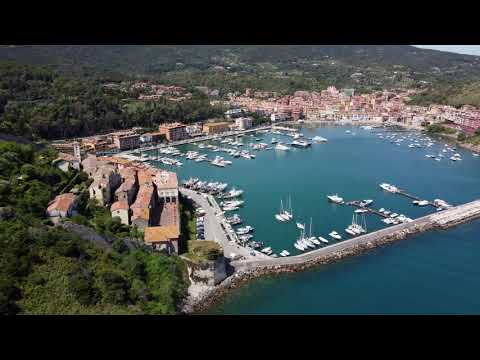
Porto Ercole is a district of the municipality of Monte Argentario, in the province of Grosseto, with about 2,600 residents. The relevant town hall is at Piazza dei Rioni 8 in Porto Santo Stefano (58019), phone 0564 811911. From Rome it's about two hours by car: take the SS1 Aurelia north to the Orbetello exit, cross the lagoon on the Grand Ducal causeway or follow the Feniglia tombolo, and in about 10 kilometers you reach the village. By train, get off at the Orbetello-Monte Argentario station, on the Tyrrhenian line from Rome to Grosseto, and continue on the intercity bus that connects Orbetello to Porto Ercole. Schedules change between winter and summer and should be checked on the Tuscan public transport operator's website before you leave. You don't pay any ticket to enter the village: the town is open, the walk inside the walls is free, and the real costs of the day are parking, the beach clubs and lunch. The forts are largely privately owned and aren't open to visitors on a regular basis. Forte Stella is the only state-owned one and opens for exhibitions and summer events, with a calendar published by the Municipality of Monte Argentario. If you arrive in August, the deciding question isn't the ticket but the parking space: by 9 in the morning you can still find one, from 11 on you drive around in circles.
Porto Ercole is on the eastern side of the Argentario Promontory, a little over 40 kilometers southeast of Grosseto, about 7 kilometers from Orbetello and a dozen kilometers from Porto Santo Stefano, with which it forms the two largest districts of the municipality. To get an overview of the whole promontory, from the lagoon to the coves of the western coast, the reference page is the one dedicated to Monte Argentario.
How to Get to Porto Ercole and Get Around
The geography of the Argentario is deceptive. On the map the promontory looks like a round, easy island. In person it's a limestone massif 635 meters high, Punta Telegrafo, with narrow mid-slope roads and hairpin bends that kill any average speed. Porto Ercole occupies the southeast side, the one most sheltered from the southwest wind, and that's why the Romans put a landing place here and the Spaniards put four fortresses.
By Car to Porto Ercole
From Rome there is only one road and no sensible alternative: the Aurelia as far as the Orbetello Scalo junction, then the provincial road that goes down toward the lagoon. At that point you choose. The Grand Ducal causeway route crosses Orbetello and cuts the lagoon in a straight line, with a view that's worth the detour even for just five minutes of stopping. The Feniglia route follows the southern tombolo, passes the entrances to the pine forest and reaches Porto Ercole from the Cala Galera side. If you have time, take the first on the way out and the second on the way back, so you see both shores of the lagoon. The old town is closed to traffic: cars stay in the parking lots along the harbor and on the road that climbs up, and from there you continue on foot.
By Train and Bus to Porto Ercole
The Orbetello-Monte Argentario station serves regional trains and a few long-distance stops on the Tyrrhenian line. From the station the buses leave for the Argentario, calling at Orbetello, the Feniglia junction and Porto Ercole. In high season the frequency increases, in winter it drops a lot, and on Sundays even more. The practical advice for anyone traveling without a car is to look at the last return bus before you even look at the first outbound one: in Porto Ercole, being stranded after dinner is a real risk.
Getting to Porto Ercole by Sea
Porto Ercole has two distinct harbors: the old port, below the village, where the gozzi and the fishing boats moor, and the Cala Galera marina, a little further north, which takes large pleasure craft. Since 2016 the roadstead has also been a port of call for a US cruise line, with passengers coming ashore by tender. The scheduled connections to the archipelago, however, don't leave from here: the ferries and hydrofoils for Giglio Island and Giannutri sail from Porto Santo Stefano, on the opposite side of the promontory, about 20 minutes away by car.
The Old Village of Porto Ercole, Alley by Alley
The historic settlement is gathered at the southern end of the bay, climbing a spur that ends in the Rocca. You enter through a single gate, and this is the first thing to understand: Porto Ercole isn't a town you cross, it's a town you climb up into and come back down from the same way. The city wall wraps the whole core and joins the fortress, drawing a triangle that you can read in its entirety from the water.
Porta Senese and the Entrance to the Village of Porto Ercole
The main opening is a Gothic arched portal topped by a bell tower, on the eastern side of the walls: it's Porta Senese, which the locals also call Porta Pisana, and you reach it from Via Ricasoli. The detail to look at is the archivolt, which belongs to the works commissioned by the Republic of Siena in the 15th century, when the port was purchased and made secure. Beyond the gate opens a maze of alleys, buttress arches, small stairways and little squares overlooking the water. The absence of cars isn't an aesthetic choice: the slopes and the widths simply don't allow them, and the result is that you walk listening to the seagulls and the mooring lines slapping in the harbor.
Piazza Santa Barbara and the Governor's Palace
Climbing, you reach Piazza Santa Barbara, the village's natural terrace, with a view that sweeps over the old port as far as Forte Filippo. The Governor's Palace faces the square, with a façade of Renaissance design: it was the seat of civil power during the Spanish period, when Porto Ercole was one of the strongholds of the State of the Presidi. The Santa Barbara bastion, which gives the square its name, reinforces the city wall right at this point. According to an unproven hypothesis it housed a lighthouse in the Byzantine era, and the position, in fact, is the right one for a light signal.
The Stairways and Walls of Porto Ercole
From the square start the stairways that lead to the church and then to the Rocca. They are steep, made of stone, often as narrow as one person: anyone with knee problems finds that out halfway up. The city wall is visible in stretches between the houses, absorbed into the buildings, and in some places it serves as the wall of a private home. That's why a walk in Porto Ercole is never a visit to a monument: here the fortification is still the load-bearing structure of the town, and families live inside it.
The Waterfront and the Boatyards of Porto Ercole
The modern town developed along the natural bay that forms the port. The waterfront alternates bars and restaurants with terraces over the water with shops carved out of the old fishermen's storehouses: the transformation is obvious and not everyone digests it, but the backdrop of the scene has stayed the same. At the end of the promenade there are still the boatyards that repair hulls, and in the late afternoon you watch the fish being landed from the fishing boats coming back in. If I had to name the right time to walk the waterfront, I'd say 18:30 on a weekday: the beach clubs empty out, the boats come back, and for half an hour Porto Ercole becomes a working port again.
The Spanish Fortresses of Porto Ercole
Four fortresses within sight of one another, on a stretch of sea front a little over 2 kilometers wide: it's a density that has few equals in Italy, and it's no accident. After the War of Siena, Philip II of Spain found himself holding a promontory that controlled the route between the southern Tyrrhenian Sea and Provence, and decided to make it impregnable. The result is the defensive system that still draws the skyline of Porto Ercole today.

The Aldobrandeschi Rocca of Porto Ercole
The Rocca, which the locals also call Rocca Spagnola, is the oldest of the four and the only one that tells the whole story of the place. The site housed a small chapel dedicated to Saint John the Evangelist, mentioned in a document of Pope Gregory VII from 1074. In 1296 the territory was granted in emphyteusis to Margherita Aldobrandeschi, Countess of Sovana, who had a square tower built there called Torre di Terra: that is the first core of the fortress. In the 14th century the Orsini inherited the fief and enlarged the tower. In the 15th century Siena arrived and sent the painter and sculptor Lorenzo di Pietro, known as il Vecchietta, to the building site to add two round towers. In 1487 Francesco di Giorgio Martini stepped in, the military engineer who was rewriting the grammar of Italian fortifications, and later Bernardo Buontalenti. Under the Spanish the engineer Giovanni Camerini reinforced the structures and dug underground galleries. After the Second World War the Rocca was closed and sold to private owners, who turned the interior buildings into homes. Some spaces outside the perimeter moat are municipal property. It can't be visited. You look at it from below, and it's worth looking hard: five building campaigns over seven centuries can be read with the naked eye in the different masonry.
Forte Filippo, the Stronghold of Porto Ercole
Forte Filippo occupies the hill north of the port and takes its name from the sovereign who wanted it. Giovanni Camerini built it shortly after the middle of the 16th century, in 1558, where a Sienese lookout structure called Forte Sant'Ermo used to stand. The plan is quadrangular, with a double curtain wall and corner bastions, a drawbridge and a round-arched portal. Inside there were a powder magazine, a chapel, barracks and storehouses. Its dominant position made it the seat of the general staff in case of attack. After Italian unification it lost its military function and in the late 19th century it was turned into a prison. During the Second World War it took in civilians displaced by the bombings. In the second half of the 20th century it passed to private owners, who restored it and converted it into residences.
Forte Stella, the Six-Pointed Fortress of Porto Ercole
Forte Stella is the most photographed and the most interesting from an architectural point of view. It stands on a promontory west of the town, where the Renaissance Forte Sant'Ippolito already existed, partly absorbed into the new work. Philip II entrusted its design to Bernardo Buontalenti and Giovanni Camerini in 1558, but the work went on for generations: a view from 1646 still shows it unfinished, and completion came only in the second half of the 17th century. The geometry is double and has to be looked at from above to be understood: an outer quadrangular fortification with hexagonal bastions at the corners encloses an inner body in the shape of a six-pointed star, with thick, raised curtain walls. In the center of the top terrace there is a hexagonal skylight that brings natural light into the interior rooms. It remained state property, was restored in the 1990s and is now the venue for exhibitions and cultural events during the summer: it's the only one of the four that you can really enter, with a bit of luck on the calendar.
Forte Santa Caterina and the Control of Cala Galera
Forte Santa Caterina was built near Forte Filippo to control the inlet where the Cala Galera marina is today. It performed guard and offensive functions until the early 19th century. With the annexation of the territory to the Grand Duchy of Tuscany the fortification was gradually decommissioned. At the end of the century it had one last, not very noble use: infirmary for the inmates of the Forte Filippo prison.
The Walls, the Bastion and the Polveriera
The walls of Porto Ercole made up the village's defensive system, with the Gothic-arched Porta Senese on the eastern side as the only gate for vehicles at the time. They are reinforced by the Santa Barbara Bastion and by the Aldobrandeschi Rocca above. Just outside the town, on top of Poggio della Polveriera, in a position overlooking the Orbetello Lagoon, stands a late 18th-century military complex used as an ammunition depot, with the annex from the same period that housed the garrison.
The Porto Ercole Lighthouse and the Coastal Towers
The lighthouse dates to 1862 and was activated by the Regia Marina to light the eastern coast of the promontory. It's a cylindrical tower of white masonry with an inner gallery, set on top of the bastion that closes the Aldobrandeschi Rocca: its presence explains why, looking at the village from the sea in the evening, the light seems to come out of the fortress itself. Torre del Mulinaccio and Torre dell'Acqua complete the defensive picture, two surviving coastal structures of the lookout system that Siena and then Spain had stretched along the whole Argentario coast.
The Nine Vanished Fortifications of Piero Strozzi
There is a chapter that almost nobody tells, and it concerns the fortifications that no longer exist. On the eve of the battle of 1555, the Florentine commander Piero Strozzi, in the service of France and an ally of Siena, had the town fortified with eight additional works besides the already existing Rocca: forte della Galera, forte di Santa Barbara, forte Sant'Elmo, forte Stronco, forte Guasparrino, forte dell'Avvoltoio, forte Sant'Ippolito and forte Ercoletto, the last one planted on the Isolotto in front of the coast. Of those eight structures no visible trace remains: only the Rocca survived the siege and the Spanish reorganization that followed. Walking the scenic road today means crossing an erased military landscape, of which the place names and little else remain.
A Curiosity About Porto Ercole
The curiosity concerns the name of the town and its documentary survival, and it's one of those that throws off anyone who arrives convinced they're visiting a fishing village born in the Middle Ages. Porto Ercole appears in writing long before its fortresses: the Latin form Portu Herculis is recorded in the Itinerarium Maritimum, the late antique register of ports and landing places, among the stops of the sea route that led from Rome to Provence. It wasn't a village: it was a navigation station, a place where you took on water and waited for the wind to turn. Even before that, the area was frequented by the Etruscans, as the finds collected in the neighboring areas show, and from the Roman era a column remains, recovered right inside the harbor basin.
What follows is even more curious, because it runs through a forgery. Porto Ercole reappears in the medieval period in a document that historians have established to be apocryphal: the donation attributed to Charlemagne to the Tre Fontane Abbey in Rome. The document is false, but the forgery is in its way a proof, because to build a credible claim you had to cite places that existed and were worth something. It is from that chain of rights, real or constructed, that in 1296 the abbey grants the territory in emphyteusis to Margherita Aldobrandeschi, and that the tower is born from which everything else descends. The town you see today, with its four fortresses, is the final product of a paper that should never have existed.
I'll add the detail I like best: on the site of the Rocca, before the tower, there was a small chapel dedicated to Saint John the Evangelist, and its existence is attested in an act of Pope Gregory VII from 1074. It means that the highest and most defensible point of Porto Ercole was, for at least two centuries, a place of prayer before becoming a place of war. In the order in which men occupy a promontory, usually the opposite happens.
The Death of Caravaggio in Porto Ercole
It's the fact that brings most cultured visitors here, and it's also the one around which the most inaccuracies circulate. Michelangelo Merisi, known as Caravaggio, died on July 18, 1610, at the age of 38. The thesis accepted today by historiography places the death in Porto Ercole. Alternative hypotheses have existed and partly persist, pointing to Palo di Ladispoli or Civitavecchia, and it's worth understanding where they come from.
The Journey from Naples and the Stop at Palo
In July 1610 Caravaggio was living in Naples, a guest of the marchioness Costanza Colonna at Palazzo Cellammare. He was waiting for the pardon that would allow him to return to Rome after the capital sentence for the murder of Ranuccio Tomassoni. He boarded a transport felucca that shuttled to Porto Ercole every week, counting on landing at Palo, papal territory about 40 kilometers from Rome. At Palo he was stopped for questioning. The felucca couldn't wait: it set off again toward Porto Ercole, taking away the painter's luggage, inside which were three canvases and the price agreed with Cardinal Scipione Borghese for his definitive freedom. Once released, Caravaggio set out to chase that boat along the coast. Anyone who knows the Maremma in summer knows what that means: kilometers of open beach, no shade, a high fever on your back.
The Santa Croce Sanatorium and the Church of Sant'Erasmo
According to the documented reconstruction, the painter came ashore on the Feniglia tombolo in desperate condition, worn out by the journey and with a high fever. He was taken in at the small sanatorium named for Maria Ausiliatrice, run by the Confraternity of Santa Croce, which stood uphill from the church of Sant'Erasmo, in the upper village. That structure no longer exists. The cause of death, according to the documentation of the time, was a high fever very probably linked to a neglected infection. Research carried out around 2010 put forward different hypotheses, from brucellosis to lead poisoning from the heavy metals contained in the pigments. They are hypotheses, and should be taken as such: none has the value of a confirmed finding.
The San Sebastiano Cemetery and the Bones
The remains were buried in the old San Sebastiano cemetery, where the center of the new village stands today, at the intersection of Via Nuova and Via Caravaggio. During some excavations in 1956 in that area, bones were found, among them those believed to be the painter's. Between 2008 and 2010 a research group coordinated by the University of Bologna, with the participation of other universities, subjected those remains to carbon-14 analysis and DNA investigations, arriving at attributing some of the remains to Merisi with a stated probability on the order of 85 percent. It isn't a certainty and the researchers never presented it as one.
The Two Caravaggio Monuments of Porto Ercole
In 2002, at the entrance to the town, a small evocative monument designed by the architect Giuseppe La Fauci, one of the authors of the discovery of the remains, was erected: it features the cloak, the sword, the prison grating and the Maltese cross, four objects that sum up the painter's biography better than a tombstone. In 2010, for the 400th anniversary of his death, an open-air sarcophagus containing five of the artist's presumed bones was placed a short distance away. The operation raised controversy in academic circles and it has never entirely died down. Our opinion is that the 2002 monument works and the 2010 sarcophagus doesn't: the first evokes, the second claims to certify something that no one can certify.
Where to See Caravaggio After Porto Ercole
Frequently Asked Questions About Porto Ercole
Where exactly is Porto Ercole?
Porto Ercole is a district of the municipality of Monte Argentario, in the province of Grosseto, on the eastern side of the Argentario promontory. It is a little over 40 kilometers from Grosseto, about 7 kilometers from Orbetello and a dozen from Porto Santo Stefano. It occupies the southeast side of the promontory, the one most sheltered from the southwest wind.
How long does it take to get from Rome to Porto Ercole?
From Rome to Porto Ercole it takes about two hours by car along the SS1 Aurelia, traffic permitting. By train you reach the Orbetello Monte Argentario station on the Tyrrhenian line, and then you need a bus or a taxi to reach the town on the promontory.
Can you visit the Spanish fortresses of Porto Ercole?
For the most part, no: the Aldobrandeschi Rocca was sold entirely to private owners after the Second World War and its interior buildings are homes, with no ticket office or visiting hours. Forte Filippo also met a similar fate. Of the four Spanish fortresses that characterize Porto Ercole, the real visibility for the visitor remains mostly external, along the walls and the walkways that can be followed from the village.
Where did Caravaggio die, in Porto Ercole?
The thesis accepted today by historiography places the death of Michelangelo Merisi, known as Caravaggio, in Porto Ercole, on July 18, 1610, at the age of 38. Alternative hypotheses exist and partly persist, pointing to Palo di Ladispoli or Civitavecchia as the place of death: the matter is therefore not considered definitively closed by all historians, even if the Porto Ercole version remains the most credited.
What are the best beaches in Porto Ercole?
In Porto Ercole the coast alternates two very different types of shoreline: to the south and north of the town are the large sandy stretches of the tombolos and the sheltered inlets, suited to families and children, while on the western flank, along the scenic road, you find small coves wedged among the rocks with clear water and more demanding access. It's best to choose according to the type of crowd you want before you leave.
Is Porto Ercole suitable for a visit with children?
Yes, Porto Ercole lends itself well to a visit with children as long as you choose the right destinations. For the beach, Cala Galera and the Feniglia pine forest are the two most sensible options, with sand, shallow and gently sloping water, and services nearby. The coves along the scenic road, with uncomfortable paths and demanding access, are not suitable for small children or strollers.
What is the best time to visit Porto Ercole?
May and the first half of June are the best window for visiting Porto Ercole, with water already acceptable, the Feniglia pine forest at its most beautiful, restaurants open and prices not yet at high-season levels. September is considered the twin of early June, with warmer sea. July and August remain the most crowded months.
What do you eat in Porto Ercole?
In Porto Ercole the cooking is that of the Maremma coast, with some Ligurian and Neapolitan additions brought by the fishing families who settled here between the 19th and 20th centuries. The signature dish is the caldaro, a poor-man's fish soup cooked with tomato and served on bread, to which are added stuffed totani, anchovies and oily fish in several preparations, often served in places with a terrace on the waterfront.
Anyone who comes all the way here for Merisi almost always goes back to Rome wanting to see the canvases again. The three large canvases of the Contarelli Chapel in the church of San Luigi dei Francesi remain the obligatory starting point. The Cerasi Chapel in Santa Maria del Popolo holds the Conversion of Saul and the Crucifixion of Saint Peter. The Galleria Borghese keeps the core collected by the very Scipione Borghese who was handling the pardon, and Palazzo Barberini displays the Judith and Holofernes and the Narcissus of disputed attribution. A Caravaggio itinerary that starts in the Maremma and ends in Rome is one of the thematic routes that the colleagues at TourLeaderPro build to order for groups and small parties.
Something Nobody Tells You About Porto Ercole
The guides sell Porto Ercole as the village of the four fortresses and let you believe that you can visit them. That's not the case, and it's better to know it before you leave than to find out in front of a closed gate. The Aldobrandeschi Rocca was sold entirely to private owners after the Second World War and its interior buildings are homes: there's no ticket office, no hours, no visit. Forte Filippo met the same fate in the second half of the 20th century and is now a residential complex, with a private museum that opens only by appointment. Forte Santa Caterina has no museum function. The only state-owned one is Forte Stella, which opens for summer exhibitions and events. So of the Four Fortresses that give their name to the rowing palio, three are seen from the outside.
The second thing nobody says is about the beaches. The real sand, the comfortable kind, with a beach club and parking, isn't inside the town in Porto Ercole: it's at Feniglia and Cala Galera, both before you reach the center. The coves you see in the photographs, Le Viste, Spiaggia Lunga, Sbarcatello, Acqua Dolce, are on the scenic road and you reach them by leaving the car in a lay-by and walking down paths about 200 meters long, uncomfortable in some stretches. Anyone who arrives with a stroller, a recently operated knee or a 3-kilogram beach umbrella finds out halfway down that the hard part is the return, uphill, at 17:00, with the sun still high.
The third, the most practical of all: you don't enter the old village by car. Not because of a discretionary ban, but because the widths don't allow it. Anyone with mobility problems can see the waterfront and the port without effort, but the climb to Piazza Santa Barbara and the church is one continuous stairway. Saying so beforehand avoids disappointments and family arguments on the spot.
The Beaches of Porto Ercole
The coast of Porto Ercole alternates two types of shoreline that have nothing in common. To the south and north of the town are the large sandy stretches of the tombolos and the sheltered inlets. On the western flank, along the scenic road, are the coves wedged among the rocks, with clear water and demanding access. Choosing one without knowing which family it belongs to is the quickest way to ruin your day.
Feniglia, the Longest Beach in Porto Ercole
Feniglia is the southern tombolo, the one you meet before reaching the town when coming from Orbetello. It's a sandy strip of about 6 kilometers that joins Ansedonia to the promontory, and the beach runs along its whole length. There are a few beach clubs, bars and restaurants at the shore, and a great deal of free beach: if you walk 20 minutes toward the center of the tombolo you still find space even on Ferragosto. The seabed slopes gently, which makes it suitable for children. Behind the shoreline stretches the pine forest of the Duna Feniglia Nature Reserve, which can be explored on foot and by bike, where meeting fallow deer is not a remote possibility but the rule in the cool hours. It's one of the most pleasant walks on the Tuscan coast.

Cala Galera, the Easy Beach of Porto Ercole
Cala Galera beach is just before you arrive in Porto Ercole, between the marina of the same name and Poggio Pertuso. It's the easiest to reach of all: from the provincial road that leads to the town you turn toward Cala Galera, go about 200 meters, turn left and continue to a large free parking lot. From there it's about 100 meters on foot. Sand, shallow water, so suitable even for the smallest children. There is both free beach and an equipped beach club. If you're traveling with a newborn or with someone who doesn't walk well, this is the right choice and there's no contest with the scenic coves.

Le Viste and the Isolotto of Porto Ercole
Le Viste is reached just after leaving the town along the scenic road: on the left there's a small roadside bar, you leave the car in the designated parking areas and go down a path of about 200 meters. The beach is partly free and partly equipped, with a bar and beach clubs. In front of the bay the Isolotto emerges, the rock that closes the view and gives this cove its recognizable photograph. It's the busiest of the three scenic ones, and also the one with the most manageable descent.

Spiaggia Lunga Below Forte Stella
Spiaggia Lunga is always reached from the scenic road: at kilometer 1.55, a few meters before the turnoff for Forte Stella, the path that goes down to the shore opens on the left. The route is about 200 meters long and hard to walk in some stretches: closed shoes, not flip-flops. The beach is free, but for those who want it there is an umbrella and lounger rental service. The bay is dominated by Forte Stella, which stands out on the ridge: it is the main reason it's worth tackling the descent.

Sbarcatello and Acqua Dolce
Sbarcatello is reached from Porto Ercole by the scenic road: at kilometer 1.6 you leave the car and continue on foot along a pedestrian path. It's the most secluded of the coves near the town, with a rocky bottom and very clear water, and anyone with a mask and snorkel will find their day here. A little further on, still along the scenic road and still with a descent on foot, you reach Acqua Dolce, which owes its name to the veins of spring water that surface near the shore. These are beaches for self-sufficient adults and older kids: they are not beaches for families with gear in tow.

The Sea of Porto Ercole Seen from a Boat
The best way to understand the coast of Porto Ercole remains renting a gozzo or an inflatable in the port, with or without a license depending on the engine power. From the water you reach coves that have no access from land, you go around the Isolotto and you see the front of the fortresses from the perspective for which it was designed, that is, the perspective of someone arriving from the sea with hostile intentions. Porto Ercole is also a recognized center for scuba tourism, with several dive centers active in season: the seabed of the promontory and the shoals offshore are among the most visited in the northern Tyrrhenian Sea.
The Duna Feniglia Nature Reserve
The reserve protects 474 hectares of tombolo and was established in 1971 by decree of the Ministry of Agriculture and Forests. Administratively it lies in the municipality of Orbetello, along the sandy isthmus of about 6 kilometers that connects Ansedonia to Monte Argentario and closes the lagoon to the south. There are two entrances: from Orbetello across the Grand Ducal causeway, and from Ansedonia along the old Aurelia.
The Pine Forest and the Bike Path of Feniglia
The backbone of the reserve is a dirt road built between 1928 and 1940 that runs through it from one end to the other. You do it on foot or by bike, never by car. Perpendicular cross paths at intervals of about a kilometer lead from the central road to the beach, and information panels and kilometer markers signal the exits. It's a simple system and it works, but it's best to memorize the number of your own access, because on the way back one pine forest looks a lot like another. There are bird-watching stations, a trail equipped for the blind and a fitness trail.
The Vegetation and the Fallow Deer of Feniglia
The plant cover is divided into three bands: a protective coastal strip of 94 hectares, a stone pine forest of 320 hectares and a mixed zone of pines and broadleaf trees of 60 hectares. The most visible fauna are the fallow deer, introduced in the 1950s and plentiful today. Among the native mammals there are also badgers and foxes, and in the wetlands herons and ducks. The advice is to enter the pine forest shortly after dawn or in the last hour of light: at noon the deer are in shelter and you see nothing, at dawn they graze 20 meters from the road.
Feniglia and Caravaggio
This beach is not only a vacation spot. It is the shore on which, according to the reconstruction accepted by historiography, Caravaggio came ashore in July 1610, already in very grave condition. Walking on the tombolo with this awareness changes how you perceive the place: 6 kilometers of open sand, without a single shelter, are exactly the worst scenario for a man with a high fever chasing a boat.
The Advice I Give You for Visiting Porto Ercole
There is one piece of advice and it concerns the order of things. Almost everyone arrives in Porto Ercole in mid-morning, parks wherever they can, climbs up to the village under a blazing sun, looks out from Piazza Santa Barbara, comes down overheated, has lunch on the waterfront and leaves for a beach that by then is full. It's the worst way to organize the day, and it produces the memory of a hot, crowded town that does justice to nothing.
Do the opposite. Arrive early and go straight into the water, at Feniglia or Cala Galera, when the beach is still empty and the parking lot is free. Stay at the sea until 13:00, have a leisurely lunch. In the afternoon, when the light starts to drop, take the scenic road: 2.5 kilometers of hairpin bends with constant lookouts, a stop at the Forte Stella turnoff, and back toward the town. Enter the village after 18:00, through Porta Senese. The difference is enormous: the stairways are in shade, the stone has lost its glare, the square is livable and the port lights up. Whoever visits Porto Ercole at 11 in the morning visits a different place from whoever visits it at 7 in the evening, and the second is the one worth the trip.
Second part of the advice: two pairs of shoes. In the trunk keep a pair of closed shoes with a treaded sole, which you'll need for the paths to the coves and for the climb to the Rocca, and the flip-flops for the beach. Third part: cash. Some of the smaller businesses on the waterfront and the umbrella rentals at the free coves still work mostly in cash, and the nearest ATM is not around the corner when you're at kilometer 1.55 of the scenic road.
One last thing, about method. Porto Ercole makes full sense only if you read it together with the rest of the promontory and the lagoon. A single day is enough for the town and one beach. Two days let you add Porto Santo Stefano, the complete scenic road and the Orbetello lagoon. Three days also allow a crossing to Giglio. Anyone with only a weekend should choose between sea and history and not try to do both in full.
The Cala Galera Marina and Sailing in Porto Ercole
In the inlet before the town opens Cala Galera, one of the historic marinas of the Tyrrhenian coast, where pleasure boats and large vessels moor. Its birth changed the economic profile of Porto Ercole more than any other factor of the 20th century: it brought a stable clientele, generated boatbuilding and services, and shifted the town's center of gravity from fish to boating. The old port, below the village, has instead kept its traditional function, with the gozzi, the nets laid out and the fishing boats coming back in the afternoon.
Porto Ercole and Competitive Sailing
Porto Ercole is a center of international importance for sailing and recreational boating. The Circolo Nautico e della Vela Argentario, born from the merger of two earlier clubs, organizes the Coppa Regina dei Paesi Bassi here, a 112-mile offshore race starting from Porto Ercole at sunset, part of the Trofeo Arcipelago Toscano calendar and regularly able to draw more than 30 boats. The race takes its name from Queen Juliana of the Netherlands, who became attached to the Argentario starting in 1965 and became a member of the sailing club.
Diving and Water Sports in Porto Ercole
Scuba tourism is very well developed, with dive centers active in season. The coast alternates rock walls, shoals and detrital seabeds, and the clarity of the water on the eastern side of the promontory is on average good even in high summer, when the currents work in your favor. Those who don't dive can still rent canoes and boards from a good number of operators on the waterfront and on the equipped beaches.
Another Well-Known Fact, Yet Rarely Cited
That Porto Ercole was part of the State of the Presidi, more or less everyone knows, and you read it on any panel. What almost nobody tells is how strange that State was, and how long it lasted. It was born in 1557, after the Treaty of London, by the will of Philip II of Spain: a Spanish governorship set inside Tuscany, with Orbetello as its capital and four main garrisons, namely Orbetello itself, Talamone, Porto Ercole and Porto Santo Stefano, to which Porto Longone on Elba was added from 1603. It wasn't a distant colony: it was a piece of Spain 70 kilometers from Grosseto, administered by the viceroys of Naples.
The little-cited fact is the chain of successive handovers. Austria took over from Spain in 1707, after the War of the Spanish Succession. In 1733 the territory passed to the Bourbons and was absorbed into the Kingdom of Naples, where it stayed until 1801, when the Treaty of Florence ceded it to Napoleonic France. Only after the Congress of Vienna, in 1815, did the Presidi cease to exist as an autonomous entity and merge into the Grand Duchy of Tuscany of the Habsburg-Lorraine. It means that for over two and a half centuries a resident of Porto Ercole was never Tuscan in the political sense: he was a Spanish subject, then Austrian, then Neapolitan, then French. Tuscany, for Porto Ercole, is a recent condition.
This story explains very concrete things that can still be seen today. It explains why the tombstones of the Spanish governors are preserved in the church of Sant'Erasmo. It explains why the military place names are Iberian and not Grand Ducal. It explains why the fortified system is oversized compared to the population: it didn't defend a town, it defended an imperial route. And it explains, finally, why the speech and the seafaring traditions of the Argentario have roots different from those of the inland Maremma, which has always been Grand Ducal.
The Churches of Porto Ercole
The Church of Sant'Erasmo, the Oldest in Porto Ercole
Sant'Erasmo is the oldest place of worship in the town and stands at the top of the village. The first core dates to the 14th century, when the Orsini controlled the territory, and the oldest part can be identified in the choir. The current building is 18th-century in design and was partly rebuilt after the last war. Inside are preserved the tombstones of the Spanish governors of the State of the Presidi, who were buried here: it is the most direct document of the Iberian period that can be seen in Porto Ercole. It's also the church near which, according to the accepted reconstruction, Caravaggio was taken in when already at death's door, in the sanatorium of the Confraternity of Santa Croce that stood a little uphill. Sant'Erasmo is the patron saint of sailors, and the June festival is dedicated to him.
The Church of San Rocco
It is on the road at the entrance to the town, at the foot of the hill on which Forte Filippo stands. It was built on a very ancient hermitage and restored in the 18th century on the initiative of Don Antonio Perez, as the plaque above the entrance attests. It's a small, secluded building that almost everyone drives past without noticing.
The Church of San Paolo della Croce in Porto Ercole
It stands in the newest part of the town and is the only modern church in Porto Ercole. The building, opened to the public in 1966, is made up of two vaulted chapels for about 500 square meters in all, designed by Mario Luzzetti. In 1986 the parish was formed from the union of two existing ones: that of Sant'Erasmo, which covered the old settlement, and that of San Paolo della Croce, which covered the Grotte district and the more recently built areas.
The Deconsecrated Churches of Porto Ercole
Three religious buildings no longer have a liturgical function and are worth recognizing as you walk. The deconsecrated church of the Corpo di Guardia is near Porta Senese. The church of Santa Croce, an old hospital with a chapel, stands uphill from the church of Sant'Erasmo: it is the complex tied to the confraternity that ran the infirmary. The church of San Sebastiano, also deconsecrated, is in the Grotte district, and its name matches that of the old cemetery in which the remains attributed to Caravaggio were buried.
Natural Areas and Gardens of Porto Ercole
The Isolotto of Porto Ercole
In front of the coast, just outside the Le Viste bay, the Isolotto emerges: a mostly rocky islet, with vegetation dominated by Euphorbia dendroides, the tree spurge that turns yellow in summer and covers itself in green in spring. It constitutes a special protection zone included among the protected natural areas of the province of Grosseto. On that rock Piero Strozzi had the forte Ercoletto built, on the eve of the battle of 1555, of which no trace remains. Today you can only get there by boat and you don't land.
The Casa Bianca Garden, the Botanical Garden of Porto Ercole
It's the real surprise of the promontory and almost nobody mentions it. Also called Giardino Ricasoli, it was founded in 1868 by Vincenzo Ricasoli and is one of the first acclimatization gardens created in Italy, the first in Tuscany. It develops on a steep terraced slope near the Casa Bianca, which belonged to the marquis Alessandro Corsini. The collection counts about 1,300 specimens belonging to 150 species, coming largely from the Middle East, Asia and America. The growth was very rapid: already eight years after planting, 536 species had been planted, and in 1886 there were over 1,800 specimens. For decades it was a destination for scholars from all over Europe, above all for two specimens of Nannorrhops ritchiana, a palm native to Afghanistan that fruits regularly here, a unique case in Italy and perhaps on the continent. Since it is private property, access is not free and any openings should be checked with the Municipality of Monte Argentario.
20th-Century Architecture in Porto Ercole
There is a chapter of contemporary architectural history that in Porto Ercole was written almost quietly, on the hills above the sea, in the years when the promontory was becoming a destination for the international bourgeoisie. Villa Italiesin was built at Poggio Pertuso in 1960 to a design by Christian Norberg-Schulz, the Norwegian theorist who shortly afterward would write the best-known pages on the concept of genius loci. Also at Poggio Pertuso, between 1968 and 1970, Villa Valdroni went up to a design by Oreste Martelli Castaldi. In the Casacce area, in 1977, Villa Rebecchini was built to a design by the architect Julio Lafuente. They are all private residences and cannot be visited. You catch glimpses from the scenic road, and recognizing them while driving is a game worth suggesting to anyone with a good eye.
The Monuments of Porto Ercole
In Piazza Roma stands the Monument to the Fallen of the Great War and to Those Lost at Sea: a set of stone elements that ends in the statue of a soldier in white marble, with commemorative plaques on the front bearing the names of the fallen and of those lost on land and at sea. The double dedication, to the fallen and to those lost at sea, says it all about what Porto Ercole was before tourism. At the entrance to the town, on the other hand, there is the Caravaggio Monument, made in 2002 by the architect Giuseppe La Fauci.
The Right Photo to Take in Porto Ercole
The photograph everyone tries to take is the one of the port with the boats in the foreground and the village in the background, shot from the waterfront at noon. It almost never works, and the reason is technical: at that hour the sun is high and behind the village, the white hulls burn out, the façades fall into flat shade and the result is a washed-out postcard that looks like a thousand others.
The right photo in Porto Ercole is a different one and has three variants, all with the same rule: low light and a high vantage point. The first is taken from the Forte Stella turnoff, on the scenic road, in the last hour before sunset. From there you take in Spiaggia Lunga, the Isolotto and the coastline that fades toward Feniglia, with the fort on the left to give depth. The sun sets behind the promontory and the light comes in low across the water: it's the moment when the surface of the sea turns metallic and the outlines of the rocks stand out.
The second variant is the village seen from the pier, but early in the morning, around 07:30, with the sun still low in the east fully lighting up the wall of houses, the Rocca and the white lighthouse above the bastion. It's the only hour when the front of the village is in direct light and the photograph returns the true colors of the plaster. The port at that hour is empty, the water is still and reflects: if you place the camera low, almost at the water's surface, the reflection doubles the image.
The third is the least obvious and the most successful: Porta Senese photographed from inside the village, against the light, with the Gothic arch framing the little stairway and the bell tower above. It's a tight architectural photograph that tells the story of the town better than the panorama. One technical tip and one about good manners. The technical one: on the scenic road don't stop on a bend to shoot, there are marked lay-bys and the bends are blind. The one about good manners: in the old village the windows face the alleys a meter from your lens, and people live behind them all year round.
Some Important Events That Happened Here in History
The chronology of Porto Ercole is made of a few very heavy dates, almost all military, and two or three civic turning points that changed the town more than the battles did.
1074. An act of Pope Gregory VII mentions the chapel dedicated to Saint John the Evangelist on the height that will later house the Rocca. It is the first medieval attestation of the site.
1296. Margherita Aldobrandeschi, Countess of Sovana, having received the territory in emphyteusis from the Tre Fontane Abbey, has the Torre di Terra built, a square tower that is the first core of the Rocca. It is the birth certificate of fortified Porto Ercole.
15th century. The Republic of Siena buys the port, consolidates the medieval building, raises the walls that ring the village and builds some of the coastal towers that can still be seen along the Argentario coast. Il Vecchietta works on the Rocca building site, adding two round towers.
1487. Francesco di Giorgio Martini works on the fortress, applying the principles of bastioned fortification that he was developing throughout central Italy. Under Siena, Porto Ercole goes through a phase of prosperity.
1555. With the alliance of Florence with Spain and of Siena with France, the town finds itself at the center of the contest. Piero Strozzi has eight emergency fortifications built. What the sources call the Capture of Porto Ercole is fought, an episode that Giorgio Vasari will depict in the Salone dei Cinquecento of Palazzo Vecchio in Florence. Of Strozzi's eight works nothing will remain: only the Rocca survives.
1557. The State of the Presidi is born, a Spanish governorship with Orbetello as its capital, sanctioned by the Treaty of London and consolidated by the Peace of Cateau-Cambrésis of 1559. Porto Ercole becomes one of the main strongholds.
1558. Philip II has work begin on Forte Filippo, with Giovanni Camerini, and on Forte Stella, with Camerini and Bernardo Buontalenti. The completion of Forte Stella will drag on until the second half of the 17th century: a view from 1646 still shows it unfinished.
July 18, 1610. Michelangelo Merisi, known as Caravaggio, dies in Porto Ercole, taken in at the sanatorium of the Confraternity of Santa Croce after coming ashore in very grave condition on the Feniglia tombolo. He is 38 years old.
1707, 1733, 1801, 1815. The sequence of changes of sovereignty: first Austria after the War of the Spanish Succession, then the Bourbons of Naples, then Napoleonic France with the Treaty of Florence, finally the Grand Duchy of Tuscany after the Congress of Vienna.
1862. The Regia Marina activates the lighthouse above the bastion of the Rocca, to light the eastern coast of the promontory.
1868. Vincenzo Ricasoli founds the Casa Bianca garden, the first acclimatization garden in Tuscany.
1928-1940. The dirt road that runs the entire length of the Feniglia tombolo is built, today the backbone of the reserve.
Second World War. Forte Filippo takes in civilians displaced by the bombings. In the postwar period the Rocca is closed and sold to private owners, and with it the relationship between the town and its fortresses changes forever.
1956. Excavations in the area of the old San Sebastiano cemetery bring to light bones, among them those attributed to Caravaggio.
1965. Queen Juliana of the Netherlands becomes attached to the Argentario and will spend summers there with her family for over 40 years. It is the conventional date of Porto Ercole's entry into the geography of elite international tourism.
1971. By decree of the Ministry of Agriculture and Forests the Duna Feniglia Nature Reserve is born, 474 hectares of protected tombolo.
1978. The rowing palio of the Four Fortresses is held in the old port for the first time, as part of the festivities of Saint Erasmus.
2002 and 2010. The evocative monument to Caravaggio is placed and, for the 400th anniversary, the open-air sarcophagus with five of the presumed bones. Between 2008 and 2010 the carbon-14 and DNA analyses conducted by the University of Bologna with other universities attribute the remains to the painter with a stated probability on the order of 85 percent.
2014. Porto Ercole joins the association of the most beautiful villages in Italy. The town also holds the FEE Blue Flag and the green flag for beaches suitable for children.
2016. The roadstead becomes an official port of call for a US cruise company, with visible consequences for the town's summer traffic.
Who Has Passed Through Porto Ercole
For a town of a little over 2,600 inhabitants, the list of those who have passed through is out of proportion, and it divides into three seasons very different from one another.
The Military Architects and the Commanders
The first season is that of the building sites. On the Rocca worked Lorenzo di Pietro, known as il Vecchietta, a Sienese painter, sculptor and architect among the protagonists of the Tuscan 15th century, sent here by the Republic of Siena to add the two round towers. In 1487 Francesco di Giorgio Martini set his hand to it, the engineer and treatise writer who was reinventing Italian fortification against artillery. Later came Bernardo Buontalenti, the Medici architect, also involved in the design of Forte Stella. And Giovanni Camerini worked on it for a long time, the engineer in the service of the Spanish crown who signed Forte Filippo and reinforced the Rocca by digging its underground galleries. Among the military men, the big name is Piero Strozzi, the Florentine commander in exile in the service of France, who in 1555 had the town fortified with eight emergency forts and lost the game anyway. The battle that followed was later painted by Giorgio Vasari in the Salone dei Cinquecento: Vasari never came to Porto Ercole, but Porto Ercole entered his Medici celebratory cycle.
Caravaggio, the Guest Who Didn't Want to Stop
The second season has only one name. Michelangelo Merisi arrived here in July 1610 not by choice but in pursuit, behind a felucca that had carried off his luggage. He died on July 18. He is the only great figure in the history of Italian art whose date of death is tied to a town of this size, and it has marked the identity of the place: a street, a monument, a sarcophagus, and a constant flow of visitors who arrive with the Roman canvases in their heads. It is also worth remembering those who were waiting for him on the other side: Cardinal Scipione Borghese, with whom the price of the pardon had been agreed, and the marchioness Costanza Colonna, who had hosted him in Naples and protected him for years.
Writers, Sovereigns and the Jet Set
The third season is 20th-century. Between 1954 and 1956 the American writer Robert Penn Warren lived in the Rocca, by then passed into private hands, and worked there on texts that earned him the recognition of the Pulitzer: a Pulitzer Prize ripened inside an Aldobrandeschi fortress is a circumstance that would deserve a plaque. From 1965 Queen Juliana of the Netherlands fell in love with the Argentario and had a villa built there. She became a member of the sailing club and spent summers here with her family for over 40 years, racing on occasion alongside other sovereigns, among them Juan Carlos I of Spain and Constantine II of Greece. It is this presence, more than any promotional campaign, that made Porto Ercole a destination of the international jet set. On the contemporary architecture front, the Norwegian Christian Norberg-Schulz, author of Villa Italiesin in 1960, Oreste Martelli Castaldi with Villa Valdroni between 1968 and 1970 and Julio Lafuente with Villa Rebecchini in 1977 left their mark.
The Feast of Saint Erasmus and the Palio of the Four Fortresses
The patron saint's festival falls in June and is the most authentic thing that happens in Porto Ercole all year. The central moment is a night procession of dressed boats, which leave the port lit up and draw a ring of lights on the water: Saint Erasmus is the protector of sailors, and the devotion here isn't folklore for tourists but the memory of families who really did lose someone to the sea, as the dedication to those lost at sea on the monument in Piazza Roma recalls.
Since 1978 the festivities have included a rowing palio held in the old port, called the Palio of the Four Fortresses because the districts bear the names of the Spanish garrisons that surround the town: Forte Filippo, the Rocca, Forte Santa Caterina and Forte Stella. They row gozzi, on a short and tense course inside the basin, with the public crowded on the pier and under the walls. If you can choose when to come, come in June for the palio: the town in those days is full, but full of local people, which no longer happens in August. The exact calendar is published by the Municipality of Monte Argentario and changes from year to year.
When to Go to Porto Ercole
May and the first half of June are the best window by far: water already acceptable, the Feniglia pine forest at its most beautiful, restaurants open, free parking and prices not yet at high-season levels. September is the twin of early June, with warmer sea and more visible fallow deer, and for me it's the number one choice if you have no school constraints. July and August are something else: the town works at full capacity, the nightlife exists, but the traffic on the scenic road and the difficulty of parking change the tone of the vacation. In August arrive at dawn or give up.
In winter Porto Ercole becomes a small, quiet town, with many businesses closed and a wind that whips the port. It has a severe charm of its own, and anyone looking for the fortresses without crowds finds exactly that: stone, rough sea and nobody. Check opening times before you leave, though, because between November and February quite a few restaurants observe long closing periods.
Porto Ercole with Children
The town lends itself better than it seems, as long as you choose the right destinations. For the beach, Cala Galera and Feniglia are the two sensible options: sand, shallow and gently sloping water, services nearby, parking at a manageable distance. The coves on the scenic road, on the other hand, with their 200-meter paths and uncomfortable stretches, are not suitable for small children or strollers. The Feniglia pine forest is the winning card for the afternoon: flat road, continuous shade, bike rentals and the hunt for fallow deer, which for a six-year-old is worth more than any monument. The walk through the old village works if you tell it well, because the theme of the four fortresses and the pirates sells itself. Keep in mind the stairways and bring water. The town has earned the green flag, the recognition given to coastal localities considered suitable for the youngest.
What to See Around Porto Ercole
Porto Ercole gives you much more if you use it as a base for a piece of the Maremma and northern Lazio. The short radius, within half an hour, includes Porto Santo Stefano with the Spanish Fortress and the departure point for the islands, the Orbetello lagoon with its oasis and its flamingos, and the historic center of Orbetello with the walls of Etruscan origin and the Duomo. A little beyond Feniglia you reach Ansedonia, where the ancient Roman city of Cosa stands with its forum and its acropolis, and the nearby Capalbio, a walled village inland.
Anyone with a full day takes the boat from Porto Santo Stefano to Giglio Island, with Giglio Porto, Giglio Castello and the coves of the western side, or to Giannutri, the southernmost of the Tuscan archipelago. Going south along the Aurelia you enter Etruria: Vulci with the archaeological park and the Ponte dell'Abbadia, Montalto di Castro, and further down the necropolises of Tarquinia with the painted tombs, which are a World Heritage site. Inland, Tuscania and Viterbo complete an itinerary that joins the Maremma coast to the hinterland of the Tuscia. Anyone heading back toward the capital finds along the way Civitavecchia and Ladispoli with the castle of Palo, the place where Caravaggio was stopped.
To the north, instead, you enter the Maremma Regional Park, with the main access from the Alberese visitor center and with routes on foot, on horseback and by bike among the Uccellina Mountains, the marshes and the Grand Ducal pine forest. Some routes have limited access and a shuttle, and must be booked: conditions change from season to season and are checked on the park's official website before you set out. For anyone organizing a multi-day itinerary among the Maremma, the Argentario and Etruria who wants to delegate the logistics, TourLeaderPro's group trip organization service covers exactly this kind of route.
To English-speaking visitors who arrive in Tuscany with a week at their disposal I recommend starting from the Tuscany guide and, if the base stays in Rome, from the page on day trips, which explains how to get around by train without renting a car. Anyone thinking in terms of sea and coastlines will find a general overview in the guide to Italian beaches.
Where to Eat and Sleep in Porto Ercole
The cooking is that of the Maremma coast, with some Ligurian and Neapolitan additions brought by the fishing families who settled here between the 19th and 20th centuries. The signature dish of the Argentario is the caldaro, a poor-man's fish soup cooked with tomato and served on bread. Then there are stuffed totani, anchovies, and oily fish in every form. On the waterfront the places with a terrace over the water charge the prices of an internationally known resort: you eat well, you pay accordingly. The trattorias of the upper village and those on the road to Cala Galera generally have a better quality-to-price ratio. In high season, book: in Porto Ercole in August, at 20:30 without a table, you walk.
On the hospitality front, Porto Ercole has historically strong high-end accommodation and a limited mid-range, with a few properties in town and several options along the road to Cala Galera and on the Feniglia tombolo. Anyone looking for low prices bases themselves in Orbetello or Albinia and commutes every day. The travel time stays acceptable and the saving in August is considerable. For a long stay, the most balanced formula is a house on the tombolo, which puts the beach within walking distance and the town 10 minutes away by car.
Quick Questions About Porto Ercole
Where is Porto Ercole
Porto Ercole is a district of the municipality of Monte Argentario, in the province of Grosseto, on the eastern side of the Argentario promontory. It is a little over 40 kilometers from Grosseto, about 7 kilometers from Orbetello and a dozen from Porto Santo Stefano.
How long does it take to get from Rome to Porto Ercole
About two hours by car along the SS1 Aurelia, traffic permitting. By train you reach the Orbetello-Monte Argentario station and continue on the bus line for the Argentario.
Do you pay to enter Porto Ercole
No. The village is freely accessible and the walk inside the walls is free. The costs of the day are parking, the beach club if any, and food.
Can you visit the fortresses of Porto Ercole
Only in part. The Aldobrandeschi Rocca and Forte Filippo are private properties turned into residences and aren't visited regularly. Forte Filippo houses a private museum open by appointment. Forte Santa Caterina has no museum function. Forte Stella is state-owned and opens for summer exhibitions and events: the calendar is published by the Municipality of Monte Argentario.
What is the most beautiful beach in Porto Ercole
It depends on what you're looking for. For sand, convenience and children, Feniglia and Cala Galera. For clear water and scenery, the coves on the scenic road: Le Viste, Spiaggia Lunga, Sbarcatello, Acqua Dolce. The latter require a descent on foot of about 200 meters.
Are the beaches of Porto Ercole suitable for children
Cala Galera and Feniglia yes, for the sand and shallow water. The scenic coves no, because of the access paths. The town has earned the green flag, a recognition given to localities considered suitable for the youngest.
Where do you park in Porto Ercole
In the parking lots along the port and on the access roads to the village. The historic center is inaccessible to cars because of the width of the streets. At Cala Galera there is a large free parking lot about 100 meters from the beach. In August it's best to arrive by 9 in the morning.
Can you enter the old village of Porto Ercole by car
No. The core inside the walls is walked on foot, with steep stairways between the square, the church and the Rocca.
Is Porto Ercole accessible for people with mobility difficulties
The waterfront and the port area are flat and can be walked without problems. The upper village is not: access is by continuous stairways. Among the beaches, Cala Galera is the most manageable because of the short route from the parking lot.
Where did Caravaggio die
According to the reconstruction accepted by historiography, in Porto Ercole on July 18, 1610, in the sanatorium of the Confraternity of Santa Croce near the church of Sant'Erasmo. Alternative hypotheses have existed that pointed to Palo di Ladispoli or Civitavecchia.
Where are Caravaggio's bones buried in Porto Ercole
The remains were buried in the old San Sebastiano cemetery, in the area where the new village stands today between Via Nuova and Via Caravaggio. In 2010 some of the presumed bones were placed in an open-air sarcophagus, a short distance from the 2002 monument.
How long does a visit to Porto Ercole last
The old village can be walked at a leisurely pace in an hour and a half. Adding the scenic road with stops at the lookouts brings you to half a day. With a beach and a lunch, the day is full.
What is the difference between Porto Ercole and Porto Santo Stefano
Porto Ercole is smaller, more historic and more compact, with the walled village and the four fortresses. Porto Santo Stefano is the administrative center of the municipality, larger and more commercial, and it's from there that the ferries leave for Giglio and Giannutri. They are a dozen kilometers apart.
Do ferries for Giglio Island leave from Porto Ercole
No. Ferries and hydrofoils for Giglio and Giannutri sail from Porto Santo Stefano, on the other side of the promontory, about 20 minutes away by car.
When is the Palio of the Four Fortresses held in Porto Ercole
In June, within the festivities for the patron saint Erasmus, in the old port. It has been held since 1978 and the districts bear the names of the four Spanish fortresses. The exact dates are published every year by the Municipality of Monte Argentario.
Does Porto Ercole have the Blue Flag
Yes, the locality has earned the Blue Flag awarded by the FEE, in addition to the green flag for beaches suitable for children. Since 2014 it has also been part of the association of the most beautiful villages in Italy.
Can you snorkel and dive in Porto Ercole
Yes. Scuba tourism is very well developed and several dive centers operate in season. For snorkeling, the rocky coves on the scenic road, in particular Sbarcatello, offer the best conditions.
Can you rent a boat in Porto Ercole
Yes, in the port there are rentals of gozzi and inflatables, with or without a boating license depending on the engine power. It's the best way to reach the coves with no access from land and to go around the Isolotto.
What is the Duna Feniglia Reserve
It is a protected natural area of 474 hectares established in 1971, which occupies the tombolo of about 6 kilometers between Ansedonia and Monte Argentario. You walk or bike it along a dirt road built between 1928 and 1940, and it's known for the population of fallow deer introduced in the 1950s.
Can you bring dogs to the beaches of Porto Ercole
The rules change between free beaches, beach clubs and the reserve area, and are updated with seasonal ordinances: check them on the website of the Municipality of Monte Argentario and with the individual beach club before you leave.
What is the best time to visit Porto Ercole
May, the first half of June and September. July and August offer the town at peak activity but with traffic, difficult parking and high prices. Winter is quiet and fascinating, with many seasonal closures.
How many inhabitants does Porto Ercole have
About 2,600 residents. In August the present population multiplies.
Can you visit the Casa Bianca garden in Porto Ercole
The Ricasoli garden, founded in 1868, is private property and has no regular public opening. Any visits on the occasion of cultural initiatives should be checked with the Municipality of Monte Argentario.
The Verdict on Porto Ercole
Porto Ercole is one of the few places on the Tyrrhenian coast where history hasn't been turned into scenery: the fortresses are lived in, the port still works, the village stairways serve the people who live there. This makes it less tamed than other better-known localities and, for me, much more interesting. But it's also a town that doesn't forgive haste or the wrong shoulder season: anyone who arrives on a Saturday in August at noon will see only a traffic jam and an expensive waterfront. If you have just one day, take it in September, get in the water at 8 in the morning, do the scenic road at 6 in the evening and go up to the village at sunset. And spend half an hour on Via Caravaggio, without expecting a revelation: it's an ordinary street in an ordinary town, and that is exactly the point. The greatest painter of the 17th century ended up in a place like this, chasing a boat.
Article written by the editorial team of TourLeaderPro, contact them for Private/Corporate/V.I.P. Tours and Experiences.
Planning a trip to Rome? The English-language guides to visiting the city are on ItalyPlanner.com.