Orbetello (GR)
In short. Orbetello is in the province of Grosseto, on the strip of land that splits the lagoon of the same name in two and points toward Monte Argentario.

Orbetello is in the province of Grosseto, on the strip of land that splits the lagoon of the same name in two and points toward Monte Argentario. The historic center is reached from Via Aurelia (SS1) by exiting at Orbetello Scalo and continuing for two kilometers, or by train to the Orbetello-Monte Argentario station, on the Tyrrhenian Rome-Grosseto-Pisa line, served by Regionali and Regionali Veloci with about 13 direct connections a day from Roma Termini and average times around an hour and three quarters. From the station to the center it's a little over two kilometers, covered by the local buses and, much better, by the bike and pedestrian path that runs along the Ponente lagoon. The town is visited on foot and free of charge: you don't pay any ticket to enter the center, the churches or the lagoon promenade. You do pay admission to the Municipal Archaeological Museum, housed in the Guzman powder magazine at Via Mura di Levante 3 (phone 350 5905073, museoguzman@comune.orbetello.gr.it), and for the visit to the WWF Orbetello Lagoon Oasis, whose entrance is at Casale Giannella, Strada Provinciale 36 della Giannella at kilometer 4, between Albinia and Orbetello (phone and WhatsApp 388 4231098, oasiorbetello@wwf.it). Updated fares and hours should be checked on the respective official websites before leaving, because they change from season to season.
For parking: inside the walls the spaces are few and mostly paid in the summer months, while along the avenue that follows the Levante lagoon and in the area near Porta Nuova it's easier to find a spot. Anyone arriving in August should do a simple calculation: every minute spent looking for a spot inside the walls is a minute stolen from the lagoon. Better to leave the car just outside and walk.
The nature picture has a precise address in the EstateRomana network: Orbetello Lagoon Oasis. From there you enter the chapter dedicated to the wetland, taken up here in full and expanded.
Where Orbetello (GR) is and what its territory is like
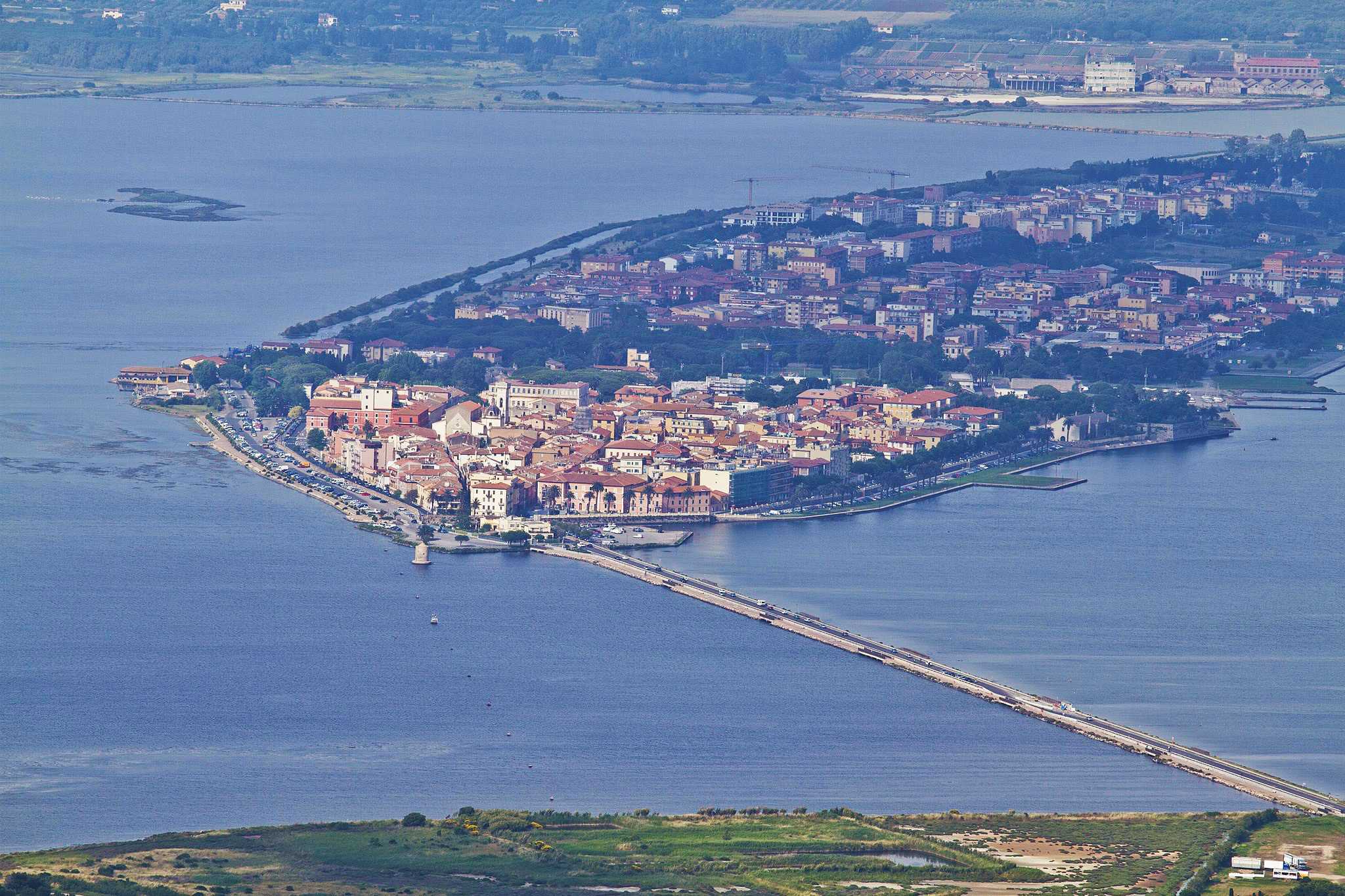
The town stands in the middle of the lagoon and is joined to the promontory of Argentario by a road built on an artificial embankment, the dam, which divided the body of water into two distinct basins: the Levante Lagoon and the Ponente Lagoon. It's not a map detail. The two lagoons have different management histories, different water exchange and different wildlife, and anyone who comes here for the birds needs to know which of the two interests them.
Until 1944 a railway also ran on the dam, linking Orbetello to Porto Santo Stefano. The war took it away together with the seaplane base, and the route today is memory and roadbed, not track.
The municipal territory is varied in an almost textbook way. The lagoon wetland is closed off from the sea by two tomboli, the Tombolo della Feniglia and the Tombolo della Giannella, long sandbars covered in pine forest and Mediterranean scrub and fringed by beaches that in summer become the main tourist draw. Toward the reliefs of Talamone and of Ansedonia the coast changes character: it becomes rocky, sharp, hard to access, and anyone looking for sand there won't find it.
The hinterland is made of modest hills, where the vegetation grows spontaneously and forms tangled scrub, and of flat zones once malarial and today intensively farmed. The land reclamation is the reason this landscape exists in the form we see: without the work on the waters, the Albegna plain would still be a marsh. It's worth keeping in mind while driving among the fields toward Albinia.
The municipality has a little over 14,000 inhabitants and includes the hamlets of Albinia, Ansedonia, Fonteblanda, Giannella, Quattro Strade, San Donato and Talamone. It is one of the reasons a serious visit to Orbetello doesn't end inside the walls: the municipality is big, and the best pieces are spread out.
The history of Orbetello (GR), from the Etruscans to the State of the Presidi
The Etruscan origins and the Roman port
The area has been frequented since the Etruscan period, when it must have worked as a maritime landing along the routes linking the northern Etruscan cities with the southern ones, Vulci and Tarquinia first among them. The importance of the landing grew with Rome, which founded the colony of Cosa near Ansedonia.
A settlement called Alminia, at the mouth of the Albegna river, appears together with Talamone in the Itinerarium Maritimum, the ancient list of cities, stations and ports along the route that led from Rome to Provence. The archaeological digs carried out between 1997 and 2002 showed that in Roman times, at least until the 1st century BC, between the present town of Albinia and the river mouth there was a port serving a series of workshops that produced amphorae. It's a fact that changes how you see the place: not just any landing, but a production district with an industry of its own.
The Middle Ages, the Abbey of Tre Fontane and the Aldobrandeschi
In 1074 the medietatem Castri Orbitelli was donated by Pope Gregory VII, born Hildebrand of Soana, together with other appurtenances and nearby localities, among them the Civitas Ansedoniae, the Castrum Elsae (perhaps the present Stachilagi castle) and Monte Argentario, to the abbey of Tre Fontane in Rome, otherwise known as Sant'Anastasio alle Acque Salvie. The donation confirmed an act attributed to 805 to Charlemagne and Pope Leo III, held however to be apocryphal by scholars. The distinction between an authentic document and a late one has to be kept, because it is what separates history from local legend.
Tradition has it instead that it was Pietro II Farnese, commander of the papal cavalry, who defeated the Ghibelline armies of Tuscany in 1110 and, probably, founded the village. In medieval documents the name appears as Orbetellum and Orbitellus, and is made to derive either from the diminutive of Latin herbetum, grassy place, or from the juxtaposition of orbis and tellus, land surrounded by waters. Neither etymology is proven. They are hypotheses, and as hypotheses they should be told.
In 1161 Pope Alexander III confirmed the possession to the abbey of Acque Salvie. In 1262 Orbetello appears as one of the liveliest and most populous centers of the county of the Aldobrandeschi, who as vassals of the abbey ruled the territory until the early 14th century, when it was occupied by the people of Orvieto.
In 1286 Countess Margherita, daughter of Ildebrandino of Soana, recognized the emphyteusis contract for the properties received from the monastery of Sant'Anastasio: among them Ansedonia with the port of Phenilia, Orbetello, Porto Ercole, the Argentario, the Giglio, Giannutri, Marsilianum, Capalbio, Altrocosto and Serpena, with all the appurtenances and rights attached including those of navigation and fishing, at an annual rent of 15 pounds. In 1302 the Aldobrandeschi lost the possession by order of Pope Boniface VIII, having sided with the party of Guido of Santa Fiora, declared a public enemy of the Church. In 1303 the same pope granted those properties to Benedetto Caetani.
The Orsini, who succeeded the Aldobrandeschi by marriage, tried to retake Orbetello but had to yield to Orvieto. In 1358 the abbey of Tre Fontane nonetheless renewed the enfeoffment in favor of the Orsini, investing Counts Ildebrandino, Nicola and Gentile as lords of Orbetello.
Siena, 1414 and the race for an outlet to the sea
On August 18, 1414 the fortress was conquered by the Sienese, and in 1417 the whole Orbetello countryside became part of Siena, which had been seeking that outlet to the sea for decades. In 1452 Pope Nicholas V recognized for the Commune of Siena the conquest of the territories already held by the Aldobrandeschi and renewed with the Sienese the emphyteusis contract by fiduciary right and in perpetuity, after a settlement for the unpaid rents, listing one by one the properties of the abbey of Sant'Anastasio that passed to Siena.
These are the decades when the lagoon stops being just a food resource and becomes an installation: the nine Sienese windmills of the 15th century were born in that context, and only one has come down to us.
The State of the Presidi: Orbetello as Spanish capital
At the end of the Republic of Siena, from 1557, thanks to the conquest by Charles V, the territory became the seat of the State of the Presidi of Spain, which extended along the coast from Talamone to Capalbio. The feudal rights of the abbey of Tre Fontane definitively lapsed, even if the abbey continued to hold the spiritual care of the places. For two and a half centuries Orbetello was a capital in miniature: governor, garrison, military shipyards, customs. The bastioned walls, the powder magazine, the monumental gates are the visible legacy of that period, and they are the reason the town looks like no other Maremma village.
Austrians, Bourbons, Kingdom of Italy
From 1707 to 1736 the territory was governed by the Austrians. From 1736 the State of the Presidi entered the Kingdom of Naples and was governed by the Bourbons until 1801, starting with Charles of Bourbon, king of Naples and Sicily and then king of Spain with the title of Charles III. After him the government passed to his son Ferdinand IV. Incorporated into the Kingdom of Etruria, the territory passed to the Grand Duchy of Tuscany and, in 1860, to the Kingdom of Sardinia, and the year after to the Kingdom of Italy.
The 1900s: Italo Balbo, the seaplane base and the war
Orbetello became a name known across Europe when from the Orbetello lagoon, between 1927 and 1933, Italo Balbo set off with his squadrons of seaplanes for the four aerial cruises. In the Levante lagoon there was a seaplane base of international importance, with hangars designed by Pier Luigi Nervi, one of the most influential engineers of the century. It was destroyed in 1944 by the German occupying forces. Today in that area is the Parco delle Crociere.
In the postwar period the town saw strong population growth and an urban expansion that made it the third center of the province by population. Today it is an established tourist destination, a protected site for the presence of the lagoon and important for fishing and fish farming.

What to see in Orbetello (GR): the historic center step by step
Orbetello has a single traffic light. It's the kind of detail told at the bar that nonetheless says something true about the scale of the place: here you walk, you don't drive. The town works like a small Tyrrhenian Venice, with the fishermen's little boats in place of gondolas and the lagoon reaching to lap the public gardens.
The Spanish windmill and the dam of Orbetello
Coming from the Argentario you travel along the dam built in 1842 by Grand Duke Leopold II of Lorraine, and on the left the circular windmill emerges from the water. It is the only survivor of the nine mills built by the Sienese during the 15th century. Originally they worked with a water-driven mechanism, and the grain arrived on the barchini, the flat boats typical of the lagoon. In 1557, with the move to Spanish rule, the mills were restored and reinforced and, thanks to new sail blades, converted to harness the mistral and the scirocco: hence the name Spanish windmill. It has a conical roof and a rear wind propeller, and still guards the Ponente lagoon at the start of the embankment.
Straight opinion: the mill is the tourist symbol of the town and is rightly photographed to death, but the moment when it is really worth looking at it is not noon, when the light flattens it. It is the hour before sunset, with the lagoon turning into a mirror and the black silhouette against the sky. If you have only one day, organize it around that quarter of an hour.
The Etruscan walls and the gates of Orbetello (GR)
Past the mill you meet the best-preserved stretch of the Etruscan walls in large polygonal blocks, datable to the 4th century BC according to the traditional reading, with part of the scholarship placing them as early as the 5th. They are walls you can touch with your hand while walking the lagoon promenade: you don't need a ticket, you need to notice them.
The Spanish strengthened the circuit by building on the land side the imposing bastioned line, of which remain visible the two town gates, the fortress raised around the old Cassero and in part two ravelins. Porta Medina Coeli, or Porta Nuova, was built in 1697 along the walls and took its name from the Spanish governor of the time, the Duke of Medina Coeli: it is still today the main entrance to the historic core. Porta a Terra, from the 1600s, has Baroque forms and was reached by a drawbridge, with the guardhouse rooms at the sides. Porta del Soccorso, built around 1620 in travertine, is lightened by an elegant pediment with a plaque.
Corso Italia, Piazza Plebiscito and the Governor's palace
Corso Italia is the street for the passeggiata and the shops, and leads to Piazza Plebiscito and then to the square where the Governor's palace stands, seat of the Spanish governor general of the State of the Presidi, recognizable by its arcaded loggia and clock tower. At the center of the portico stands a bust of Giuseppe Garibaldi made by the sculptor Ettore Ferrari, the same author as the monument to Giordano Bruno in Campo de' Fiori in Rome.
The square appears in the sources both as Piazza Garibaldi and as Piazza Eroe dei Due Mondi. It is the same place, and the double name confuses anyone looking for the address on maps.
Piazza IV Novembre and the church of the Madonna delle Grazie
Continuing you arrive in Piazza IV Novembre, where the little church of Santa Maria delle Grazie, formerly Santa Maria ad Portam, deserves a stop, keeping a 15th-century fresco of the Sienese school. Since the 16th century the church has been absorbed into the complex of the united hospitals of San Giovanni di Dio and was altered in the 19th century, when the hospital was annexed to the military hospital of San Giacomo. At the center of the entrance portal the municipal coat of arms of Orbetello is carved.
Inside are preserved works of good quality: the fresco of the Madonna and Child enthroned between Saints Peter and Paul, attributed to a follower of Benvenuto di Giovanni, and an 18th-century painting of the Madonna and Child in glory among angels attributed to the workshop of Sebastiano Conca. Attributions, not signatures: the difference matters, and anyone who tells you otherwise is selling certainties that art historians don't have.
The Duomo of Orbetello (GR): the co-cathedral of Santa Maria Assunta
Walking along the Lungolaguna di Ponente, which also preserves stretches of Etruscan walls, you reach Piazza della Repubblica and the Duomo. The co-cathedral of Santa Maria Assunta is the main church of the municipal territory. Of Romanesque origin, it bears the marks of the renovation ordered by the Orsini between 1370 and 1376, and there is record of an enlargement as early as 1201. In 1582 it was raised to a collegiate church by Cardinal Alessandro Farnese, and in the following century it was enlarged again with the addition of the two side aisles and the dome of the chapel of San Biagio, setting the late Gothic facade inside a larger one. The neo-Gothic bell tower dates to 1898. In 1981 the church was raised to co-cathedral of the diocese of Pitigliano-Sovana-Orbetello.
The high base the church sits on would reproduce the podium of a pre-existing temple, and many therefore maintain the existence of an Etruscan and then Roman temple under the Duomo. But there is no certain proof. It is a reasonable archaeological hypothesis, not an established fact, and it should be said clearly.
Inside are preserved the 18th-century canvas of the Circumcision, inspired by Apollonio Nasini, the Assumption of the Madonna, made in 1801 for the king of Naples, a 19th-century tempera painting of the Madonna enthroned among angels against the background of the lagoon, and the small copper paintings with the mysteries of the Rosary by Francesco Nasini. The parish of San Biagio in the co-cathedral has about 3,610 inhabitants.
The late Gothic facade is the most beautiful thing in the historic center and people look at it for 30 seconds. Stay twice as long: the interlock between the old front and the 17th-century casing tells the whole history of the city in one go.
San Francesco da Paola, San Giuseppe and the other minor churches
In the urban center there remains to visit the church of San Francesco da Paola, in Piazza Beccaria, which dates to the 16th century and was built with the attached convent, now gone, as the seat of the tertiaries of the Minims of Saint Francis of Paola. Inside you see many tomb slabs of commanders and governors of the State of the Presidi, and on the high altar a 17th-century altarpiece with the apparition of the Annunciation to Saint Francis of Paola and Saint Blaise. The epigraphs of the Spanish period are the most immediate source for understanding who ruled here and for how long.
The church of San Giuseppe, from the 16th century and reworked several times, keeps a contemporary mural painting with Angels adoring the monstrance and an 18th-century wooden statue of the Immaculate Conception, of Neapolitan manufacture: a material clue to the link with the Kingdom of Naples.
The church of Sant'Antonio, in Via Dante, was built between the end of the 17th and the early 18th century. Today it is deconsecrated and keeps the Baroque altar and some burial slabs. The church of the Madonna delle Vigne, built in the 19th century in Neo-Romanesque style on the site of an earlier small rural chapel, was the parish church of Orbetello Scalo from 1941 to 1967, before the building of the modern church of the Cottolengo.
The Guzman powder magazine and the Archaeological Museum of Orbetello (GR)
The Porta Nuova complex, with the access gates to the historic center, leads to the Guzman powder magazine, a building of 1692 built by the Spanish and designed by the Flemish architect Ferdinand De Grunembergh. The name comes from the nearby Guzmán bastion. It served to hold tons of explosive, and in front of the windows curious obelisks were put up with the function of protecting the contents from gunfire.
The restored structure today houses the Municipal Archaeological Museum, on the first floor of the building, at Via Mura di Levante 3. The collections cover a span from prehistory to the Roman age and are organized in three large groups. First the materials from the Orbetello necropolis, with embossed gold ornaments, bronzes and ceramics tied to the banquet, referred to the Etruscan aristocracy of the 4th century BC. Then the materials from the Talamone area, with decorative elements of a temple and the contents of a votive deposit that includes weapons and miniature farm tools. Finally the acquisitions from the territory, from Pescia Romana, Chiarone, San Donato and Monte Argentario. Guided visits and educational activities are available by reservation, along with a bookshop and the audio guide. The building is not accessible to people in wheelchairs: anyone with mobility problems should know it before climbing all the way up.
The miniature farm tools in the votive deposit are the thing I recommend looking at longest. They are poor objects, offered by ordinary people, and they tell of an everyday religiosity that the gold of the necropolis doesn't tell at all.
The Umberto I barracks and the Talamone pediment
Piazza della Repubblica is overlooked by the former Umberto I barracks, created in 1808 by enlarging the old convent of the Poor Clares, founded in 1651 and suppressed in the Napoleonic era. The building keeps the architectural traces of its original religious function and today hosts civic uses, among them the Pietro Raveggi municipal library.
A story worth knowing has played out here. The Talamone pediment, an extraordinary example of a terracotta pediment of the Etruscan-Hellenistic era, datable to around 150 BC, comes from the temple of Poggio Talamonaccio and depicts the Theban myth, with the final duel between the brothers Eteocles and Polynices at the center and around them the other heroes of the expedition of the Seven against Thebes. Found at the end of the 1800s, it belongs to the National Archaeological Museum of Florence, which granted it on display in Orbetello in the Umberto I barracks. The exhibition venue has had alternating fortunes over the years: anyone coming specifically to see the pediment should ask the Comune or the museum for confirmation before setting out, because it is a piece that has moved more than once.
Panoramic views from the Passionist convent
To a first-time visitor I recommend starting from above. You take the road from Orbetello to Porto Santo Stefano, turn left onto the provincial road that climbs toward the summit of Monte Argentario, and at an elevation of 273 meters you find the Passionist convent. From up there the geography explains itself: on the right the Feniglia tombolo, on the left the Giannella tombolo, at the center the city surrounded by 26 square kilometers of lagoon. 10 minutes up there are worth an hour of explanations.

The Orbetello lagoon (GR): WWF oasis, birds and fishing
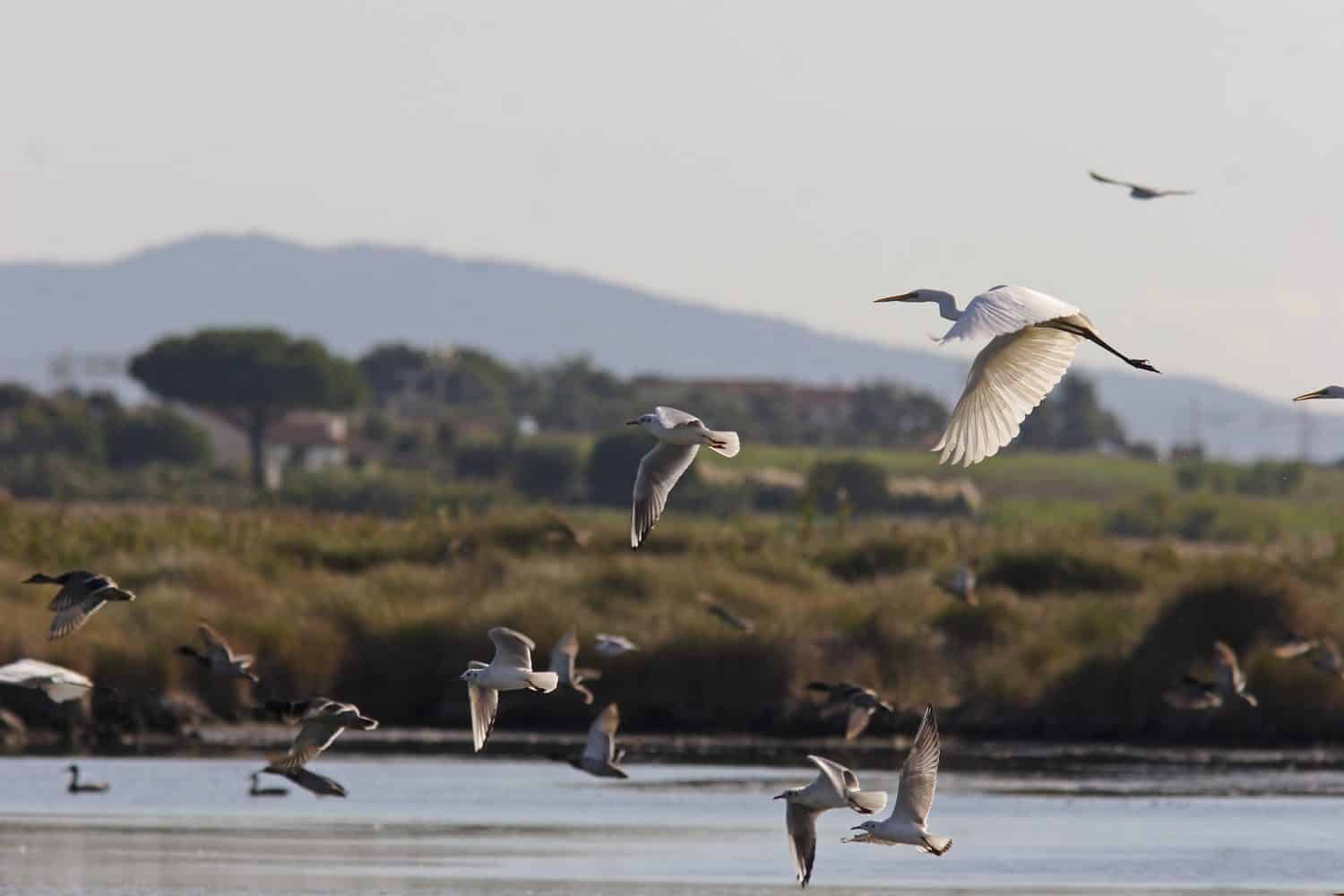
Orbetello is first of all a lagoon, and the lagoon is visited on foot. From the Orbetello Scalo station starts the bike and pedestrian path that runs along the whole Ponente lagoon, the one protected by the WWF, to the center of the city: a walk of about an hour, stops included. Those who live here are used to the sight of pink flamingos, which winter every year from fall to spring, of white herons and of flocks of coots in flight. The lagoon has a surface of 26.22 square kilometers and is a stretch of sea between the two coastal strips that join the promontory of Argentario to the mainland.
The WWF Orbetello Lagoon Oasis and the Casale Giannella
The WWF Oasis extends over 870 hectares in the municipality of Orbetello and is recognized as a wetland of international importance: one of the most important Italian wintering areas for many bird species. You can see thousands of individuals among ducks, herons, geese, cranes, flamingos, lapwings, waders and raptors. Among the most prized presences are the nesting osprey and the colonies of common terns.
The visiting calendar is the thing that ruins more trips than any other. From September 22 to May 10 the oasis is open on Saturdays, Sundays and holidays from 9 to 16. From May 11 to September 21 access is only by guided visits, on Tuesdays, Thursdays, Saturdays and Sundays at 17:30. The entrance is at Casale Giannella, on Strada Provinciale 36 della Giannella at kilometer 4, between Albinia and Orbetello. The WWF warns explicitly that the oasis entrance cannot be reached on foot or by bicycle. To book: 388 4231098, also by WhatsApp, or oasiorbetello@wwf.it. Costs and calendar should be confirmed on the official WWF website, because the seasonal openings change.
The Casale della Giannella, born as a coastal tower in the second half of the 16th century, is today the seat of the Aurelio Peccei environmental education center, founded in 1989, and is the gateway to the oasis on the tombolo. If I had to name a single thing worth planning a winter weekend in the Maremma for, I would name this: the flamingos on the Ponente lagoon in January, in low light, are a show that in August simply doesn't exist.
The black-winged stilt and birdwatching in the lagoon
Among the most recognizable winged residents of the lagoon is the black-winged stilt, a black and white wader with very long red legs, a protected species and a symbol of Italian wetlands. To watch it well you need three simple things: decent binoculars, silence and the patience to stay still for 20 minutes in the same hide. Anyone who arrives talking loudly sees much less, and it's not the birds' fault.
The best period for birdwatching runs from October to March, when the lagoon hosts the wintering birds. In spring the migratory traffic is intense but quicker. In midsummer the numbers drop and the midday heat makes everything harder, a further reason why in summer the guided visits are set in the late afternoon.

The fishermen of Orbetello, bottarga and the Slow Food Presidium
If you're passing through, stop by the fishermen's cooperative La Peschereccia, founded in 1946 by the union of 13 members, and the company Orbetello Pesca Lagunare, born in 1989. They deal with fishing and all related activities, eco-sustainable tourism and events. The tasting center is in a restored 19th-century stable, on the Ponente lagoon, and you eat fresh fish there at prices that are honest for the area. Updated hours and information are on the site ipescatoriorbetello.it.
The traditional fishing of the Orbetello lagoon is a Slow Food Presidium, and it's worth understanding why. The historic catching system is the lavoriero, a barrier once of wood and today mechanized, placed at the channels linking the lagoon to the sea: it uses the flow of the tides to funnel the fish into catching chambers. Alongside the lavoriero are used the tramaglio, a fixed net with three layers of mesh that catches every species, and more selective gear such as martavelli and fish traps, used for eels, winter crabs, shrimp and gobies. The lagoon yields sea bass, sea bream, mullet, eels, sand smelt and shrimp according to the calendar of the seasons. The cooperative brings together about 40 fishermen and the processing takes place at Orbetello Pesca Lagunare.
The emblematic product is bottarga: salted roe of female mullet, dried after salting and served by tradition in thin slices with oil and lemon. Two preservation techniques still practiced are traced back to the Spanish rule of the 16th and 17th centuries: the sfumatura, with a sauce based on pepper, and the scavecciatura, a marinade with hot vinegar, rosemary, garlic and pepper. Sfumata eel is the most famous result of the first. Personal opinion: Orbetello's bottarga holds up against the Sardinian ones and costs less than its value, and buying it here from the fishermen instead of in a souvenir shop is the difference between taking home a product and taking home a package.

The Remus navebus and trips on the lagoon
Since 2005 the fishermen of Orbetello and the pro loco have organized trips on the lagoon with the Remus, a boat able to carry up to 38 passengers on guided visits during which the activity of fishing is told in its historical and social context. It's the smartest way to understand the lavoriero: from the water you see how it works, from land you don't. Costs, hours and period of operation should be asked directly of the pro loco or the cooperative, because the calendar is seasonal.
The dam and the bike loop
The dam bridge, ordered in 1842 by Leopold II of Lorraine, joins Orbetello to Monte Argentario. Besides by car, you can cross it comfortably along the bike and pedestrian path connected to the loop of the Levante Lagoon: 19 kilometers almost entirely flat, with a practically obligatory stop for a swim at the Feniglia beach. It's a ride within reach of anyone with a bicycle and half a day, and the only serious advice is to do it counterclockwise early in the morning, when the sun is not yet in your face and the fallow deer of the Feniglia can still be seen.
The hamlets and territory of Orbetello (GR)
Talamone, the Aldobrandeschi fortress and the walls
Talamone is the seafaring village of the municipality, dominated by the Aldobrandeschi fortress, an imposing stronghold built around the middle of the 13th century with lookout and defense functions over the landing below. Enlarged and restructured by the Sienese in the following century, it was altered again in the 15th century, half destroyed by pirate raids and restored in the second half of the 16th century with the entry of the locality into the State of the Presidi. In 1944 it suffered bombing damage, followed by restorations that brought it back to its present look.
The walls of Talamone tell the same story in the form of a building site: a first circuit built in the 13th century by the Aldobrandeschi, a restructuring begun in 1465 and entrusted to the Lombards Elia Mattei, Pietro Giovanni and Giovanni Albini, further restorations directed in 1541 by the architect Antonio Maria Lari after the damage of a violent pirate raid, the Spanish strengthening in the 16th and 17th centuries, the bombings of 1944 and the restorations up to those of 2012. Of the old access gates to the village only the so-called Porta Garibaldi remains today.
The parish church of Santa Maria Assunta in Talamone was rebuilt in 1949 after the 1944 bombings had destroyed the earlier building, dating to 1374 and redone in the 17th century. Inside some 17th-century works are preserved. The parish has about 550 inhabitants. Along the provincial road linking the village to Fonteblanda is the church of the Madonna delle Grazie, from the 17th century, with a facade preceded by a portico of three orders of arches and a bell gable. In the cemetery of Talamone is the Vivarelli Mausoleum, a monumental funerary chapel in Liberty style built between 1905 and 1906 by the architect Lorenzo Porciatti for Cavalier Jader Vivarelli. The Talamone lighthouse, from 1865, was activated by the Navy to light the promontory and owes its present look to the renovation of 1947.
Ansedonia, Cosa and the Torre della Tagliata
Cosa was founded by the Romans in 273 BC as a colony and was abandoned completely in the 14th century. Remains survive of the Cyclopean walls, the forum and the temple of Jupiter. Not far away is the villa of Settefinestre, from the 1st century BC, modified in the 15th century. The walls of Cosa, built during the 3rd century BC, extended for almost a kilometer and a half and were reinforced by 18 towers. After the fall of the empire and the abandonment of the city they suffered deep decay, until they were restored by the Aldobrandeschi in the 11th century and then abandoned again. A long restoration finished at the end of the 20th century brought them back to legible condition.
At Ansedonia there are also the church of San Biagio alla Tagliata, built on an ancient Roman mausoleum, the Torre di San Biagio, built in the Middle Ages as a watchtower and strengthened by the Spanish in the 16th century and today a well-preserved ruin near the so-called spacco della Regina, and the Torre della Tagliata, built in the 16th century on the site of a medieval tower and then turned into a home. It was a residence of Giacomo Puccini, who worked on his works here, among them Turandot.
Albinia, the Forte delle Saline, Fonteblanda and Poggio Talamonaccio
Albinia is the northern gate of the municipality, on the Albegna plain. Here is the Forte delle Saline, a fortified structure ordered by the Sienese in the 15th century, with a design dated 1469, and then modified and strengthened by the Spanish in 1630. It served to control the adjacent salt pans, a leading economic resource, the river landing of the Albegna and the passage over the Giannella tombolo. Today it is publicly owned and used as an archive of the Soprintendenza: it is therefore not a tourist visit, and it's better to know that before you reach the gate. The parish church of Albinia, Santa Maria delle Grazie, consecrated on April 8, 1957, has simple forms recalling Neo-Romanesque and keeps a venerated statue of Saint Rita. The parish has about 3,600 inhabitants.
Poggio Talamonaccio, a promontory that closes the gulf of Talamone to the south not far from Fonteblanda, hosted in the Etruscan-Roman era the original settlement of Talamone, equipped also with a port. Right here stood the Etruscan temple of the end of the 4th century BC from which the pediment comes. The Torre di Talamonaccio, built in the Middle Ages as a watchtower and strengthened by the Spanish in the 16th century, is today a private residence and is known for having been used as a set for the film Quantum of Solace in 2008.
The church of Santa Maria Goretti, parish church of Fonteblanda, was begun in 1950 and consecrated only on July 5, 1980. The parish has about 1,390 inhabitants. Near Fonteblanda, along the Osa beach and inside a hotel complex, stands the church commonly called Santa Maria dell'Osa, in fact the church of the Blessed Virgin Mary of Pompeii, built in 1963 to a design by the architect Ico Parisi and renovated in 1991: a rare example of modern religious architecture in the Maremma, signed by a protagonist of Italian design.
The parish churches of Orbetello (GR) and its hamlets
Besides the Duomo, the territory has a system of 20th-century parishes worth listing in full, because it tells the postwar urban expansion better than any statistic. The church of San Giuseppe Benedetto Cottolengo, parish church of the Orbetello Scalo district, was consecrated on June 11, 1967 and keeps a crucifix of 1967 by the painter Sigfrido Maovaz and a Via Crucis by Gianpaolo Marchesi of 1970. The complex also includes the baptistery chapel and the parish priest's office, and the parish has about 1,650 inhabitants. The church of San Paolo della Croce, parish church of the Neghelli district, was consecrated on October 11, 1987 by Bishop Eugenio Binini and has a bell tower with eight bells installed on steel supports. The parish has about 3,800 inhabitants.
The church of San Donato, parish church of the rural hamlet of the same name, was consecrated on May 28, 1961 and strongly wanted by Bishop Paolo Galeazzi. The parish had been established on April 1, 1943 and has about 540 inhabitants. Beside the church rises a spired bell tower 37 meters high with four bells. The church of the Madonna di Loreto, in the rural locality of Polverosa, was built to a design by Carlo Boccianti and consecrated on December 7, 1958 by the same Bishop Galeazzi. The parish was established on January 1, 1955 and has about 400 inhabitants. The building has sober Neo-Romanesque forms, a facade preceded by a portico and the wrought-iron coat of arms of Monsignor Galeazzi, who promoted its construction.
Among the other religious buildings of the territory are the chapel of Sant'Antonio alla Giannella and the monastery of Sant'Angelo, known as Sant'Angelo Rovinato, today reduced to ruins. It was the seat of a Benedictine monastery dating to the 10th century. In the cemetery of Orbetello rest Italo Balbo and the other pilots who fell on June 28, 1940 at Tobruk.
Coastal towers and fortifications around Orbetello (GR)
The system of coastal towers is the least visited and most fascinating chapter of the territory. The Torre di San Pancrazio was built in the second half of the 16th century by the Spanish to strengthen the coastal defense of the State of the Presidi and served as lookout, defense and offense until the early 1800s. Today it is absorbed into a private complex. The Torre delle Cannelle, north of Talamone on a promontory sheer above the sea near Cala di Forno, was built by the Medici in the second half of the 16th century at the southern borders of the Grand Duchy of Tuscany, restructured in the 1700s and decommissioned in the second half of the following century. Today it is used as a hotel. The Torre di Capo d'Uomo, a little north of Talamone inside the Maremma Natural Park, dates to the second half of the 16th century and is built on a pre-existing medieval fortification. Restored in the 1700s, it was decommissioned in the first half of the 1800s with the entry of Talamone into the Grand Duchy and is now a private residence. The Torre di Poggio Raso, also north of Talamone in the park, is of medieval origin with substantial renovations in the 15th century and at the end of the 16th. After its defensive function ended following the unification of Italy it was sold to private owners and today hosts an accommodation facility.
To these are added the two great military structures of the main town: the former Guzman powder magazine, of 1692, and the former A. Brunetta airport, that is the former seaplane base, built in the early 1900s, a protagonist at the time of the transatlantic flights and destroyed in 1944 by the German occupying forces.

Trekking, biking and natural areas around Orbetello (GR)
Anyone who loves walking has plenty to choose from here. The lagoon loop is an entirely flat route that runs along its shores and lends itself to being broken into short stretches. The Duna Feniglia Nature Reserve runs parallel to the beach of the same name and preserves intact the ecosystem of the tombolo that bounds the lagoon to the south. It is traveled on foot and by bicycle, several fallow deer live freely inside it and in the central part of the beach, about six kilometers long, there is a zone frequented by naturists. The Tombolo della Giannella preserves much of the original ecosystem of the strip that bounds the lagoon to the west, between the mouth of the Albegna and the Santa Liberata canal.
From Orbetello Scalo starts a route that leads to the ruins of the monastery of Sant'Angelo Rovinato. Another reaches the viewpoint of the Tenuta della Parrina. Many trails cross the Argentario promontory, and guides devoted to it circulate online and in bookstores, among them one that describes 31 itineraries proposed by the Argentario Trekking group.
The Maremma Natural Park, a regional protected area between Talamone and Principina a Mare, extends from the southern slopes of the Uccellina mountains to the marsh area beyond the mouth of the Ombrone and preserves a vast zone of Mediterranean scrub together with the wetland environment. Talamone is its southern entrance, and this makes Orbetello a smart logistical base for two days of nature. Finally, Campo Regio should be mentioned, a biotope included in regional site of interest B20 near Fonteblanda.
Blunt opinion: the most beautiful stretch on foot is not the most famous one. The Feniglia in summer is packed in the first two kilometers from the Ansedonia gate and almost deserted in the middle. Walk 20 more minutes and you find yourselves alone, with the fallow deer.
The festivals of Orbetello (GR): barchini, San Biagio and the Piano Festival
The race of the barchini is the traditional maritime palio held in the waters of the lagoon on the last Sunday of July. The five rioni compete: the three of the historic center, Duomo, Piazza d'Armi and Porto, and the two modern ones, Neghelli and Stazione. Local tradition dates the first races to 1768, but that is exactly a tradition, not a date documented by a deed: whoever tells it as certainty goes beyond the sources.
The festival of San Biagio honors the patron saint of the city and is held in May, postponed from the calendar feast of February 3. Besides the religious service a procession is organized through the streets of the historic center and the barchini are lit up on the lagoon: it is the evening when the city is most beautiful, and almost no tourist knows it.
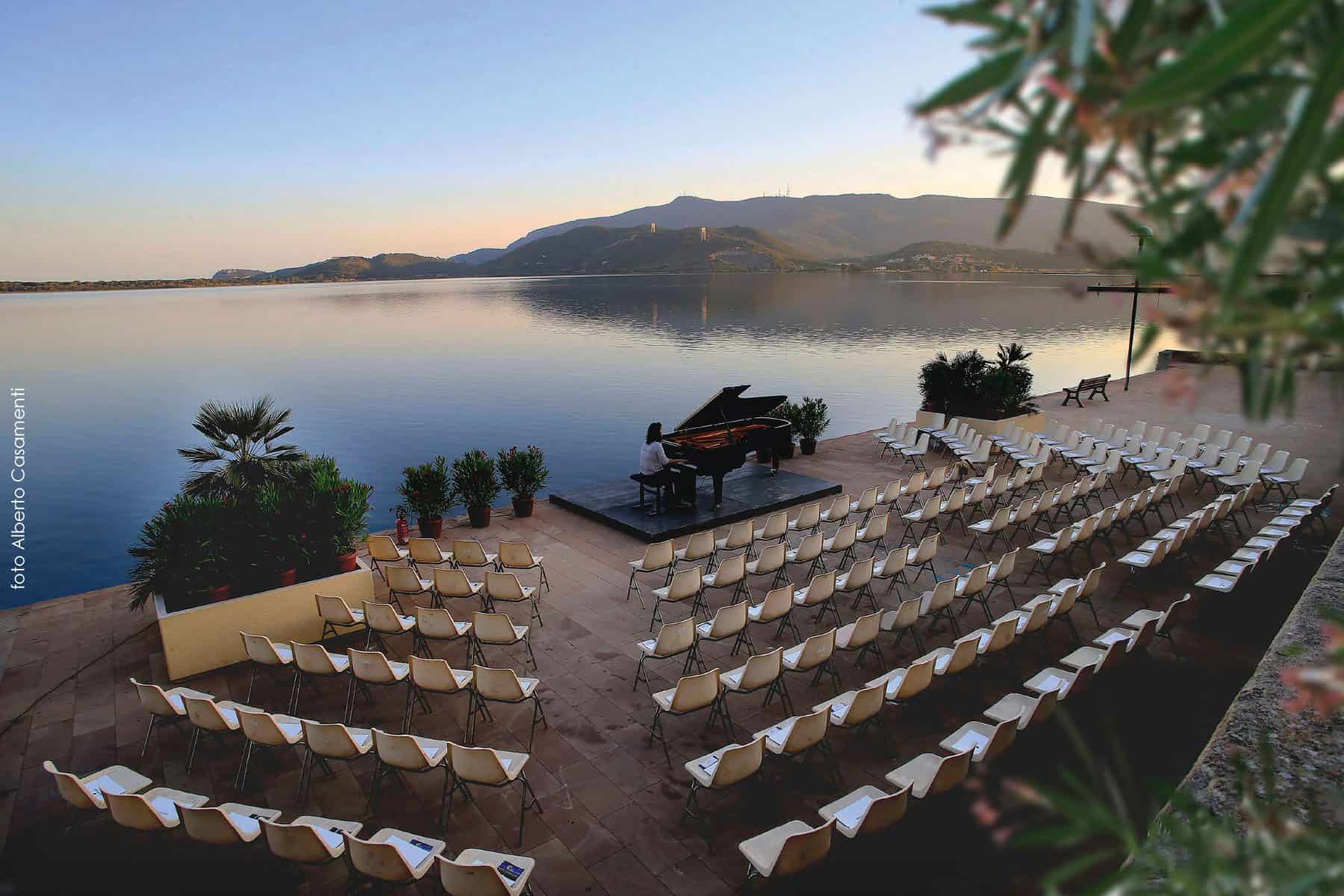
In summer comes the Orbetello Piano Festival, an international piano series that in 2026 reached its 15th edition, with the artistic direction of Giuliano Adorno. The concerts are held in unconventional places: the terrace of the Guzman powder magazine overlooking the lagoon, the botanical garden, the WWF Oasis of the Bosco di Patanella and the Casale Giannella. The exact dates vary from year to year and press sources don't always agree with each other. The official calendar is on the festival website, orbetellopianofestival.it, and that is where you should check before booking a hotel.
A concert at sunset on the terrace of a Spanish powder magazine, with flamingos within a few hundred meters, is one of those experiences that alone justify a two-hour trip from Rome. If you happen to be here in summer, check if a date is available before you even decide what to visit.
A curiosity about Orbetello (GR)
The curiosity I like to tell in front of the Guzman powder magazine concerns four obelisks. The building, built in 1692 to a design by the Flemish architect Ferdinand De Grunembergh, had to hold tons of gunpowder a few tens of meters from the houses. The problem was not accidental fire, which could be controlled with the discipline of the garrison: it was enemy fire. A cannon or musket shot coming in through a window would have blown half the city sky high. The solution adopted by the Spanish designers is as rudimentary as it is ingenious: in front of every opening stone obelisks were erected, vertical screens meant to intercept incoming projectiles before they could slip into the opening.
They are still there today, and most visitors mistake them for decoration. They are not: they are military engineering of the 1600s, and they are one of the very few visible examples of this device in Italy. It's worth getting close and looking at the alignment between the obelisk and the window it protects: the geometry is exact, calculated on the angle of fire possible from the land side.
There is a second level of curiosity, and it is political. A powder magazine of that size in a town of just a few thousand souls says how much Orbetello counted in the defensive system of the Spanish monarchy in the Mediterranean. It was not a village warehouse: it was the depot of a sovereign State, the State of the Presidi, which kept under control the route between Spain and the Kingdom of Naples. When in 1860 Garibaldi came to resupply here, he took ammunition from a structure designed 160 years earlier for a completely different war.
Something nobody tells you about Orbetello (GR)
It must be said plainly, because it's the most frequent mistake and it ruins days: the WWF Orbetello Lagoon Oasis is not visited whenever you want. The WWF publishes a rigid seasonal calendar. From September 22 to May 10 the oasis opens only on Saturdays, Sundays and holidays, from 9 to 16. From May 11 to September 21, that is, in the whole high tourist season, access is allowed only with guided visits, on four days of the week, Tuesday, Thursday, Saturday and Sunday, at a single time: 17:30.
It means that a family arriving in Orbetello on a Wednesday in August at 11 in the morning with the idea of going to see the flamingos doesn't get in, period. And it also means that the visit has to be booked at the number given by the WWF, 388 4231098, also available on WhatsApp, or by email at oasiorbetello@wwf.it.
There is a second detail, and it's the one that throws into crisis anyone planning by bicycle: the oasis entrance cannot be reached on foot or by bicycle. The WWF itself writes it. Access is at Casale Giannella, at kilometer 4 of provincial road 36 della Giannella, on a road you travel by car. Anyone who left the car in the center and rented a bike for the day does not reach the oasis, and no printed tourist guide writes it this clearly.
Third thing nobody says: the Ponente lagoon and the Levante lagoon are separated by the dam and don't offer the same experience. The bike and pedestrian path from the station runs along the Ponente one and is public and always accessible, free, with no hours. It's the perfect fallback when the oasis is closed, and with good binoculars you still see herons, coots and, in the right months, flamingos.
The advice I give you for visiting Orbetello (GR)
My advice is to reverse the order in which almost everyone visits Orbetello. People arrive, park in the center, stroll the corso, photograph the mill, eat and leave for the beaches of the Argentario. Wrong. Orbetello should be started from above and finished on the water.
Early morning: go up to the Passionist convent at 273 meters and look at the shape of the tomboli and the double lagoon. It takes just 20 minutes, and from there on you will understand everything you see. Come down and leave the car outside the walls, toward Porta Nuova. Give the late morning to the historic center in the right order: Etruscan walls on the Lungolaguna di Ponente, Duomo, church of the Madonna delle Grazie, San Francesco da Paola, Guzman powder magazine with the archaeological museum. It's three full hours if the things really interest you, an hour and a half if you move fast.
Lunch at the fishermen's tasting center on the Ponente lagoon, not in a restaurant on the corso: it costs less and the fish is what they caught themselves. Buy the bottarga there, not elsewhere.
Afternoon: bicycle on the Levante Lagoon loop toward the Feniglia, or, if you booked in time and it's the right day, the guided visit to the WWF oasis at 17:30. The two things don't fit in the same day: choose.
Sunset on the dam, in front of the mill. There's no argument: it is the moment and the spot for which it's worth having come. If you have to cut something from the program, cut the museum, not the sunset. And if you have two days, give the second to Talamone and Ansedonia, which together with Orbetello form a single historical story and which almost no one connects.
Another well-known fact, yet seldom cited
That Orbetello was Spanish many people know, at least in the vague form of a tourist slogan. What almost no one brings into focus is the institutional meaning of it: from 1557 to 1801 Orbetello was not a Tuscan city with a foreign garrison. It was the capital of a sovereign State distinct from the Grand Duchy, the State of the Presidi, with its own governor general, its own administration, its own customs house and its own jurisdiction, extending along the coast from Talamone to Capalbio and including Porto Ercole, Porto Santo Stefano, the Argentario and Ansedonia.
The consequences can still be seen today while strolling. The Governor's palace on the main square is not a town hall: it is the residence of a representative of the crown of Spain. The slabs of commanders and governors in San Francesco da Paola are documents of a State, not of a passing garrison. The bastioned line on the land side is the fortified frontier of that State toward the Grand Duchy, that is, toward a potentially hostile neighbor. Even the place name Piazza d'Armi, one of the five rioni that run the barchini race, comes from there.
I add the passage that is almost always skipped: from 1707 to 1736 the territory was administered by the Austrians, and only from 1736 did it enter the orbit of the Bourbons of Naples, remaining there until 1801. It means that in less than a century the people of Orbetello changed three sovereignties without moving a meter. It is a case study of how fluid Italian political geography was before Unification, and it explains why the local material culture, from the cooking to the fish preservation techniques, is a recognizable hybrid.
The right photo to take in Orbetello (GR)
The right photo is just one and must be taken at a precise moment: the Spanish windmill from the dam, in the hour before sunset, with the Ponente lagoon calm.
The reasons are technical. The mill is isolated in the water a short way from the shore, so it has no urban background to disturb. In the golden hour the light comes from the west, that is, from behind the subject if you stand on the city side: if you want the dark silhouette against the orange sky stay on that side, if you want the stone lit up cross over and shoot from the other side. The lagoon, protected by the tomboli, is often a mirror in the evening, and the reflection doubles the subject. A light tripod and a long exposure turn the water into silk.
Two typical mistakes. The first is shooting at noon with the sun straight overhead: you get a gray cylinder with no volume. The second is putting it in the exact center of the frame: the mill holds up very well to the rule of thirds, and the dam stretching toward the Argentario is a natural leading line worth more than the subject.
The second photo, the one almost nobody takes, is from above: from the Passionist convent, above 270 meters, you frame the city as an island in the middle of the double lagoon, with the two tomboli closing the horizon. With the low winter fog it becomes memorable. The third is in the oasis, but it requires patience and a telephoto lens: the flamingos don't come closer, and anyone who tries to make them do so sends them into flight, which is exactly what you must not do in a protected area.
Some important events that happened here in history
1074, the donation of Gregory VII. The pope who shortly after would shake Europe with the investiture struggle donated half of the castle of Orbetello, together with Ansedonia and the Argentario, to the Roman abbey of Tre Fontane. It is the act that ties this strip of Maremma for almost five centuries to a monastery in Rome.
August 18, 1414, the Sienese conquest. The fortress falls into the hands of Siena, and in 1417 the whole Orbetello countryside enters the Republic. For Siena, a city without a sea, it is the conquest of an outlet awaited for generations. For Orbetello it is the beginning of the age of the windmills and the lagoon works.
1557, the birth of the State of the Presidi. After the fall of the Republic of Siena, the conquest by Charles V turns this stretch of coast into an autonomous Spanish dominion with Orbetello as capital. It is the event that drew the city we see: bastioned walls, monumental gates, powder magazine.
1692, the building of the Guzman powder magazine. A military building that two and a half centuries later becomes the city's archaeological museum and, in summer, the stage of an international piano festival. Few conversions are as eloquent.
1842, the dam of Leopold II. The grand duke has built the embankment that joins Orbetello to the Argentario. The city stops being almost an island and the lagoon is divided into two basins, with ecological consequences still studied today.
1860, Garibaldi. Landed at Talamone during the Expedition of the 1,000, Garibaldi reaches Orbetello and resupplies with ammunition at the Guzman powder magazine. 11 people from Orbetello offer to follow him, and the fortress of Talamone becomes the gathering point of the volunteers who embark.
1927-1933, the aerial cruises. From the seaplane base on the Levante lagoon, with hangars designed by Pier Luigi Nervi, Italo Balbo leads four aerial cruises with squadrons of seaplanes. For a few years the name of this provincial town appears in the newspapers of half the world.
June 28, 1940, Tobruk. Balbo and other pilots fall at Tobruk. They rest in the cemetery of Orbetello. The link between the city and aviation ends in the grimmest way.
1944, the destruction. The German occupying forces destroy the seaplane base. The railway on the dam to Porto Santo Stefano ceases to work. The bombings damage the fortress of Talamone and raze the parish church of the village. A single year erases half a century of infrastructure.
Who has passed through Orbetello (GR)
Pope Gregory VII, born Hildebrand of Soana, is the first documented name tied to this territory: the donation of 1074 to the abbey of Tre Fontane carries his signature. There is no record that he was physically here, and I won't write it: the link is legal, and that is already notable enough.
Cardinal Alessandro Farnese raised the Duomo to a collegiate church in 1582. Farnese power, which in this part of Italy is also met at Farnese, reaches here in the form of an ecclesiastical decree.
Grand Duke Leopold II of Lorraine is the material author of the landscape you photograph: the dam of 1842 is his work, and it is the most visible sign of Lorraine reformism in the Maremma, the same season that brought the land reclamations.
Giuseppe Garibaldi passed through here in 1860 during the Expedition of the 1,000: landing at Talamone, resupply of ammunition at the Orbetello powder magazine, 11 local volunteers embarked. The bust under the portico of the Governor's palace, the work of Ettore Ferrari, is the city's memory of that passage. Ferrari is the same sculptor as the monument to Giordano Bruno in Rome, and the choice to entrust him with the bust was not neutral in a city with a strong Risorgimento tradition.
Giacomo Puccini stayed at the Torre della Tagliata, in Ansedonia, and worked there on his works, among them Turandot. Anyone who arrives in Ansedonia looking for the tower finds it: it is a private residence, seen from outside, and the fact that a composer chose a Spanish tower on the sea as a studio says a lot about the character of this stretch of coast.
Italo Balbo is the heaviest 20th-century name. Between 1927 and 1933 he left from here for the four aerial cruises, and he has rested in the city cemetery since 1940. A historically cumbersome figure, tied to the Fascist regime: telling about him doesn't mean celebrating him, and his presence explains why Orbetello had a seaplane base of international importance.
Pier Luigi Nervi, the greatest Italian structural engineer of the 20th century, designed the hangars of the seaplane base. They were destroyed in 1944 and survive only in photographic documentation: it is an architectural loss that deserves to be remembered more than it is.
Ico Parisi, architect and designer of international fame, signed in 1963 the church of Santa Maria dell'Osa near Fonteblanda. Lorenzo Porciatti, the greatest Grosseto architect between the 1800s and 1900s, built the Vivarelli mausoleum in the cemetery of Talamone.
I add a collective presence, which counts more than many illustrious names: the fishermen. For centuries the same community has practiced the lavoriero in the channels between lagoon and sea. The continuity of that gesture is the true intangible heritage of Orbetello, and the recognition as a Slow Food Presidium certifies it.
When to go to Orbetello (GR) and when to avoid it
The best season, for those who come for the landscape and the birds, runs from October to March. It's cold, it's windy, the light is low and perfect, the flamingos are there, prices collapse and the historic center goes back to its inhabitants. The flip side is that in winter the oasis opens only on weekends and holidays and that several activities on the coast close.
April, May, September and October are the best compromise of all: mild temperatures, long days, sea still or already usable, lagoon full of life. The festival of San Biagio falls in May and is an excellent reason to choose that month.
July and August are the season to weigh coolly. The barchini race on the last Sunday of July and the Piano Festival are serious reasons to come, but the Aurelia and the road to the Argentario clog up, parking becomes a problem and the lagoon in summer is less interesting from the wildlife point of view. Ferragosto here, honestly, I would avoid.
What to eat in Orbetello (GR)
The cooking of Orbetello is lagoon cooking, different both from seafood cooking and from the inland Maremma kind. The star product is mullet bottarga, served in thin slices with oil and lemon or grated over pasta. Sfumata eel, preserved with the pepper-based sauce of Spanish tradition, and fish in scaveccio, marinated with hot vinegar, rosemary, garlic and pepper, are the two historic preparations that tell the passage of the Presidi better than a book.
In the lagoon they fish sea bass, sea bream, mullet, eels, sand smelt and shrimp, on a calendar that follows the seasons. It's worth a look at the creams and sauces for crostini produced by the cooperative: they are the most honest gastronomic souvenir of the area.
On wine: we are in the Grosseto Maremma, and the denominations of the area deserve attention. I don't name wineries or places I haven't been able to check one by one. Ask the fishermen at the tasting center, who will point you better than any list.
Orbetello (GR) with children
It is a destination that works well with children, provided you make use of its strong points. The first is that the historic center is small, flat and low in traffic: you walk without anxiety. The second is the bicycle: the Levante Lagoon loop and the bike path from the station are flat and safe routes, and the free fallow deer in the Feniglia are a sure hit with the little ones.
The third is the WWF oasis, but only with due caution: the visit is guided, requires silence and attention, and for a child under six it can be long. The Aurelio Peccei environmental education center at Casale Giannella exists precisely for teaching, and it's the right choice for a family. The archaeological museum has educational activities by reservation, and the gold of the necropolis and the miniature tools of the votive deposit work well with middle schoolers.
An honest practical note: the beaches of the tomboli are long and sandy and are perfect for children, but the rocky coast toward Talamone and Ansedonia is not. It is not bucket-and-shovel terrain.
Accessibility and practical information in Orbetello (GR)
The historic center is flat, and this helps a lot those with mobility difficulties: the lagoon promenade, Corso Italia and the squares are walked without climbs. The surface, however, in several spots is historic paving, so not smooth.
The archaeological museum in the Guzman powder magazine is not accessible to people in wheelchairs, and this has to be factored in at the planning stage. For the WWF oasis, access is by car to Casale Giannella and the internal paths are unpaved: anyone with particular needs should make a call ahead to the oasis number, which is the quickest way to get an exact answer.
For the station: it is called Orbetello-Monte Argentario and is in Orbetello Scalo, so outside the center. Those arriving by train with heavy luggage should consider the bus or a taxi. Those traveling light should do the bike and pedestrian path on foot, which is a good introduction to the landscape.
What is around Orbetello (GR)
Within a few kilometers there is a concentration of things to see that few Italian tourist bases can match. Monte Argentario with its two ports, Porto Santo Stefano and Porto Ercole, is reached in 20 minutes by crossing the dam. Ansedonia with the Roman city of Cosa is about 10 kilometers to the south, Capalbio a little farther.
From Porto Santo Stefano the ferries leave for Giglio Island. Going down the Aurelia toward Lazio you enter the Etruscan area par excellence: Montalto di Castro, Vulci with the archaeological park and the Devil's Bridge, and farther south Tarquinia with the painted tombs, a World Heritage site. Anyone with a week and a car can build an Etruscan itinerary that starts from Orbetello and reaches Orvieto, and it would be a great trip.
To organize a tailor-made itinerary in the Maremma or accompaniment with authorized guides and tour leaders, the editorial team works with TourLeaderPro, which handles groups and trips throughout Italy, and with the service of private experiences for small groups for those who want something calibrated to measure. If the trip includes Rome and the rest of the country, our reference page on day itineraries is day trips in Italy, while the general guide to the region is Tuscany travel guide. On the portal you also find my trip and the list of tourist attractions.
Quick questions about Orbetello (GR)
How far is Orbetello (GR) from Rome?
About 150 kilometers along Via Aurelia, the SS1. By train from Roma Termini to the Orbetello-Monte Argentario station there are about 13 direct connections a day, with average times around an hour and three quarters, the first around 6 in the morning and the last late in the evening.
Do you pay to enter Orbetello (GR)?
No. The historic center, the lagoon promenade, the walls, the churches and the view of the mill are free. You only pay for the archaeological museum and the visit to the WWF oasis.
How much time do you need to visit Orbetello (GR)?
Half a day for the historic center, at a relaxed pace. A full day if you add the bicycle on the lagoon loop or the oasis. Two days if you also want Talamone and Ansedonia, and that's the length I recommend.
How do you get to the WWF Orbetello Lagoon Oasis?
By car, to Casale Giannella, provincial road 36 della Giannella at kilometer 4, between Albinia and Orbetello. The WWF specifies that the entrance cannot be reached on foot or by bicycle.
When is the WWF oasis open?
From September 22 to May 10 on Saturdays, Sundays and holidays from 9 to 16. From May 11 to September 21 only with guided visits on Tuesdays, Thursdays, Saturdays and Sundays at 17:30. It's always best to confirm on the official WWF website.
Do you need to book the visit to the oasis?
Yes, especially for the guided visits. The number given by the WWF is 388 4231098, also usable on WhatsApp, and the email address is oasiorbetello@wwf.it.
Where do you see flamingos in Orbetello (GR)?
In the lagoon, above all the Ponente one, from fall to spring. They can also be seen from the bike and pedestrian path that starts at Orbetello Scalo, for free, with binoculars.
What is the best period for birdwatching?
From October to March, when the lagoon hosts the wintering birds. In summer the numbers drop and the midday heat makes observation harder.
Where is the archaeological museum of Orbetello (GR)?
In the former Guzman powder magazine, at Via Mura di Levante 3. Phone 350 5905073, email museoguzman@comune.orbetello.gr.it. Hours and fares should be checked on the Comune website.
Is the archaeological museum wheelchair accessible?
No. The structure does not appear to be accessible to people in wheelchairs. The collection is on the first floor of the historic building.
What can you see in the archaeological museum?
Materials from prehistory to the Roman age in three groups: the Orbetello necropolis with embossed gold, bronzes and banquet ceramics of the 4th century BC. The Talamone area with decorative elements of a temple and a votive deposit with weapons and miniature farm tools. And the acquisitions from the territory.
Where can you see the Talamone pediment?
The pediment belongs to the National Archaeological Museum of Florence and was displayed in Orbetello in the Umberto I barracks. The display venue has changed over time: anyone coming specifically should ask the Comune of Orbetello for confirmation before leaving.
Can you swim in Orbetello (GR)?
Not in the lagoon. The beaches are on the two tomboli, the Feniglia to the south and the Giannella to the north, both sandy and kilometers long, reachable by car or bicycle.
Can you get around Orbetello (GR) by bicycle?
Yes, and it's the best way. The Levante Lagoon loop measures about 19 kilometers, almost all flat, and the Ponente lagoon bike and pedestrian path links the station to the center in about an hour on foot, much less by bike.
Where do you park in Orbetello (GR)?
Inside the walls the spaces are few and in summer mostly paid. It's best to leave the car along the avenues outside Porta Nuova or toward the Levante lagoon and continue on foot.
When is the palio of the barchini run?
On the last Sunday of July, in the waters of the lagoon, with the contest among the five rioni: Duomo, Piazza d'Armi, Porto, Neghelli and Stazione.
When is San Biagio, patron saint of Orbetello (GR), celebrated?
The city festival is held in May, postponed from the liturgical feast of February 3, with a procession in the historic center and lit-up barchini on the lagoon.
What is the Orbetello Piano Festival?
An international piano series, in 2026 reaching its 15th edition, with artistic direction by Giuliano Adorno and concerts in places like the terrace of the Guzman powder magazine, the botanical garden and the WWF areas. The updated calendar is on the festival's official website.
What do you buy in Orbetello (GR)?
Mullet bottarga, sfumata eel, fish in scaveccio, sauces and creams for crostini. The right place is the tasting center of the fishermen's cooperative on the Ponente lagoon.
What is the difference between Orbetello (GR) and the Argentario?
Orbetello is the city on the lagoon, with a walled historic center. The Argentario is the mountainous promontory linked by the dam, with the ports of Porto Santo Stefano and Porto Ercole and rocky coves. They are two different and complementary experiences, 20 minutes from each other.
Is Orbetello (GR) suitable for a day trip from Rome?
Yes, by direct train or by car. Starting early you can comfortably do the historic center, lunch with the fishermen and a walk on the lagoon, coming back in the evening. For the oasis and the tomboli you need to stay overnight.
Does it rain often? What is the weather like in Orbetello (GR)?
The climate is Mediterranean, with hot, breezy summers and mild winters. The wind is a constant and you feel it on the lagoon: even in March a windbreaker changes the quality of the walk.
We close with our opinion. Orbetello is almost always treated as the place you cross to get to the Argentario, and this is a serious error of perspective. It is the only Italian city built in the middle of a Tyrrhenian lagoon, it has an institutional history that resembles no other in Tuscany and it keeps a trade, lagoon fishing, that has disappeared elsewhere. Give it a whole day, not an hour between one ferry and the next. And if you have time for only one thing, go to the dam an hour before sunset: you'll understand why I go back every year.
Article written by the editorial team of TourLeaderPro, contact them for Private/Corporate/V.I.P. Tours and Experiences.
Planning a trip to Rome? The English guides for visiting the city are on ItalyPlanner.com.