Montalto di Castro (VT)
In short. Montalto di Castro is a municipality of about 8,680 inhabitants in the province of Viterbo, 42 meters above sea level, on the left bank of the Fiora river, in the Lazio Maremma.
Montalto di Castro is a municipality of about 8,680 inhabitants in the province of Viterbo, 42 meters above sea level, on the left bank of the Fiora river, in the Lazio Maremma. You get there from Rome in about an hour and a half by car along the via Aurelia, State Road 1, and from Viterbo in a little under an hour on the provincial road that passes through Tuscania. The train works: the Montalto di Castro station is on the Roma Termini-Grosseto line, and the hamlet of Torre di Maremma was born right around the station. The municipal territory includes the historic village, the seaside hamlet of Montalto Marina two kilometers from the center, the station, Pescia Romana on the border with Tuscany and, above all, the archaeological area of Vulci. The Vulci National Archaeological Museum, housed in the Castello dell'Abbadia (01011 Canino, phone 0761 437787, drm-laz@cultura.gov.it), charges €5 for a full ticket and €2 for a reduced one, but its closure to the public for works funded by the National Recovery and Resilience Plan has been extended to October 15, 2026: anyone planning to visit the museum should check the website of the Lazio Regional Museums Directorate before setting out. The open-air archaeological park and the beaches do not share a single ticket office with the museum: the park's hours and rates should be checked on the operator's website. Other municipal information, from office hours to beach ordinances, is on the website of the Municipality of Montalto di Castro.
Frequently Asked Questions About Montalto di Castro (VT)
Where is Montalto di Castro and how far is it from Rome?
Montalto di Castro is about an hour and a half by car from Rome along the via Aurelia, State Road 1, in normal traffic. It sits on a modest rise above the plain of the Fiora river, a few kilometers from the sea, in the province of Viterbo.
How do I get to Montalto di Castro by train?
You get to Montalto di Castro by train with the regional services of the Tyrrhenian line Roma Termini-Grosseto, which stop at the Montalto di Castro station. The station is however far from the historic center, so it is best to arrange onward transport.
Is Montalto di Castro good for children?
Yes, Montalto di Castro works well with children: in 2017 its coastline received the green flag awarded by Italian pediatricians to beaches suited to the little ones, for the fine sand, the seabed that slopes gently for tens of meters and the pine woods behind where you can take shelter in the middle hours of the day.
What is there to see in Montalto di Castro?
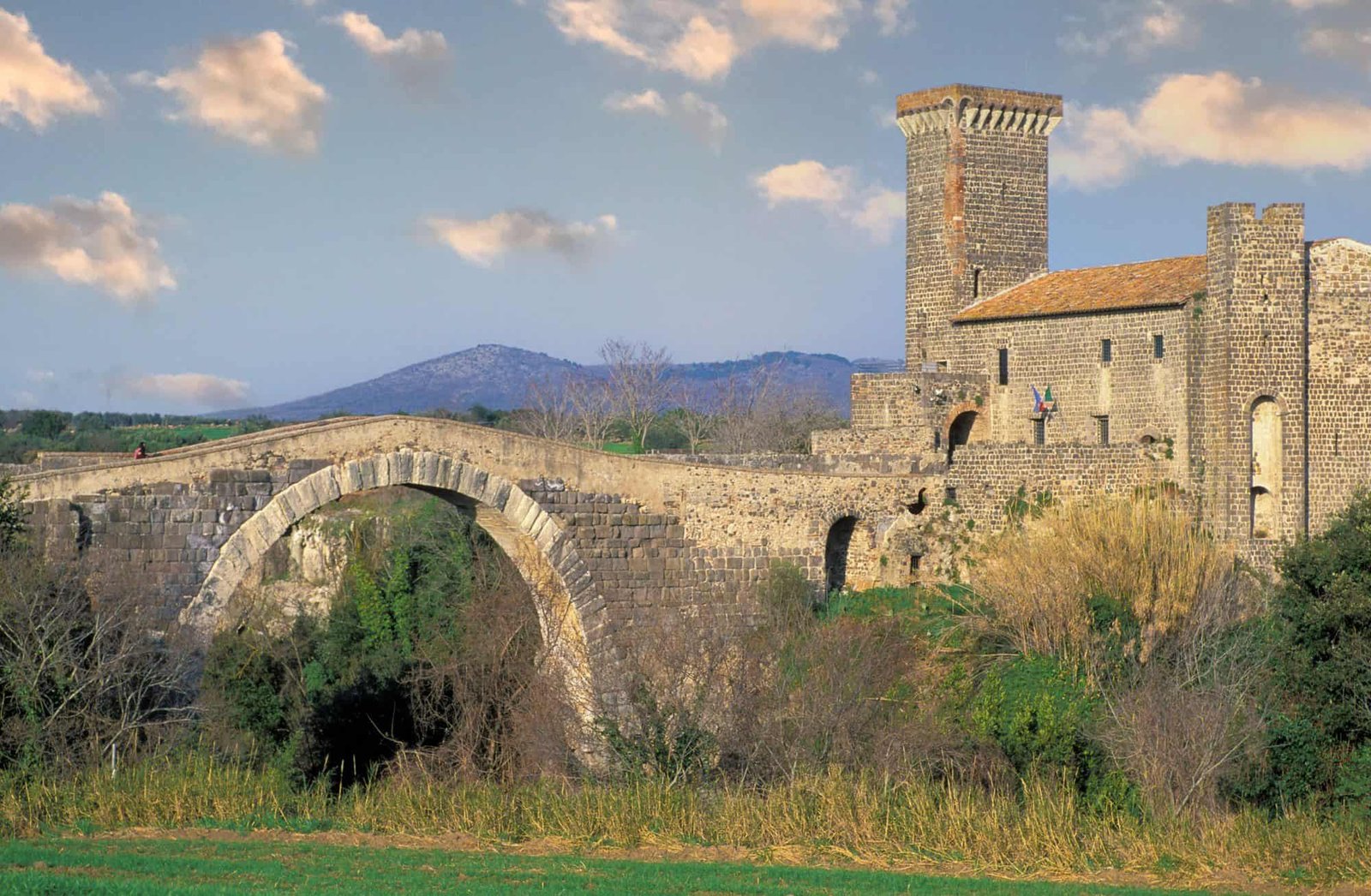
In Montalto di Castro it is worth seeing Vulci, one of the major city-states of Etruria and for a couple of centuries a maritime power of the Tyrrhenian, the Ponte del Diavolo with the Castello dell'Abbadia in the background, and the medieval historic center clustered around the fortress.
When should I go to Montalto di Castro?
Spring is the best season for Montalto di Castro: from mid-March to mid-June the Lazio Maremma is green and the temperatures let you walk for hours among the necropolises, while the sea stays cold until well into May. Summer is instead the season of the marina, with the beach as the protagonist.
What is grown and eaten in Montalto di Castro?
In Montalto di Castro agriculture remains the economic backbone of the municipality: cereals, melons, watermelons, tomatoes and the green asparagus of the Maremma are grown, together with the olive tree, which here falls within the area of the protected designation of origin oil of Canino.
Is it true that there is a nuclear power plant in Montalto di Castro?
In Montalto di Castro construction began in the 1980s of the Alto Lazio power plant, a nuclear facility that however never entered service. On the already developed site the De Mita government ordered in 1989 the construction of a multi-fuel thermoelectric plant in its place.
What are Pescia Romana and the hamlets of Montalto di Castro?
Pescia Romana is a hamlet of Montalto di Castro that occupies the far north of the municipal territory, on the border with Tuscany, 13.4 kilometers from the main town. The municipality also includes the Borgo Vecchio, which grew after 1700 around a Jesuit church, and the Borgo Nuovo, inaugurated in 1961 along the Aurelia.
Anyone who wants to travel with a professional who knows the coastal Tuscia will find certified tourist escorts and tour leaders through the TourLeaderPro network.

Where Montalto di Castro Is and How to Get There from Rome
Geography explains almost everything about this place. Montalto di Castro sits on a modest rise above the plain of the Fiora, a few kilometers from the sea, at a point where the Roman consular road had to pass and where the river, navigable for a good stretch at its mouth, offered a landing place. Every phase of its history, from the Etruscan settlement of Vulci to the medieval port, from the Dogana dei Pascoli to the power plant, comes from this combination: fresh water, nearby sea, a road with no alternative. Anyone arriving today sees a very wide cultivated plain, a profile of distant mountains toward the interior and a line of pines defending the beach. It is not a landscape that works as an instant postcard, and that keeps the crowds away.
By Car from Rome to Montalto di Castro
The route is the Aurelia. You leave Rome toward the northwest, pass Civitavecchia, continue beyond Tarquinia and, shortly after the turnoff for Montalto Marina, take the exit for the center. The travel time shown by the maps is about an hour and a half, but it should be taken with caution: on summer weekends the stretch between Civitavecchia and Tarquinia clogs up regularly, and anyone leaving at nine on a July Saturday morning takes much longer. The advice: leave at 7:30, have breakfast in Tarquinia and arrive at Vulci for opening. The difference between the two strategies is 40 minutes of queue and three degrees of temperature on the archaeological route, which is done on foot and without shade.
A warning about the navigator. Many systems, if you simply type Vulci, lead to the wrong turnoff along the road linking Montalto di Castro to Canino: the park entrance and the Castello dell'Abbadia are on different sides of the bridge, and whoever gets it wrong ends up making a U-turn on a narrow provincial road. It is best to set the Castello dell'Abbadia as the destination and, once there, find your way by the signs.
By Train and Bus to Montalto di Castro
The Montalto di Castro station is served by the regional trains of the Tyrrhenian line between Roma Termini and Grosseto. It is a village station, with few runs in the middle hours, and it is far from the historic center: without a vehicle, the connection between station, village, marina and Vulci becomes complicated. Local bus timetables change from season to season. Anyone who doesn't drive and wants to see the archaeological park should do the math in advance, or consider relying on a private service: Vulci is several kilometers from the town, along a provincial road with no sidewalks, and on foot it is not an option.
Getting Around Between the Village, the Marina and Vulci
The municipality is wide and the three points of interest are distinct. The historic village is visited on foot in a couple of hours. Montalto Marina is two kilometers away, with straight roads and parking lots that in August fill up by 10:00. Vulci is inland, toward Canino, and requires a good half hour each way plus the time of the visit, which does not drop below two and a half hours if you want to really see something. One full day covers all three. Two days do it well, swim included.
The Village of Montalto di Castro: What to Really See
The historic center is small and should be taken for what it is: a settlement of medieval foundation that lost and regained its population about 10 times, rebuilt piece by piece between the 18th and 19th centuries, with the layout tight around the fortress and a ring of more recent houses around it. You don't come to Montalto di Castro for a monumental historic center. You come because the village is the key to reading an enormous territory, and because in one hour you can read the whole story: the lords' castle, the church the pope had built to convince people to stay, the fountains that tell of the arrival of water, the bridge that says how much the river mattered.

The Castle and the Rocca of Montalto di Castro
The building that dominates the village is the castle, also called the Rocca and tied in local memory both to the Orsini and to the Guglielmi family, who held it in the modern age. The structure keeps the layout of a control fortification, not a pleasure residence: thick walls, few openings, a compact block that you read from far away as soon as you leave the Aurelia. In the 18th century, when the population began to grow again after the historic low, a whole floor was added to the castle. It is a detail that says a lot: you build upward when the space inside the walls is no longer enough.
Local sources attribute the founding of the fortified nucleus now to the refugees from Gravisca, the coastal city destroyed by pirates between the fifth and sixth centuries, now to Desiderius king of the Lombards in the eighth century. Neither version is supported by documents: they are scholarly traditions, and as such they should be told. The documented history begins in 852, when the name Montis Alti appears in a bull of Pope Leo IV addressed to the bishop of Tuscania. Before that date we are in the territory of hypotheses, and anyone who tells you otherwise is selling legend as history.

The Church of Santa Maria Assunta
The parish church of Santa Maria Assunta is the village's main church and belongs to the great building season of the late 18th century, the one set off by the reforms of Pius VI. It should be looked at with the right eye: it is not an art project, it is a government project. A pope who wants to repopulate a village of 600 souls builds a spacious church because the church, in an agro-pastoral settlement, is the place that holds together a community of seasonal laborers and families who came from the Apennines and from Corsica. The dedication to the Assumption is the most common in inland Lazio and is no surprise.
The Church of Santa Croce and the Convent of San Sisto
Santa Croce is the other religious building in the center, more intimate and less visited by tourists. The San Sisto complex, a convent and church of 13th-century layout, is instead the village's historic monastic presence, and in the 18th century it had a second, entirely practical life: the papal government placed the new hospital there, inside the monastery's structures. It is worth stopping a minute in front of this fact. In a village that in 1709 counted 182 inhabitants, opening a hospital was not philanthropy: it was an attempt to make survivable a place where malaria killed more than wars did.
The church of Santa Maria della Vittoria is also remembered in the municipal territory. The opening hours of the churches of Montalto di Castro follow parish life and not museum life: outside service hours they are often found closed, and there is no continuous custodian service.
Palazzo Funari and the Civil Architecture of Montalto di Castro
Palazzo Funari, from the 17th century, is the best example of civil architecture in the village and testifies to the existence, already in the modern age, of a small local middle class in a village otherwise split between the feudal lord and the laborers. The Palazzo del Chiarone, in the countryside toward the northern border, is instead tied to the function of controlling the territory: the Chiarone is the stream that marks the border with Tuscany, and that palace guarded a crossing, not a view.
The Fountains of Montalto di Castro
Three historic fountains dot the village: the Fontana del Mascherone, the Fontana delle Tre Cannelle and the Fontana Franco Palombaro. The first two are tied to the great papal investment of the 18th century, when the bridge over the Fiora was built, under which also runs the aqueduct that feeds the Mascherone. A bridge that carries both road and water is a clever and costly work, and in the logic of the time it says that someone in Rome had decided Montalto had to survive. The Fontana delle Tre Cannelle was built in the same season of reforms that saw Santa Maria Assunta rise.
The Etruscan Bridge
The municipality's heritage also includes a bridge called Etruscan, which must be clearly distinguished from the famous Ponte del Diavolo of Vulci. They are two different structures, in two different points along the course of the Fiora, and the confusion between the two is the most common mistake I hear visitors make. The monumental bridge, the one more than 20 meters high below the Castello dell'Abbadia, is at Vulci: I talk about it further on.
Vulci, the Etruscan City in the Territory of Montalto di Castro
Here the discussion changes scale. Vulci, in Etruscan Velch, was one of the major city-states of Etruria, almost certainly one of the 12 of the league, and for a couple of centuries a maritime and commercial power of the Tyrrhenian. Its fortune was born from metals: the territory was rich in mineral resources and already from the ninth century BC local craft production traveled toward Sardinia and toward the Greek settlements. Anyone who visits Vulci thinking they will find a minor site makes an error of perspective: the Vulci bronzes and the vases that came out of these necropolises fill the display cases of the greatest European museums, from the Louvre to the British Museum, and the reason you don't see them here is told further on.
The end came in 280 BC, with the defeat against Rome. The city was not razed to the ground: it became a Roman municipium in the first century BC and went on living, ever more marginal, until its final abandonment in the eighth century AD. The silence lasted 1,000 years. Only in 1778 was the site scientifically identified, by Turriozzi, and from then on the history of Vulci becomes the history of how one digs and who profits from it.

The City: Walls, Decumanus, Great Temple and Domus of the Cryptoporticus
The urban area was ringed by walls, with at least five gates, three of which have been investigated by the excavations: the West gate, the North gate and the East gate. Anyone walking on the plateau today follows the decumanus, the main axis, and meets two buildings that deserve a long stop. The first is the Great Temple, the city's major sacred structure. The second is the Domus of the Cryptoporticus, a grand house that belonged to people of high rank, with a covered, vaulted space that served to support the terracing and to offer a cool passage in summer. Next to the domus a mithraeum of the second century BC has been identified: the presence of an Eastern cult at this point in Etruria is one of the most interesting findings of the recent excavations.
The practical advice is trivial but decisive: the urban route is on open ground, with tall grass in spring and no shade in summer. Closed shoes, hat, water. The Vulci plateau at noon in July is one of the hottest places I know in Lazio.
The Necropolises of Vulci and the Cuccumella
Around the city stretch the necropolises: Poggio Maremma, Ponte Rotto, Osteria. They contain thousands of tombs of different forms and types, and that number is the reason Vulci fed the European antiquities market for two centuries. The most impressive monument is the Cuccumella, a tumulus 18 meters high and 70 meters in diameter: the largest in Etruria. Seen up close it looks like a natural hill, and that is precisely the effect the Etruscan architects were after.
In the Osteria necropolis is the Tomb of the Sphinx, opened to the public after a long restoration, while the Tomb of the Sardinian Bronzes, discovered in 1958, has been attributed to a high-ranking woman of Sardinian origin: a fact that confirms how wide the radius of Vulci's contacts was in the archaic Mediterranean.
The François Tomb, the Painted Masterpiece
The François Tomb was rediscovered in April 1857 in the Ponte Rotto necropolis by Alessandro François, archaeologist and royal commissioner of war and navy of the Grand Duchy of Tuscany, who gave it its name. It is a hypogeum dug into siltstone, with seven chambers arranged around an atrium and a tablinum, and it belonged to the Saties, an aristocratic Vulci family. The dating proposed by scholars places it between 340 and 330 BC.
The painted cycle is the pinnacle of Etruscan painting along with the tombs of Tarquinia, and its power lies in the iconographic program. On one side Greek myth: Achilles slitting the throats of Trojan prisoners in honor of Patroclus, with the Etruscan demons Vanth and Charun beside him watching over the massacre. On the other side local history, told as a revenge. Macstarna frees Caile Vipinas from his chains. Aule Vipinas kills Venthi Caules. Larth Ulthes kills Laris Papathnas Velznach, that is, a man from Volsinii. And Marce Camitlnas faces Cneve Tarchunies Rumach, a Tarquin of Rome. Vel Saties, the owner of the tomb, is portrayed in triumphal dress while taking the auspices from the flight of a bird, assisted by the young Arnza.
The point that needs explaining to visitors is this: Macstarna has been identified with Servius Tullius, and the identification does not come from a modern fantasy. It was the emperor Claudius, a scholar and enthusiast of Etruscan antiquities, who handed down that tradition. The François Tomb is therefore the Etruscan voice on an episode from the origins of Rome, told from the point of view of those who fought Rome. There is no more explicit political document in all Etruscan art.
Here comes the news that always disappoints those who arrive unprepared: the frescoes are no longer in the tomb. They were detached from the walls in 1863 and taken to Villa Albani in Rome by order of Prince Alessandro Torlonia. They remain the private property of the Torlonia heirs and can be seen only on rare exhibition occasions. A full-scale reconstruction of the cycle can be visited at the Museum of Archaeological Research of Vulci at Canino. Anyone arriving at Vulci dreaming of going in under those paintings needs to know this beforehand, not in front of an empty chamber.
The Ponte del Diavolo and the Castello dell'Abbadia
The bridge that spans the Fiora below the castle is the most photographed monument of the area. The structure, Etruscan in its lower part and reworked in the Roman age, dates to the third century BC and exceeds 20 meters in height above the river. A water conduit also ran along the top. The nickname Ponte del Diavolo belongs to a family of legends found all over Europe, which attributes to the devil the engineering works that popular memory can no longer explain: when a structure is too bold to be human, it is handed over to the devil. At Vulci the boldness is real, and anyone leaning over the parapet understands it without needing explanations.

The Castello dell'Abbadia began as an abbey, dedicated according to tradition to Saint Mamilianus, and was turned into a fortress starting in the 12th century. The Aldobrandeschi passed through it, the Church of Orvieto, the Prefetti di Vico. In 1430 the fief went to Ranuccio Farnese the Elder and in 1513 Cardinal Alessandro Farnese, the future Pope Paul III, obtained it for life and altered its structure. In 1537 it entered the Duchy of Castro. In 1649, with the end of the duchy, it returned to the Papal State. In the Napoleonic age it passed to Lucien Bonaparte as prince of Canino, then to the Torlonia, and in the 19th century it was used as a papal customs house. Since 1975 it has housed the Vulci National Archaeological Museum.
The museum displays materials from the 19th-century excavations up to the early 2000s, with particular weight on pottery and on grave goods from the context of the François Tomb, and covers the span from the Iron Age to the second and third centuries BC. A full ticket is €5, a reduced one €2, with electronic ticketing through the Musei Italiani app and a free audio guide on izi.TRAVEL. Mind the current condition, though: the closure to the public has been extended to October 15, 2026 for works funded by the National Recovery and Resilience Plan. Anyone planning the visit should check the opening status on the official website before leaving.
The Pellicone Pool
Not far from the bridge the Fiora forms a widening in a rock basin, the Pellicone pool, with a small waterfall and vertical walls. It is a spot of great effect and has a small film career behind it, having appeared in productions shot in the area. It is worth the detour on foot, with the obvious warning: the bottom is uneven and the banks are slippery.
Lucien Bonaparte, Napoleon's Brother Who Dug Vulci
The most ambiguous chapter in Vulci's history carries a cumbersome surname. Lucien Bonaparte, born in Ajaccio on May 21, 1775 and died in Viterbo on June 29, 1840, Napoleon's brother, settled in Canino in 1804 after the break with his brother. Pope Pius VII made him prince of Canino in 1814 and Leo XII prince of Musignano on March 21, 1824. With his second wife, Alexandrine de Bleschamp, married in 1802, he took up residence in this corner of the Tuscia.
It was he who financed out of his own pocket the great excavation campaigns on lands he owned, and the declared purpose was the recovery and sale of whatever was found. Before him Vincenzo Campanari had carried out excavations from 1828 to 1837, giving the site European fame. The combined result is that tens of thousands of Attic vases and Vulci bronzes took the road to the museums and private collections of the continent. The later campaigns, from 1879 to 1889, then in 1895, between 1915 and 1920, between 1928 and 1929, in 1957, in 1960, from 1961 to 1963 and from 1996 to 2001, worked on a site already largely emptied. The verdict is clear: without the 19th-century excavations we would not know Vulci, and because of the 19th-century excavations we can no longer reconstruct almost any grave assemblage in its integrity. Anyone who wants to see the major pieces that came out of this earth has to go to the Etruscan Museum of Villa Giulia in Rome, or beyond the Alps.
Montalto Marina and the Beaches of Montalto di Castro
Montalto Marina is the municipality's seaside locality, two kilometers from the historic center, developed starting in the 1950s like so many marinas on the Lazio coast: first the houses of the Montalto people, then the little villas of the Romans, finally the accommodation facilities. The shore is sandy, wide, with pine woods behind and a seabed that slopes gently. This combination of wide beach and shallow water explains why the place has become a destination for families and not for nightlife.
On the Montalto di Castro shoreline, equipped beach establishments and stretches of free beach coexist, and the proportion between the two changes from year to year according to the concessions. The stretch has received significant environmental recognition in the past: the four sails of the Legambiente Guida Blu in the 2010 edition and, in 2017, the green flag awarded by Italian pediatricians to beaches judged child-friendly. These are dated recognitions and should be read for what they are, that is, the snapshot of a single year. The most recent rankings can be consulted on the websites of the bodies that award them.

Le Murelle and the Tombolo
Further south opens the locality of Le Murelle, and it is the stretch I prefer. Here the Mediterranean scrub of the tombolo comes almost down to the water's edge: junipers, mastic trees, rockroses, stone pines planted in the 20th-century reclamations. The tombolo is not decoration, it is natural infrastructure: it holds the sand, defends the hinterland from the salt wind and regulates the freshwater table. Walking inside the pine wood in the middle hours, when the beach burns, is the right way to spend an August afternoon here.
The Dog Beach at Montalto di Castro
The municipality has identified at Montalto Marina a stretch of shore where pets are allowed with their handlers. The area is in the locality of Sanguinaro, next to the Militari beach establishment, and is marked off with posts and ropes and signaled by dedicated signage. Along the Murelle road there is also an establishment equipped for dogs. Beach ordinances change every season and set the hours and rules of access: anyone traveling with a dog should check them on the website of the Municipality of Montalto di Castro before leaving, because the ban on the rest of the shoreline is enforced.
Accessibility of the Montalto di Castro Beaches
On the shoreline there is an establishment free of architectural barriers, presented as the first on the coastal stretch to have tackled the problem in a complete way, with a bathing assistance service for people with disabilities. It is a point on which this marina got there before much more famous localities, and it deserves to be said. Anyone who needs Job chairs, walkways down to the water's edge or help in the water should contact the establishment directly to check availability on the chosen day.
The History of Montalto di Castro, from the Castrum to the 20th Century
The historical story of Montalto di Castro is a textbook case of a frontier community: never large, never entirely abandoned, repopulated by force every time it risked disappearing. It is worth following it in full, because it explains the landscape you cross today.

The Disputed Origins
Three hypotheses compete for the origins of the settlement. The first has the castrum Montis Alti founded between the fifth and sixth centuries AD by the refugees from Gravisca, the coastal city destroyed by pirates. The second attributes the founding of the castle to Desiderius, king of the Lombards, in the eighth century. The third places the settlement where Forum Aurelii stood, in the locality of Casa dell'Uliveto, positioned to control the via Aurelia: the Romans would have assigned there the lands taken from Vulci after the victory of the consul Tiberius Coruncanius, for which he was granted a triumph. Neither of the first two is supported by documents. Documentary certainty begins in 852, with the bull of Pope Leo IV to the bishop of Tuscania in which the name Montis Alti appears for the first time.
The Middle Ages and the Port on the Fiora
Between the 11th and 12th centuries Montalto suffered serious destruction. The best known is that of 1109: Pope Paschal II, to defeat Stefano dei Corsi who had entrenched himself there, had the castrum destroyed by Norman troops. Despite this, in the medieval age a port landing developed at the mouth of the Fiora, an important stop on the Tyrrhenian routes and in particular for loading grain. The historic center then reached its greatest urban expansion: in the 14th century it housed more than 1,000 men.
A territory like this, with a port and a river, becomes coveted. Besides the pope, the Commune of Rome, the Orsini and the Prefetti di Vico contested it. The continuous wars, the Avignon captivity and the economic downturn brought the village to its knees, however, and from 1,000 men it fell to 250. The partial recovery came in 1421, when Pope Martin V, interested in keeping an inhabited center in the area to watch over the Dogana dei Pascoli, issued a bull to encourage repopulation. From that moment Montalto's fate is tied to the agro-pastoral system, to transhumance and to seasonal work. Malaria and the very harsh living conditions made the danger of depopulation constant, averted only by continuous migrations from the Apennines and from Corsica.
The Farnese, the Duchy of Castro and the Collapse
On December 22, 1535, Pope Paul III granted Montalto and its territory as a fief to his son Pier Luigi Farnese. Two years later, with the bull Videlicet immeriti of October 31, 1537, the Duchy of Castro was formally born, a state that stretched from the Tyrrhenian to Lake Bolsena and included, besides Montalto, Musignano, Canino, Cellere, Tessennano, Valentano, Ischia, Gradoli and other localities that are now all in the province of Viterbo. The duchy's coat of arms bore a rampant lion and the three blue lilies of the Farnese. Montalto then lived through a brief flourishing season.
The 17th century overturned everything. The two Wars of Castro, fought between 1641 and 1644 and between 1646 and 1649, set the Farnese against the papacy: first Urban VIII and the Barberini, with the papal occupation begun on September 27, 1641 and the Treaty of Rome of March 31, 1644, then Innocent X. The final blow fell in 1649: Castro capitulated on September 2 and was razed to the ground by order of the pope. The territory returned to the Papal State, and on December 19 of the same year Duke Ranuccio II formally ceded the duchy to the Apostolic Chamber for 1,629,750 scudi, unable to meet the family's debts. For Montalto it was no improvement: the entire territory was leased to a general contractor and sheep farming and extensive wheat growing dominated there.
The Terrible Years of the 18th Century
The first decades of the 18th century are remembered as Montalto's terrible years. In 1709 the population hit its historic low: 182 inhabitants. The papal government noticed the situation and launched concrete investments: the bridge over the Fiora river, under which also runs the aqueduct for the Fontana del Mascherone, and a new hospital carved out of the monastery of San Sisto. Around the middle of the century the municipality began the long legal battle against the contractors in defense of civic-use rights, with a great many lawsuits that led it into chronic indebtedness.
Once again it was a pope who intervened. Pius VI, with a Motu proprio of 1778, cancelled the debts, abolished duties and taxes, placed municipal revenues under the administration of the Apostolic Chamber and increased civic-use rights, stimulating the cultivation of the land and repopulation. The reforms did not touch the deep structures and the endemic problems remained, malaria, poverty, epidemics, but the numbers responded: in 1783 the population reached the threshold of 600 inhabitants, an agricultural middle class was born, a broad season of building sites got under way with the church of Santa Maria Assunta, the new Fontana delle Tre Cannelle, the raising of a floor of the castle and the construction of new homes inside and outside the center. The shift from the lease system to that of emphyteusis, wanted by the treasurer Fabrizio Ruffo, gave the local economy a further push.
From the 19th Century to the Land Reform
Between 1798 and 1814 the entire territory of the Church suffered continuous troop passages and two long invasions by the French army. On the pope's return, in 1814, Montalto was depopulated and weak again. The century that followed was marked by attacks on civic-use rights, by the definitive privatization of the state-owned lands and by the persistence of the old systems of exploitation: large estates were born and the Montalto people became proletarianized. The early 20th century is remembered for the blood tribute paid in the Great War and for the land occupations, the peasant movement that, partly interrupted during the Fascist 20 years and resumed at the end of the Second World War, found in the land reform, with the expropriation of the big landowners and the division into lots, only a partial fulfillment. In 1928 the municipality passed from the province of Rome to that of Viterbo.
Castro, the Erased City That Gives Montalto di Castro Its Name
The second element of the place name is not a whim. Montalto di Castro carries in its name a city that no longer exists. Castro stood on a tuff rock in the Viterbo hinterland and was the capital of the Farnese duchy: the Farnese rebuilt it from scratch, with the involvement of Antonio da Sangallo the Younger, equipping it with modern fortifications and even a mint of its own. It was the project of a Renaissance capital in miniature, designed to give sovereign dignity to a family that the papacy had just raised up.
In 1649 that project was materially erased. After the capitulation of September 2, by order of Innocent X all the buildings were pulled down, including the main church. The chronicles of the time report that a pyramid was erected on the spot with the inscription Qui fu Castro. No trace of that inscription has ever been found, and the detail should therefore be handed over to tradition, not to documented history. The episode that had precipitated the crisis had taken place a few months earlier: on March 18, 1649, Bishop Cristoforo Giarda, appointed by Innocent X, fell into an ambush.
This is the reason there still exist, in the Tuscia, so many place names that carry that name. The village on the Aurelia is called Montalto di Castro because it belonged to the duchy, and in the Viterbo area you also find Grotte di Castro. Anyone who confuses this Castro with other Italian towns of the same name goes the wrong way by several kilometers, and it is a frequent mistake.
The Montalto di Castro Power Plant, the Industrial Story Everyone Remembers
For a generation of Italians the name Montalto di Castro means only one thing: the nuclear plant that was never switched on. On the coast, in the 1980s, construction began of the Alto Lazio power plant, a facility that never entered service. On the already developed site, with the existing water works reused, the De Mita government ordered in 1989 the construction of a multi-fuel thermoelectric plant, named after Alessandro Volta.

The plant's numbers are impressive: 3.6 gigawatts of power, four steam units of 660 megawatts each that can run on heavy fuel oil or methane, eight gas turbines of 120 to 125 megawatts. It was the most powerful thermoelectric plant in Italy. It worked very little, however, around 3,000 hours a year out of a theoretical maximum of 8,760, because the electricity market did not need it. Construction had begun in 1992 and ended in 1998. Dismantling is under way, started in 2017, and industrial conversions are being discussed for the freed areas, including a data center.
Alongside the thermoelectric story there is a less told photovoltaic one: in the municipal territory a solar plant of 84.2 megawatts was built that in 2014 ranked second in Europe by power. In 40 years Montalto di Castro has therefore hosted a failed nuclear plant, the largest Italian thermoelectric plant and one of the largest photovoltaic parks on the continent. Few communities of 8,000 inhabitants can tell an energy story like that.
Pescia Romana and the Hamlets of Montalto di Castro
The municipality has a vast territory made up of distinct nuclei. Pescia Romana, 13.4 kilometers from the main town, occupies the far north of the municipal territory, on the border with Pescia Fiorentina and with Tuscany. The Borgo Vecchio is the oldest nucleus, grown after 1700 around a Jesuit church dedicated to Saint Ignatius of Loyola. The Borgo Nuovo was inaugurated in 1961 along the Aurelia. Around 1820 the Pescia estate was granted to the Boncompagni Ludovisi family, who kept it until the land reform of the 1950s: since then the local economy rests on agriculture, with cereals, fruit and vegetables, and on tourism. The climate is Mediterranean, with mild winters and hot, dry summers.
The other hamlets are Montalto Marina on the coast, Montalto di Castro scalo between the village and the marina, and Torre di Maremma near the railway station. Anyone looking for a house to rent for a week at the seaside will find very different offers between the marina, where you live for the beach, and the inland nuclei, where you live for the countryside.
What Is Grown and What Is Eaten in Montalto di Castro
Agriculture is still the economic backbone of the municipality, and the products found on the market stalls say so clearly: cereals, melons, watermelons, tomatoes, the green asparagus of the Maremma and the olive tree, which here falls within the area of the protected designation of origin oil of Canino. In 2015, 671 businesses with 2,018 employees were active in the municipal territory, a figure that gives the real measure of the place: a productive community, not a museum village.
At the table this means an unpretentious cuisine of land and sea, with the oily fish and shellfish of the coast, the homemade pasta of the Maremma hinterland, acquacotta, pork and game in the cold season, new oil in November. It is better to eat in the village and not at the marina if you want local cooking, and at the marina if you want just-landed fish and a table with a view. The green asparagus in spring is worth a detour by itself.
A Curiosity About Montalto di Castro (VT)
The most beautiful curiosity concerns a Roman emperor and a painted wall. In the François Tomb, found in the municipal territory, there is a scene in which a figure called Macstarna frees a prisoner, Caile Vipinas, by cutting his ropes. That Macstarna, according to an ancient tradition, would be Servius Tullius, the sixth king of Rome. Handing down this identification was not a romantic antiquarian, but the emperor Claudius, a scholar of Etruscan matters and author of works on the language and history of that people, who argued for the Etruscan origin of the Roman king in a speech delivered before the senate.
The significance is enormous and systematically underestimated. On the walls of a tomb in Montalto di Castro there is an Etruscan version of the origins of Rome, painted by people who considered Rome an adversary and not a mother country. In that cycle a Roman, Cneve Tarchunies Rumach, that is, a Tarquin, is faced by a man from Vulci. It means that in the fourth century BC a local aristocracy, as patron, had told on the walls of its own tomb a story in which its ancestors had beaten the Romans. Official historiography, the kind we read in the manuals, comes from the winning side. Here the losing side speaks, and speaks in colors.
I add the curiosity within the curiosity: the tomb is in the territory of Montalto di Castro, but its paintings were detached in 1863 and taken to Rome, where they remain in a private collection. Anyone who arrives at Vulci to see Macstarna sees an empty chamber. This is the paradox of this municipality: it owns one of the most important figurative documents of Italian antiquity and cannot show it to anyone.
One Thing Nobody Tells You About Montalto di Castro (VT)
Nobody tells you that Montalto di Castro, for two centuries, was one of the main factories of finds for the European antiquities market, and that this is the reason the local museums are small and those of Paris and London are full. The mechanism deserves to be explained well, because it is a lesson in the history of culture.
After the site was identified in 1778, the excavations opened with a declared objective that makes us flinch today: to find and sell. Lucien Bonaparte, prince of Canino, financed the campaigns on his own land precisely to market what was found, and Vincenzo Campanari worked from 1828 to 1837 giving the site an international fame that multiplied demand. In those years Vulci put on the market such a quantity of Attic vases that it altered prices and filled the collections of half of Europe. The method was brutal: you looked for the intact, sellable piece, you discarded the rest, you did not record the context.
The consequence is that today, for the vast majority of Vulci materials held around the world, we do not know which tomb they come from or what they were associated with. A vase without context is a beautiful and mute object. The later campaigns, the scientific ones of the 20th century and the early 2000s, worked on what remained and on less plundered areas, and have restored information that the 19th century had destroyed. When you walk among the necropolises of Montalto di Castro, remember that the silence of those tumuli is not natural: it was produced.
My Advice for Visiting Montalto di Castro (VT)
The advice is to reverse the order that almost everyone follows. Most visitors arrive in summer, go to the beach, and if time is left over make a quick trip to Vulci in the afternoon. It is the worst way to organize the day. The archaeological area is an open plateau with no shade, and a July or August afternoon gives you a rushed and painful visit.
Do the opposite. Wake up early, have breakfast in the village, enter the archaeological park at opening, two or three hours of walking among the bridge, walls, temple and necropolises while the air is still cool. Around noon head back, have lunch in the shade, and devote the afternoon to the Murelle beach, where the pine wood lets you alternate sun and shelter. Visit the village at sunset, when the low light shows off the castle and the temperature becomes civil.
The second piece of advice concerns the season. If you can choose, come to Montalto di Castro between April and the first half of June, or in late September. In spring the Maremma countryside is green, the asparagus is on the stalls, the archaeological park can be walked without suffering and the sea, at the end of May, is already swimmable for those without Caribbean expectations. In September the water is at its best temperature of the year and the beaches empty after Ferragosto. July and August remain the only window for those with school-age children, and in that case it is worth booking your lodging well in advance, because accommodation here is limited and prices rise sharply.
Third piece of advice, the most concrete: bring closed shoes. Too many people tackle the necropolises in flip-flops, with tall grass and loose stones. It is not a museum route, it is an open-air archaeological site with real terrain.
Another Well-Known Fact, Yet Rarely Mentioned
Everyone knows that Montalto di Castro is the municipality of the plant that was never switched on. Almost nobody connects that fact to the geography that made it possible, which is the same reason the Etruscans built Vulci here. They needed water in quantity, a low and clear coast, a communication route already in place. The Fiora, the sea and the Aurelia: the three conditions that made this territory a commercial hub in the seventh century BC are the same ones that in the 20th century made it the ideal site for a 3,600 megawatt plant. The water works designed for the nuclear plant were then reused for the thermoelectric plant: nothing is thrown away, in a place where water is the resource that decides everything.
There is a second well-known fact that is rarely connected. The medieval port at the mouth of the Fiora, which in the 14th century loaded grain for the Tyrrhenian routes, occupied roughly the same stretch of coast where centuries earlier the landing places of Vulci sorted metals and ceramics. Always the same spot, always the same function, with the masters and the goods changed. When you drive on the Aurelia between Montalto Marina and the Tuscan border you cross a plain that seems empty and recent: in reality it is one of the oldest and most continuously used commercial corridors of the peninsula.
The third element, which is worth citing because it contradicts a commonplace, concerns the population. It is often said that the villages of the Tuscia are depopulating. Montalto di Castro has known real depopulation, the kind that brought a village to 182 souls in 1709, and came out of it with repeated public interventions over the course of three centuries. Today it counts about 8,680 inhabitants and in 2015 it hosted 671 active businesses with 2,018 employees. It is a municipality that works, not a nativity scene.
The Right Photo to Take at Montalto di Castro (VT)
The photograph to take home is only one, and it is not the beach. It is the Ponte del Diavolo with the Castello dell'Abbadia in the background, shot from the bank of the Fiora and not from above. You have to go down toward the river along the path that leads to the gorge, turn around and frame the arch from below, with the water in the foreground and the castle that seems to rest on the bridge. From down there the 20 meters of height can be read in full, and the Etruscan structure at the base can be told apart from the Roman-age work and the later restorations.
The right light is that of early morning, when the sun lights the front of the castle and the gorge stays in cold half-light: the contrast does the rest. In the middle of the day the bridge becomes flat and white. At sunset you are shooting against the light, and what you need is a black silhouette against the sky, which is a different and legitimate photograph, but less readable.
If you are looking for an alternative image, the second best is the Pellicone pool, with the waterfall and the rock walls that close off the basin. The third is less obvious and amusing: the silhouette of the power plant on the line of the sea horizon, shot from the beach at sunset. It is an uncomfortable image, which the brochures will never use, and it tells this stretch of coast more honestly than any postcard. Practical rule for all three: no bulky tripods on the archaeological walkways and absolute respect for the fences, which at Vulci protect fragile structures and are not a suggestion.
Some Important Events That Happened Here in History
The first event is a military defeat that changed the balance of the Tyrrhenian. In 280 BC Vulci was beaten by the Romans, and tradition links to the victory over the Vulci territory the triumph granted to the consul Tiberius Coruncanius, with the lands taken from the Etruscan city assigned to the victors in the area of Forum Aurelii. From that moment one of the major maritime powers of Etruria began to become a peripheral municipium, and the wealth that had built ports and monumental necropolises stopped regenerating.
The second event is from 1109. Pope Paschal II, to flush out Stefano dei Corsi who had barricaded himself there, had the castrum Montis Alti destroyed by Norman troops. It was not an isolated episode: between the 11th and 12th centuries the village suffered repeated destruction, and each time it was rebuilt because control of the mouth of the Fiora was worth the expense.
The third is from 1421 and has nothing heroic about it, yet it saved the village. Pope Martin V, who needed an inhabited center to watch over the Dogana dei Pascoli, issued a bull to encourage the repopulation of the territory. An administrative act, not a battle, and through it passes the survival of Montalto di Castro over the next four centuries.
The fourth event is the end of the Duchy of Castro. After the two wars fought between 1641 and 1649, on September 2, 1649 Castro capitulated and was demolished by order of Innocent X. On December 19 of the same year Ranuccio II Farnese ceded the duchy to the Apostolic Chamber for 1,629,750 scudi. Montalto lost in one blow both its capital and its administrative autonomy.
The fifth is from 1709, and it is the most striking in its sobriety: the municipality's population fell to 182 inhabitants. A village of that size is no longer a community, it is a garrison. The reforms of Pius VI of 1778, with the cancellation of debts and the abolition of duties and taxes, brought the village back to 600 souls in 1783.
The sixth event is from 1857, when Alessandro François brought back to light the tomb that bears his name in the Ponte Rotto necropolis, restoring to art history the most political Etruscan painted cycle known. The seventh, finally, belongs to our own era: the start in the 1980s of the building site of the nuclear plant that never entered service and its replacement, from 1992, with the most powerful thermoelectric plant in Italy, now being dismantled.
Who Has Passed Through Montalto di Castro (VT)
The most famous figure who tied his life to this area is Luciano Bonaparte, Napoleon's brother, born in Ajaccio on May 21, 1775 and died in Viterbo on June 29, 1840. After breaking with his brother the emperor, he settled in Canino in 1804, received the title of Prince of Canino from Pius VII in 1814 and that of Prince of Musignano from Leo XII on March 21, 1824. With his wife Alexandrine de Bleschamp, whom he married in 1802, he made the Tuscia his adopted homeland, and paid out of his own pocket for the excavations at Vulci on land he owned. Napoleon's brother selling Etruscan vases to European museums is a figure that sums up an entire era.
Before him, and in the opposite direction, came Vincenzo Campanari, who dug at Vulci from 1828 to 1837 and brought the site to international attention, and earlier still Turriozzi, who in 1778 scientifically identified the Etruscan city. In 1857 Alessandro François arrived, an archaeologist in the service of the Grand Duchy of Tuscany, and in 1863 Prince Alessandro Torlonia had the frescoes of the tomb detached to take them to Villa Albani.
The list of the powerful who decided the fate of this town is just as long, even if many never set foot in it. Pope Leo IV mentions it in 852. Paschal II orders its destruction in 1109. Martin V signs its repopulation in 1421. Paul III hands it to his son Pier Luigi Farnese on December 22, 1535. Urban VIII and Innocent X overwhelm it with the Wars of Castro. Pius VI lifts it up again with the Motu proprio of 1778. The treasurer Fabrizio Ruffo reforms its land regime. In ancient history, local memory keeps the name of Desiderius, king of the Lombards, to whom tradition attributes the founding of the castle in the 8th century: an attribution with no documentary support, which should be told as a legend and not as a fact.
Finally the painted figures, who count as much at Vulci as the real ones. Vel Saties, a Vulcian aristocrat of the 4th century BC, portrayed in his own tomb in triumphal dress watching the flight of a bird with the young Arnza beside him. Macstarna, identified by the emperor Claudius with Servius Tullius. The brothers Aule and Caile Vipinas. They are the oldest faces this territory has left us, and it is a small injustice of history that they are today in Rome, in a private collection, instead of at Montalto di Castro.
When to go to Montalto di Castro
Spring is the best season of all. From mid-March to mid-June the Lazio Maremma is green, the temperatures let you walk for hours among the necropolises, and the wheat fields and melon patches give the plain a color that doesn't exist in August. The sea is cold until well into May, so it is a season for archaeology and countryside, not for swimming.
Summer is the season of the marina. July and August bring families, second homes that fill up, packed beach clubs and parking lots that are full by 10 in the morning. Anyone who comes in these months should organize their days in reverse, as explained above: archaeology at dawn, beach in the afternoon.
September is the best month to come back to Montalto di Castro. The water is at its warmest of the year, the beaches empty out in the second week, lodging prices drop and the archaeological park can be walked again at any hour. Autumn and winter have a small audience but a serious advantage: the Maremma countryside in November, with the new oil, is a food experience that few people associate with this stretch of coast.
Montalto di Castro with children
This town works well with children, and not by chance. In 2017 the coastline received the green flag that Italian pediatricians award to beaches considered suitable for the youngest, and the reason is technical: fine sand, a seabed that slopes gently for tens of meters, pine woods behind where you can take shelter in the middle hours of the day. Add that the distances within town are short and that you can always find a stretch of free beach where you can set up your umbrella without spending anything.
On the cultural side, Vulci is one of the few archaeological sites that really holds children's attention, because it is not a museum but an outdoor route: you walk, you cross a bridge 20 meters high, you enter tombs cut into the rock, you go down to a small lake with a waterfall. There is only one rule to make it work: two hours, not four, and with a snack and plenty of water in the backpack. If the family group includes a child under five, the city stroller is useless on that terrain: you need a child-carrier backpack.
What's around Montalto di Castro
Its location is one of the strong points of this town, because within an hour by car you reach places very different from one another. To the south, along the Aurelia, you get to Tarquinia, with the Monterozzi necropolis and its painted tombs still in place, and it is the complementary visit par excellence to Vulci: there the paintings are seen where they were made. A little farther on are the Tarquinia salt pans, with flamingos in the right season, and continuing you meet the port of Civitavecchia. Going further down, toward Rome, you enter the area of Cerveteri and the Banditaccia necropolis, the third vertex of the Tyrrhenian Etruscan triangle.
To the north you cross into Tuscany in 10 minutes: Capalbio, Ansedonia with the ruins of Cosa, the lagoon and the peninsula of Orbetello. Inland, instead, you climb into the deep Tuscia: Tuscania with its Romanesque basilicas, Viterbo and the medieval San Pellegrino quarter, Lake Bolsena with the towns of the old Farnese duchy, and the Palazzo Farnese at Caprarola, which shows what the same family built when it had the power and the money to do so.
Anyone planning a multi-day itinerary among Rome, the Maremma and the Tuscia will find on the TourLeaderPro network the logistical support for groups and, for accompanied trips, the tour escort service, while those traveling with friends and relatives from abroad can pass on to them the English guides to Lazio and to the Italian beaches, plus the collection of day trips from the big Italian cities.
Quick questions about Montalto di Castro
How far is Montalto di Castro from Rome
About an hour and a half by car along Via Aurelia, state road 1, in normal traffic. On summer weekends the time grows noticeably between Civitavecchia and Tarquinia.
How do you get to Montalto di Castro by train
With the regional trains of the Tyrrhenian Rome Termini-Grosseto line, which stop at Montalto di Castro station. The station is far from the center and from the marina, so without your own vehicle or an organized transfer, getting around becomes complicated.
How many inhabitants does Montalto di Castro have
About 8,680. The documented historic low is from 1709, when the town dropped to 182 inhabitants.
Why is it called Montalto di Castro
Because it belonged to the Duchy of Castro, the Farnese state created in 1537 whose capital, Castro, was razed to the ground in 1649 on the order of Pope Innocent X. The name of the destroyed city has stayed in the place name.
Is the Vulci National Archaeological Museum open
Closure to the public has been extended until October 15, 2026 for works funded by the National Recovery and Resilience Plan. Opening status should be checked on the website of the Regional Directorate of Museums of Lazio before the visit.
How much does the ticket to the Vulci museum cost
The full ticket is €5 and the reduced ticket €2, with electronic ticketing through the Musei Italiani app. The outdoor archaeological park has separate management: rates and hours are checked on the park operator's website.
Where is the Castello dell'Abbadia
Above the Fiora gorge, next to the Devil's Bridge, in the territory of Canino, a short distance from Montalto di Castro. The address of the museum housed there is Castello dell'Abbadia, 01011 Canino, telephone 0761 437787.
Can you see the frescoes of the François Tomb
No, not on site. They were detached in 1863 and taken to Villa Albani in Rome at the wish of Prince Alessandro Torlonia, and they remain the private property of the Torlonia heirs, visible only on rare exhibition occasions. A full-size reconstruction of the cycle is at the Museum of Archaeological Research of Vulci in Canino.
How long does it take to visit Vulci
Two and a half hours at a minimum for the route that includes the bridge, the urban area and part of the necropolises. Taking it slowly, and including the small Pellicone lake, you easily get to four hours.
Is a visit to Vulci suitable for children
Yes, and it is one of the few archaeological visits that really work with children, because you walk outdoors and enter spaces cut into the rock. Better to limit it to two hours, with water and a hat.
Is the Vulci archaeological route wheelchair accessible
The route runs on natural ground, with grassy stretches, slopes and an uneven surface, and cannot be compared to a museum itinerary. If you have accessibility needs, contact the park operator in advance to find out which stretches are passable.
Where are the beaches of Montalto di Castro
At Montalto Marina, two kilometers west of the historic center, and in the southernmost stretch of the Le Murelle area, where the pine wood reaches almost to the water's edge.
Are there free beaches at Montalto di Castro
Yes, the coastline alternates equipped beach clubs and free stretches. The split changes from season to season according to the municipal concessions.
Can you take a dog to the beach at Montalto di Castro
In the area identified by the town at Montalto Marina, in the Sanguinaro area, next to the Militari beach club, marked off with poles and ropes and signposted. Along the Murelle road there is also a beach club equipped for dogs. The access rules are set every year by the beach ordinance.
Are the beaches of Montalto di Castro accessible to people with disabilities
On the coastline there is a beach club free of architectural barriers, presented as the first on this stretch to have tackled the issue comprehensively, with assistance for bathing. It's best to contact it in advance about availability on the day you choose.
Is the sea at Montalto di Castro clean
The stretch received the four sails of Legambiente's Guida Blu in the 2010 edition and in 2017 the green flag of Italian pediatricians. These are recognitions that refer to those years: updated data on bathing water quality can be consulted on the portals of the competent bodies.
What to see in Montalto di Castro in one day
In the morning the Vulci archaeological park with the Devil's Bridge, in the afternoon the Murelle beach, at sunset the village with the castle, the church of Santa Maria Assunta and the historic fountains. It is a full but sustainable day.
What to see in Montalto di Castro in two days
On the first day Vulci at an unhurried pace, bridge, urban area, necropolises and the small Pellicone lake. On the second day sea in the morning, village in the afternoon and a side trip to Tarquinia or toward the Tuscan border.
When is the best time to visit Montalto di Castro
April, May and the first half of June for archaeology and countryside, September for the sea, with warm water and less crowded beaches. July and August are the families' season, with higher prices and difficult parking.
What is the difference between Vulci and Tarquinia
At Tarquinia you see the painted tombs in the place where they were made. At Vulci you see an Etruscan city with walls, decumanus, temples and houses, plus the monumental bridge, but the paintings of the François Tomb are no longer on site. The two visits are complementary and worth doing in the same vacation.
Can you swim in the small Pellicone lake
It is a natural river environment, with an uneven bottom and slippery banks, inside a protected area: the access conditions and any bans are set by the park operator and must be respected.
What do you eat in Montalto di Castro
Land and sea cooking: fish and seafood on the coast, homemade pasta and Maremma dishes inland, the green asparagus of the Maremma in spring, the oil from the Canino protected designation of origin area, melons and watermelons in summer.
Can you visit the Montalto di Castro power plant
The Alessandro Volta thermoelectric plant is being dismantled and is not a tourist site. You can see it perfectly well from the beach and from the Aurelia, and that is enough to grasp its scale.
Is Montalto di Castro a good base for visiting the Tuscia
Yes, as long as you have a car. From here you reach Tarquinia, Tuscania, Viterbo, Lake Bolsena and the Tuscan coast as far as Orbetello in an hour, and in a little over an hour you are back in Rome.
The final verdict on Montalto di Castro
If I had to name a single reason to come all the way here, it would not be the beach, even though it is one of the most convenient in northern Lazio for those traveling with children. It would be Vulci. In Italy there are very few places where you walk inside an Etruscan city reading its layout on the ground, cross a bridge from the 3rd century BC that is 20 meters high and go down into monumental tombs within a single morning. That visitors are few compared with the big sites is an advantage for those who visit and a problem for those who manage it, and one can only hope that the works under way at the museum give the territory back an exhibition space worthy of what this land has produced.
My closing advice is to come here off season, with serious shoes and half a day more than you had planned. Montalto di Castro rewards those who slow down and punishes those who rush: it is a wide town, with its three centers far apart, and anyone who tries to tick it off like a list in three hours goes home having seen a parking lot, an arch and a beach. Anyone who gives it two days goes home with the idea, a correct one, of having crossed 3,000 years of history on the same plain.
Article written by the editorial team of TourLeaderPro, contact them for Private/Corporate/V.I.P. Tours and Experiences.
Planning a trip to Rome? The English guides to visiting the city are on ItalyPlanner.com.