Argentario (GR)
In short. The Argentario (GR) is the promontory of the municipality of Monte Argentario, province of Grosseto, with the two towns of Porto Santo Stefano (the municipal seat) and Porto Ercole.

The Argentario (GR) is the promontory of the municipality of Monte Argentario, province of Grosseto, with the two towns of Porto Santo Stefano (the municipal seat) and Porto Ercole. From Rome by car: the Aurelia SS1 north to the Orbetello exit, then the provincial road along the Giannella tombolo to Porto Santo Stefano, or the one over the Orbetello causeway to Porto Ercole. About 150 kilometers and two hours without traffic, more on summer weekends, when the queue already starts at Albinia. By train: the Tyrrhenian line Rome-Pisa, Orbetello-Monte Argentario station, served by all the regional trains and by some pairs of Intercity and Frecciabianca trains, about an hour and a half on the fast regionals leaving Termini. From the station the Autolinee Toscane intercity buses leave, line 0O1 for Porto Santo Stefano (stops at Orbetello Scalo, Terrarossa, Santa Liberata, lungomare dei Navigatori, Valle) and line 0O2 for Porto Ercole. There is an integrated train plus bus ticket, "Argentario Link", sold on all Trenitalia channels by choosing Porto Santo Stefano as the destination. Parking: in Porto Santo Stefano the paid spaces are on the waterfront and in the Valle area, in Porto Ercole in the area of the new port and Cala Galera. In summer arrive before 10 or resign yourself. Paid entries: the Fortezza Spagnola in Porto Santo Stefano (full ticket 4 euros, reduced 2 euros, free for children under 6 and for people with disabilities with a companion. Open every day from June to September, only on weekends in spring and fall. Check the hours on the website of the municipality or of the Musei di Maremma because it closes during municipal events). The WWF Oasis of the Orbetello Lagoon can be visited freely on weekends from September 22 to May 10, from 9 to 16, and only with a guided visit by reservation in the hot months. Beaches and trails are free. Minimum time to understand anything about the Argentario: two full days, one for each coast.
Before going into detail, to get your bearings in the area: the nearby guides are Porto Santo Stefano, Porto Ercole, Orbetello and Giglio Island, which you reach from the Argentario by ferry. The complete list of destinations outside Rome is on the tourist attractions page. Anyone who prefers to read in English will find a general guide to the region in ItalyPlanner's Tuscany travel guide.

What the Argentario (GR) is and why it pays to arrive prepared
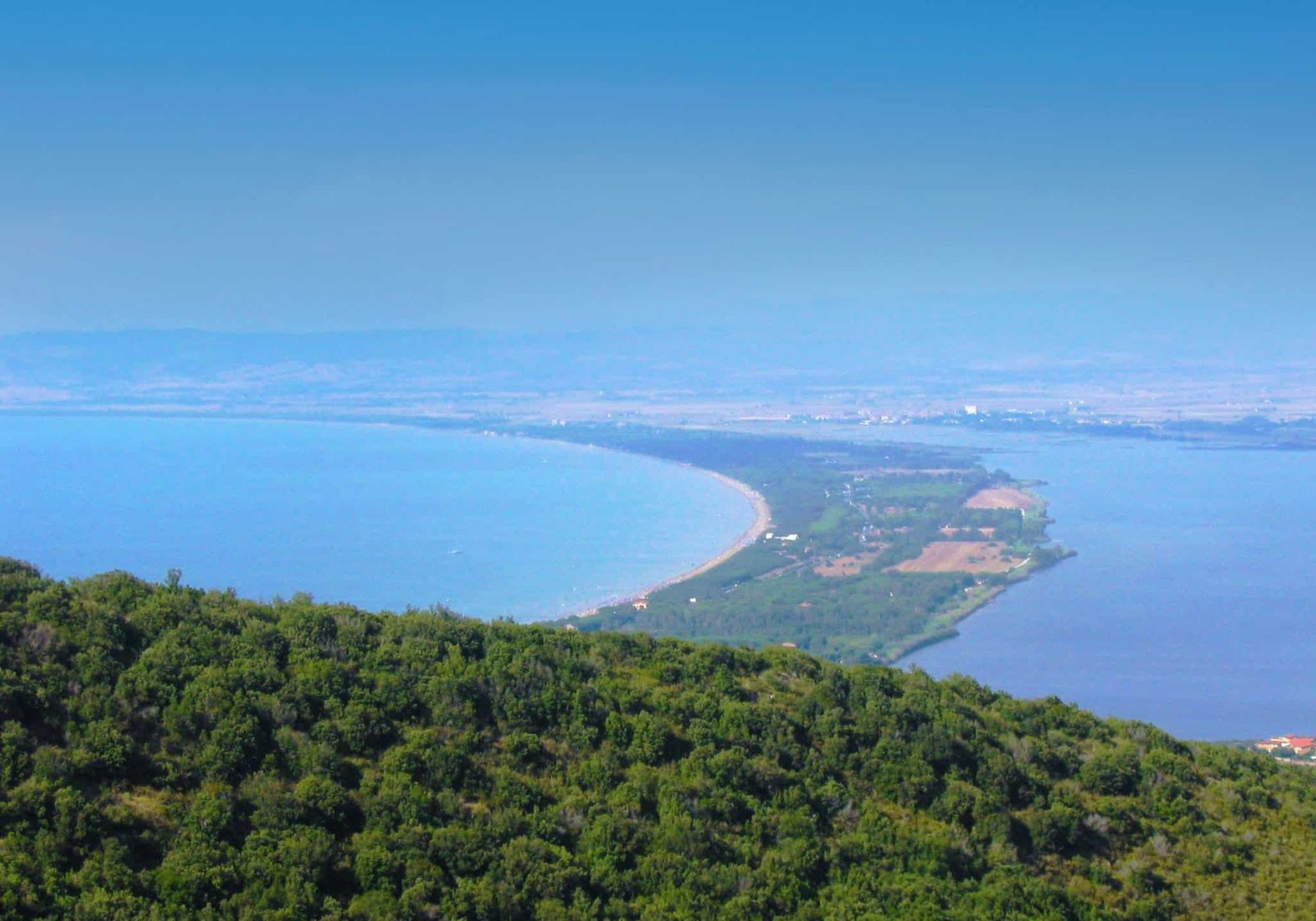
Monte Argentario juts out into the Tyrrhenian Sea about two hours from Rome, right opposite the two southernmost islands of the Tuscan Archipelago, Giglio and Giannutri. It's the last piece of Tuscany before Lazio, the southernmost part of the Silver Coast, and it's an anomalous promontory: a limestone block 635 meters high at Punta Telegrafo, held to the mainland by two tongues of sand, the Giannella and Feniglia tomboli, with the Orbetello lagoon in between. It was originally an island. Over the millennia the currents built the two sand bars, and the result is a landscape with no equal on the Tyrrhenian coast: on one side sheer cliffs with pebble coves, on the other 12 kilometers of sandy beach protected by pine woods, and in the middle still water where flamingos stop in winter.
The climate is the second reason for its good fortune: mild almost all year, with a winter you barely feel and a summer ventilated by the sea on three sides. The marine environment is the third. The Argentario's jagged coast, with walls, caves, shoals and wrecks, is among the most visited by divers in the Tyrrhenian and has submerged flora and fauna that in few other areas of Tuscany are found so close to shore. The municipality displays the Blue Flag, the FEE recognition for coastal localities, and the pediatricians' green flag for beaches suited to children. Porto Ercole joined the association of the Borghi più belli d'Italia in 2014. Since 2016 Porto Santo Stefano and Porto Ercole are also ports of call of the American cruise line Oceania Cruises, which explains the white ships that now and then anchor offshore.
The seafaring tradition is deep and still real: the Argentario has a fishing fleet, a boatbuilding tradition of master shipwrights documented in the museum of the Fortezza, and a vocation for sailing and pleasure boating that has made its ports an international reference point, with famous yachts and vintage boats at the moorings. For those arriving from inland, though, the surprise is the interior: the high part of the promontory is a network of trails that climb from the sea through the scrub to Punta Telegrafo, with views over the whole archipelago that on tramontana days reach Corsica. It's also mountain bike terrain, steep and technical, for those with legs. And there's golf: the Argentario Golf Club is a 77-hectare park with a championship 18-hole course, par 71 over 6191 meters, laid out in a natural amphitheater of olive trees and Mediterranean scrub.

The Promontory of Kings: the Argentario (GR) and international tourism
From the 1960s to the 1990s Monte Argentario was one of the most exclusive destinations in Europe, so much so that it earned the nickname "Promontorio dei Re", the Promontory of Kings. The prestige was built by the royal family of the Netherlands, which for over 40 years made the Argentario its summer residence at the Sbarcatello villa. Around that presence much of the jet set of the time gathered, and the ports saw names pass through like Richard Burton and Elizabeth Taylor, Kirk Douglas, Ingrid Bergman, plus Charlie Chaplin and Jacqueline Kennedy in the earlier years. You'll find the chronicle in the chapter on who has passed through here. What matters for the visitor is to understand that that season left a concrete legacy: villas hidden in the scrub, an urban planning that protected the coast from the concrete flows of the 1970s, and a high-end hospitality that still today defines the price range of Porto Ercole.
Closely intertwined with that history is that of the Hotel Il Pellicano, above the Acqua Dolce cove, opened in 1965 by a couple in love, as the hotel still tells it, and become one of the most photographed hotels in the Mediterranean. Today it's part of the Leading Hotels of the World and regularly appears in the world rankings. I don't mention it to send you to sleep there: I mention it because it's the key to reading the south side of the Argentario, where the best beaches are at the foot of residences and villas and where public access, always guaranteed by law, passes through trails and pedestrian gates that you need to know about. They are described here one by one.
A professional's consideration: the Argentario is not a place for those who want everything within reach. The beautiful beaches are earned on foot or by boat, parking is scarce, prices in high season are Tuscan. In return it is one of the few stretches of coast two hours from Rome where the sea, at the end of August, is still clear. If you have to choose a single sea day trip outside the region from Rome, this one and Capalbio are the two serious candidates. The Argentario wins on variety.

A curiosity about the Argentario (GR)
The name Argentario has nothing to do with silver, and the curious thing is how old the confusion is. In antiquity the promontory was called Cosano, from the Roman colony of Cosa, founded on the height of Ansedonia, right where the Feniglia tombolo detaches from the mainland. The name Argentarius mons appears for the first time in a late antique poet, Rutilius Namatianus, who in the 5th century describes it in his De reditu suo (I, 315 and following), recounting the return trip by sea from Rome to Gaul. There were never silver mines on the mountain. The explanations put forward by scholars are two, and you still find them opposed today. The first, upheld by the 19th-century geographers Santi and Repetti, looks to the luster of the promontory's micaceous rocks, which in the afternoon sun really do shine like sheet metal. The second, advanced by the geographer Assunto Mori in the Bollettino della Società Geografica Italiana in 1922, is more refined: the owners of the mountain in Roman times were the Domitii Ahenobarbi, the family from which the emperor Nero came, and the Domitii were argentarii, that is, bankers. The promontory would have been called "of the bankers", not "of silver". It is a hypothesis, not a documented fact, but it has an economic logic the other doesn't: the Domitii obtained these lands, according to tradition, as compensation for the loans made to the republic during the Second Punic War, and they profitably practiced fishing there in the fish ponds of the Santa Liberata villa.
The curiosity within the curiosity: the three Roman landings of the Argentario, Portus Herculis, Incitaria and Domitiana positio, are listed in the Itinerarium Maritimum, the 3rd-century AD sailing guide that describes the route from Rome to Provence. It means that the boats that today go around the coves retrace, cove after cove, a trade route 2,000 years old. When you circle the promontory in a dinghy, think about it at Santa Liberata: the basins you see surfacing at low tide are the Domitiana positio of the sailing guide.

The tour of the beaches of the Argentario (GR), one by one
The best way to see the Argentario's beaches is from the sea. Renting a boat, even a small dinghy that needs no license, lets you go around the promontory and reach those coves that from land require steep trails or are simply inaccessible. The golden rule is the wind: you pick the north, south or west bays depending on where it's blowing from, and for this you need a minimum of experience or, better, the advice of whoever rents you the boat. With the maestrale you go to the east and south side. With the scirocco to the north side, toward Pozzarello and Cantoniera, where the sea becomes clearer precisely with that wind. For those not used to open sea or looking only for sand and shallow water for the family, there is an easy solution: the Giannella and Feniglia tomboli, two very long beaches protected by pine woods, with easy access and no surprises. For rock lovers, instead, the whole coast of the mountain alternates high cliffs with wild coves, often reachable only by sea, in water that stays crystal clear even in August. Divers find one of the most varied coasts of the Tyrrhenian: walls, caves, shoals and wrecks a few minutes from the ports.
The descriptions that follow start from the Giannella, to the north, and go clockwise to the Feniglia, to the southeast. The trail distances are approximate: bring closed shoes, water and a beach umbrella, because outside the towns there are no services.
The Giannella, the north tombolo of the Argentario
The Giannella is the northern sand bar, the one you drive along arriving from Albinia: about six kilometers of wide, straight beach, with the lagoon behind you and the mountain ahead growing with every kilometer. You come to it a few kilometers before entering Porto Santo Stefano. There are beach clubs and long stretches of free beach, bars and small restaurants right on the shore, and there are many accesses along the road of the same name, each with its own dirt parking lot that in August fills up by 10. Behind it runs a narrow, long pine wood that offers the only real shade. It's the Argentario's sailing-sports beach: the sandy bottom, the steady maestrale wind and the absence of rocks make it an ideal base for windsurfing, kitesurfing and catamarans, and the sailing schools work from May to September. The bottom slopes gently, the water is less transparent than in the rocky coves but warmer, and for small children it's the safest beach of the promontory together with the Feniglia. A tip: on the Giannella the sunset falls straight onto the sea, in front of you, and the free beach toward Santa Liberata is the right place to watch it without paying for a lounger.
The Feniglia of the Argentario, beach and reserve
The Feniglia is the southern tombolo, the one you drive along arriving in Porto Ercole from the Orbetello causeway. Here too you find some beach clubs, bars and restaurants on the shore, and kilometers of free beach. But the Feniglia is above all its pine wood: the Duna Feniglia Nature Reserve, 474 hectares over six kilometers in length, declared a forest reserve in 1971 and born from a reforestation begun in 1910, when the State expropriated the dune, reduced to shifting sand by centuries of deforestation, and reforested it with stone pine. In 50 years a wood of 460 hectares has grown. The reserve can be crossed only on foot or by bicycle along a six-kilometer dirt road from which the numbered openings toward the sea branch off. Cars do not enter. The fallow deer, introduced in the 1950s from the presidential estate to contain the invasive broadleaf trees, are plentiful and not very shy: you will almost certainly meet them in the early morning or toward sunset. It's one of the most pleasant walks on the Tuscan coast, flat, in the shade, with the scent of resin and the lagoon glimpsed on the left. And it has an illustrious ghost: it was on this beach that on July 18, 1610 Caravaggio was found dying. I talk about it in the chapter on events.
The Bagni di Domiziano
The Bagni di Domiziano, also called Gerini beach, is a small sandy beach on the right of the road that leads from the Giannella to Porto Santo Stefano, in the locality of Santa Liberata, at the foot of what was the seaside villa of the Domitii Ahenobarbi. The popular name is an affectionate historical mistake: the emperor Domitian has nothing to do with it, the villa belongs to the Domitii, Nero's gens, and dates to the 1st century BC. At low tide the basins of the ancient fish pond surface from the sea, and the ruins of the villa and the 16th-century Santa Liberata tower built above it are also visible. The bottom slopes gently, so it's a beach very well suited to children, and being able to swim over a Roman fish pond is an experience that few other places in Italy offer at no cost. The beach is entirely free, with no bars or beach clubs: bring everything from home. Parking is along the road and is scarce. In summer it's best to arrive early or by bicycle from the Giannella.
La Soda
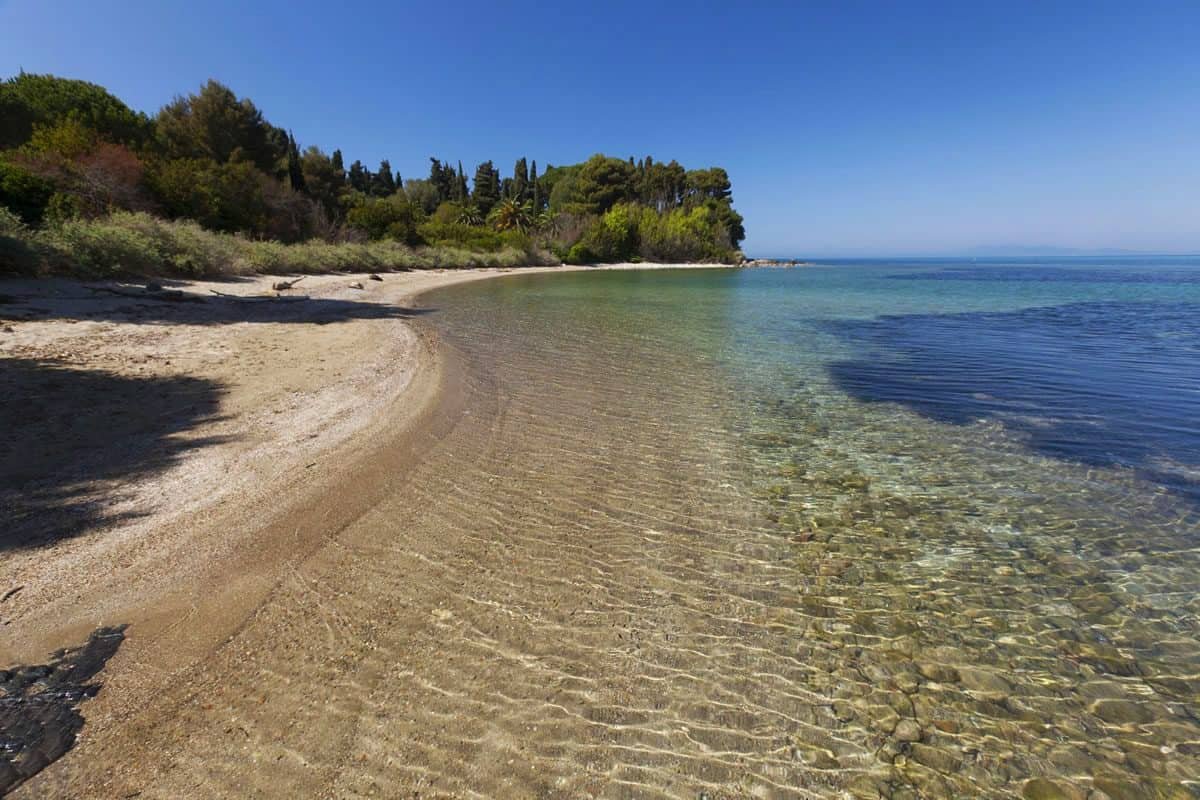
La Soda is the cove you come to continuing from the Bagni di Domiziano toward Porto Santo Stefano. It's a beach of small pebbles, partly free and partly served by a beach club, with a bar and restaurant right on the sea. The ease of access from land and the undemanding bottoms, which descend gradually over sand and posidonia, make it the ideal cove for those starting to dive: many Argentario dive centers bring their basic courses here, and it's also a good place for a first snorkeling with children, because the barrier of rocks at the sides hosts sea breams and bogues in a meter of water. Parking is on the road, a few spaces. It's a morning beach: in the afternoon the sun goes behind the mountain earlier than elsewhere.

Il Pozzarello
The Pozzarello beach comes right after La Soda: a wide bay lined by the road, with a part of free beach and a beach club with bar and restaurant. Access is directly from the road, with no steps or trails, and for this reason it's the most convenient beach of the Argentario for people with reduced mobility, together with the Cantoniera and the Moletto. It's a quiet bay, of sand and fine pebbles, particularly recommended on scirocco days, when the wind from the southeast leaves it in a calm while the south side of the promontory is battered. On the hill behind you can see the Forte del Pozzarello, the last fortification built on the promontory (1874-1888), which I discuss further on. In the Pozzarello locality there's also the modern church of the Santissima Trinità, consecrated in 2002.
La Bionda
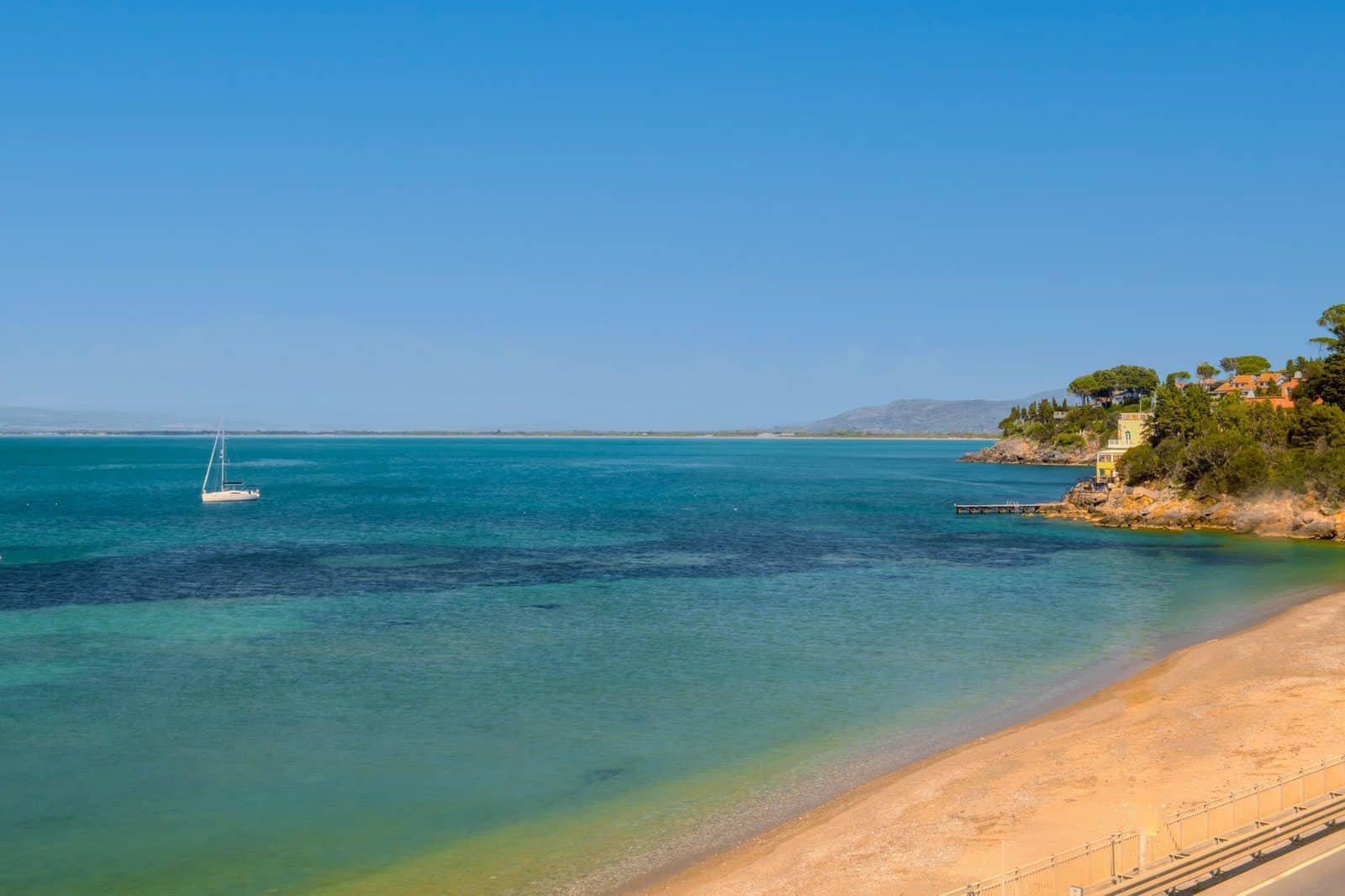
La Bionda is a small cove that you find by taking, at the end of the Pozzarello, the little road that runs along the sea, or by starting from Porto Santo Stefano beyond the three tunnels of the old railway. It gives the impression of being a private beach, because a few small villas face it and a barrier of rocks closes off the stretch of water, which stays always calm. It isn't one: access is free. You reach it comfortably on foot from Porto Santo Stefano in a quarter of an hour, it has no beach clubs or bars, and the only drawback is that with certain winds posidonia seaweed piles up on the shore. For those staying in town without a car it's the simplest solution for a quiet swim early in the morning.
La Cantoniera and the little train tunnel
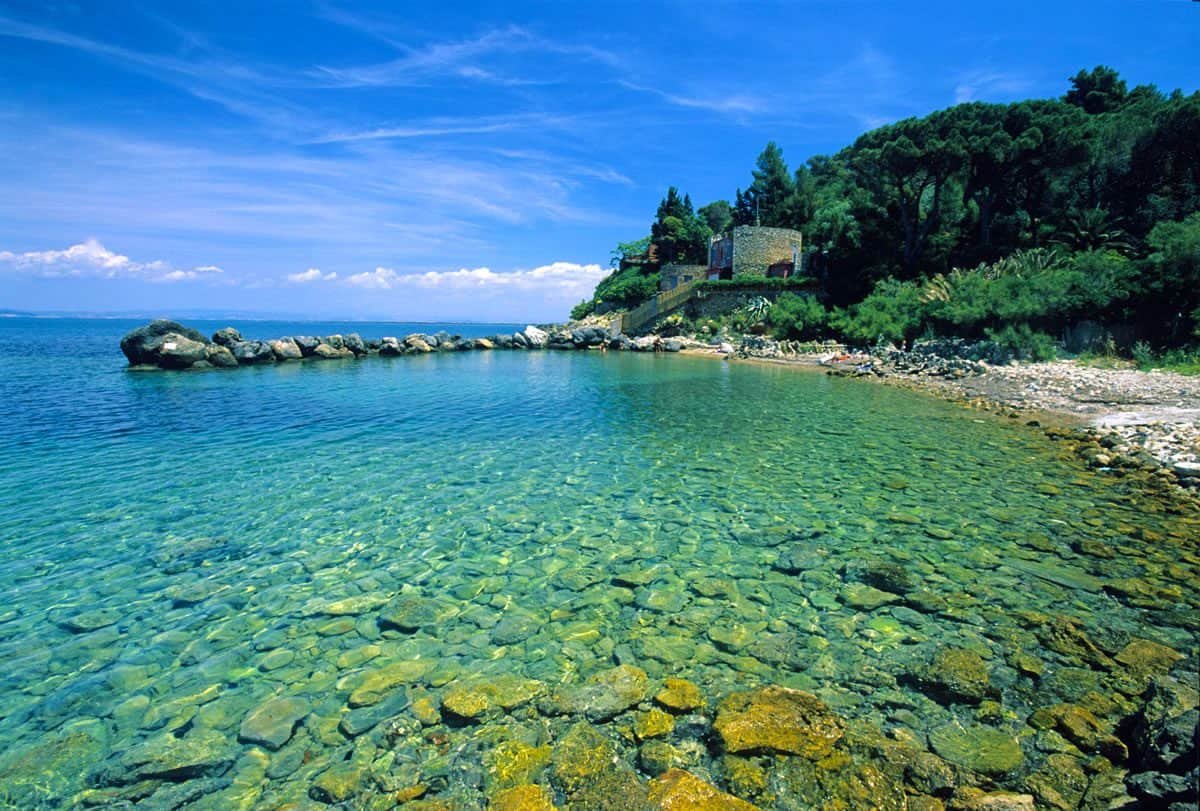
La Cantoniera is a small beach of sand and tiny pebbles, also reachable on foot from Porto Santo Stefano through the tunnel where from 1913 to 1944 the little train ran that connected the town with Orbetello Scalo: the Orbetello-Porto Santo Stefano railway, a tramway destroyed by the bombings and never rebuilt, whose route today is a walking path. There are the free beach and the beach club with bar and restaurant. It's a lively beach, very popular with local kids, who show off with dives from the rocks on the left side. When there's scirocco the sea here is particularly clear. It's also accessible to people with disabilities. If you want to see the Argentario of the residents and not that of the tourists, La Cantoniera on a July evening is the right place.
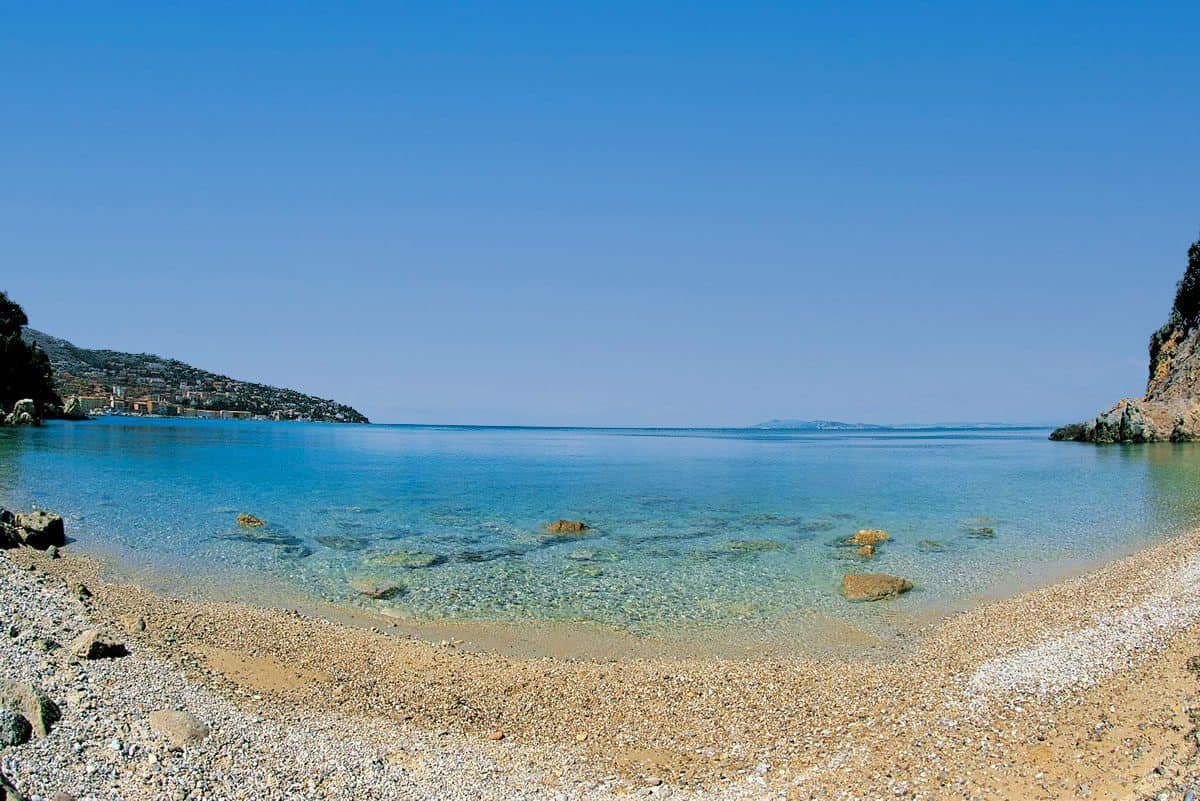
Il Moletto
Il Moletto is a small beach inside Porto Santo Stefano, on the side of the Valle harbor: very easy to reach and accessible even in a wheelchair. The free beach space is small, the rest is a beach club with bar and restaurant. In the summer period a water polo field is set up in the waters in front, and water polo in Porto Santo Stefano is a religion second only to the Palio: the evening matches are followed from the quay. A lunch-break beach, not a full-day one.
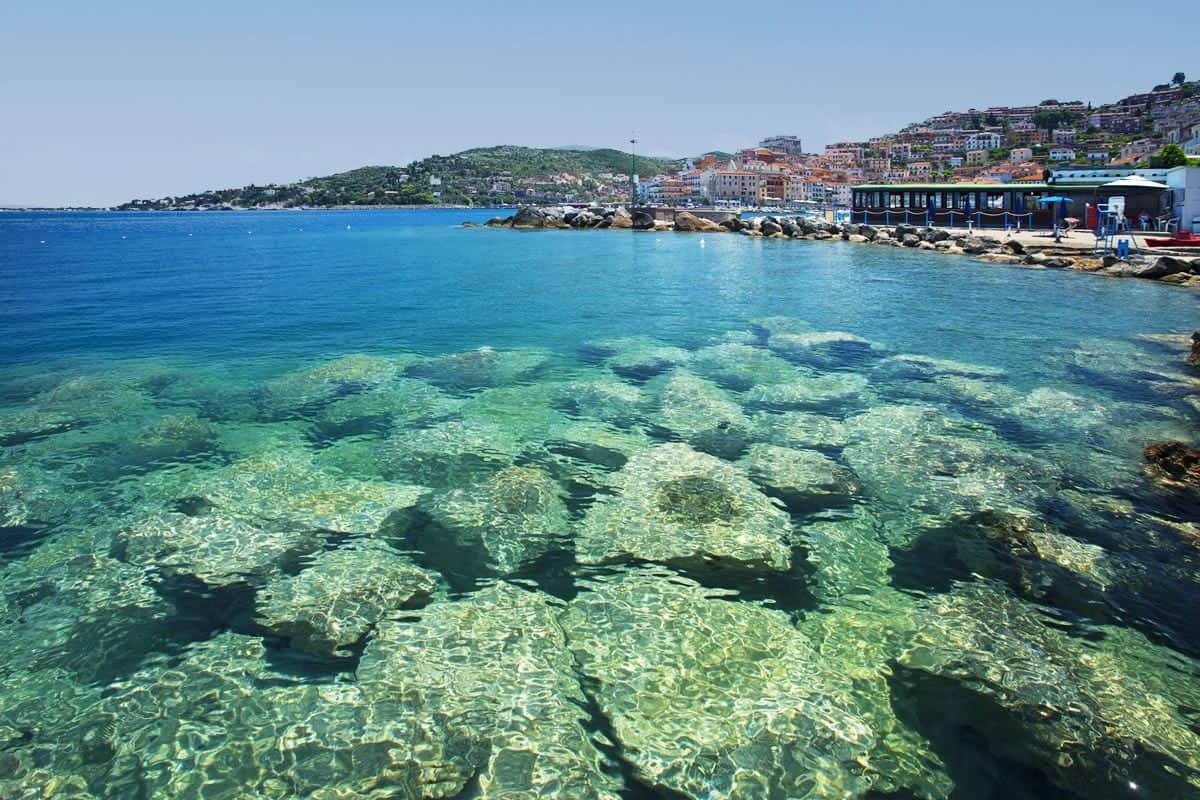
La Caletta
La Caletta is the beach of the hotel of the same name, also inside Porto Santo Stefano and therefore easy for everyone to reach. It has a beach club, bar, restaurant and a dive center that organizes guided shore dives to observe seahorses, which live in the posidonia meadow a few meters from the shore. It's one of the few areas of Tuscany where they are regularly seen, and for an eight-year-old with a mask it's worth more than any aquarium. A small artificial dock also lets the youngest dive in safely.
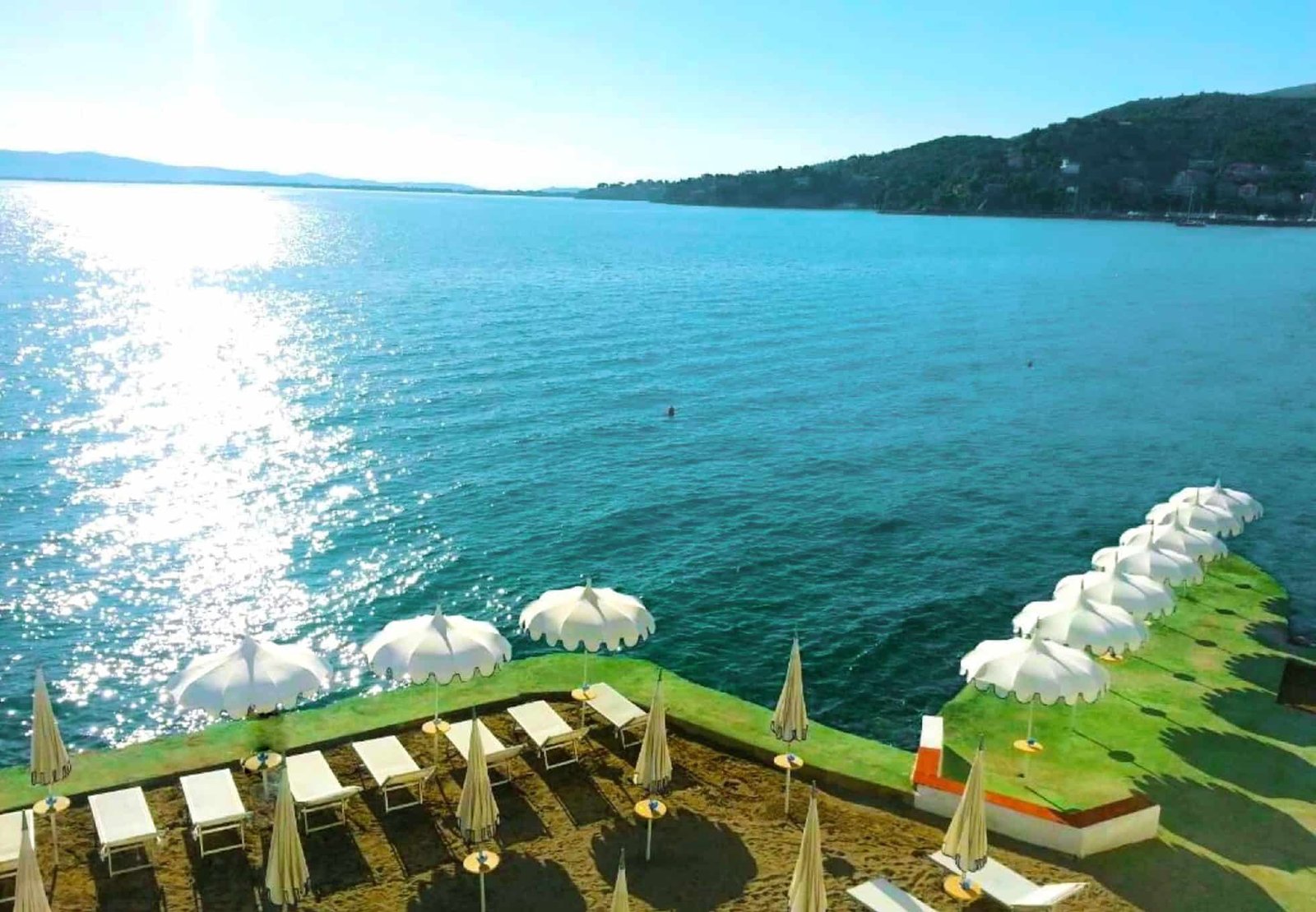
Cala La Cacciarella and the Grotta del Turco
La Cacciarella is the first of the beaches far from the towns, so with no bars or beach clubs, and in exchange decidedly more beautiful from a natural point of view. It's a tiny sandy beach set between two cliffs, under the Feltrinelli villa. The trail from the panoramic road is about 500 meters long and demanding, steep, with the last stretch on rock. Bring a mask: the bottoms are among the most beautiful on the west side. In the cliff to the east opens the Grotta del Turco, with an entrance that's barely visible and a wide interior. According to legend a boat of local fishermen hid there fleeing the Barbary corsairs, who between the 1500s and the 1700s raided these coasts and whom the locals called indiscriminately "Turks". Above, on the hill, remains the Torre della Cacciarella, one of the Spanish towers of the lookout system. It's not a beach for children or for people with knee problems.
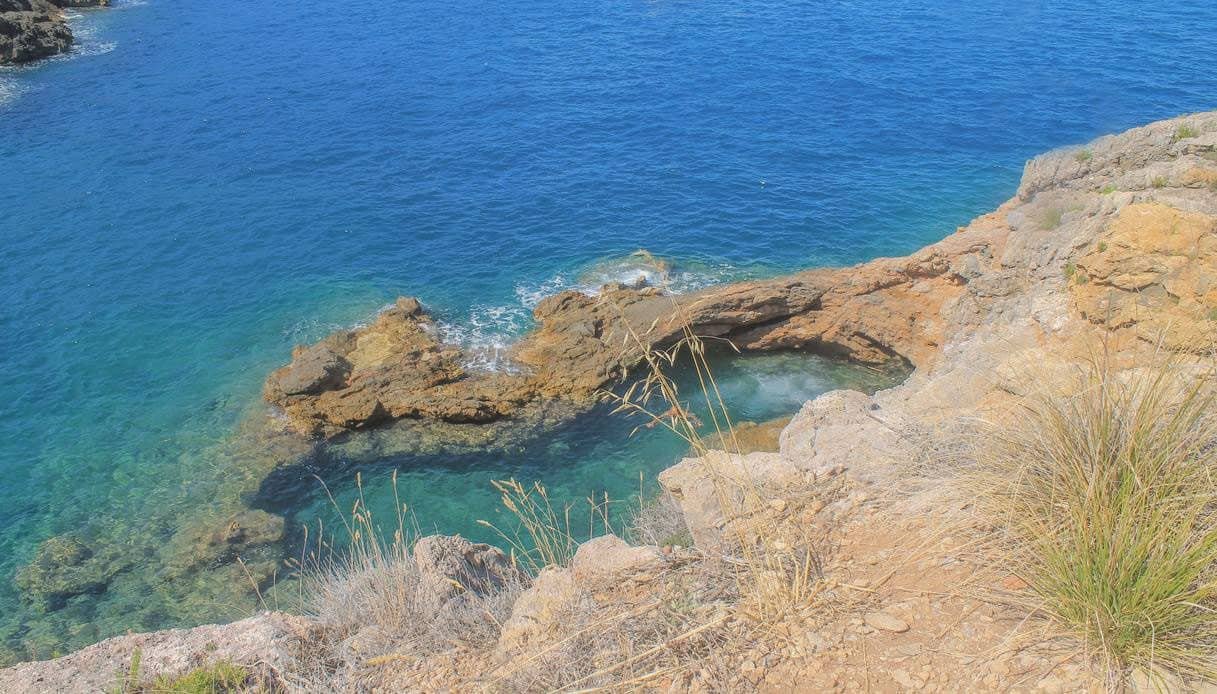
Cala Grande and the submerged Christ
Cala Grande is perfectly visible from the panoramic road and is the cove most frequented by boats of the Argentario: on August weekends the anchorage is a parking lot of dinghies. The vegetation comes down to the shore and there's no tourist who doesn't stop at the viewpoint to photograph it. Three pebble beaches face onto it. The trail that leads to the first is just over 500 meters long and is actually the ancient Fosso del Cauto, which descends through a grove of tall holm oaks, shady and cool even at noon. The route is not excessively demanding but it isn't suitable for everyone. It's an excellent place for snorkeling and for long swims in deep water. On the bottom of the cove, a few meters deep, is the statue of Christ the Redeemer placed in 1990 and restored in 2014, the destination of an underwater pilgrimage that the promontory's dive centers organize every summer. On the coast remains the Torre di Cala Grande, Spanish.
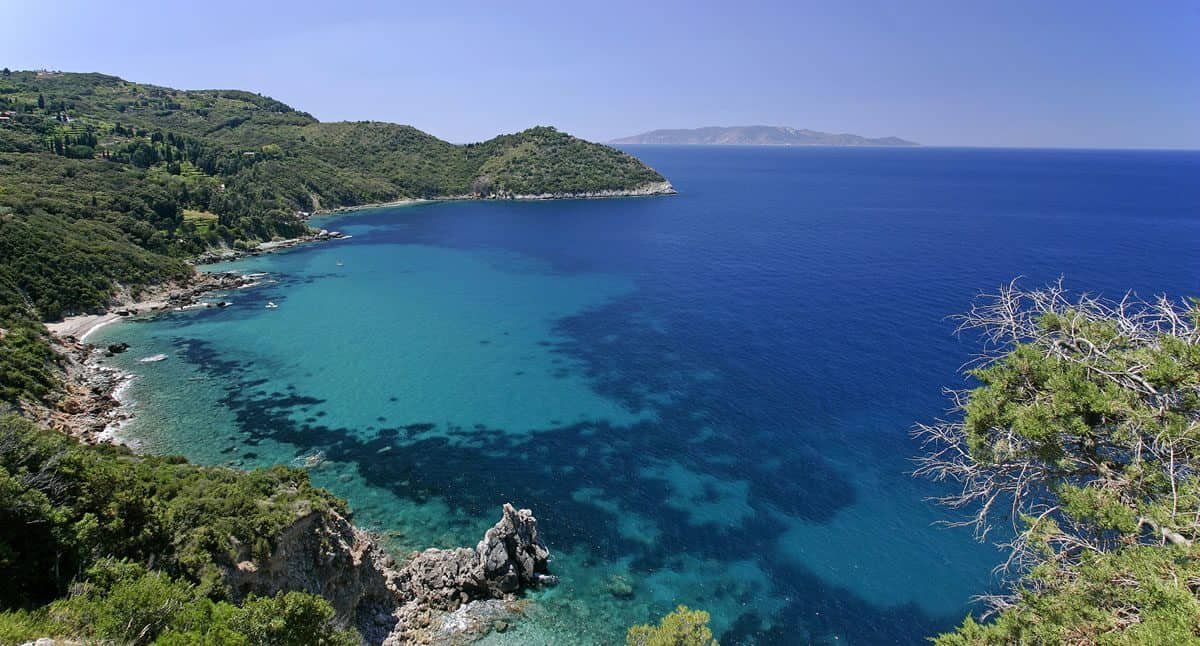
Cala del Gesso, the most beautiful
Cala del Gesso is, in our judgment and in that of nearly everyone who knows it, the most beautiful beach of the Argentario. You reach it by following the panoramic road to kilometer 5.9, where Via dei Pionieri branches off on the right. You follow this little road for a few hundred meters and, at the end of the descent, you pass a gate with a pedestrian passage. From there a paved trail of about 700 meters drops steeply with very wide views over the Argentarola and Giglio. The climb back is hard: avoid it in the hottest hours and bring water. The effort is repaid: the beach is of very small pebbles, the water is a blue that looks color-corrected on a computer, and opposite is the islet of the Argentarola with its submerged cave. On the cliff to the right you can see the remains of a Spanish lookout tower of the 16th century. The parking lot at the top is tiny: in August, if you arrive after nine, you won't find a space, and stopping along the panoramic road is forbidden and fined. No services, no bar.
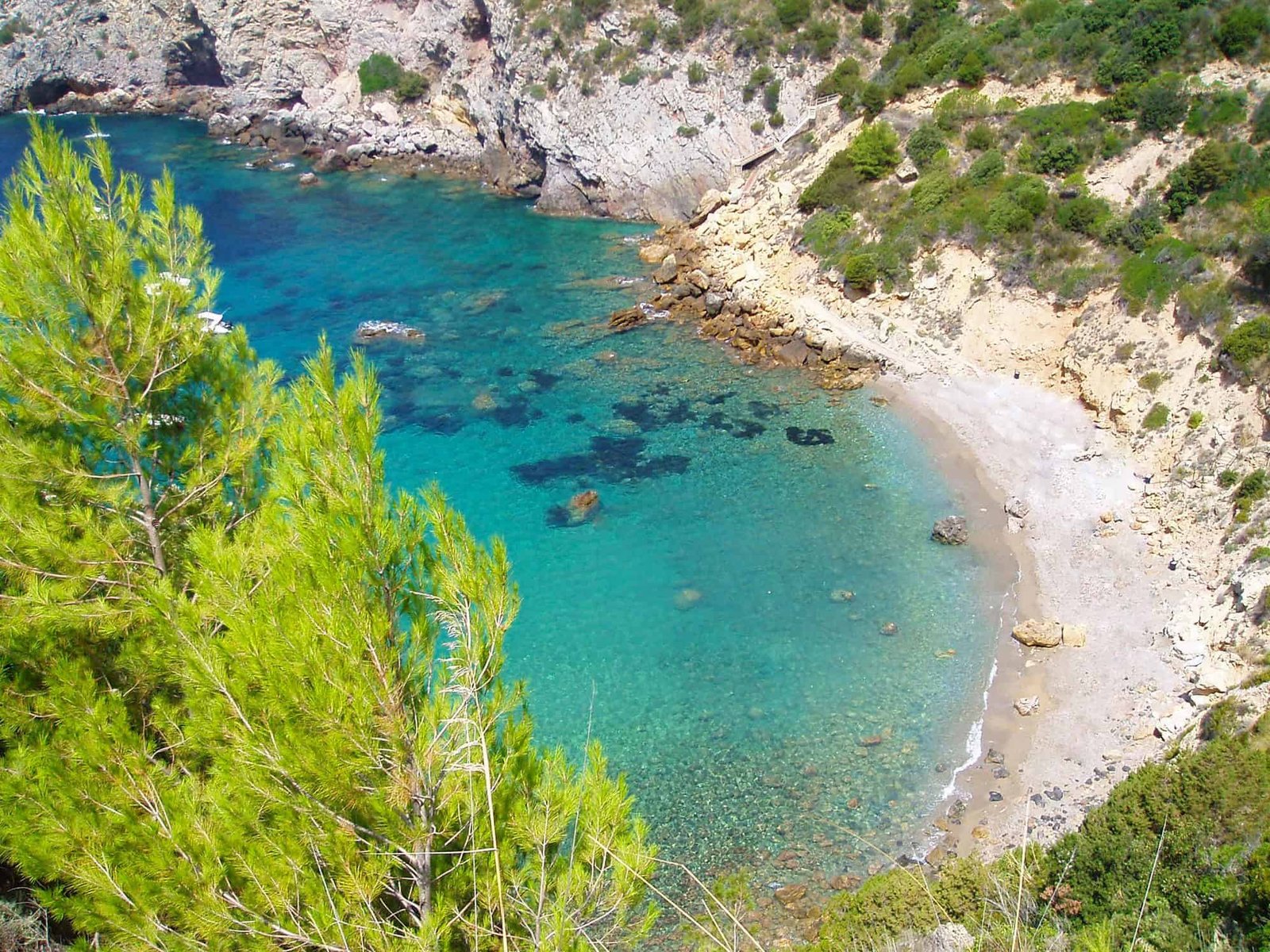
Cala del Bove
Cala del Bove is a little further on from Cala del Gesso. The path can only be walked and is about 700 meters long. There's no shore: it's a cliff of smoothed rock, on which you can lie down in a relatively comfortable way, with the water turning deep right away. An excellent area for snorkeling, with walls that drop steeply and plenty of fish. Not recommended for those who don't swim well and for small children, because getting out of the water with a long swell takes care.

Cala Piccola and the Scoglio del Corallo
Cala Piccola is a small pebble beach reached from the road by following the signs for the Torre di Cala Piccola hotel, built around a Spanish tower. The beach club belongs to the hotel and land access is reserved for guests and for members of the Cala Piccola residential consortium. By sea, as everywhere in Italy, the shoreline is free. In front of the beach is the famous Scoglio del Corallo, a shoal that rises from 45 meters deep to a few meters below the surface: it's one of the classic dives of the Tyrrhenian, with red gorgonians and coral, reserved for those with certification. In the Cala Piccola locality there is also Villa Ricci, designed by the architect Julio Garcia Lafuente in 1977.
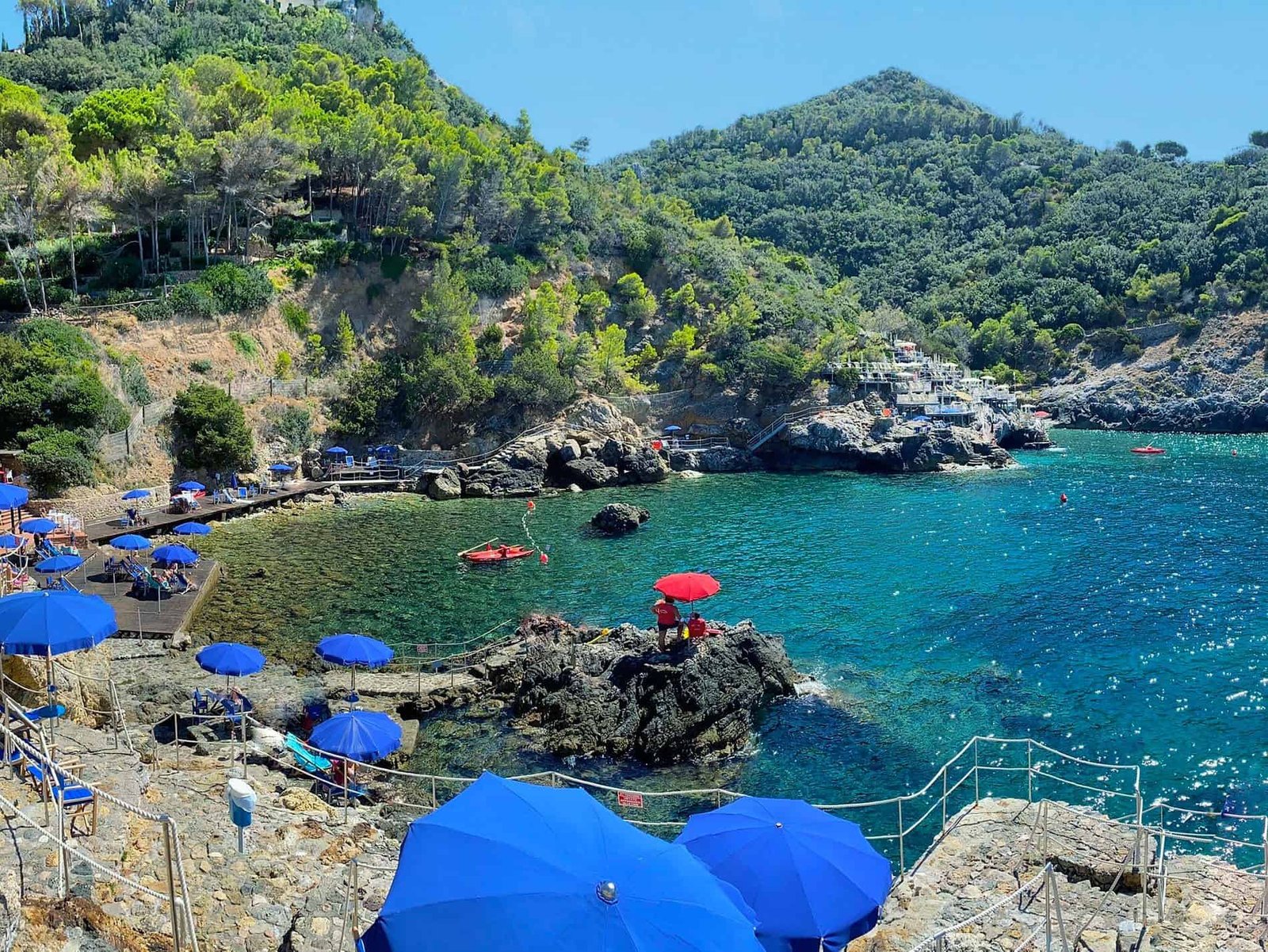
Mar Morto, the natural pools
Mar Morto is reached by a fairly long trail, about 500 meters, but not excessively demanding. The name comes from the rocky barrier that keeps waves from reaching the shore directly: behind the barrier natural pools form where the water is always calm, and swimming in there with a rough sea outside is one of the memorable experiences of the Argentario. There are no bars or shelter from the sun, which beats down hard here all day: umbrella, sunscreen and water are not optional. The bottom is among the most beautiful of the promontory and very rich in fish: a mask is enough. To lie down look for the smoothest rocks on the barrier. They are never comfortable, but the little pebble beach at the foot of the slope is to be avoided, because in summer the heat there is almost unbearable and getting into the sea is more complicated. From the barrier you easily reach both the open sea and the pools, and it's also the breeziest spot.
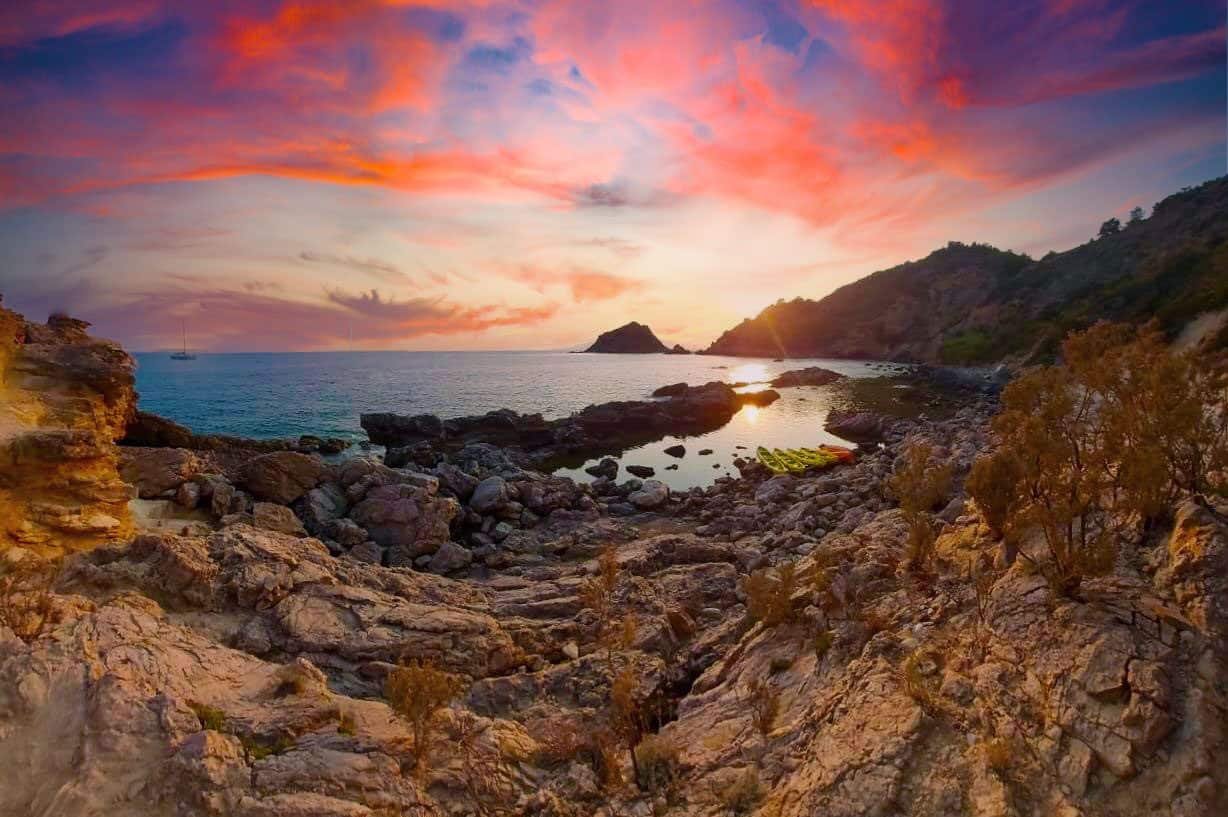
Le Cannelle and the tower
The road to Le Cannelle is the same as for Mar Morto, continuing for about 700 meters to an automatic gate with a pedestrian passage on the right: you leave the car and walk down about 150 meters of wide, paved road. On the left side of the bay rises the Torre delle Cannelle, Spanish, fully restored but not open to visits because it's a private residence. The bar and the beach club are reserved for members of the residence. The beach, of large pebbles and sand, is free. With a very rough sea from the libeccio, Le Cannelle becomes the field of the Argentario's surfers, and it's worth going down even just to watch them. To experienced swimmers I recommend the crossing to the right as far as the next cove, Mar Morto, where the bottom is of rare beauty.

L'Acqua Dolce, below Il Pellicano
L'Acqua Dolce is reached from Porto Ercole along the panoramic road, following the signs for the Hotel Il Pellicano. Just before the hotel entrance you are required to leave the car in a parking lot and continue on foot along a very easy trail of about 200 meters. The beach is of sand and small pebbles, set between two points, and takes its name from a spring that surfaces among the stones. Practical tip: don't arrive too late, because in summer around 18:00 the sun drops behind the mountain at the back of the beach and the bay ends up in shade an hour before the others. It's a morning and early afternoon beach.
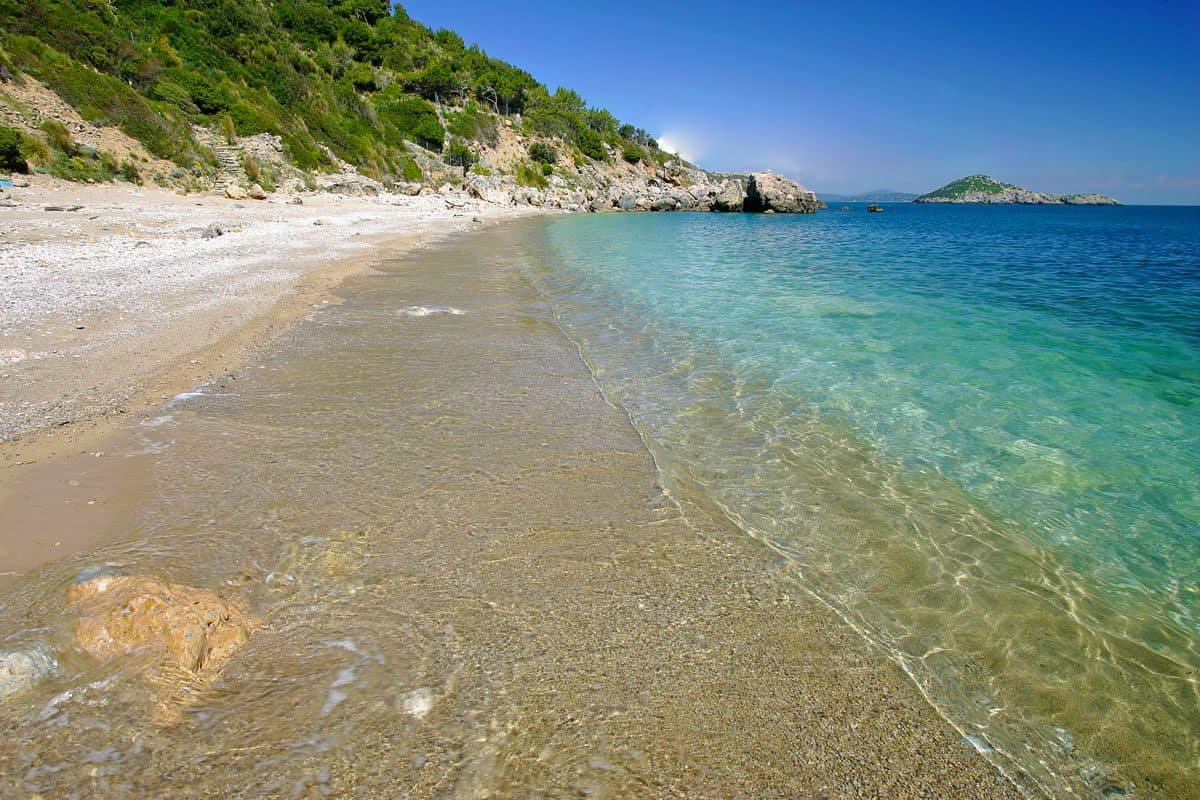
Lo Sbarcatello
Lo Sbarcatello is reached from Porto Ercole along the panoramic road: at kilometer 1.6 you leave the car and continue on foot along a pedestrian trail that goes down to the cove, of pebbles and rocks, with very clear water. It's the stretch of coast where in the 1960s the Dutch royal family had its villa built, L'Elefante Felice, and the cove keeps a secluded air: few bathers, almost all locals, no services.
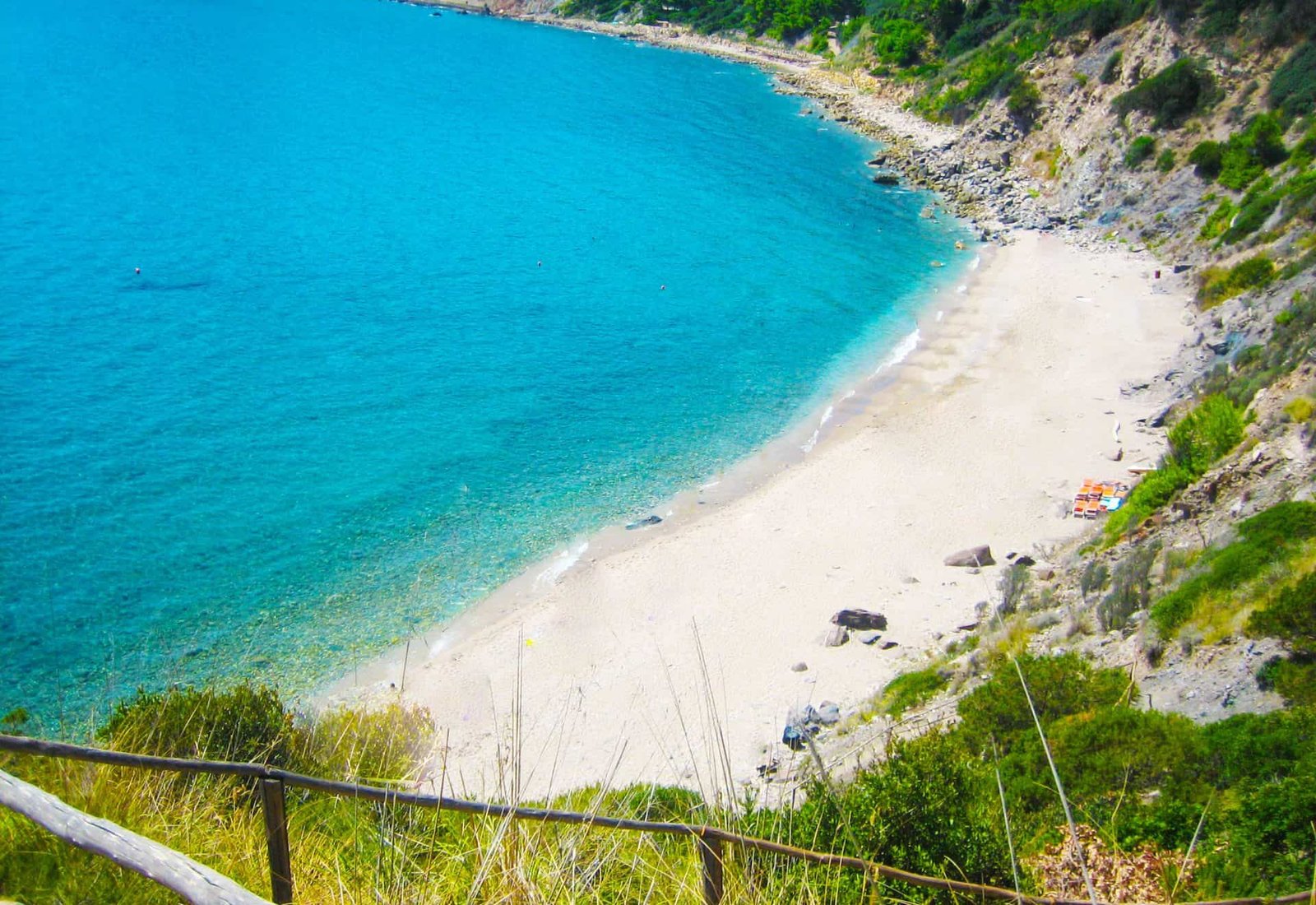
La Spiaggia Lunga below Forte Stella
La Spiaggia Lunga is reached from Porto Ercole by the panoramic road. At kilometer 1.55, a few meters before the turn for Forte Stella, the trail starts on the left, about 200 meters long and difficult in places, with rock steps and loose earth. The beach is free, with an umbrella and lounger rental service for those who want it, and is dominated by the star-shaped mass of Forte Stella. It is perhaps the most photogenic beach on the south side, because the Spanish fort frames the bay from above and in the afternoon the light hits it from the side.
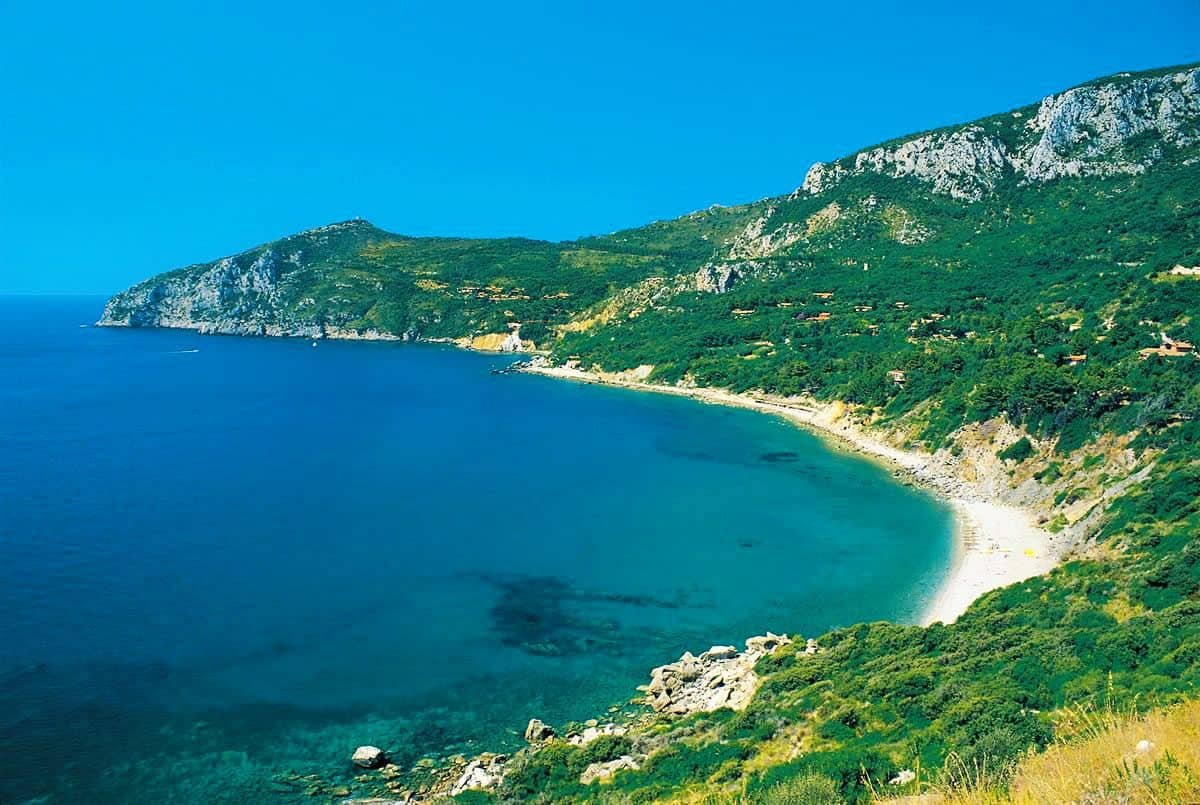
Le Viste and the Isolotto
Le Viste is reached from Porto Ercole just after leaving the town along the panoramic road: on the left there's a small bar along the road, you leave the car in the designated parking lots and go down a trail of about 200 meters. The beach is partly free and partly equipped with a bar and beach clubs. Opposite the bay is the Isolotto di Porto Ercole, a rock covered in tree spurge protected as a Special Protection Area, which in the morning light seems to float. It's the most convenient beach of Porto Ercole for those without a boat.
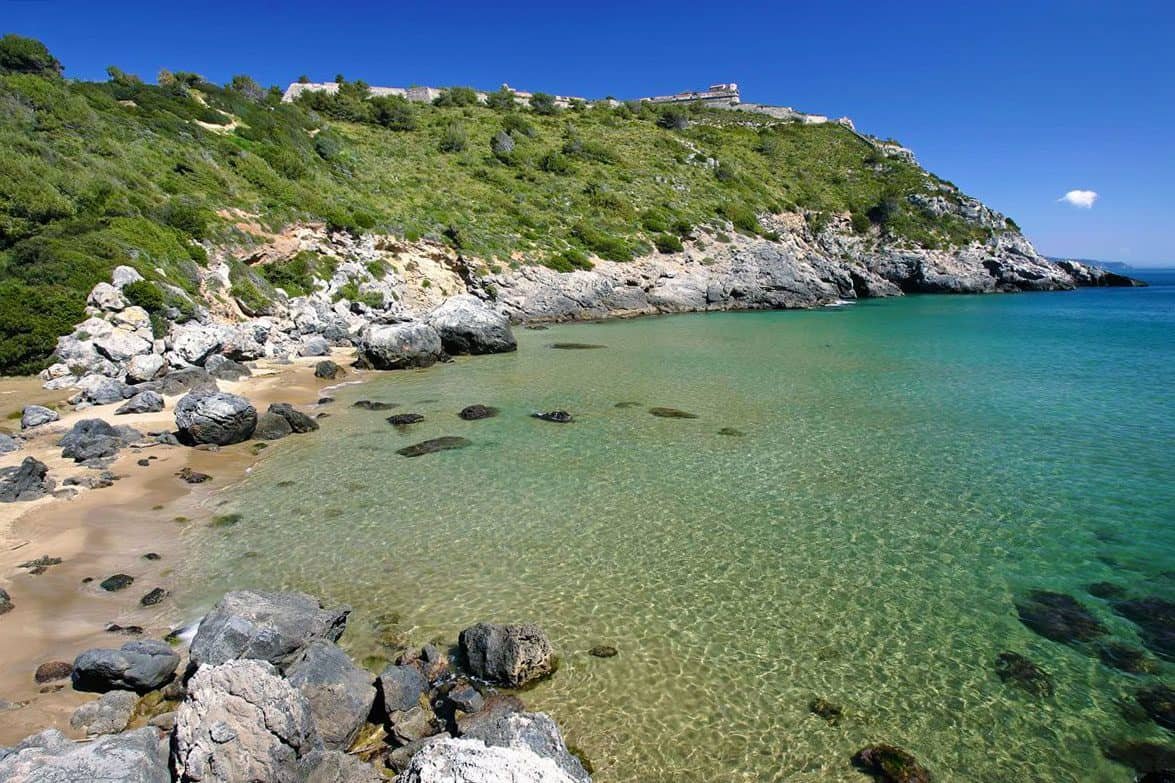
Cala Galera
The beach of Cala Galera is just before Porto Ercole, between the Cala Galera marina and the hill of Poggio Pertuso. It's very easy to reach: from the provincial road to Porto Ercole you turn toward Cala Galera, go about 200 meters, turn left to the large free parking lot, and from there you walk the last 100 meters. It's a sandy beach with shallow water, so it's also suitable for the smallest children. There are the free beach and an equipped beach club. On Poggio Pertuso, above the cove, stand two villas from the 1960s that architecture enthusiasts know: Villa Italiesin (1960) by the Norwegian architectural historian Christian Norberg-Schulz and Villa Valdroni (1968-1970) by Oreste Martelli Castaldi.

Something nobody tells you about Argentario (GR)
No guide tells you that the Argentario was, in World War II, the second most destroyed municipality in Italy after Cassino. For the Germans Porto Santo Stefano was a logistics base of prime importance on the Tyrrhenian, the real stronghold of the Wehrmacht on the Tuscan coast, and from 1943 to June 1944 the Allies bombed it repeatedly. The towns were razed to the ground, the civilians killed were many, and Radio London emphasized those bombings as proof of the coming victory. On June 7, 1944, retreating, the German troops blew up the parish church of Santo Stefano, rebuilt and consecrated only on December 25, 1950. In the same year, 1944, they destroyed the upper part of the Santa Liberata tower. When you stroll along the waterfront of Porto Santo Stefano, look at the houses: they are almost all postwar, and this explains why the town, though old, doesn't have the look of a village that Porto Ercole has. On the lungomare dei Navigatori a defused aircraft bomb, with two steles bearing the names of the civilians who fell in 1943, recalls all this next to the Civil Protection monument. Few tourists stop to read it.
The second thing they don't tell you: the most famous villa on the promontory, Villa La Cacciarella, called Villa Feltrinelli, perched above the sea on the point of the same name on the west side, was commissioned by the publisher Carlo Feltrinelli in 1940 to a design by the Milanese architects Pozzi and Lancia. Feltrinelli died shortly before seeing it finished, and from 1943 the widow Giannalisa and her new husband Luigi Barzini took refuge there from the bombings. Some biographers say that right there, in the villa's air-raid shelter, the very young Giangiacomo Feltrinelli, future publisher and future militant, began to take an interest in communism by spending time with the workers who dug the shelter and watching with curiosity the explosives used in the digging. It is a biographical tradition, not a document. In the villa was born Benedetta Barzini, second child of the couple and later a celebrated model. In 2005 the residence hosted the wedding of Anna Falchi and Stefano Ricucci, and in 2015 it was bought and renovated by the Russian businessman German Khan. From the Cacciarella trail you see it from below: it can't be visited.
The third: the torpedo test range. In 1943 the Silurificio Moto Fides of Livorno, a branch of Whitehead, built in Porto Santo Stefano a structure for testing torpedoes at sea. It was destroyed by Allied bombing the same year and never went into operation. The remains of the supporting columns are still in the sea, in the locality that bears its name, and have become an industrial archaeology find that divers visit between one dive and the next.

The history of the Argentario (GR) from the Etruscans to the Stato dei Presidi
The promontory was probably inhabited already by the Etruscans, whose presence in the surrounding Maremma, from Vulci to Talamone, is documented by archaeological remains. On the mountain itself the traces are scarce and mostly prehistoric, in the caves. History becomes readable with Rome: the whole area became part of the personal property of the Domitii Ahenobarbi, who according to tradition obtained it as compensation for the sums lent to the republic during the Second Punic War. Cosa, the Roman colony on the height of Ansedonia, is the reference center of the promontory in that period, and its port and fish pond mark the start of the Feniglia. In the 4th century AD the promontory passed under the control of the Roman Church. In the Middle Ages, with the decline of traffic on Via Aurelia and the progressive silting up of the Maremma, these places remained sparsely inhabited for a long time.
In the late Middle Ages the mountain followed the fortunes of Orbetello: the Aldobrandeschi, the Orsini, Ladislaus king of Naples, Siena. In 1555, during the War of Siena, Porto Ercole was fortified by the Florentine exile Piero Strozzi with eight additional works and then taken by the imperial forces. The episode, the Presa di Porto Ercole, was frescoed by Vasari in Palazzo Vecchio. With the Franco-Spanish peace of 1559 the Spain of Philip II kept Orbetello, Porto Ercole, Porto Santo Stefano, Talamone and Ansedonia and made them the Stato dei Presidi, with Orbetello as capital: a small military state that controlled the Tyrrhenian between Genoa and Naples. To this period date the fortifications that Philip II had erected against the Turks and the French, making the promontory the defensive linchpin of the Presidi and reviving the civil life of these places: Forte Filippo, Forte Stella, Forte Santa Caterina and the Rocca at Porto Ercole, the Fortezza Spagnola at Porto Santo Stefano, and a chain of lookout towers along the whole coast from Talamone to Ansedonia. The Spanish fortified the two ports and gave shape to the two towns you see today.
Spanish rule lasted until 1714. The Argentario then passed to the Austrians until 1738 and to the Bourbons of Naples until the Napoleonic age. After Napoleon's defeat, in 1815 the Presidi entered the Grand Duchy of Tuscany, and in 1860 the Kingdom of Italy. In the meantime, between 1913 and 1944, a tramway connected Porto Santo Stefano to the Orbetello station through the tunnels that are now walking paths. The bombings of 1943-1944 wiped it out together with much of the town. The postwar was reconstruction, then tourism, then the "Promontorio dei Re". It's a history in which the Argentario has always belonged to someone else, Rome, Siena, Madrid, Vienna, Naples, Florence, and for this very reason it has a seafaring culture that is more Mediterranean than Tuscan: you can hear it in the dialect, which has Campanian influences, and taste it in the cooking.

The advice I give you for visiting Argentario (GR)
There is only one piece of advice and it goes against the trend: don't do the Argentario as a day trip from Rome in August. Two hours of Aurelia on the way there, the queue on the Giannella, the parking that doesn't exist, the Cala del Gesso trail at noon at 35 degrees and the drive back at seven in the evening with the whole Maremma lined up at Albinia: it's the way to hate a place that deserves to be loved. If you have just one day, choose it in June or September, when the sea is already or still warm and the coves are empty. Arrive in Porto Santo Stefano by nine, rent a dinghy at the Valle harbor and go around the promontory counterclockwise, with stops at Cala Grande, Cala del Gesso and Mar Morto, coming back in the afternoon for a schiaccia with onions and anchovies on the waterfront. If you have two days, sleep in Porto Ercole and give the second to the Feniglia by bicycle in the morning and to Forte Stella and the old town in the late afternoon, when the Rocca lights up with orange light.
The second piece of advice is about the boat. A 40-horsepower dinghy that needs no license is driven with common sense, but the sea of the Argentario changes in an hour: the west side, between the Cacciarella and Cala Piccola, becomes impassable for a beginner with a strong maestrale. Listen to whoever rents to you and don't go past the point if they tell you not to. Whoever wants no responsibility will find in the two ports boats with a skipper and, for groups, a guide who takes care of everything: TourLeaderPro organizes private experiences for small groups departing from Rome and provides professional tour guides for days out of town. The third piece of advice is banal and nobody follows it: closed shoes for the trails. Flip-flops on Via dei Pionieri are the first cause of broken ankles on the promontory.

Archaeological sites and caves of the Argentario (GR)
The karst caves of the Argentario
The whole promontory is a mass of limestone rock that over time has undergone karst and marine erosion, producing many caves with stalactites, stalagmites, underground lakes, galleries and tunnels, inhabited in the Neolithic age. The three main ones deserve to be known even by those who will never enter a cave. The Grotta Grande dell'Argentarola is an underwater cave in the islet opposite Cala del Gesso: its concretions, formed when the sea level was lower, are studied by geologists to reconstruct the oscillations of the Mediterranean over the last hundreds of thousands of years. It is a site of international importance for paleoclimatology, and is visited only with certification and a guide. The Grotta dei Santi opens in the cove of the same name on the southeast coast and is characterized by prehistoric finds studied since the 1850s. Today it is the permanent seat of an excavation campaign with the Universities of Pisa and Siena and the University of São Paulo in Brazil, which study its prehistoric levels. The Grotta degli Stretti, also called the Grotta del Granduca or of Punta degli Stretti, opens along provincial road 161 between Orbetello and Porto Santo Stefano. Discovered in 1842, it has internal lakes, many rooms and galleries, and is the destination of caving excursions. Bone remains and Neolithic tools have been found there.
Also worth mentioning are the Grotta del Turco along the Cacciarella coast, the Grotta Azzurra near Punta Avoltore, the Grotta di Nonna Vittoria at Punta della Riccia and the Grotta della Polveriera at Poggio Mortaio, where a Tyrrhenian fossil beach has been identified, that is, a sea level of more than 100,000 years ago left hanging above the present one.
The Roman finds of the Bagni di Domiziano
Near Santa Liberata, in the locality of Villa Domizia, are preserved the remains of the Roman villa of the 1st century BC built by the Domitii Ahenobarbi. The villa had a fish pond for fish farming, the cetariae, with a complex system of cisterns, galleries, tanks, thermal pools and port structures. The sailing guide of the 3rd century AD, the Itinerarium Maritimum of the Itinerarium Antonini, records the place as Domitiana positio, in a list of landings of the imperial age. In 1572 the Santa Liberata tower was built over the ruins, and its upper part was destroyed by the Germans in 1944. Because of the Domitii's presence the mountain has been, over the centuries, the site of many finds: bricks, coarse-ware ceramics, wall circuits and stretches of Roman roads. The best way to see the site is from the sea at low tide, or from the Bagni di Domiziano beach with a mask.
The Sphinx of the Argentario, between archaeology and fantasy
In 1955 at Punta Ciana, in the far southern sector of the promontory, Costantino Cattoi, a former colonel of the Regia Aeronautica, collaborator of Gabriele D'Annunzio, who called him "Costantin dall'ala occhiuta", and friend of Italo Balbo, reported an enormous rock about 10 meters high with the features of a face and what seemed to him an Egyptian headdress, and he interpreted it as a pre-Etruscan sculpture linked to the god Thoth. Cattoi came into contact with George Hunt Williamson, Daniel Ruzo and Denis Saurat, who, working independently, connected the "rock sculptures" of the Argentario to those of Marcahuasi in Peru and read in them proof of a link between the promontory, a surviving remnant of Atlantis, and the Andes. It must be said clearly: there is no archaeological recognition of these forms, which for geology are natural erosion of the limestone. But Cattoi's story is a piece of Italian twentieth century, and the rock of Punta Ciana, seen from the sea with the low sun, really does have a face.
The giant cheetah of the Argentario
In the first half of the 20th century a fossil skull of a large Pleistocene feline, which lived more than a million and a half years ago, was found in a quarry on Monte Argentario. The fossil, trapped in the rock, had long been a puzzle for paleontologists, who had attributed it to different species, including a female European jaguar. In 2018 a team coordinated by Marco Cherin of the University of Perugia, with Sapienza of Rome, the University of Verona and the European synchrotron of Grenoble, analyzed it with high-resolution tomography and published its identity in Scientific Reports: it is an Acinonyx pardinensis, the giant cheetah, an animal that combined traits of modern cheetahs and panthers. The promontory, a million and a half years ago, was a savanna.

Another well-known fact, yet rarely mentioned
Everyone knows that Porto Santo Stefano has the Palio Marinaro. Few know the rules and almost nobody knows how hard it is. Since 1937, every August 15 except in the war years, the four districts of the town, Pilarella, Valle, Croce and Fortezza, compete in one of the longest rowing regattas in the world. Each crew consists of a helmsman and four rowers on four identical wooden boats that carry the names of winds: Maestrale, Grecale, Libeccio and Scirocco. The course is 4,000 meters: 10 times the 400 meters between two buoys, with five turns offshore and four on land, on the afternoon of Ferragosto and with the whole town on the lungomare dei Navigatori. Pilarella is the most decorated district with 26 victories. The Coppa d'Oro, the most coveted trophy, has been won three times by Fortezza and once each by Croce and Valle. The colors: white and red with the seagull and the St. Andrew's cross for Croce. Green, yellow and red with the golden fortress for Fortezza. Red, white and blue with the golden amphora and the dolphin for Pilarella. Light blue and white with the axe and the lighthouse for Valle. In the weeks before, the districts' flags cover every balcony and the town divides in earnest.
Porto Ercole answers in June. On the occasion of the patron saint's feast of Sant'Erasmo, protector of sailors, a night procession of dressed boats carrying the statue of the saint along the coast takes place, and since 1978 the Palio delle Quattro Fortezze, a rowing regatta in the old harbor named for the four Spanish fortifications that surround the town: Forte Filippo, the Rocca, Forte Santa Caterina and Forte Stella. The rarely mentioned fact is that these two festivals are not folklore for tourists: they were born, the one of 1937 by municipal regulation, from races between fishermen that already existed, and the crews train from April. Whoever wants to see the real Argentario, and not the one of the yachts, should come on August 15 and stay until the fireworks.
The natural areas of the Argentario (GR)
Isolotto di Porto Ercole and Argentarola
They are two rocky islets, one in front of the Viste beach and the other in front of Cala del Gesso, dominated by tree spurge, the shrub that turns red in spring and in July loses its leaves to withstand drought. The vegetation is in an excellent state of conservation especially on the Argentarola. They make up a Special Protection Area included among the protected areas of the province of Grosseto: you don't land, and the herring gulls that nest there will let you know if you get too close.
The Orbetello Lagoon
A site of regional interest, the lagoon is one of the most important lagoon ecosystems in Italy, enclosed between the Santa Liberata canal to the northwest and the Feniglia to the southeast, on the northeast coast of the promontory. A part of the western lagoon is the WWF Oasis of the Orbetello Lagoon, 870 hectares established in 1971 after the discovery of a nesting colony of avocets, managed directly by WWF Italia. The entrance is on the Aurelia at kilometer 148.300, in the locality of Ceriolo, southbound lane. From the hides you observe pink flamingos and thousands of waterbirds. From September 22 to May 10 it can be visited freely on weekends and holidays from 9 to 16, with last entry at 14, and in the hot months only with a guided visit by reservation, on Tuesday, Thursday, Saturday and Sunday in the late afternoon. Between the Argentario and the lagoon passes the flight of the flamingos at sunset, and from the Giannella road you see it for free.
The Cetacean Sanctuary
The sea in front of the Argentario is part of the Pelagos Sanctuary for marine mammals, a protected area among France, the Principality of Monaco and Italy, classified as a Specially Protected Area of Mediterranean Importance. In Italy it was established in 1991 by the Ministry of the Environment and includes the entire coastal strip of the promontory. Don't expect whales from the beach. Bottlenose dolphins, though, often follow the fishing boats on their return to Porto Santo Stefano, and from the ferry to Giglio they are seen with some regularity.
The Casa Bianca Garden in Porto Ercole
Also called the Giardino Ricasoli, it was founded in 1868 by Vincenzo Ricasoli and is one of the first acclimatization gardens in Italy, the first in Tuscany. It occupies a steep terraced slope next to the Casa Bianca, property of the marquis Alessandro Corsini, and houses a collection of 1300 specimens of 150 species, largely from the Middle East, Asia and America. Already eight years after planting, 536 species had been set there, and in 1886 over 1800 specimens were counted. For a long time it was a destination for botanists from all over the world, in particular for two Nannorrhops ritchiana, palms native to Afghanistan that here, a unique case in Italy and perhaps in Europe, fruit regularly. It is a private garden: openings are occasional and must be asked about on site.
The right photo to take at Argentario (GR)
The photo everybody takes is Cala Grande from the viewpoint on the panoramic road, and it's the right one: the scrub running down to the pebbles, the three arcs of beach, the dinghies at anchor. But the right photo of the Argentario, the one that explains the place, is taken from Punta Telegrafo, the 635 meters of the summit, at dawn or sunset. You drive up to the Passionist convent and the monumental Cross, then continue on foot on the dirt road to the antennas. From up there you have the whole geography in a single glance: the two tomboli like two arms embracing the lagoon, Orbetello on its tongue of land, Ansedonia with the ruins of Cosa, Giglio and Giannutri in front, and on tramontana days Corsica and Elba. At dawn the sun rises behind the Monti dell'Uccellina and the lagoon becomes a pink mirror. At sunset the sea to the west burns. A wide-angle lens, and the patience to wait for the light.
The second photo is at Porto Ercole from the Aldobrandeschi Rocca, from the terrace below the lighthouse, with the old harbor below, the Palazzo dei Governanti and Forte Filippo on the other hill: early in the morning, with the sun behind you. The third is the Fortezza Spagnola of Porto Santo Stefano from the Valle pier, in the evening, with the lights of the boats. The fourth, for those with a boat, is the Torre di Cala Grande or that of the Argentiera from the sea, with the raking sun of seven o'clock: Spanish towers are photographed from below. Avoid instead photographing Cala del Gesso at noon in August: the vertical light flattens it and the people on the pebbles turn it into an anthill.
Cuisine of the Argentario (GR): what to eat and where
Argentario cooking is fishermen's cooking, with simple Mediterranean ingredients: poor-fish soups, seasonal vegetables, Tuscan oil, local sweets and wines. In the old "frasche", as the first local taverns were called, later vanished, at lunch and snack time people ate hard-boiled eggs and salted anchovies with garlic and parsley, and stockfish beaten with a piece of wood against the wall, soaked with chickpeas and cooked with onion, tomato, capers and anchovies. That cooking survives in the traditional products recognized by the Region, which are worth knowing before sitting down at the table.
The caldaro dell'Argentario is the poor-fish soup par excellence: scorpionfish, weevers, moray eels, cooked in the "caldaro", the ship's cauldron, with tomato and garlic, poured over stale bread. Every family has its version and every restaurant in the port offers it. Order it where they make it by reservation, it's the sign that they use the fish of the day. Dried fiche maschie are not found for sale: they are an artisanal product intended for home consumption, included in the list of traditional Italian agri-food products. They are bonito or small tuna opened "a stocchetto" and stretched for a day or two on board the fishing boats to dry in the wind. To revive the tradition, since 1993 Porto Ercole has organized the festival of the fica maschia. Bonito in oil, a product of ancient origin, is the preservation in oil of bonito fillets, also among the traditional products. About 100 kilograms a year are produced in the Argentario, so if they offer it to you in a shop in the port, buy it. The minestra di spernocchia uses the dialect name of the mantis shrimp, of Campanian derivation, one of the many signs of the Neapolitan matrix of the local dialect. Scaveccio is fried fish left to rest in a marinade of vinegar, onion, chili, garlic, rosemary and bay: the sailors' preserve for the days without fishing. Tonnina is salted and dried tuna fillets, the poor relative of bottarga.
The schiaccia with onions and anchovies is the signature dish of Porto Santo Stefano, documented since 1898: a flatbread of bread dough filled with anchovies and golden onions, which the town's bakeries turn out in the morning and which is gone by noon. It's the best thing to eat standing on the waterfront, with a cold beer, after the boat tour around the promontory. Then the sweets: the pagnottella, a traditional Christmas loaf. The schiaccia di Pasqua, a leavened sweet of the Easter period. The coroglio degli sposi, a ring cake with a granulated finish and alchermes that was served at weddings. And to drink: the Ansonica Costa dell'Argentario, a DOC white wine from a native grape, the ansonica precisely, which on the Argentario and at Giglio gives a full, saline white, good with fish. And the Argentarium, a herbal digestive liqueur from the mountain made according to an old recipe of the Passionist Fathers of the convent. The Riminese of Porto Ercole was instead an ancient wine produced until the early 1900s, known since the 18th century and praised by many agronomists of the time, among them Pietro Cuppari, who described it in the Giornale Agrario Toscano in his Escursione agraria al Monte Argentario of 1854. Today it is only a name in documents.
Where to eat: on the waterfront of Porto Santo Stefano and in the old port of Porto Ercole you find the fish trattorias, expensive in August and honest the rest of the year. Porto Ercole prices are higher. The fish market of Porto Santo Stefano when the fishing boats come back, in the early afternoon, is where the restaurateurs buy: watch it even if you don't cook. Names of places: ask in town, the management changes from year to year.
Some important events that happened here in history
On July 18, 1610 Michelangelo Merisi, Caravaggio, died at Porto Ercole. The version accepted by historiography: the painter, fleeing from Naples toward Rome in the hope of a papal pardon, landed by mistake at Palo and was left without the boat with his paintings. He went up the coast and was found dying on the beach of the Feniglia, taken in at the church of Sant'Erasmo, where the Spanish governors had their burials, and died of fevers. He was buried in the old cemetery of San Sebastiano. In 1956 bones attributed to him were found. In 2010, the 400th anniversary, anthropological studies on the remains led to the setting up of a small open sarcophagus with five fragments attributed to the painter, and at the entrance of Porto Ercole there has been since 2002 a monument to Caravaggio by the architect Giuseppe La Fauci, one of the authors of the discovery. I say attributed: the identification is probable, not certain, and there are scholars who contest it. But the place of death, Porto Ercole, is now accepted by historiography, and closes the old legend of the end on the beach in Lazio.
On May 9, 1860 Garibaldi and the Mille stopped at Porto Santo Stefano during the voyage from Quarto to Marsala: the two steamships called at the port, in a town that had been Tuscan for only a few months and would be Italian within the year. In 1555 the Presa di Porto Ercole marked the end of the War of Siena on the coast and the beginning of the two Spanish centuries. In 1937 the municipality regulated the Palio Marinaro. In 1943-1944 the Allied bombings made the Argentario the second most destroyed municipality in Italy. On June 7, 1944 the retreating Germans blew up the church of Santo Stefano. In 1971 the Feniglia reserve and the WWF oasis of Orbetello were born in the same year. In 1990 the statue of Christ was placed at Cala Grande, and in 2018 the identity of the giant cheetah was revealed. Now and then the history of the Argentario is that of an isolated promontory that great events crossed by chance, like Caravaggio and Garibaldi. More often it is the history of those who fortified it to hold it.
What to see in the Argentario (GR): churches and convents
The convent of the Presentazione al Tempio of the Passionists
Known as the convent of the Passionist Fathers, it was built in the 18th century in a dominant and isolated position on the northern slope of the mountain, along the road that climbs to the summit of Punta Telegrafo. It is the mother house of the Congregation of the Passionists, founded by Saint Paul of the Cross, who lived as a hermit on the Argentario and wrote the order's rule. The complex includes the convent part and the church, and from the esplanade the view over the lagoon is among the widest on the promontory. It is the congregation's first retreat and for Passionists all over the world it is a place of pilgrimage. The church can be visited during service hours. The silence of the place is what stays with you.
The church and novitiate of San Giuseppe
Isolated on the mountain a little beyond the Passionist convent, the complex includes the monastery and the church, also built in the 18th century. It was wanted by Saint Paul of the Cross as a retreat for novices, in a place even more secluded than the first. Between the two convents, along the road, stands the Cappella dei Passionisti, from the 18th century, a stop on the route the religious walked on foot.
The church of Sant'Erasmo in Porto Ercole
In the old town, it is one of the oldest places of worship in Porto Ercole and was the church in which the Spanish governors of the Stato dei Presidi were buried, whose gravestones remain. According to the reconstruction accepted by historians, it was here, or in the attached hospital, that Caravaggio was taken in, dying, on July 18, 1610, found moribund on the Feniglia. Sant'Erasmo is the patron saint of sailors, and the June festival, with the procession of boats, starts from this church. Uphill from the church, the church of Santa Croce was the old hospital with a chapel.
The church of San Rocco in Porto Ercole
It is located along the road at the entrance of the town, at the foot of the hill on which Forte Filippo stands. It was built on a very ancient hermitage and restored in the 18th century by don Antonio Perez, as the plaque above the entrance attests: a roadside church, for travelers and the fort's soldiers.
The church of San Paolo della Croce in Porto Ercole
In the new part of Porto Ercole, the parish was created in 1986 from the union of that of Sant'Erasmo, which included the old settlement, and that of San Paolo della Croce, which included the Grotte district and the recently built areas. The church was opened in 1966: a modern building designed by Mario Luzzetti, made up of two vaulted chapels of about 500 square meters. In the Grotte district there is also the deconsecrated church of San Sebastiano, next to the old cemetery where Caravaggio was buried.
The church of Santo Stefano Protomartire in Porto Santo Stefano
Built by the Spanish in the 17th century, it was blown up by German troops on June 7, 1944 and rebuilt in the postwar. The new church was consecrated on December 25, 1950. The town rebuilt it before the houses, and that says something.
The modern churches: Immacolata Concezione and Santissima Trinità
The church of the Immacolata Concezione, in the Valle district of Porto Santo Stefano, is a parish building of futuristic appearance made between 1973 and 1979 to a design by Carlo Boccianti, although the first stone had been blessed on April 9, 1961 by Bishop Paolo Galeazzi. It was inaugurated on December 7, 1979 and restored in 2004. The church of the Santissima Trinità, in the Pozzarello locality, is a modern parish building by the same Boccianti, built between 1999 and 2002 and consecrated on June 22, 2002. Like them or not, they are the testimony of a town that rebuilt everything from scratch after 1944.
Other religious buildings of the Argentario
The Cappella della Madonna di Loreto, from the 19th century, stands near the tower of the Peschiera di Nassa and was built at the beginning of the 19th century to give the tower a private chapel. The church of the Corpo di Guardia, deconsecrated, is near the Porta Senese of Porto Ercole. The church of Santa Croce, an old hospital with a chapel, is uphill from Sant'Erasmo. The church of San Sebastiano, deconsecrated, is in the Grotte district. The Cappella dei Passionisti is along the road between the convent and the novitiate.
Palaces and villas of the Argentario (GR)
The Palazzo dei Governanti in Porto Ercole
On the square of the old port, it was built in the first half of the 1500s as the residence of the Spanish governors of the Stato dei Presidi, whose capital was in nearby Orbetello. The original complex was larger: the rear part was damaged in World War II. The façade with the clock is the one you see from the quay. It is the backdrop of the classic photo of Porto Ercole.
The Fattoria di Terrarossa
A rural complex of the 17th century built by the Spanish in the locality of the same name on the northeast slope of the promontory, above the lagoon, where the bus stop still bears the name. Today it is the seat of a hotel complex.
Villa La Giocondiana in Porto Santo Stefano
Also called Villa Viti, it was built in Porto Santo Stefano in the 1920s by the architect Giovanni Maria Viti, a many-sided figure of the town, and was one of the few period residences to come through the 1944 bombings unscathed: to understand what Porto Santo Stefano was like before the war you have to look at it.
Villa La Cacciarella, the Feltrinelli villa
Its story is told in the chapter on what nobody tells you: commissioned by Carlo Feltrinelli in 1940 to a design by Pozzi and Lancia, refuge of Giannalisa Feltrinelli and Luigi Barzini from 1943, birthplace of Benedetta Barzini, venue of the Falchi-Ricucci wedding in 2005, since 2015 owned by German Khan. It can be seen from the sea and from the Cacciarella trail.
The modern residences of the Argentario
Villa L'Elefante Felice, The Happy Elephant, was built in 1960 at Lo Sbarcatello and belonged for over 40 years to the royal family of the Netherlands. The name comes from Prince Consort Bernhard, who became a convinced animal protectionist after having been an equally convinced hunter. The architect was Prince Pier Francesco Borghese. In 2008 it was bought and renovated by a Belgian businessman linked to Heineken beer. Villa Italiesin, at Poggio Pertuso in Porto Ercole, dates from 1960 to a design by Christian Norberg-Schulz, the Norwegian architectural historian. Villa Valdroni, also at Poggio Pertuso, dates from 1968-1970 to a design by Oreste Martelli Castaldi. Villa Ricci at Cala Piccola and Villa Rebecchini in the Casacce locality in Porto Ercole both date from 1977 to a design by Julio Garcia Lafuente. None can be visited, all can be glimpsed from the sea: the boat tour around the Argentario is also a lesson in 20th-century architecture.
The fortresses of the Argentario (GR), one by one
The Fortezza Spagnola in Porto Santo Stefano
It dominates the town from the Piazzale del Governatore, between the two inlets of the port. It was built by the Spanish between the end of the 16th and the beginning of the 17th century, after Porto Santo Stefano's entry into the Stato dei Presidi, on the site of a Sienese tower of the 1400s. Work went slowly and was concluded only in 1636, with the improvements of the military engineer Pedro Álvarez. It withstood the French, who in the Napoleonic age reinforced it against the English, served in both world wars, and in the postwar period for a time housed the municipal offices, left without a seat. Since 1997 it has been a museum site of the Musei di Maremma network with two permanent exhibitions: Memorie Sommerse, of underwater archaeology, with finds from the promontory's wrecks and in the central courtyard the reconstruction of a Roman ship with its cargo of amphorae. And Maestri d'Ascia, which documents with tools, models, photographs and panels the 1,000-year tradition of the town's wooden shipbuilding. Full ticket 4 euros, reduced 2 euros for groups, students, over-65s and children from 7 to 12, free under six and for people with disabilities with a companion. Open every day from June to September, morning and afternoon (in July and August until 21:00), and on weekends from mid-March to May and in October and November. It closes during municipal events, so check beforehand. From the bastions the view over the port and Giglio is worth the ticket alone.
The Aldobrandeschi Rocca of Porto Ercole
It was one of the bulwarks of the promontory's defensive system: of medieval origin, Aldobrandeschi, then Sienese and finally Spanish, it overlooks the town and the Porta Senese. After World War II it was closed and sold entirely to private owners, who have partly transformed the interior buildings into residences, while the spaces outside the perimeter moat are municipal property. On the bastion that closes it, the Porto Ercole Lighthouse has risen since 1862, a cylindrical tower in white masonry with an inner gallery, activated by the Regia Marina to light the eastern coast. You climb from the old town through alleys and stairs to the terrace below the lighthouse: it's the obligatory walk of Porto Ercole.
Forte Filippo
On the hill northeast of the port, it was built by the architect Giovanni Camerini a little after the middle of the 1500s, on the site of an earlier lookout structure, and is the most imposing fort of the system. In the second half of the 20th century it was sold to private owners, restored and returned to its old appearance. The interior buildings, once military, are now residences. It can't be visited, but from the road that runs alongside it the view over Cala Galera and the Feniglia is the reason to do so.
Forte Stella
On a promontory west of the town of Porto Ercole, above the Spiaggia Lunga, it takes its name from its star-shaped plan, typical of 16th-century military architecture. It remained state property, was restored in the 1990s and is very well preserved. In summer it hosts exhibitions and cultural events, and it is the only one of the Porto Ercole forts you can enter. The opening period and hours change every year: ask at the municipality. From its terraces the whole south coast of the Argentario can be read.
Forte Santa Caterina
It was built near Forte Filippo to control the inlet where the port of Cala Galera stands. Its guard and offensive functions lasted until the beginning of the 19th century. With the annexation to the Grand Duchy of Tuscany the fortification was progressively decommissioned and at the end of the century it served as an infirmary for the prisoners held at Forte Filippo, which had become a prison. It is the least known of the four forts and is privately owned.
The walls of Porto Ercole
They made up the town's defensive system, with the Gothic-arched Porta Senese that opens on the eastern side and gives access to the old town. They are reinforced by the Bastione di Santa Barbara and by the Rocca above. Passing under the Porta Senese and climbing the alleys is the right way to enter Porto Ercole. You leave the car below.
The Polveriera of Monte Argentario
A military complex on the top of the Poggio della Polveriera, in a dominant position over the Orbetello lagoon, near Porto Ercole. Built in the late 1700s, it was an ammunition depot and includes the annex of the same period that housed the garrison. Nearby opens the Polveriera cave with the Tyrrhenian fossil beach.
The Forte del Pozzarello
The coastal defensive structure on the hill above the Pozzarello bay was built in the second half of the 19th century and is the last fortification built in the promontory area, in chronological order: designed in 1874 and completed in 1888. In World War II anti-aircraft guns were installed there in an attempt to defend the area from the bombings. From the postwar it was in effect a large depot of weapons and ammunition, definitively decommissioned in 1975 and then abandoned. You see it from the road. You don't go in.
The Lividonia Lighthouse and the Ronconali Semaphore
The Lividonia Lighthouse, from 1883, was activated by the Regia Marina west of Porto Santo Stefano to light the northwestern point of the promontory. Its present appearance comes from a renovation in 1926. The road to reach it is the panoramic one, and the spot is among the most beautiful for watching the sunset over Giglio. The Ronconali Semaphore, on the western ridge, was a Navy signaling station in a masonry building with a rectangular plan of two attached bodies: the one toward land on two levels, with the main door in the center of the façade, the one toward the sea on three levels, culminating in a quadrangular turret. After decommissioning it was sold to private owners and in 2011 it was renovated and returned to its original appearance. It is reached on foot from the ridge trails.
The Siluripedio of Porto Santo Stefano
A military structure built in 1943 by the Silurificio Moto Fides S.A. of Livorno, a branch of Whitehead, for the experimentation, fine-tuning and testing of torpedoes at sea. Destroyed by Allied bombing the same year, it never went into operation. The remains of the supporting columns are still in the sea near the locality of the same name and are industrial archaeology finds.
The coastal towers of the Argentario
The Spanish lookout system, linked by sight with fires and smoke signals, encircled the whole promontory. The towers that remain, clockwise from the north: Torre della Peschiera di Nassa, on the lagoon, with the chapel of the Madonna di Loreto. Torre di Santa Liberata, of 1572 on the ruins of the Roman villa, chopped off in 1944. Torre del Calvello. Torre dell'Argentiera, whose ruins are seen from Cala del Gesso. Torre di Lividonia. Torre della Cacciarella. Torre di Poggio Natalino. Torre di Cala Grande. Torre di Cala Moresca. Torre di Cala Piccola, next to the hotel of the same name. Torre di Capo d'Uomo, on the westernmost point. Torre della Maddalena. Torre delle Cannelle, restored and private. Torre Ciana, on the south point. Torre Avvoltore, at Punta Avoltore. Torre dell'Acqua. Torre del Mulinaccio. Many are ruins, some are villas. Almost all are photographed only from the sea. Whoever loves coastal towers has a similar route, in Lazio, on the coast of Tarquinia and Montalto di Castro.
The other monuments of the Argentario (GR)
The monumental Cross, built in 1934 at the wish of the Passionist friars and the population, was destroyed by Allied bombing in 1944 and rebuilt in the same spot and on the same base in 1948. It stands on the road that climbs from the convent of the Presentazione al Tempio to Punta Telegrafo and is a panoramic and historical landmark of the whole mountain. The Monument to the fallen of the two world wars in Porto Santo Stefano, on Via della Vittoria, was made in 1964 by the sculptor Goffredo Verginelli to a design by Giovanni Maria Viti, poet, journalist, sculptor, painter and sharp observer of the seafaring traditions of the promontory. It stands in place of another that commemorated the fallen of World War I, a white marble soldier of 1922 destroyed by the 1943 bombings. The Monument to those lost at sea, on the lungomare dei Navigatori, is by the sculptor Egidio Ambrosetti, 1999: a monumental bronze sculpture titled Tromba marina. Next to it, the monument to the civilian victims of the 1943 bombings, with the defused aircraft bomb and the two steles with the names, placed next to the one dedicated to Civil Protection. The statue of Christ the Redeemer on the seabed of Cala Grande, inaugurated in 1990 and restored in 2014, is a destination of underwater pilgrimage. In Porto Ercole, in Piazza Roma, the Monument to the Fallen of the Great War and those lost at sea is a set of stone elements culminating in the statue of a white marble soldier, with the slabs bearing the names of the fallen and missing on land and at sea on the front. The Monument to Caravaggio, at the entrance of Porto Ercole, dates from 2002, by the architect Giuseppe La Fauci, one of the authors of the discovery of the remains attributed to the painter.
Who has passed through Argentario (GR)
The first documented name is that of Rutilius Namatianus, prefect of Rome and poet, who in the autumn of 417 sailed along the Argentario returning to Gaul and described it in the De reditu suo, giving it for the first time the name it still has. The Domitii Ahenobarbi, Nero's gens, had their villa and the fish ponds of Santa Liberata here in the 1st century BC. In the 1500s the great military engineers of Spain passed through, among them Giovanni Camerini, author of Forte Filippo, and Pedro Álvarez, who finished the Fortezza of Porto Santo Stefano. And Piero Strozzi, the Florentine exile in French service who defended Porto Ercole in 1555 and lost it. Caravaggio died here on July 18, 1610. Saint Paul of the Cross, Paolo Danei, lived as a hermit on the mountain and founded here in the 18th century the congregation of the Passionists, which still has its mother house here. Giuseppe Garibaldi stopped here with the Mille on May 9, 1860. Pietro Cuppari, agronomist, made his Escursione agraria here in 1854 and praised its wine. Vincenzo Ricasoli planted here in 1868 the first acclimatization garden in Tuscany.
The 20th century is the season of celebrated names. Costantino Cattoi, the pilot friend of D'Annunzio and Balbo, came here looking for Atlantis in 1955. Carlo Feltrinelli built the villa here in 1940. Luigi Barzini lived the war years here with Giannalisa Feltrinelli. The young Giangiacomo spent his adolescence here. Benedetta Barzini was born here. The royal family of the Netherlands, with Prince Consort Bernhard, spent summers here for over 40 years in the villa at Lo Sbarcatello, and around them the jet set: Richard Burton and Elizabeth Taylor, Kirk Douglas, Ingrid Bergman, and before them Charlie Chaplin and Jacqueline Kennedy, according to local chronicles. Christian Norberg-Schulz and Julio Garcia Lafuente left villas here. Anna Falchi was married here in 2005. The guests of the Pellicano from 1965 onward are a list apart, which the hotel guards and which includes a good part of the cinema and fashion of the last 60 years. But the passage I suggest you look for is another one: that of the Palio crews, whose names are written in the headquarters of the districts of Porto Santo Stefano, and who on the Argentario count for more than kings.
How to really visit the Argentario (GR): duration, route, guide
In one day: a boat tour around the promontory from Porto Santo Stefano, three hours with two swim stops, then lunch on the waterfront and the Fortezza Spagnola in the afternoon, or the panoramic road by car with stops at the viewpoints of Cala Grande and Cala del Gesso. In two days add Porto Ercole, the Rocca and Forte Stella, and the Feniglia by bicycle. In three days, the climb to Punta Telegrafo and the convents, the WWF Oasis, and one of the coves on the south side on foot. Whoever travels with a corporate group or an extended family from Rome saves time with a guide: TourLeaderPro's group travel organization covers the logistics, from the bus to the boat, and leaves the sea to you. For those combining the Argentario with other trips from Rome, ItalyPlanner's day trips page, in English, helps fit the days together. To compare the promontory's beaches with the rest of the peninsula there is the guide to the beaches of Italy. The panoramic road that goes around the whole promontory, by the way, is not entirely paved and in some stretches is closed: find out on the spot before counting on it for a tour by car.
The Argentario (GR) with children and in a wheelchair
With small children: Giannella and Feniglia, sand and shallow water, and the Bagni di Domiziano for swimming over the Roman fish pond. With children from eight years old: La Caletta for the seahorses, La Soda for the first snorkeling, the Feniglia by bicycle for the fallow deer, the Palio if you're there on August 15. The coves on the west side, Cacciarella, Cala del Gesso, Cala del Bove, are not for families with strollers: steep trails and no services. For those who get around in a wheelchair: Pozzarello, Cantoniera and Moletto have direct access from the road and equipped beach clubs. The Feniglia has the flat dirt road. The Fortezza Spagnola is partly accessible. The rest of the promontory, unfortunately, is made of stairs and trails.
How much a day at the Argentario (GR) costs and how to save
Free beaches and trails cost nothing. The Feniglia and the Giannella have kilometers of free beach next to the beach clubs. The Fortezza Spagnola costs 4 euros, 2 reduced. The dinghy is the big item: the price changes by season and by engine, and must be asked directly at the rental outfits of the Valle harbor and Porto Ercole. Splitting it among four or five people it remains the best investment of the day. The regional train from Rome with the integrated Argentario Link ticket avoids the parking, which is the second big item: on the waterfront of Porto Santo Stefano and in Porto Ercole in August you pay for the whole day. You save by coming in June or September, sleeping in Orbetello or Albinia instead of Porto Ercole, and eating the schiaccia standing up instead of fish sitting down.
What is around the Argentario (GR)
Orbetello, on its tongue of land in the lagoon, with the Cathedral and the Spanish Mill, 10 minutes away. Ansedonia with the ruins of Cosa and the Etruscan Tagliata, a quarter of an hour from Porto Ercole. The Isola del Giglio by ferry from Porto Santo Stefano, an hour's crossing, and Giannutri with the summer runs. Capalbio, the village and the Tarot Garden, half an hour away. Going up, the inland Maremma with Pitigliano, Sovana and the Saturnia thermal baths, an hour away. Toward Rome, the Etruscan coast of Lazio with Vulci, Montalto di Castro, Tarquinia and Civitavecchia, and further inland Lake Bolsena. For Tuscany in general, ItalyPlanner's regional page in English gives the overall picture.
When to go to the Argentario (GR) and when to avoid it
The best period is from late May to late June and from September to mid-October: warm sea, empty coves, findable parking, human prices. July is full but livable on weekdays. August, and in particular the week of Ferragosto, is to be avoided unless you want the Palio. In that case come for the Palio and accept the rest. Winter is lovely for the trails and for Punta Telegrafo, with the crisp tramontana air and the flamingos in the lagoon. Many restaurants close, the museums open only on weekends. With a strong maestrale the west side is impassable. With the scirocco the north side, Pozzarello and Cantoniera, is the best.
Quick questions about Argentario (GR)
How far is the Argentario from Rome?
About 150 kilometers by the Aurelia, two hours by car without traffic. By regional train about an hour and a half to Orbetello-Monte Argentario, plus the bus.
How do you get to the Argentario without a car?
Train to Orbetello-Monte Argentario and Autolinee Toscane bus 0O1 for Porto Santo Stefano or 0O2 for Porto Ercole. The integrated Argentario Link ticket is bought on the Trenitalia channels by choosing Porto Santo Stefano as the destination.
What is the most beautiful beach of the Argentario?
Cala del Gesso for beauty, Mar Morto for the natural pools, Cala Grande for snorkeling. For families, Feniglia and Giannella.
Do you pay for the Argentario's beaches?
No. All have free stretches. The beach clubs charge. Cala Piccola and Le Cannelle have beach clubs reserved for members, but the shoreline remains free.
Do you need a boat to visit the Argentario?
It's not essential, but it's the best way: many coves on the west side can be reached only by sea or by steep trails.
How much does the Fortezza Spagnola of the Argentario cost?
Full 4 euros, reduced 2 euros, free under six and for people with disabilities with a companion. Open every day from June to September, on weekends in spring and fall.
Is the Argentario suitable for children?
Yes, on the tomboli and the beaches of the towns. The wild coves, no.
Is the Argentario accessible in a wheelchair?
Pozzarello, Cantoniera and Moletto have direct access from the road. The Feniglia is flat. The Fortezza Spagnola is partly accessible.
Where do you park at the Argentario?
In Porto Santo Stefano on the waterfront and at the Valle, in Porto Ercole at the new port and at Cala Galera, all paid in summer. For the coves the parking lots are small and fill up early.
When is the Palio Marinaro dell'Argentario run?
On August 15 in Porto Santo Stefano, since 1937. The Palio delle Quattro Fortezze of Porto Ercole is run in June for Sant'Erasmo, since 1978.
What is the difference between Porto Santo Stefano and Porto Ercole?
Porto Santo Stefano is the main town, larger, rebuilt after the war, with the port for Giglio and the Palio. Porto Ercole is the old village, among the most beautiful in Italy, with the Spanish forts and the higher prices.
Can you drive around the Argentario?
Only in part: the panoramic road cannot be driven in its entirety and some stretches are closed. Find out on the spot.
How long does it take to visit the Argentario?
One day for the boat tour and one town. Two for both towns and the Feniglia. Three for the mountain, the convents and the oasis.
Can you climb Punta Telegrafo?
Yes, by car as far as the Passionist convent and the Cross, then on foot on the dirt road to the 635 meters of the summit.
Where do you see Caravaggio at the Argentario?
In Porto Ercole: the church of Sant'Erasmo, the 2002 monument at the entrance of the town, the Grotte district with the church of San Sebastiano.
Are there dives for beginners at the Argentario?
Yes, at La Soda and La Caletta with the dive centers. The Scoglio del Corallo at Cala Piccola and the Argentarola are for certified divers.
What do you eat at the Argentario?
Caldaro, schiaccia with onions and anchovies, scaveccio, bonito in oil, Ansonica Costa dell'Argentario.
Can you go to Giglio from the Argentario?
Yes, with the ferries from Porto Santo Stefano, about an hour's crossing. In summer also to Giannutri.
Is the Argentario in Tuscany or in Lazio?
In Tuscany, province of Grosseto, a few kilometers from the Lazio border.
What is the best time for the Argentario?
June and September. August only for the Palio.
One last thing: the Argentario is understood from the sea and loved on foot. Do the boat tour around the promontory on the first day, then walk back to a single cove, any one, and stay there until the sun goes behind the mountain. That's where the promontory stops being a list of beaches and becomes a place.
Article written by the TourLeaderPro editorial team, contact them for Private/Corporate/V.I.P. Tours and Experiences.
Planning a trip to Rome? The English-language guides to visiting the city are on ItalyPlanner.com.