Calcata (VT)
In short. Calcata Vecchia is reached from Via degli Americani, 01030 Calcata VT, the alley where the village's only gate opens.

Calcata Vecchia is reached from Via degli Americani, 01030 Calcata VT, the alley where the village's only gate opens. From the public parking lot set on the plateau above the village, you walk down a small road through the chestnut trees, and in five minutes you're at the arch in the walls. The historic center has no entrance fee, no ticket office, no turnstiles. It's a lived-in village, and you can walk through it freely every day, at any hour. Calcata is an independent municipality in Viterbo Province, 217 meters above sea level, with just over 900 residents spread between the ancient rock fortress and the modern settlement of Calcata Nuova, about two kilometers away. It's a little less than 50 kilometers from Rome. By car, you leave the Grande Raccordo Anulare toward the Cassia bis or the Flaminia and climb into the Falisco countryside in about an hour. Public transport is inconvenient and irregular, so the car remains the reasonable choice. The shops and the two or three osterie open mostly on weekends and in the warm months. On winter weekdays the village is almost deserted, and anyone looking for quiet will find it. You don't need to book anything to enter the village. Instead, it's worth booking a table if you want to have lunch on Sunday, because the places are tiny and seats run out quickly.
The village is the inhabited center of the Treja Valley Regional Park, and anyone coming up here for the first time would do well to treat the visit to the village and the gorge as one thing. The fortress and the woods around it are the same landscape, seen from two different heights.

What Calcata Is and Why It's Different from Every Other Village in Lazio
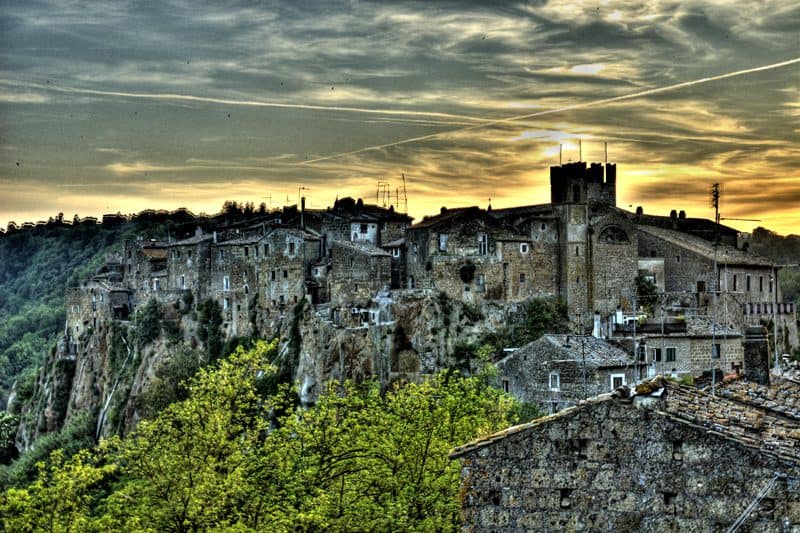
Calcata is a handful of tuff houses grown on a spur of volcanic rock that drops away on three sides into the valley of the Treja river. Seen from the lookout opposite, the fortress looks like an island. The walls, the small windows and the roofs rise directly out of the tuff bank, with no break between the carved stone and the built stone. This shape is not a picturesque whim, it's geology. The red tuff with black scoria of this part of the Tuscia is soft, easy to cut and to hollow out, and excellent for making cellars and caves. But it's also fragile: it crumbles, flakes off, collapses. The whole modern history of the village plays out around that fragility. In the mid-twentieth century it was declared uninhabitable, and for a few decades it risked disappearing.
The difference from the other hill towns of Lazio is that Calcata was not restored by a technical office or turned into a postcard. It was repopulated, house by house, by people who came to live there by choice starting in the 1960s and 1970s. Artisans, sculptors, painters, musicians, people looking for cheap rent and ancient walls. The result is a settlement of fewer than a hundred souls where nearly every small door hides a studio, a workshop, or an improvised gallery. From here come the nicknames the newspapers have been repeating for decades: the village of artists, the village of hippies, the village of witches. They are convenient labels, and like all labels they tell only half the truth. The half they tell well is that Calcata is one of the very few Italian historic centers saved from below, by the residents themselves, against a demolition that had already been decided.
First Look: How to Get into Calcata
You leave the car in the dirt parking lot above the village, cross a small open space with a few stalls, and take the downhill path. The road narrows, the trees close overhead, and at the bottom the Porta comes into view, the only gap in the medieval walls. Once through the arch you're inside, and the urban scale changes all at once: alleys a couple of meters wide, buttress arches thrown from one house to the next, little stairs climbing toward private terraces, laundry hung out, cats everywhere. You can walk the whole village in a quarter hour, but length isn't the point. Density is. Every few steps there's a shop, a window of ceramics, a jewelry workshop, a table of used books, or a café with four small tables.
The central square, small and irregular, is the social heart of the village. The church faces onto it, residents gather here, and this is where anyone arriving for Sunday lunch sits down. From the ends of the alleys, in several places, short natural lookouts open onto the valley. The tuff ends, and below is the green void of the gorge. These viewpoints have no parapet or only basic railings, so with small children it's best to hold their hands tight.
The Church of the Santissimo Nome di Gesù
On the square stands the Chiesa del Santissimo Nome di Gesù, the main religious building in the village. The structure dates back to the 14th century and was reworked in later styles. The documented renovation is from 1793, commissioned by the Sinibaldi family, who played a prominent role in the village in modern times. Inside, the church keeps the intimate feel of a country parish, without grand baroque decoration. It's worth a stop to understand the center of gravity of the historic community, not for a catalog of masterpieces.
This church is also where, for centuries, Italy's most debated relic was kept, the so-called Holy Foreskin. The story of that relic deserves its own chapter, because it's the reason Calcata has made it into books, newspapers and even international news.
The Holy Foreskin Relic: The True Story Behind the Legend of Calcata
The story, as far as tradition goes, begins with the Sack of Rome in 1527. According to the account passed down in the village, a Landsknecht among the imperial troops who looted the city supposedly stole a reliquary case from the Sancta Sanctorum of the Lateran. It held a relic venerated as the foreskin of Christ, a reminder of the Circumcision. While fleeing, the soldier was supposedly captured and imprisoned right in Calcata, where he hid the case in a niche in his cell. The relic was supposedly found again in 1557. From then on, Calcata became a pilgrimage destination. Every January 1, the feast of the Circumcision, a procession carried the case through the village's alleys, and the faithful came from far away for the occasion.
So far, the tradition, which like all devotional traditions should be taken for what it is: a story handed down, not an archival document. The verifiable fact, on the other hand, and a dramatic one, is how the story ends. In 1983 the relic, kept in its reliquary, disappeared shortly before a procession. It was never found, the thief remains unknown, and with that disappearance a devotion that had lasted centuries came to an abrupt end. The Catholic Church, moreover, had long discouraged public worship of such relics, and the 1983 disappearance effectively put an end to the matter. Today, all that remains of the Holy Foreskin in the village is the story, a few old photographs of the case, and the sulfurous reputation that comes with it. That's why Calcata is often presented as a place of mysteries, much more than its real and more interesting history as a village that was saved.
How Calcata Was Condemned to Death and How It Was Saved
The chapter that truly explains the village of today is the one from the 20th century. For centuries, collapses of the tuff bed were a problem people lived with: the cliff crumbled, every so often a piece of the escarpment broke off, and the houses on the edges were at risk. In 1935 a special state law ordered the total evacuation of the historic center for safety reasons, declaring it uninhabitable because of the danger of landslides. The residents were pushed to move to a new settlement built about 2 kilometers away, on stable ground. This is today's Calcata Nuova, orderly and without history, where a large part of the population still lives.
The old village, emptied by decree, remained almost deserted for a couple of decades, and over it hung the prospect of demolition: to the administration, an uninhabited and crumbling fortress had no reason to stay standing. This is where the story still told today at the tables of the local taverns comes in. Starting in the 1960s, and with more force in the 1970s, artists, intellectuals, craftspeople and young people looking for a different life began to arrive. They bought houses for very little money or occupied the abandoned ones, and restored them at their own expense. By restoring them, they showed that the village could be lived in. By living there, they gave it value back. The demolition never happened. Calcata Vecchia survived because a group of people decided, against the advice of the offices, that it was worth saving.
This is the reason the village has the atmosphere it has. It isn't a museum of itself: it's a successful experiment in living together, with all the tensions that such an experiment brings. Those who live there defend their peace and quiet, and a polite visitor understands that right away.

Ancient Origins: the Falisci, Narce and the Temple of Monte Li Santi
Long before the Middle Ages, this part of the Treja valley was territory of the Falisci, the Faliscan people, who spoke a language related to Latin and who were centered on Falerii, today's Civita Castellana. Opposite Calcata, on the plateau overlooking the river, stood the settlement of Narce, one of the most important Faliscan centers, inhabited from prehistory through the Archaic age: excavations have revealed settlements and necropolises spanning a very long period of time. Not far away, archaeologists have identified the sanctuary of Monte Li Santi, a sacred area with the remains of an Archaic temple, and several necropolises carved into the tuff along the ridges of the valley.
Walking through the gorge you come across cuts in the rock, chamber tombs, channels and cavities that belong to this ancient layering. The landscape you cross today to reach the waterfalls is the same one the Faliscans inhabited, with the same tuff walls pierced by tombs and shelters. It is a context worth keeping in mind, because it strips Calcata of its aura as a place that came into being by chance: people have lived here and carved this same rock for at least two and a half millennia.
The medieval village and the centuries of feudal lords
Calcata appears in medieval records very early: the first mentions of the place name date to the late 8th century, when the hilltop settlement was already a fortified point controlling the valley. Throughout the Middle Ages and the early modern period the town was a fief of families of Roman and Lazio nobility, who made it a small agricultural and defensive domain. The walls, the single gate and the tight arrangement of the houses reflect this function of a closed stronghold, which defends itself by controlling its only access. The urban layout visible today is largely late medieval and modern, with 18th- and 19th-century alterations, such as the restoration of the church in 1793.
An administrative detail that surprises many: Calcata is today in the province of Viterbo, but it only passed there in 1927. Before that it belonged to the province of Rome, and its closeness to the capital, more than to Viterbo, explains why, since the 1960s, the town has become a refuge for Roman artists seeking quiet an hour's drive from the Grande Raccordo.
The Valle del Treja Regional Park
The village cannot be understood without its river. The Treja rises in the Sabatini Mountains, flows down carving a deep gorge into the tuff and joins the Tiber: along its course a landscape of vertical walls, riparian woods, springs and small waterfalls has formed. To protect it, the Lazio Region established the Valle del Treja Regional Park in 1982, which safeguards about 628 hectares straddling two municipalities and two provinces: Calcata, in the province of Viterbo, and Mazzano Romano, in the province of Rome. The park offices are located right in the historic center of Calcata, which says a lot about how intertwined the destiny of the village and that of the protected area are.
Inside the park you walk a network of marked trails that connect the two towns overlooking the valley, descend to the river, pass through the archaeological areas and reach the most photographed point of the whole area, the Monte Gelato waterfalls. It is not a high-mountain park: the elevation changes are limited, but the trails are often steep, muddy after rain and uneven, so sturdy shoes are needed, not the flip-flops some people arrive in, imagining a postcard-perfect walk.
The Monte Gelato waterfalls, the water gem of the valley
The Monte Gelato waterfalls are the most famous spot in the Parco Valle del Treja and one of the most beautiful water corners an hour from Rome. They are not imposing falls: they are a series of low, wide drops that the Treja forms at an old water mill, the Mola di Monte Gelato, at the Mola di Mazzano. The combination of water, moss, mill ruins and natural basins has a charm that film has used many times. Over the years this gorge has been the setting for many films and TV dramas, from peplum to the Italian western, because it offers an intact, theatrical river landscape in a few square meters.
You can get there both from the trails inside the park, with a walk from the village, and from a closer parking area on the Mazzano Romano side, convenient for those bringing children or who don't want to tackle the whole gorge on foot. In summer the pools fill with families bathing. In spring and autumn, with high water flow and the colors of the woods, the place shines and the crowds are minimal. Swimming is at your own risk, without lifeguards, and the wet rocks are slippery: it is a very beautiful place and one to respect, not a water park.
Opera Bosco, the museum of art in nature
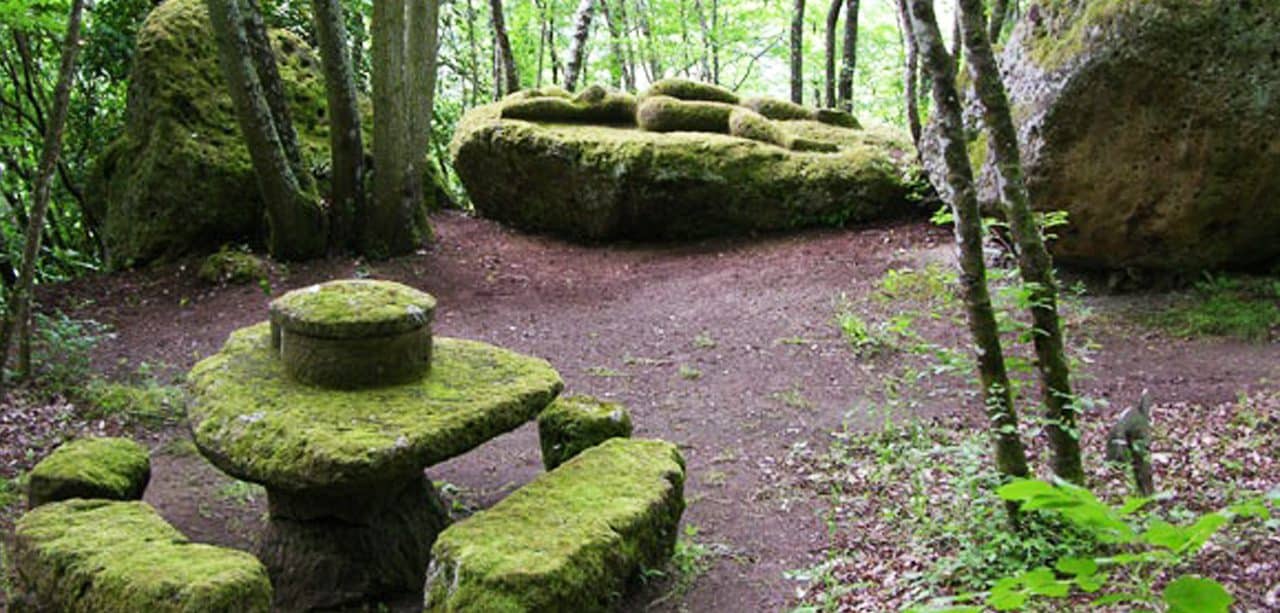
A short distance from the village, inside the gorge of the Treja Valley, is Opera Bosco - Museo di Arte nella Natura, one of the most original places in the whole area. It is an outdoor museum-workshop founded in 1996 by artist Anne Demijttenaere together with Costantino Morosin, and it occupies about two hectares of forest. The rule behind it is firm: works are made using only the raw materials of the forest, branches, leaves, earth, stone, without bringing in plastic or metal from outside. Over time many installations change or dissolve, reabsorbed by the environment. This isn't art to keep under glass. It's art that is born and dies in the place that hosts it.
The museum was already accredited by the Lazio Region in 1997 and entered the regional museum system. Over the years it has received the Mention of the Landscape Prize of the Council of Europe in several editions, a rare European recognition for such a small place. Besides the exhibition route, Opera Bosco runs environmental education activities with schools and fine arts academies, and organizes workshops, seminars and artist residencies. Visits are not always free of charge and open continuously, so it's worth checking openings, hours and procedures on the museum's official website, operabosco.eu, before heading up, because the schedule follows the seasons and events.

Workshops, Artisans and the Human-Scale Nativity
Calcata's real museum is spread across its workshops. In the village alleys, sculptors, ceramicists, painters, jewelry makers, and leather and wood artisans work. Many keep their studios open on weekends, and buying a piece here means taking home an object made on the spot, not an industrial souvenir. It's worth remembering that these are workplaces and homes at the same time: go in politely, ask before taking photos, and don't treat the alley like a set.
Since 2013, craftswoman Marina Petroni has set up a human-scale nativity scene in the historic center, with life-size papier-mâché figures placed around the village: the innkeeper, the farmer, the baker, the old trades rebuilt among the alleys. It is an installation that turns the village into an open-air theater during the Christmas season and draws many visitors. If you go in December, expect crowds on weekends and check the opening dates.
A Day in Calcata: How to Plan Your Visit
How Long You Need to Visit Calcata
The village alone can be walked in an hour and a half, at an easy pace, stopping in a few workshops and having a coffee in the piazza. But Calcata gives its best to those who give it half a day or a full day: morning in the village and lunch at an osteria, afternoon in the gorge as far as the Monte Gelato waterfalls or Opera Bosco. Anyone who rushes in for a photo and leaves again hasn't seen Calcata, just its postcard.
The Right Time of Year
Spring and autumn are the best seasons: the forest is at its peak, the Treja has plenty of water, and the temperature makes it possible to walk the gorge without suffering. Summer is crowded, hot in the village and packed at the waterfalls. Winter on weekdays is really beautiful and quiet, but many workshops and osterie are closed, so it's worth checking before making the trip for nothing. Sunday is the liveliest day of the year, and also the busiest.
With Children
Kids enjoy Calcata for its cats, its maze-like alleys and, at the waterfalls, the shallow water where they splash around in summer. Watch out for the drops at the village overlooks, which often lack sturdy railings, and for the uneven paths of the gorge, which are not suitable for strollers. To reach the waterfalls with small children, it's better to use the closer access from the Mazzano Romano side instead of the long descent from the village.

How to Get to Calcata from Rome
By car it's simple: take the Grande Raccordo Anulare, exit toward the Cassia bis (via Veientana) or the Flaminia heading north, head into the agro falisco, and follow the signs for Calcata Vecchia. From Rome it takes about an hour to get up here, traffic permitting. The last stretch is a country road that climbs to the plateau above the village, where the parking lot is. From there you continue only on foot, because the historic center is closed to cars and in any case impassable for a vehicle.
Getting there by public transport is inconvenient: there is no train station in the town, and the regular bus lines are infrequent and designed for residents, not for day tourists. If you don't have a car, consider renting one or a shared vehicle. Saving on the car here often means giving up the visit entirely or depending on inconvenient schedules. Once you arrive, the village and its natural sights are all covered on foot.
What to See Around Calcata: the Tuscia and the Agro Falisco
Calcata is the ideal starting point for a tour of southern Tuscia and the Agro Falisco, one of the least visited and richest areas of Lazio. Within half an hour or a little more, you can reach villages and monuments that, put together, are worth an entire weekend.
To the west is Sutri, with its Roman amphitheater carved into the tufa and the rock-cut necropolis, and Ronciglione at the foot of the Monti Cimini. Heading up, you reach Lake Bracciano with its towns overlooking the water, and farther north the provincial capital, Viterbo, with the medieval San Pellegrino quarter and the Palace of the Popes. For gardens and sixteenth-century architecture, there are Palazzo Farnese in Caprarola, with its pentagonal plan and the scala regia, and the Villa Lante in Bagnaia, one of the most perfect Italian-style gardens in Europe. Further away, but in the same spirit as tufa towns perched over the void, Civita di Bagnoregio and, toward the sea, ancient Tarquinia with its painted Etruscan tombs are both worth the trip. Heading back toward Rome along the Tiber, you'll come across Castelnuovo di Porto with its rocca. None of these places is more than an hour from Calcata, and together they form an itinerary that keeps you away from the most obvious destinations in the capital.
Where to Eat and the Question of Tables
The osterie in the village are few and small, with a cuisine that focuses on local products: ricotta and local cheeses, legumes, meats, and traditional sweets. On weekends and holidays, seats go fast, so the practical advice is just one thing: call and book before you head up, especially for Sunday lunch. Anyone who arrives without a reservation at noon on a nice spring Sunday risks wandering around for nothing and settling for a sandwich. During the week, in winter, it's the opposite: you may find almost everything closed, so it's worth checking in advance that there's a place open.
The Tufa of Calcata: Understanding the Rock to Understand the Village
You can't understand Calcata without looking at the stone it's built on. The whole Falisco area sits on thick beds of tufa, the rock formed from the volcanic deposits of the Sabatini and Vicani complexes, the same volcanic systems that created the lakes of Bracciano and Vico. The tufa in this area is soft to work and for that reason valuable: for millennia people have carved cellars, caves, columbaria, channels, and tombs into it. The same ease of working that makes it useful also makes it fragile in air and water. Vertical walls crack, rainwater seeps into the fissures, frost widens them, and periodically sections of the cliff break off and fall into the valley. This is the mechanism behind the collapses at Calcata and, ultimately, the 1935 evacuation decree.
Looking at the rocca from the lookout opposite, you can see all of this with the naked eye: the line where the natural tufa ends and the built wall begins is almost imperceptible, because the houses were put up with blocks cut on site, from the very same material as the cliff. The village and the rock are literally the same substance, cut in two different ways. This continuity is what distinguishes the rock-cut villages of the Tuscia from those built with stone brought in from outside: here people didn't build on top of the rock, they built with the rock, hollowing it out and reusing it. And it's also why, when the tufa gives way, it's not just the ground that gives way but the house itself, made of the same material.
The Community of Calcata: Living in a Village of 100 Souls
The number is striking when you really focus on it: a few dozen people live permanently in Calcata's historic center, and the entire municipality has just over 900 residents, between the rocca and Calcata Nuova. In a settlement this small, the community is everything, and the community of Calcata Vecchia is particular because it largely arrived from outside by choice, not by birth. It is the second or third generation of that movement of artists and craftspeople that has repopulated the abandoned houses since the 1960s. This gives the village a double character, both rural and cosmopolitan, where the farmer from an old local family and the sculptor who arrived from another region or from abroad share the same alley.
For visitors, this reality comes down to one simple rule of behavior: you are a guest in someone else's home. The alleys are de facto private streets, the doorsteps are the thresholds of homes, and daily life goes on in full view of anyone passing by. On high-season weekends the relationship between residents and visitors flips, and the village can receive in one afternoon more people than live there in a whole year. The residents live with this pressure, but the unwritten agreement is clear: look, shop in the local stores, eat in the osterias, and respect the quiet and the privacy. Those who come in this spirit are welcomed warmly. Those who treat the village as a film set find, rightly, closed doors.
The trails of Treja Valley Park: walking the gorge
The network of trails in Treja Valley Park is the best way to really understand the territory of Calcata, and it doesn't require mountaineering experience, but it isn't something to tackle in city shoes either. The routes connect the village to the valley floor, follow the river, pass the archaeological areas, and reach the Monte Gelato waterfalls on the far side of the park toward Mazzano Romano. The elevation changes are moderate but constant: you descend steeply toward the Treja, climb back up, and cross stretches where the path runs along the hillside above the gorge. After rain the ground becomes muddy and slippery, and the roots and wet stones are treacherous.
If you want to walk well here, equip yourself with trekking shoes or at least closed shoes with a lugged sole, bring water, and in summer set out early to avoid the hot hours. In spring the gorge is a riot of green and the river flows generously. In autumn the colors of the riparian woods make the effort worthwhile. The trails are marked, but phone coverage in the gorge is spotty, so it's a good idea to have an idea of the route before you go down and not rely only on the map on your phone. For those who don't feel up to the whole descent, there is still the option of reaching the waterfalls from the nearest parking area on the Mazzano Romano side and still enjoying the heart of the valley's water without the most demanding stretch.
Mazzano Romano, Calcata's twin on the other bank
Treja Valley Park doesn't belong to Calcata alone: the protected area also includes Mazzano Romano, a village overlooking the same valley but in the province of Rome, where the park's legal headquarters are located. The two towns look at each other from opposite sides of the gorge and are linked by trails: one of the most beautiful walks in the area connects Calcata and Mazzano Romano precisely through the valley floor and the waterfalls. Mazzano also has its own historic center of tufa, less famous than Calcata but just as old, and together the two villages tell the same geological and human story of this part of the Agro Falisco.
For those with a full day, planning the loop that touches both towns and the waterfalls is the most complete way to experience the valley. You start from one of the two villages, descend into the gorge, reach the water of the Treja and the Mola di Monte Gelato, and climb back up on the other side. It's a route that requires strong legs and suitable shoes, but it gives you a sense of a unified landscape, where the border between Viterbo Province and the Rome province is just a line on a map and nature doesn't recognize it.
Calcata and the movies: a valley for filming
It's worth going back, in more detail, to the relationship between this valley and the movies, because it is one of the least predictable aspects of the area. The Treja gorge, and in particular the setting of the Monte Gelato waterfalls, with the ruins of the water mill and the pools between the rocks, has offered Italian productions a rare natural environment for decades: real running water, ruined architecture ready to use, dense woods, and no trace of modernity, all within a short distance of the Roman studios. Very different genres, from films set in antiquity to swashbuckling adventures and westerns shot in Italy, have found their natural backdrop here.
This explains why, when they reach the waterfalls, many visitors feel they recognize the place: the gorge has entered the imagery of popular Italian cinema without the general public knowing its name. Knowing that those rocks served as the backdrop for dozens of stories adds a layer to the walk: you're not just walking through a beautiful valley, but inside a piece of the history of twentieth-century film production. It's one more reason to respect the place and not turn it, with litter and noise, into the opposite of what made it valuable.
A curiosity about Calcata (VT)
The curiosity that almost no one connects to this village is that Calcata was, by State law, officially sentenced to death, and it is alive today only because someone disobeyed that sentence. The 1935 eviction order was not a piece of cautionary advice: it was a measure that declared the historic center uninhabitable and ordered its abandonment, with demolition as the natural outcome. For decades the fortress remained empty, a shell of tuff destined to be razed to the ground. The village you visit today, with its shops and its cats, exists because in the 1960s and 1970s a group of artists and craftsmen bought or occupied those condemned houses and restored them at their own expense, proving on the ground that they were livable and thus removing any reason for demolition.
It's a curiosity that turns the usual way of looking at Italian villages on its head. Usually the stories are about towns that die from depopulation. Calcata is a town that died by decree and then was reborn through private stubbornness. The next time you pass through the Porta and wander into the alleys, keep in mind that every restored house is, literally, a house snatched from the bulldozer. This fact, verifiable in the administrative history of the twentieth century, explains the town's identity much better than any legend about witches.
Something Nobody Tells You About Calcata (VT)
What weekend guidebooks don't say is that Calcata is a village that is really lived in, not a theme park, and that respecting this daily life makes the difference between a nice visit and an embarrassing one. Fewer than 100 people live permanently in the historic center, often right in the buildings that face the most photographed alleys. The open doors are not attractions: they are artists' studios and private homes. Photographing the inside of a shop without asking, sitting on someone else's doorstep, or talking loudly on Sunday morning while residents are sleeping are behaviors that weigh much more up here than they would in a city.
There is also a practical detail that nobody mentions in advance: a large part of the services is not in the old village but in Calcata Nuova, two kilometers further on, where the bulk of the population, the offices and the basic shops are. The historic center, with its few taverns and shops, runs on and off to the rhythm of tourism and the seasons. Anyone who climbs up on a weekday in winter expecting the village to be as lively as in the summer photos is often disappointed: that day Calcata Vecchia may simply be closed, silent and empty. It's not a flaw, it's the nature of a tiny village. Knowing this in advance, you choose the right day and won't be left high and dry.
The Advice I Give You for Visiting Calcata (VT)
My advice is not to treat Calcata as a one-hour stop but to build a real half day around it, and always to tie it to the valley. The classic mistake is to arrive at noon, walk the alleys in 40 minutes, take the photo from the lookout and leave: that way you see the stage set but miss everything else. The right visit starts early, with the village still quiet and the low light on the tuff houses. It continues with a slow stop in the shops and a lunch booked at a tavern, and it culminates in the afternoon, going down into the gorge all the way to the Monte Gelato waterfalls or into the Opera Bosco woods.
Second tip, short and to the point: shoes. Too many people arrive dressed for an aperitivo and then find themselves slipping on a muddy path full of roots. If you plan to go down to the waterfalls or into the valley, you need closed shoes with good soles. Period. Third: choose the season. Spring and autumn are clearly better than the crowded summer and the half-closed weekday winter. And if you can, avoid high-season Sundays, when the parking lot fills up and the alleys turn into a single-file line: the charm of Calcata is its silence, and silence is found on the in-between days.

Another Well-Known Fact, Yet Rarely Mentioned
The fact everyone knows only half of is that the Treja gorge below Calcata was, for decades, one of the most used natural sets in Italian cinema. The Monte Gelato waterfalls, with the ruins of the old water mill and the basins between the rocks, served as a backdrop for a remarkable number of films and TV dramas: peplum films set in an imaginary antiquity, Westerns shot in Italy, and adventures of every kind. Here, in a few square meters, they found an intact and theatrical river landscape that would have cost a fortune to rebuild elsewhere. Anyone who knows the cinema of those years, arriving at the waterfalls, often has the feeling of having already seen the place: it's because they probably have, on film.
The part that's rarely mentioned is the why. This valley offered productions three things at once: real running water, ruined architecture already in place and a total absence of modern signs, all an hour from the studios of Rome. The tuff, the woods, the crumbling mill made up a nature both tamed and wild, perfect for the camera. Knowing this changes the way you look: the gorge isn't just a nice spot for a summer swim, it's a piece of Italian film history, and the same rocks where families sit today served as a backdrop for dozens of stories shot here.
The right photo to take in Calcata (VT)
The photograph that shows Calcata for what it is isn't taken inside the village but in front of it. Leaving the town and heading to the opposite side of the valley, along the park trails or from the viewpoints that look at the stronghold, you capture the image that made the place famous: the whole settlement suspended on its spur of tuff, the houses that seem to grow out of the rock, the green precipice of the gorge all around. It's the shot that explains the geology and the history of the town in one go, and it's impossible to get while staying inside the alleys.
The best light is early morning or late afternoon, when the low sun lights the tuff orange and lengthens the shadows on the houses. At noon the same scene flattens. In autumn the woods surrounding the stronghold turn red and gold and make a natural frame. If instead you're after an atmospheric photo inside the village, aim for the alleys backlit at dawn, with cats on the thresholds and laundry hung out, before the visitors arrive: after 10 in the morning, on weekends, the alleys fill up and the magic of the emptiness vanishes. A recommendation that counts double up here: if the open door of a shop or a house enters the frame, ask before shooting. They're homes, not backdrops.

Some important events that happened here in history
The first event that marked Calcata is remote and collective: the very long Faliscan presence at the site of Narce, across from the village, from prehistory to the Archaic age, with the sanctuary of Monte Li Santi and the necropolises cut into the tuff. It isn't a single fact but a stratification of centuries, and it remains imprinted on the landscape: the valley you walk today to reach the waterfalls was already inhabited and sacred more than 2,000 years ago.
The second event belongs to devotional legend and is the story of the Holy Foreskin: according to tradition the relic arrived in Calcata after the Sack of Rome in 1527 and was found there in 1557, giving rise to centuries of pilgrimages and to the procession of January 1. The third event, this one fully documented and dramatic, closes that story: in 1983 the relic disappeared shortly before a procession and was never found again, abruptly ending a devotion centuries old.
The fourth event is the one that decided the physical survival of the town: the special law of 1935 that decreed its evacuation because of the danger of landslides, with the transfer of the residents to Calcata Nuova, and then, in the 1960s and 1970s, the repopulation by artists and craftspeople that saved the village from demolition. Finally there is a painful and concrete chapter, that of the Second World War: the area knew the Resistance, with a partisan band active between Faleria and Calcata officially recognized after the war, and recorded the killing of civilians during the occupation, between November 1943 and January 1944. These are facts that anchor the town to the hard history of the 20th century, beyond the legends.
Who passed through Calcata (VT)
Those who passed through here, more than the great names of history, are the artists and intellectuals who from the 1960s and 1970s on made Calcata their home and their workshop. The village owes its survival to them: sculptors, painters, ceramists, musicians and craftspeople from different parts of Italy and from abroad who bought or occupied the houses abandoned after the evacuation and brought them back to life. Among the documented figures of the town's artistic renaissance is the couple who in 1996 founded Opera Bosco, the artist Anne Demijttenaere and Costantino Morosin, who in the Treja gorge invented a museum of art in nature recognized at the European level. Even today the historic center is populated by workshops of resident artists, and since 2013 the craftswoman Marina Petroni has set up her life-size nativity scene in the alleys.
Before them, and for much longer, pilgrims passed through here: for centuries, every January 1, the faithful, even from far away, climbed to Calcata for the procession of the relic, making a village of few souls a known destination of devotion. And before that, in antiquity, this valley was traveled and inhabited by the Faliscans, the people of the Faliscan territory who built sanctuaries and necropolises here. Calcata, at bottom, has always been a place that attracts those looking for something out of the ordinary: pilgrims, artists, dreamers. It is its oldest and most authentic vocation, much more than the fame as a village of witches that the newspapers have sewn onto it.
The Nature of the Valley: Woods, Water and Wildlife of the Treja
The Treja gorge holds a dense riparian wood, grown in the shelter of the tufa walls and fed by the humidity of the river: oaks, hornbeams, maples, and along the water willows and poplars, with an undergrowth of ferns and mosses that form green carpets on the shady rocks. It is a cool environment even in summer, when the sun beats down in the village and in the gorge you can breathe. The richness of water and the variety of habitats, from the rock face to the gravelly riverbed, make the valley a refuge for wildlife: woodland and gorge birds, amphibians along the pools, small mammals. The park protects exactly this combination of geology, water and life that elsewhere, in the cultivated countryside around, has been lost.
Walking in the valley means crossing all these layers together: the volcanic rock, the tombs dug by the Faliscans, the river that keeps working the tufa, the wood that covers everything. It is a landscape that asks for slowness and attention, not performance. Anyone who goes down in this spirit, stopping to listen to the water and to look at the walls riddled with ancient burials, takes home from Calcata much more than a photograph from the lookout.
Practical Tips for the Day at Calcata
A few concrete pointers, the kind that make the difference between a successful day and a bad one. Bring cash: the shops and small places don't always accept cards, and up here you don't find an ATM on every corner. Wear closed shoes if you plan to go down into the valley, and a change of clothes if you go to the waterfalls with children who will want to get wet. In summer set out early, both for the heat and for parking, which fills up on high-season weekends. In winter call an osteria beforehand to be sure of finding it open. Respect the park's signs and don't leave the marked trails: the wet tufa at the edges of the gorge is crumbly and the overlooks are not all protected.
Finally remember that Calcata Vecchia and Calcata Nuova are two different things and two kilometers apart: if the navigator takes you to Calcata Nuova, look for the turnoff for Calcata Vecchia, the historic village, which is what you came to see. And keep in mind the rhythm of the town: alive and full on warm weekends, quiet and largely closed on winter weekdays. Choosing the right day is, here more than elsewhere, half the success of the visit.
1983, the Silence and the Village That Came Out of It
For centuries Calcata was known, well beyond the borders of the Faliscan territory, for a relic venerated as the Holy Foreskin of Christ, kept in the village church and carried in procession once a year. Then, in 1983, the relic was gone: vanished from the parish priest's house, never found, never explained. It is worth telling in full, because it is the key to understanding what this village was before becoming the village of artists, keeping firm the distinction between what the documents support and what is tradition handed down by word of mouth.
What Is Documented and What Is Not
It is best to set the boundaries right away, because on this subject confusion is the rule. It is documented that in Calcata there existed for centuries a public cult, with a reliquary kept in the village, an annual feast and a procession followed by the population: local memories and the chronicle of the 20th century speak of this. It is documented that over the course of the 20th century the attitude of the ecclesiastical authorities toward this cult grew ever colder, until openly discouraging it. And it is documented that in 1983 the object disappeared and that it has not been recovered since.
What is not documented, and cannot be, is what was really contained in that reliquary. On this the text takes no position and does not assume the burden: the authenticity of relics of this kind cannot be verified, and the Church itself, with its progressive cooling, long ago stopped encouraging the faithful to ask the question. What remains, and what is concrete, is the cult: a real religious and social phenomenon, with dates, witnesses and consequences for the village.
1527 and the Arrival of the Relic: Tradition, Not a Notarial Deed
The version that has always been told in Calcata links the arrival of the relic to the Sack of Rome in 1527. According to this account, a soldier in the imperial army, after stealing sacred objects in the city, was supposedly captured and held in Calcata, and there he hid the relic. The discovery supposedly happened only 30 years later, around 1557, and that started the cult. The Sack of Rome in 1527 is a historical event of the first importance, and the scattering of sacred objects in those months is well known. The rest, that is the soldier, the imprisonment in the town, the hiding place and the discovery, belongs to local tradition. It is the story with which a community explained to itself the presence of an extraordinary object, not a reconstruction based on archival documents from the time of the events.
Over the centuries, several places in Europe have claimed the same relic. This alone explains why the question of authenticity has never been resolvable, and why it is more honest to treat the history of 1527 for what it is, a founding tradition with no certain confirmation.
The Cult, the Procession and the Slow Brake of the Church
What is absolutely not legend is the scale of the cult. For generations Calcata had its own festival tied to the relic, with the reliquary case carried through the streets of the village and a flow of visitors arriving from outside. For a small town perched on a tufa spur, it was also an identity and a source of income.
In the twentieth century, things change. Church authorities, for reasons related to the sobriety of worship and to embarrassment toward a devotion that was hard to govern, gradually distance themselves. The relic is shown less and less, the festival loses its official endorsement, and public discussion of the object is discouraged. It is not a sudden ban. It is a long withdrawal of support. At the end of this process the reliquary is no longer displayed in the church and is kept privately, in the parish priest's house. It is from there that it disappears.
1983: the Versions of the Disappearance
The disappearance is placed in 1983, and the substance is simple: the reliquary can no longer be found, the news gets out, and it is never recovered. Everything else is hypothesis, and that needs to be said clearly, because on this point at least three versions circulate and none has ever been proven.
The first is that of ordinary theft: someone enters, takes the container, which was an object of material value, and sells it without much interest in the contents. The second is that of targeted theft, carried out by collectors or circles interested precisely in that relic. The third, the most debated in town, claims the disappearance was somehow aided from inside, as a definitive way to close a matter that had become troublesome. Anyone who spends time in Calcata hears all three repeated. No investigation has ever established what happened. The question remains open, and anyone who presents it as solved, in one direction or the other, goes beyond what is known.
What Remains Today in the Village
Anyone who arrives in Calcata today looking for the relic finds nothing to see, and it's good to know that before you climb up. There is no reliquary case, no display, and no signage telling the story. The village church remains the physical place to which the story is tied, but the chapter is closed, and not everyone in town is willing to talk about it in the same way. Some tell it gladly, some dismiss it in two words, and some see it as a curiosity that has overshadowed the rest of Calcata. It's worth keeping this sensitivity in mind. For those who live there, it is not a funny anecdote. It is the religious history of their own community.
From Condemned Village to Town of Artists
There is a reason this story stopped precisely in those years, and it concerns what Calcata had become. In the twentieth century the old village was declared unsafe because of the risk of collapse of the tufa spur it sits on, and the population was gradually moved to the new settlement nearby. The old town emptied out. Starting in the 1960s, the abandoned houses, which cost very little, were occupied and then bought by artists, craftspeople and people looking for a different way of life. This is where today's Calcata comes from, with its workshops, studios and a small, very unusual community.
The result is that the relic disappears at the exact moment the town is changing its skin. The farming community that had built the cult no longer lived up there. The new one had other reference points. Anyone who visits the village with this in mind reads it better: the same very narrow lanes, the same square, the same church, but two different populations and two stories that overlap without fully mixing.
Quick Questions About Calcata (VT)
How much does it cost to enter Calcata?
Nothing: Calcata is an inhabited town, and the historic center is free to access, with no ticket and no opening hours. What you may pay for is parking, when it is paid, and any guided tours or entry to specific venues such as Opera Bosco.
Do you need to book to visit Calcata?
For entering the village, no. Instead, it's better to book a table if you want to have lunch at the osteria, especially on Sundays and holidays, and to check the opening hours of Opera Bosco on the museum's official website before heading up.
How long does it take to visit Calcata?
The village alone takes an hour and a half to walk around. To do it properly, combining the village, lunch, and a walk down into the valley to the Monte Gelato waterfalls or Opera Bosco, you need half a day or a full day.
How do you get to Calcata from Rome?
By car, in about an hour: from the Grande Raccordo Anulare, take the Cassia bis or the Flaminia heading north and follow the signs for Calcata Vecchia, up to the parking area above the village. By public transport, the connection is inconvenient, so the car is the recommended choice.
Where do you park in Calcata?
In a parking area set up on the plateau above the historic center. From there, it's a few minutes on foot down to the Porta: the old village is closed to cars.
Is Calcata suitable for children?
Yes, with care. The maze-like alleys and the cats appeal to little ones, and in summer the waterfalls have shallow water to splash around in. You need to watch them at the drop-off points in the village, often without sturdy railings, and keep in mind that the paths in the gorge are uneven and not suitable for strollers.
Can you swim at the Monte Gelato waterfalls?
Yes, in the natural pools of the Treja, but at your own risk and without supervision. The wet rocks are slippery and the water flow varies with the seasons: it's a natural environment to respect, not an equipped swimming pool.
What are Calcata Vecchia and Calcata Nuova?
Calcata Vecchia is the historic village on the tufa spur, the one you visit. Calcata Nuova is the modern settlement built about two kilometers away after the 1935 evacuation, where most of the population lives and the everyday services are located.
Why is Calcata called the village of witches?
It's a nickname born from the village's atmosphere and local legends, fueled by its reputation as a refuge for artists and free spirits and by the story of the relic of the Holy Foreskin. It's tourist folklore: the real history of the town, the story of the evacuation and rebirth, is more interesting than its esoteric reputation.
Is it true that Calcata had the foreskin of Jesus?
According to tradition, yes: a relic venerated as such supposedly arrived in the town after the Sack of Rome in 1527 and was found again in 1557, with a procession every January 1. The one certain fact is that the reliquary disappeared in 1983, shortly before a procession, and was never found again.
What is Opera Bosco?
It's an outdoor museum-workshop of art in nature founded in 1996 in the Treja gorge, where the works are made only with materials from the forest and over time they transform or dissolve. It covers about two hectares and received the Menzione del Premio del Paesaggio from the Council of Europe.
Is the historic center of Calcata accessible to people with mobility problems?
Only partly. The village is made of narrow alleys, small staircases and cobblestones, with changes in elevation, and the valley paths are uneven: people with mobility difficulties can see the square and some alleys, but the gorge and the waterfalls are demanding.
When is the best time to visit Calcata?
Spring and autumn, when the forest is at its peak, the Treja's water is abundant, and walking is comfortable in mild weather. Summer is crowded and hot, and winter weekdays are lonely, with many shops and osterie closed.
Are there restaurants in Calcata?
Yes, a few osterie and eateries in the village, serving local cooking. They're small and fill up quickly on weekends: it's best to book, especially for Sunday lunch.
Is Calcata open in winter?
The village can always be visited, because it's inhabited, but on winter weekdays many shops and osterie are closed and the village is almost deserted. To find it lively, it's best to choose a weekend or check ahead before heading up.
How far is Calcata from Rome?
A little under 50 kilometers, about an hour by car from the Grande Raccordo Anulare under normal traffic conditions.
What province is Calcata in?
In Viterbo Province, in Lazio, although until 1927 it belonged to the province of Rome and it is still very closely tied to the capital, from which many of its visitors and artist-residents come.
What is there to see near Calcata?
A lot: the Monte Gelato waterfalls and Opera Bosco in the same valley, and within a half-hour radius Sutri, Ronciglione, Lake Bracciano, Viterbo, Palazzo Farnese in Caprarola and Villa Lante, a bit farther, Civita di Bagnoregio and Tarquinia.
Can you buy artists' works in Calcata?
Yes, and it's one of the reasons to go up: in the village's workshops work sculptors, ceramicists, painters and jewelry makers who sell their own pieces directly, made on site. Many studios open mainly on weekends.
Are there really so many cats in Calcata?
Yes, cats are a constant presence in the village and one of its most loved features: you find them on doorsteps, on low walls, in the alleyways. They are part of the life of the town, not a staged attraction. You look at them and leave them alone, the way you would with someone else's pets.
Do you need a guide to visit Calcata?
For the village itself, no, you can wander freely. A guide or a guided tour makes sense to understand the geology, the Falisci and archaeological history of the valley and to tackle the paths of the gorge, where the context tells you much more than you would see on your own.
How much does parking cost in Calcata?
Parking is on the plateau above the village, and during peak periods and on busy days it is paid. Rates change over time, so it's best to check them on site. Bringing cash helps.
Are there special events during the year in Calcata?
The Christmas period, with the life-size nativity scene set up in the alleyways since 2013, is one of the most popular times. Throughout the year the village and Opera Bosco host artistic and cultural initiatives. It's best to check the updated calendars before planning your visit for a specific date.
One last word on Calcata
If I had to tell a friend how to experience Calcata, I'd tell him to forget the word day trip. This town can't be consumed in an hour, and it gives nothing to anyone who treats it like a row of photos to collect. It gives a lot, though, to those who choose the right day away from the crowds, wear sturdy shoes, step into the shops with curiosity and respect, sit in an osteria without rushing, and then head down into the gorge to see the real water of the Treja between the tufa rocks. Calcata proves that a town can die by decree and be reborn through stubbornness. Keep this history in mind as you walk among its rescued houses, and you won't mistake one of the most authentic and stubborn places in Lazio for a set for posing.
Article written by the editorial team at TourLeaderPro, contact them for Private/Corporate/V.I.P. Tours and Experiences.
Planning a trip to Rome? English-language guides to visiting the city are on ItalyPlanner.com.