Chia ghost town (Soriano nel Cimino)
In short. Chia is a hamlet of the municipality of Soriano nel Cimino, in the province of Viterbo, at about 300 meters above sea level and seven kilometers from the municipal seat, overlooking the Tiber valley.

Chia is a hamlet of the municipality of Soriano nel Cimino, in the province of Viterbo, at about 300 meters above sea level and seven kilometers from the municipal seat, overlooking the Tiber valley. The inhabited area proper counts a few hundred residents. The old core, the one everyone calls Chia Vecchia, has been largely abandoned since the 1950s and can be visited freely from the outside, with no ticket and no hours, with the caution that centuries-old and partly unsafe masonry demands. The useful road reference is the Strada Provinciale Ortana: the Chia Tower, the best-known monument of the hamlet, has its address at kilometer 15 of the SP Ortana, 01038 Soriano nel Cimino (VT). The tower cannot be visited at will: you enter only during scheduled openings and on guided visits by reservation, and the dates are requested from the municipal tourist office, phone 0761 748871 or 378 3033319, email ufficioturistico@comune.sorianonelcimino.vt.it. From Rome you get there by car in a good hour and a half, A1 motorway to Orte and then provincial roads toward Soriano, or via Cassia and Vetralla for those who prefer scenery to speed. You park in the pull-offs along the road of the new village and walk down: inside the old village the car doesn't enter and shouldn't. Admission fees for the individual private sites and the seasonal hours of the waterfall park should be asked of the operators directly before leaving, because they change from year to year.
Chia depends administratively on Soriano nel Cimino, and it is from there that it is best to plan the day: the municipal seat has the Orsini castle, the services, the bars and the parking that the hamlet lacks.
How to get to Chia ghost town (Soriano nel Cimino) and where to leave the car
The hamlet is a handful of houses on a spur of tuff, and this determines everything: the roads, the parking, the way you visit. If you come from Rome, take the A1 toward Florence and exit at Orte, then head for Soriano nel Cimino and from there take the Ortana provincial road toward Bomarzo. If you want the scenic route, skip the motorway and go up the Cassia, touch Vetralla and Viterbo and come down on the Tuscia from the west: you lose half an hour and gain a landscape of hazelnut groves and beeches that is worth the gas.
Without a car the math gets complicated. The useful railway station is Orte, on the line that links Rome to Florence and Perugia. From Orte to Soriano nel Cimino the connection is by road, with schedules to be read on the regional carrier's website before setting out, and from Soriano there are still seven kilometers to Chia. The advice, blunt: if you don't have a car, put Chia inside a day organized with a guide, or give it up. It is not a place that forgives badly matched timetables. Anyone who wants to rely on a professional can go through the network of certified tour guides of TourLeaderPro, which works on exactly this kind of request.
You park in the new village, in the pull-offs along the road, and continue on foot. It is a few hundred meters of gentle slope, but the surface of the old alleys is irregular paving and carved steps: closed shoes, a grippy sole, and no stroller.
What Chia really is: two villages looking at each other
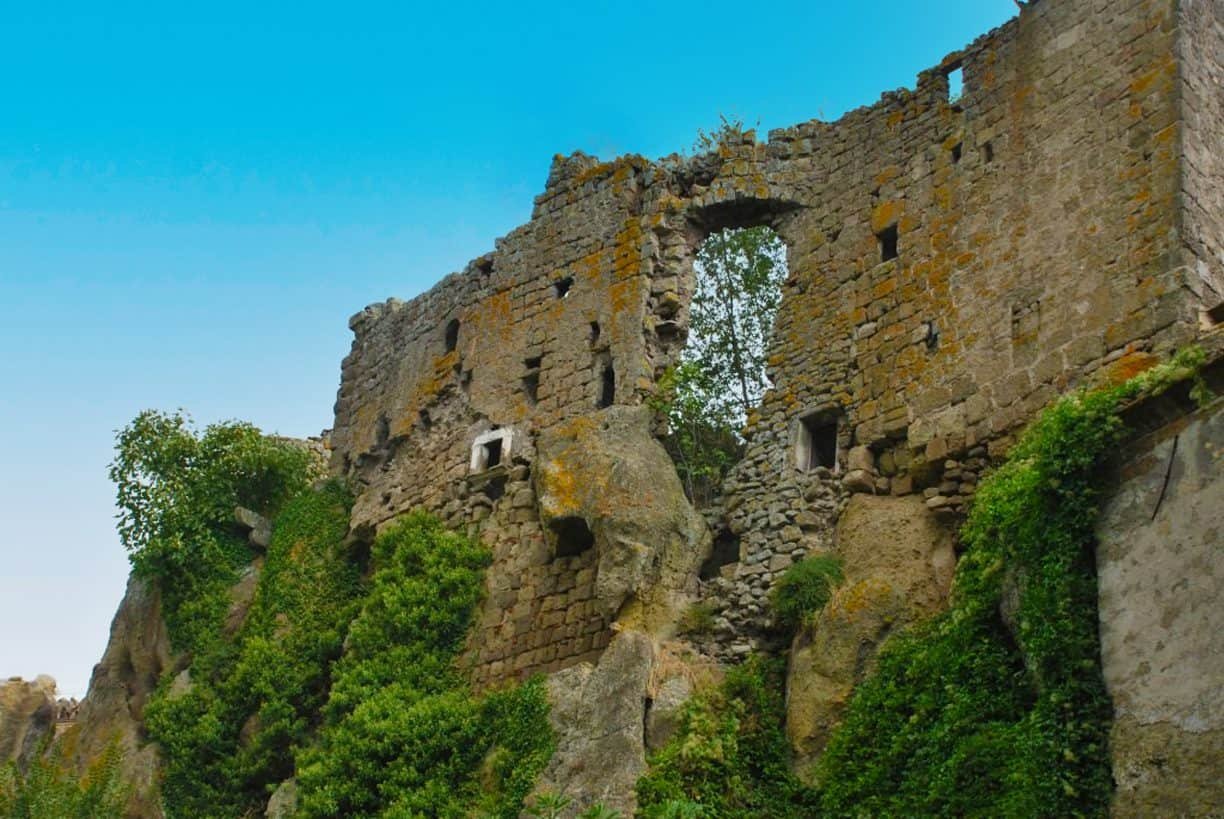
The most common confusion is precisely this. Chia is not a dead village: it is a double village. On one side is the abandoned medieval core, perched on the tuff, with empty houses, collapsed roofs and alleys that close in on themselves. On the other, alongside and further down, is the modern village, which arose after the postwar exodus, where the families who stayed live. The phenomenon is the classic one of the central Apennines and the Tuscia: the upper village is left because it is inconvenient, unhealthy, without running water and without a road for the car, and the community rebuilds itself 100 meters lower down.
The result is that at Chia you walk in two times at once. There is the bench with the retiree reading the newspaper and, 20 steps later, the void of a house without floors in which a fig tree grows. This coexistence is the most interesting thing about the place, and in our view it is also the reason Chia holds up better than other abandoned villages: not having been turned into a theme park, it has not been emptied out completely either.

Visiting Chia Vecchia, alley by alley
The walk takes a little over an hour if you limit yourself to the village, three or four hours if you add the tower and the gorge of the stream. It is worth doing it in the order that follows, because it is the order in which the village was formed: first the Renaissance part, then the medieval heart, finally the descent to the modern square.
Piazza Garibaldi, where the visit to Chia begins
You start from Piazza Garibaldi, in the Renaissance part of the village. It is a modest space, without striking monuments, and for that very reason instructive: here you read the Chia of the 16th and 17th centuries, the one that had spread outside the fortified enclosure when the danger of raids had passed and families could afford wider windows and more carefully made portals. Look at the frames of the openings on the small palazzi facing the square: the Renaissance molding in peperino is still readable under the redone plaster.
The church of the Madonna delle Grazie
On the left, leaving the square, you meet the church of the Madonna delle Grazie, begun in 1617 and completed in 1623. That is six years of construction, a normal time for a hamlet church where funds arrived in installments, between private bequests and contributions from the feudal lord. The portal is the element to look at: a belated Renaissance layout, as often happens in the Tuscia, where the repertoire of the 16th century continues to be used well into the following century because the local workers work from models they know. The dating 1617-1623 is the one handed down by local tradition and taken up by the municipal documentation. The interior, when accessible, is visited during services.
Personal opinion: it is the church almost everyone photographs in passing on the way to Pasolini's tower. They are wrong. It is the only building in the village that lets you date a construction phase precisely, and without that date the rest of the village remains an indistinct mass of old stones.
Via Ripetta and the alleys of the village of Chia
From there you take Via Ripetta, and the scale of the village changes suddenly. The alleys narrow, the light arrives in blades, the houses lean on one another because the tuff bank gives no room. This is medieval urban planning in its pure state: no regular square, no straight axis, the layout follows the contour lines of the spur. Anyone who knows Vitorchiano or Bassano in Teverina finds the same grammar here, but without the restoration and without the pots of geraniums.
Piazza Giordano Bruno, the ancient heart
Continuing, you enter the oldest part of the village, where an irregular little square named for Giordano Bruno opens up. Irregular is the right word: it is not a designed square, it is the space left free between the houses, widened over the centuries by collapses and demolitions. In the rock villages of the Tuscia these voids are often the sign of a vanished building, and at Chia the most likely candidate is precisely the old parish church.
The arabesque portal and the shepherd's inscription
On a portal in the area, on the underside of the lintel, runs an incised inscription that can still be read: SEX....OP(US) HOC PASTOR FECIT. The reading is partial, the beginning is illegible, and the reconstructible sense is that a certain Sex... the shepherd had this work made. The word pastor, in a medieval context, can mean the shepherd of flocks as well as the shepherd of souls, that is, the parish priest. The second hypothesis is the more frequent in commissioning inscriptions on lintels, but on the surviving text alone it remains a hypothesis and not an established fact. The lintel is decorated with an incised arabesque, a motif that in the Tuscia is found on reused pieces and on the work of local stonecutters between the 13th and 15th centuries. Dating: not documented.
The ruins of the church of San Giovenale
Among the houses, set into the building line, you can recognize the ruins of the oldest parish church of the village, dedicated to San Giovenale and modified in the Renaissance, now completely destroyed. On the lintel of the portal runs a second inscription, with the last five letters of uncertain reading: H. OPUS F. FIERI DIVI ACESA. Here too the formula is the commissioning one, hoc opus fecit fieri, that is, had this work made. The final part has no agreed reading.
San Giovenale is the first bishop of Narni, who died according to tradition in 376, and his cult is very widespread throughout the area between southern Umbria and the Tuscia: the dedication of the Chia parish church confirms him as the patron of the community still today. Seeing a church reduced to the wall of a house is less rare than it seems: when a community shrinks, disused sacred buildings become stone quarries and storerooms, and the lintel survives because nobody knows what to do with it.
The underpass of the tower house and the stepped ramp
From an arched underpass, carved out under a tower house, a little street starts that descends with a stepped ramp to a lower level. The covered passage under a building block is the typical solution of villages on a spur: when space runs out you build over the street, and the alley becomes a tunnel. The ramp is flanked, at least in part toward the outside, by two rows of houses separated by very narrow alleys, and some of these are still inhabited. Walk slowly: the steps are worn in the middle and become slippery in the rain.
The second underpass and the village square
A second arched passage leads out of the oldest residential core and opens onto the present square of the village. On this space you can read constructions and reworkings of earlier buildings carried out in the late Renaissance and in later periods: it is the point where the medieval village joins the modern one, and you can see it with the naked eye, because the masonry, the levels and the width of the windows change.
The tiles with the poets' verses
In the rock village, outside the last houses still inhabited, it is customary to place clay tiles incised with verses by great Italian authors. Among them is Ungaretti with Soldiers, the four-line poem written at the front in 1918, the one about soldiers as leaves on autumn trees. It is an initiative of the community, not a tourist operation: the tiles are small, unsigned, and are found by walking. Finding them all is the best game Chia offers patient visitors.
The Chia Tower, Pasolini's house
The tower is the monument that made the hamlet famous, and it is also the oldest and most misunderstood piece of the site. It has a pentagonal plan, very rare in Lazio, and reaches 42 meters in height: it was the defensive pivot of the tuff spur and was part of the castle of Colle Casale, of which ruins remain all around, toward the stream. The five-sided plan is not a whim: on an irregular spur it lets the faces of the tower coincide with the possible directions of attack, and eliminates the dead angles that a square plan would leave uncovered.
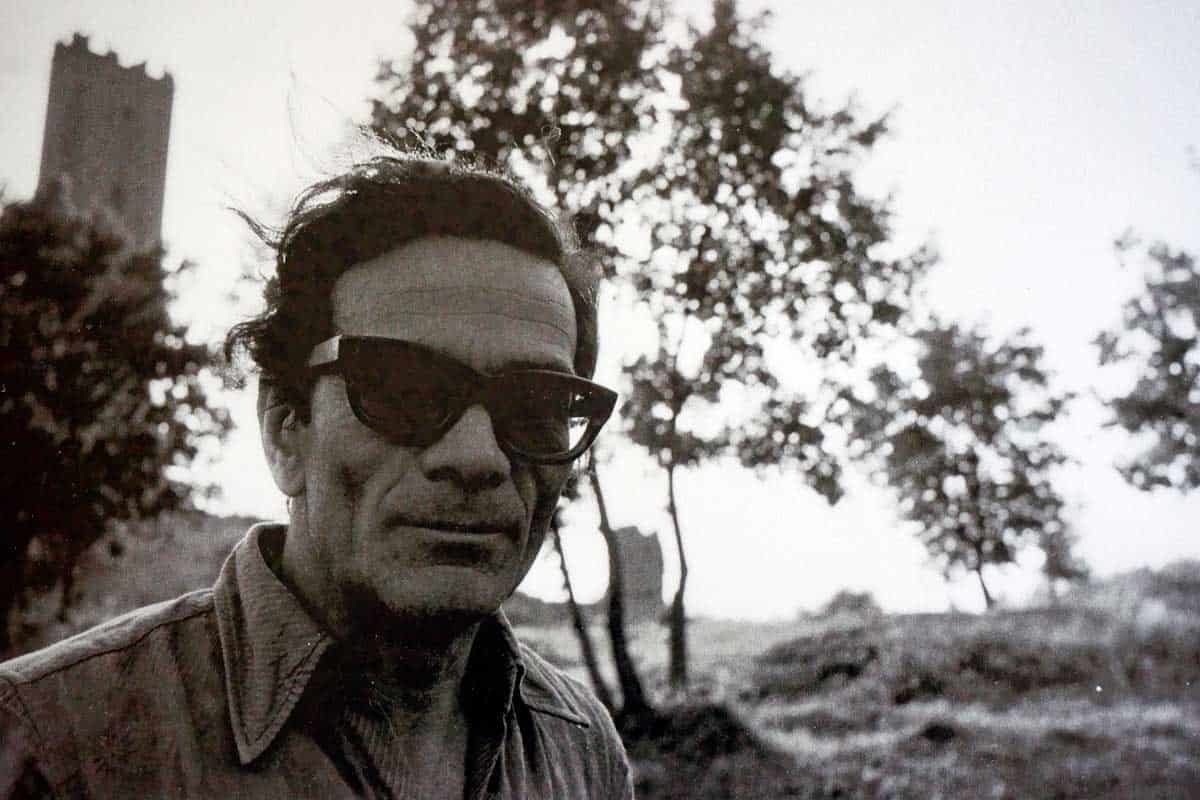
Pier Paolo Pasolini saw it in 1964, during the filming of The Gospel According to St. Matthew, and was obsessed with it: he bought it in the autumn of 1970 and had it restored to live in. Today the tower is privately owned and can be visited only on extraordinary openings and on guided visits by reservation, which the Municipality of Soriano nel Cimino organizes periodically. It also hosts cultural events and concerts. Call the tourist office before setting out: showing up at the gate hoping it is open is the surest way to waste a Sunday.
Even with the gate closed the walk around the outside is worthwhile: you walk around the plateau, you see the remains of the castle, you go down toward the ruined mills along the stream and you understand why a man who had Rome at his feet wanted to write here.

The Fosso Castello waterfalls below Chia
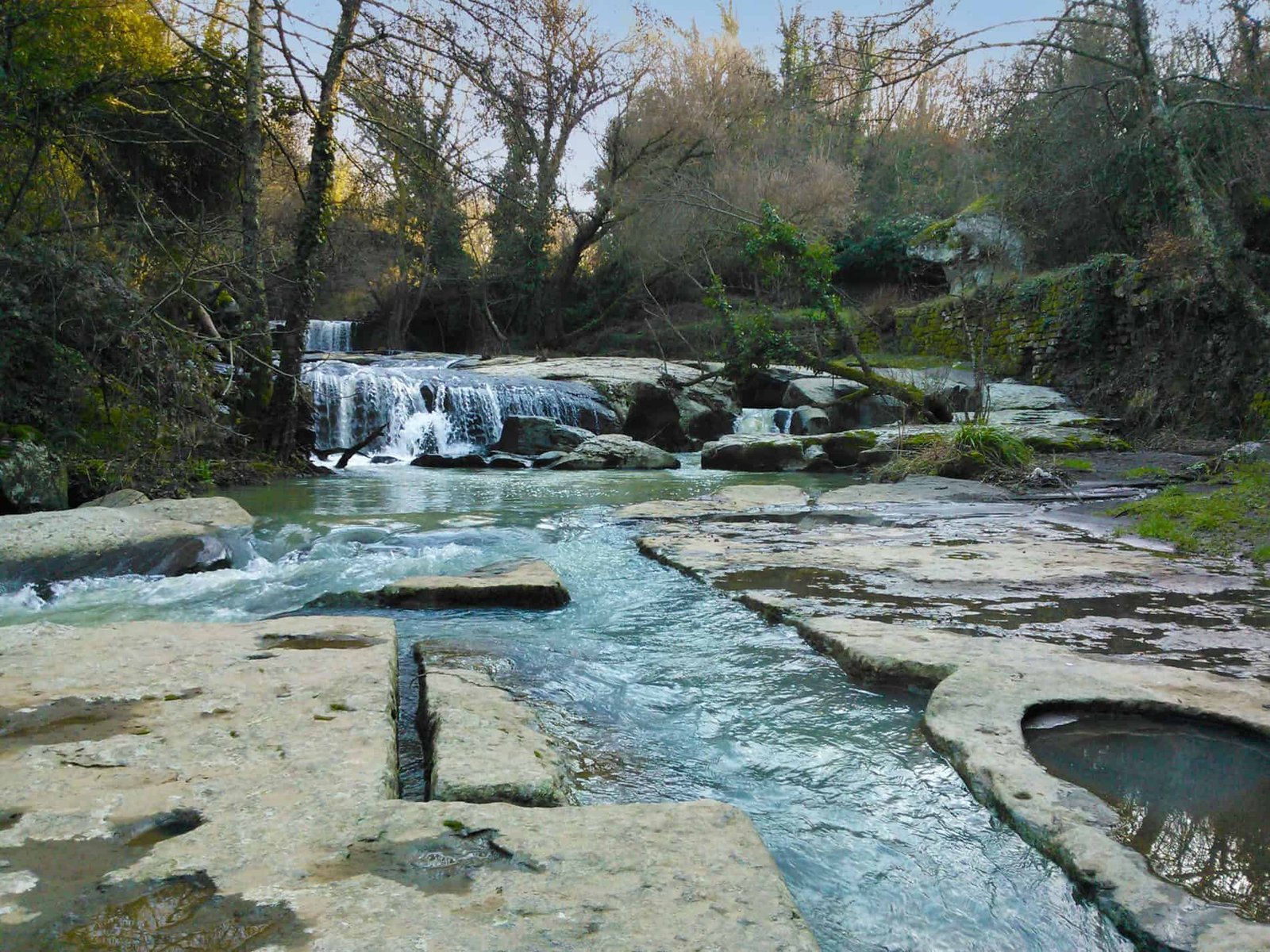
Below the tower the stream has cut a narrow, shady gorge, with drops of water and rock pools: these are the Fosso Castello waterfalls, the place where people go at Chia in summer. The water descends over a bed of tuff and basalt and forms green pools, some deep, with a temperature that at the end of July is uncomfortable for anyone expecting the sea.
Two practical warnings worth more than any description. The first: the bottom of the pools is smooth, slippery rock, and the drops have undertow currents. You go in where you can touch the bottom, and that's it. The second: after thunderstorms the stream rises fast and changes character within an hour, so if the sky closes in upstream you leave the gorge and wait above. Access and any fees for the equipped part of the river park are managed locally and should be asked about beforehand, because they vary with the season.
Opinion: the Fosso Castello waterfalls are the reason many visitors arrive at Chia and leave without having seen the village. It is a planning mistake. Do the village early in the morning, with the raking light in the alleys, and go down to the stream after lunch, when the shade of the gorge becomes a blessing.
Before the Middle Ages: Santa Cecilia, the Finestraccia, the tuff pyramid
The village you see dates roughly to 1100, but the area was frequented much earlier, in Etruscan times and perhaps earlier still. The finds in the immediate vicinity say so: hypogean houses, cave tombs, basins, wells, concentrated above all in the area of Santa Cecilia, in the wooded valley floor.
In the woods around you come across ancient writing on stones, burials, anthropomorphic tombs dug into the rock, sarcophagus tombs, funerary markers, altars, the remains of a church. There is the Finestraccia, a large tomb, perhaps Etruscan, reused as a dwelling at least until the Middle Ages: the residential reuse of rock-cut tombs is a phenomenon documented throughout the Tuscia and explains why so many hypogea have niches, hearths and mangers that have nothing to do with the funerary rite.
And there is the so-called Etruscan pyramid, the preacher's rock, in the woods toward Bomarzo: a monolith of peperino worked in steps, 28 steps cut into the rock that climb to a summit surface with channels and small wells. The current interpretation speaks of a rock-cut altar of the pre-Roman era with a sacrificial function. The attribution to the Etruscans is probable but not certain, and some trace it back even further, to the Eneolithic Rinaldone culture. To be distinguished by degree of certainty: the artifact is documented and visitable, the function is a reasoned archaeological hypothesis, the precise dating does not exist. Anyone who wants to stay on the theme of stepped monuments has the Pyramid of Cestius in the city, which has nothing in common with this one except the popular name.

The origins of the village of Chia
During the Roman era, from the 3rd century BC onward, Chia had no appreciable development, and the area was depopulated already in the period of the barbarian invasions. It is in the Middle Ages that the urban imprint seen today is defined: the village tightens on the spur, equips itself with walls and fortifications and organizes the houses around the tower.
On the name no one has a definitive answer. Some old records register the locality as Cheggia or Icea. A local legend holds that Chia takes its name from a Lombard noblewoman who settled here with her retinue, perhaps at the time of the Lombard raids in Lazio. The word, however, seems rather to be of Etruscan origin. The levels are best kept separate: the Lombard legend is oral tradition, the Etruscan origin is a linguistic hypothesis, the document that would settle the question does not exist.
The feudal history of Chia, from 1260 to the Borghese
The old chronicles call Chia a castle, but the word misleads. From the 13th and 14th centuries it must have been not a castle proper but a complex of tiny palazzi and houses, some with low towers and bastions laid out according to a precise defensive scheme. It is the model of the castrum with an inhabited curtain wall, very widespread in the Tuscia: the defense is not an isolated manor, it is the village itself.
The precise documentary references begin in 1260. That year, as the scholar Edoardo Martinori reports, a feudal lord named Cappello, also lord of the nearby castle of Colle Casale, was tried for heresy by the people of Viterbo: Pope Alexander IV confiscated all his property, which passed to the Apostolic Chamber. In 1298 the Chamber invested the bishop of Orte with the fief.
In 1301 Chia returned to the Apostolic Chamber, which in the same year, by the will of Boniface VIII, ceded the investiture to Guastapane dei Porcari, as compensation for the loss of the fortress of Soriano nel Cimino. In 1321 Napoleone Orsini, son of Orso, bought Chia from the Guastapane with the permission of the Holy See. In 1369 the fief went to Simeotto Orsini by papal grant, but Martin V took it from that family to pass it to his own. Then Chia passed in 1427 to Antonio Colonna, in 1431 again to the Orsini, and in more recent times to the Lante della Rovere, who in 1836 sold it to the Borghese.
The ending of the feudal story is less pretty and harder: the depopulation caused by the two world wars empties the village, and in the early 1950s the abandonment of the old core is almost complete. An administrative clarification that often escapes notice: until 1942 Chia was a hamlet of the municipality of Bomarzo, and only in that year did it pass to Soriano nel Cimino. Anyone looking for documents earlier than 1942 will find them in the archives of Bomarzo, not in those of Soriano.
Pier Paolo Pasolini at Chia
The Gospel According to St. Matthew and the baptism of Christ
Pasolini arrived here in 1964 while shooting The Gospel According to St. Matthew. On the Fosso Castello, below the tower, he set the scene of the baptism of Jesus in the Jordan: since then the gorge has been known locally as the place of the baptism of Christ. The landscape you see in the film, with the shallow water and the tuff walls, is still the same, and recognizing it in person has a certain effect.
The tower bought in 1970
The director wrote in 1966 that he wanted that tower, in what he called the most beautiful landscape in the world, where Ariosto would have gone mad with joy at seeing himself recreated with such innocence of oaks, hills, waters and ravines. The purchase took place in the autumn of 1970, and in the last years of his life Pasolini stayed there often, making it his place for writing.
Petrolio, the Lutheran Letters, I know
At Chia he worked on Petrolio, the novel left unfinished and published posthumously in 1992, and from here he sent to the Corriere della Sera the pieces that would flow into the Lutheran Letters and the Corsair Writings. Among them is the most quoted article of his journalistic output, the one that begins with the words I know, which appeared in the Corriere della Sera on November 14, 1974 under the title What is this coup? The mechanism of the article is all in one opposition: I know the names of those responsible for the massacres, Pasolini writes, but I have no proof, I don't even have clues, and I know because I am an intellectual, a writer who coordinates even distant facts and restores logic where arbitrariness, madness and mystery seem to reign.
That text, written in a pentagonal tower above a stream of the Tuscia, has become one of the most discussed pages of Italian 20th-century history. It is worth reading before you come: it changes the way you look at the plateau.
The poem about the pink oaks and the bust in the square
Pasolini also dedicated a poem to Chia, published in the collection The New Youth, which came out in 1975 and reworks and rewrites the Friulian poems of the 1940s. It speaks of the pink oaks of Chia, an image that most probably alludes to the shades of the foliage in the surrounding woods when the season turns. In the village square, on March 19, 2011, a bronze bust dedicated to the director was unveiled.
A curiosity about Chia ghost town (Soriano nel Cimino)
The real curiosity of Chia is not Pasolini: it is the plan of the tower. Five sides, 42 meters tall. In Lazio, lookout and defense towers are square when they are medieval inland ones, cylindrical when they are coastal or when they are adapted to artillery between the 15th and 16th centuries. The pentagon is a solution found in the bastioned fortifications of the full 16th century, not in a rural castle tower of the Tuscia. At Chia the reason is geometric before it is military: the tuff spur the tower is set on has no right angles, and building with five faces lets the masonry rest directly on the rock bank without wasting volume and without leaving blind corners toward the stream.
There is a second curiosity, less visible and more beautiful. The old village was not abandoned because of an earthquake, a landslide or an epidemic, that is, the causes that usually produce a ghost town. It was abandoned through demographic exhaustion, after two world wars that had taken the men away and after the agricultural economy of the spur had stopped holding up. A ghost town through weariness, not catastrophe. This changes what you see too: there is no rubble from a sudden collapse, there are houses closed in an orderly way, walled-up doors, roofs that fell slowly season after season. It is a civil abandonment, and if you look at it with this key the place stops being merely pretty and becomes a document about inland Italy in the 20th century.
I add a third thing that always amuses groups: the name of the hamlet, Chia, has generated a small international place-name confusion, because there is a Chia in Sardinia, on the coast of the Sulcis, and one in Colombia. When you look for information always write Chia Soriano nel Cimino, otherwise you end up looking at beaches.
One thing nobody tells you about Chia ghost town (Soriano nel Cimino)
That Chia, until 1942, did not belong to Soriano nel Cimino. It was a hamlet of Bomarzo, the town of the Park of the Monsters, and the administrative change is very recent compared with the history of the village. It sounds like a bureaucratic detail and yet it explains quite a lot. It explains why the territory of Chia looks toward the Tiber valley and not toward the Cimini. It explains why the boundaries of the wooded properties around Santa Cecilia are tangled. It explains why the tuff pyramid, which everyone calls the pyramid of Bomarzo, is a few minutes from the village. And it explains why archive research on Chia is a small trap: anyone looking for notarial deeds, Gregorian land registers and parish registers earlier than 1942 has to look under Bomarzo.
The second thing almost nobody tells concerns the mills. Along the Fosso Castello, below the tower, there are remains of water mills. They are not a romantic detail: they were the economic infrastructure of the castle. A village on a spur with no spring at the top lives off the watercourse below it, and the drop of the gorge supplied the energy for grinding. When you look at the tower from above you see power. When you go down to the mills you see where the money came from.
Third thing, and here I become unpleasant: the resemblance between Chia and the Sassi of Matera, which you read about nearly everywhere, works as a photographic suggestion and not as a historical analogy. The Sassi are a system of dwellings dug into calcarenite, inhabited without interruption for millennia and evacuated by law in 1952. Chia is a village built above ground on tuff, with walled-up houses, which emptied by itself. The resemblance concerns the grain of the stone, not the history. Anyone who wants a real comparison for Chia must look at the other abandoned places of Lazio, such as Monterano, Celleno or Antuni.
The advice I give you for visiting Chia ghost town (Soriano nel Cimino)
Go early in the morning and on a weekday, and allow a whole day, not two hours of stopover between one stage and another. Chia deserves the time almost nobody gives it, and in return it asks for no tickets and no lines.
The recommended plan is this. Arrive by nine, park in the new village, walk around the old village with the raking light coming into the alleys, a good hour. Then the plateau of the tower and the ruins of the castle of Colle Casale, with the phone call to the tourist office made days earlier to find out whether openings or guided visits are scheduled. Lunch at Soriano nel Cimino, because at Chia the services are minimal. Afternoon in the gorge of the Fosso Castello, with swimsuit in the bag from June to September and shoes that can get wet. Whoever still has energy closes the day at Bomarzo, 10 minutes by car, or at Vitorchiano.
Three warnings worth reading. First: don't go into the abandoned houses, the floors are rotten and there is nobody to pull you out. Second: bring water, because in the old village there is no guaranteed working fountain and in summer the tuff spur gives back heat until evening. Third, and in our view the most important: drop the idea of doing Chia together with Civita di Bagnoregio on the same day. They are two different worlds, they are 50 minutes apart by road, and you would end up rushing through both. If you have to choose between an authentic abandonment and a perfectly staged one, know that Civita is more spectacular and Chia is more real.
Another well-known fact, yet rarely cited
That the patron saint of Chia is San Giovenale everyone in the village knows and almost no one outside does, and above all almost no one connects the dedication with what it means. Giovenale is the first bishop of Narni, who died according to tradition in 376: his cult marks a precise area, the one that runs from southern Umbria down the Tiber toward the Tuscia, and it is one of the most reliable markers of the ancient relations between dioceses. The oldest parish church of Chia, the one reduced to a ruin among the houses, was dedicated to him. Translated: the dedication says which way this community looked long before anyone assigned it to one municipality or another.
The feast falls on May 3. Until the 1960s it was celebrated on May 3 and 4. Today the celebrations always begin on May 3, but the feast proper takes place on the first weekend of the month. The typical sweet of the occasion is the San Giovenale biscuit, a dry patronal-feast biscuit, the kind made to last and to be dunked: the sweet tradition of the Tuscia feasts is almost all of this type, poor doughs, little fat, long keeping.
The little-cited fact, then, is that at Chia a living community feast still exists, in a village that almost everyone describes as dead. It is the simplest refutation of the word ghost, and anyone who happens by on the first weekend of May finds a village that has nothing spectral about it. For once, the advice is to go precisely on those days, accepting that the photographs of silence will turn out badly.
The right photo to take at Chia ghost town (Soriano nel Cimino)
The photograph everyone attempts is the isolated tower against the sky, and it almost always comes out flat: 42 meters of pale stone at midday become a white blotch with no volume. The right photo is another, and it asks for two things, the hour and the position.
The hour is early morning, or the last light of the afternoon, when the raking sun carves the masonry and makes the edges of the pentagonal plan readable. The position is the opposite side of the gorge: the tower should be framed from below or at an angle, with the stream and the vegetation as foreground and as a measure of scale. Without an element of scale, that tower in photographs looks 10 meters tall.
Inside the village the best photograph is vertical and narrow: one of the arched underpasses, with the alley continuing beyond and a rectangle of light at the end. Expose for the distant light and let the walls close in shadow, otherwise you lose the only thing that passage has to say, that is, the compression. If instead you are looking for the portrait of the double village, stand in the new part and frame an inhabited house in the foreground with the ruins behind: it is the photo that tells Chia better than any panorama.
One last thing, and it is not pedantry. In the gorge, with the water, you need long exposures and therefore a support: a light tripod or a flat rock and the timer. And out of respect for those who still live here, no drones over inhabited houses and no lenses pointed into windows.
Some important events that happened here in history
The first documented fact of which Chia is the protagonist is a trial for heresy. In 1260 the feudal lord Cappello, also lord of the castle of Colle Casale, is tried for heresy by the people of Viterbo and loses everything: Pope Alexander IV confiscates his property, which ends up with the Apostolic Chamber. These are the years in which the Roman Inquisition is working at full pace in the Tuscia and in which feudal estates also move by judicial means. That the first known event of a small village on a tuff spur is a trial for heresy says a lot about how the 13th century worked in the Patrimony of Saint Peter.
The second event is from 1301, and is politically more interesting than it seems: Boniface VIII assigns the fief to Guastapane dei Porcari as compensation for the loss of the fortress of Soriano nel Cimino. A feudal compensation, that is, a refund in land, decided by the pope who two years later would end up in the affair of Anagni. Chia thus enters the chessboard of the Roman families, and for two centuries passes between Orsini and Colonna, the two houses contending for Lazio: 1321 Napoleone Orsini, 1369 Simeotto Orsini, then Martin V who brings the fief to his own family, 1427 Antonio Colonna, 1431 Orsini again. A village of a few hundred souls that changes flag every time the pope changes.
The third fact is from 1836, when the Lante della Rovere sell to the Borghese: it is the end of the small feudalism and the entry into the great landholding of the papal 19th century. The fourth is from 1942, the passage from Bomarzo to Soriano nel Cimino. The fifth, the most important of all, has no precise date: it is the emptying of the old village in the early 1950s, after the two world wars had bled the community dry. The sixth is from 1964, when a film crew goes down into the gorge to shoot the baptism of Christ and a poet from Bologna decides that this is the most beautiful landscape in the world. The seventh is from the autumn of 1970, the purchase of the tower. The eighth is March 19, 2011, the unveiling of the bronze bust in the square.
Seen in a row, these eight facts tell a complete arc: a castle born to defend itself, passed from hand to hand among the powerful, emptied by hunger and reborn as a literary place. Few places in Lazio have such a clear trajectory.
Who has passed through Chia ghost town (Soriano nel Cimino)
The name everyone knows is Pier Paolo Pasolini, and his was not a visit but a choice of life: arriving in 1964 with the crew of The Gospel According to St. Matthew, he bought the tower in the autumn of 1970 and made it the place where he wrote Petrolio and part of the journalistic pieces of his last years. With him, at Chia, passed the production machine of one of the most important Italian films of the 20th century: technicians, local extras, the whole village involved as always happened in Pasolini productions, which took their extras on the spot.
Before him, and in another register, those who passed through Chia were the powerful who fought over it. Napoleone Orsini, son of Orso, who in 1321 buys it from the Guastapane with the permission of the Holy See: the Orsini are in those years the family controlling half of northern Lazio. Simeotto Orsini, invested in 1369. Antonio Colonna, who in 1427 brings here the name of the rival house. And, by decision at a distance, two popes who put their signature on the fate of the village: Alexander IV, who in 1260 confiscated the property of the heretic feudal lord, and Boniface VIII, who in 1301 assigned the fief to the Porcari. Neither of them, as far as the records allow us to say, ever set foot on the spur: they decided from Viterbo, from Anagni or from Rome, as things were decided then.
Then there are the passages documented indirectly, those of the scholars. Edoardo Martinori, numismatist and historian of the castles of Lazio, collected between the 19th and 20th centuries the information on the feudal lords of Chia that everyone still cites today: without his work of combing the archives the story of Cappello and the heresy trial would be lost.
Finally, the pilgrims of literature. From the 1970s onward Chia has become a destination for readers, scholars and directors who come up to see where Pasolini wrote, and the flow has never stopped: on the anniversary of his death and on the days the tower is open the plateau fills with people who have come from far away. It is not mass tourism, it is cultural pilgrimage, and it is the reason this place still has a name today.
Chia with children, accessibility and safety
With children it works, but on precise conditions. The alleys, the arched underpasses and the stepped ramp are a perfect adventure for anyone from age six up, and the tiles with the poets' verses become a treasure hunt that keeps them busy for an hour. Under six the irregular surface is tiring and the risk of tripping is real. The stroller, simply, does not get through: plan on a baby carrier.
On accessibility I am honest to the point of rudeness: the old village is not accessible to anyone using a wheelchair. Carved steps, uneven paving, steep slopes, narrow passages. Those with mobility difficulties can however enjoy the new part of the village, the square with the Pasolini bust and the viewpoints reachable by car, which offer the same view over the valley.
On safety, three rules. You don't enter the abandoned houses. You don't lean out over the retaining walls that overlook the stream. In the gorge you don't dive in and you don't climb up the stream after a thunderstorm. I add that in the upper part phone signal is patchy: if you split up, agree on a meeting point and time beforehand.
When to go to Chia and when to avoid it
The best period, without discussion, is autumn. October and November bring to the woods of the Cimini the shades Pasolini called the pink oaks, the light lowers, the alleys gain contrast and the gorge of the stream still has water without the crush of August. Spring is excellent: April and May have the new green, and on the first weekend of May there is the patron saint's feast.
Summer is the season of the waterfalls and is the only one in which Chia really gets crowded, on the weekends of July and August. If you come for the village and not for the water, avoid Saturday and Sunday of those two months, or arrive at dawn. Winter has a severe charm, but the days are short and wet tuff makes the steps treacherous: if it has been raining for days, put it off.
A reality check that is often missing from descriptions: at Chia there is no ticket office, no supervision staff and no route equipped with panels. It means the place is free and always open, and also that nobody will tell you where not to put your feet. Act accordingly.
What to eat around here
Chia has no cuisine of its own: it has that of Soriano nel Cimino and the Cimini, which is one of the soundest in inland Lazio. The signature product is the chestnut, and in particular the marrone of the Cimini, protagonist of the autumn festival of Soriano. Then beans, mountain legumes, soups. The fresh pasta of the Tuscia is lombrichelli, hand-rolled spaghettoni of water and flour, which here are dressed with meat sauce or with porcini from the beech woods.
For dessert the appointment is the patronal one, with the San Giovenale biscuit tied to the feast of May 3. For wine you stray toward the nearby hills, with the denominations of the province of Viterbo. I name no restaurants: they change management, they close in winter, and a wrong tip costs more than a missed one. Ask in the village, which in the Tuscia still works.
What to see around Chia within half an hour by car
The position of Chia is its hidden advantage: within a radius of 20 or 30 minutes there is a concentration of things to see that few areas of Lazio can afford. 10 minutes away is Bomarzo with the Park of the Monsters, the 16th-century woods of Vicino Orsini with the peperino sculptures. A quarter of an hour away, Vitorchiano, with its circuit of walls and the moai donated by the sculptors of Easter Island. A little further on Bassano in Teverina, perched above the Tiber valley.
Toward the Cimini you go up to San Martino al Cimino, with the Cistercian abbey and the urban layout ordered by Olimpia Maidalchini, and down to Lake Vico, a nature reserve in a crater. To the west is Viterbo with the medieval quarter of San Pellegrino and the Palace of the Popes, to the south Vignanello with the Ruspoli castle and its Italian garden among the best preserved in Europe, and Palazzo Farnese at Caprarola, which is the most imposing monument in the whole province.
For archaeology enthusiasts there are the area of ancient Ferento with its Roman theater, and farther away Tuscania with its basilicas. For nature, the Pian Sant'Angelo Natural Monument at Corchiano and the Diosilla waterfalls. Anyone planning a multi-day itinerary in inland Lazio finds a reasoned overview of the region's destinations in the ItalyPlanner English-language guide to Lazio, useful above all for those traveling with foreign friends.
Quick questions about Chia ghost town (Soriano nel Cimino)
How much does it cost to visit Chia ghost town (Soriano nel Cimino)?
The old village can be walked for free: there is no ticket office and no gate. Only any guided visits to the Chia Tower and access to the equipped part of the waterfall park have a cost, and they should be asked about in advance at the municipal tourist office and from the operators.
Can you go inside Pasolini's Chia Tower?
Only on extraordinary openings and guided visits by reservation organized by the Municipality of Soriano nel Cimino. The tower is private property: it has no ordinary opening hours. Information at the tourist office, 0761 748871 or 378 3033319.
How long does it take to visit Chia?
An hour and a half for the old village alone, at an easy pace. Half a day if you add the tower plateau and the ruins of the castle of Colle Casale. A full day if you also go down to the gorge of the Fosso Castello.
How far is Chia from Rome?
About an hour and a half by car, with the Orte motorway exit as a reference and then the provincial roads toward Soriano nel Cimino. Chia is seven kilometers from the municipal seat.
Is Chia ghost town really uninhabited?
No, and that is the surprise. The medieval core has been abandoned since the 1950s, but the new village that arose alongside and downhill is alive and counts several hundred residents. Some houses in the lower part of the old village are still inhabited.
Why was Chia abandoned?
Through depopulation, not a catastrophe. The two world wars and emigration emptied the community, and in the early 1950s the abandonment of the old village was by then almost complete. The families who remained moved into the new houses built further downhill.
Is Chia suitable for visiting with children?
Yes from age six up, with closed shoes and constant supervision. The stroller does not get through: you need a baby carrier or the children's own legs. You don't go into the abandoned houses for any reason.
Is Chia wheelchair accessible?
The old village is not: steps, uneven paving and steep slopes make it impassable. The new part of the village, the square with the Pasolini bust and the viewpoints reachable by car can instead be traveled.
Where do you park at Chia?
In the pull-offs along the road of the new village. In the old core the car does not enter. On summer weekends, when people arrive for the waterfalls, the spaces fill up early: it is best to arrive in the morning.
Do you need to book to visit Chia?
For the village, no. For the Chia Tower, yes, booking is mandatory and must be made in advance because openings are few and places limited.
Can you swim at the Fosso Castello waterfalls?
The pools are swimmable, but there is no supervision and the smooth rock bottom is slippery. You go in where you can touch the bottom, never alone, and you leave the gorge when the weather changes, because the stream rises fast after thunderstorms.
What film was shot at Chia?
The Gospel According to St. Matthew by Pier Paolo Pasolini, from 1964: the scene of the baptism of Jesus was set precisely in the gorge below the tower, and that is why the place is called in the village the place of the baptism of Christ.
What did Pasolini write at the Chia Tower?
There he worked on the unfinished novel Petrolio and wrote the journalistic pieces of his last years, collected in the Lutheran Letters and the Corsair Writings, among them the article that begins with I know, published in the Corriere della Sera on November 14, 1974.
When is the patron saint celebrated at Chia?
San Giovenale is celebrated on May 3. Until the 1960s the feast lasted on May 3 and 4. Today the celebrations always open on the 3rd and the feast proper is held on the first weekend of the month. The sweet of the occasion is the San Giovenale biscuit.
What is the difference between Chia and Civita di Bagnoregio?
Civita is a village on an eroding cliff, reachable only on foot over a bridge, with an entrance ticket and heavy tourist traffic. Chia is free, little visited and not staged. Civita is more spectacular, Chia is more authentic.
Is Chia more like Monterano or Celleno?
Like both, in the mechanism of abandonment, but with one difference: at Monterano and Celleno the old village is completely empty, while at Chia the new village physically borders the old one and some houses remain inhabited.
What is the Etruscan pyramid near Chia?
A monolith of peperino worked in steps, with 28 steps cut into the rock that climb to a surface with channels and small wells, in the woods toward Bomarzo. It is interpreted as a pre-Roman rock-cut altar. The Etruscan attribution is probable but not certain.
How tall is the Chia Tower?
42 meters, with a rare pentagonal plan. It was part of the defensive system of the castle of Colle Casale, of which ruins remain all around the spur.
Until when was Chia a hamlet of Bomarzo?
Until 1942, the year it passed to the municipality of Soriano nel Cimino. Anyone looking for archive documents earlier than that date has to look under Bomarzo.
Can you visit Chia in one day from Rome?
Yes, and it is in fact the best formula: early departure, village in the morning, lunch at Soriano nel Cimino, waterfalls or Bomarzo in the afternoon, back in the evening. Anyone who prefers to be accompanied by a professional can turn to the guides of the TourLeaderPro tourist accompaniment network, and anyone traveling with foreign guests finds day ideas in the ItalyPlanner day trips section.
Year after year, parts of the village still intact lose another roof. It is the fate of these places, and there is no need to pretend otherwise: no superintendency has the funds to keep standing an entire village that nobody lives in. That is why it is best not to put it off. Go now, walk slowly, touch nothing and stay five minutes in silence on the tower plateau, looking at the valley. You understand by yourself why a man who could have lived anywhere chose to write here. And if you are looking for an English-language guide to organize the rest of the trip among Italian art and history, you will find it in the ItalyPlanner art and history section.
Article written by the editorial team of TourLeaderPro, contact them for Private/Corporate/V.I.P. Tours and Experiences.
Planning a trip to Rome? The English-language guides to visiting the city are on ItalyPlanner.com.