Orte (VT)
In short. Orte (VT) is a village of the Tuscia perched on a tuff cliff above the Tiber valley, in the province of Viterbo, about 70 kilometers from Rome.

Orte (VT) is a village of the Tuscia perched on a tuff cliff above the Tiber valley, in the province of Viterbo, about 70 kilometers from Rome. The tourist office that handles the guided visits and underground routes is at Via Matteotti 45, 01028 Orte (VT), phone 0761 267870 or 379 2085237, email ufficioturisticoorte@gmail.com. By car you arrive from the Autostrada del Sole A1 with the Orte exit, or from the Civitavecchia-Orte-Terni-Cesena expressway (the E45). From north Rome count a good hour of driving. By train the Orte station is served by the regional trains of the Rome-Orte line and by the trains for Umbria and the Marche. The station, however, is at Orte Scalo, on the plain, and the historic center is three kilometers higher, on the cliff, so you need to plan for a bus link or a taxi. The car is left in the parking lots at the foot of the walls, outside the historic center, which is a maze of alleys almost entirely pedestrian at peak hours. The guided routes of underground Orte, according to the tourist office's fare list, range from €8 for the short one-hour tour to €13 for the long one of an hour and 40 minutes, up to €15 for the full two-hour route, with discounts for school groups and university students and free entry under six and for people with disabilities. Departures require a minimum of two people and booking is recommended. The Museo d'Arte Sacra, in the church of San Silvestro at Piazza Colonna 5, charges €3 admission and €4 with guided visit, with a 50 percent discount under 13 and over 64. Before leaving, a phone call to the tourist office is a good idea: hours and openings of the individual monuments change with the season.
To place Orte within the rest of the province, the provincial capital Viterbo is 24 kilometers away and works as a base for a long weekend. The full list of places to see in Lazio is on the tourist attractions page.
How to get to Orte (VT) and where to leave the car
By car from Rome to Orte (VT)
The simplest road is the A1 toward Florence to the Orte exit, then the signs for the historic center. Anyone who doesn't want to pay the toll can go up Via Flaminia to Magliano Sabina and then cut over to the Tiber, but at least 40 minutes are added. The practical advice is trivial and nobody gives it: don't try to squeeze inside the walls. The cliff has narrow, one-way roads designed for those who live there, and every year some driver ends up wedged in an alley with his nose against a medieval arch. The parking lots are at the edge of the old town and from there to the heart of the village it's a five or six minute walk, uphill but without effort.
By train: the Orte station and the rail junction
Orte is one of the busiest stations in central Italy and this, for the traveler, is a rare advantage in a village of 8,000 inhabitants. The regional trains of Lazio pass through, the connections for Terni, Spoleto, Foligno and Ancona, and several long-distance trains. Anyone arriving without a car gets off at Orte, leaves the station and finds a height difference of about 200 meters separating them from the village. The link to the historic center is arranged on the spot, at the tourist office or with the taxis in the square. It's a climb you can do on foot, but with July heat and a suitcase I advise against the attempt for anyone.
How much time you need to visit Orte (VT)
Half a day for the historic center walked at ease. A full day if you add a route of underground Orte, which alone takes from one to two hours. Two days if you also want to go down to the archaeological area of Seripola and widen the circuit to the nearby villages. Anyone who arrives at 11, eats and leaves at 3 has seen the postcard and has missed the town.
The hill, the cliff and the shape of Orte (VT)
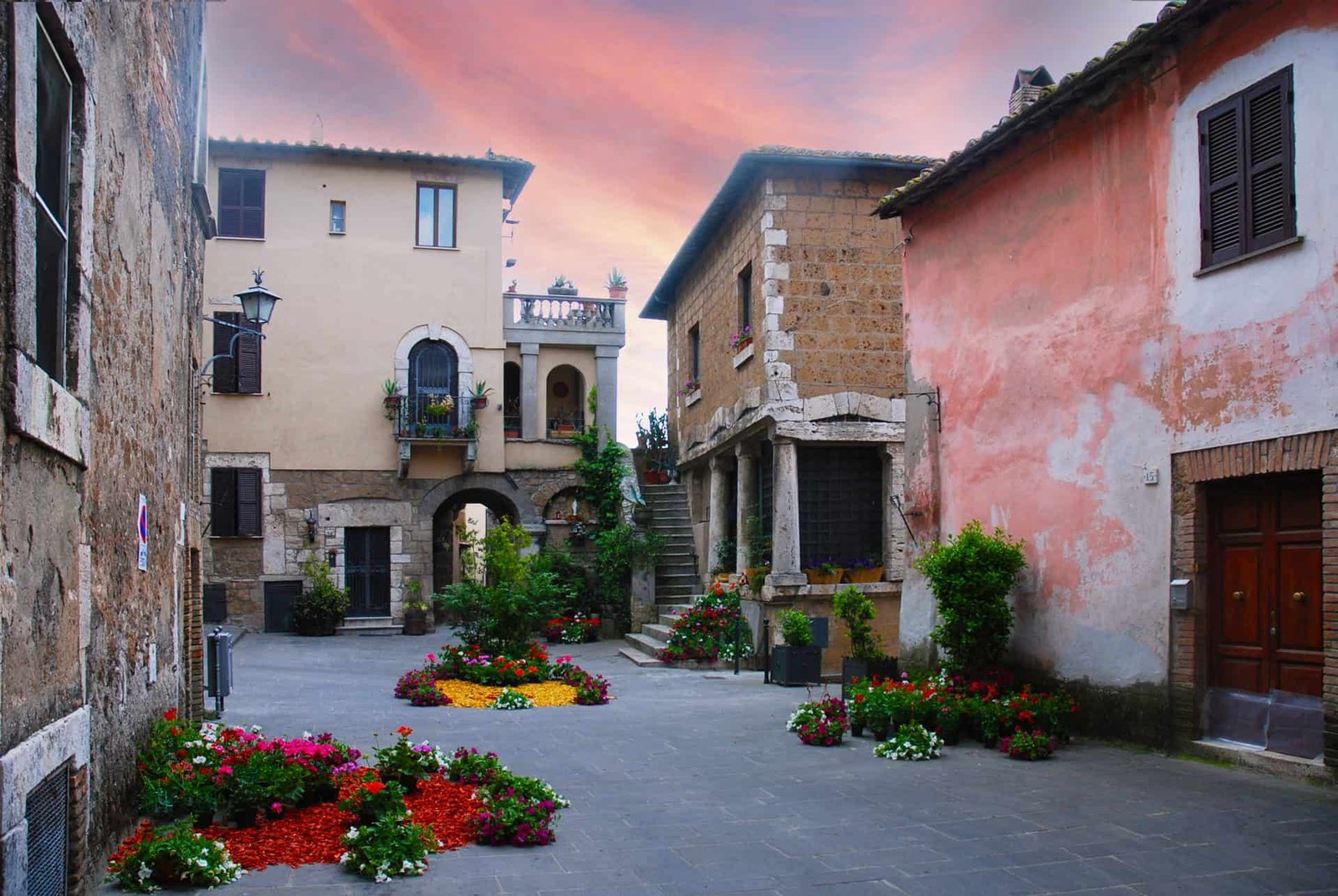
The village occupies a tuff plateau with an elliptical plan, adapted to the shape of the hill. The perimeter houses sit directly on the edge of the sheer walls, and those walls, seen from below, appear pierced at different heights by rooms dug into the rock: cellars, storerooms, dovecotes, dwelling rooms that the centuries have emptied and that today look like blind windows. The cliff is not a pedestal, it is the lower part of the town. Anyone who arrives from the expressway and sees that long, compact profile, tuff-yellow above the green of the valley, understands in three seconds why the shape of Orte has become a matter of national cultural discussion.
The old town is closed within a perimeter you walk in a good 20 minutes. Seven streets descend from the main square toward as many contrade, each named after a saint, and this radial structure is not medieval scenery but an administrative order that for centuries regulated taxes, militia and festivals. Walking in Orte means crossing that design without noticing.
What to see in Orte (VT), place by place
Piazza della Libertà, the civic heart of Orte (VT)
It was called Platea Sancte Marie, Piazza di Santa Maria, and after Italian unification it became Piazza Vittorio Emanuele before the present name. Archaeological remains document that the Roman forum occupied this same space: under today's paving slabs are 20 centuries of square. The seven streets of the seven contrade flow into it, and at the access points you can still see the chains, already present in the 1400s, which had a legal and not an ornamental function: they marked off the space where communal authority applied. On the square face the Palazzo Comunale, the Palazzo dell'Orologio and the facades of the families that mattered. It is the place where religious and civil life met and sometimes clashed for 700 years.
The Underground Fountain of Orte (VT)
Under the main square is the true monument of Orte, and almost nobody mentions it in general guides. The Fontana Ipogea is a basin dug into the tuff in Roman times, the terminal of an ancient conduit whose origin some scholars trace back to the Etruscan era: the more prudent attribution speaks of a water collection and supply system reworked several times. For centuries it was the only source of supply and the public water reserve of the city. On the stones of the large basin you can still see the grooves left by the jugs of the women who queued to draw water: it is not a poetic detail, it is measurable wear. The penalties for anyone who fouled the water were severe, and a custodian appointed by the Priors kept the keys to the door, which nobody else could open. The arrangement in its present form dates to the early 1600s. If I had to save a single space in Orte, I would save this one.
The Renaissance aqueduct and the Arco di Porticata
The aqueduct brought the water of the springs of the colle delle Grazie to the underground fountain of the square. The forms seen today are the result of a 16th-century restructuring that filled in the Arco di Porticata, the vaulted passage through which the ancient Via Amerina passed. It's worth stopping a moment: in a few square meters a Roman consular road, a medieval arch and a hydraulic work of the 1500s overlap. Rome teaches how to read these layerings. Orte offers them at reduced scale and legible at a glance, which for anyone learning is an advantage.
The Casa di Giuda
Deeply restructured in recent times, it keeps the medieval portico that recurs in several buildings of the historic center. The name comes from a local tradition: in the Middle Ages the building would have belonged to a traitor of the community, whose goods were confiscated. It must be said honestly that this is Orte oral tradition, not a notarial document: the house is authentic, the story of the traitor belongs to the narrative heritage of the town. The portico, that yes, is a lesson in 13th-century civil building.
The historic gates of Orte (VT)
The Porta del Vascellaro takes its name from the potters' quarter, which in Roman and medieval times counted many workshops: a papal coat of arms is in plain view. Beside it stands the small former church of San Gregorio, which keeps frescoes of the second half of the 15th century, and on the walls of the church and nearby buildings you can spot fragments of Lombard-era decoration reused in the masonry. They are pieces of the 8th century set into a wall like bricks: reuse is the true hallmark of Italian medieval building.
Porta Franca is one of the few traces left of the old fortress. It juts out under the great wall of Palazzo Alberti and was in the medieval period one of the access points to the city. The Porta di San Cesareo owes its name to a church dedicated to that saint, existing in 1337 and already gone by the end of the 1500s. Its construction began in 1449, in the framework of the fortifications started after 1431: at the death of Martin V the people of Orte destroyed the Rocca, which had become in their eyes a place of tyranny, and the city had to redraw its defenses. A first gate, torn down shortly after 1870, was topped by the coats of arms of Eugenius IV and Nicholas V. San Cesareo, a deacon and martyr condemned to be drowned in the sea of Terracina, in Rome was invoked against the floods of the Tiber: in Orte he was prayed to against inundations and drownings, and the gate that bears his name looked exactly toward the river.
The churches of Orte (VT)
The Co-cathedral of Santa Maria Assunta
Founded in the 9th century, it has today a Baroque and bright look that is the result of the 1721 renovation designed by the architects Castrachini and Bizzacchero. The facade is much later: work began in 1898 and ended in 1901. Before then the building had already been transformed and enlarged in the first half of the 1300s and in the second half of the 1500s, which explains why the plan lacks the geometric neatness you would expect from an 18th-century building site. Inside you look at the 18th-century organ, built with parts of an earlier 16th-century instrument, the wooden choir, the monumental 17th-century altar that holds the relics of the Holy Martyrs co-patrons and the altarpiece by Giuseppe Bottani of 1752 with the Madonna in glory and the eight Holy Martyrs. An institutional note that explains a lot about the history of this town: the church today has the status of co-cathedral of the Diocese of Civita Castellana, while Orte remains a titular episcopal see. A city that loses the bishop's seat and keeps the cathedral is a city that lost a political battle, not a battle of faith.
The church and former convent of Sant'Agostino
This is the most layered church in Orte, and it is the result of merging three sacred buildings that arose in different eras: the church of Santa Croce, the oratory of Sant'Egidio and the church of Sant'Agostino. The presence of the Augustinian friars inside the city is documented in 1278 and the church seen today was already in function in 1335. Santa Croce is the oldest part of the complex and the Hospital of the Convalescents was attached to it. The bell tower was originally the turret of the entrance gate of the communal residence and keeps its coat of arms: a bell tower that was a civic tower says, better than any essay, how the relationship between commune and religious orders worked in the 1300s. Inside you can see traces of Renaissance frescoes, a wooden Crucifix of the 15th century and the altarpiece of the Madonna of the Rosary, a 16th-century work by the painter Giorgio da Orte. The cloister of the former convent is also notable.
The church of San Pietro
When the church of San Pietro alla Rocca was demolished, it was decided to rebuild it where it stands now. The present building dates to the first half of the 15th century and underwent important renovations in 1731. Two slabs are kept there: one recalls Bishop Leo, datable between the 8th and 9th century, the other is the tombstone of the Leoncini family. To Canon Lando Leoncini is owed, in the early 17th century, the writing of a history of Orte that remained unpublished. I point out the detail because it is the reason why many local stories circulate with confidence without ever having been printed: they come from there.
The church of San Biagio
Of Romanesque origin, dated to 1253, it underwent deep alterations in 1757. It belonged to the Roman Hospital of Santo Spirito in Saxia, whose symbol, the Lorraine cross, it keeps above the entrance portal. Until 1613 that order ran a Preceptory in the adjacent rooms. The Lorraine cross on a village portal is a mark of ownership: it means the Roman hospital owned lands and income up here, and it is one of the ways Rome governed its countryside without sending a soldier there.
The church and former convent of San Francesco
In ancient times the church, in Romanesque style, was dedicated to Sant'Angelo. The present building, built in 1695, has a single nave and Baroque forms evident in the wide curtain that opens over the high altar. Inside are kept canvases of good quality and an altarpiece with the Madonna of Mercy. Next to the church is the convent, to which the Franciscans moved in 1259, with a wide and elegant cloister where the well is still visible.
The church of Santa Maria di Loreto
Church and monastery were built in 1641 on the site of the Hospital of the Raccomandati at the wish of the Roberteschi sisters, last survivors of an old Orte family. The monastery remained alive for 174 years, until the Napoleonic era. Today the church houses the statue of the Madonna of Pompeii, to which the people of Orte look with particular devotion.
The Sanctuary of the Santissima Trinità
The small white church stands facing the city, on the hill that the documents call Collis Hortanus in the 11th century and Civita Deserta in the 15th. It is a place made holy in the past by the presence of hermits and hosted San Bernardino of Siena, who according to local tradition dwelled in one of its caves in 1426. The church is dug into the tuff and keeps inside frescoes of the 14th and 15th centuries. From the esplanade you get the frontal view of the cliff of Orte: it is the point from which the town can be read in its entirety.
The Sanctuary and Monastery of Santa Maria delle Grazie
The sanctuary seen today is datable to 1521 and rose on a chapel already existing in 1159. The monastery was built in 1579 by the Hieronymite fathers, then passed to the Orte Seminary and in 1957 was entrusted definitively to the Benedictine Nuns. The community runs a well-known production of herbal products: if the monastery is open, it is one of the few truly local purchases you can make in Orte.
The church of Santa Maria di Loreto at Castel Bagnolo
Eight kilometers from the center, on a plateau immersed in a wildlife and archaeological zone, are the church and castle of Bagnolo. The castle was founded around the middle of the 11th century and in 1081 was ceded to the Roman monastery of San Silvestro in Capite, which held it until the 1800s. Inside the church remain traces of 16th-century frescoes. Raised to a parish in 1688 with the title it keeps, it holds an olive-wood statue of the Madonna of Loreto placed there in that period. You get there by car and the visit has to be arranged: it is not a place you find open by chance.
The church of Sant'Antonio at Orte Scalo
The hamlet born around the station has a church of its own and a history of its own. Father Geremia, superior of the convent of San Bernardino, started the apostolate at Orte Scalo and conceived the idea of a spacious church, helped by parishioners of every class and origin. From 1931 to 1954, the year of completion and consecration, a mighty temple in Neo-Gothic style took shape, and around that building site Orte Scalo was rebuilt morally and materially after the destruction of the war. To complete the church the parish house was built. The Neo-Gothic of the 1930s usually moves nobody, but here it tells a piece of social history that the historic center doesn't tell.

The old palaces of Orte (VT)
Palazzo Nuzzi
Built at the start of the 1700s by the Orte-born Cardinal Ferdinando Nuzzi, Prefect of the Annona and bishop of Orvieto, to a design by the architect Carlo Fontana. The architect's name should be weighed: Fontana is one of the protagonists of the late Roman Baroque, and his signature on a provincial palace measures how much the commissioning family counted. After Italian unification the palace became the municipal seat and was merged with the old communal residence. In the entrance hall are displayed classical and early medieval marble finds of local origin. On the first floor are frescoed rooms, among them the present Council Chamber, and in an adjacent room two canvases of the 17th century of good quality.
Palazzo Comunale
The palace facing the main square is attested as early as 1295. A few years earlier the original residence of the commune, in Piazza Sant'Agostino, had given way to the home of the Augustinian friars. On the facade three coats of arms tell of a century of subjection and alliances: on the right that of Clement VII Medici, dated 1528, on the left that of Paul III Farnese, 1535, in the center on the old portal the ancient coat of arms of the City of Orte. The staircase that allowed entrance from this side was demolished in 1846.
Palazzo dell'Orologio
Built in the early years of the 17th century next to the area occupied by the church of San Giovanni in Fonte, the ancient baptistery, it began as the Palazzo del Podestà. It is at that moment that the square begins to take on its present look: civil power equips itself with a facade and a public clock, that is, with a way to mark everyone's time.
Palazzo Roberteschi
The Renaissance lines seen today are the result of an important renovation carried out between the 1400s and 1500s. The original core is a tower of the 12th century, and this is the typical way in which Italian noble families turned defensive architecture into representative architecture. The palace is today the seat of the Ente Ottava Medievale, which keeps a cultural center and a specialized library there: anyone who deals with serious historical reenactment finds first-hand material here.
Palazzo Alberti alla Rocca
With severe and elegant lines, it was built between 1598 and 1602 by the Orte branch of the Alberti, on the ruins of the demolished fortress. It is one of the five palaces that family left in the city. On the main floor an elegant hall keeps cycles of frescoes between the 17th and 18th century. Building your own palace on the rubble of the pope's fortress is a political statement carved in stone.
Palazzo Alberti in Via Garibaldi
With severe forms, behind an imposing portal topped by a large family coat of arms, it conceals an elegant spiral staircase that tradition attributes to Vignola. It must be said for fairness that this is a traditional and undocumented attribution: the staircase is beautiful anyway, and Vignola's name in the Tuscia is spent with a generosity that architectural historians do not share.
Palazzo Nerei-Roberti and the vanished porticoes
To the left of the square began the porticoes populated by the shops of artisans and notaries, the beating heart of communal economic life. Held up by sturdy columns and Romanesque capitals, they extended along the whole of present-day Via Gramsci. The palace, already existing in 1305, has kept its architectural lines. Walking along Via Gramsci today imagining that succession of arches with the signs of the trades is the most useful mental exercise you can do in Orte: it explains why the town had 5,000 inhabitants in the 1300s and was not a village.
The museums of Orte (VT)
The Museo d'Arte Sacra in the church of San Silvestro
It was established in 1967 and has a record worth remembering: it is the first diocesan museum opened in Lazio. The main seat is the Romanesque church of San Silvestro, at Piazza Colonna 5, a single-nave building of the mid-11th century with a bell tower of Roman-Lazio type datable to the mid-12th. The original bell is kept inside the museum. A second section occupies the Bishop's Palace at Via Giulio Roscio 10 and can be visited with a guided visit. According to information from the Diocese of Civita Castellana, San Silvestro is open Thursday and Friday from 15 to 19 and Saturday and Sunday from 9 to 13 and from 15 to 19. The Bishop's Palace section is open on Saturday from 9 to 13. Closed December 25 and January 1.
The collection is not vast but the quality is high and alone justifies the trip. The exceptional piece is the mosaic fragment with the Byzantine Madonna, the work of Constantinopolitan craftsmen of the early 8th century, from the Oratory of John VII in the old Basilica of St. Peter in the Vatican: when the Constantinian basilica was demolished, those mosaics were dismembered and scattered, and one piece ended up up here. Standing one meter from a mosaic face of the 8th century, in a village church, with no line and no crowd, is an experience you can't buy in Rome. Alongside are many gold-ground panels of the 12th-16th centuries of the upper Lazio, Umbrian and Sienese schools, canvases, silverware and sacred vestments. Among the works pointed out by diocesan sources and local literature are a Madonna advocata attributed to Taddeo di Bartolo and dated 1420, carried in procession for the Assumption, a San Francesco and scenes of his life on a gold ground, a 14th-century reliquary cross and a Blessing Redeemer attributed to Piermatteo d'Amelia and dated 1491. School attributions should be taken for what they are: solid critical proposals but not all definitive.
The Museo delle Confraternite of Orte (VT)
Created inside the large sacristy of the church of Santa Croce, which was originally a hospital, it keeps the furnishings of the Orte Confraternities. It is not a museum of dead objects: almost everything you see in the display cases is taken out on Good Friday and carried in procession. Standing out are the bier of 1626, the processional base of the Addolorata, the tall and slender large white cross of the Confraternity of Santa Croce, the two 18th-century lanterns of the Confraternity of the Santissima Trinità and a 16th-century panel with Saint Giles Abbot. Anyone who visits Orte outside Holy Week understands here what happens when Holy Week arrives.
The Civic Archaeological Museum
Set up in the old church of Sant'Antonio, it holds the finds from the excavations conducted in Orte and in the municipal territory by the Soprintendenza per i Beni Archeologici dell'Etruria Meridionale. It is organized in three sections: Etruscan, from the end of the 6th to the early 3rd century BC, Roman, from the middle Republic to the Late Empire, and Early Middle Ages, from the 6th to the 11th century. A large part of the materials from Seripola is here. Watch out though: at the moment the tourist office lists the Civic Archaeological Museum as not open to visitors, so before planning the visit around this museum it's best to phone and get the situation confirmed.
Underground Orte, the city under the city
Orte has a continuity of life that goes from the end of the Bronze Age, the 12th century BC, to today. Inside the cliff that supports it, over about 25 centuries of uninterrupted occupation, have been dug the water supply network made of tunnels, cisterns and wells, the wastewater drainage system, the storerooms, the depots, the cellars, the stables, the dovecotes, some living rooms, the craft workshops for processing wool and hemp, the washhouses, the fountains, the summer triclinia, the nurseries and the pleasure spots of private gardens. It is a second city, and you can visit it.
The aqueduct and the main tunnel
The main tunnel runs for about 280 meters under the town, from Piazza della Libertà area toward the Arco del Vascellaro, and carried to the underground fountain the water collected on the colle delle Grazie. The first rainwater collection works are traced by local studies to the 6th-5th century BC. Walking down there with a flashlight, hearing the sound of footsteps over your head, is the quickest way to understand that a village on a cliff doesn't survive without a hydraulic system.
The rock-cut dovecote and the snow well
The dovecote dug into the tuff, with its rows of nesting niches, was a breeding operation: pigeons were meat, fertilizer and messengers. The snow well was made in 1891 to keep the ice meant for the hospital and for the preservation of medicines. The leap between the two structures is 600 years and is made in 30 steps.
The rock-cut nymphaeum
It is the most scenic space of the itinerary and is opened only on scheduled occasions: the tourist office includes it in the full route, indicated for the third weekend of the month, and on some specific dates. If you happen to be in Orte on exactly those days, change your plans and go.
How to book underground Orte
The visits are organized by the tourist office at Via Matteotti 45. The fare list shows €8 for the short one-hour tour on one of the three routes, €13 for the long tour of an hour and 40 minutes that combines aqueduct, dovecote and snow well, €15 for the complete two-hour tour. The reductions are €5, €10 and €13 for school groups and university students, free under six and for people with disabilities. The departures listed are at 9:15, 11:00, 15:15 and 17:00, with Wednesday limited to the afternoon, and a minimum of two participants is needed. Seasonal hours change: booking on the Orte tourist office website or a phone call avoids disappointment. Anyone who arrives without booking on a Wednesday morning in November stays outside.
Seripola, the Roman port on the Tiber
In 1962, during the works on the Autostrada del Sole, the workers cut the ground and the structures of a Roman river port came to light, which scholars identify with the Castellum Amerinum of the itinerary sources. The place was frequented already in prehistoric times and port activity is documented over a very long span, from the Republican age to the full Middle Ages, when from about the year 1000 the site passed under the control of the abbey of Farfa. On the hill that overlooks the port the remains of the towers of the castle of Castiglioni are still visible.
What you see today: stretches of paved Roman road, shops, living quarters, a well, the water drainage system and a small bath complex with a notable floor heating system. At this point the Tiber was wide and deep enough to receive sizable vessels: here the grain that went down toward Rome was loaded, and Livy recalls that from Etruria wheat reached Rome by the Tiber and that with it the plebs was fed. The area is not an archaeological park with a ticket office. Visits are organized by reservation through the tourist office and generally for groups, with notice of a few weeks. Local sources indicate a duration of about two and a half hours and a cost around €8, reduced €5. Ask for confirmation before setting out.
The Terme di Orte and the sulfur waters
The thermal complex uses natural sulfur waters that gush out at about 30 degrees. There are two large pools, one of which has a thermomineral waterfall and an area reserved for swimmers, a children's pool and a large equipped park with oaks and conifers. It is a summer facility, of local tradition, that opens in the good season: the opening calendar and fares are published season by season on the Terme di Orte website and on their social channels, so they should be checked before leaving. Blunt opinion: it is not a luxury spa and does not pretend to be. It is the place where the families of the Tiber valley spend the August afternoon, and it should be taken for what it is, in that spirit.
The seven contrade of Orte (VT) and the Ottava de Santo Egidio
The seven contrade
The contrade of Orte are San Gregorio, Porcini, Sant'Angelo, San Giovenale, Olivola, San Biagio and San Sebastiano. Each corresponds to one of the streets that descend from the main square and each has a banner, colors and teams. They are not a 20th-century invention for tourists: they are the modern translation of the old urban articulation of the medieval city.
The Ottava de Santo Egidio
Sant'Egidio has been celebrated as the patron of Orte since 1501, as the statute book reports, but the devotion is much older: already in 1327 the Confraternity of Santa Croce had adopted him as its protector. On the evening of August 31, the eve of the feast, the great procession takes place. In the past all the city magistracies and the 16 guilds of the arts took part. Today the image of Sant'Egidio, a masterpiece of 15th-century sculpture that tradition attributes to Saturnino Gatti, is carried through the streets of the historic center by the brothers of the company of Santa Croce, preceded by the delegations of the seven contrade, whose banners receive the bishop's blessing at the end of the route. With that act the Ottava begins.
The feast is of ancient tradition and was made solemn by Pope Boniface IX in 1396 with the grant of the same indulgences as the Porziuncola of Assisi. It is also cited in the old communal statutes. For two weeks the town goes back to the 1300s: games, music, reenactments of medieval life, exhibitions, and genuine food served in the contrada taverns. The 2026 edition ran from August 31 to September 13 and is organized by the Ente Ottava Medievale, which is based in Palazzo Roberteschi, at Via Vittorio Emanuele 5/7. The updated calendar is on the website of the Ente Ottava Medievale.
The Palio dell'Anello d'Argento
On the last day, which always coincides with the second Sunday of September, the Palio is held. A historic procession accompanies the archers to the main square for the contest of the Anello d'Argento, and in the evening the flag-throwers' show closes everything. Tip: get to the Palio an hour and a half early or you'll be looking at somebody else's back. The contrada taverns, instead, open in the evening and it's worth trying two different ones to understand how the cooking changes from one rione to the next.
The Procession of the Dead Christ
It takes place every Good Friday and is one of the oldest of its kind in Italy. Local tradition dates it to the early 1200s and claims its original form unchanged: a somber procession that accompanies Christ to the burial. The nine Orte confraternities take part, now united in a single body: Sant'Antonio Abate, Santa Maria delle Grazie, Madonna del Santissimo Rifugio dei Peccatori, San Pietro, Santissima Trinità, Misericordia, Santissimo Rosario, which is a women's confraternity, Santissimo Sacramento and Santa Croce. The oldest is that of Santa Croce, whose presence in Orte is attested as early as 1159.
About 500 brothers take part in the procession, marching in order of seniority in their respective robes. The departure is from the church of Santa Croce. In the main square the procession stops and the brothers arrange themselves in the shape of a heart: after a spiritual thought from the bishop they intone some verses of the Miserere. After going through the streets of the historic center, outside the church of Sant'Agostino the brothers dedicate the song of the Stabat Mater to Mary. The rite ends in the nearby church of Santa Croce, with the breaking of the Good Friday bread as a sign of fellowship. There was also a peasant belief, with no documentary backing and reported here as oral tradition: if the candles that adorned the bier and the Addolorata reached the square all lit, the year would bring an abundant harvest. Anyone who wants to see a real Italian procession, without accredited photographers and without stages, should come here on Good Friday. But come in silence.
History of Orte (VT)
Etruscans and origins
The origins are ancient and the name, Horta or Hortae, has an uncertain etymology. The hypothesis that Orte was one of the cities of the Etruscan federation is recurrent but unproven. The Etruscans lived there from the 6th century BC and left in the necropolises grave goods that are now kept in the Vatican Museums. The settlement arose not far from a thermal zone called Capannelle, so named for the huts built over the pools, and from the sulfur springs of the Fosso della Penna: hot water and springs favored the settlement of the area from ancient times.
Rome, Via Amerina and the port
Orte is just upstream of the confluence of the Nera into the Tiber, a position that gave it from the start a role as a river landing. The turning point comes with the building of Via Amerina in 241-240 BC, after the capture of Falerii and the stabilization of Roman rule north of Veii. Rome had already settled accounts with the Etruscans in this valley: the two battles of Lake Vadimo, traditionally dated 309 and 283 BC, were fought near here and the second closed the matter definitively. At the start of the 1st century BC Orte is raised to a municipium. The territory fills with villas and farms that live off the transit of Via Amerina, under the Arco di Porticata, and off the port of the Castellum Amerinum at Seripola, strengthened in the Augustan age. Virgil, in the Aeneid, cites the hortinae classes among the ranks opposing Aeneas: it can be translated as fleets or as armies of Orte, the point is that the name of the place was known in Rome.
Byzantines, Lombards and the early Middle Ages
The establishment of Christianity, with the elevation to a bishop's see in the early 7th century, and the addition of fortifications by the Byzantines signal the growth of Orte in the Tiber area. The city was long contested by the Lombards, who wanted control of the roads between Rome and Ravenna. In the middle of the 9th century it knows a further development, with the founding of a second cathedral, later Santa Maria Assunta, and the strengthening of the walls. Occupied by the Arabs and retaken in 914, between the 10th and 11th centuries it intensifies its control of the river, contending for primacy with Amelia, Narni and the abbey of Farfa.
The late Middle Ages, the highest moment
Here begins the most flourishing period: the city grows with the development of suburban districts and around 1150 takes in the bridge over the river. In 1330 Orte has 5,000 inhabitants, a number to be read in context: Rome had about 35,000, and Siena, Pisa and Lucca 20,000. The late Middle Ages is the time when Orte gains notable autonomy and independence, and that is why the centuries up to the 15th left it the greatest number of works of art. Anyone who visits the Museo d'Arte Sacra and wonders how a small town owns gold-ground panels of that level has the answer in this demographic figure.
The decline: the bridge, the plague, the Ponte Felice
The centralization of papal power, internal struggles and epidemics progressively reduce the extent of the city, with the abandonment of the suburbs. The plague weakens it in 1486. The material blow comes with the collapse of the bridge over the Tiber, which local sources place in 1524 and others in 1530: the exact date is debated, the effect is not. The political blow comes in 1589, when Sixtus V chooses to favor the axis of the Flaminia by building the Ponte Felice below the fortress of Borghetto. Traffic changes road and Orte drops off the map. The Orte bridge was never rebuilt, helped by the scourge of the plague and the continual floods of the 16th century. The influence of the noble families of Orte was of no avail. From there began a slow and deep decline, which culminated in the gradual loss of the episcopal see in favor of Civita Castellana: until the reorganization of the dioceses in the 20th century the bishops alternated their stays between the two seats and kept signing themselves Episcopus Hortanae et Castellanae Ecclesiae. In spite of everything Orte remained one of the main cities of the Patrimony of St. Peter in the Tuscia and already in the 1600s was the seat of a Governorate for a territory as large as the diocesan one.
The railway and the 1900s
The economic recession between the 16th and 18th centuries brings with it the growth of large estates and sheep farming and the growth of the wool trade, with the social rise of some families that left in the historic center the palaces still seen today. The real recovery begins with the building of the railway in the papal era, in the 1860s, which gives back to Orte the function that the Tiber and Via Amerina had had. Around the station a hamlet arises, destined to grow until it became the demographic and economic center of the municipality, despite the serious destruction of the Second World War. In recent times the Autostrada del Sole and the Civitavecchia-Orte-Cesena expressway have given back and increased that crossroads role that the city had had for 20 centuries. It's a circular story: Orte exists because people pass through, and every time a new road bypasses it, the city gets sick.
The springs of Orte (VT)
The territory is rich in natural springs, which for centuries were a public resource. The Fontana Antica, on the plateau of Castel Bagnolo, is the main supply source of the public aqueduct. Then there are the Acqua del Galletto. The Fonte Zelli, in the locality of Zelli on the Vasanellese road, which gushes from a permeable vein between travertine banks and was declared non-potable already in the 1980s. The Acqua della Breccia, a spring of notable flow in the locality of La Breccia, so called for the gravel quarry still active, declared non-potable in the 2000s. The Fonte di Buci, almost against the Tiber. And the Fonte dell'Acqua Acetosa, near the old church of San Lorenzo, with two pools, the first with two spouts slightly fizzy and the second ferrous and scarcer, potable until the 1980s and then compromised by human settlement. I list them because they are the water map of the town and explain where people settled, but none of these should be drunk today without checking with the Comune.
A curiosity about Orte (VT)
In 1974 Rai broadcast a 17-minute documentary titled La forma della città, signed by Paolo Brunatto and Pier Paolo Pasolini, with Ninetto Davoli. The first part is shot entirely in Orte, and Pasolini does something no television popularizer had done before: he takes the camera, frames the profile of the village on the cliff and shows how it takes just shifting the lens a few degrees for a modern building to enter the field of view and deform that line. His thesis is that the profile of a historic city is a collective asset exactly like a fresco, and that whoever interrupts it with an out-of-scale construction commits an act of cultural vandalism, however legal.
The real curiosity is that Orte was not chosen because it was the most beautiful. It was chosen because it was the most exemplary: a compact village, readable from afar, that offers itself to the eye all at once and therefore makes visible in an immediate way the damage of a single wrong intervention. Since then the town carries a kind of involuntary responsibility: it has become the Italian textbook case on the protection of the built landscape. In local administrations the topic has come back repeatedly, and the Pasolinian lesson is cited in official acts as an urban planning argument.
The right way to take up that legacy, for a visitor, is simple: before entering the town, stop at a point from which the cliff can be seen whole, the esplanade of the Santissima Trinità is ideal, and look at the profile for a good two minutes. Then go in. You will already have understood something that no explanatory panel inside the village will tell you.
Something nobody tells you about Orte (VT)
That the city you visit is not the one you see. The historic center you walk on the surface has a double in negative dug into the tuff that equals it in extent and exceeds it in age. The roughly two kilometers of accessible underground spaces are not a curiosity added to the tourist circuit: they are the infrastructure that made the tourist circuit possible. Without the 280-meter tunnel that brought the water of the colle delle Grazie to the underground fountain, there would have been no stable settlement on the cliff, because an isolated tuff cliff has no water of its own and whoever lives there dies of thirst at the first siege.
The second fact almost nobody tells is the economic function of those spaces. The dovecotes were breeding operations, not decoration. The cellars and storerooms under the houses served to keep wine and provisions at constant temperature in the months when the sun of this valley tops 35 degrees. The snow well of 1891, with its ice meant for the hospital and medicines, is 19th-century sanitary technology. There are basins for pressing grapes, workshops where wool and hemp were worked, washhouses, and even summer triclinia and nurseries for the private gardens of rich families. Put another way, the underground of Orte is an archive of labor, not a gallery of mysteries.
Third observation, and this is opinion: general guides give Orte three lines as a highway exit and six as a panoramic village, and skip the underground part entirely because it requires a reservation and an escort, that is, organizational effort. It is exactly the reason why those who go down find, even in high season, groups of six or eight people and not lines. Take advantage while it lasts.
The advice I give you for visiting Orte (VT)
The first piece of advice concerns the order of the visit, and it completely changes the day. Don't start from the historic center. Start from below and from outside: stop at the esplanade of the Santissima Trinità or at a point on the road going up from which the cliff can be seen whole, and observe the walls pierced by the dug-out rooms. At that point go up, enter the town and do underground Orte. Only afterward walk on the surface among square, churches and palaces. This way the surface reads as a consequence of what lies beneath, which is the right historical order, and the visit stops being a collection of unconnected buildings.
Second piece of advice, on logistics. Phone the tourist office two or three days ahead, at 0761 267870 or 379 2085237, and set the time of the underground route. Orte is not a continuous-flow place: the museums have openings concentrated between Thursday and Sunday, the underground routes have fixed departures at set times and a minimum of two participants, and the Civic Archaeological Museum is currently listed as not open to visitors. Anyone who arrives on a Monday morning without having phoned risks finding a beautiful village closed.
Third piece of advice, on shoes and the body. The cliff is climbed, the alleys have uneven surfaces and underground you walk on irregular ground, with a constant temperature of around 13 or 14 degrees even at Ferragosto. Closed shoes with a lugged sole, a sweatshirt in the backpack even in summer, water. Anyone who suffers from claustrophobia should choose the short aqueduct tour and not the complete one. And one last unpopular opinion: avoid the Saturday afternoon of the Ottava if your goal is to visit the monuments, because during the festival the logic of the town is different and the places of culture take second place. The festival deserves a trip of its own.
Another well-known fact, yet seldom cited
Everyone knows Orte is a railway junction. Almost nobody links that fact to the reason Orte exists. The town was born and grew for a single geographic reason: it is the point where, just upstream of the confluence of the Nera into the Tiber, the river was navigable and crossable, and above the river there was a defensible cliff. Everything else follows from this. The Roman port of Seripola, Via Amerina passing under the Arco di Porticata, the multi-arched bridge that until the 1500s was the Tiber crossing north of Rome, the papal railway of the 1800s, the Autostrada del Sole and the expressway to Cesena: five different infrastructures in 25 centuries, all in the same spot, for the same reason.
The corollary is the part rarely cited. When the passage moves, Orte collapses. It has happened exactly once, and brutally. In 1589 Sixtus V had the Ponte Felice built on the Flaminia, below the fortress of Borghetto, and the traffic between Rome and the north changed road. The bridge of Orte, already collapsed in the early 1500s, was never rebuilt. In a few decades the city lost income, role and finally the bishop's residence, which passed progressively to Civita Castellana. It took almost three centuries, until the railway, for the flow to return. Anyone who today looks at the A1 interchange and judges it an industrial eyesore at the foot of a beautiful village has not understood that this interchange is the reason the village is still inhabited and is not a ruin like Antuni or Rocchettine.
An opinion Orte doesn't always like: the town should claim this identity of crossroads instead of hiding it behind the medieval postcard image. It is a more interesting and truer story.
The right photo to take in Orte (VT)
The photograph that makes Orte is just one and it is the one Pasolini chose: the whole profile of the cliff with the town above, shot from outside, with the valley in the foreground. You get it from the opposite slope, from the area of the Sanctuary of the Santissima Trinità, or from some points of the road that climbs from the valley floor. The right light is that of late afternoon, when the raking sun lights up the tuff and the rooms dug into the wall become a grid of black shadows. In the morning the wall is backlit and everything is lost. Composition: horizontal, the town in the upper third, a bit of valley below to give the measure of the drop. Avoid heavy zoom, which flattens the cliff and takes away its overhang.
The second photo, the one nobody takes, is from the bottom up, below the wall, with the openings of the hypogea punching through the tuff at different heights. You need a wide angle and you need to accept that the sky will burn out. It is the image that explains the concept of a dug-out city better than 1,000 words.
Inside the village, the two best subjects are Piazza della Libertà with the chains in the foreground and the sequence of alleys descending toward the contrade, where the tuff of the houses changes color between sun and shade. Underground, photography is hard and it has to be said: little light, narrow spaces, and flash on the tuff wall returns a flat, yellow image. Anyone with a camera that handles high ISO should keep the aperture open and rest the body against the wall. Anyone with only a phone should let it go and look with their eyes, which is better. Rule of courtesy: in churches and in the Museo d'Arte Sacra you ask first if photographing is allowed, and the answer is sometimes no, for conservation reasons and not out of whim.
Some important events that happened here in history
The first event that marked this valley is the two battles of Lake Vadimo, traditionally dated 309 and 283 BC. They were fought near Orte, between Rome and the Etruscan cities allied with the Umbrians and, on the second occasion, with the Senone Gauls. The second battle closed Etruscan resistance in central Italy: from then on the Tiber valley was Roman without further discussion. A few decades later, in 241-240 BC, the building of Via Amerina turned a cliff settlement into a hub of the empire.
The second event is of 914: Orte, which had been occupied by the Arabs during the raids into the Tiber valley, is retaken. It is a date Romans know little, but which explains the system of towers and fortifications of the lower Tuscia better than any manual.
The third event is 1396, when Pope Boniface IX grants the Ottava of Sant'Egidio the same indulgences as the Porziuncola of Assisi. It is not a devotional detail: a plenary indulgence granted to a provincial feast means pilgrims, market, money and prestige. It was an economic choice as well as a spiritual one, and it has kept a festival alive for over 600 years.
The fourth event is of 1431: at the death of Martin V the people of Orte destroyed the Rocca, which had become a place of tyranny. It is an episode of violent communal autonomy that left a physical mark on the city, because in 1449 work began on the Porta di San Cesareo, within an overall rethinking of the fortifications, and later the Alberti built their palace right on the ruins of the demolished fortress.
The fifth event is the double catastrophe of the 1500s: the plague of 1486 that had already weakened the population, the collapse of the bridge over the Tiber in the early 1500s and finally, in 1589, the building of the Ponte Felice ordered by Sixtus V. Three blows in a century, the last one definitive. The sixth and last event is of 1962, when the digging of the Autostrada del Sole brought back to light the Roman port of Seripola: a 20th-century infrastructure that, for once, gave something back instead of destroying it.
Who has passed through Orte (VT)
The oldest figure is literary and should be taken with tongs: Virgil, in the seventh book of the Aeneid, cites the hortinae classes among the Italic forces lined up against Aeneas. It is not a chronicle, it is Augustan epic, but it testifies that the name of this place circulated in the Rome of the 1st century BC with a weight of its own. On the historical side, Livy recalls the grain that went down from Etruria to Rome by the Tiber: that grain passed through here.
San Bernardino of Siena, the great Franciscan preacher of the 1400s, according to local tradition dwelled in 1426 in one of the caves of the hill of the Santissima Trinità, facing the town. The circumstance is handed down by Orte memory and should be recorded as such, but it is consistent with the saint's preaching itineraries in central Italy in those years. Also in the 1400s, the sculpture of Sant'Egidio that still comes out in procession on August 31 is attributed by local critical tradition to Saturnino Gatti, a sculptor and painter of L'Aquila.
Among the popes, Boniface IX intervenes in Orte in 1396 with the grant of indulgences to the Ottava. Martin V leaves his mark with the Rocca, destroyed by the people of Orte at his death in 1431. Eugenius IV and Nicholas V appear with their coats of arms on the gate of San Cesareo. Clement VII Medici and Paul III Farnese have their coats of arms on the facade of the Palazzo Comunale, dated 1528 and 1535. And Sixtus V decides, in 1589, the economic fate of the city with the Ponte Felice. Five popes in 150 years on one facade and one gate: it is the way the Papal State signed its possessions.
Among the artists and local figures, Carlo Fontana designs Palazzo Nuzzi for the Orte-born Cardinal Ferdinando Nuzzi, Prefect of the Annona and bishop of Orvieto. Giuseppe Bottani signs in 1752 the altarpiece of the cathedral. Giorgio da Orte paints in the 1500s the Madonna of the Rosary of Sant'Agostino. Local literature refers to Cola di Orte a Madonna dei Raccomandati. In the 1900s comes Pier Paolo Pasolini, who in 1974 chooses Orte as a case study for La forma della città together with Paolo Brunatto and Ninetto Davoli, and makes it a national symbol of landscape protection. Pasolini, for that matter, frequented this whole strip of Tuscia: at Chia, above Soriano nel Cimino, he bought the tower where he lived in his last years. If I had to name a single figure who changed the way Italy looks at Orte, I would name him without hesitation.
Orte (VT) with children
It works, on two conditions. The first is the underground route: for a child of eight or 10, going down with a flashlight into a tunnel dug 2,500 years ago is worth 10 museums, and the dovecote with its nest niches is the kind of space remembered for years. Under six, entry is free, but think carefully: the dark, the narrow spaces and the constant 13 degrees are not for everyone, and the short one-hour tour is the reasonable choice. The second condition is the Terme di Orte in summer, with the pool dedicated to the little ones and the tree-filled park, which solve the afternoon when the cliff turns into a grill.
The best period of all to come with children is the Ottava de Santo Egidio, between August 31 and the second Sunday of September: processions, drums, flag-throwers, archers and contrada taverns are an immersion in the 1300s that no classroom reproduces. Bring earplugs for the little ones, because the drum challenge is seriously loud.
Accessibility in Orte (VT)
It must be said frankly: a medieval village on a tuff cliff is not an easy place for people with mobility difficulties. The alleys slope, the surface is often irregular stone, and the underground spaces are reached by stairs cut into the tuff, so the underground route is not wheelchair accessible. The tourist office fare list provides free entry for people with disabilities, but free entry doesn't solve the physical barrier. The sensible thing is to phone the tourist office first, explain the situation and have them indicate a workable surface itinerary: Piazza della Libertà and the main streets around it are the easiest parts. The Museo d'Arte Sacra is housed in a historic church and it's best to ask in advance. Anyone traveling with a stroller should make peace with it: a baby carrier is better.
How much a day in Orte (VT) costs and how to save
The bill is honest. A short underground route in Orte costs €8, the long one €13, the complete one €15, with reductions to €5, €10 and €13 for school groups and university students. The Museo d'Arte Sacra asks €3, €4 with guided visit, half price under 13 and over 64, free under 11. Churches cost nothing. Parking at the edge of the historic center is the most variable item and should be checked on the spot. With a trattoria lunch, a couple spends a day in Orte with a sum that in Rome covers two tickets to a state museum and nothing else.
How you really save: you come as two or more, because the departures of the underground routes require a minimum of two people and anyone who arrives alone risks paying anyway for waiting for another visitor. You choose the long tour instead of two short ones, because it costs less than the sum. You come by train if you're coming from Rome, avoiding toll and fuel. And you avoid the classic mistake, adding Orte as a 10-minute stop inside an itinerary aimed at Orvieto: in that case you don't save, you throw away the trip ticket.
When to go to Orte (VT) and when to avoid it
The best season is spring, from mid-April to the end of May, when the Tiber valley is green and the temperature lets you walk uphill without suffering. In May the artichoke festival is also held. The second good period is September, with the Ottava and the first cool air. October and November have low and beautiful light for photographing the cliff, and at the end of November the cellars of the historic center open for a wine event: it's best to ask the tourist office for the dates.
To avoid: July and August in the middle hours, because the tuff gives back heat and the alleys become an oven, unless the program is built around the underground and the baths. And Monday and Wednesday mornings, when many openings are reduced. Good Friday is an extraordinary date to attend the Procession of the Dead Christ, but it is a day dedicated to the procession: don't count on visiting the museums at leisure.
What to eat in Orte (VT)
We are in the lower Tuscia, on the border with Umbria and the Sabina, and the cooking says so clearly. The artichoke is the identity product of the Orte area, so much so that a festival is dedicated to it in May: it is eaten fried, stewed in a pan with mentuccia, inside frittatas. Then there are the legumes from the valley countryside, pork processed according to Tuscia tradition, extra virgin olive oil, which here meets the Sabina productions among the oldest in Italy, and the wines of the hills between Orte and Bassano in Teverina.
On bread and pasta the local rule is simplicity: legume soups, egg pastas dressed with long-cooked meat sauces, and in season the mushrooms and chestnuts that come down from the Cimini, where Soriano nel Cimino holds the most famous chestnut festival of the province. A sweet note: the Benedictine nuns of Santa Maria delle Grazie run a well-known herbal products line, and a purchase there is worth more than 10 souvenirs. Here I don't name places to eat: in small towns management changes, and a wrong tip ruins a day. Ask the tourist office, which knows who is working well at the moment.
What is around Orte (VT)
Orte is an excellent base camp for the lower Tuscia and the Sabina, and this is its best use. A few kilometers away is Bassano in Teverina, with its bell tower and old village. On the other side are Vasanello with the Orsini castle, Vignanello with the Castello Ruspoli and its 16th-century garden, and Civita Castellana, which took the episcopal seat away from Orte and which keeps the Forte Sangallo. Toward the Cimini you go up to Soriano nel Cimino and the abandoned village of Chia, then to San Martino al Cimino and Lake Vico, up to Viterbo and its medieval quarter.
For nature lovers, the Natural Monument and WWF Oasis of Pian Sant'Angelo and the gorges of Corchiano show the tuff gorges that cut this territory. Going down along the river you reach the reserve of Nazzano Tevere-Farfa, the first river park of Lazio. On the Sabina side are the abbey of Farfa, Casperia, Fara in Sabina and the ruins of Rocchettine. Past the regional border, Orvieto is a little under half an hour from the interchange. Anyone who wants to organize a tailor-made itinerary in this part of Lazio can turn to professionals like the tour leaders of TourLeaderPro, while those traveling with foreign friends find the English guides of the region on the Lazio page of ItalyPlanner.
Quick questions about Orte (VT)
Where is Orte (VT)?
In the province of Viterbo, in northern Lazio, on a tuff cliff overlooking the Tiber valley, 24 kilometers from Viterbo and about 70 kilometers from Rome.
How far is Orte (VT) from Rome?
About 70 kilometers. By car you take the A1 to the Orte exit and the travel time is a little over an hour, traffic permitting. By train you get off at the Orte station, on the line that links Rome to Umbria.
Can you get to Orte (VT) by train?
Yes, and it is one of the most important rail junctions in central Italy. The station, however, is at Orte Scalo, on the plain: the historic center is on the cliff, three kilometers higher, so you need a bus link or a taxi.
How much does it cost to visit underground Orte?
According to the tourist office fare list: €8 the short one-hour tour, €13 the long tour of an hour and 40 minutes, €15 the complete two-hour tour. Reductions to €5, €10 and €13 for school groups and university students, free under six and for people with disabilities.
Do you need to book to visit Orte (VT)?
For the underground routes yes, booking is recommended and a minimum of two participants is needed. For the historic center no. For Seripola booking is mandatory and well in advance.
How much time do you need to visit Orte (VT)?
Half a day for the historic center, a full day adding an underground route, two days if you want to include Seripola and the nearby villages.
How much does the Museo d'Arte Sacra of Orte (VT) cost?
€3 for full admission, €4 with guided visit, a 50 percent reduction under 13 and over 64, free under 11.
When is the Museo d'Arte Sacra open?
The San Silvestro seat, at Piazza Colonna 5, is listed as open Thursday and Friday from 15 to 19, Saturday and Sunday from 9 to 13 and from 15 to 19. The Palazzo Vescovile section on Saturday morning, with guided visit. Closed December 25 and January 1.
Can you visit the Civic Archaeological Museum of Orte (VT)?
The tourist office currently lists it as not open to visitors. Before planning the visit it's best to call for confirmation.
Can you visit Orte (VT) in a wheelchair?
The historic center has slopes and irregular surfaces and the underground route is reached by stairs cut into the tuff, so it is not accessible. Piazza della Libertà and the main streets around it are the workable part. Better to agree on an itinerary with the tourist office first.
Is Orte (VT) suitable for children?
Very, above all for the underground route and, in summer, for the thermal pools with a pool dedicated to the little ones. Under six, consider the short tour instead of the complete one.
Can you take photographs in Orte (VT)?
Outdoors without problems. In churches and in the Museo d'Arte Sacra you ask first: in some spaces photography is limited for conservation reasons. Underground the light is scarce and flash returns flat images.
When does the Ottava de Santo Egidio take place in Orte (VT)?
From August 31 to the second Sunday of September. The 2026 edition ran from August 31 to September 13. The calendar is published by the Ente Ottava Medievale, based in Palazzo Roberteschi.
What is the Palio dell'Anello d'Argento?
The contest among the seven contrade that closes the Ottava, held by the archers in the main square on the last day of the festival, that is, the second Sunday of September, preceded by the historic procession and followed by the flag-throwers' show.
What are the contrade of Orte (VT)?
Seven: San Gregorio, Porcini, Sant'Angelo, San Giovenale, Olivola, San Biagio and San Sebastiano.
When is the Procession of the Dead Christ held?
Every Good Friday. About 500 brothers of the nine Orte confraternities take part, setting out from the church of Santa Croce.
Are the Terme di Orte (VT) open all year?
No, it is a seasonal facility with outdoor pools fed by sulfur waters that gush out at around 30 degrees. Opening period and fares should be checked on the facility's official website before leaving.
What is the difference between Orte and Orte Scalo?
Orte is the historic village on the cliff. Orte Scalo is the hamlet born in the 1800s around the railway station, today the most populous center of the municipality, with its Neo-Gothic church of Sant'Antonio.
Where do you park in Orte (VT)?
In the parking lots at the edge of the historic center, at the foot of the walls. Inside the village the roads are very narrow and not recommended for anyone who doesn't know the alleys.
What is there to eat in Orte (VT)?
Artichoke of the Orte area, to which a festival is dedicated in May, legumes, cured meats of the Tuscia, extra virgin olive oil, mushrooms and chestnuts of the Cimini in fall, and the wines of the hills between Orte and Bassano in Teverina.
Is Orte (VT) worth visiting on a day trip from Rome?
Yes, and it is one of the best day trips in northern Lazio, above all for those who arrive by train. Anyone planning a trip in Lazio finds ideas on the page of ItalyPlanner day trips and can build their own itinerary with the page my trip.
Orte is a town that defends itself poorly. Whoever passes on the motorway sees it for four seconds and files it as a panoramic profile. Whoever stops for a coffee files it as a pretty village. It needs a visitor who agrees to go underground, to book a visit, to wait for four in the afternoon for the right light on the cliff. At that point it gives back 25 centuries in half a day, an exchange rate very few places in Italy can offer. If you have only one free day and the temptation to spend it in Orvieto, try spending it here: Orvieto will still be there, and in Orte you will be almost alone. For private or tailor-made experiences in this territory you can rely on TourLeaderPro for small groups.
Article written by the editorial team of TourLeaderPro, contact them for Private/Corporate/V.I.P. Tours and Experiences.
Planning a trip to Rome? The English guides for visiting the city are on ItalyPlanner.com.