Vasanello (VT)
In short. Vasanello is in the province of Viterbo, at an elevation of 265 meters, on a tuff spur at the head of the Rio Palanza, a tributary of the Tiber, about 10 kilometers from Orte.
Vasanello is in the province of Viterbo, at an elevation of 265 meters, on a tuff spur at the head of the Rio Palanza, a tributary of the Tiber, about 10 kilometers from Orte. From Rome you get there on the A1 motorway toward Florence, Orte exit, then the provincial roads toward Vasanello: about 70 kilometers, an hour and 10 minutes of driving in normal conditions. By train the station is Orte, on the regional FL1 line from Roma Tiburtina and Roma Ostiense (50-70 minutes depending on the stops). From Orte station the Cotral runs toward Soriano nel Cimino and Vallerano stop at Vasanello, with commuter frequencies and almost nothing on Sunday: check the schedules on the Cotral website the day before. Leave the car in the new part of town, at the edge of the historic center, and continue on foot. The paid monument is the Castello Orsini, private property of the Misciattelli family, at Piazza della Repubblica 9. It opens with a guided visit the last weekend of every month from March to November, and for groups of at least 15 people by reservation all year. Full ticket 10 euros, students 5 euros, groups over 25 people 8 euros. Reservations at 328 6552632 or 0763 837473, or at castellorsinivasanello@gmail.com. The full visit of the castle, medieval garden and old ceramics factory lasts about two hours. The churches of Santa Maria Assunta and San Salvatore are free to enter during parish hours. The Ceramics Museum is housed in Palazzo Celestini, the town hall, at Via Roma 30: ask the municipality about opening times (telephone 0761 40891). For the rest of the town you don't need to book anything.
Vasanello is among the Tuscia destinations gathered in the tourist attractions of Lazio and combines in a day with Orte and Bassano in Teverina, which are 10 and 8 kilometers away respectively.
How to get to Vasanello (VT) from Rome and from Viterbo
There are towns you come across by chance and towns you have to decide to reach. Vasanello belongs to the second category, and this is its first advantage. Nobody gets there because they drive past it: you get there because you chose to leave the motorway corridor between Rome and Florence and take a provincial road that climbs calmly toward the plateaus of the southern Tuscia, at the exact point where Lazio begins to look like Umbria without being it yet. In every season, on this road, the landscape changes register within a few kilometers, as if someone had turned a knob.
By car from Rome: the Orte exit
From Rome the main route is the A1 Milano-Napoli motorway heading north, exiting at Orte. From northern Rome it is the first really useful exit for anyone aiming at the inner Tuscia: about 70 kilometers, a little over an hour of driving, an hour and a quarter if you leave at rush hour or get stuck in the queue at the Roma nord toll gate on a summer Friday afternoon. Once you exit the signs are clear: follow the direction Orte scalo and then the provincial road that leads toward Vasanello and Bassano in Teverina. It's another 10 or 12 kilometers, no more, but they are kilometers that completely change the rhythm of the trip: the traffic disappears, the curves widen, the olive groves appear.
A practical tip that is not a detail: don't trust the GPS to the letter. The provincial roads of this area have numbering that changes, stretches that fork, and more than one intersection where the sign for Vasanello is written small on a signpost that time has not treated well. If the GPS suggests a shortcut on a dirt road through the fields, think twice: in summer it's a scenic stroll, after an autumn storm it can become a serious problem. The main paved road remains the right choice for anyone who doesn't know the area, and costs at most five minutes.
By car from Viterbo: the road of the Cimini
Anyone arriving from Viterbo has an entirely different route and, in some ways, a more beautiful one. It's about 30 kilometers, about 40 minutes, but they cross the densest part of the Tuscia. You go down from the provincial capital toward the southeast, skirt the volcanic reliefs of the Cimini, pass towns that deserve a stop even of half an hour. If you have time, extend toward Soriano nel Cimino, where the Orsini castle dominates the town from above and where the beech forest climbing toward Monte Cimino is among the most surprising things in northern Lazio. From Soriano you go down toward Vallerano and head for the Tiber valley. It's an itinerary that adds 40 minutes to the trip and at least three memories.
By train: the FL1 to Orte and then the Cotral
For those traveling by train the situation is simpler than you might imagine, at least up to a point. The reference station is Orte, one of the most important rail junctions in central Italy: the regional trains of the FL1 line, which connects Rome to the Sabina and to upper Lazio, pass through here, and the routes toward Florence, Perugia and Ancona cross here. From Roma Tiburtina or Roma Ostiense the regional trains to Orte are frequent for a good part of the day and the trip takes between 50 minutes and an hour and 10 minutes depending on the number of stops. From Orte to Vasanello, on the other hand, you have to get organized: the Cotral lines that go up from Orte station toward Soriano nel Cimino and Vallerano stop at Vasanello, but they follow schedules designed for students and commuters, concentrated in the early morning and early afternoon, with a drastic reduction on holidays. The realistic advice is to check the schedules the day before on the Cotral website and, if the trip is on a Sunday, to seriously consider the car or a private transfer.
Anyone who wants to build a more structured itinerary without going crazy over connections can rely on those who organize group trips in Italy with a guide: TourLeaderPro puts together in a single day two or three towns of this strip of the Tuscia, solving the problem of transfers. It's not the same experience as independent travel, but for those short on time who want to see the best it's a solution that works.
When to go to Vasanello (VT) and how much time you need
The four seasons of Vasanello
Vasanello behaves differently depending on the season, and it's worth knowing before you leave. Spring, from mid-April to early June, is the best period by far: pleasant temperatures, countryside green in a way that the Lazio summer quickly erases, days long enough to visit the center calmly and move on to a nearby town. In addition there is the patron saint's festival of San Lanno, from May 4 to 7, and on the last weekend of April and of May the medieval garden of the castle is in bloom. Summer has the advantage of festivals and events, from the Ortaccio Jazz Festival in the first days of August to the gnocco festival, and the disadvantage of heat: the inner Tuscia, far from the sea and enclosed between hills, reaches serious temperatures in the middle hours in July and August. Move early in the morning and start again in the late afternoon. Autumn, October in particular, is the season of colors and of products of the land: chestnuts from the Cimini, mushrooms, new oil. Winter is the season of truth, the one in which the town is left alone with itself, the streets are empty and the castle looks even bigger than it is. But the castle closes its monthly visits from December to February, and you have to factor that in.
Where to park in Vasanello
The historic center is small, compact, with streets that have the dimensions of five centuries ago. It's not a place to drive around in, and trying is a mistake. The parking areas are in the newer part of town, right next to the old core, and from there you enter on foot in a few minutes. Leave the car at the first reasonable opportunity and walk: the town can be crossed from one end to the other in a quarter of an hour, and walking you see things that you miss completely from a car, starting with the peperino portals and the carved lintels that dot the houses of the center.
How much time you need for Vasanello
A layered answer. To see Vasanello in the strict sense, that is the castle from outside, Santa Maria Assunta, San Salvatore, the loop of the historic center and a stop, two or three hours are enough. To really see Vasanello, with the guided visit of the castle and garden (two hours on their own), a ceramics workshop, a walk to the viewpoints over the valley and time to talk with someone, you need a good half day. Anyone who wants to go down to Palazzolo, among Roman kilns and necropolis, has to add a couple of hours of walking. To use Vasanello as the pivot of a whole day in the southern Tuscia, combining it with Orte and Bassano in Teverina, you need a full day: it's the formula I recommend most often.
Accessibility of the historic center
It has to be said clearly, because too many guides ignore it. The historic center of Vasanello has slopes, uneven paving, steps that appear suddenly in the middle of an alley. Anyone with mobility difficulties can enjoy a good part of the town by staying on the main streets, which are relatively flat, but some parts of the oldest core are objectively demanding. Small strollers manage, big ones suffer. The castle has vehicle access and restrooms, but the historic rooms are reached by stairs: anyone with specific needs should say so when booking. Palazzolo, with its path in the gorge, is not suitable for those with mobility problems.
Services in town
Vasanello is a living town, with about 4,000 inhabitants, and all the basic services are there: bars, grocery stores, pharmacy, post office, gas stations in the lower part of town. Don't expect the tourist offering of an equipped resort, because it isn't one: expect the offering of a normal town, which is a different thing and in some ways a better one. The bars in the center are places where you walk in and get looked at for two seconds, after which nobody pays attention anymore and you can listen to the conversations at the counter, the fastest way to understand how a place works.
Where to sleep near Vasanello
In the municipal territory and in the immediate surroundings there are agriturismi, vacation houses and small bed and breakfasts, often made from restored farm buildings. Availability is limited, so on high-season weekends it's worth booking ahead. Many visitors choose to stay in Viterbo, which has a much larger accommodation capacity and is about 40 minutes away, or in the Orte area, convenient for those moving by train. Anyone who thinks in English and wants to compare the bases for the whole region will find a useful overview in the ItalyPlanner guide to Lazio, built precisely in terms of bases and travel radius.
One last practical note, the most important. Vasanello is not visited with a checklist of things to tick off, because the list would be short and leave you unsatisfied. It's visited with a rhythm. Anyone who arrives in a rush, looks at the castle from outside, takes two photos and leaves, has seen almost nothing. Anyone who allows themselves 20 minutes of aimless wandering, goes into a church when it's open, stops in front of a window of ceramics and asks the people working there how a piece is made, takes home much more than the size of the town suggests. It's a place that rewards slowness, and in an era when everything pushes in the opposite direction this quality is worth the detour from the motorway.

The plateau, the river and the border: how Vasanello took shape
To understand Vasanello you have to look at a map, and look at it well. The town stands on an isolated tuff spur at the head of the Rio Palanza, a tributary of the Tiber, and looks east over the Tiber valley. To the west it leans against the last offshoots of the volcanic hills that culminate in the Monti Cimini. It's a position on the margin, and places on the margin always have a more complicated history than places at the center. A few kilometers away, beyond the river, Umbria begins: Amelia, Narni, Otricoli are at distances that today are covered in half an hour and that in the Middle Ages meant another political world, another jurisdiction, another system of alliances. Vasanello lived for centuries on this fault line, and its architecture tells it with a clarity that surprises anyone arriving and expecting to find just any little town.
The Falisci, Palazzolo and the Roman kilns of Vasanello
The history begins long before the castle. The area between Orte, Vasanello and Civita Castellana was the land of the Falisci, a people speaking an Italic language related to Latin and with a material culture closely tied to the Etruscan world, whose main center was Falerii, the ancestor of Civita Castellana. Their story ended in 241 BC, when Rome destroyed the city and moved the inhabitants to the new foundation on the plain, Falerii Novi. In the territory of Vasanello the Faliscan presence is documented by the rock settlement of Palazzolo, in the gorge below the town, where in Roman times kilns worked that produced Italic terra sigillata, the fine tableware of the Empire: a potter named Ancharius, who signed his pieces, has been identified in finds from other Roman provinces. It's not a detail: it means that 2,000 years ago this clay traveled. Not far away, at the bridge of Valle Gaudenzio, a structure remains that local tradition dates to the 2nd century. These are scattered traces, not monumental necropolises like at Cerveteri or Tarquinia: burials in the rock, stretches of road sunk into the tuff, materials that surface during farm work.
Vasanello on Via Amerina and the Byzantine corridor
In Roman times the area was crossed by the great routes to the north: Via Flaminia, which goes up the Tiber valley, and Via Amerina, which cut further west toward Amelia. It is the Amerina that matters for Vasanello, and the reason is entirely early medieval: when the Lombards occupied central Italy, cutting the Flaminia, the Amerina became the corridor that linked Rome to Ravenna through the territories that remained Byzantine. A narrow, guarded passage, along which armies, ambassadors, merchants, clergy and pilgrims headed to Rome from northern Europe moved. This explains why the strip between Orte, Vasanello and Gallese is so dense with early medieval fortifications, and also explains the good fortune of the town's churches: Santa Maria Assunta, very close to the route, was born in all probability as a pilgrimage parish church.
From the 10th century to the Orsini
There is no reliable news of Vasanello before the 10th century, when the pope granted it as a fief to the Roman abbey of San Silvestro. The oldest document preserved in the town, however, is a marble inscription of 1038, set into the wall in San Salvatore, which recalls the archpriest Domenico "in Castro Vassanello": the first written attestation of the name. In 1212 Innocent III entrusted its administration to the podestà of Orte. In 1303 the commune entered into a mutual peace agreement with Viterbo, a sign of a community already organized within its walls. At the end of the 13th century the Orsini arrived: the sources oscillate between 1278, the year in which the Church is said to have ceded the fief to Orso Orsini, and 1285, the traditional date of the founding of the castle, and one of them adds that Orso's first stay lasted only four years before Bassanello returned to the Holy See. The stable Orsini rule is that of the 15th century, with Ludovico Orsini and his wife Adriana de Mila, a niece of Pope Callixtus III Borgia, and then with their son Orsino and his bride Giulia Farnese. In 1505 the fief passed by way of dowry to the Della Rovere, in 1534 to the Colonna, in 1787 to the Barberini-Colonna di Sciarra. In 1885 the walls of the town were largely torn down. In 1907 the marquis Luigi Misciattelli bought the castle and restored it. The family still owns it.
The castle, the church, the craft
The first element that strikes you on arrival is the Castello Orsini, today Orsini Misciattelli. It's not a castle you have to look for: it's right there, backed up against the edge of the historic center, with its four corner towers and the compact mass of tuff masonry seen from afar. Its story is that of a 13th-century military building that became a noble residence in the 15th century, and this double nature can still be read today: windows where there used to be arrow slits, a courtyard with a well where there used to be a parade ground, coffered ceilings painted for a wedding. The second element is the pair of Romanesque churches, Santa Maria Assunta and San Salvatore, both with three naves on columns, both from the 11th century, both with medieval frescoes and with a bell tower that played a role in the town's defenses. Finding two churches of this level in a town of 4,000 inhabitants says something precise: in the Middle Ages Vasanello was not a periphery. The third identity-defining element is not a monument but a craft, ceramics, born from the availability of good-quality local clays and of wood for the kilns, and never interrupted from the Falisci to the workshops of today.
The landscape around Vasanello
Vasanello occupies a transition strip between two very different geographic systems. To the west the Cimini, volcanic hills covered with chestnut and beech trees, with elevations above 1,000 meters and a decidedly cooler climate. To the east the Tiber valley, wide, bright, with river terraces and cultivated fields. In between, modest hills, olive groves, arable land, vineyards, patches of woods following the drainage lines. The gorges that cut the tuff are a constant of the whole Tuscia, and also around Vasanello, starting with the Rio Palanza, there are cuts in the rock where the landscape suddenly changes scale. For the traveler this translates into something concrete: within a radius of 20 kilometers you pass from one environment to another with a speed that has few parallels in Lazio. In a single day you can climb into the beech forest above Soriano, walk in the gorges of Vitorchiano, look out over the Tiber valley from Graffignano and end on the rock of Orte. Four landscapes, four stories, held together by a territory formed by stratifications: Falisci, Romans, Byzantines, Lombards, baronial feudalism, Papal States.
The lordly Middle Ages brought the system of castles of which the Castello Orsini is the local expression. Then, for centuries, the long season of the Papal States, which for these towns meant a relative stability and an agricultural economy supplemented by crafts: the kilns worked, the fields produced, families emigrated when needed. It's the story of a thousand Italian towns, and Vasanello is no exception. The difference is that here the craft did not die out, and that changes everything.
The Castello Orsini of Vasanello (VT), place by place
The castle is the reason most visitors come to Vasanello, and that's as it should be, provided you know what you're going to see. It's not a siege fortress like those of Nepi or Civita Castellana, and it's not a villa. It's a 13th-century fortress that was painted for a wedding in the 15th century and that in the 20th century became a factory of artistic ceramics. Three lives in a single perimeter. The guided visit tells all three, and lasts two hours that don't weigh on you.
The exterior of the Castello Orsini: the four towers and the walls
The layout is that of the baronial fortification of Lazio at the end of the 13th century: four corner towers, a sturdy curtain wall in tuff, a relationship with the town that is at once protection and control. A local source recalls that it stands on an earlier bastion, of the Faliscan-Roman age, and the position confirms it: the castle occupies the point where the tuff spur detaches from the plateau. The Orsini, who controlled a strip of territory from the Sabina to the southern Tuscia, needed a garrison here on the road that went up from the Tiber valley toward the interior. Anyone who knows the other Orsini fortifications of the province recognizes the grammar, the same one found with variations at Soriano nel Cimino and at Bomarzo. The masonry, seen up close, is a woven surface: tuff, brick, patches from different eras, and it is precisely this stratification that is worth reading by walking all around the building, because every side tells a different building phase. On one front the houses of the town press against the walls in an inextricable tangle. On another the castle detaches and shows its nature as a fortress.
The courtyard, the well and the lemon house of the castle of Vasanello
You enter a courtyard with the well at the center. It's the place that best tells the transformation from military machine to residence: where in the 13th century there was a parade ground, in the 15th century and then in the 18th century living quarters were opened up, and on one side of the complex the Barberini added in the 18th century the stables that today house the ceramics factory. There is also a lemon house, which belongs to the 19th- and 20th-century life of the residence. A castle of this kind was not lived in by the lord alone: it was an organism, with castellan, household staff, kitchens, stables, storerooms, artisans who made repairs, peasants who brought the tithes. Walking in the historic center and seeing the houses pressed against the perimeter you see the physical trace of that mutual dependence. The town formed around the fortress like a fabric around a core.
The apartment painted for the wedding of Giulia Farnese
The highlight of the visit is the historic apartment on the main floor, decorated in the second half of the 15th century when the Orsini transformed the fortress into a noble residence: painted coffered ceilings, friezes with winged putti, decorative bands, heraldic motifs celebrating the family's marriage alliances with the Farnese and with the Della Rovere. Local tradition ties the decoration to the wedding of Orsino Orsini, lord of Bassanello, with Giulia Farnese, the contract signed in Rome in May 1489 and the ceremony on May 9, 1490: he was 17 and missing an eye, she 15, the sister of that Alessandro Farnese who in 1534 would become Paul III. Giulia followed her husband to the fief after the wedding, and from here, in 1494, Pope Alexander VI Borgia, whose mistress she was, summoned her back to Rome with letters that went as far as threatening excommunication. The marriage had produced a daughter, Laura, born on November 30, 1492, who in 1505 married Niccolò Della Rovere bringing the castle as dowry. In front of these ceilings it's worth raising your head and looking for the coats of arms: the Farnese rose, the Orsini bear and rose, the Della Rovere oak. It's the heraldry that tells the story, much more than the guides. In our opinion it's the most interesting late 15th-century decorative cycle in the southern Tuscia after Caprarola, and it's almost unknown.
The medieval garden of the Castello Orsini of Vasanello
The garden is the most recent creation and the most singular. It was reconstructed by Elena Misciattelli Mocenigo Soranzo, an archaeologist, on precise historical sources: the plan of the abbey of St. Gall and Charlemagne's Capitulare de villis, the two documents that describe how a garden should be organized in the early Middle Ages. It is divided into four sectors: the hortus with vegetables and fruit, the hortus conclusus or garden of love, the herbularius with medicinal and aromatic plants, the pomarium or orchard. The rule that governs it is just one: only native species or in any case species known in Europe before 1492, so no tomatoes, no potatoes, no corn, no peppers. It's a garden that reads like a book of food history, and the bloom of late April and May is when it is at its best. The Associazione Parchi e Giardini d'Italia lists it among the historic gardens of Lazio, and it is considered unique in the Tuscia. Today it is looked after by her granddaughter Natalia, who often accompanies the visits.
The Ceramiche Misciattelli factory in Vasanello
In the 18th-century stables of the Barberini, the Misciattelli installed in the 20th century a factory of artistic ceramics, the Ceramica Bassanello. On the dates the sources diverge: some trace it to 1907, with the purchase of the castle, some to 1917, some place the start of author production in 1949 with Professor Paolo Misciattelli, a chemistry teacher, who devised a special white clay body. What is certain is the ambition: the factory was an avant-garde center that called artists such as Renato Guttuso, Spadini, Mazzacurati and Del Drago to collaborate, and exported to the United States and Japan. It closed in 1978, when the market wanted serial production. The spaces, with the kilns, the tables and a display of pieces, are visited together with the castle, and for those who love 20th-century ceramics they are the most surprising part of the route.
How to visit the Castello Orsini
The castle is private property, protected by the Codice dei beni culturali, and access follows the family's rules. The ordinary openings are the last Saturday and Sunday of every month from March to November, with a guided visit. Groups of at least 15 people can book all year. Full ticket 10 euros, students 5, groups over 25 people 8 euros each. The visit includes the rooms, the garden and the factory and lasts about two hours. You book by phone or by email at the addresses given at the beginning. The municipality of Vasanello publishes the dates from time to time on its channels. Don't take the opening for granted: a phone call the day before solves 90 percent of disappointments.

The church of Santa Maria Assunta in Vasanello (VT)
The churches of the Lazio towns all look alike, to a distracted eye: a reworked medieval layout, a Baroque intervention that covered the earlier structures, a few devotional altars. Santa Maria Assunta does not. It's an 11th-century Romanesque church (one source says 10th) that has remained legible, built according to tradition over a pagan temple, in a position that ties it to Via Amerina and to the pilgrims headed to Rome. It's the mother church of the town and it holds the patron saint.
The portico, the bell tower and the walls
The exterior presents an asymmetrical 15th-century portico, with architraves supported by two columns. The bell tower is the most curious part: it was born with the church, but when the town was girded with walls it was incorporated into the defensive system and raised, with orders of mullioned windows now walled up. The walls were largely demolished in 1885, and the bell tower remained to testify that here the church also served as a bastion. In the atrium are kept a stele and the fragments of a heavy Roman altar in travertine: the material proof that the site was frequented well before the year 1000.
The three naves and the peperino capitals of Santa Maria Assunta in Vasanello
The interior has three naves divided by two rows of columns with Romanesque capitals in peperino, decorated with plant motifs, geometric patterns and fantastic animals. It's worth going along them one by one: the capitals do not repeat, and in some appear figures belonging to that early medieval bestiary made of dragons, facing birds and interlace, in which every sculptor put something of his own. The baptismal font is late Renaissance, 16th-century. There are no Baroque trappings covering the structure, and this sobriety is the reason the church strikes you.
The apses and the 12th-century frescoes in Vasanello
The church ends with three semicircular apses. In the two minor apses paintings of the 12th century with Byzantine influence survive, with the Redeemer between Saints Peter and Paul. They are among the oldest medieval pictorial testimonies in the Tuscia, and should be looked at calmly and in low light. They are frontal, hieratic images, with that dark background and those draperies in parallel lines that mark Roman and Lazio painting of the 12th century, before the naturalism of the 13th century arrives. Anyone who compares them with the frescoes of San Salvatore, which are four centuries later, understands at a stroke how the way of painting a saint has changed.
The crypt and the relics of San Lanno
Under the presbytery opens the crypt with the glass urn containing the wax statue of San Lanno, patron saint of Vasanello, made by the wax modeler Gioacchino Mortula in 1827 with the saint's bones inside. The story of the relics is documented: in 1628, with the bishop's authorization, a hole was opened in a wall of the castle where according to tradition the faithful had hidden the remains. The bones of a man about 1.70 meters tall were found along with a terracotta brick, the "brick of San Lanno", which is still venerated. On March 23, 1630 the bones were officially recognized and on April 6 transferred to the crypt. The gilded silver reliquary bust that goes out in procession dates from 1754, the work of the silversmith Vincenzo Belli, a gift of Giulio Cesare Colonna-Barberini, lord of the place. The hagiographic tradition makes Lanno a soldier born in Cologne in 280, enlisted in the 13th legion at Trier and sent to Rome in Diocletian's guard, a preacher at Bassanello and beheaded outside the walls on May 5, 296. These are data of legend, not of history, but the devotion that was born from it has been real for four centuries.

The church of San Salvatore in Vasanello (VT)
If Santa Maria Assunta is the church of the patron saint, San Salvatore is the church of the document. Here is set into the wall the inscription of 1038 with the name of the archpriest Domenico and the formula "in Castro Vassanello", the oldest attestation of the town. This one too is from the 11th century, in tuff, with three naves, and this one too has a bell tower that has become the symbol of the town.
The bell tower of San Salvatore, 28 meters above Vasanello
The bell tower was built in the 13th century, when the church's original portico was torn down: six floors for 28 meters, in white travertine with decorations in red brick, with mullioned windows on the lower floors and three-light windows on the upper ones on small peperino columns. It is of Cosmatesque taste, that is it belongs to that culture of Roman marble workers of the 13th century that scattered Lazio with bell towers in two-color bands and inlaid pavements. Popular tradition holds that Elvio, the last Etruscan king, rests beneath the bell tower: it's a legend, and like all legends it says more about the town than about history. You photograph it from below, with the sun at a slant, when the travertine and the brick separate sharply.
The interior, the cippus and the frescoes
The three naves are divided by columns with Ionic capitals. The high altar rests on a marble cippus of the 7th-8th century, rediscovered during the restorations of 1941: an early medieval reuse that pushes back by three centuries the life of the place of worship compared with the inscription. The frescoes are 16th-century and tell of saints and gospel scenes. Among the best known are the Madonna delle Rondini and the shrine of the Madonna della Febbre, the work of Filippo Scarelli, a local painter. In the apse the tabernacle with Saints Peter and Paul. One source attributes some paintings of the church to the circle of Piermatteo d'Amelia, the Umbrian master active in the area at the end of the 15th century: it's a hypothesis, not a documented fact, and I report it as such. What is documented is Piermatteo's fresco in the chapel of San Lanno, which I discuss shortly.

The chapel of San Lanno, the Madonna delle Grazie and Santa Maria della Stella
The chapel of San Lanno in Vasanello and the 1493 fresco by Piermatteo d'Amelia
On the road to Orte, a few hundred meters from the center, stands the chapel built around the year 1000 on the spot where tradition places the martyrdom of the patron saint. It holds a fresco dated 1493 by Piermatteo d'Amelia, with San Lanno on horseback paying homage to the Virgin with Child. Piermatteo is a name worth the stop: an Umbrian from Amelia, a pupil of Filippo Lippi at Spoleto, he was called by Sixtus IV to paint the first starry sky of the vault of the Sistine Chapel, the one that Michelangelo covered 30 years later. Finding him in a country chapel on the road to Orte is one of those surprises that make the Tuscia a territory to study, not just to visit. The chapel has no fixed hours: ask at the parish.
The abbey of the Madonna delle Grazie
Outside the town, the abbey of the Madonna delle Grazie dates back to the 14th century and holds frescoes attributed to the school of Perugino, including a good-quality Madonna with blessing Child. The attribution is by scholarly tradition, not by document, and the Perugino circle in the Tuscia and southern Umbria was so vast between the 15th and 16th centuries that the term indicates a language more than a workshop. It remains a quiet place, visited on feast days and on parish openings.
Santa Maria della Stella
In Piazza della Repubblica, in front of the castle, the church of Santa Maria della Stella is 18th-century and is the only religious building of the town that speaks the Baroque language. It serves as a counterpoint: after two Romanesque churches, its facade shows how vital Vasanello still was in the 18th century of the Barberini-Colonna, the same ones who built the castle stables and donated the patron saint's silver bust.
Palazzolo and the underground Vasanello
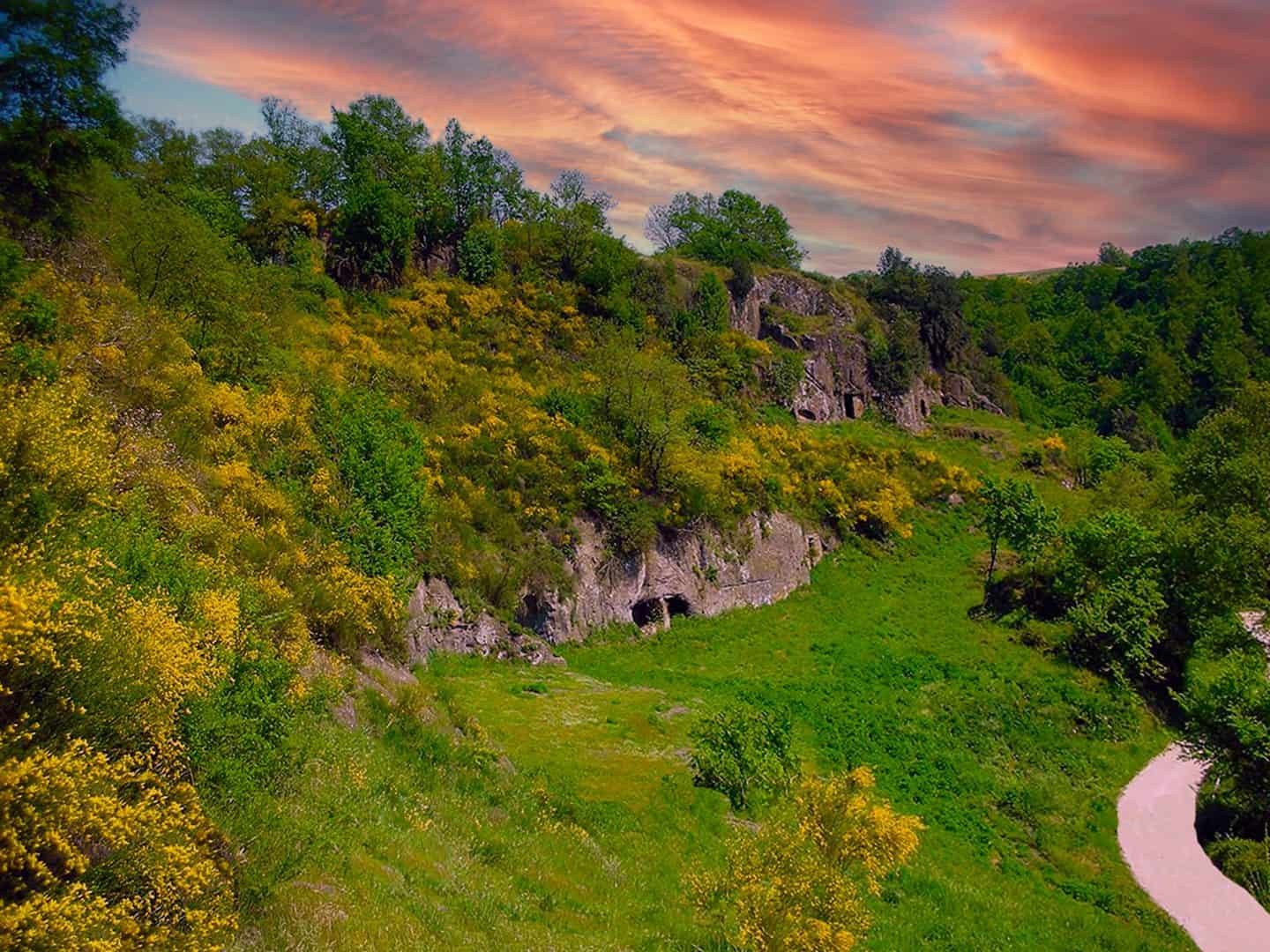
Below the town, in the gorge of the Rio Palanza, you go down into another world. Palazzolo, or Castrum Palazoli, is defined by the archaeologists of the Università della Tuscia who studied it (the team of Elisabetta De Minicis, with Giancarlo Pastura) as one of the sites with the longest continuity of life in the Tuscia: a Faliscan rock settlement, the Roman kilns of terra sigillata, an early medieval Christian necropolis with tombs cut into the rock, and above it all a medieval castle later abandoned. The route that starts from the town takes in a cave and a waterfall, the necropolis, the Grotta delle Monache, the site called i Morticelli, the kilns and the so-called Cella di Santa Rosa, a rock hermitage. It's a historical-archaeological and nature itinerary together, of a few kilometers, on an unequipped path: real shoes, water, and care after rain, because wet tuff is insidiously slippery. The guided visits organized by the castle and by local associations often include it as an afternoon trek, and it's the best way to understand what you are looking at, because without a guide the kilns look like holes in the rock. The finds from Palazzolo are displayed in the Ceramics Museum in town.
The ceramics of Vasanello (VT): 2,000 years of clay
The third identity-defining element of Vasanello is not a monument but a craft, and it has to be told with the same seriousness with which a castle is told. It's not a side activity grafted onto tourism. It's a rooted tradition, born from the availability of good-quality local clays and from the presence of fuel for the kilns, and documented without interruption from the Faliscan potters to the workshops of today.
Why they have always made pots in Vasanello
Vasanello makes ceramics because in Vasanello there is clay. It seems trivial, and yet it's the kind of elementary truth that contemporary tourism tends to forget, used as it is to thinking that craft traditions arise from a vague cultural inclination. It isn't so. Ceramic craft arises where three things come together: good clay, fuel for the kilns and water for the working. If one is missing, the tradition doesn't take root. This part of the Tuscia has all three: the clay deposits of the strip sloping toward the Tiber are the residue of ancient sedimentary environments, the woods of the Cimini and the hill thickets have given wood for centuries, the ditches and springs, starting with the Rio Palanza, have given the water.
Clays are not all the same, and this is the part almost nobody tells. Quality depends on grain size, plasticity, iron content, impurities, behavior in firing. A very ferrous clay fires brick red. One poor in iron tends toward beige or yellowish. A clay that is too fat shrinks excessively and cracks. One that is too lean can't be modeled. Ceramists, before being artists, were for centuries connoisseurs of the ground: they knew which quarry to take the body from for a certain job, how to blend different clays, how long to let them rest. It's no surprise that Professor Misciattelli, a chemist, devoted his factory precisely to a new body, white clay: research on the material is the true continuity of this craft.
From the Falisci to Ancharius, from the papal edict to the Orlandi
The Ceramics Museum tells the sequence in order. First the Falisci, with finds from the necropolises and places of worship of the territory: Faliscan ceramic production between the 4th and 3rd centuries BC reached very high levels, with red-figure vases now in museums around half the world. Then the Roman section, the richest, with the Italic terra sigillata from the kilns of Palazzolo and the name of the potter Ancharius, found on pieces in other parts of the Empire. Then the Renaissance, documented by archive papers on ceramic activity between Orte, Vasanello and Gallese, including a papal edict of the 16th century that regulated the craft: proof that there were enough workshops to require a rule. Then the 19th and 20th centuries, with the local ceramist families, the Orlandi first among them, the works of Giulio Francesconi and Mario Pieri, and the Ceramica Bassanello of the Misciattelli. There is no direct line of transmission between the Faliscan workshops and the modern kilns, it would be incorrect to claim it. There is a continuity of resource: the same earth, the same deposits, the same gesture of taking a body of clay and giving it a form. 2,300 years later, in this corner of the Tuscia, someone still turns a wheel.
The Ceramics Museum in Palazzo Celestini
The museum is housed in Palazzo Celestini, the town hall, on Via Roma, and is the right entrance door to understand the town: an hour among the display cases lines up 2,000 years and makes everything you see afterward legible, from the kilns of Palazzolo to the ovens of the factory in the castle. Opening times follow the availability of municipal staff and associations: ask the municipality before coming, and if you are organizing a group ask for a dedicated opening. In the same province the most famous tradition is that of Civita Castellana, which in the 20th century turned into an industrial district of sanitary ceramics of international importance. But before industry there were workshops, and the workshops were wherever there was clay. Vasanello is one of these places, and unlike Civita it has kept the scale of the workshop.
Terracotta, maiolica, slip: what to buy in Vasanello
Ceramics is not one thing, and knowing it changes the way you look at objects. There is terracotta, clay fired without a glassy coating, porous, the color that the iron in the body gives it. There is maiolica, terracotta covered with a white, opaque tin glaze, on which you paint and which is fired a second time: it's the technique of the great Italian tradition, that of Deruta, Faenza, Castelli, Orvieto. There is slip, a coating of diluted clay used to even out or decorate the surface before firing. Each has different times, costs and risks. A piece of hand-painted maiolica has behind it two firings and many hours of painting: if it costs little, either it's not what it seems, or someone is working at a loss. A practical note: always ask if the piece is suitable for food contact, if you intend to use it to serve food. Modern certified glazes are. Some traditional decorations or purely ornamental pieces may not be. It's not a rude question, it's a question from an informed person, and whoever works well answers gladly.
A curiosity about Vasanello (VT)
Every town has its curiosity, and usually it's just one. Vasanello has at least four, of different kinds: linguistic, about the name. Material, about the earth. Artistic, about what is inside the churches. Dynastic, about one of the most talked-about women of the Renaissance. I take them one by one, starting with the one that seems made up and is instead in the records.
The town that changed a letter in 1949
Until 1949 this town was officially called Bassanello. Not a nickname, not a dialect variant: the name in the documents of the Papal States, of the Kingdom of Italy and of the first years of the Republic. With that name it appears in the chronicles, in the maps, in the correspondence of the Borgia and the Farnese. Then, with a measure of 1949, the name became Vasanello. The reasons were administrative: post-unification Italy and then republican Italy intervened several times on place names to eliminate homonyms that created postal and registry confusion, and Bassano and Bassanello are names that recur. In the same province there is Bassano Romano. Eight kilometers away there is Bassano in Teverina. In the Veneto there is Bassano del Grappa, which had quite a bit of fame. A town called Bassanello, in the middle of this crowding, was condemned to receive mail meant for others. The solution was a different letter.
And here the interesting thing happens, the one that turns a bureaucratic act into a cultural fact. The new name sounds like a diminutive of vaso (vase), and the town had and has a centuries-old ceramic tradition. The name slotted over the craft as if someone had designed it, and it entered common sense, the signs, the way the town presents itself. But there is a second level, which almost nobody knows and which I tell in the next chapter: the V was not an invention of 1949. The curiosity has a Roman tail: in Rome's 15th municipio there still exist today a Via Bassanello, named in 1957, and a Via Vasanello, named in 1966. The same town, two streets, two names, nine years apart. The toponymy of the capital had not noticed the change, or had not wanted to give up the old name.
There is also a melancholy side. Anyone born in Vasanello before 1949 was born in Bassanello: same town, same house, different name. In family documents, on gravestones in the cemetery, in parish registers, the old name still appears. If you happen to read "Bassanello" on a dated inscription, it's not a mistake: it's the town as it was, before a letter of the alphabet transformed it.
A saint from Cologne beheaded at Bassanello
The second curiosity is hagiographic. The patron saint of Vasanello is not a Lazio saint but, according to tradition, a legionary born in Cologne in 280, of a noble and Christian family, enlisted at Trier in 292 in a legion made up almost entirely of Christians, sent to Rome in 294 in Diocletian's guard. Transferred to Bassanello, he preached and converted. Arrested, he was flogged and tortured with red-hot irons. Led to the temple of Mars to renounce his faith, with a prayer he made the structure collapse on the pagan priests. On the road to the execution he restored sight to a blind man. He was beheaded on May 5, 296 just outside the walls. None of these data is historical in the strict sense: it's a passio, a devotional account. But the finding of the bones in 1628, the recognition of 1630, the first procession of 1634, the silver bust of 1754, the wax statue of 1827 and the hymn composed in 1939 by don Tertulliano Maracci and performed for the first time on May 4 of that year by the band of Vallerano are all documented facts. The legend is old. The devotion that has kept it alive has four centuries of papers.
The Sistine sky and a country chapel in Vasanello
The third curiosity is artistic. The man who painted the fresco of the chapel of San Lanno in 1493, Piermatteo d'Amelia, is the same one who a dozen years earlier had painted the first vault of the Sistine Chapel: a blue sky strewn with golden stars, later covered by Michelangelo. Piermatteo was born in Amelia, half an hour from here across the Tiber, trained with Filippo Lippi in the cathedral of Spoleto and worked for a long time between southern Umbria and upper Lazio: Narni, Castiglione in Teverina, Orvieto. That a patron from Bassanello called him for a country chapel says two things: that the town had resources, and that the border between Lazio and Umbria, for a 15th-century painter, did not exist.
Giulia Farnese in Vasanello and the pope's letters
The fourth curiosity is dynastic and has the flavor of a novel. Giulia Farnese, "Giulia la Bella", wife of Orsino Orsini, lord of Bassanello, and mistress of Pope Alexander VI, lived in this castle. In 1494, while she was at Bassanello with her husband, the Borgia pope wrote her furious letters to make her return to Rome, going as far as threatening excommunication of her and Orsino. It's one of the best-known episodes of the Borgia private life, and it happened here, in these rooms with coffered ceilings. Orsino died in 1500 right at Bassanello. Their daughter Laura inherited the fief and brought it as dowry to the Della Rovere in 1505. Giulia moved in 1506 to Carbognano, which she governed until 1522, and died in Rome on March 23, 1524. The castle of Vasanello is, with Carbognano, the place that more than any other keeps the physical trace of this woman, one of the most discussed female figures of the Roman Renaissance.
Something nobody tells you about Vasanello (VT)
Here is the most interesting part, the one with the things guides don't write. Not because they are secrets, but because they belong to a different register: they are observations you make after returning to a place several times, and that don't go into descriptive entries because they are not information but judgments. One, however, is information, and we start with that.
The V of Vasanello is a thousand years old
Everyone says that in 1949 Bassanello became Vasanello to avoid postal confusion, and that the new name, with its assonance with the vase, was a gift of chance. Almost nobody says that the V was already there in the Middle Ages. The inscription of 1038 set into the wall in San Salvatore names the town "in Castro Vassanello": with the V. Bassanello, with the B, is the form that took hold in the following centuries, probably because of the oscillation between the two consonants typical of the dialects of central Italy, and which the papal chanceries and then the unified state fixed. The measure of 1949, therefore, did not invent a name: it fished one out from nine centuries earlier. That the postwar officials knew it, or simply changed a letter to distinguish the town from Bassano, is not documented. But whoever tells you that the name "comes from vases" is telling the least interesting part of the story. The etymology of the original name is to be sought elsewhere, in all probability in a personal name or in the morphology of the place, and the resemblance to "vaso" remains a coincidence. Coincidences, when they fall in the right place, become true all the same.
The ceramics of Vasanello are not a souvenir, they are a fragile economy
When you read about a town with a centuries-old ceramic tradition, the image that forms is one of serene continuity, of workshops handed down from father to son in an uninterrupted flow. The reality is different: handmade Italian ceramics is a sector in structural difficulty, and Vasanello is no exception. Production by hand has costs that industrial production doesn't have: time, firing losses, energy for the kilns, space for drying. A hand-decorated piece thrown on the wheel takes hours. A mass-printed piece takes seconds. On the global market, where low-cost decorative ceramics arrives from Asian production at prices impossible to compete with, the artisan has only one space, quality and uniqueness, and occupying it requires commercial skills that don't always accompany technical mastery. The closing of the Misciattelli factory in 1978, when the market wanted series, is the local version of this story.
Then there is generational turnover, the most serious problem. Learning to work ceramics at a professional level takes years, not months: you master the wheel only through repetition, and knowledge of glazes and firings is built on mistakes. A young person has to accept a long period of poorly paid training in a context where the prospect of income is uncertain. Many don't, understandably. And every workshop that closes without having trained someone takes away a body of technical solutions that is written down nowhere. When you buy a piece in Vasanello you are not making a tourist purchase: you are taking part, to a minimal but real degree, in the survival of a supply chain. Is that rhetorical? Maybe. Is it true? Absolutely.
Vasanello is not a postcard town, and that is its greatest merit
Vasanello is not beautiful in the way we have learned to consider Italian towns beautiful. It must be said frankly, because anyone arriving with the wrong expectation is disappointed and the fault is not the town's. In the last 20 years an aesthetic of the village has consolidated that we all recognize: perfectly paved alleys, geraniums at the windows, wrought-iron signs, no visible electric cables, well-kept shops, an atmosphere of total preservation. It's a real aesthetic and in some cases an authentic one, but it is also the product of major investments and precise choices, often accompanied by the replacement of the resident population with second homes and accommodation businesses. Vasanello is not like that. There are electric cables on the facades. There are aluminum window frames next to 16th-century portals. There are buildings from the 1970s that intrude on the historic fabric, closed shutters, peeling plaster. It's a real town, where real people live who have renovated according to their means and not according to a color plan.
Weakness or strength? It depends on what you are looking for. If you are looking for the postcard, there are places that deliver it better, Calcata and Sutri to stay in the province. If you are looking to understand how a town of inland Italy really lives in the 21st century, Vasanello shows it unfiltered. And there is a practical advantage: in postcard towns the prices are postcard-town prices, the bars are set up for the tourist and conversation with a resident is hard because there are few residents. In Vasanello a coffee costs what it costs in a town, and the person sitting next to you at the bar lives there. This is an area that has experienced significant depopulation and that lives on a mixed economy: agriculture, small manufacturing (the 247 active businesses counted in 2015 are a respectable number for 4,000 inhabitants), commuting to Rome and Viterbo, a bit of tourism. Tourism, here, is still an addition, not the base. Whoever arrives is welcomed as a guest and not processed as a customer, and the difference is felt in every interaction. When tourism becomes the base of the economy that quality is lost, always. Enjoying it while it lasts is the least you can do.
The border with Umbria is an advantage almost nobody uses
Vasanello is only a few kilometers from the Umbrian border, and this position, for anyone organizing an itinerary, is an opportunity that almost everyone wastes. The reason is banal: people travel by region. They decide "I'm doing a weekend in Umbria" or "I'm doing a tour of the Tuscia", and administrative borders become mental borders. But the Tiber valley, in this stretch, is a coherent geographic unit that the regions cut in two. Amelia, Narni, Otricoli on one side. Orte, Vasanello, Bassano in Teverina, Graffignano on the other. The distances are ridiculous, the roads are good, and nobody does it. Piermatteo d'Amelia did it in the 15th century, as we have seen.
Anyone who does it discovers that crossing the river changes the building material. In the Tuscia, tuff and peperino dominate, gray and ocher volcanic stones, soft, easy to work, which give the facades a porous and warm look. In the Umbria of Amelia and Narni, limestone and pinkish stone appear, harder, lighter, with an entirely different texture. The agrarian landscape is similar, the vegetation is the same, but the towns seem made of different substances, because they are. It's a lesson in geology applied to architecture that you learn in 20 minutes by car. And the culinary border too is an illusion: fresh pastas of Umbrian tradition next to Lazio preparations, pork central on both sides, oil the protagonist everywhere. The differences are nuances, and understanding them is one of the subtle pleasures of traveling in a border area.
The truth about timing: Vasanello is a stop, not a destination
The most uncomfortable thing, and I say it because readers prefer honesty to enthusiasm: Vasanello, by itself, does not justify a trip. Anyone who lives in Milan and plans five days in central Italy doesn't need to put it on the list. Anyone who lives in Rome and has a free Sunday will find in Vasanello, within an itinerary, an excellent choice. This distinction seems obvious but almost no guide makes it, because the prevailing editorial model pushes to present every place as unmissable, with an inflation of superlatives that makes it impossible to understand what is really worth it. There are places worth a trip, places worth a detour and places worth a stop. Vasanello is worth a detour within a well-built route, and in that position it gives a great deal. With Orte and Bassano in Teverina it is a perfect day. With a climb toward Vallerano and Soriano nel Cimino it becomes a weekend. With Viterbo and Vitorchiano it becomes a serious trip into the Tuscia. By itself it remains an interesting town seen in two hours, three if the castle is open.
The time the town needs, not you
What remains is the most elusive observation. Towns like Vasanello have a time of their own, and the visitor brings a different time, that of the organized day, of stops, of the planned return. These two times almost never coincide, and when the visitor imposes theirs the town doesn't open up. The shop that opens at half past nine instead of nine is not disorganization, it's the rhythm of a business whose owner has other things to do. The workshop closed in the early afternoon is not laziness, it's the break that still exists in much of inland Italy. The fact that nobody stops you to sell you something is not coldness, it's the exact opposite of what happens in a tourist place. Anyone who gets irritated by these things is asking a town of 4,000 inhabitants to behave like a shopping mall, and that is not reasonable. Anyone who accepts the time of the place discovers that a door opens: the woman who explains where to find the key to the chapel, the ceramist who shows a piece just out of the kiln, the conversation at the bar that starts with the weather and ends with the story of what the town was like 40 years ago.

The advice I give you for visiting Vasanello (VT)
Here the story gives way to suggestions, because the job of someone who writes about travel is not only to inform but to take responsibility for an opinion. And mine on Vasanello is clear-cut: don't come for Vasanello alone. Not in the sense of company, but in the sense that the town can't bear the weight of an outing built entirely on it. It gives its best inside an itinerary, like a note inside a chord. It has an important castle, two Romanesque churches with medieval frescoes, a pleasant historic center, an archaeological site in the gorge and a living craft tradition: solid elements. But anyone who drives an hour and a quarter from Rome for two hours of visiting goes home with the feeling of having covered more road than experience. The solution is not to take Vasanello out of the itinerary: it's to build the right itinerary around Vasanello.
First piece of advice: the border loop
The recommended itinerary. You leave Rome early, exit at Orte and start right from Orte, the most spectacular town of the group from the scenic point of view: a settlement built on an isolated tuff rock, with a dug-out underground that is among the most incredible things in Lazio. Two hours in Orte, in the morning, when the light hits the rock from the side. Then the provincial road and in a quarter of an hour Vasanello, to which you devote the central time of the day: the castle if it's an opening day, the two churches, the center, a stop in a workshop. In the afternoon you go up toward Bassano in Teverina, tiny, with a bell tower detached from the church that is a fascinating one-off, and you close with the light of sunset over the valley. Three towns within a radius of 15 kilometers, three atmospheres, not a kilometer wasted. If the day is the last weekend of the month, reverse it: castle in the morning at 10:30, Orte in the afternoon.
Second piece of advice: the long variant over the Cimini
For those with two days, you sleep in the area and on the second day aim for Vitorchiano, perched above a deep gorge, then Soriano nel Cimino with the Orsini castle and the beech forest, and finish in Viterbo, which deserves half a day just for the medieval San Pellegrino quarter. Anyone who prefers the Tiber side swaps Soriano for Bomarzo and its Park of Monsters, half an hour away. Two days like this are worth any weekend out of town and cost a fraction of much more advertised destinations. Anyone who wants the organized day, with guide and transfers, can ask those who design private tailor-made experiences for small groups from Rome, where the southern Tuscia is one of the most underrated and least crowded countrysides.
Third piece of advice: buy the ceramics
Stop in a workshop and buy, plain and simple. The ceramic tradition of Vasanello survives because someone keeps buying the pieces. It's not the rhetoric of supporting craft: it's arithmetic. A workshop that produces and doesn't sell closes, and when it closes a knowledge is lost that no course can reconstruct, because that knowledge lives in the hands and is passed on by watching. Even a bowl: it costs less than a dinner and lasts 20 years. And when you go in, ask. How the body is prepared, how long a piece takes, at what temperature it is fired, what happens when a firing goes wrong. People who work with their hands, if they sense a genuine interest, gladly tell. In craft workshops the afternoons pass without your noticing, and you come out every time knowing something that isn't written anywhere.
Fourth piece of advice: walk all the way around the castle
Most visitors stop at the main front, take the photo and leave. Wrong. The perimeter of the Castello Orsini should be walked in full, because every side tells a different building phase and because the relationship with the town changes radically from one point to another. It's 20 minutes of walking and it changes the perception of the monument. Do it even if you have the guided visit booked: inside you see the ceilings, outside you understand the fortress.
Fifth piece of advice: adapt your schedule to the season
It's a general rule for the whole Tuscia but here it counts double. In summer arrive early, by half past nine, wander until half past noon, stop for lunch and start again around half past five. The middle hours of a July day in this area are inhospitable, and walking around a historic center at 40 degrees is not tourism, it's endurance. In spring and autumn the whole day is good, and the late afternoon gives, over the Tiber valley, a light that is worth the detour on its own.
Sixth piece of advice: eat in town, not on the motorway
It seems obvious and yet it's the thing most often gotten wrong. Many do the loop and then leave, stopping at a service area on the A1. It's a waste. The cooking of this strip of the Tuscia is solid and well made: hand-pulled fresh pastas, slow-cooked meat sauces, legumes, seasonal vegetables, local cheeses, extra virgin olive oil of a serious level because the olive groves are everywhere, and the gnocco cò la rattacacio, the town's dish. I don't give addresses, because businesses change and I don't want to write something that in a year will be false: go into a bar in the center and ask where to eat well. They'll send you to the right place.
Seventh piece of advice: find out about opening times beforehand
It's the point where many are disappointed, and the disappointment is almost always avoidable. The castle opens the last weekend of the month and by reservation, the churches follow parish hours, the chapel of San Lanno opens on request, the museum depends on the municipality, the workshops keep workshop hours and in small towns the afternoon closing is still a reality. On Sundays or holidays, check. A phone call to the municipality or the castle solves 90 percent of the problems.
Eighth piece of advice: real shoes, and slow down
The historic center has uneven paving, slopes, steps. Palazzolo has a path in the gorge. A pair of closed shoes with a decent sole changes the experience, especially if it rains. And then the hardest advice to follow: slow down. Vasanello has nothing to offer to those who run. There are no lines, tickets to win, viewpoints to reach before the others. There is a town living its normal day that lets in those who move at its rhythm. Sit on a bench for 10 minutes doing nothing. Watch who passes. Listen. It's the hardest thing to do on a trip and the most rewarding.
Another well-known fact, yet rarely cited
That Via Amerina passed through here everyone says. That for two centuries it was the only road holding Rome together with the rest of Byzantine Italy, and that Vasanello stood on that line like a frontier post, is rarely read. It's worth stopping.
The Byzantine corridor and the frontier of Vasanello
When in 568 the Lombards came down into Italy and in the following decades occupied Spoleto and the Umbrian valley, Via Flaminia, which from Rome went up the Tiber and crossed the Apennines toward Rimini and Ravenna, was cut. The Eastern Empire, which governed Italy from Ravenna through the exarch, remained connected to Rome by a single cord: Via Amerina, which from Nepi climbed through Falerii Novi, Orte and Amelia to Todi and Perugia, and from there bent toward the Adriatic coast. This is the so-called Byzantine corridor, a strip a few dozen kilometers wide, with the Lombards of Tuscia to the west and those of Spoleto to the east. Vasanello was inside that strip, a step from the Tiber that marked the limit. The castles, parish churches and fortified villages that dot this strip were born to guard the road and to serve those who traveled it: armies, officials, bishops, merchants and, in growing numbers, pilgrims headed to Rome from northern Europe. Santa Maria Assunta, with its portico and its position right by the route, belongs to this logic. Anyone who visits Orte and then Vasanello walks on a geography that is 1,500 years old and that decided, much more than the feudal lords, where the towns would rise. The Biodistretto della Via Amerina e delle Forre, which brings together the municipalities of the area, is working today to bring this road back into travelers' minds, and it's a cultural operation I approve without reservation: it puts Vasanello back where it has always been, on a road, not in a corner.
The walls of Vasanello torn down in 1885 and the bell towers that remained
The second little-cited fact is 20th-century, or nearly so. Vasanello had mighty walls, those that in the 14th century allowed it to negotiate as an equal with Viterbo, and lost them in 1885, when they were largely demolished, as in so many Italian towns of the 19th century that saw in the walls an obstacle to growth and a ready quarry. The two bell towers remain, that of Santa Maria Assunta, which was incorporated into the defenses and raised with mullioned windows later walled up, and that of San Salvatore, which rises 28 meters. Looking at them knowing that they were watchtowers as well as bell towers changes the reading of the town: Vasanello was a castrum, a fortified settlement, and the churches were part of it.
The right photo to take in Vasanello (VT)
There is a photograph that everyone takes in Vasanello, and it's the wrong one: the castle shot head-on, from the square, with the sun in your face, holding the phone horizontally and trying to fit everything in. The result is a flat image, with the masonry burned out by the light and no depth. The right photograph requires two things that cost nothing: choosing the hour and choosing the spot.
The hour: raking light on the walls of the Castello Orsini of Vasanello
The castle's masonry is a woven surface: tuff, brick, old plaster, patches from different eras. A surface like that needs raking light to reveal itself. With the sun high everything flattens and the wall becomes a gray blotch. With the sun low, in the first hour after dawn or the last before sunset, the same wall becomes a relief: every joint casts its shadow, every irregularity emerges, the color goes from gray to a warm ocher that is the true color of this architecture. The late afternoon is the best moment, and with it the 20 minutes after sunset, the blue hour, when the sky keeps an intense blue luminosity and the first lights come on. With a tripod, or even just a low wall to rest the phone on, it's the moment to use.
The spot: the castle inside the town
Don't photograph the castle head-on: look for an angle that puts together two elements, the bulk of the fortress and a piece of the town. An alley that comes out on the flank, an arch framing a tower, a row of houses leading the eye toward the walls. The castle alone is an object. The castle inside the town is a story, that of the relationship between the fortress and the village that grew up against it, which is the theme of Vasanello. To find these spots you only need to walk: go around the perimeter and every time you turn into a side alley, look back. The best framings are almost always found looking back, not ahead. It's a rule that holds in all Italian historic centers and that almost nobody applies.
The second photo: the bell tower of San Salvatore from below
The bell tower of San Salvatore, with its bands of white travertine and red brick and its three-light windows on peperino columns, is the most photogenic subject in town when the sun strikes it from the side: the two-tone effect separates sharply and the six floors can be counted one by one. From below, with the phone held vertically, without trying to straighten the lines.
The third photo: the ceramics
Not a shelf of souvenirs, but a detail: the hands of someone working at the wheel, a row of raw pieces drying, the surface of a cracked glaze, the color of a clay body before firing. These are images that tell a craft instead of documenting an object, and they have a force that a vase on a shelf will never have. You ask permission first, always, and in most cases the answer is a yes with a smile, because someone who works well is pleased when somebody notices. In the Misciattelli factory, during the visit, the kilns and the work tables are a subject of industrial archaeology that deserves attention.
The fourth photo: the landscape toward the Tiber
Vasanello occupies a plateau that looks over the Tiber valley, and there are points along the edge of the town and on the roads leading out where the view opens: the countryside sloping away, the fields, the patches of woods, and on clear days the Umbrian hills in the background. It's not a spectacular view in the strict sense, there are no peaks or precipices. It has a quality I appreciate more: the calm of an ancient agrarian landscape, drawn by centuries of work. The best moment is first thing in the morning, when mist rises from the depressions and the valley fills with horizontal layers of light. It happens above all in autumn and on damp spring days.
The fifth photo: inside the churches, without flash
Santa Maria Assunta and San Salvatore are active places of worship. If there are people praying or a service is going on, you lower the phone and that's it. If the church is empty and nobody has set restrictions, the frescoes of the apses and the capitals deserve a shot, with a few precautions: the interior light is scarce and warm, so it's better to rest the phone on something stable instead of raising the sensitivity, and it's better to get close to details instead of looking for the overall view. A capital with its fantastic animal, a fragment of 12th-century fresco, the profile of a column against the half-light: they are more beautiful and truer images than a blurry panorama. Never flash: it flattens everything, produces reflections and on ancient surfaces it's often forbidden for conservation reasons. If there is no light, you rest the phone and shoot with the timer.
Post-production and good manners
The Tuscia should be treated lightly. The colors of this territory are naturally warm and desaturated: the tuff is ocher, the stone is gray, the green of the countryside is dusty. Heavily saturated edits, with pushed contrast and crushed shadows, produce images that look like another place. Raise the contrast slightly, recover the shadows, and stop. And then the attitude: in small towns, photographing means entering someone's daily life. The windows you would like to frame are windows of lived-in houses, the people sitting in front of the door are not extras. The rule is simple: you ask. A nod, a smile, a word. Often what begins as a request for permission ends in a conversation, and it's the conversation, in the end, that you really take home from a place like Vasanello.

Some important events that happened here in history
Vasanello has not hosted pitched battles or councils, but its chronology is denser than the size of the town suggests. I put it in order, distinguishing what is documented from what is tradition.
241 BC: the end of the Falisci
Rome destroys Falerii and deports the inhabitants to the new city on the plain. The Faliscan territory, Vasanello included, enters definitively into the Roman orbit. In the following centuries the kilns of Palazzolo produce terra sigillata that travels across the Empire with the mark of Ancharius. Documented by archaeology.
May 5, 296: the martyrdom of San Lanno
According to the passio, the legionary Lanno is beheaded outside the walls of Bassanello after making the temple of Mars collapse. It is tradition, not history: but it is the date around which the town has organized its identity for four centuries, and the chapel on the road to Orte stands on the spot that memory assigned to it.
1038: the first document with the name
The archpriest Domenico has a marble inscription carved recalling "in Castro Vassanello": the documentary birth of the town, with the V. In the same century Santa Maria Assunta and San Salvatore are built. Documented.
1212 and 1303: Orte and Viterbo
Innocent III entrusts the administration of the fief to the podestà of Orte. 90 years later, in 1303, the commune of Bassanello signs with Viterbo a mutual peace agreement: a small town negotiating with the most powerful city of the Tuscia. Documented.
1278-1285: the Orsini arrive
The Church cedes the fief to Orso Orsini, who starts the castle. One source has him stay only four years before the fief returns to the Holy See, another fixes the founding at 1285. Orsini rule consolidates in the 15th century with Ludovico Orsini and Adriana de Mila. Documented in the dates with oscillations.
1490-1494: Giulia Farnese at Bassanello
On May 9, 1490 Orsino Orsini marries in Rome Giulia Farnese, aged 15. The couple settles in the fief. In 1494 Alexander VI summons Giulia back to Rome with letters threatening excommunication: the little castle of Bassanello enters European chronicle. In 1500 Orsino dies here. In 1505 their daughter Laura brings the fief as dowry to Niccolò Della Rovere. Documented.
1493: Piermatteo d'Amelia paints San Lanno
The painter of the starry sky of the Sistine signs the fresco of the patron saint's chapel. Documented by the date on the work.
1534 and 1787: Colonna and Barberini
The fief passes to the Colonna in the same year in which Giulia's brother becomes Pope Paul III, and in 1787 to the Barberini-Colonna di Sciarra, who build the castle stables and who in 1754, by the hand of Giulio Cesare Colonna-Barberini, had already donated the silver bust of San Lanno. Documented.
1628-1634: the finding of the relics
After a hole is opened in a wall of the castle, the bones and brick of the patron saint are found. On March 23, 1630 the recognition, on April 6 the transfer to the crypt, in 1634 the first procession with the porters. The feast is born that is still celebrated every May 5, with the Gran Festone held every 10 years. Documented.
1885: the walls fall
The walls of the castrum are largely demolished. The bell towers remain. Documented.
1907-1978: the Misciattelli and the Ceramica Bassanello
The marquis Luigi Misciattelli buys and restores the castle. The family installs there in the 20th century the artistic ceramics factory that calls Guttuso, Spadini, Mazzacurati and Del Drago to work and exports to the United States and Japan, until its closing in 1978. Documented, with discordant start dates among the sources.
1939: the hymn of San Lanno
Don Tertulliano Maracci composes the patron saint's hymn, performed for the first time on May 4 by the Vallerano town band. Documented.
1941: the cippus of San Salvatore re-emerges
During the restorations of the church it is discovered that the altar rests on a marble cippus of the 7th-8th century. Documented.
1949: Bassanello becomes Vasanello
A measure changes the official name of the municipality. The V of the inscription of 1038 returns after nine centuries. Documented.
2018: the castle reopens to the public
On March 24 and 25, 2018 the Castello Orsini inaugurates the regular openings of the last weekend of the month, with a visit to the rooms of Giulia Farnese, to the Misciattelli collection and a trek to Palazzolo. Since then the formula has consolidated and is the one in force. Documented.
Who passed through Vasanello (VT)
The question "who passed through here" is among the most interesting you can ask a town, and the answer, in the case of Vasanello, is not the one you expect. There are no plaques to poets on holiday or to English travelers of the Grand Tour, who went from Rome to Tivoli and Terracina, certainly not up the Tiber valley. Those who passed through here did so for concrete reasons, and precisely for this the story is more interesting.
The Falisci and the potter Ancharius
First of all, the Falisci: their civilization, which spoke an Italic language related to Latin and had a material culture tied to the Etruscan world, produced exceptional ceramics and ended in 241 BC. Then the Roman potters of Palazzolo, and among them a name, Ancharius, who signed the terra sigillata coming out of these kilns and whom archaeologists have found in other provinces of the Empire. He is the first inhabitant of Vasanello whose name we know, and he made pots. There is no better way to begin the list.
San Lanno and the pilgrims of Via Amerina
The legionary from Cologne of tradition, and with him, in the centuries of the Byzantine corridor, armies, ambassadors, bishops, merchants and pilgrims headed to Rome from northern Europe. Not all of them passed exactly through Bassanello, but all of them passed through this strip of territory, and the parish churches like Santa Maria Assunta were born for them.
Orso Orsini and the lords of the castle
Orso Orsini, who at the end of the 13th century started the fortress. Ludovico Orsini and Adriana de Mila, niece of Callixtus III and cousin of Cardinal Rodrigo Borgia, who in the 15th century made the castle a residence. Their son Orsino, "monoculus", who died here in 1500. Then Niccolò Della Rovere, the Colonna, the Barberini-Colonna di Sciarra with Giulio Cesare, donor of the silver bust in 1754. In the rooms of the castle, in different eras, administrators, castellans and guests passing between Rome and Umbria moved about. A castle of this rank was a node in a network.
Giulia Farnese
The most famous. A bride at 15 in 1490, the pope's mistress, mother of Laura, lady of Bassanello in the years of Alexander VI's furious letters, then of Carbognano from 1506 to 1522, died in Rome on March 23, 1524. The painted ceilings of the noble apartment are her material legacy, and the castle of Vasanello is the place where you can imagine her on the firmest grounds.
Piermatteo d'Amelia and the marble workers of the bell tower
The Umbrian painter, a pupil of Filippo Lippi and author of the first sky of the Sistine, in 1493 for the chapel of San Lanno. And before him, in the 13th century, the workers of Cosmatesque culture who built the bell tower of San Salvatore in travertine and brick: highly specialized artisans, organized in family workshops, who moved where there was work and whose signatures appear in dozens of churches in Lazio. Nearly anonymous figures for the great history of art, but their passage is documented by the object itself.
Vincenzo Belli, Gioacchino Mortula, don Tertulliano Maracci
The Roman silversmith who in 1754 chased the reliquary bust. The wax modeler who in 1827 modeled the patron saint's statue with the bones inside. The priest and musician who in 1939 wrote the hymn. Three men who gave the saint the form in which the town still sees him.
The Misciattelli and the artists of the Ceramica Bassanello
The marquis Luigi, who bought the castle in 1907. Professor Paolo, a chemist, who invented the white clay and made the factory an avant-garde center. The artists who worked there, Renato Guttuso above all. Elena, the archaeologist who reconstructed the medieval garden. Natalia, who today opens the doors. A family that in a little over a century has turned a fortress into a place of cultural production, and continues to do so.
The archaeologists of the Università della Tuscia
Elisabetta De Minicis and Giancarlo Pastura, who excavated and read Palazzolo, giving back to the town the awareness of 2,000 years of continuity. They passed through with trowels and notebooks, and left more than many lords.
The emigrants and the ceramists
Between the end of the 19th century and the middle of the 20th, the rural Tuscia emptied its towns: America, Argentina, then Belgium, Germany, Switzerland, then Rome. Every family in Vasanello has someone who left. Some came back, many did not, some come back in the summer with children and grandchildren who speak another language. This movement left no monuments but shaped the town more than any feudal lord. And then the ceramists, who passed through and above all stayed: the Orlandi, Giulio Francesconi, Mario Pieri, and the generations of artisans who learned the craft from a father or a master. Every time you walk into a workshop and see someone at the wheel, you see the last visible link of a chain 2,000 years long. If I had to answer the question in the title in one line I would say this: through Vasanello have passed the Falisci, the Byzantines, the Orsini, the Borgia by proxy, the Farnese, the Della Rovere, the Colonna, the Barberini, a painter of the Sistine, the Roman marble workers, the pilgrims, the peasants, the emigrants and the ceramists. Towns that hosted the great names remember them with plaques. Vasanello remembers all the others with its walls, its alleys, its kilns and the things people keep making with their hands.
Festivals and events in Vasanello (VT) through the year
The festival of San Lanno, May 4 to 7
It's the appointment that defines the town. May 5 recalls the martyrdom, the 6th and 7th the finding of the relics. The program includes liturgical celebrations, the procession with the silver bust of 1754, the band, the festive lights, the market and evenings in the square. Every 10 years the Gran Festone is celebrated: the urn with the saint's wax statue comes out of the crypt and is carried in procession through the streets of the town by a team of porters, according to a custom that goes back to the first transport of 1634. It's the moment when Vasanello most resembles itself, with the emigrants coming back and the alleys full. Anyone who wants to see the town in festival should choose these days. Anyone who wants to see it in silence should avoid them.
The Calendimaggio at the castle of Vasanello
In the second half of May the Castello Orsini hosts the Calendimaggio festival, which reenacts medieval spring celebrations with the garden in full bloom. It's the most suitable occasion to see the castle and its garden together at the best moment of the year, and for those coming with children it's the most successful formula.
The Ortaccio Jazz Festival in Vasanello
In the first days of August the town hosts a jazz festival that is considered among the most important in the Tuscia. Playing jazz in a village of 4,000 inhabitants on a summer night makes precise sense: the small squares work as natural concert halls, and the audience is mixed, residents and enthusiasts who have come from Rome. The program is published every year on the channels of the municipality and the associations.
The gnocco cò la rattacacio festival
Between July and August the town's dish is celebrated, gnocco cò la rattacacio, made with flour and eggs and dressed with the grated cheese that gives it its dialect name. It's a real village festival, with long tables and generous portions, and it's the cheapest and most cheerful way to have dinner in Vasanello in summer.
The autumn fair
The municipality organizes periodic markets and fairs. For the autumn a fair-market is announced for October 25. These are days when the center fills with stalls and when it's best to arrive early for parking.
What to eat in Vasanello (VT) and in the Tuscia of the Tiber
The cooking of this strip is a transition between Lazio and Umbria and gives no discounts. The identity dish is the gnocco cò la rattacacio, a pasta of flour and eggs with grated cheese, to which the town devotes a festival. Around it there are hand-pulled fresh pastas, slow-cooked meat sauces, legumes, seasonal vegetables, the pecorino cheeses of the area, pork in all its forms, and extra virgin olive oil, which here is of a serious level because olive groves cover every hill between the town and the Tiber. In autumn come the chestnuts of the Cimini, which have their capital in Vallerano and Soriano, mushrooms and new oil. I don't name places because they change and because the rule of the bar in the center, where you ask for advice, works better than any list. A practical warning: in small towns the kitchen closes early, both at lunch and at dinner. Anyone arriving at half past two risks finding the stoves off.
What's around Vasanello (VT)
The value of Vasanello depends on the itinerary, and the itinerary depends on what's around. There's a lot. Orte, 10 kilometers away, with the rock and the dug-out underground, is the first choice. Bassano in Teverina, at eight, is the second, with its detached bell tower. Civita Castellana, about 20 kilometers away, keeps the museum of the Falisci in the Forte Sangallo and the cathedral with the Cosmatesque portico: it's the natural complement for anyone who got passionate about ancient ceramics at the Vasanello museum. Toward the Cimini, Vallerano and Soriano nel Cimino with the beech forest. Vitorchiano on its gorge. Chia with its tower. The Park of Monsters of Bomarzo and, for walkers, Monte Casoli. Toward the south, Calcata and Sutri with the amphitheater cut into the tuff. Toward the west Caprarola with Palazzo Farnese, which closes the circle with Giulia: it was her brother's grandson who built it. Beyond the Tiber, Amelia, Narni, Otricoli and, a bit further up, Orvieto. Anyone who thinks in English will find on ItalyPlanner the guide to Civita Castellana and the Falisci and the overview of the best small towns in Lazio, useful for building the loop.
Vasanello (VT) with children
With children Vasanello works better than you might expect, provided you pick the right things. The castle with a guided visit is a fairy-tale experience: four towers, a well, a garden with plants "from before Christopher Columbus" (a question kids like: "what's missing in this vegetable garden?") and a factory with kilns. The crypt of San Lanno with the wax statue is striking, and for some children a bit too much: consider the age. The ceramics museum is short and concrete, and if a workshop lets them touch the clay the day is made. Palazzolo with the waterfall and the caves is an adventure for kids from eight years up who like walking. Below that age the path in the gorge is tiring. The gnocco festival and the Calendimaggio are the events best suited to families. Strollers: only small ones, and with patience.
Quick questions about Vasanello (VT)
Where is Vasanello?
In the province of Viterbo, in the southern Tuscia, on a tuff plateau that looks over the Tiber valley, 10 kilometers from Orte and a few kilometers from the border with Umbria.
How far is Vasanello from Rome?
About 70 kilometers on the A1 motorway with the exit at Orte: an hour and 10 minutes of driving in normal conditions, an hour and a quarter on traffic days.
How do you get to Vasanello without a car?
Regional FL1 train from Roma Tiburtina or Ostiense to Orte (50-70 minutes), then a Cotral bus on the lines to Soriano nel Cimino and Vallerano, with commuter schedules and almost none on Sunday. Check the Cotral website the day before.
How much does it cost to visit the Castello Orsini of Vasanello?
Full ticket 10 euros, students 5 euros, groups over 25 people 8 euros. The visit is guided and lasts about two hours.
When is the Castello Orsini of Vasanello open?
The last Saturday and Sunday of every month from March to November, with morning and afternoon shifts, and for groups of at least 15 people by reservation all year. It's best to call first.
Do you need to book for the castle of Vasanello?
For groups yes, always. For the monthly openings it's recommended: book by phone at 328 6552632 or 0763 837473, or by writing to castellorsinivasanello@gmail.com.
Do you pay to enter the churches of Vasanello?
No. Santa Maria Assunta and San Salvatore are parish churches open during service hours. The chapel of San Lanno and the Madonna delle Grazie open on request or on feast days.
Does the Ceramics Museum of Vasanello have fixed hours?
No: it is housed in the town hall, Palazzo Celestini at Via Roma 30, and openings are requested from the municipality at 0761 40891. For groups a dedicated opening can be requested.
How much time do you need to visit Vasanello?
Two or three hours for the center and the churches. Half a day with the castle. A full day with Palazzolo or combined with Orte and Bassano in Teverina.
Is Vasanello suitable for children?
Yes, with the castle, the medieval garden and the ceramics factory as strong points. Palazzolo is for kids from eight years up.
Is Vasanello wheelchair accessible?
Partially. The main streets of the center are passable, the alleys of the old core and the historic rooms of the castle have steps and stairs. Anyone with specific needs should say so when booking.
Where do you park in Vasanello?
In the parking areas of the new part of town, next to the historic center, which is covered on foot. On feast days and fair days it's best to arrive early.
Can you take photos in the castle and the churches of Vasanello?
In the churches yes, without flash and with respect for services. In the castle the guide communicates the rules at the start of the visit.
Why was Vasanello called Bassanello?
Bassanello was the official name until 1949, when a measure changed it to Vasanello to avoid confusion with Bassano in Teverina, Bassano Romano and Bassano del Grappa. The inscription of 1038 in San Salvatore, however, already uses the form "Vassanello".
Who was San Lanno, the patron saint of Vasanello?
According to tradition a Roman legionary born in Cologne, martyred at Bassanello on May 5, 296. The relics were found in 1628 and are in the crypt of Santa Maria Assunta. The feast is May 4 to 7.
Did Giulia Farnese really live in Vasanello?
Yes. She married Orsino Orsini, lord of Bassanello, in 1490 and lived in the castle, where in 1494 the letters of Alexander VI reached her demanding her presence in Rome. Orsino died here in 1500.
What is Palazzolo in Vasanello?
An archaeological site in the gorge below the town: a Faliscan rock settlement, Roman kilns of terra sigillata, an early medieval necropolis and the remains of a medieval castle. It's reached on foot by an unequipped path.
What is the difference between Vasanello and Bassano in Teverina?
They are two different towns eight kilometers apart. Vasanello is bigger, has the castle and the ceramic tradition. Bassano in Teverina is tiny and has the bell tower detached from the church. They go well together.
What do you buy in Vasanello?
Ceramics from the local workshops, terracotta and maiolica, and extra virgin olive oil. For tableware ask if it is suitable for food contact.
What do you eat in Vasanello?
Gnocco cò la rattacacio, fresh pastas, meat sauces, pecorino, pork, oil, and in autumn the chestnuts of the Cimini.
What is the best time to visit Vasanello?
From mid-April to early June, with the festival of San Lanno and the castle garden in bloom. October for the colors and the products. Summer is hot in the middle hours, winter is quiet but the castle doesn't open.
Is Vasanello worth a trip on its own?
No, it's worth a detour within an itinerary in the Tuscia of the Tiber with Orte, Bassano in Teverina and the towns of the Cimini. In that position it gives a great deal.
The picture, in short, is this: Vasanello rewards those who arrive without hurry and without demands, and disappoints those who arrive with the list in hand. It has a castle where the most discussed woman of the Roman Renaissance lived, two Romanesque churches with frescoes from nine centuries ago, a painter of the Sistine in a country chapel, 2,000 years of kilns in the gorge and a craft that endures. It doesn't ask to be admired. It asks for a bit of attention, which in today's tourism is the rarest commodity. Give Vasanello more time than its size suggests: it gives it back.
Article written by the editorial team of TourLeaderPro, contact them for Private/Corporate/V.I.P. Tours and Experiences.
Planning a trip to Rome? The English guides to visiting the city are on ItalyPlanner.com.