Vitorchiano (VT)
In short. Vitorchiano is in the province of Viterbo, in the heart of the Tuscia, and is a little over an hour from Rome's Grande Raccordo Anulare.

Vitorchiano is in the province of Viterbo, in the heart of the Tuscia, and is a little over an hour from Rome's Grande Raccordo Anulare. By car you take Via Cassia to Viterbo and then the Orte-Viterbo expressway, exit Vitorchiano, or you get to Orte, continue on the Orte-Viterbo and exit at the town. If you travel by train, get off at the Viterbo Porta Romana station and take one of the Cotral buses that connect the provincial capital to the towns of the Cimini Mountains. The stop leaves you a few minutes' walk from the upper part of the town. The historic center is an open medieval village and you pay no ticket to walk through it. You leave the car in the parking areas just outside the walls, along the ring road or near Porta Romana, and you enter on foot, because the inner streets are narrow, uphill and largely pedestrian. There are no closing hours for the town. The individual churches, the Trappist nuns' monastery, the Centro Botanico Moutan in Pallone and the museums or civic spaces set up in the former convent of Sant'Agnese do have their own hours, which are best checked on their official channels before you leave, because they change with the seasons and with events. The peperino Moai, one of the reasons so many people come up here, is placed just outside the center, along the road that leads toward the countryside. You reach it on foot in a handful of minutes from the main square.
This guide is part of the pages dedicated to villages and towns that can be visited in a day from Rome. Vitorchiano is one of the most scenic in the whole Viterbo area, and deserves a slow visit. Below you'll find the town described setting by setting, its history of eight centuries of loyalty to Rome, the events that mark its year and the answers to the questions people really ask before arriving.
Where Vitorchiano (VT) Is and How to Get There
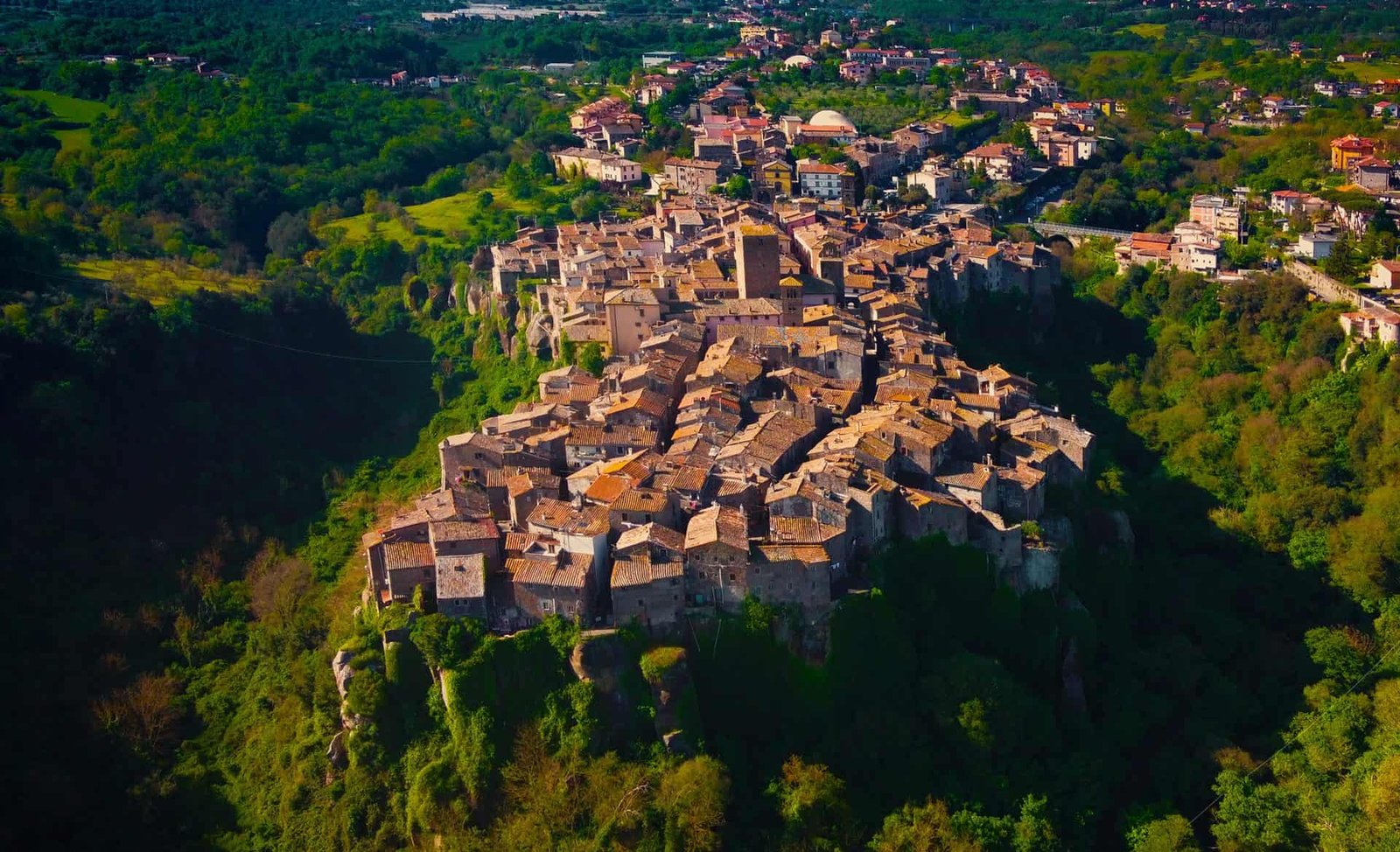
Vitorchiano rises at the foot of the Cimini Mountains, the volcanic group that closes the Viterbo basin to the south, a little under 10 kilometers from the provincial capital. The town occupies a spur of rock overlooking the Valle del Vezza, the watercourse that runs in the gorge at the base of the village. If you come from Rome you have two convenient roads: the first goes through Orte and continues on the Orte-Viterbo expressway, the second goes up the whole Via Cassia touching Sutri, Ronciglione and Viterbo before turning off toward the Cimini. In both cases the travel time from the Raccordo is around an hour and a quarter, traffic permitting.
By Train and Bus to Vitorchiano (VT)
If you prefer not to drive you can reach Viterbo by train, with the regional trains that leave from Roma Ostiense and Roma Trastevere toward the Tuscia, and from there take a suburban bus toward Vitorchiano. It's a trip that requires patience, because the provincial bus runs are not very frequent and it's best to check the updated schedule before setting out. The advantage is that you arrive close to the center without having to think about parking. For a comfortable day trip, however, the car remains the most practical choice: it lets you combine Vitorchiano with other villages in the area on the same day.
Where to Park in Vitorchiano (VT)
The old village is closed to traffic and has to be toured on foot. The parking areas are all outside the walls. The most used is the one in the upper part, near Piazza Roma and Porta Madonna della Neve, from which you go straight down into the medieval part. On the weekends of the big events, such as the Sagra del Cavatello or Peperino in Fiore, the spaces fill up early and it's best to arrive in the morning. From any parking area, the entrance to the town is a few steps away: Vitorchiano is visited entirely on foot in a couple of hours, without rushing.
The Village Suspended on the Peperino of Vitorchiano (VT)
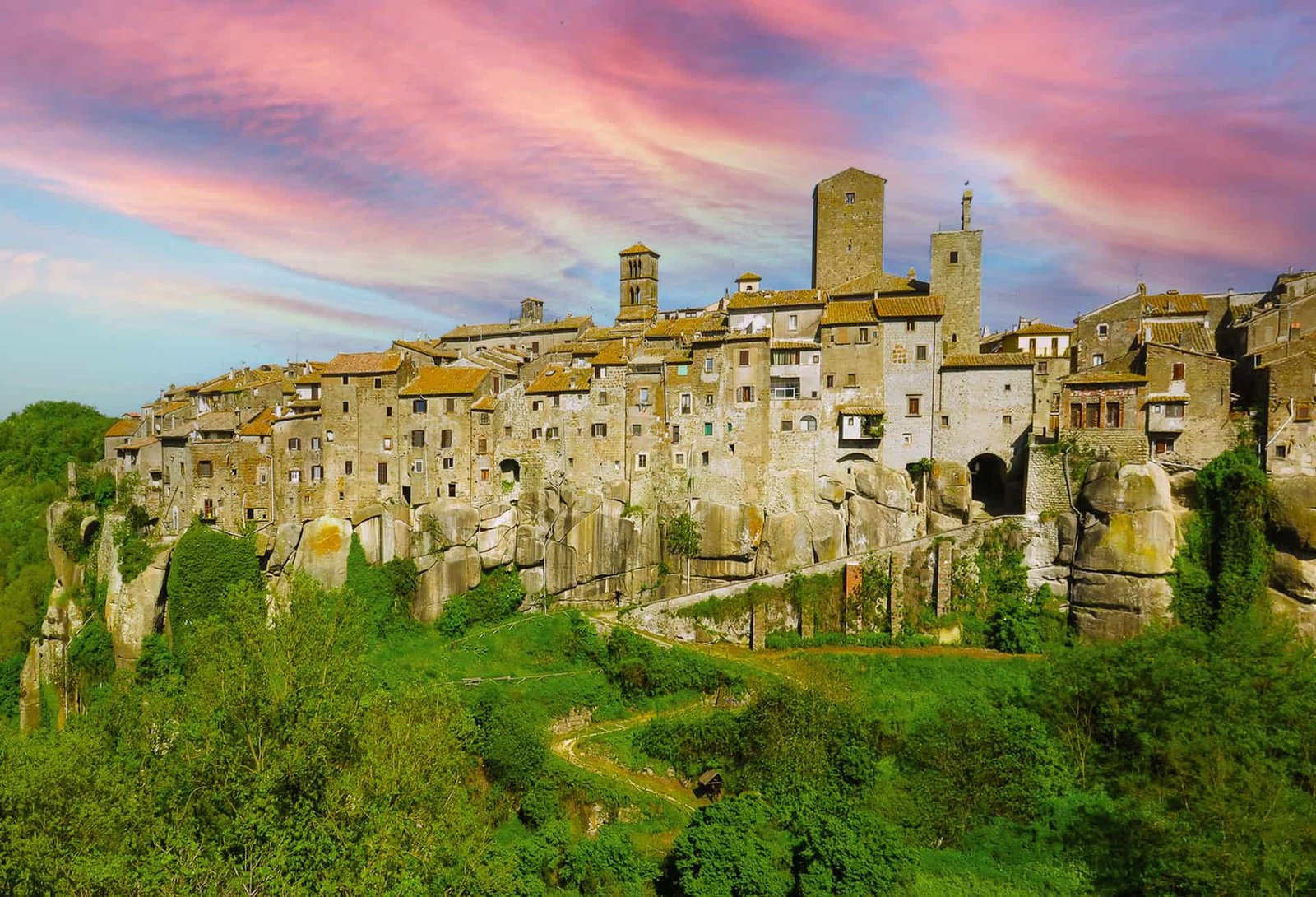
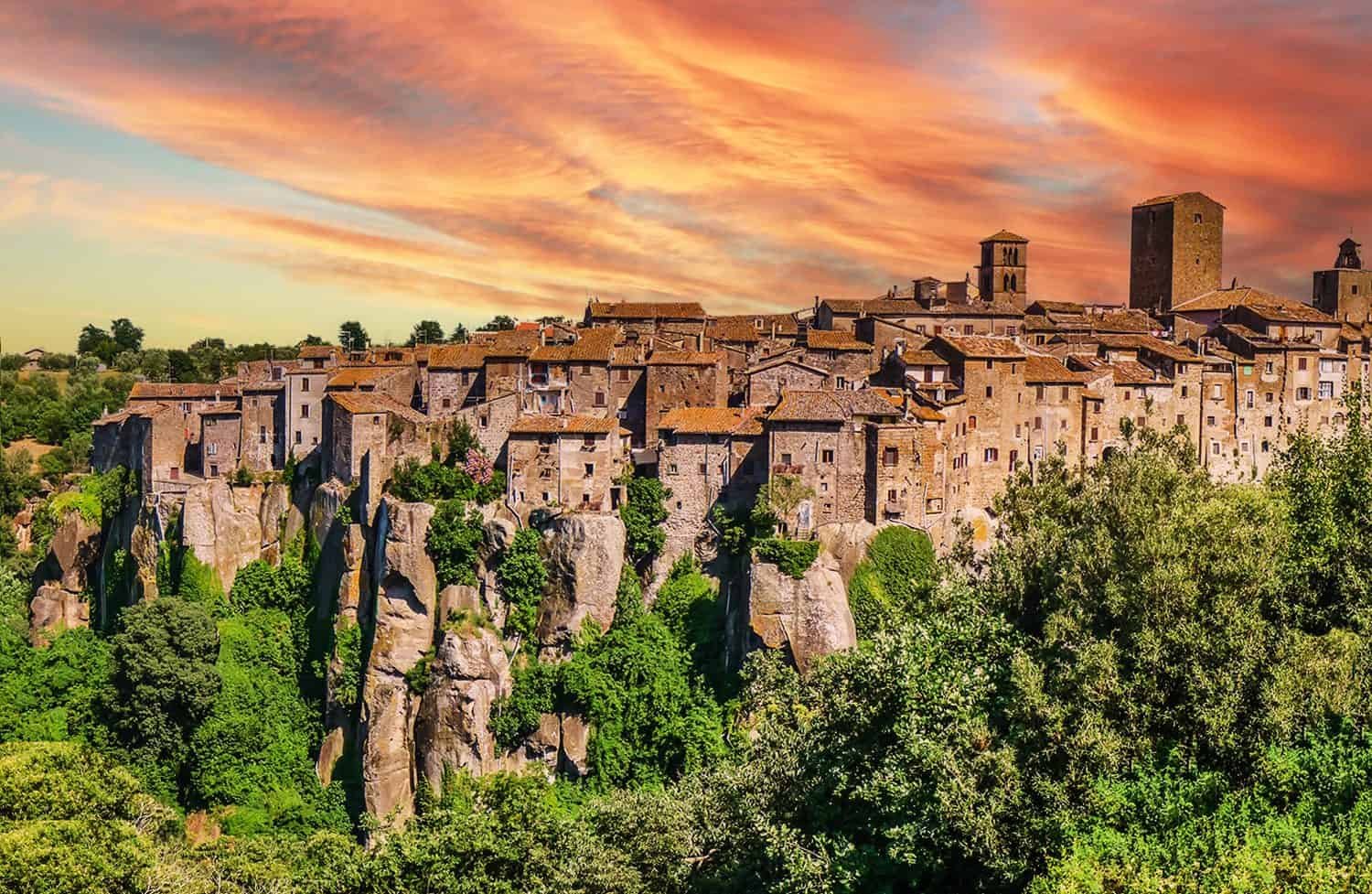
The first image you take home of Vitorchiano is that of the town's profile seen from below, from the bottom of the Valle del Vezza: the houses seem to grow out of the rock and lean out over the void, as if the town were resting on a shelf of gray stone. It's not an optical effect built on purpose, but the result of the geology of the Cimini. Here the ground is made of peperino, a volcanic rock that the volcanoes of the area deposited in compact banks. The erosion of the watercourses carved the valleys and left spurs and cliffs standing, and on one of these spurs people built the town, resting the foundations of the buildings directly on the rock bank fractured into enormous boulders. The result is a village that seems to have grown together with the cliff, with no break between the natural stone and the stone worked by the masons.
What Is the Peperino of Vitorchiano (VT)
Peperino is the true identity material of this corner of the Tuscia. It is a tuff of volcanic origin, dark gray, dotted with small darker inclusions that recall peppercorns: hence the name. It is a stone that is soft to work when it comes out of the quarry and hardens with exposure to the air, resistant and lasting, and for this reason it has been used for centuries throughout the Viterbo area for portals, door jambs, cornices, stairs and fountains. In Vitorchiano peperino is not only the rock the town stands on. It is the material the town was built with and it is still today an economic resource, with active quarries in the territory. Walking through the streets you notice that portals, brackets and windowsills are almost all in the same gray stone, and this uniformity of material gives the village its color compactness.
The Profferlo Houses of Vitorchiano (VT)
A detail to look at carefully, because it is one of the most typical features of the civil architecture of the Tuscia: many houses in the center have the profferlo, the external stone staircase that rises from the street to the first floor, where the real entrance of the dwelling was. The ground floor was meant for storerooms, stables or workshops, while people lived on the upper floor, and the external stairs, often set against the facade and covered by a small arch or a little loggia, joined the two levels. It's a medieval solution found in Viterbo, in Bagnaia and in the neighboring villages, but in Vitorchiano it has been preserved in particular abundance. Walking the streets of the center means passing under and beside dozens of these peperino staircases, which animate the facades and draw a continuous play of shadows.
Porta Romana and the Walls of Vitorchiano (VT)
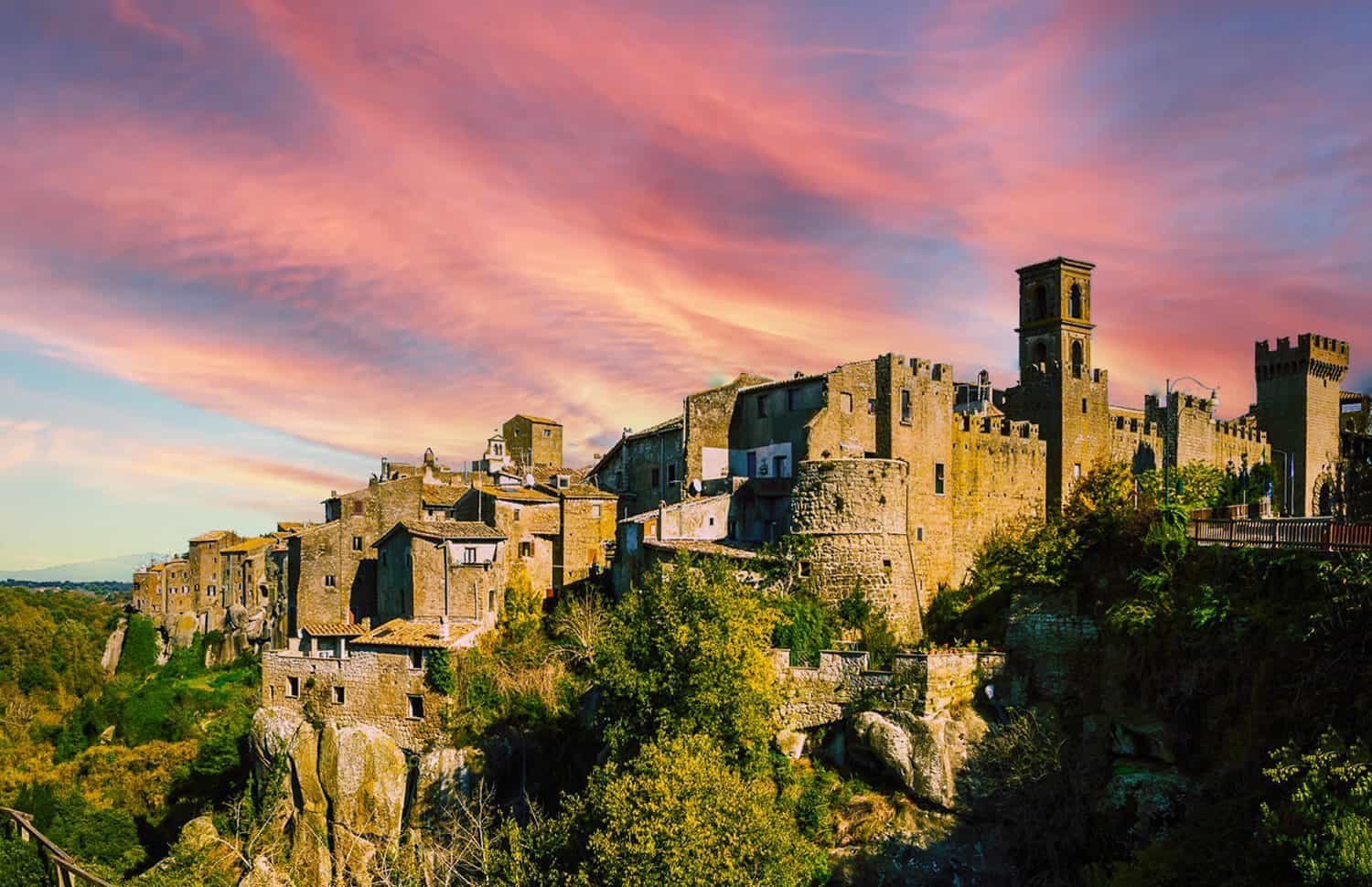
You enter the old village through Porta Romana, the main access on the side facing Rome and Viterbo. From here starts Via dell'Arrengo, the street that climbs up through the historic center, and you pass the circuit of walls that defends the most exposed flank of the town. The castle walls were fortified during the 13th century, the century in which Vitorchiano was gambling its own survival between the designs of Viterbo and the protection of Rome, and they run for a considerable stretch protecting the southern side of the town. On the other sides the defense was left to nature: the steep gorges surrounding the spur made the village practically impregnable without the need for great wall works, and it is this combination of walls and precipices that made Vitorchiano so hard to conquer.
Next to the Gate: The Church of the Santissima Trinità
Right at the entrance to the town, near Porta Romana, is the church of the Santissima Trinità, which the people of Vitorchiano more often call Sant'Amanzio after the name of the saint whose body it keeps. It's an 11th-century building, with a single nave, a roof of wooden trusses and a Romanesque bell tower, and it keeps inside valuable paintings. It's the first natural stop as soon as you pass the gate, before climbing toward the upper part of the village.
The Historic Center of Vitorchiano (VT), Street by Street
The oldest complex of the town, the one that opens after Porta Madonna della Neve, has been preserved entirely with its medieval character, apart from a few recent building interventions. Walking Via dell'Arrengo and the streets that branch off it means crossing narrow, winding lanes between buildings of tuff and peperino, with towers, flowered little squares, external stairs, balconies and arches, and continuous views over the wooded valley that surrounds the spur. The compactness of the urban fabric and the quality of the stone mean that the village has remained one of the most legible medieval settings in the whole province, so much so that it has been chosen several times by the movies as a natural set.
Piazza Roma and the Spindle Fountain of Vitorchiano (VT)
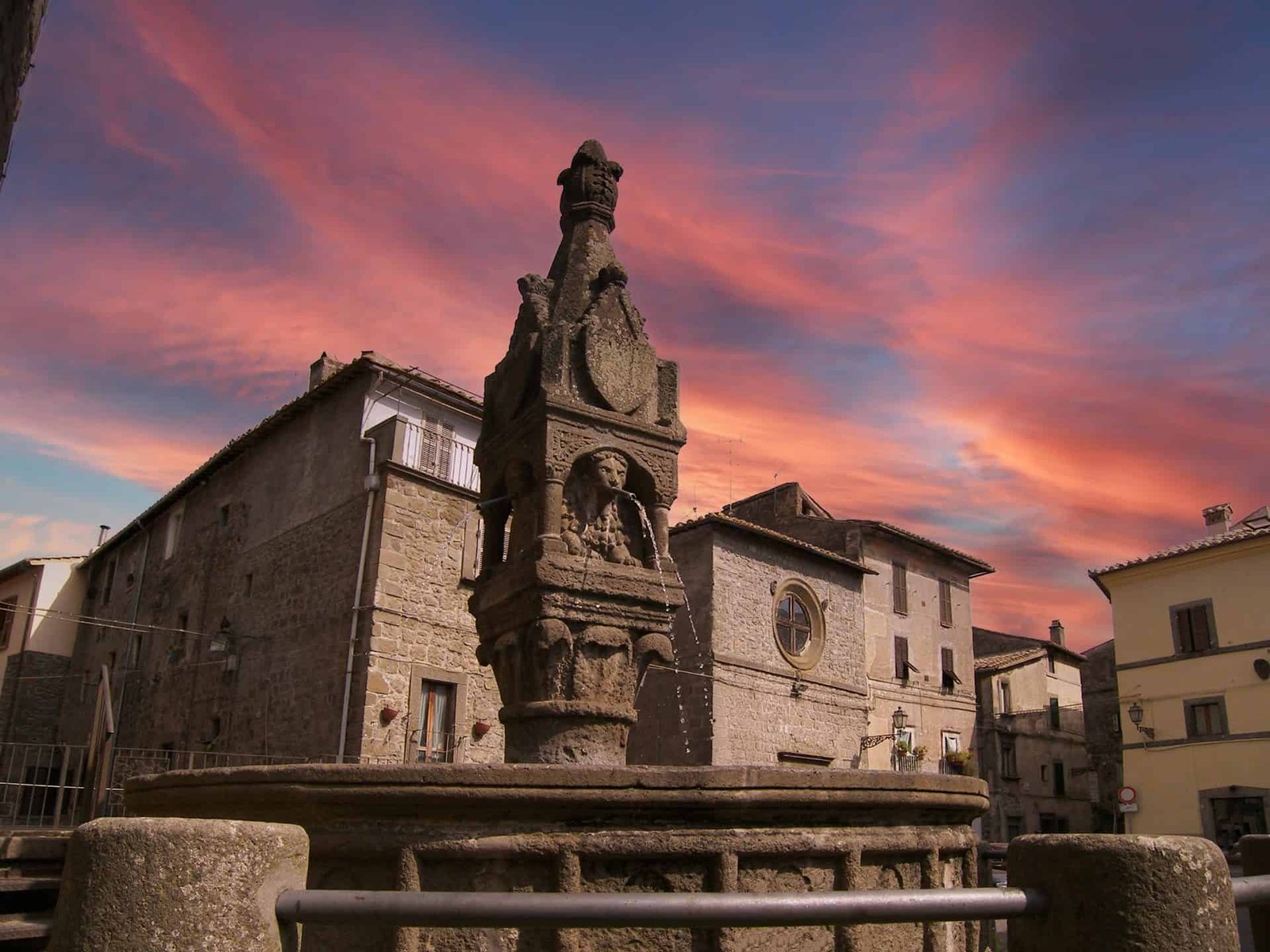
The center of the town's life is Piazza Roma, the main square. Overlooking it are the back of the Palazzo Comunale, the Porta Madonna della Neve that leads into the medieval village, the Clock Tower and, above all, the artistic 13th-century spindle fountain. The spindle fountain is a type of fountain characteristic of the Viterbo Tuscia, with a circular basin and a tapered central element that recalls, precisely, the spindle used for spinning. The one in Vitorchiano is one of the most elegant examples in the area and for centuries it has been the town's meeting point. Anyone short on time should at least come this far: the square with the fountain is the most recognizable face of the village.
The Palazzo Comunale and the Torre del Comune of Vitorchiano (VT)
The Palazzo Comunale is among the most beautiful in the Viterbo area. It dates from the early 15th century and keeps a remarkable Salone d'Onore and an archive with precious parchments going back to the 13th century, the written documentation of the village's long story. Next to it and behind it rises the Torre del Comune, the tallest of the towers of Vitorchiano, which reaches about 30 meters. Its bulk and its sturdiness made it the town's last defensive bulwark, the point where people would have barricaded themselves if the walls had fallen. Today the tower is one of the elements that mark the skyline of the village seen from afar.
Casa del Podestà and Palazzo del Vescovo of Vitorchiano (VT)
Among the civic buildings, the Casa del Podestà deserves a look. At its center is a refined spindle fountain decorated with the symbols of the four Evangelists. The building was the seat of whoever administered justice and civil power in the communal Middle Ages. Not far away is the Palazzo del Vescovo, another stately residence of the village. These are stops that tell of the organization of the town's public life when Vitorchiano was a community proud of its autonomy, jealous of the privileges that came to it from Rome.
The Churches of Vitorchiano (VT)
Despite its small size, Vitorchiano keeps a good number of religious buildings, some inside the village and others scattered in the countryside around, each with its own story. It's worth going through all of them, because they tell different phases of the town's life, from the Romanesque to the 16th century.
The Church of Santa Maria Assunta, the Oldest in Vitorchiano (VT)
The church of Santa Maria Assunta is the oldest and most monumental in the town. It was built in the 13th century in a clearly Romanesque style, with a Gothic-style bell tower alongside, in three tiers. Inside are kept a baptismal font, remains of frescoes and a 16th-century hanging pulpit. It is the building that best testifies to the communal age of the village, when Vitorchiano was equipping itself with a main church worthy of its ambitions.
The Church of the Madonna di San Nicola
Outside the town, on the road to Viterbo, stands the church of the Madonna di San Nicola, attached to the monastery of the Poor Clares and datable to the early 16th century. It is small but, for the richness of the old frescoes of the Viterbo school that decorate it, it is considered the most beautiful in Vitorchiano. Grandiose is the scene of the Last Judgment with the Glory of Christ in the apse, from 1541, while the oldest painting is that of the Madonna di San Nicola on the high altar, an image that according to tradition protects newlyweds. It's a stop that rewards those who agree to move a little away from the center.
The Church of San Michele and the Former Convent of Sant'Agnese
The church of San Michele is a 14th-century oratory just outside the town, in a panoramic position along one of the deep gorges that surround the village, and it is dedicated to Saint Michael the Archangel, the patron saint. Inside the town, instead, the former convent of Sant'Agnese was built in the mid-15th century on pre-existing structures for an order of young nuns from well-off families, then enriched over time with halls and artistic improvements, then abandoned. Today it is municipal property and hosts the library, the auditorium and other civic activities. The patron saint, Saint Michael, is also linked to the rock sanctuary that stands in the countryside of the town, the destination of the patron saint's procession.
The Peperino Moai of Vitorchiano (VT)
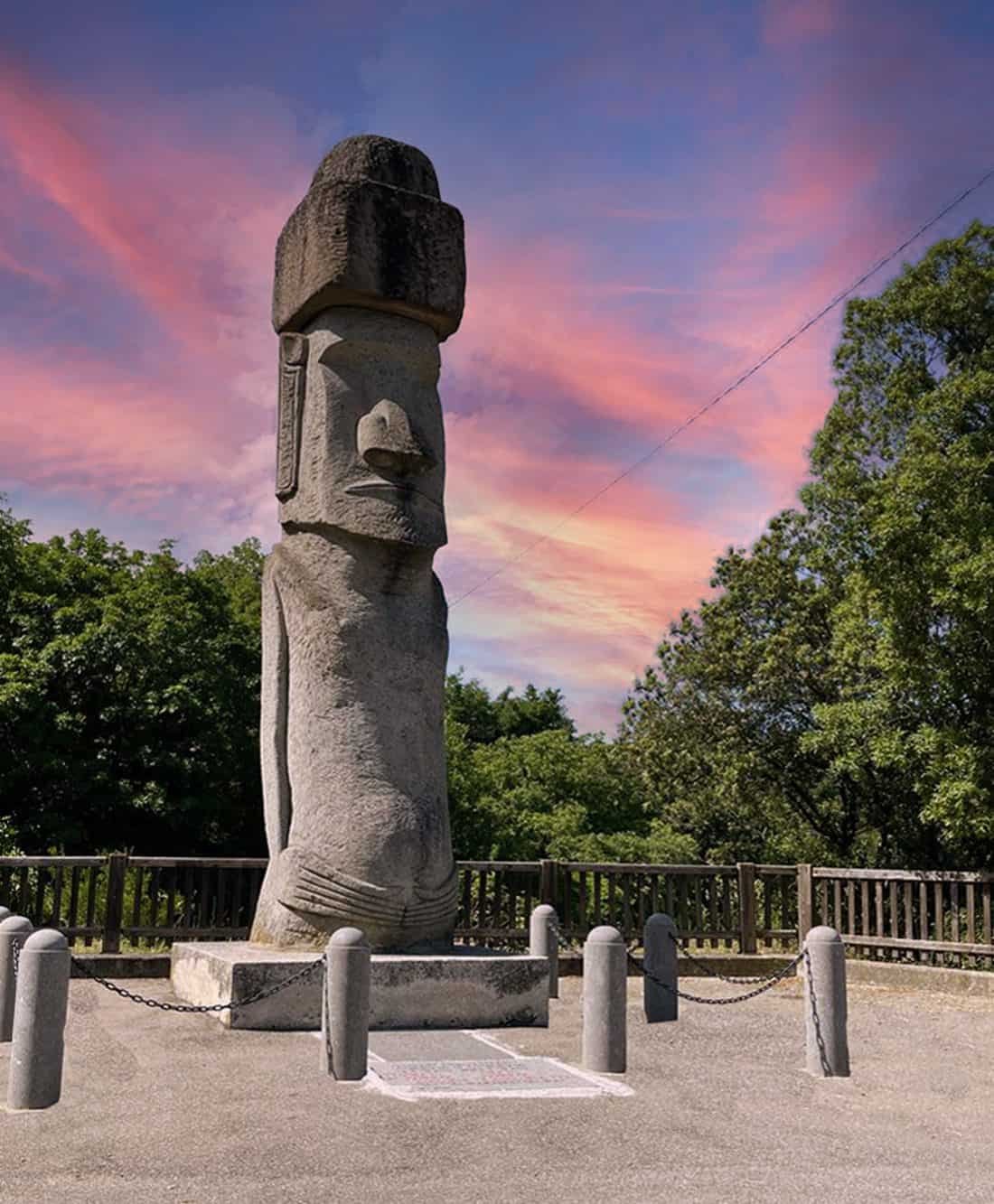
At Vitorchiano, just outside the center, there is a monolithic moai statue, the same type of stone giant that made Easter Island famous. It is not a tourist reproduction. It is an authentic moai, sculpted in 1990 by a group of 11 Rapa Nui natives who came from Easter Island, invited to Italy as part of a cultural television program of the RAI in the early 1990s, as a gesture of twinning between the two communities. The story is the stuff of novels. The original moai of Easter Island, exposed to the weather for centuries, were deteriorating, and to reproduce their carving in front of the cameras a volcanic stone similar to that of the quarries of the Pacific Ocean was needed. It was found right here, in the peperino banks of the Tuscia: an enormous block of the local gray stone, weighing about 30 tons, which the sculptors who came from Easter Island worked with hand axes and sharp stones, following the techniques handed down by their ancestors.
Why the Moai Is Important for Vitorchiano (VT)
The result is a moai in every respect, made with the right hands and the right methods by descendants of those who really did sculpt those giants, and for this reason it is described as one of the very few authentic moai existing outside Easter Island. Today the statue stands just outside the town and has become one of the symbols of the village, a curiosity that brings to Vitorchiano visitors who perhaps didn't know it existed. It is also the perfect place to understand the deep bond between this village and its stone: the same peperino the houses rest on has become, for once, the material of a colossus come from the other side of the world.
The Trappist Nuns' Monastery of Vitorchiano (VT)
Just outside the town, in the middle of the greenery, stands the monastery of the Trappist nuns of Vitorchiano, a cloistered Cistercian community among the best known in Italy. The nuns follow the Rule of Saint Benedict according to the Trappist reform, with a life marked by prayer and work, and support their activity with quality handmade products. The monastery is not a tourist attraction in the usual sense of the term, but its presence has been part of the identity of the territory for over a century, and those who pass through Vitorchiano often mention it among the realities that give the town a secluded, withdrawn character. Information on visits, services and products can be found on the community's official channels.
The Centro Botanico Moutan and the Peonies of Vitorchiano (VT)
In the hamlet of Pallone, in the territory of Vitorchiano, stretches the Centro Botanico Moutan, an enormous nursery park devoted almost entirely to peonies. The collection, one of the most important in the world for this kind of flower, spreads over about 15 hectares among holm oaks, cypresses, oaks and centuries-old olive trees, and during the spring bloom, between April and May, it offers a spectacle of colors that is hard to match. The bloom, however, is short and varies from year to year, depending on how the season goes, and anyone who wants to see it at its peak must find out beforehand about the actual state of the flowers by checking the center's official channel, so as not to arrive too early or too late. It is a destination that pairs naturally with a visit to the village, for those who happen to be here in the right season.
The Nature Around Vitorchiano (VT)
The town is surrounded by dense woods that increase its isolated, secluded look. Around the spur grow oaks, in particular the Turkey oak, and then ash trees, beeches, elms and chestnuts, while clear streams run at the bottom of the valleys. The undergrowth is rich in junipers, ferns, broom, hollies, butcher's broom and many species of edible mushrooms, among them the porcino, and truffles also thrive in the soil. The fauna is the typical one of the wooded Tuscia: foxes, beech martens, weasels, hares and wild boar among the mammals, hawks and little owls among the birds. It's an environment that is worth a walk in the countryside just outside the town, where the noise of traffic disappears completely.
The Selva di Malano and the Etruscan Memories
Between the plateaus of Montecasoli and Corviano, on the border of Vitorchiano with Bomarzo and Soriano nel Cimino, stretches the Selva di Malano, a wood scattered with Etruscan-Roman memories: rock-cut tombs, altars carved in the rock and worked boulders, among them the so-called Sasso del Predicatore. It is a place that tells how ancient human presence in this territory is, long before the medieval village arose, and it lends itself to hikes for those who like to walk between archaeology and nature. Nearby, the relief of Monte Casoli di Bomarzo keeps other traces of the ancient settlement.
Vitorchiano (VT) at the Movies: L'Armata Brancaleone
In 1966 Mario Monicelli chose Vitorchiano among the places to shoot L'Armata Brancaleone, the film with Vittorio Gassman, Catherine Spaak and Gian Maria Volonté that would found an entire strand of Italian comic and adventure cinema set in a ramshackle, starving Middle Ages. The peperino streets, the arches and the peeling facades of the village offered the perfect backdrop for the shabby band of Brancaleone da Norcia, with no need for sets: the town as it was would do. It is not the only film that has used Vitorchiano as a set, but it is the one that fixed its image forever in the memory of Italians, and even today those who arrive for the first time recognize the atmosphere of that cinema in these little streets.
Traditions, Events and Folklore of Vitorchiano (VT)
The year in Vitorchiano is marked by a few events that fill the village and are worth knowing about to choose when to come. They are real festivals, rooted in the community, not reproductions for tourists.
The Sagra del Cavatello
On the first weekend of August the historic center comes alive with the Sagra del Cavatello, dedicated to a type of homemade pasta typical of the town. In the village's little square long tables are set under the Viterbo-style fountain, surrounded by the peperino palaces, and for a few evenings the medieval heart of the town fills again with people, plates and voices. It is one of the best occasions to taste the local cooking in its natural setting.
Peperino in Fiore
In early June Peperino in Fiore is held, the flower and plant event that decorates the town with thousands of floral arrangements. Flowers invade the squares, the house walls, the balconies and the towers, often set beside works made with volcanic rock and wrought iron, and they show off the monuments and the most characteristic corners of the village. It is the moment when Vitorchiano plays the card of contrast between the gray hardness of peperino and the delicacy of petals, and for those who love photography it is perhaps the best occasion of the year.
The Poggiata del Patrono and the Carnival
On May 8 the Poggiata del Patrono is celebrated, an excursion in the countryside sacred to Saint Michael the Archangel toward the rock sanctuary of the mid-14th century, with torchlight processions, processions with large lanterns adorned with flowers and a big collective afternoon outing in the countryside. It is the festival in which the community recognizes itself around its own saint. In winter, instead, comes the Vitorchiano Carnival with the parade of allegorical floats, a deeply felt event that involves the whole town in the cold months.
The Fidelato and the Fedeli to Rome
The most identity-defining event, however, is tied to the centuries-old relationship with Rome: for many centuries the Fedeli of Vitorchiano have taken part in the official events of the city of Rome as the Campidoglio Guard, with the uniform that according to tradition was redesigned in the Renaissance by Michelangelo Buonarroti in person. It is the living sign of an ancient privilege, which the town continues to exercise, and with which the history of the village is thoroughly imbued.
The Typical Products of Vitorchiano (VT)
The territory offers products of great quality that are worth looking for in the shops and at the festivals: chestnuts, hazelnuts, mushrooms, fine olive oils, excellent wines, sheep's and cow's milk cheeses, truffles, hams and cured meats. It is the typical pantry of the Cimini Mountains, a hilly and wooded area that has always lived off the fruits of the forest and sheep farming. Those who visit the town during a festival have the chance to taste them in the best way, cooked according to home recipes. At other times they can be found from producers and in the shops of the center.
How to Really Visit Vitorchiano (VT): a Walking Itinerary
Anyone who arrives without a route in mind risks wandering at random and missing something. So here is how to line things up in an orderly visit. You start from the parking areas in the upper part and go down toward Piazza Roma, the town's living room, where you stop in front of the 13th-century spindle fountain and look up at the Clock Tower and the back of the Palazzo Comunale. From here you pass through Porta Madonna della Neve and enter the medieval village proper, taking the narrow streets that descend between the peperino palaces. Walking slowly you meet the profferli, the external stone stairs, the arches that span the alleys, the small flowered squares and the sudden views over the valley. You touch the Palazzo Comunale with its Salone d'Onore, the Torre del Comune, the Casa del Podestà with the second spindle fountain decorated with the symbols of the Evangelists, the Palazzo del Vescovo. Going down further you reach Porta Romana, the historic access toward Rome, next to the church of the Santissima Trinità.
The Second Part of the Visit to Vitorchiano (VT)
Once out of the village, you devote the second part of the day to the places just outside the center: the peperino Moai, which you reach on foot in a few minutes, the church of San Michele overlooking the gorge, the church of the Madonna di San Nicola on the road to Viterbo with its 16th-century frescoes, and, in the right season, the Centro Botanico Moutan in Pallone with its peonies. Anyone who still has energy can look for one of the viewpoints that look at the town from below, because it is from there that you catch the image of the village suspended on the cliff. A complete tour of this kind takes a good half day and leaves time for a stop at the table. It's the best way not to reduce Vitorchiano to a sequence of photographs taken in a hurry.
Vitorchiano (VT) with Children
For a family outing the town works well. Children are struck by the Moai, which gives the chance to tell them the story of Easter Island and of the sculptors who came from the other side of the world, and they have fun going up and down the profferli and discovering the glimpses over the gorge. The center is small and is covered without effort in a couple of hours, so nobody gets tired. The only precaution concerns the viewpoints over the precipice, which need to be kept under control, and the uphill streets, tiring for a stroller. On the other hand, during the festivals and above all during Peperino in Fiore, the town fills with colors and stands and becomes a cheerful destination even for the youngest.
The Name of Vitorchiano (VT) and Its Origins
The name of the town carries with it a piece of its oldest history. Tradition has it derive from the Latin Vicus Orchianus, or Orclanus, the village linked to ancient Orchia, indicated as a place sacred to the Etruscan goddess Norzia, the deity of fate venerated in this part of inland Etruria. The village would have been built or strengthened to offer a better home to the inhabitants of that older center, in an area that had already been frequented in Etruscan times and crossed by the Romans. Human presence on these plateaus, besides, is very ancient: already in the Bronze Age, around the 11th century BC, a prosperous village occupied the territory, and the countryside still keeps today tombs, altars and worked boulders that speak of that remote past. Vitorchiano was thus born as a castrum, a fortified center in the southernmost part of the Tuscia, and its later history was marked for centuries by the closeness to powerful Viterbo and by the equally close bond with Rome.
A Curiosity About Vitorchiano (VT)
The curiosity that throws everyone off concerns an acronym that is usually associated only with Rome: S.P.Q.R. In Vitorchiano the abbreviation of the Senate and People of Rome appears everywhere, carved on the walls, on the portals, on the town's coats of arms, and it is not a local quirk or an imitation. It is a right won in the field. In the Middle Ages Vitorchiano was such an ally of Rome as to deserve, with an official act of the 13th century, the right to adorn itself with the S.P.Q.R. and the Capitoline Wolf, the only center outside the Aurelian Walls to have been given permission. The town also adopted a Latin motto that fixed its pride: Sum Vitorclanum castrum membrumque romanum, that is Vitorchiano, castle and part of Rome. Those who arrive here and notice the Capitoline coat of arms on a small village of the Cimini are usually surprised. It is the visible sign of a history that has tied this spur of peperino to the Eternal City for eight centuries, and that the town has never stopped claiming. It is not folklore added later. It is the memory of a pact that in Vitorchiano has been handed down without interruption, and that still today leads its men to stand guard on the Campidoglio.
Something Nobody Tells You About Vitorchiano (VT)
Those who arrive in Vitorchiano look up, toward the towers and the palaces, and risk missing the point of view that explains everything: the one from below. The village must also be seen from the bottom of the Valle del Vezza or from one of the viewpoints that overlook the gorge, because only from there do you understand why they call it the suspended village. From above, walking through the streets, the town looks like an ordinary uphill medieval center. From below, with the houses sprouting from the edge of the cliff and seeming to lean out into the void above the precipice, you see how the town literally rests on a blade of rock. Few visitors take the time to go down or to look for the right viewpoint, and so they go home without having seen the truest image of the place. A second detail that almost everyone misses concerns the profferli, the external peperino stairs: they look like a picturesque ornament and are instead the signature of a medieval way of living, with the real home on the first floor and the working life on the ground floor. Looking at them knowing what they were for changes the way you walk through the town.
The Advice I Give You for Visiting Vitorchiano (VT)
The advice on when to come is simple: choose the moment according to what you want to see. If you are looking for the village in its silence, with the light caressing the peperino, come early in the morning on a weekday in the shoulder season, spring or fall, when the town is empty and the gray stone warms in the sun. If instead you want color and celebration, aim for Peperino in Fiore in early June or the Sagra del Cavatello at the beginning of August, allowing for more people and full parking. In any case leave the car outside the walls and walk everything on foot, slowly: two hours are enough for the center, but if you add the Moai, the Centro Botanico Moutan in Pallone in the peony season and maybe a viewpoint over the valley, the day fills up by itself. And above all don't be fooled by the small size of the town: Vitorchiano deserves a slow visit, not a hit and run between one photo and the next. Those who cross it in a rush leave convinced they have seen a nice little village. Those who walk it slowly catch its history, which is anything but small.
Another Well-Known Fact, Yet Rarely Cited
It is known that Vitorchiano gave Rome its Fedeli, but a sonic detail that follows from it is rarely mentioned. Among the duties of the Guard there was, and still is, that of sounding the particular Roman trumpets called clarine at the main official public events of the city. Precisely because of this custom those trumpets are known by tradition as the clarine of Vitorchiano, and in Rome the expression sounding the clarine has become proverbial in the sense of calling the people together. Then there is another detail that few connect with the town: in the Capitoline Museums, in Rome, is kept the Spinario, the famous ancient bronze that depicts a boy intent on removing a thorn from his foot. According to a handed-down tradition, that boy would be Gneo Marzio, a young man from Vitorchiano who stopped to rest, with the thorn still in his foot, after running without pause from his city to Rome to warn the Romans of the advance of the Etruscans. It is a legend, not a documented fact, but it explains why in Vitorchiano the Spinario is felt to be one's own. Rome, moreover, has paid the town for centuries an annual allowance, drawn from taxes, meant to pay the Guard: an economic as well as symbolic thread, which still binds the two communities today.
The Right Photo to Take at Vitorchiano (VT)
The photograph that brings home the soul of the place is not taken inside the town, but facing it. Leave the village, look for one of the viewpoints over the Valle del Vezza or go down along the road that circles the spur, and frame the whole front of the houses sprouting from the edge of the cliff: that is how you catch the effect of the suspended village, with the gray stone of the buildings that looks like the natural continuation of the rock. The best light is that of the late afternoon, when the low sun warms the peperino and sets the houses apart from the green of the valley. Inside the town, instead, the two shots you shouldn't miss are the spindle fountain in Piazza Roma, with the Clock Tower behind it, and a glimpse of a street with the profferli in the foreground, the peperino staircases that climb toward the first-floor entrances. And if you want the photo nobody expects, it's the one of the Moai just outside the center: a giant from Easter Island in the middle of the Viterbo countryside, a contrast that by itself tells the happy strangeness of this town.
Some Important Events That Took Place Here in History
The history of Vitorchiano is a long sequence of sieges, betrayals, resistance and pacts, all revolving around the triangle between the small village, powerful Viterbo and distant Rome. The village has very ancient origins: already in the Bronze Age, around the 11th century BC, a prosperous settlement occupied these plateaus, and the area was later frequented by the Etruscans and crossed by the Romans, as the tombs and altars of the Selva di Malano show. The core of the town as we know it is tied to the tradition according to which Desiderius, the last king of the Lombards, would have built or strengthened cities and castles in the Viterbo area, and among them the Vicus Orchianus from which the name Vitorchiano would derive, to offer a better home to the inhabitants of ancient Orchia, a place sacred to the Etruscan goddess Norzia.
The Sieges of the 13th Century and Loyalty to Rome
The decisive chapter opens at the end of the 12th century. In 1199 Vitorchiano declared itself free of any tie to Viterbo, and in response the village was besieged by the Viterbo militias. Against them the people of Vitorchiano called for the help of Rome, and in 1201 the town was freed from the siege and became a fief of Rome. The conflicts, however, did not die out: in 1232 the Viterbo people took the village again and devastated it. They were very hard years, of destruction and rebuilding. To raise the walls again, the Papal State had to resort to the help of the treasurer Giovanni Annibaldi, who fortified the town until it was almost impregnable. But the people of Vitorchiano put up badly with his rule and, after begging Rome in vain to free them, in 1267 they saw to reimbursing him at their own expense for the sums spent. It was then that, with a solemn act of submission to Rome, the town earned the title of Most Faithful Land to the City and the bundle of privileges that still distinguish it: the tax exemptions, the S.P.Q.R., the Capitoline Wolf and, above all, the honor of providing the men for the Capitoline guard, exercised without interruption to this day. The sources place the recognition of loyalty between the middle and the end of the 13th century, in the years between 1265 and 1267.
Santa Rosa Exiled to Vitorchiano
Then there is an episode that intertwines the history of the village with that of the best-loved saint of Viterbo. Santa Rosa, patron saint of the provincial capital, was exiled in 1250 precisely to Vitorchiano, and tradition attributes to her two miracles performed in the town: the restoring of sight to a girl named Delicata, through prayer and the laying on of hands, and the conversion of a heretic, called the sorceress, through the ordeal of fire. She is the same figure whose memory, in Viterbo, is celebrated every year with the transport of the gigantic Macchina di Santa Rosa, one of the most spectacular traditions of the Tuscia. That the saint spent part of her brief exile in Vitorchiano is another thread that ties the village to the great events of its land.
Who Passed Through Vitorchiano (VT)
Through the streets and countryside of Vitorchiano, in different eras, figures have passed who belong to great history and to the history of cinema. In the 13th century Santa Rosa of Viterbo was exiled here, the young Franciscan tertiary and patron saint of the provincial capital, who according to tradition performed two miracles here during the forced stay of 1250. Tied to the story of the village is also the name of Giovanni Annibaldi, the papal treasurer who in the 13th century fortified the town with the walls that made it almost impregnable, before being sent away by the people of Vitorchiano. Further back in time, tradition links the town's name to Desiderius, the last king of the Lombards, indicated as the one who would have given shape to the medieval castrum.
The Artists and Directors Who Passed Through Vitorchiano (VT)
In the Renaissance local tradition calls into play none other than Michelangelo Buonarroti, to whom the design of the uniform of the Fedeli of Vitorchiano, the Campidoglio Guard, is attributed. It is an attribution handed down by tradition, not a documented fact, but it says how high the town sets its own pride. In the 20th century it is cinema that brings famous faces to Vitorchiano: in 1966 Mario Monicelli shot L'Armata Brancaleone here with Vittorio Gassman, Catherine Spaak and Gian Maria Volonté, and for a few weeks the peperino streets filled with actors in medieval costume. And in 1990 it was the Rapa Nui sculptors who came from Easter Island who left their mark here, the peperino Moai: figures very far from this corner of the Tuscia, yet tied forever to the town by the stone they worked.
What to See Around Vitorchiano (VT)
Vitorchiano is at the center of one of the richest areas of villages and nature in Lazio, and within a few kilometers it offers ideas to fill more than one day. A short distance away you reach the stone monsters of the Monster Park of Bomarzo, the abandoned town of Celleno, the ghost village, and nearby Soriano nel Cimino with its castle. Also worth the trip are Vignanello with the famous Castello Ruspoli, and the monumental Palazzo Farnese in Caprarola. A little farther, the spectacular Civita di Bagnoregio, the dying city, is one of the most photographed places in Italy, while those who love nature find peace on the shores of the Lake Vico nature reserve.
Other Villages Near Vitorchiano (VT)
On the opposite side deserving a stop are Calcata, perched on a tuff cliff above the Treja valley, and the provincial capital Viterbo with its medieval San Pellegrino district and the Palazzo dei Papi. Not to be overlooked are Orte, overlooking the Tiber along the ancient Via Amerina, and the placid San Martino al Cimino with its Cistercian abbey. With a little more road you get to Chia, the ancient village dear to Pier Paolo Pasolini, and to Farnese, the town that gave its name to the famous family. They are all destinations reachable in a day, which make Vitorchiano an excellent base for exploring the Viterbo Tuscia.
Quick Questions About Vitorchiano (VT)
How far is Vitorchiano (VT) from Rome?
Vitorchiano is in the province of Viterbo and is a little over an hour by car from Rome's Grande Raccordo Anulare, following Via Cassia or going through Orte and the Orte-Viterbo expressway. It is one of the most convenient day trips out of town for anyone who wants to see a village of the Tuscia in a day.
Do you pay a ticket to enter Vitorchiano (VT)?
No. The historic center is an open medieval village and is visited freely on foot, with no ticket. Only a few specific places have their own hours and entrances, such as the churches, the Trappist nuns' monastery or the Centro Botanico Moutan, which are best checked on their official channels.
How much time do you need to visit Vitorchiano (VT)?
For the historic center alone about two hours are enough, at an easy pace. If you add the Moai just outside the town, a viewpoint over the Valle del Vezza and, in spring, the peonies of the Centro Botanico Moutan in Pallone, you comfortably fill half a day or more.
How do you get to Vitorchiano (VT) by public transportation?
You get to Viterbo by train from Rome and from there take a Cotral suburban bus toward Vitorchiano. The provincial bus runs are not very frequent, so it's best to check the updated schedule before leaving. For a comfortable trip, the car remains the most practical choice.
Where do you park in Vitorchiano (VT)?
The parking areas are all outside the walls, because the old village is pedestrian. The most convenient is the one in the upper part, near Piazza Roma and Porta Madonna della Neve. On the days of the big festivals the spaces run out early, so it's best to arrive in the morning.
Why is Vitorchiano (VT) called the suspended village?
Because the town is built on a spur of peperino overlooking the Valle del Vezza, and seen from below the houses seem to grow out of the rock and lean out into the void above the gorge. It is this effect, due to the volcanic geology of the Cimini Mountains, that earned it the nickname of suspended village.
What is the peperino of Vitorchiano (VT)?
It is a volcanic tuff of dark gray color, dotted with small darker inclusions that recall peppercorns, from which it takes its name. It is the rock the town rests on and the stone the town was built with. Still today it is quarried in the territory's quarries.
Is the Moai of Vitorchiano (VT) authentic?
Yes. It was sculpted in 1990 by 11 Rapa Nui natives who came from Easter Island, who worked a block of local peperino of about 30 tons with hand axes and sharp stones, following traditional techniques. It is described as one of the very few authentic moai existing outside Easter Island.
Where is the Moai in Vitorchiano (VT)?
The statue stands just outside the historic center, along the road that leads toward the countryside, and is reached on foot in a few minutes from the main square. It has become one of the symbols of the town.
Why is the S.P.Q.R. found in Vitorchiano (VT)?
Because in the 13th century the village was so faithful to Rome that it obtained, with an official act, the right to adorn itself with the S.P.Q.R. and the Capitoline Wolf. It is the only center outside the Aurelian Walls to have been given permission. The town also adopted the motto Sum Vitorclanum castrum membrumque romanum.
Who are the Fedeli of Vitorchiano (VT)?
They are the men the town has provided for centuries as the Campidoglio Guard for the official events of the city of Rome, by virtue of the privilege obtained in the 13th century. Their uniform, according to tradition, was redesigned in the Renaissance by Michelangelo Buonarroti.
Is Vitorchiano (VT) suitable for children?
Yes, it is a convenient destination for a family outing: the village is small, it's toured on foot in a couple of hours and it has many things that strike children, from the Moai to the profferli to the views over the valley. Just watch out for the uphill streets and the viewpoints over the gorge, which need to be kept under control.
When is it best to visit Vitorchiano (VT)?
For the quiet town, in the morning on a weekday in spring or fall. For the celebration and the colors, during Peperino in Fiore in early June or the Sagra del Cavatello at the beginning of August. For the peonies of the Centro Botanico Moutan, between April and May, checking the state of the bloom first.
What absolutely must you see in Vitorchiano (VT)?
Piazza Roma with the spindle fountain and the Clock Tower, Via dell'Arrengo with the profferlo houses, the church of Santa Maria Assunta, the Palazzo Comunale, the peperino Moai just outside the center and a viewpoint over the Valle del Vezza to catch the suspended village from below.
What film was shot in Vitorchiano (VT)?
In 1966 Mario Monicelli shot L'Armata Brancaleone here with Vittorio Gassman, Catherine Spaak and Gian Maria Volonté. The peperino streets of the village offered the perfect medieval setting without the need for added sets.
What do you eat in Vitorchiano (VT)?
The cooking is that of the Cimini Mountains: chestnuts, hazelnuts, porcini mushrooms, truffles, olive oils, wines, sheep's and cow's milk cheeses, hams and cured meats. The town's signature dish is the cavatello, the homemade pasta to which the festival at the beginning of August is dedicated.
What can you see near Vitorchiano (VT) in a day?
Within a few kilometers there are the Bomarzo Monster Park, Celleno the ghost village, Soriano nel Cimino, Vignanello with Ruspoli Castle, Palazzo Farnese in Caprarola, Civita di Bagnoregio, Viterbo, Calcata and Lake Vico. Vitorchiano is an excellent base for exploring the Tuscia.
Is the Historic Center of Vitorchiano (VT) Accessible?
The old village has narrow streets, uphill and partly paved with flagstones, with stairs and changes in level, so for people with mobility difficulties some stretches are demanding. Piazza Roma and the upper part can be reached more easily, while the medieval heart requires dealing with slopes and steps.
Is Vitorchiano (VT) Wheelchair Accessible?
The historic center presents concrete obstacles for people who move in a wheelchair: narrow, uphill streets, with uneven paving, steps and steep slopes. The upper part around Piazza Roma is easier, while the inside of the medieval village is hard to get around. The Moai, which is outside the walls, is more easily reached. It's best to take these characteristics of the town into account before the visit.
Are There Restaurants and Bars in Vitorchiano (VT)?
Yes, the town and its immediate surroundings offer trattorias, osterias and bars where you can taste the cooking of the Cimini Mountains, from cavatello to mushrooms, from cured meats to local cheeses. During the festivals, in particular the Sagra del Cavatello in early August, you eat directly at the long laid tables in the historic center, under the Viterbo-style fountain.
When Do the Peonies of the Centro Botanico Moutan Bloom?
The peony bloom at Pallone is usually concentrated between April and May, but it is short and changes from year to year according to how the season goes. Anyone who wants to see it at its fullest should find out beforehand about the actual state of the flowers through the botanical center's official channel, to avoid arriving when the bloom is not yet open or has already faded.
Why Do People Talk About the Spinario in Vitorchiano (VT)?
Because a tradition links the famous ancient bronze of the Spinario, kept in the Capitoline Museums in Rome, to Gneo Marzio, a young man of Vitorchiano who according to the story ran all the way to Rome to warn the Romans of the advance of the Etruscans, stopping afterward to pull a thorn out of his foot. It is a legend, not a documented fact, but it explains the town's affection for that statue.
Can You Combine Vitorchiano (VT) with Bomarzo?
Yes, it's a natural pairing. The Bomarzo Monster Park, with its enormous 16th-century stone sculptures, is a few kilometers away and can comfortably be visited on the same day, as can the nearby plateau of Monte Casoli with its Etruscan memories. Many visitors join the two places in a single trip in the Tuscia.
Why the Spindle Fountain Is a Symbol of the Tuscia in Vitorchiano (VT)
The spindle fountain deserves a few more words, because it is one of the elements that best tell of Vitorchiano's belonging to the civilization of the Viterbo Tuscia. The type takes its name from the shape of the central element, tapering upward like the spindle used to spin wool, which rises from the basin. It is a model of public fountain widespread in the medieval communes of the area, where water was the center of daily life and the fountain the place where people drew water, watered animals and met. Vitorchiano keeps more than one: the most famous is the 13th-century one in Piazza Roma, but a second example, decorated with the symbols of the four Evangelists, is found in the Casa del Podestà. They are fountains built, like all the rest of the town, with the local peperino, and the sobriety of their lines goes well with the gray severity of the facades. Stopping to observe their details, the wear of the stone and the marks left by the centuries helps you understand the rhythm of a community that built its own history around that water.
To Close: Why Go Up to Vitorchiano (VT)
The Tuscia has many medieval villages, and almost all of them beautiful, but Vitorchiano has something the others don't: a history that ties it directly to Rome, written on the walls with an abbreviation that usually belongs only to the capital, and an almost physical relationship with its own stone, peperino, which you see in the houses, in the stairs, in the fountains and even in a giant that came from Easter Island. The advice is not to treat it as a quick stop: take the time to go down and look at it from below, to walk slowly among the profferli, to get all the way to the Moai and, if you happen to be there in the right season, to stretch out to the peonies of Pallone. Vitorchiano repays those who slow down, and disappoints only those who rush through it.
Article written by the editorial team of TourLeaderPro, contact them for Private/Corporate/V.I.P. Tours and Experiences.
Planning a trip to Rome? The English-language guides to visiting the city are on ItalyPlanner.com.