Vignanello (VT)
In short. Vignanello is in the Tuscia of Viterbo, 18 km north of Viterbo, at 369 meters above sea level on the slopes of the Monti Cimini.
Vignanello is in the Tuscia of Viterbo, 18 km north of Viterbo, at 369 meters above sea level on the slopes of the Monti Cimini. By car you get there along the Autostrada del Sole to the Orte exit, then the SS204 and Via Cimina heading north. The trip from Rome takes about an hour. COTRAL runs buses from Viterbo with variable frequency: check the updated schedules on the official website before setting out. The Castello Ruspoli is open to the public from Easter to the end of October, every Sunday and public holiday, 10:30-18:00. For information and bookings for guided visits the contact is 0761 647044 or 3273984629. The Etruscan connutti (underground Vignanello) can be visited on the same days, with tours at 10:30, 11:45, 12:45, 15:30, 16:45 and 17:45. The ticket costs 5.00 euros, with bookings via WhatsApp at 379 289 4471. The historic center and the churches are freely accessible during the day. For those planning an itinerary in the Lazio Tuscia, the Viterbo guide offers an ideal logistical base for exploring the whole area.
Vignanello is one of those villages of the Tuscia that deserve the detour not for a single monument, but for the sum of what it has preserved: an inhabited castle with one of the best Renaissance gardens in Italy, an underground system of tunnels of Faliscan origin still partly unexplored, a centuries-old wine tradition with a native grape almost unknown outside the province, and a surprisingly intact medieval urban fabric. The family that owns the castle still lives in it today. For those coming from Rome with the idea of "doing Tuscia," this is the stop that sets the itinerary apart from any other.

The Castello Ruspoli of Vignanello (VT)
Medieval origins: from 847 to the Benedictine convent
The first documented traces of a defensive structure on this ridge date to AD 847. The height on which Vignanello stands was a natural strategic position, with precipices on three sides and the Cimino plain under visual control. Around the year 1000 the fortress was handed over to a Benedictine community, which set up a convent there. The monastic settlement remained active for a few centuries before the lordly interest prevailed over the religious one: in the first half of the 16th century the complex was transformed into an aristocratic residence, losing completely its conventual character and acquiring that of a Renaissance fortress.
The Farnese design and the 16th-century reconstruction
The decisive architectural turning point came between 1531 and 1538, when Beatrice Farnese and her husband Sforza Marescotti commissioned the reconstruction of the building. The attribution of the design to Antonio da Sangallo the Younger, who in those years was actively working for the Farnese family throughout the Tuscia, is a plausible historical hypothesis but not documented with certainty. Pope Paul III Farnese confirmed the possession of the castle to his niece Ortensia Farnese, consolidating the link between the papal house and the territory of Viterbo.
The result is a castle with a square plan and four cylindrical corner bastions, a deep moat still visible, Ghibelline crenellation and construction in local gray stone. The drawbridge has been replaced by a fixed bridge, but the original defensive layout has remained substantially intact. From the architectural point of view, the Castello Ruspoli belongs to that generation of fortress-residences that in the first half of the 16th century mediated between the defensive needs inherited from the Middle Ages and the new aspirations to display of the Renaissance nobility: it is not a pure fortress, it is not yet a palace, it is something in between that has many examples in the Tuscia, but few preserved with this continuity of habitation.
The great hall and the frescoes for Benedict XIII
Inside, the main hall preserves a cycle of frescoes made in honor of Pope Benedict XIII, who visited the castle in 1725. The papal visit was an event of extraordinary prestige for the Marescotti Ruspoli family and the frescoes are its permanent celebratory memory. The iconographic content celebrates the house and the pontiff at the same time, according to a code of self-representation typical of the Roman aristocracy of the early 18th century. The guided visits include the fresco hall and a few reception rooms. The private apartments remain, understandably, inaccessible.

The Italian gardens of the Castello Ruspoli of Vignanello (VT)
Ottavia Orsini and the 1611 design
The garden is the real rarity of Vignanello, and it has to be understood before seeing it. Ottavia Orsini, who designed it and had it built in 1610-1611, was the daughter of Vicino Orsini, the creator of the famous Parco dei Mostri of Bomarzo. Anyone who has visited Bomarzo knows what designing a garden meant for that family: an intellectual and political gesture as well as an aesthetic one, a declaration of culture and power. Ottavia did not repeat her father's bizarre register, but did something just as precise: she cut into the boxwood hedges her own initials and those of her two sons, Sforza and Galeazzo, making the garden a permanent green heraldic signature. Those initials are still there, legible in the hedges.
The 12 boxwood parterres: the broderie that reads from the castle
The garden is organized along four main avenues that start from a central fountain, the so-called Fontana del Vignola, decorated with the Ruspoli coat of arms with six mounts. The avenues divide the surface into 12 parterres of boxwood trimmed into geometric shapes, which from the top of the castle read like a calligraphic drawing on green paper. This type of formal scheme is called broderie, from the French term that describes embroidery: the pruned hedges imitate the thread of the embroiderer composing plant and geometric motifs on a ground of gravel or bare earth.
The broderie arrives in Italy from the French courts of the late 16th century, but at Vignanello it finds a Tuscan-Lazio version with influences from the horticultural tradition of the monasteries. The result is one of the best-preserved Italian gardens in Italy: not in the sense of a recently restored and rigidly maintained garden, but of a space that the same family has tended continuously for over four centuries. The difference is felt in the controlled irregularity of the hedges, in the natural aging of the avenues, in the presence of species that a "restored" garden would not have.
The four sections: Giardino di Verdura, Barchetto, Barco, Giardino Segreto
The complex is divided into four distinct areas. The Giardino di Verdura is the most formal section, that of the boxwood broderie parterres, and it is also the best preserved. The Barchetto was the park of small game animals and still carries its original function in its name (a "barchetto" was an enclosure for small wild fauna). The Barco is the largest wooded area, less structured, which served as an actual hunting reserve. The Giardino Segreto deserves a discussion of its own.
The water system: Ottavia Orsini's aqueduct
To irrigate a garden of this complexity on a hillside ridge, Ottavia Orsini had an innovative water system built that exploited the underground aquifers already used by the ancient Falisci. The main tunnel that crosses the town still holds the remains of the terracotta aqueduct built in the early 17th century, and this link between the garden and the underground system is one of the most fascinating elements of Vignanello: the visible garden and the invisible connutti are complementary infrastructures, born from the same act of design. Francesco Maria Ruspoli redesigned the water system in the early 18th century with the help of a gardener trusted by the pope, consolidating what Ottavia had created.
The Giardino Segreto: the four card suits
Francesco Maria Ruspoli had a private garden built in the early 18th century, separate from the public sections of the complex, covered by pergolas that guaranteed full shade and relative privacy. It was a place of retreat and conversation, not of display. In the course of the 20th century Maria Rita Lante della Rovere restored this space with an intervention that has something of the bizarre: the hedges were trimmed into the shape of the four suits of playing cards, hearts, diamonds, clubs and spades, alternating in the flower beds. The inspiration is not documented precisely. The result is a corner of the garden that resembles no other in Italy. If the Giardino di Verdura is the official text, the Giardino Segreto is the marginal note in another hand's writing.
The Ruspoli family: four centuries of history between Vignanello and Rome
From Marescotti to Ruspoli: the surname of the one who gave way
The history of the family that lives in the castle is as intricate as the hedges of the garden. The Marescotti obtained Vignanello through the marriage of Marcantonio Marescotti to Ortensia Farnese. The surname became Ruspoli when Sforza Vicino Marescotti married Vittoria Ruspoli: since the Ruspoli family risked extinction in the male line, a marriage agreement was drawn up under which the husband took his wife's surname. In modern Europe this type of agreement was rare but not unheard of, especially among families of ancient lineage concerned with preserving the continuity of the house. From that moment the Marescotti surname disappeared and only Ruspoli remained, even though the bloodline was the Marescotti one.
Clarice Marescotti: the saint of Vignanello
Before the surname changed, one of the most famous members of the family was Clarice Marescotti (1585-1640), born in Vignanello and died in Viterbo. Having entered a convent unwillingly because of a disappointment in love, Clarice lived for years a double life of apparent piety and dissipated conduct, until she had a radical conversion that led her to found in Viterbo the "Confraternity of the Sacconi," an association for assisting the poor and prisoners who wore a sack as a symbol of humility. Beatified in 1807 by Pius VII and canonized in 1807, she is today Saint Hyacintha Marescotti. Her cult is widespread above all in the Viterbo area. Her figure is one of the clearest examples of that late and total conversion that characterizes so much of the sainthood of the Counter-Reformation.
Francesco Maria Ruspoli: the Arcadia and Handel
The most interesting figure of the house for those who move in the territories of European cultural history is Francesco Maria Ruspoli (1672-1731), who in 1709 received the title of Prince by donating to the pope an armed regiment during the war of Comacchio. Francesco Maria was one of the founders of the Accademia dell'Arcadia in Rome in 1690, the literary society that gathered poets, writers and nobles in Baroque Rome with the declared aim of purifying the Italian language of Marinism. Having among the founders a marquis who later became a prince, with a castle in the Tuscia, gave the Arcadia that aristocratic rootedness it needed to survive.
But the most extraordinary episode in Francesco Maria's life concerns a guest he had brought with him from Germany: Georg Friedrich Handel arrived in Rome in 1706 and lived for a year in the Ruspoli residence in Rome. In that period he composed about 50 cantatas, many of them performed at the musical evenings organized by the Prince. Handel was still a young composer of 21. His Italian stay, financed in part by the generosity of the Ruspoli, was decisively formative for the style he would later develop in England. The name of Francesco Maria Ruspoli appears in the registers of Handel's cantatas as the main patron. It is one of those links between musical history and local history that almost no tourist guide remembers.
Francesco Ruspoli, 8th Prince: the Great War, the sonnets, the bronzes
Francesco Ruspoli (1899-1989), eighth prince of the house, was a figure of many-sided nature who could not easily be classified. A veteran of both world wars, he wrote sonnets and practiced bronze sculpture with a seriousness that went beyond aristocratic dilettantism. He was also the last Grand Master of the Sacred Apostolic Hospice, an honorary office tied to the family since 1952, which formally placed him within the papal court. He died in 1989, leaving two sons of opposite character.
Dado Ruspoli and the Roman dolce vita
Francesco "Dado" Ruspoli (1928-2005) was, of the two brothers, the one who won an international notoriety entirely foreign to institutions: a friend of Salvador Dalí, Pablo Picasso and a good part of the great names of art and entertainment of the 1950s and 1960s, Dado embodied that figure of the bohemian aristocrat that the Rome of the dolce vita knew how to produce with a certain regularity. He had five children by three different women. His son Tao is a musician and director. His story is one of those biographies that seem invented and instead are documented.
Lillio Ruspoli and the daughters who own it today
The younger brother, Lillio Ruspoli, was of opposite temperament: politically committed, he was among the founders of the Movimento Sociale Italiano in 1951 and earned the epithet "farmer prince" for his involvement in the direct management of the agricultural properties. He had three daughters, including Claudia and Giada Ruspoli, who are today the owners of the castle and manage its opening to the public. The family's continuity of habitation, from 1530 to today, is the real anomaly of Vignanello: there are better restored castles in Tuscany, bigger gardens in Lazio, but very few places where the history of the house and that of the family coincide so perfectly for almost 500 years.

The medieval village of Vignanello (VT)
The urban structure and the origins
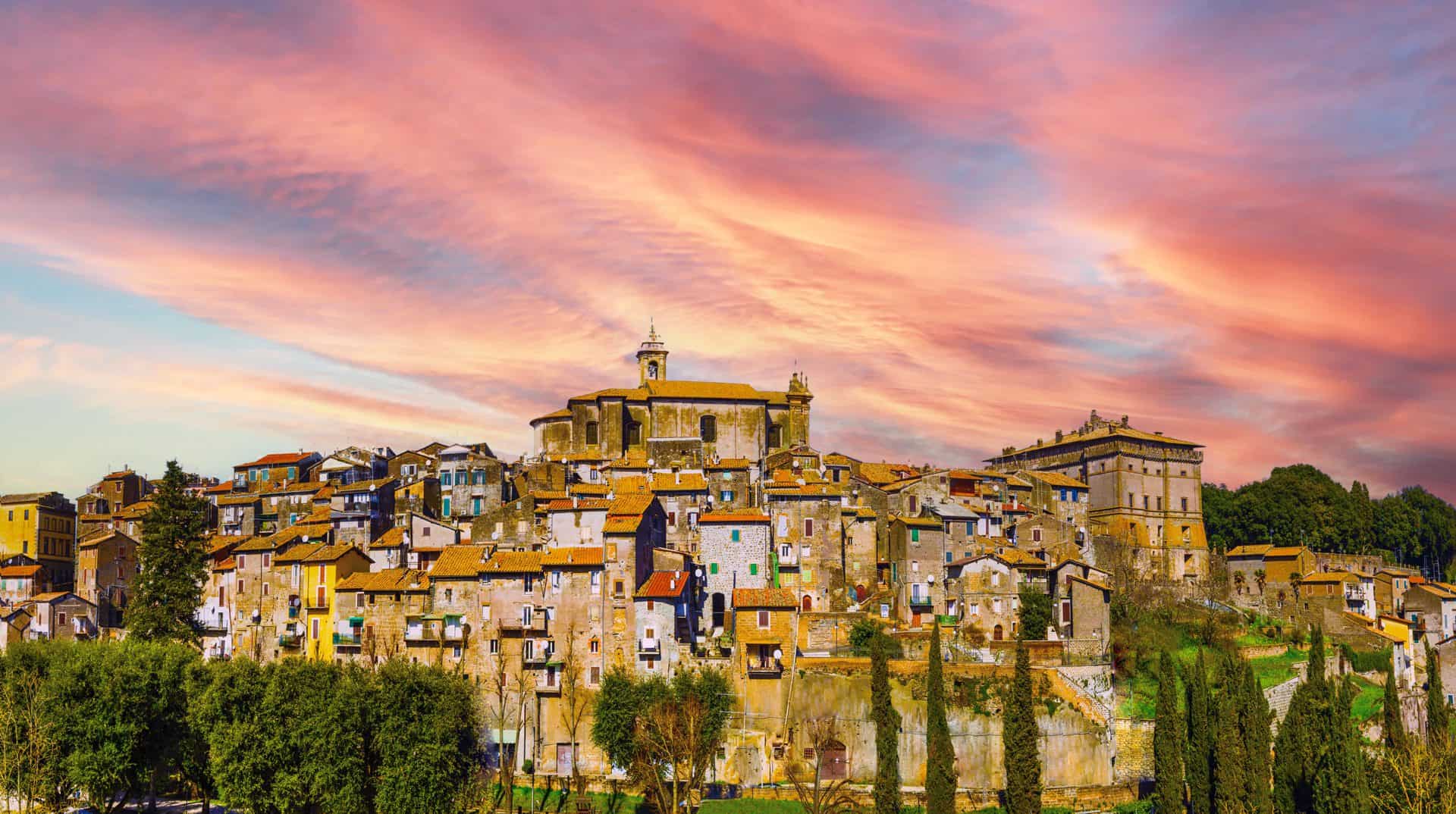
The village of Vignanello develops around the castle following a medieval radial-ring layout, with the streets converging toward the core of the castle like rays toward a center. Evidence of human settlement in this area goes back to the Paleolithic, but it is the presence of a Faliscan center between the 8th and 2nd centuries BC in the area of the present historic center that gives Vignanello a significant urban prehistory. The Falisci, an Italic people linguistically related to the Latins, controlled this territory before the Roman conquest of 241 BC. Their underground tunnels, reused for centuries afterward, are the material proof of this ancient occupation.
The first documented mention of the village dates to AD 604, when it appears in records as "olivetum in feudo Julianelli," a papal possession already then characterized by olive cultivation. The name Vignanello probably derives from "vineae," the vineyards that covered the slopes of the Cimini. The present layout of the village is the medieval one, consolidated between the 12th and 14th centuries under several lordly dominions, before the Farnese and then the Marescotti Ruspoli stabilized its definitive arrangement.
The Porta del Molesino and the Baroque fountain
The Porta del Molesino (1692) is the main access to the historic center from the plain side and carries in its name the memory of the Faliscan necropolis of Molesino, which stretched just outside the walls. The Baroque fountain of 1673, in the center of the village, is one of the most successful pieces of urban furnishing in the 17th-century Tuscia: not monumental, but proportioned to the setting it decorates, with that quality of discreet presence that distinguishes good urban-furnishing interventions from imposed ones.
The Casini Ruspoli: the Palazzo con gli archi
The Casini Ruspoli, also called the "Palazzo con gli archi," were begun in 1722 on the initiative of Francesco Maria Ruspoli as a secondary residence for display. The arched loggia that characterizes the facade is an architectural element of uncommon quality for an intervention in a provincial village: it reveals the family's financial means in that period and the will to endow Vignanello with a building of urban rank comparable to those of Rome. The construction was carried on in successive phases and was never completed in the original design, but the result is nonetheless one of the most elegant buildings of the historic center.

The churches of Vignanello (VT)
The Collegiata di Santa Maria della Presentazione
The Collegiate Church of Santa Maria della Presentazione was built between 1710 and 1723, in a period when the Ruspoli family was at the peak of its political and cultural influence in Rome and in the Tuscia. The facade is in late Baroque style with elements of transition toward 18th-century classicism. The interior has a single nave with side chapels and preserves works of art of local interest. In the crypts lies part of the system of the connutti, with the chapel dedicated to the Most Holy Madonna of the Seven Sorrows and the burials of some members of the Ruspoli family, which creates a direct physical link between the surface church and the Faliscan-medieval underground system.
The Church of San Giovanni Decollato
The Church of San Giovanni Decollato, built in 1614, is the oldest religious building of the historic center among those still readable in their original structure. The title, San Giovanni Decollato, that is Saint John the Baptist beheaded, is frequent in the churches of the confraternities that assisted those condemned to death. The Roman confraternity of the same name, founded in 1488, had branches in many centers of Lazio, and the dedication of this church probably reflects the local presence of an assistance confraternity. The building is more sober than the village's 18th-century churches and preserves an architectural quality of 16th-century measure that contrasts pleasantly with the late Baroque of the Collegiata.
Other churches: the Santi Angeli Custodi and the chapels
The Church of the Santi Angeli Custodi (1705) completes the religious panorama of the historic center with a building of contained size but good workmanship. In the 17th and 18th centuries Vignanello had a density of religious buildings higher than you would expect from a village of this size, a sign of the Ruspoli family's active patronage of local religious life and of the community's economic solidity in the period of the house's greatest splendor. Some rural chapels in the surrounding countryside deserve the attention of those who stay in the area for more than half a day.
Underground Vignanello: the Etruscan connutti and the 17th-century aqueduct
The connutti are underground tunnels dug into the tuff beneath the historic center of Vignanello. The term comes from the local dialect and has no standardized equivalent in Italian: "cuniculi" is the Latin term that best describes the type, the same as the Etruscan and Faliscan underground aqueducts that cross the territory of the Tuscia. At Vignanello the original dating of these excavations remains partly uncertain: the documented presence of a Faliscan center in the area (8th-2nd century BC) makes it plausible that the ancient Falisci made them to collect water from the underground aquifers, following a practice widespread throughout the Faliscan-Etruscan territory of upper Lazio.
In the course of the 17th century Ottavia Orsini had the system extended for irrigation purposes: the main tunnel that crosses the town still holds the remains of the terracotta aqueduct built at the beginning of the 1600s to bring water to the garden of the Castello Ruspoli. The connection between the ancient underground and the Renaissance garden, kept in operation for centuries by the same family, is one of the most eloquent examples of how the Tuscia has layered its water infrastructure on a prehistoric base never completely abandoned.
The main complex of the connutti lies under the Collegiata di Santa Maria della Presentazione and includes a chapel dedicated to the Most Holy Madonna of the Seven Sorrows with the burials of some members of the Ruspoli. The guided visit, which starts from the church and goes into the underground system, is one of the most unusual experiences of the Tuscia: you literally walk inside the geology of the town, with the tuff a few centimeters above your head and the roots of the castle visible in the ceiling of some galleries. Hours: Sundays and public holidays at 10:30, 11:45, 12:45, 15:30, 16:45 and 17:45. Ticket: 5.00 euros. WhatsApp bookings at 379 289 4471.
The "Vignanello sotterranea" project has made accessible only a part of the system, which extends toward the castle and, according to some local sources, in the direction of the neighboring villages. The complete exploration is not yet finished. Whoever comes to Vignanello expecting to visit a well-organized underground system like that of Naples or Orvieto will be disappointed. Whoever comes with the right frame of mind for a partial and authentic exploration will find something rare.
The cooking of Vignanello (VT): traditions with a Cimino flavor
Gnocchi col ferro
Gnocchi col ferro are the most characteristic fresh pasta of Vignanello and of the Tuscia in general: a dough of flour, water and sometimes eggs, worked by hand with a knitting needle or a thin stick that imprints a helical ridging on the outside of the gnocco. The final shape resembles a tubular maltagliato. The ridged surface holds the sauce better than any smooth pasta. The traditional sauce is a pork sauce with tomato and local spices, but there are variants with hare, wild boar or lamb depending on the season. It is a pasta that takes time and dexterity, less and less common in the village's restaurants compared with the memory that the older inhabitants have of it.
Acquacotta and pignattaccia
Acquacotta is the peasant soup par excellence of the Maremma and the Tuscia: seasonal vegetables, stale bread, eggs and sometimes pecorino, cooked together with water and oil. The name is almost a declaration of sobriety: cooked water, nothing else. The Viterbo version is richer than the Maremma one and often includes porcini mushrooms from the Cimini woods, which in autumn are among the best in Lazio. Pignattaccia is instead a stew of mixed meats (beef, pork, mutton, sometimes game) cooked slowly in a terracotta pignatta with wine, bay leaf and rosemary. The name comes from the pignatta, the terracotta container that was once the main utensil of poor Lazio cooking.
Sweets and feasts
The local sweets tradition is tied to religious feasts: anise ring cakes for Easter, tozzetti with hazelnuts (the Cimini are among the main hazelnut producers in Lazio), the autumn castagnaccio. The hazelnuts of the Cimini also go into some savory preparations, especially in the sauces for game main courses. The wine festival in August and the oil and wine festival in November offer the best occasions to taste the whole range of local production without having to split yourself among several restaurants.
Wine and oil of Vignanello (VT)
The Greco di Vignanello and the 1992 DOC
Wine production in Vignanello has documented roots at least in the 4th century BC, when a red-figure vase of Faliscan production found in the Molesino necropolis depicted Dionysus in the act of revealing to his son the secret of winemaking. A flawless mythological beginning for a tradition that has remained alive without interruption to this day. The wines of Vignanello won a gold medal at the Turin International Exposition of 1911, a recognition that at the time was equivalent to a quality certification at the European level. The IGT "Colli Cimini" designation came in 1989, followed in November 1992 by the DOC "Vignanello," which protects the wines produced in the municipal territory.
The most characteristic grape is the Greco di Vignanello, a native white grape produced as a single varietal by some local producers. The name "Greco" doesn't mean the grape is of Greek origin: like many similar names in central Italy, it probably indicates a variety of ancient introduction or a grape considered of higher quality than the more common varieties. The aromatic profile is floral and slightly mineral, with an acidity that goes well with lake fish dishes (the Lake Bolsena area is less than half an hour away) and with white meats. It is not a wine of national fame, which means you can still find it at reasonable prices and often without having to book weeks in advance.
The producers and wineries of Vignanello (VT)
The main producers of the area are: Viticoltori dei Colli Cimini, which makes Greco di Vignanello as a single varietal, the Molesino (from Merlot) and the Rulliano Riserva. Tenuta Mara Olivieri, which works with an approach oriented to the volcanic terroir of the Cimini. Salenero, which makes the Aliano, a Greco-based cuvée. Casamecocci, with the Malandrino from native grape varieties. Winery visits are possible by appointment, and at least two producers offer tastings paired with local products. Whoever visits Vignanello without making a winery a stop loses half of the understanding of the area.
Canino DOP oil: the boundary of Tuscia extra virgin
Vignanello lies in the production area of Canino DOP oil, the protected designation of origin that protects the extra virgin oil produced in the southern Tuscia. The main cultivar is the Caninese, a native olive of the Viterbo area that produces an oil with an intense fruitiness, with herbaceous notes and a pronounced bitter and peppery aftertaste. The olive-growing vocation of Vignanello is documented from the village's first mention in AD 604, where it already appears as "olivetum": the continuity between that first citation and the olives harvested today in the countryside around the village is one of those direct lines that agrarian history knows how to draw better than any other.
The oil is bought directly from local producers or in the village shops. The oil and wine festival in November is the best moment to buy it fresh from the press, when the aromatic profile is at its most intense before oxidation begins its slow work.

The Sbandieratori e Musici of Vignanello (VT)
The group of the Sbandieratori e Musici of Vignanello is one of the most active associations in the village and carries the name of Vignanello to many historical reenactments and medieval fairs, not only in the Tuscia but throughout Italy and abroad. The flag-wavers practice the tradition of throwing and catching flags, an art that requires years of training and very precise group coordination. In the context of historical reenactments, the Vignanello group is recognizable for the quality of its performance and its fidelity to medieval costumes. The most important public appearances coincide with the village's feasts: the Corpus Domini Infiorata and the summer festivals are the occasions on which they perform most often in the municipal territory.
The feasts and traditions of Vignanello (VT)
The Corpus Domini Infiorata
The Corpus Domini Infiorata is the most spectacular feast of Vignanello: for the religious occasion (which falls between May and June, 60 days after Easter), the streets of the historic center are covered with carpets of flowers composed following predefined designs, according to a tradition widespread in many villages of Lazio and Umbria. The Vignanello version is organized by the Pro Loco with the active participation of the whole community. The designs are worked out in the preceding months and made in the night between Friday and the Sunday of Corpus Domini. The duration of the Infiorata is short by definition: the petals are used up within a few hours, and the carpet is then crossed by the procession that is its reason for being. Whoever arrives too late finds the streets clean and the community already at lunch.
The wine festival and the oil and wine festival
The wine festival is held in August, in the hottest period of the year, when the vineyards are already advanced in ripening and the previous year's wine is still at the height of its expression. The oil and wine festival in November is instead the autumn occasion, tied to the olive harvest and pressing: it is the moment when the territory produces fresh oil and new wine at the same time, a gastronomic conjunction that is rarely met with this quality. Whoever can choose between the two, choose November: the light of the Tuscia in autumn is different from any other, and the cold of the Cimini makes you regret only the jackets left at home.
The Living Tombola of December 26
The Living Tombola of December 26 is a local tradition of rare originality: the people of the village physically play the numbers of the tombola, with costumes and elaborate sketches. It is not a historical reenactment in the conventional sense of the term, but a community feast with a theatrical element that makes it different from any other folkloric event in the area. It is one of those traditions that survive because the local community truly cares about it, not because someone "rediscovered" it for tourism.
The Kite Festival and the Epiphany
The Kite Festival in May takes advantage of the constant winds on the Cimini, which in spring make the ridges ideal for flying kites. The event is recent compared with the village's other traditions but has consolidated quickly, probably because it answers to something real: it really does blow on the Cimini, and the village children fly kites even without a festival. The Epiphany brings the tradition of the Epiphany Tree, a rite of pre-Christian origin reworked in a Catholic key, common in many villages of central Italy.
A curiosity about Vignanello (VT)
Vignanello (VT) keeps in the hedges of its garden a heraldic message that is 400 years old and can still be read. When Ottavia Orsini had the garden of the Castello Ruspoli made in 1611, she wanted the boxwood hedges of the parterres to bear, carved into the greenery, her initials and those of her two sons, Sforza and Galeazzo Marescotti: "O," "S" and "G," cut into the vegetation with a precision that required years of work and constant maintenance. The extraordinary thing is that those initials are still there, recognizable by anyone who visits the garden today. They have not been rediscovered or restored: they have been maintained by the same family for 400 years in a row, because the gardener who tends them today knows the story of those letters and knows his task is to keep them legible. In a country that keeps almost nothing for more than a generation, this continuity is rarer than any work of art displayed in a museum.
The real curiosity is not that the initials exist, but that nobody has ever changed or erased them in the four centuries of the family's successions, not even when the main surname changed from Marescotti to Ruspoli. The initials of Ottavia Orsini in the greenery of Vignanello (VT) remained while the surnames around them changed: it is a form of plant memory, literally.
Something nobody tells you about Vignanello (VT)
Those who visit Vignanello (VT) hear about Handel almost always in a generic way: "Prince Ruspoli hosted the composer." What is almost never said is that Francesco Maria Ruspoli was Handel's main patron during his entire Italian stay, and that the cantatas composed between 1707 and 1708 in Rome and in the circles tied to the Ruspoli make up a fundamental part of the composer's youthful output. These are about 50 works, written for the weekly musical academies that the prince organized in his Roman palace: evenings in which the Roman aristocracy gathered to hear new music, with Handel at the harpsichord and the best singers of Rome available for the occasion.
The detail that almost no guide reports is that some of these Handel cantatas of the Ruspoli still bear the indication "for the Marchesa Ruspoli" or explicitly cite the context of the Roman academies: they are historical documents that place Vignanello (VT), through the family that lives in it, in the history of European Baroque music at a level that no other Lazio village of this size can claim. Handel left Rome in 1709 to go to Hanover. Prince Ruspoli received the princely title in the same year, for military merits. The two events are not connected, but the coincidence says something about the intensity of that period.
The visit to the castle of Vignanello (VT) takes on a different meaning when you know this story: you are in a building that was, for a year, one of the centers of European musical life.
The advice I give you for visiting Vignanello (VT)
The advice I give to those who visit Vignanello (VT) is just one: don't go in summer, or at least don't go only in summer. The Cimini in July and August are hot, the villages are crowded with regional tourists, and the garden, which has to be seen in its completeness, risks being visited in a rush, in a line with other groups. The right moment for Vignanello (VT) is late spring, from late April to early June, when the boxwood is at its fullest color and the days are still cool enough to walk without sweating. Or October, the last week before the castle closes: the autumn light on the gray stone of the bastions and on the green of the hedges is different from any other season, and the crowd is noticeably smaller.
A second suggestion, which holds regardless of season: combine the visit to the castle with the one to the connutti. They are not the same thing, they are booked separately, and many visitors choose only one of the two. It's a mistake: the understanding of the castle is fuller when you have been in the tunnels that fed its garden, and vice versa. Vignanello (VT) works as a system, not as a series of separate attractions. Whoever has time adds a third: a visit to a local winery to understand the Greco di Vignanello. With these three stops you fill a whole day and go back to Rome with more ideas than you had when you set out.
For those who want to rely on expert professionals of the Tuscia, TourLeaderPro organizes private guided tours in Lazio with specialized tour leaders: a way to visit Vignanello, Caprarola and the Cimino villages without worrying about logistics and with the certainty of having someone who knows the territory. Those who get in touch with them can request a personalized quote on the TourLeaderPro contact page.
Another well-known fact, yet rarely cited
The well-known fact about Vignanello (VT) that almost nobody cites with the precision it deserves is that the gardens of the Castello Ruspoli are one of the very rare examples in Italy of an Italian garden of the early 17th century preserved in its original structure without interruption. In Italy there are many historic gardens, many of them more famous and more visited: Villa d'Este in Tivoli, Villa Lante in Bagnaia, the Boboli Gardens in Florence. But almost all of them have undergone over the centuries partial remakings, more or less philological restorations, transformations of fashion or ownership that altered their structure. The gardens of Vignanello (VT) have not: the same family has maintained them without interruption from 1611 to today, which means that the layout of the parterres is substantially the one Ottavia Orsini had designed, even though the individual boxwood specimens have of course been replaced over time.
This is a fact that botanists and garden historians know well, but that the general public rarely knows because Vignanello (VT) doesn't have the same tourist visibility as Villa d'Este or Bomarzo. The result is that you visit a garden of rare historical-botanical value often in the company of very few other people, without the organized groups and without the commercial pressure that characterizes the most famous sites of the Tuscia.
The service of TourLeaderPro works with licensed tour leaders. It is not a minor site compared with the big ones, but a first-class historical document that simply has not yet had the tourism it deserves.
The right photo to take at Vignanello (VT)
The right photo to take at Vignanello (VT) is shot from the balcony or the high window of the castle, looking down on the garden. It's not an easy photo to get: it requires taking the complete guided visit of the castle, which includes access to the upper floors, and choosing the time of day when the light comes in from the southwest and lights the boxwood parterres at an angle that brings out the volumes of the hedges. Early in the morning, with the light grazing the parterres from the east, the hedges cast short shadows that enhance the geometric design. In late afternoon, the raking light from the west creates long shadows that completely change how the garden reads. Both are good, but morning is rare and afternoon is common: the morning is worth the alarm clock.
Those who can't get into the castle can take the second-best photo: the silhouette of the entrance bridge framed with the castle in the background, backlit in the first hours of the morning when the fog of the Cimini rises slowly from the woods. It's a photo that works only in certain weather conditions (October and November mornings are the best) and that requires being on the spot at dawn. For those coming from Rome who don't want to sleep in Vignanello, Viterbo offers convenient hotels 18 km away: you set out at dawn from Viterbo and arrive at Vignanello (VT) with the right light.
The third option, more democratic and almost always successful, is the view of the village from the entrance of Via Cimina, with the profile of the castle emerging among the chestnut and hazel woods. It's a photograph that doesn't require particular hours and works in all seasons, but that in autumn, when the chestnuts go from green to copper, becomes something different from ordinary tourist documentation.
Some important events that happened here in history
The history of Vignanello (VT) is not a story of battles or revolutions, but of slow transformations and private decisions that had lasting consequences. The first event documented with a precise date is the destruction of the original medieval settlement by the Viterbo forces in 1228: Viterbo, which in that period was at war with many of the castles and villages of its countryside, razed the original fortress to the ground leaving only the foundations on which the present castle was later built. It's a story of defeat that nonetheless contains in seed the reconstruction: without the destruction of 1228 there would have been no 16th-century project, and without the 16th-century project there would be no bastions and moat that we see today.
Between 1531 and 1538 the Farnese family, at the peak of its political power in Italy (in 1534 Alessandro Farnese would become Pope Paul III), commissioned the reconstruction of the castle in its present form. It is an episode that fits into the great Farnese architectural season of the Tuscia, which in those same decades produced the palace of Caprarola, the villas of Viterbo and many interventions in the Viterbo area. Vignanello (VT) is one of the minor episodes of this campaign, but it is the one best preserved in its original use.
In 1611 Ottavia Orsini made the garden, an event that has the characteristics of a cultural decision more than a historical fact in the conventional sense: the garden was a declaration of family identity and botanical culture that left a physical document more durable than many notarial deeds and many battles. In 1709 Pope Benedict XIII visited the castle, an honor that the Ruspoli celebrated with the frescoes of the main hall. In the same year Francesco Maria Ruspoli received the princely title and Handel left Rome never to return: the coincidence of these three events within a few months tells the family's position in the context of early 18th-century Rome better than any analysis.
In the 20th century Vignanello (VT) went through the two world wars without suffering significant structural damage (a fortune not to be taken for granted for a medieval village less than 100 kilometers from Rome), and the castle remained at the disposal of the Ruspoli family without the confiscations or requisitions that struck many other noble holdings in the Fascist period and the republican transition. This continuity of possession was also continuity of maintenance: the castle and garden we see today have not been restored, they have simply been preserved over time.
Who has passed through Vignanello (VT)
The list of who has really passed through Vignanello (VT) is more selective than that of many more famous Lazio villages, but it includes two figures who by themselves justify the detour from the Cassia or the Flaminia.
Georg Friedrich Handel stayed in Rome between 1706 and 1709 as a guest of the Ruspoli family: the castle of Vignanello (VT) was the prince's summer and autumn residence, and the composer spent periods of work there alternating with the Roman residence. The cantatas composed in these years (among them "Armida abbandonata," "Agrippina condanna da sorte" and many others) are the direct product of this Italian stay financed largely by the prince of Vignanello (VT). Handel was 21 on arrival and 23 on departure: the Italian seasons of the Ruspoli were his seasons of decisive formation.
Pope Benedict XIII visited the castle in 1725. A papal visit was a rare event even for the families of the high Roman nobility: the pontiff did not travel to please local lords, but for liturgical or diplomatic reasons. The 1725 visit to Vignanello (VT) was probably a combination of Benedict XIII's personal devotion (he was a Dominican of austere training) and recognition of the rank acquired by the Ruspoli family with the princely title of 1709. The frescoes of the main hall remain the permanent document of that passage.
Ottavia Orsini did not "pass through" Vignanello (VT): she lived there permanently after her marriage and died there. But her passage in the historical sense (her decision to create the garden in 1611) is the founding moment of the Vignanello we see today. Daughter of Vicino Orsini, the creator of the Parco dei Mostri of Bomarzo, she had in her blood the culture of designing green spaces as intellectual gestures: her garden at Vignanello (VT) is less bizarre than her father's but perhaps more refined, because it gave up the surprise effect to aim for the geometric perfection of the broderie.
Salvador Dalí and Pablo Picasso did not visit the castle, but they frequented Dado Ruspoli in the Rome of the 1950s and 1960s: the connection between Vignanello (VT) and the international artistic culture of the 20th century passes through the figure of Dado, who brought the great names of contemporary art to the family's Roman parties. To say that Dalí and Picasso "passed through Vignanello" would be an exaggeration. To say that the owner of the castle of Vignanello (VT) was in their circle is documented.
To go deeper into the history of these figures and the places they frequented in the region, the ItalyPlanner guides on day trips from Rome cover many of the territories adjacent to Vignanello (VT) with a detail useful for those coming from abroad. The site also offers practical indications on when to visit Italy depending on the season, information relevant to those planning an itinerary in the Lazio Tuscia.
The surroundings of Vignanello (VT): the Cimino Tuscia
Soriano nel Cimino and Chia
A few kilometers to the northeast, Soriano nel Cimino offers the Castello Orsini-Odescalchi and the best-preserved medieval village of the Cimini. The Fontana Papacqua of Soriano is one of the most bizarre monumental fountains of 16th-century Lazio, built by Pope Pius V with an architecture that includes an artificial grotto with figures of monsters in clear continuity with the Orsini tradition of nearby Bomarzo. The tower of Chia, in the countryside between Soriano and Vignanello, is known for having been restored and lived in by Pier Paolo Pasolini, who considered it his refuge far from Rome.
Viterbo: the city of the popes
Viterbo is the natural logistical center for those exploring the Tuscia: a provincial capital, it has an extraordinarily preserved medieval center with the Palazzo dei Papi, the fountains, the thermal baths and the San Pellegrino quarter, which is one of the most intact examples of urban medieval architecture in central Italy. From Vignanello (VT) it takes about 20 minutes by car.
Caprarola and Palazzo Farnese
Caprarola is the most important stop in the surroundings for those coming from Vignanello (VT). The Palazzo Farnese in Caprarola is one of the most ambitious Renaissance villas ever built in Italy: a pentagonal fortress transformed into a ducal residence to a design by Jacopo Barozzi da Vignola, with a painted spiral staircase and terraced gardens that unfold for hundreds of meters toward the mountain. Compared with the Castello Ruspoli of Vignanello (VT), Caprarola is everything Vignanello is not: pompous, monumental, scenographic in the most explicit sense of the term. The two places complete each other in the itinerary: Vignanello for the quality of its domestic preservation, Caprarola for the grandeur of its iconographic program.
Villa Lante: the garden of Bagnaia
At Villa Lante, a hamlet of Viterbo, you find one of the most perfect Renaissance gardens in Italy, almost contemporary with that of Vignanello (VT) but of a completely different scale. Villa Lante is state property managed by the Soprintendenza. Its cascading garden, with water basins that descend along the main axis, is considered by botanists and garden historians an absolute masterpiece of the genre. The comparison with Vignanello (VT) is instructive: both gardens belong to the same cultural season, but Villa Lante is a project commissioned by a cardinal while the garden of the Castello Ruspoli is a domestic project of a noblewoman. The difference in scale and intention reads clearly.
Ronciglione and Lake Vico
Ronciglione, south of the Cimini, is the village closest to Vignanello (VT) toward Rome and lies on the edge of Lake Vico, the only volcanic lake of central Italy protected as a nature reserve. Lake Vico is one of the most appreciated fishing spots in Lazio and hosts an important bird fauna, especially during the spring and autumn migrations. Ronciglione has a good-quality historic center and a historic Carnival that is among the oldest in Lazio.
San Martino al Cimino and Vitorchiano
San Martino al Cimino is the most unusual village of the Cimini: it was built from scratch in the first half of the 17th century by Cardinal Barberini as a model village for the peasants of the local Cistercian abbey. The elliptical urban structure, with low houses arranged around the abbey church in an almost perfect symmetry, is unique in Lazio and has few parallels in Italy. Vitorchiano, a few kilometers toward the Tiber, is known for peperino, the gray-black stone of volcanic origin with which all the houses of the village are built and which gives it a somber, austere look very different from the other villages of the Tuscia.
Nepi, Sutri and Orte
Nepi is the southern gate of the ancient Tuscia, with the Borgia fortress and a territory rich in Etruscan necropolises. Sutri, still farther south along Via Cassia, is the point where Etruscan and Roman history overlap with the greatest density in all the Tuscia: the Roman amphitheater carved into the tuff, the necropolis, the rock-cut church. Orte, on the bank of the Tiber, is a little-known medieval village with an underground system of tunnels and cisterns that makes an interesting parallel with the connutti of Vignanello (VT).
Civita di Bagnoregio and Montefiascone
Civita di Bagnoregio is the most photographed destination in the Tuscia and deserves its fame, though with all the due reservations about the mass tourism that has reached it. Montefiascone, on Lake Bolsena, is known mainly for Est! Est!! Est!!!, the white wine whose legendary story is documented as early as the 12th century, and for the Rocca dei Papi that dominates the lake.
Farnese VT: the border of Etruria
Farnese, on the border with Tuscany, is the village that carries in its name the first documented attestation of the Farnese house in the territory: it is not just an onomastic curiosity, but the geographic point from which the family that built half of Renaissance Tuscia set out. The distance from Vignanello (VT) is about an hour, which makes it too far for a stop on the same day, but perfect for those staying in the Tuscia for two days.
How to get to Vignanello (VT)
By car from Rome
From Rome the most direct route follows the Autostrada del Sole (A1) to the Orte exit, then the E45 expressway for a short stretch and finally the SS204 north in the direction of Viterbo, turning off for Vignanello after about 12 km from the Cività Castellana roundabout. The total route from Rome is about 80 km and takes an hour in normal conditions. Alternatively you can take Via Cassia to Ronciglione and from there take provincial roads north: the route is longer but crosses landscapes of great quality.
By bus and train
COTRAL runs buses from Viterbo to Vignanello: the schedules must be checked on the official COTRAL website before leaving, since frequencies vary significantly between weekdays, Saturdays and holidays. From Rome you can take the train to Viterbo (regional line from Roma Ostiense or from Roma Porta San Paolo with a change at Viterbo) and then the bus. There is no direct rail connection to Vignanello. Public transport is workable but requires planning: the day has to be organized around the bus schedules, not the other way around.
Quick questions about Vignanello (VT)
When is the Castello Ruspoli of Vignanello (VT) open?
The Castello Ruspoli is open from Easter to the end of October, every Sunday and public holiday, 10:30-18:00. For updated information and extraordinary changes it is advisable to contact the castle at 0761 647044 or 3273984629 before leaving.
How much does it cost to enter the castle?
The ticket price is not indicated in the official sources consulted. It's advisable to check it directly at the castle's phone number or through the website guideviterbo.com. Carrying cash is prudent for the small villages of the Tuscia.
Can you visit the garden of the Castello Ruspoli without the guided tour?
The visit to the castle and the garden takes place in guided form, with tours organized on the opening days. A free independent visit to the garden is not provided. This limits scheduling flexibility somewhat, but guarantees a reading of the place richer than you would get wandering alone among the hedges.
How do you visit the connutti of Vignanello (VT)?
The connutti are visited with guided tours on the same opening days as the castle (Sundays and public holidays), with tours at 10:30, 11:45, 12:45, 15:30, 16:45 and 17:45. The ticket costs 5.00 euros. Booking is available via WhatsApp at 379 289 4471. These are underground spaces with low ceilings and paths that are not always easy: comfortable shoes and clothing you aren't afraid to get dirty are the minimum preparation.
Is Vignanello (VT) suitable for families with children?
The village and the garden are suitable for children from 6-7 years old, who will enjoy the maze of hedges and the stories of the family. The connutti require a minimum of aptitude for enclosed spaces and are not recommended for very small children or for those who suffer from claustrophobia. The wine festival in August and the Living Tombola in December are pleasant community events for all ages.
Is there a restaurant in Vignanello (VT)?
Vignanello (VT) has a few places in the historic center, but the number is limited and the kitchens work mostly on weekends and in feast periods. Those who visit the village on a weekday would do well to check in advance which places are open, or plan to have lunch in Soriano nel Cimino or Viterbo, where the offering is broader and more reliable.
Is there parking in Vignanello (VT)?
There are parking areas near the historic center, in the lower part of the village. The medieval historic center has narrow streets not passable by car. You walk from the parking to the castle in a few minutes on slightly uphill streets. The walk is part of the village experience.
Is Vignanello (VT) accessible to people with reduced mobility?
The medieval historic center has irregular stone paving and uphill stretches that make access difficult with wheelchairs or strollers. The castle gardens have more regular paths, but you need to check the specific access conditions in advance with the management. The connutti are not accessible to people with reduced mobility.
How long does the visit to Vignanello (VT) take?
A complete visit that includes the castle with the garden, the connutti and a walk in the historic center takes a whole day: on average 3-4 hours for the organized sites plus the free walk in the village. Whoever adds a winery visit brings the day to 6-7 hours. Whoever wants only the castle and the garden can manage it in 2-3 hours, but gives up understanding the area.
Does Vignanello (VT) produce special wines?
Yes: the Vignanello DOC designation protects several white, red and rosé wines. The most characteristic is the Greco di Vignanello, a native white that won the gold medal at the Turin International Exposition of 1911. Four local wineries produce quality wines, and some offer tastings by appointment.
How do you pair the wine of Vignanello (VT) with the local cooking?
The Greco di Vignanello pairs well with lake fish (Lake Bolsena is less than 30 minutes away), with fresh sheep's cheeses and with vegetable soups like acquacotta. The designation's reds go with pignattaccia, game stews and aged cheeses. The Canino DOP oil produced in the territory is the reference condiment for local cooking.
Is Vignanello (VT) near other interesting villages?
Yes: Soriano nel Cimino is a few km away, San Martino al Cimino can be reached in about 20 minutes, Viterbo is 18 km away. Caprarola with the Palazzo Farnese is about 25 km to the south. Villa Lante can be reached in under 30 minutes. Vignanello (VT) is an excellent starting point for a circular itinerary in the Cimino Tuscia.
Can you take photographs in the castle and the garden?
Photographs for personal use are generally allowed, but you need to check the specific conditions with the management at the time of booking or arrival. The use of tripods and professional equipment might require a separate authorization. In the connutti, the poor light conditions and narrow paths make photography challenging but not impossible with suitable equipment.
Is there a period when Vignanello (VT) should be avoided?
There is no period that can be called wrong for Vignanello (VT), but the winter months (December-March) see the castle closed and the village with very reduced activity. Full August can be hotter than expected on the Cimini, and the weekends of August and September attract regional tourism that lowers the quality of the experience. The best months are April-May and October.
Does Vignanello (VT) have places to stay?
Vignanello (VT) has a limited accommodation offering, with a few agriturismi and bed & breakfasts in the municipal territory. Those who prefer an urban center with a greater choice of hotels, restaurants and services will find in Viterbo the most convenient logistical base for exploring the area. Viterbo also has historic thermal baths, which adds an interesting stop to the itinerary.
When is the Corpus Domini Infiorata held in Vignanello (VT)?
The Infiorata is held for the Corpus Domini feast, which falls 60 days after Easter, generally between late May and early June. The date varies every year: consult the website of the Pro Loco of Vignanello or the program of municipal events for the exact date of the current season.
Are the connutti of Vignanello (VT) safe to visit?
The visits to the connutti are organized with expert guides and established routes: they are safe for almost all visitors. The underground spaces have ceilings lower than average and temperatures lower than outside (bringing an extra layer is advised even in summer). Those who suffer from severe claustrophobia should think carefully before booking.
A full-day itinerary in Vignanello (VT) and the surroundings
Those who have a whole day to give to the area can organize it this way. Morning: arrival in Vignanello (VT) at 10:30 for the first connutti tour. Right after, a visit to the castle and the gardens. Lunch in the village or at Soriano nel Cimino, where the historic center deserves a walk. Afternoon: move to Caprarola for the Palazzo Farnese (check the afternoon opening on the Soprintendenza website) or to Villa Lante for the gardens. Return to Rome in the late afternoon along Via Cassia through Ronciglione and Nepi.
Those who can stay two days add Viterbo with the Palazzo dei Papi, Vitorchiano and Sutri with its rock-cut amphitheater. With three days you add Civita di Bagnoregio and Montefiascone on Lake Bolsena. The Tuscia lends itself well to this kind of concentric itinerary: the center is quality, and Vignanello (VT) is one of the best cores to start from.
For those who want to rely on a tour operator with a professional guide included to explore this area, ItalyPlanner.com offers an English-language perspective on trips outside Rome, with practical indications useful also for those who move independently. Those who instead look for private accompaniment in Italian with qualified guides can contact TourLeaderPro directly for a tailor-made quote for the Lazio Tuscia.
The Castello Ruspoli of Vignanello, the broderie gardens, the Faliscan connutti and the Greco di Vignanello DOC form a system that has no equivalent in the Tuscia. I can say, without emphasis, that Vignanello (VT) is the village of the Tuscia that I recommend first to anyone who wants to understand this territory beyond the postcards of Civita di Bagnoregio. It is not the most scenic, it is not the most accessible, it does not have the cafe in the square open on Sunday morning with the certainty of someone running a hotel nearby. But it has something rarer: continuity, authenticity and the concrete sense of being inside a story that is not yet over.
Article written by the editorial team of TourLeaderPro, contact them for Private/Corporate/V.I.P. Tours and Experiences.
Planning a trip to Rome? The English-language guides for visiting the city are on ItalyPlanner.com.