Celleno (VT)
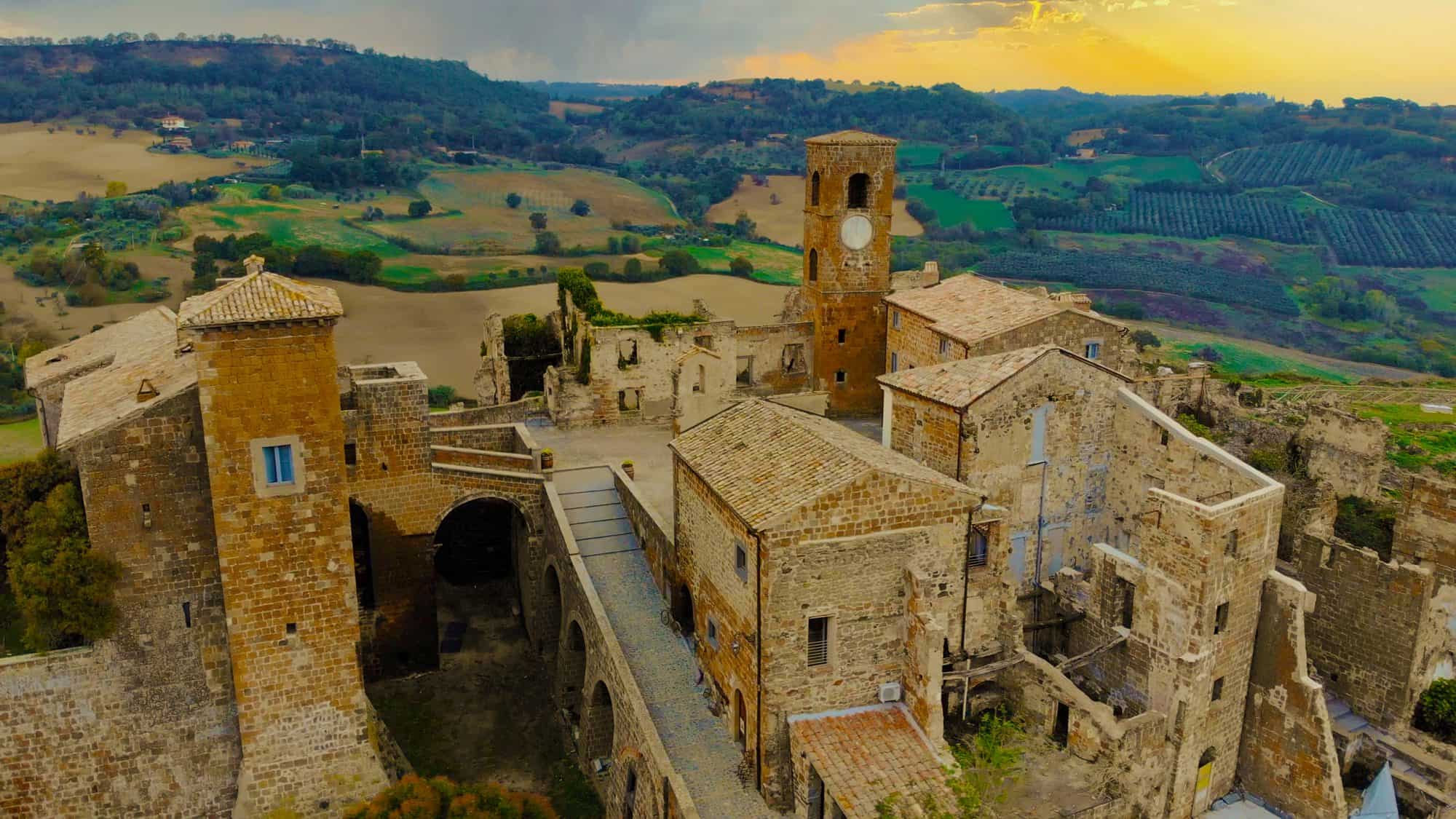
In short. The ghost village of Celleno (VT) occupies a tuff spur 341 meters above sea level, in the Teverina area of Viterbo, about a kilometer and a half from the modern town and some 15 kilometers from Civita di Bagnoregio.
The ghost village of Celleno (VT) occupies a tuff spur 341 meters above sea level, in the Teverina area of Viterbo, about a kilometer and a half from the modern town and some 15 kilometers from Civita di Bagnoregio. From Viterbo it's 20 kilometers to the northeast, from Orvieto 25 to the south. From Rome it's about an hour and a half of travel: A1 toward Florence as far as the Orte exit, then the expressway to Viterbo and the provincial roads of the Teverina. You park in the new town, around Piazza della Repubblica, and walk down toward the plateau of the old settlement. Those arriving by train get off at Orte or Attigliano-Bomarzo, on the Rome-Florence line, but without a car the last stretch remains inconvenient. The full visit of the archaeological and monumental area takes a good hour and a half, longer if you stop at the exhibits set up in the restored houses. Opening hours and fares change with the season and with events: check them on the village's official website, ilborgofantasmadicelleno.com, or by calling 338 7197681, the number given by the site's management. Closed shoes with a lugged sole are not a whim: wet tuff is slippery and the ramps are steep.
If your trip to Tuscia lasts more than a day, it's worth fitting Celleno into a wide loop around Lake Bolsena, which is half an hour of curves from here and completely changes the landscape.
Where Celleno (VT) is and why the village is two
The first thing to understand before leaving is that Celleno is a split comune. There is the living town, with just over 1,300 residents, the town hall, the pharmacy, the schools, grown in two phases from the 1930s around the Borgata Luigi Razza. And there is the dead town, the tuff plateau with the castle, the churches, the squares and the alleys, which the people of Celleno have always simply called Il Castello and which today everyone knows as the ghost village.
The plateau is bounded to the south by the town walls and to the north by the natural slope that plunges toward the gorges. Below, the waters have carved narrow ravines that the old-timers called the Gole dell'Infernaccio, a place name that needs no explaining to anyone leaning over the edge. The urban layout is the classic spindle shape, with the main square at the center and the two gates at the ends, and it can still be read in full because nobody has built on top of it for 70 years.
Anyone who arrives thinking of the postcard of Civita di Bagnoregio is thrown off, and luckily so. Celleno has no scenic bridge and no crowd. It has something Civita has lost, namely silence, and something Civita never had, namely a real castle, with a moat and the double arch of the drawbridge.
The ghost village of Celleno (VT): what you visit, place by place
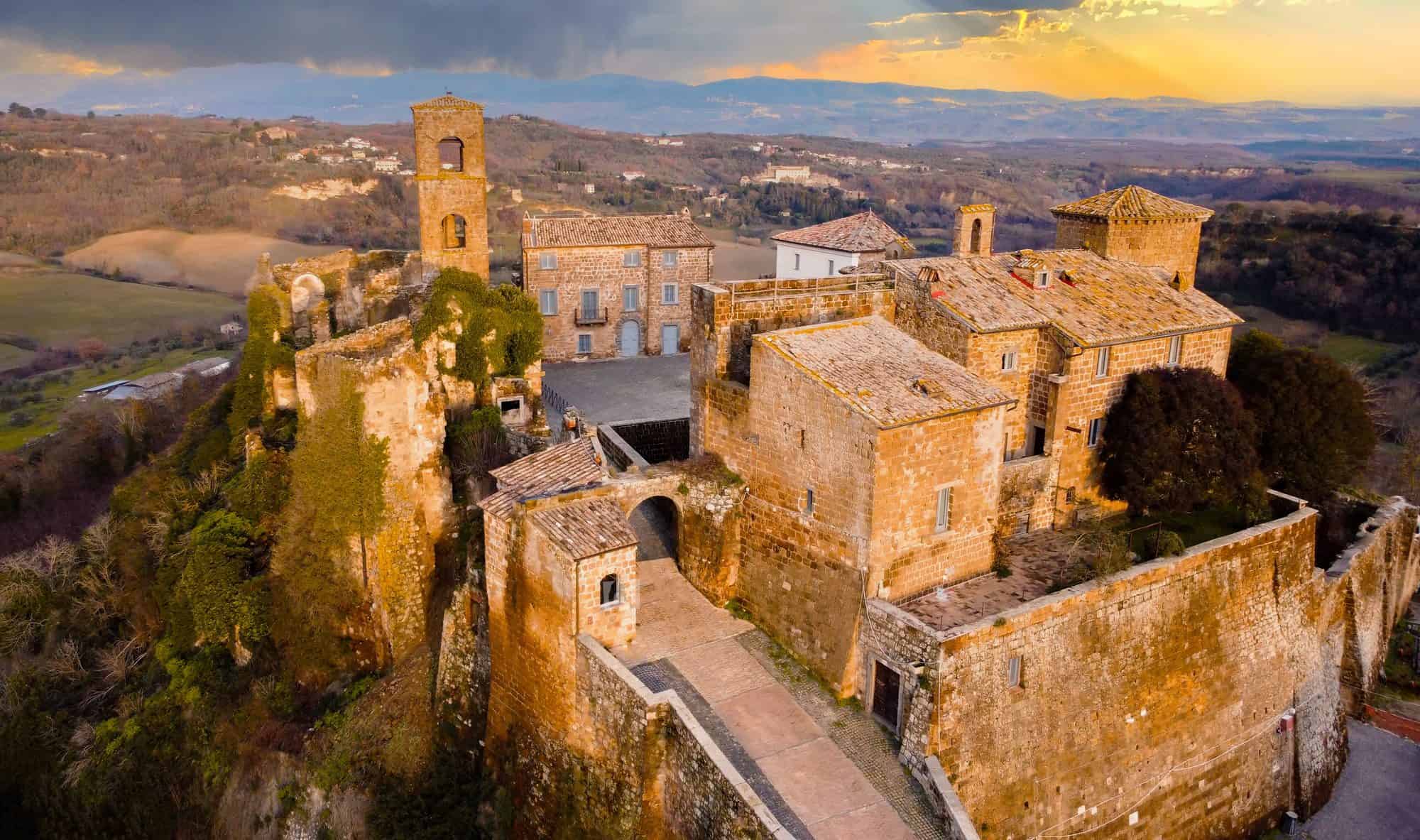
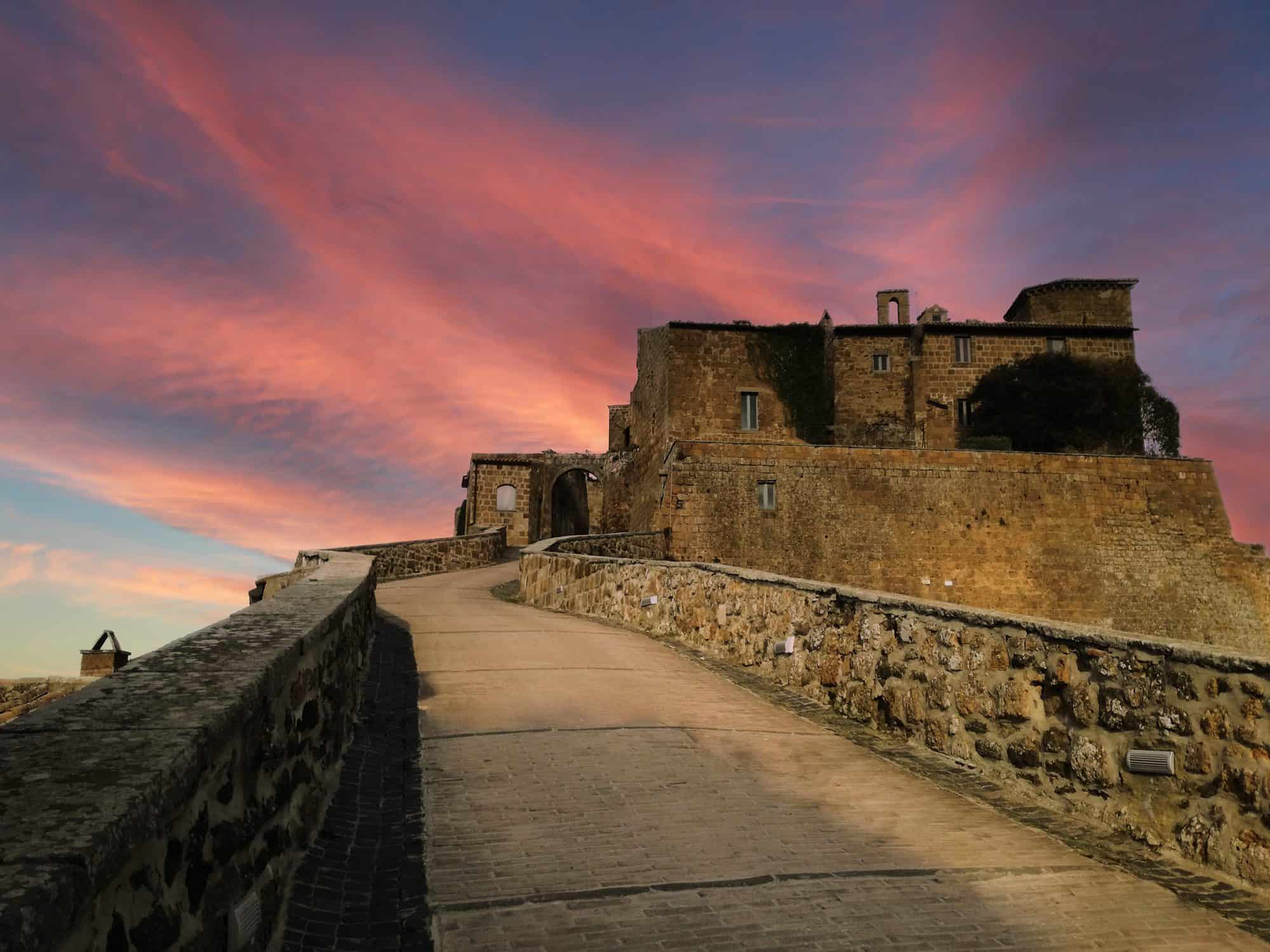
The visiting route is not a tourist loop invented at a desk: it follows the historic road layout. You enter by the scenic Via del Ponte, which leads into the main square through Porta Vecchia, or you pass through Piazza del Mercato, onto which the Castello Orsini faces with a defensive curtain wall more than 10 meters high. Those with time walk both, one on the way in and one on the way back, because the castle changes its face depending on how you approach it.
Via del Ponte and Porta Vecchia
Via del Ponte is the entrance backdrop: it climbs narrow between the tuff walls, bends around the moat and reveals the defensive apparatus one piece at a time. Going up the little road and the staircase you first notice the imposing battered masonry that reinforces the fortress and the Torre Piccola, then, at the last bend, the double arch of the drawbridge. It's a piece of medieval stage direction that still works today, and it's worth slowing down instead of photographing right away. Porta Vecchia marks the passage from the space of transit to that of the community: on that side there's the countryside, on this side there was the town.
Piazza del Mercato, also called Il Torracchio
Piazza del Mercato, which the people of Celleno also call Il Torracchio, probably arose during the 15th-century urban development, when the village at the foot of the castle consolidated and the church of San Rocco was built. It was not only the place of commercial exchange: it acted as an urban and social hinge between the two cores of the settlement, the high fortified one and the low open one. From here the castle's curtain wall is appreciated for what it is, a defensive wall and not a showpiece facade.
The Castello Orsini of Celleno (VT)
The fortress is the best-preserved building on the plateau and continues to organize the urban layout even amid general abandonment. The severe facade has kept its original defensive vocation, appreciable in the original plainness of the masonry: no decoration, no rustication, only the geometry of the blocks and the cut of the windows. The term Castello, in the mouths of the people of Celleno, has always had the generic meaning of castrum, that is, the walled perimeter of the settlement. The actual fortified building, once the seat of the town hall, is distinguished by calling it the Castello degli Orsini, after the family that held the fief from 1527 to 1580.
Look at the moat from below and then at the bridge from above. The difference in height tells better than any panel why this place was contested for five centuries.
Piazza del Comune, then Piazza Maggiore, then Piazza del Municipio
The main square has changed its name three times in the land registers: in the Gregorian cadastre of 1816 it is recorded as Piazza del Comune, in the Papal one of 1872 as Piazza Maggiore, in the current one as Piazza del Municipio. Popularly, though, it has always been Il Castello, like the whole district. It was the nerve center of the settlement because the main functions were concentrated there: the administrative one, since the castle proper housed the town government, and the religious one, with two churches facing it.
In the basements and on the ground floors of the buildings the businesses opened: the butcher, the public telephone post, the cobbler's shop. The overall shape of the square fits 13th- and 14th-century models and must have been laid out at the time of the castle's 14th-century completion. Anyone with a good eye will notice that the ground floors are almost all at different levels: tuff is not leveled, it is accommodated.
The church of San Donato, a mother church reduced to a ruin
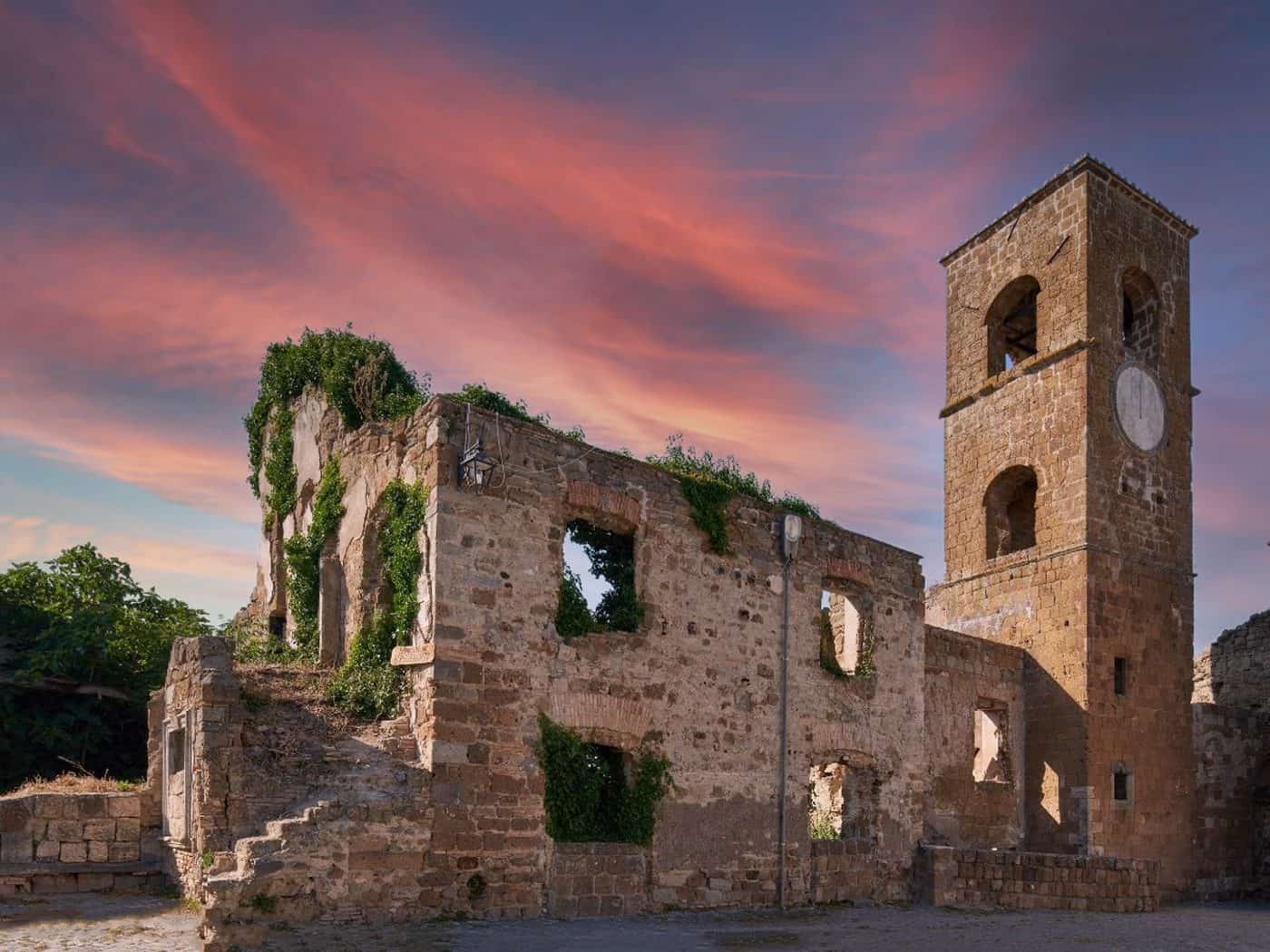
Today it sits off to the side of the square's spatial focus, but San Donato was once the community's mother church. It is in a state of ruin. Of its noble history there remains, on the right side, a side portal datable to the 12th century: a round arch of shaped blocks, worked with a deep torus and with wide, rich jambs, with dentils and diamond points. Anyone who knows the Romanesque of Tuscia recognizes it at first glance as top-quality material.
During the 18th century the church underwent a radical transformation: the original axis was rotated by 90 degrees and the interior was reorganized into three naves of neoclassical taste. An operation that seems like violence to us today and that was then routine business. The paradoxical result is that the oldest piece, the 13th-century portal, is also the best preserved.
The church of San Carlo, founded in the Jubilee year 1625
The church of San Carlo was founded in the Jubilee year 1625, as the inscription on the lintel of the window opening on the side toward the castle reads, where the formula ANO IUBILEI MDCXXV appears. Only five years had passed since the canonization of Charles Borromeo: a community of a few hundred souls dedicating a church to a saint canonized five years earlier tells how quickly devotional fashions arrived even in hilltop villages. The construction, as the inscription on the frieze of the portal specifies, was supported by the then-existing Congregation of San Carlo.
The building is small, with a single nave and a straight back wall. The whole layout betrays the sobriety of the building means. The front ends flat, with a terminal molding of carved tuff blocks onto which the slender little bell gable is grafted. The portal is topped by a thin broken pediment enclosing the symbol of Calvary and brushing the base of the small square window with basaltina jambs. At the corners the masonry is laid with a studied alternation of large, carefully cut tuff blocks. The side toward the castle forms the high flank of the street that takes its name from the church itself: the 17th-century masonry is set on the medieval one, making the most of what was already there. In recent exhibits the interior has housed a collection of gramophones and historic talking machines, and hearing a tin horn in a bare 17th-century church is one of the most curious experiences of the tour.
The church of San Rocco and the wooden Crucifix
San Rocco is the only church on the plateau still in use for services. It stands in the little square of the village born at the foot of the castle and was built to protect the population from plagues: its position extra moenia is no accident, because the saint of contagion willingly kept outside the walls. It stands out for the beauty of the peperino portal, for the altar with the wooden crucifix and for some important fragments of Renaissance frescoes. Between 2001 and 2002 the parish priest don Giorgio Basacca had substantial restoration work done on the altar, the sacristy and the wooden choir, financed by the Fondazione della Cassa di Risparmio di Roma.
The wooden crucifix, 1.70 meters tall, is kept at the altar. By geographic contiguity its most immediate points of reference are the wooden crucifix in the cathedral of Montefiascone and the more famous one in Civita di Bagnoregio, which a widespread critical tradition generically attributes to the 15th century and the Donatello school. Like the dead Christ of Civita, the Crucifix of Celleno too concentrates its force in the face, highly expressive and suffering, fixed in the moment of passing: both sculptures have articulated arms, because during processions they were laid along the body, placed on a bier and carried on shoulders.
The face finds its expressive elements in the half-open mouth, in the eyes barely open in a thin slit and above all in the protrusion of the cheekbones, which underlines the hollowing of the cheeks. Compared with that of Civita, the Crucifix of Celleno shows greater articulation and less formal compactness. The dating to the 1400s is rejected by both stylistic analysis and documentary evidence: the work is more plausibly placed in the second half of the 1600s. The documents also say that only from 1707 does the Crucifix appear above the high altar of San Rocco, perhaps to replace or cover an image of the Virgin that was not well liked. At that date it was not yet provided with the whole Baroque apparatus, because it is recorded only as clausum intra Tabernaculum ligneum serico velo.
The present apparatus is a full-blown altar machine. The Crucifix is placed on a cross painted in black and gold, surrounded by long golden rays alternating with silvered clouds from which cherub heads emerge, of not very refined workmanship. Above, two angels with golden hair and drapery hold a large royal crown over the head of Christ. The whole is set in the complex structure of the Baroque altar and enclosed by glass, like a sculpted altarpiece. In the entablature above, two little angel heads serve as protomes, while in the center appears the radiate dove of the Holy Spirit. Above, within an articulated broken pediment with volutes, caryatids and angels bearing cornucopias and lights, sits the bust of God the Father.
Along the vertical you can read the reason for this machine: setting around the ancient Crucifix the visualization of the Trinitarian dogma, adding to the painfully human dimension of death the other two divine persons. Stylistic and documentary evidence place its making in the first half of the 17th century, and in 1869 a restoration by the gilder Cerroni is documented. Look at it from the entrance and then from below, almost at the level of the step: the machine is calculated for the second point of view, not the first.
The restored houses, the oven and the cobbler's shop
Part of the buildings on the plateau has been consolidated and refitted with rooms that reconstruct everyday life in the early 1900s: the oven, the cobbler's shop, domestic interiors with tools, vessels, beds. This is the real reason Celleno deserves more than a scenic stroll. Many abandoned villages offer ruins. Here they chose to put the town back on stage as it was the day before the evacuation, and you can feel the difference.
An observation as a professional: reconstructing rooms is a genre that can slip into folklore. Here it holds up because the objects come from the area and because the architectural context is authentic. Don't expect a tidy ethnographic museum with scientific captions, though: it's a living exhibit, which changes over the years and which is animated on festival days.
The Etruscan storeroom dug into the tuff
Among the rooms you can visit there is an underground chamber dug into the tuff bank, interpreted as a storeroom of the Etruscan era, with containers and fire vessels. Life on this spur has been practically uninterrupted since pre-Roman times: Etruscan tombs of the 7th and 6th century BC come from the Celleno territory, and part of the recovered materials has gone into the collections of the Museo Nazionale Etrusco di Villa Giulia in Rome. The tuff that doomed the town is the same that made it livable for 25 centuries: it is dug with an ax, it stays cool in summer, it lends itself to cellars, stables and storerooms.
The majolica of the 1400s
The Castello site has yielded a series of majolica pieces of marked homogeneity, generally datable to the first half of the 1400s and traceable to three groups of provenance: imports from Orvieto, from Viterbo and from Tuscany. It's a detail that at first sight seems for specialists and that in fact says a great deal: a town of a few hundred families was buying ceramics from three different production districts, so it was plugged into broad trade circuits. The majolica is displayed in one of the rooms along the route, together with medieval and Renaissance materials.
The Convento di San Giovanni Battista, the gateway to the village
In Celleno they simply call it Il Convento. It is a remarkable complex that introduces the village, in a dominant position on the southern side of the Tiber Valley. Along the road the sequence formed by the left flank of the little Romanesque church and the facade of the main church unfolds discreetly, linked by a series of four arches. At the back, instead, the rest of the building stretches out with far greater monumentality down to the slope covered by a wood of centuries-old holm oaks.
The foundation dates to the beginning of the 17th century: by a letter of May 5, 1608, Pope Paul V granted permission to build, in order to house religious who would provide for the spiritual needs of the people of Celleno. The place chosen was where a small church of Romanesque layout stood, which on the outer facing of the apse shows a succession of hanging small arches in the Lombard style, probably of the 10th or 11th century. A community of Franciscans settled there as early as 1610.
The structure suffered considerable damage in the disastrous earthquake that struck nearby Bagnoregio in 1695. The frescoes distributed in the different interior rooms date to the 16th and 17th century, with a fragment by an older and more valuable hand in the cellar room. In 1716 a friar of the community frescoed the galleries of the cloister with portraits of Franciscan saints. Between 1754 and 1769 the convent saw a campaign of works and enlargements. To the frescoed cloister are added a monumental well and the park of holm oaks: on summer days it is the coolest point of the whole visit.
Inside, only one of the 18th-century tiles of the Way of the Cross is preserved, originally placed in the first shrine on Via Roma and returned by a private individual to the current owners of the former convent structure. It depicts station number one, Jesus is condemned to death. The tile is attributable to the workshop of Gregorio Caselli, the leading exponent of 18th-century Deruta ceramics. The painter Giovanni Meazzi was active with him, a refined author of many works that show significant analogies with the Celleno tile in period of production, stylistic features, and the size and shape of the clay molds.
In 1875 the convent was hit by the suppression laws, but in the following years the friars managed to regain possession of it, settling the rent with which the state property office had leased it to the Comune di Celleno. It was not enough to save it from abandonment: in 1968 the Roman Province of the Friars Minor Conventual transferred it to a private party. To that period of decay dates, in all likelihood, the loss of the large paintings that adorned the side altars of the main church, now deconsecrated, which keeps only a remarkable 18th-century wooden choir and the remains of a fine fresco depicting the Virgin. In more recent years the complex has passed into the ownership of the Centro Comunitario, which runs it directly and hosts training and hospitality activities there.
Via Roma and the Salita dei Misteri
Via Roma is a stretch of road of particular importance from the historical, urban and architectural point of view: it starts from the entrance of the former Convento di San Giovanni Battista and runs for about 110 meters to Piazza San Rocco. It is characterized by the retaining wall, on average 3.6 meters high, on which the stations of the Way of the Cross stand: hence the popular name Salita dei Misteri. The shrines end in a pediment and are interspersed with panels of plain plastered masonry, topped by a coping of hand-worked basaltina blocks.
Today the shrines lack their original ceramic tiles, stolen along with other works of art in the 1970s, after the sale of the Convent to private parties. 13 remain in all: eight facing Via Roma and five right up against the portico of the church of San Giovanni Battista. Walking along a devotional path emptied of its contents is, in our judgment, the most melancholy moment of Celleno, more than the view of the gutted houses.
The Way of the Cross and the 18th-century enclosure
The Way of the Cross was built around the middle of the 18th century, at the same time as the enclosure wall of the cloister. To the same period date a dormitory wing on the side facing the town, made up of about 10 rooms, the infirmary, the pharmacy, the chapel, the loggia, the confessionals of the church, the furnishings of the sacristy and other decorative works. These works were finished in 1769 and allowed the convent to take in a larger number of friars and to host one of the professors of the religious province.

The history of Celleno (VT): from the Etruscans to the Papal State
The occupation of the spur dates to pre-Roman times, with an almost uninterrupted continuity of life. The first specific news about the foundation of the castle, though, is from the year 1026, when Emperor Conrad II the Salian granted this territory to the family of the Counts of Bagnoregio, who made it a strategic outpost for controlling the area. At the beginning of the 12th century the castle of Celleno appears included in the list of places allied with the Church against the imperial threat: a switch of sides that says how much the position was worth.
By the end of the following century the fortified settlement came under the hegemony of the powerful Comune of Viterbo and was therefore involved in the military events of the area, including the destruction of Ferento and the long dispute with Orvieto. Having meanwhile constituted itself a free Comune, Celleno continued its policy of alliances with Viterbo, engaging in the harsh controversies with Rome.
During the 1300s the castle went through the alternating fortunes of the rivalry between Guelphs and Ghibellines. In the 15th century it became a possession of the Gatti family. From 1527 to 1580 it was a fief of the Orsini, the family from which the castle still takes its name. From the end of the 1500s Celleno was reabsorbed into the Papal State and progressively lost strategic importance, heading into a decline that no one was ever able to reverse.
A heraldic detail that closes the circle: the Comune's coat of arms shows a harpy in natural colors on an azure field, within a shield decorated with a fluttering ribbon. The symbol was adopted relatively recently, not before the Unification of Italy, on the basis of the fascinating but poorly founded hypothesis that the name of the town derives from that of one of the mythological Harpies.
The name of Celleno (VT): harpies, cells and cavities in the tuff
Two families of explanations circulate on the origin of the place name, and it's best to keep them separate by degree of reliability. The first is literary and ancient: the Greek critic and historian Dionysius of Halicarnassus reports that Celleno was founded by Italus, a descendant of Oenotrus, in memory of his daughter Cilenia, and this many years before the siege of Troy. To this was attached, in the modern era, the association with Celaeno, one of the three harpies, daughters of Thaumas and Electra in Greek mythology, which then became the town's coat of arms.
The second explanation is linguistic and much more solid: the place name may derive from cella, in the sense of a grotto or cavity, with the suffix -anus indicating belonging. In the Celleno territory the tuff soil has always lent itself to the formation of artificial cavities, and the same root is found in other place names in the area, for example Cellere. Between a harpy and a cellar dug in the tuff, philology sides with the cellar. The curiosity lies in a single word, and it is tuff.
Why Celleno (VT) was abandoned: earthquakes, landslides and decrees
The abandonment was not sudden. It was an agony four centuries long, documented step by step. The instability of the ground was known as early as the 1500s: the Statute of Celleno, written in 1572, prescribed penalties for anyone who dug pits for dovecotes, in order not to weaken the tuff mass further. It's worth stopping on this fact: a 16th-century town had already understood the link between digging and instability, and legislated accordingly.
The 17th-century sources continue to record collapses and dangerous dwellings. The disastrous earthquake that struck the Teverina in 1695, and Bagnoregio in particular, imposed drastic measures: digging cellars inside the castle was forbidden and the rebuilding of the castle walls and of the damaged houses in the districts of Piazzarella and Ripa was ordered.
On June 8, 1931 a shock of intensity IV on the Mercalli scale, with its epicenter right at Celleno, aggravated the hydrogeological instability of the settlement. By 1934 the situation at the Castello was dramatic: some homeless families were housed in the Villino Baiocchini, owned by the lawyer Galli. On October 15, 1934 the Town Council resolved to buy land near the Convent, in the area called Orto del Convento, to build public housing, a gym, a casa dei balilla and a military training field. The decision was later revoked: the terrain difficulties made it impossible to expand the town on that land.
In April 1935 the laying of the first stone finally took place at Poggetti, about two kilometers from the old historic center, even though construction of the sewers had begun months earlier. In February 1936 the second lot was solemnly started, in the presence of the Prefect and the Secretary General. Still in September 1946 the then undersecretary Giulio Andreotti wrote to the mayor Luigi Crescia to reassure him of his interest with the public works superintendency, so that work on the dangerous houses would be started.
On March 18, 1951 the Town Council decreed the transfer of the population from old Celleno to the new settlement of the Borgata Luigi Razza. On Christmas Eve of the same year the President of the Republic Luigi Einaudi signed the act that sanctioned the end of the old settlement: the Decree of the President of the Republic of December 24, 1951, number 1746, declared the settlement subject to transfer. The population was forcibly moved to a safer place. Old Celleno ceased to be a town by decree, which is a far more bureaucratic and far less romantic way to die than the ghost village label suggests.
A similar fate befell many other centers of Tuscia and Lazio: Civita di Bagnoregio, Calcata, Falerii Novi at Fabrica di Roma, San Michele in Teverina, Bassano in Teverina. Whoever wants to understand the phenomenon as a whole can compare Celleno with Monterano, abandoned for completely different reasons, with the Rocchettine in Sabina and with the village of Antuni on Lake Turano.
New Celleno and the Borgata Luigi Razza
Piazza della Repubblica is the administrative and social center of the new urbanization, born in the 1930s and made necessary by the progressive erosion of the tuff cliff. The original core is the Borgata Luigi Razza, built by the Genio Civile.
The story has a precise starting date: on July 6, 1935 the minister Luigi Razza visited Old Celleno and, finding it in dangerous condition, ordered the engineer Prezioso to draw up a project for the construction of public housing. Work on what the people of Celleno called the Case Nove began that very year, even though the first-stone ceremony for the second lot is documented only on February 19, 1936, in the presence of the Prefect and the Federal Secretary. Razza didn't live to see any of it: he died on August 7, 1935 in a plane crash near Cairo, at the age of 43. On March 3, 1938 the Town Council decided to name the district after him, and since then it has been called Borgata Luigi Razza.
In April 1936 the new minister Cobolli Gigli expressed a favorable opinion on the definitive transfer of the settlement. On March 30, 1937 the podestà of Celleno asked that storage rooms be built for each apartment, and a year later a regulation was approved for the so-called permanent shelters, with housing managed by the Comune and financed by rental income.
The building types of the permanent shelters
The permanent shelters come in three types. On the main street four buildings of eight units each were built, laid out on two levels with two separate entrances at the sides of the main front. On the secondary streets to the north, on a regular orthogonal grid, are the buildings of two and four units, with a single central entrance and rooms divided over two floors. Only later was a simplified variant introduced, again with buildings on two levels but with the first one raised, so as to easily obtain semi-basement cellars.
On March 12, 1938 the contract was signed to supply the houses with electricity. On April 4 of the same year the units were officially handed over to 24 families of Celleno. The forced transfer of the population also required moving some services, including the bread oven. On September 16 the Società Volsinia di Energia Elettrica installed public lighting, 13 lamps for a total cost of 1,200 lire.
During the war the houses were damaged by cannon fire, machine-gun fire and hand grenades: from 1944 onward the mayors repeatedly asked the competent bodies for reimbursement. All the buildings still keep their original architectural elements today and have undergone a restoration careful to preserve the original color scheme, which provided for differentiating all the buildings. It's a detail that escapes anyone passing by in a car and that deserves five minutes on foot: the public housing of the 1930s, here, had a color plan.
In the postwar period the abandonment of the historic center was completed, because consolidation according to the criteria of the time was considered too costly. The Town Council then decided to enlarge the new settlement with a 50 million loan to build houses for the homeless, who by then amounted to three quarters of the population residing within the town walls. In 1950 the Genio Civile drew up a new project to move the whole settlement into the expansion around the Borgata Luigi Razza. In the following years further permanent shelters, or anti-unhealthy houses, were built in Via Rossini, assigned between 1951 and 1959 and financed with the Fanfani law and the Romita law. In the 1970s came the last expansion dictated by the Genio Civile, before the Comune took back the urban planning functions.
The new church of San Donato and the Rationalist square
First the elementary school was built, then the town hall, finally the church dedicated to San Donato: all to a project by the Genio Civile, following an organic functional layout and an architectural approach of Rationalist legacy. Even today on the main square coexist the administrative center, the religious one and public utility services such as the pharmacy and the post office. The original project for the church called for Neo-Gothic stylistic features, with a central portal topped by a tall and rather improbable gablet: pressure from the then parish priest don Angelo led to simplification, and the result is the better for it.

Enrico Castellani, the painter who bought the castle
In 1973 Enrico Castellani, one of the protagonists of Italian art in the second half of the 1900s, bought the remains of the Castello Orsini of Celleno and began to restore them. He lived there for almost 45 years and died there on December 1, 2017. The Comune later dedicated a square to him in the old village, and Celleno is home to the Fondazione Enrico Castellani, which keeps his archive and certifies his works.
This circumstance changes the way you look at the place. Castellani's extroflexed surfaces, canvases modulated by a grid of nails that generates regular shadows, are work on raking light. Whoever knows them and then walks on the plateau at sunset, while the sun cuts sideways across the tuff walls and every block casts its shadow, understands that the abandoned town and the painter's research spoke the same language. It is not a literary coincidence: it is the reason an internationally famous Milanese artist chose a ruin in the Viterbo area instead of a studio in the city.
The festivals of Celleno (VT): cherries in June, street artists in September
The Cherry Festival and the pit-spitting championship
On the second Sunday of June, with a fringe of days before and after, Celleno organizes one of the oldest Italian festivals dedicated to the cherry. For over 50 years allegorical floats on a cherry-growing theme have paraded. In recent years the giant crostata made with cherry jam has caught on, and above all the pit-spitting championship, a more serious competition than the name suggests, with distances that exceed 20 meters.
A practical warning: during the festival the new town is full and the parking along the provincial road runs out early. If the goal is to visit the old village in peace, June is not the right weekend. If instead the goal is the festival, arrive in the morning and plan on walking. The cherries of the area are the town's signature product and are bought directly from the growers.
The Teverina Buskers, the international street artists festival
Since 2016, on the second weekend of September the old village hosts the Teverina Buskers, an international street artists festival organized by the cultural association Il Circo Verde, based in Celleno, under the artistic direction of Simone Romanò and in collaboration with the Comune and the Pro Loco. In September 2025 the event reached its 10th edition. The format is the classic busking one, free and inclusive shows, contemporary circus and street art spread across the squares and alleys.
Watching a tightrope walker work above Piazza del Mercato, with the castle's curtain wall behind, is one of those experiences that reconcile you to the very idea of a festival. The festival is the first of its kind in Viterbo Tuscia and draws thousands of people every year. Check the program before you leave, because the dates shift by a few days from one edition to the next.
A curiosity about Celleno (VT)
The finest curiosity of Celleno is not a legend. It is a rule of law from the 1500s. In the town statute drawn up in 1572 there is a provision that punishes anyone who digs pits for dovecotes, that is, cavities and small wells in the tuff bank. The stated reason is technical: not to weaken further the mass on which the town rests. It means that four and a half centuries ago a rural administration of a few hundred souls had perfectly understood the mechanism of the instability and had tried to stop it by regulation, exactly as a hydrogeological management plan would today.
The rest of the story says how it ended. In the 1600s the sources record continual collapses and dangerous dwellings. After the earthquake of 1695 it was necessary to forbid again the digging of cellars inside the castle and to order the rebuilding of the walls and houses of the districts of Piazzarella and Ripa. The ban was right and ineffective, because digging in the tuff was how a family built its pantry, its stable, its wine cellar. The town ate its own foundations out of necessity, not ignorance.
There is an equally curious heraldic corollary. The Comune chose a harpy as its coat of arms, on the hypothesis that the name derives from the mythological Celaeno. The choice is recent, not earlier than the Unification of Italy. The more linguistically solid explanation is the other one, the one that derives the place name from cella, that is, a cavity in the tuff. The town, in short, adopted as its symbol a winged monster when its name probably spoke of grottoes, that is, of exactly those cavities that determined its ruin. If you're looking for an irony of history, there it is, served up.
One thing nobody tells you about Celleno (VT)
Almost all the accounts of the ghost village insist on the landslide and the earthquake, as if one night the earth had opened and the population had fled. It didn't go that way, and anyone who visits the place with that idea in mind doesn't understand what's in front of them. Old Celleno was emptied by an administrative procedure lasting almost 20 years, punctuated by resolutions, loans, specifications and Genio Civile projects: the minister's inspection in July 1935, the laying of the first stone at Poggetti in April of the same year, the handover of the first 24 houses in April 1938, the transfer resolution of March 18, 1951 and finally the presidential decree of December 24, 1951 that declared the settlement subject to transfer.
The consequence is that the abandonment was a move, not a flight. Families carried away furniture, fixtures, roof tiles, stones to reuse. Many houses on the plateau have no roof because the roof was taken apart and put back up down in the valley. That is why the village, unlike the towns destroyed by the earthquakes of the Apennines, does not look like a place struck by an instantaneous event: it looks like a place stripped calmly.
Then there is the least known chapter of all, the second plundering. In the 1970s, after the sale of the Convento di San Giovanni Battista to private parties, the ceramic tiles of the stations of the Way of the Cross along Via Roma disappeared, along with other works of art. The shrines of the Salita dei Misteri are all still in place, 13 in all, and all empty. In the same period of decay the large paintings of the side altars of the convent church were lost. The town was not killed by the tuff alone: part of the damage came later, and had human hands.
My advice for visiting Celleno (VT)
First piece of advice, the one worth more than all the others: don't arrive at noon. The plateau is exposed and has no shade, the tuff reflects heat, and in the middle hours of July and August the visit becomes an endurance test. The two right windows are early morning, when the raking light draws the masonry, and the two hours before sunset, when the color of the tuff goes from gray to honey and the valleys fill with haze. If I had to choose only one, I would choose late afternoon.
Second piece of advice: enter by one gate and leave by the other. Go up from Via del Ponte, which bends around the moat and leads you to discover the double arch of the drawbridge after the battered masonry. Then go down from Piazza del Mercato, where the castle shows its curtain wall more than 10 meters high. Going back and forth on the same route halves the yield of the visit, because the whole village is built on sequences of approach.
Third piece of advice, on method: allow an hour and a half for the full tour and don't squeeze it between two other stops. The classic mistake of those who come from the capital is to fit Celleno between Civita di Bagnoregio and the trip back, giving it 40 minutes. Better to pair it with just one other nearby stop, for example Civitella d'Agliano or Castiglione in Teverina, and spend the rest of the time eating well.
Fourth piece of advice, a practical one: call before you leave. Hours change with the season, and on event days the village may be taken over by the setups. The reference number given by the site's management is 338 7197681. Bring water, because there are no bars on the plateau, and shoes with a lugged sole. Anyone who wants a reasoned reading of the places can rely on a professional guide: the network of guides and tour leaders of TourLeaderPro regularly works in Tuscia and organizes tailor-made private and corporate outings.
Another well-known fact, yet rarely cited
That a great artist lived in Celleno is known by many, at least in the Viterbo area. Almost no one, though, really connects the two things, namely that the Castello Orsini was saved because in 1973 a painter bought and restored it. Enrico Castellani, one of the central names of Italian art of the postwar period, arrived here when the plateau was a heap of ruins in an area nobody visited, lived there for almost 45 years and died in Celleno on December 1, 2017.
The well-known fact, then, is the artist's presence. The rarely cited one is its material consequence: without that private purchase, the building that today organizes the whole visit, with the moat, the battered masonry, the Torre Piccola and the bridge, would in all likelihood have collapsed like the houses around it. The preservation of Celleno does not come from a public plan. It comes from an individual choice, and this should give pause to anyone who deals with abandoned villages.
There is a second rarely cited element, and it concerns 20th-century art in the provinces. After Castellani's death the Comune named a square after him in the old village, and Celleno is home to the Foundation that keeps his archive and certifies his works. It means that a town of just over 1,300 inhabitants hosts the reference institution for one of the Italian artists most highly rated on the international market. It's not the random coincidence it seems: it's a sign that Tuscia, from the 1960s onward, has been a laboratory chosen by many artists, as Paul Wiedmer at Civitella d'Agliano and the experience of Opera Bosco in Calcata also show.
The right photo to take at Celleno (VT)
The photograph everyone attempts is the castle head-on from Piazza del Mercato. It's a good image and comes out well even with a phone, but it's the least interesting, because it compresses depth and flattens the relief of the masonry. The right photo is another one: you go up Via del Ponte, pass the curve of the moat and stop where the double arch of the drawbridge lines up with the battered masonry. From there, with the low sun behind the photographer, the two arches stand out and the batter gives back its full shadow. It's the framing that explains the architecture instead of just showing it.
The second image to take home is not a monument. It is the north edge, where the plateau ends and the void begins toward the gorges of the Gole dell'Infernaccio. Put a built element in the foreground, a corner of wall or an empty window, and let the landscape do the rest: that drop in elevation tells in a single frame why the town was abandoned. For the portrait with a setting, instead, the Salita dei Misteri along Via Roma works, with the row of empty shrines on the wall 3.6 meters high.
Two technical warnings. Tuff, in full light at noon, becomes a white surface with no detail: if you can, move the visit to the golden hour. And in spring look for a raised spot that holds together the village and the cherry trees in bloom of the Celleno countryside: it's the only moment of the year when the agricultural landscape enters the frame with a color of its own.
Some important events that happened here in history
The first documented event that counts is from 1026: Emperor Conrad II the Salian grants the territory to the Counts of Bagnoregio, who make it an outpost for controlling the area. It is the official birth act of the castle, and places Celleno right away inside the contest between Empire and Papacy. At the beginning of the 12th century the picture reverses and the castle appears in the list of places allied with the Church against the imperial threat.
The second block of events concerns the territorial wars. By the end of the 1200s Celleno passes under the hegemony of the Comune of Viterbo and is dragged into the area's military affairs, among them the destruction of Ferento and the dispute with Orvieto. Having constituted itself a free Comune, it continues its alliances with Viterbo and its controversies with Rome. In the 1300s come the struggles between Guelphs and Ghibellines, in the 1400s the rule of the Gatti, and between 1527 and 1580 the fief passes to the Orsini.
The third event is geological and has a date: the earthquake of 1695, which struck the Teverina and Bagnoregio in particular, seriously damaged the convent of San Giovanni Battista and forced the administration to forbid the digging of cellars inside the castle and to order the rebuilding of the walls and houses of Piazzarella and Ripa. The fourth is from June 8, 1931, when a shock with its epicenter at Celleno, of intensity IV on the Mercalli scale, accelerated the instability and made the situation unmanageable.
The fifth event is the decisive one and has two dates. On March 18, 1951 the Town Council decrees the transfer of the population to the new settlement. On December 24, 1951 the decree of the President of the Republic number 1746 declares the old settlement subject to transfer. In between, the war: during the conflict the houses of the Borgata Luigi Razza were damaged by cannon fire, machine-gun fire and hand grenades, and from 1944 onward the mayors asked the competent bodies for reimbursement. The sixth and last event is from 1973 and has the opposite sign from all the others: the purchase and restoration of the Castello Orsini by Enrico Castellani, that is, the moment when the decline stops.
Who has passed through Celleno (VT)
The figure who left the deepest mark is Enrico Castellani, who didn't pass through here but stayed: from 1973 until his death, on December 1, 2017, he lived in and restored the Castello Orsini. His presence changed the fate of the village, and today the Foundation that bears his name is based in the town.
In the Renaissance and the early modern era, the lords who counted in central Italy passed through here. The Orsini, one of the great Roman baronial families, held the fief from 1527 to 1580 and gave the castle its name. Before them the Gatti, powerful in Viterbo, had it in the 1400s. And at the origin of it all is an emperor, Conrad II the Salian, who in 1026 granted the territory to the Counts of Bagnoregio. A pope appears in one precise document: Paul V, who by a letter of May 5, 1608 authorized the construction of the convent of San Giovanni Battista.
The political 1900s bring two names. The minister Luigi Razza visited Old Celleno on July 6, 1935, judged the conditions dangerous and ordered the engineer Prezioso to draw up a public housing project. He died a few weeks later, on August 7, 1935, in a plane crash near Cairo, at the age of 43, and the new borgata has borne his name since March 3, 1938. In September 1946 the undersecretary Giulio Andreotti wrote to the mayor Luigi Crescia to reassure him about the start of work on the dangerous houses. Five years later it was the President of the Republic Luigi Einaudi who signed, on Christmas Eve 1951, the decree that closed the history of the old settlement.
Finally there is an ancient and indirect literary passage, which counts as evidence of the place's fame more than as chronicle: Dionysius of Halicarnassus, a Greek historian active in Rome in the Augustan age, reports the tradition according to which Celleno was founded by Italus, a descendant of Oenotrus, in memory of his daughter Cilenia, many years before the siege of Troy. It is myth, not history, and should be taken for what it is. Today, instead, the street artists of half of Europe pass through here, every September, for the Teverina Buskers.
Celleno (VT) with children
It works, and better than many museums. An abandoned town with a castle, a moat and a drawbridge is a natural attraction for a child of six or 10, and the refitted rooms with the oven, the cobbler's shop and the early 1900s interiors give concrete hooks for the story. The Etruscan chamber dug in the tuff, with the containers and fire vessels, is usually the piece that strikes them most.
There are two cautions, and they are serious. The plateau has edges not always protected toward the gorges, so small children must be held by the hand along the north edge. And the ground is uneven: lightweight strollers are no use at all, a baby carrier is better. In June, during the cherry festival, the new town becomes a small fair with allegorical floats and the pit-spitting championship: for a family it's the best day of the year, provided you give up the silence.
Accessibility of the ghost village of Celleno (VT)
It must be said frankly: the old village is a medieval settlement on a cliff, with climbs, staircases and uneven paving. A wheelchair cannot cover the whole itinerary, nor even a significant part of it. Those with mobility difficulties can still reach by car the viewpoints toward the plateau and enjoy the overall view, which is remarkable, and can visit Piazza della Repubblica and the new town with no problem.
For a precise assessment of the route's conditions on the day of the visit, it's best to call ahead to the number given by the site's management, 338 7197681, and ask which stretches are passable. Conditions change with the consolidation works, which on the plateau are recurring.
When to go to Celleno (VT) and when to avoid it
The best season is spring, between April and the first half of May: the Celleno countryside is planted with cherry trees and the blossoming changes the landscape around the cliff. The second good period is fall, from late September to November, when the light drops, the colors of the Convento's holm oak wood warm up and the morning mists fill the Tiber valley.
To avoid, or at least to tackle with smart timing, is peak July and August in the middle hours: on the plateau there is no shade and there are no bars. To avoid, if you're after quiet, are the weekend of the cherry festival in June and that of the Teverina Buskers in September, which are wonderful but crowded. After days of rain the tuff becomes slippery and some stretches may be closed for safety: a phone call before setting out saves two hours of useless travel.
What to eat and what to take home
The signature product is the cherry, grown across the whole hill belt around the town and celebrated by the June festival. In season you buy it directly from the growers, and it's worth taking home the jam too, the one that ends up in the festival's giant crostata. For the rest, the cooking is that of inner Tuscia: extra virgin olive oil from the Viterbo hills, legumes, chickpea and chestnut soups, lamb, raw-milk pecorinos. The wines of the area are those of the Teverina and the Orvieto area, a short distance from the Umbrian border.
No signs are recommended here: in small towns management changes and a list gets old within a year. The rule is simple: you eat where workers eat during the week and hunters on Sunday, and you always ask if the bread is from a local oven. Within 20 minutes by car you find serious trattorie at Civitella d'Agliano, at Castiglione in Teverina and toward Bolsena, where lake fish comes into play.
What to see around Celleno (VT)
The province of Viterbo, as anyone who goes there knows, never stops surprising. Within half an hour are Civita di Bagnoregio, the Parco dei Mostri of Bomarzo with its Mannerist statues, the gardens of Villa Lante at Bagnaia and, a little farther, Palazzo Farnese at Caprarola. To the north open Lake Bolsena and its villages, from Marta to Capodimonte to Gradoli.
Close by there are also Sant'Angelo di Roccalvecce, which became known as the fairy-tale town thanks to its murals, and Civitella d'Agliano, which hides La Serpara, the sculpture garden created since 1997 by the Swiss artist Paul Wiedmer, with over 40 installations immersed in vegetation and openings limited to a few days a year. Those who want to stretch toward the Cimini mountains find Soriano nel Cimino and the old village of Chia. Those who aim for archaeology have Tuscania and Vulci. To organize a multi-day itinerary outside Rome, with realistic timing and your own transport, the section on day trips at ItalyPlanner is useful, designed for those who travel in English.
How to really visit Celleno (VT): duration, route, guide
The full tour takes an hour and a half at an easy pace, two hours if you really stop in every room and read what there is to read. The natural route is this: arrival at the Convento di San Giovanni Battista, climb up Via Roma along the Salita dei Misteri, stop at San Rocco, entrance to the plateau, main square, church of San Carlo, ruin of San Donato, castle with moat and bridge, look-out on the north edge, descent through Piazza del Mercato.
A guide, here, is not a luxury. The village communicates little on its own, because the furnishings are missing, the signs are missing and the people are missing: without a story, a visitor sees walls. With a story, they see a community that held out four centuries on a rock that was crumbling. For organized groups, corporate trips and private outings in Tuscia, the network of licensed tour leaders and guides of TourLeaderPro is a reliable reference. Those instead who prepare a trip on their own and read English will find at ItalyPlanner the Roman base from which to build the outings outside the city.
Quick questions about Celleno (VT)
Where is Celleno (VT)?
In the Teverina area of Viterbo, in northern Lazio, on a tuff spur 341 meters above sea level between Lake Bolsena and the Tiber valley. It is about 20 kilometers from Viterbo, about 25 from Orvieto, about 15 from Civita di Bagnoregio.
How far is Celleno (VT) from Rome?
About an hour and a half by car. The simplest route is the A1 toward Florence as far as Orte, then the expressway to Viterbo and the provincial roads of the Teverina.
Can you get to Celleno (VT) without a car?
It's possible but inconvenient. The useful train stations on the Rome-Florence line are Orte and Attigliano-Bomarzo, and from there you still need a road vehicle. For a day trip from Rome the car remains the realistic solution.
How much does it cost to enter the ghost village of Celleno (VT)?
Fares change with the season and with events under way: check them on the village's official website or call 338 7197681, the number given by the site's management.
What are the opening hours?
Hours also vary through the year, with wider openings in the good season and on weekends. It's best to check them on the official website before setting out.
Do you need to book a visit to Celleno (VT)?
For an individual visit generally no, while for groups and accompanied visits booking is advisable. The phone contact given by the site's management is 338 7197681.
How much time do you need to visit the ghost village?
An hour and a half for the full tour at a normal pace, a good two hours if you stop in the set-up rooms and look at the castle and the churches at leisure.
Why is Celleno called a ghost village?
Because the old settlement was abandoned due to the instability of the tuff bank. The town resolution for the transfer is from March 18, 1951 and the presidential decree that declared the settlement subject to transfer is from December 24, 1951.
Is the village dangerous?
The visiting route has been made safe, but it remains a cliff-top site with elevation changes, steps and edges toward the gorges. You need closed shoes, attention with children and caution after rain, when the tuff becomes slippery.
Can you take photos at Celleno (VT)?
Yes, and the place deserves them. The best light is that of early morning and of the two hours before sunset. At noon the tuff burns out and loses all detail.
Is Celleno (VT) suitable for children?
Very, thanks to the castle with moat and bridge and the reconstructed rooms with the oven and the cobbler's shop. Watch out, though, for the unprotected edges and the uneven ground: a baby carrier is better than a stroller.
Is the village wheelchair accessible?
No, not as a whole: climbs, staircases and uneven paving make the complete itinerary impassable. The viewpoints reachable by car and the new town remain accessible.
Where do you park?
In the new town, in Piazza della Repubblica area, from which you walk to the old village area. On festival days the spaces run out early.
When is the cherry festival of Celleno (VT)?
The second Sunday of June, with the adjacent days. It includes the parade of allegorical floats on a cherry-growing theme, the giant cherry jam crostata and the pit-spitting championship, where distances over 20 meters are reached.
What is the Teverina Buskers?
The international street artists festival that since 2016 has enlivened the old village on the second weekend of September, organized by the association Il Circo Verde with the artistic direction of Simone Romanò. In 2025 it reached its 10th edition.
Who was Enrico Castellani and what does he have to do with Celleno (VT)?
A protagonist of Italian art of the second half of the 1900s. In 1973 he bought the remains of the Castello Orsini and restored them, lived in Celleno for almost 45 years and died there on December 1, 2017. The Foundation that keeps his archive is based in the town.
What is the difference between Celleno (VT) and Civita di Bagnoregio?
Civita is inhabited, scenic and very busy, with paid access via the pedestrian bridge. Celleno is uninhabited, much less visited, and keeps a castle with a moat and drawbridge that doesn't exist at Civita. They are complementary, not alternatives.
What do you see inside the village?
The Castello Orsini, the churches of San Rocco, San Carlo and San Donato, Piazza del Comune and Piazza del Mercato, the Salita dei Misteri along Via Roma, the Convento di San Giovanni Battista with the frescoed cloister and the well, the refitted houses with the oven and the cobbler's shop, the Etruscan chamber dug in the tuff and the 15th-century majolica.
Are there bars or restaurants inside the old village?
Not on the plateau. You bring water and eat in the new town or in the nearby towns of the Teverina.
Can Celleno (VT) be combined with other day visits?
Yes, but without overdoing it. One additional stop only, for example Civita di Bagnoregio, Civitella d'Agliano or Lake Bolsena, makes for a balanced day. Three stops turn it into a race.
What is the best time to visit Celleno (VT)?
Spring, with the cherry trees in bloom, and fall, for the light and the colors. Peak August in the middle hours is the worst choice.
One last thing. Celleno should not be visited as a macabre curiosity, which is how almost everyone tells it. It should be visited as the most readable document we have of a story common to dozens of towns of inland Italy: a community that digs its own tuff to live, weakens the rock that holds it up, tries to stop with a law of 1572, fails, and in the end is relocated by decree. If you get there at sunset, with the right silence, you feel this story under your feet. Go before it becomes fashionable.
Article written by the TourLeaderPro editorial team, contact them for Private/Corporate/V.I.P. Tours and Experiences.
Planning a trip to Rome? The English-language guides to visiting the city are on ItalyPlanner.com.