San Michele in Teverina (VT)
In short. San Michele in Teverina (VT) is a hamlet (frazione) of the municipality of Civitella d'Agliano, in the province of Viterbo, in upper Tuscia, and not an autonomous municipality.
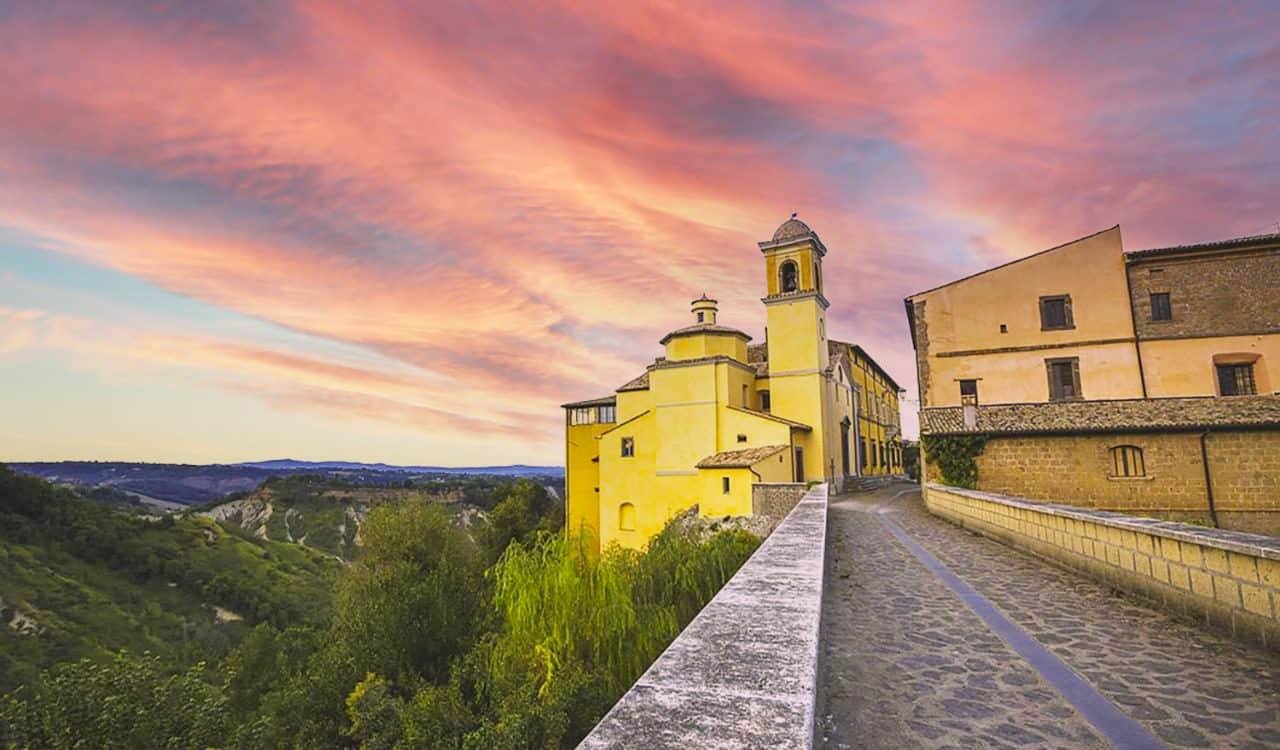
San Michele in Teverina (VT) is a hamlet (frazione) of the municipality of Civitella d'Agliano, in the province of Viterbo, in upper Tuscia, and not an autonomous municipality. The reference town hall is that of Civitella d'Agliano, and the postal code is 01020. The village occupies a tuff spur overlooking the Valle dei Calanchi, the same one that surrounds Civita di Bagnoregio. You get there by car on the Strada Teverina, the provincial road that connects Viterbo to the Tiber valley, or by bus on the Cotral Viterbo-Civitella d'Agliano line, which stops at Roccalvecce, Sant'Angelo in Teverina and Graffignano, with weekday frequencies and reduced service on weekends (schedules on the Cotral website). The most convenient train station is Orvieto, on the Rome-Florence direttissima line, about 20 kilometers away. The village is visited on foot and for free: there is no ticket office, no turnstile, no opening hours. The castle, instead, is today a private historic residence with hotel-style hospitality, at Piazza Castello 1, phone +39 324 9966134. You see the interiors if you sleep there, or during the guided visits organized on certain dates of the year. The rest of the settlement is a dispersed village run by a cooperative of residents, contact +39 333 3244660. For a first orientation to the area it's best to start with the page on Viterbo and the one on Civita di Bagnoregio.
What San Michele in Teverina (VT) really is
Let's start with a misunderstanding that has been going around travel sites for years. San Michele in Teverina does not belong to Civita Castellana, which is on the other side of the province, on Via Flaminia, more than 50 kilometers away as the crow flies. San Michele in Teverina is a hamlet of Civitella d'Agliano, a municipality of a little over 1,400 inhabitants in the northern part of the Viterbo area, toward the Umbrian border. Anyone who sets the GPS to the wrong municipality ends up in another valley, with an hour of driving to make up.
The second fact to make clear concerns the population. The village has fewer than 200 permanent residents, and it's a figure that has to be read for what it means: a community that shrank by three quarters in the 1900s and that today keeps open a few houses, a bar, a church and a castle. The depopulation is not a colorful anecdote. It's the reason why over the last 20 years a model of dispersed hospitality was born here instead of a hotel. In the village you sleep inside the residents' houses, you eat where they eat, and tourism works as a supplement to farm income, not as a replacement.
The third fact is geological, and it conditions everything else. San Michele in Teverina stands on the boundary between two materials that don't get along: above, the compact tuff of the Bolsena volcano, below, the Pliocene clays of the Tiber basin. Rainwater digs into the clays, the tuff stays hanging, and the result is the calanchi, those blades of white-gray earth grooved like the backs of animals. It's the very same mechanism that is eroding Civita di Bagnoregio. With one difference that seems decisive to me: at Civita there are 2,000 visitors a day in high season, while at San Michele in Teverina, in the same landscape, on an October afternoon you meet three people.

How to get to San Michele in Teverina (VT)
By car to San Michele in Teverina
From Rome the fastest route is the A1 highway to the Orvieto exit, then State Road 71 south and the turnoff onto the Teverina. It takes around two hours, traffic permitting. From Viterbo you take the Strada Teverina heading northeast and continue for about 40 kilometers through Roccalvecce, Sant'Angelo and Graffignano. It's a narrow provincial road, with hairpin bends, blind curves and flocks crossing, and the real time always exceeds the one estimated by the GPS. Anyone arriving on the A1 from the north gets off at Orte and goes up along the Tiber. The last kilometer is a climb that narrows until it becomes a tight alley between the houses. Anyone driving a camper or a long van should stop before that, at the entrance to the village.
By public transport to San Michele in Teverina
The connection exists and it's the Cotral one that links Viterbo to Civitella d'Agliano, stopping at Celleno, Roccalvecce, Sant'Angelo in Teverina, Graffignano and San Michele. In timetable apps the stop often appears abbreviated as "S. Michele Teverina". It's best to search for the single word instead of the full name, otherwise the search engine doesn't find it. The service is tuned to commuters and students, so it works well on weekdays and thins out a lot on Saturday and Sunday. From Rome the realistic route is a train to Viterbo and then a bus, with a departure from the capital early in the morning. Alternatively you get off at Orvieto by train and continue by taxi or rental car: about 20 kilometers, but with no direct lines. Practical advice: if the goal of the day also includes the calanchi, public transport is not enough. You need your own vehicle or a driver.
Where to park at San Michele in Teverina (VT)
There is no paid parking lot or equipped area. You leave the car in the wide spots at the entrance to the settlement, before the roadway narrows, and enter on foot. The castle square is not a parking lot, even when it looks empty. It's the courtyard of an inhabited residence and the residents' passage must be kept clear. On the days of the patron saint's festival access to the center is closed completely.
The village of San Michele in Teverina (VT), street by street
The layout of the town is that of a castle that has dissolved into a village. At the top of the spur are the Renaissance palace and the remains of the medieval fortress. In front, a square that was never a public square but the castle's parade ground. And from there, radiating out, three or four alleys that descend toward the edge of the tuff and open onto the void. You can walk all of it in 20 minutes. The point is that 20 minutes are not enough, because almost every doorway tells something: reused lintels, chiseled-off coats of arms, blocked windows, mangers carved in the tuff on the ground floor of the houses.
The castle square of San Michele in Teverina
It's the geometric heart of the village and also its most frequent misunderstanding. Anyone arriving thinks they're in a municipal square with a castle on one side. In reality the entire space was inside the walls, closed, controlled, and the houses that border it today leaned against the defensive curtain walls after they were dismantled. Look at the base of the buildings on the south side: the masonry changes at mid-height, below are the squared blocks of the fortification, above the exposed tuff of the farmhouses. The line of the moat can be read in the difference in level you climb as you enter.
The church of San Michele Arcangelo
The parish church bears the name that gave the village its name, and it's listed in the registry of places of worship of the Italian Episcopal Conference together with the village's second church. The cult of Saint Michael in Tuscia normally follows ridge routes and passes, and the dedication to Saint Michael the Archangel along the Tiber valley almost always has to do with the Lombard presence in the early Middle Ages. It's a recurring hypothesis in studies of the territory, not a documented fact for this single building, and it should be taken for what it is. The interior is simple, with a single nave, and to see it you have to find it open: there is no custodian here, you go in during services or by asking around. The patron saint's festival falls around September 29, the liturgical date of the holy archangels, and it's the day on which the village fills up again.
The church of the Immacolata Concezione
The village's second church, also listed by the CEI, is smaller and goes unnoticed by those who walk distractedly. It's worth a stop for the opposite reason to the one that usually takes you into a church: not for a masterpiece, but to grasp how structured the religious life was in a community that today counts fewer than 200 souls. Two churches in a settlement of this size mean confraternities, oratories, testamentary bequests and a social organization that the current number of residents doesn't even let you imagine.
The alleys and the viewpoint of San Michele in Teverina
The best moment of the visit is not in the square. It's where the alleys end against the parapet and the valley opens up. From there, on a clear day, you can make out the calanchi in the foreground, the profile of Civitella d'Agliano on its plateau and, toward the west, the unmistakable silhouette of the spur of Civita di Bagnoregio. It's the view that justifies the trip. Bring a pair of shoes with a deep tread: the paving is uneven and going downhill it gets slippery as soon as it rains.
The Castle of San Michele in Teverina (VT)
Castel di Piero, the fortress of the Baglioni
The original name of the place was not San Michele but Castel di Piero, from the name of Piero di Mugnano, feudal lord of the Tiber valley who had the fortress built starting in the 12th century. From then on, for about five centuries, the castle remained tied to the Baglioni, the dynasty of condottieri who from Perugia controlled a strip of territory straddling Umbria and Tuscia and who scattered the valley with border fortresses, from Graffignano on down. They weren't showpiece castles. They were garrisons on a supply line between Viterbo and Umbria, built where the tuff offered a defensible position and the horizon let you see trouble coming.
The siege of 1522
The episode that changed the shape of the castle is a family quarrel that degenerated into private war. In 1522 the feudal succession set against each other Piero I Baglioni, who had married a Medici, and Antonio Baglioni of Perugia, related to the Farnese. The siege was led by Galeazzo Farnese. Piero held out, and in the course of the fighting 500 Corsican mercenaries were killed. It's an enormous figure for an armed clash of this scale, and it says how little private the private wars of the early 1500s really were. In the end the castle fell and its defensive structures were largely dismantled. That is why today what remains of the medieval is stretches of wall and not an entire fortress.
The Renaissance reconstruction of the castle
A few years later Piero I regained control of the fief and had the Renaissance palace that you see today built on the remains of the fortress: no longer a war machine but a noble residence, with a courtyard, painted ceilings and reception rooms. Local tradition attributes the direction of the building site to Caterina de Galleto de' Medici, Piero's wife, and to their daughter Virginia Baglioni. There is also a more novelistic version, according to which the fief would have belonged to Catherine de' Medici, the future queen of France, as a cousin of the Baglioni. It's a tradition, not a documented fact, and as such it should be told that way. The distinction matters, because it's exactly the kind of slippage that turns an archive note into a tourist legend.
The rooms of the Castle of San Michele in Teverina today
The palace is today a historic residence with hospitality, and its rooms bear the names of the families who passed through this history. The best-known suite is the Principe di Montholon. Next to it are the Marchese Galeotto de' Medici, the Rooms of Beatrice Farnese, the Penthouse of Francesca Orsini, the Virginia Baglioni, Simonetto Baglioni, Pirro Baglioni and Piero Mugnano apartments, the Villa Raniero Gatti, the Napoleona de Montholon apartment, the Isidoro Benedetti, the rooms named for Pope Paul III Farnese and Pope Clement VII Medici, and the Piccarda Bueri open space. The rooms keep period furniture and frescoed ceilings, with private sitting rooms and relaxation areas. Completing the offer are the apartments that look directly onto the castle square. The rooms and apartments number around 15 in all, for a total capacity of about 25 beds. The exact square footage and availability have to be asked of the property directly. The services include an outdoor pool, a gym, a game room, bicycles, an in-house church, wine tastings and transfers on request. Official website: castellodisanmichele.it.
A useful remark, because the question is frequent: sleeping inside a castle is not the same as visiting it. If your interest is historical and not hotel-related, the good opportunities are the guided visits that local associations organize on certain weekends, often pairing San Michele in Teverina with the castle of Graffignano. They cost little, last a morning and take you inside rooms that otherwise stay closed.

From the Domicelli to the Benedetti del Precetto
In the 1600s the castle passed by inheritance to the Domicelli of Orvieto, and then to other noble families, in that continual turnover of houses that in the Papal State went along with marriages, debts and bankruptcies. At the end of the 1700s the fief, by now renamed San Michele, belonged to Prince Benedetti del Precetto, count of San Michele. The change of name is not a registry detail. It marks the passage from a feudal and military identity, tied to the founder Piero, to a parish and community identity, tied to the patron saint of the church.
The Montholons, Napoleon and Saint Helena
In 1849 San Michele was bought by the family of the Princes of Montholon, and here the story of a village in the Viterbo area crosses European history. The most famous member of that house is Charles Tristan, Marquis de Montholon, born in Paris in 1783 and died in 1853. He followed Napoleon into exile on Saint Helena after the second abdication of 1815 and stayed at Longwood until the emperor's death, in May 1821, collecting his memoirs and later publishing the Récits de la captivité de l'Empereur Napoléon à Sainte-Hélène in 1847. On Saint Helena, in 1816, a daughter, Hélène, was born to him. After imprisonment in the fortress of Ham and his release in 1847, he was a deputy in the Legislative Assembly of the Second Republic in 1849. His heirs held the castle until 1970. A small note on method: modern historiography has shown that Montholon's military memoirs contain several autobiographical falsehoods, battle wounds included. Which makes the character more interesting, not less.
The Valle dei Calanchi around San Michele in Teverina (VT)
How the calanchi are born
The calanco is a form of accelerated erosion that occurs on poorly permeable clays with no vegetation cover. Rainwater doesn't penetrate, it runs along the surface, cuts parallel furrows that get ever deeper, and in a few seasons sculpts those sharp ridges that from far away look like dunes and up close are vertical walls of hardened mud. Here the phenomenon is amplified by the stratigraphy: the tuff of the Vulsini complex, compact and heavy, rests on friable Pliocene clays. The clays retreat, the tuff is left jutting out, and sooner or later it gives way in blocks. It's the same dynamic that made Civita di Bagnoregio famous, where the documented erosion processes go back more than a thousand years and soil consolidation techniques have followed one another from the 1300s onward.
The UNESCO candidacy and what it means for San Michele in Teverina
On January 31, 2017 the cultural landscape of Civita di Bagnoregio was entered in the Italian tentative list of the World Heritage Centre, in the cultural landscape category, under criteria (iii) and (v). The dossier insists on a point that isn't intuitive: the value of the site is not only the preserved medieval settlement, but the complete catalog of consolidation techniques applied for centuries to ground that slides. Tentative list means formal candidacy, not inscription. Anyone who reads "UNESCO site" applied to the calanchi is anticipating an outcome that doesn't exist yet. San Michele in Teverina belongs to the same landscape system and shares its fragility, with an out-of-the-way position that has so far protected it from overcrowding.
Walking among the calanchi from San Michele in Teverina
From the village you descend toward the valley floor along dirt tracks and paths that connect San Michele to Civitella d'Agliano and, by longer routes, to the area of Lubriano and Bagnoregio. They are poorly marked trails, crossing private property and cultivated fields. The elementary courtesy is to ask in the village before setting out, and the elementary prudence is never to go near the edge of the calanchi, which is unstable by definition and gives way without warning. After rain the clay becomes impassable, it sticks to your boots in layers two fingers thick and turns a walk into a slog. Right season: late April, May, or October.

Frequently asked questions about San Michele in Teverina (VT)
Where exactly is San Michele in Teverina?
San Michele in Teverina is in the province of Viterbo, in upper Tuscia, on the edge of the Valle dei Calanchi, with postal code 01020. It is a hamlet of the municipality of Civitella d'Agliano and has no administrative link with Civita Castellana, a different municipality in the same province, much farther south.
Is San Michele in Teverina an autonomous municipality?
No, San Michele in Teverina is not an autonomous municipality. It is a hamlet of Civitella d'Agliano, and for certificates, registry and public offices you refer to that town hall. The village is nonetheless a recognizable settlement, built around the remains of a medieval castle.
How do you get to San Michele in Teverina from Rome?
From Rome to San Michele in Teverina the fastest route is the A1 highway to the Orvieto exit, then State Road 71 south with a turnoff onto the Teverina. The trip takes around two hours, traffic permitting. From Viterbo you take the Strada Teverina northeast, through Roccalvecce and Graffignano.
Can you visit the castle of San Michele in Teverina?
The castle of San Michele in Teverina, today known as Castel di Piero, is private property with a hospitality function. It has no ticket office or public opening hours and does not appear in the lists of visitable monuments. On certain chosen dates some cultural associations organize visits, but you have to ask in advance to find out.
Can you stay overnight in San Michele in Teverina?
Yes, in San Michele in Teverina the hospitality is organized as an albergo diffuso, with restored residents' houses made available. There are five properties, all inside the village: L'Angoletto dei Calanchi, L'Olivo, La Casetta del Pàstine with its two units, and I Corbezzoli, for a total of about 22 beds.
Is San Michele in Teverina good for kids?
San Michele in Teverina works better with children than you would imagine, on two conditions: leave the stroller in the car, because the paving and the slopes of the village make it unusable, and pay attention to the parapets, which in some stretches are low and look onto drops of clay. A village without car traffic is nonetheless a relief for anyone with small children.
What is the best time to go to San Michele in Teverina?
The best time to visit San Michele in Teverina is spring and autumn. Between mid-April and the end of May the calanchi still have a veil of green at the base and the trails are dry, while October gives the best colors along with the harvests just finished.
What is there to eat and drink near San Michele in Teverina?
Near San Michele in Teverina the cooking is the typical cuisine of inland Tuscia, made of legumes, farro soups, acquacotta and pecorino. The product that made this municipality famous in the wine world is Grechetto, grown in Civitella d'Agliano by the Sergio Mottura winery on 120 hectares among the calanchi and the Tiber plains.
Sleeping in San Michele in Teverina (VT): the dispersed village
The village's hospitality, outside the castle, is organized as an albergo diffuso: restored residents' houses made available, with a distributed reception and community management. There are five properties, all inside the village: L'Angoletto dei Calanchi, four beds. L'Olivo, four beds. La Casetta del Pàstine in the two units I Platani and Il Melano, five beds each. I Corbezzoli, four beds. 22 beds in all, which gives the measure of how small the scale of this tourism is. The offerings include trekking, bike touring, yoga and wellness, food and wine tastings, horseback riding and cultural visits. Contacts: phone +39 333 3244660, email sanmicheleborgo@libero.it, website sanmicheleborgo.com.
Blunt opinion: this is the best reason to come here instead of Civita. At Civita di Bagnoregio you pay a ticket, cross the bridge in a line and head back after an hour. At San Michele in Teverina you sleep inside the village and in the evening you are left alone with the calanchi. They are two different experiences, and anyone with two days should do both, in that order. To organize the whole itinerary with a professional on site you can turn to the network of guides of TourLeaderPro.
A curiosity about San Michele in Teverina (VT)
The real curiosity concerns the name, and it's a story of place names that tells five centuries of social history in two words. Until well into the 1500s this place was called Castel di Piero: the name of a man, Piero di Mugnano, the lord who had built the fortress in the 12th century. A purely feudal place name, the kind that declares who is in charge and leaves no room for doubt. At the end of the 1700s, in the documents of Prince Benedetti del Precetto, the fief appears already renamed San Michele: the man's name is gone, replaced by that of the patron saint of the church. In between there had been the siege of 1522, the dismantling of the defenses, the transformation of the fortress into a palace and the slow metamorphosis of a garrison into a community of farmers.
The second element of the name, "in Teverina", is just as telling. The Teverina is not a municipality and not a province. It's a name of a territory, the band of hills that accompanies the Tiber between Lazio and Umbria, and it recurs in a string of nearby place names, from Castiglione in Teverina to Sant'Angelo in Teverina. These are towns that for centuries looked to the river as their main street, when the Tiber valley was a trade route and not a valley floor crossed by a highway. Whoever settled the current name, in practice, recorded two belongings: the religious one and the river one. Of the feudal one, which had lasted 500 years, nothing is left, not even on the road sign. A curiosity, I'll add, that satellite navigators keep handling badly, because the double name regularly sends outsiders looking for San Michele in the wrong province.
Something nobody tells you about San Michele in Teverina (VT)
That the castle can be visited without sleeping there, but only on chosen dates, and that nobody will tell you unless you ask. The palace is private property with a hospitality function: it has no ticket office, no opening hours, and does not appear in the lists of visitable monuments. Anyone who arrives in the square and finds the door closed concludes that the castle cannot be visited and leaves. In reality some local cultural associations, with the agreement of the owners, organize guided visits during the year that go into the historic rooms, often on days that pair San Michele in Teverina with the Baglioni castle of Graffignano, a short distance away. They are mornings of three or four hours, with a meeting point in the village and mandatory reservation, and they cost a fraction of what you spend for a state museum.
The second piece of information that almost nobody gives concerns the right way to ask. In a village of this size there is no tourist office, and the channel that works is the telephone: the castle's for the interiors, the dispersed village's for the rest. Anyone who calls a few days ahead, explaining what they want to see, almost always finds someone willing to open a church or point out the right trail. Anyone who shows up unannounced on an August Sunday afternoon finds the village asleep. It's a rule that holds for all of minor Tuscia and that is worth learning once and for all: in towns of 200 inhabitants, welcome is organized, it isn't found. It holds for groups too: managing a group here requires arrangements made in advance, as the pages on organizing group travel in Italy explain well.
The advice I give you for visiting San Michele in Teverina (VT)
Come in the late afternoon and stay overnight. It's the most concrete advice I can give about this place, and it's worth more than any list of things to see. San Michele in Teverina has no monument that justifies the trip on its own. It has a position, and the position pays off only in a certain light. In the three hours before sunset the calanchi go from the flat gray of midday to a pinkish ocher that digs out every furrow, and the profile of Civita di Bagnoregio detaches from the valley floor like an island. At that point the village counts three visitors and you are all three.
The second piece of advice concerns the pairing. Anyone with only one day who arrives from Rome should do it like this: morning at Civita di Bagnoregio, when the bridge can still be walked without a crowd. Lunch at Castiglione in Teverina or at Civitella d'Agliano. Afternoon and sunset at San Michele in Teverina. This way the minor village is not the side dish but the finale, which is the role it plays best. Anyone with two days should add Celleno and Bolsena, or go down toward Viterbo and the medieval San Pellegrino quarter.
Third piece of advice, one of the boring ones that nonetheless saves the day: fill up on gas beforehand. Between Graffignano and Civitella d'Agliano the gas stations are few and close early, the phone signal in the valley floors of the calanchi comes and goes, and downloadable map coverage really helps here. Bring water, because in the village there is no bar open at all hours, and allow for the last stretch of road slowing you down to 30 kilometers an hour. Anyone planning from outside Italy will find a general overview of the region in the English guides of ItalyPlanner dedicated to Lazio.
Another well-known fact, yet rarely cited
That the Baglioni were not only the owners of this castle, but one of the most violent and unluckiest families of the Italian Renaissance, and that San Michele in Teverina belongs entirely to that story. The Perugian branch of the Baglioni is known to historians for the "red wedding" of July 1500, the massacre within the house carried out in Perugia during the celebrations of a marriage, and for the arc that led Gianpaolo Baglioni to beheading at Castel Sant'Angelo in 1520, on the orders of Leo X. It's the frame within which the succession quarrel of 1522 that ended with the siege of Castel di Piero has to be read: not a provincial oddity, but the last act of a family war that had already bloodied Perugia and that here, on the edge of Tuscia, found one of its appendages.
The second little-cited fact concerns a woman. Francesca Baglioni Orsini, daughter of this house, is remembered by the learned sources as the founder of the Roman monastery of Santa Maria dell'Umiltà, of the Order of Saint Dominic. In the 1700s an entire Istoria della vita, ed azioni was dedicated to her, which says how much her figure counted in the Rome of female religious foundations. The link with Marie de' Medici, future queen of France, belongs to family tradition and not to solid documentation, and should be taken as such. The substantial point remains: from this border fortress, in two generations, came people who left a mark on Perugia, on Rome and, with the Montholons three centuries later, on Saint Helena. For a town of 200 inhabitants that's not bad.
The right photo to take in San Michele in Teverina (VT)
The photograph that works for this place is not the castle. It's the castle within the landscape, shot from outside. Leave the village toward the valley, take the dirt track that descends toward Civitella d'Agliano and walk three or 400 meters to the point where the path makes a curve and the village appears alongside: the tuff spur, the houses clinging to the edge, the volume of the Renaissance palace closing the profile at the top and, below, the grooving of the calanchi. A medium lens, between 50 and 85 millimeters equivalent, to compress the planes and give weight to the clay wall. Right time: the last half hour before sunset, when the raking light separates every furrow. Early morning works the opposite way, with the village backlit and the valley full of haze. That's beautiful too, but it's a different photograph.
Inside the village the second image to look for is in Piazza del Castello, at blue hour, when the few lit windows are enough to draw the perimeter of what was the parade ground. Moderate wide-angle, tripod if you have one, long exposure. And a warning: here you are photographing houses lived in by 20 or 30 families who all know each other. You don't point a lens into a window, you don't fly a drone over the roofs without asking, and you don't enter private courtyards to find the framing. Courtesy costs nothing and in a village this small it's remembered for a long time. For the rest, the night sky here is still truly dark: anyone who brings a tripod and a fast lens can try the Milky Way above the calanchi on the moonless nights of July and August.

Some important events that happened here in history
The first is the founding itself. In the 12th century Piero di Mugnano, feudal lord in the Tiber valley, chooses this spur and builds a fortress on it: Castel di Piero is born. The choice of site is not aesthetic, it's military and hydraulic at once, because the tuff guarantees a solid base and the edge of the valley makes three sides out of four unassailable. From that moment the place enters the defensive system that the Baglioni build along the border between Tuscia and Umbria, to protect the supply routes between Viterbo and the Tiber valley.
The second event is the most dramatic: the siege of 1522. A contested succession sets Piero I Baglioni, married to a Medici, against Antonio Baglioni of Perugia, related to the Farnese. The attack is led by Galeazzo Farnese. The defense holds for a long time, 500 Corsican mercenaries are left on the field, but in the end the fortress is taken and its defensive structures dismantled. A siege that ends with the partial demolition of the walls is not just any defeat: it's the deliberate erasure of the military function of a place.
The third is the rebirth. Within a few years Piero I regains possession of the fief and on the ruins of the fortress has the Renaissance palace built, with the contribution, according to local tradition, of his wife Caterina de Galleto de' Medici and his daughter Virginia Baglioni. A castle that stops defending itself and starts receiving guests: it's the transition that in the Italian 1500s repeats itself in dozens of fortresses, and which here can be read with the naked eye in the jump between the squared blocks at the base and the lighter masonry above.
The fourth is 1849, the year of the purchase by the Princes of Montholon. The fief of an Umbrian condottiero passes into the hands of a French family tied to the memory of Napoleon, and stays there until 1970: 121 years, longer than many Italian noble families managed to keep their historic residences. The fifth event has no precise date and is the most important of all: the depopulation of the second half of the 1900s, when the village loses most of its inhabitants and risks ending up like the neighboring abandoned village of Celleno or like Antuni on Lake Turano. The sixth, finally, is the reaction: the birth of the albergo diffuso and the restoration of the castle as a historic residence, two choices that kept alive a settlement that was about to close. And on January 31, 2017, with the candidacy of the cultural landscape of Civita di Bagnoregio for the UNESCO tentative list, this valley too officially entered an international dossier.
Who passed through San Michele in Teverina (VT)
The first name is that of the founder: Piero di Mugnano, the feudal lord who in the 12th century gives his own name to the castle and to the community that grows around it. After him, for about five centuries, the scene is occupied by the Baglioni: Piero I, who in 1522 withstands the siege and then rebuilds the palace. Simonetto and Pirro, whose names survive today in the rooms of the castle. Virginia Baglioni, who according to tradition takes part with her mother in directing the Renaissance building site. On the opposing side appears Galeazzo Farnese, who leads the siege, and in the background the Farnese kinship that a few years later would give the Church Paul III.
On the maternal side pass the Medici. Caterina de Galleto de' Medici, wife of Piero I, is the figure to whom local sources attribute the reconstruction. Tradition then holds that the fief belonged to Catherine de' Medici, the future queen of France, as a cousin of the Baglioni, but the documentation does not confirm it and that should be said clearly. Among the women of this family Francesca Baglioni Orsini stands out, founder in Rome of the Dominican monastery of Santa Maria dell'Umiltà.
In the 1600s the Domicelli of Orvieto arrive, and at the end of the 1700s Prince Benedetti del Precetto, count of San Michele. From 1849 the village belongs to the Montholons, and with them the most famous figure this history can claim enters the scene: Charles Tristan, Marquis de Montholon, Napoleon's companion in exile on Saint Helena from 1815 to 1821, author of the Récits de la captivité, prisoner at Ham and finally deputy of the French Second Republic. Napoleon never set foot here, and on this there are no misunderstandings to feed: it was his memory, carried by the man who had assisted him to the last day, that made its home in the Teverina. In recent times the territory has attracted another kind of outsider, artists: a few kilometers away, at Civitella d'Agliano, the Swiss sculptor Paul Wiedmer opened in 1997 the sculpture garden of the Serpara, four hectares with more than 80 works by more than 30 international artists.
What to see around San Michele in Teverina (VT)
La Serpara, the sculpture garden of Paul Wiedmer
Strada Teverina at kilometer 26, municipality of Civitella d'Agliano. Paul Wiedmer, a Swiss artist, began in 1997 to populate four hectares of countryside with sculptures and installations of his own and those of invited colleagues. Today the works number around 80 and the artists around 30. Visits are by appointment, with a free offering, phone 0761 914071. The place is listed among the places of the contemporary by the Ministry of Culture and fits into the tradition of art gardens of central Italy, the one whose progenitor is the sacred wood of Bomarzo and which has a close relative in the Opera Bosco di Calcata.
Civitella d'Agliano, the municipal seat
Four kilometers of road and you reach the town of which San Michele in Teverina is a hamlet: 1,400 inhabitants on a tuff plateau sloping toward the Tiber, with the Monaldeschi tower, the bastions and the walls that bound the historic center. The parish church of Saints Peter and Callistus dates from the 12th-13th century and holds works by Filippo Naldini and Ludovico Mazzanti. Next to it is the church of the Madonna delle Grazie. The patron saint is Saint Gorgonius. Cardinal Angelo Maria Dolci was born here in 1867.
The castles of the Baglioni and the Teverina
The fortress of Graffignano, from the 1200s, was built to protect the supply line between Viterbo and Umbria and then passed to the Borromeo and the Santacroce. It displays a collection of ceramics recovered from three household refuse pits of the 1500s and 1600s, which tell of daily life better than any fresco. Farther north, Castiglione in Teverina overlooks the confluence of the Paglia and the Tiber and hosts a large wine museum. Toward the west is the abandoned village of Celleno, and beyond the valley floor Orvieto with its cathedral.
The rest of Tuscia within a day's reach
The province of Viterbo never stops surprising, and anyone who comes this far has within driving distance a sampler that's hard to match: the Park of the Monsters at Bomarzo, the old village of Chia dear to Pier Paolo Pasolini and Soriano nel Cimino, the gardens of Villa Lante at Bagnaia, the pentagonal Palazzo Farnese at Caprarola, Lake Bolsena with the town of Bolsena and the Rocca dei Papi at Montefiascone, and farther south the village of Calcata above the Treja valley.
Eating and drinking around San Michele in Teverina (VT)
The cooking is that of inland Tuscia: legumes, farro soups, acquacotta, pecorino, home-cured pork, extra virgin olive oil from the clay hills. But the product that made this municipality famous in the wine world is Grechetto. At Civitella d'Agliano, on Strada Ombricolo, the Sergio Mottura winery works 120 hectares among the calanchi of Tuscia and the Tiber plains, with a production oriented toward whites: Poggio della Costa, La Torre a Civitella, Muffo, as well as Orvieto, reds and a sparkling wine. The old-vine Grechetto selections have put the name of this corner of the province on international wine lists. Cellar visits are booked through the winery's website, phone 0761 914533.
A useful clarification for anyone planning: in the village the dining offer is minimal and the hours follow those of a small community. Anyone who wants to eat out should book at Civitella d'Agliano or Castiglione in Teverina, or arrange to cook in the lodging. It's one of those things nobody considers in Rome and that in a village of 200 inhabitants make the difference between a lovely evening and a sandwich.
San Michele in Teverina (VT) with kids
It works better than you would imagine, on two conditions. The first is the stroller: leave it in the car, because the paving, the stairs and the slopes make it unusable. A baby carrier backpack is better. The second is safety at the parapets, which in some stretches are low and look onto drops of clay. That said, a village where cars don't pass is a relief for anyone with small children, and the view of the calanchi, with the right explanation, becomes a geology lesson that no book can match: water digging, clay sliding, tuff staying suspended. The activities of the dispersed village include hikes and horseback rides, which for the older ones are a real draw. For kids from 10 years up, the combination of the castle and the story of the siege of 1522 always works.
When to go to San Michele in Teverina (VT)
Spring and autumn, without hesitation. Between mid-April and the end of May the calanchi still have a veil of green at the base, the days are long and the trails are dry. October gives the best colors and the harvests just finished. July and August are hot and the midday light flattens the landscape, but the evenings are the reward, with temperatures that here, unlike Rome, really drop after sunset. Winter has a severe appeal, with the fog that fills the valley floor and lets only the plateaus emerge: beautiful to photograph, uncomfortable to visit, because many properties reduce their activity. On September 29, for the feast of the holy archangels, the village fills with those who emigrated and come back. It's the liveliest day of the year and at the same time the one on which it's hardest to find a place.
Quick questions about San Michele in Teverina (VT)
Where exactly is San Michele in Teverina?
In the province of Viterbo, upper Tuscia, on the edge of the Valle dei Calanchi. It is a hamlet of the municipality of Civitella d'Agliano, postal code 01020, and has nothing to do with Civita Castellana, which is another municipality in the same province, much farther south.
Is San Michele in Teverina an autonomous municipality?
No. It is a hamlet of Civitella d'Agliano. For certificates, registry and offices the reference is the town hall of the municipal seat, a few kilometers down the road.
How much does it cost to visit San Michele in Teverina?
Nothing. The village is a public settlement and can be walked freely on foot, without a ticket and without hours. You pay only if you sleep in the castle or in the houses of the dispersed village, or if you take part in an organized guided visit.
How much time do you need to visit San Michele in Teverina?
For just the tour of the village 40 minutes are enough. To do it well, with a stop at the viewpoint and the light of sunset, allow two or three hours. If you add a walk toward the calanchi, half a day.
Can you visit the inside of the Castle of San Michele in Teverina?
Not freely: the palace is a private historic residence with hospitality activity. You see the interiors by staying there or by taking part in the guided visits organized on certain dates of the year by local associations.
How much does it cost to sleep at the Castle of San Michele in Teverina?
Rates vary by season and type of accommodation and are not published in fixed form. They have to be requested from the property, at Piazza Castello 1, phone +39 324 9966134, or through the official website.
What is the dispersed village of San Michele in Teverina?
A hospitality system that uses restored houses inside the village instead of a single hotel. There are five properties, for 22 beds in all, and the management is by the local community.
How do you get to San Michele in Teverina from Rome?
By car about two hours, via the A1 to Orvieto and then State Road 71 and the Strada Teverina. By public transport, a train to Viterbo and then a Cotral bus on the line to Civitella d'Agliano, leaving Rome early in the morning.
Can you get there by public transport on Sundays too?
The Cotral service is tuned to weekdays and is cut back a lot on weekends. For Saturday and Sunday it's best to check the schedules in advance on the company's website or to consider your own vehicle.
How far is San Michele in Teverina from Civita di Bagnoregio?
About 20 minutes by car, within the same Valle dei Calanchi. It's the natural pairing for anyone with only one day.
How many inhabitants does San Michele in Teverina have?
Fewer than 200 permanent residents. The municipality it belongs to, Civitella d'Agliano, counts a little over 1,400.
Is the Valle dei Calanchi a UNESCO heritage site?
Not yet. The cultural landscape of Civita di Bagnoregio was entered on January 31, 2017 in the Italian tentative list, under criteria (iii) and (v). It's a formal candidacy, not an inscription in the World Heritage list.
Can you walk through the calanchi from San Michele in Teverina?
Yes, along dirt tracks and poorly marked paths that descend toward the valley floor. Caution is needed: the edge of the calanchi is unstable and after rain the clay becomes impassable.
Is San Michele in Teverina accessible to people with mobility difficulties?
The historic center has uneven paving, slopes and steps, so passability in a wheelchair is limited. The castle square, however, can be reached from the upper entrance of the village by a short and relatively flat route.
Is there parking in San Michele in Teverina?
There is no equipped area. You leave the car in the wide spots at the entrance to the settlement, before the road narrows, and continue on foot.
Can you take photos in San Michele in Teverina?
Yes, in all public spaces. Common sense applies to the inhabited houses: no lenses pointed into windows, no drones over the roofs without asking, no entering private courtyards.
What is the difference between San Michele in Teverina and Celleno?
Old Celleno is an abandoned village, visitable as a site, with a ticket and a route. San Michele in Teverina is a living, inhabited town, with no ticket office. You are visiting two opposite conditions of the same landscape.
Is it suitable for kids?
Yes, because no cars pass, but without a stroller and with attention to the low parapets above the drops. The horseback rides and hikes organized by the dispersed village work well with older kids.
Is the food good in San Michele in Teverina?
The offer in the village is minimal and with reduced hours. For dinner it's best to book at Civitella d'Agliano or at Castiglione in Teverina. The local wine to look for is Grechetto.
What is the best time to visit San Michele in Teverina?
From mid-April to the end of May and all of October. In summer the evening is excellent. In winter the landscape is splendid but many activities cut their hours.
Do you need to book to visit San Michele in Teverina?
Not to walk in the village. To sleep, to enter the castle or to take a guided visit, yes, and a few days ahead: here welcome is organized by phone, it isn't found by chance.
Is there a tourist office in San Michele in Teverina?
No. The practical contacts are the number of the dispersed village, +39 333 3244660, and that of the castle, +39 324 9966134.
If I had to name a single reason to climb up here, I wouldn't name the castle, deserving as its history is. I would say the silence of six in the afternoon in the square, with the valley changing color every five minutes and nobody around asking you to get in line. Places like this can't stand the masses, and telling about them carries a responsibility: come in small numbers, stay one night, spend something in the village and leave things as you found them. Anyone preparing a broader itinerary in Tuscia will find useful material also in the English guides of ItalyPlanner on day trips and in the pages of TourLeaderPro dedicated to professional guiding.
Article written by the editorial team of TourLeaderPro, contact them for Private/Corporate/V.I.P. Tours and Experiences.
Planning a trip to Rome? The English guides for visiting the city are on ItalyPlanner.com.