Castiglione in Teverina (VT)
In short. Castiglione in Teverina is in Viterbo Province, on the ridge that separates Lazio from Umbria, 228 meters above sea level and about 40 kilometers from Viterbo.
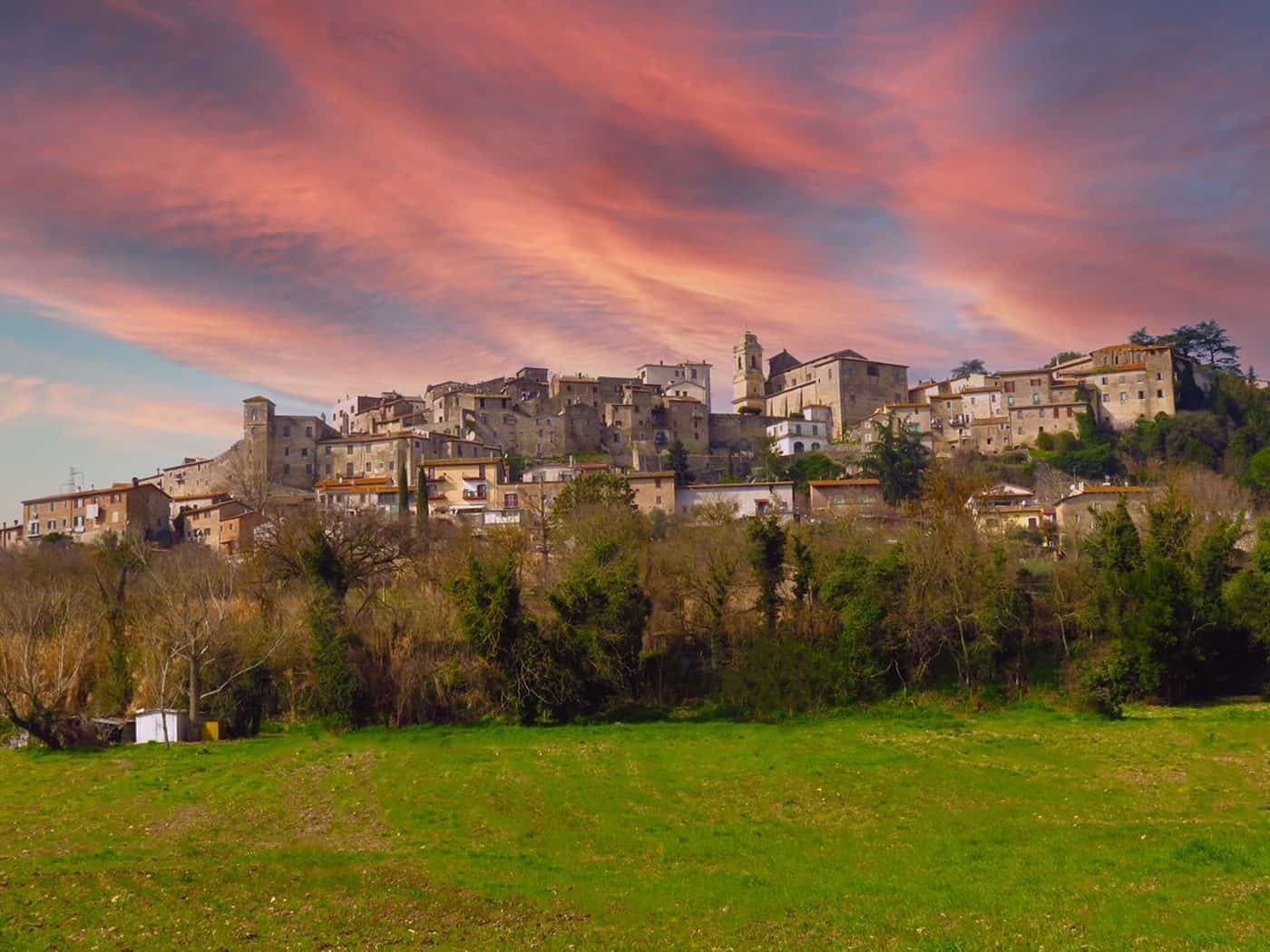
Castiglione in Teverina is in Viterbo Province, on the ridge that separates Lazio from Umbria, 228 meters above sea level and about 40 kilometers from Viterbo. The town hall is in the historic center, right by the main square. You walk the village entirely on foot and you don't need a ticket to enter, because the village is a living village and not a fenced archaeological site. There is only one attraction that requires a ticket, the MUVIS, the Museum of Wine and Agri-food Sciences carved out of the historic cellars of the Vaselli farm estate. Hours, fares and booking arrangements should be read on the museum's official website, muvis.it, before you get in the car, because in low season opening is tied to reservations and groups. You get there by car from the Cassia or from the Autostrada del Sole, Orvieto exit, in a little over an hour from the Grande Raccordo Anulare. By public transit you combine the train to Orvieto and the intercity bus, and you check the schedules on the website of the regional carrier Cotral, which also has a toll-free number, 800 174 471. The village has a little over 2,000 inhabitants and lives off the vine: no lines, no turnstiles, no luggage storage.
If you're building a wider itinerary, the page of all tourist attractions on the site collects the villages and sites of the area and lets you fit Castiglione in Teverina together with nearby destinations without wasted kilometers.
A useful clarification before you leave, because it is the most frequent question: Castiglione in Teverina is in Lazio, Viterbo Province, even though the landscape you see from the viewpoint is Umbrian almost as far as the Duomo of Orvieto. The administrative border passes a stone's throw from the village, and until 1927 the municipality even belonged to the province of Rome. This border position explains almost everything you see: the type of wine, the surnames, the cooking, the medieval alliances, even the accent.

Where Castiglione in Teverina (VT) is and how to get there
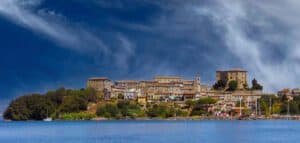
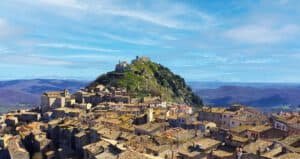
The village occupies the top of a tuff hill overlooking the Tiber valley, in the sector of Viterbo Province that geographers and old land registries call Teverina: a belt of hills between the river and the volcanic reliefs of Lake Bolsena, dotted with walled villages that look at one another. Geography here is not a decorative detail. Castiglione was born as a visual control point and remains one: from the parapet below the Rocca you take in an arc of horizon that reaches the cliff of Civita di Bagnoregio on one side and the Umbrian mountains on the other.
Driving from Rome to Castiglione in Teverina (VT)
The quickest route from the Raccordo is the A1 motorway to the Orvieto exit, then the provincial roads toward the southwest: you run alongside the Tiber, cross the bridge and climb. A little over an hour of driving in normal conditions, an hour and a half on an August Saturday when everyone headed to Umbria uses the same exit. The alternative is the Cassia as far as Montefiascone and then the provincial Teverina road toward the east, a slower route but much more beautiful, because it crosses the high countryside and shows you the village in profile before you reach it. Anyone driving calmly and wanting to see something along the way should pick the second.
The provincial road 5 Teverina connects Castiglione to Civitella d'Agliano and is the backbone of the whole area: it is the road on which the villages of the Viterbo Teverina line up, and anyone with a whole day would do well to drive all of it instead of returning to the motorway after the first stop.
Getting to Castiglione in Teverina (VT) from Orvieto
From Orvieto it's a few kilometers of descent toward the river and climb back up on the Lazio side. It is the natural connection, and also the historically decisive one: for centuries Castiglione gravitated toward Orvieto much more than toward Viterbo, and the village's story can only be read by keeping an eye on what was happening in the Umbrian city. Anyone visiting Orvieto in a day with a car can add Castiglione in the afternoon without effort, and gains in contrast: the Gothic cathedral plus the underground cellar of a village of 2,000 souls.
Castiglione in Teverina (VT) by public transit
There is no train station in the village. The reference hub is Orvieto on the Rome-Florence line, from where you continue by regional intercity bus. The Lazio network is run by Cotral, which publishes updated schedules on its website and allows searching by stop. The toll-free number is 800 174 471. The practical advice, for those who don't drive, is to check the last return run before even deciding the arrival time: in villages of 2,000 inhabitants evening service thins out, and being left on foot on a winter evening is not a romantic adventure.
Where to park in Castiglione in Teverina (VT)
The historic center is small and the internal roadways are narrow: it's best to leave the car in the spaces along the ring road and climb on foot, which is also the right way to enter a walled village. From any parking spot outside the gate, the square of the Collegiata is five minutes' walk. If you arrive with a coach or a camper you need to ask the Comune in advance about suitable areas: the access curves don't forgive long vehicles.
A curiosity about Castiglione in Teverina (VT)
The real curiosity of Castiglione in Teverina is not on the surface: it is underfoot. The village is built on a bank of tuff, and tuff can be dug. Under the houses, under the streets, under the square runs a system of underground rooms that for centuries had a single function, keeping wine at the right temperature without machinery. When in the early 1900s the Vaselli family set up its winery here, it invented nothing: it took an old peasant practice and brought it to industrial scale, digging enormous volumes into the tuff. The largest of those cellars has a tall, narrow central nave, with the barrels lined up at the sides like the stalls of a choir, and for this reason in the village they have always called it the Cathedral. It's not a simile invented by a marketing office: it's the name given to it by the workers who worked there.
The interesting point is what this architecture tells. A village of 2,000 inhabitants that equips itself with a cellar of that size is not a marginal village: it is a production hub that worked for a market far wider than its own bell tower. The wine left from here for Rome, and the Viterbo Teverina, which on tourist maps looks like a periphery, was for decades one of the supply areas of the capital. When today you enter the cellar and feel the temperature drop suddenly by several degrees while outside it hits 35, you understand why tuff beat concrete for 2,000 years and why the winemakers stopped digging only when the industrial refrigerator arrived.
I'll add the opinion, which is firm: of all the things you visit in this corner of the province, the underground cellar of Castiglione in Teverina is the one that most surprises the visitor who doesn't expect it. Whoever arrives from Orvieto full of cathedrals and mosaics often thinks that the afternoon in a little village will be filler. They came out of the Cathedral of tuff talking about that, not about the Duomo.
The village of Castiglione in Teverina (VT) on foot, street by street
The village can be read in an hour of slow walking, and it's best to do it counterclockwise starting from the square of the Collegiata, which is the highest and most open point, then descending toward the circuit of the old walls. The plan is the classic one of the enlarged medieval castle: a tight core around the stronghold, then rings of houses leaning against one another following the contour lines, finally the outer 20th-century districts. Those with a good eye enjoy recognizing the seams, which are always the arches.
Via dell'Arco and the covered passages of Castiglione in Teverina (VT)
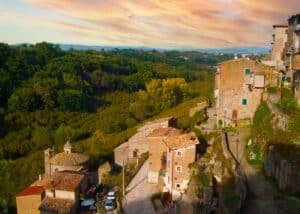
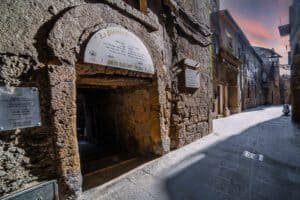
The most photogenic stretch of the village is where the street passes under the houses through a masonry arch, with the paving rising in steps and the facades narrowing until they leave a strip of sky. These covered passages are not a whim: they come from the need to gain living volume where the ground wasn't available, building over the public street with the community's consent. In practice, the upper floors straddle the alley. The result, four or five centuries later, is a succession of thresholds of shade and light that changes character every two hours, and that at sunset becomes the best reason to have come all this way.
The square and the town hall of Castiglione in Teverina (VT)
The central square is dominated by the bulk of the Collegiata dei Santi Filippo e Giacomo and hosts the town hall, which is the village's main civic building. It is the space where the life of the village unfolds, where the stages for the festivals are set up and where in summer, after dinner, everyone gathers. One tip: sit there for 20 minutes doing nothing. In a village this size, observing the square is as much a part of the visit as the church.
The walls, gates and alleys of Castiglione in Teverina (VT)
Of the fortified enclosure there remain stretches incorporated into dwellings, recognizable by the different masonry texture and the larger blocks at the base. It's the fate of almost all the castles of the Tuscia: once the defensive function ended, the walls became house walls. Walking along the outer edge of the center you meet glimpses over the roofs and the vineyards, laundry hung out, vertical gardens carved from three square meters of earth, cats in a number out of proportion to the inhabitants. The village is not restored for tourist purposes, and that is its best quality.
The viewpoint over the Tiber valley
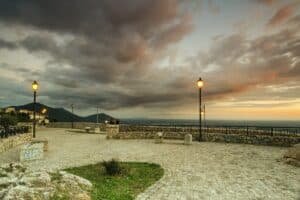
The best viewpoint is on the side that looks east, toward the river. From up there you measure what the eyes of the medieval castle-dwellers measured every day: who was coming up from the valley, and how long it would take them. The Tiber valley here is wide, cultivated, ordered by rows of vines. In the background the Umbrian reliefs rise. With the clean air of a day with a north wind you can clearly make out the silhouette of Orvieto on its cliff.

The Collegiata dei Santi Filippo e Giacomo in Castiglione in Teverina (VT)
The main church of the village is the Collegiata dei Santi Filippo e Giacomo, completed in 1630 and facing the central square. The title of collegiata indicates that the building was served by a college of canons, a rank that in the 1600s was granted to churches of sizable communities: it's one clue, among many, of the weight the village had reached. The interior has a Counter-Reformation layout, with orderly side altars and a decoration that favors the legibility of the images over their complication. Don't expect Roman splendor: here the patronage is local and the painters are those who worked between Orvieto and the Tuscia.
The Madonna and Child between Saint Dominic and Saint Catherine
The most precious work in the Collegiata is a 16th-century panel with the Madonna and Child flanked by Saint Dominic and Saint Catherine. The presence of the two Dominican saints is not accidental: it indicates a patronage tied to the order, or a Rosary confraternity, the Dominican devotion that in that century spread to every parish of the peninsula. Look at it up close, because the merit of this painting is in the detail: the skin tones, the transparency of the veils, the construction of space behind the figures. A panel of this level in a hill village is exactly the kind of thing that makes the scattered museums of the Tuscia interesting.
The Annunciation and the Last Supper
Two typically 17th-century works flank the 16th-century panel and allow a useful exercise: comparing two ways of painting 70 years apart. In the Annunciation, pose and gesture matter. In the Last Supper, what matters is the arrangement of the bodies around the table and the handling of light. Provincial 17th-century painting is often dismissed as repetitive, and in part it is, but it is also the era when painting learns to tell an event instead of displaying an icon. In these two canvases you see the passage.
The Assumption by the Master of Castiglione in Teverina (VT)
Among the works in the church is one attributed to an anonymous artist conventionally called the Master of Castiglione in Teverina. The formula of the anonymous master, coined by art historians when a group of works shows a recognizable hand but the painter's name isn't documented, is one of the most elegant inventions of modern criticism: it says what is known and doesn't pretend to know what isn't. A village that gives its name to an anonymous painter enters the history of art by right, even if it doesn't know his face.
The Madonna with Saint Andrew and Saint Lawrence
From the late 1600s is the Madonna with Saint Andrew and Saint Lawrence, recognizable by the usual attributes, the X-shaped cross for Andrew and the gridiron for Lawrence. Altarpieces with titular saints placed beside the Virgin almost always answer to a precise logic, namely the devotion of the families or confraternities that paid for the altar. Anyone visiting provincial churches should get in the habit of reading the side saints as a social signature: they tell you who was in charge in the parish better than any plaque.
Visiting the Collegiata: hours and good manners
The Collegiata is a parish church in service, so hours follow those of the services and not those of a museum. Whoever arrives in mid-afternoon in winter may find it closed: in that case you ask in the village, which is the old method and still the most effective. Photos without flash are generally tolerated, but if a celebration is under way you wait outside. It's worth remembering because the first cause of embarrassing moments in villages is a noisy group showing up during a funeral.
Rocca Monaldeschi of Castiglione in Teverina (VT)
The Rocca is the building that generated the village. It dates to the 12th century and was built, according to local tradition, using materials from Paterno, the nearby settlement destroyed by the Monaldeschi. Reusing the blocks of a razed settlement is a practice documented throughout the Italian Middle Ages, and it has a meaning that goes beyond saving money: the enemy's stone inside the victor's wall is a political act. Whoever passed under those walls knew where they came from.
From watchtower to bell tower
The original function was twofold, lookout and defense: from here they controlled the river valley and the ridge roads, and signaled with fire to the neighboring castles. With the end of the lords' wars the tower lost its military reason and was converted, as happened to dozens of towers in the Tuscia, into a bell tower. Today it has the peaceful look of a bell tower and whoever arrives distracted doesn't imagine that this volume is the reason the village exists. Look at the base: the masonry of the first few meters is of another era from the upper part, and you can see it with the naked eye.
The panorama from the Rocca
Around the Rocca open the openings and battlements from which the upper Tiber valley is dominated. It's the point where the landscape becomes understandable: you see the river, you see the cultivated fields, you see the line of villages on the opposite ridge. Personal opinion, and I defend it: five minutes standing still up here are worth more than half an hour of visiting any interior, because they explain why the castle is there and not 300 meters further on.

The church of San Rocco in Castiglione in Teverina (VT)
The little church of San Rocco dates to the 15th century and is one of the buildings most loved by the people of Castiglione, for reasons that have to do with the history of fear. San Rocco is the saint invoked against the plague, and his cult explodes in Italy precisely between the 15th and 16th centuries, on the wave of the epidemics that depopulated entire territories. Every time you find a church or altar of San Rocco built in those years in a village, there is a collective vow behind it: if we escape this, we'll build you the church. This tiny architecture, which to the distracted visitor seems merely pretty, is in reality a document of survival.
The saint's iconography is immediately recognizable and worth knowing how to read: a pilgrim with cloak and staff, the bubo shown on the bare thigh, often the dog bringing him bread and the angel who tends him. He is one of the rare saints depicted showing off his own illness, and this made him close to those who prayed. Chapels of San Rocco were almost always built at the edges of the settlement or along the roads, because they were tied to the lazarets and to the passage of travelers.
When the church of San Rocco is open
Like almost all the minor churches of villages, it opens on the occasion of celebrations and festivals, not continuously. Anyone keen to see it inside should time the visit with the patron saint's festival or ask for information at the parish. From the outside, in any case, it is one of the most successful photographic subjects in the village, especially in the low light of late afternoon.

The Sanctuary of the Madonna della Neve in Castiglione in Teverina (VT)
Outside the settlement, in a rural position, stands the sanctuary of the Madonna della Neve, a 16th-century building tied in local tradition to a request addressed to Pope Alexander VI. The dedication to the Madonna della Neve recalls the Roman legend of the summer snowfall on the Esquiline, at the origin of Santa Maria Maggiore, and the festival falls on August 5: in Castiglione it is the patron saint's festival, the day the village stops.
Country churches have a function that urban visitors struggle to grasp. They did not serve the parish, they served the countryside: they were the reference point of the farmers who lived on scattered farms, the destination of processions for rain and for the harvest, the place where seed was blessed. The sanctuary outside the walls is, in an agricultural municipality, the most democratic building there is.
The festival of the Madonna della Neve on August 5
August 5 is the day of the patroness, and it is also the moment when the village reaches its maximum population density, among residents, emigrants who have come back for the occasion and summer vacationers. Anyone who wants to see Castiglione in Teverina in its most authentic form should come on those days. Anyone seeking silence and parking should pick any other time of year.
Something nobody tells you about Castiglione in Teverina (VT)
No guide writes it, but to understand Castiglione you have to know that until 1927 this municipality did not belong to Viterbo Province: it belonged to the province of Rome. Viterbo Province was established that year as part of the administrative reorganization of the period, and absorbed dozens of municipalities that previously answered to the capital. It sounds like a bureaucratic detail. It is nothing of the kind, and it explains three concrete things that the visitor notices without being able to explain them.
The first: the commercial orientation of the village has always been toward Rome, not toward Viterbo. Wine, oil, grain went down to the capital, and the capital was the reference market. The second: the network of family and work relationships still looks today to the south and the north, toward Rome and toward Orvieto, much more than west toward the provincial capital, which is nevertheless about 40 kilometers away. The third: the sensibility of the people of Castiglione about their own belonging. Ask in the village if they feel like people from Viterbo and listen to the answer, which is rarely a flat yes.
There is a second little-known fact, of a different order. In 1860, when the Kingdom of Italy had already been born but Lazio remained with the Papal States, Castiglione in Teverina found itself less than a kilometer from the international border. Less than a kilometer. It means that the fields of a single family could lie in two different states, that smuggling was a trade and not an occasional offense, that the papal guards and the carabinieri of the Kingdom watched each other from one hill to the next. The village was annexed to the Kingdom of Italy on September 18, 1870, two days before the breach of Porta Pia: in Castiglione the end of the temporal power came before it did in Rome.
The MUVIS, the Museum of Wine and Agri-food Sciences of Castiglione in Teverina (VT)
The MUVIS, the Museum of Wine and Agri-food Sciences, occupies the spaces of the old Vaselli farm estate with its cellars and declares about 2,000 square meters of exhibition surface, a size that makes it one of the largest wine museums in Europe. It is inside the village, not on the outskirts, and this is already a significant fact: the museum is not a pavilion built apart, it is the village's historic production plant turned into a visitor route. For hours, tickets, guided visits and tastings the reference is the official website muvis.it, which publishes the updated calendar and booking arrangements.
The Vaselli farm estate
The Vaselli farm estate is the agricultural and industrial complex that marked the 20th century in Castiglione. The economy of an entire municipality revolved around structures of this type: the families of day laborers, the carts, the vats, the transport, the cooperative cellar, the rhythms of the grape harvest that marked the year far more than the liturgical calendar. Visiting those spaces means crossing a piece of Italian labor history, that phase in which hill agriculture stopped being pure subsistence and became enterprise.
The Cathedral, the underground cellar
The most impressive room in the complex is the great dug-out cellar that in the village they call the Cathedral, for its height and for its nave-like design. You walk in and everything changes: the acoustics, the temperature, the quality of the light. You don't need to be a wine enthusiast to stay inside for 20 minutes. It's one of those functional architectures that, without meaning to, become monumental, like granaries, aqueducts or the workshops of certain ports.
The route and the sections of the MUVIS
The museum's approach is not limited to the bottle: the title speaks of agri-food sciences, and the route widens the gaze to food production, to the tools of farm work, to the transformation of the products of the land. It's a correct choice, because wine alone risks becoming a fetish, while placed in the agrarian cycle it makes sense. Anyone visiting with children will find in the tools and machines the right hook: the presses and the pumps work much better than any panel.
Hours, tickets and reservations at the MUVIS of Castiglione in Teverina (VT)
The opening calendar varies with the season and with events, and in many periods of the year access is organized in guided-tour shifts. Before leaving, therefore, you check the museum's official website and, if needed, you phone: it's the only way to get the right information for the right day. Anyone traveling in a group should always book, even when opening is guaranteed, because the underground spaces have limited capacity and a coach that shows up without notice risks waiting outside.
Frequently asked questions about Castiglione in Teverina (VT)
Where exactly is Castiglione in Teverina (VT)?
Castiglione in Teverina (VT) is in Viterbo Province, in northern Lazio, on a tuff hill overlooking the Tiber valley on the border with Umbria, 228 meters above sea level and about 40 kilometers from the provincial capital.
How far is Castiglione in Teverina (VT) from Rome?
Castiglione in Teverina (VT) is a little over an hour by car from the Grande Raccordo Anulare, using the A1 motorway with the exit at Orvieto. The village is part of the Viterbo sector called Teverina, a belt of hills between the Tiber river and the volcanic reliefs of Lake Bolsena.
What is there to visit in the village of Castiglione in Teverina (VT)?
In the village of Castiglione in Teverina (VT) you visit the Collegiata dei Santi Filippo e Giacomo, completed in 1630, the 12th-century Rocca Monaldeschi, the little 15th-century church of San Rocco and the MUVIS, the Museum of Wine and Agri-food Sciences, which occupies the spaces of the old Vaselli farm estate with about 2,000 square meters of exhibition space.
How long does it take to visit Castiglione in Teverina (VT)?
Half a day in Castiglione in Teverina (VT), with a tour of the historic village, the Collegiata, the Rocca and the viewpoint, takes a good two and a half hours without the museum. The recommended formula for those with more time is a full day, with the morning in the village, lunch in the village and the afternoon given to the museum and the cellars.
Is Castiglione in Teverina (VT) good for children?
Castiglione in Teverina (VT) works well with kids mainly thanks to the museum, where the underground spaces of the old cellar, with barrels, presses and farm machines, have an immediate effect on those under 12. The Festa della Trebbiatura in July and the living nativity in December are other moments suited to families.
Is Castiglione in Teverina (VT) accessible for people with mobility difficulties?
Castiglione in Teverina (VT) is a medieval ridge village with stepped streets and marked slopes, so it is not a comfortable environment for people with mobility difficulties. Some stretches of the center, like the square and the main streets, can be walked, while the alleys with steps and the covered passages cannot. For the museum it's best to ask for information in advance.
When is the best time to go to Castiglione in Teverina (VT)?
Spring, in particular April and May, is the recommended period to visit Castiglione in Teverina (VT), with green countryside, long days and mild temperatures, also coinciding with the festivals of the Crucifix that bring animation to the village.
What wine do you drink in Castiglione in Teverina (VT)?
Castiglione in Teverina (VT) is part of the Associazione Nazionale Città del Vino, the network of Italian municipalities with a wine-growing vocation, and the soils of the area derive from the great eruptions of the Vulsini volcanic district, the same one that dug Lake Bolsena: tuffs and pozzolanas rich in potassium that give wines tied to the Colli del Tevere.
The advice I give you for visiting Castiglione in Teverina (VT)
There is one piece of advice and it is worth more than any itinerary: don't come to Castiglione in Teverina alone, in the sense of not coming without linking it to anything else, but above all don't descend on it in a rush. Barely two hours between a visit to Orvieto and the return to Rome is the perfect waste. The village gives its best in a precise formula, the long late afternoon: arrive around four, tour the village calmly, visit the cellars, sunset from the viewpoint, dinner in the village, return after dark. In this sequence everything works, light included.
Second point, on method: check beforehand the opening of the museum and the availability of the kitchen where you want to have dinner. In villages of 2,000 inhabitants dinner is not an automatic assumption, and on a Tuesday in November the risk of finding everything closed is real. A phone call in the morning solves it.
Third point, against the current: avoid August 5 if your idea of a village is the silent postcard kind. That day the village is full, loud, taken over by the patron saint's festival, and the visitor who was looking for the deserted alley finds himself in the middle of a community celebrating. Which is wonderful, but it's a different visit. Choose knowingly which of the two you want.
Fourth and last, on guiding: this is an area where a competent guide multiplies the value of the day, because local historical facts are not written on panels and the geography of the villages needs explaining. For a private itinerary in the Tuscia and the Tiber valley you can go through TourLeaderPro, which organizes professional guiding outside the capital too.
Sermugnano and the Etruscan site of the Poggio
The hamlet of Sermugnano, between Orvieto and Bagnoregio, holds the protohistoric and Etruscan archaeological site of the Poggio, which is the reason the territory of Castiglione in Teverina appears in Etruscological bibliography. The excavations have yielded a monumental building datable between the end of the 7th and the beginning of the 6th century BC and a large cistern abandoned toward the end of the 6th century BC, structures belonging to an Etruscan settlement of rank, in a position of control over the valley.
The monumental building and the cistern
A monumental building of the Orientalizing or Archaic age, in a hill settlement, almost always indicates an aristocratic residence or a complex with a public and cultic function. They are the structures that archaeologists call, cautiously, prestige buildings: they have a large plan, walls of squared blocks, often a courtyard. The cistern is just as instructive, because water management is the real indicator of the complexity of an ancient community. Digging and plastering a large cistern means having organized labor, technical knowledge and an authority able to impose a collective work.
The abandonment toward the end of the 6th century BC places the end of this phase in a moment of general reorganization of inland Etruria, when power concentrates in the great centers, and Volsinii, the ancestor of Orvieto, grows at the expense of the smaller settlements of the countryside. The Poggio of Sermugnano tells, on a small scale, a process that concerns the whole region.
Visiting the Poggio site
It is a country archaeological area, not a park equipped with ticket office and bookshop: before going it's best to ask at the Comune or at the museum about access conditions and the possible presence of guided visits. Closed shoes, a hat in summer, and the awareness that a site of this kind can only be read with someone to explain it or with a good plan in hand. Anyone with neither should stick to the landscape, which repays the trip anyway.
The history of Castiglione in Teverina (VT), from the Villanovans to the Kingdom of Italy
The name of the village derives in all probability from a large stronghold present in the territory, a castellione, that is, a castle of considerable size. The specification in Teverina was added later to distinguish it from the other Castiglione in Italy, which are many. Documented history begins late, because for centuries this territory fell within the orbit of the Orvieto area and did not produce a chronicle of its own.
Villanovans and Etruscans
Ancient settlement is attested by the Villanovan culture and then by the Etruscans, of whom the Poggio site at Sermugnano is the main testimony. The Tiber valley is, in this phase, a shifting frontier and a trade corridor: metals, wine and ceramics pass through here. Wine, incidentally, has been produced in this area for at least two and a half millennia, and the agricultural vocation of the municipality is not a recent invention.
The stronghold of the year 1000 and the end of Paterno
The present settlement forms around the year 1000 around the stronghold, according to the phenomenon historians call incastellamento: the population scattered across the countryside concentrates on high ground, inside a fortified enclosure, under the protection and control of a lord. In the first half of the 14th century the phenomenon receives a brutal acceleration: the inhabitants of Paterno, a nearby settlement that was destroyed, are transferred to Castiglione, in 1351 according to the chronology reported by the sources. A forced transfer of population, four centuries after incastellamento, is a traumatic event that leaves its mark in place names and collective memory.
Monaldeschi, Filippeschi, Savelli
Castiglione enters documented history in 1351 and its medieval story is entirely tied to Orvieto. The noble Orvieto family of the Monaldeschi, Guelph in allegiance, after getting the better of their Ghibelline rivals the Filippeschi, split into branches that fought each other ferociously for control of the castles of the countryside, and Castiglione was one of the objects of contention. In the Middle Ages the village became a fief of the Monaldeschi della Cervara, a branch that takes its name from another possession, and later of the Savelli family, one of the great Roman baronial houses.
It's worth remembering that this feudal geography is not an abstraction: the name of Cervara recurs in the place names of Lazio and the same families appear hundreds of kilometers apart. The Italy of the barons was a network, not a mosaic of isolated little states.
The Farnese and the Duchy of Castro
In the first half of the 16th century, in 1539, Castiglione passed to the Farnese and became part of the Duchy of Castro, the territorial creation that Pope Paul III built for his son Pier Luigi. The Duchy was one of the most ambitious political undertakings of 16th-century Italy and one of the most ruinous: its capital, Castro, would be razed to the ground in 1649 by order of Innocent X. Castiglione, fortunately for itself, had already left the Duchy 12 years earlier.
The buyback of 1637
In 1637 the people of Castiglione decided to buy back their own village by taking on a loan of 20,000 scudi. It is the most interesting passage of the whole local history and deserves emphasis. A community of farmers and artisans going into debt to buy its freedom from the feudal lord is not a common fact: it means there existed a class of local landowners able to guarantee the loan, a municipal administration able to manage it and a collective will firm enough to accept decades of fiscal sacrifice. 20,000 scudi, in the 1600s, was an enormous sum for a village of that size. Whoever looks for the character of the people of Castiglione finds it there, not in legends.
The Risorgimento, the border and the annexation of 1870
During the Risorgimento the village was the scene of many events, and in 1860, still part of the Papal States, it found itself less than a kilometer from the border of the new Kingdom of Italy. On September 18, 1870 Castiglione became part of the Kingdom, two days before the taking of Rome. 10 years of frontier, with everything that entails in terms of customs, smuggling, volunteers' escapes and political surveillance, shaped a mentality.
The 20th century and the move to Viterbo Province
In 1927 the municipality passed from the province of Rome to the newly established Viterbo Province. Economically the 20th century is the century of great wine-growing, with the Vaselli farm estate and the cellars dug into the tuff, and at the same time the century of emigration, which gradually emptied the hill villages. Recent economic data describe a municipality of small businesses: 145 active in 2015, with 305 employees, a little over half a percentage point of the provincial total.
Another well-known fact, yet rarely cited
Everyone knows wine is made in this area. Almost nobody connects the fact to the physical reason that makes it possible, namely the volcano. The soils of the Viterbo Teverina derive in large part from the great eruptions of the Vulsini volcanic district, the same one that dug the basin of Lake Bolsena: tuffs, pozzolanas, ashes rich in potassium. They are loose, draining soils, poor in organic matter and rich in minerals, exactly what the vine likes.
Three consequences follow from this premise that you can touch in Castiglione. The first is the landscape: the hills have soft profiles and vertical walls where the tuff outcrops, and the contrast between the two is the visual signature of the area. The second is the architecture: you build with what you have, and here you have tuff, soft to cut and resistant once in place, which explains the uniform color of the villages. The third is the cellar: tuff is dug with simple tools, holds well without supports and keeps temperature and humidity constant all year. Without the volcano there would be no Cathedral under the village.
Then there is a little-cited and very concrete corollary for travelers. The same volcanic soils that make wine also make water: the springs of this belt are many and the village fountains are almost all working. Bring a water bottle and fill it in the village instead of buying bottles. It isn't brochure ecology, it's the way the local people have always done it.
The wine of Castiglione in Teverina (VT) and the cellars of the Colli del Tevere
The municipality belongs to the Associazione Nazionale Città del Vino, the network of Italian municipalities with a wine-growing vocation, based in Siena, which brings together administrations with at least one designation of origin on their territory. Membership is not a decorative medal: it entails commitments on urban planning for vineyard areas, on promotion and on wine-tourism hospitality.
What wines you drink in Castiglione in Teverina (VT)
The area is a land of whites from traditional central Italian grapes and reds of medium structure, in a border area where producers' choices vary quite a lot from one winery to another. The designations and production rules that apply to these vineyards can be consulted at the wineries themselves and at the Comune: if you want the technical detail, ask directly in the cellar, where by the way it is the most welcome question you can ask. The practical advice is not to arrive with the prejudice of village wine: in the last 20 years the average quality on this belt of hills has risen in a way that those who haven't been back in a while struggle to imagine.
Visiting a winery in Castiglione in Teverina (VT)
The farms of the territory receive visitors by appointment and organize tastings. The most interesting period is the one right around the grape harvest, between the end of August and September, when you see them at work. Minimum rules of wine-tourism good manners: you phone first, you arrive on time, you don't present a group of 15 people as four, you spit if you're driving. The producer who gives you an hour of his time in the middle of the harvest is doing you a favor.
The Festa del Vino dei Colli del Tevere
The event that made the village known beyond its own borders is the Festa del Vino dei Colli del Tevere, held in August, which turns the village into a route of cellars, stands and music. It is the moment when the relationship between the village and its product becomes visible: not a fair dropped in from above, but a community festival born around everyone's work. The precise dates of the current edition can be found on the official channels of the Comune and the Pro Loco.
The festivals of Castiglione in Teverina (VT), month by month
The calendar of Castiglione's events is full and follows the farming cycle precisely, which is after all the way villages have always organized time. Below, the order of the year, with the warning that exact dates should be confirmed each season on the official channels of the Comune and the local associations.
The Castiglione Carnival
It opens the series, between February and March depending on the date of Easter. The village carnival is an interesting social machine: it involves families for weeks in building floats and costumes, and whoever arrives on the day of the parade sees only the tip of a collective job begun in January.
The Feste del Santissimo Crocifisso
They fall between the end of April and the first days of May, straddling the change of season. Devotions to the Crucifix, deeply rooted in central Italy, are almost always tied to collective vows for the end of a calamity: famine, earthquake, epidemic.
The festival of Saint Anthony of Padua
On June 13 Saint Anthony of Padua is celebrated, one of the most popular saints in Italy, protector of lost things and, in peasant practice, much invoked for animals and for the bread of the poor.
The Festa della Trebbiatura
In July the village reenacts threshing, the operation that separated the grain from the straw and that until the 1950s required dozens of hands and the steam machine hired from farm to farm. It is one of the most instructive festivals for those who bring children or grandchildren: the historic threshers in operation explain in 10 minutes what a book explains in 30 pages.
The patron saint's festival of the Madonna della Neve
August 5 is the patroness's festival and the busiest day of the year. Procession, festive lights, band, the whole village.
The Festa del Vino dei Colli del Tevere in August
In August, the village's main event, the one that brings visitors from the whole province and from nearby Umbria.
The grape harvest festival
In September the harvest is celebrated. It is the period when the territory is most beautiful: the leaves begin to turn color, the air dries, the light lengthens. If I had to name a single month to come to Castiglione in Teverina, I would name September without hesitation.
The Festa di San Martino, oil, mushrooms and wine
In November, around the 11th, the farming calendar celebrates the saint who gives his name to the short summer of mid-autumn and to the new wine. New oil, woodland mushrooms and wine of the year: that's the menu, and it has worked for centuries.
The Living Nativity in December
In December the village turns into a living nativity, with costumed participants who restage the old trades and offer visitors soups, fritters, focaccia, cheese and ricotta, honey, sweets, wine and herbal teas. The living nativity in tuff villages works better than elsewhere for a banal and decisive reason: the sets already exist. Dress warmly, because you walk slowly outdoors for a couple of hours.
The right photo to take in Castiglione in Teverina (VT)
The photograph that Castiglione in Teverina gives you to take home is just one, and it isn't the panorama. It is the covered passage of Via dell'Arco, framed from below, with the street rising in steps and the arch cutting the scene in half. It works for a technical reason: the arch creates a natural frame and sharply separates two planes of light, the shadow in the foreground and the lit background beyond the passage. It's the visual structure that the human eye finds irresistible and that photographers call, without much imagination, a frame within the frame.
Timing matters more than equipment. The good light is the low light of early morning or the last hour before sunset, when the tuff goes from gray to honey and the shadows lengthen over the steps. At noon the same shot is flat and the contrast between shade and sun becomes unmanageable for any sensor. If you have a phone, lean on the wall to steady it, tap the screen on the lit background to expose for that and let the foreground stay dark: the silhouette of the arch is the subject.
The second photo, the one nobody takes and that nevertheless tells the village best of all, is from the valley road: the village seen from below, gathered at the foot of the Rocca, with the vineyards in the foreground and the houses rising in concentric circles. You have to stop at a safe spot on the provincial road and walk a bit, but it is the image that explains in one stroke the urban structure, the relationship with the countryside and the reason the castle is up there.
Third indication, for those who love details: the doors. In this village the house doors have stone jambs, ceramic house numbers, doorbells stacked from three different eras. A series of 10 doors photographed with the same framing is the nicest memory you can bring back from a village of the Tuscia, and it costs only attention.

Some important events that happened here in history
The first event that takes the form of a date is the destruction of Paterno and the transfer of its inhabitants to Castiglione, placed by the sources in 1351. A village that disappears and a population moved en bloc inside the walls of another: it is an event that changes the social makeup, the language, the cults, even the surnames. The stones of Paterno ended up in the Rocca, and the memory of that lost settlement has remained in the place names of the territory.
The second is the long internal conflict of the Monaldeschi. After driving the rival Ghibelline Filippeschi out of Orvieto, the Guelph house split into branches that fought each other for decades, and control of Castiglione was one of the targets of those struggles. The Orvieto chronicles of the 14th century are a catalog of ambushes, sieges and reconciliations that lasted as long as an oath. The village changed masters several times and the Rocca was the material object of the dispute.
The third event is the buyback of 1637, with the 20,000 scudi loan: the act by which the community bought itself, leaving the Duchy of Castro 12 years before that Duchy's capital was razed to the ground. In the history of small Italian municipalities few episodes are as eloquent of collective self-awareness.
The fourth is the decade of frontier between 1860 and 1870, when the border of the Papal States with the Kingdom of Italy ran less than a kilometer from the village, and the annexation of September 18, 1870, anticipated by two days compared with the breach of Porta Pia.
The fifth is the most painful and it is the one the village remembers with the greatest precision. Between March 6 and 7, 1944, following an informant's tip and after a roundup, the Fascists of the Social Republic from Orvieto surprised the members of an anti-Fascist band in a cave at Sermugnano. Seven people were arrested and, on March 29, 1944, after torture, were shot in a gravel quarry at Camorena, in the territory of Orvieto. Some relatives of the victims and the local farmers accused of having supported them also suffered violence. It is a story that concerns two communities, that of Castiglione and that of Orvieto, and that local civic memory continues to honor. Whoever passes through here on March 29 should know it.
Who has passed through Castiglione in Teverina (VT)
The question of who passed through here, in a village of this size, has to be approached honestly: don't expect the parade of emperors and popes that can be told in a city. What can be said with documentary certainty is already quite a lot, and more interesting than anecdote.
Through the Rocca passed the Monaldeschi, the house that dominated Orvieto and its countryside between the 13th and 15th centuries, and in particular the branch called della Cervara, which held Castiglione as a fief. They are names that in 14th-century chronicles appear next to those of the great protagonists of Italian politics of the time, because Orvieto was a leading Guelph city and a recurring papal seat. After them the village was held by the Savelli, one of the seven great Roman baronial families, who gave the Church popes and cardinals and who owned castles scattered across Lazio.
In 1539 the village passed to the Farnese, and this means it became part of the holdings of the family of Pope Paul III, the pope of the Council of Trent, the man who commissioned Michelangelo's Last Judgment, the man who carved out the Duchy of Castro for his son Pier Luigi. The Farnese did not come to spend their summers in Castiglione, but the administrative link with the most ambitious court of 16th-century Italy is documented and weighs on local history far more than a famous visit.
Local papal tradition then ties the sanctuary of the Madonna della Neve to a request addressed to Alexander VI, the Borgia, the Spanish pope whose story has filled libraries. On this point the historian's caution is in order: it is a tradition reported by local memory, not a fact documented by records, and as such it should be received.
In the 20th century the figure who left the deepest mark is not a prince but an entrepreneur: the Vaselli family, who set up the farm estate and the cellars here and who gave work to a considerable part of the village. In the real history of Italian villages, the name that counts for the life of families is almost always this one, not the one carved on coats of arms.
Finally, and without rhetoric, through Castiglione in Teverina passed the seven anti-Fascists arrested at Sermugnano in March 1944. They weren't famous, and precisely for this reason they deserve to be remembered among the people who made the history of this place.
What to see around Castiglione in Teverina (VT)
Castiglione is at the center of one of the densest concentrations of villages in Italy, and this is the real reason it's worth getting there: within half an hour's drive you line up destinations that elsewhere would be enough to fill an entire vacation.
Civitella d'Agliano and the Viterbo Teverina
The provincial road leads directly to Civitella d'Agliano, another ridge village overlooking the badlands, with a tower you can see from far away. It's the natural stop after Castiglione for anyone who wants to understand the structure of the territory. Also in this belt are San Michele in Teverina and Bassano in Teverina, which complete the picture of the villages of the Teverina.
Civita di Bagnoregio and Celleno
A few kilometers to the west you reach Civita di Bagnoregio, the isolated cliff connected by the pedestrian bridge, which is the most visited destination in the province and requires an entrance ticket. Along the same line you meet Celleno, the abandoned village that in recent years has been recovered as a visitable site. The comparison between the two is instructive: two villages emptied by landslides, two different destinies.
Orvieto
On the other side of the river, in Umbria, Orvieto with its Duomo, the Saint Patrick's Well and the underground city. The Castiglione-Orvieto link is the most convenient of all and the pair works very well in a day: the cathedral in the morning, the cellars in the tuff in the afternoon, which are after all the same geological story told from two sides.
Lake Bolsena, Bolsena and Montefiascone
To the southwest opens Lake Bolsena, the largest volcanic lake in Europe, with Bolsena and its basilica and, on the height that closes the basin to the south, Montefiascone with Rocca dei Papi. If you have two days, do the full circuit of the lake on the second day.
Viterbo, Orte and the Tuscia
The provincial capital, Viterbo, preserves the best-preserved medieval quarter in Lazio and Palazzo dei Papi. On the Tiber line, toward Rome, Orte is the railway hub of the area and a tuff village with a system of underground tunnels. For those preparing a trip in English or traveling with foreign guests, the guide to the region on ItalyPlanner collects the villages of Lazio with pages in English.
Eating and sleeping in Castiglione in Teverina (VT)
The cooking of this belt of hills is that of the inner Tuscia with Umbrian influences: legume soups, homemade pasta, grilled meats, lamb, mushrooms and truffles in season, extra virgin olive oil that here is a main ingredient and not an accessory condiment. Among desserts, dry biscuits for dunking in wine rule, which is the correct way to end a meal around here.
Where to eat in Castiglione in Teverina (VT)
The offer is that of a village of 2,000 inhabitants: few signs, almost all family-run, often open in the evening only on weekends off-season. You phone and you book, always. Sunday lunch in a village place should be booked a few days ahead, because the community fills it and not tourism.
Where to sleep in Castiglione in Teverina (VT) and around
The most common formula in the area is the agriturismo with a vineyard, which lets you sleep among the rows and dine where the food is produced. In the village there are small scattered-lodging options. Anyone using Castiglione as a base to explore the Teverina, Bagnoregio and Orvieto makes a smart choice: you sleep and eat at reasonable prices within 20 minutes of the most crowded destinations.
When to go to Castiglione in Teverina (VT)
The local climate is classified in zone D with 1,826 degree days, which in plain words means cool, damp winters with valley fog, and hot, dry summers at hill elevation. The good seasons and the less good ones follow from this.
Spring
April and May are ideal for walking: green countryside, long days, mild temperatures, and the festivals of the Crucifix that bring animation. It's the period I recommend to those who come for the first time and want to combine village and landscape.
Summer
July and August are the months of the festivals, with the threshing, the patron saint's festival of August 5 and the Festa del Vino. The heat in the middle hours is serious: you visit early in the morning or after 5 p.m., and the underground cellars become the most pleasant place in the village. Anyone seeking tranquility should avoid the first 10 days of August.
Autumn, the best season
September and October are, in our judgment, absolutely the right moment: grape harvest, colors, light, perfect temperatures, cellars in operation, free tables in the restaurants. If I had to bring a group only once in a year, I would bring it in September.
Winter
From November to February the village closes in on itself, and you need to know it: many businesses reduce their hours, some close. There remain two excellent reasons to come, the festival of San Martino with the new oil in November and the living nativity in December. Outside those dates, check everything before leaving.
Castiglione in Teverina (VT) with children
The village works well with kids on two conditions. The first is the museum: the underground spaces of the old cellar, with the barrels, the presses, the farm machines, have an immediate effect on those under 12, because they are big, dark and full of recognizable objects. The second is the choice of period: the Festa della Trebbiatura in July and the living nativity in December are both events in which you see something being done, and children stay put in front of things that move.
To keep in mind: rigid strollers suffer a lot on the steps and cobbles of the historic center, and a sling or a child-carrier backpack solves the problem. In summer bring water and hats, because the shade in the upper village is patchy. And let them run: in a village of 2,000 inhabitants traffic is minimal and kids can walk ahead without anyone having to hold their hand every moment.
Accessibility of Castiglione in Teverina (VT)
It has to be said frankly: a medieval ridge village, with stepped streets and marked slopes, is not a comfortable environment for people with mobility difficulties. Some stretches of the center can be walked, the square and the main streets in particular, while the alleys with steps and the covered passages cannot. For the museum and for access to the underground rooms, which involve ramps and level changes, it's best to ask staff in advance which routes are practicable. Anyone accompanying a person in a wheelchair should plan the itinerary on the upper level of the village and give up the lower part from the start: it's more honest to say so than to let you discover the problem on the spot.
Itineraries: how much time you need for Castiglione in Teverina (VT)
Half a day
Arrival, tour of the historic village, Collegiata, Rocca, viewpoint, a coffee in the square. A good two and a half hours, without the museum. It's the bare minimum and is fine only as a graft onto an Orvieto day.
A full day
Morning in the village, lunch in the village, afternoon at the museum and the cellars, sunset from the viewpoint. This is the right formula and the one I recommend to everyone.
Two days in the Teverina
First day Castiglione and Civitella d'Agliano, night in an agriturismo. Second day Civita di Bagnoregio early in the morning, before the coaches, and Orvieto or Lake Bolsena in the afternoon. Two days like this are worth a week of crowded destinations. For organizing a private or corporate itinerary in the Tuscia, with professional guiding, the reference is TourLeaderPro.
Quick questions about Castiglione in Teverina (VT)
Where exactly is Castiglione in Teverina (VT)?
In Viterbo Province, in northern Lazio, on a hill overlooking the Tiber valley on the border with Umbria, 228 meters above sea level and about 40 kilometers from the provincial capital.
How far is Castiglione in Teverina (VT) from Rome?
A little over an hour by car from the Grande Raccordo Anulare, using the A1 motorway with the Orvieto exit. By the Cassia the route is slower but more scenic.
Do you pay to enter the village of Castiglione in Teverina (VT)?
No. The historic center is an inhabited village, open and free. The ticket is needed only for the wine museum.
What is the MUVIS?
The Museum of Wine and Agri-food Sciences, carved out of the spaces and cellars of the old Vaselli farm estate, with about 2,000 square meters of exhibition surface.
How much is the MUVIS ticket and what are the hours?
Fares and calendar vary with the season and the type of visit: the source to consult before leaving is the museum's official website, muvis.it.
Do you need to book a visit to the museum?
For groups yes, always. For individuals it depends on the period, because in low season opening is often organized in guided shifts.
What is the Cathedral of Castiglione in Teverina (VT)?
It isn't a church: it's the name used in the village for the great underground cellar dug into the tuff, called that for its height and for its nave layout.
How long does it take to visit Castiglione in Teverina (VT)?
Two and a half hours for the village alone, a full day if you add the museum, lunch and sunset from the viewpoint.
What is the best time to come?
September, for the grape harvest, the light and the temperatures. Alternatively April and May.
When is the Colli del Tevere Wine Festival held?
In August. The precise dates of the current edition are checked on the official channels of the Comune and the local associations.
Who is the patron saint of Castiglione in Teverina (VT)?
The Madonna della Neve, celebrated on August 5, with the 16th-century country sanctuary dedicated to her.
How many inhabitants does Castiglione in Teverina (VT) have?
A little over 2,000, according to the figures reported by current demographic sources.
Is Castiglione in Teverina (VT) in Lazio or Umbria?
In Lazio, Viterbo Province. The Umbrian border passes at a very short distance, and until 1927 the municipality belonged to the province of Rome.
Can you get to Castiglione in Teverina (VT) by train?
Not directly: the reference station is Orvieto, on the Rome-Florence line, from where you continue by intercity bus or with a transfer by road.
Are there buses to Castiglione in Teverina (VT)?
The intercity service in Lazio is run by Cotral: schedules and stops are consulted on the carrier's official website or at the toll-free number 800 174 471.
Where do you park in Castiglione in Teverina (VT)?
In the spaces outside the historic center, along the ring road, then climbing on foot. The village has narrow streets and you don't drive around in it.
Is the village wheelchair accessible?
Only in part. The square and the main streets can be walked, the stepped alleys and the covered passages cannot. For the museum it's best to ask in advance which routes are practicable.
Is Castiglione in Teverina (VT) good for children?
Yes, above all for the museum, with the farm machines and the dug-out rooms, and for the festivals where you see work being done, like the threshing in July and the living nativity in December.
Can you visit the cellars and do tastings?
The farms of the territory receive visitors by appointment. You phone first, set the time and, if you're driving, taste with judgment.
What do you eat in Castiglione in Teverina (VT)?
Cooking of the inner Tuscia with Umbrian influences: soups, homemade pasta, grilled meats, mushrooms and truffles in season, local extra virgin olive oil, dry biscuits for dunking in wine.
What is the difference between Castiglione in Teverina (VT) and Civita di Bagnoregio?
Civita is an isolated cliff, almost uninhabited, paid and very crowded. Castiglione is a living village, free and uncrowded, with an underground heritage that Civita does not have. They can be visited very well on the same trip.
What is the Poggio site at Sermugnano?
A protohistoric and Etruscan archaeological area in the hamlet of Sermugnano, with a monumental building from the end of the 7th and beginning of the 6th century BC and a large cistern abandoned toward the end of the 6th century BC.
What does Castiglione in Teverina (VT) remember of 1944?
The arrest, between March 6 and 7, 1944, of seven anti-Fascists surprised in a cave at Sermugnano and their shooting on March 29, 1944 at Camorena, in the territory of Orvieto.
Are there guides who accompany you in the Viterbo Teverina?
Yes, and in a territory where the information is not on panels it makes a notable difference. For private and group itineraries you can turn to accredited professionals such as those of the TourLeaderPro network.
Is there a guide in English for those traveling with foreign guests?
For those preparing a trip to Rome and Lazio in English, the starting point is the collection of things to do on ItalyPlanner.
Is it worth staying overnight?
Yes, if you want to use the Teverina as a base for Bagnoregio, Orvieto and Lake Bolsena. You sleep and eat at reasonable prices 20 minutes from the most crowded destinations.
To close, our opinion: Castiglione in Teverina is one of those places that reward whoever arrives without hurry and with a question in mind. It has no universal masterpiece to put on the cover, it has a hill, a converted tower, a 17th-century church with a few good canvases and a dug-out cellar that is worth the trip by itself. If you have a free day between Rome and Umbria, spend it here instead of in yet another line in front of a famous monument: you'll go home with something you haven't already seen in photographs a thousand times.
Article written by the editorial team of TourLeaderPro, contact them for Private/Corporate/V.I.P. Tours and Experiences.
Planning a trip to Rome? The English-language guides for visiting the city are on ItalyPlanner.com.