Civitella d’Agliano (VT)
In short. Civitella d’Agliano is a municipality of just over 1,500 inhabitants in the province of Viterbo, postal code 01020, area code 0761, set at 262 meters above sea level on a tuff spur overlooking the Tiber valley: the municipal territory…
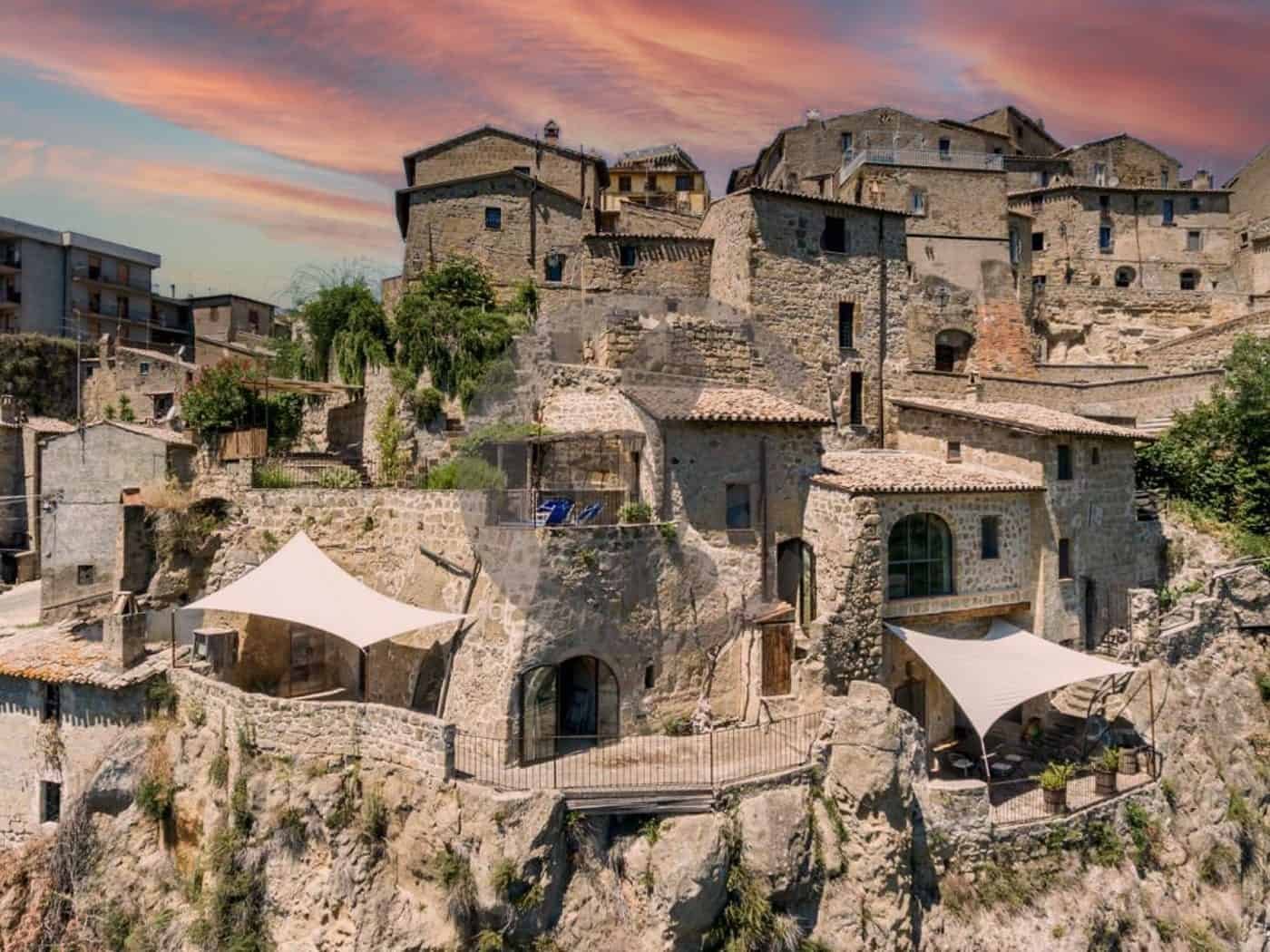

Civitella d’Agliano is a municipality of just over 1,500 inhabitants in the province of Viterbo, postal code 01020, area code 0761, set at 262 meters above sea level on a tuff spur overlooking the Tiber valley: the municipal territory measures 32.96 square kilometers and includes the hamlets of San Michele in Teverina, San Sebastiano, Spoletino, Pian della Breccia and Case Nuove. You get there by car from Rome in about an hour and a half along the A1 highway, exiting at Attigliano or at Orvieto and continuing on the Teverina provincial road. From Orvieto the drive takes a little under half an hour, from Viterbo about 40 minutes. The village has no ticket office: the historic center is walked on foot and free of charge at any hour of the day, you leave the car in the open spaces just outside the gate and walk in. The Monaldeschi tower can be visited, but the hours depend on the season and on the availability of the volunteers: it's best to phone the town hall before getting in the car. The art garden La Serpara, which is the reason many foreigners know this town, can be seen only by appointment: phone 0761 914071, email laserpara.sculpturegarden@gmail.com. Anyone who wants to pair the day with a tasting must book at the winery at least a few days ahead, because the businesses here are small and have no staff dedicated to a constant flow of guests.
If you are building an itinerary in northern Tuscia, this guide is meant to be read together with the one on Viterbo and the one on Orvieto: Civitella d’Agliano is exactly halfway between the two, and on its own it doesn't fill a whole day.

Where Civitella d’Agliano is and how you really get there
Geography explains almost everything about this town. Civitella d’Agliano occupies the northeastern sector of the province of Viterbo, the strip locals call Teverina because the river bounds it and for centuries made it a frontier: on this side the Patrimonio di San Pietro in Tuscia, on the other the Umbria of Orvieto. The neighboring municipalities are Alviano, Bagnoregio, Castiglione in Teverina, Graffignano, Guardea, Montecchio, Orvieto and Viterbo, and the list alone says we are at an administrative crossroads between Lazio and Umbria. The town stands on a tuff hill sloping toward the Tiber, surrounded by woods, olive groves and vineyards, and on the side of the badlands the ground drops suddenly into a series of spires of pale clay that in the late afternoon turn almost white.
By car from Rome to Civitella d’Agliano
The simplest route is the A1 toward Florence. The Attigliano exit puts you on ordinary roads that go up the Teverina toward the northwest. The Orvieto exit comes from above and goes down. Both work, the choice depends on traffic and on what you want to see first. Anyone who doesn't like the highway can go up the Cassia to Viterbo and then cut east: it's slower, but it crosses a landscape worth the time lost, with Bagnaia, the hazelnut groves and the cultivated hills. Practical advice: don't trust the time the GPS gives in the last 20 curves, because the provincial road is narrow, full of tractors in the grape harvest season and with a roadway that narrows in some stretches. Add a quarter of an hour and you'll arrive in a good mood.
By train and public transport
There is no rail connection inside the municipality. The useful stations are Orvieto, on the Rome-Florence direttissima, and Attigliano Bomarzo, on the same line but farther south. From there you need a regular bus or a taxi, and the frequency of intercity buses on holidays is what it is. Anyone traveling without a car should think honestly: this is a territory you get around on four wheels. If you really want to arrive by train, take Orvieto as a base, sleep there and rent a car for a day: you cover Civitella d’Agliano, Castiglione in Teverina and the badlands valley without rushing.
Where to park in Civitella d’Agliano
The historic center is closed to cars for obvious reasons of width: some alleys don't let even a cart through. You leave the vehicle in the spaces along the road leading to the entrance arch and in the area of the main square, and continue on foot. The slopes are moderate compared to other villages of Tuscia, but the paving is stone and the climb to the tower calls for shoes with a serious sole. On summer evenings, when there are food and wine events, the spaces fill up fast: arrive before 19:00 or be ready to walk a few hundred meters more.
The village on the tuff: what Civitella d’Agliano really is
Civitella d’Agliano belongs to a family of settlements that repeats in northern Lazio with few variations: a tuff plateau isolated by erosion, a compact town occupying all its available surface, a single entrance gate, and below, emptiness. It is the same building principle that holds up Civita di Bagnoregio, with the difference that here the cliff has not yet crumbled and the town is still fully inhabited. The perimeter is defined by the old walls and the drop of the cliff. Inside, the urban fabric is the medieval one, made of alleys that pinch shut, reinforcing arches between the houses, little stairways that climb toward the highest point and squares as wide as a room.
Anyone who enters notices one thing right away: the town has a readable shape. It's not a labyrinth, it's an organism with a spine and ribs. You go up, reach the tower, go down the other side, come out again at the square. In 40 minutes of slow walking you have seen everything, and for exactly this reason Civitella d’Agliano works better as part of an itinerary than as a single destination. The historic center has been nominated several times in the Luoghi del Cuore campaigns of the Fondo Ambiente Italiano, in the 2014, 2016, 2018, 2020 and 2022 editions: a fact that says how much the local community cares about this perimeter of stone, because those nominations are built on signatures collected in town, not at a desk.
The minor architecture of Civitella d’Agliano
What is worth looking at here is not the individual monuments, though they exist, but the grain of ordinary building. Peperino portals with a monolithic lintel, exterior stairs rising to the first floor, windows walled up and reopened three times in seven centuries, squared tuff cornerstones sticking out of fallen plaster, tile roofs following the slope of the rock. It is the architecture of people who built with stone quarried 200 meters away, and you can see it: the color of the town is the color of its hill. Look also at the service doors at street level, the low ones: many open onto cellars dug directly into the tuff, where wine and provisions were kept. Under Civitella d’Agliano there is a second town, underground, that almost no visitor sees.
The cliff, the walls and the gate
The natural defensive front is the cliff and the bastion. The old walls can still be read in several places, absorbed into the houses: in some stretches the wall of a house is the old curtain wall, with the oldest facing at the bottom and the modern raising above. The entrance arch to the historic center is the point where the town decides who comes in, and to its left opens the whole complex of the parish church, which we will see shortly. One note: stop under the arch and look back toward the countryside before entering. From there you understand the logic of the place better than from any panoramic terrace, because you see at once the road from which friends arrived and the valley from which enemies came.
The Rocca Monaldeschi and the tower of Civitella d’Agliano
The symbol of the town is the fortified complex of the Monaldeschi. Little of the castle remains: what you see today is mainly the large bastion and, above all, the tower, which has been preserved in excellent condition and can now be climbed up to the summit terrace. Local sources place the building of the rocca in the 13th century, with the dual function of lookout and defense. The archive documents referring to the oldest castle instead go back to the 11th century and to the Counts of Bagnoregio, whose descendants later took the name Monaldeschi della Cervara. The two datings do not exclude each other: a frontier castle was rebuilt every time it changed owner, and here the owners changed quite a few times.
Climbing the tower of Civitella d’Agliano: what you see
The climb is short and steep. From the terrace the eye takes in the Tiber valley, the basin of Lake Alviano with its wetland oasis, the badlands that descend westward and, on clear days, the outline of the Orvieto plateau. It is the point where you understand why someone decided to build right here: from this height they controlled the ford of the river and the road that went up the valley, that is the commercial traffic between Rome and northern Italy. In the Middle Ages controlling a road meant taxing it, and taxing a road meant eating.
In our judgment this is one of the few towers in Lazio where the effort of the stairs is repaid immediately, because the panorama isn't generic. Don't look only far away. Look down, at the roofs of the town, and count the chimneys. The houses are still lived in, the laundry is hanging, life is there. The panoramic towers of emptied villages give another kind of emotion, a colder one.
When to climb and when to avoid it
The opening hours of the tower are not continuous all year and should be checked with the town hall before the visit. For the best light go up in the last hour before sunset: the badlands backlit become white blades and the valley fills with golden haze. If you suffer from vertigo, consider that the terrace is high and the parapet is that of an adapted medieval structure, not that of a modern lookout. In the heart of August, at noon, the stone gives back all the accumulated heat: you go up and down in a hurry, enjoying nothing.
The parish church of Santi Pietro e Callisto
To the left of the entrance arch to the historic center extends the whole complex of the parish church. In reality there are two churches side by side: the parish church dedicated to Santi Pietro e Callisto and that of the Madonna delle Grazie, above whose roofs rises the 18th-century bell tower. The first building of the parish church dates between the end of the 12th and the beginning of the 13th century, which makes it contemporary with the peak phase of incastellamento. What you see today, however, is the result of later reworkings, and the screen façade that occupies one side of the square, in small bricks and stone, is actually from 1940. It's an element that throws off anyone expecting a medieval front, and it's worth knowing beforehand: it is not a badly done historical fake, it is a declared 20th-century intervention.
The main entrance, hemmed in and halved by the parish house that has grown up against it, is perfectly oriented to the east, following the ancient liturgical rule. Inside, the building is laid out in three aisles separated by three columns topped by arches. The wealth of the church is not in the architecture: it is in the canvases, and in particular in the fact that almost all of them are the work of just two painters active within a few decades. The result is a stylistic and chronological unity that is rarely found in village churches, because usually each generation adds its own painting and its own taste.
Filippo Naldini and Ludovico Mazzanti, the two painters of the parish church
Ludovico Mazzanti is the major name: a painter of Roman training, raised in the orbit of the late Baroque language that in Rome took its lead from Baciccio's example, he worked for a long time in Umbria and Tuscia and was tied in particular to Orvieto. Filippo Naldini is the collaborator and continuer, the man who in the 1780s completed the cycle. The fact that their paintings live together here in such high numbers turns a minor parish church into a small coherent sampler of 18th-century sacred painting of central Italy. It is not a museum, it is a living church, and this changes how you look at it: the canvases are still on the altars they were painted for, with the light they were designed for.
The right aisle: from the Rosary to the Zucchini chapel
Entering, on the inner façade wall of the right aisle, you meet the canvas of the Madonna of the Rosary with Saints Catherine and Dominic, a work by Filippo Naldini of 1782. Continuing along the aisle you reach the altar of Saint Joseph, with the Transit of Saint Joseph, again by Naldini, executed in 1783. Next is the Zucchini chapel, which bears the name of the founder, with the Assumption of Mary into Heaven. The following altar holds, in a small chapel, the statue of the Madonna of the Rosary: one of the many gifts made to the parish by Cardinal Angelo Maria Dolci, the most illustrious native of Civitella, of whom we will say more shortly.
A tip: look at the sequence as a sequence, not as four separate paintings. Naldini in this aisle plays on a warm range and vertical compositions that close at the top with an opening of sky. Go from one to the next without looking back and the construction of the cycle becomes evident.
The high altar and the body of San Coronato
In the apse is the high altar. Under the altar table is kept the body of the martyr San Coronato, and above the wooden choir stands the altarpiece with the Immaculate Conception, Saint Peter and Saint Callistus, a work by Ludovico Mazzanti of 1765. It is the most important piece in the church and should be viewed from the back of the central nave, not from underneath: the painter calculated the distance. The presence of a martyr's body under the high altar deserves an explanation, because the contemporary visitor finds it bizarre. Between the 17th and 18th centuries, communities in Lazio obtained from the Roman authorities the gift of relics taken from the city's underground cemeteries: these were the so-called corpi santi, an enormous symbolic capital for a country parish, which thereby acquired a physical patron, a reason for pilgrimage and one more feast on the calendar.
The left aisle and the detached fresco of the Conventino
In the left aisle is another canvas by Filippo Naldini, the Christ the Redeemer with Saints Blaise, Bonaventure, Vincent Ferrer and Charles Borromeo, of 1781. The altar that follows is dedicated to the crucifix. Above the door is placed the detached section of a 15th-century fresco from the church known as the Conventino, outside the town. The last altar of the aisle is that of the patron saint, Saint Gorgonius, with the canvas by Ludovico Mazzanti depicting the Madonna and Child with Saints Gorgonius, Lawrence, Lucy and Pope Callistus, of 1753.
The detached fresco of the Conventino needs precision. Local tradition attributes the 15th-century fresco to Pastura, that is Antonio del Massaro da Viterbo, born around 1450 and dead in his city before 1516. Pastura is a documented artist: in December 1478 he took part in Rome in the founding of the guild and university of painters of San Luca, he collaborated with Pinturicchio on the decoration of the Borgia apartment in the Vatican, where critics attribute to him in particular the Room of the Liberal Arts and the Room of the Trades, he worked in Orvieto between 1497 and 1499 and returned to Viterbo in 1504, becoming the reference figure of local painting after the death of Lorenzo da Viterbo. His language is that of an Umbrian-Lazio painter of the late 15th century, with sweet faces of Pinturicchio descent. That the fresco of Civitella d’Agliano is his is an attribution, not an archive fact: look at it knowing that the milieu is the right one and that the name is the one proposed by tradition.

The church of the Madonna delle Grazie
Wedged between the apse of the parish church and the walls of the castle stands the church of the Madonna delle Grazie. It is not a second church built on a whim: it was built to protect a fresco of the Virgin and Child, following a dynamic that repeats constantly in Lazio. An image painted on an outer wall or on a roadside shrine becomes an object of devotion, devotion produces offerings, offerings produce a building that wraps around the image. The church was born from the fresco and not the other way around. When you enter, look first for the venerated image and then at the space that has grown around it: you will understand the building sequence.
Inside, on the right, an altar holds a statue of Our Lady of Sorrows, flanked by the canvases of Saint Aloysius Gonzaga and Saint Nicholas of Bari by Filippo Naldini. On the left is the altar with the canvas of Saint Ursula and her virgin companions, also flanked by two Naldini works, a Saint Francis of Paola and a Saint Liborius. It is the completion of the discussion begun in the parish church: the same hand, the same years, the same patronage. The 18th-century bell tower that you see from the square serves both churches.
The Conventino church and the buildings outside the walls
Outside the built-up area stands the church of the Conventino, dating to the 1400s, from which the detached fresco kept in the parish church comes. The extra moenia location is typical of regular religious settlements: mendicant orders and convents settled just outside the circuit, where land was available and where the relationship with wayfarers was more direct. The place name itself, Conventino, preserves the memory of this function. The building has no continuous visiting hours and is not a museum: anyone who wants to see inside must ask at the parish.
History of Civitella d’Agliano, from the Etruscans to the Kingdom of Italy
The history of this territory is older than the village you see. Before the appearance of the baronial castles the Teverina had been settled by the Etruscans and then by the Romans, and with good probability some communities lived along the banks of the Tiber even earlier. The finds say so: tombs, including an Etruscan tomb identified at Case Nuove, columbaria, remains of Roman villas and farm installations, fragments of columns, ceramic artifacts. Materials from a Roman villa in the territory are kept in a local restoration workshop, with the prospect of a future museum display.
From the fall of Rome to incastellamento
The decisive passage comes with the collapse of the empire. The farming populations who had previously traded their harvests freely with merchants coming up the Tiber moved to the heights, from where it was possible to spot raids in time and organize defense. It's not a romantic detail: it is the physical reason why the towns of Tuscia are all on top of something. An important testimony of the Lombard era in this municipality is the archaeological site of Castel Sozio, which documents the intermediate phase between the abandonment of the plain and the birth of the castle proper. Local tradition also remembers a first fortress, of which no trace remains, said to have been raised in a place called Agliano at the dawn of the year 1000 by the Counts Bovaccini, feudatories of Corbara and Montemarte: it is a datum of tradition, not a documented fact, and as such it should be taken.
The Monaldeschi, Orvieto and the demolition of the castle
Establishing the precise date of the origin of Civitella and its castle is difficult, but from the examination of several archive documents it can be held that the castle was raised in the 11th century by the Counts of Bagnoregio, whose descendants took, much later, the surname Monaldeschi della Cervara. From that moment the story gets eventful, and the engine is always the same: the frontier position between the area of influence of Orvieto and the Papal State.
In 1322 the feudal lords were Ghibelline, that is, opponents of the temporal power of the popes. In that year the castle was demolished by order of the Commune of Orvieto, which thus punished the help given by the lords of Civitella to the rebel Ghibellines of Orvieto. The following year, with the Monaldeschi driven out and replaced by the Guelph Orsini, the same Commune of Orvieto ordered the castle rebuilt. It is worth pausing a moment on this detail, because it tells the political mechanism of the time better than any textbook: the same authority that had torn down the fortress had it raised again 12 months later. The fortress was not the problem, the problem was who lived inside. In 1329, in any case, the Monaldeschi returned firmly into possession of Civitella.
The Prefects of Vico and the Apostolic Chamber
Like most of the lands subject to the temporal dominion of the Church, Civitella too suffered the invasion of one of the Prefects of Vico, the Viterbo dynasty that for two centuries held the papacy in check in the Patrimonio. In 1353 it was Giovanni di Vico who prepared the invasion, but the occupation was short: two years later the Monaldeschi regained possession of the fief. Their fortune, however, was over. They were not in the good graces of the Church and in 1415 the Apostolic Chamber intervened again, driving them out for good and taking over the fief and its revenues.
Leo X, the vicariate in Orvieto and the birth of the Comune
In 1517 Pope Leo X, son of Lorenzo the Magnificent, renewed the enfeoffment of Civitella d’Agliano to the Commune of Orvieto, granting it in perpetual vicariate. The formula was customary in papal diplomacy: a castle was entrusted to an allied city, which answered for it to the Apostolic Chamber. In 1564 Civitella constituted itself as a Comune, remaining tributary of the Patrimonio di San Pietro like all the fiefs of the Papal State, a condition that lasted until annexation to the Kingdom of Italy in 1870. An administrative detail almost nobody knows: the municipality passed from the province of Rome to that of Viterbo only in 1927, when the province of Viterbo was established.
The statutes and the historical archive of Civitella d’Agliano
Among the most important documents kept in the municipal historical archive are the statutes, that is the codes that regulated the life and works of the people of the medieval village. The oldest is dated 1467, the intermediate code is from 1517 and the most recent dates to the 18th century. They were texts that set everything: when animals could be taken to pasture, how much a fine for damage cost, who cleaned the springs, how the priors were elected. Anyone who studies daily life in the towns of Lazio in the 1400s knows that these codes are worth more than 10 chronicles: chronicles tell the wars, statutes tell the people.
Cardinal Angelo Maria Dolci
In 1867 Civitella d’Agliano was the birthplace of Cardinal Angelo Maria Dolci, who died in 1939. His bequests keep alive the institution that bears his name, which has housed a nursery school and the Sisters of Calvary. The main square of the town bears his name, and several furnishings of the churches, including the statue of the Madonna of the Rosary in the parish church, are his gifts. In small towns the ecclesiastical career of a fellow townsman was for a long time the only channel through which money, education and works of art arrived: the story of Cardinal Dolci is the story of how a village of 1,000 souls could afford works and institutions.
Castel di Piero, Castel Sozio and San Michele in Teverina
The municipality doesn't end with its main town. The territory preserves two other historic cores that deserve a detour, and one of them was an autonomous municipality until a century ago.
The history of Castel di Piero
Of the medieval village of Castel di Piero the baronial palace remains, in an excellent state of preservation, built near the original castle of the Baglioni. That castle was torn down by Pope Adrian VI in 1522 to assert the supremacy of the Apostolic Chamber over the assets of the fief, which the rival heirs Piero and Giovancarlo Baglioni stubbornly fought over with their own militias. It's a story that says a lot about the era: two cousins in arms over a castle and a pontiff who settles the dispute by razing the object of the contention to the ground.
To feel safer in their rule of the fief, the Baglioni submitted Castel di Piero now to powerful Viterbo, now to no less proud Orvieto, depending on which way the political wind blew. The story of Castel di Piero is therefore not very different from that of Civitella d’Agliano: here too feudal lords followed feudal lords. The Baglioni were followed by the Simoncelli, then the Sarcinelli, finally the fief was bought by the Benedetti of Spoleto. In 1847 the lord of San Michele in Teverina became Luigi Desiderato Semonville, Duke of Monthalon, direct descendant of Carlo Tristano, aide-de-camp of Napoleon.
San Michele in Teverina, the municipality that no longer exists
No less interesting than that of the main town is the history of the hamlet of San Michele in Teverina, which was an autonomous municipality until 1927, when it was merged into Civitella d’Agliano. Those who visit the village find a castle layout that is easy to read and a landscape that descends toward the river. The two communities have kept distinct identities, distinct festivals and even different ways of telling the same feudal story: if you have time, go there and ask in the square. They'll tell you things you won't find written.
Castel Sozio
The archaeological site of Castel Sozio documents the Lombard presence in the territory. It's not a place equipped for tourist visits and has no marked trails like an archaeological park: it is a site, and it should be treated as one. Anyone who studies the early Middle Ages in Lazio knows how rare Lombard traces are in this part of Tuscia, because the area stayed Byzantine for a long time and then passed under papal control: this is precisely what makes Castel Sozio interesting to specialists.
The badlands of Civitella d’Agliano and the Valle dei Calanchi
The landscape surrounding Civitella d’Agliano is hilly and wooded, but its signature is the badlands: tongues and spires of whitish clay generated by the erosion of rainwater on Pliocene sediments, which the tuff above protects as long as it holds and then lets collapse. The result is a sharp, almost lunar profile that changes color four times a day. The municipality borders the area everybody calls the Valle dei Calanchi, the system that extends toward Bagnoregio and that made Civita di Bagnoregio famous.
How to look at the badlands
A badland is not a mountain in miniature: it is a phenomenon of accelerated erosion. Water digs parallel furrows, the furrows deepen, the ridges between one furrow and the next thin out until they become blades. Where vegetation is missing the process runs, where there is tree cover it slows. This is why the badlands have that nervous, always different design: every winter redraws them. Look at them after an autumn rain, when the clay is saturated and the white turns glossy gray: it's the state in which you best understand what material they are made of.
Walking among the badlands
Some trails descend from the town toward the valley. Non-negotiable rule: you don't walk on wet clay. It becomes a bar of soap, it sticks to the soles in layers five centimeters thick and slopes that look harmless become slides. Go with dry ground, in sturdy hiking boots, with water, and without trying out shortcuts: the edges of the badlands give way. In summer look for the cool hours, because the clay reflects the light and there is no shade. A tip: do the walk early in the morning and keep the tower and the churches for the afternoon, not the other way around.

La Serpara, the art garden of Civitella d’Agliano
In the territory of Civitella d’Agliano, at the end of a white dirt road branching off the Teverina provincial road, there is an open-air museum of contemporary sculpture: La Serpara, the garden created by the Swiss artist Paul Wiedmer, who in 1997 bought a valley to turn it into an atelier and park. It is the place that brings visitors to Civitella d’Agliano from Switzerland, Germany and the Netherlands, and it is the reason this town appears in international surveys of sculpture gardens next to far more famous names.
How the garden began
The idea is that of an artist who stops exhibiting elsewhere and builds his own context. Wiedmer, together with his wife Jacqueline Dolder, a botany enthusiast, and his son Simone, also an artist, has worked on an area of about 40,000 square meters in which a large reed bed, flower beds, hedges, trees and small ponds host statues and installations. The works are by the family and by Italian and international artists invited over the years: today the garden gathers works by more than 40 artists, among them Daniel Spoerri, Thomas Baumgärtel and Bruno Ceccobelli. The park grows year by year, with new installations, long-term loans and works designed specifically for this place.
A clarification that is needed, because confusion is frequent: Daniel Spoerri has his own sculpture garden, much larger and visitable with regular hours, but that one is in Seggiano, in the province of Grosseto, in Tuscany. La Serpara of Civitella d’Agliano is something else, in another place and another region. They are two different experiences, and anyone who confuses them while planning ends up traveling 200 kilometers for nothing.
What you see at La Serpara
Salvaged materials, welded steel, fire sculptures and water fountains: Wiedmer's vocabulary is that of European sculpture of the second half of the 20th century, grown in contact with Nouveau Réalisme, where the discarded industrial object returns to the scene as poetic material. Earth, wood, water, fire, metal: the five elements that the garden sets in dialogue with the green of this corner of Tuscia. The difference from a conventional sculpture park is that here the boundary between exhibition area, workplace and home is deliberately blurred, and so is that between art and shaped nature.
Sculpture gardens have a long tradition in Europe, which ultimately goes back to the Roman world, rises to an art form in the Renaissance and produces in the Baroque its most theatrical examples: Tuscia holds two absolute cornerstones, the Parco dei Mostri of Bomarzo and the gardens of Villa Lante in Bagnaia. La Serpara fits into that genealogy with the opposite character: where Bomarzo is enigmatic spectacle and Villa Lante is courtly geometry, here the layout is reserved, almost domestic, and asks to be discovered one step at a time. Those who have visited Opera Bosco in Calcata will recognize the same family of intentions, with different materials.
Visiting La Serpara: booking and contacts
The garden is visited exclusively by appointment: there are no continuous opening hours and there is no ticket office where you can show up unannounced. The contact is the phone 0761 914071 and the email address laserpara.sculpturegarden@gmail.com. The address is località Serpara 1, 01020 Civitella d’Agliano (VT). La Serpara is reached at the end of the little white road that starts at kilometer 26 of the Teverina provincial road, west of the A1 highway, between the Orvieto and Attigliano exits. Anyone arriving with a low car should go slowly on the last unpaved stretch.
The tip: phone well in advance, especially if you are a group, and ask explicitly how long the visit lasts. This is not a place where you walk in, take three photographs and leave. It's a place that asks for at least a couple of hours and a certain willingness to listen. If you have three other stops planned the same day, postpone: you'll see it badly and little will stay with you.
Grechetto and the wines of Civitella d’Agliano
Anyone in the wine trade knows the name of this municipality even without ever having been here, because Civitella d’Agliano is a typical geographical indication denomination covering whites, rosés and reds. The grape that made it known is grechetto, a white grape with a hard berry and thick skin, traditionally grown between southern Umbria and upper Lazio, capable of producing wines with lively acidity, a note of ripe yellow fruit and a structure that withstands aging far more than the prejudice about central Italian whites would suggest.
The winery that built the reputation of grechetto from this territory is that of Sergio Mottura, based right in Civitella d’Agliano, producer among others of the Poggio della Costa and the Latour a Civitella, both Civitella d’Agliano typical geographical indication from grechetto grapes, as well as reds such as the Civitella Rosso from organic farming. The municipal territory falls within the Teverina district and on the Strada del Vino, which links the wineries of the area together with the olive mills: the local extra virgin oil is the other serious product of these hills.
How to organize a tasting
Rule number one: you book. The cellars in this area are farms, not visitor centers with guides on permanent duty. Rule number two: ask in advance whether the tasting includes something to eat, because tasting four or five wines on an empty stomach at 11:00 in the morning is a mistake you pay for in the afternoon. Rule number three, the most important: someone has to drive. The provincial roads of the Teverina are narrow and full of blind curves, and the checks in this province are real.
A clear opinion, after many visits in this district: the grechetto of the Teverina is one of the most underrated Italian whites on the domestic market. It costs a fraction of what Alto Adige whites of equal level cost, ages better than anyone expects and accompanies the local cuisine, which is based on legumes, sheep meat and homemade pasta, without overpowering it. If you have to take home a single bottle from this trip, take a grechetto and open it in three years.
The festivals and events of Civitella d’Agliano
The town's calendar is concentrated between July and September, as in all of Tuscia. In July the food and wine event Nelle Terre del Grechetto takes place, which is the identity appointment of the municipality and brings together producers, tastings and the historic center. In August it is the turn of the Sagra della Birra e della Pizza, which is the real popular festival, the one that fills the squares with families. In September come the Festival del Vino e della Musica and above all the feast of the patron saint, Saint Gorgonius the martyr, celebrated on September 9 with a procession and fireworks.
In the summer months the village has also for years hosted art courses of European level, born with the intent of recovering the houses of the historic center: sculptors, painters and writers from different cities and countries of Italy and Europe liven up the town, mixing with the inhabitants. It is a model that has worked in several places in Tuscia, and in Civitella d’Agliano it has produced a coexistence between historic residents and international artistic presences that you can feel walking around: the painted doors, the workshops, the German-language nameplates on the doorbells.
When to go to Civitella d’Agliano
The best season is the second half of September. The festivals have just passed, the grape harvest is under way, the light is low and warm, the badlands have the right color and the temperatures allow walking. May is the second choice, with the countryside at its greenest. July and August are very hot and the town, with no shade in the upper part, becomes tiring in the middle of the day: if you go in that period, move before 11:00 and after 17:00. In winter the village is beautiful and empty, but bars and restaurants cut their opening days: phone first, or you'll end up having lunch in Orvieto.
A curiosity about Civitella d’Agliano (VT)
The most instructive curiosity about Civitella d’Agliano concerns 1322 and 1323, two consecutive years in which the castle was first torn down and then rebuilt by the same authority. In 1322 the Commune of Orvieto ordered the demolition of the fortress to punish the local lords, who had backed the rebel Ghibellines of Orvieto. The following year, with the Monaldeschi driven out and the Guelph Orsini installed in their place, the same Commune of Orvieto ordered the castle raised again. In 12 months the same stone went from symbol of rebellion to garrison of loyalty.
The paradox is not a colorful anecdote: it describes exactly how territorial power worked in communal Italy. Fortification was not a value in itself, it was a tool, and its meaning depended entirely on who held the keys. Destroying it was a judicial act, rebuilding it an administrative act. Whoever climbs the tower of Civitella d’Agliano today looks at a structure that survived this kind of swings for centuries, changing owners at least five times between the 13th and 15th centuries: Counts of Bagnoregio, Monaldeschi, Orsini, Prefects of Vico, Monaldeschi again, finally the Apostolic Chamber.
There is a second curiosity, more recent and just as little known: Civitella d’Agliano has not always been part of Viterbo. Until 1927 the municipality belonged to the province of Rome, and passed to Viterbo only when that province was established. In the same year the municipality absorbed San Michele in Teverina, which until then had been an autonomous municipality. 1927 is therefore the date on which the administrative geography of this corner of Lazio took the shape it has today, and the elders of the town still speak of it as a watershed.
Something nobody tells you about Civitella d’Agliano (VT)
What no brochure says is that in Civitella d’Agliano the most important monument is not visited by strolling: it is visited by phoning. The art garden La Serpara, which is the real reason the name of this town circulates abroad, has no opening hours, no ticket office and does not accept visitors who show up without notice. You enter only by appointment, by contacting the number 0761 914071 or the garden's email address. Anyone who arrives in Civitella d’Agliano on a Sunday morning imagining a sculpture park open like a museum goes home having seen a gate.
The same applies, with different shades, to the Monaldeschi tower: access depends on the season and on the availability of whoever holds the keys, and there is no guaranteed schedule valid all year. A phone call to the town hall before leaving solves the problem. It's the practical difference between villages organized for mass tourism and those that receive tourism but do not live off it: here the welcome is real and cordial, but it is also sized for a community of 1,500 people.
I'll add a second piece of information that usually nobody provides: under the houses of the historic center there is a system of cellars dug into the tuff, used for centuries to store wine and provisions. It's not an equipped tourist route and you won't find it on any map handed out in the square. If you happen to be in town during a food and wine event, though, some owners open their cellar for the occasion: that is when you see the real underground of Civitella d’Agliano, and it doesn't happen at any other time of year.
The advice I give you for visiting Civitella d’Agliano (VT)
My advice is not to come here alone. Not in the sense of bringing company, but in the sense of not building a whole day around this one town. Civitella d’Agliano takes two or three hours of attentive visit, tower and churches included, and its strength lies in context: it is a piece of an itinerary in the Teverina that includes Castiglione in Teverina with its wine museum, Graffignano with the Baglioni castle, the Lake Alviano oasis and, a bit further north, Civita di Bagnoregio.
Here is how to organize it. Leave Rome early, arrive around 10:00, park outside the walls. First the historic center and the tower, with the morning light that illuminates the front of the valley. Then the parish church and the Madonna delle Grazie, which indoors can be visited well at any hour. Lunch in town, without hurry, and with the local wine. In the early afternoon, if it was booked in time, the visit to La Serpara, which asks for at least two hours. Alternatively a winery, or the descent toward the badlands. Return with a stop in Orvieto for the sunset on the cathedral, which is half an hour away by road.
A second, less obvious tip: go down 20 meters below the town, on the valley side, and look at Civitella d’Agliano from below. The village seen from inside tells one story, the village seen from below tells another, namely how a community has built for eight centuries on a tuff platform that erosion constantly wears away. The real subject of this town is the relationship between stone and emptiness. Whoever stays only in the square doesn't see it.
Another well-known fact, yet rarely cited
Everyone knows that the territory of Civitella d’Agliano is ancient and that Etruscans and Romans lived in it. Almost nobody, though, connects that ancient fact to the one thing that explains the shape of the modern town: the move from the plain to the heights after the fall of the empire. Before the collapse, farming communities lived along the Tiber and traded their harvests with the merchants who came up the river. The river was a road and the plain was wealth. When that system falls apart, the plain becomes dangerous and wealth moves up. The town doesn't stand on the tuff for love of the view: it stands there because from up there you see raids coming hours in advance.
The passage is documented in the municipal territory by the archaeological site of Castel Sozio, of the Lombard era, which testifies to the intermediate phase between the abandonment of valley-floor settlements and the birth of the castle. It is a sequence that repeats throughout Tuscia, but here it is particularly readable because the three levels are all still on the ground: the Roman villa below, whose materials are kept in a local restoration workshop awaiting a future display, the early medieval settlement halfway up the slope, the castle on top.
There is a corollary that matters for the visitor. If you look at the countryside around Civitella d’Agliano and it seems empty to you, it is not: it has been inhabited for 2,500 years, and the Etruscan tombs of Case Nuove, the columbaria, the column fragments and the ceramics that come out of the fields prove it. What looks like natural farmland is in reality a continuous archaeological deposit, from which every plowing can still bring something up.
The right photo to take at Civitella d’Agliano (VT)
There is only one photograph that pays off, and it is not the one from the tower terrace. It's the one of the town shot from outside, from the road climbing toward the village on the badlands side, with the Monaldeschi tower closing the profile at the top and the white clay spires in the foreground. You need side light: first hour of the morning or last of the afternoon. At noon the tuff goes flat and the clay burns out, the contrast disappears and the photograph dies.
If you have a long lens, compress the town against the backdrop of the Tiber valley: the telephoto brings the background closer and gives back that sense of a village resting on emptiness that the eye perceives and the wide angle destroys. If you only have your phone, don't go wide: use the optical zoom if there is one, look for a foreground of clay or olive trees to give scale to the image and keep the horizon line low, so that the town occupies the upper third of the frame.
The second photograph to take home is from the top of the tower, but not of the panorama: of the roofs. Overlapping tiles in layers of different eras, brick chimneys, little terraces of four square meters with laundry hanging. It's the image that says that Civitella d’Agliano is not a set, it's a town. And if you pass in front of the façade of the parish church, the one in small bricks and stone from 1940, go ahead and photograph it: many avoid it because it's not medieval, but it is an honest document of how 20th-century Italy put its hands back on its villages.
Last recommendation, the kind nobody ever makes: ask before photographing people. In a town of 1,500 inhabitants a camera pointed at someone without a nod is a discourtesy that gets noticed, and it closes the door to all the conversations that follow. Ask, and in most cases they will say yes and also tell you something.
Some important events that happened here in history
The first event that left a material mark is the demolition of the castle in 1322, ordered by the Commune of Orvieto as punishment for the support the lords of Civitella gave to the rebel Ghibellines. It was a political and military act together, and it erased the original layout of the fortress. The second is the reconstruction ordered in 1323 by the same Commune of Orvieto, after the expulsion of the Monaldeschi and the installation of the Guelph Orsini. The third is the return of the Monaldeschi in 1329, which put the fief back in the hands of the family that had held it for generations.
In 1353 the territory suffered the invasion prepared by Giovanni di Vico, exponent of the dynasty of the Prefects of Vico, the Viterbo power that in those years contested with the papacy the dominion over the Patrimonio di San Pietro in Tuscia. The occupation was short: two years later, in 1355, the Monaldeschi regained possession of the fief. The final blow came in 1415, when the Apostolic Chamber drove out the Monaldeschi and took over the fief and its revenues, ending four centuries of family lordship.
1517 is the year of the measure of Leo X, the Medici pope son of Lorenzo the Magnificent, who renewed the enfeoffment of Civitella d’Agliano to the Commune of Orvieto by granting it in perpetual vicariate. Five years later, in 1522, Pope Adrian VI had the Baglioni castle at Castel di Piero torn down to assert the supremacy of the Apostolic Chamber over the fief contested between the heirs Piero and Giovancarlo Baglioni. In 1564 Civitella constituted itself as a Comune, remaining tributary of the Patrimonio di San Pietro until annexation to the Kingdom of Italy in 1870.
Among the events of the modern age should be remembered the drafting of the municipal statutes, whose surviving codes are dated 1467, 1517 and the 18th century, and the building of the painting cycle of the churches between 1753 and 1783, which gave the town its most substantial artistic heritage. In 1847 Luigi Desiderato Semonville, Duke of Monthalon and direct descendant of Carlo Tristano, aide-de-camp of Napoleon, became lord of San Michele in Teverina. In 1927, finally, the municipality passed from the province of Rome to that of Viterbo and absorbed San Michele in Teverina, which until then had been an autonomous municipality.
Who has passed through Civitella d’Agliano (VT)
The first name is that of a family: the Monaldeschi della Cervara, descendants of the Counts of Bagnoregio, who held this castle on and off between the 11th and 15th centuries and who in the history of Orvieto represent one of the two great clans in perpetual conflict. The Orsini passed through here, installed by the Guelphs of Orvieto in 1323, and Giovanni di Vico, the Viterbo prefect who in 1353 brought his militias here. These are armed passages, not courtesy visits: this was border land and those who arrived here arrived to take it.
Among the popes, two directly affected this territory. Leo X, that is Giovanni de’ Medici, son of Lorenzo the Magnificent, who in 1517 granted Civitella d’Agliano in perpetual vicariate to the Commune of Orvieto. And Adrian VI, the Dutchman Adrian Florensz, the only pontiff from the Netherlands before the 20th century, who in 1522 ordered the demolition of the Baglioni castle at Castel di Piero. Neither set foot in the town, but both changed its destiny with a chancery act.
The most illustrious native of Civitella is Cardinal Angelo Maria Dolci, born here in 1867 and died in 1939, whose career brought to the town bequests, works of art and charitable institutions. The main square bears his name. Among the lords of the territory one should remember Luigi Desiderato Semonville, Duke of Monthalon, who in 1847 became lord of San Michele in Teverina: he was a direct descendant of Carlo Tristano, aide-de-camp of Napoleon, and his presence here is one of those unexpected threads that tie a town of Tuscia to European history.
The contemporary chapter belongs to artists. Paul Wiedmer, Swiss sculptor, chose Civitella d’Agliano in 1997 and built La Serpara here, bringing to this valley works and presences of international artists: among the names represented in the garden are Daniel Spoerri, a central figure of Nouveau Réalisme, Thomas Baumgärtel and Bruno Ceccobelli. Joining them every summer are the sculptors, painters and writers who attend the art courses organized in the historic center and who, for a few weeks, double the creative population of the town.

What to see around Civitella d’Agliano
The Teverina of Viterbo is a compact district and can be toured well in one or two days. A few kilometers away is Castiglione in Teverina, which hosts a wine museum housed in historic cellars. A bit farther on is Graffignano with its castle. To the north you reach Civita di Bagnoregio, the town on the cliff that can be reached only on foot across the bridge, and farther west opens Lake Bolsena with the village of Bolsena.
On the Umbrian side, a quarter of an hour away by road, is the Lake Alviano oasis, one of the most interesting wetlands in central Italy for birdwatching, with observation huts and equipped trails. And of course Orvieto, with the cathedral, Saint Patrick's Well and the underground city, which from here is the most natural half-day destination.
If you have more time and want to stay in the Viterbo Tuscia, the classic itineraries lead to the Parco dei Mostri of Bomarzo, the gardens of Villa Lante in Bagnaia, Soriano nel Cimino and the hamlet of Chia, the village of Calcata with its Museo di Arte nella Natura and the Farnese fortress at Caprarola. The province of Viterbo is the territory of Lazio with the greatest density of things to see per square kilometer, and this is one of its least trodden gateways.
Civitella d’Agliano with kids
It works, on two conditions. The first is the tower: climbing a real medieval tower, with the narrow stairs and the terrace at the top, is the only attraction that holds an eight-year-old in front of a historic village. Check beforehand that it is open, because without the tower the visit becomes a stroll among stones and the boredom threshold arrives early. The second is time: an hour and a half is the right length, beyond that you slide into whining.
The badlands, seen from above, are very popular with kids because they look like the landscapes of video games and science fiction movies. The descent on foot, however, isn't suitable for the youngest: the clay ground is slippery and the edges give way. The garden of La Serpara, with its metal sculptures, fountains and fire works, has enormous potential for curious children, but requires booking and careful behavior: it is a private place full of fragile works and real sharp edges.
Frequently asked questions about Civitella d’Agliano (VT)
Where is Civitella d'Agliano and how far is it from Rome?
Civitella d'Agliano is in the province of Viterbo, in the northern part of Tuscia called Teverina, on a tuff hill at 262 meters of elevation sloping toward the Tiber valley. It borders Alviano, Bagnoregio, Castiglione in Teverina, Graffignano, Guardea, Montecchio, Orvieto and Viterbo, and is about an hour and a half by car from Rome along the A1 highway.
How long does it take to visit Civitella d'Agliano?
Civitella d'Agliano can be visited in two or three hours of attentive visit, tower and churches included. It's best not to build a whole day around it, but to fit it into a broader itinerary in the Teverina together with Castiglione in Teverina and Graffignano.
Can you climb the tower of the Rocca Monaldeschi in Civitella d'Agliano?
Yes, the tower of the Monaldeschi fortified complex in Civitella d'Agliano has been preserved in excellent condition and can be climbed up to the summit terrace. Local sources place the building of the rocca in the 13th century, with a lookout and defense function.
How do you visit the La Serpara garden near Civitella d'Agliano?
La Serpara, the contemporary sculpture garden created by the Swiss artist Paul Wiedmer in the territory of Civitella d'Agliano, has no opening hours or fixed ticket office and does not accept visitors without notice: you enter only by appointment, by contacting 0761 914071. It is the real reason the name of the town circulates abroad as well, attracting visitors from Switzerland, Germany and the Netherlands.
Is Civitella d'Agliano suitable for a visit with children?
Civitella d'Agliano works with children above all thanks to the medieval tower, which with its narrow stairs and terrace at the top is the attraction that keeps them most engaged in front of a historic village. The right length of the visit with an eight-year-old is about an hour and a half. It's best to check in advance that the tower is open, because without it the visit risks becoming boring early.
Is Civitella d'Agliano accessible to people with mobility difficulties?
Civitella d'Agliano is a medieval village on a cliff and is not an accessible environment: the paving is irregular stone, there are steps and sloping alleys, and the tower is reached by a staircase that rules out wheelchairs and strollers. The area of the main square and the level stretch around the churches can be walked with some difficulty, while the rest of the historic center requires physical independence.
What do you drink in Civitella d'Agliano?
Civitella d'Agliano gives its name to a typical geographical indication that covers white, rosé and red wines, made known above all by grechetto, a white grape with a hard berry and thick skin traditionally grown between southern Umbria and upper Lazio. The wines that come from it have lively acidity and a note of yellow fruit.
What are the main festivals of Civitella d'Agliano?
The calendar of Civitella d'Agliano is concentrated between July and September: in July the food and wine event Nelle Terre del Grechetto takes place, the identity appointment of the town with producers and tastings in the historic center, while in August comes the Sagra della Birra e della Pizza, the popular festival that fills the squares with families.
Accessibility and practical information on Civitella d’Agliano
It has to be said frankly: a medieval village on a cliff is not an accessible environment. The paving is irregular stone, there are steps, big steps and sloping alleys, and the tower is reached by a staircase that rules out wheelchairs and strollers. The area of the main square and the level stretch around the churches can be walked with some difficulty. The rest of the historic center requires physical independence. Those with walking problems can still enjoy the square, the two churches and the view over the valley from the lower points of the town.
Services: the town has bars, a few restaurants and food businesses tied to the farms of the territory, but it doesn't have the continuous offering of a tourist center. On weekdays in low season it's best to phone before counting on lunch on the spot. There are no luggage storage points, there is no information office open all year with fixed hours, and public restrooms are limited. The tip: arrive with a full tank, with water, and with a plan B for lunch in Orvieto or Castiglione in Teverina.
Those organizing a group visit with a professional tour leader will find in the tourist accompaniment services of TourLeaderPro assistance with the logistics of these minor itineraries, where the difference between a successful day and a failed one is made by bookings made in time. For group trips there is also the service dedicated to organizing group trips in Italy. Those instead preparing the trip for foreign friends can lean on the English guide to Lazio and, for the food and wine side, on the section dedicated to food and wine in Italy.
Quick questions about Civitella d’Agliano (VT)
Where is Civitella d’Agliano?
In the province of Viterbo, in the northern part of Tuscia called Teverina, on a tuff hill at 262 meters of elevation sloping toward the Tiber valley. It borders Alviano, Bagnoregio, Castiglione in Teverina, Graffignano, Guardea, Montecchio, Orvieto and Viterbo.
How far is Civitella d’Agliano from Rome?
About an hour and a half by car along the A1 highway, exiting at Attigliano or at Orvieto and continuing on the Teverina provincial road. There is no direct train connection: the nearest useful station is Orvieto.
How much does it cost to visit Civitella d’Agliano?
The historic center is freely accessible and free. For the Monaldeschi tower and for the art garden La Serpara, the visiting conditions and any fees should be asked directly of the town hall and the garden, because they are not facilities with a ticket office open all year.
How much time do you need to visit Civitella d’Agliano?
Two or three hours for the historic center, the tower and the two churches. With a visit to La Serpara or to a winery you comfortably reach a full half day.
Can you climb the tower of Civitella d’Agliano?
Yes, the tower can now be climbed up to the panoramic terrace, but opening depends on the season and on the availability of whoever manages it: it's best to ask at the town hall before leaving.
How do you visit La Serpara of Civitella d’Agliano?
Exclusively by appointment. The contacts are the phone 0761 914071 and the email address laserpara.sculpturegarden@gmail.com. There are no fixed opening hours and you can't show up without a reservation.
Is La Serpara the garden of Daniel Spoerri?
No. La Serpara is the garden created by Paul Wiedmer in Civitella d’Agliano, where works by Spoerri are also present. The Giardino di Daniel Spoerri is a different place and is located in Seggiano, in the province of Grosseto, in Tuscany.
Who is the patron saint of Civitella d’Agliano?
Saint Gorgonius the martyr, celebrated on September 9 with a procession and fireworks. In the parish church his altar holds a canvas by Ludovico Mazzanti of 1753.
What are the main festivals of Civitella d’Agliano?
In July the food and wine event Nelle Terre del Grechetto, in August the Sagra della Birra e della Pizza, in September the Festival del Vino e della Musica and the patron saint's feast of Saint Gorgonius.
What wine is made in Civitella d’Agliano?
Civitella d’Agliano is a typical geographical indication that includes whites, rosés and reds. The reference grape is grechetto, the basis of labels such as the Poggio della Costa and the Latour a Civitella from the Sergio Mottura winery, based in the municipality.
Can you visit the wineries of Civitella d’Agliano?
Yes, but only by reservation: they are small farms, without staff permanently dedicated to hospitality. The territory is part of the Strada del Vino della Teverina route.
What are the badlands of Civitella d’Agliano?
They are erosion formations on clay soils that generate ridges and spires of whitish clay. The municipality looks out onto the system of the Valle dei Calanchi, the same one that surrounds Civita di Bagnoregio.
Can you walk among the badlands?
Some trails descend toward the valley, but they should be tackled on dry ground and with suitable footwear: wet clay is dangerously slippery and the ridge edges give way. In rain it's better to give up.
Is Civitella d’Agliano wheelchair accessible?
Only partially. The square and the area around the churches can be walked with some difficulty, while the sloping alleys, the big steps and the climb to the tower are not accessible.
Is Civitella d’Agliano suitable for children?
Yes, especially if the tower is open: climbing a real medieval tower is the part that wins them over. The ideal visit with the little ones lasts an hour and a half. The descent on foot into the badlands, on the other hand, is not suitable for them.
How many people live in Civitella d’Agliano?
Just over 1,500 residents, in a municipal territory of 32.96 square kilometers that includes the hamlets of San Michele in Teverina, San Sebastiano, Spoletino, Pian della Breccia and Case Nuove.
When is the best time to go to Civitella d’Agliano?
The second half of September, with the grape harvest under way and low light on the badlands. May is the second choice. In the heart of August the heat on the upper part of the village is heavy and in winter many venues cut their opening.
What is the difference between Civitella d’Agliano and Civita di Bagnoregio?
Both stand on cliffs in the same badlands area, but Civita di Bagnoregio is almost uninhabited, can be reached only on foot across a bridge and receives an enormous flow of tourists. Civitella d’Agliano is a fully living town, reachable by car and with an incomparably smaller number of visitors.
Is the food good in Civitella d’Agliano?
There are bars, restaurants and businesses tied to the farms, with local cuisine based on legumes, sheep meat, homemade pasta and local oil. On weekdays in low season it's prudent to phone first to check whether they are open.
What do you see from the tower of Civitella d’Agliano?
The Tiber valley, the Lake Alviano basin, the badlands that descend to the west and, in clear air, the Orvieto plateau. It is the spot that explains the strategic reason the castle was built right here.
What to see near Civitella d’Agliano in a day?
Castiglione in Teverina with the wine museum, Graffignano, Civita di Bagnoregio, the Lake Alviano oasis and Orvieto. Widening the radius, the Parco dei Mostri of Bomarzo, Villa Lante in Bagnaia and Lake Bolsena.
Are there museums in Civitella d’Agliano?
There is no civic museum with continuous hours. The materials from a Roman villa in the territory are kept in a local restoration workshop, with the prospect of a future display. The real museum, in fact, is the art garden of La Serpara, visitable by appointment.
Who built the castle of Civitella d’Agliano?
Archive documents trace the construction to the 11th century and to the Counts of Bagnoregio, ancestors of the Monaldeschi della Cervara. Local sources instead date the layout of the rocca seen today to the 13th century: a border fortress was rebuilt at every change of owner.
The verdict on Civitella d’Agliano
If I had to place Civitella d’Agliano on a scale of the villages of Tuscia, I would put it among those to be seen early, before somebody really notices. It doesn't have the plot twist of Civita di Bagnoregio or the monumental power of Viterbo, and exactly for this reason it keeps something the others have lost: proportion. You arrive, you climb, you look, you go down, you drink a glass of grechetto and you go home having understood something about how a town is built and defended on a platform of tuff that crumbles.
The final advice is practical and is worth more than any description: phone ahead. The town hall for the tower, La Serpara for the garden, the winery for the tasting, the restaurant for the table. This is a town that welcomes well those who announce themselves and that, simply, is not organized for those who show up unannounced. Do it, and you'll take home a full day. Don't, and you'll be left with the memory of a nice view and three closed gates.
Article written by the editorial team of TourLeaderPro, contact them for Private/Corporate/V.I.P. Tours and Experiences.
Planning a trip to Rome? The guides in English for visiting the city are on ItalyPlanner.com.