Capodimonte (VT) – Lake Bolsena
In short. Capodimonte is a town in the province of Viterbo of about 1,650 inhabitants, at 334 meters above sea level, built on a promontory of volcanic rock that juts into the southwestern shore of Lake Bolsena, the largest lake of volcanic origin in Europe.


Capodimonte is a town in the province of Viterbo of about 1,650 inhabitants, at 334 meters above sea level, built on a promontory of volcanic rock that juts into the southwestern shore of Lake Bolsena, the largest lake of volcanic origin in Europe. From Rome it is about 110 kilometers: by car you take the Cassia as far as Viterbo and then the signs for Marta and Capodimonte, or the A1 motorway with the exit at Orte, the expressway to Viterbo and the Cassia again northward (the town is some 20 kilometers from the provincial capital). With public transport you use the regional Cotral buses, with runs from Viterbo and from Roma Saxa Rubra. The reference railway stations are Viterbo, Montefiascone and Orvieto, connected to the lake, again, by Cotral buses. Entry to the village, the lakefront, the beach and the harbor is free. The Rocca Farnese, at Piazza della Rocca 1, is a private residence and can be visited only on organized opening days (in 2026 the FAI Delegation of Viterbo has scheduled free-contribution slots on June 20, July 4 and 18, August 8 and September 5, at 17:30 and 18:30, with mandatory booking and 25 people per slot). The Museum of Inland Water Navigation is on Viale Regina Margherita, on the lakefront, closed Monday to Wednesday and open Thursday and Friday 10-13 and 16-19, Saturday and Sunday 10:30-12:30 and 14-18, with a paid ticket to be checked at the entrance. The Isola Bisentina, which belongs to the municipal territory, is reached by boat from the harbor of Capodimonte (and from Bolsena) from April 5 to November 1, 2026, every day except Monday and Wednesday. The ticket costs €20 for adults, €15 for young people aged 6 to 15 and for people with disabilities, free up to age 6, and includes a guided visit of two and a half or three hours. You book on the official website isolabisentina.org.
This guide is part of the pages devoted to the villages and towns of Lazio: for the complete picture of the basin it is best to read first the page on Lake Bolsena, then come back here.
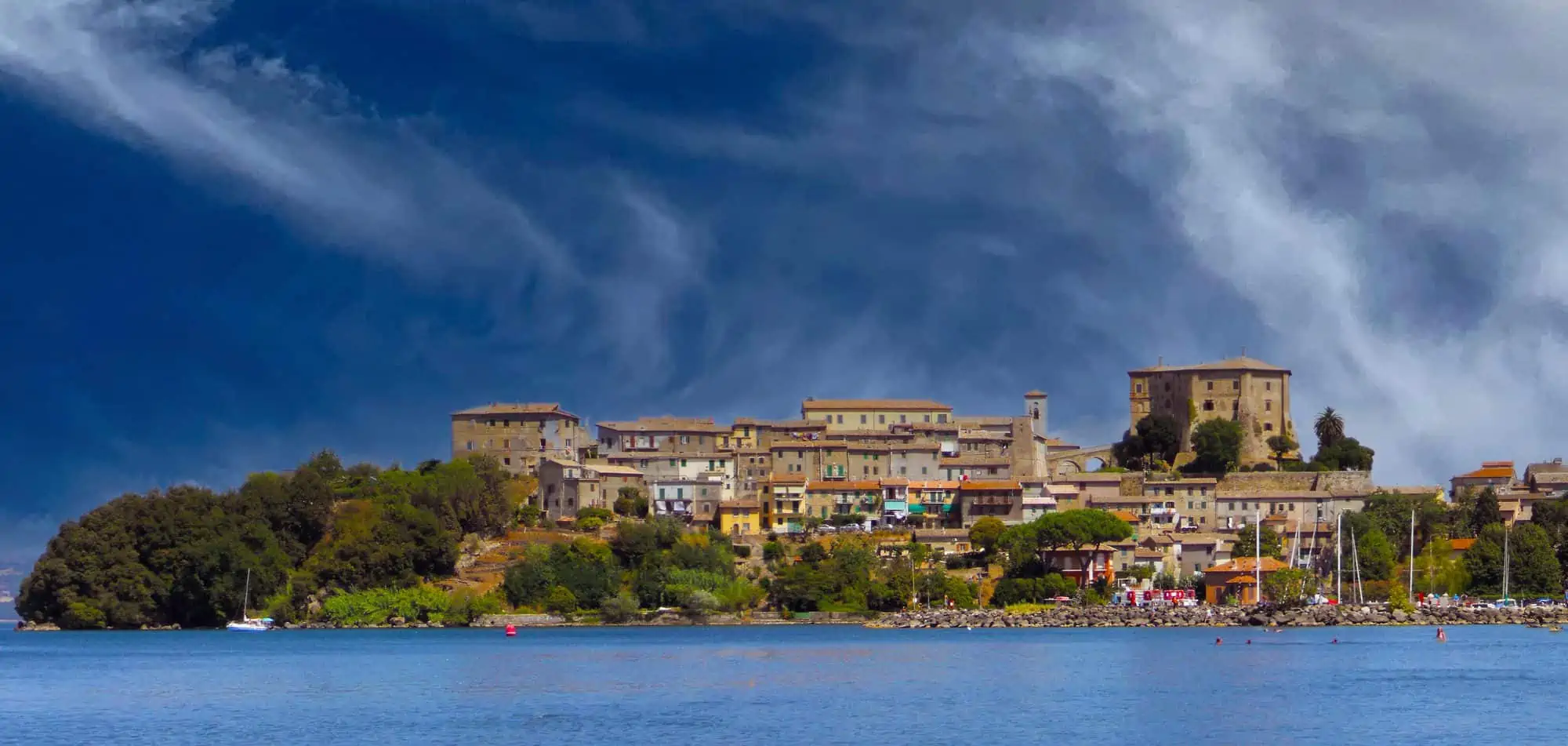
Capodimonte on Lake Bolsena: why this village is different from the others
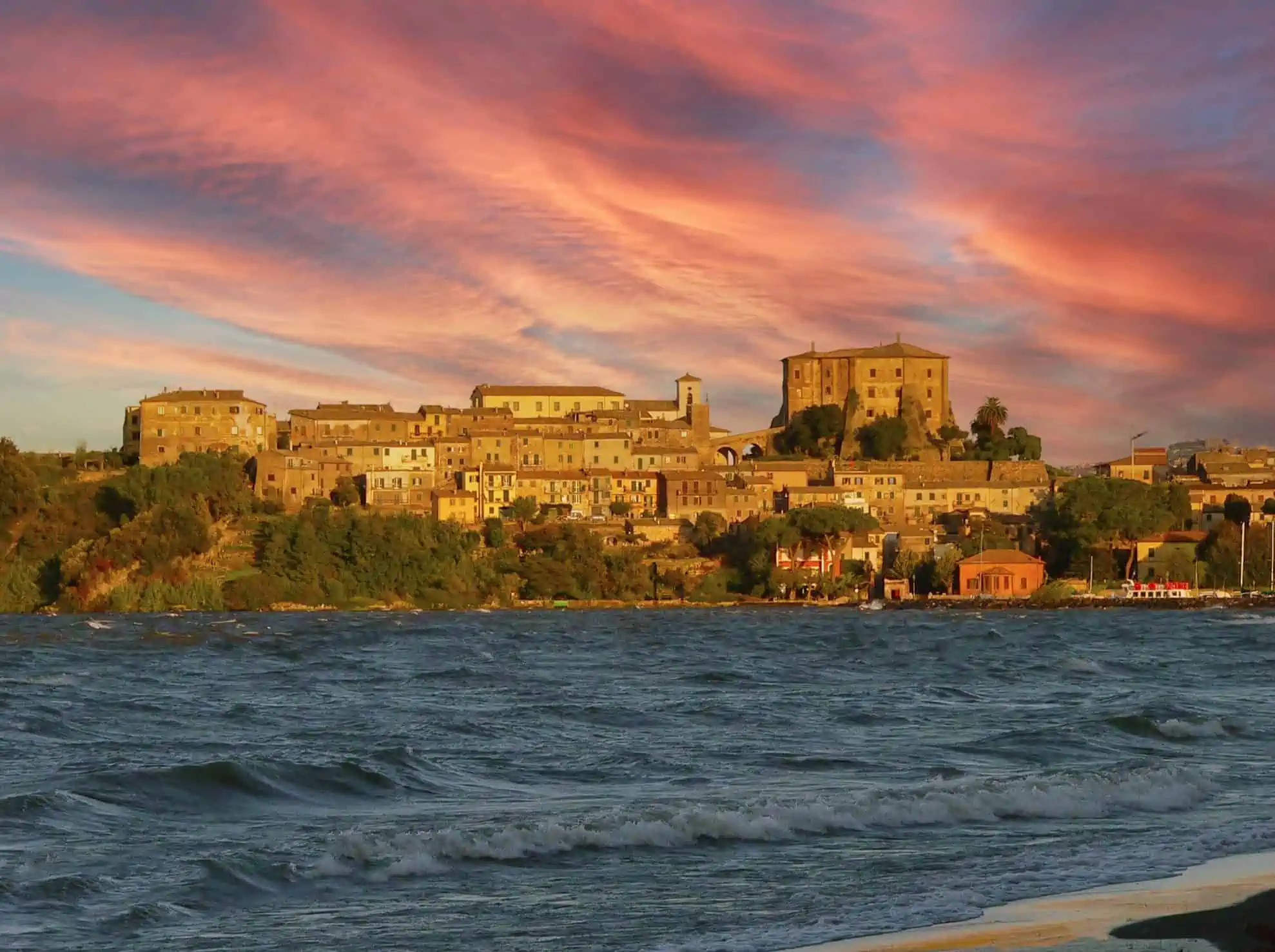
Lake Bolsena has about 10 towns on its shores, but only one is built over the water. Capodimonte occupies a small peninsula: the historic center is a cluster of medieval houses climbing the tuff rock, crowned by the octagonal mass of the Rocca Farnese, and the modern town has spread out on the flat, at the foot of the promontory, along a promenade shaded by centuries-old plane trees that runs parallel to a long beach of dark sand. From any point of the lakefront, when you raise your eyes, the Rocca is there, with its corner bastions and the loggia open toward the lake. It is a scene out of a painting, and in fact in the tourist catalogs Capodimonte is called "the gem" or "the pearl" of Lake Bolsena. I prefer another definition, more honest: it is the town on the lake where you feel the water the most, because you have it on three sides.
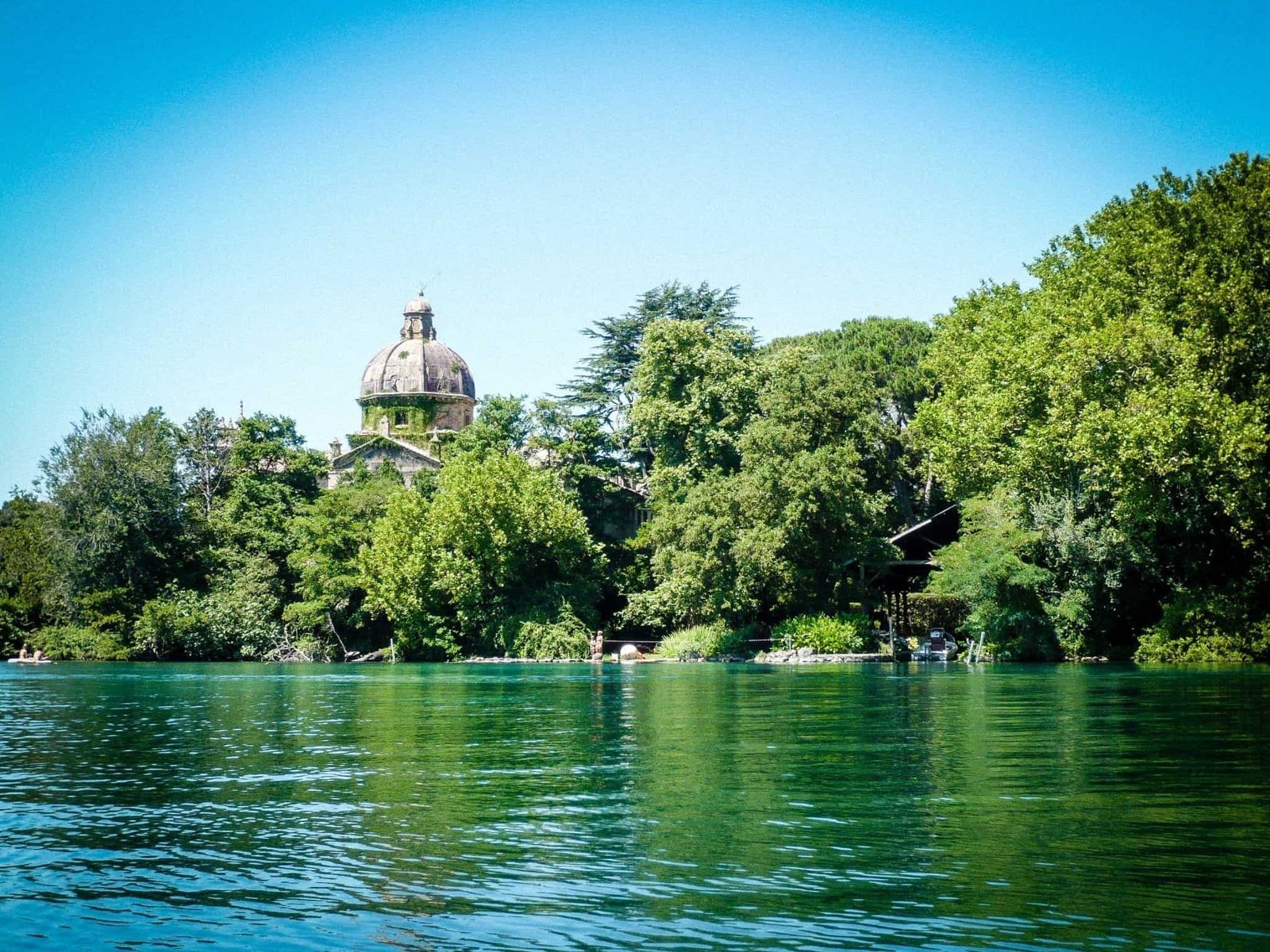
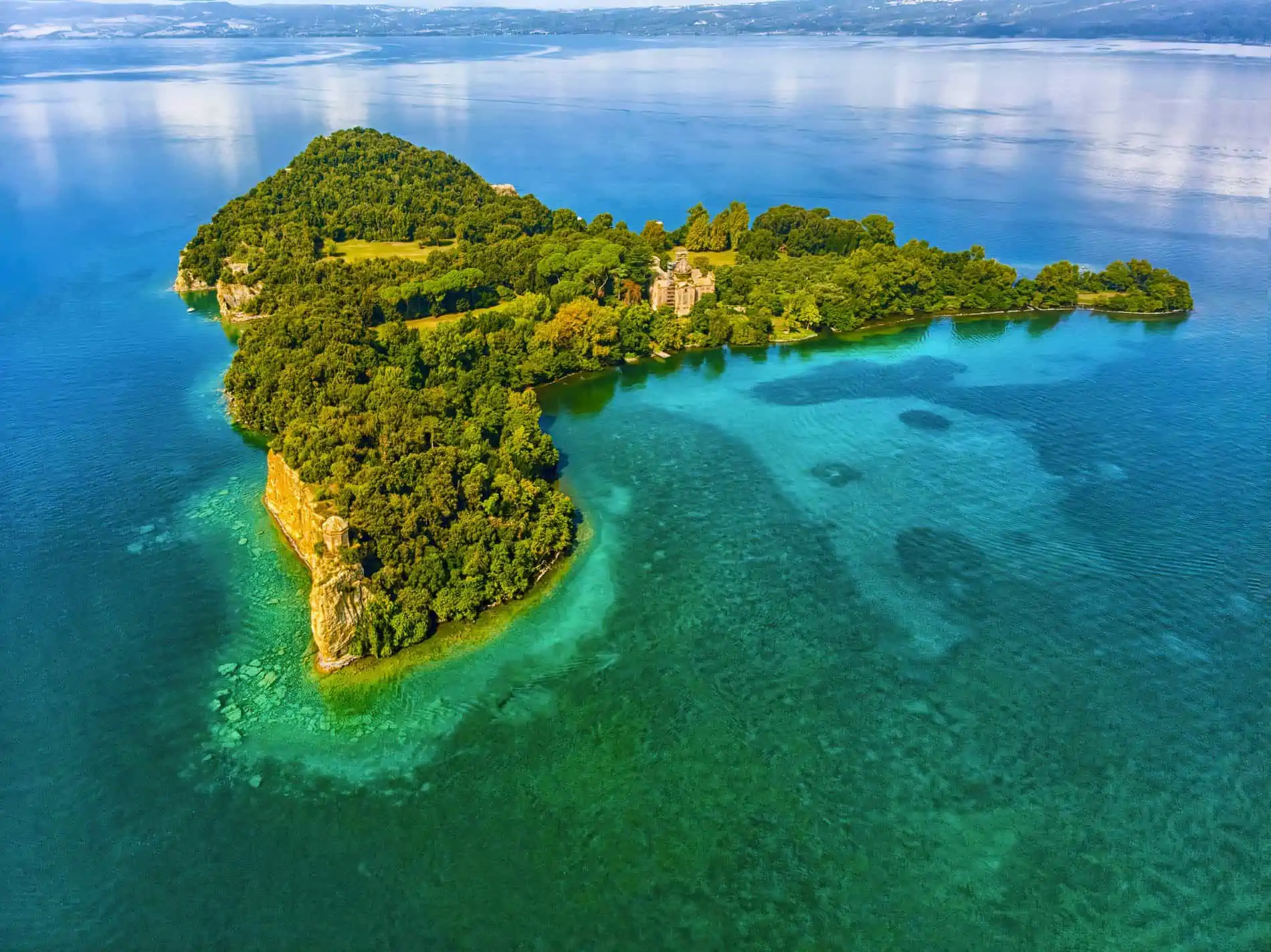
Tourism is the driving sector of the local economy, supported by sailing, canoeing, windsurfing and a marina that welcomes sailboats and motorboats. From the pier of Capodimonte the boats also leave for the Isola Bisentina, the larger of the two islands of the lake, which the Etruscans considered sacred and which over the centuries has accumulated myths and legends, up to the recent and rather extravagant one of the underground kingdom of Agarthi. The island is a couple of kilometers from the shore and from Capodimonte you see its whole outline: Monte Tabor to the north, the wooded plain to the south, the lead dome of the church of Santi Giacomo e Cristoforo poking out from the holm oaks.
The beach and the lakefront of Capodimonte
The beach of Capodimonte is one of the concrete reasons Romans come here in summer instead of going to the sea. The shore is volcanic sand, dark and fine, with safe seabeds that slope gently, so suitable even for small children. The beach is cleaned daily with a cleaning machine, and small Italian gardens have been laid out along the promenade. The lakefront of Viale Regina Margherita, with the plane trees, the restaurants and the museum, is the town's living room: here you stroll in the evening, here you eat the whitefish, here the festival is held. The harbor is at one end, under the Rocca, and is the point you leave from for the island. An observation as a professional: the beach of Capodimonte is windier than those of Bolsena and Marta, and anyone who sails or windsurfs knows it. Anyone who just wants to sit in the sun under an umbrella notices it on the days of the tramontana.
What to see in Capodimonte in one day
The places to see in Capodimonte are, in the order met by someone climbing from the lakefront: the Church of San Rocco and the Church of San Carlo, in the village. The Collegiata of Santa Maria Assunta in Cielo, in Piazza della Rocca, with the venerated image of the Madonna delle Grazie. Palazzo Borghese, now the seat of the Municipality, in the small square to the right of the church. The Palazzo Poniatowski attributed to Valadier, which the people of Capodimonte call "il Palazzaccio". The Rocca Farnese with its hanging garden. The farmhouse with the Farnese stables, the Historical and Religious Museum on Via della Rocca and the underwater nativity scene next to the small gardens of the same street. Outside the center remain the Museum of Inland Water Navigation, on the lakefront, the Church of the Madonna del Soccorso at the cemetery, and, a few kilometers to the north, the promontory of Bisenzio with the Etruscan necropolises and the little church of Sant'Agapito. Some of these places are under restoration or open only on special occasions: before planning the day it is best to check with the Municipality of Capodimonte or with the Pro Loco.
The Bronze Age dugout canoe of Capodimonte
The most extraordinary archaeological piece in the town is not Etruscan but much older. In 1989, in the waters of the lake near Capodimonte, a monoxylous dugout canoe was recovered, that is, a boat made from a single trunk, more than six meters long and datable to the Final Bronze Age, between the 14th and the 11th century BC. It has a structural peculiarity that led scholars to suppose it was one of the two halves of a primitive catamaran. For years the canoe was displayed in the "Vittorio Fanelli" cultural center. Since 2010 it has been the central piece of the Museum of Inland Water Navigation, built precisely around it. The dating "to the Paleolithic" that circulates in many descriptions of the town is a gross error: it is the late Bronze Age, and the 3,000 years of distance between the two epochs are not a detail.
How to get to Capodimonte (VT) - Lake Bolsena from Rome
By car the simplest road is the Cassia: you leave Rome, pass Viterbo and continue toward Montefiascone and Marta, or follow the Cassia to the turnoff for Capodimonte. Those who prefer the motorway take the A1 to Orte, the Orte-Viterbo expressway and then the Cassia northward. From Viterbo to the town it is some 20 kilometers to the northwest, more or less half an hour. From Rome allow a good hour and a half in ordinary traffic, more on a summer Saturday morning.
Those without a car use Cotral: there are runs from Roma Saxa Rubra and from Viterbo, and the stops are in town. The schedules change between summer and winter and between weekdays and holidays, and on holidays the runs thin out: check them on the Cotral website before leaving. By train you arrive at Viterbo, Montefiascone or Orvieto, and from there you continue by bus. The advice is clear: for Capodimonte the car is almost indispensable if you also want to do the tour of the lake or get to the island on time. With public transport the trip is possible, but you have to concentrate on the town and the beach and give up the detours.
Where to park in Capodimonte
The historic center is largely pedestrian and the alleys are narrow: you leave the car down below, on the lakefront or in the parking areas of the new part of town, and walk up to the Rocca in 10 minutes. In August, on the days of the Sagra del Coregone and the feast of San Rocco, the spaces run out in the early afternoon.

The Rocca Farnese of Capodimonte, Sangallo's octagon
The Rocca Farnese of Capodimonte is the monument that makes the town. It stands on the highest point of the promontory, on a tuff rock that drops sheer into the lake, and you recognize it from kilometers away by its octagonal plan, unique among the Farnese residences of northern Lazio together with the pentagon of Caprarola. The history is layered. On the promontory there was a medieval fortress of the Lords of Bisenzio, the counts who dominated this stretch of lake from the early Middle Ages. The Farnese, who had Capodimonte among their possessions from 1385, absorbed it and transformed it. Antonio da Sangallo the Younger, the family's trusted architect and future author of Palazzo Farnese in Rome, rethought the quadrangular layout in octagonal form, with the corners marked by bastions, and opened toward the square a facade with arcades. Vasari places his intervention between 1513 and 1515, in the years when Cardinal Alessandro Farnese, the future Pope Paul III, was building his own image as a prince. A drawing kept in the Uffizi bears the inscription "ponte levatore chapitumonti" and is dated after 1517. The drawbridge was later replaced by a masonry bridge with two arches, which is the one you still enter by today.
The result is a building halfway between a fortress and a palace, and in fact the Rocca Farnese of Capodimonte remained unfinished for centuries: the 16th-century mass wraps around a medieval tower and keeps frescoed rooms, a loggia on the lake and a Renaissance garden. It was the Farnese's favorite residence on the lake, the place where the family received popes, sovereigns, artists and political men, Italian and foreign, who praised its magnificence. In our judgment the Rocca of Capodimonte is worth more than that of Marta and of many more famous Farnese residences, precisely because it remained unfinished and was not filled with 19th-century stuccoes. You can still read Sangallo's project.
The restoration of the Rocca Farnese and the 2026 openings
The Rocca is privately owned. A first restoration of the facades, wanted by the owners, gave back the ancient forms and reopened a Renaissance loggia that had been walled up for centuries. In 2023 the building was reopened to the public for organized visits, thanks to the commitment of the owners, the administrator and the Municipality. A second intervention, financed with PNRR funds under the Caput Mundi program and coordinated by the Superintendency for the province of Viterbo, was recently completed, and in the summer of 2026 the FAI Delegation of Viterbo organized five days of visits to show the outcome of the works: the inner courtyard, the former loggia (part of the private residence, opened as an exception) with a fresco probably attributed to Giovan Francesco Penni, a pupil of Raphael, and the hanging garden with views over the lake. The dates are June 20, July 4 and 18, August 8 and September 5, 2026, with slots at 17:30 and 18:30, free contribution, mandatory booking and a maximum of 25 people per slot. Outside these occasions the Rocca Farnese of Capodimonte can be visited only by appointment with the owners, and there are no hours or ticket office: anyone who shows up at the door without having booked finds the door closed.
The garden of the Rocca Farnese
Around the Rocca runs a garden with monumental trees, hedges and flower beds laid out in the Italian style. In the 19th century exotic species were introduced there, magnolias, the Japanese pagoda tree, palms, oleanders, which today constitute a tree heritage of value. From the garden terrace the view takes in the whole lake, with the Isola Bisentina in front and, on clear days, Montefiascone and Bolsena on the opposite shore. It is the most photographed spot in Capodimonte, and rightly so.
The churches and palaces of Capodimonte
The Collegiata of Santa Maria Assunta and the Madonna delle Grazie
The Collegiata Church of Santa Maria Assunta in Cielo is the parish church of Capodimonte and stands in a panoramic position, almost against the Rocca, in Piazza della Rocca. Its interior keeps stuccoes that local tradition attributes to Vignola, the architect who worked for the Farnese at Caprarola and on the Isola Bisentina, and above all the image of the Madonna delle Grazie, the most venerated painting in the town, attributed to Sebastiano Conca. Conca, born in Gaeta in 1680 and died in Naples in 1764, trained in Naples at the school of Francesco Solimena, moved to Rome in 1706 and there was among the most sought-after painters of the early 18th century, director of the Accademia di San Luca from 1729, author of frescoes in San Giovanni in Laterano and in Santa Cecilia in Trastevere. The attribution of the Madonna delle Grazie oscillates, in the local sources, between the hand of the master and that of his school: it is a tradition, not a document, and should be taken as such. It changes nothing for the visitor: in front of that painting, on the second Sunday after Easter, hundreds of the faithful gather, and that is the right way to see it.
Palazzo Borghese and the Palazzo Poniatowski by Valadier
In the small square to the right of the Collegiata stands Palazzo Borghese, now the seat of the Municipality of Capodimonte, which recalls in its name the passage of the fief to the great Roman family after the end of the Duchy of Castro. Not far away is the Palazzo Poniatowski, which local tradition attributes to Giuseppe Valadier, the architect of Piazza del Popolo, and which the town has renamed "il Palazzaccio": a nickname that says a lot about the irreverent affection of the people of Capodimonte for their own heritage. The Poniatowski were the Polish princely family, related to the last king of Poland, who in the 19th century owned lands and palaces in the Tuscia. The ensemble of Rocca, Collegiata, Palazzo Borghese and Palazzaccio represents the lordly face of a village that, for the rest, has kept a medieval layout of alleys, small stairways and houses leaning against one another.
San Rocco, San Carlo, the Madonna del Soccorso and the other churches of Capodimonte
The religious buildings of Capodimonte are six. Besides the Collegiata, in the village there are the Church of San Rocco, dedicated to the town's patron saint, and the Church of San Carlo. At the cemetery is the Church of the Madonna del Soccorso. On the Isola Bisentina the Church of Santi Giacomo e Cristoforo. On Monte Bisenzio the Church of Sant'Agapito, which recalls the bishopric of the ancient destroyed city. The minor churches of the village have hours tied to services and feasts: San Rocco, in particular, opens and comes alive in the week of Ferragosto.
The Historical and Religious Museum, the stables farmhouse and the underwater nativity scene
On Via della Rocca is the Historical and Religious Museum of Capodimonte, which gathers furnishings, vestments and memorabilia of parish life, and not far away is the farmhouse with the stables of Palazzo Farnese, the service complex of the Rocca. Also on Via della Rocca, next to the small gardens, is the underwater nativity scene, a Christmas tradition that uses the water of the lake as its stage set. These places have irregular openings and some have been affected by restoration works: anyone who wants to see them should ask at the Municipality or the parish before going up.

The Museum of Inland Water Navigation of Capodimonte
The Museum of Inland Water Navigation, inaugurated in 2010 on Viale Regina Margherita, on the lakefront of Capodimonte, is the only Italian museum devoted entirely to navigation on lakes and rivers. The piece around which it was born is the monoxylous dugout canoe of the Final Bronze Age discovered in 1989, more than six meters of hollowed-out trunk. Around it are arranged the traditional boats of central Italy, the naval finds from archaeology up to the 20th century and an anthropological section with the work tools and everyday objects of the fishermen of Lake Bolsena: nets, fish traps, lampare, the tools for "setting for whitefish" with the bottom nets. It is open Thursday to Sunday (Thursday and Friday 10-13 and 16-19, Saturday and Sunday 10:30-12:30 and 14-18), closed Monday to Wednesday. The ticket is paid and Touring Club members get a discount. Phone 0761 872437. It is a small museum, visited in 45 minutes, and it is worth doing before boarding the boat for the island: after seeing how people fished on the lake, the crossing takes on another meaning.
The Isola Bisentina in front of Capodimonte: history, churches and woods
The Isola Bisentina lies in the central-western part of Lake Bolsena, opposite Capodimonte, and belongs to its municipal territory. It is the larger of the two islands of the lake (the other is the Martana, in front of Marta), triangular in shape, with Monte Tabor to the north and a flat area to the south, and an extent of about 17 hectares covered by a wood of holm oaks and centuries-old trees. It owes its name to the ancient city of Bisenzio, which stood on the mainland opposite, on the southwestern shore of the lake. On such a small island a disproportionate amount of history is concentrated: Etruscan and Roman presences attested by finds, a dugout canoe discovered in 1989 at Punta Calcino, a rebellious medieval village, a Franciscan convent, a Farnese dynastic church, a prison for heretics, seven chapels, visits by popes, an Art Nouveau garden, film sets.
From the Etruscans to the popes: the history of the Isola Bisentina
Around the year 1000 the island hosted a small village that rebelled against Orvieto. In the 13th century Pope Urban IV conquered and destroyed it, imposing on it the name Isola Urbana, and from then on it became a prison for heretics. At the end of the 14th century it passed to the Farnese, who made it the family's place of representation on the lake. In 1431 Pope Eugene IV authorized the founding of a Franciscan convent. In 1462 Pope Pius II Piccolomini visited the island, celebrated mass there and, as he himself tells in the Commentarii, dined in the shade of a large poplar. In 1469 the island hosted the general congregation of the Order of Friars Minor Observant. Ranuccio Farnese began the construction of the church of Santi Giacomo e Cristoforo, conceived as a burial place for the family, and in 1588 Cardinal Alessandro Farnese the Younger, the nephew of Paul III, ordered its enlargement on an original design by Vignola, with the lead-covered dome that can still be seen today from Capodimonte. The friars abandoned the convent in 1599 and by the end of the 17th century the island was deserted.
In 1871 the entrepreneur Alarico Patti bought it. In 1912 Princess Beatrice Spada created there an Italian garden and an Art Nouveau small harbor. It then passed to the Ravaschieri Fieschi and the Del Drago, who between the 1970s and the 1990s opened it to excursions and classical music concerts, before closing it again. In 2017 the Isola Bisentina was bought by the Rovati family, Lombard pharmaceutical entrepreneurs, who reopened it to the public on March 25, 2018, for the FAI Spring Days, after 15 years of closure, and since then they have run it with a program of restorations and guided visits. The church of Santi Giacomo e Cristoforo is now under restoration and a contemporary art series has been launched on the island, titled "La Memoria dell'Acqua. Artisti in dialogo con l'Isola Bisentina".
The Path of the Seven Chapels and Sangallo's Rocchina
The Friars Minor built seven small churches along the perimeter of the island, in imitation of the seven churches of Rome, so that the pilgrim could make on the island, in miniature, the same penitential itinerary as in the city. The most notable are the chapel of Santa Caterina, called the Rocchina, octagonal in plan, built in 1520 on a spur of rock sheer above the lake on commission from Cardinal Alessandro Farnese and attributed to Antonio da Sangallo the Younger, the same architect as the Rocca of Capodimonte. The chapel of the Crucifix or of Monte Calvario, with frescoes from the school of Benozzo Gozzoli. And the church of San Pio Papa, which commemorates the visit of Pius II. Lake Bolsena, between Capodimonte, the island, Montefiascone and San Lorenzo Nuovo, is a small capital of Renaissance octagonal architecture: the Rocca, the Rocchina, the church of San Giovanni al Lago and the 18th-century square of San Lorenzo Nuovo form a coherent itinerary that few know.
The Malta dei Papi on the Isola Bisentina
The Malta dei Papi is a hypogean structure dug into Monte Tabor: a tunnel and a circular cavity six meters across, connected to the outside by a vertical shaft 30 meters long. The origin is probably Etruscan and ritual. In the Middle Ages it became the prison into which heretics were lowered from above, and its fame was such that Dante cites it in the Paradiso, in the ninth canto, as a place of punishment. Since 2026 the Malta dei Papi has been included in the route of the guided visit, together with the church of Santi Giacomo e Cristoforo, the dock, the chapel of the Crucifix and the Rocchina. It is the most interesting addition of recent years: anyone who saw the island before 2026 has a good reason to come back.
How to visit the Isola Bisentina from Capodimonte
Visits run from April 5 to November 1, 2026, every day except Monday and Wednesday, with boarding from the pier of Capodimonte and the pier of Bolsena. The boat ticket, which includes the guided visit, costs €20 for adults, €15 for young people aged 6 to 15 and for people with disabilities, and is free up to age 6. For groups of at least 20 people departing from Capodimonte the fares drop to €18 and €13. The route is a loop of about a kilometer and a half, almost all flat but with 35 irregular steps, classified as of tourist difficulty. The visit lasts between two and a half and three hours. Trekking footwear is mandatory, smoking is forbidden, small animals are allowed on a leash, there are no picnics and nothing is taken away from the island. You book online on the site isolabisentina.org. For exclusive visits write to info@isolabisentina.org. The practical advice: the first morning slot, with the lake still flat and the raking light on Monte Tabor, is the most beautiful and the least crowded.
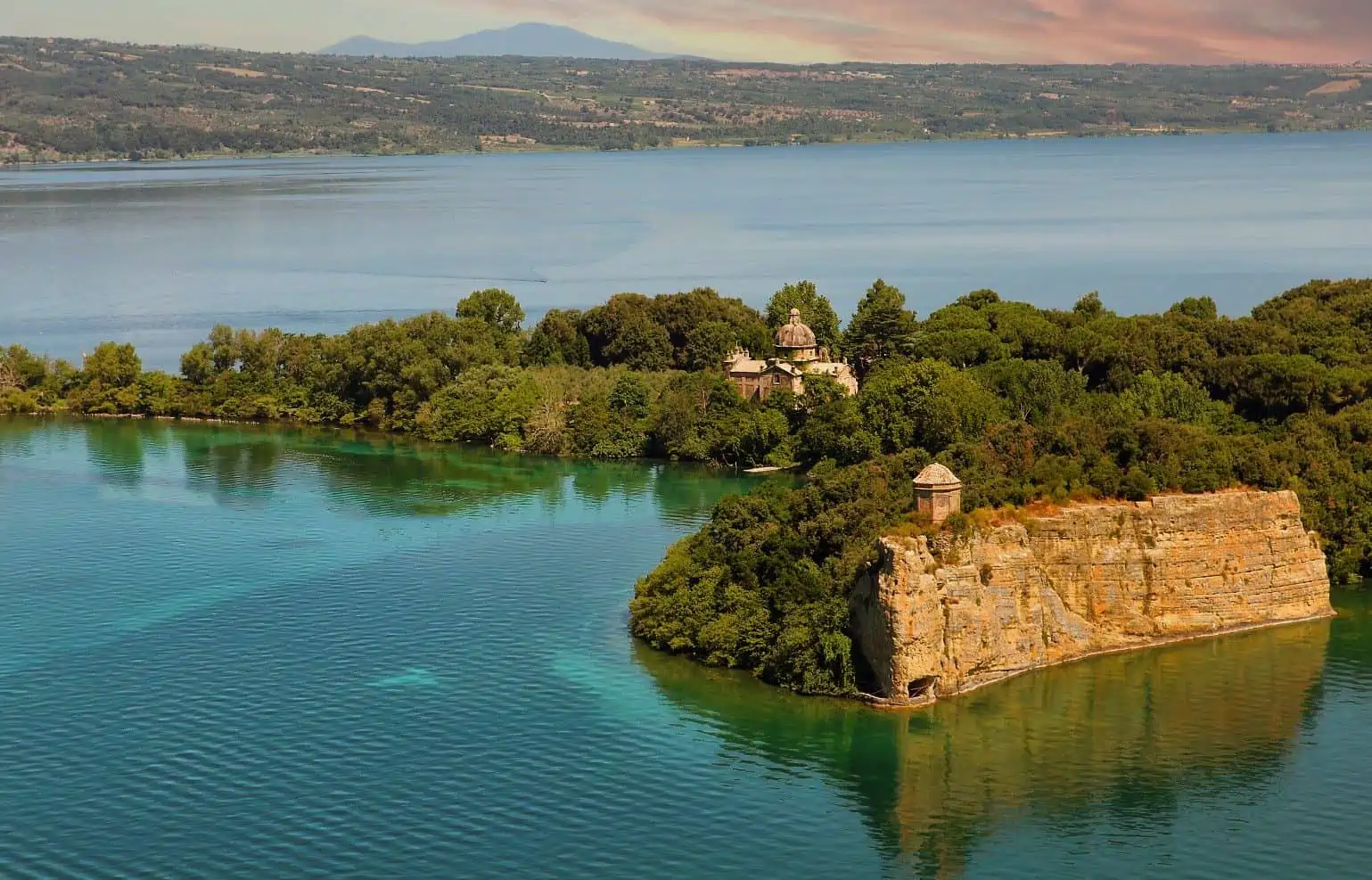
The Fanum Voltumnae and the Isola Bisentina
For generations scholars have searched on the shores of Lake Bolsena for the Fanum Voltumnae, the federal sanctuary of the Etruscans where, according to Livy, the leaders of the 12 cities of the league gathered every spring to elect the supreme chief, celebrate the festivals and decide on war and peace. Annio da Viterbo in the 15th century wanted it at Viterbo, George Dennis in the 19th century at Montefiascone, others at Bolsena or on the Isola Bisentina, strong in the sacredness the Etruscans attributed to the island. The excavations carried out since 2000 at the Campo della Fiera, below the rock of Orvieto, have with good reasons moved the identification there. The Bisentina hypothesis therefore remains a suggestion without evidence, and on the page it must be said clearly: there were Etruscans on the island, but the federal sanctuary was in all likelihood at Orvieto.
The legend of Agarthi on the Isola Bisentina
If the history of the Isola Bisentina is already dense in itself, its most singular attraction for a certain public comes from an esoteric legend. The tale is tied to the myth of the Kingdom of Agarthi, on which in 1875 the studies of the Russian-American theosophist Helena Blavatsky concentrated: Agarthi, in Sanskrit "the inaccessible," would be a kingdom located at the center of the planet according to the Hollow Earth theory, home of the mythical king of the world, inhabited by a peaceful population in contact with higher entities and able to use a mental energy called vril. Among the gateways to this kingdom, the only one on Italian territory would be precisely the Malta dei Papi of the Isola Bisentina, and the fact that the Etruscans held the island sacred has fed the story. It must be said without embarrassment: it is 20th-century esoteric literature, not archaeology. But it is a good example of how a small place can hide from view a centuries-long extension of mystery, and the guides of the island are asked about Agarthi on every visit.
Bisenzio, the Etruscan city from which Capodimonte was born
The history of Capodimonte begins elsewhere, on the promontory of Bisenzio, a few kilometers north of the town, sheer above the lake. In 2011, along the stretch of coast between the promontory of Capodimonte and that of Pajeto, some 40 finds were collected, pottery fragments and animal remains, of the Bronze Age. Their comparison with similar materials found at other points of the lake made it possible to recognize a late Bronze Age settlement right on the promontory of Capodimonte, and the canoe in the museum belongs to that same horizon. The first settlement of Bisenzio also dates to the Bronze Age, which later became an important Etruscan center, the Vesentum of the sources, with very rich necropolises whose grave goods are in good part kept at the National Etruscan Museum of Villa Giulia in Rome. The city was destroyed in 280 BC during the Roman conquest and refounded as a municipium under the name Visentium. It became a bishop's seat and was devastated by the Lombards in the early Middle Ages (the sources oscillate between the 7th and the 8th century).
The founding of Capodimonte in 1102
Part of the survivors of Bisenzio and of the nearby settlement of Cornassa took refuge eastward, on the promontory, and formed the first nucleus of Capodimonte, which in 1102 is mentioned for the first time, as "Capo di Monte," when it became a parish. Another group preferred to rebuild on the ruins, giving rise to the medieval castle of Bisenzio, whose ruin can still be recognized on the mountain. Capodimonte depended for a long time on the Counts of Bisenzio, then entered the orbit of Orvieto and of the diocese of Montefiascone, and in 1385 it was assigned to the Farnese family, who made it one of the strongholds of what in 1537 would become the Duchy of Castro, a sovereign state wedged between Tuscany and the Papal States. With the end of the duchy, in 1649, the town passed to the Apostolic Camera and remained there until the entry into the Kingdom of Italy, in 1870. In 1807 Pope Pius VII sanctioned the definitive union with Capodimonte of the castle of Bisenzio and of the Isola Bisentina: since then the island belongs to Capodimonte.
Capodimonte today: the Romans' village and the new part
As in many villages of the Tuscia, the recent urban expansion came from an exchange: the inhabitants sold the small houses of the old village, largely to Romans who use them as second homes, and moved to the new part, developed on the flat in front of the lakefront, a few meters from the promenade and the beach. The young emigrate toward Rome and Viterbo, where work is easier to find, and the resident population, about 1,650 people, ages. In summer, though, the town multiplies: the second homes fill up, the lakefront comes alive and Capodimonte goes back to being what it has been for centuries, a vacation place.
Capodimonte and the Farnese: Giulia la Bella and the Borgia pope
The Farnese left indelible traces in the territory of the duchy, and Capodimonte was one of their favorite places well before Caprarola. The family was of local origin, rooted between Canino, Ischia di Castro, Valentano, Farnese and the lake. Palazzo Farnese at Ischia di Castro, transformed in the 16th century on a design attributed to Antonio da Sangallo the Younger from a 13th-century fortress, is the oldest Farnese residence still existing, and from there in 1527 Pier Luigi Farnese wrote on behalf of the emperor Charles V "from my Palace of Ischia." After 1649 that palace passed to the Apostolic Camera, to the Capranica and to the Piermartini, and today it is privately owned. At Capodimonte the Farnese built the Rocca and received popes and princes there, and from here begins the story of the most gossiped-about woman of the Roman Renaissance.
Giulia Farnese, the pope's sister
Giulia Farnese was born in 1475, probably in Canino, in the fortress of the historic center, although an insistent tradition wants her born in the Rocca of Capodimonte, where the family gladly resided. The marriage contract with Orsino Orsini, son of Adriana de Mila, cousin of Cardinal Rodrigo Borgia, was drawn up in Rome on May 20 and 21, 1489 and the wedding was consummated on May 9, 1490. The relationship with Rodrigo Borgia, who in 1492 became pope with the name Alexander VI, was consolidated in 1493: Giulia lived in Rome in the palace of Cardinal Zeno together with Lucrezia Borgia, and the pope went so far as to threaten her with excommunication when she wanted to move away from him. The daughter Laura, born on November 30, 1492, was attributed now to Orsino, now to the pope. On September 20, 1493 Alexander VI made Giulia's brother, Alessandro Farnese, a cardinal, whom the Romans for this reason called "the petticoat cardinal" and who in 1534 would become Pope Paul III. From 1506 Giulia governed the fief of Carbognano with a firm hand and died in Rome on March 23, 1524, in the palace of her cardinal brother.
The legend of Capodimonte tells things differently: Giulia, madly in love with the cardinal, would have been forced to marry his nephew to silence the gossip, and at the pope's death would have withdrawn to the Rocca, in despair, until she still wanders restlessly today through the village and over the waters of the lake. It is a beautiful story to tell in the evening on the lakefront, and in town it is told. The documents say otherwise. At Capodimonte, in compensation, the family truly lived through a bereavement: on July 12, 1494 Angelo Farnese, brother of Giulia and Alessandro, died there. Those who want to follow the thread of the Borgia in Rome can climb the Salita dei Borgia, in the Monti district, where tradition places the house of Vannozza Cattanei, the other lover of Rodrigo Borgia, mother of Giovanni, Cesare, Goffredo and Lucrezia.
Capodimonte and "Beauty and the Beast": Petrus Gonsalvus at the Rocca Farnese
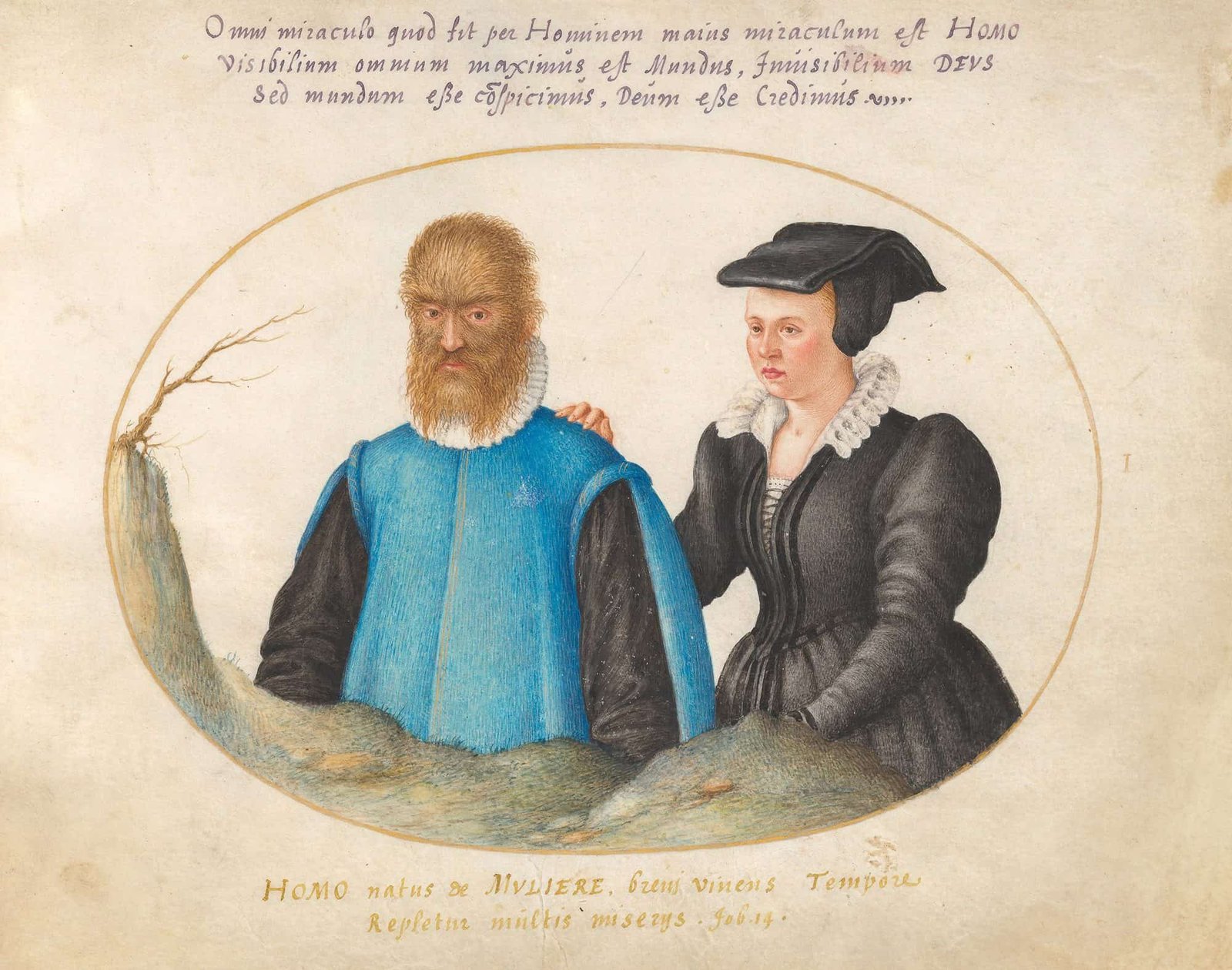
In the Rocca Farnese of Capodimonte died, on January 20, 1618, one of the most famous figures of the Europe of his time: Petrus Gonsalvus, in Spanish Pedro González, the gentleman affected by hypertrichosis whom popular culture has chosen as the model of the "Beast" of the fairy tale "Beauty and the Beast." He was born in Tenerife in 1537, a few decades after the conquest of the island by Alonso Fernández de Lugo, and because of his appearance, his face and body entirely covered with hair, he was called "Salvaje Gentilhombre de Tenerife" and "Hombre Lobo Canario." At 10 he was taken to France and given to the court of Henry II, where he remained 44 years. Instead of keeping him as a sideshow freak, the king had him educated: Petrus learned the humanities and Latin, and was granted the honorary title of "don," as a descendant of a Guanche king, the original population of the Canary Islands.
Catherine, the children and the portraits of Ambras
In 1573 Petrus married Catherine, believed to be a lady-in-waiting of Queen Catherine de' Medici, a woman of normal appearance who stayed by his side all his life. It is this marriage, between a man with the face of a beast and a very beautiful young woman, that fed the idea that the 18th-century fairy tale of Madame de Villeneuve and Madame de Beaumont has a root in their story. They had six children, four of them affected by hypertrichosis, among them Antonietta Gonsalvus, portrayed as a child in one of the most famous paintings of the late 16th century. At Ambras Castle, near Innsbruck, four paintings depicting Petrus and the children are kept. From those portraits medicine took the name "Ambras syndrome" for the congenital form of hypertrichosis. Petrus and his family are believed to be the oldest cases of hypertrichosis described in Europe, and details of their life are found in the Vatican Archive and in archives of Rome and Naples.
The move to Italy and death at Capodimonte
Between 1580 and 1590 Petrus Gonsalvus left France with his family and moved to Italy, first to the court of Margaret of Parma, the natural daughter of Charles V married to Ottavio Farnese, and then, under the protection of the Farnese, to Capodimonte, in the Rocca on the lake, where he spent his last years and died in 1618. That a man observed all his life as a curiosity chose to end his days in a fishing village on Lake Bolsena, far from the courts, is perhaps the most moving part of the story. The date of his death, January 20, coincides with the feast of San Sebastiano, patron saint of Capodimonte: a coincidence that few in town notice.
The whitefish and the cuisine of Capodimonte
The typical dish of Capodimonte is the whitefish, the fish that made the cuisine of Lake Bolsena famous. It is eaten in a thousand ways, grilled over embers, baked in parchment, in fillets, as a ragù for pasta, in fried meatballs, in the restaurants of the lakefront, accompanied by the Cannaiola, the sweet and light red wine of nearby Marta, or by the Est! Est!! Est!!! of Montefiascone. The history of the whitefish is less ancient than people think: it is not a native fish. It belongs to the salmonid family, and was introduced into Lake Bolsena in 1891, when 60,000 fry from Lake Constance were released there, incubated at the fish-farming station of Rome, from eggs of the imperial establishment of Huningue in Alsace. In a little over a century it has become the symbol of the lake and a traditional agri-food product of Lazio. The minimum catch size is 30 centimeters, reached in the middle of the third year of life, and fishing is closed from December 25 to January 30 to respect reproduction. The traditional techniques with which the fishermen of Capodimonte catch it, the "retoncine a fonno" lowered at night, have been documented as intangible heritage and can be seen in the anthropological section of the Museum of Navigation.
The other dishes of the lake in Capodimonte
Alongside the whitefish, the table of Capodimonte offers the sbroscia, the fish soup of the lake fishermen, cooked with lake water, potatoes, onion and mint. Pasta in tench broth. The vegetable acquacotta. Perch fillets. The fry of latterini, the small silvery fish that here they call "gocce di lago." Eel, which on Lake Bolsena has an ancient fame, given that Dante put Pope Martin IV in Purgatory precisely for the eels of Bolsena drowned in vernaccia. Inland they produce oil, cereals, vegetables, cheeses and wine. A clear opinion: the best whitefish is the grilled one, simple, with a thread of local oil. The "creative" versions found in some restaurants mortify it.
The Sagra del Coregone of Capodimonte
For a real feast of whitefish there is the festival that the town devotes to it every year at the beginning of August: in 2026 the 42nd Sagra del Coregone is held from August 6 to 9, Thursday to Sunday, from 19:00, on the lakefront of Viale Regina Margherita, organized by the cultural association "Franco Grossi" under the patronage of the Municipality of Capodimonte. The festival was born in 1981 as an occasional grill during the celebrations of Sant'Antonio Abate, in January. It was Franco Grossi, after whom the association is named, who proposed moving it to August to catch the vacationers, and since then the event has kept its volunteer spirit and devotes the proceeds to social purposes. In four evenings about 900 kilograms of fish are cooked over embers for 5,000 people, with takeaway possible. The 2026 menu includes the fry of gocce di lago at €5, the caserecce with lake ragù at €8, the grilled whitefish at €13, the fries at €5 and the local wine at €9. The stands along the streets are an invitation that is hard to resist, and the line at the grill is long but moves.
The festivals and traditions of Capodimonte
San Sebastiano, San Filippo Neri and San Rocco
The patron saint of Capodimonte is San Sebastiano, celebrated on January 20. Since the saint is also venerated as the patron of municipal police officers, on January 20 a sizable group of municipal police agents in uniform gathers in the town, a scene that surprises anyone who happens to be in Capodimonte in the depth of winter. The co-patron is San Filippo Neri, celebrated on May 26. The protector of the town is San Rocco, whose feast, on August 16, is the culmination of the Capodimonte summer: fireworks over the lake late in the evening of the eve, open-air dance nights, variety shows, chamber music concerts and concerts of the Schola Cantorum of Capodimonte. On August 15, for the Assumption to which the Collegiata is dedicated, the procession is held with more fireworks, and in guides to the lake San Rocco is sometimes indicated as the patron: in town the distinction between patron, co-patron and protector is precise and they care about it.
Sant'Antonio Abate, the Madonna delle Grazie and the infiorate
On January 17, for Sant'Antonio Abate, animals are blessed and the bonfire of Sant'Antonio is lit, with distribution of bruschetta dressed with local oil: it is the feast from which, in 1981, the whitefish grill was born that would become the August festival. The Feast of the Madonna delle Grazie falls on the second Sunday after Easter. The icon, the ancient painting attributed to Sebastiano Conca or his school, is solemnly displayed from the second Saturday after Easter, at 15:00, for the entire week in the Collegiata of Santa Maria Assunta, in a celebration attended by hundreds of the faithful, and on the third Sunday after Easter it is carried in procession along the streets of the town adorned with a colorful infiorata. A second infiorata accompanies the Corpus Domini procession, the Sunday after the feast. The April infiorata is, in our judgment, the most beautiful moment to see Capodimonte: the town is in flower, the tourists are few and the village belongs to its inhabitants.
A curiosity about Capodimonte (VT) - Lake Bolsena
The curiosity concerns the bridge by which you enter the Rocca. Among the drawings of Antonio da Sangallo the Younger kept in the Gabinetto dei Disegni e delle Stampe of the Uffizi there is one that bears, in the architect's own hand, the inscription "ponte levatore chapitumonti," and it is dated after 1517. The drawbridge of Capodimonte, designed by the greatest military architect of the Italian 16th century, was later replaced by a masonry bridge with two arches, which is the one you cross today. But the drawing remains, and it is one of the few written testimonies that let us follow Sangallo's work on the lake almost year by year. Vasari, in the Life of Sangallo, places between 1513 and 1515 the intervention on the entrance forebody and on the courtyard: they are the years when Cardinal Alessandro Farnese, who would become Paul III, was spending on the Tuscia to build the family's prestige, and Capodimonte precedes Caprarola by 30 years. The second curiosity, which ties to the first, is the octagon. Within a radius of a few kilometers Sangallo and the Farnese left two octagonal buildings, the Rocca of Capodimonte and the Rocchina of Santa Caterina on the Isola Bisentina of 1520, and later the form returned in the church of San Giovanni al Lago at Montefiascone and, in 1774, in the octagonal square of San Lorenzo Nuovo, designed by Francesco Navone on the model of Amalienborg in Copenhagen. Lake Bolsena is, without anyone advertising it, an open-air museum of the Renaissance central plan, and Capodimonte is its opening chapter.
Something nobody tells you about Capodimonte (VT) - Lake Bolsena
Nobody tells you that the Rocca Farnese, the monument you come to Capodimonte for, has no opening hours. It is a private residence, and however much the photographs show it on every cover of the Tuscia, the way in is only one: an organized opening date, or an appointment with the owners. In 2026 the occasions are the five FAI days between June and September, in which you visit the courtyard, the former loggia with the fresco attributed to Penni and the hanging garden, with one-hour slots at 17:30 and 18:30, 25 people at a time and mandatory booking. Outside those dates, whoever arrives in Piazza della Rocca sees the two-arched bridge, the door and the restored facades, and that is all. The second thing nobody says: the Isola Bisentina closes on Monday and Wednesday, and the season runs from April 5 to November 1. Whoever arrives in Capodimonte on a Monday in July with the idea of "doing the island" goes home without having seen it, and the harbor has no free ferry service: you go only with the guided visit, you book online and trekking footwear is mandatory, because the route has 35 irregular steps cut into the tuff and beach sandals are not enough. The third: the Museum of Navigation, which is the easiest place to visit in town, closes Monday to Wednesday. A simple rule follows, worth more than any description: you come to Capodimonte from Thursday to Sunday, and for the Rocca you choose one of the published dates.
The advice I give you for visiting Capodimonte (VT) - Lake Bolsena
The advice is to build the day around the island and not around the town. You book the first morning boat slot from Capodimonte, arrive at the harbor half an hour early, park on the lakefront while it is still empty and spend three hours among the dock, the church of Santi Giacomo e Cristoforo, the chapel of the Crucifix, the Rocchina and the Malta dei Papi. You return to shore for lunchtime, eat grilled whitefish in one of the restaurants of Viale Regina Margherita and in the early afternoon, when the sun beats down, you visit the Museum of Navigation, which is indoors and a short walk away. Around five you climb to the village: the Collegiata, Palazzo Borghese, the Palazzaccio, the alleys and Piazza della Rocca, with the light lowering over the lake. If it is one of the opening days, the 17:30 slot at the Rocca closes the day in the best way. Whoever has a second day devotes it to the tour of the lake, clockwise: Marta with its tower and the Cannaiola, Montefiascone with the dome and the Est! Est!! Est!!!, Bolsena with the basilica of Santa Cristina and the Monaldeschi castle, Grotte di Castro and Gradoli on the upper shore, and Valentano with the other Rocca Farnese, the one of the museum of the Prehistory of the Tuscia. The right period: late May or September, with the lake warm, the long light and without the August crowd. Avoid, unless you really want the festival, the second weekend of August.
Another well-known fact, yet rarely cited
Everyone knows Lake Bolsena is volcanic. Few remember that it is the largest lake of volcanic origin in Europe and that the volcano is the same one that gave Capodimonte its black sand and its rock. The basin occupies the caldera of the Vulsini complex, which erupted between about 600,000 and 100,000 years ago. The promontory on which the village stands is an outcrop of that history, and the Isola Bisentina and the Martana are its most visible remains, two secondary cones half submerged. A second well-known but rarely cited fact concerns the whitefish: everyone eats it as “the fish of the lake,” but it arrived in 1891 from Lake Constance, with eggs incubated in Rome, and its history in the lake is a little over 130 years. The fishermen of Capodimonte built around an imported fish a work culture, with their own nets, schedules and techniques, which today is documented as intangible heritage. It is proof that traditions are often younger than they seem, without being any less true for that. The third fact: on the island, in the 13th century, heretics were lowered into a 30-meter pit, the Malta dei Papi, and the thing was so well known that Dante used it in the Paradiso as an image of punishment. From Capodimonte the island looks like a garden. For three centuries it was also a prison.
The Right Photo to Take at Capodimonte (VT) - Lake Bolsena
The right photo of Capodimonte is taken from the water, and more precisely from the boat that leaves for the Isola Bisentina, 10 minutes after departure, turning back toward the town. From there the promontory appears whole: the dark beach and the plane trees below, the medieval houses climbing in a cluster, the Collegiata and, at the top, the octagon of the Rocca with its loggia open onto the lake. It is the only shot in which you understand that Capodimonte is a peninsula, and the first run of the morning, with the sun still low in the east, lights the Rocca from the side and leaves the lake flat. The second photo is the one from the hanging garden of the Rocca, when it is open: the Isola Bisentina in the center, the lead dome poking out of the holm oaks and, in the background, Montefiascone on the opposite shore. In September, with clean air, you can also make out Bolsena. The third, for those who prefer the evening, is shot from the lakefront at the port, at sunset, with the Rocca backlit and the sailboats coming back in. On the eve of San Rocco, August 15, fireworks reflected in the water are added, but you have to arrive two hours early to get a spot on the shore. One technical warning: volcanic sand is dark and absorbs light, and photos of the beach taken at noon come out flat. The beach of Capodimonte is photographed at 8 in the morning or at golden hour, never in full sun.
Some Important Events That Happened Here in History
The first event is a destruction: in 280 BC Rome conquered and destroyed Etruscan Bisenzio, the city that dominated this stretch of lake, and refounded it as a municipium with the name Visentium. The second is another destruction, the Lombard one of the early Middle Ages, from which Capodimonte was born: the survivors took refuge on the promontory to the east and in 1102 the new settlement of “Capo di Monte” became a parish. The third is the arrival of the Farnese, in 1385, which transformed a fishing village into the lake residence of a rising family. The fourth is Sangallo's building site, between 1513 and 1517, which gave the town the octagon that distinguishes it. The fifth is the visit of Pope Pius II, in 1462, who from the island looked at this shore and wrote about it in the Commentarii. The sixth is the death, on July 12, 1494, of Angelo Farnese, brother of Giulia and of the future Paul III, in the Rocca. The seventh is the death of Petrus Gonsalvus, on January 20, 1618, also in the Rocca, which closes in the silence of a lake village one of the most observed lives in Europe. The eighth is the end of the Duchy of Castro, in 1649, when papal troops razed Castro to the ground and Capodimonte passed to the Apostolic Chamber, in which it remained until 1870. The ninth is the decree of Pius VII of 1807 that definitively united the castle of Bisenzio and the Isola Bisentina to the municipality. The 10th is 1891, with the 60,000 whitefish fry poured into the lake. The 11th is 1989, with the recovery of the Bronze Age dugout canoe, and 2010, with the opening of the museum that holds it. The 12th, and most recent, is March 25, 2018, when the Isola Bisentina, bought the year before by the Rovati family, reopened its doors to the public after 15 years. Since that day Capodimonte has again become the port of the island, and its summer economy has clearly gained from it.
Who Passed Through Capodimonte (VT) - Lake Bolsena
First of all, the Farnese passed through Capodimonte: Alessandro Farnese, the cardinal who in 1534 became Pope Paul III, who made the Rocca a residence and commissioned from Sangallo the Rocchina on the island, Pier Luigi Farnese, his son, first Duke of Castro, Cardinal Alessandro Farnese the Younger, who in 1588 wanted Vignola's dome on the island church, and Giulia Farnese, the pope's sister, who according to local tradition was born in the Rocca and who lost her brother Angelo here in 1494. Antonio da Sangallo the Younger worked here in person between 1513 and 1517, and Vignola designed for the island in front of the town. Pope Pius II Piccolomini celebrated Mass on the island in 1462 and dined in the shade of a poplar, and the Commentarii preserve the account. Local sources recall that many other pontiffs came to the lake during summer breaks, guests of the Farnese. Petrus Gonsalvus and Catherine spent their last years of life here, after the court of Henry II of France and that of Margaret of Parma, and Petrus died here in 1618. Sebastiano Conca, or his workshop, painted the Madonna delle Grazie of the Collegiata in the 18th century, and Giuseppe Valadier, according to tradition, designed the Palazzaccio of the Poniatowski. In the 19th and 20th centuries the history of the island carries the names of the entrepreneur Alarico Patti, of Princess Beatrice Spada, of the Ravaschieri Fieschi and of the Del Drago, and in 2017 that of the Rovati family. Cinema has used the Isola Bisentina as a set for films by Carlo Verdone and Alice Rohrwacher, and Walter Siti made it the main setting of the novel “La natura è innocente.” Finally, and they are the silent majority, the Romans: for a century they have been buying the houses of the village, filling the beach from June to September, and they have made Capodimonte a small summer colony of the capital on the lake.
What to See Around Capodimonte: The Other Villages of Lake Bolsena and the Tuscia
Anyone who arrives in Capodimonte should also visit the villages of the lake: Bolsena, Marta, Gradoli, Grotte di Castro and Montefiascone, and, an hour's drive away, Sant'Angelo di Roccalvecce, the village of fairy tales, with murals that tell fairy tales on the facades of the houses. On the Farnese side the town of Farnese, Ischia di Castro with the oldest palace of the family, Valentano and the ruins of Castro complete the picture of the duchy. The province of Viterbo never stops amazing, as anyone knows who has already seen the Monster Park of Bomarzo, the ancient village of Chia below Soriano nel Cimino, Civita di Bagnoregio, Calcata with the Opera Bosco, the museum of art in nature, the gardens of Villa Lante in Bagnaia or the Palazzo Farnese in Caprarola, the other Farnese masterpiece of the Tuscia, pentagonal as Capodimonte is octagonal.
Graffignano, Civitella d'Agliano and La Serpara
On the bank of the Tiber, east of the lake, are the small village of Graffignano and Civitella d'Agliano, which hides an open-air museum: La Serpara of Paul Wiedmer, the Swiss artist who in 1997 bought a valley to make it a garden-atelier with more than 40 installations and sculptures that blend into the vegetation, visitable only on certain days of the year, by reservation. It is a one-hour detour from Capodimonte and I recommend it to those who have already done the tour of the lake and want a different Tuscia.
Capodimonte with Kids, Accessibility and How Much It Costs
Capodimonte is one of the lake towns best suited to children: the beach has shallow, safe waters, the lakefront is flat and shaded, the navigation museum with the dugout canoe and the boats appeals to little ones, and the boat crossing is an adventure in itself. The Isola Bisentina, however, has precise limits: the visit lasts three hours, the route has 35 irregular steps and hiking footwear is mandatory. Strollers are not suitable, and children up to 6 enter free but must be carried in the awkward stretches. The upper village has stairways and uphill alleys and the Rocca, with the bridge and the courtyard, is not designed for wheelchairs. The lakefront, the beach and the museum, however, are accessible. How much it costs: the town, the beach and the village are free. The museum has a modest paid ticket. The island costs €20 per person, €15 for young people, and is the main item in the day's budget. The Rocca, on FAI days, is by free contribution. A family of four doing island, museum and a whitefish lunch spends roughly between €120 and €150, parking included.
Quick Questions About Capodimonte (VT) - Lake Bolsena
Where is Capodimonte and how far is it from Rome?
Capodimonte is in the province of Viterbo, on the southwestern shore of Lake Bolsena, at an elevation of 334 meters and about 20 kilometers northwest of Viterbo. From Rome it is about 110 kilometers, a good hour and a half by car on the Cassia or on the A1 with the Orte exit.
How do you get to Capodimonte without a car?
With Cotral buses from Roma Saxa Rubra or from Viterbo. By train you reach Viterbo, Montefiascone or Orvieto and continue by bus. Check the times on the Cotral website, because on holidays the runs are reduced.
How much does it cost to enter Capodimonte?
Nothing: the village, the lakefront, the beach and the port are free. You only pay for the ticket to the Museo della Navigazione and the boat ticket to the Isola Bisentina.
Can you visit the Rocca Farnese of Capodimonte?
Only on the organized open days (in 2026 on June 20, July 4 and 18, August 8 and September 5, with the Viterbo FAI Delegation, reservation required and free contribution) or by appointment with the owners. The Rocca is a private residence and has no regular hours or ticket office.
What can you see in the Rocca Farnese during the visits?
The inner courtyard, the former loggia with a fresco attributed with some probability to Giovan Francesco Penni, and the hanging garden with views of the lake and the island. The private rooms are not part of the route.
Who built the Rocca Farnese of Capodimonte?
The Farnese, on an earlier fortress of the Lords of Bisenzio, to a design by Antonio da Sangallo the Younger, who between 1513 and 1517 redesigned the layout in an octagonal form with corner bastions, loggia and garden.
Why is the Rocca of Capodimonte octagonal?
Because Sangallo transformed the medieval quadrangular base into an octagon with the corners marked by bastions, a solution halfway between fortress and villa that answered the Renaissance taste for the central plan. The same shape returns in the Rocchina of Santa Caterina on the Isola Bisentina, of 1520.
How do you get from Capodimonte to the Isola Bisentina?
By boat from the port of Capodimonte (or from Bolsena), with the guided visit included, from April 5 to November 1, 2026, every day except Monday and Wednesday. You book online on the site isolabisentina.org.
How much does the visit to the Isola Bisentina cost?
€20 for adults, €15 for young people from 6 to 15 and for people with disabilities, free up to 6 years. For groups of at least 20 people from Capodimonte, €18 and €13. The price includes boat and guide.
How long does the visit to the Isola Bisentina take?
Between two and a half and three hours, on a loop of about a kilometer and a half with 35 irregular steps. Hiking footwear is mandatory.
What can you see on the Isola Bisentina?
The church of Saints James and Christopher with Vignola's dome (under restoration), the dock, the chapel of the Crucifix or of Mount Calvary with frescoes of the school of Benozzo Gozzoli, Sangallo's Rocchina of Santa Caterina and the Malta dei Papi, as well as the holm oak wood and the garden.
Can you go to the Isola Bisentina with your own boat?
No: the island is private and can be visited only with the guided visit organized by the owners. You can sail around it, but not land.
What is the Malta dei Papi?
A cavity dug into the island's Mount Tabor, probably of Etruscan origin, used in the Middle Ages as a prison for heretics and cited by Dante in the Paradiso. Since 2026 it has been included in the visit.
What can you see in the Museum of Navigation in Inland Waters of Capodimonte?
The single-log dugout canoe of the Final Bronze Age discovered in 1989, more than six meters long, the traditional boats of central Italy, naval finds from antiquity to the 20th century and the section on the tools of the lake fishermen. It is on Viale Regina Margherita, on the lakefront.
What are the hours of the Museum of Navigation of Capodimonte?
Closed Monday through Wednesday. Thursday and Friday 10-13 and 16-19. Saturday and Sunday 10.30-12.30 and 14-18. Paid ticket, reduction for members of the Touring Club. Phone 0761 872437.
Is Capodimonte suitable for children?
Yes for the beach, with its shallow waters, for the flat lakefront and for the museum. The island is demanding under six because of the length and the steps, and strollers are not suitable for the route.
Is Capodimonte wheelchair accessible?
The lakefront, the beach and the museum yes. The upper village has stairways and slopes, and the Rocca and the island present steps and uneven surfaces that make the visit difficult in a wheelchair.
What is the typical dish of Capodimonte?
Whitefish, the salmonid introduced into the lake in 1891, served grilled over embers, baked in parchment or as a ragù. Alongside it, the sbroscia, fried sand smelt, perch fillets and eel. The wine is the Cannaiola of Marta or the Est! Est!! Est!!! of Montefiascone.
When is the Capodimonte Whitefish Festival held?
At the beginning of August: in 2026 from August 6 to 9, from 19:00, on the lakefront of Viale Regina Margherita, organized by the “Franco Grossi” association. It is the 42nd edition.
Who is the patron saint of Capodimonte?
San Sebastiano, celebrated on January 20. The co-patron is San Filippo Neri (May 26) and the protector is San Rocco (August 16), whose feast is the high point of the summer.
When is the infiorata of Capodimonte held?
On the third Sunday after Easter, for the procession of the Madonna delle Grazie, and on the Sunday after Corpus Domini.
Who was Petrus Gonsalvus and what does he have to do with Capodimonte?
A gentleman from Tenerife with hypertrichosis, educated at the court of Henry II of France, considered the inspiration for the “Beast” of the fairy tale. With his wife Catherine he settled in the Rocca Farnese of Capodimonte, where he died on January 20, 1618.
Was Giulia Farnese born in Capodimonte?
Local tradition maintains so. Studies have her born more probably in Canino in 1475. At Capodimonte, in the Rocca, her brother Angelo died in 1494. Giulia died in Rome in 1524, not on the lake.
Can you swim at Capodimonte?
Yes: the volcanic sand beach of the lakefront has bottoms that slope gently and is cleaned every day. The lake water in July and August is warm and windy days are frequent.
What is the difference between Capodimonte and Bolsena?
Bolsena is the largest town on the lake, with the basilica of Santa Cristina, the castle and the story of the Eucharistic miracle. Capodimonte is a smaller village, built on a promontory, with the octagonal Rocca, the beach and the embarkation closest to the island. Those who want history and churches choose Bolsena, those who want lake and island choose Capodimonte.
What is the difference between the Isola Bisentina and the Isola Martana?
The Bisentina, in front of Capodimonte, is the larger, has churches, chapels and woods and can be visited with a guide. The Martana, in front of Marta, is smaller, private and not visitable, known for the legend of the Gothic queen Amalasuntha, who was imprisoned there and killed in 535.
How much time do you need to visit Capodimonte?
Half a day for village, museum and lakefront. A whole day adding the island. Two days with the tour of the lake.
When is the best time to go to Capodimonte?
From late May to late September for the lake. April for the infiorata. August for the festival and San Rocco, but with crowds. From November to March the island is closed and the town is very quiet.
Final Advice on Capodimonte
Capodimonte is the town on Lake Bolsena that I recommend to anyone with a single day who wants to understand the lake: because it has water on three sides, because it has Sangallo's Rocca at the top and the island in front, and because from its pier you leave for the most singular place in the Tuscia. Whoever limits themselves to the beach gets it wrong, and whoever skips the island gets it more wrong. You book the morning boat, you eat grilled whitefish on the lakefront, you climb to the Rocca at the hour when the sun goes down, and you return to Rome with the idea, a correct one, that an hour and a half from the city there is a piece of Renaissance on the water that almost nobody knows.
Article written by the editorial team of TourLeaderPro, contact them for Private/Corporate/V.I.P. Tours and Experiences.
Planning a trip to Rome? The English-language guides to visiting the city and day trips from the capital are on ItalyPlanner.com.