Valentano (VT)
In short. Valentano is a town of about 2,800 inhabitants in the province of Viterbo, at an elevation of 538 meters, on the ridge that separates Lake Bolsena from the small Lake Mezzano.
Valentano is a town of about 2,800 inhabitants in the province of Viterbo, at an elevation of 538 meters, on the ridge that separates Lake Bolsena from the small Lake Mezzano. From Rome you get there by car in a little under two hours: Autostrada A1 as far as Orte, the expressway to Viterbo, then the Cassia as far as Montefiascone and the road that follows the western shore of the lake through Marta and Capodimonte, from where you climb inland. Alternatively, from Viterbo, take the provincial road that heads northwest through the countryside, about 30 kilometers. There is no train station: if you travel by public transport, take the regional train to Viterbo and continue with the Cotral buses of the Viterbo (Riello) to Farnese line, which stops at Valentano. Check the schedules on the Cotral website because the runs are tailored to students and commuters. The center is essentially pedestrian: you park for free along the streets that surround the old core. The only paid site is the Museo della Preistoria della Tuscia e della Rocca Farnese, at Piazza della Vittoria 11: full price €4, reduced €2, free for children under six, people with disabilities and residents. Closed Monday. From October to May it is open Tuesday to Thursday from 9:00 to 13:00, Friday and Saturday also from 14:00 to 17:00, Sunday from 10:00 to 13:00. From June to September it is open Tuesday to Friday from 15:30 to 19:30, Saturday and Sunday from 9:00 to 13:00 and from 15:30 to 19:30. Guided visits are booked through the museum's website or by phone at 0761 420018. For a full day, museum included, you need six hours. To understand the area, one night.
Valentano is part of our itinerary on Lake Bolsena, which gathers all the villages of the volcanic basin, and it speaks closely to the pages on Farnese and on Gradoli, the other two strongholds of Farnese memory in the upper Tuscia.

How to Get to Valentano (VT) from Rome and Where to Leave the Car
There are towns you reach by chance, because they happen to lie along the road, and towns you have to decide to reach. Valentano belongs to the second category. It is not on the way to any other place, it has no station, it does not appear in the circuits of the buses that grind through Lazio in a day. It stands on a tuff hill between two lakes, about 100 kilometers from Rome, and you get there only if you have put it in your plan. That is its good fortune: those who climb up find a village of the Tuscia viterbese that has not learned to play the part of the village and that goes on living its own rhythm with a naturalness that has been lost elsewhere for 20 years.
By Car to Valentano (VT): The Three Roads
The main route from Rome is the Autostrada A1 with the exit at Orte. From there the expressway takes you to Viterbo, and from Viterbo you head north toward the lake. The classic route follows the Cassia as far as Montefiascone, then crests along the western shore touching Marta and Capodimonte. From Capodimonte you leave the water and climb for eight kilometers of gentle curves. It is the road I recommend to anyone arriving for the first time, because it accompanies the traveler along the lake and then gradually detaches him from the shore, making him understand with the body, even before the head, that Valentano is not a lake town but a ridge town. You get there by climbing, and the fact of climbing is already half the story.
The alternative is the interior: from Viterbo you take the provincial road that crosses the high countryside and you drive about 30 kilometers. It is the shortest route and the most honest, because it shows the Tuscia as it really is outside the brochures: wheat fields, rows of hazelnut trees, tuff farmhouses, flocks that cross without asking permission. Don't expect expressways: these are provincial roads, with some narrow stretches and the potholes that winter rains bring with them. The real time between Viterbo and Valentano is a little under three quarters of an hour, not the half hour promised by the navigator. Allow for it and set out calmly: haste, here, is a bad counselor.
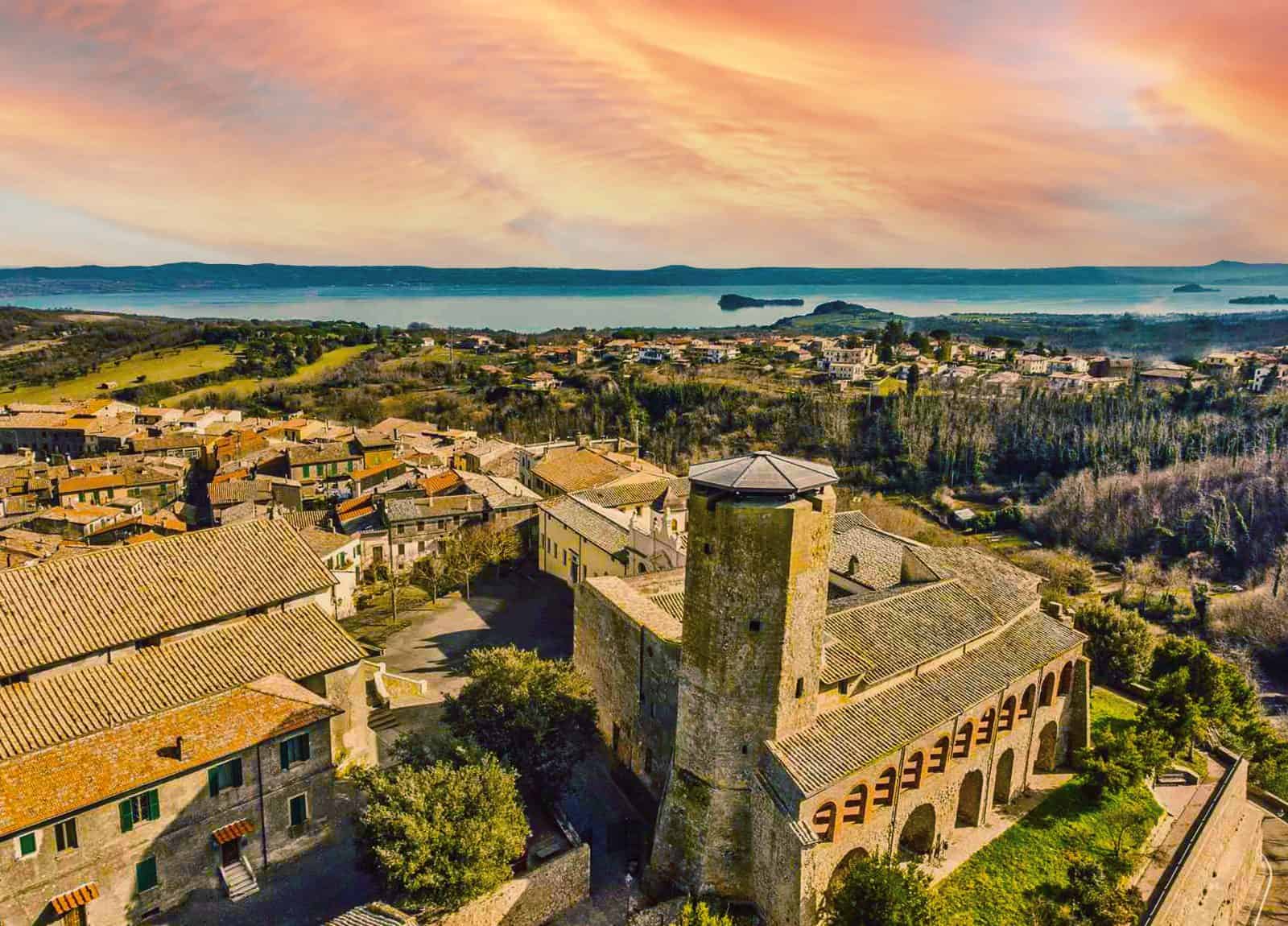
Those arriving from the north, from Tuscany or western Umbria, have an easier time. You leave the A1 at Orvieto and descend along the shore of the lake, touching Bolsena and Gradoli before turning inland. In this case Valentano arrives almost as a prize, after skirting the whole basin. From Bolsena it is a little over 20 kilometers, a good half hour, and on the last hairpin bends you get the first glimpse of the octagonal tower of the Rocca rising above the roofs.
Valentano (VT) by Public Transport: Train Plus Bus
On public transport we need to be clear. Valentano has no railway station and the connection is by road, with the Cotral bus lines that run out of Viterbo. The useful line leaves from the Viterbo terminus of Riello and continues toward Farnese via Valentano. There are daily runs designed for students and commuters, which means schedules concentrated in the early morning and in the afternoon, a thinning in the middle of the day and an almost total absence on Sunday. From Rome you reach Viterbo with the regional train on the FL3 line or with the Cotral buses from Saxa Rubra. If the plan is to arrive in Viterbo by train and improvise, you risk spending more time at the stop than in town: check the schedules on the Cotral website before leaving and, if you can, travel by car. Those who prefer to delegate the logistics to a professional can turn to TourLeaderPro for tour leading, which organizes transfers and days in the upper Tuscia with real times and not theoretical kilometers.
Where to Park in Valentano (VT)
Parking is not a serious problem. Valentano has free spaces just outside the historic center, along the streets that surround the old core and in Piazza della Vittoria area, and for most of the year you find a spot without trouble. The practical advice is not to try to squeeze into the village with the car: the streets are narrow, the one-way streets change direction with logic that only residents master, and you would end up doing the same loop three times. Leave the car at the first available lot and continue on foot. The center can be crossed in a quarter of an hour from one end to the other and walking it is the only way to understand it. The exceptions are the third Sunday of May, the day of the Fiera del Cedro, and August 14 and 15, when the town fills up for the Solco Dritto: on those days you park far away and walk up.
The Elevation of Valentano (VT) and the Climate
The altitude is worth a couple of words, because it affects the experience more than you might think. Valentano sits at 538 meters, on a rise that dominates the whole area. In summer, when Rome is unbreathable and even the lakeshore gets muggy, here the evening really cools down. In winter the wind blows, the fog rises from the basins and stays caught among the houses, and every so often it really snows. Always bring one more layer than you think you need, even in August: at sunset, on the San Martino terrace, the air changes character in half an hour.
How Much Time to Spend in Valentano (VT)
It depends on what you are looking for. If you just want to say you have been there, three hours are enough. If you want to see the museum at leisure, wander the historic center without hurry, sit down to eat and then go down to Lake Mezzano, you need a full day. If instead Valentano becomes the base for exploring the upper Tuscia, two or three nights are the right investment: from here you reach Farnese, the Selva del Lamone and Lake Bolsena on all its shores in half an hour, and in a little over half an hour you are at Tuscania, at Viterbo or at Pitigliano, across the Tuscan border. It is a strategic position disguised as an isolated place, and this is its real quality.
Sleeping in Valentano (VT) and Nearby
The accommodation offer is small but it exists: farm stays in the countryside, a few room rentals in town, scattered lodging in the nearby villages. Don't expect hotel chains or standardized services. Expect owners who tell you where to buy good bread and who, if you ask them, take you to see a piece of countryside you would not find on your own. The classic mistake is to book everything on the lake and then have to drive every evening: those organizing the trip in English will find a reasoned overview of the area in the ItalyPlanner guide to Lake Bolsena, which explains well how the shores and services are distributed.
Services, the Market and the Off-Season in Valentano (VT)
Valentano is a real town, with a pharmacy, bank, post office, grocery stores, tobacco shop, bars. It is not a museum village emptied of inhabitants. You can rely on it for daily needs without going back to Viterbo, but the hours are those of the Italian provinces: a long afternoon closure, shops shuttered on Sunday, and on market day the whole town pouring into the square. If you happen by that morning, don't complain about the traffic: you are witnessing the most authentic thing Valentano has to offer.
Those traveling off-season should keep in mind that from November to March the upper Tuscia empties out: many places cut their opening days, some facilities close, the museum switches to winter hours with mornings as the main slot. It is not a reason to give up, quite the opposite: winter has a severe beauty, with the hills turning ocher and the fogs transforming the tower of the Rocca into a silhouette from a gothic novel. But it is an excellent reason to phone ahead and take nothing for granted. Slow tourism works only if those who practice it accept the rhythms of the place instead of demanding that the place adapt to theirs.
The Hill Between Two Lakes: The History of Valentano (VT)
To understand Valentano you have to look at a map, and look at it well. The town stands on a rise that occupies an anomalous position: it does not overlook Lake Bolsena like the lakeshore villages everyone knows, and it is not shut into the depression of Lake Mezzano, a little farther west. It sits exactly in the middle, on the back that separates the two basins, in a position that lets it control both without belonging to either. Whoever chose that spot to build a settlement did not do it for the view. They did it because from up there you could see anyone coming, from any direction, hours in advance.
The Volcano, the Tuff and the Two Lakes of Valentano (VT)
This vocation for control is the key to the whole local history. The area of the Monti Volsini is volcanic land: Lake Bolsena is the fill of an enormous collapsed caldera, and Lake Mezzano occupies a smaller cavity, in all likelihood an explosion crater of the Latera volcanic complex, formed about 400,000 years ago. The tuff derived from it has given the inhabitants, for millennia, a building material that is easy to cut and surprisingly durable, and a soil of exceptional fertility. Human settlement here is very ancient and uninterrupted: where there is fresh water, good land and soft stone to dig, people stop and never leave again.
Valentano (VT) Before the Farnese: Prehistory, Etruscans, Rome, the Middle Ages
The oldest traces go back to the Paleolithic, and I will come back to this at length because it is the chapter that makes Valentano unique in the Lazio landscape. Then come the Etruscans, who make this region their center, with Vulci, Tarquinia and Volsinii as a crown around the territory. Etruscan presences are documented at Monte Becco, Spinetto and Vallone. Valentano lies in the middle of that triangle, in a zone of border and transit, crossed by routes that connected the interior to the coast. With Rome the area enters a phase of agricultural normalization: rustic villas, farms and a branch of Via Clodia that touches this sector of the Volsini while the great consular roads pass farther east and farther west.
It is in the Middle Ages that Valentano re-emerges with a role of its own. The name appears in documents of the early Middle Ages: a reference in the register of Farfa in 813 and the form Balentanu in the papers of the abbey of San Salvatore al Monte Amiata in 844. In 827 a ruined castle at Mezzano is already mentioned. In a territory contested among the papacy, the Tuscan communes and the great feudal families, a fortified hill between two lakes was worth much more than its demographic weight. In 1252 a fire devastated the settlement, saved according to local tradition by the intercession of Saint Agatha, protector against fire. In 1296, after the destruction of the war between Orvieto and Viterbo, the fortified complex was rebuilt around the octagonal tower that is still the town's emblem today.
The Farnese in Valentano (VT), from 1354 to the Duchy of Castro
In 1354 the family that would change the fate of the village forever comes onto the scene: the Farnese, who obtained the lordship and the Rocca in the framework of the reorganization of the Papal States led by Cardinal Albornoz. Their rise is one of the most fascinating stories of the Italian Renaissance, and it has the rare merit of having truly started from below, or at least from a middle level. Lords of small castles in the northern Tuscia, condottieri in the service now of the pope, now of Siena, the Farnese build in the 1400s a network of possessions with its center of gravity right between Lake Bolsena and the Fiora. Valentano, together with Farnese, Ischia di Castro, Latera and Capodimonte, is one of the nodes of this network, and from the 1400s the family lived there regularly: in 1488 it celebrates there the wedding of Angelo Farnese and Lella Orsini, in 1519 that of Pier Luigi and Gerolama Orsini of Pitigliano, and here between 1520 and 1530 are born the children of this last couple, including Cardinal Alessandro and the future duke Ottavio.
When in 1537 Pope Paul III, born Alessandro Farnese, creates the Duchy of Castro and Ronciglione for his son Pier Luigi, Valentano becomes part of one of the most singular political experiments of modern Italy: a feudal state carved out inside the Papal States, with a capital, Castro, redesigned by Antonio da Sangallo the Younger, a court, a mint, the ambition of a European principality. The duchy will last a little over a century and will end in the most brutal way: in 1649, at the end of the second War of Castro, the troops of Innocent X raze the capital to the ground and on the ruins is planted a column with an inscription recalling that Castro once stood there. Of that city today ruins remain in the scrub between Ischia di Castro and the Fiora valley. Valentano, which had been its administrative seat, becomes after the destruction the center of the so-called Castrense, the former ducal territory returned to the Apostolic Chamber.
After the Farnese: Nuns, Zouaves, Emigrants
Valentano is, in this sense, one of the main custodians of Farnese memory. The Rocca that dominates the town is not just any castle: it is a noble residence that the family progressively transformed from a military fortress into a showpiece dwelling, with courtyard, loggias, a frescoed grand staircase and a layout that tells the passage from the defensive Middle Ages to the residential Renaissance. After 1649 the building was a granary and a prison. In 1731 the cloistered Dominican nuns arrived, who kept it until 1930. From 1867 to 1870 it housed the garrison of the Papal Zouaves sent by Pius IX against the Garibaldians, and in 1870, before leaving, the Zouaves burned the town's historical archive. In 1927 the reorganization of the provinces moved Valentano from Rome to Viterbo. In June 1944 bombings killed seven civilians at the Portonaccio of Palazzo Vitozzi.
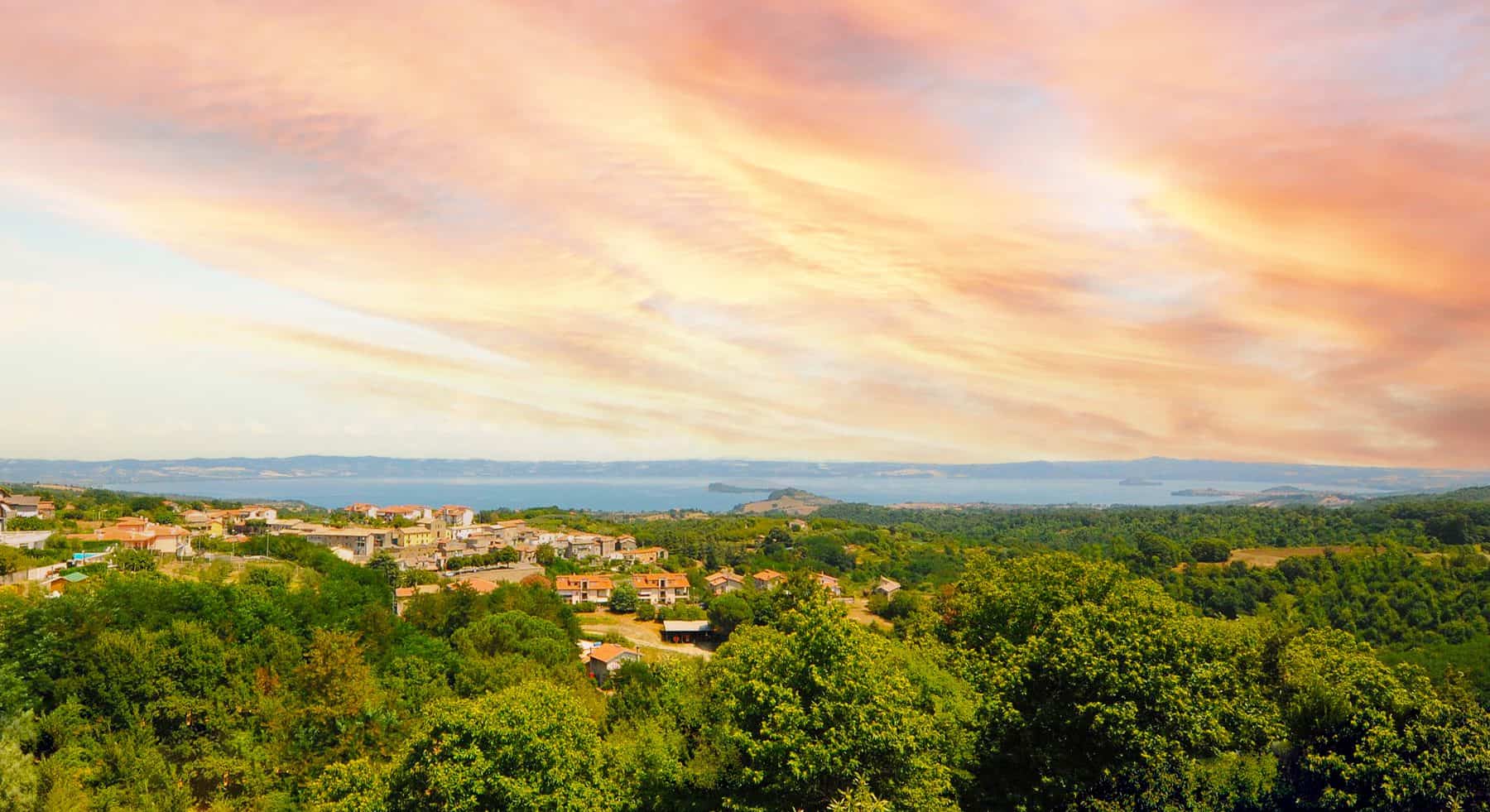
The landscape surrounding all this has a quality that I struggle to describe without slipping into rhetoric, so I will say it directly: it is an agricultural landscape that has not suffered the brutality of modernization. The fields still have human dimensions, the hedgerows are there, the farmhouses are in their place, and the dirt roads that connect one farm to another can be walked and cycled without anyone taking you for a Martian. To the west the land slopes toward the Fiora valley and the Maremma, to the northwest the Mezzano basin and the floor of the Latera caldera open up, to the east the gaze falls on Lake Bolsena with Bisentina Island and Martana piercing its surface. On clear days, from the tower of the Rocca, you can make out the Tyrrhenian Sea and the profile of Monte Amiata.
Via Francigena and the Pilgrim Roads Around Valentano (VT)
Via Francigena also passes through this territory, or rather: it passes in one of its variants, because the canonical route of Sigeric's itinerary runs farther east, along the line that touches Acquapendente, Bolsena, Montefiascone and Viterbo. But the Francigena was never a single road: it was a bundle of routes that adapted to the seasons, to wars, to the condition of the fords and to the presence of hospices. The western side of the lake was crossed by roads that connected southern Tuscany to the interior Tuscia, and at Valentano the presence of a Templar settlement at Villa delle Fontane, later passed to the Knights of Malta, says that assistance to wayfarers here was organized. Today there are hiking routes that recover those paths, and walking them is the best way to understand how people moved who crossed this land before the automobile.
Valentano (VT), a Town That Still Produces
There is an aspect of great interest that almost nobody talks about: agricultural continuity. Valentano is still a town that produces. Wheat, oil, wine, vegetables, and above all that heritage of local varieties that industrial agriculture has swept away almost everywhere and that has survived here: the chickpea of the solco dritto, tied to the ritual of August 14, the potato of the upper Viterbo area, the legumes of the volcanic soils. These are products with a different flavor because they grow on mineral-rich soils and at an altitude that slows ripening. The 20th century left the same scars it left on all the towns of inland Italy: heavy emigration to the Americas already at the end of the 1800s, then young people moving away to Rome and the north. But the wound did not turn into agony: the town has kept a stable population, associations, festivals, a collective life that you see immediately on a summer evening in the square.
And so the question I ask myself every time I come back: why isn't Valentano famous? The answer is in the geography described at the opening of the chapter. Not being on the lake, in a region where the lake is the main draw, has meant staying outside the flows. The agencies take groups to Bolsena for the Eucharistic miracle, to Capodimonte for the beach, to Montefiascone for the wine. Valentano, which has neither the miracle nor the beach nor a famous appellation, has stayed on the margins. And that is why those who arrive today find something that has been lost elsewhere: a town that does not need you in order to exist, and that for exactly this reason welcomes you without calculation.
A Curiosity About Valentano (VT)
If I had to choose just one reason to convince someone to climb up here, I would not talk about the view or the food. I would talk about something Valentano has and that almost no other town in Lazio can claim: the coexistence, inside the same building, of two histories separated by 5,000 years. In the Rocca Farnese, that is, in a Renaissance palace inhabited by one of the most powerful families in Europe, there is a museum that tells the prehistory of the Tuscia from the Lower Paleolithic, 800,000 or 900,000 years ago, to the early Iron Age. On one side the Farnese, the popes, the dukes and the famous weddings. On the other the pile-dwelling villages of huts, the coarse-ware vases and the flint tools of communities that lived on these same hills when Europe had not yet learned to write. The two histories live together in a few hundred square meters, and this short circuit in time is, for me, the real curiosity of Valentano. But the curiosities do not end with the museum: there are three more that deserve to be told at length.
The Lake That Hides a Village: The Pile Dwellings of Mezzano
Lake Mezzano is a small body of water of almost circular shape, 47.5 hectares in surface area and 2.5 kilometers in perimeter, at an elevation of 452 meters, a few kilometers from Valentano. It has no inflowing streams: springs and rain feed it, and the Olpeta flows out of it, descending toward the Fiora. Seen from above it looks like an open eye in the countryside. Those who arrive for the first time find it surprisingly intimate: no built-up lakefront, no rows of beach clubs, only reed beds, meadows and the woods coming down to the shore. It is the kind of place where you sit down and don't talk for 20 minutes, not as a pose but because it comes naturally.
What makes Mezzano extraordinary, however, is below the surface. Starting in 1973 underwater explorations brought to light a pile-dwelling settlement submerged along the lake's coastal strip, a structured settlement with thousands of wooden elements preserved by water and mud in conditions that would be unthinkable on dry land. The materials cover a span from the 3rd millennium BC, the Copper Age, to the 12th century BC, the Final Bronze Age: ceramics, wooden objects, bronzes. Latin authors knew this body of water as Lacus Statoniensis: Pliny the Elder, Vitruvius and Seneca mention it.
The technical point is worth explaining well, because it is the reason pile-dwelling sites are so valuable. Wood, plant fibers, textiles, seeds, all the organic material that made up most of the material culture of a prehistoric community, under normal conditions rots and disappears within a few decades. Of a Bronze Age village built on dry ground we typically have left a handful of postholes and a few fragments of pottery. If the same village ends up underwater, in an oxygen-free environment, the wood is preserved. And with the wood the information is preserved: the species of trees used, the way they were cut, the growth rings that allow dendrochronological dating, the arrangement of the structures, the remains of what was eaten. Building a village on piles is not a stopgap: it is an engineering operation that requires planning, division of tasks, knowledge of materials and a social structure able to sustain a prolonged effort.
The fact that this heritage is tied to such a small and little-visited lake is a paradox that continues to strike me. Tens of thousands of people come to Lake Bolsena every summer. Mezzano is reached by a secondary provincial road, the SP 118 toward the floor of the Latera caldera, the last stretch on foot, and often there are only three of you. Yet it is under this water that one of the most important prehistoric archives of central Italy is preserved. A practical note: the submerged site cannot be visited. You don't go to Mezzano to see the pile dwellings the way you go to see an amphitheater. What you can do, and what I recommend, is to visit the museum in Valentano first, where the recovered materials are displayed and put in context, and then go down to the lake with that knowledge in your head. The landscape changes when you know what is underneath: it becomes a place inhabited by time, not a pretty spot to have a snack.

Obsidian, the Ancient Routes and a Territory Less Isolated Than It Seems
This is the curiosity I tell last, because it overturns the perception. Looking at Valentano today you get the impression of a secluded place, off the routes, peripheral. Prehistory tells the exact opposite. Among the materials that archaeology recovers from the Neolithic sites of Tyrrhenian central Italy, obsidian appears regularly, the black, sharp volcanic glass with which blades of higher quality than flint were made. Obsidian is not found everywhere: in the western Mediterranean the main sources are few and well identified, all on islands: Lipari, Palmarola, Sardinia and Pantelleria. Geochemical analyses make it possible to trace the deposit of origin of each single fragment, and the result is that pieces of volcanic glass from the islands traveled to the continental interior through exchange chains hundreds of kilometers long.
Add the circulation of metals. The area between the Fiora, the Amiata and the Monti della Tolfa is one of the most important mining regions of ancient Italy, with copper deposits exploited since the Bronze Age and later the basis of Etruscan fortune. The Selvicciola hoard, displayed in Valentano, with its bronzes of the early Iron Age, is the material proof of that circulation. The communities that lived around Mezzano were not isolated peasants at the bottom of a valley: they were on a network of routes that connected the mines to the interior, the interior to the coast, the coast to the sea lanes. The dirt roads that today look like paths follow in many cases very ancient tracks, because geography does not change: a pass is a pass, a ford is a ford, and the lines of least resistance chosen by a Bronze Age shepherd are the same ones a tractor chooses today. Walking here means walking inside a communication network that is thousands of years old, and the fact that it seems deserted to us today is a recent accident.
The Name, the Tuff and the Cellars Under the Houses of Valentano (VT)
To finish, a minor but delightful curiosity, the kind you discover chatting at the bar. Three hypotheses circulate on the origin of the place name, none proven: derivation from an Etruscan center called Verentum (to this day the people of Valentano call themselves verentani). The Valle Ontana, the valley of the alders, which would also be the basis of the tree in the town's coat of arms, although a local study of 2012 maintains that the tree in the old coat of arms is not an alder at all. And an estate of a certain Valente, with the Latin suffix in -ano that indicates ownership. As often happens with place names in central Italy, the truth is probably layered: an ancient core reread through Latin, then the vernacular, up to the present form. The absence of a certain answer is not a defect: it adds a margin of mystery to a town that has quite a few mysteries.
Much more concrete is the relationship between Valentano and the tuff on which it stands. As in the whole volcanic area of the Volsini, the subsoil of the settlement is hollowed out: cellars, storerooms, underground spaces that house owners carved into the tuff bank over the centuries. They served to store wine, oil, provisions, and they keep a constant temperature all year that no modern system matches with the same elegance. Recent excavations under the church of Santa Maria have yielded exactly this kind of infrastructure, with a large well-cistern and a grain silo datable between the late 1200s and the early 1300s. There is no organized tourist system for visiting the cellars, but if you happen to be in town during a festival and someone invites you to go underground, accept without hesitating: that is where the intangible heritage of the upper Tuscia is kept, and no museum can tell it to you with the same force.
The Rocca Farnese of Valentano (VT), Place by Place
The Museo della Preistoria della Tuscia e della Rocca Farnese has a long name that is already a program: two souls, one building. And it is, without exaggeration, one of the best-conceived provincial museums in Lazio. It was established by the town council in 1989, after the recovery of a Rocca abandoned since 1957 had begun in 1979, and opened to the public in June 1996. In 2011 the restoration of the south and east wings added the tactile-olfactory path, the specialist library, the archives and a restoration workshop. The visit unfolds over two floors plus the tower, and I describe it in the order in which you walk it.
The Cortile d'Amore of the Rocca Farnese
You enter through the Cortile d'Amore, which today houses the ticket office, classrooms, bookshop and refreshment area and which is the most eloquent proof of the transformation of the Rocca from fortress to dwelling. It was made for the wedding of Angelo Farnese, son of Pier Luigi the Elder, to Lella Orsini of Pitigliano, celebrated in 1488: the lower colonnade carries capitals sculpted by a Lorenzo, a Florentine stonecutter, with the coats of arms of the two families, the Farnese lilies and propitiatory allegories for the couple. At the center is a well whose octagonal shape echoes the tower. In summer the courtyard hosts concerts and ceremonies. Stop under the portico to look at the capitals one by one: they are the only point in the Rocca where 15th-century sculpture still speaks with its own voice, because all the rest of the Farnese decoration was covered or dispersed in the following centuries.
The Octagonal Tower of the Rocca Farnese
The octagonal tower is the emblem of Valentano, visible from the whole basin. It dates to the reconstruction of 1296, after the fire of 1252 and the war between Orvieto and Viterbo. Originally it was outside the castle and connected by a drawbridge, and it was the Farnese who partly incorporated it into the Rocca. It is about 26 meters high and is entirely accessible up to the top. On the first floor, during the three years of the Papal Zouaves, it served as a punishment cell: drawings and writings by the punished soldiers remain on the walls, worth looking for at leisure. Today its rooms house the D'Ascenzi Etruscan collection and the enigmatic tablet. From the top you take in Lake Bolsena, the floor of the Latera caldera and the Vulci plain as far as the Tyrrhenian: it is the point where you understand, at a single stroke, why the hill was fortified.
The Scala Santa of the Rocca Farnese
The Scala Santa is the most surprising space in the building, and it comes from a paradox. Cardinal Alessandro Farnese the Younger, the Great Cardinal born in this Rocca in 1520, had a monumental frescoed grand staircase built in the 1500s. In 1731 the cloistered Dominican nuns, who came from the Viterbo convent of Santa Caterina under the guidance of Sister Maria Gertrude Salandri, judged it too profane: they erased the original frescoes and turned it into a reproduction of the Scala Santa of the Lateran, with 28 steps and three panels per side painted with episodes of the Passion, Jesus before Annas, Caiaphas, Pilate and Herod. A covered corridor at the top contains four more scenes. The work, between 1731 and 1748, was overseen by the priest Candido Costa, confessor of the nuns. The result is a Renaissance cardinal's staircase dressed in 18th-century devotion: a document more than a masterpiece, and for that very reason fascinating.
The First Floor: The Prehistory of the Tuscia, Room by Room
The first floor, over 400 square meters, is dedicated to the prehistory of the Tuscia from the Lower Paleolithic to the early Iron Age, between the 9th and 8th centuries BC. The route is chronological and each section corresponds to a site in the territory. For the Paleolithic it starts from Cenciano Diruto and the Grotta delle Settecannelle, with choppers, bifaces, scrapers and retouched points: tools that tell of human presence on these hills for hundreds of thousands of years. The Neolithic is represented by the village of Poggio Olivastro, with the ceramics and obsidian blades mentioned above. The Copper Age has as its focus the necropolis of Selvicciola, with the small grotto tombs dug into the tuff and the grave goods. The Bronze Age is the richest room: the submerged settlement of Lake Mezzano with its piles, ceramics and bronzes, the cremation necropolis of Ponte San Pietro and that of Castelfranco Lamoncello. The early Iron Age closes with the Selvicciola hoard, a deposit of bronzes that documents the circulation of metals on the eve of the Etruscan world. Panels, reconstruction models and multimedia stations explain the environmental and social transformations. The display approach is not the very common one of the case full of fragments with a tiny label, but an evident effort to make the non-archaeologist visitor understand why that dark potsherd is important.
The Second Floor: Valentano (VT) from the Middle Ages to the Modern Era
The second floor, about 200 square meters, follows the development of Valentano from the 7th century AD to the contemporary era, and the guiding thread is ceramics. There are glazed and enameled cannata jugs, 14th-century ceramics painted in manganese brown and copper green, 15th-century pieces in antimony yellow and cobalt blue, fragments with raised green and zaffera, sgraffito plates of the Viterbo school, two Hispano-Moresque bowls imported from Manises, near Valencia, and a medieval iron sword. The piece around which everything turns is a group of materials collected in 1987 in a refuse pit of the Rocca, that is, a dump well where broken tableware ended up: among them a wedding plate with the Farnese and Orsini coats of arms, commissioned by Cardinal Alessandro Farnese the Elder, the future Paul III, for the wedding of his son Pier Luigi to Gerolama Orsini of Pitigliano in 1519. It is a small object and has to be sought out with attention, but it says more than 100 pages about the relationship between this Rocca and the family: here people did not pass through, here they lived, ate and married.
The D'Ascenzi Etruscan Collection and the Enigmatic Tablet
In the octagonal tower there are two smaller but precious rooms. The D'Ascenzi collection, of private origin, gathers Etruscan ceramics of several phases, glass pastes of Phoenician tradition, small bronzes and bone objects: a bridge between the prehistory of the first floor and the world of Vulci and Tarquinia. The small room on the second floor of the tower has kept, since 2013, the enigmatic tablet of the Latera caldera, found in 1993-1994 by the Soprintendenza per l'Etruria meridionale at a place called Vallone, a few kilometers from the town. Enigmatic tablets are small artifacts in terracotta, more rarely in stone, of the Bronze Age, between the 21st and 14th centuries BC, with impressed geometric signs of unknown meaning. About 342 examples are known across northern Italy, the Danube area and the Black Sea, and the one from Valentano is the only one in Lazio. The prevailing hypothesis is that it is a system of communication or counting, but nobody really knows. For me it is the most fascinating object in the whole museum: a message from 4,000 years ago that nobody can read.
The Tactile-Olfactory Path, the Library and the Archive of the Rocca Farnese
In the wings restored in 2011 are the tactile-olfactory path, designed for blind visitors but useful to anyone who wants to touch copies of the finds and recognize the smells of the plants and materials of prehistory. The municipal library, in the east wing since 1988. And the historical archive, which keeps documents from 1450 to 1870, that is, up to the fire set by the Zouaves. Anyone researching Farnese history finds here one of the most interesting collections in the upper Tuscia. The museum also has a virtual tour on its website, handy for preparing, but no screen reproduces the vertigo of climbing the 28 steps of the Scala Santa inside a 13th-century fortress.
Hours, Prices and How to Visit the Museum of Valentano (VT)
The entrance is at Piazza della Vittoria 11. The ticket costs €4 full price and €2 reduced. Admitted free are residents, people with disabilities, children under six, accompanying teachers and guides on duty. It is closed on Monday all year. From October to May the hours are in the morning, from 9:00 to 13:00 Tuesday to Thursday, with the addition of the afternoon from 14:00 to 17:00 on Friday and Saturday, and from 10:00 to 13:00 on Sunday. From June to September you visit in the afternoon, from 15:30 to 19:30 Tuesday to Friday, and on the weekend both the morning from 9:00 to 13:00 and the afternoon. Guided visits and workshops for schools are booked through the official website museovalentano.it or at 0761 420018. Allow an hour and a half. With children, two, because the prehistoric part captures them in a way that art museums almost never manage.
The Historic Center of Valentano (VT), Place by Place
The historic center has a medieval layout of tuff houses, closed in by the castle walls and served by two gates, Porta Magenta and Porta San Martino. The backbone is a trident of streets, Via Carlo Alberto, Via Gramsci and Corso Matteotti, which converges on the two main squares, Piazza Cavour and Largo Paolo Ruffini, while the Selciata climbs toward the Rocca. You get around it in an hour, but every building has a story worth stopping for.
Porta Magenta, the Porta del Mascherone
You enter through Porta Magenta, which everyone calls Porta del Mascherone for the face carved at the top, with its tongue out: according to local tradition it represents the inclination of the people of Valentano for gossip, and every town in the Tuscia has a version of it. The gate was built in 1779, under the pontificate of Pius VI, after the collapse of the earlier Porta Romana erected in 1417 under Martin V Colonna. Above the arch the monumental papal coat of arms remains. Local tradition holds that an old design by Jacopo Barozzi da Vignola, the Farnese architect who died in 1572, was used for the reconstruction. It is an attribution of tradition, undocumented, and should be taken as such. The current name dates to the 19th century.
The Town Hall of Valentano (VT)
Piazza Cavour is overlooked by the Palazzo comunale, of Renaissance layout with an 18th-century remodeling. On the facade you can read three coats of arms that sum up the history of the town: that of Valentano, that of Martin V Colonna, the pope who refounded the gate in 1417, and that of the Farnese. From the balcony, every August 14, the result of the Solco Dritto is read out. Under the portico the plaque to the fallen of the Great War, from 1919, carries an epitaph by the man of letters Fausto Salvatori: Valentano lost 66 men in that conflict, and the place names of the center, Via Trento e Trieste, Piazza della Vittoria, were renamed in their memory.
The Collegiate Church of San Giovanni Apostolo ed Evangelista
The mother church of Valentano dates to around the year 1000, in Romanesque forms. In 1253 Innocent IV conferred on it the title of pieve, the facade is from the mid-1400s and the interior was redone in Baroque style between the end of the 1600s and the early 1700s. The bell tower, together with the octagonal tower of the Rocca, is one of the two civic symbols of the village. Inside are kept a fresco of the Crucifixion attributed to Marcello Venusti, the Lombard pupil of Michelangelo, which survived the Baroque remodeling. A wooden statue of the Madonna Assunta from the mid-1600s, which is the protagonist of the Ferragosto festival. A canvas of the Madonna and Child with Saints Peter and Paul by Alessandro Mattia da Farnese, called the painter of Valentano, from the church of Santa Maria. And the relics of the co-patron Saint Justin the martyr. The organ is recent, a Claudio Pierini from 2017. Look at the Venusti first: attributions to Michelangelo's followers in the provinces have to be taken with caution, but the drawing of the figures is of good quality and deserves the comparison.
The Church of Santa Maria and the Corso of Valentano (VT)
Along Corso Matteotti stands the church of Santa Maria, of medieval origin, documented at least from the 1300s. An urbanistic detail tells its story better than anything: originally it faced north, and around 1520, in the framework of the Farnese works to reorganize the town, it was turned to face east to align with the new Via di Santa Maria, the present corso. The present appearance dates to 1736-1744, on a design by the architect Pietro Amari. Inside, the statue of the Madonna della Coroncina and a 15th-century fresco of the Madonna della Rosa. Recent excavations have brought to light, under the floor, two furnaces for casting bells, the medieval burial area, a large well-cistern and a grain silo, all datable between the end of the 1200s and the beginning of the 1300s: it is the town's subsoil coming to the surface, and it confirms what was said about the cellars in the tuff.
Palazzo Vitozzi and Palazzo Cruciani
On Via Trento e Trieste, Palazzo Vitozzi preserves windows in volcanic stone, the family coat of arms and the name of the builder, Joannes Vitotius, inscribed on the facade. Its Portonaccio is the place where in June 1944 seven civilians died under the bombings. On Via Carlo Alberto, Palazzo Cruciani is the birthplace of Paolo Ruffini, the mathematician and physician who was born in Valentano in 1765 and whom the world knows for Ruffini's rule, the one used in school to divide polynomials, and for the first proof, incomplete but decisive, of the impossibility of solving the fifth-degree equation by radicals. The largo in front bears his name. He is the most famous native of Valentano and almost nobody knows it.
Porta San Martino and the Panoramic Terrace
At the opposite end of the town, Porta San Martino opens onto the panoramic terrace of the same name, the lookout from which you dominate the Mezzano basin and the floor of the Latera caldera, which is a Site of Community Importance. It is the point from which, on the evening of August 14, you look at the illuminated furrow on the plain. In the early morning it is deserted and the raking light draws the fields like a relief map.
The Churches Outside the Walls: Santa Croce, Madonna del Monte, Madonna della Salute
Outside the walls the church of Santa Croce, medieval, keeps a fresco with the Virgin and the flagellants, testimony of the confraternities of disciplinati who here, as in all of the Tuscia, ran assistance. At the locality of Montenero, the church of the Madonna del Monte, also medieval and also called della Pietà, was restored in 1986. The sanctuary of the Madonna della Salute has a story out of a novel: it was born around 1470 from a chapel erected by Francesco Portici, a brigand who turned himself in to the authorities and named the place of his exile as the site for the construction. In 1506 the Augustinian friars built the church there, in 1708 it passed to the Friars Minor, and inside an organ from 1852 still plays. At Villa delle Fontane, where in 839 there stood a village that later became a Templar commandery and then one of the Knights of Malta, the memory remains of the ancient Sancta Maria ad Templum and the church of the Annunziata and Sant'Agapito, rebuilt around 1930.
Something Nobody Tells You About Valentano (VT)
I arrive at the part I write with the most pleasure, the one in which I try to say the things the official guides don't say. Not because they lie, but because a guide has the job of promoting, and here the job is another, more modest one: getting people to arrive prepared. About Valentano there are four truths that nobody puts in writing and that, if you know them beforehand, change your trip.
The first and most important: Valentano is not a postcard village, and it is better to know it before leaving. Whoever arrives expecting Civita di Bagnoregio, Calcata or one of the Lazio villages redone for the visitor's eye will be thrown off. Here there is an authentic historic center but not restored in a scenographic way, there are modern buildings mixed with the old ones, there are the traces of a town that kept building and living instead of freezing itself. It is not a defect: it is the reason Valentano still has a soul. But if your yardstick is magazine aesthetics, you will be disappointed, and it will be the fault of the expectation, not of the town. The other three truths I develop one by one.
The Museum of Valentano (VT) Is Much More Important Than Its Reputation Suggests
This is the thing that should be written in capital letters at the entrance to the town. The Museo della Preistoria della Tuscia is not a civic museum put together out of local pride, with two cases of potsherds and a dusty model. It displays materials of real scientific relevance, from one of the most significant pile-dwelling contexts of central Italy, from the only enigmatic tablet of Lazio and from Copper Age and Bronze Age necropolises that specialists cite in the manuals. The problem is that nobody knows it. In the tourist narrative of Lazio, archaeology coincides with Rome, with the Etruscans of Tarquinia and Cerveteri, at most with Vulci. Prehistory is the great absentee: perceived as dark matter, lacking photogenic monuments, good for specialists. It is a serious cultural error, because it erases hundreds of thousands of years of human history in this territory and deprives the public of the only perspective that lets us understand how the landscape we cross was formed.
The practical consequence is that the museum receives a fraction of the visitors it deserves. Those who go in almost always find themselves alone, with the rare chance to look at things without elbows and with the even rarer one of asking questions of whoever watches over the rooms, who often knows the materials much better than you would expect. Take advantage of this condition: in a crowded museum you learn nothing, in an empty museum you learn everything. I add a piece of advice on method. In front of a prehistoric object the natural reaction is indifference: a piece of dark pottery, a stone tool, a fragment of wood. To get past it you have to change the question. Don't ask yourself what that object is, ask yourself who made it and why. That oak pile was cut by someone, with a tool, on a particular day, to build a house in which a family would sleep. The moment you reconstruct the human gesture behind the object, prehistory stops being a fog and becomes a story. And if you are traveling with teenagers bored by churches, this museum is your secret weapon: the pile dwellings, the submerged village rediscovered by divers, the tablet nobody can read have a power of attraction that no fresco equals. It happens that kids who haven't looked at anything for three days stop in front of a Mezzano case and start asking questions.
Lake Mezzano Is Not a Beach, and Should Be Treated Accordingly
Second uncomfortable truth. On the internet circulate images of Lake Mezzano that make it a small natural paradise, and indeed it is, but the word paradise generates wrong expectations. Mezzano is not an equipped swimming lake. It is not the little brother of Lake Bolsena. It is a small basin of crater origin, proposed since 2005 as a Site of Community Interest, with its own environmental characteristics and a use that needs to be calibrated with care. First: don't expect services. You arrive on foot, the shore is natural, the vegetation touches the water in many places. Bring everything you need and take everything away again, trash included. Second: the water level varies with the season and the rains, because the lake lives only on springs and precipitation. Third, and this is the delicate point: it is a protected archaeological context. The submerged pile-dwelling site is not a playground. You don't dig, you don't collect anything, you don't take anything away, and this also applies to the little piece of blackened wood that looks like an ordinary twig and that might not be one at all.
That said, Mezzano is one of the most beautiful places in all of inland Lazio, and I say it without hesitation. Its beauty is a gathered one: the closed basin, the silence, the water birds, the countryside you see beyond the edge of the crater. You go to walk along the shore, to sit, to look. Whoever arrives with the mentality of a swimmer will find little. Whoever arrives with the mentality of a walker will find a great deal. A practical detail: the access road, provincial road 118 toward the plain, is secondary and narrow in some stretches. With a normal car there are no problems, with a camper the matter gets complicated, with a bus it is out of the question. In spring the lake is at its maximum: high water, green meadows, blossoms, a quantity of animal life that you perceive without being a naturalist. In midsummer the central hours are to be avoided. In autumn the woods change color and the water takes on a deep tone that it has in no other season. In winter it can be spectacular on clear days and desolate on foggy ones.
The Cuisine of the Tuscia in Valentano (VT) Is Real, but You Need to Know What to Ask For
Third truth, and it concerns the table. In the upper Tuscia you eat well, but the risk of eating badly exists, and it comes from a misunderstanding: many visitors look for the dishes they have read are typical of Lazio, that is, the Roman ones, and end up ordering carbonaras and amatricianas in a territory that has a completely different cuisine. The cuisine of the Tuscia viterbese is a cuisine of the land, poor in origin and very rich in result, built on three pillars: legumes, grains and oil. In Valentano the three products to look for by name are the cece del solco dritto, a small, flavorful chickpea that takes its name from the Ferragosto rite and is eaten in soup or with pasta. The potato of the upper Viterbo area, grown on the volcanic soils of the strip between Bolsena and Grotte di Castro, which makes gnocchi of a consistency not found elsewhere. And the tortello valentanese, the filled pasta of the festival. Around them, the dishes of the whole district: lentil and bean soups finished with a swirl of raw oil, handmade pasta with meat sauces, the Maremma acquacotta that comes up across the border with stale bread, vegetables and egg, lamb roasted in the oven or on the grill, sheep's milk cheeses. And the oil: the extra virgin from the hill strip between the lake and the Cimini has a bitter and peppery profile that those not used to it mistake for a defect and that is instead the signature of a living oil.
On wine, a clarification. The most famous appellation of the area is that of Montefiascone, with the white of the legendary name, but on the western strip of the lake, between Gradoli and Grotte di Castro, wines are produced that deserve attention, often by small producers who sell directly, including the Aleatico di Gradoli, the sweet red that closes a legume meal well. Ask the restaurant for something local instead of the national label you already know. One last warning: in the Tuscia the portions are generous and the miniature tasting menu has not caught on. Choose two courses and concentrate on those, leaving room for dessert if it is homemade. And if they offer you an amaro at the end, accept it: it is part of the ritual.
The Tourism Valentano (VT) Needs Is Not What It Seems
What remains is the most uncomfortable reflection, the one on the relationship between those who visit and those who live there. In the villages of inland Italy a narrative has spread according to which tourism would be the solution to depopulation. It is a narrative that oversimplifies and in the worst cases produces damage: towns that empty of residents and fill with vacation homes, grocery stores that close and reopen as souvenir shops, property prices that push out the local young. Valentano, for now, is very far from this scenario, and it is one of the reasons I gladly go back. But the direction depends on the type of visitor it will attract. Hit-and-run tourism, made of buses unloading groups for 40 minutes, leaves almost nothing and consumes identity. Slow tourism, made of people who stay one or more nights, eat in the local places, buy from producers, enter the museum and pay the four euros for the ticket, supports real activities and gives the young an economic reason to stay. The way you visit Valentano is not a private question of taste: it is a small political choice. And so the thing that nobody really tells you, the synthesis of it all: Valentano does not need you, but you might need Valentano. In an age when traveling more and more often means standing in line to see something already seen a thousand times in photographs, there still exist places where you arrive without a reservation, walk without a crowd, eat without a menu in five languages and talk with someone who doesn't consider you a customer. It won't last forever. But as long as it lasts, climbing this hill between two lakes is one of the best ways I know to remember why we travel.
My Advice for Visiting Valentano (VT)
The main advice is just one: don't treat Valentano as a stop. Don't slot it into a tour of Lake Bolsena between Capodimonte and Gradoli, with a 40-minute break and a photo of the Rocca. It doesn't work. Valentano has no postcard monument that is used up in a quarter of an hour and no spectacular historic center to photograph in a rush. It has a density of meaning that reveals itself only if you give it time, and the minimum time is a full half day. That said, I get into the substance with a series of operational pointers, in order of importance.
Start with the museum, not the town. It is counterintuitive: the instinct is to tour the village first and then go in somewhere if there is time left. Here it should be done the other way around. The Museo della Preistoria della Tuscia e della Rocca Farnese provides the keys to reading everything else: after visiting it, the hill, the two lakes, the country roads and even the walls of the houses acquire a meaning they did not have before. If you leave it for last, you risk arriving tired and moving through it distractedly, throwing away the best part. In the summer months, when it is open only in the afternoon on weekdays, reverse the order: town and Mezzano in the morning, museum from 15:30.
Climb the octagonal tower and stay there. From the 26 meters of the tower you dominate a natural amphitheater that includes the Bolsena basin to the east and the countryside sloping toward the Maremma to the west. It is not a panorama to look at for 30 seconds: it is a panorama to read. Take the time to identify the islands on the lake, the profile of the hills, the direction you came from. When you begin to recognize the geography, you understand why that hill was fortified: the view is the very reason for the town's existence.
Go down to Lake Mezzano in the afternoon, except in summer. The right order has two reasons. The first is the light: the basin receives the low afternoon sun in a way that makes the water almost metallic, and the reed bed on the shore takes on a golden tone that is not there in the morning. The second is that, if you have visited the museum, you will arrive at the lake with your head full of what lies beneath. Bring water, shoes that don't fear mud and a hat.
Eat in town, not outside. It is a rule I apply everywhere in the Tuscia and which works well here. The dining in Valentano is sized for residents before visitors, which means honest portions, reasonable prices and local cooking without reinterpretation. Look for dishes that speak of this land and always ask where the oil comes from, and to taste it on a slice of bread before dressing anything. Book for lunch and take nothing for granted in the evening: outside summer weekends the evening offer can shrink considerably, and if you arrive suddenly on a Monday evening in November, allow for having to move on. It is not a defect: it is the physiology of a town that lives off itself.
Combine Valentano with one or two nearby villages, not five. The classic mistake of those who visit the upper Tuscia is bulimia: six towns in a day, all seen badly. Build sensible pairs. Valentano plus Farnese works very well, because together they tell the story of the duchy and the Selva del Lamone lies in between. Valentano plus Capodimonte works for those who want to alternate hill and water in the same day. Valentano plus Gradoli is the perfect combination for those interested in Farnese history and in food and wine, since Gradoli keeps another palazzo of the family. Anyone who wants a complete Farnese itinerary, built by someone who accompanies groups for a living, can ask TourLeaderPro, which organizes group trips in Italy tailor-made.
Choose the season carefully. The best period runs from mid-April to mid-June and from mid-September to the end of October. In spring the countryside is in bloom, the temperatures are perfect for walking and the light has a clarity that gives visibility as far as Monte Amiata. On the third Sunday of May there is the Fiera del Cedro, established in 1461 by Pier Luigi Farnese the Elder and still alive. In autumn come the colors of the woods, the grape harvest, the olive picking and the first new oil, which is the highest gastronomic moment of the year. July and August are manageable thanks to the altitude but have to be approached with smart schedules. August 14 and 15, for the Solco Dritto, are an experience worth a night in town. Winter is for those who love bare landscapes and don't fear the wind.
Bring cash. It sounds old-fashioned and in part it is, but at markets, small farms and in some bars in the center cash remains the smoothest tool. Having €50 in your pocket will keep you from giving up a wheel of pecorino bought from the person who made it. And talk to people: it is the advice worth more than all the others put together and that no printed guide will give you, because it cannot be standardized. Ask the bartender where to eat well, ask whoever watches over the museum what is worth seeing in the surroundings, ask the farmer selling eggs if you can stop by to see the field. In most cases you will get not an answer but a piece of a story that will stay with you longer than any monument. Anyone who comes to Valentano looking for confirmation of a prepackaged idea of a village, all geraniums and hanging laundry, will be disappointed: there are also 1970s apartment buildings here, and rolled-down shutters. Anyone who comes willing to look at what is there will leave with the feeling of having seen something others don't see.
Another Well-Known Fact, Yet Rarely Cited
Everyone in Valentano will tell you that Giulia Farnese, la Bella, sister of the future Paul III and mistress of Rodrigo Borgia, Pope Alexander VI, was married in the Rocca. That is the well-known fact. What is cited less is how things stand in the documents. Giulia was born around 1475 into a family rooted between the lake and the Fiora. The marriage contract with Orsino Orsini was signed on May 21, 1489 in Rome, in the palace of Cardinal Rodrigo Borgia, vice-chancellor of the Church, and the ceremony was held in the same palace on May 9, 1490. The relationship with Borgia, who was then almost 60 years old, began around 1491. In 1493 her brother Alessandro, 25 years old, received the cardinal's hat, and from that hat would start the trajectory that 40 years later brought him to the papal throne. The tradition that places Giulia's wedding in the Rocca of Valentano is therefore a tradition, not an archival fact, and as a tradition it should be told.
But the true fact, the one that tradition has in some way replaced, is even more interesting. The Rocca of Valentano really was a house of Farnese weddings and births, only with other protagonists. In 1488 Angelo Farnese, brother of Giulia and Alessandro, married Lella Orsini of Pitigliano here, and it is for that wedding that the Cortile d'Amore with its allegorical capitals was built. In 1519 Pier Luigi Farnese, the son of Cardinal Alessandro and future first duke of Castro, married Gerolama Orsini of Pitigliano, and the wedding plate with the two coats of arms displayed on the second floor of the museum is the material remnant of that banquet. And above all, in this Rocca were born the children of Pier Luigi and Gerolama: Alessandro on September 27, 1520, the Great Cardinal who would commission the palace of Caprarola, the church of the Gesù and the completion of Palazzo Farnese in Rome. Vittoria in 1521, future duchess of Urbino. Ottavio on October 9, 1524, who at 14 married Margaret of Austria, daughter of Charles V, and was the second duke of Parma. Ranuccio in 1530, a cardinal at 15. The risk, with Giulia, is to reduce her to the role that novels and television series have assigned her, that of the high-class courtesan: a lazy and false reading, because the letters and the documented behavior show a woman who negotiated, managed her own assets and moved skillfully in an environment where a misstep cost your life, and because without her position at the Borgia court there would have been neither the duchy nor the palace that today houses the French embassy. But the symmetrical risk, in Valentano, is to let the legend of one wedding cover the reality of an entire generation born within these walls. Rome was the stage. The Tuscia was home, and home was this.
The Right Photo to Take in Valentano (VT)
I confess a prejudice: I distrust guides that point out the exact spot to stand for the perfect photograph, because the result is that 200,000 people take the same image and convince themselves they have seen a place. That said, in Valentano a photograph truly worth taking exists, and it is not the one that instinctively comes to mind. The wrong photo is the Rocca framed from below, from the square, in full sun, with the white sky behind it: the image everyone takes in the first five minutes and nobody will ever look at again, with the building flattened and the backlight eating the details of the masonry.
The right photo is the one that holds the hill and the water together. The sense of Valentano is in its position: a fortified settlement on a rise, with two volcanic basins at its sides. A photograph that conveys this tells the story of the town. One that limits itself to the facade of a building does not. The work to be done is to look for a viewpoint where, in the same frame, there fit the silhouette of the village with the octagonal tower and, in the background or to the side, the surface of the lake. These points are found along the roads that climb toward the town, above all on the side that looks toward Bolsena, on the provincial road that arrives from Capodimonte. It is worth driving the last stretch slowly, identifying two or three pull-offs where you can stop safely, and coming back at the right moment. The rule is simple: don't photograph while you are arriving, because it will be the wrong hour. Identify the spot, memorize it, come back in the golden hour.
On the golden hour, geography imposes a constraint. Lake Bolsena lies east of Valentano: the sun rises over it and sets behind the back of the town. The frame toward the lake works magnificently early in the morning, when the raking light from the east lights the water and the morning mist spreads over the basin like a sheet, with the islands emerging like whale backs. It is the hardest moment to win, because it requires getting up in the dark, but it is also the one that gives the best images of the entire upper Tuscia. At sunset the game reverses: the sun falls toward the Maremma and the Tyrrhenian, and the photograph to take looks at the western countryside from the San Martino terrace or from the top of the tower, with the hills overlapping in successive planes and the haze separating them in bands of ever lighter gray. It is a photograph of atmosphere more than of subject, and it works very well in black and white. With a telephoto lens, compress the planes and the result resembles certain 19th-century engravings.
The third photograph, for those with time, is made at Lake Mezzano. Here the subject is circularity: an almost perfect crater, with the crown of vegetation that closes it in and the still water at the center. To render it you have to find a slightly raised point on the shore, so that the lens takes in a portion of the curve large enough to suggest the shape. A wide angle helps, but without overdoing it: below a certain focal length the lake becomes a puddle at the back of the frame. The trick is to put something in the foreground, a branch, a reed bed, a fallen trunk, that gives depth and scale. Then there is the category of small photographs, which I prefer. The historic center is made of tuff, and tuff absorbs light instead of reflecting it, has a visible grain and changes color dramatically: in the midday sun it is almost yellow, at dawn it tends to pink, after rain it becomes dark brown. Photographing a doorjamb, an arch, the mascherone of Porta Magenta, the octagonal well of the courtyard, means photographing the very matter of this territory. And a recommendation about people: the temptation to photograph the elderly sitting outside their homes is strong, but you don't shoot in secret. You ask. In most cases the answer is yes, and what you get is a real portrait, and often a conversation worth more than the photograph.

Some Important Events That Happened Here in History
Here, in a row, are the documented facts that have marked Valentano, because read in sequence they tell a single story: that of a hill that has always been worth more than its demographic weight.
In 1252 a fire devastated the town. Tradition attributes its salvation to Saint Agatha, and the cult has remained. In 1296, after the war between Orvieto and Viterbo that had also struck Valentano, the fortification was rebuilt around the octagonal tower. In 1354 the Farnese obtained the lordship and the Rocca, and from that moment for three centuries the fate of the town coincided with that of the family. In 1417 Martin V Colonna had the Porta Romana erected, later collapsed and replaced in 1779 by the present Porta Magenta. In 1461 Pier Luigi Farnese the Elder established the Fiera del Cedro, which is still held on the third Sunday of May and the following Monday: five and a half centuries of continuity for a village market is a record that few places in Italy can claim.
1488 is the year of the wedding of Angelo Farnese and Lella Orsini and of the Cortile d'Amore. 1519 that of the wedding of Pier Luigi and Gerolama Orsini. 1520 and 1524 are the birth years, in the Rocca, of Cardinal Alessandro and Duke Ottavio. Around 1520 the Farnese reorganized the settlement, rotating the church of Santa Maria to open the new corso. In 1534 Alessandro Farnese the Elder became Pope Paul III and had built in the Rocca the loggia that bears his name. In 1537 he created the Duchy of Castro for his son Pier Luigi, with Valentano among the main centers. In 1649 the second War of Castro ended with the destruction of the capital by the troops of Innocent X: the Farnese left the Rocca and Valentano became the administrative center of the Castrense returned to the Church. In 1731 the Dominican nuns arrived, who made the Scala Santa and held the Rocca for two centuries, until 1930, when they moved to Gubbio.
The 1800s were turbulent. In 1848 the Associazione Castrense was born, which brought together liberals and democrats of the former duchy, and in 1860 the Lega dei Comuni. In 1867 the Garibaldians of Giuseppe Baldini and Riccardo Bousquet arrived and clashed with the Papal Zouaves, who garrisoned the Rocca until 1870 and, before leaving, burned the municipal archive: that is why the historical archive kept today in the museum stops at that date. The Great War cost 66 dead to a town of a few thousand souls. In 1927 the reorganization of the provinces moved Valentano from Rome to Viterbo. In June 1944 bombings hit the center and killed seven civilians at the Portonaccio of Palazzo Vitozzi, a few weeks before liberation.
Then recent history, which for Valentano is above all a history of discoveries. In 1973 underwater explorations in Lake Mezzano identified the submerged pile-dwelling settlement and started the campaigns that continue today. In 1979 the recovery of the abandoned Rocca began. In 1987 the refuse pit yielded the wedding plate of 1519. In 1989 the town council established the museum. In 1993-1994 at Vallone the enigmatic tablet came to light. In June 1996 the museum opened to the public and in 2011 it completed the south and east wings. In August 2026, for the first time in a history of many centuries, the plow of the Solco Dritto was guided by a woman, Martina Marchi, 23 years old: a tiny fact in the national news and a big one in the town's, which says how alive and not embalmed this tradition is.
Who Has Passed Through Valentano (VT)
The question of who has passed through a place is almost always the most revealing, because it dismantles the idea that small towns were always small. Valentano has seen pass through or stay figures who left a mark on European history, and it was part of a territorial system crossed by a continuous human flow. Here are the passages that count.
The first name, inevitably, is that of the Farnese, and here it is not a matter of passages but of residence. Ranuccio the Elder, the condottiero who in the 1400s fought for the pope and for Siena and built the family's fortune with the lance. Pier Luigi the Elder, who established the fair in 1461. Angelo, married here in 1488. Alessandro, the future Paul III, who convened the Council of Trent, entrusted Michelangelo with the Last Judgment and the building of Saint Peter's, and who had the loggia built in this Rocca. Pier Luigi the Younger, first duke of Castro, then of Parma and Piacenza, assassinated in Piacenza in 1547. The children born here, the Great Cardinal Alessandro, Ottavio, Vittoria and Ranuccio. Giulia la Bella belongs to this list by tradition more than by document, as explained, but her properties on the lake were a short distance from here. With the duchy came a coming and going of officials, architects, cartographers: Antonio da Sangallo the Younger, who designed Castro and according to local tradition also put his hand to the Rocca of Valentano after 1519, and Jacopo Barozzi da Vignola, the architect of Caprarola, to whom the same tradition attributes the design of Porta Magenta.
Around 1585 there arrived in Valentano, in the service of Mario Farnese, the Venetian poet Antonio Ongaro, author of the Alceo, the piscatory fable that transposes Tasso's Aminta to the Tyrrhenian coast. He spent his last years here and died here, in all probability at the beginning of 1593, according to the Dizionario biografico degli italiani. In 1765 Paolo Ruffini was born at Palazzo Cruciani, who would go on to teach at Modena, treat the sick during the typhus epidemic of 1817 and leave his name in algebra books all over the world: he is the native of Valentano who traveled farthest without moving from Emilia. The man of letters Fausto Salvatori, author of the Inno a Roma set to music by Puccini, wrote the epitaph of the fallen on the Palazzo comunale in 1919.
Then there are the pilgrims, the largest and most anonymous category. Via Francigena, on its main route, crosses northern Lazio touching Bolsena, Montefiascone and Viterbo, but the system of routes was much more branched than Sigeric's itinerary suggests. Those coming down from southern Tuscany, those coming from the Maremma, those looking for alternative routes to avoid unsafe areas or impassable fords moved along western lines that touched Valentano, and the Templar commandery of Villa delle Fontane was one of the stops. The medieval pilgrimage was not religious tourism: it was a risky undertaking, on foot, with the real possibility of dying on the road from disease, hunger or at the hands of brigands. The villages along the routes provided hospitality, food, assistance, burial. Walking today along the paths of the Francigena in the Tuscia, perhaps starting from Montefiascone or Bolsena, means setting your feet in a flow that has lasted for more than 1,000 years.
Between the 1700s and 1800s came the Grand Tour travelers, and here the relationship with Valentano becomes more oblique. Italy was the obligatory destination of European aristocratic education, and the Tuscia lay on the way of those coming down from Florence and Siena toward Rome along the Cassia. The diaries, engravings and watercolors of that season built the image of inland Italy that we still carry in our heads: ruins covered in vegetation, peasants in costume, volcanic lakes in the haze, towns perched on cliffs. The Lake Bolsena area enters fully into this repertoire. Valentano appears, in passing, in the descriptions of those who left the main road out of curiosity or necessity, without any famous diary having fixed it on the page like Bolsena or Montefiascone. In 1867 the Garibaldians passed through and, for three years, the Papal Zouaves stayed, young Catholics from France, Belgium, the Netherlands and Canada enlisted to defend Pius IX: their writings on the walls of the octagonal tower are the most unusual signature a visitor has left in Valentano.
The 20th century brings another kind of passage: archaeologists. It is they, with the campaigns that since 1973 have concerned Lake Mezzano and with the excavations of the Soprintendenza at Vallone, Selvicciola and Ponte San Pietro, who gave Valentano back an international dimension. Work on a submerged pile-dwelling site is among the most complex in archaeology: it requires underwater skills, conservation protocols for waterlogged wood, laboratory analyses and a patience that media time does not reward. The people who worked in those waters left no plaques or statues, but they are fully among those who marked the recent history of the town. And there is a category I care about, that of those who left and never came back: the emigrants, who from the end of the 1800s carried the name of Valentano to the Americas and northern Europe. In many families there is still a branch that lives on the other side of the ocean and that comes back in summer, with a strange accent and a precise nostalgia. Finally the passages of today: walkers, cyclotourists, people who work remotely and choose the interior instead of the coast. They are slow passages, capable of leaving something to the territory instead of consuming it, and it is on this flow that the villages of the upper Tuscia can build a future. If I had to sum it up in one line: far more people have passed through Valentano than the town lets you imagine today. A hill between two lakes never stays empty for long.

The Festivals of Valentano (VT): The Solco Dritto and the Fiera del Cedro
The Solco Dritto is the festival that defines Valentano, and it should be seen at least once in a lifetime. At dawn on August 14, around 05:30, a plow drawn by oxen sets off from the plain below the town and traces a furrow of about five kilometers following the guide markers planted in the preceding days. The plowman at the plow handle is chosen by the Signori della festa, that is, by the age cohort that organizes the Ferragosto that year, and his task is only one: to keep the furrow straight. From the balcony of the Palazzo comunale the verdict is then read out: straight furrow, good year and abundant harvest. Crooked furrow, bad omen. It is a rite of thanksgiving to the Madonna Assunta, whose 17th-century wooden statue goes out in procession from the Collegiata on the 15th, but its roots are evidently older than Christianity: the future is read in the earth, as the Etruscan haruspices did on these same hills. After the plowing there is the peasant snack with biscuits and wine. In the evening the furrow is lit up and from the San Martino lookout it appears as a blade of light on the plain. It is the only night of the year when I recommend sleeping in town at any cost.
The Fiera del Cedro, on the third Sunday of May and the following Monday, is older still: Pier Luigi Farnese the Elder established it in 1461, and since then Valentano has hosted a market of local products and goods that fills the town. The name recalls the citrus fruit, but today the fair is above all the occasion to buy oil, legumes, cheeses and tools from those who make them, and to see the town in its liveliest dress. The other occasions to look for are the summer sagre of the tortello valentanese, the filled pasta that is the dish of local identity.
What to See Around Valentano (VT)
Within a 10-minute drive are Lake Mezzano, the plain of the Latera caldera with the village of Latera, and Capodimonte with its Farnese fortress on the lake and the boat to Bisentina Island. In 20 minutes you reach Farnese, the town that gave the family its name, and the Selva del Lamone, a forest on lava flows full of trails and legends. Gradoli with the Farnese palazzo and the Aleatico. Grotte di Castro with the Etruscan necropolises and the potatoes. Ischia di Castro, from which you reach the ruins of Castro in the scrub. In half an hour you touch Bolsena with the basilica of Santa Cristina, Tuscania with its two Romanesque churches, Pitigliano across the Tuscan border, and Montalto di Castro with the archaeological park of Vulci. For the whole area, in English, the ItalyPlanner selection of small towns in Lazio helps you choose the right pairs of villages. For the rest of the region there is the ItalyPlanner guide to Lazio.
Valentano (VT) with Children and Accessibility
With children Valentano works better than many famous villages, for a simple reason: the museum is designed for them. The models of the pile-dwelling village, the multimedia stations, the tactile-olfactory path where you touch copies of tools and smell resins, the climb up the tower with the writings of the imprisoned soldiers, the well in the courtyard: it is a visit that holds up for two hours without complaints. The museum organizes educational workshops by reservation, and admission is free under six. The historic center is flat in the upper part and has few steps. The Selciata toward the Rocca is uphill but short. Lake Mezzano requires a stretch on foot on unpaved ground: with a sturdy stroller it can be done, with a city one it can't. For wheelchair accessibility the museum has a dedicated page on its website and the Cortile d'Amore with the services on the ground floor is barrier-free. The upper floors and the tower can be reached with limits that are worth checking by phone, because the building is a 13th-century fortress and not everything can be adapted. People with disabilities get in free.
When to Go to Valentano (VT) and When to Avoid It
Spring and autumn, without hesitation: April and May for the blossoms and the Fiera del Cedro, October for the new oil and the colors of the Lamone. Ferragosto for the Solco Dritto, knowing that the town is full and that you sleep wherever you find a place. To avoid: Mondays, because the museum is closed and the town is at its minimum. The central hours of July and August at Mezzano. Foggy winter days, which cancel the panorama that is the reason for the visit. If you have only one day and want to see the Rocca, don't come in summer on a weekday morning: you would find the museum closed until 15:30.
Quick Questions About Valentano (VT)
How Far Is Valentano (VT) from Rome?
About 110 kilometers by the most direct route, A1 as far as Orte and then Viterbo. By car count a little under two hours, more on summer weekends on the Cassia.
How Do You Get to Valentano (VT) Without a Car?
Regional train on the FL3 or a Cotral bus from Rome to Viterbo, then a Cotral bus on the Viterbo Riello to Farnese line, which stops at Valentano. The runs are few, concentrated in the morning and afternoon and almost absent on Sunday: check the schedules on the Cotral website before leaving.
How Much Does the Museum of Valentano (VT) Cost?
Full price €4, reduced €2. Free for residents, people with disabilities, children under six, accompanying teachers and licensed tour guides on duty.
What Are the Hours of the Museo della Preistoria della Tuscia?
Closed Monday. October to May: Tuesday, Wednesday and Thursday 9:00-13:00. Friday and Saturday 9:00-13:00 and 14:00-17:00. Sunday 10:00-13:00. June to September: Tuesday to Friday 15:30-19:30. Saturday and Sunday 9:00-13:00 and 15:30-19:30.
Do You Need to Book to Visit the Rocca Farnese of Valentano?
For a self-guided visit, no. Guided visits, workshops and groups are booked through the website museovalentano.it or by phone at 0761 420018.
How Long Does the Visit to Valentano (VT) Take?
An hour and a half for the museum, an hour for the historic center, an hour and a half to go down to Lake Mezzano and back. A full half day is the minimum. A day with lunch is the right measure.
Can You Swim in Lake Mezzano?
It is not a lake equipped for swimming and has no services: you arrive on foot, the shore is natural and the lake bed hosts a protected archaeological site. It is for walking and looking, not for swimming.
Can You See the Pile Dwellings of Lake Mezzano?
No, the submerged village cannot be visited. The finds recovered from 1973 onward, piles, ceramics and bronzes, are displayed on the first floor of the museum of Valentano.
Is Valentano (VT) Suitable for Children?
Yes, above all for the museum: models of the pile-dwelling village, multimedia stations, a tactile-olfactory path, the climb up the octagonal tower. Admission is free under six and the educational workshops are booked.
Is the Museum of Valentano Wheelchair Accessible?
The Cortile d'Amore and the ground-floor services are barrier-free and the museum publishes a dedicated accessibility page on its website. For the upper floors and the tower it is best to phone first, because the building is a medieval fortress.
Where Do You Park in Valentano (VT)?
In the free spaces along the streets that surround the historic center and in Piazza della Vittoria area. On the days of the Solco Dritto and the Fiera del Cedro you park farther away and walk up.
What Is the Solco Dritto of Valentano?
The propitiatory rite of August 14: at dawn a plow traces a furrow of about five kilometers on the plain below the town, and in the evening from the balcony of the town hall the verdict is read out. Straight, good harvest. It is tied to the festival of the Assumption on August 15.
When Is the Fiera del Cedro of Valentano Held?
On the third Sunday of May and the following Monday. It was established in 1461 by Pier Luigi Farnese the Elder.
What Do You Eat in Valentano (VT)?
The tortello valentanese, the cece del solco dritto in soup, gnocchi with the potato of the upper Viterbo area, acquacotta, lamb, pecorino, and extra virgin oil from the hill strip. To drink, the wines of the western shore of the lake and the Aleatico di Gradoli.
Who Was Born in Valentano (VT)?
Cardinal Alessandro Farnese the Younger in 1520 and Duke Ottavio Farnese in 1524, both in the Rocca. The mathematician Paolo Ruffini in 1765, at Palazzo Cruciani.
Did Giulia Farnese Really Marry in Valentano?
It is a local tradition. The documents place the contract of 1489 and the ceremony of 1490 in the palace of Cardinal Rodrigo Borgia in Rome. In the Rocca, instead, the weddings of Angelo Farnese in 1488 and of Pier Luigi Farnese in 1519 were celebrated.
What Is the Difference Between Valentano and Farnese?
Farnese is the town that gave the family its name, with the Selva del Lamone behind it. Valentano is the residence where the Farnese lived, married and were born, and it keeps the museum. Together, in one day, they tell the story of the Duchy of Castro.
What to See in Valentano (VT) in Two Hours?
The Cortile d'Amore, the Scala Santa, the Mezzano room and the octagonal tower in the museum. Then Porta Magenta, the Collegiata and the San Martino terrace.
Can You Climb the Octagonal Tower?
Yes, the tower is accessible to the top, 26 meters, within the museum route. From the top you see Lake Bolsena, the Latera caldera and, on clear days, the Tyrrhenian.
Is Valentano (VT) on Via Francigena?
Not on the main route, which passes through Acquapendente, Bolsena, Montefiascone and Viterbo, but on one of the western pilgrimage variants. At Villa delle Fontane there was a Templar commandery.
What Is the Best Time to Visit Valentano (VT)?
From mid-April to mid-June and from mid-September to the end of October. August 14 and 15 for the Solco Dritto, if you accept the crowd.
Is Valentano (VT) Worth a Night?
Yes, if you want to use it as a base for the upper Tuscia: Farnese, Gradoli, Capodimonte, Bolsena, Tuscania and Pitigliano are all within half an hour. A single night in August, for the Solco Dritto, I recommend to anyone.
Valentano is the town of the Tuscia that is most beautiful to explain and hardest to sell: it has no postcard, it has substance. Whoever arrives with the idea of ticking a box leaves disappointed. Whoever enters the Rocca, climbs the tower, goes down to Mezzano and stops for dinner in town goes home with something rare, the feeling of having understood a territory instead of merely having seen it. The advice is blunt: half a day is the minimum, one night is the right measure, and the museum should be visited before everything else.
Article written by the editorial team of TourLeaderPro, contact them for Private/Corporate/V.I.P. Tours and Experiences.
Planning a trip to Rome? The English-language guides for visiting the city are on ItalyPlanner.com.