Vallerano (VT)
In short. Vallerano is a town of about 2,400 inhabitants in the province of Viterbo, at 390 meters above sea level on the southern slope of Monte Cimino, the highest peak of the Cimini range.
Vallerano is a town of about 2,400 inhabitants in the province of Viterbo, at 390 meters above sea level on the southern slope of Monte Cimino, the highest peak of the Cimini range. The town hall is in Piazza della Repubblica. The reference address for the Chestnut Festival and for the visitor offices is Piazzale Armando Diaz 13. From Rome you get there by car on the A1 with the Orte exit and then on state road 204 Ortana and the Cimini provincial roads (an hour and 20 minutes, an hour and a half depending on traffic), or by Via Cassia with a detour after Vetralla or Ronciglione. From Viterbo, which is about 13 kilometers away as the crow flies and about 20 minutes by provincial road 25 Canepinese, Vallerano is a comfortable half day. Without a car: the Roma Nord railway (Roma Piazzale Flaminio, Civita Castellana, Viterbo, now run by ASTRAL and Cotral) has a stop at Vallerano on the Civita Castellana-Viterbo section, served with reduced schedules and at times by replacement buses. Cotral buses connect Viterbo to the towns of the Cimini with runs concentrated in the morning and late afternoon. Entry to the village and the churches is free. The Sanctuary of Madonna del Ruscello holds Mass on Sundays at 11:30 and the church of San Vittore on the first Sunday of the month at the same time (parish: telephone 0761 753002). Outside those times, opening depends on the parish's availability. You park along the ring road and in the open areas at the edge of the historic center, never inside the alleys. The Night of the Candles (late August) is the only occasion with a ticket: in 2026 the full price was €6.99, the reduced price for children from 5 to 10 years old €5, free under 5, with online presale indicated by the organizers on their website. That evening the town is closed to traffic and you enter with shuttles from the outer parking lots. Weekly closing day: none, the village can always be walked.
Vallerano is one of the destinations we cover on the page dedicated to the tourist attractions of Lazio, along with the Cimini villages of Vignanello and Soriano nel Cimino, which are its natural neighbors. If you're preparing an itinerary in English, you'll find the regional overview in the ItalyPlanner guide to Lazio.

There are villages that can be read in half a day and others that ask you to walk the same street twice, because the second time the landscape is no longer the same. Vallerano belongs to the second category. It occupies the band where the tufa of Tuscia gives way to the forest and the hazelnut groves of the lower elevations make room for fruit-bearing chestnut groves, with the Cimino ridge protecting the town from northern winds. It doesn't have the fame of Civita di Bagnoregio, it doesn't have the summer traffic of Viterbo, it doesn't have the pentagonal palace that draws the tour buses at Caprarola. It has an intact human scale, an early 17th-century sanctuary that in Rome would pass for a church of rank, a Protected Designation of Origin fruit that carries the name of the town, the tomb of a Strega Prize writer and one night a year when the public lighting is turned off and the historic center entrusts itself to 100,000 candles. It's one of the few towns in the province where a visit on any ordinary Sunday is worth as much as one on a festival day, and sometimes more.
What follows is meant for two different readers: the Roman looking for a day trip leaving after breakfast and back before dinner, and the traveler who has put Tuscia on the schedule for three or four days and wants to understand where to fit in a village that general guides cover in two lines. To both I say the same thing: Vallerano is not a filler stop. If you approach it at the right pace, it gives back a very precise idea of how the life of an agricultural center in the Cimini worked, and in part still works.
How to Get to Vallerano (VT) from Rome, from Viterbo and Without a Car
The A1 Highway and the Orte Exit
The first question is always how long it takes from Rome. As the crow flies Vallerano is about 60 kilometers from the capital. By road the count rises to a good 80 by the fastest route, and the drive, with normal traffic and no stops, takes an hour and 20 minutes to an hour and a half. It's not a distance that scares anyone, but it's not a trip to improvise at 11 in the morning either: if you want to see the town without hurrying, visit the sanctuary, have a proper lunch and take a walk in the woods, you have to budget the time in full.
The most direct route from Rome goes by the A1 Autostrada toward Florence with the exit at Orte, the reference toll booth for all of eastern Tuscia. From Orte you take the SS204 Ortana, the state road that heads toward Viterbo through vineyards, olive groves and the first hints of the volcanic hills. Following the signs for Vallerano, you leave the state road for the provincial roads that climb to the Cimini, passing near Vasanello and Vignanello. It's about 10 kilometers worth driving without hurry, because this is where you understand the geography of the place: you climb gradually, the landscape closes in, the hazelnut groves thicken and behind a curve the compact profile of the town appears with the bell tower of San Vittore and the octagonal dome of the sanctuary.
Via Cassia and the Cimini Road
There's a second route, the one to choose when you have time and want to understand how you really enter Tuscia: the Cassia. The SS2 climbs from Rome toward the north through La Storta, Monterosi, Sutri, Ronciglione and Vetralla. It's slower than the highway, means about 10 traffic lights and a few urban crossings, but it offers a progression of landscape the A1 doesn't have. Whoever chooses it can tie the day to a stop at Sutri, with the amphitheater carved into the tufa, or to a detour toward Lake Vico, which remains one of the most beautiful nature reserves in Lazio and is about 20 minutes from Vallerano on the road that touches Canepina. The overall time count goes up, but the day becomes something else.
From Viterbo to Vallerano (VT) in 20 Minutes
Those arriving from Viterbo have it easy: Vallerano is reached in about 20 minutes along provincial road 25 Canepinese, which connects the provincial capital to Canepina, Vallerano and Vignanello, or by the longer and more beautiful route through Soriano nel Cimino crossing the forested band. Toward Fabrica di Roma you go down instead by provincial road 65 Valleranese. Whoever bases themselves in Viterbo for three or four days, and I often recommend this to those who want to move in a star pattern, can pair Vitorchiano in the morning with Vallerano in the afternoon without rushing.
Train and Bus to Vallerano (VT)
On public transportation it pays to be precise, because nobody needs a fairy tale. Vallerano has its own railway stop on the Roma-Civita Castellana-Viterbo railway, the old Roma Nord that departs from Piazzale Flaminio. The suburban section between Civita Castellana and Viterbo, opened in 1913, has been run since July 1, 2022 by ASTRAL for the infrastructure and by Cotral for the trains. Service on this section has been reduced for years, though, with trains that on weekdays no longer run the whole line, runs split at Catalano and periods of bus replacement: before planning the trip by train, check the timetable in force on the Cotral website. The most reliable alternative is the Trenitalia regional train from Roma Ostiense or Trastevere to Viterbo, and from Viterbo the Cotral bus toward the Cimini towns, with schedules designed for commuters and students: early in the morning and late in the afternoon it works, in the middle hours and on holidays the runs thin out. If you're traveling for the day from Rome without a car, give Vallerano the whole day, not a leftover slice. For organized groups, extended families and multi-stop itineraries, the logistics of Tuscia are gladly entrusted to those who do it for a living: TourLeaderPro organizes group trips in Italy with a dedicated tour leader, and around here the difference between a pleasant day and a frustrating one almost always comes down to the order in which things are done.
Where to Park in Vallerano (VT)
Parking in villages is always the real knot. Vallerano has a compact historic center, with narrow streets, partly restricted to traffic, and the golden rule is the one for all Cimini towns: don't try to drive in as far as the square. Leave the vehicle along the ring road and in the parking spaces near the entrances to the center and continue on foot. Distances are measured in minutes and walking is the only way to notice the details: the carved lintels, the peperino portals, the plaques of the old shops. On festival days and on the evening of the candles the system changes radically, with extensive closures and parking areas set up outside the town and connected by shuttles. I talk about it later because it's exactly the kind of information that makes the difference.
Accessibility and Strollers
Vallerano is a village of medieval layout built on a rise: climbs, descents, steps and uneven paving are the norm. Those with mobility difficulties or traveling with a stroller will find the sanctuary's forecourt, reachable by paved road, and the lower part of the town around Piazza della Repubblica convenient. The alleys of the historic core require a sure step and suitable shoes. It's not an insurmountable obstacle, but it's good to know beforehand and not find out with a sleeping child in your arms and 300 meters of climb ahead.
How Much Time You Need to Visit Vallerano (VT)
The question of timing is the one where I see the most mistakes. For Vallerano alone, with the sanctuary, San Vittore, the historic center and an easy walk, two and a half or three hours are enough. Vallerano plus lunch makes four hours. Vallerano plus a hike in the woods takes a full half day, better with a morning start. Vallerano plus one of the neighboring villages fills the day: Vignanello is the natural complement, with the Ruspoli castle and the Italian garden a few kilometers away, and whoever prefers the woods chooses Soriano nel Cimino with its beech forest. Four towns in one day, the classic mistake of those leaving the capital, produce only a collection of parking lots.
As for the season, the indication is clear: autumn is Vallerano's season. October and November bring the color of the woods, the chestnut harvest, the Chestnut Festival on weekends, the air turning sharp at sunset. The end of August is the Night of the Candles, that is, the absolute peak of attendance with everything that comes with it. Spring is underrated and for that reason perfect: April and May offer the woods recovering, dry trails and no lines. Full summer, July above all, is the quietest and least distinctive season, good for those looking for silence and temperatures that at 390 meters, under the beech forest, stay milder than in Rome.
Between Tufa and Chestnut Trees: the Cimini Landscape That Built Vallerano
The Volcano Beneath Vallerano (VT)
To understand Vallerano you have to start from below, literally. The ground on which the town rests is the child of the volcanic activity of the Cimino complex and, a bit farther south, of the Vico complex, which left as its legacy Lake Vico inside its caldera. From this geological history come three elements that recur everywhere: the peperino, the gray, compact stone that here is the universal building material. The deep, acidic soils that the chestnut prefers. And the network of gorges and ravines carved by watercourses in the volcanic bank. When people say that in Tuscia the landscape is the real work of art, it isn't rhetoric: every wall, every portal, every step of these villages comes from the same substrate on which the forest around them grows.
Peperino, the Gray Stone of Vallerano (VT)
Peperino is a pyroclastic rock that is easy to work right after quarrying and hardens with exposure, a characteristic that for centuries made it the material of choice for the stonecutters of the area. In Vallerano you recognize it in the doorways of houses, in jambs, brackets, window frames, drinking troughs, and in the triangular baptismal font of 1450 in San Vittore. Its color, a gray that turns brownish on damp days and lightens under low sun, gives the historic center a sober tone, far from the golden warmth of Roman travertine. It's a gray that doesn't push, that accompanies, and it explains why photographs taken here at noon often come out flat while those at the end of the afternoon have an unexpected depth.
From the Bronze Age to Fortification
The formation of the settlement follows the logic that shaped almost all the centers of the area. The first traces of settlement in the territory of Vallerano date to the Bronze Age. Faliscan and Etruscan peoples followed, whose tombs remain in the countryside, and after the battle of Lake Vadimo, at the end of the 4th century BC, Romanization distributed the population along the roads and around rustic villas. With the late antique crisis people drew together again at higher elevations, in protected positions: the core of Vallerano was born from this movement of medieval fortification, with the settlement compacting around a strong point, the old castle on whose site the church of Sant'Andrea stands today, and defending itself by exploiting the difference in elevation. The Grotta di San Salvatore, an early medieval chapel with the altar carved into the living rock and remains of Byzantine-style frescoes, is the oldest testimony of this phase.
The Papal State, the Farnese and the Duchy of Castro
In the Middle Ages the entire Cimini area came into the orbit of the Papal State: around 1154 Pope Adrian IV brought it back under the direct control of the Apostolic See, and then Vallerano gravitated for a long time toward Viterbo. In the 16th century came the Farnese, who put the town in their Duchy of Castro, built the church of Sant'Andrea on the ruins of the castle and left their lily in the municipal coat of arms, still today a blue shield with a golden lily enclosed by oak and laurel branches. It's a story common to many villages of Tuscia: the territory is papal, but daily management passes through noble houses that build palaces and gardens and leave an architectural mark more visible than the pontifical one. Neighboring Vignanello, with the castle of the Marescotti and then the Ruspoli and the Italian garden, is the most eloquent example, and the two towns shared administrative and family events for centuries, even hosting in the same year the same 22-year-old German composer I talk about later.
Chestnut, Hazelnut and Beech: the Three Bands of Vallerano (VT)
The other pillar of Vallerano identity is agricultural and has a precise name: the chestnut. The slopes of the Cimino host centuries-old, orderly fruit-bearing chestnut groves, tended like a long-term investment, because a chestnut grove planted today produces for children and grandchildren. The Castagna di Vallerano obtained Protected Designation of Origin status in 2009, and it's not a decorative sticker: it means a production code, a zone limited to the municipal territory alone, inspections, and a market that recognizes in the raw material a value above average. Climbing in elevation the chestnut gives way to the beech: the beech forest of the Cimini is one of the most remarkable natural environments in northern Lazio, with the ancient beech forest of Soriano, recognized by UNESCO in 2017, as the best-known case, and from Vallerano the access points to the ridge trails can be reached in a few minutes by car. At the lowest elevations, finally, is the hazelnut, which in recent decades has turned the landscape of Tuscia into an extensive and profitable monoculture: the attentive visitor will notice the difference between the light, orderly green of the hazelnut groves and the deep green of the chestnut groves at altitude. They are two economies, two eras and two different ways of being on the land. Discussing it with a local farmer is the best way to understand the tensions of this province between profitability, land consumption and the survival of the landscape.
Fountains and Wash Houses
One thing to look for is the fountains and wash houses. In a town whose sanctuary carries the name of a brook, water is not a detail. The springs of the Cimini have always fed drinking troughs, watering places and laundry basins, and these peperino structures, often dated, are material documents of pre-modern daily life. They are also, for those who photograph, some of the best subjects in town, because they combine stone, water, reflected light and a border of green. It's finally worth remembering that this slice of Tuscia was never as peripheral as its present-day quiet suggests: the routes between the Tiber valley and the Viterbo area passed through here, pilgrims, traders in timber and forest fruits, papal officials, and Viterbo itself, papal seat in the 13th century and stage of the longest conclave in history, exerted an enormous gravitational force on these centers. Looking at Vallerano as an isolated dot is an error of perspective: it was a node in a dense network and still is, as shown by the number of Vallerano residents who work or study in the provincial capital.

The History of Vallerano (VT) in 10 Dates
An essential chronology helps you get your bearings before the visit, because the town reads better if you know when what happened. Bronze Age: first settlements in the territory. End of the 4th century BC: after the battle of Lake Vadimo the Faliscan and Etruscan area passes to Rome. Around 1154: Pope Adrian IV brings Vallerano back under the Church. 1450: the community decrees the new baptismal font of San Vittore, proof that the church already existed. 1497: the southern entrance of San Vittore opens, dated by the inscription on the lintel. 1512: the Farnese have the church of Sant'Andrea built on the ruins of the castle. July 5, 1604: the miracle of the blood from the lips of the Madonna del Ruscello. March 8, 1605: the first stone of the sanctuary is laid, substantially completed in 1609 and crowned by the dome in 1620. 1635-1644: Giulio Cesare Burzi of Parma builds the monumental organ. June 18, 1707: according to the studies of Ursula Kirkendale, George Frideric Handel performs his Salve Regina in the sanctuary. 1762: the coffered ceiling of San Vittore. 1927: with the reorganization of the provinces Vallerano passes from Rome to Viterbo. 1956: Corrado Alvaro is buried in the town cemetery. April 23, 1993: the Madonna del Ruscello is proclaimed patron of the blood donors of Lazio. April 8, 2009: the Castagna di Vallerano DOP enters the Official Journal of the European Union. From here on, each chapter takes up one of these dates and tells it at length.
A Curiosity About Vallerano (VT)
The sanctuary of Vallerano has a long name that nobody uses in full, and that's a pity, because the tail of that name tells the town's most singular story: Sanctuary of Maria Santissima del Ruscello dei Donatori di Sangue. The first part is ancient. In 1604 the painter Stefano Menicucci was restoring a 15th-century fresco of the Virgin with Child, an image of the Lazio school painted on a wall beside a watercourse on the edge of the settlement, the one that gives the Ruscello its name. On July 5, while he was working on the lip of the image, according to the chronicles blood gushed from the lips of the Madonna. Bishop Andrea Longo verified the event with a canonical inquiry, the community raised funds, and on March 8, 1605 construction began on a temple that has no equal in proportions among the Cimini towns. A second prodigy, dated September 29, 1606, is depicted in the frescoes that Giovanni Francesco Vandi painted in the choir in 1685.
The second part of the name is very recent and is the real curiosity. On April 23, 1993, Cardinal Camillo Ruini, together with the bishops of the Lazio Episcopal Conference, officially proclaimed the Madonna del Ruscello patron of blood donors for the entire ecclesiastical region of Lazio. The decision held two things together: the miraculous blood of 1604 and the concrete commitment of the community, because the Vallerano AVIS section, founded in 1982, is among the most active in Italy in proportion to the population. The result is a rare case of 17th-century devotion reinterpreted by a modern civic practice: the same image before which the pilgrims of the 1600s knelt is today the spiritual reference point of those who donate blood throughout Lazio, and every year groups of donors from across the region come through the sanctuary. Whoever walks in thinking they're visiting a village church finds instead a place where the thread between faith, body and community is stretched in a way few Italian sanctuaries can claim. And it's the strongest reason to come all the way here: not the scenery of one night, but this continuity of four centuries.

The Sanctuary of the Madonna del Ruscello in Vallerano (VT), Chapel by Chapel
The real visit to Vallerano begins here, in a slightly off-center position with respect to the old core, almost a hinge between the old town and the countryside. The construction of a building of these proportions in a center of a few hundred families is not explained by normal parish commissioning. It is explained by a devotional event that mobilized resources and workers well beyond local means. The Farnese, dukes of Parma and Piacenza and lords of Vallerano, paid substantial contributions, and with them Cardinal Odoardo Farnese. The sanctuary is, in this sense, a historical document even before being a monument: it tells of a moment when this town was at the center of attention of a wide area.
The Architecture: a Vignolesque Design and a Farnese Dome
Local tradition and many guides attribute the design to Jacopo Barozzi da Vignola. Vignola died in 1573, 32 years before the first stone, so the correct formula is the cautious one: the design derives from the Vignolesque repertoire, perhaps from a model by the architect left to the Farnese, for whom he had built the palace at Caprarola. Documented, instead, is the hand of Giovanni Maria Benazzini, architect of the Farnese house, who built the dome in 1620: round inside, octagonal outside, it is the volume you recognize from afar arriving along the provincial roads. The church was substantially completed in 1609. The plan is a Latin cross, with a single nave onto which open six arched side chapels, three per side, a transept and a presbytery designed to absorb the flow of pilgrims. The style is a nimble Baroque still imbued with Renaissance measure, and the light that enters from the high windows, filtered by the gray of the exterior peperino, produces inside an effect of great breadth.
The Wooden Portal
Before going in, stop at the door. The walnut portal is carved with the Annunciation, the Visitation and the town's two patron saints, Andrew the apostle and Victor the martyr, who are also the titular saints of the two churches of the historic center. It's the kind of detail you skip if you walk in hurriedly and that instead immediately fixes the devotional hierarchy of Vallerano: the Madonna at the center, the two patrons standing guard.
The High Altar and the Miraculous Image
The high altar, from 1627, is the work of Domenico Marconi with Roman sculptors, in rare marbles and alabasters. At the center is set the original image of the Virgin with Child, the 15th-century fresco of the Lazio school before which Menicucci was working in 1604. It is the same wall, transported and set into the new temple, and it's worth getting close to understand how modest the image was from which all this was born. In front of the altar I recommend sitting, not walking. Churches are poorly viewed standing with a phone in hand: letting the eye adjust to the light and starting to look up, at cornices, capitals, the band above the arches, is the right way.
The Farnese Chapel with Lanfranco's Assumption
Among the side chapels the most important is the Farnese chapel, with the Madonna Assumed into Heaven by Giovanni Lanfranco (Parma 1582, Rome 1647). Lanfranco is one of the greats of Roman Baroque, a pupil of the Carracci, author of the dome of Sant'Andrea della Valle in Rome: finding one of his altarpieces in a Cimini village is a surprise explained only by the link between the painter, from Parma, and the Farnese, dukes of Parma. It's the work to stop in front of the longest. Observe the ascending movement of the Virgin and the way the light comes from inside the scene and not from outside: it's the language Lanfranco brought to the great Roman domes, here in chapel format.
The Marcucci Chapel and Troppa's Annunciation
In the Marcucci chapel is the Annunciation by Girolamo Troppa, a painter from Rocchette in Sabina active in Rome in the second half of the 17th century, less known than Lanfranco but with a lively brushstroke you recognize at once. All the chapels are lined with gilded stuccoes and floral decorations, and the sequence of the side altars, with their alternation of family commissions, is an X-ray of Vallerano society in the 1600s: whoever had a chapel in the sanctuary counted in town.
The Choir with Vandi's Frescoes and the Ecstasy of Saint Charles
The choir was frescoed by Giovanni Francesco Vandi in 1685 with the miracle of September 29, 1606 and with apocalyptic scenes. Vandi is the same painter who in 1647 signed a canvas in San Vittore, and following him from one church to the other is one of the pleasures of an attentive visit. Sources also cite in the sanctuary an Ecstasy of Saint Charles Borromeo by Antonio Circignani, called il Pomarancio, son of the more famous Niccolò, and the pendentives of the dome painted by a painter named Bastiani: traditional attributions that I report as such.
Burzi's Monumental Organ, One of the Greatest in Italy
Then there's the organ, and here Vallerano plays in a higher league. It was built by Giulio Cesare Burzi of Parma between 1635 and 1644 for 550 scudi. It was enlarged in 1655 by Giacomo Marchesi of Arezzo. It was restored by Luigi Priori in 1835, Felice Ercoli between 1846 and 1862 and the Priori brothers in 1864, bringing it to 33 stops and over 2,000 pipes. The wooden case, with the Farnese coats of arms, the musician angels and the Baroque carvings, is a work in itself. The instrument is preserved but not working today, and it's the only real melancholy of the visit: whoever has heard it described knows that its restoration would be the most important cultural news this town could give. At this keyboard, according to the studies of the musicologist Ursula Kirkendale, the young Handel sat in 1707, and I talk about it in a separate chapter because it deserves it.
Votive Offerings, Hours and How to Visit the Sanctuary
A second suggestion: look at the votive offerings and ex-votos, when accessible. They are the least artistic and most human part of a sanctuary and tell of cured illnesses, trips that went well, accidents avoided. They are documents of religious anthropology more eloquent than many altarpieces. Sunday Mass is at 11:30. The sanctuary depends on the parish of San Vittore (telephone 0761 753002) and outside the services the opening follows the liturgical calendar and parish needs, with closures in the middle hours. Showing up on a weekday in mid-afternoon without calling is the easiest way to find the door closed. The forecourt is reachable by car on a paved road, which makes the sanctuary the most accessible part of Vallerano for those with mobility difficulties.
The Other Churches of Vallerano (VT), One by One
San Vittore Martire, the Patron's Church
In the center of town the church of San Vittore Martire is older than was thought: a decree of 1450 on the construction of a new baptismal font proves it already existed, and the rectangular Romanesque layout with smooth walls, originally without windows, places it well before the 16th century. Originally it had its facade to the west with a single entrance. Toward the end of the 14th century it was lengthened by demolishing the original facade, and in 1497 the southern entrance was opened, as the inscription on the lintel says. The baptismal font of 1450 is peperino, triangular in shape, with a wrought-iron gate decorated with lilies and the figure of the saint. The square bell tower, 27.50 meters tall, had four stories with a pyramid and was reduced to three in 1604.
The showpiece is the ceiling: in 1759 Bishop Lanucci ordered the demolition of the 12 small wall altars, the widening of the openings and the construction of a worthy covering, and in 1762 the carpenter Mastro Domenico Ercole of Viterbo made 116 octagonal coffers with a stylized blue flower and at the center the crowned lily of the municipal coat of arms. The decoration cost 397 scudi, paid by the Confraternity of the Most Holy Sacrament, and until 1864 the central panel showed the patron. The walnut choir in a semicircle around the high altar dates to 1751. The organ, whose sound the documents describe as very sweet, was built in 1750 by Lorenzo Alari of Rome. At the high altar the altarpiece with the Madonna and Child between Saint Victor and Saint Sebastian is by Francesco Ricci, paid 32.90 scudi. At the right altar near the door is the canvas signed Io. Franc.us Vandius in 1647, the same Vandi of the sanctuary. An 18th-century gilded wood reliquary with a silver head, donated in 1752, holds the patron's relics. The church was reconsecrated by Bishop Mengacci on August 21, 1853 and restored in 1921-1922 by Professor Ercole Aloysi, and on that occasion the chapel of the Madonna of Lourdes was born, inaugurated on February 11, 1922 in memory of the fallen of the Great War. Mass is celebrated on the first Sunday of the month at 11:30. The feast of San Vittore, originally on May 14, has been moved since 1921 to between the end of August and the first 10 days of September for economic and social reasons. It draws pilgrims from across the province, includes historical reenactments, concerts and closing fireworks, and every family receives the blessed Bread of San Vittore. It's the festival in which the town shows itself for what it is, without displays designed for outside audiences, and I recommend it to those who want to understand Vallerano more than the evening of the candles.
Sant'Andrea Apostolo, the Farnese Church on the Castle
The church of Sant'Andrea, now the parish church, was built in 1512 by the Farnese family on the ruins of the old castle and rebuilt in the second half of the 18th century. The imposing building, in a town of this size, declares the house's will to physically mark the strong point of the settlement. Inside it preserves 16th-century frescoes and a triptych of the Assumption that local tradition attributes to Carolino da Viterbo and dates to 1478, therefore earlier than the church itself and in all likelihood coming from a previous building. It's worth the visit for the relationship between the bulk of the building and the tight weave of the alleys around it, which is the same disproportion, on a smaller scale, as the sanctuary.
Maria Santissima della Pieve
The church of the Pieve has uncertain origins, but the style suggests a foundation around the year 1000, and it is the oldest standing church in town. It was connected to a small convent of Conventual friars suppressed by Pope Innocent X, with the properties passing to the episcopal Mensa. The convent was destroyed in a fire at the beginning of the 20th century. It has two aisles, the larger one 19 meters long and 6 wide, the smaller one 12.50 long, with four altars: the main one dedicated to Saint Anthony of Padua, that of Saint Francis receiving the stigmata, that of Mary with a fresco image, and that of Saint Ursula. An altar of Saint Stephen has been plastered over. From 1883 to 1920 the feast of the Name of Mary was celebrated here. Today it is deconsecrated and preserves traces of wall paintings. It is reached by paved road and opening must be requested from the parish.
Madonna del Rosario, Most Holy Crucifix and the Hermitages
The church of the Madonna del Rosario, from the 1600s, faces Piazza dell'Oratorio in the medieval village, near the former hospital, and is in a state of abandonment. You look at it from the outside, and that is exactly how it tells the life cycle of sacred buildings in a town that has more of them than it can maintain. The church of the Most Holy Crucifix, built around 1600 on the road to Fabrica di Roma, is attributed to a pupil of Vignola: another piece of the Farnese architectural culture that circulated in the territory. Outside the settlement, in the La Stufa locality among the Cimini woods, the hermitage of San Leonardo housed Benedictine communities and is the right destination for those who want to tie the visit to a walk. The Grotta di San Salvatore, finally, is the early medieval chapel with the altar carved from living rock and remains of Byzantine-style frescoes: to get in, ask at the town hall or the parish, and it's worth the phone call.
The Medieval Village of Vallerano (VT) on Foot
Piazza della Repubblica and the Town Hall
The urban fabric tells its own history. The main streets follow the contour lines, the cross alleys cut through them with short staircases, and the square, with the town hall as its backdrop, works as always in Italian towns: it is at once living room, office, agora and meeting point. The town hall, with its sober facade and the clock that marks the hours for those who pass through the square 10 times a day, is the civic symbol that counterbalances the religious symbol of the sanctuary. The Farnese lily of the coat of arms, which is found on the ceiling of San Vittore and on the gate of the baptismal font, ties the two powers in the same sign. This dialectic between civil and ecclesiastical, readable in the arrangement of the buildings, holds for half of Italy but in small villages it is seen with a sharpness that is lost in cities. In Piazza della Repubblica, during the Chestnut Festival, roasted chestnuts and wine are handed out.
Walls, Towers and Little Arches
The historic center preserves stretches of medieval walls and towers, alleys with small connecting arches between houses, outside staircases, peperino portals with dated lintels. There is no marked route: the advice is to enter from the lower part, climb toward Sant'Andrea, that is, toward the point where the castle stood, and come back down by the side alleys to the Pieve. In an hour you've seen everything, in two you've understood. The cellars dug into the tufa beneath the houses, which open to the public during the Chestnut Festival, are the underground part of this fabric: spaces that are cool all year and for centuries stored wine, chestnuts and cured meats and are today the real theater of the autumn festival.
The Library, the School and the Statue of Corrado Alvaro
In front of the elementary school named after Corrado Alvaro, like the municipal library and a street in town, there is a bronze statue of the writer with the epigraph that says it all: a writer who loved this land so much. It's the point where Vallerano declares its second identity, the literary one, and I talk about it in the next chapter because it's the thing nobody really tells.

Something Nobody Tells You About Vallerano (VT)
The 1951 Strega Prize winner rests in the cemetery of Vallerano. Corrado Alvaro, born in San Luca in Aspromonte on April 15, 1895 and died in Rome on June 11, 1956, the author of Gente in Aspromonte (1930), L'uomo è forte (1938) and Quasi una vita (1950, Strega 1951), had bought a small country house in this Cimini town and chose to be buried here. Those who know 20th-century Italian literature associate Alvaro with Calabria and the Rome of the newspapers. Almost nobody knows that his resting place is a village cemetery among chestnut trees, an hour from Rome. Vallerano has returned the favor with a street, the library, the school, the bronze statue in front of the elementary school entrance and, since 2015, the Corrado Alvaro - Libero Bigiaretti literary prize, which the town established by pairing the Calabrian writer with another storyteller of 20th-century Italy. For those who travel with a book in their pocket it's the most intimate visit in town: the cemetery is open during ordinary hours, the tomb is simple, and nobody will bring a group there.
The second thing nobody says concerns the chestnut, and it is less cheerful. The Castagna di Vallerano DOP, recognized in 2009, went through a crisis a few years later that put its survival in doubt. From 2010 the chestnut gall wasp, a small hymenopteran that arrived from Asia, devastated the harvests. In 2016 a parasitic fungus prevented pollination and local production collapsed to the point that the president of the Vallecimina chestnut growers' association, Roberto Colla, publicly denounced that the chestnuts sold in town came from elsewhere, nullifying the very meaning of the designation, and that the DOP was effectively suspended for lack of product. The historic chestnut market of Vallerano, for decades one of Italy's main centers of production and trade of the fruit, has shrunk. Since then biological control with the antagonist insect Torymus sinensis and the work of the producers have allowed a recovery, but whoever buys chestnuts in Vallerano in October would do well to ask where they come from: the informed question is the serious producer's best ally, and whoever sells the fruit of their own chestnut grove gladly answers. It's a piece of information that no festival flyer carries and that changes the way you look at the chestnut groves on the Cimino: a landscape that seems eternal and that instead, 15 years ago, risked disappearing.
The third thing nobody says is perceptual in nature. Vallerano is one of those towns you only understand by changing elevation. Seen from below, arriving along the provincial roads, it is a compact profile resting against the slope. Seen from above, from the roads and trails toward the Cimino ridge, it is a gray patch in a green sea, with the bell tower of San Vittore and the octagonal dome of the sanctuary as the only reference points. It's worth devoting half an hour to leaving town to look at it from outside: a few kilometers of uphill road toward Canepina or a short walk on the trails that start from the edges of the settlement are enough. The relationship between town and woods, moreover, has never been only aesthetic: for centuries the woods were pantry and storehouse, firewood, timber, vineyard stakes, charcoal, chestnuts, mushrooms, pasture for pigs, and the rules of collective use of those resources, made of usage rights and customs older than any legislation, are one of the most interesting chapters in the social history of these communities. Whoever has the patience to have them told by the elders in the square takes home a heritage that no guide contains.
The Night of the Candles in Vallerano (VT)
If I had to name one thing for which Vallerano is known beyond the province's borders, it would be the Night of the Candles. It's a simple idea that works because it is simple. One late summer evening the town turns off the public lighting, shuts off the signs, silences the streetlamps and entrusts the historic center to the light of about 100,000 candles placed by the residents along the walls, on windowsills, in arches, on staircases, in courtyards opened for the occasion. Nothing technological, nothing pyrotechnic: a gray stone village returned to the light it had before electricity. The event, organized by the Associazione Notte delle Candele di Vallerano with artistic direction by Maurizio Gregori, was born inside the Piccole Serenate Notturne festival, which has passed 25 years of activity, and in 2026 it reached its 19th edition, set for Saturday, August 29 from 18:00 until late at night, with the theme of the four seasons and 17 performance spaces including concerts, theater, poetry, dance and installations. Admission is paid: full price €6.99, children from 5 to 10 years old €5, free under 5, with online presale on the channel indicated by the organizers. Parking is organized in three zones outside the town, with shuttles from 19:00 to 02:00 and areas for campers. The date changes every year and must be checked on the channels of the association and the town: it's the most frequent mistake I see, arriving on the wrong evening on the word of an out-of-date site.
The Town as a Chandelier: the Mechanics
The mechanics are more complex than they seem. It's not enough to buy candles and light them: you have to decide where, with what density, with what rhythm, in what container. Too much light and the effect becomes banal. Too little and people stumble, can't see, can't photograph. The balance consists in creating rhythm: dense stretches on the main axes, thinning in the side alleys, scenographic concentrations on arches, staircases, portals, fountains. Whoever has staged a theatrical set recognizes the logic. Then there's the human factor, which is the most impressive part: the setup requires an enormous number of hands relative to the population, days of work to prepare the supports, lighting shifts with teams starting from different points and converging, and continuous supervision during the evening because the candles burn down, the wind blows them out, a few tip over. It's invisible work that holds the illusion up.
The Passage from Day to Flame
The most beautiful moment, for those already inside, is the passage. Not the event at full swing, with the town full, but the quarter hour in which natural light leaves and the flames take over. At first they are barely seen, yellowish points within a blue light that is still dominant. Then the sky drops a tone and the relationship reverses. The stones change color, the outlines of the arches deepen, the shadows lengthen on the walls. It lasts very little and doesn't return. Whoever arrives at 10 sees a set design. Whoever is there at dusk sees a transformation. There is also a sound aspect that almost nobody mentions: with the public lighting off, people lower their voices, almost by reflex. In a square lit like day you shout. In a square lit by candles you murmur. An event with thousands of people thus produces a noise level far lower than you'd expect, and this makes the atmosphere more than any visual device.
The Truth About the Crowd: Exit, Food, Wind
On the evening of the candles Vallerano receives a number of people many times its population, and this is the variable that governs everything: parking, eating, going to the bathroom, moving around, leaving all become mass-management problems inside a medieval fabric not designed for those numbers. First consequence, the exit times: everyone thinks about arrival and nobody about departure, and the mass outflow at the end of the evening is the longest part of the day, with narrow provincial roads and only one useful direction. There are two options: leave before the peak, giving up the last hour, or, and it's the one I prefer, stay until very late and hit the road when little is left. The worst compromise is to move in the middle. Second consequence, the food: the associations' refreshment points are the backbone of the system but have lines, and whoever arrives hungry at nine spends the evening in line. Eat early, before dark, or have dinner at Vignanello or Soriano and arrive for sunset. Third consequence, the way of moving: in the alleys the crowd behaves like a fluid, slows at bottlenecks and stops where someone is taking a photo, so you think in loops and not in there-and-back trips, you step aside before shooting, and if you're in a group you set in advance a meeting point recognizable in the dark, because your phone, among thousands of people concentrated in a few hundred meters, can become unusable. Fourth thing, the wind: it takes little to blow out hundreds of flames, and on windy evenings the town never reaches the luminous density of calm ones. It's not an organizational flaw, it's physics. Fifth and most important: the real charm is not at the most crowded point. Thousands of people crowd into the three places that became famous on social media while 50 meters away there are deserted staircases with perfect rows of candles and nobody looking at them.

Why a Small Community Manages to Do Big Things
How does a town of 2,400 inhabitants manage to organize an event that draws tens of thousands? The answer from those who work on it is that it works because it isn't delegated. There's no outside company that arrives, sets up, collects and dismantles. There's a local association, there are families who have always taken part, there are young people who grow up doing the simple tasks first and then the responsible ones. The model has enormous merits, authenticity and the ability to restart after the difficult years, and evident limits, the fatigue and the dependence on a few key people. It also changes the way people behave: whoever tells you where to park is not an employee, it's a volunteer who chose to spend the evening in the street. A thank-you meant sincerely is worth more than it seems. In the villages of inland Lazio depopulation is a real problem, and events like this and supply chains like the chestnut one are reasons to stay or to return. They don't solve the demographic problem, but they create skills and pride, which are the precondition of any solution. Tourism, when it is measured and managed by the community, is a tool. When it becomes the goal, it devours what it came looking for.
The Advice I Give You for Visiting Vallerano (VT)
The main advice is one and I put it right away: arrive early and stay late. Vallerano gives its best in the two time bands that hit-and-run tourism systematically skips: early morning, when the streets are empty and the light enters low into the alleys, and dusk, when the peperino warms up and the town fills with people coming out to enjoy the cool air. Between 11 and 4 is the least interesting part of the day, with light that flattens everything and the businesses closed for the break.
If the goal is the Night of the Candles, the plan I recommend comes from mistakes paid for in person. The first time I arrived late, with the idea that it was only a village festival. I parked very far away and entered the center when the tide had already filled every alley. The second time I did things properly. Arrive in the early afternoon, not in the evening. Park where they tell you without trying tricks, because whoever slips into the side streets lengthens the walk instead of shortening it. Go up into town in daylight, to understand its geometry: in the dark the reference points change completely. Eat early. Then take a spot on a high point or on a staircase and wait for sunset without moving: the transition lasts a few minutes and whoever spends it walking misses it. After twilight change strategy and walk the side alleys, where the density drops and the atmosphere concentrates. And when the crowd starts to flow out, stay: the last half hour, with the candles burning down and the town emptying, has a beautiful melancholy.
Second piece of advice, of the opposite sign: seriously consider an ordinary day. It sounds counterintuitive in a guide that devotes so much space to an event, but it's the opinion I give most often to those who sincerely ask. Vallerano on a Sunday morning in October, with the bar in the square full of locals and the sanctuary open for the 11:30 Mass, is a more authentic and more restful experience than any event. Third: pair without overdoing it, a single neighboring village, Vignanello or Soriano, a long lunch, a walk. The rest is left for next time. Fourth, on eating: here lunch isn't an interval between two visits, it's one of the visits, and you always book, even off-season, because seats are few and one group fills everything. In autumn you ask what's seasonal instead of ordering from the menu. Fifth: serious shoes, because the paving of the Cimini villages gets slippery with humidity, which here is almost always present in the evening, and for the beech forest trails you need a real sole. Sixth, on the weather: the evening is cooler than you'd imagine, even in August, and whoever stays out late in a T-shirt regrets it every time. A sweatshirt in the backpack takes up nothing. Seventh: walk out of town, even for just half an hour, because a few hundred meters are enough to go from the urban setting to the chestnut groves. Eighth, valid for all of Tuscia: ask. In small villages information isn't on signs, it's in people, and people answer gladly because they're not yet besieged by requests. Ninth, for those traveling with children: calibrate expectations, because there's no interactive museum or theme park, but there are the woods, chestnuts to gather in season, spaces without traffic and the evening of the candles, which for a child is pure enchantment. That evening you hold hands in crowded stretches and agree on a meeting point. Tenth: leave something in the territory. A village of this size survives if those passing through consume something, a coffee, a lunch, a kilo of chestnuts, a bottle. Buying directly from producers is the most efficient way to get the value where it's needed. And one last piece of advice: don't try to see everything. Better one base, Viterbo for those who want services, a village for those who want silence, and short stops in a star pattern. Those who prefer to rely on people who work the territory every day will find TourLeaderPro's private tailor-made experiences for small groups, built on the idea that a few stops done well are worth more than many done in a rush.
The Castagna di Vallerano DOP and the Woods That Produce It
What the Designation Says
The Castagna di Vallerano DOP was registered with Regulation (EC) No. 286/2009, published in the Official Journal of the European Union on April 8, 2009. It was the 177th Italian designation, and the minister of the time presented it by recalling that Vallerano was one of the country's main centers of chestnut production and marketing. The production zone coincides with the municipal territory alone, which makes the designation one of the smallest in Italy by extent: a village DOP, literally. Without that recognition the chestnut of the Cimini would be just any chestnut on a market dominated by large volumes. With the recognition it's an identifiable, traceable product that can be placed in price bands that make the upkeep of the chestnut groves sustainable.
A Chestnut Grove Is Not a Forest
A fruit-bearing chestnut grove is not a spontaneous forest. It is a plantation that must be pruned, cleaned, grafted and defended from pathogens and parasites with skill and continuity. The crisis of the gall wasp and the fungus, between 2010 and 2016, showed this in the harshest way. When you walk in a well-kept chestnut grove, with trees well spaced and clean ground, you are looking at a landscape built and maintained by human work, not a natural condition. The knowledge that sustains it, when to prune, how to graft, when to harvest, how to dry the chestnuts in the drying huts called metati, has been partly lost and partly survives, and is today one of the assets on which the designation rests.
The Chestnut in the Kitchen
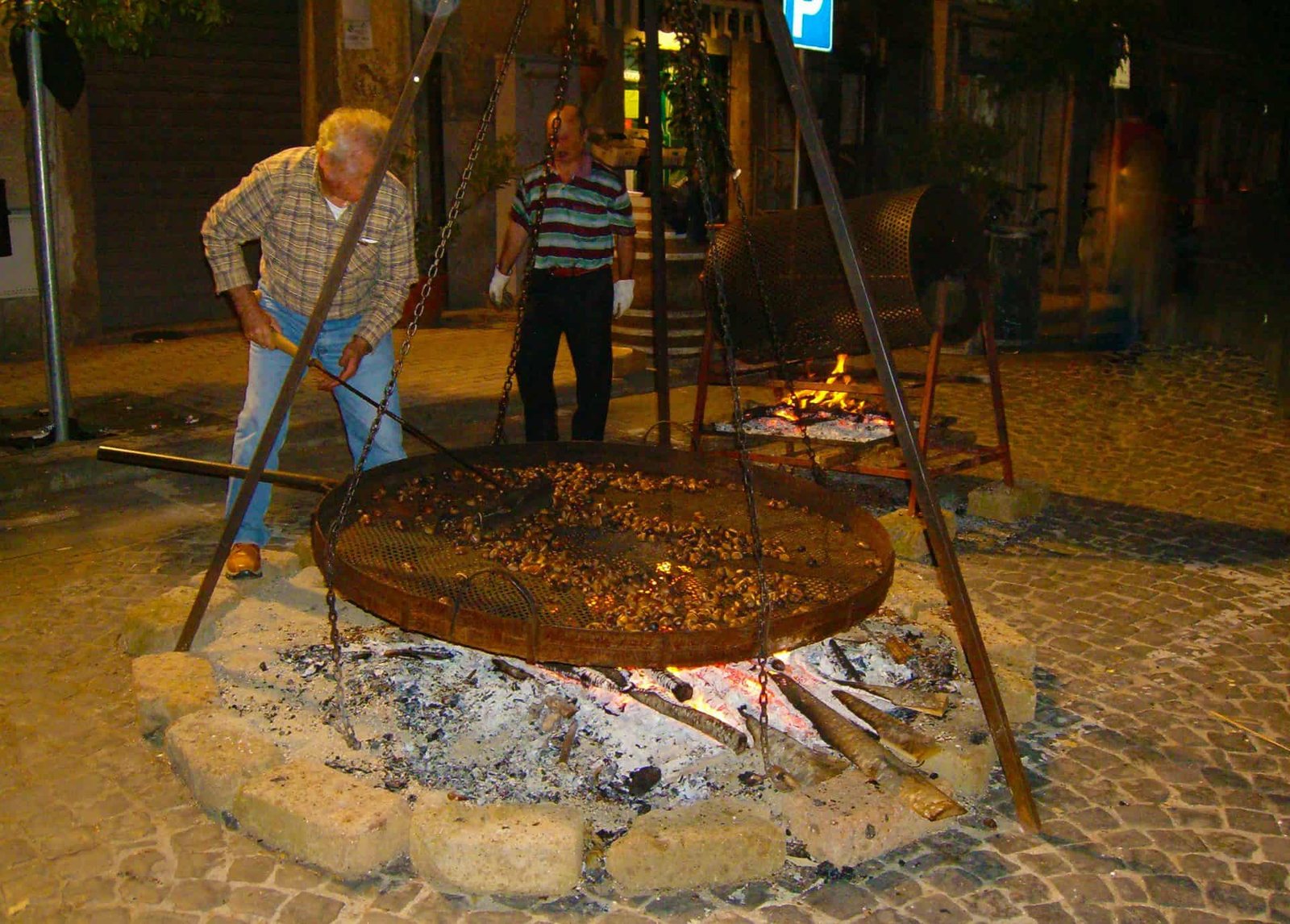
On the gastronomic side the chestnut goes into everything here. There is direct consumption, roasted, with the ritual of the perforated pan identical for generations. There is the boiled chestnut, which in peasant cooking was a side food and not a dessert. There is the flour, which opens the way to rustic doughs and to the fricciolose, the traditional chestnut pasta served in the cellars during the festival. There is the chestnut and chickpea soup, a humble dish and perfect for October evenings. There are the marroni for processing, the marrons glacés, the creams, and the use in savory cooking with pork, mushrooms and aged cheeses, a logical consequence of a territory where the woods hold chestnut trees, mushrooms and wild boar and the houses hold pigs and sheep. Alongside the chestnut the territory produces extra virgin olive oil, hazelnuts, wine and porchetta.
The Chestnut Festival of Vallerano (VT)
The Chestnut Festival takes up the weekends of October and the first ones of November. The 2025 edition ran from October 11 to November 2, with its base at Piazzale Armando Diaz 13, roasted chestnuts and wine in Piazza della Repubblica, craft markets, guided visits, cooking workshops and above all the cellars dug into the tufa opened in the historic center, where you eat chestnut and chickpea soup and fricciolose. Entry to the festival is free. The good window for fresh product is narrow and depends on how the year goes: whoever comes to buy chestnuts from the producers should find out beforehand how the harvest is going, because two weeks early or late changes everything. All the neighboring villages work the same autumn vein, Soriano nel Cimino in the lead with its famous festival, and with a single logistical base you see quite a few different things. In our judgment the Chestnut Festival, with the cellars open and a tenth of the crowd, is worth more than the Night of the Candles for those who want to understand the town.
Another Well-Known Fact, Yet Rarely Mentioned
In town everyone knows it. Outside, almost nobody. In the summer of 1707 George Frideric Handel, 22 years old, a guest of Marquis Francesco Maria Ruspoli in the castle of Vignanello since December 1706, regularly went up to Vallerano to play Burzi's organ in the Ruscello sanctuary, then among the largest in Italy and just enlarged by Marchesi. According to the reconstruction of the musicologist Ursula Kirkendale, on June 18, 1707, in the presence of the Farnese, lords of Vallerano, and the Ruspoli, Handel performed his Salve Regina (HWV 241) with the soprano Margherita Durastanti and himself at the organ. The date falls close to Trinity Sunday of that year, the feast for which the antiphon seems to have been composed. The older tradition instead placed the first performance in Rome, in the church of Santa Maria in Montesanto, on July 16, 1707, under the patronage of the Colonna. The two versions coexist in scholarship, and the reader should know that the Vallerano one is a documented hypothesis, not an absolute certainty. The fact that it has been embraced by the town and by scholars of local history nonetheless makes it one of the few cases in which a town of 2,000 inhabitants can claim with some foundation a world premiere by a composer of that stature.
Why is it well known yet rarely cited? Because the organ is silent. An instrument of 33 stops and more than 2,000 pipes, with a case carved with the Farnese coats of arms, preserved but not working, doesn't produce concerts, and without concerts it doesn't produce news. Whoever visits the sanctuary should stop under the choir loft and look at the case: it is the only object in Vallerano that listened to Handel. Whoever wants to follow the thread of the summer of 1707 should then go to Vignanello, where the Ruspoli castle preserves the garden in which the composer strolled. The ItalyPlanner selection of day trips in Italy is the starting point in English for those organizing a day from Rome across the two towns. One last opinion: a Night of the Candles with the Salve Regina performed in the sanctuary on the restored organ would be the most fitting way to close the circle, and someone will do it sooner or later.
The Right Photo to Take in Vallerano (VT)
The most photographed picture of Vallerano is the one from the Night of the Candles, and it is also the hardest to do well. A scene lit only by open flames has an enormous dynamic range: points of very intense light inside an almost dark setting, and every automatic setting goes into crisis. The phone left to itself exposes for the shadow, raises the sensitivity, produces noise and burns out the flames, which become shapeless white blotches. The solution is simple: tap the screen on a lit area and manually lower the exposure by one or two steps, so the flames keep their shape, the walls remain legible and the black stays black. The second problem is camera shake: in low light shutter times get longer, and you don't need a tripod, you need a support, a low wall, a windowsill, the handrail of a staircase, with the two-second self-timer so you don't move the phone by pressing. The third piece of advice concerns the subject: the packed square and the main alley give confused images. What works is a deserted staircase with the double row of flames following its profile, an arch framing a perspective of receding lights, a window with three candles on the sill and darkness around, a fountain in which the water reflects the points of light. The rule is the usual one: subtract until only the essential remains.
In daylight Vallerano photographs beautifully. The golden moment for the historic center is early morning, when the low sun enters from one end of the alleys and creates corridors of cut light: the peperino, dull at noon, with low light shows its grain, its veining, the marks of the chisels, and the portals become interesting instead of merely documentary. The second moment is late afternoon, for the overall shot from outside: you climb along one of the roads toward the ridge, find a gap in the vegetation and compose with the green of the woods in the foreground, the compact gray of the settlement in the center and the countryside in the background. It's the photograph that explains Vallerano better than any description: a town inside a forest. Third subject, the sanctuary: outside the challenge is to give the measure of the volume against its context, including a person or a house beside it for scale. Inside the problem goes back to being the light of the high windows, and you brace yourself, expose for the lit area and look for the geometries, the dome seen from the center of the crossing, the organ case from below. Inside a church respect comes before the shot: if there is a service, you lower the phone. Fourth subject, the one almost nobody photographs and the most characteristic: the chestnut grove. A mature fruit-bearing chestnut grove, with large knotty trunks well spaced and clean ground, has an almost architectural quality, and photographed in diffused light, overcast sky or light fog, frequent conditions in autumn, it gives an atmosphere that no square can give. In October and November, with the burrs on the ground and the leaves turning brownish yellow, it is one of the most beautiful subjects in northern Lazio. Fifth, the detail of daily life: the enamel plaques of the old shops, the ceramic house numbers, the laundry hung out, the pots on windowsills, the tools against a wall, photographed vertically and in flat light, without seeking effect. On people the rule is banal and effective: if the subject is recognizable and the photo is of them, you ask. It costs five seconds and almost always the answer is yes, often with a conversation worth more than the photograph. Pointing the lens in the face of an elderly man sitting in the square as if he were a piece of furniture is the gesture that ruins the relationship between villages and visitors more than any other. On drones: flight is subject to national regulations and local restrictions, you don't fly over a crowd, and on the evening of the candles this is decisive. One last suggestion on method: return to the same subject in different seasons. The same alley in April and in November are two images that, placed side by side, tell the territory better than 10 different places seen once.

The Seasons of Vallerano (VT): When to Go and When to Avoid
A statement that may sound heretical: the evening of the candles is the least representative of the year. It's spectacular, but the town that evening isn't itself, it's a stage. Whoever wants to understand what it's really like has to come another time. October and November are the golden period, but the two months aren't equivalent: October brings the harvest, the festival on weekends, the woods with the first turns of color and moderate attendance. November brings the real silence, leaves on the ground, fog rising from the valleys in the early hours, low light all day. If I had to choose a single day of the year to bring a friend who loves real places, I'd choose a Tuesday in mid-November. April and May are the surprise: the beech forest in spring has translucent new leaves and an acid green that lasts a few weeks, the undergrowth blooms, the trails are dry. There's no drawing event, so there's nobody, and Lake Vico with its reserve is the ideal complement. December and January are harsh but not without charm: the town closes up, businesses reduce activity, the cold at altitude is real, and in compensation there is the domestic dimension of the holidays, with nativity scenes, services and community rites without any tourism. The days are short and by five it's already night. July and the first half of August are the period I advise against for those seeking the character of the place and recommend for those seeking refreshment: the altitude helps, the woods give shade, the evening is pleasant, but the town lives in a suspended time waiting for the big evening. The religious festivals, San Vittore between the end of August and early September and the sanctuary's anniversaries, are the moments when the community shows itself without filters. Dates vary and must be checked, but whoever happens upon one sees something no tourist-oriented event can replicate.
Some Important Events That Happened Here in History
The first event is the one from which everything descends: July 5, 1604, the blood from the lips of the fresco that Stefano Menicucci was restoring, verified by Bishop Andrea Longo, and March 8, 1605, the first stone of the sanctuary, with the church standing in 1609, Benazzini's dome in 1620, Marconi's altar in 1627 and Burzi's organ between 1635 and 1644: 40 years in which a town of farmers and woodcutters, with the money of the Farnese and of pilgrims, raised a basilica. The second is from 1512, when the Farnese built Sant'Andrea on the ruins of the castle, turning the military strong point of the village into a place of worship: it's the moment when Vallerano stops being a fortress and becomes a town. The third is June 18, 1707, the date proposed by scholarship for Handel's Salve Regina in the sanctuary, with the Farnese and the Ruspoli in church and Durastanti singing: the only day when the great history of European music passed through these parts. The fourth is 1762, the ceiling of San Vittore with the 116 coffers paid for by the Confraternity of the Most Holy Sacrament, which tells of a community capable, in the middle of the 18th century, of financing a work of that level on its own. The fifth is February 11, 1922, the inauguration of the chapel of the Madonna of Lourdes in San Vittore in memory of the fallen of the Great War, who for a town of this size were many. The sixth is January 2, 1927, royal decree No. 1 by which Vallerano passed from the province of Rome to the newly established one of Viterbo: hence the abbreviation VT that goes with the name. The seventh is 1956, the burial of Corrado Alvaro. The eighth is April 23, 1993, the proclamation of the Madonna del Ruscello as patron of the blood donors of Lazio. The ninth is April 8, 2009, the chestnut's DOP in the European Official Journal, and the tenth, in the negative, 2016, the year the same DOP was effectively suspended for lack of fruit. In between, from 2008 onward, the editions of the Night of the Candles, which have changed the image of the town more than any other event of the last 50 years. An opinion: the most important event remains the first, because without 1604 there would be no sanctuary, no organ, no Handel, no donors and probably not even the desire to light 100,000 candles.
Who Passed Through Vallerano (VT)
The history of Vallerano doesn't need borrowed celebrities, but it has a few real ones, and they need to be placed by distinguishing what is documented from what is tradition. Documented are the Farnese: dukes of Parma and Piacenza, lords of the town from the 16th century, builders of Sant'Andrea in 1512 and funders of the sanctuary, with Cardinal Odoardo Farnese among the contributors and members of the family present in church in June 1707. Their lily is still in the municipal coat of arms. Documented is Giovanni Maria Benazzini, architect of the Farnese house, author of the 1620 dome, and documented is Domenico Marconi, who with Roman sculptors made the high altar in 1627. Attributed by tradition is Jacopo Barozzi da Vignola, who died in 1573, whose design would lie at the base of the sanctuary and whose school would have produced the church of the Crucifix: an ideal passage more than a physical one. Giovanni Lanfranco certainly passed through, with the Assumption of the Farnese chapel, and so did Girolamo Troppa, with the Annunciation of the Marcucci chapel, and Giovanni Francesco Vandi, who worked in town from at least 1647 (the San Vittore canvas) to 1685 (the sanctuary choir): nearly 40 years of relationship between a painter and a community. Giulio Cesare Burzi of Parma, organ builder, passed through between 1635 and 1644, and after him Marchesi, the Priori and Felice Ercoli. According to the studies of Ursula Kirkendale, George Frideric Handel passed through in the summer of 1707 with the singer Margherita Durastanti and his patron Francesco Maria Ruspoli. The bishops who left their mark on the churches passed through: Andrea Longo in 1604, Lanucci in 1759, Mengacci at the reconsecration of 1853, and Cardinal Camillo Ruini with the bishops of Lazio in 1993. Corrado Alvaro passed through and stayed, who bought a house here and has been buried here since 1956. And the conclave passed through, indirectly: in the 13th century the papal court gravitated for decades on Viterbo, 15 kilometers away, and courts need food, wood, stone and labor that came from the countryside.
Then there are the human categories that explain the town better than names. The pilgrims, who for centuries came on foot from all the Cimini towns toward the Madonna del Ruscello, for graces received and for vows, on roads that were dusty cattle tracks in summer and impassable in winter: whoever enters the sanctuary should imagine the nave full of people who arrived on foot from 15 kilometers away, because it is the only image that gives back the sense of that space. The peperino stonecutters, almost always anonymous, often from families that handed down the trade: the real author of Vallerano's minor architecture is a collective technical tradition, not a signature. The Grand Tour travelers, who followed the Cassia and built the image of Tuscia as a wild, wooded, archaeological land that still conditions our gaze, even if the big names stopped on the main routes and didn't climb this far. The farmers and woodcutters who materially made the landscape, every chestnut grove, every low wall, every path. The 20th-century migrants, who left for Rome, the North and abroad, who return for San Vittore and for the candles and who are one of the forces that keep these communities alive: many of the people you see on festival evenings aren't tourists, they're children of the place. And the blood donors, who since 1993 come up to the sanctuary from all over Lazio: the latest category of pilgrims, and perhaps the most consistent with the name of the place. Many attributions that circulate about Italian villages, so-and-so passed through here, such-and-such slept here, are oral traditions without documents. Vallerano is lucky enough to be able to do without feeding them.
Village Etiquette: How to Behave in Vallerano (VT)
In a village of 2,400 inhabitants the visitor is visible: in Rome nobody notices you, here within 20 minutes half the town knows you've arrived. It's not a judgment, it's a matter of scale, and it changes the rules. First rule: say hello. In the towns of central Italy people greet each other when passing, even strangers, and a good morning said naturally turns an outsider into a person you can talk to. It's the cheapest way I know to improve a trip. Second: respect private spaces. Open courtyards, outside staircases, vegetable gardens on the street: visible doesn't mean visitable, and if the courtyard is beautiful you ask, because almost always they let you in and even tell you the story of the house. Third: mind the noise, because a voice bouncing between the walls of an alley reaches inside the houses. In the alleys you speak as in the hallway of an apartment building. Fourth, on event days: follow the volunteers' directions, who aren't professional security staff but citizens who have taken on the responsibility of making something complicated work. Fifth: trash, because tens of thousands of people produce a quantity of waste that a small town isn't sized to absorb, and disposing of it where indicated is the difference between a town that gets back on its feet in a few hours the next day and one that takes days. Sixth: in purchases, ask where chestnuts, honey, oil and wine come from, and buy from the producer when possible. Seventh: don't treat the village as a backdrop. A town is not a set, it's someone's home every day of the year. Whoever arrives with this awareness gets doors that open, information no guide contains, invitations to return. And the summary of it all: Vallerano deserves a second visit. The first is made for the event or the sanctuary, the second for the town, and you discover it's something else entirely. The villages that stay in memory aren't the ones that amazed you once, but the ones where you had time to get a little bored and look around.
Vallerano (VT) with Children and with Those Who Walk Little
With children Vallerano works provided you calibrate expectations. The program I recommend: the sanctuary in the morning, with the game of finding the two saints on the walnut portal and the lily on the organ pipes. A walk in the alleys hunting for dated lintels. An hour in a chestnut grove at the edge of the settlement, which in October becomes a burr-gathering session in sturdy shoes. A long lunch. On the evening of the candles, for a child, it's pure enchantment, but between 21:00 and 23:00 the crowd in the alleys is real and the little ones are held by the hand, with an agreed meeting point and a warm garment. Strollers struggle in the upper core and do fine in the lower part and at the sanctuary. Those who walk little can do the visit in three stages by car: sanctuary forecourt, Piazza della Repubblica, the viewpoint on the road to Canepina, with short stretches on foot. The churches have no equipped routes. The Grotta di San Salvatore and the hermitage of San Leonardo are not accessible to those with mobility difficulties.
What to Eat in Vallerano (VT) and Where
The cooking of the Cimini Tuscia is substantial: handmade pasta, long-simmered sauces, grilled meats, mushrooms in season, legumes, and the chestnut in all its forms from October onward. In Vallerano the dishes to look for are fricciolose made with chestnut flour, chestnut and chickpea soup, roasted chestnuts in the square during the festival, porchetta, extra virgin olive oil and hazelnuts from the Cimini. The wine is that of the Viterbo hills. Restaurants are few and you always book, even on weekdays, because when a group arrives everything fills up. On the evening of the candles ordinary restaurants can't handle the numbers and people rely on the associations' refreshment points, with the waiting times that follow. I don't name places: they change, and the barman in the square is a more up-to-date source than any page. Those who want a lunch with an organized visit for a corporate group or an extended family can lean on those who build tailor-made days in Tuscia: the editorial team of TourLeaderPro does it for a living.
What to See Around Vallerano (VT) Within 20 Minutes by Road
A few kilometers away is Vignanello, with the Ruspoli castle and the Italian garden designed by Ottavia Orsini, which the town shares with Vallerano in history and in the Handel thread. It's the most natural pairing. Soriano nel Cimino has the Orsini castle, the ancient beech forest and the Sasso Menicante, the rocking boulder that is one of Lazio's geological curiosities. Caprarola with the Palazzo Farnese is the greatest monument of Tuscia and the key to understanding who ruled Vallerano in the 16th century. Lake Vico, inside the volcanic caldera, is 20 minutes away passing through Canepina. Fabrica di Roma is the town toward which the Valleranese provincial road descends, and Vasanello, with the Orsini castle and its hinge position toward the Tiber valley, is along the road from Orte. The hamlet of Chia, with its gorges, waterfalls and the tower where Pier Paolo Pasolini chose to live his last years, completes the literary reading of the territory together with Alvaro's tomb. Vitorchiano with its peperino spur, Viterbo with the medieval San Pellegrino quarter and the Palace of the Popes, Villa Lante at Bagnaia with its water features, the Monster Park of Bomarzo and Civita Castellana with Sangallo's fortress are all within half an hour. Those with more days should continue toward Civita di Bagnoregio and Lake Bolsena. In English, the ItalyPlanner guide to Civita di Bagnoregio is the right complement.
Quick Questions About Vallerano (VT)
Where Is Vallerano (VT)?
In the province of Viterbo, on the southern slope of Monte Cimino, at 390 meters above sea level, about 13 kilometers southeast of Viterbo and about 60 kilometers as the crow flies north of Rome. It borders Canepina, Caprarola, Carbognano, Fabrica di Roma, Soriano nel Cimino and Vignanello.
How Far Is Vallerano (VT) from Rome and How Long Does It Take?
By road, a little over 80 kilometers on the A1 with the Orte exit. An hour and 20 minutes to an hour and a half without traffic. By Via Cassia it's slower but more beautiful.
Can You Get to Vallerano (VT) by Train?
There is a stop on the Roma-Civita Castellana-Viterbo railway (Roma Nord, from Piazzale Flaminio), but service on the Civita Castellana-Viterbo section is reduced and in some periods replaced by buses: check the Cotral timetable. The alternative is the train to Viterbo and then the Cotral bus.
How Much Does It Cost to Visit Vallerano (VT)?
Nothing: the village, the sanctuary and the churches are free to enter. You pay only for the Night of the Candles (in 2026 full price €6.99, children 5-10 years old €5, free under 5).
What Are the Hours of the Sanctuary of the Madonna del Ruscello?
Mass on Sundays at 11:30. Outside services, opening depends on the parish of San Vittore, telephone 0761 753002. It's best to call before a weekday.
How Long Does the Visit to Vallerano (VT) Take?
Two and a half or three hours for the sanctuary, San Vittore and the historic center. Four with lunch. Half a day with the woods. A full day with Vignanello or Soriano.
When Is the Night of the Candles Held?
In late August, on a Saturday, from 18:00 until late at night. In 2026 on August 29 (19th edition). The date changes every year and must be checked on the channels of the organizing association and the town.
Where Do You Park for the Night of the Candles?
In three areas outside the town (zones A, B and C) connected by shuttles from 19:00 to 02:00. There are also areas for campers. The center is closed to traffic.
When Is the Chestnut Festival of Vallerano (VT)?
On weekends between mid-October and early November (in 2025 from October 11 to November 2), with free entry, roasted chestnuts in Piazza della Repubblica and cellars in the tufa open.
Is the Castagna di Vallerano DOP or IGP?
DOP, from Regulation (EC) 286/2009 of April 8, 2009. The production zone is the municipality of Vallerano alone.
Who Is Buried in Vallerano (VT)?
The writer Corrado Alvaro (1895-1956), 1951 Strega Prize winner, who had a country house in town. The cemetery is open during ordinary hours.
Did Handel Really Play in Vallerano?
According to the studies of Ursula Kirkendale, on June 18, 1707 he performed the Salve Regina on the sanctuary organ. The older tradition places the premiere in Rome on July 16, 1707. Handel's presence in Vignanello in the summer of 1707 is, however, certain.
Is Vallerano (VT) Good for Children?
Yes, with woods, chestnuts and alleys without traffic. The evening of the candles is crowded and little ones should be held by the hand. There are no interactive museums.
Is Vallerano (VT) Wheelchair Accessible?
Partially: the sanctuary forecourt and the lower part of town yes, the upper alleys with staircases no. The churches have no equipped routes.
Can You Take Photos in the Sanctuary?
Outside services, with discretion and without flash. During services you lower the phone. For the organ, ask the parish priest.
Do You Need to Book to Visit Vallerano (VT)?
No for the village. Yes for the restaurant, always. For the Night of the Candles online presale is recommended. For the Grotta di San Salvatore and the Pieve, ask the parish or the town.
What Is the Best Time to Visit Vallerano (VT)?
October and November for chestnuts, colors and the festival. April and May for the beech forest and the silence. Late August only for the candles.
What Is the Difference Between Vallerano (VT) and Vignanello?
Vignanello has the Ruspoli castle and the Italian garden, that is, the noble monument. Vallerano has the sanctuary, the DOP chestnut and the festival of light, that is, the community. They can be visited together in one day.
Who Is the Patron of Vallerano (VT)?
Saint Victor the Martyr, celebrated between the end of August and the first 10 days of September (originally on May 14) with reenactments, concerts, fireworks and the distribution of the Bread of San Vittore.
What Do You Eat in Vallerano (VT)?
Chestnut fricciolose, chestnut and chickpea soup, roasted chestnuts, porchetta, mushrooms in season, oil and hazelnuts from the Cimini.
How Many Inhabitants Does Vallerano (VT) Have?
About 2,400. In 1927 the municipality passed from the province of Rome to that of Viterbo.
One last opinion: if you have only one day and want Vallerano, choose a Saturday in October with the cellars open, go up to the sanctuary at 11:00, stop under the organ case for a minute in silence and think of a 22-year-old German sitting up there in 1707. You'll see the candles another year. The town you'll understand that day.
Article written by the editorial team of TourLeaderPro, contact them for Private/Corporate/V.I.P. Tours and Experiences.
Planning a trip to Rome? The English guides to visiting the city are on ItalyPlanner.com.