Cascata del Picchio (Nepi)
In short. The Cascata del Picchio can only be reached on foot, from the historic center of Nepi (VT), in the province of Viterbo, about 50 kilometers north of Rome.

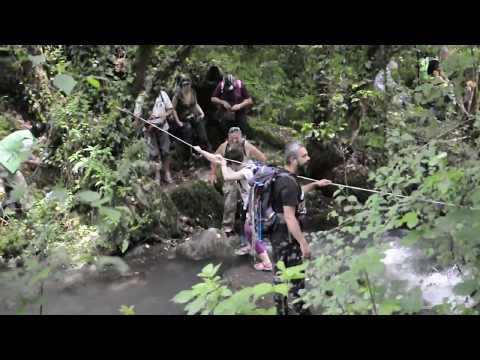
The Cascata del Picchio can only be reached on foot, from the historic center of Nepi (VT), in the province of Viterbo, about 50 kilometers north of Rome. The waterfall is set in the gorge of the Rio Falisco, between the town and Castel Sant'Elia, and has no ticket office, gates, hours or custodians. Entry is free and at no cost, always, because it is in fact a stretch of stream in a wooded ravine. The most convenient starting point is Piazza della Bottata, below the Rocca dei Borgia, where you park for free. From there the complete loop toward Castel Sant'Elia measures about 10.5 kilometers with 345 meters of elevation gain and takes almost four hours of walking, while the round trip to the waterfall alone, by the Cavoni trail, takes a little under three hours and about 12 kilometers of distance with 250 meters of elevation gain depending on the variant chosen. From the Cavoni junction to the waterfall it takes on average 45 to 60 minutes. By car you reach Nepi from Via Cassia bis (the Roma Viterbo expressway), Nepi exit. By public transport you take the Cotral regional bus from the Saxa Rubra station in Rome, with a travel time of around 40 minutes, and get off in town. The trail is not equipped: it involves stream fords, fixed ropes at two points and eroded stretches. For information on whether it is passable after rain the reference is the Comune di Nepi, Piazza del Comune 20, 01036 Nepi (VT), phone 0761 55811. Swimming at the Cascata del Picchio is neither allowed nor recommended: the pools are narrow, shallow and rocky, and no body supervises them.
If you are planning the whole day, it is worth reading the page dedicated to Nepi too: the village and the waterfall are a single visit, not two different outings.
Where the Cascata del Picchio (Nepi) really is
Nepi stands on a tuff spur surrounded on three sides by watercourses. The name of the town, according to the etymology that local scholars give as the most probable, derives from the Etruscan root nepa, water: a place name that works as a geographic description. At the base of the cliff run the streams that over millennia have carved the gorges, and one of these, the Rio Falisco, produces the drop everyone calls Cascata del Picchio.
The distance as the crow flies from the last houses of the town is negligible, a little over 100 meters. The fact that it feels like a separate world depends on a detail of vertical geography: the town is up high, on the tuff plateau, the waterfall is down low, at the bottom of a crack dozens of meters deep. Between the two worlds there are 80 or 90 meters of wall, woods of holm oak and Turkey oak, maples, a dense undergrowth that in summer closes off the view in every direction. That is why the noise of the town doesn't arrive and why, once you are under the drop, you have the impression of being much farther away than you really are.
The Cascata del Picchio is not the only waterfall of Nepi, and this is where a good part of the confusion you read around comes from. Below the Rocca dei Borgia, visible from the walls and a few steps from the center, falls the Cavaterra waterfall. Not far away, along the Rio Puzzolo, opens the Pizzo waterfall. The Picchio is the third, the farthest from the town and the hardest to reach: three different drops, three different streams, and three names that anyone who doesn't know the area regularly mixes up.

How to get to the Cascata del Picchio (Nepi)
By car
From Rome you take the Cassia bis, the expressway that heads toward Viterbo, and exit at Nepi. From the toll gate to the historic center it's a few minutes. The parking to look for is the one at Piazza della Bottata, at the foot of the Rocca: it's where most organized excursions meet, and it's free. Alternatively you leave the car in the parking lots along the Farnese walls, a little higher up.
A practical warning worth its weight in gold: don't look for a road that leads to the waterfall. It doesn't exist. Anyone who types the name into the navigator and blindly follows the arrow ends up on a dirt farm road in the middle of fields, with no way out and no possibility of turning the car around. The only access is on foot and starts from the town.
By public transport
Nepi is served by the Cotral regional buses that leave from the Saxa Rubra terminal, the northern terminus of the Roma Nord railway, on Via Salaria. The travel time is about 40 minutes in normal traffic conditions. Schedules change between weekdays, Saturdays and holidays, and on Sundays the runs thin out quite a lot: anyone planning the excursion as a day trip without a car has to check the return time first, because walking back from the gorge and finding the last run gone is a classic. In town the stop is close to the center, so from getting off the bus to the trail's starting point you walk very little.
The starting point of the trail to the Cascata del Picchio (Nepi)
With the Rocca dei Borgia on your right you take the downhill road that runs along its side. Past the arch, on the left, the Cavaterra waterfall appears: it is the first spectacle of the day and arrives after five minutes of walking, which says a lot about how concentrated the beauty of this territory is. You cross the bridge, continue for a short stretch along the state road and right away you find the signs for the Cavoni. You turn left onto Via del Cardinale and arrive at a fork where two signs indicate the nature trails. For the Cascata del Picchio you take the one on the right.
The trail to the Cascata del Picchio (Nepi), stretch by stretch
The Tagliata dei Cavoni and the gorge of the Fosso della Massa
From the fork the road, which here carries the name Tagliata dei Cavoni, goes down quickly into the gorge of the Fosso della Massa. The descent is short, a few minutes, and at the bottom there is a bridge. The temperature drop is immediate and noticeable: you enter a damp, shady microclimate, a couple of degrees cooler than the plateau.
The bridge is the hinge of the whole itinerary. From here you decide: continuing uphill you reach the Cavoni proper. Going back to the bridge and turning right, with the bridge in front of you, you walk with the river on your left and head for the waterfall. Anyone with time does both, and does well.
The Cavoni above the Cascata del Picchio (Nepi)
The Cavoni are sunken roads: corridors dug by hand into the tuff, open to the sky, with vertical walls that in some places exceed 10 meters in height and in others narrow to the point that spreading your arms you touch both. They are not a natural phenomenon, and this is the point almost nobody explains well: they are works of territorial engineering by the Falisci, the people who occupied this portion of Lazio before the Roman conquest, built to link the tuff plateaus to the bottom of the gorges. They served to move people, animals and carts where the morphology did not allow it.
Walking in the Cavoni you notice small niches carved into the walls. Local tradition calls them devil-chasing niches and attributes them to the Christian era, when the pagan sunken roads were reconsecrated with sacred images and little lamps. Were they made for that, or reused later? That is an open question: what you see is a regular hollow, repeated, at the height of a man.
The floor of the sunken road is marked by parallel grooves. They are not decorations: they are the cart tracks, worn into the tuff by centuries of passage. Look at them closely, because they are the most concrete proof that this was not a landscape curiosity but a working road.
From the bridge to the Cascata del Picchio (Nepi)
Back at the bridge and heading in the direction of the river, the character of the route changes. The trail becomes steep, the elevation changes constantly, you climb and descend following the course of the gorge. The ground alternates packed earth, roots, muddy stretches that become slippery after rain and short passages on rock. There are no mountaineering difficulties, but not the comfort of a park trail either: you need hiking boots with a lugged sole and a minimum of habit walking on uneven terrain.
Along the stretch you meet the stream fords. In some places there are small wooden bridges, in others fixed ropes stretched from one bank to the other: they help, but they are not certified equipment and nobody maintains them regularly. After heavy rain the water level rises quickly, and the fords that at normal flow you cross in three steps become seriously dangerous. If the water comes above the knee and has force, you turn back. No waterfall is worth a wrong ford.
The last stretch is well marked and slightly downhill. Then the noise changes, becomes continuous and deep, and the gorge opens onto the drop of the Picchio. The waterfall plunges into a narrow gorge, with vegetation closing off the scene on both sides: the light arrives from above, filtered, and changes completely depending on the hour. It is the most spectacular waterfall of lower Tuscia, and whoever calls it that is not exaggerating.
The detour to the Tasso spring
Before reaching the waterfall, anyone who wants to can detour toward the Tasso spring. It is a short variant but decidedly more demanding than the main trail: the descent is not easy, you have to climb and ford the stream twice. Here too there are fixed ropes that make the fords manageable, but it remains a stretch to do only in low-flow conditions and with suitable shoes.
The vegetation around the spring is lush to the point of excess, with ferns, mosses and trees that close off the sky. In exchange, in summer, mosquitoes are a constant and aggressive presence: repellent is a must, long sleeves recommended. In our judgment the detour to the Tasso is worth it only from March to May, because in high summer you pay an entomological price out of proportion to what you see.
The long loop toward Castel Sant'Elia
The most complete version of the excursion doesn't go back by the same trail but closes a loop between Nepi and Castel Sant'Elia, passing from gorge to gorge. You start from Piazza della Bottata, walk the Cavoni, look out at the viewpoints over the gorge of the Rio Puzzolo and over the Cavaterra waterfall, cross the medieval humpback bridge over the Fosso del Ponte di Castello, go down to the Cascata del Picchio and climb back up toward the plateau with the view of Castel Sant'Elia and its bell tower. It is about 10.5 kilometers, 345 meters of elevation gain and as much descent, lasting around three hours and 40 minutes, medium difficulty.
The stretches marked 178B and 178C are the ones on which the route authors recommend the most attention, especially after abundant rain: they are the passages that go down toward the bottom of the gorges, with steep slopes and an eroded surface. It is not a loop to do in the dark, not a loop to do with a storm coming and not a loop to improvise without a GPS track.
Can you follow the route on your own?
Yes, but with due caution. Signage exists and has been improved in recent years, but it is not continuous like on a Club Alpino mountain trail: there are unmarked forks, secondary tracks opened by wild boars that look like trails, and stretches where summer vegetation covers the signs. Carrying a track downloaded on the phone, with the offline map, solves 90 percent of the problems.
Frequently asked questions about the Cascata del Picchio (Nepi)
How much does it cost to enter the Cascata del Picchio in Nepi?
Access to the Cascata del Picchio in Nepi is free and at no cost at any time, because it is not a fenced site but a stretch of gorge along the Rio Falisco. The only expenses of a day here are fuel or the bus, any lunch in town and the ticket for the Rocca dei Borgia, if you decide to visit it.
Can you get to the Cascata del Picchio by car?
No, you can't get to the Cascata del Picchio by car: the car is left in town at Nepi, typically in the free parking lot of Piazza della Bottata at the foot of the Rocca, and the rest of the way is on foot. There is no drivable road that reaches the drop of water.
Can you swim at the Cascata del Picchio?
No, you don't swim at the Cascata del Picchio: the pools at the base of the drop are small, the bottom is rock and blocks, the depth is deceptive and variable, and no authority exercises supervision or swimming-safety checks on this stretch of gorge.
When is the best time to see the Cascata del Picchio with full water?
The best period for the Cascata del Picchio runs from mid-March to late May and from mid-September to November. In August, after a dry season, the water often shrinks to a thread that slides over the tuff without making noise, because the Rio Falisco has a small basin and a torrential regime tied to rainfall.
Is the Cascata del Picchio suitable for children?
It depends on age: a 10 or 12 year old used to walking tackles the route to the Cascata del Picchio without problems and finds it adventurous, thanks to the fords and the ropes along the trail. Under seven or eight the picture changes, because the eroded stretches and the fords are demanding and carrying a child in your arms down a slippery descent is not advisable.
Is the Cascata del Picchio wheelchair accessible?
No, the Cascata del Picchio is not accessible to people with reduced mobility: there is no alternative route, there are no ramps and the ground is natural, with fords to cross on foot. A concrete alternative is the Cavaterra waterfall, visible from the viewpoint below the Rocca, in the center of Nepi.
What do I need to bring to visit the Cascata del Picchio?
For the Cascata del Picchio you need hiking boots with a lugged sole, because the fords and muddy stretches punish smooth soles, and telescopic poles useful downhill and at the fords. In summer it is worth adding river sandals, a change of socks and insect repellent, because along the trail there are no certified drinking fountains.
What is there to see around the Cascata del Picchio in Nepi?
Near the Cascata del Picchio, the main monument of Nepi is the Rocca dei Borgia, the point from which the trail toward the gorge starts. The foundations include a wall of Etruscan Roman origin and a quadrangular tower, while the three-level residential layout is the work of Antonio da Sangallo the Elder for the Borgia.
Anyone who isn't familiar with hiking, or who accompanies people who aren't very fit, does well to rely on a licensed hiking guide or on one of the associations that organize group walks to the Cascata del Picchio. If you are looking for a professional to build the day, the network of tour leaders and guides of TourLeaderPro regularly works on Lazio and not only on the city of Rome.

Cascata del Picchio (Nepi)
The gorges, the cavoni and the geology that explains the Cascata del Picchio (Nepi)
What a gorge is
Gorges are the geomorphological element that defines the whole Agro Falisco: very narrow valleys bounded by sub-vertical walls, carved by the erosive action of streams on the volcanic substrate. The material the stream has worked in is tuff, product of the eruptions of the Sabatino and Cimino volcanic districts. The datings given by the local literature place the formation of these cuts in a span from about 600,000 to about 20,000 years ago: not an event, a very long process.
Tuff has a characteristic that explains the shape of the gorges: it is soft enough to be cut vertically, compact enough to hold overhanging walls without collapsing right away. The result is miniature canyons with almost perfectly vertical sides, tens of meters high, with the stream running at the bottom on a bed of blocks fallen from above. The Cascata del Picchio is born exactly from this mechanism: a step in the rock that the Rio Falisco has not yet managed to wear away.
The Rio Falisco
The watercourse that feeds the waterfall carries the name of the people who inhabited this territory. The flow is modest and seasonal: in autumn and spring the drop is full and noisy, in August it shrinks to a veil. Anyone who arrives at the end of summer and is disappointed didn't come to the wrong place, they came in the wrong month. Keep that in mind when you look at photographs taken in flood conditions and decide the date of the trip.
The cavoni, that is, the sunken roads of the Falisci
Cavoni and gorges look so alike that visitors confuse them, and it's understandable: both are deep corridors dug into the tuff. The difference is the author. The gorge is dug by water over hundreds of thousands of years. The cavone is dug by humans with hand tools, in historical time. The Falisci built them in the pre-Roman era to link the settlements on the plateaus with the valleys, and they remain among the most impressive engineering works of ancient central Italy, all the more so when you consider they were dug without explosives and without machines.
The system is not isolated. Similar sunken roads are found across all of Tuscia and in the nearby Maremma, and in northern Lazio they form a network that linked settlements, necropolises and sanctuaries. Walking inside them, with the light coming down from a sliver of sky 10 meters above your head, is the part of the excursion you remember longest, often longer than the waterfall itself.
Safety at the Cascata del Picchio (Nepi): what needs to be said clearly
This is the section I ask you to read in full, even if you always skip the safety sections.
First: you don't swim at the Cascata del Picchio. The pools at the base of the drop are small, the bottom is rock and blocks, the depth is deceptive and variable, and no authority exercises supervision or swimming-safety checks. Anyone who writes that it's a place to cool off does readers a terrible disservice. Diving in is dangerous in an obvious way and must not be done: under the surface of the water there are boulders. Wetting your feet sitting on a stone is something else, and it's what sensible people do.
Second: the fords. They are not equipped passages in a technical sense. The fixed ropes stretched between the banks were put there by volunteers and hikers, not by a body that answers for them, and their hold is not guaranteed. Don't load your full body weight on them and don't use them as the only handhold. If the stream is swollen, the ford must be abandoned: the floods of the tuff ditches rise fast because the basin is small and the ground impermeable.
Third: the walls. The gorges lose blocks, especially in spring after the freeze and thaw cycles and after heavy rains. Don't stop to eat under an overhang and don't linger long at the base of the walls. The floor of the gorge is strewn with boulders fallen from above, which should be enough information.
Fourth: phone signal at the bottom of the gorge is weak or absent. Tell someone where you are going and what time you expect to be out. The single emergency number is 112.
Fifth: nothing you find along the route, from the niches of the Cavoni to the cart grooves, should be touched, carved or taken away. It is an archaeological territory, not a playground.
When to go to the Cascata del Picchio (Nepi)
The best window is double: from mid-March to late May and from mid-September to November. In spring the flow of the Rio Falisco is at its maximum, the vegetation is light green and has not yet closed the gaps, the temperatures in the gorge are perfect for walking. In autumn the woods change color and the October rains put water back in the drop, with the advantage of a less frequented trail.
Summer is the worst season, and I say it against the common sense that associates waterfalls and heat. From July to early September the drop shrinks, the mosquitoes of the gorge are relentless and the dry ground makes the downhill stretches more slippery, not less. If you have to go in July, go at dawn.
Winter is doable on dry days and gives you the gorge in its most readable form, with the woods bare and the tuff walls fully visible. After two days of rain, however, the route should be postponed without discussion.
How much time you really need
For the waterfall alone, round trip taking it easy with a few photo stops, allow three hours. For the complete loop to Castel Sant'Elia, a solid four hours plus stops. For a day that includes the waterfall and a visit to the village of Nepi with the Rocca dei Borgia, the right time is from 9:00 in the morning to late afternoon. Squeezing everything into half a day means running and seeing nothing.
What to bring to the Cascata del Picchio (Nepi)
Hiking boots with a lugged sole, not sneakers: the fords and muddy stretches punish smooth soles. Telescopic poles, useful downhill and even more at the fords as a third point of support. A change of socks and, in summer, river sandals to cross without wetting your boots. Water, because along the trail there are no certified drinking fountains. Insect repellent from March to October. A downloaded GPS track and the offline map. A bag to carry your trash back, including organic waste.
What you don't need: the drone, which has no room to maneuver in the gorge and disturbs wildlife, light-colored clothing, which after the first ford is no longer light, new shoes.
A curiosity about the Cascata del Picchio (Nepi)
The best curiosity of this place is not about the water but about the name of the town that guards it. Nepi is called that, according to the reading accepted by the local scholarly tradition, from the Etruscan root nepa, which means water. It is one of the very rare cases where the name of an Italian town is a pure hydrographic description: not the patron saint, not the founder, not the position. Water. And the curious thing is that the place name continues to be exact after 25 centuries: three watercourses at the base of the cliff, three waterfalls within a few kilometers, a network of springs that has made the mineral water of Nepi a product known well beyond the borders of Lazio.
There is more, and it concerns the perception of the place. Nepi has a waterfall inside the town, the Cavaterra, which falls below the walls of the Rocca dei Borgia. A town with a waterfall under its castle and two in the surroundings has no need to invent attractions. And yet the Cascata del Picchio remained for decades known only to residents and a handful of hikers, because the only way to reach it is to walk for an hour inside a gorge.
I'll add a linguistic curiosity nobody ever explains: the word cavone, with which the people of Nepi call the sunken roads, is not a technical term from an archaeology manual but a popular, local name, survived in spoken use. In scientific publications you almost always read via cava or tagliata. Anyone who says cavone, in Nepi, is using a word with a very long continuity of use behind it, and it is a small philological luxury that can only be noticed on the spot.
One thing nobody tells you about the Cascata del Picchio (Nepi)
That the Cascata del Picchio, in August, often isn't there. Or rather: the drop is there, the wall, the gorge, but the water shrinks to a thread that slides over the tuff making neither noise nor foam. The Rio Falisco has a small basin and a torrential regime: it depends on rain, not on a glacier or a lake. The photographs that circulate, with the full jet and the mist at the base, were taken almost all between March and May. Nobody writes it, and people set out in August convinced they will find that scene.
The second thing nobody tells you concerns the real effort of the route. The ratings you find around swing between difficulty E, that is, easy hiking, and medium difficulty. Both are true and concern different variants: the difference between the two judgments is the number of fords you decide to take on and whether you include the descent to the Tasso spring. The trail is not technical, but it's not the walk on flat ground some people describe either: 250 meters of elevation gain broken into continual ups and downs are felt, especially on the way back.
The third is practical and everyone learns it at their own expense: in the gorge the phone gets no signal. Anyone counting on navigating in real time with the online map is left without a map at the worst point, at the bottom of the gorge where the forks all look alike. The track has to be downloaded before leaving, while there is still signal in town.
The fourth, finally, concerns the trail surface after rain. Wet tuff develops a very thin and extraordinarily slippery film, different from normal mud: you don't sink in, you slide. It's the reason injuries here don't happen at the fords, where everyone pays attention, but on the apparently harmless downhill stretches.
The advice I give you for visiting the Cascata del Picchio (Nepi)
The advice is to invert the mental order of the day. Don't treat the Cascata del Picchio as the destination and Nepi as the side dish: treat the gorge as a single organism, in which the town, the sunken roads, the medieval bridge, the three waterfalls and Via Amerina are parts of the same system. Anyone who arrives, goes down, photographs the drop and climbs back up has seen the least interesting thing about the place. Anyone who walks slowly in the Cavoni, recognizes the cart grooves, looks out over the gorge of the Rio Puzzolo and then reaches the waterfall understands why the Falisci settled here.
The second piece of advice is about timing. Start early, before 9:00. Not to avoid the crowd, which on this trail is never a serious problem, but for the light: the gorge is narrow and the sun enters it in a short window, mid-morning, when the rays cut through the vapor at the base of the drop. In the afternoon the waterfall is in full shade and loses half its effect.
Third: go in twos or threes, never alone. Not out of fear, but out of elementary rescue arithmetic. At the bottom of the gorge there is no signal, the trail is little frequented on weekdays and a twisted ankle halfway becomes a very serious problem if there is nobody who can climb back up to call for help.
Fourth, and here I go against the current: if you have only one day and want to see a waterfall of northern Lazio with small children or with people who aren't very fit, don't come here. Go to the Cascate di Monte Gelato, in the Parco della Valle del Treja, where you park 200 meters from the water. The Cascata del Picchio rewards those who walk, and should be chosen knowing it.
Fifth: stop for lunch in Nepi instead of bringing a sandwich. The town has real osterie, and after three hours of gorge a plate of pasta all'amatriciana sitting in the square is the right conclusion to the excursion. And if you are building a longer itinerary in Lazio, the overview of day trips from Rome on ItalyPlanner helps fit the distances together without kidding yourself about travel times.
Another well-known fact, yet rarely cited
That this gorge is crossed by a Roman road, and not just any road. Via Amerina was opened in 241 BC, after the Roman conquest of the Agro Falisco, and linked the Faliscan territory with Umbria, passing through Nepi and Falerii Novi. It is well known among archaeologists and perfectly unknown to most people walking toward the waterfall, who pass over the paving stones without knowing what they are.
The stretch you meet along the trails of Nepi preserves in some places the original paving, the wheel grooves and the cuts in the tuff with which the Romans reduced the slopes. Via Amerina is one of the rare cases where a minor consular road has been preserved because nobody built on top of it: the modern routes went elsewhere, the countryside closed back in, and the paving stones stayed where they were.
There is a second historical level worth knowing. In the early Middle Ages, when the Lombards occupied much of central Italy, Via Amerina remained one of the few safe lines of communication between Rome and Ravenna, the so-called Byzantine corridor. For two centuries, along this strip of territory, ambassadors, armies and popes passed. The rock-cut necropolises and the churches dug into the tuff that dot the route belong to that season.
A third fact that is rarely cited, and a very concrete one: the medieval humpback bridge over the Fosso del Ponte di Castello, which you meet on the loop between Nepi and Castel Sant'Elia, is not a tourist reconstruction. It is an old structure still used by pedestrians, with the classic hump in the middle, and it is one of the most photographed points on the route even though it appears in almost no guide.
The Right Photo to Take at Picchio Waterfall (Nepi)
The photo everyone tries to take is the frontal shot of the drop, with the tripod planted in the pool and the long exposure that turns the water into silk. That's perfectly fine, and it's also easy: neutral density filter, one or two seconds of exposure, stopped-down aperture, lowest ISO. You need the tripod, you need a cloth to dry the lens from the spray and you need patience to wait for the wind to stop the leaves in the foreground.
But the right photo, the one nobody takes, is a different one: turn your back to the waterfall and photograph the gorge. Picchio Waterfall on its own could be anywhere. The gorge that contains it, with its vertical walls of yellow tuff, the woods looking over from above and the narrow strip of sky in between, is recognizably Tuscia and nowhere else. Wide-angle lens, one person in the frame for scale, and you have the portrait of the place.
The second photo to take home is in the Cavoni, not at the waterfall. Enter the sunken road, wait for someone in the group to walk to the middle of the corridor, and shoot from the far end with the light coming down vertically from the slit: the contrast between the tiny figure and the walls 10 meters high tells the story of the Faliscans' work better than any caption. With a phone it comes out well if you lock the exposure on the lit wall and let the shadows close in.
Time of day: midmorning, between 10 a.m. and noon, when the light enters the gorge. Avoid full summer midday, which produces unmanageable contrast between the blown-out sky and the black bottom. A practical note on photo safety: don't climb the wet boulders at the base of the drop to look for the best framing. Wet tuff is slippery and unforgiving, and no photograph is worth a fall in a gorge with no phone signal.

Some Important Events That Happened Here in History
The gorges of Nepi don't have a single date, they have a stratigraphy of events. The first is the Roman conquest of the Agro Falisco. In 241 BC, after the destruction of Falerii Veteres and the deportation of its inhabitants to the new Falerii Novi on the plain, Rome opened Via Amerina. It is the infrastructural birth certificate of this territory, and the road passes a few hundred meters from the waterfall's gorge. Nepi, unlike nearby Civita Castellana, had chosen the Roman side and became a municipium, earning the role of gateway to Etruria.
The second event is Christian and underground. From the end of the second century, and then above all between the fourth and fifth, the tuff walls around the town were dug out to hold the catacomb of Santa Savinilla, one of the most extensive cemetery complexes in Lazio. Tradition links the site to Saints Tolomeo and Romano, still the patron saints of Nepi today, celebrated on August 24. The catacombs can be visited by reservation through the Museo Civico.
The third is the Borgia era, and it changes the face of the town above the gorge. In the 1400s Cardinal Rodrigo Borgia, future Pope Alexander VI, entrusted Antonio da Sangallo the Elder with transforming the old fortress into a fortified residence on three levels, with a surrounding wall and corner towers. In 1499 Alexander VI gave Nepi to his daughter Lucrezia Borgia, who governed it until 1501. Lucrezia Borgia withdrew here after the murder of her second husband, Alfonso of Aragon, and in those months the town knew a brief season of court life.
The fourth is Farnese. Pier Luigi Farnese, son of Pope Paul III, called on Antonio da Sangallo the Younger to strengthen the defenses with corner bastions and curtain walls, producing one of the sturdiest examples of military architecture in the area. The Palazzo Comunale was begun in 1542 and the monumental walls you can still see today belong to this phase.
The fifth event is hydraulic, and has to do directly with the water of which Picchio Waterfall is a natural manifestation. The search for a spring to bring into town began in 1559 at Varano, northwest of Nepi. The project stalled, was resumed in 1702 under Cardinal Giuseppe Renato Imperiali, saw the first order of arches completed in 1707 and ended in 1727, when the fountain went into operation in Piazza del Comune. The aqueduct, directed by Filippo Barigioni, measures about 285 meters in the visible stretch and counts 36 arches on two orders, with a maximum height of around 20 meters. It still feeds the public fountains, almost three centuries later.
The sixth, finally, is recent and concerns the trail as such. Only in recent decades have the gorges of Nepi been recognized as hiking heritage, marked, mapped and included in the circuits of the Agro Falisco. Until the 1980s they were ground for hunting, firewood gathering and grazing, walked by those who worked there and by nobody else.
Who Has Passed Through Picchio Waterfall (Nepi)
The illustrious visitor of whom we have material proof is Joseph Mallord William Turner. The English painter, the greatest British landscape artist of the 19th century, passed through Nepi twice during his Italian travels: in 1819, when he drew the Rocca dei Borgia on a sheet that also holds three sketches of Civita Castellana, and in 1828, during his second trip to Italy, when he filled his notebooks with views of the aqueduct, the Palazzo Comunale and the church of San Bernardo. Those sheets are now at the Tate in London, in the Turner Bequest, cataloged with the numbers D14802, D21795 and D21796. Turner didn't come for the scenic. He came for the gorges, for the way the light falls inside a crack in the tuff, and that is exactly what you look for today with a phone in your hand.
Before him came the Faliscans, who shaped this landscape with their hands. The Cavoni are their signature. We don't know names, but we know the work, and in a territory of papal commissions it is already remarkable that the most impressive work is anonymous and collective.
The Romans passed through, literally: Via Amerina was for centuries a transit road, and whoever went from Rome toward Umbria crossed this territory. In the early Middle Ages, along the Byzantine corridor, ambassadors, armies and pilgrims bound for Ravenna walked it when the other roads were in Lombard hands.
Lucrezia Borgia passed through, who was lady of Nepi between 1499 and 1501. She governed the fief at a very hard moment of her life, after the violent death of her second husband, and the Rocca that dominates the gorge still carries the name of her family. That she personally went down along the cavoni we don't know, and I won't write it: we know that she lived for months overlooking this gorge.
Antonio da Sangallo the Elder and Antonio da Sangallo the Younger passed through, two generations of the most important dynasty of military architects of the Italian Renaissance, called here decades apart by the Borgia first and the Farnese later. The first to turn the fortress into a palace, the second to make the town impregnable.
And today, every weekend, the hiking groups of the Lazio associations pass through. It's not a folkloric detail: they are the ones who keep the trail open, renew the ropes at the fords and report the stretches hit by landslides. Without that volunteer watch, the gorge would close up again in three seasons.
What to See Around Picchio Waterfall (Nepi)
Nepi and the Rocca dei Borgia
The Rocca is the main monument of the town and the point where the trail starts. The foundations include a wall of Etruscan-Roman origin and a quadrangular tower guarding the east side. The round tower is a medieval addition. The three-level residential layout is by Antonio da Sangallo the Elder for the Borgia. The corner bastions are by Antonio da Sangallo the Younger for the Farnese. From the keep the view takes in the whole Agro Falisco. Visits are guided, generally on weekends with different hours between the winter and summer seasons: it's worth calling before going up, because the hours change and the ticket office is not open continuously.
The Aqueduct of Nepi
36 arches on two orders, about 285 meters visible, 20 meters of maximum height, completed in 1727 under the direction of Filippo Barigioni after even Vignola had tried without success to complete the undertaking in the 1500s. It is the work that best explains the relationship between this town and water, and it's five minutes on foot from the starting point of the trail.
The Catacomb of Santa Savinilla
One of the most extensive early Christian cemetery complexes in Lazio, dug into the tuff, in use since late antiquity. The visit is possible by reservation through the Museo Civico of Nepi: it is not a free-access site and shouldn't be looked for on your own.
Castel Sant'Elia
Three kilometers from Nepi, at the other end of the hiking loop. The village overlooks the gorge from the opposite side and preserves the basilica of Sant'Elia, with medieval frescoes of great importance. If you do the loop, you see it appear from above, on the edge of the plateau, and it's one of the best moments of the day. The page dedicated to Castel Sant'Elia collects the details on the basilica.
The Other Waterfalls in the Area
Within half an hour by car there are several waterfalls. The Monte Gelato waterfalls in the Valle del Treja Park are the most accessible and suited to families. The Corchiano gorges repeat the same landscape of tuff and sunken roads. The Diosilla waterfalls complete the picture for those who want to build a weekend entirely devoted to the water of the Tuscia.
Villages to Add to the Same Trip
Within a few kilometers you can visit Sutri with its amphitheater carved into the tuff, Calcata perched above the Treja valley, Civita Castellana with the Forte Sangallo, Faleria, Civitella San Paolo and Ronciglione. A little farther away you find Lake Vico and Lake Bracciano, with Bracciano, Trevignano Romano and Anguillara Sabazia. Whoever has one more day should spend it on Caprarola and the Park of the Monsters in Bomarzo, or on Viterbo, which has the best-preserved medieval quarter in Lazio. For those arriving from abroad and building the itinerary starting from the capital, the English guide to things to do in Rome on ItalyPlanner is a good starting point to work out how many days you need before dedicating one to the Tuscia.
Picchio Waterfall (Nepi) with Kids
It depends on age and habit. A kid of 10 or 12 who walks regularly handles the route without problems and finds it adventurous, because the fords and ropes are exactly the kind of obstacle kids love. Under seven or eight the situation changes: the eroded stretches, the ropes and the two or three fords are demanding, and carrying a child on your shoulders down a slippery descent is a bad idea. A baby-carrier backpack is not suited to this trail.
The reasonable version with small children is a different one: you stay in town, go see the Cavaterra waterfall from the walls, which drops a stone's throw from the Rocca and asks for no effort, visit the Rocca dei Borgia and put Picchio off until the legs have grown. Or you move the outing to the Monte Gelato waterfalls, which can be reached in a few minutes from the parking lot.
Accessibility of Picchio Waterfall (Nepi)
It must be said frankly: Picchio Waterfall is not accessible to people with reduced mobility. There is no alternative route, there are no ramps, the ground is natural and the fords have to be crossed on foot. Anyone with problems walking, with balance or with vertigo should not take on this trail.
The concrete alternative, and it's not a fallback, is the Cavaterra waterfall seen from the viewpoint under the Rocca, in the center of Nepi, reachable on urban surface. The view is remarkable and costs five minutes of walking.
How Much Does It Cost to Visit Picchio Waterfall (Nepi)
The waterfall itself costs nothing: there's no ticket, no toll, no reservation. The only expenses of a day here are fuel or the regional bus ticket, the possible lunch in town and the ticket for the Rocca dei Borgia, if you decide to visit it: the amount is modest and the visit is guided, but hours and fare must be confirmed by calling the number given by the Comune, because they change with the season.
If you want to rely on a licensed hiking guide for the trail, the cost depends on the number of participants and the formula chosen. For groups, corporate incentives or private visits in Lazio you can contact TourLeaderPro directly, which works with licensed tour leaders and guides.
Quick Questions About Picchio Waterfall (Nepi)
How Much Does It Cost to Enter Picchio Waterfall (Nepi)?
Nothing. Access is free and open at any time, because it isn't a fenced site but a stretch of gorge along the Rio Falisco.
Can You Get to Picchio Waterfall (Nepi) by Car?
No. You leave the car in town, in Nepi, and do the rest on foot. There is no drivable road that reaches the waterfall, and following the GPS to the letter leads onto dead-end dirt roads.
How Long Does It Take to Get to Picchio Waterfall (Nepi)?
From the Cavoni fork you walk on average 45 to 60 minutes, depending on pace and ground conditions. From the parking lot in town, round trip with a few stops, count about three hours.
How Long Is the Complete Route?
The loop connecting Nepi and Castel Sant'Elia measures about 10.5 kilometers with 345 meters of elevation gain and takes around three hours and 40 minutes of actual walking. The variant to the Cavoni, round trip, is around 12 kilometers with 250 meters of elevation gain.
How Difficult Is the Trail to Picchio Waterfall (Nepi)?
The available classifications range between easy and medium hiking. There are no technical passages, but there are fords, fixed ropes, eroded stretches and continuous ups and downs: you need a minimum of fitness and suitable shoes.
Can You Swim at Picchio Waterfall (Nepi)?
No, and I'll say it without beating around the bush. The pools are small, rocky and unsupervised, the depth is irregular and there is no bathing-water monitoring of any kind. Diving in is dangerous because the bottom is rock. At most you get your feet wet.
Is the Trail Marked?
In part. Signage exists and has improved in recent years, but it isn't continuous: some forks aren't indicated and in summer the vegetation covers the marks. Bring a GPS track downloaded before you leave.
Is There Cell Service at Picchio Waterfall (Nepi)?
At the bottom of the gorge the signal is weak or absent. Download maps and tracks while you're still in town and tell someone your times.
When Is the Best Time to See Picchio Waterfall (Nepi)?
From mid-March to the end of May and from mid-September to November. In those months the flow of the Rio Falisco is full and the temperatures in the gorge are ideal.
Is the Waterfall Still There in August?
Often it shrinks to a trickle. The regime is torrential and depends on the rains: if you're looking for the full jet of the photographs, go in spring.
Are There Mosquitoes?
Plenty, from June to September, especially on the stretch toward the Tasso spring where the vegetation is thicker and the water still. Repellent and long sleeves radically change the day.
Can You Go Alone to Picchio Waterfall (Nepi)?
Technically yes, but the advice is to go at least in twos. No signal, a trail little traveled on weekdays and slippery fords make a small injury a big problem.
Is the Route Suitable for Children?
From age 10 up and used to walking, yes, and it's even fun. Under seven or eight it's better to give up and fall back on the Cavaterra waterfall in town or the Monte Gelato waterfalls.
Is It Wheelchair Accessible?
No. The ground is natural, there are fords and steep drops and there are no equipped alternative routes. The accessible alternative is the viewpoint over the Cavaterra waterfall, in the center of Nepi.
Can You Bring a Dog?
Yes, on a leash, as long as it's a dog used to walking and able to handle the fords. The wet rocky ground is not suited to old dogs or very small ones, and the wildlife of the gorge must be respected.
What Is the Difference Between Picchio Waterfall (Nepi) and the Cavaterra Waterfall?
The Cavaterra drops under the Rocca dei Borgia, inside the town, and you see it in five minutes from the parking lot. The Picchio is at the bottom of the Rio Falisco gorge and requires almost an hour of walking. They are two different waterfalls on different streams.
What About the Pizzo Waterfall?
It is the third waterfall of Nepi, along the Rio Puzzolo, and you meet it on some variants of the loop. The name Pizzo also indicates the tongue of tuff between the ravines that leads toward Castel Sant'Elia.
Do You Need a Guide for Picchio Waterfall (Nepi)?
It isn't mandatory. But it's a reasonable choice for those who aren't experienced at hiking, for those bringing a group, or for those who want to understand sunken roads, gorges and Via Amerina instead of just walking over them.
How Do You Get to Nepi from Rome Without a Car?
With the Cotral regional buses from the Saxa Rubra terminal, about 40 minutes of travel. Check the return schedule in advance, which thins out a lot on holidays.
What Are the Cavoni?
Sunken roads dug by hand into the tuff by the Faliscans in the pre-Roman age, up to over 10 meters deep, which connected the plateaus to the bottom of the gorges. On the floor you can still read the ruts left by the carts.
Can You Take Photos with a Drone?
Not advised and often impractical: the gorge is very narrow, there is no room to maneuver, the signal is poor and the disturbance to wildlife is real. The national rules on flights must be checked in any case before taking off.
What Can I See If I Only Have Half a Day?
Stay in town: Rocca dei Borgia, aqueduct, Farnese walls and the Cavaterra waterfall from the viewpoint. Picchio Waterfall needs a full day to be seen without rushing.
The Final Advice on Picchio Waterfall (Nepi)
There are too many places in Lazio that promote themselves as secrets. Picchio Waterfall is one of the few that truly deserves the adjective, for the most banal reason: you can only get there by walking, and walking selects. Go in April, early in the morning, with serious shoes and the track downloaded. Give up if it has rained for two days and give up if the stream is swollen, because that gorge gives no discounts and no photograph is worth a forced ford. If instead you find it in its best conditions, with full water and the light cutting the gorge in half at midmorning, you'll come back to Nepi a second time sooner than you think. And the second time, stay longer in the Cavoni.
Article written by the editorial team of TourLeaderPro, contact them for Private/Corporate/V.I.P. Tours and Experiences.
Planning a trip to Rome? The English guides to visiting the city are on ItalyPlanner.com.